“The Birth of a Nation” in Ireland, Autumn 1916

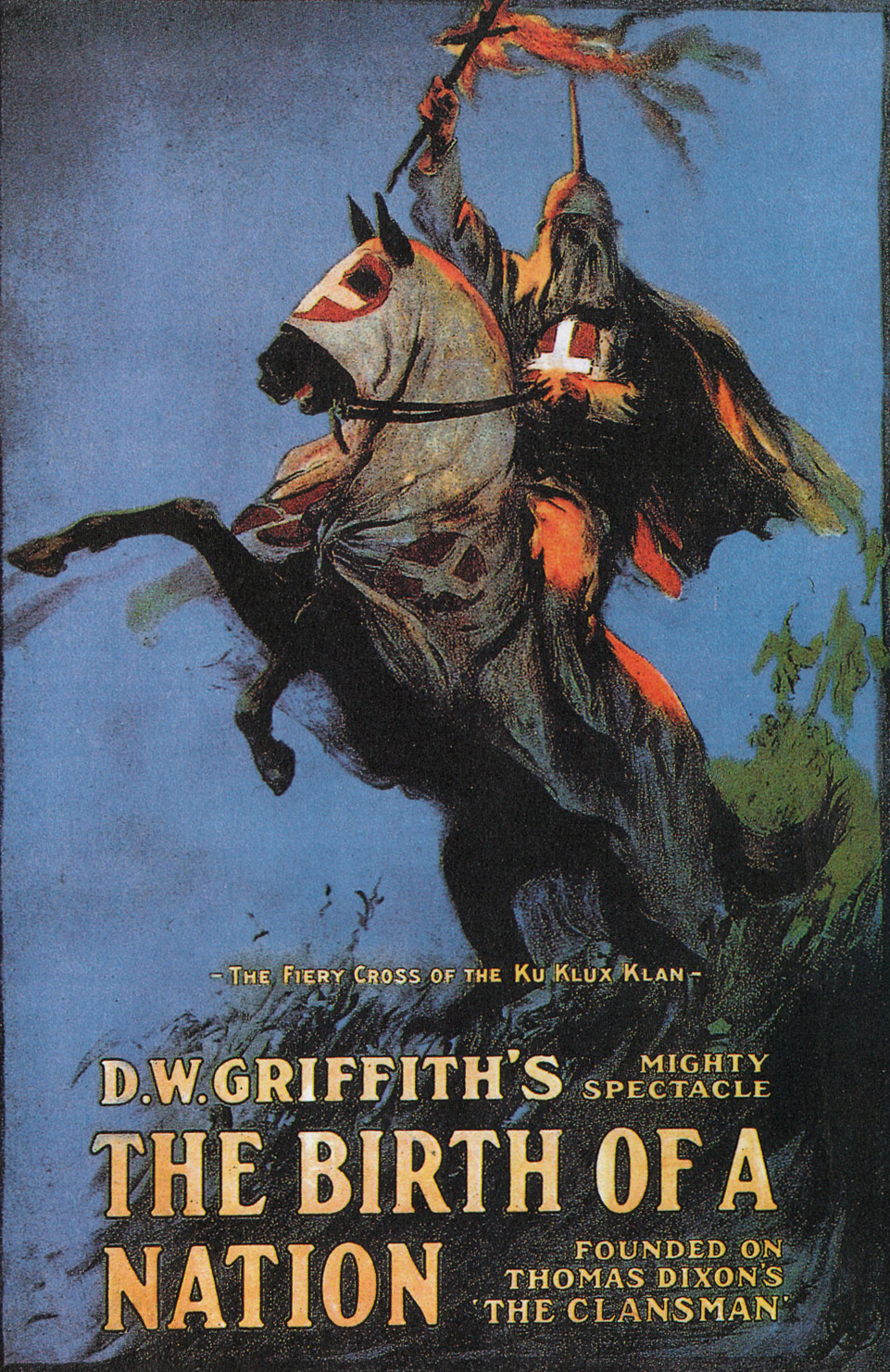
Theatrical poster; Wikipedia.

Theatrical poster; Wikipedia.

D. W. Griffith’s racist epic The Birth of a Nation (US: Epoch, 1915) caused a sensation when it finally reached Ireland in the autumn of 1916, more for its epic ambitions than for its racism. It played exclusively at just three venues: first, at Belfast’s Grand Opera House, for the three week from 7 to 26 August; next, at Cork’s Opera House for the week of 28 August-2 September; and finally, at Dublin’s Gaiety Theatre for a two-week run from 18 to 30 September. Clever marketing to middle-class tastes, a mastery of filmic spectacle and even its title in a country consumed by a struggle for or against the birth of a more-or-less autonomous nation propelled it into the Irish consciousness like few previous films.

“‘Ireland will never be fit to take its place among nationalities, big or small, until it is recast and remade. It is in the melting-pot now…. What picture of the process of remoulding will the historian of the future give his generation? ” This question from US senator Patrick J. Maguire appeared as “To-Day’s Thought” at the top of the Man About Town’s “Seen and Heard” column in the Evening Herald on 26 September 1916.  In the column’s “Afterthought,” the Man About Town answered: “Why a moving picture, of course – another ‘Birth of a Nation.’” As writers in the Bioscope and Dublin Evening Mail had earlier in the year, the Man About Town thought that the historiography of the near future would be written not on the page but on the screen, with the light of the film camera and projector. Unlike these previous writers who had discussed British propaganda films, the Man About Town was referring to the fictional Birth of a Nation, which was then starting the second of its two-week run at the Gaiety.
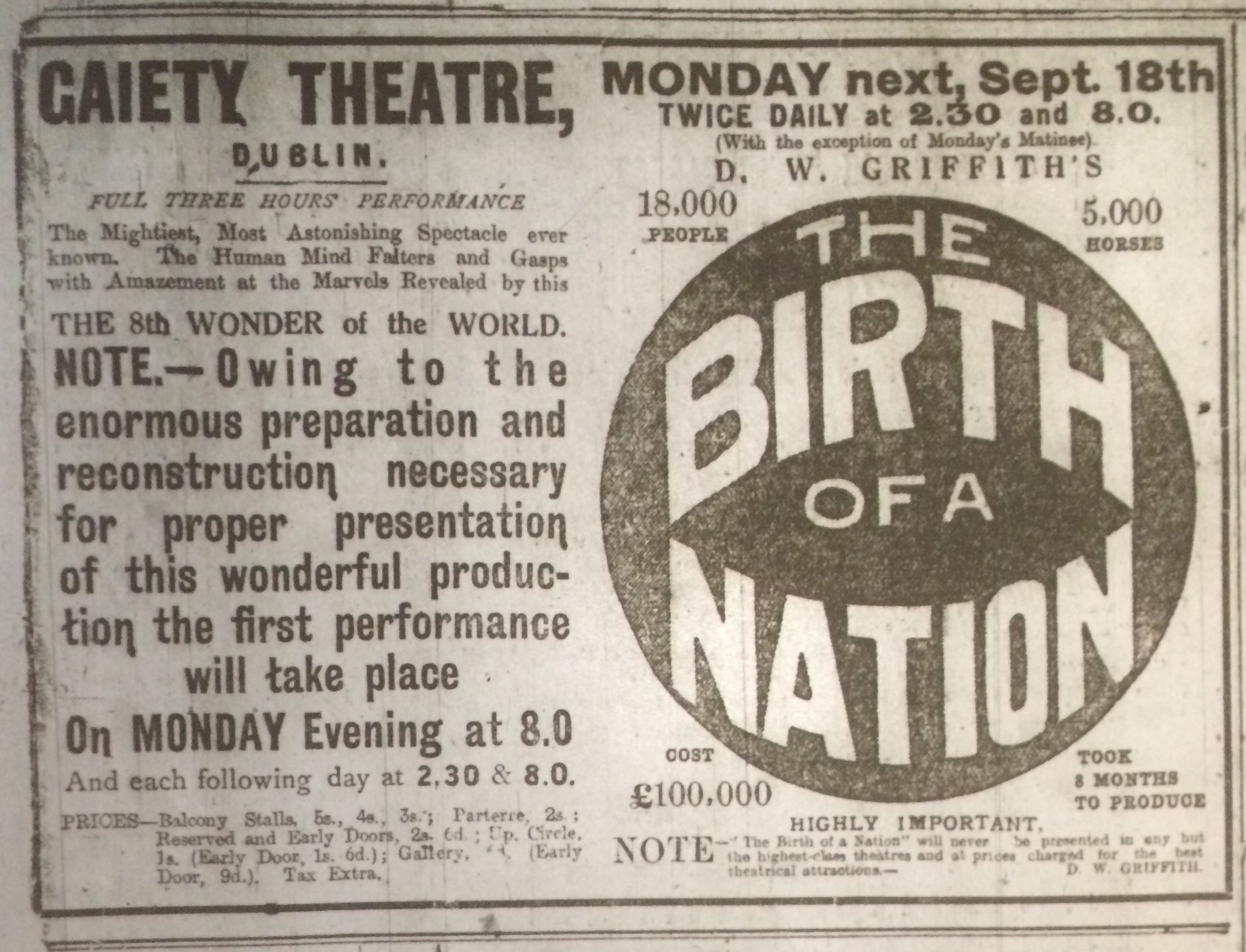
Dublin Evening Mail 16 September 1916: 2.

One of a series of large display ads for The Birth of a Nation in the Dublin Evening Mail, this one appeared on 16 September 1916: 2.

“By the way, have you seen it – the ‘Birth of a Nation’ at the Gaiety?” the Man About Town continued, clearly somewhat overwhelmed by this version of the American Civil War and period of Reconstruction that followed it. Focusing on the Northern Stoneman and Southern Cameron families, Griffith depicts the Civil War as a national tragedy, that was followed by the assassination of Abraham Lincoln which allowed such radical Republicans as Austin Stoneman (Ralph Lewis) – a fictional version of Thaddeus Stevens – to unleash on the defeated South a plague of carpetbaggers and state legislatures of freed blacks incapable of governing even their own behaviour never mind a state. Order could only be restored when Ben Cameron (Henry B. Walthall) founded the Ku Klux Klan (KKK), which restores order and rescues white women from the sexual depredations of black men. Awed by the film’s technical achievements, Irish journalists tended to treat it as a factual retelling of events. “If you fail to see it you are missing a part of your education,” the Man About Town warned. “I have sat out some kinema shows in my time, but nothing to come near this. It’s the greatest screened drama that ever came to Dublin.”
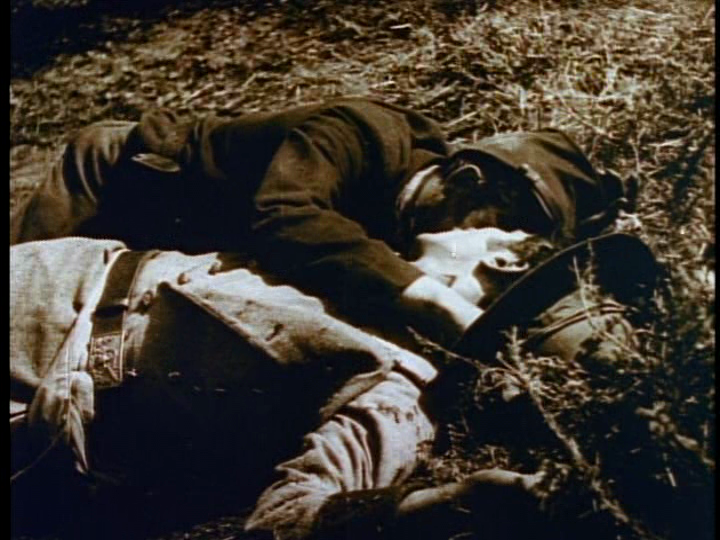
Childhood friends but belonging to opposing Union and Confederate armies, the youngest sons of the Cameron and Stoneman families meet on the battlefield and die in each other's arms.

Childhood friends but belonging to opposing Union and Confederate armies, the youngest sons of the Cameron and Stoneman families meet on the battlefield and die in each other’s arms in The Birth of a Nation.

Under the title “Absolutely It,” Jacques’ review at the Evening Herald concluded that it was “the most enthralling thing in film land ever presented to a Dublin audience” and declared the reviewer lost for words. “If you ask me to give a full and detailed account of all the characters, love stories, historical incidents and thrilling incidents that occurred during the two hours that ‘The Birth of a Nation” reel kept spinning at the Gaiety Theatre last night,” he confided, “I’m sorry to say I can’t do it.” He nevertheless usefully provided what he called “but the baldest outline”:

The film shows us with almost overwhelming detail life in America, both North and South, just previous to and during the course of the Civil War. Mixed up with the fighting we follow the fortunes of two families united by ties of friendship but on opposite sides in the struggle. Then, when the war is over, we see the rising of the blacks, who, thanks to the slushy policy of the North, get all the power into their own hands and become bestial tyrants in consequence.

Kindly before our eyes is pictured the inception of the biggest secret society the world has ever seen, for it embraced every white in the South and yet remained secret. Finally we see how this society – the Ku-Klux-Klan – by the employment of mailed glove methods and working on negroid superstition, was enabled to stamp out the black peril and permit the whites in the Southern States to live without the men carrying their lives (and their six-shooters) in their hands.

Jacques was somewhat unusual among Irish reviewers in focusing on the second, more audaciously racist part of the film, which deals with the Reconstruction, and his use of such terms as “bestial tyrants,” “negroid superstition” and “the black peril” leaves little doubt that he accepted the film’s racism.
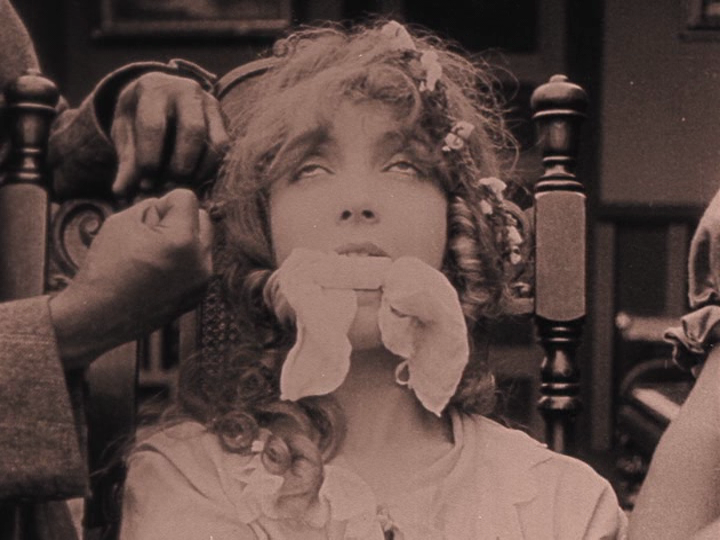
The very picture of imperilled femininity, Elsie Stoneman (Lillian Gish) awaits her forced marriage to the mixed race Silas Lynch in The Birth of a Nation.

In just one climactic instance of racially imperilled femininity, Elsie Stoneman (Lillian Gish) awaits her forced marriage to the mixed race Silas Lynch (George Siegmann) in The Birth of a Nation.

The Man About Town largely avoided explicit white-supremacist phrasing but made clear that the film’s affective power – frequently evoked with images of imperilled femininity – was deployed to ensure that the audience identified with Southern whites:

It gives you every emotion in the human gamut. One time you marvel at the beauty of the sunny cottonfields, then you smile at the quaint costumes. You want to kiss and cuddle the sweet young person loved by heroic young men. You feel an all-overness when you see howling mobs surging in flaming towns; you grip yourself at the sight of men amuck smashing and tearing houses above the heads of cellared women; you feel the shock of battle. You laugh and cheer and cry. It’s better than a good play. It’s a marvel.

The reviewer at the Belfast News-Letter contended that the emotional charge was intensified over the film’s three-hour span in order to offer the audience a final release by cheering the KKK. “Historically of the greatest value,” s/he claimed,

“The Birth of a Nation” holds the audience enthralled for over three hours, and the enthusiasm of the spectators waxes stronger and stronger with each succeeding scene, until, towards the close, they seize the opportunity afforded by the thrilling exploits of the Ku Klux Kan [sic] to give vent to their long pent-up emotions in frequent and hearty outbursts of applause. (“Grand Opera House”  BN.)

Only the reviewer at Cork’s Evening Echo in any way questioned the film’s racial politics. “The southern cotton planters were persuaded nature intended the negroes to be bought and sold and to cultivate cotton,” s/he observed, commenting that the “outlook of these planters appears peculiar at the present day,” but undermining what may be a mild criticism by adding that “one can to some extent understand it” (“Opera House”). “Mr. Griffith, it is easy to see, has a strong Southern bias,” the Northern Whig reviewer pointed out, “but this would not matter if it did not lead him to overstate an excellent case.” This overstatement was particularly evident in the depiction of the KKK: “to represent [the KKK] as a new order of chivalry is simply fantastic.” However, the writer’s problem appears to have been historical accuracy – the fact that it “is tinged too deeply with melodrama” – and not racist ideology: “If the Ku-Klux-Klan cannot be adorned with a halo, Mr. Griffith uses it to produce some splendid sensational thrills and the final fight for Piedmont is as good a realistic spectacle as one has ever seen staged” (“Grand Opera House” NW 8 Aug.).

It is possible to track these difference in reception of The Birth of a Nation because it received so much newspaper coverage, and this in turn was because it played exclusively at three of Ireland’s most prestigious theatres rather than at Belfast’s, Cork’s and Dublin’s picture houses. This formed part of a deliberate international exhibition strategy designed to distinguish The Birth of a Nation as a cultural event unlike any previous film screening. Rather than be distributed through existing distribution companies, the film was exhibited in a “road show” format, brought to the cities in which it was to be shown by a travelling company of technical crew and musicians. The company’s arrival was heralded by an elaborate marketing campaign that included large newspaper display ads describing – or rather exaggerating – the film’s unprecedented scale (Stokes 121). The claim repeated most often in Irish newspaper ads related less to the film’s narrative than to the assertion that the extent of the production needed to be measured in the thousands:  18,000 people, 5,000 horses and £10,000 costs.
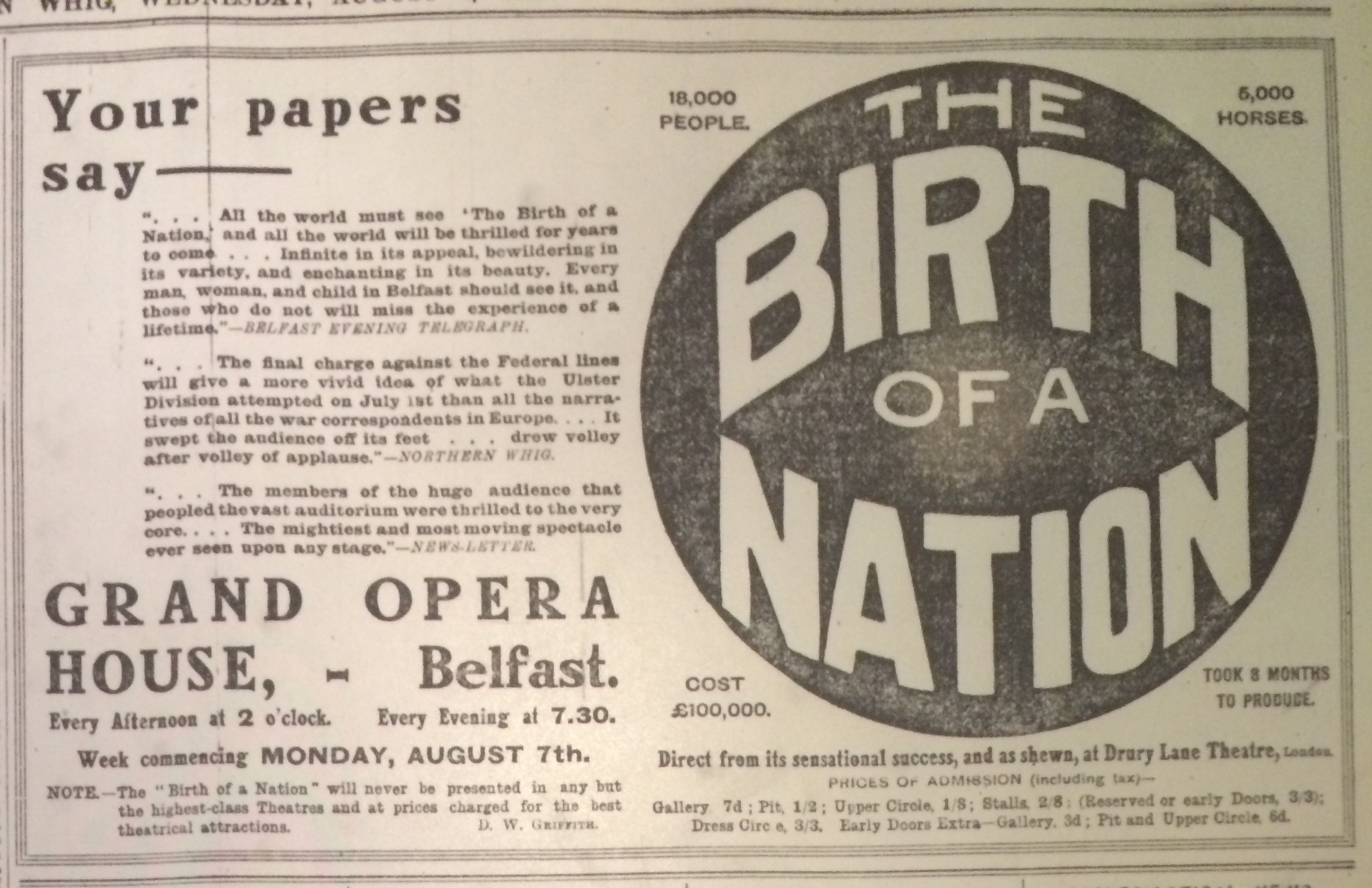
This ad quoted the overwhelmingly positive reviews in Belfast's papers; Northern Whig 9 Aug. 1916: 7.

This ad quoted the overwhelmingly positive reviews in Belfast’s papers. Notable missing is the nationalist daily Irish News, which did not advertise or review the film. Northern Whig 9 Aug. 1916: 7.

Every ad also carried a note from director D. W. Griffith guaranteeing that “‘The Birth of a Nation’ will never be presented in any but the highest-class theatres and at prices charged for the best theatrical attractions.” Theatrical prestige was financially lucrative. “At both houses yesterday large audiences attended,” the Irish Times’ reviewer noted in the course of a comparatively short review of the Gaiety shows, observing that luxury and expense were sometimes forced on “later comers at the evening performance [who were] unable to obtain admission, except to the dearer parts of the theatre” (“‘Birth of a Nation’” IT). The Irish exhibition of The Birth of a Nation awaited a British road-show company that came – according to the ads – “direct from its sensational success at Drury Lane, London.” As a result, the film had taken a year and half to reach Ireland.
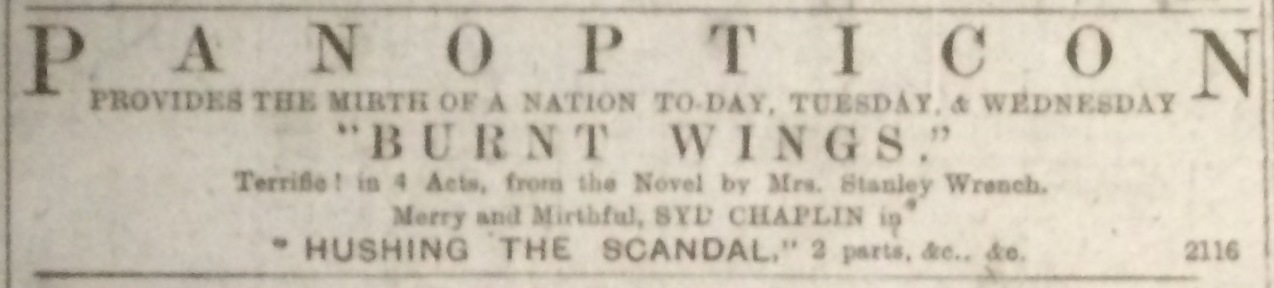
Belfast News-Letter 15 Aug. 1916: 1.

The Panopticon’s “mirth of a nation”; Belfast News-Letter 15 Aug. 1916: 1.

The attempt to suggest that the prestige theatres should be the exhibition spaces for prestige films was, not surprisingly, resisted by picture-house owners. During the Belfast run, the rival Panopticon advertised that if not “the birth of a nation,” it was providing “the mirth of a nation,” albeit that its main feature Burnt Wings (Britain: Broadwest, 1916) – in which a woman adopts her husband’s illegitimate child – does not seem altogether mirthful (“Panopticon”). For distributors of other high-profile films, the choice of picture house or theatre appears to have been more pragmatic. When the most ambitious of the British government’s propaganda films The Battle of the Somme finally opened on 11 September, it was first shown in Dublin at a theatre, the Theatre Royal, but in Belfast, it was shown at the luxurious Picture House, Royal Avenue. “[N]ever have the facts of war been more vividly brought home to people living far away from the scene of action,” the Belfast News-Letter commented. “For this latter feature we are indebted to the pictures which have from time to time been obtained by means of the cinematograph [… F]rom the moment of preparation, all through that deadly, but glorious, First of July, on to the crash of victory, the story is unfolded in all the strength and simplicity which such photography can give ” (“Battle of the Somme”).
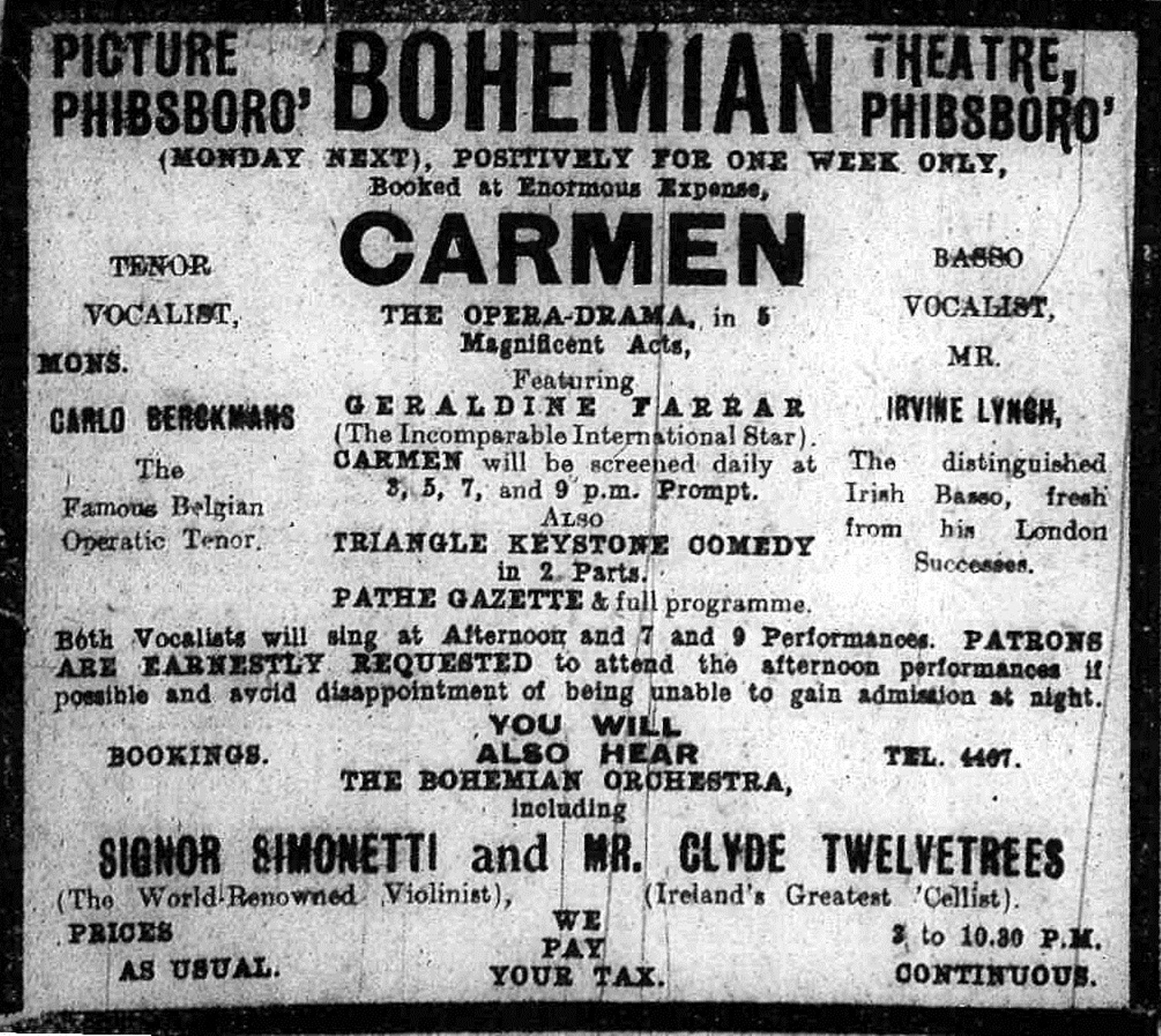
Dublin Evening Mail 26 Aug. 1916: 2.

Carmen, a silent-screen opera; Dublin Evening Mail,  26 Aug. 1916: 2.

Undoubtedly, certain picture houses were capable of mounting productions that rivalled the theatres’ biggest spectacles. In the week beginning 28 August, Dublin’s Bohemian capitalized on its acknowledged superiority in musical attractions by exhibiting the opera film Carmen (US: Lasky, 1915), directed by Cecil B. DeMille and starring Metropolitan Opera diva Geraldine Farrar in her first film role. Farrar did not, of course, appear at the Bohemian to sing her part, but the live musical accompaniment by the Bohemian orchestra was supplemented by both concert instrumentalists Achille Simonetti and Clyde Twelvetrees and vocalists Belgian tenor Carlo Berckmans and Irish basso Irvine Lynch.

Although it did not have such vocal attractions, The Birth of a Nation outdid all of these in other ways. One of these was its exceeding length, running almost three times longer than either Carmen or The Battle of the Somme. Indeed, its running time of over three hours was 50-100% longer than most picture-house programmes, which usually consisted of several films. And however exaggerated the figures that appeared in its ads, local reviewers recognized it as an unusually lavish production. “The Grand Opera House was filled to overflowing last night,” the Belfast News-Letter‘s reviewer observed,

and collectively and individually, without exception, the members of the huge audience that peopled the vast auditorium were thrilled to the very core by the stupendous historical drama that was unfolded before their eyes. “The Birth of a Nation” is unquestionably the finest cinematograph production ever seen in this city, but it represents far more than that; it is one of the mightiest and most moving spectacles ever seen upon any stage, and its creation is an epochal event in the history of the art of cinematography. (“Grand Opera House” BN.)
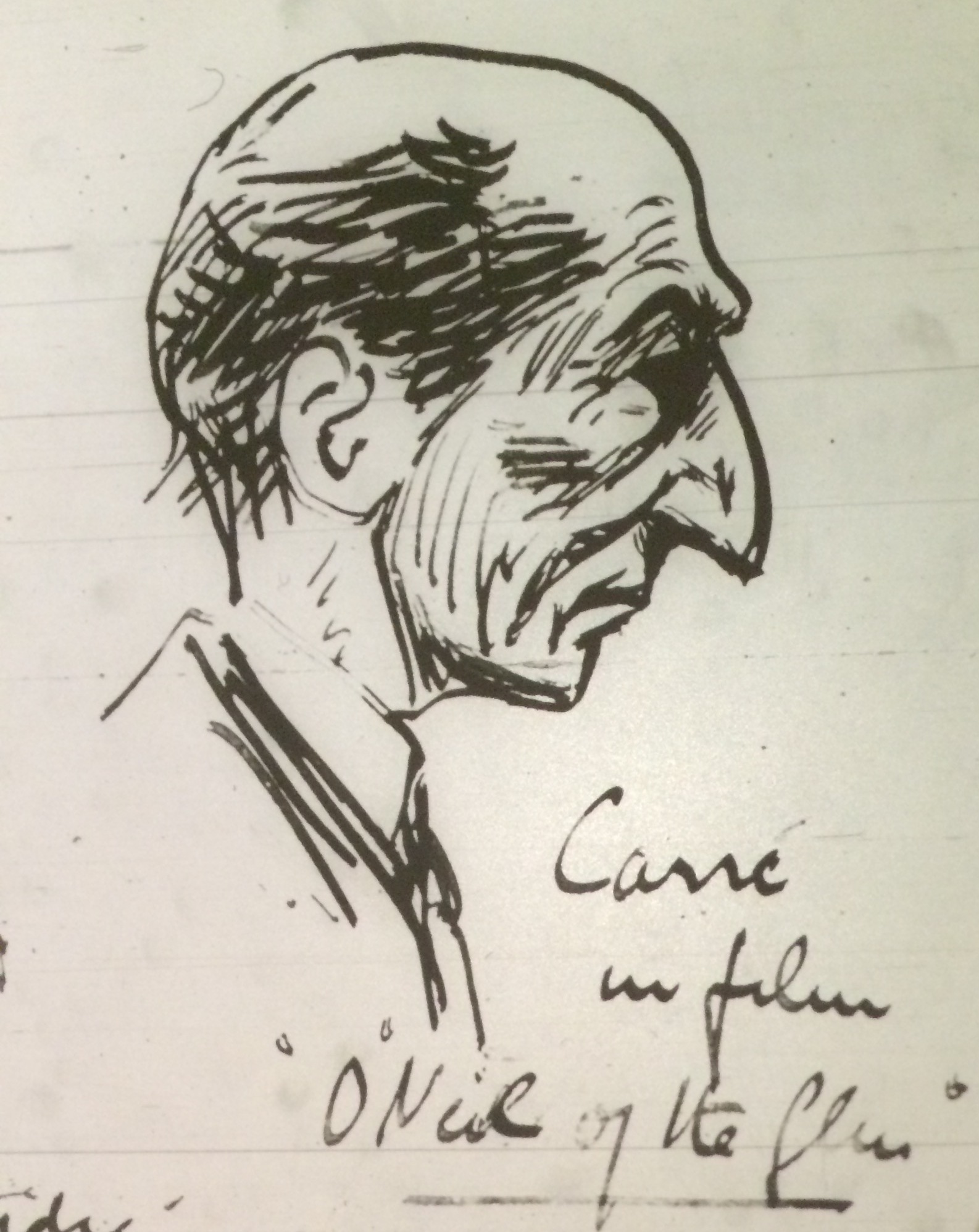
Joseph Holloway saw several films apart from The Birth of a Nation in September 1916, including a second viewing of the Film Company of Ireland’s O’Neil of the Glen, at which he sketched actor J. M. Carre.

Joseph Holloway saw several films apart from The Birth of a Nation in September 1916, including a second viewing of the Film Company of Ireland’s O’Neil of the Glen, at which he sketched actor J. M. Carre.

However, it seems that audiences in Dublin and those in Belfast interpreted the spectacle in different ways. Writing of Dublin, Nicholas Andrew Miller has pointed out that “[i]f the film produced a local political impact on the Irish audience, then, it is not because it narrated Irish historical experience, but because it created a discursive space in which local Irish references – and memories – could appear in the guise of spectacle” (115). Citing the diary of inveterate theatregoer Joseph Holloway, Miller shows that members of the Gaiety audience used the film to criticize post-Easter Rising Ireland. Holloway had attended the Gaiety on 20 September, when he thought the film “stupendous […] & to say that I was thrilled by visiting it is to state but downright fact. It is a story of the War between North & South & its after effect until the negroes were again put in their proper place.”  Holloway also reports that his neighbour Miss Conroy told him of shouts at one of the screenings concerning British Army commander John Maxwell, who had imposed harsh martial law on Dublin in the aftermath of the Rising and had executed 15 of the leaders. The comments came during a scene in the film in which

Lincoln refuses to deal harshly with the Southern Leaders, & says, “he’ll treat them as if nothing occurred at all!” – on a shout coming from one of the audience “where is Sir John Maxwell to hear that?” followed by great approval & the contrary, till she got quite frightened of there being a row.

(The barber’s assistant, who was present at opening show first night, said one on gallery called out after seeing the above incident – “For our second Cromwell!”). (Holloway.)

For Miller, the memories and local references the film evoked related to nationalist politics, in this case, the Easter Rising.
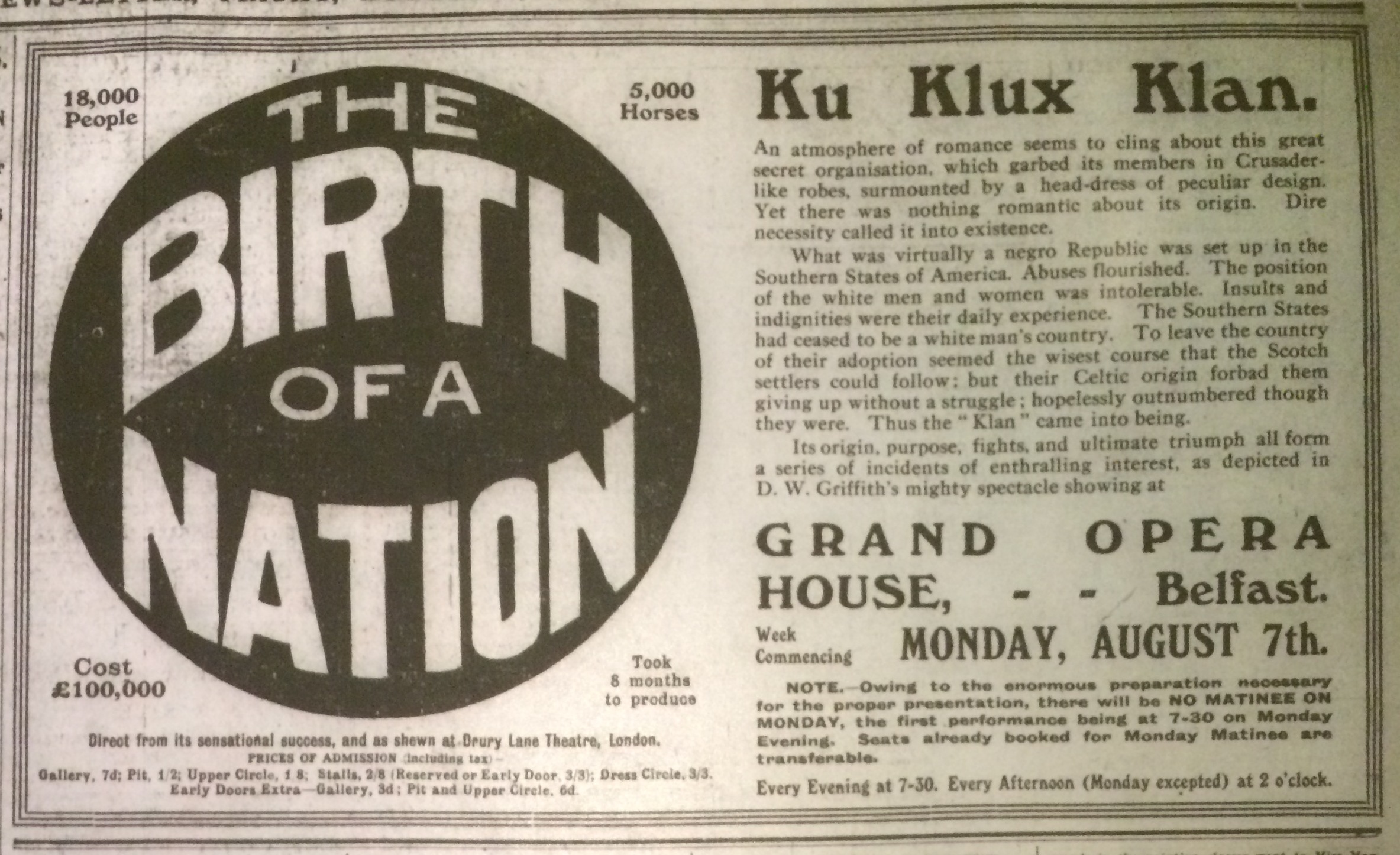
This film ad openly praised the Ku Klux Klan; Belfast News-Letter 3 Aug. 1916: 7.

This film ad openly praised the Ku Klux Klan; Belfast News-Letter 3 Aug. 1916: 7.

The Belfast context was quite different. As no equivalent of Holloway’s diary exists for Belfast and as the Irish News – the city’s main nationalist newspaper – did not advertise or review the Grand Opera House shows, the surviving responses to The Birth of a Nation come from the city’s unionist newspapers. As well as this, the film opened on 7 August, more than a month earlier than in Dublin, putting it in the high summer, when an exodus from the city to seaside resorts was being reported (“Holiday Scenes in Belfast”). “Even in such hot weather as we have been experiencing recently a visit to the Opera House to see the ‘Birth of a Nation’ will not be regretted, but on the other hand will long be remembered with much pleasure by all who pay it” (“Birth of a Nation” NW). Despite this, the film ran for three weeks, a week longer than in Dublin, and the papers reported that the enthusiasm of Belfast audiences had not waned even by its third week, “which finds the film in higher favour than ever. […] Not only is Mr. Griffith’s spectacle continually drawing new admirers but a great many people are discovering that it well repays a second and even a third visit” (“Grand Opera House”  NW 22 Aug.).

For the reviewers in Belfast, the outstanding feature of local relevance in The Birth of Nation was its depiction of war, which made it particularly timely given that the papers were elsewhere reporting on the battles of the Somme and Verdun and at one point, on the increased use of non-white soldiers in battle (“Coloured Men and the War”). “The battle of Petersburg, in which the Federal troops sustained their greatest and final defeat, caused great interest on account of the close analogy it bears to the fighting on the Western front to-day,” the Belfast News-Letter observed, “it was one of the earliest, if not the first occasions in history, on which the contending armies entrenched in the open with the opposing lines only a few yards apart” (“Grand Opera House” BN).

However, the film’s contemporary relevance came  not just for these battlefield details but also from the depiction of the emotions felt by soldiers’ families.

The departure of the troops for the scene of action, the pathos of parting from their friends and relatives, the tragic letters which tell of their devotion and sacrifices, the sorrow and suffering that are bravely endured by grief-stricken parents who have given their sons to their country – all these things are typical of what is happening at the present time. No one can witness this mighty spectacle without being moved to tears. There are scenes of indescribable pathos, and there are also scenes of surpassing beauty and of infinite sweetness and tenderness. (“‘Birth of a Nation’” BN.)

Although a greater emphasis fell on the war scenes in Belfast – “where picture houses thrive and claim thousands of habitués” – it was also true of Dublin and Cork that “[t]he prophesy that the film would create a sensation wherever it was produced has been fulfilled to the letter” (“Grand Opera House” NW 15 Aug.). Irish filmgoers – but not cinemagoers – thronged to see Griffith’s massive spectacle in the autumn of 1916, were duly impressed by it and had few qualms about its racism.

References

“The Battle of the Somme: Historic Film to be Exhibited in Belfast.” Belfast News-Letter 18 Aug. 1916: 8.

“The Birth of a Nation.” Northern Whig 12 Aug. 1916: 6.

“‘The Birth of a Nation’: Impressive Spectacle at the Grand Opera House.” Belfast News-Letter 12 Aug. 1916: 2.

“‘The Birth of a Nation.’” Irish Times 20 Sep. 1916: 3.

“Cinema’s Popularity: Manifold Potentialities: Shows What Theatre Only Tells.” Belfast Evening Telegraph 29 Sep. 1916: 4.

“Coloured Men and the War.” Belfast News-Letter 4 Aug. 1916: 8.

“Grand Opera House: ‘The Birth of a Nation.’” Belfast News-Letter 8 Aug. 1916: 2.

“Grand Opera House: ‘The Birth of a Nation.’” Northern Whig 8 Aug. 1916: 7; 15 Aug. 1916: 7; 22 Aug. 1916: 7.

Holiday Scenes in Belfast: Big Exodus to the Seaside: The Railway Stations Besieged.” Belfast News-Letter 8 Aug. 1916: 4.

Holloway, Joseph. Holloway Diaries. National Library of Ireland.

Hughes, Tom. How Belfast Saw the Light: A Cinematic History. Belfast: Hughes, 2014. Pp. 237-40.

Jacques. “Absolutely It: Amazing Realism at Gaiety Theatre: ‘Birth of a Nation.’” Evening Herald 19 Sep. 1916: 3.

The Man About Town. “Things Seen and Heard.” Evening Herald 26 Sep. 1916: 2.

Miller, Nicholas Andrew. Modernism, Ireland and the Erotics of Memory. Cambridge: Cambridge UP, 2002).

“Opera House: ‘The Birth of a Nation.’” Evening Echo 29 Aug. 1916: 2.

“Panopticon.” Belfast News-Letter 15 Aug. 1916: 2.

Stokes, Melvyn. D.W. Griffith’s The Birth of a Nation: A History of “the Most Controversial Motion Picture of All Time.” New York: Oxford UP, 2008.
Irish Audiences Watch “O’Neil of the Glen,” August 1916

If cinema in Ireland in July 1916 prompts reflection on film as a weapon of war, developments the following month show significant developments in the emergence of film as an expression of national culture. On 7 August 1916, audiences at Dublin’s Bohemian Picture Theatre were the first to see O’Neil of the Glen (often spelled O’Neill of the Glen), the first Film Company of Ireland (FCOI) production to be publicly released. Formed in March 1916 by James Mark Sullivan and Henry Fitzgibbon, the FCOI would become the most important indigenous fiction film producer of the 1910s. Ò’Neil of the Glen itself, however, is believed to be a lost film, like all FCOI’s other production except Knocknagow (1918), Willy Reilly and His Colleen Bawn (1920) and one reel of the two-reel comedy Paying the Rent (1920). Nevertheless, its success with audiences was vital to securing FCOI’s future.

O'Neil Boh 7 Aug 1916

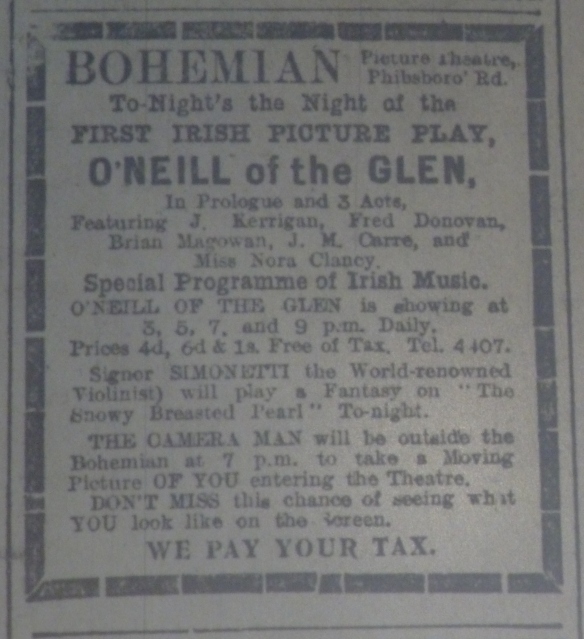
Ad for the first public exhibition of O’Neil of the Glen, at Dublin’s Bohemian, Dublin Evening Mail 7 Aug. 1916: 2.

That success was won in part by the careful management of publicity, a fact that means that the surviving ads, articles and reviews in the press must be treated with caution. It may be a forgivable exaggeration for the papers to have hailed the premiere of O’Neil of the Glen as the start of a new Irish industry, but it was not true that this was “the first picture-play ever produced in Ireland by an Irish company of Irish players,” a claim repeated almost verbatim in several paper, indicating that the journalists were working from the same FCOI publicity materials (“New Irish Industry,”  “O’Neill of the Glen,” “Irish Film Triumph”). Most recently, Charles McEvoy of Dublin’s Masterpiece Cinema had funded Fun at Finglas Fair – even if it had allegedly been destroyed during the Easter Rising before being publicly shown – and in 1912-13, cinema-owner and mayor John J. Farrell had made a number of films with his company Irish Film Productions (Rockett 95, Condon 237).

IRISHLIMEGHT1_MAY_P6 001

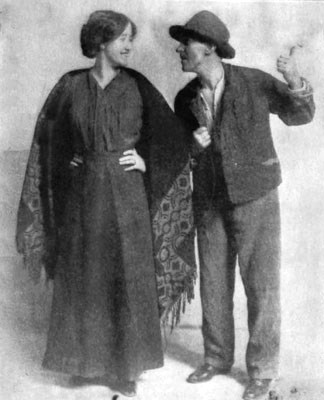
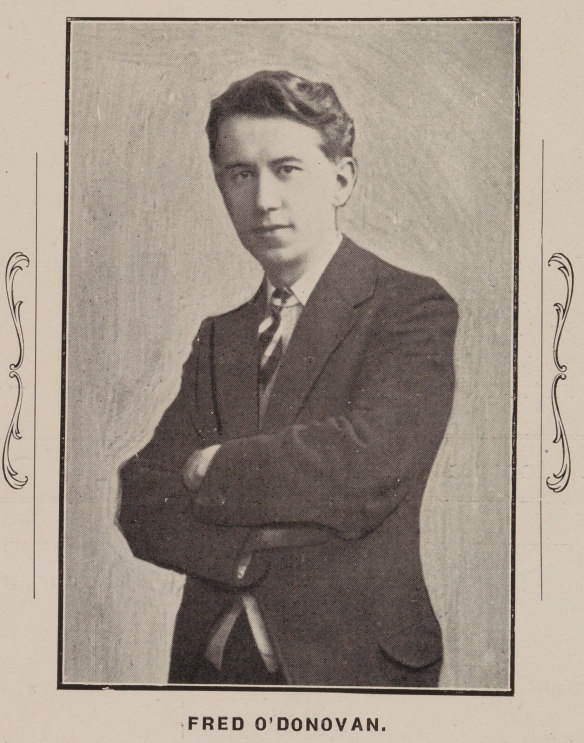
Abbey Theatre and Film Company of Ireland actor – and later director – Fred O’Donovan; Irish Limelight 1:5 (May 1917): 6.

Nevertheless, although O’Neil of the Glen was not the first indigenous Irish fiction film, it was a very significant one by the country’s most important film production company of the 1910s. On 29 June, FCOI announced a “trial exhibition,” or what would now be called a test screening, of their first completed production, O’Neil of the Glen, at Dublin’s Carlton. By this time, and in the context of management difficulties at the Abbey Theatre, FCOI had been able to contract J. M. Kerrigan and Fred O’Donovan, two of the Abbey’s biggest stars, albeit that they were permitted to appear in certain plays (“Abbey Theatre,” “Platform and Stage”). Kerrigan, indeed, directed and played a part in O’Neil of the Glen, a three-reel feature based on a script adapted by W. J. Lysaght from M[argaret] T. Pender’s story of the same title that had been serialized in the Shamrock in 1891. The film told how Don O’Neil (Brian Magowan), the son of a landowner who had been defrauded by the solicitor Tremaine (J. M. Carre), saves the life of Tremaine’s daughter, Nola (Nora Clancy), whose love he wrests from Graves (O’Donovan), a blackmailing suitor (“Bohemian,” Evening Mail).

“The film is of a quality which leads one to anticipate success for the venture,” wrote an Irish Times correspondent at the trial exhibition, noting that it was part of a process of perfecting the film: “the promoters are engaged in a ruthless revision of the film to bring it up to the highest possible standard” (“Irish Film Production”). The Bioscope’s Irish correspondent Paddy’ was less complimentary about this early cut of the film, pointing out that although “[g]reat care was taken with the production and camera work,” it possessed “many of the weak points common to first productions” (“Paddy,” 13 Jul.). Addressing a lunch for the press at the Gresham Hotel after the screening, Fitzgibbon claimed that FCOI “had started an industry which would eventually be a source of great revenue in Ireland.” For his part, Sullivan argued that the film showed that Irish productions – taking advantage of Irish “imagination, ideals, and artistic temperament and beautiful scenery” – could competing with those anywhere (“Irish Film Production”).

Paddy began to revise his lukewarm opinion of O’Neil of the Glen in light of the news that Frederick A. Sparling had booked the film for its first run at his Bohemian for the week of 7-13 August. The Bohemian was one of Dublin’s biggest and most luxurious cinemas, and Sparling’s commitment to a run that was twice the usual three days “speaks well for the film and the undoubted drawing powers such a production will have for Irish audiences” (Paddy, 27 Jul.). In the event, Sparling also included an unplanned Sunday show to take advantage of the phenomenal level of interest.

Although FCOI appears to have taken the bookings itself, prominent local distributor Ben Cowan of Express Film Agency handled this and other FCOI films from 1916 by running trade shows and placing advertisements in the daily and trade press. It was likely one of Cowan’s “novel ideas in the advertising line” for FCOI cameraman John A. Bennett – a former projectionist at Dublin’s Rotunda – to film the audience on the first night and for this local film to be shown subsequently with the feature (Paddy, 27 Jul.; 17 Aug.). “Don’t miss this chance of seeing what you look like on the Screen,” ads warned the opening-night audience. The musical attractions included a special programme of Irish melodies and the cinema’s “world-renowned violinist” Signor Simonetti playing a fantasy on the “Snowy Breasted Pearl” at the evening shows. “It is confidently hoped that large audiences will visit the Bohemian during the coming week,” revealed a preview in the Evening Mail, “and thus mark in a tangible manner their appreciation of what may justly be described as a really first-class picture-play, and one that is sure to bring the work and the players of the Film Company of Ireland right into the forefront of popularity with audiences and trade alike” (“Bohemian”).

The surprising extent of the success of O’Neil of the Glen must be measured in the first instance as a marketing victory rather than an artistic one, by FCOI. The degree to which these early films challenged existing ways of representing the Irish is questionable, but many contemporary commentators seem initially to have been content that films with wholly Irish creative input were finally being made. Nevertheless, the way in which the company were able to capitalize on the interest and goodwill attending the exhibition of this first indigenous Irish fiction film and, crucially, to publicize the large attendances not only in Ireland, where interest was likely to be strong in any case, but also in Britain, appears to have secured a British distribution deal and thereby to have ensured the company survival in this initial period. This success was built on what appears to have been a genuinely surprising level of interest in the picture. “The film, which was expected to prove a good draw, actually surpassed all anticipations,” observed Paddy, warming further to the film, “a record being established for the week, and queues being the rule every evening” (17 Aug.). The Irish Times commented that enthusiastic audiences in a crowded cinema “proves that the Dublin public is always ready to support and encourage Irish enterprise” (“Film Company of Ireland,” 9 Aug.). “That the genuine enthusiasm displayed last night at the conclusion of the film will be the means of bringing before the public a second production by the Irish Film Company in the near future,” observed the Freeman’s Journal, “is a universal wish” (“Bohemian”).

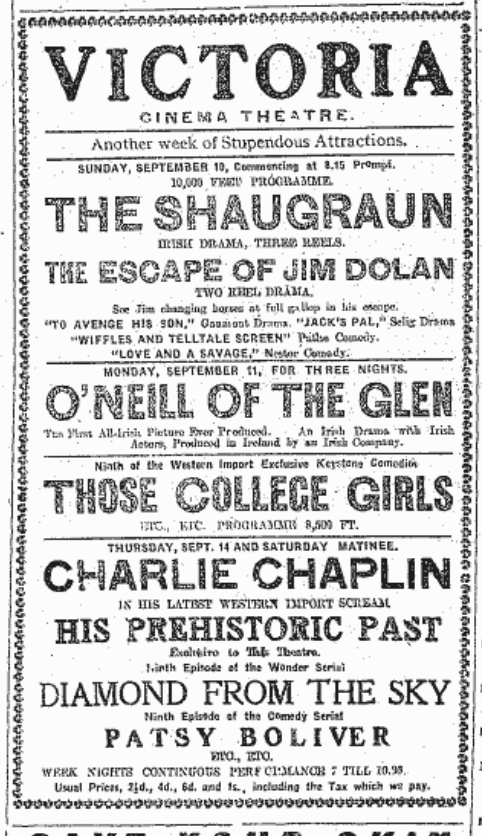
O'Neil Victoria 9 Sep 1916p4

Ad for Galway’s Victoria Cinema Theatre for the week in which O’Neil of the Glen featured. Connacht Tribune 9 Sep 1916: 4.

This wish would be soon fulfilled, and O’Neil of the Glen was exhibited around the country in the following weeks and months. When following substantial runs in Dublin and Belfast it was announced for a three-day run at Galway’s Victoria Cinema Theatre on 11-13 September, a Connacht Tribune reporter distinguished its attractions from that of American films, which were unrivalled “in the matter of cinematographic thoroughness and all-round fullness and finish of technique, but one can get too much of a good thing.” The FCOI’s “national or […] patriotic enterprise” offered something that monotonously perfect and ubiquitous American films could not: “The production is Irish, the subject is Irish, the mise-en-scene is Irish, and the actors and actresses are Irish” (“‘O’Neill of the Glen’”). A writer in the Cork Examiner during the film’s run at Cork’s Coliseum Theatre (14-16 September) concurred, arguing that

[t]hrere certainly should be an opening for cinema representation of Irish drama as played by native Irish actors, whose one object is to show Irish life in its true perspective, without grotesque exaggeration, or what is just as bad, giving an unreal picture of it, even when the intention is friendly to the country and the people. (“Coliseum Theatre.”)

A journalist at the Derry People was particularly interested in the local connections of a film “in which well-known Irish artistes will be screened, and details dealing with Tyrone and neighbouring localities introduced in splendid style” (“Hall”). The film’s second Dublin run was at the Dame Street Picture House (21-3 September) – the cinema closest to FCOI’s offices and where some of their subsequent 1916 films would premiere – before it had first and second runs in Belfast, at the Duncairn (28-30 September) and the Clonard (2-4 October). Subsequent screenings included Mullingar’s National (14-15 October), Kilkenny’s Cinema (18-19 October) and Dublin’s Fr Mathew Hall (2 December).

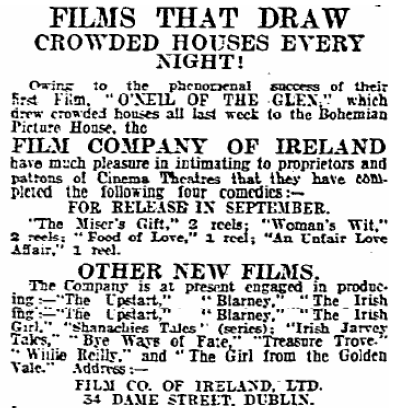
FCOI IT 14 Aug 1916p4

Irish Times 14 Aug. 1916: 4.

While O’Neil of the Glen toured the country, the company quickly followed up this successful debut with the announcements of their next films in the dailies and trades. On the Monday after the last show of O’Neil of the Glen at the Bohemian, the Dublin papers carried an advertisement headed “Films that Draw Crowded Houses Every Night!” that recommended FCOI’s new films on the basis of the audience-drawing power of that first film. Four two-reel comedies were scheduled for release in September – The Miser’s Gift, Woman’s Wit, Food of Love and An Unfair Love Affair – and nine other forthcoming productions were named, only one of which, “Willie Reilly,” is recognizable as a subsequent FCOI release. An Evening Mail reporter who attended The Miser’s Gift trade show at the Dame Street PH later that week commented that “[i]t is not only characteristically Irish, it is characteristically good. The Irish Picture-House manager who does not support an Irish company which can produce work of the class of ‘The Miser’s Gift’ is missing an opportunity of giving his shows a touch of distinction” (“‘Miser’s Gift’”).

The Miser’s Gift is also lost, but its narrative appears to involve a scheme of Eileen Dolan (Nora Clancy) and her lover, Ned McGrath (Fred O’Donovan), to get her miserly father (J. M. Kerrigan) drunk and dream of leprechaun gold so that he will look favourably on their relationship. “It is agreeable to have pictures such as this,’ commented the Irish Times, “preserving a genuinely Irish atmosphere and that inherent charm which is to be found in Irish life. The sight, for instance, of lepracauns and other little people who live in legend disporting themselves in a fairy fort is a feature which surely is pleasing to Irish eyes” (“Film Company of Ireland,” 18 Aug.). The Irish public got its first chance to delight in authentic Irish leprechauns disporting themselves on the cinema screen in October and November 1916: at Arklow’s Gaiety Picture House (9-11 October), Cork’s Coliseum (12-15 October), Tralee’s Picturedrome (19-21 October), Dublin’s Dame Street PH (26–8 October), Derry’s Hall (2-4 November), Sligo’s Picture Theatre (13-15 November), Kilkenny’s Cinema (15-16 November) and Athlone’s Fr Mathew Hall (22-25 Nov).

Ch5One

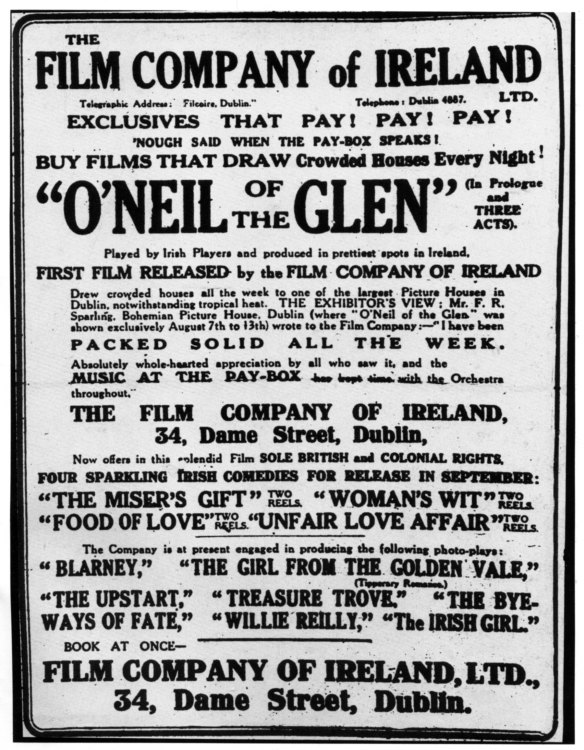
Bioscope 24 Aug. 1916: 754.

As these arrangements were being made for Ireland, FCOI also entered the British film market on the foundation of O’Neil of the Glen’s Irish success. The Bohemian debut was the subject of an article on the company in the Bioscope of 24 August, which also carried a full-page advertisement listing the actual and intended films mentioned in the Irish papers (“First Irish Film”). Both the article and the advertisement included quotes from Sparling on the huge business the film generated, “the absolutely whole-hearted appreciation of every person who has seen it,” and the fact that “the ‘music’ at the pay-box has kept time with the orchestra throughout.” In contrast to Paddy’s original critical assessment of the film, this article described the audiences’ appreciation of “the exceptional excellence of the first film produced in Ireland by an Irish company and by Irish players.” A month later, although mentioning the film’s success everywhere it had been exhibited, Paddy contended that FCOI’s “second picture, ‘The Miser’s Gift,’ is greatly in advance of the first as regards the quality, and if this company stick to their guns they should still be well in the front rank of British producers” (28 Sep.). Despite Paddy’s reservations, the message prevailed that O’Neil of the Glen packed cinemas in Dublin and Belfast and that Irish exhibitors were eager for more, a message that helped FCOI to acquire a British distributor (Paddy, 14 Sep.). The company did this at the end of October, when Davidson’s Film Sales Agency bought the rights for FCOI’s 1916 films (Paddy, 2 Nov.).

Indigenous Irish film production may not have started with O’Neil of the Glen, but it did enter a new phase.

References

“Abbey Theatre.” Irish Times 7 Aug. 1916: 3.

“The Bohemian.” Dublin Evening Mail 5 Aug. 1916: 5.

“The Bohemian.” Freeman’s Journal 8 Aug. 1916: 6.

“Coliseum Theatre: ‘O’Neill of the Glen.’” Cork Examiner 15 Sep. 1916: 2.

Condon, Denis. Early Irish Cinema, 1895-1921. Dublin: Irish Academic, 2008.
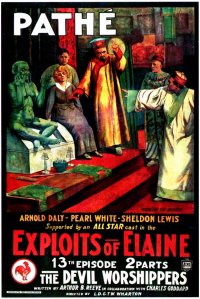
“The Film Company of Ireland.” Irish Times 9 Aug. 1916: 6; 18 Aug. 1916: 2.

“First Irish Film: Success of ‘O’Neil of the Glen.’” Bioscope 24 Aug. 1916: 689.

“The Hall.” Derry People 16 Sep. 1916: 5.

“Irish Film Production.” Irish Times 30 Jun. 1916: 7.

“Irish Film Triumph: Several New Plays.” Cork Examiner 16 Aug. 1916: 6.

“‘The Miser’s Gift’: New Irish Comedy.” Dublin Evening Mail 17 Aug. 1916: 2.

“New Irish Films: Four Coming Comedies.” Freeman’s Journal 15 Aug. 1916: 4.

“New Irish Industry: Film Company of Ireland.” Connaught Telegraph 5 Aug. 1916: 8.

“New Irish Industry: The Film Co. of Ireland: A Promising Enterprise.” Freeman’s Journal 30 Jun. 1916: 6.

“‘The O’Neill of the Glen.’” Derry People 12 Aug. 1916: 5.

Paddy. “Ireland: With the Renters and Exhibitors.” Bioscope 13 Jul. 1916: 173; 27 Jul. 1916: 359; 17 Aug. 1916: 655; 14 Sep. 1916: 1060; 28 Sep. 1916: 1285; 2 Nov. 1916: 518.

“Platform and Stage.” Irish Times 7 Oct. 1916: 9.

Rockett, Kevin. The Irish Filmography. Dublin: Red Mountain, 1996.

“Topics of the Week.” Bioscope 10 Aug. 1916: 466.

Dublin Wreckage Films, Martial Law and Daylight Saving Time in May 1916

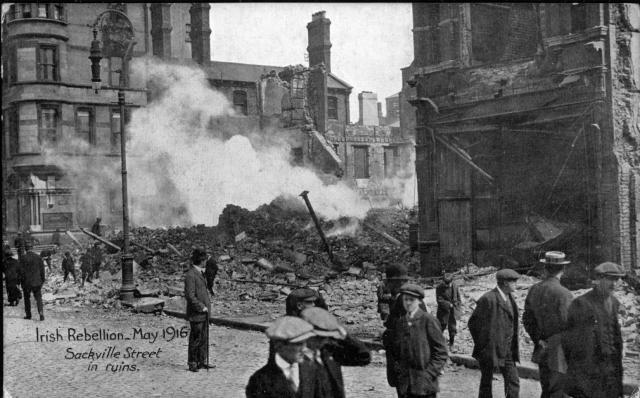
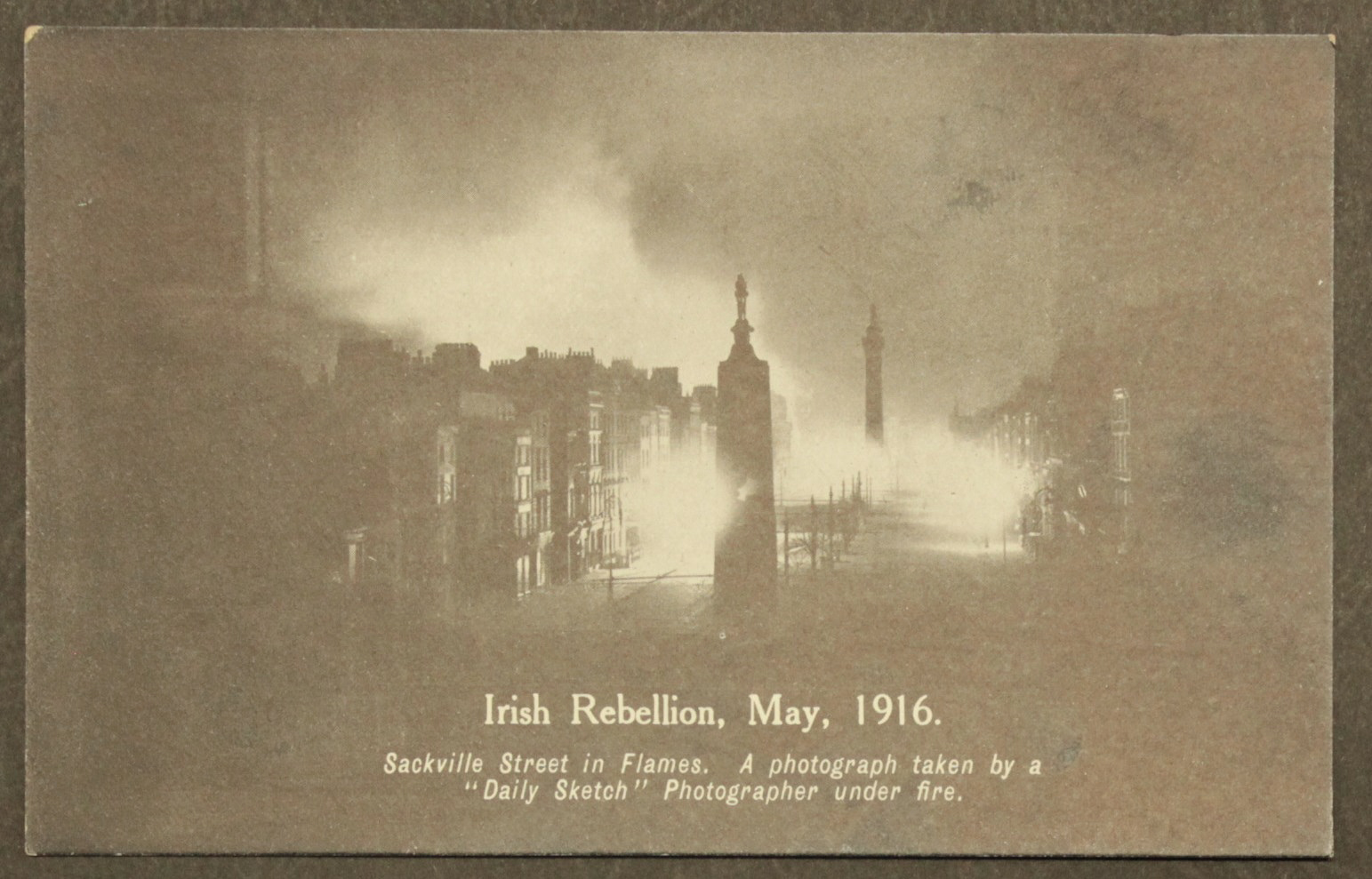
Dublin's smoking ruins. Image from Come Here to Me.

Dublin’s smoking ruins in May 1916. Image from the blog Come Here to Me.

Smoke still rose from the ruins in Dublin city centre at the start of May 1916, including from those of the Grand Cinema, but the weather was about to quench the remaining embers. “The remark of the elderly Dublin citizen who, gazing out of the window on Saturday morning, exclaimed: ‘There has been insurrection, famine, and fire; now we’re going to have a flood,’ were more or less justified by the state of the weather,” observed the Ulster Herald of the period of 6-8 May. “From the early hours of Friday morning until Sunday, Dublin has been under a never-ceasing deluge of rain, and even the most curiosity stricken of those who are themselves within its borders are deterred from wandering forth on visits of inspection amongst the ruins” (“Rising in Dublin”).

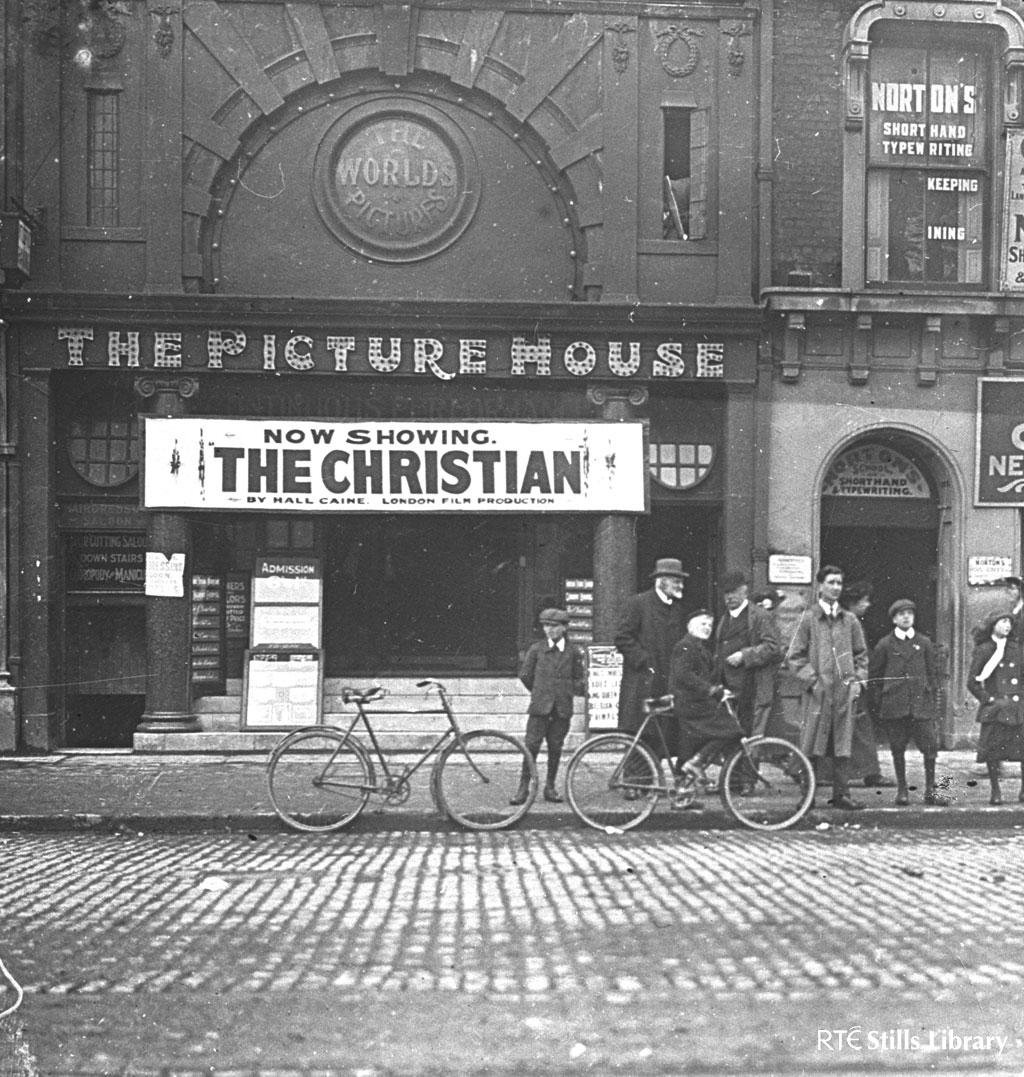
A photograph of the Picture House, Sackville/O’Connell Street taken during the week of 8-13 May. Image from RTÉ Archives on Twitter bit.ly/1bFWG0U

A photograph of the Picture House, Sackville/O’Connell Street taken during the week of 8-13 May. Image from RTÉ Archives on Twitter.

Despite the fact that the city seemed to be under attack from the four horsemen of the apocalypse, some normality was returning by Monday, 8 May. “Two cinema houses have re-opened in O’Connell street up to 6.30 each evening,” the same source reported, “and one of them displays a large poster announcing ‘All Easter Week: ‘The Christian.’”One of the earliest surviving photographs of a Dublin picture house shows that this was the Picture House at 51 Lower Sackville/O’Connell Street, which was remarkably unscathed given that it faced the totally destroyed Grand. Most of the people in the photograph are not interested in The Christian, however, but are – in the Ulster Herald’s terms – stricken by curiosity to see the ruins.

A photograph of Sackville/O’Connell Street in flames. Image from Letters of 1916.

A photograph of Sackville/O’Connell Street in flames. Image from Letters of 1916.

The Rising itself struck some observers as inherently cinematic. “For spectacular purposes nothing I have seen compares with the bombardment late yesterday afternoon of the Irish Republican flag on the cupola of the building nearly a mile from the hotel,” a Lloyd’s News Service journalist reported from his/her hotel room. “Fully fifty shells burst around the cupola before the flag fluttered to the ground. A cinema picture of this side-show would have been worth thousands” (“Dublin Rebellion”).

No cinematographer seems to have captured scenes of the Rising itself that might have satisfied the curiosity of those who could not get to Dublin’s city centre. This is disappointing but hardly surprising given the dangers from fire, bombardment and snipers. Nevertheless, several newsreel films were made of the aftermath of the Rising showing the city in ruins by Pathé News, Gaumont Graphic and Topical Budget. The Irish Independent’s London correspondent noted that “Dublin wreckage films” were being shown in London theatres and picture houses offering a “picture of gaping ruins far more appalling than the London public has been prepared for” and a heartbreaking sight for Dubliners in exile (“Our London Letter”).

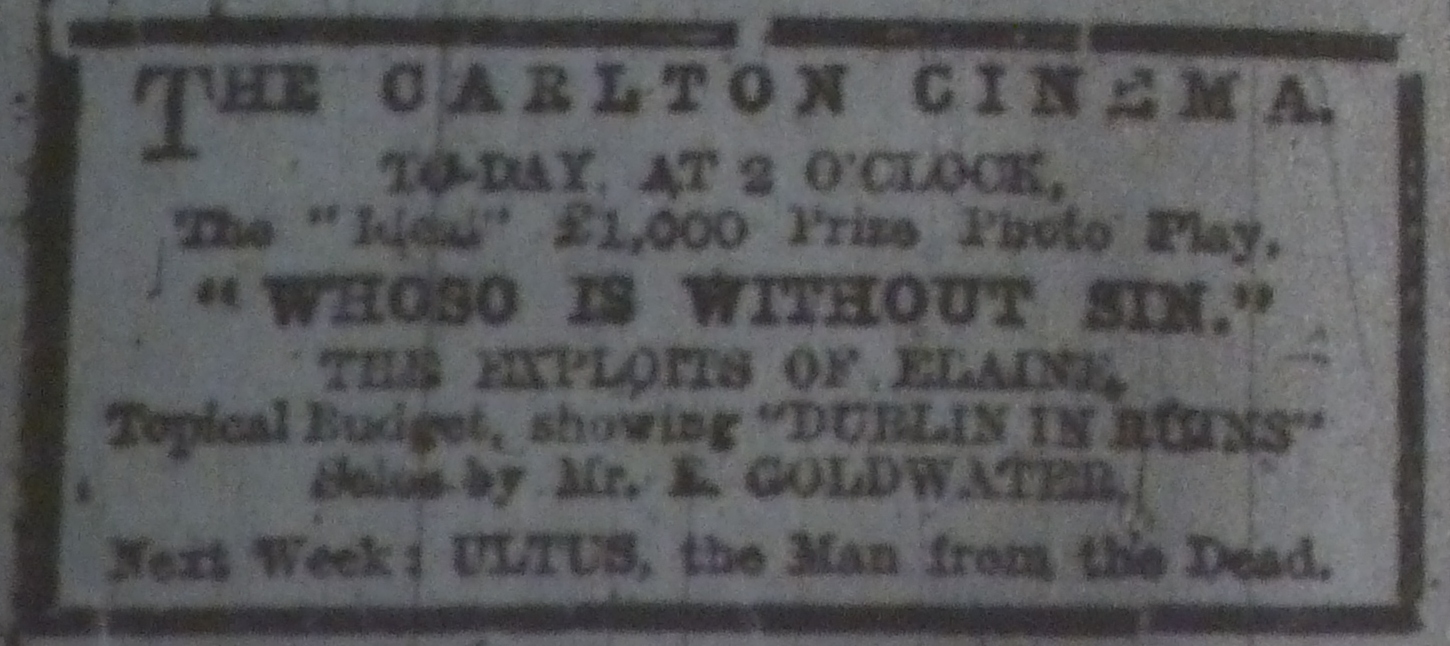
The programme at Dublin's Carlton for the week of the 8-13 May included Topical Budget's Dublin in Ruins. Dublin Evening Mail 9 May 1916: 2.

The programme at Dublin’s Carlton for the week of the 8-13 May included Topical Budget’s Dublin in Ruins. Dublin Evening Mail 9 May 1916: 2.

These films were also shown in Dublin itself once the picture houses reopened, which happened mostly in the week of 8-13 May. At this point, martial law restrictions allowed them to open only to 8pm. “The fabric of that historic building, the Rotunda, has happily escaped almost unscathed from the recent ordeal of fire,” the reviewer in the Irish Times noted on 9 May, “and an excellent programme of living pictures was yesterday presented to a succession of large audiences” (“Rotunda Pictures”).  Further down Sackville/O’Connell Street and closer to the centre of the fighting during the Rising, the Carlton also opened on 8 May with “a superb programme, the Topical Budget included ‘Dublin Ruins,’ depicting the desolation of the Irish metropolis consequent upon the insurrection” (“Carlton Cinema”). “Though the Pillar Picture House was well within the fire zone during the recent disturbances,” the Irish Times also noted, “the building has escaped with very minor injuries, and, despite the difficulties of transport, the management were able to re-open yesterday at noon with a very attractive programme” (“Pillar Picture House”). Although business at the Mary Street Picture House was “somewhat hampered by the dislocation of cross-Channel communication,” it offered a programme that included Chaplin’s A Film Johnnie (US: Keystone, 1914) and the Gaumont Graphic with all the latest topical features, and recent events in Dublin” (“Mary Street”).

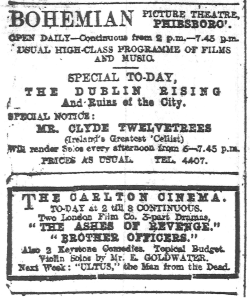
Boh Dublin Rising DEM 12 May 1916

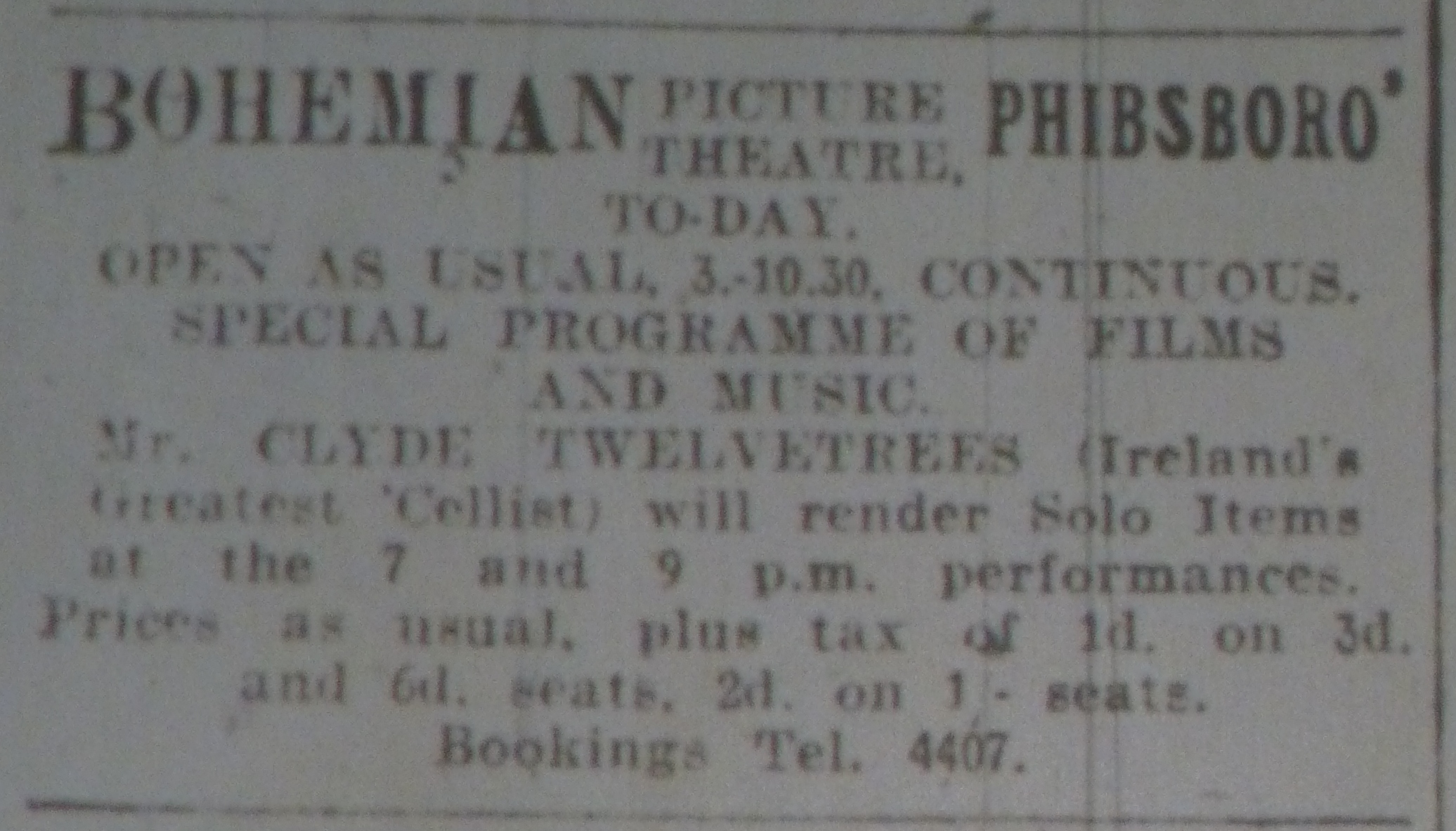
The Bohemian advertised The Dublin Rising and Ruins of the City with musical accompaniment by Clyde Twelvetrees. Dublin Evening Mail 12 May 1916: 2.

In the second half of that week (11-13 May), the Bohemian exhibited what appears to have been a longer film of the city’s ruins, Dublin Rising and Ruins of the City. Its prominence in advertising suggests that this was not just another newsreel item but something more substantial. The only surviving newsreel film of more than a few minutes is the Imperial War Museum’s (IWM’s) 14-minute Easter Rising, Dublin 1916. The IWM has little information on the origins of the film, and its intertitles are missing.

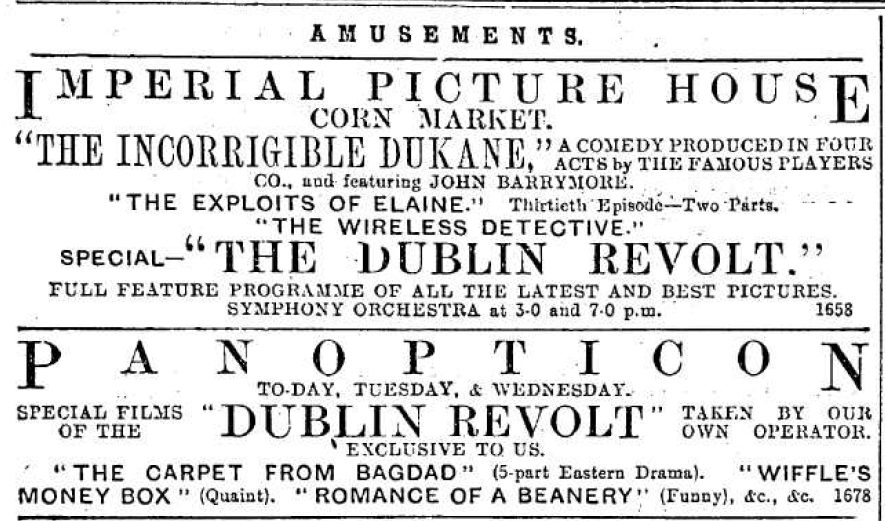
Ad for the exhibition at Belfast’s Panopticon of Dublin Revolt, a long film of the aftermath of the Rising; the similarly titled film at the Imperial is actually the Topical Budget. Belfast News-Letter 8 May 1916: 4.

Ad for the exhibition at Belfast’s Panopticon of Dublin Revolt, a long film of the aftermath of the Rising; the similarly titled film at the Imperial is actually the Topical Budget. Belfast News-Letter 8 May 1916: 4.

However, under the title Dublin Revolt, the IWM film was shown at Belfast’s Panopticon for the week of 8-13 May, and in other Belfast cinemas for the latter half of that week. The film had intertitles, including “[‘T]he Sinn Feiners marching into Dublin,’ ‘The Parade of the National Volunteers and Sinn Feiners,’ ‘Liberty Hall,’ ‘British Picket at the Custom House,’ ‘Wounded Sinn Feiners in Hospital,’ ‘British Armoured Car’” (“Panopticon,” 9 May).  The Panopticon’s ad in the Belfast News-Letter claimed that the film was “Taken by Our Own Operator,” but it may have been shot by Norman Whitten of General Film Supply, Ireland’s most prominent maker of film topicals. Paddy, Irish correspondent of the trade journal Bioscope, reported that Whitten “was out very early with his camera, and secured practically 2,000 feet of exceptionally interesting views.” Given the chaos of the picture-house business in Dublin after the Rising and the international interest in events, he sold these to “Messrs. Jury’s Imperial Pictures, Limited, and Mr. Whitten crossed over to England with the negatives so as to make sure that they reached their destination” (Paddy, 18 May). The Bohemian may have secured a 1,000-foot cut of the GFS film (Condon).

Framegrab from Easter Rising, Dublin 1916 (IWM 194) showing newsboys selling the Irish Times of 3 May 1916 against the ruins of Eden Quay.

Framegrab from Easter Rising, Dublin 1916 (IWM 194) showing newsboys selling the Irish Times of 3 May 1916 against the backdrop of the ruins on Eden Quay.

In Dublin, these films appear to have been designed to attract into the picture houses the people who were wandering the destroyed city centre fascinated by the ruins. Paddy reported that “people are not too keen on pictures just at the moment,” but were instead watching as “[o]dd walls of ruined buildings are being pulled down in Sackville Street […T]he streets are packed with people in dense masses, quite oblivious to the fact that some portion of the bricks and mortar may fall on them” (Paddy, 18 May).

Dublin Evening Mail 10 May 1916: 2.

Dublin Evening Mail 10 May 1916: 2.

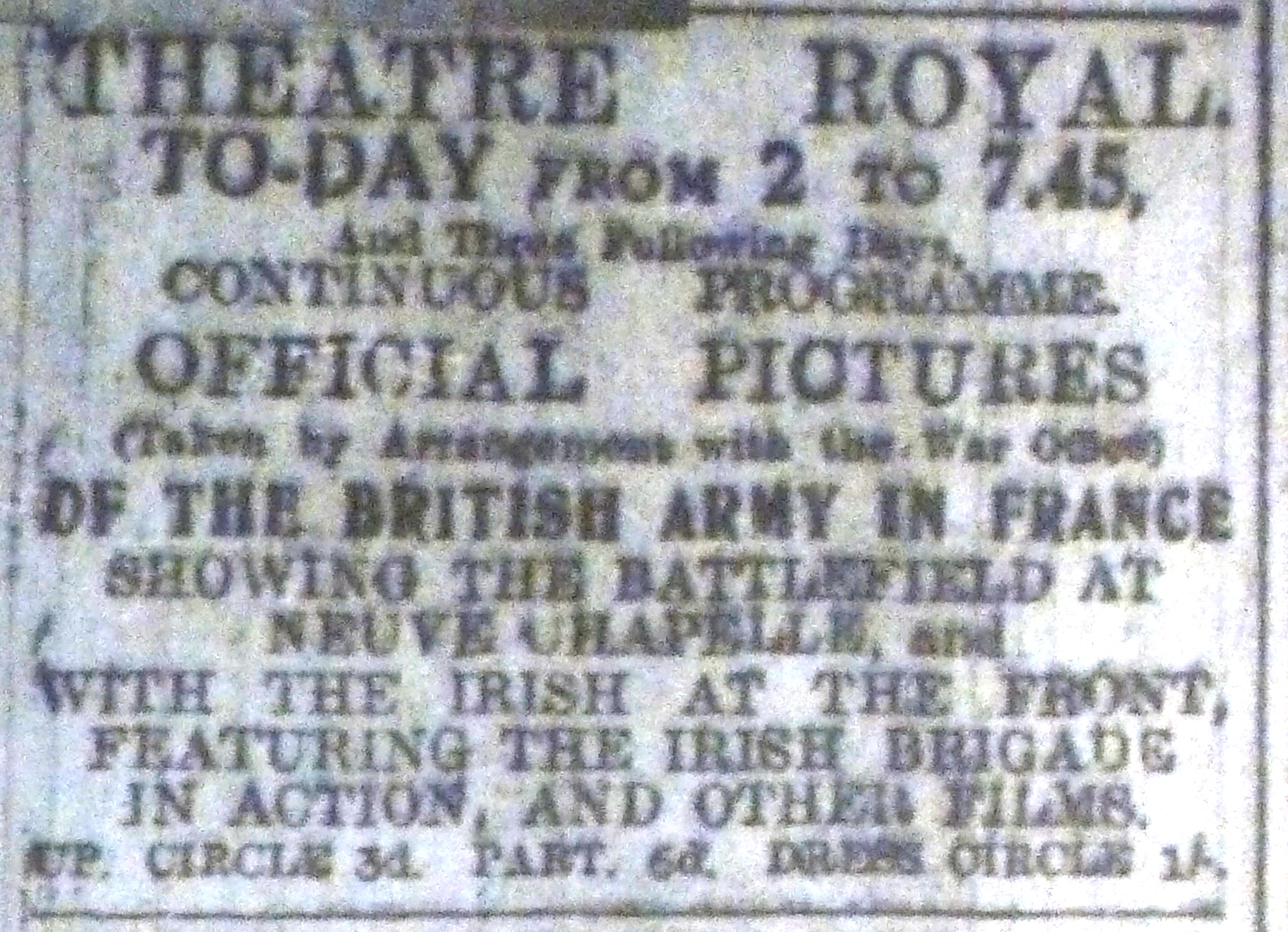
Films in other venues were fulfilling different purposes. For four days beginning on 10 May, Dublin’s Theatre Royal – a legitimate theatre that only occasionally showed films – chose films that emphasized the loyalty of Dublin citizens. The Royal showed the War Office films, The Battlefield of Neuve Chapelle, which had previously been exhibited in the city, and the new With the Irish at the Front. “The pictures will be of special interest to all citizens,” observed the Irish Times, “but particularly to those whose relatives figure in the scenes from which the photographs have been taken” (“Theatre Royal”). This demonstration of loyalty appears to have been successful because the “pictures were warmly applauded by the audience, among which were many soldiers.”

Belfast News-Letter 6 May 1916: 8.

Belfast News-Letter 6 May 1916: 8.

The disruption to communications and transport caused by the Rising had effects on cinema around the country. “Splendid programmes have been submitted at the ‘National’” in Mullingar

where, despite the dislocation of all business resulting from the troubles in Dublin at Easter, the management were enabled to keep up a capital supply of films. In the case of the ‘Exploits of Elaine,’ however, the films could not be procured by any cinema, during the period of traffic dislocation, and it was only this week that the welcome announcement could be made that the great serial would be resumed. (“National Picture Palace.”)

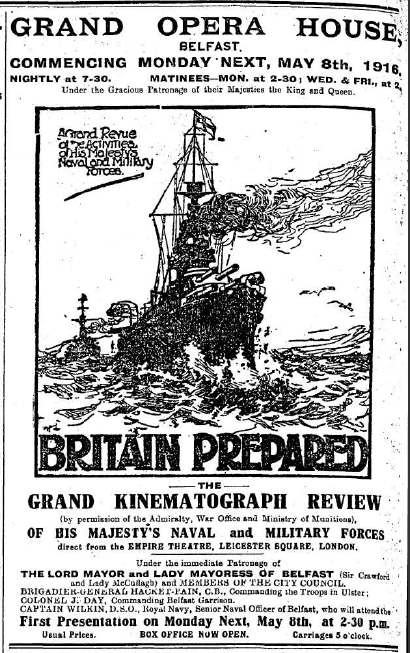
Although the second week in May brought Dublin Revolt to Belfast’s Panopticon, the lack of a train service between Dublin and Belfast until 3 May meant that manager-proprietor Fred Stewart could not show the films he had advertised for the first week (“Panopticon,” 2 May). As well as this, the cancellation of the planned visit by the D’Oly Carte Opera Company during the week of 15-20 May caused Belfast’s Opera House to retain the film Britain Prepared for a second week (“Grand Opera House”).

Given the disruption and excitement generated by the Rising, other developments seem to have been taken in stride. These included the introduction of the Entertainment Tax and of Daylight Saving Time, and a government focus on cinema as the cause of juvenile crime. Irish newspapers widely reported Home Secretary Herbert Samuel’s statement in Westminster that one of the causes of the considerable rise in juvenile crime in provincial towns was “the character of some of the films shown at cinematograph theatres” (“Crime and the Cinema”). The Leitrim Observer took up the issue in its editorial at the end of May. “There can be no doubt that the cinema has abundantly established its claim as a cheap, popular, and harmless form of amusement and recreation, so far as the adults are concerned,” it argued. “Whether the ordinary cinematograph entertainment is good for young children is another matter” (“Children and Cinemas”). Although acknowledging that parents without childcare had to bring their children to the picture houses with them, the writer thought this a poor excuse if harm was actually being done to the young people.

Article explaining rates of Entertainment Tax; Evening Telegraph 15 May 1916: 1.

Article explaining rates of Entertainment Tax; Evening Telegraph 15 May 1916: 1.

The much heralded Entertainment Tax came into force on 15 May 1916. A reporter for the Cork Examiner gave the matter considerable attention, interviewing theatre managers and analyzing who was paying most. The writer found picture-house managers relatively untroubled by the measure, arguing that if there was any effect at all, it would likely only be for the first week or so.  The writer also pointed out that if there were any decreased attendance, it might in any case be attributed to good summer weather.

Dublin's Bohemian advertises new tax; Evening Telegraph 15 May 1916: 2.

Dublin’s Bohemian advertises new tax; Evening Telegraph 15 May 1916: 2.

However, s/he also noted that the percentage increase “reverses the rule of imposing the highest percentage of tax on the well to do” (“Entertainment Tax,” 16 May). The tax increased the price of the cheapest penny tickets by a ½p  or 50% while those paying for expensive seats between 2s 6d and 5s paid only 3d or between 10% and 5%. “As the actual increases in prices are comparatively small,” s/he nevertheless concluded, “the public will in all probability adapt themselves to the new conditions without any serious demur.” The writer of the Southern Star’s “Bandon Notes” column took a similar view. “The young lads of the town who constantly patronise the pictures in large numbers will be, one would be inclined to think, seriously hit by the tax,” s/he initially contended. “However, where a young lad would be able to make out 3d for the pictures, he would also be able to find 4d. Therefore, from their point of view, we think things will go on as usual.”

Examining the amount raised during the tax’s first week, the Belfast News-Letter found that the bulk of the receipts came from picture houses rather than theatres. Using figures from Liverpool, it estimated that £900 of the £1,600 tax collected in the city came from cinemas (“Entertainment Tax,” 24 May).

The introduction of Daylight Saving Time on 21 May proved even less controversial in the Irish cinema trade. Among the Dublin theatre and picture house managers/proprietors interviewed by an Irish Independent reporter, manager Richard Bell of the Sackville Picture House and John J. Farrell, who owned several Dublin picture houses, expressed the view that the measure would not affect them in any way and that they saw no reason to change their hours of opening. Only Barney Armstrong of the Empire Theatre thought the regulation “would likely have the effect of slightly reducing the attendances during the summer months, especially at the first ‘house’” (“Daylight Saving Act”). For picture houses that opened from the early afternoon, this was less of an issue.

By the end of May, life in the Dublin appeared to be returning to normal, albeit among the ruins of the city centre. Paddy noted that “[m]arital law in Dublin has been considerably modified, people now being allowed out until 12 o’clock. This means that one can visit a theatre or music hall in comfort and still be able to catch the last tram home.” Even if many picture houses were slower in settling down after the Rising, this was due to good weather, which “proved equally as strong an attraction as the spectacle of falling buildings” (Paddy, 25 May).

References

“Bandon Notes.” Southern Star 20 May 1916: 5.

“The Carlton Cinema.” Irish Times 9 May 1916: 3.

“Children and Cinemas.” Leitrim Observer 27 May 1916: 3.

Condon, Denis. “‘Pictures in Abeyance’: Irish Cinema and the Aftermath of the 1916 Easter Rising.” Moving Worlds April 2016.

“Crime and the Cinema.” Leitrim Observer 20 May 1916: 7.

“Daylight Saving Act: Favourable Irish Recption.” Irish Independent 19 May 1916: 4.

“The Dublin Rebellion.” Southern Star 6 May 1916: 2.

“Entertainment Tax Comes into Operation.” Cork Examiner 16 May 1916: 6.

“The Entertainment Tax: £1,600 the First Week’s Yield in Liverpool.” Belfast News-Letter 24 May 1916: 4.

“Grand Opera House: ‘Britain Prepared.’” Belfast News-Letter 16 May 1916: 2.

“Mary Street Picture House.” Irish Times 9 May 1916: 3.

“National Picture Palace.” Westmeath Examiner 20 May 1916: 4.

“Our London Letter: Dublin Wreckage Films.” Irish Independent 15 May 1916: 2.

Paddy. “Pictures in Ireland.” Bioscope  18 May 1916: 845; 25 May 1916: 911.

“The Panopticon.” Belfast News-Letter 2 May 1916: 2; 9 May 1916: 2.

“The Pillar Picture House.” Irish Times 9 May 1916: 3.

“The Rising in Dublin: Scenes in the Ruins.” Ulster Herald 13 May 1916: 3.

“Rotunda Pictures.” Irish Times 9 May 1916: 3.

“Theatre Royal.” Irish Times 9 May 1916, p. 3.


Irish Cinema and the Desire for Change in April 1916

Among the Situations Wanted ads, the Waterville projectionist seeks new prospects; Irish Independent 1 Apr. 1916: 6.

Among the Situations Wanted ads, a Waterville projectionist seeks new prospects; Irish Independent 1 Apr. 1916: 6.

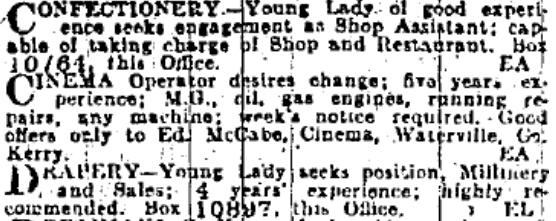
Desiring a change of job, Edward McCabe, the operator (projectionist) at the cinema in Waterville, Co. Kerry, put a small ad in the Irish Independent outlining his five years of experience and seeking “good offers only.” McCabe was expectant – or at least hopeful – of an improved situation, and given cinema’s continuing growth despite the war, his prospects seemed good. Change was certainly coming to Ireland in April 1916, if not of the kind for which McCabe expressed a desire. Planned and executed by a small group of insurgent nationalists, socialists and women’s rights campaigners against British rule, the Easter Rising that month would be the catalyst for profound social and political change, but the cinema had few direct links with it. Although the Rising took place largely in Dublin between 24 and 29 April, the failure of the rebels to land arms in north Kerry – far from Waterville in the south – and the arrest of Rising leader Roger Casement as he was set ashore from a German U-Boat on 21 April influenced events in Dublin and elsewhere. When the Kerry events caused the planned Easter Sunday Rising to be initially cancelled and then rescheduled to Easter Monday, Frank Hardiman and his comrades in the Irish Volunteers and the secret Irish Republican Brotherhood in Galway were thrown into confusion. Manager of the Galway’s Town Hall Picture Palace for James T. Jameson’s Irish Animated Picture Company, Hardiman was arrested on Tuesday, 25 April, paraded with other rebels through the streets and imprisoned on a ship in Galway Bay (“Statement of Frank Hardiman”).

Beside the iconic ruins of the Dublin Bread Company on Dublin's Lower Sackville/O'Connell Street in late May/early April 1916 were the ruins of the smaller Grand Cinema, its projection box visible.

To the left of the iconic ruins of the DBC (Dublin Bread Company) on Dublin’s Lower Sackville/O’Connell Street in late April/early May 1916 were the ruins of the smaller Grand Cinema, its projection box visible on the first floor. Source: Irish Times.

The Rising was even more of a surprise than this for most people working in Irish cinema, and the few who became directly involved did so because they got caught up in events. Despite apparently having no direct role in the Rising, Irish-American diplomat James M. Sullivan, who had recently founded the Film Company of Ireland (FCOI), was arrested outside his home in Dublin on 28 April and imprisoned in Kilmainham Gaol until 6 May (“Irish-American Minister”). The FCOI’s offices at 16 Henry Street would be completely destroyed during the fighting of Easter Week, but the disruption and destruction that were the Rising’s most immediate effects on cinema in Dublin can be seem most clearly in the many photographs of the ruined Grand Cinema – the mangled remains of its projectors clearly visible – beside the iconic hulk of the Dublin Bread Company on Lower Sackville/O’Connell Street. The World’s Fair Waxworks at 30 Henry Street, one of the first and cheapest picture houses in the city, was also completely ruined. Other picture houses were also damaged, if not to this extent, and the military authorities who administered the city after the surrender of the rebels prohibited all entertainments for a time.

Cinema was prohibited as part of a general curfew rather than for any direct role in the Rising, but it did constitute revolutionary change of a kind in Ireland, bringing an explosion of imagery to people and places that could not have experienced anything like it before. This is perhaps epitomized by the Waterville Cinema that Edward McCabe desired to leave on the eve of the Rising. It opened in late December or early January 1916, when a rare notice appeared in the Kerryman commenting on the success of its opening (“New Cinema, Waterville”). It changed the films it showed four times a week, on Sunday, Monday, Wednesday and Friday, including such bill toppers as Chaplin’s The Property Man (US: Mutual, 1914), appropriate for a village that now hosts a Chaplin festival. That Waterville had a picture house at all is remarkable, given that the 1911 Census put its population at just 300 inhabitants and that the village itself was located on the extreme western periphery of Europe. It must have been a precarious enterprise, and it is extraordinary that it lasted even until McCabe sought to leave. The frequent changes suggest that the proprietor attempted to attract patrons several times a week in a region where many inhabitants were subsistence farmers or fisherfolk. Indeed, Ireland’s west coast held a special place in the nationalist consciousness because its remoteness made it a bastion of a tradition Irish culture that was often presented as an ascetic pastoralism conducted in the Irish language. If cinema could be in such a small, remote and traditional place, it seems it could be anywhere. However, Waterville and its environs had something that other poorer parts of the west did not. The peripherality of this part of Kerry had actually made it a hub of modernity, the site in the 1860s for the landing of the first transatlantic telegraphic cable and building of a telegraph station, located on nearby Valencia Island. News from America came first to this remote spot in south Kerry, and Waterville’s population included many who worked as relatively highly paid telegraphists. The patronage of these cable workers and their families who settled in the areas appears to have kept the cinema going at least until McCabe departed.

Skibbereen Coliseum SS 22 Apr 1916

Announcement of the reopening of Skibbereen’s Kinemac as the Coliseum; Sikbbereen Eagle 22 Apr. 1916: 8.

Despite its unusual demographics, Waterville was by no means alone among remote locations in south Kerry and west Cork experiencing the new media of the 1910s, albeit that these changes were occurring in towns with much larger populations. Founded by vibrator entrepreneur Gerald Macaura in 1914, the troubled Kinemac in Skibbereen (pop. 3,021) reopened on 25 April 1916 under a new name, the Coliseum, managed by Andy Wright’s Southern Coliseums. Clonakilty, Co. Cork (pop. 2,961) also saw developments in its cinema enterprises, some of which were not entirely legal. On 23 March, 19-year-old Michael “Murt” O’Donovan was charged at a special court in the town with defrauding Alexander Bonthorne of Faulkland, Scotland and Malachy Brady of Tudor House, Roscommon by failing to supply home cinema equipment for which they had paid him (“Special Court”). O’Donovan had no link to Clonakilty’s picture house, which drew audiences from its hinterland. “‘Where are the boys of the village tonight?’” asked the columnist of the Southern Star’s “Shannonvale Notes.” “They are at the ‘Movies’ escorting certain young ladies and their lady friend who lives up [the] street. Since the Cinematograph started in Clon, it has been well patronised by the boys of our village.” Accompanying young ladies to the cinema was not looked on favourably by young men everywhere. When some of Clones, Co. Monaghan’s unmarried men founded a bachelors’ club to resist a mooted Bachelor Tax, they expressed their opposition to the practice of bringing local ladies “to picture houses, on excursions, picnics, motor drives, or cycle runs” (“Clones Bachelors”).

Even in such towns as Naas, Co. Kildare (pop. 3,842), which had only occasional picture shows, cinema could be encountered on a stroll. “I confess I knew very little of Charlie Chaplin until the other day,” the Kildare Observer’s “Items and Ideas” columnist revealed. “Several times have I heard references to him in a ditty chanted in chorus by small boys from the lanes of Naas as they paraded the suburban thoroughfares.” The columnist included the words, sung to the tune of the 1907 song “Red Wing”:

The moon shines bright on Charlie Chaplin,

His boots is crackin’, for want of blackin’,

And his khaki trousers need a mendin’

Before we send him

To the Dardanelles.

By April 1916, many involved in Irish cinema were resisting or embracing changes sought by the British government, which was increasingly finding cinema useful in various ways. Despite the industry’s strenuous lobbying against it, the government was undeterred in its determination to divert some of the money spent on entertainments into its much depleted war reserves; it set 15 May as the day on which the new Amusement Tax would be imposed on picture houses and theatres. There seemed little firm opposition to it outside the industry in Ireland, the Evening Herald arguing that no valid argument can be advanced against it” (“Where Ireland Goes Out”).  Film’s increasingly direct role in recruiting in Ireland was highlighted when H. Higginson announced that he – like Edward McCabe – desired a change and was resigning the managership of the newly reopened Clontarf Cinema in Dublin to lead a cinema recruiting campaign. He proposed to give two shows in each place the campaign reached, the first exhibiting army and navy films, and the second offering a regular drama and comedy programme whose proceeds would go to various war funds. He also intended “to arrange so that the first man who is actually accepted and passed by the doctor for service with the colours will be presented free with a high-class solid silver luminous wristlet watch, the usual shop price of which is 43s” (“Cinema Recruiting Campaign”). No such recruiting event appears to have been reported later in April, but James J. Stafford’s lent his cinema for a “war meeting” in Longford on 14 April at which films showed “what the war means, in many phases, and the large gathering that thronged the Theatre were treated to a series of recruiting speeches which were generally acknowledged to be the strongest delivered since the start of the military canvass of the country” (“War Meeting in Longford”).

The long-running campaign for educational uses of film gained a new public advocate in mid-April 1916 when David Gilmore from Belfast’s Ormeau Road wrote a letter to the Belfast Newsletter outlining how the dangers of carelessly discarded fruit peel might be ameliorated cinematically. He suggested that “if each cinema show displayed a short film at each exhibition depicting the evil of throwing slippery things on the sidewalk, and a reading caution not to do so, thousands of children would take thought and not throw peel, &c., where people would slip on it.” His enthusiasm for this early public service film extended to an imagined scenario: “The little silent drama could show a child throwing peel down, a person slipping thereon, lying in a hospital, and then creeping about on crutches. Or the drama could end by a funeral, as slipping on orange peel has caused in more than one case” (“Throwing Orange Peel”). He may have been joking, but if not, he displayed a surprising unawareness that films already dealt extensively with casually or maliciously tossed peel, film comedians having done, if anything, too much to exploit the banana skin’s comic potential.

Cellists Clyde Twelvetrees and Joseph Schofield Source: Royal Irish Academy of Music blog.

The changes that picture houses had brought to Dublin’s entertainment world meant that they competed for audiences with popular theatres. By no means for the first or last time, this was explicit again in the week beginning 17 April 1916, when the Empire Theatre’s programme consisted not of its usual variety acts but of the film The Rosary (US: Selig, 1915), starring Kathlyn Williams. The film has been shown first in the city at the Theatre Royal over the 1916 New Year week and had had subsequent runs at the Princess Cinema in Rathmines (14-16 Feb.), the Phoenix Picture Palace on Ellis Quay (6-9 Apr.) and the Dame Street Picture House (13-15 Apr.). Despite the recent showings at the Phoenix and Dame, Empire manager Barney Armstrong must have considered this religious-themed film a good prospect in the run-up to Easter weekend because he offered additional musical attractions that would see the film accompanied “with organ and full orchestra effects” (“Empire Theatre”). When shown at the picture houses, the film had received little attention from newspaper critics, but when it appeared at the Empire, the main daily newspapers gave it as much critical attention as they gave to any other show. However, they gave it a mixed reception. Although the Evening Telegraph reviewer called The Rosary a “splendid” film – perhaps referring to its seven-reel length – s/he complained that it showed “a woeful ignorance of Irish Catholic sentiment, and the impersonations [offer] very little suggestion of an Irish atmosphere” (ibid).

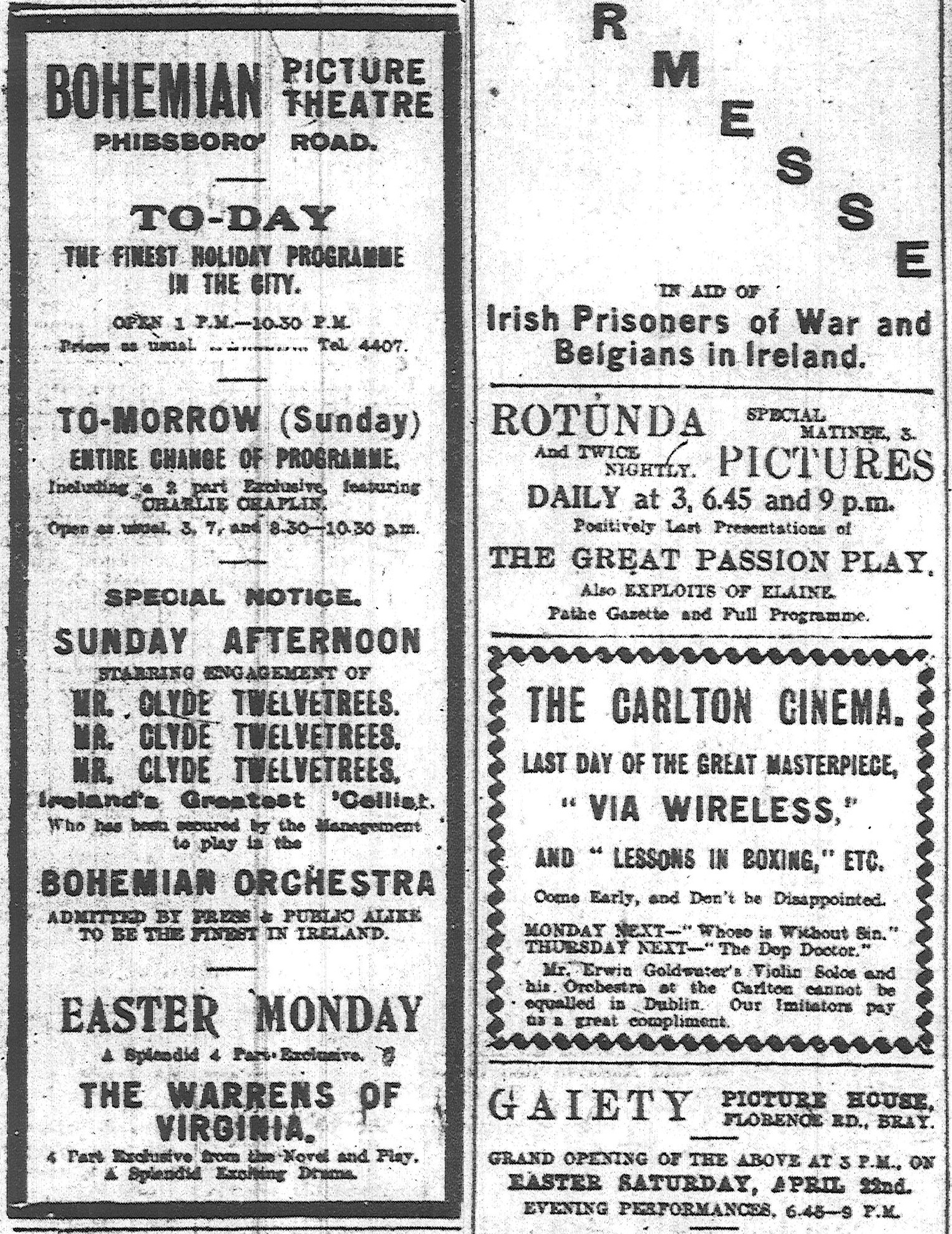
The Bohemian advertises its engagement of Twelvetrees prominent in its Easter programme, beside the Carlton’s ad for its attractions, including Erwin Goldwater’s solo playing; Dublin Evening Mail 22 Apr 1916: 2.

The Bohemian advertised its engagement of Twelvetrees prominently in its Easter programme, beside the Carlton’s ad for its attractions, including Erwin Goldwater’s solo playing; Dublin Evening Mail 22 Apr 1916: 2.

The disparities in the press attention that the Rosary received at the picture houses and at the Empire were an indication that theatre remained the dominant entertainment medium, but there were also indications that this situation was changing. In attracting patrons to The Rosary, the Empire advertised the superiority of the musical attractions it could offer. However, several of the city’s picture houses were enhancing their musical offerings to compete against each other and the theatres. On St Patrick’s Day, 17 March 1916, concert violinist Erwin Goldwater had become resident soloist at the recently opened Carlton Cinema. This somewhat undermined the Bohemian Picture Theatre long advertised claim that it possessed the largest and best orchestra of any of the city’s picture houses. In response, the Bohemian engaged Clyde Twelvetrees – concert cellist and professor of the Royal Irish Academy of Music – to play as part of its daily programme. “Up to the present,” the Irish Independent commented, “if one wanted to hear a few famed soloists one had to attend the big concerts; but now one can hear the very best at convenience (“Dublin and District”). And these musical opportunities were set to increase, as Dublin’s Pillar Picture House engaged another renowned cellist, Joseph Schofield.

Schofield’s debut at the Pillar did not, however, take place as scheduled, at 4pm on Easter Monday, 24 April 1916. By that time, members of the Irish Volunteers and Irish Citizen Army under Patrick Pearse and James Connolly had taken possession of the nearby GPO, and the Rising was underway. Dublin’s cinema screens would remain dark for two weeks as more urgent changes took the stage.

References

“A Cinema Recruiting Campaign.” Dublin Evening Mail 6 Apr. 1916: 4.

“Clones Bachelors Establish a Washing, Cooking and Household Managing Club.” Anglo-Celt 1 Apr. 1916: 11.

“Clontarf Cinema Theatre to be Opened on Sundays.”  Evening Telegraph 31 Mar. 1916: 3.

“Dublin and District.” Irish Independent 22 Apr. 1916: 4.

“The Empire Theatre.” Evening Telegraph 18 Apr. 1918: 6.

“Irish-American Minister: Unpleasant Experiences in Dublin.” Evening Herald 9 May 1916: 1.

“Items and Ideas.” Kildare Observer 1 Apr. 1916: 5.

“New Cinema, Waterville.” Kerryman 8 Jan. 1916: 8.

“Shannonvale Notes.” Southern Star 15 Apr. 1916: 1.

“Special Court in Clonakilty.” Skibbereen Eagle 1 Apr. 1916: 3.

“Statement of Frank Hardiman.” Bureau of Military History, Witness Statement 406, p. 2-3 <http://bureauofmilitaryhistory.ie/reels/bmh/BMH.WS0406.pdf#page=1&gt;

“Throwing Orange Peel, &c., on Sidewalks.” Belfast Newsletter 12 Apr. 1916: 6.

“War Meeting in Longford.” Longford Leader 22 Apr. 1916: 1.

“War Pictures.” Longford Leader 15 Apr. 1916: 1.

“Where Ireland Goes Out.” Evening Herald 13 Apr. 1916: 2.

The Constant Watchfulness of Irish Cinema in March 1916

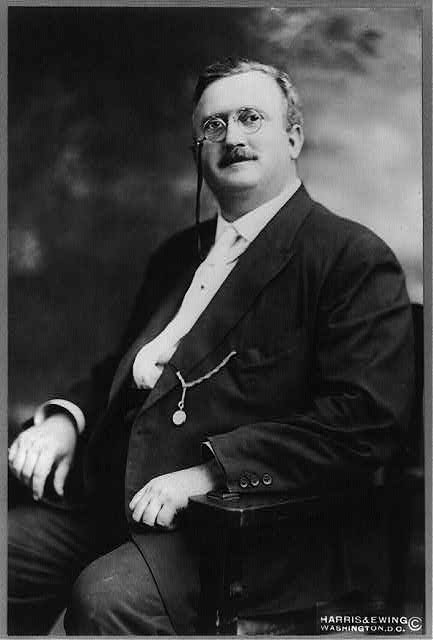
Irish-American James Mark Sullivan, who co-founded the Film Company of Ireland in March 1916. https://www.loc.gov/item/2002706157/

Irish-American James Mark Sullivan, who co-founded the Film Company of Ireland in March 1916. Image from the Library of Congress.

Although Ireland is celebrating the centenary of the 1916 Rising in March 2016, Easter was celebrated in 1916 in late April. Nevertheless, March 1916 saw such momentous cinematic events as the founding of the first major indigenous film production company. And even if Easter itself was still some way off, Irish cinema hit the beginning of the Easter season. In what was clearly a coordinated move by the Irish Catholic hierarchy, several bishops mentioned cinema in their Lenten pastorals, the letters from them read out on 5 March 1916 in churches in their dioceses to mark the start of the 40-day fasting period leading up to Easter. “Immodest representations in Theatres should be reprobated by every good man, and every effort should be made to discountenance them,” ordered the Bishop of Cork, but he had a particular warning about cinema:

We desire to direct your attention particularly to cinematograph and picture shows. The films come from outside, and from places where what concerns Christian modesty is made little of, and there is always a danger that what is unfit to be seen may be exhibited unless constant watchfulness is exercised to exclude what is objectionable and offensive in a Catholic country.(“Lenten Pastorals.”)

This call for “constant watchfulness” was an intensification of the hierarchy’s involvement in the church’s efforts to control cinema. If the church could not prevent people going to picture houses altogether, it was determined that it would shape what, where and when people would watch. The initially mainly lay Vigilance Committees had in late 1915 been put under centralized clerical control as the Irish Vigilance Association, which held a mass meeting at Dublin’s Mansion House that sent a renewed demand for the introduction of a specifically Irish film censorship (“Mansion House Meeting”). The many local campaigns against the opening of picture houses on Sunday were also led from the altar. “At different Masses on Sunday last in the four parish churches, as well as in the Black Abbey and Capuchin Friary,” reported the Kilkenny People, “a strong appeal was made to the people to abstain from attending the local Picture House on Sundays, particularly during Lent” (“Sunday Cinemas in Kilkenny”).

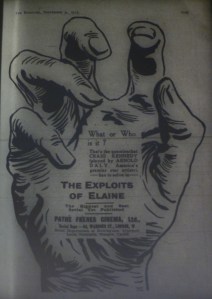
Ad for Stafford's Longford Cinema in St Patrick's week included an episode of The Exploits of Elaine (US: Wharton, 1914), the serial that featured the master criminal the Clutching Hand. Longford Leader 11 Mar. 1916: 3.

Ad for Stafford’s Longford Cinema in St Patrick’s week included an episode of The Exploits of Elaine (US: Wharton, 1914), the serial that featured the master criminal the Clutching Hand. Longford Leader 11 Mar. 1916: 3.

In making their calls for vigilance, the bishops could indicate the harmfulness of cinema by citing the ongoing trial of a gang of boys in Mullingar who had committed robberies inspired by onscreen criminals. The papers reported many similar cases including the prosecution of 20-year-old ex-sailor James J. Sloan who told the Belfast Assizes that his house-breaking equipment was “the materials Charlie Chaplin works with” (“Items of Interest”). The prominence of such stories led James Stafford of the Longford Cinema to refute publicly the claim made by a boy charged with larceny at the local petty session that he had committed the robbery to get money to go to the pictures. “I have made it a point not to admit to the Longford Cinema Theatre boys of this class,” Stafford contended, “and this boy in particular is one of several of his class whom I frequently refused admission” (“Unfounded Allegation”). As the Mullingar case suggests, the class he referred to was the poorest of the working-class.

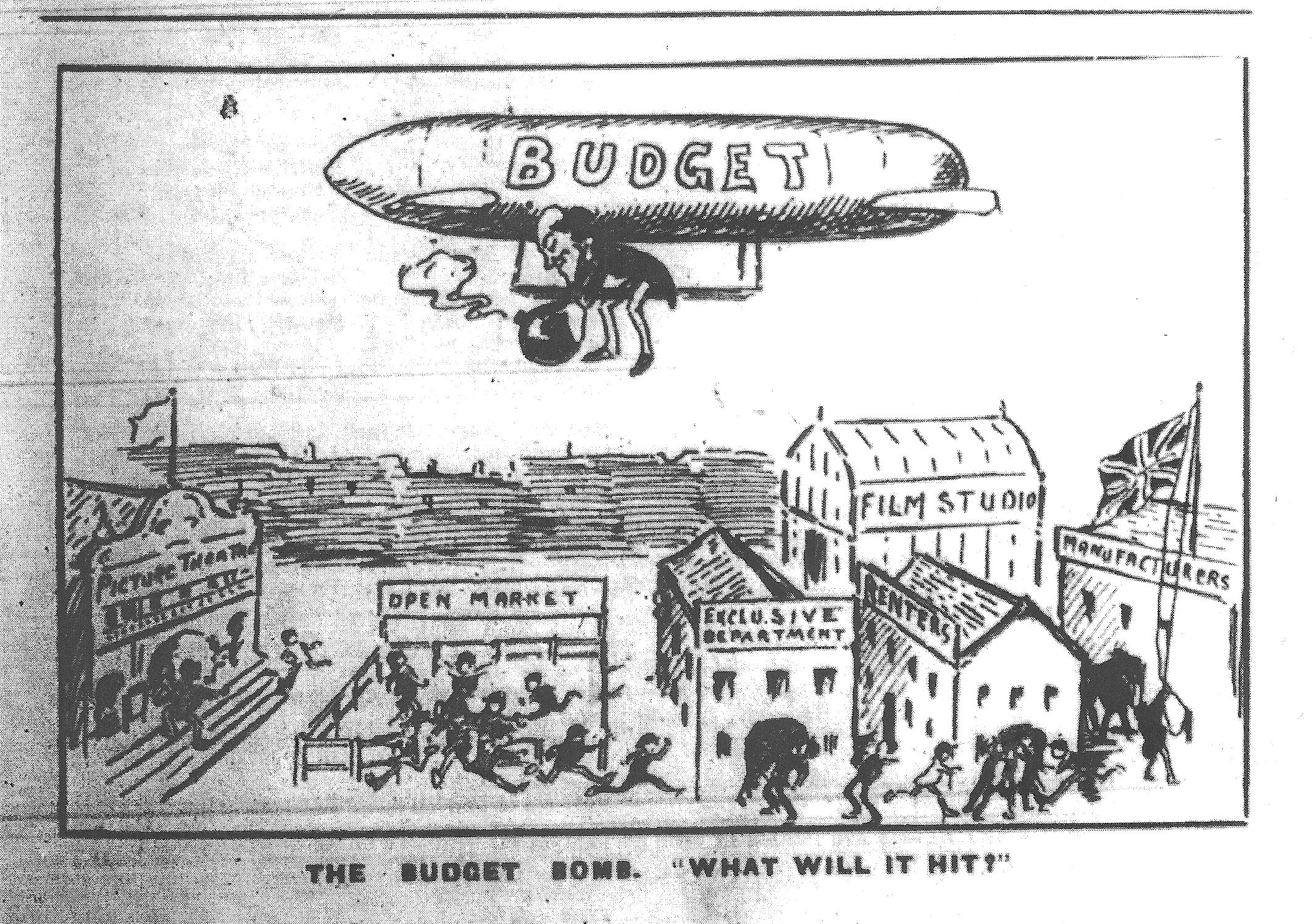
The cinema industry long feared the imposition of crippling taxes, going so far in this cartoon as to identify the British government with the zeppelin raids then terrorizing southeast England. Bioscope 7 Oct. 1915: 16c.

The cinema industry long feared the imposition of crippling taxes, going so far in this cartoon as to identify the British government with the zeppelin raids then terrorizing southeast England. Bioscope 7 Oct. 1915: 16c.

The British government also had a vigilant eye on the cinema industry in Britain and Ireland as a way of raising needed war funds. Months before the imposition of an amusement tax in the May 1916 budget, there was much discussion of its likely effects on the industry and how it was to be collected. “The view which at present commends itself to the authorities,” reported the Irish Independent, “is that the Government should print the tickets for the cinema shows, and these should be purchased from the Government by the trade at a price which would cover the tax” (“Proposed Cinema Tax”). As well as further binding the cinema industry to the British war effort, the tax would alter the working-class nature of cinema. “Upon the injustices of a penny per seat tax there can be not two opinions,” argued Frank W. Ogden Smith in the trade journal Bioscope,

and if such a tax be allowed to pass unchallenged this point must be borne in mind – when we revert to peace times it will mean the cinema as a poor man’s amusement and recreation will have ceased to exist, for the Government having tasted the fruit and found it refreshing in actuality not theory, will not be likely to relinquish the tax. (“Passing of the Penny Cinema.”)

Longford and Mullingar were just two of the Irish places where this process could be most clearly seen in March 1916.

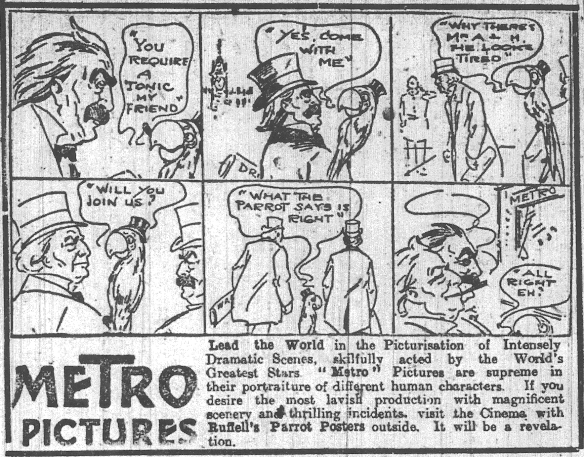
Metro ad featuring Ruffells’ parrot, Dublin Evening Mail 6 Mar. 1916: 2.

Metro ad featuring Ruffells’ parrot, Dublin Evening Mail 6 Mar. 1916: 2.

The industry as a whole – including the Bioscope – had long courted an audience far beyond the penny cinemagoer, and it did so in a climate in which many doubted that cinema represented a quality contribution to culture. At a meeting of the Cork County Council, the chairman complained that the large amount of money spent on technical education was wasted because “the people for whom it was intended showed no disposition to profit by it.” Instead, the popularity of Charlie Chaplin and picture houses were proof, he believed, of the failure of the art classes provided to raise the public taste (“Cork County Council”). Publicity strategies to counter such views and promote films and picture houses as quality entertainment were important, and one ad campaign stood out in Ireland in March 1916. Metro’s British agent Ruffells’ Exclusives was pioneering in marketing film brands to the Irish public. Ads for Metro had been appearing in newspapers for some time when the Bioscope reported that Ruffells in Dublin abandoned their trademark parrot for another animal in order to stage a spectacular publicity stunt: “This consisted of six donkey carts, all passing the leading station and advertising on large boards the display of Metro pictures. The houses showing the films were the Bohemian, the Carlton, the Grafton Street and Grand” (“Trade Topics”).

Evening Telegraph 16 Mar. 1916: 4.

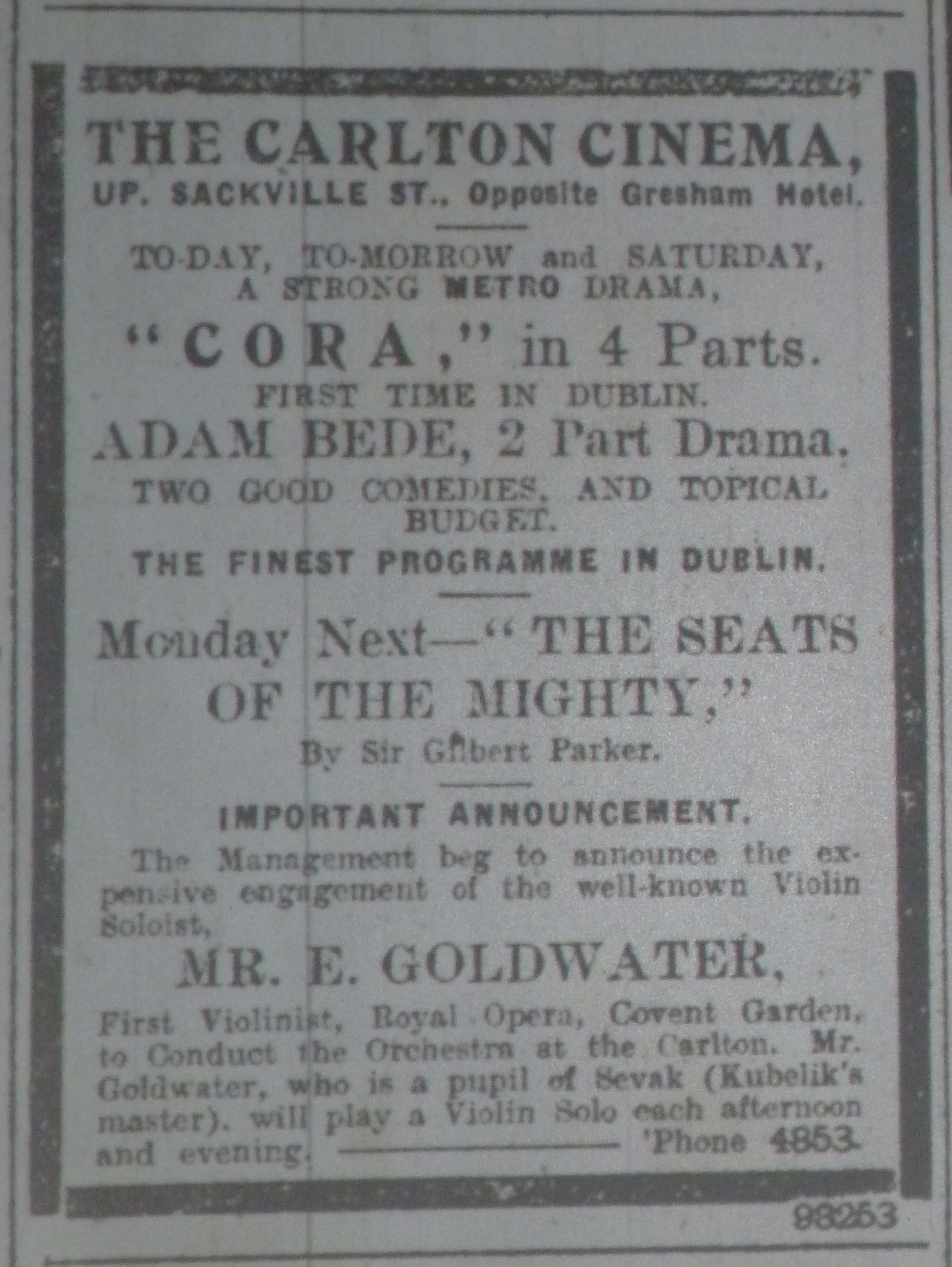
Dublin’s Carlton showing Metro drama Cora. Evening Telegraph 16 Mar. 1916: 1.

These named picture houses were among Dublin’s most prominent cinemas, and each watched what the others were doing. What they were doing to ensure success was to provide lavishly comfortable buildings, feature such highly publicized films as Metro’s and offer novel musical accompaniment. Located in Phibsboro outside the city centre, the Bohemian had attracted patrons since its opening in 1914 by advertising the best musical attractions in the city. The Bohemian’s orchestra consisted of 16 musicians under musical director Percy Carver. With the increasing competition for cinema patrons in the city centre, the Carlton as the latest-opened picture house sought to secure its audience by adding to its musical attractions. Beginning on Patrick’s Day, 17 March, the Carlton challenged the Bohemian’s musical pre-eminence by engaging the concert violinist Erwin Goldwater. The Irish Times called this “[a] new departure in connection with cinema entertainments [that] takes the form of a violin recital by Mr. E. Goldwater, a pupil of Sevcik, and formerly first violin at the Royal Opera, Covent Garden. Mr. Goldwater will conduct the orchestra at the Carlton” (“Platform and Stage”).

Clontarf reopens 17 Mar 1916 ET

Ad for reopening of the Clontarf Cinema; Evening Telegraph 17 Mar. 1916: 1.

Goldwater’s engagement was not the only significant event that picture-house proprietors planned for the holiday of the Irish patron saint. A company led by I. I. Bradlaw, David Frame and Henry Grandy reopened the Clontarf Cinema in the former Clontarf Town Hall. “It has been re-decorated and reconstructed throughout in the most luxurious manner,” the Evening Telegraph announced, “and will be found to be equal in every respect to the very best picture houses in the city” (“The Cinema, Clontarf”). Several picture houses offered special programmes of Irish films and/or music. Perhaps the most surprising of these was at Belfast’s CPA (Central Presbyterian Association) Assembly Hall. “Five reels of well-selected cinema were screened, and the premier place amongst these was taken by “Brennan of the Moor,” a three-part filmisation of the Irish story,” revealed the Northern Whig. “Mr. F. J. Moffett presided at the organ, and also acted as accompanist. Mr. W. R. Gordon sang several Irish folk-songs in a most pleasing manner” (“C.P.A. Entertainments”).

“Mr. Erwin Goldwater.” Irish Limelight May 1917: 17.

Although Brennan of the Moor (US: Solax, 1913) was revived on occasion, the most popular films to constitute an Irish programme were still those made by Sidney Olcott and Gene Gauntier for Kalem and other companies in Ireland between 1910 and 1914. Nenagh’s Ormond Kinema Company provided films – including an unnamed Chaplin and The Colleen Bawn (US: Kalem, 1911) – free of charge to the Toomevara and Nenagh Hurling Club after their fund-raising concert in Nenagh’s Town Hall on 17 March (“St. Patrick’s Night’s Concert”). “Some unique films of the famous Tubberadora, Toomevara, and Thurles Teams” were also shown (“The Coming St Patrick’s Night Concert”). The Colleen Bawn was the most popular of Dublin-born Dion Boucicault’s stage melodramas, but productions of his more political Arrah-na-Pogue and The Shaughraun were particularly evident in March 1916. In early March 1916, The Shaughraun (US: Kalem, 1912) – which featured an escaped Fenian – was revived at both Dublin’s Rotunda and Bohemian; during the same period, a stage version was produced at Dublin’s Father Mathew Hall by the Barry Sullivan Society, while at the Hibernian Hall, Parnell Square, the Hibernian Players staged Arrah-na-Pogue. The Olcott and Gauntier’s Arrah-na-Pogue (US: Kalem, 1911) was shown at the newly refurbished Omagh Picture House on St Patrick’s night (“Omagh Picture House”). The Rotunda’s programme for St Patrick’s day and the two days following included two other of Kalem’s Irish-shot films: the 1798 drama Rory O’More (US: Kalem, 1911) and The Fishermaid of Ballydavid (US: Kalem, 1911).

Small ad from the Film Company of Ireland seeking Irish scenarios; Freeman's Jorunal 9 Mar. 1916: 2.

Small ad from the Film Company of Ireland seeking Irish scenarios; Freeman’s Jorunal 9 Mar. 1916: 2.

The Kalem films were so regularly revived in part because no fiction films had been shot in Ireland since Olcott had stopped coming to Ireland following the outbreak of the war. In March 1916, this situation was about to change with the founding of the most important indigenous Irish film production company of the silent period. On 2 March, Irish American lawyer and diplomat James Mark Sullivan and Henry Fitzgibbon registered the Film Company of Ireland (FCOI) at Dublin’s Companies Registration Office. The FCOI had little early press coverage. “The objects are to establish, organise and work in Ireland the manufacture and construction of cinema films of every description,” reported the Freeman’s Journal, seemingly reproducing the information on the company registration form,

and to engage in the making of scenic and dramatic moving pictures, and in the sale and exchange of cinema pictures, and to engage in the employment of skilled and unskilled labour, and of all such artistes, authors, and performers as the development of the business may require. (“An Irish Film Company.”)

Ads that appeared in the papers on 9 March specifically sought authors of “photo play scenarios, preferably with Irish atmosphere and background.” These ads gave the address of the FCOI’s offices as 16 Henry Street, uncomfortably close to the GPO, soon to be the major site of the Easter Rising.

J. M. Kerrigan with Sara Allgood in a 1911 Abbey touring production of The Playboy of the Western World. Image from Wikipedia.

J. M. Kerrigan with Sara Allgood in a 1911 Abbey touring production of The Playboy of the Western World. Image from Wikipedia.

The FCOI also sought actors, and here Joseph Holloway’s diary offers an intriguing early insight. When actor Felix Hughes answered an FCOI ad for actors, he “was astonished on entering the manager’s room to see Joe Kerrigan quite at home there with his back to the fire – the manager was seated at a table & spoke with the twang of a Yankee.” Kerrigan was one of the Abbey Theatre’s leading actors, and Hughes was surprised to encounter him seemingly embedded with Sullivan in the FCOI. However,

Kerrigan spoke up for him & said to the manager, “he’s the very one we want,” (evidently K is to be the star actor in new Co. & has some monetary interest in it as well.) “He has played at the Abbey & travelled with Co to London.” So the manager said, “We must have Felix,” & entered his name & address & said, “he would hear from him in the course of four or five weeks time when all arrangements were fixed up to begin operations. (Holloway, 21 Mar. 1916).

As its operations began, the FCOI gave the hope that cinema would not just be something that the authorities constantly surveilled but would produce challenging films for burgeoning Irish audiences at a historical moment.

References

“The Cinema, Clontarf.” Evening Telegraph 16 Mar. 1916: 2.

“The Coming St Patrick’s Night Concert.” Nenagh News 11 Mar. 1916: 4.

“Cork County Council: Annual Estimate.” Cork Examiner 1 Mar. 1916: 3.

“C.P.A. Entertainments.” Northern Whig 20 Mar. 1916: 7.

Holloway, Joseph. Holloway Diaries. National Library of Ireland.

“Items of Interest: A Youthful Burglar” Irish Independent 17 Mar. 1916: 4.

“An Irish Film Company.” Freeman’s Journal 4 Mar 1916: 2.

“Lenten Pastorals: Diocese of Cork.” Cork Examiner 6 Mar. 1916: 7.

“Mansion House Meeting: Message from the Pope.” Freeman’s Journal 14 March 1916: 3.

Ogden Smith, Frank W. “The Passing of the Penny Cinema.” Bioscope 9 Mar. 1916: 1008.
“Omagh Picture House: Extensive Alterations.” Ulster Herald 18 March 1916: 5.

“Platform and Stage.” Irish Times 18 Mar. 1916: 7.

“Proposed Cinema Tax.” Irish Independent 23 Mar. 1916: 4.

“St. Patrick’s Night’s Concert.” Nenagh News 18 Mar. 1916: 3.

“Sunday Cinemas in Kilkenny.” Kilkenny People 18 Mar. 1916: 5.

“Trade Topics.” Bioscope 30 Mar. 1916: 1377.

“An Unfounded Allegation Contradicted.” Longford Leader 25 Mar. 1916: 2.

Irish Cinema Catches the Public Eye in February 1916

Audience P&Pg 19 Feb 1916p475

Voices filling the dark; Pictures and the Picturegoer 19 Feb. 1916: 475.

At the end of January 1916, cinema-trade-journal Bioscope’s Irish correspondent Paddy congratulated George Hay, manager of Waterford’s Broad Street Cinema, on his catchy new programmes. “‘The Picture and Picturegoer’ is on sale in the theatre,” he observed, “and Mr. Hay has had his entire programme printed on the front page. This catches the public eye, and moreover, when the paper is left lying about at home it catches the eye of other members of the family.” Getting and remaining in the public eye was important to the cinema business, but much of the publicity it garnered in Ireland in February 1916 was negative.

Elaine Hand Sep 2 1915 Bio

Eye-catching ad for The Exploits of Elaine incorporating the clutchching hand motif; Bioscope 9 Sep. 1915: 1127.

Cinema’s “Clutching Hand” certainly caught the public’s eye in February 1916. The Exploits of Elaine (US: Wharton, 1914) serial had been showing in many Irish picture houses, including Dublin’s Rotunda, which had shown the first episode, “The Clutching Hand,” on 18 October 1915. The plucky Elaine’s (Pearl White’s) repeated imperilling by master criminal the Clutching Hand (Sheldon Lewis) and rescuing by scientific detective Craig Kennedy (Arnold Daly) proved a lucrative formula. Showing one episode a week, the Rotunda reached the 14th and final episode, “The Reckoning,” on 20 January 1916. “Those who have followed the various episodes in this serial picture must not omit to visit the Rotunda,” a newspaper article warned, “and witness the first dénouement of the Clutching Hand, in which the culprit is revealed through his inadvertence in referring to the hidden treasure” (“The ‘Clutching Hand’ Revealed”). “Thus far,” the Irish Independent observed, “‘Exploits’ may claim to have established a record in general interest, and increased attendances are like to be experienced as the story reaches its climax” (“Dublin and District”).

Exploits_of_Elaine_-_The_Devil_Worshippers_(1914)

Poster for the episode of The Exploits of Elaine in which the Clutching Hand’s identity is revealed. Source: Wikipedia.

Other picture houses were not far behind the Rotunda. On 10-12 February, Cork’s Coliseum showed the 13th episode, “The Devil Worshippers,” in which the identity of the master criminal the Clutching Hand is revealed. Smaller towns started the serial later, with the first episode being offered to audiences in Ballina in June 1916 and in Longford town in July 1916. Seeing its success, producers Wharton Studios had quickly followed it with The New Exploits of Elaine (US: Wharton, 1915), and the Rotunda and others would begin showing this as soon as the original concluded. As a result, the phrase “Clutching Hand” was in circulation in Ireland as a synonym for criminality throughout 1916. Calling for an enquiry into the military killing of civilians during the Easter Rising, for example, Dublin alderman Laurence O’Neill described himself as having “the clutching hand of the military authority upon him” (“Action of Corporation”).

Pictures and the Picturegoer 26 Feb. 1916.

Pictures and the Picturegoer 26 Feb. 1916.

We have seen here that White’s Elaine offered young women an adventurous role model, but court cases reveal that the Clutching Hand proved equally inspirational for the criminal careers of Irish child gangs. A writer in the Southern Star noted that “the Exploits of Elaine, or the Clutching Hand, is drawing crowded houses at the local Kinema” in Kinsale, Co. Cork. As a result, “[a]ll our youth are now budding Sherlock Holmes.” But the influence of the serial was not so clear cut:

This habit of observation properly cultivated is a very useful thing and fits the youngster for life’s battle, but, judging by the cases before the local court on Saturday last the Clutching Hand is also in evidence. A month was the reward in this case. (“Kinsale Notes and Notions.”)

Cinema could be educational by providing “useful lessons by ocular demonstration” but the “Clutching Hand remains.”

The Southern Star writer did not provide details of the case in Kinsale, but more evidence exists for those the Clutching Hand inspired in Newry and Mullingar. On 9 February 1916, seven boys and one girl were each sentenced to five years in various reformatories and industrial schools for stealing from shops in Newry. As each child was sentenced and put in a room beside the court, they sang the popular World War I song “Are We Downhearted? No!” – a song that begins by mentioning Pat Malone of the Irish Fusiliers – and cheered.“[A]s each fresh defendant came from the magistrates’ hands he was received with the sign of the ‘Clutching Hand,’ and solemnly responded” (“Boys and the ‘Clutching Hand’”). Sentenced to five years at Philipstown Reformatory for stealing 16s 7d and some handkerchiefs on 14 January, Bernard Hughes described how

they planned the robberies, and with the proceeds went to a picture palace, in the café of which they had tea, bread and butter, lemonade, chocolate, wine, and cigarettes. After sleeping in “Duck” Marron’s common lodginghouse all night at 4d. each, they visited Warrenpoint next day, where they were arrested.

The rich food and lodgings they experienced on their spree contrasted markedly to the conditions in which at least some of them lived. Head Constable Mara gave evidence of having been invited by accused James O’Hare’s father, a sailor home on leave, to see how his children were living:

They were covered with vermin, and their mother was drunk. The house was filthy, and nothing in it but a dirty sack for five children to sleep on. [Another accused John] Hanratty, it was stated, lived in the worst house in Newry, with his mother and his sister.

Such testimony does not appear to have influenced the magistrates towards any more leniency than extended incarceration. Nevertheless, the solidarity between the children in court seems remarkable. By mentioned just these signs of defiance in court without the details of their desperate living conditions, most papers presented the case as a commentary on the antisocial nature of cinema.

The Exploits of Elaine showing in Mullingar. Westmeath Examiner 26 Feb. 1916: 8.
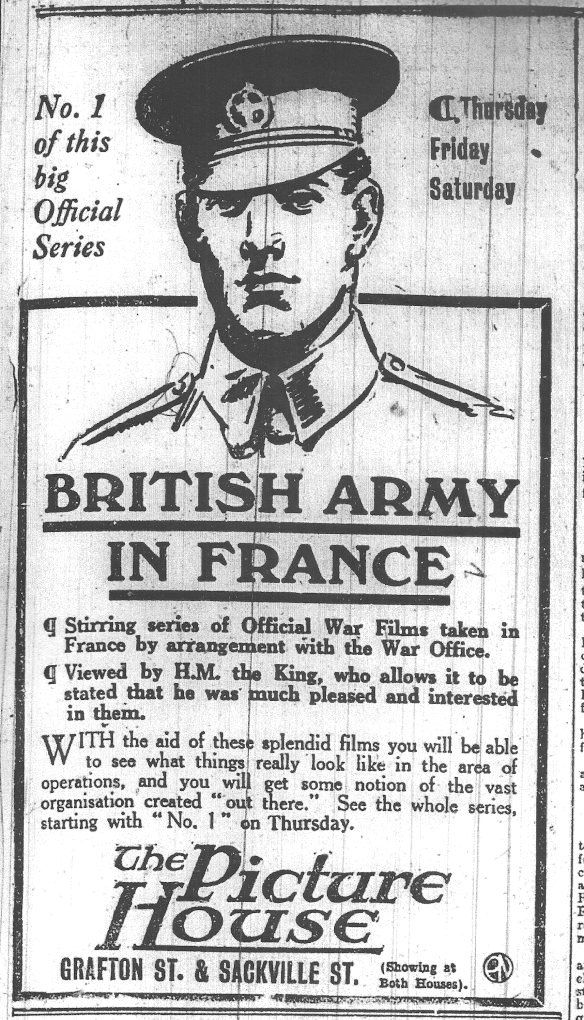
The Exploits of Elaine showing in Mullingar. Westmeath Examiner 26 Feb. 1916: 8.
Reports of the Newry case, or similar cases elsewhere, may have inspired the behaviour of the 12-year-old John Connor, Thomas Keena and Michael Creevy who on 26 February 1916 were arrested for stealing in Mullingar. Sergeant Campbell informed the petty sessions that having been told by J. F. Gallagher that £1 10s had been robbed from his shop, he went to Healy’s Picture House and found the boys in possession of the remainder of the money. Although the chairman of the petty sessions seemed inclined to grant Creevy’s mother’s request for bail for her son, the boy himself asked not to be sent home but to go to a detention home with the other boys. While in the cells at the police barracks, the boys reportedly sang “It’s a Long Way to Tipperary” and shouted “Hurrah for the Clutching Hand” (“Robbery in Patrick Street”). The magistrates hearing the boys’ case sent a resolution to the Mullingar Town Commissioners urging them not to renew picture house licences until the proprietors undertook not to show any film that depicted burglary to children under 16 (“Youths Charged with Robbery”). The Commissioners simplified this by barring boys under 16 from evening performances (“Mullingar Town Commissioners”).

These cases lent fuel to the campaigns to regulate – or eliminate – cinema. “What is really a little alarming,” argued a writer in the Irish Times citing the Newry case,

is the prospect of a gradual Americanisation – and a very cheap sort of Americanisation at that – of all our English and Irish ideals and of the whole British outlook on things in general. To-day the picture-house does little or nothing for patriotism; it is not helping us to victory in the field. (“American Films.”)

This writer supported H. G. Richards’ suggestion in the London Times that the importation of all foreign – mainly American – films be banned, including raw film stock. Richards argued this move would save £2 million, free up space on cargo ships, encourage the British film industry to expand, and make films more educational. Considering some of the economic and moral arguments for and against a ban, the Sunday Independent seemed to come down against it. “Naturally for the defence,” an editorial item observed, “we have the sound standing arguments of the public need of diversion in war as well as peace-time, and the benefit to temperance of the competition of the Cinema theatres with the publichouses.” The writer seemed to consider something of a clincher the fact “that on each of the British battle cruisers which await the appearance of the German fleet is installed a picture show for the amusement of the fighting men” (“The Passing Show”).

Few in the industry shared Richards’ views. Fan magazine Pictures and the Picturegoer pointed out that while British audiences were staunch supporters of British films, domestic companies could not supply the market. “[U]nfortunately, the [British] films that are worth much would not go far to feed the four thousand odd theatres,” s/he observed. “Indeed, if all the British film companies suddenly decided to work day and night in order to turn out films with the rapidity of a munitions factory, the output would provide but a mere drop in the ocean” (“Don’t Close Our Picture Theatres”). As the article pointed out, the dearth of people and materials in wartime made it unlikely that the British industry could expand to any great degree.

While these kind of arguments were unlikely to convince those intent on reshaping a mainly entertainment medium into a mainly educational one, other government priorities militated against a film-import ban. The Irish papers prepared their readers for the imposition of an amusement tax in the upcoming budget as a much-needed revenue-raising measure. Cinemagoers would feel the clutching hand of the war economy in May.

References

“Action of Corporation: Petition to House of Commons.” Freeman’s Journal 3 Aug. 1916: 7.

“American Films.” Irish Times 14 Feb. 1916: 4.

“Boys and the ‘Clutching Hand’: Remarkable Case at Newry.’” Irish Times 10 Feb. 1916: 6.

“The ‘Clutching Hand’ Revealed.” Irish Times 20 Jan. 1916: 9.

“Don’t Close Our Picture Theatres: ‘Movies’ the War-Time Medicine of the Masses.” Pictures and the Picturegoer 26 Feb. 1916: 494.

“Dublin and District: Rotunda Pictures.” Irish Independent 20 Jan. 1916: 5.

“Kinsale Notes and Notions.” Southern Star 5 Feb. 1916: 7.

“Mullingar Town Commissioners: Cinemas and the Youth.” Westmeath Examiner 18 Mar. 1916: 6.

Paddy. “Pictures in Ireland.” Bioscope 27 Jan. 1916: 344.

“The Passing Show.” Sunday Independent 13 Feb. 1916: 4.

“Robbery in Patrick Street: Extraordinary Performance of Boys.” Westmeath Examiner 4 Mar. 1916: 8.

“Youths Charged with Robbery: Cheering for the ‘Clutching Hand.’” Westmeath Examiner 18 Mar. 1916: 6.

“The Nation’s Historian” or a “Violent Stimulant to the Eyes”?: Irish Cinema at the Beginning of 1916

Balfour Bio 6 Jan 1916

Arthur Balfour, “Cabinet Minister as Cinema-Lecturer,” touts the importance of war films; Bioscope 6 Jan. 1916: 16.

On 29 December 1915, Arthur Balfour, Britain’s First Lord of the Admiralty, attended a screening of the war film Britain Prepared (Britain: Urban, 1915) at London’s Empire Theatre, Leister Square. “[T]these pictures constitute something more than an afternoon’s amusement,” he asserted. “They contain a lesson of the deepest import to us and the world” (“Britain’s Might Revealed”). The trade journal Bioscope was delighted with Balfour’s comments before the screening, drawing attention to them in a prominent article in its first 1916 issue. “This is, we believe, the first time in the history of the cinematograph that a Cabinet Minister has made a formal speech of introduction at an exhibition of moving pictures,” it claimed, “and as such it is an event of no small significance.” The Bioscope of 20 January clarified the magnitude of its significance, when it declared that cinema was now – finally – “The Nation’s Historian”:

The Trade has just cause for pride and gratification in the complete unanimity with which Press and public, Cabinet Minister and man-in-the-street alike, have welcomed the official cinematograph pictures of the war and the life and training of our soldiers and sailors. It has, we admit, taken a very long time to convince the Government and the Fourth Estate of the value of the cinematograph as the national historian, but now that their approval is forthcoming and the work pronounced to be good, we can well afford to regard the time as well spent. (“Nation’s Historian.”).

Doubtless Balfour’s endorsement of Britain Prepared was a valuable governmental recognition of the British film industry, and as such it is an important historical document. It is more doubtful that a film clearly conceived as propaganda – showing how Britain had prepared and was prepared to fight its enemies – can be considered a work of history. Nor was the Bioscope really interested in making a case for the film as history; it was enough of an achievement that Balfour’s presence and words showed how useful cinema had become to the war effort.

Metro ad DEM 3 Jan 1916

David Lloyd George and H H Asquith feature in this ad for Metro Pictures; Dublin Evening Mail 3 Jan. 1916: 5.

While Balfour argued that Britain Prepared was not mere entertainment but a film that British politicians should take seriously, one distribution company suggested that two other Cabinet ministers were watching its films for relaxation. In January 1916, the Dublin Evening Mail carried a series of ads placed by Ruffell’s, British agents for US production and distribution company Metro Pictures. The ads featured the Ruffell’s mascot, a parrot in a top hat, and in the first of these ads – which is in comic-strip form – the parrot convinces Minister for Munitions David Lloyd George and Prime Minister Herbert Henry Asquith to watch a Metro film as a needed break from their war duties. The incongruity of the images of these senior politicians visiting a cinema with the behatted and cigar-chewing parrot might distract from the no-less significant if admittedly less spectacular incongruity of this and other ads appearing in an Irish daily newspaper. Distribution was a wholesaling business; it acted as the intermediary between the manufacturers – film production companies such as Metro – and the retailers – the cinema-owners who actually showed the films. In the ordinary course of business, a distribution company such as Ruffell’s would advertise in such cinema trade journals as the Bioscope but not in the dailies. Ruffell’s did advertise in the trade press, but this series of ads sought to create recognition among cinema-goers of the relatively new Metro brand name and of the Ruffell’s parrot.

British Army DEM 20 Jan 1916

Official war film British Army in France at the Provincial Cinematograph Company’s Dublin picture houses. In the fist half of this week, the Grafton had shown With the Indian Troops in France. Dublin Evening Mail, 20 Jan. 1916: 5.

And the parrot was right: cinema was more likely the nation’s – or the world’s – entertainer than its historian. Amusement was the primary reason that Irish patrons visited a picture house, even if they did also come for other reasons, including to see how the war that they mostly read about in newspapers actually looked, and to cheer or to boo at a film that sought to use such images to engender patriotic feelings towards a nation that was invariably Britain. Nonetheless, the notion of the cinema as national historian had particular resonances for Ireland in 1916, as it has in 2016 as the country commemorates 1916. The experience of the more than 200,000 thousand Irishmen in the British armed forces were, of course, represented to some extent by Britain Prepared and other propaganda films that were appearing in increasing numbers. The Picture Houses in Grafton Street and in Sackville/O’Connell Street, which were owned by the British chain Provincial Cinematograph Theatres, made a particular feature of these films, promoting them with prominent illustrated ads, such as the one for British Army in France on 20 January. The Bioscope quoted Balfour as regretting that Britain did not “have a permanent record of the grand deeds of our armies in France and Flanders” (“Britain’s Might Revealed”). A number of such films did exist, but filmmakers would answer this call for a permanent record most spectacularly later in the year in the form of the film The Battle of the Somme (Britain: British Topical Committee for War Films, 1916).

As one of the main purposes of such films was to show the unity of the kingdom, they could not represent the motives of Irish nationalists, who had to look elsewhere for elements of an Irish historical experience on film. This was clearly so in the case of the separatist nationalists who sought Irish independence from Britain and opposed recruitment, but it also included the many more moderate Irish nationalists, even soldiers who had joined the war in answer to John Redmond’s call to fight for Home Rule. Nationalist MPs at Westminster ensured Ireland was treated as a special case even in relation to military recruitment, a fact emphasized in January 1916 when the Military Service Act excluded the country from the compulsory conscription. Given the paucity of film production in Ireland, there was little prospect of cinema providing a detailed film record of the struggle for Irish national self-determination. The nearest thing to such a film was Ireland a Nation (US: Macnamara, 1914), shot in Ireland in 1914 but not shown in the country until 1917. Newsreel films of armed National and Irish Volunteers parading do exist, albeit that the Ulster Volunteers were better at media management, including arranging for cinematograph operators to record significant demonstrations. Fiction films representing Ireland’s rebellions in 1798 and 1803 had been made by US companies such as Domino and Kalem, Sidney Olcott shooting many Irish-shot films for the latter. The special Sunday shows at Dublin’s Phibsboro Picture House on 23 January featured For the Wearing of the Green (US: Domino, 1914), in which “Paddy Dwyer, the Irish blacksmith, and his helper, Dennis Grady, who is also his daughter Norah’s sweetheart, are the prime leaders in the conspiracy against the Crown” (“Domino”). The Hibernian Electric Theatre’s Sunday feature a week later was Olcott’s The Mayor from Ireland (US: Kalem, 1911), in which two Irish immigrants follow each other in the office of New York mayor. Neither of these films was a new release, but their revival suggests their importance for Irish audiences in offering fictional self-representations that included revolutionary romances.

Hibernian ad ET 29 Jan 1916p1

Ad for Hibernian, Evening Telegraph 29 Jan. 1916: 1.

Indeed, the Hibernian Electric Theatre may provide one of the most direct links between Irish cinema and the revolution that was being planned for 1916. This picture house at 113 Capel Street, Dublin, had previously been called the Irish Cinema and had been owned and run by Richard Graham. Financial difficulties including rent default forced Graham to sell in late 1915 (“Capel Street Picture House”). No account of the reopening as the Hibernian appears to exist, but it was advertising in the Evening Telegraph by the start of January. The ads and short notices that month give an indication of some of the people involved, including manger Thomas Fullam and musical director Miss M. Grundy (“Hibernian Electric Theatre”). It is possible that it was owned or part owned by Michael Mallin, as later recalled by his son (Hughes 76-78.). Dublin silk weaver, British Army bugler, union organizer and leader of the Irish Citizen Army, Mallin would be executed in May 1916 for his role in the Easter Rising. How his picture-house experience may have had a bearing on his revolutionary activity or vice versa is difficult to say. Nevertheless, the Hibernian was located beside the Trades Hall – a fact noted in ads – and it is likely that its programming aimed to attract union members, as well as the many working class people who lived in the slum districts that would have been the catchment area for the cinema’s audience. In 1913 and 1914, the Irish Cinema had been the only picture house and one of the few entertainments of any kind that advertised in the radical labour journal The Irish Worker. However, apart from The Mayor from Ireland, its offerings seem little different from those of other Dublin picture houses.

Larkin Prison II 4 Jan 1916p4

Irish Independent 4 Jan. 1916: 4.

If Irish picture-house owners – even radical ones – had only moulded cinema in limited ways to produce a national moving image, religious groups were working more deliberately to ensure that cinema reflected the churches’ worldview. This was particularly the case with Catholic groups, such as the Dublin Vigilance Committee, which in December 1915 had coalesced with other vigilance groups around the country to become the Irish Vigilance Association (IVA). Following his arrest on 31 December 1915, serial cinema protester and militant IVA member William Larkin was released from Dublin’s Mountjoy Jail on 4 January 1916. He had been imprisoned for non-payment of the fine imposed on him in October and November for his protest at the Bohemian Picture Theatre in September (“Picture Theatre Protest”). The IVA arranged a parade of welcome from Larkin’s house in Sherrard Avenue in the north city to Foster Place, a favoured place to hold speeches beside the city-centre building that had until 1800 had been the Irish parliament. Larkin’s short prison term had done nothing to lessen his activism on the introduction of film censorship; indeed, it allowed him to claim a certain martyrdom. “I was treated as a low criminal in Mountjoy Jail for protesting against a film,” he claimed in an exchange of correspondence published by the Evening Telegraph. “I had to don a convict’s garb, eat skilly, lie on a board, and refuse hard bread. I had to parade with degenerates in a prison yard; and all, that our youth might be spared gazing on suggestion” (“Proposed Cinema Censorship”).

This concern with young people also prompted calls for censorship from reformers seemingly unaligned with the IVA. In a letter to the Telegraph, E. Gordon urged regulation of picture houses to prevent children from attending late evening shows. “I have seen toddlers and youngsters, aye, and smoking cigarettes (another Dublin byelaw more honoured in the breach than the observance) in picture houses at 10.30 p.m,” he observed:

Where did they get the money, and where were their homes? Where were their parents? Why are those children allowed to spend their lives thus? Perhaps the housing question would account for a lot of it. Now, those youngsters go in to a picture house (“It’s only tuppence, Billy”). They do not go in to look at a moral lesson faithfully learned, or for education – only for a laugh, and “it’s comfey.” (“Children at the Cinema.”)

Gordon wished for an educational cinema, recognizing it as “a great, wonderful and fascinating optical achievement (if directed in the proper channel) that was never dreamt of twenty years ago.” As such, it was an “accomplishment which makes old lanternists blush, and yet their blush can be condoned, for the old scientific lantern will still hold its own, at least in the class-room and lecture hall.”

In the Dublin township of Rathmines, the ongoing controversy on the opening of picture houses on Sunday continued into early 1916. At a meeting on 5 January, the council eventually split 8-8, and the chairman cast the deciding vote in favour of closing cinemas on Sundays; they had had limited opening hours before this. Councillor Thomas Kennedy spoke in favour of keeping them open, reading a supporting letter from the Ratepayers’ Protection Association that argued that soldiers’ relatives particularly liked seeing war reports and that closing cinemas on the only day when many people could visit them would drive these people to the pubs for recreation. Rejecting such arguments, Chairman Sibthorpe explained that he had cast his vote in favour of Sunday closing because oculists had “stated that their work had been more than doubled since these cinemas had been applying a violent stimulant to the eyes of the young people, and they were absolutely ruining the sight of the rising generation” (“Cinema Shows”).

Young people who got into trouble with the law – and their legal representatives – were well aware of these discourses on cinema’s pernicious effects on the young and of how to use them to their advantage. When “two young fellows” named Richard Barnes and Thomas Farrell appeared before Mr. Swifte at Dublin’s Southern Police Court on 27 January 1916, their solicitor argued that they had entered a banana store illegally because of watching burglaries at the picture houses and playing slot machines (“Cinema and Slot Machines”). These new forms of popular culture “were the means of leading many a young fellow astray,” he argued.

Charlie at the Bank

Chaplin foils a robbery in Charlie at the Bank (US: Essanay, 1915).

The person responsible for a good amount of this violent visual stimulation in Ireland in 1916 was Charlie Chaplin, but in January 1916, he was foiling robberies rather than committing them. The writer of the Evening Telegraph’s “Gleaned from All Sources” column, however, had picked up the news that Chaplin’s career was on the wane, “which is the obvious and inevitable result of overdoing the Chaplin ‘boom.’ When it came to imitations in music-hall revues and Charlie Chaplin calendars and pin-cushions,” s/he observed, “a reaction was inevitable.” Despite merchandizing and overexposure, that reaction was not apparent in Dublin picture houses, according to the review writer in the same issue of the Telegraph. Charlie at the Bank had recently been released, and the reviewer was assessing the show at the Pillar Picture House. “There is more riotous fun packed into this two-reel comedy than any other photo-play of a like length. The world’s great comedian, Charlie Chaplin, has outdone himself in this new production. While all his other comedies are funny, this one is a scream. It abounds in real humour and comic situations, with Chaplin at his best in his inimitable antics” (“Pillar Picture House,” 18 Jan.). Charlie at the Bank was shown at more picture houses than any other film that month, suggesting that cinema-owners did not believe that Chaplin’s career was experiencing a dip. Audiences seemed to agree: on account of the “hundreds who could not gain admission” during the three day run, the film was held over for a further three days (“Pillar Picture House,” 20 Jan.).

As 1916 began, Irish audiences enjoyed a thriving cinema culture that more often offered them a violent stimulant of the Chaplin kind than national history.

References

“Britain’s Might Revealed by Film: A Cabinet Minister as Cinema-Lecturer.” Bioscope 6 Jan. 1916: 16A.

“Children at the Cinema.” Evening Telegraph 8 Jan. 1916.

“Cinema and Slot Machines.” Dublin Evening Mail 27 Jan. 1916: 5.

“Cinema Shows: Sunday Performances in Rathmines: Action of Urban Council.” Evening Telegraph 5 Jan. 1916: 5.

“Domino: The Wearing of the Green.” Moving Picture World 3 Mar. 1914: 1302.

“Dublin and District: Picture Theatre Protest.” Irish Independent 1 Jan. 1916: 6.

“Gleaned from All Sources: The Late Charlie Chaplin.” Evening Telegraph 18 Jan. 1916: 1.

“Hibernian Electric Theatre.” Evening Telegraph 29 Jan. 1916: .

Hughes, Brian. Micheal Mallin. Dublin: O’Brien Press, 2012.

“The Nation’s Historian: Triumphant Vindication of the Cinematograph.” Bioscope 20 Jan. 1916: 229.

“Pillar Picture House.” Evening Telegraph 18 Jan 1916: 5; 20 Jan 1916: 5.

“Proposed Cinema Censorship.” Evening Telegraph 11 Jan. 1916: 3.

Succeeding Like Success: Irish Cinema at Christmas 1915

Carlton Cinema, c. 1920. Source: Art Deco in Dublin.

Carlton Cinema, c. 1920. Source: Art Deco in Dublin.

Christmas 1915 was worth celebrating for those involved in the cinema in Ireland. Despite the war and attempts by religious groups to limit its expansion, cinema had continued to grow in 1915, and several new picture houses opened in time for end-of-year holiday season. In many ways, then, a short item in the trade journal Bioscope in December 1915 on the recent opening of an Irish cinema well characterizes the state of the industry as a whole at the end of 1915. “They say,” it began, “nothing succeeds like success” (“Trade Topics”).

However, the success of cinema in 1915 needs to be qualified as well as acknowledged. For a start the short Bioscope item appears to be a promotional piece with little substance. It continues: “but what Mr. Andy Wright said a few nights ago when, in opening the doors for the first time of his new theatre at Waterford, he was knocked down in the rush of an eager populace anxious to secure their seats, is not recorded.” Not recorder either – by this item or other contemporary sources – is what the name of this new theatre was. Not that Wright was unused to the openings of Irish picture houses. Best known as the managing director of the Liverpool-based distribution company Films, Limited and of Wright’s Enterprises, he was also heavily involved in a number of exhibition companies in Ireland. He was a director of Irish Empire Palaces, of the company that built and ran Dublin’s Phoenix Picture Palace, and of Southern Coliseums (“World of Finance”; Paddy, 7 Nov.). Following successes in Wexford and Kinsale during summer 1915, he had opened the Cinema in Carlow in September (Paddy, 9 Sep.). However, this item – if it has any basis in reality – must refer to the opening two months earlier of Waterford’s Coliseum, following its conversion from the Waterford Rink (Paddy, 28 Oct.).

Opening of Enniscorthy's Cinema Theatre, Echo Enniscorthy 4 Dec. 1915: 6, and 11 Dec. 1915: 6.

Ads for the opening weeks of Enniscorthy’s Cinema Theatre, Echo Enniscorthy 4 Dec. 1915: 6, and 11 Dec. 1915: 6.

Among the actual openings for the 1915 Christmas season were picture houses in Enniscorthy, Belfast and Dublin. Enniscorthy’s new Cinema Theatre opened on Wednesday, 8 December, at the Ancient Order of Hibernian’s hall on New Street, which on the occasion, “was crowded, and many people were turned away. The hall was cosily fitted up. The screen proved to be large and the pictures to be clear and bright” (“New Cinema”). All the machinery, fittings and films for the new Cinema Theatre had been provided by Norman Whitten’s General Film Supply, which was also fitting out the picture house in Waterville, Co. Kerry, (Paddy, 9 Dec.). With a population of just 5,500, Enniscorthy could sustain this new picture house alongside the existing Abbey Picture House. Nevertheless, the Abbey put on a rival programme of comedies for 8 December designed to maximize its own audience. Competing with the Cinema Theatre’s naval drama On Secret Service (US: American, 1915) and Chaplin two-reel comedy Laughing Gas (US: Keystone, 1914), the Abbey topped its bill with the Chaplin six-reel feature comedy Tillie’s Punctured Romance (US: Keystone, 1914).

Dublin picture houses advertising the first showings of Chaplin's latest film Charlie at Work. Evening Telegraph 4 Dec. 1915: 1.

Dublin picture houses advertising the first showings of Chaplin’s latest film Charlie at Work. Evening Telegraph 4 Dec. 1915: 1.

Enniscorthy did not have a monopoly on Chaplin. He was still everywhere, with the films he made with Keystone in 1914 still in circulation while his newer Essanay films received special advertising. When Dublin’s Pillar Picture House, Mary Street Picture House and Electric Theatre, Talbot Street premiered the new Charlie at Work on 6 December, Getting Acquainted (US: Keystone, 1914) maintained the audience of the Picture House, Sackville/O’Connell Street “in continuous roars of laughter,” while at the Masterpiece Theatre, one of the Keystones in which Chaplin played alongside Ford Sterling “kept the house in an uproarious mood” (“Picture House,” “Masterpiece”). Of the many other stars, perhaps Mary Pickford was the only one to approach Chaplin. On 2 December, Cork’s Coliseum showed Mistress Nell, which featured Pickford, “who has become such a prime favourite in many Irish picture theatres” (Paddy, 2 Dec.).

Willowfield PH Belfast

Willowfield Picture House and Unionist Club. Cinema Treasures.

Neither Chaplin nor Pickford topped the bill when Belfast’s newest cinema the Willowfield Picture House opened on 20 December. There was nothing at all unusual about the military mien of the featured drama The Commanding Officer (US: Famous Players, 1915), even when it was complemented by a local topical film of The Inspection of the Ulster Division (1915). The latter film was, however, unusually appropriate for a venue that was also the social club for the Ulster Unionist Party.

Evening Telegraph, 24-25 Dec. 1915: 4.

Evening Telegraph, 24-25 Dec. 1915: 4.

Dublin’s newest cinema was less out of the ordinary. When the Carlton Cinema Theatre opened its doors on 27 December, it was the last new Irish picture house of 1915. Located at 52 Upper Sackville/O’Connell Street, it had been designed by architect Thomas F. McNamara for Frank W. Chambers, who also ran a tobacconist and billiard hall on the same street. “There is a magnificent entrance and lounge – the latter also being a tea room,” the Bioscope’s Paddy noted, “which lend an imposing appearance to the whole theatre” (6 Jan.). Inside, “[t]he hall is very spacious and well proportioned; the slope in the floor is a distinct improvement, whilst the scheme of decoration and lighting is very effective (“New Carlton Cinema Theatre”). The main opening film was His Wife’s Story (US: Biograph, 1915), which was accompanied, Paddy revealed, by an “orchestra, which consisted of two violins, a piano and a ‘cello.” He predicted that “with the improvement which is bound to come in the course of time, [it] should prove one of the best orchestras in Dublin.” All reviewers commented on the lack of expense spared by Chambers in fitting out the cinema, including in the generator and projectors chosen. “There is, indeed,” the Irish Times declared confidently, “little likelihood of spectators having to suffer the delay of a breakdown, in the Carlton” (“New Picture House”).This was just tempting fate because the same paper reported on 20 January 1916, that a breakdown in the generator had been repaired and that “the light on the picture screen is now perfect” – suggesting previous imperfections – for upcoming screenings of the adaptation of Arthur Conan Doyle’s A Study in Scarlet (“Carlton Picture Theatre”).

Despite such initial technical difficulties, the Carlton would become one of the city’s most popular cinemas. Partly this was because of its favourable location opposite the Gresham Hotel, but it was also because of the musical attractions it would soon offer. In doing so, it would have to compete with two well-established rivals, the nearby Rotunda and the suburban Bohemian. At the Rotunda, “[t]he music, which is now an important feature of a Picture Entertainment, is supplied by the first-class Orchestra, under the baton of Miss Murphy, R.I.A.M.” (“Rotunda Pictures”). However, the state of the art in film accompaniment in Dublin was to be heard at the Bohemian, and in December 1915, it was about to popularize the cinema solo. “The success attendant on the violin solos given by Miss M. Burke, a member of the Bohemian orchestra, during the performances of last week,” an Evening Telegraph reviewer revealed, “doubtless influenced the management to engage for the present week the services of Mr. Patrick Delaney, the celebrated violinist, who rendered at the 7 and 9 performances some delightful selections, which were warmly applauded by large audiences” (“Bohemian”). Although the Bohemian management decided to engage a male soloist, this development was started by one of the city’s skilled women musicians. This Miss M. Burke is likely Mary Burke, who in the 1911 Census is listed as a Galway-born music teacher living in the nearby suburb of Drumcondra.

Victoria Boh Orch 25 Dec 1915p4

Dublin’s Bohemian Orchestra helped reopen Galway’s Victoria Cinema. Connacht Tribune 25 Dec. 1915: 4.

The Bohemian and Galway would have other connections at Christmas 1915. Galway saw the reopening of two of its picture houses – the Cinema Theatre and the Victoria Cinema – on St. Stephen’s Day, 26 December. The main Christmas pictures at the other cinemas – the Court Theatre and the Town Hall Pictures – were serials, the firth episode of The Black Box (US: Universal, 1915) in the case of the Court and the eighth episode The Exploits of Elaine The Exploits of Elaine (US: Wharton, 1914) at the Town Hall. This sense of business as usual was not adopted by the reopening venues, which offered special musical features. The Cinema Theatre under new manager George Gutherie, engaged two singers, “Australian Prima Donna” Marie Elster, who sang “Ave Maria,” and juvenile Irish vocalist Ruth Conway. Among its main alterations, the Victoria Cinema had erected a veranda to protect queuing patrons from the rain, replaced its screen and installed a new projector “to prevent delays between the parts of one picture.” These infrastructural enhancements were launched by a three-day visit from Percy Carver’s Bohemian Orchestra, “acknowledged by press and public as the finest in Ireland” (“Notes & News”). Whether or not Mary Burke was among the visiting musicians is not recorded.

Christmas was celebrated in picture houses around the country with such traditional fare as pantomime films but also with more recent innovations. The Cork Examiner’s review of Robinson Crusoe at Cork’s Coliseum asserted the superiority of the cinema version over the theatrical. “There must be more than ‘Crusoe’s’ own adventures in the modern [theatrical] pantomime. Topical songs are introduced, and this distracts the attention from the mariner’s adventures. It is here the cinema producer scores, for he can keep the main story before the mind all the time” (“Coliseum”). Christmas provided the opportunity for showmen and -women to mount extra film entertainments and for travelling picture shows to visit smaller towns that did not have a regular cinema. James Barrett was granted a licence for a film show in Castlebar’s Town Hall (“Castlebar Urban Council”). With a population of just over 1,500, Granard, Co. Longford, hosted a “highly attractive cinema and gramophone entertainment” at the Town Hall on 29-30 December, “organised for the comforts’ fund of the various battalions of the Leinster Regiments” (“Granard Notes”).

Cinema’s role not only as entertainment but also as a recruiting tool was an important way in which its social usefulness was measured in Christmas 1915. Those men who had not yet enlisted were encouraged to do so by recruitment meetings that included films in Macroom, Charleville and other Co. Cork towns (“Macroom Notes,” “Recruiting Rally”). By contrast, the Freeman’s Journal indicated that some popular films and plays were attempting to prevent recruiting. Praising recruiting efforts around the country, an editorial item observed that the “Irish capital has certainly done magnificently, and perhaps the greatest incentive to recruiting in our midst has been the idiotic pin pricks of the pro-German humbugs, passing as melodramatic Emmets and cinematograph Wolfe Tones” ([Editorial item]). Although it is unlikely that the writer had yet seen it, Sidney Olcott’s Irish-shot Bold Emmett, Ireland’s Martyr (US: Sid Olcott Feature Players, 1915) – steeped in the Irish melodramas of Dion Boucicault – could have been so described.

Dec 4 1915 Nationality PHs ad

Picture house advertising helped fund some of the radical nationalist press; Nationality, 4 Dec. 1915: 3. Available online from the National Archives of Ireland.

Cinema was not expanding everywhere, in part due to the war but also because it had opponents, some of whom were even more active and influential than the Freeman’s editorial writer. Kells Picture House closed for one of its regular hiatuses when its tenancy terminated on 7 December, but it would reopen again in January ([Small ad]). The Ormonde Cinema Company informed Nenagh Town that

[i]n reference to the opinions of well-known advocates of economy during the continuance of the war, and to encourage their propaganda so far as amusements are concerned, [we] have decided to hold exhibitions of pictures only twice weekly in future, viz., on Sunday and Wednesday nights instead of four nights, as was their practice hitherto. (“Nenagh Town Council.”)

Other kinds of cultural nationalist propaganda also rejected cinema. Minnie McAllister of Magherafelt, Co. Derry, the recipient of the third prize in the Columban League of Irish Youth essay competition, included going to the pictures among the foreign manners and customs that Irish boys and girls should avoid. “There is nothing in these performances that appeals to the real Irish imagination,” she wrote, “and frequently enough they are of a description that should not be tolerated in any self respecting country” (“Columban League of Irish Youth”).

Edward O’Dwyer, bishop of Limerick, was of a similar opinion. Just in time for the New Year, he wrote a letter on the exhibition of an immoral film in Limerick city to Fr J. A. O’Connor, administrator of St Michael’s parish that was published nationally in the Cork Examiner and Freeman’s Journal (“Indecent Picture Exhibitions,” “Immoral Pictures”). “On last Wednesday,” he revealed, “a picture was shown in one of these houses, and from the descriptions which has been give to me of it, I feel bound to take the strongest steps within my power as a Catholic Bishop, to prevent the continuance of such an agency of corruption” (ibid.). The description of which film so incensed the bishop is not clear, but he seemed disinclined to confirm its offensiveness by actually viewing the film before urging that swift steps be taken against the picture house in question. On the last day of the year, Limerick’s Vigilance Committee informed the Borough Council through the pages of the Limerick Leader that it could within days expect the Committee’s draft restrictions to be included in subsequent cinematograph licences (“Limerick Vigilance Association”). At a meeting earlier in the month in which the Dublin Vigilance Committee revealed that it had been granted representation at the Recorder annual hearings to grant – or deny – music licences to picture houses, the Committee had acknowledged the increasing national reach of the vigilance movement by changing its name to the Irish Vigilance Association (Dublin Committee) (“Dublin Vigilance Committee”).

As 1915 ended, cinema was certainly a more important cultural force in Ireland than it had ever been, seen as variously profitable, pleasurable and useful. However, it had formidable local opponents ranged against it that were more organized and determined to curb its influence or to destroy it.

References

“The Bohemian.” Evening Telegraph 7 Dec. 1915: 2.

“The Carlton Picture Theatre.” Irish Times 20 Jan. 1916: 8.

“Castlebar Urban Council.” Western People 18 Dec. 1915: 2.

“Coliseum: ‘Robinson Crusoe.’” Cork Examiner 28 Dec. 1915: 6.

“Columban League of Irish Youth: Occasional Chats with the Members.” Donegal News 18 Dec. 1915, p. 7; Ulster Herald 18 Dec. 1915: p. 3.

“Dublin Vigilance Committee.” Evening Telegraph 4 Dec. 1915: 3.

[Editorial Item.] Freeman’s Journal 18 Dec. 1915: 6.

“Granard Notes.” Longford Leader 25 Dec. 1915: 1.

“Immoral Pictures: Letter from Most Rev. Dr. O’Dwyer.” Freeman’s Journal 30 Dec. 1915: 6.

“Indecent Picture Exhibitions: Letter from Most Rev. Dr. O’Dwyer.” Cork Examiner 30 Dec. 1915: 4.

“Limerick Vigilance Association: And Local Picture Houses: Important Restrictions Proposed.” Limerick Leader 31 Dec. 1915, p. 10.

“Macroom Notes.” Southern Star 18 Dec. 1915: 5.

“The Masterpiece.” Evening Telegraph 7 Dec. 1915: 2.

“Nenagh Town Council and Retrenchment.” Nenagh News 25 Dec 1915: 2.

“The New Cinema.” Echo Enniscorthy 11 Dec. 1915: 7.

“A New Picture House.” Irish Times 30 Dec. 1915: 3.

“Notes & News.” Connacht Tribune 25 Dec. 1915: 4.

Paddy. “Pictures in Ireland.” Bioscope 7 Nov. 1912: 417; 9 Sep. 1915: 1176; 28 Oct. 1915: 468; 9 Dec. 1915: 1109; 30 Dec. 1915: 1472; 6 Jan. 1916: 53.

“The Picture House, O’Connell St.” Evening Telegraph 7 Dec. 1915: 2.

“Recruiting Rally in North Cork.” Cork Examiner 29 Dec. 1915: 8.

“Rotunda Pictures.” Evening Telegraph 24 Dec. 1915: 6.

[Small ad.] Meath Chronicle 4 Dec. 1915: 5.

“Trade Topics.” Bioscope 23 Dec. 1915: 1307.

“World of Finance.” Bioscope 7 Mar. 1912: 689; 13 Jun. 1912: 807.

Monopolizing the Limelight: Irish Cinema and Politics in Autumn 1915

“Valentine Grant in All for Old Ireland, the first of a series of Lubin comedy dramas made in Irelnad.” Pictures and the Picturegoer 11 Sep. 1915: 461. Courtesy of the Media History Digital Library.

In late August 1915, a Dublin Evening Mail columnist urged readers to pay more attention to such politicians as Winston Churchill than to celebrities. “It would undoubtedly be very bad for the nation,” s/he argued,

if its greatest heroes were, say, Mr. Harry Lauder […] or Charlie Chaplin, who is said to be making a colossal fortune by comic performances for the cinematograph films. These people deserve our respect, no doubt; they scarcely ever fail to get our applause; but we must not give them the monopoly of the limelight. (“Town Topics.”)

Given that limelight was the late 19th century’s favoured theatrical lighting, this was precisely what one should expect such star performers as Harry Lauder and Charlie Chaplin to be monopolizing, had not “limelight” already become synonymous by 1915 with public attention. Churchill, Chaplin and limelight: even as the Mail reporter denies it, the juxtaposition is suggestive of an early celebrity culture that made little distinction between a personality’s reasons for occupying the public’s gaze, be his or her forte politics or pratfalls. In Irish picture houses in mid-autumn 1915, politics – if not Churchill – were important, but Chaplin was everywhere.

Evening Telegraph 13 Sep. 1915: 2.

Lord Kitchener, all but pointing his finger at us in this illustrated ad from the Evening Telegraph 13 Sep. 1915: 2.

Churchill did not appear on Irish cinema screens at this time – or at least, he was not noted to have done – but politics both international and national was visible in films and in the picture-house auditorium. Irish-born Horatio Herbert Kitchener, British Secretary of State for War, was a more visible and commanding presence in pictures houses than Churchill in September 1915. His image appeared on illustrated ads for the film Lord Kitchener in the Firing Line (Britain: Gaumont, 1915). “At one point Lord Kitchener is seen observing the German positions,” noted the Freeman’s Journal, “at another he is reviewing the French troops. Taken altogether, the film is of great historic interest” (“Grafton Picture House”). Film’s usefulness as a recruiting tool was also being recognized in Ireland, where the Dublin Recruiting Committee awarded Norman Whitten’s General Film Supply a contract to produce an Irish recruiting film (Paddy, 9 Sep.).

Bioscope 23 Sep. 1915: 1380.

Full-page from the Bioscope 23 Sep. 1915: 1380.

It was not only in such newsreel specials that the war was represented but also in fictional propaganda films (see more here, here and here). In late September, Eclair publicized “Give Up your Gold, It’s for Britain!!” (France, 1915), which aimed to increase public subscription to war funds. Although the War Office had begun to make and commission films itself, this film was produced by a commercial company that expected the film to be popular by catching widespread support for the war. “Although we have had many ‘war films,’” the Bioscope observed, “[i]n too few cases has the wonderful power of the cinema drama in propaganda work been realised and made use of” (“Give Up Your Gold”). As was the Bioscope’s practice, such significant if modest progress in British – or in this case, Franco-British – propaganda was said to be more than matched by developments in Germany. The paper reprinted a report from the Daily Chronicle outlining the expansion and increased coordination of the film department of the “‘Central For Foreign Service,’ whose mission is the circulation of ‘true information’ about Germany in neutral countries” (“German Film Campaign”). The article emphasized that this was a well-connected and competent committee that included “Baron von Mumm, late German Ambassador at Peking, and the notorious Herr Dernburg,” a film producer. The worrying damage its films could do in neutral European countries might be bad enough, but “an American has had duplicates of all the new films supplied to him and […] he is pledged to exhibit them in the United States” (ibid.).

Irish loyalty and commitment to the war effort was by no means unanimous, but it was widespread given the number of Irishmen serving in the British armed forces. In the initial months of the war, the Bioscope had kept a tally of cinema personnel, including those from Ireland, who had volunteered, but as the war wore on, the journal had discontinued the practice. However, in August 1915, Paddy – the Irish correspondent – had reported on a ceremony at the Princess Cinema in Rathmines, Dublin, honouring James Ball, Thomas Butler and James Burke, members of staff who had recently joined the Royal Irish Fusiliers. “Each of the boys was presented with a suitable gift” from managing director Izidore Bradlaw, Paddy observed, “and they were informed that their places would remain open for them on their return” (Paddy, 12 Aug.).

Catherine Countiss and Lionel Barrymore in A Modern Magdalen. Moving Picture World 13 Mar. 1915: 1614

Catherine Countiss and Lionel Barrymore in A Modern Magdalen. Moving Picture World 13 Mar. 1915: 1614. Courtesy of Media History Digital Library.

Such events suggest that a consensus existed in picture houses, but descriptions of certain happenings in the auditorium make one wonder how anything on the screen could have monopolized picture-goers’ attention. The Catholic Dublin Vigilance Committees’ campaign to ensure that cinema would be suitable for their vision of Irish society had gained momentum in 1915, thanks particularly to William and Francis Larkin’s series of protests in picture houses (see here, here, here and here). William Larkin was busy again on the evening of 14 September, when during a screening of A Modern Magdalen (US: Life Photo Film, 1915) at the Bohemian in Phibsboro, Dublin, he shouted that Ireland needed film censorship. His shouting caused people to leave in a hurry, and on the steps outside the building, he continued to harangue the departing patrons. By now familiar with Larkin’s antics, proprietor Frederick Sparling had him arrested on a charge of offensive and riotous behaviour. This was, of course, exactly what Larkin wanted: the guaranteed extra publicity that would come with a court appearance (“A Scene in Picture Theatre”). And as in previous cases, the judge demonstrated at least tacit approval for Larkin’s actions by dismissing the case on the basis that it was not possible to behave offensively and riotously – as least not as the law defined it – in a theatre or picture house (“Scene in a City Cinema”). This was the end of the matter for a while, but Sparling would pursue it further later in the year (Condon).

The Catholic nationalist press supported the Vigilance movement. This photo was captioned “The Freeman’s Journal and ‘Evening Telegraph’ Section of the Procession, including motor vans.” Evening Telegraph 6 Sep. 1915: 6.

The Catholic nationalist press supported the Vigilance movement. This photo of the Vigilance demonstration in Dublin on 5 September was captioned: “The Freeman’s Journal and ‘Evening Telegraph’ Section of the Procession, including motor vans.” Evening Telegraph 6 Sep. 1915: 6.

Larkin was not acting alone in his policing of the morals of popular entertainment but was part of a mass movement. On 5 September, he had addressed an overflow meeting of people who congregated outside Dublin’s Mansion House for the now-annual demonstration of Ireland’s Vigilance Committees. Larkin had not been invited to speak at the main meeting in the Mansion House, but his audience numbered about 20,000, who heard him relate his experiences of protesting with impunity in Dublin’s theatres and picture houses (“Fighting a Plague”). Perhaps inspired by Larkin’s words, two days later, on 7 September, a group of men associated with the Catholic Arch-Confraternity of the Holy Family chased the artistes performing the variety revue Everything in the Gardens from the stage of Limerick’s Rink Palace (“Limerick to the Rescue”). The Rink Palace was part of the circuit operated by Ireland’s best known film exhibitor, James T. Jameson, who ran occasional weeks of pure variety revue but mostly offered programmes of pictures accompanied by one variety act. With over ten-years’ experience of Irish show business, Jameson should have known his audience well enough to avoid such a confrontation, but it appears that he fell afoul of a vigilance revival (“Vigilance Revived”).

“Limerick to the Rescue.” Leader 25 Sep. 1915: 153. The verse below the image explains that it “[r]epresents the raided revue with the performer flying, the audience clearing out, and the rotten Press man tearing up his puff. Wee Lorcan [Sherlock, theatre owner and Dublin’s former mayor] is seen gazing in consternation form a box.”

The pro-vigilance press was delighted with this action, perhaps none more so than D.P. Moran’s Leader. In July, Moran had published a Tom Lalor cartoon with accompanying verse by A.M.W. (John Swift) that characterized the Dublin popular audience as degenerate. Now just over two months later, the Leader published the reverse angle of this image, portraying and praising not a typical degenerate audience but the actual members of the audience of Limerick’s Rink Palace, who vowed – among other things – that “No Cockney dirt shall e’er disgrace / The fame of this historic place” (“Limerick to the Rescue”). While these popular actions continued, some of the members of the Vigilance Committees who had been inside the Mansion House were meeting with members of Dublin Corporation (“The Corporation”). Newspaper reports put particular emphasis on the discussion of objectionable film posters and of suggestive music-hall revues. Alderman J.J. Farrell, who as proprietor of the Phibsboro Picture House had experienced protests by Larkin, was adamant that none of the picture houses he controlled showed objectionable material and challenged the delegation to name the offending premises. However, Lord Mayor James Gallagher assured the delegation that “any machinery in the hands of the Corporation would be set in motion at once” (ibid. and Rockett 44-51).

Freeman's Journal 16 Sep. 1915: 8.

Classified ad for Chaplin imitators, Freeman’s Journal 16 Sep. 1915: 8.

That the Vigilance Committees did not fully understand cinema is seen in their lack of attention to Charlie Chaplin. The pattern of Larkin’s protests, the Leader’s articles and the terms on which they approached the Corporation indicate that they saw cinema as a kind of theatre. For them, it was a recorded version of the scandalous plays that Larkin also disrupted or the suggestive revues that the Arch-Confraternity men scattered. Although cinema certainly included these kinds of entertainments, Chaplin worked the other way around. His tramp character had been created on film and was assumed into a diverse range of cultural contexts. All picture houses showed his films as soon as they got them, but some created special Chaplin-themed events. The Electric Theatre in Dublin’s Talbot Street did not often advertise, but it did so during the period of 27 September-2 October, which it dubbed Chaplin Week. The management was confident that this would repay the cost of publicity because they had run a very successful Chaplin Week at the end of August. During the same week, ads for Dublin’s Coliseum Theatre promoted the live revue Charlie Chaplin Mad, featuring “A Stage Full of Charlie Chaplins” and “The Only Charlie Chaplin Girl Extant.” The last claims seems unlikely if a Bioscope item on a women’s fashion trend was to be taken seriously. “Mr. Charles Chaplin, whose ears at present must be in a chronic state of tingling,” the item began, “[h]as further added to his unique reputation by inspiring a well-known firm of ladies’ costumiers to the designing of a Charlie Chaplin costume” (“Trade Topics”).

Ads featurng Chaplin, autumn 1915. Left, Evening Telegraph 12 Aug. 1915: 2; right, Dublin Evening Mail 11 Sep. 1915: 5.

Ads featuring Chaplin, autumn 1915. Left, Evening Telegraph 12 Aug. 1915: 2; right, Dublin Evening Mail 11 Sep. 1915: 5.

Chaplin attracted an audience but also inspired an expressive fandom. The editor of the Sunday Herald claimed to have received thousands of replies when s/he offered readers £10 for the funniest story in response to the title “Why Charlie Chaplin makes me laugh.” The Masterpiece Theatre, also in Dublin’s Talbot Street, held what it called a Chaplin Revue in the week of 13-18 September, but this was a “real Chaplin week” – a jibe at the Electric for the relatively few Chaplin films they had shown in August – offering six Chaplin films for the first three days of the week and seven for the second three days (“Chaplin Revue”). During the week, the management encouraged audience interaction when it invited local Chaplin imitators to compete against one another by being filmed and having the public judge the best impersonation. “A very large entry has been secured,” the Evening Telegraph reported, “and the pick of these when filmed should make a picture of more than ordinary interest” (“Masterpiece”).

In this context at least, Chaplin certainly was monopolizing the limelight.

References

“Chaplin Revue at the Masterpiece.” Evening Telegraph 13 Sep. 1915: 6.

Condon, Denis. “‘Offensive and Riotous Behaviour’? Performing the Role of an Audience in Irish Cinema of the mid-1910s.” Performing New Media, 1890-1915. Eds. Kaveh Askari et al. New Barnet, Herts: John Libbey, 2014. 193-202.

“Fighting a Plague: Vigilance Committee’s Crusade: Annual Procession and Meeting.” Irish Catholic 11 Sep. 1915: 2.

“German Film Campaign: Herr Dernburg – Film Producer.” Bioscope 23 Sep 1915: 1360.

“‘Give Up Your Gold, It’s for Britain!!”” Bioscope 30 Sep. 1915: 1473.

“The Grafton Picture House.” Freeman’s Journal 14 Sep. 1915: 7.

“Limerick to the Rescue.” Leader 25 Sep. 1915: 153.

“The Masterpiece.” Evening Telegraph 21 Sep. 1915: 2.

Paddy. “Pictures in Ireland.” Bioscope 12 Aug. 1915: 679; 9 Sep. 1915: 1176.

Rockett, Kevin. Irish Film Censorship: A Cultural Journey from Silent Cinema to Internet Pornography. Dublin: Four Courts, 2004.

“A Scene in Picture Theatre in Dublin: Young Man Charged with Causing Disturbance: ‘Modern Magdalen’: Production of a Film and the Sequel.” Evening Herald 15 Sep. 1915: 5.

“Scene in a City Cinema: ‘Irish Censor Board Wanted’: Charge of Creating a Disturbance: The Case Dismissed.” Dublin Evening Mail 22 Sep. 1915: 5.

“Town Topics.” Dublin Evening Mail 23 Aug. 1915: 2.

“Trade Topics.” Bioscope 23 Sep. 1915: 1319.

“Vigilance Revived: Rink Palace Stormed.” Limerick Leader 8 September 1915: 3.

“Experiments Against the Public Taste” in Irish Picture Houses, August 1915

Evening Telegraph, 23 Aug. 1915: 1.

Evening Telegraph, 23 Aug. 1915: 1.

In its reviews of entertainments on Tuesday, 24 August 1915, Dublin’s Freeman’s Journal departed from the usual blandly favourable tone of newspaper notices to criticize the choice of film at the Bohemian Picture Theatre. Although the reviewer praised the “discrimination exercised by the management in the selection of films” since the picture house had opened the previous year, s/he regretted that the “inclusion of ‘Sapho’ this week introduces an unedifying subject” (“Bohemian”). Although the reviewer conceded that the film actually contained “very little to which exception might be taken,” s/he argued that “these experiments against the public taste are very dangerous, as might have been gathered from the attitude of the audience” (ibid).

The reviewer neglected to say, however, what had been the audience actual reaction to Sapho. Others were a little more forthcoming. Attending the Bohemian’s 7pm show on Monday evening, Joseph Holloway thought that the “unpleasant love story of Jean & Sapho was well enacted – a crowded audience witnessed it & many were waiting outside to see the 9 o’clock show as I came out” (Holloway, 23 Aug. 1915). Holloway did not mention any manifestations of dangerous attitudes among this apparently enthusiastic audience, but a report in the trade journal Bioscope some weeks later perhaps accounts for the Freeman’s hints about agitation among the audience. “During the screening of ‘Sapho,’ at the Bohemian Theatre,” Paddy, the Bioscope’s Irish correspondent, claimed that “the Vigilance Committee – or what purported to be the same – held a massed meeting at the corner of the street, and also secured a brass band which did a few triumphal processions past the theatre” (Paddy).

The Bohemian had been and would continue to be a target of Dublin Vigilance Committee (DVC) activity, but the use of a brass band was not repeated there. This may be because this tactic failed to attract the same level of publicity as the disturbance in the auditorium, arrest and court appearance favoured by such DVC activists as William and Francis Larkin.

A poster for Olga Nethersole’s theatrical version of Sapho, written by Clyde Fitch. Courtesy of the Library of Congress.

In any case, few audience members – and certainly not the journalists, Holloway or members of the Vigilance Committee – can have been unaware that Sapho was about a woman’s extramarital affairs. Alphonse Daudet had adapted his own popular 1884 novel for the stage, and it had been lent further notoriety when in 1900, Olga Nethersole produced and starred in a US stage version written by Clyde Fitch that told the story from Sapho’s point of view. Both the French and US versions had played in Dublin in the 1900s. So well known was the novel and play that when Nethersole returned to the Gaiety in 1906, the Irish Times commented that it

is unnecessary at this period of time to discuss the morals of the play, or argue the question whether its enactment is calculated to promote a wholesome spirit or not. The subject is one on which people have made up their minds one way or another, and judging by the constitution of last night’s audience the vast bulk, if not the entire of those present, understood perfectly the class of production which they had gone to witness.” (“Gaiety Theatre.”)

Any experiments against the public taste had long yielded their results, it seems, at least as far as the audience at the Gaiety was concerned. However, cinema had altered Ireland’s mediascape by bringing entertainment out of the city centres to the suburbs, small towns and rural areas, and because it was cheaper than theatre, it was more accessible to the working class. With these shifts in entertainment, the definition of “public taste” and “audience” was up for grabs.

In any case, not all journalists were as accepting of the taste experiments represented by plays such as Sapho as the jaded Irish Times reporter appears to have been. In July 1915, D.P. Moran, editor of the Leader, reminded readers of his 15-year-long “campaign against music hall and theatrical filth” (“‘Dirty Dublin’ Again”). He claimed this campaign was necessary because of the complicity of the newspapers with theatre owners:

The names of such plays as “Zaza” “Sapho,” and “Kitty Grey” will recall that campaign to the recollection of our older readers. But the daily Press was then as it is now rotten. We took a big start out of the dailies of that time, and they were cautious of their puffs of imported dirt, but they stuck like wax to the advertisements of the entertainments and plays however dirty. (Ibid.)

Sapho had been one of the key works in Moran’s long-running crusade against the laxity of the mainstream press. And he was right to indicate that theatre and picture-house owners paid to advertise and expected that reviews would at least pay sympathetic attention to their entertainments, if not outright reproduce promotional materials masquerading as criticism. This also makes reviews of limited use for historical purposes. In contrast to this commercial motivation, Moran was – as a self-styled Irish-Irelander interested in Gaelic culture rather than Nationalist politics – hostile to popular entertainments for their Anglicizing influence, which included promoting forms of sexual expression at odds with Irish Catholicism.

“A Review of the Audience.” Leader 17 Jul. 1915: 541.

Moran’s campaign was not limited to the content of theatrical shows or press complicity but also aimed to refashion the Irish audience. This aspect of his crusade took visual form in July 1915, when he published Tom Lalor’s cartoon entitled “A Review of the Audience.” The accompanying verses by A.M.W. (John Swift) directed readers to contemplate the “dirty degenerates ever so keen / To welcome the smut of a music hall scene.” Among these were the “Johnnie, or nut,” “the College effeminate brat, / Ne’er keen on a lesson that’s wholesome or nice, / But apt in the study of music hall vice,” as well as “the old reprobate well to the fore / In years far advanced but in vices much more.” The press was also excoriated:“Our Press lends its aid to the stuff it should drown, / The ‘Freeman’ and ‘Mail’ that should give it hard knocks / Encourage the same from a seat in a box.”

Although the picture houses were not yet on Moran’s agenda in July 1915, they soon would be when he supported the DVC coming campaign for film censorship, and the appearance of a well-publicized film adaptation of Sapho would no doubt have put him on the alert. The version of the film shown at the Bohemian in August 1915 was one of two film versions released into the British film market in 1913. When the French company Éclair released its version, starring Nethersole, in Britain in March 1913, it became a cause celebre within the industry. The film was banned in Leeds and other places, and when an exhibitor was prosecuted for showing it in Darlington, the Cinema Exhibitors’ Association took up his defence (“The ‘Sapho’Case”).

But it was the US version, released in Britain in November 1913, that would eventually make its way to Ireland. It was made by the Majestic Motion Picture Company and starred Florence Roberts. Whatever its other faults, the adaption to the screen met with approval: “Daudet’s work loses nothing in its production on the cinema, and the large audiences followed the picture through its six parts with interest” (“The Bohemian Picture House”). However, if Irish exhibitors hoped to avoid controversy by waiting nearly two years before booking the film, they miscalculated not so much the public taste as the growing power of the Catholic guardians of morality.

References

“The Bohemian.” Freeman’s Journal 24 Aug. 1915: 2.

“The Bohemian Picture House.” Dublin Evening Mail 24 Aug. 1915: 6.

“‘Dirty Dublin’ Again.” Leader 10 July 1915: 519-20.

“Gaiety Theatre.” Irish Times 20 Sep. 1906: 6.

Holloway, Joseph. Holloway Diaries. National Library of Ireland.

Paddy. “Pictures in Ireland.” Bioscope 9 Sep. 1915: 1176.

“The ‘Sapho’Case.” Bioscope 31 Jul. 1913: 349.