Instructive Images on Irish Cinema Screens in Late Summer 1917

Kingstown Pav DEM 6 Aug 1917

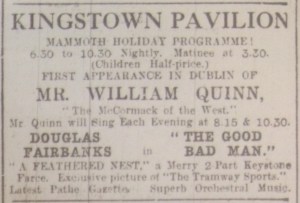
William Quinn – “The McCormack of the West” – was among the vocalists that the Pavilion engaged to attract the wealthy residents of Kingstown. Douglas Fairbanks’ The Good Bad Man (US: Fine Arts, 1916) was of secondary importance. Dublin Evening Mail 6 Aug. 1917: 2.

At the Kingstown (now Dún Laoghaire) Horticultural Show on 1 August 1917, local landlord Lord Powerscourt won not only the Challenge Cup for roses but also the Kingstown Picture House’s Cup for sweet peas (“Kingstown Horticultural Show”). That an Irish picture house was sponsoring such an event is indicative of cinema’s increasing integration into everyday life, and particularly its penetration of the realms occupied by the genteel gardeners of south County Dublin. Extra urgency had been added to the Kingstown’s courting of this audience by the reopening on 7 July 1917 of the Kingstown Pavilion. The Picture House had had the entertainment pickings of this wealthy town to itself since the Pavilion burned down on 13 November 1915. It would face well-advertised competition from the stylishly rebuilt Pavilion – designed by Coliseum architect Bertie Crewe – which sought to attract the affluent Kingstownites with vocal accompaniments to its films. You can get there [from Dublin] by tram or train,” an unnamed reviewer of the new picture house observed, “and whatever way you travel you will find plenty to please the eye en route” (“Cinema by the Sea”).
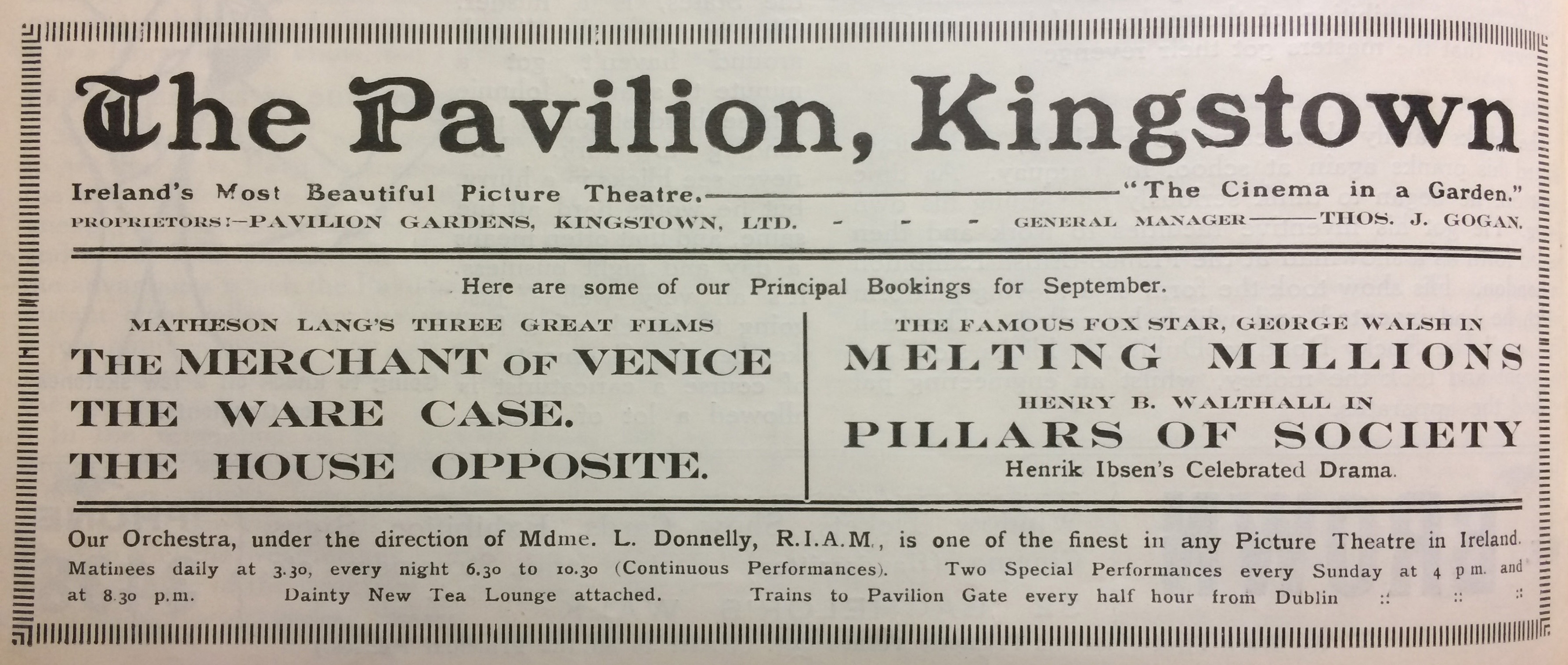
Irish Limelight 1:9 (Sep. 1917): 6.

In late summer of 1917, cinema usefulness, its embeddedness in Irish society was evident not just in the importance of propagandistic films featuring soldiers at the front but also in its instructive role in relation to food production and child rearing. Lord Powerscourt may have been happy with decorative roses and sweet pea, but the food shortages caused by the continuing war meant that people unused to agricultural work were being urged to assist in the harvests and to grow their own food. A Women’s Land Army was established in mid-1917 to provide an agricultural workforce. Among the ways in which this force was to be promoted and trained was through “an excellent cinema film […] showing the work of women on the land” (“The Women’s Land Army”). “In these days of war savings and general cheeseparing,” J. B. Holland, the writer of the “Motor News” column in Dublin’s Daily Express, reported at the end of July 1917, “it is something worthy of note to find a brand new word added to our vocabulary, and one that you can use too in polite society. Well that is the word – ‘Agronomist.’” This expansion to the writer’s vocabulary came from a film exhibited “in a cubby-hole cinema in a Sussex village” and depicting “a number of Agronomists in the very act of agronomising (or whatever the verb may be) with the result that all of us, individually and collectively decided at once to ‘go thou and do like likewise’” (Holland).
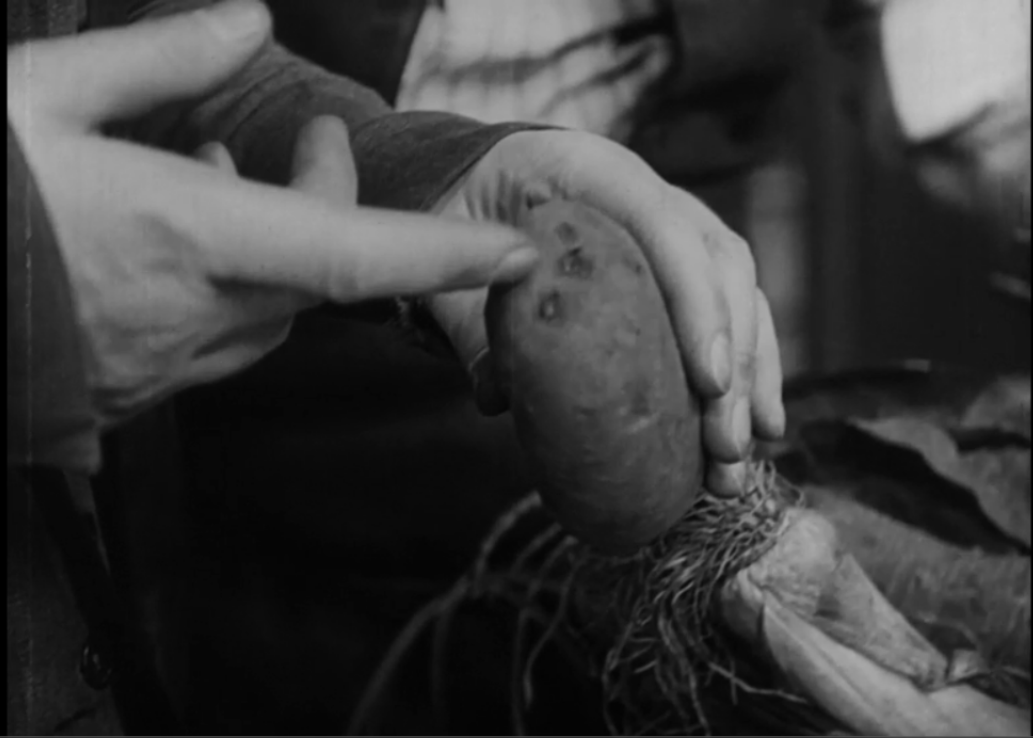
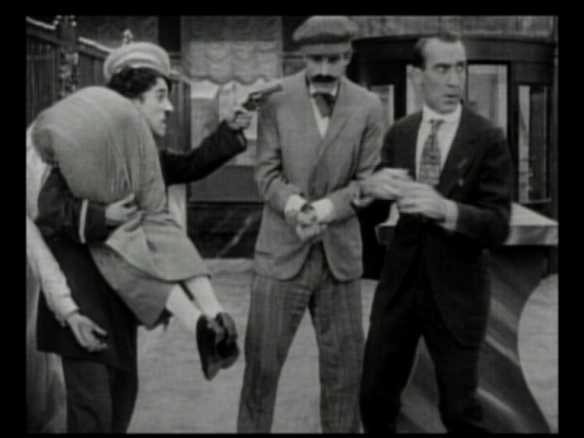
“You ought to know better than to send in seed potatoes for eating”; framegrab from Everybody’s Business (Britain: London, 1917), viewable here.

Holland did not name this film, but the Kingstown Pavilion had featured Everybody’s Business on its opening programme which may not have been an agronomizing film but was a fictional “food economy film.” It was, according to the trade journal Bioscope “in many respects the most important, and quite the most successful propaganda film that has been issued since the beginning of the war” (“Food Economy Film”). Although the “speeches of politicians, the canvassing by constituted societies, striking posters and press campaigns all have their effect,” the Bioscope argued that

a film which incorporates the essential parts of all these methods, contained in a pleasing and simple story, well told and admirably presented, must have a stupendous effect when circulated by a medium which has grown to be the most widely popular form of entertainment.
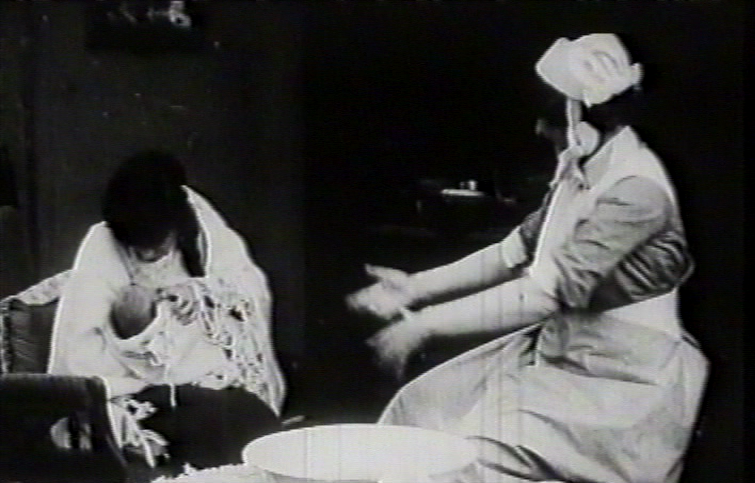
The Health Visitor (Dorothea Baird) teaches a new mother how to wash her baby in Motherhood (Britain: Trans-Atlantic, 1917). Image from the Women’s Film Pioneers Project.

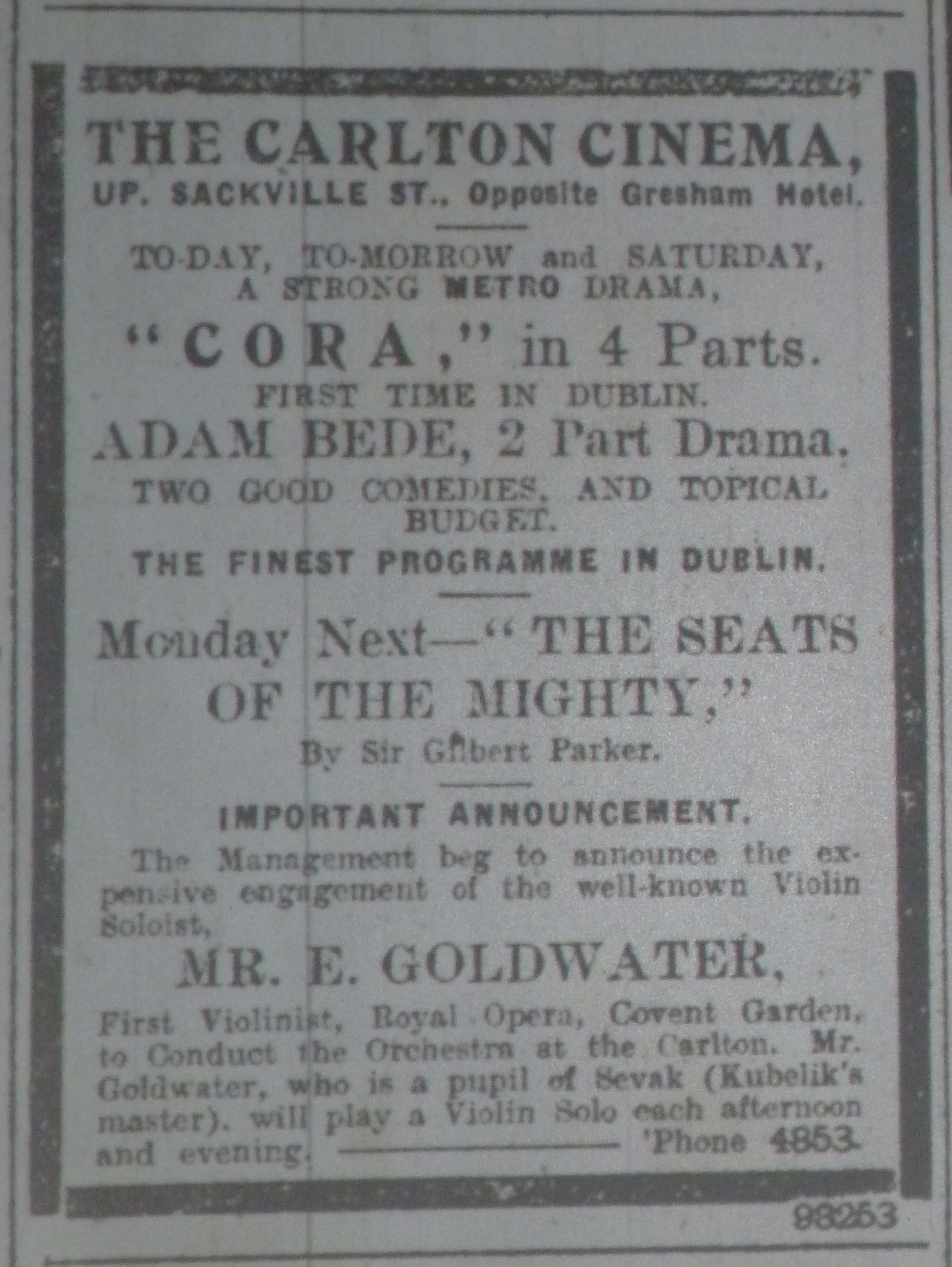
Fiction films with such an explicit instructional intent were becoming more common. Just a few days before Pavilion audiences were warned off food wastage, audiences in other Irish cinemas were learning about child rearing from Motherhood (Britain: Trans-Atlantic, 1917). Sponsored by the National Baby Week Council, the film had been written by and featured Dorothea Baird, well-known stage and screen actress and wife of actor H. B. Irving. It was released for Britain and Ireland’s first National Baby Week that ran 1-7 July 1917. Alongside Dublin’s official events centred around an exhibition at the Mansion House, the Carlton Cinema showed Motherhood, which “illustrates how the rearing of children can be made a joyful thing and happy in its results, even in the poorest homes if only kindly interest and help is given to the mothers” (“‘Motherhood’ at the Carlton”). As well as a fictional narrative that demonstrated how a new mother (Lettie Paxton) is introduced to a School for Mothers by a Health Visitor (Baird), the film carried the endorsement of celebrities such as Baird and members of the social and political elite. “Mrs. Lloyd George, the Duchess of Marlborough, Lady Rhondda, Sir Richard Burbidge, Mrs. H. B. Irving, and many other notabilities connected with the National Baby Week Council have been specially filmed,” a Dublin Daily Express article observed, “so that their portraits may accompany the messages which they send to the nation through this epoch-making picture.” Lady Wimborne, wife of Ireland’s Lord Lieutenant, also endorsed the film, albeit belatedly, by attending a screening on 17 July 1917 at the Grafton Street Picture House (“To-Day in Brief”).

In the context of this increasing elite support for cinema, Winston Churchill was going somewhat against the grain when he decided following his appointment as Minister for Munitions not to fulfil his contract with the Ideal Film Renting to write the script for a film about the origins of the war (“Mr. Churchill Not to Write Film Stories”). But then, cinema had not been completely shaped to serve the war economy. It still represented a largely proletarian entertainment form and a space removed from work or fully rationalized leisure. It continued to arouse various kinds of anxieties in those in authority. The fear that picture houses provided sanctuary for shirkers and deserters was well illustrated by a parliamentary question in late July. Henry Dalziel asked Undersecretary of State for War Ian MacPherson what the British government was doing about English men who fled to Ireland to escape conscription. “Is he aware that there are hundreds of these men to be seen at cinemas in Dublin every night,” Dalziel asked MacPherson, addressing him in the third person, “and cannot he net more than a few back?” (“Hundreds at Dublin Cinemas”).
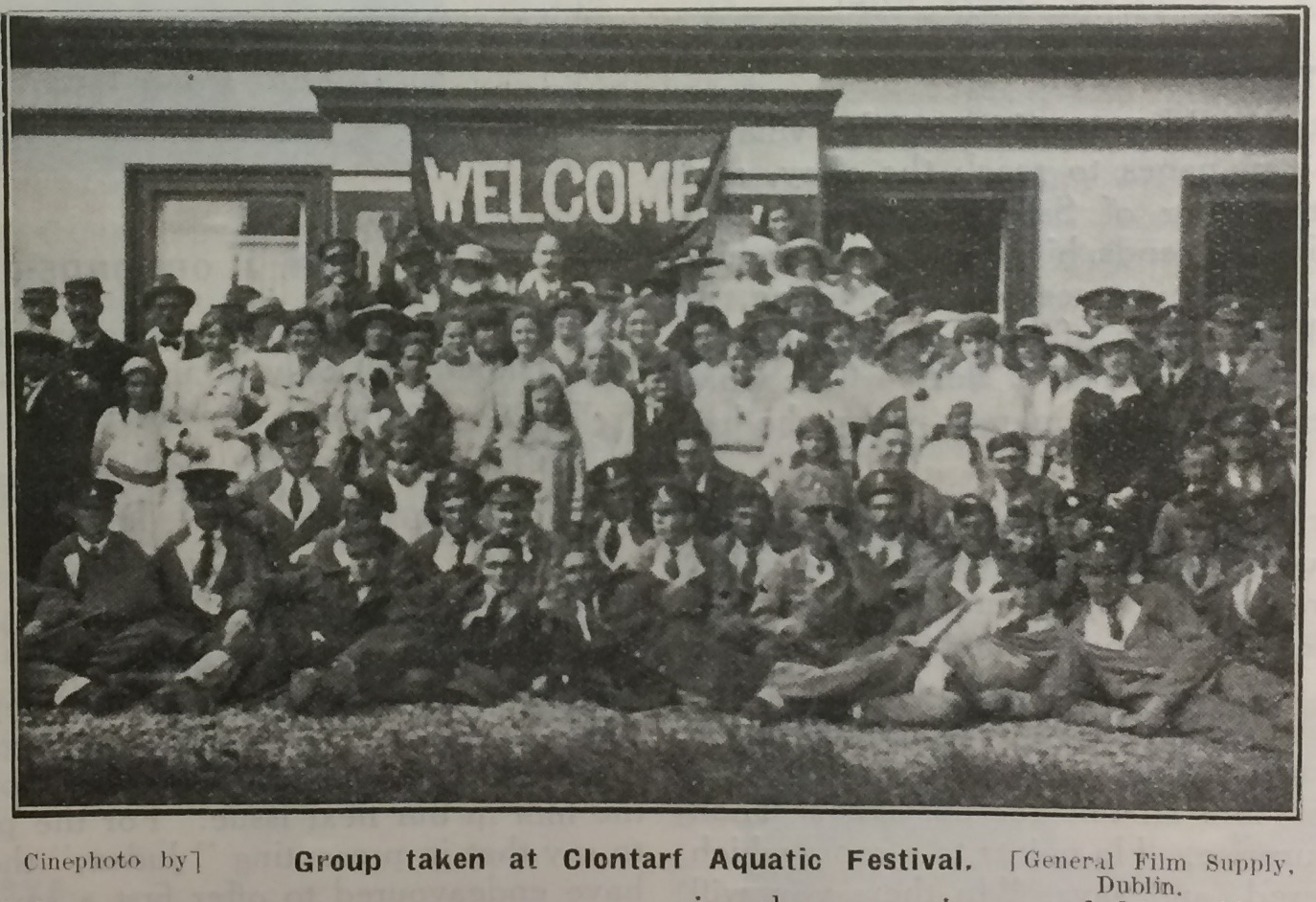
Still from the Clontarf Aquatic Festival, one of the items in Irish Events 3. Irish Limelight I:8 (Aug. 1917): 18.

Apart from the instructive fiction films, draft dodgers and other members of the cinema audience in Ireland were offered instructive local topical films, while the Film Company of Ireland was facing challenges finishing its epic Knocknagow. An increasing number of picture houses subscribed to the recently launched Irish Events newsreel, which had produced seven weekly issues and some specials by the end of August 1917. “The success of the Irish Topical Gazette has exceeded Mr. Whitten’s wildest anticipations,” observed Irish columnist Paddy in the Bioscope. “Many exhibitors have booked a contract for an extended period” (Paddy, 16 Aug.). And it was not just Irish exhibitors who could look forward to booking Irish Events because “Mr Whitten is making all arrangements for its showing in London” (Paddy, 23 Aug.).
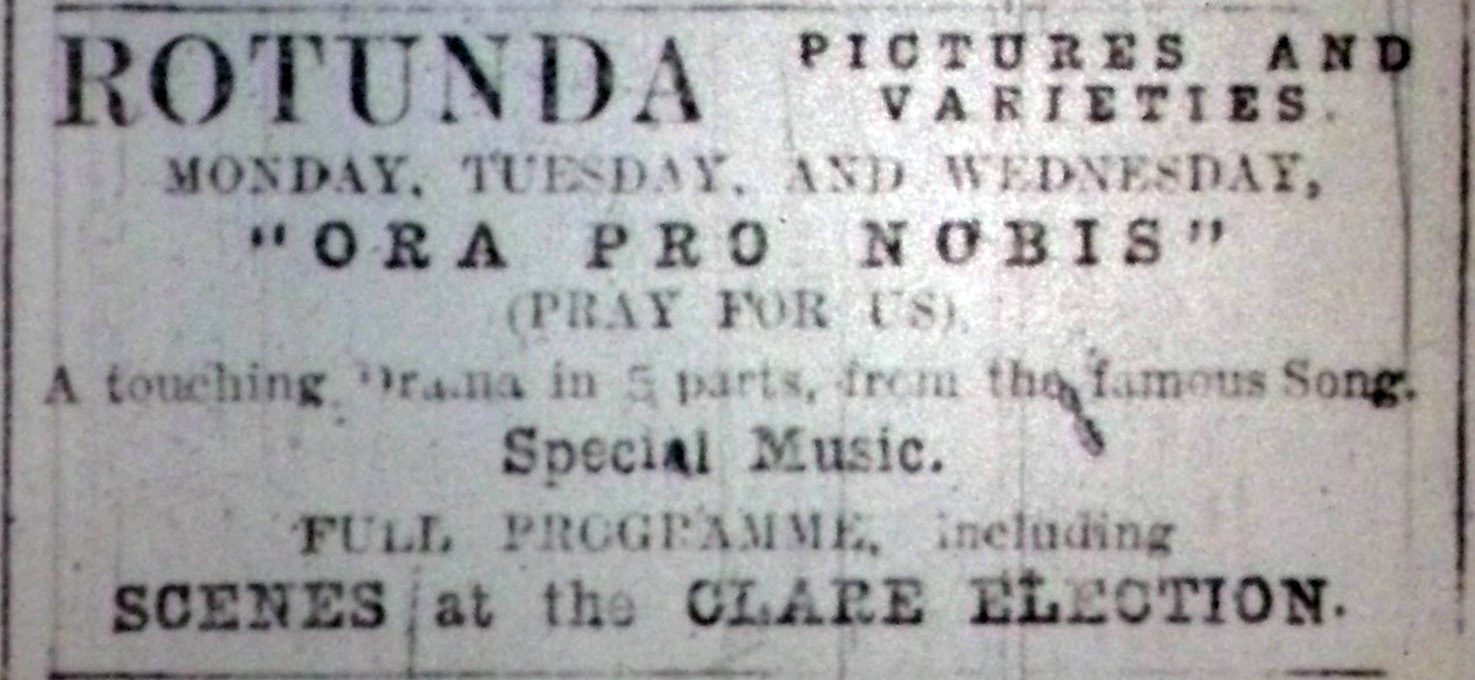
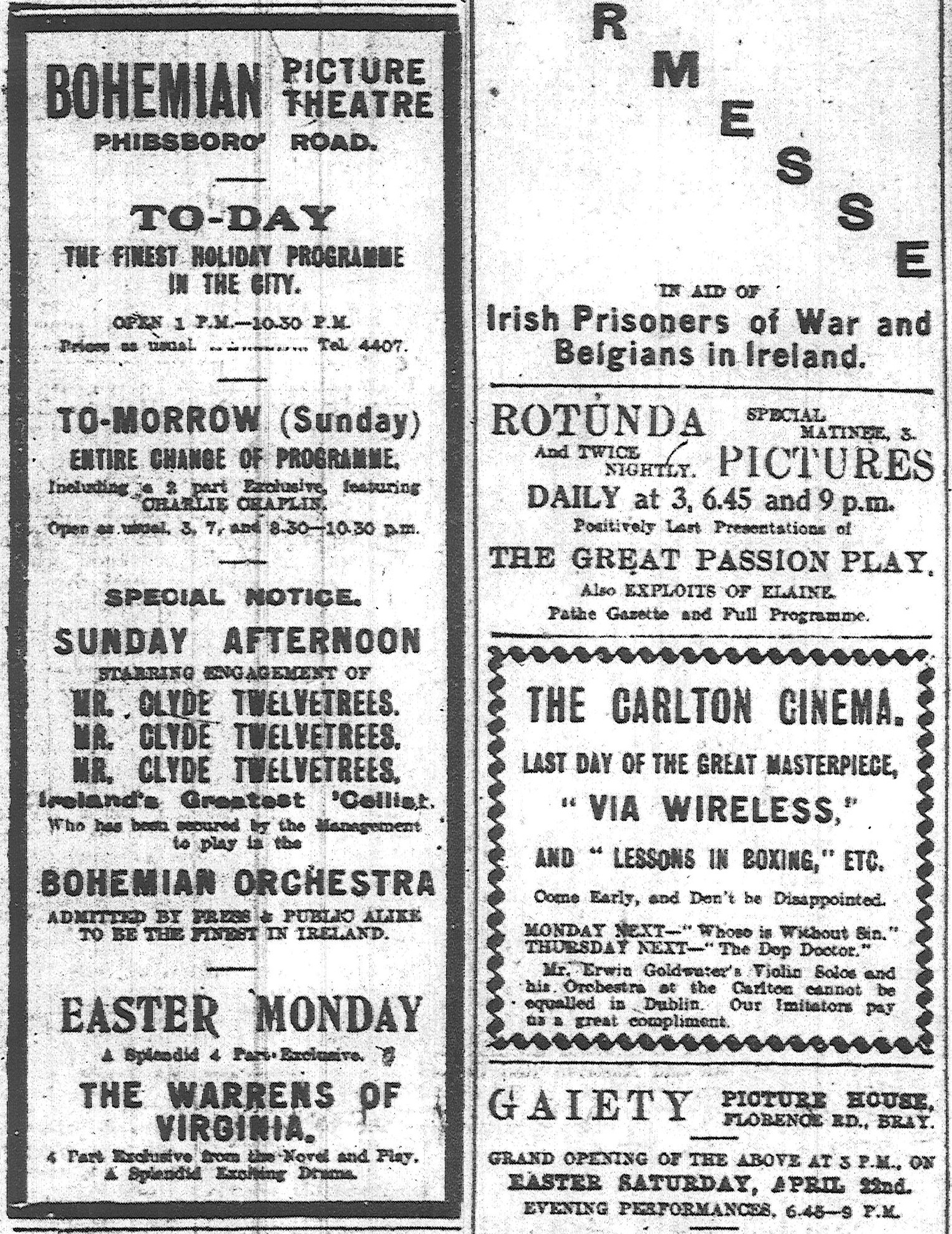
A newsreel of Eamon De Valera’s victory in the Clare Election on 11 July 1917 could be seen on the screen at Dublin’s Rotunda on 16 July. Dublin Evening Mail 16 July 1917: 2.

Irish Events 2, the second weekly instalment of this newsreel, was issued on 23 July 1917 and featured five one-minute items that represented a mix of social and political events. As such, it resembled other newsreels, but Whitten appears to have conceived of it as primarily for social events because four of the items were of this type: The Mullingar Races, Trotting in Shelbourrne Park, A Garden Fete at Bushey Park and The Metropolitan Regatta at Island Bridge. The sole political item was De Valera after the East Clare Election (“Irish Topical Films”). The election film depicted an important event, but when viewed in the week of 23-28 July, it was not particularly timely as De Valera had won for Sinn Féin on 11 July. Indeed, a film of the election had been shown at the Rotunda – and undoubtedly other picture houses – beginning on 16 July, the same day as Irish Events 1 appeared but not as part of it.
Rotunda Convention 26 Jul 1917 DEM

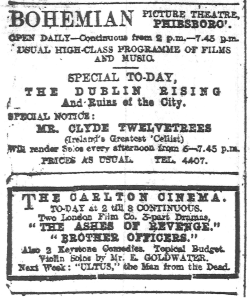
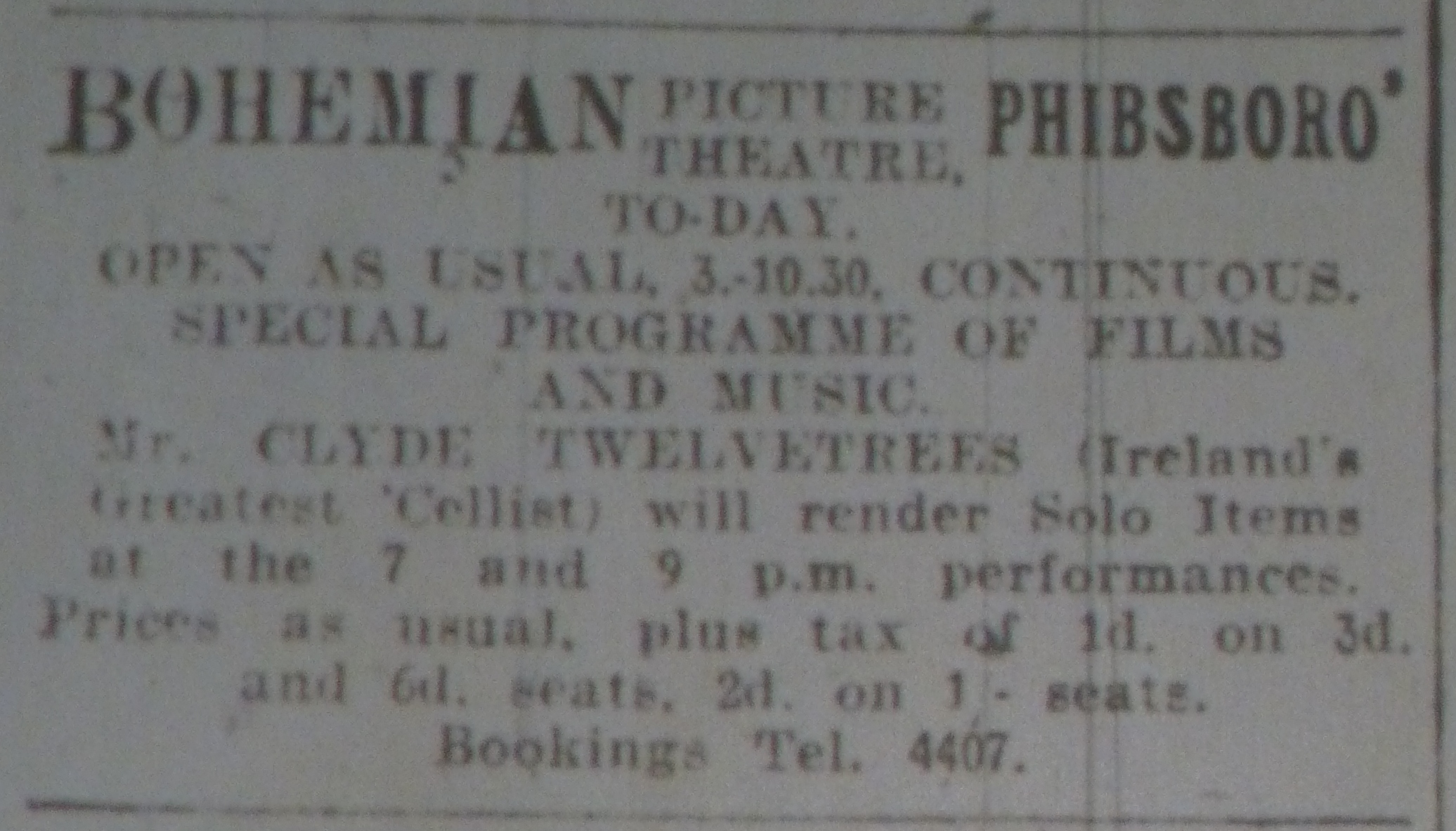
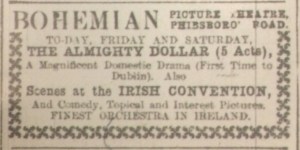
An ad for Dublin’s Bohemian featuring a newsreel special on the Irish Convention; Dublin Evening Mail 26 Jul. 1917: 2.

With the emergence of Sinn Féin, political events in Ireland were moving fast, too fast for a weekly newsreel to keep up. It appears that Whitten planned to release the regular issues of Irish Events with items that could be planned in advance of its Monday release but also to release special “stop-press” films of events that could not be included in this way. This was the case when the Irish Convention, a meeting of Irish representatives convened to tackle the “Irish problem,” opened on Wednesday, 25 July. Whitten released a newsreel special of the Convention that was screened in Dublin’s Bohemian on 26 July. “Mr. Whitten is determined,” Paddy reported, “to let nothing stand in his way as regards securing the latest topical events” (16 Aug.).
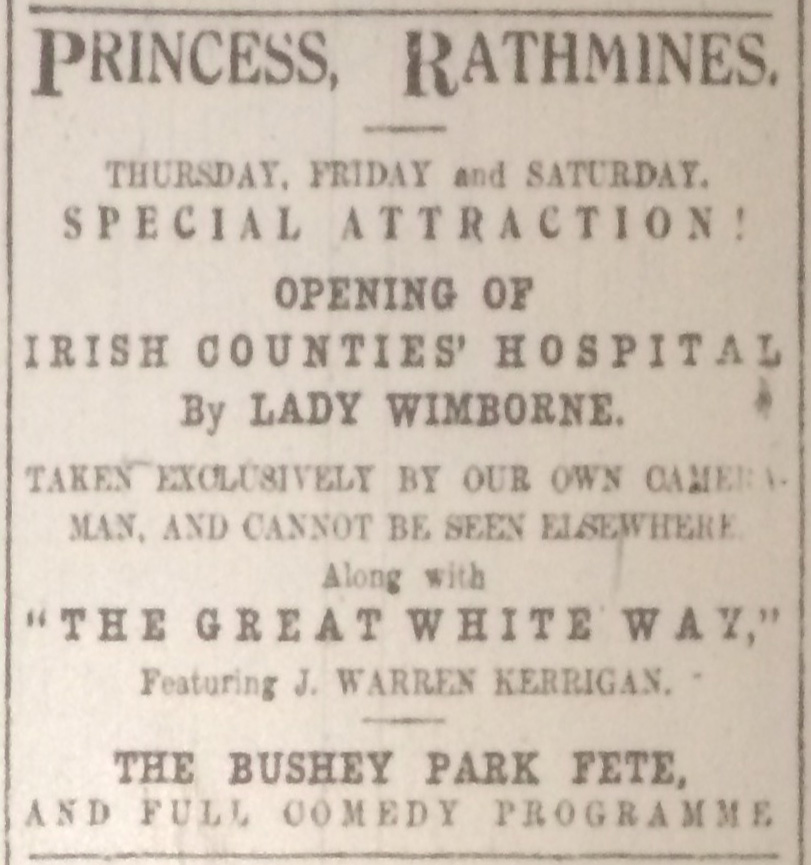
Irish Events faced competition from the filmmaking activities of the Princess picture house in Rathmines; Dublin Evening Mail 19 Jul. 1917: 2.

By releasing the films of important political events quickly, Whitten maintained the scoop on his competitors. He faced competition on the filming of newsworthy events particularly from Gaumont, which had a substantial presence in Ireland and whose Gaumont Graphic newsreel was very popular. As well as this, Irish Events also faced local competition in its depiction of social events. Throughout July and August 1917, the Princess Cinema in Rathmines filmed such social events as the British Red Cross Garden Fete and the Opening of the Irish Counties’ Hospital by Lady Wimborne and even The Bushey Park Fete, which Whitten had also featured in Irish Events 2. While the Princess advertised that their films were exclusive – taken by them and not to be seen elsewhere – Irish Events was designed to be widely distributed. Whitten and his cameraman J. Gordon Lewis would have a busy autumn as they worked on Irish Events, on advertising films for Court Laundry and Paterson’s matches, and on an animated film with cartoonist Frank Leah.
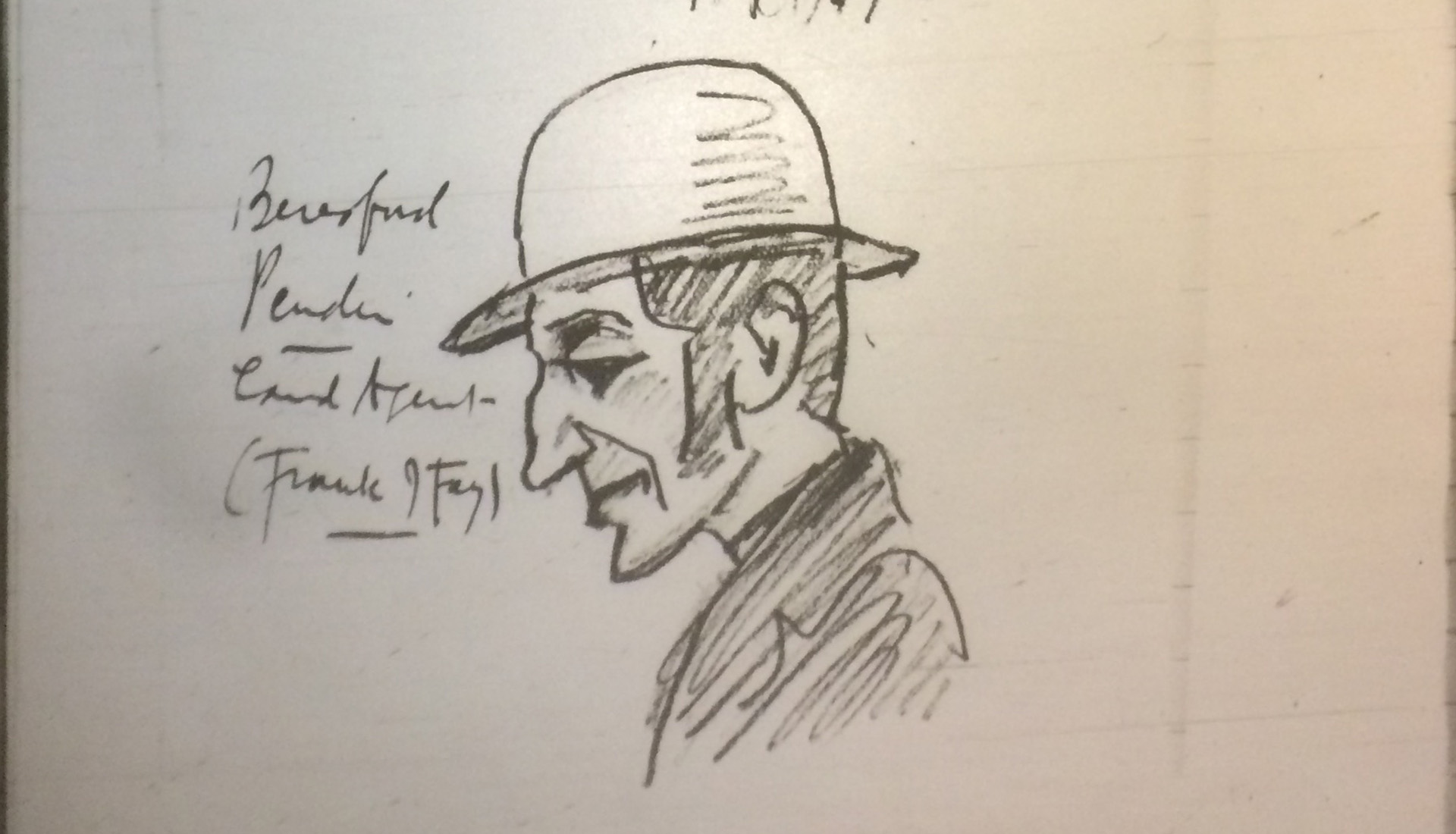
Joseph Holloway’s sketch of Frank Fay as Beresford Pender in a stage adaptation of Charles J. Kickham’s Knocknagow at the Queen’s Theatre in July 1917. National Library of Ireland.

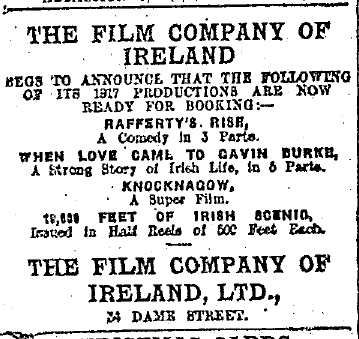
Although it had some organizational problems, Ireland’s other major indigenous film production company, the Film Company of Ireland (FCOI) also entered the somewhat crowded field of local factual filmmaking. Paddy reported that FCOI “have just finished an enormous scenic film dealing with the beauties of rural Ireland, and also containing many character studies and views of historic places” (23 Aug.). Rather than one long film, this was a series consisted of 20 one-reel films. These may have been among the company’s films that Paddy reported that Glasgow’s Square Film Company had arranged to distribute. FCOI managing director James Sullivan also told Paddy that their “almost completed” Knocknagow would be nine reels long, “the longest production ever made in the United Kingdom.”

Sullivan was eager to keep the much-anticipated adaptation of Knocknagow in the forefront of the media discussion of the company rather than its recent winding up proceedings. On 25 June 1917, his wife Ellen Sullivan, as a company creditor, had applied for its winding up in order that it could be restructured. During the proceedings, it emerged that she had given the company £500 and that it was running at a loss of £1,526 (“Film Company of Ireland”). The restructuring was necessary because James Sullivan’s co-director Henry Fitzgibbon had gone to America to promote the company but had decided not to return to Ireland. The proceedings caused some anxiety in those who were peripherally involved in FCOI. “I recently saw that the Film Co. of Ireland has been before the Court for winding up prior to reconstruction,” playwright Martin J. McHugh wrote to Joseph Holloway. “This may, and I hope will, mean only a delay in the resumption of their work; but somehow it damps one’s confidence in Irish enterprise, which does not seem usually to be blessed with good management” (Holloway, 7 Jul. 1917). McHugh had written two scripts for FCOI, “one long since paid for and photographed, and the other yet to be produced – and I wonder what will become of them.”

While the future of Irish fiction filmmaking looked uncertain at the end of summer 1917, instructive images of various kinds filled the screens.

References

“Cinema by the Sea.” Irish Limelight 1:9 (Sep. 1917): 4.

“Film Company of Ireland.” Daily Express 26 Jun. 1917: 3.

“The Food Economy Film: “Everybody’s Business”: A Stirring Appeal to the People.” Bioscope 14 Jun. 1917: 1050.

Holland, J. B. “Motor Notes.” Daily Express 30 Jul. 1917: 3.

Holloway, Joseph. Holloway Diaries. National Library of Ireland.

“Hundreds at Dublin Cinemas Every Night: Commons Questions.” Evening Herald 24 Jul. 1917: 1.

“Irish Topical Films.” Evening Telegraph 21 Jul. 1917: 4.

“Kingstown Horticultural Show: Decrease in Exhibits.” Daily Express 2 Aug. 1917: 7.

“‘Motherhood’ at the Carlton.” Daily Express 2 Jul. 1917: 7.

“Mr. Churchill Not to Write Film Stories.” Daily Express 21 Jul. 1917: 6.

Paddy. “Irish Notes.” Bioscope 5 Jul. 1917: 83; 16 Aug. 1917: 766; 23 Aug. 1917: 881.

“Seen and Heard: Notes and Notions on Men and Matters.”  Evening Herald 22 Aug. 1917: 2.

“To-Day in Brief.” Daily Express 18 Jul. 1917: 4.

“The Women’s Land Army” Daily Express 9 Jul. 1917: 4.
“Peeps at Parochial Happenings”: Irish Events Newsreel Begins, June-July 1917

Political developments formed the context for the conception and launch of Ireland’s first newsreel, Irish Events, in the month between 18 June and 17 July 1917.

Jun 18 1917 ET Prisoners 2

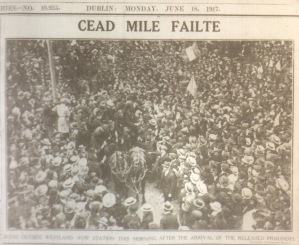
The Evening Telegraph placed a very large photograph of the returned Irish prisoners leaving Westland Row station on its front page on 18 June 1917.

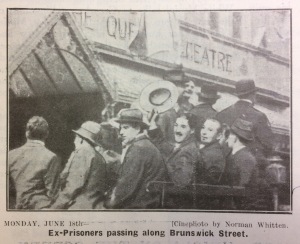
“Somewhere about 9 a.m. a man was about to enter his offices in Great Brunswick Street,” cinema trade journal Irish Limelight reported of the exciting events of 18 June 1917 in Dublin. On 15 June, the British government had announced a general amnesty for the remaining Irish people it had jailed for their roles in the 1916 Rising. Many of these prisoners had experienced jeers as they were marched out of Dublin in early May 1916; their homecoming would be very different, indeed a nationalist celebration. Nevertheless, there was tension in the city in the days leading up to their arrival because it was not clear when or by what route they would come. This was also true of the man leaving his office in Great Brunswick (now Pearse) Street. “It is possible that he was not feeling altogether in harmony with the glorious summer morning,” the Limelight observed.

For two days he had been on the alert, waiting and watching for the homecoming of the released Sinn Fein prisoners. He had no concern with their political views or with the views of the Government that set them at liberty. He was a kinematographer and he was out for business – and it looked as if the business was likely to elude him. (“Sinn Fein Prisoners’ Homecoming.”)

IRISHLIMEGHT1JUL_P17 002

Norman Whitten in his offices at 17 Great Brunswick Street; Irish Limelight 1:7 (Jul. 1917): 17. Courtesy of the National Library of Ireland.

The man was Norman Whitten, managing director of General Film Supply, for whom the prisoners’ homecoming was “as good a ‘topical’ as had happened for a long time.” An English filmmaker who had learned the cinema business from pioneer Cecil Hepworth, Whitten had been working in Ireland since the early 1910s, making topical films of local interest and advertising films. He was also an agent for several British equipment manufacturers as well a distributor of certain films. Two days after the events described by the Limelight, he would be in Dublin’s nisi prius court successfully prosecuting James J. Fisher for outstanding monies related to the exhibition of the film Lost in the Eternal City, for which Whitten held the Irish rights (“Hire of a Film”). Whether Whitten ever received the £70 and costs awarded by the court is not clear because the Limelight pointedly reported on the same page as its account of Whitten’s filmmaking that Fisher, “so well known in Ireland in connection with the official war films, left for Salonika on the 25th June” (“Mr. J. J. Fisher”).

In any case, early on 18 June, Whitten was presented with an opportunity. Westland Row station was about five-minutes walk from his office. “His key was just in the lock when a wave of cheering came down the street from the Westland Row end,” the Limelight report continues:

Looking up he saw the Sinn Fein tricolour waving at the head of a procession just turning into Great Brunswick Street. One glance was enough, and in another he was feverishly active inside in the office. Where was that favourite camera? How many feet of film had he? Where was the other box? And the tripod! (“Sinn Fein Prisoners’ Homecoming.”)

Prisoners photo IL Jul 1917

A framegrab or “cinephoto” from Whitten’s film, showing the former prisoners passing the Queen’s Theatre in Brunswick Street, which was beside Whitten’s office. Irish Limelight 1:7 (Jul. 1917): 16. Courtesy of the National Library of Ireland.

Having assembled his equipment, “he was out again in the street, the tripod was mounted on a chair, the eye of the kinematograph was pointed directly at the oncoming procession and the first film of the ex-prisoners’ homecoming was being taken.” He followed the procession through the streets to Fleming’s Hotel in Gardiner Street, where some of the former prisoners obliged him by waiting in their carriages until he had set up his camera to film them getting down.

To capitalize on this scoop, however, Whitten had to show the “hustle” for which he was renowned by developing, printing and delivering the film to the Dublin’s cinemas interested in it. In doing this, he needed to be faster than the other filmmakers who were also out shooting these events, including Gaumont’s Mr Russell. Among its extensive production and distribution businesses, Gaumont produced its own newsreel, the Gaumont Graphic, and the company had shot their first topical in Ireland in June 1913 (“Irish Topical”). Its well-appointed offices in Dublin’s Lord Edward Street included facilities for developing and printing film, but for some reason – possibly lack of personnel – Russell had to send his film to England to be processed (“Building News”). Whitten, by contrast, processed his own film, and as a result, the excitement of the shooting in the streets was followed by

hours of swift and delicate work in the ruddy gloom of the developing room and in the arid light of the drying room. Three hundred and fifty feet of film had to be fixed on the developing frames and plunged into the tanks for eight minutes, then rinsed and fixed. In the balance of half-an-hour it was washed. Fifteen minutes later the whirling drums had dried it. (“Sinn Fein Prisoners’ Homecoming.”)

At this period, a film of 350 feet would usual run five to six minutes, but this was not the completed film. Whitten edited the raw footage and added end- and intertitles to produce a finished film that likely ran five minutes, the typical length of a newsreel. This was not a typical newsreel film, however, because a newsreel usually consisted of five one-minute items showing a mixture of news and social events. Instead, this was a special topical. “By 3 p.m.,” the Limelight revealed, “three copies had been printed and fully titled with a photograph of McGuinness added at the end and were rushed off in taxis to the picture houses which had been enterprising enough to book this ‘red-hot topical.’” Joseph McGuinness had been a prisoner in Lewes jail when he was elected MP in the May 1917 Longford South by-election, and he had been at Fleming’s Hotel to greet the returned prisoners.

Boh Release Prisoners 13 Jun 18 1917 DEM

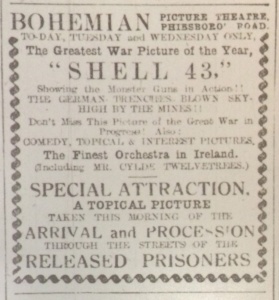
Bohemian Picture Theatre with Whitten’s film of the released prisoners; Dublin Evening Mail 18 Jun. 1917: 2.

The film was ready for afternoon showings in Dublin’s picture houses, but its initial run of just three copies meant that it could only play at three venues: the Bohemian Picture Theatre in Phibsboro, the Town Hall, Rathmines (THR) and the city-centre Rotunda. The managers of these picture houses certainly believed that the film would be a draw, and the Bohemian and THR even managed to have it prominently mentioned in their ads in the evening newspapers. Among those who were attracted were some of the prisoners themselves:

Some of the ex-prisoners and their friends could not resist the temptation to see themselves “in the pictures,” and a contingent marched up to the Rotunda early in the afternoon. They cheerfully acceded to the genial manager’s request that they should leave their flags in the porch, and, when inside, gave every indication of enjoying not only “their own film” but the rest of the programme. (“Sinn Fein Prisoners’ Homecoming.”)

Markievicz IL Jul 1917

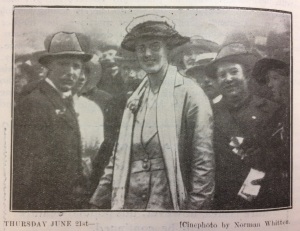
Cinephoto from Whitten’s film of the return of Countess Markievicz on 21 June 1917; Irish Limelight Jul. 1917: 16. Courtesy of the National Library of Ireland.

The Limelight’s detailed account of Whitten’s work on this film suggests that he was working alone at this point on shooting, processing and dispatching; it does not mention any employees. Nevertheless, people in the business knew Whitten’s abilities from previous events he had filmed, and on Thursday of that week, he would repeat his achievement when he had a film of the arrival back in Ireland of republican leader Countess Constance Markievicz for showing at 10:30pm, even though she did not reach Westland Row station until 6:45pm. Nevertheless, for the Monday film, he appears to have been overwhelmed by the number of requests for copies and resorted to offering other topicals he had shot of Irish and National Volunteers and the funeral of republican Jeremiah O’Donovan Rossa. When even these supplies were exhausted, desperate exhibitors were prepared to accept even Irish-themed fiction films. “[W]hen everything that could by any stretch of the imagination have been utilised as a ‘topical’ was used up,” the Limelight commented, “they fell back upon ‘The Shaughraun,’ ‘The Colleen Bawn,’ and other film plays of the earlier ‘Irish’ type.”

The phenomenal success of this film and the one of Markievicz later in the week formed the basis for Whitten’s launch of an Irish newsreel service he called Irish Events just a month later. While he must have been considering an Irish newsreel for some time, the decision to launch it in July 1917 appears to have been a sudden one because he did not mention it to the Limelight reporter who so thoroughly covered his work on the film of the released prisoners. But then he was “a hustler from Hustlerville,” as the Limelight called him (“‘Irish Events’”). The Limelight did publish a long article on the launch of Irish Event in its August issue, urging all Irish exhibitors to subscribe to it, but by the start of August, three issues of Irish Events had already been released. “Irish people always will be glad to glimpse really interesting happenings in Great Britain and abroad,” it observed, “but when it comes to peeps at parochial happenings – well, they would certainly prefer to see pictures of sports at, say, Croke Park, instead of pictures of an English sports meeting” (“‘Irish Events’”).

Ch4One

Members of the crowd smile and gesture happily when the newsreel camera is trained on them in Release of the Sinn Fein Prisoners (Ireland: General Film Supply, 1917). Courtesy of the Irish Film Institute.

Although some Irish Events would be released as specials like the film of the returning prisoners, the regular format of Irish Events mirrored that of the other newsreels such as Gaumont Graphic, Pathé News and Topical Budget. That is to say, it included both political and social events. The first few issues included “aquatic and other sports meetings, Phœnix Park demonstrations, the great funeral which the Sinn Feiners gave Mrs. MacDonagh, widow of their executed leader, the Twelfth of July Celebrations in Belfast and a fete in Lord Iveagh’s grounds” (“‘Irish Events’”). It is unlikely that Whitten could have covered all these events alone and run the other aspects of his business. Indeed, when the Limelight highlighted an Irish Events item on the Clontarf Aquatic Festival, it observed that it had been shot by both Whitten and his camera operator J. Gordon Lewis, who would become Whitten’s close collaborator. Over the Irish Events’ years of existence between 1917 and 1921, Whitten and Lewis would shoot such everyday occurrences and present them alongside some of the most momentous political events of Ireland’s history.

References

“Building News.” Irish Builder and Engineer 12 Apr. 1913: 250.

“Hire of a Film: ‘Lost in the Eternal City’: Action for £70.” Dublin Evening Mail 20 Jun. 1917: 4.
“‘Irish Events’: An Enterprise that Merits the Support of Every Exhibitor in this Country: News Films from the Four Provinces.” Irish Limelight 1:8 (Aug. 1917): 18-19.

“Irish Topical.” Bioscope 19 Jun. 1913: 857.

“Mr. J. J. Fisher.” Irish Limelight 1:7 (Jul. 1917): 17.

“Sinn Fein Prisoners’ Homecoming: Story of the Filming of Recent Remarkable Street Scenes in Dublin. Irish Limelight 1:7 (Jul. 1917): 16-17.

“Town Topics: Being a Casual Causerie.” Dublin Evening Mail 7 May 1917: 2.

A New Industry: The Film Company of Ireland’s First Season

Kathleen Murphy ET 7 Apr 1917

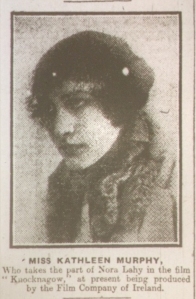
A photograph of Kathleen Murphy advertised the beginning of the Film Company of Ireland’s 1917 production season; Evening Telegraph 7 Apr. 1917: 4.
In April 1917, the Film Company of Ireland (FCOI) began publicizing the fact that they were beginning a second season of production. On 7 April, a photograph of Kathleen Murphy appeared in the Evening Telegraph‘s “Music and the Drama” column, with a caption indicating that she was playing the part of Nora Lahy in a film adaptation of Charles Kickham’s Knocknagow that was already in production. Based on Ireland’s most popular novel of the late-19th century, Knocknagow on film would be an ambitious undertaking, and it would be popular with contemporary Irish audiences. And because it – along with Willy Reilly and His Colleen Bawn (1920), is one of only two FCOI films that survive in a substantially complete form, it is relatively well known, at least by film scholars (see here, for example). However, the film of Knocknagow would not reach Irish audiences until early 1918.

Irish Independent 10 Nov. 1917: 2.

FCOI made two other feature films during the summer production season of 1917: the comedy Rafferty’s Rise and historical romance When Love Came to Gavin Burke. However, despite the fact that the May 1917 issue of Irish Limelight published photographs from Rafferty’s Rise, the release of these films would also take many months. As a result, the FCOI’s 1916 films continued to circulate and represent – indeed, to constitute – the company’s released output for much of 1917. Nevertheless, beyond O’Neil of the Glen and perhaps The Miser’s Gift – both of which have already been written about here – very little is known about the other 1916 films. This is not surprising because surviving information on them is scant. In marked contrast to the barrage of publicity that heralded the release of O’Neil of the Glen and, to a lesser extent, The Miser’s Gift, the later 1916 films seem to have appeared with little fanfare. Nevertheless, bringing together some of surviving information reveals hitherto unknown aspects of these obscure but important early Irish films and the company that made them.

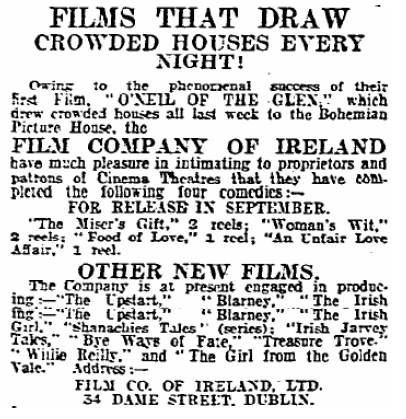
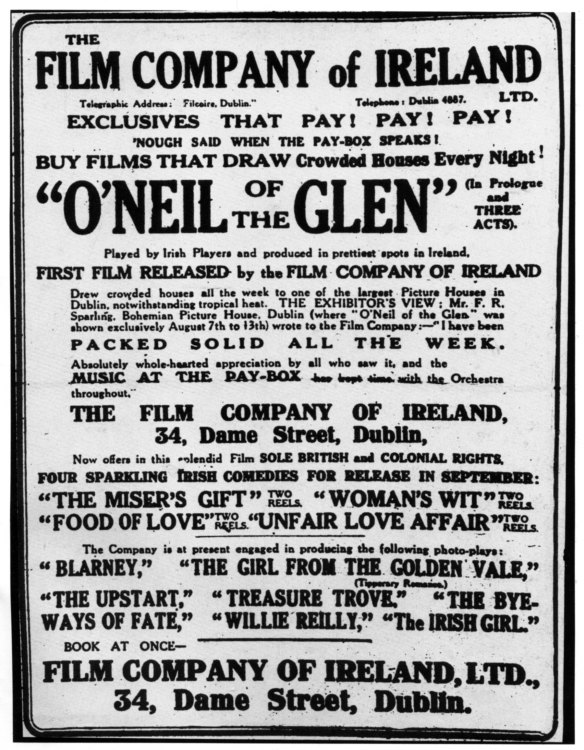
FCOI advertised upcoming releases in the Irish press on 14-15 August 1916. This one appeared in the Irish Times 14 Aug. 1916: 4.

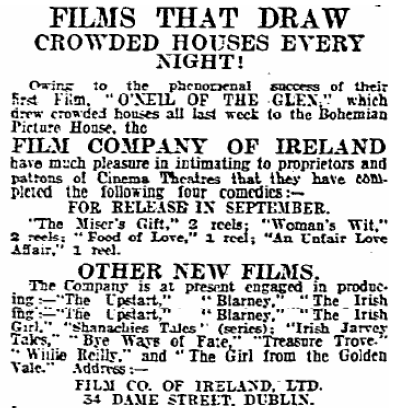
Even the number of films they made in 1917 is not entirely clear. With O’Neil of the Glen newly released and creating a stir in August 1916, the company announced in the Irish dailies that it had a further four films ready for release in September: The Miser’s Gift, Woman’s Wit, Food of Love and An Unfair Love Affair. As well as these presumably complete or almost complete films, it listed nine other titles that it had in production: The Upstart, Blarney, The Irish Girl, a series called Shanachies Tales, Irish Jarvey Tales – possibly another series – Bye Ways of Fate, Treasure Trove, Willie Reilly and The Girl from the Golden Vale. With so little surviving information, ads such as this have often been taken as confirming that these films were actually made. These films appear in the standard Irish and British filmographies – Kevin Rockett’s Irish Filmography and its online version, and Denis Gifford’s The British Film Catalogue, as they do in the books that take these reference works as a source.

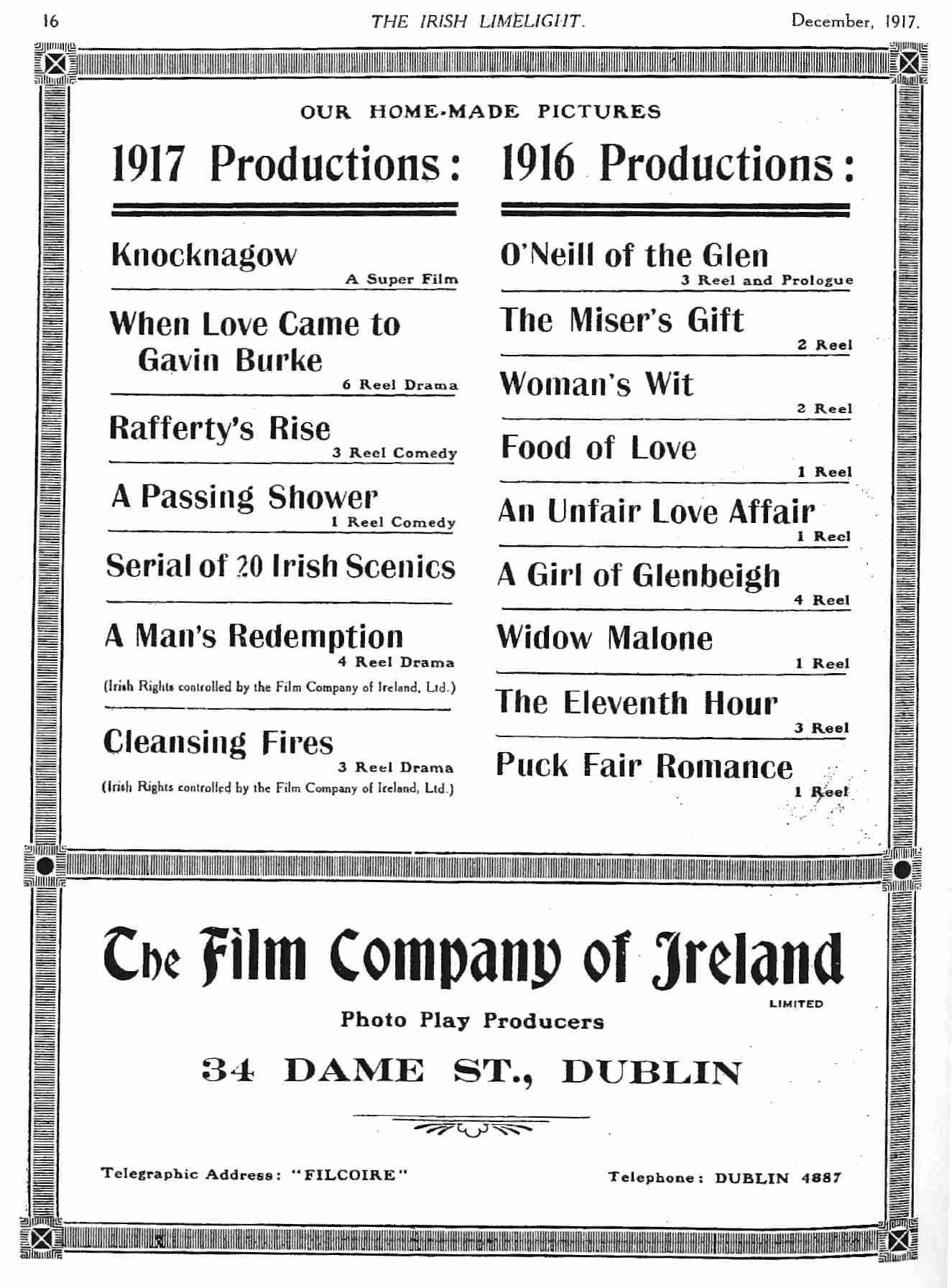
Trade journals and local and national newspapers fill in some – but by no means all – of the details of FCOI’s filmmaking and exhibition exploits from the summer of 1916 to the summer of 1917. These sources show that all four films from the first group were subsequently released, albeit not in September 1917. Of the second group, only Willie Reilly is readily recognizable as an FCOI title – Willy Reilly and His Colleen Bawn – but it would not be released until early 1920. Some of the other eight films named in this ad may be working titles for the films that FCOI did release in late 1916 and early 1917. There is substantial evidence that in addition to the five films already named, the company released four others in this period: Puck Fair Romance, A Girl of Glenbeigh, The Eleventh Hour and Widow Malone.

Ad for FCOI films released in 1916 and made in 1917. Irish Limelight Dec. 1917: 16.

None of these corresponds exactly to the in-production titles mentioned in the ad, but some are close, such as the in-production titles The Girl from the Golden Vale and The Irish Girl which bear a similarity to A Girl of Glenbeigh. These were, of course, Irish versions of titles in the format “An X Girl” or “The Girl of X” that had been internationally popular for decades. However, as A Girl of Glenbeigh specifically names a place in Kerry, it is unlikely to have morphed from The Girl from the Golden Vale – with its reference to the rich farmland in the counties to the east of Kerry. But the film may have begun life under the less specific title The Irish Girl. That said, the in-production titles that include Irish place names suggest a different geography from the four that were finally made. Blarney and The Girl from the Golden Vale indicate a company working in Cork, while A Girl of Glenbeigh and Puck Fair Romance are firmly located in west Kerry.

The issue of the films’ geography deserves further discussion, but this blog will work on the basis that FCOI did not make all the films named in the 14-15 August ad. Evidence suggests that the company released not fourteen films but nine in its opening season, which nonetheless represents a substantial output. For clarity, those nine films are: O’Neil of the Glen, The Miser’s Gift, Woman’s Wit, Food of Love, An Unfair Love Affair, Puck Fair Romance, A Girl of Glenbeigh, The Eleventh Hour and Widow Malone. Although this blog will have something to say about the first two, it will mainly focus on the latter seven.

J. M. Kerrigan

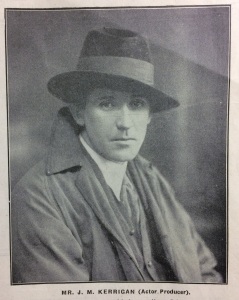
J. M. Kerrigan, Irish Limelight January 1917: 3.

All nine of these films appear to have been directed – the contemporary term, confusingly, was “produced” – by Abbey Theatre actor J. M. Kerrigan, who also starred or at least had a prominent acting role in many of them. Kerrigan was one of FCOI co-founder and producer James Mark Sullivan’s earliest recruits to the company; he was already working with FCOI in March 1916 – the same month as Sullivan and his partner Henry Fitzgibbon registered the company – and may even have invested money in it (Holloway, 21 Mar.). Kerrigan was soon joined by other actors from the Abbey and other theatres, most frequently by Fred O’Donovan, Kathleen Murphy and Nora Clancy, and more occasionally by Brian Magowan, J. M. Carre, Irene Murphy, Valentine Roberts and others. Also a star of the Abbey, O’Donovan would take over as FCOI’s actor-director for the 1917 production season when Kerrigan left Ireland for the United States in early 1917 on a career path that would eventually see him become a well-loved Hollywood character actor. His permanent departure seems to have come as a surprise to some in the press. On 12 April, Paddy reported that Kerrigan “has left America on his return voyage, and is expected to arrive almost any day now.” A report a week later suggested that he had little thoughts of returning to Ireland. “He has ‘made good’ out there in a surprisingly short space of time,” J.A.P. (Joseph A. Power) noted in the Evening Telegraph on 20 April, referring to reviews of Kerrigan’s early US stage performances. “It is only a few months since he left Ireland, yet here are the blasé Yankee journalists hurling bouquets at him with all the vigour of the great American language” (“Gossip of the Day”).

Engaging prominent Abbey actors bolstered FCOI’s claim that it was the Film Company of Ireland and was extending into the new cinematic medium the Abbey’s project of representing Ireland differently. “With the assistance of such artists as they had associated with them,” Fitzgibbon was reported as saying at a press luncheon in June 1916 to celebrate the launch of O’Neil of the Glen, “with Irish scenery and Irish literary talent, they were bound to succeed and be proud of the enterprise in which they were engaged” (“New Irish Industry”). If anybody was well placed to revise the representation of Irish people through performance, it was Kerrigan and this group of Irish actors who were intimately familiar not only with the plays and acting styles of the Irish revival developed at the Abbey but also with the modern drama represented by Shaw and Ibsen. But the company was also open to performers from beyond Ireland: “In the next film,” the Irish Times reported, “Mrs. H. M. Fitzgibbon, a vivacious French lady will make her appearance” (“Irish Film Production”). Although FCOI publicity made much of the claim that their films were “all Irish,” Fitzgibbon’s wife Peggy Darval was mentioned among the cast on occasion (“Back from Kerry”). This remark about his marriage to an actress also suggests that Fitzgibbon, about whom little else is known, may have had a personal motivation for getting involved in the film business.

FCOI seeks scriptwriters: Irish Independent 28 Mar. 1916: 1.

But actors alone were not enough for the company’s success. When Fitzgibbon mentioned the “Irish literary talent,” he must have been referring in part to Bernard Duffy, the writer of several one-act rural comedies for the Abbey who had also attended O’Neil of the Glen’s launch. Duffy praised FCOI for its “wholesome desire to reproduce the atmosphere of the country, and the motive was not purely mercenary. A vast field of folk literature was yet to be explored and utilised” (“Irish Film Production”). Nevertheless, sourcing new or adapted stories seems to have been difficult, and few if any Abbey playwrights were involved in the company. FCOI advertised more frequently in the press in 1916 for scenario writers than for other kinds of collaborators.

Following the destruction of its offices in Henry Street during the Rising, FCOI moved to Dame Street. Dublin Evening Mail 12 May 1916: 7.

Discussion of the company often mentions the destruction during the Rising of FCOI’s offices at 16 Henry Street but less frequently reveals the names of the people who worked there or in their new offices at 34 Dame Street. All the 1916 films were shot by John A. Bennett, who had worked for many years as the chief projectionist – or “operator” – and sometimes cameraperson for James T. Jameson’s Irish Animated Film Company based mainly at Dublin’s Rotunda, as well as later acting as the Dublin manager for the distribution company Films, Limited (Paddy, 18 Nov.; 13 Jul.). However, by January 1917, Bennett was seeking other work, presumably because he was not being paid by FCOI (Paddy, 11 Jan.). In any case, FCOI’s camera work in 1917 was first taken up by the company’s secretary Robert Justice – he featured in a June 1917 Irish Limelight article in this role – before Pathé camera operator William Moser became the company’s cinematographer (“With the Film Co. of Ireland”).

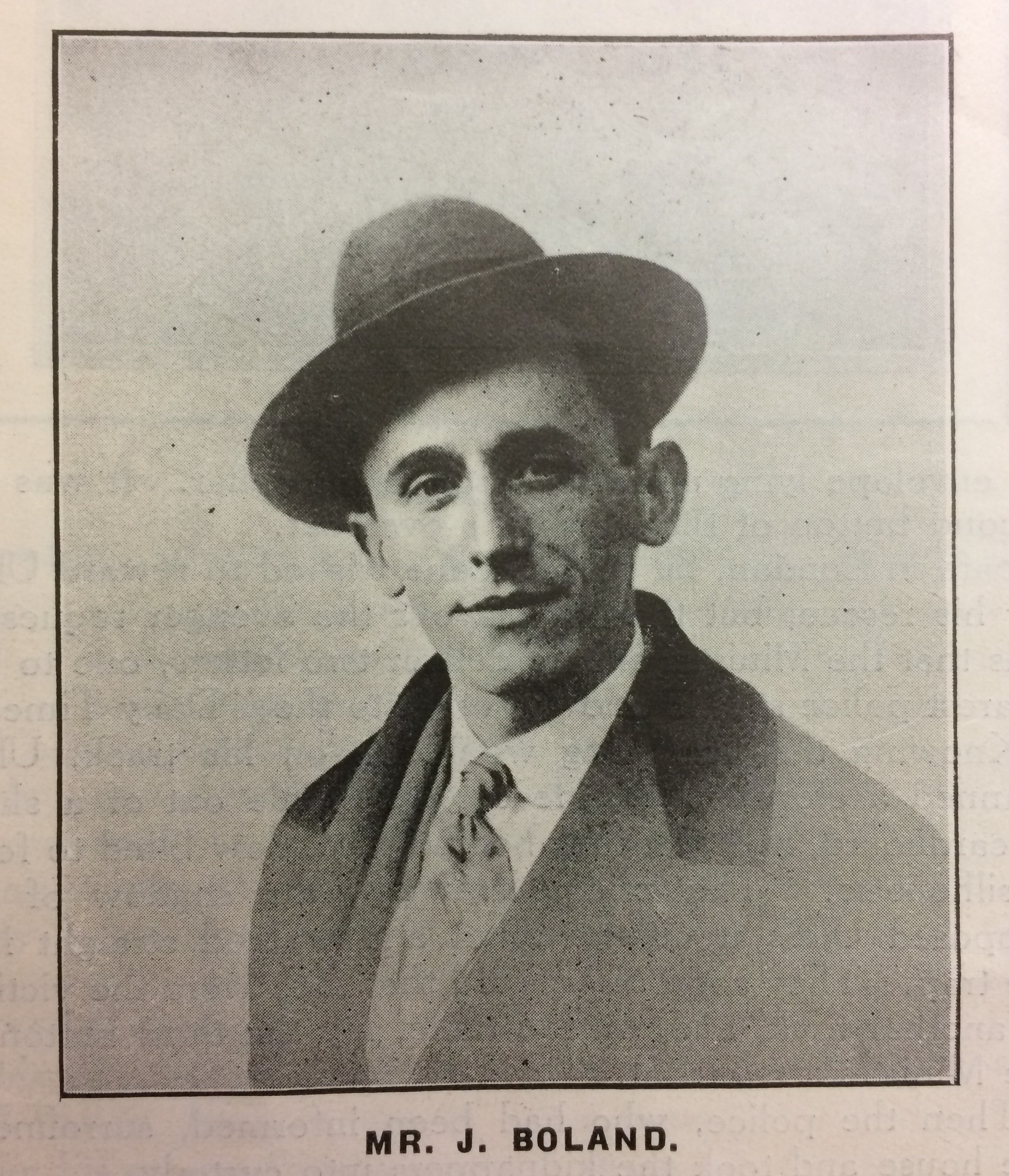
Joseph Boland Irish Limelight Jun. 1917: 6.

Among the other identifiable members of the company in 1916 and early 1917 were the sales and marketing operatives Mr. Coen, Joseph Boland and Ben Cowan. These men were vital to FCOI’s success, and although usually ignored by later film historians, they received considerable attention from contemporary trade journals because these were the people that journalists and cinema managers were most likely to meet. Coen was the company’s sales agent in Ireland until September 1916 when he was replaced by Boland, who for some years had been the travelling representative for General Film Supply (GFS), Ireland’s other major film production company of the period (Paddy, 28 Sep.). Boland appears to have had a good reputation in the industry in Ireland; the distributor M.P. Sales tried unsuccessfully and publicly to lure him away from GFS in early 1916 (Paddy, 17 Feb., 24 Feb., “Bioscope Parliament”). Cowan – one of a number of Russian Jews working in the early Irish film industry – ran Express Film Agency, the Irish agent for several British distributors, and he acted as publicist for the very successful 7 August launch of O’Neil of the Glen. Following this, he told reporters that “he intends to introduce many novel ideas in the advertising line. Another Trade show will shortly be held, at which it is Mr. Cowan’s intention to screen two more subjects” (Paddy, 27 Jul.). In the event, the second trade show on 17 August 1916 at the Dame Street Picture House would feature just The Miser’s Gift.

FCOI was intensely busy in August 1916. In Dublin, Cowan was publicizing the five complete or nearly complete productions shot earlier in the summer, as well as the other eight titles notionally in production. The Miser’s Gift was trade shown three days later. At some point in early August, Sullivan and Kerrigan brought the cast and crew to Kerry to shoot the four fiction films that would actually make up the second half of their 1916 production season. The date of departure is not clear, but if Puck Fair Romance was actually shot at Killorglin’s Puck Fair in 1916, then the company would have to have been in Kerry before 12 August because the fair took place between 10 and 12 August. They were certainly in Kerry by 20 August. An article in the Kerry News reported on a fundraising concert that FCOI mounted on 3 September to clear the debt from Glenbeigh’s Catholic church. It observed that the company “came to Glenbeigh two weeks ago where they opened a tour of the Kingdom’s beauty spots, and at present they are staying at O’Sullivan’s hotel, Muckross, having the scenes in several new films laid in and around Killarney” (“Film Company of Ireland”). If “two weeks” here is to be taken literally, the company reached Kerry on or about 20 August, but this seems like a flexible temporality. Nevertheless, the concert does seem to have marked the end of FCOI’s visit to Kerry. By 5 September, Dublin’s Evening Herald was reporting the company’s return to Dublin (“Back from Kerry”).

This suggests that the production unit had left Dublin before the publication of 14 August ad mentioning the eight films that were not subsequently made, as well as the Miser’s Gift trade show. Poor communication might explain why on 14 August, the company’s publicist did not have the titles for the scenarios that had begun shooting that week nor the locations at which they were being shot. But if this is true, then the production unit, which included Sullivan and possibly Fitzgibbon – it certainly included his wife – must have been surprized by the announcement of those eight titles in the national press. The tight timeframe also suggests that at least some and possible all of the scenarios were not carefully prepared and honed in advance but were hastily written on location. Only for The Eleventh Hour was a writer subsequently identified: Mark Coakley (“New Irish Film”).

Whatever FCOI’s reason for the eventual choice of Kerry above other parts of the country, accounts in the Kerry papers of FCOI’s filmmaking are very reminiscent of Sidney Olcott and Gene Gauntier’s filmmaking adventures in Ireland between 1910 and 1914. Making films for the Kalem Company and later for themselves, Olcott and Gauntier had repeatedly gravitated back to the Killarney area, often basing themselves in the village of Beaufort and taking advantage of the rugged mountain, lake and seashore landscapes available in west Kerry. Their dramas of rural life, emigration and historical rebellion had been very popular with Irish audiences, making this region the most identifiable early Irish cinematic landscape. The Post, however, chose to compare Olcott and Gauntier’s films unfavourably to the as-yet-unseen filmmaking efforts of FCOI. “We are glad that at length an Irish Company has appeared,” a columnist commented. “The misrepresentation of Ireland and her people were the aims of most of those who took up work such as this in the past. The production created a feeling of resentment and indignation” (“Notes on News”).

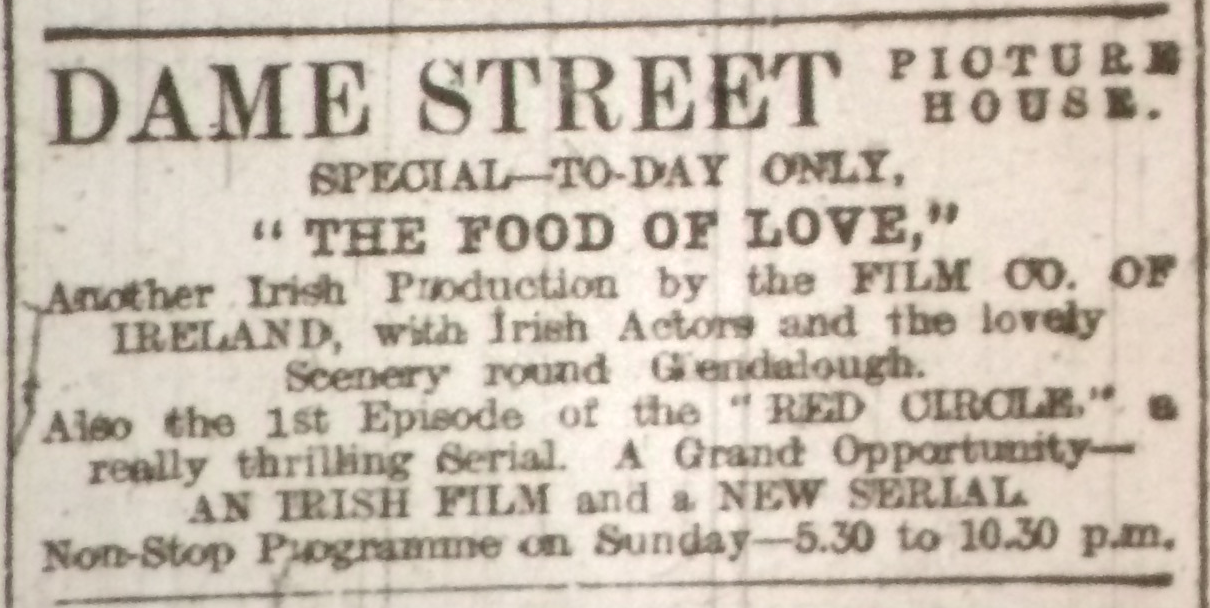
The last day of The Food of Love‘s run at the Dame Street Picture House; Dublin Evening Mail 4 Nov. 1916: 2.

Nevertheless, this does not look like FCOI offering radically new representations of Ireland. With at least some of their first five films shot in Wicklow – this certainly seems to have been the case with O’Neil of the Glen and The Food of Love whose publicity made much of “the lovely scenery around Glendalough” – and the final four shot in Kerry, FCOI was once again exploiting Ireland’s most reproduced picturesque locations (“Irish Film Production”).

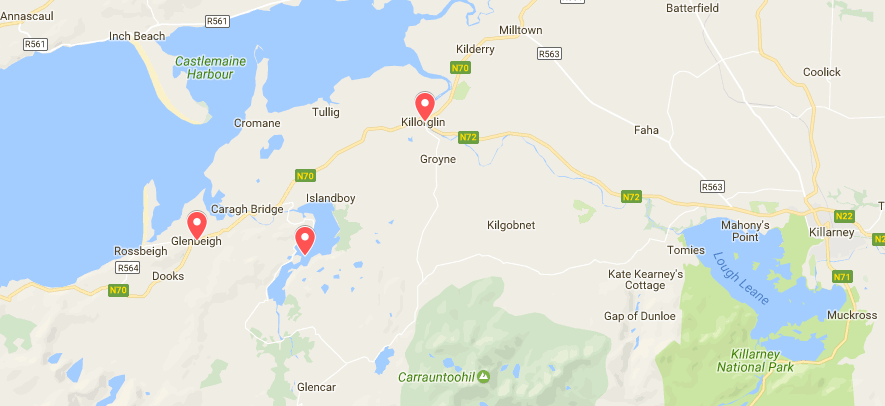
Kerry location at which FCOI shot in August 1916.

That said, there may be some novelty in the choice of southwest Kerry locations, which can be established readily from the titles and synopses of the films. The Bioscope short synopsis of Puck Fair Romance – which it titled A Romance of Puck Fair – gives little indication that the film was actually shot at Killorglin’s famous festival. “He was addicted to walking tours, she was an artist,” it begins. “They met in the country, on a farm, She thought him ‘a farmer’s boy,’ he thought her a farmer’s daughter. They canoodled and when their separate ways, he regretting having left her, she sorry to have deceived him. When they met in town it was all right” (“Condensed Film Critiques,” 28 Dec.). Little is made here of the fair, with its central feature: the electing of a billygoat as King Puck and parading him on a raised platform. Nevertheless, the critic was complimentary, if not completely positive, judging that it was “quite pretty, set in delightful Irish scenes, and there are two other nice people in it, his pal and her model, but they could not be expected to complete their romance in the same reel.”

Derry Journal 10 Jan. 1917: 2.

Killarney is most famous for its lakes, and as such, the lakeshore setting of The Eleventh Hour may be deemed clichéd. On the other hand, Coakley’s scenario – “in which the paternal instinct is the moving force” – was shot around the lesser known Caragh Lake, a scenic spot on the road between Glenbeigh and Killorglin (“New Irish Film”). A Girl of Glenbeigh indicates its setting in its title. Joseph Holloway’s comments on it when he saw it at the Rotunda on 15 Feb 1917 indicate how romance and landscape worked together. He observed in his diary that “[i]t told an interesting & effective love story that did not run smoothly, nicely amid beautiful scenery & surroundings – O’Donovan was the love in the story who had two strings to his bow – a farmer’s daughter & a lady. The latter two were played by the Miss Murphys.” Where Widow Malone – the fourth of the Kerry films – was shot is not clear from surviving sources. The Bioscope described its “simple” plot, in which

[p]retty widow Malone is counted by the political town councillor, the local schoolmaster and the village blacksmith. The two former are after her snug fortune, and are a couple of windbags, but the hearty smith, loyal when her fortune is supposed to be lost, wins Nora without much difficulty.” (“Condensed Film Critiques,” 14 Dec.).

While the period in Kerry was a busy one for the company, the return to Dublin seems to have put an end for some time to the involvement of many of the actors. Certainly, by the 25 September, Kerrigan and O’Donovan were back in Dublin and acting – in a special arrangement with FCOI – in John Bull’s Other Island, the opening play of the Abbey’s autumn season (“What’s on in Dublin”). There are some indications that the break up of the acting company was not altogether amicable. Holloway had a conversation with Abbey director John A. Keogh on 1 November 1916, who told him that “the Film Co. Of Ireland had burst up & the members all seeking engagements at the Abbey – O’Donovan had left it some time ago to join the Abbey Co.” Keogh comments may have to be treated with caution; he had hostility towards FCOI because of the special arrangements he had to make to be allowed to cast Kerrigan. Nevertheless, he did have information from the actors, so it may be true that “[f]unds had become low owing to the films released not catching on as was thought.”

Those involved in production may have been at a loose end by the start of September, but work for other elements of the business was increasing. At the end of August, Dublin Corporation considered an application from FCOI to build a studio on Pigeon House Road; the outcome of the application is not clear, but these studios were not built. Nevertheless, the Bioscope reported in September that FCOI “are fitting up very elaborate developing-rooms, etc., in their premises at 34, Dame Street, Dublin. Mr. W. James, chief operator at the Bohemian Theatre, Dublin, is in charge of the wiring and other electrical fittings” (“All-Irish Films”). This short item also renewed a call for scenario writers to “submit [FCOI] a sample of their work. The Scenario should preferably have Irish atmosphere, but this is not absolutely essential.”

Dublin Evening Mail 24 Oct. 1916: 4.

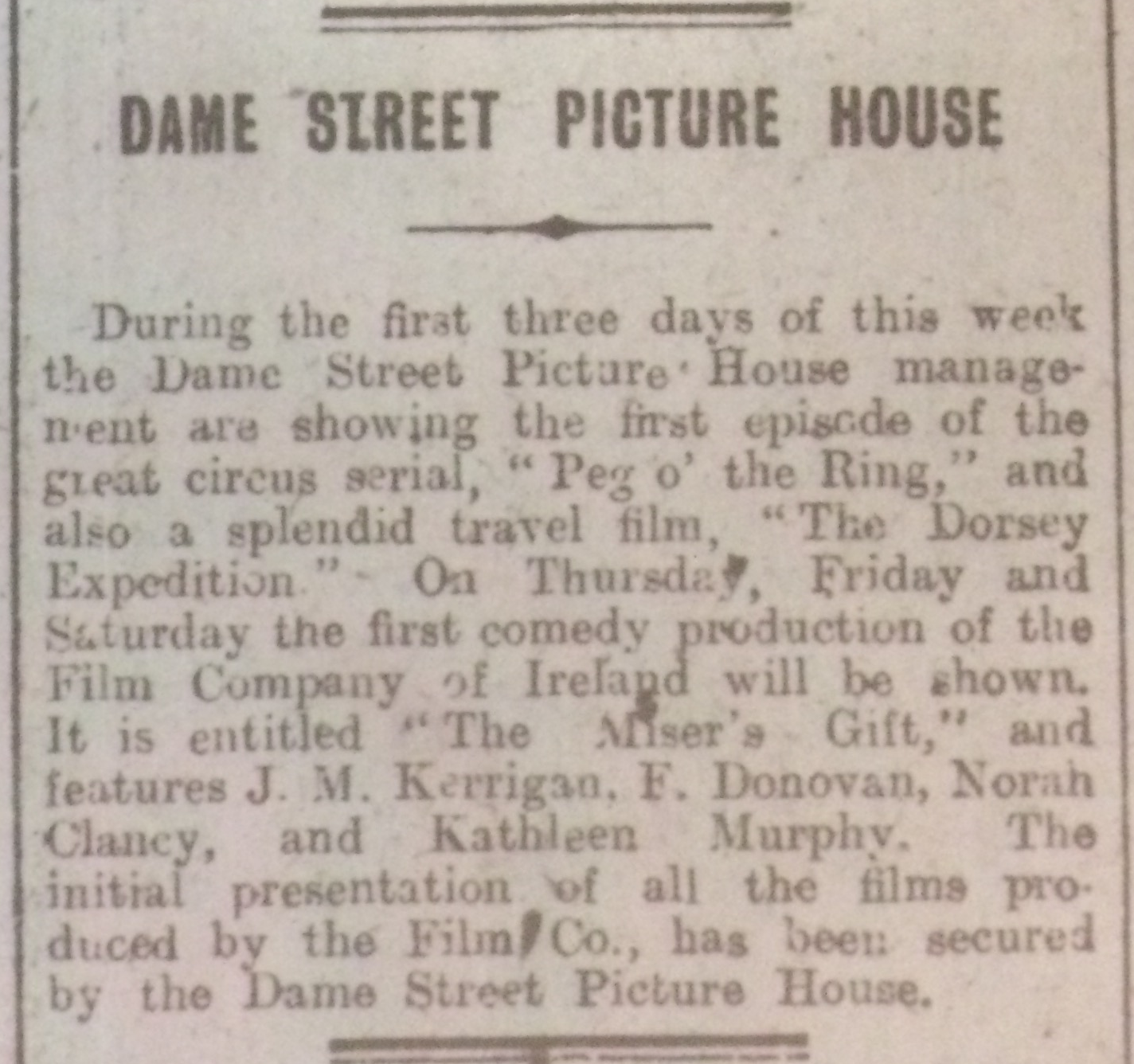
With this fit-out of post-production facilities underway, it took some time for the release of the remainder of the season’s films. The company’s first priority was the Irish market, and Boland appears to have been busy selling to cinemas all over the country. Despite the Dame Street Picture House claim in late October 1916 that it had secured “the initial presentation of all the films produced by the Film Co.,” the films premiered all over Ireland. Even FCOI’s long-heralded second release, The Miser’s Gift, had its first public viewings at Cork’s Coliseum on 12-14 October and a three-day run at Tralee’s Picturedrome (19-21 Oct.) before it had its Dublin debut at the Dame on 26-28 October. The Food of Love similarly premiered at the Coliseum on 23-25 October before appearing at the Dame for the three-day run of 2-4 November. However, Widow Malone was FCOI’s third release when it appeared at Kilkenny’s Cinema on Sunday, 22 October 1916 for a special benefit screening for the Gaelic League. The film had a more conventional three-day run at Belfast’s Kinema House later that week, beginning on 26 October.

Puck Fair Romance premiered in Belfast’s Kinema House; Belfast News-Letter 9 Nov. 1916: 1

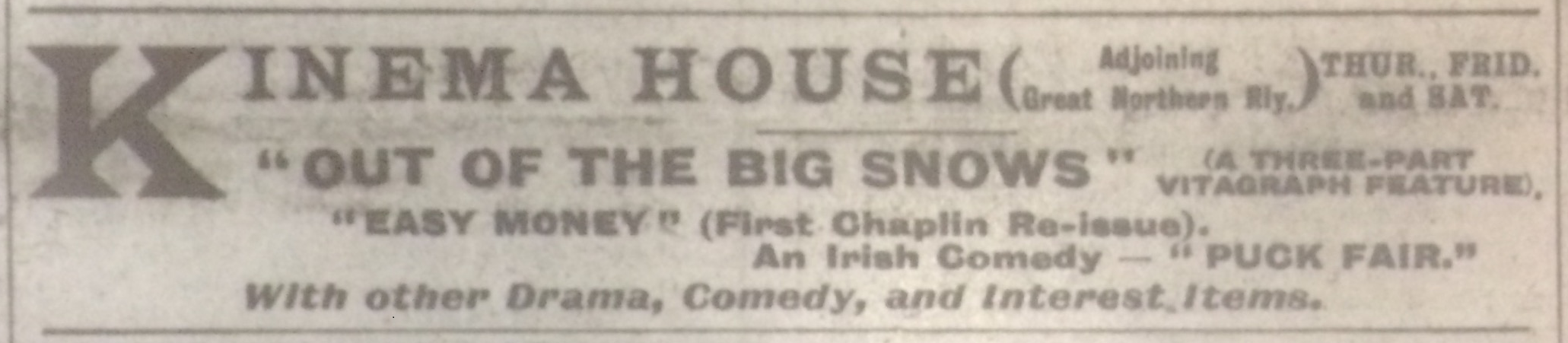
Indeed, Belfast, with the largest cinema-going population in the country, could not be and was not ignored in the awarding of premieres. Audiences at the Kinema House were the first to be offered Puck Fair Romance from 9-11 November. The Dame does seem to have debuted An Unfair Love Affair on 23-25 November. A Girl of Glenbeigh, however, premiered in Kerry, at Tralee’s Picturedrome on 27-28 November. The Dame also had the first viewings of the final two releases of the year. It opened The Eleventh Hour – FCOI’s second three-reel film –on 30 November 1916 for a three-day, end-of-week run. It was nearly a month later when the final release of the season, Woman’s Wit, had its debut at the Dame on 26 December.

Much more remains to be discovered about this initial period of FCOI and the films they made in 1916, not least their November 1916 distribution deal with Davison’s Film Sales Agency and the patterns of exhibition in Britain. Let this attempt to bring together some of the newspaper and trade journal sources mark a start of that more complete account.

References

“All-Irish Films.” Bioscope 28 Sep. 1916: 1285.

“Back from Kerry: New Films Produced by Irish Company.” Evening Herald 5 Sep. 1916: 2.

“Bioscope Parliament.” Bioscope 2 Mar. 1916: 967-68.

“Condensed Film Critiques.” Bioscope 14 Dec. 1916: i; 21 Dec. 1916: iii; 28 Dec. 1916: i.

“Film Company of Ireland: Church Debt Wiped Out.” Kerry News 6 Sep. 1916: 4.

Gifford, Denis. The British Film Catalogue, vol. 1, Fiction Film, 1895-1994. 3rd ed. London and Chicago: Fitzroy Dearborn, 2001.

“Gossip of the Day.” Evening Telegraph 20 Apr. 1917: 2.

Holloway, Joseph. Holloway Diaries. National Library of Ireland.

“Irish Film Production.” Irish Times 30 Jun. 1916: 6.

“New Irish Film.” Irish Times 30 Nov. 1916: 8.

“New Irish Industry: The Film Co. of Ireland: A Promising Enterprise.” Freeman’s Journal 30 Jun. 1916: 6.

“Notes on News.” Kerry News 1 Sep. 1916: 2.

Paddy. “Pictures in Ireland.” Bioscope 18 Nov. 1915: 841; 17 Feb. 1916: 717; 24 Feb. 1916: 812; 13 Jul. 1916: 173; 27 Jul. 1916: 359; 28 Sep. 1916: 1285; 11 Jan. 1917: 194.

Rockett, Kevin. The Irish Filmography: Fiction Films, 1896-1996. Dublin: Red Mountain, 1996.

“What’s on in Dublin Next Week.” Evening Herald 23 Sep. 1916: 2.

“With the Film Co. of Ireland: A Day with the Producers.” Irish Limelight Jun. 1917: 10-11.

Exhibiting Tanks to Irish Cinema Fans, February 1917

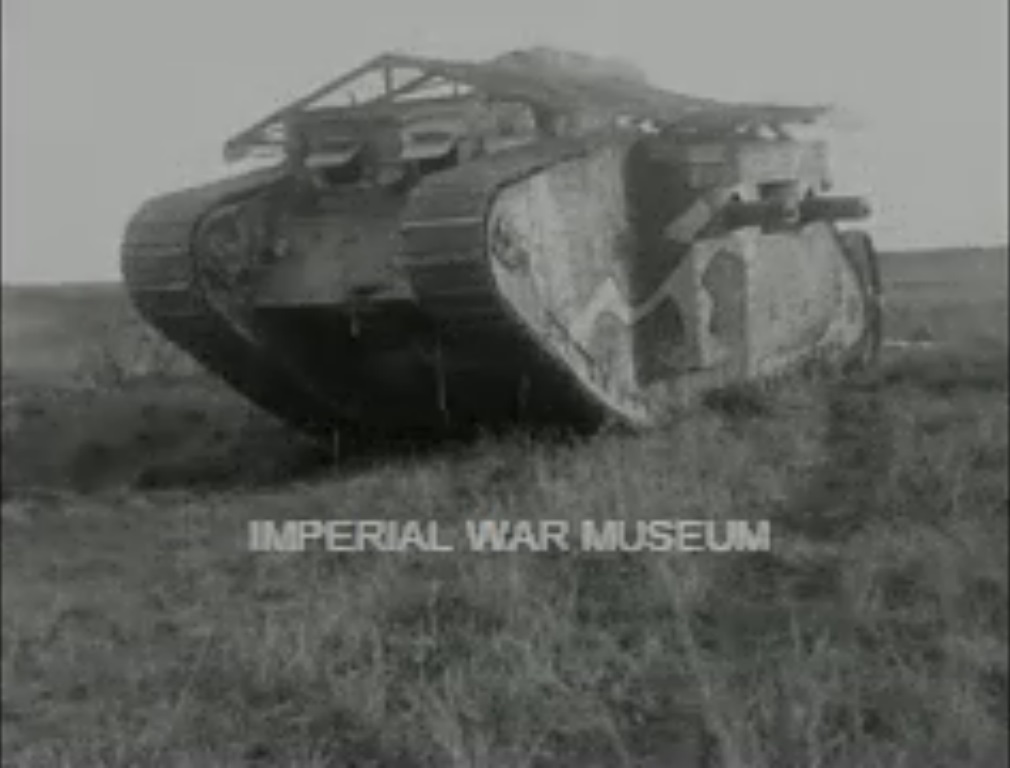
A tank goes into battle in The Battle Ancre and Advance of the Tanks (Britain: British Topical Committee for War Films, 1917) from the Imperial War Museums.

A tank goes into battle in The Battle Ancre and Advance of the Tanks (Britain: British Topical Committee for War Films, 1917); Imperial War Museums.

Cinema was so popular in Ireland in February 1917 that the press had to search for a name for its adherents, and they found it in American vernacular. “This morning there is a heart-cry from a cinema fan,” the “Gossip of the Day” columnist in the Evening Telegraph noted on 21 February 1917:

He doesn’t know that he is a cinema fan, and that is the crux of the trouble – he is ignorant of the great American language. I gather from his pathetic note that he is a regular patron of the “silent drama,” yet he finds a difficulty in understanding the explanatory inscriptions with which American producers seek to help the intellects of those who sit in the outer darkness.

Although cinema was primarily a visual medium and as such offered the promise of an international language, it still required words to specify the meaning of what might otherwise be ambiguous images. The silent film’s intertitles carried those words, but they were often in a dialect not universally understood. The columnist was surprised at this because s/he believed that “regular patrons of this form of amusement were able to understand any announcement on the screen from the ‘slick’ slang of East Side New York to the weird attempts at English of the Italian, French and Danish producers.”

Most of the films that Irish cinemagoers saw were indeed American, but it was a British film that sought to attract as many Irish cinema fans as possible in February 1917. Monday, 19 February saw the Irish opening of The Battle of the Ancre and Advance of the Tanks (Britain: British Topical Committee for War Films, 1917), a War Office-sponsored propaganda film more often called simply The Tanks. Despite this foreshortened title, tanks featured only occasionally in the film. “Throughout the five scenes,” the Evening Herald’s Man About Town complained, “the Tanks are seen about four times altogether, each time only for a very brief passing moment.”

Whatever about the coming disappointment, anticipation for the film could build on tantalizing glimpses of this new war machine that had been accumulating for several months. In autumn 1916, Irish people had read about the first battlefield deployment of tanks, and in November 1916, Dubliners had even had the opportunity of seeing a tank film, albeit it the animated Tank Cartoon (Britain: Kineto, 1916). The cinema trade press had also informed its Irish readers about the shooting of the War Office tank film (“About Those Tanks!”).

faugh-a-ballaghs-il-feb-1917

The Dublin Evening Mail appears not to have been exaggerating when it noted that the “coming of the “Tanks’ Film’ to Dublin has been eagerly anticipated.” Publicity for the film could draw on what appears to have been a widespread fascination with this new weapon, in a similar way to which the earlier propaganda films had focused on artillery or aircraft. Previewing the coming shows at Dublin’s Theatre Royal, the city’s largest entertainment venue, the Mail writer observed that the “film portrays the most interesting happenings during the Battle of the Ancre, when the Tanks were first heard of, and promises to prove one of the most successful of the many interesting war films already seen in Dublin. The Battle of the Ancre stands out as one of the most striking phases of ‘The Big Push’” (“‘The Tanks’ at ‘The Royal’”).

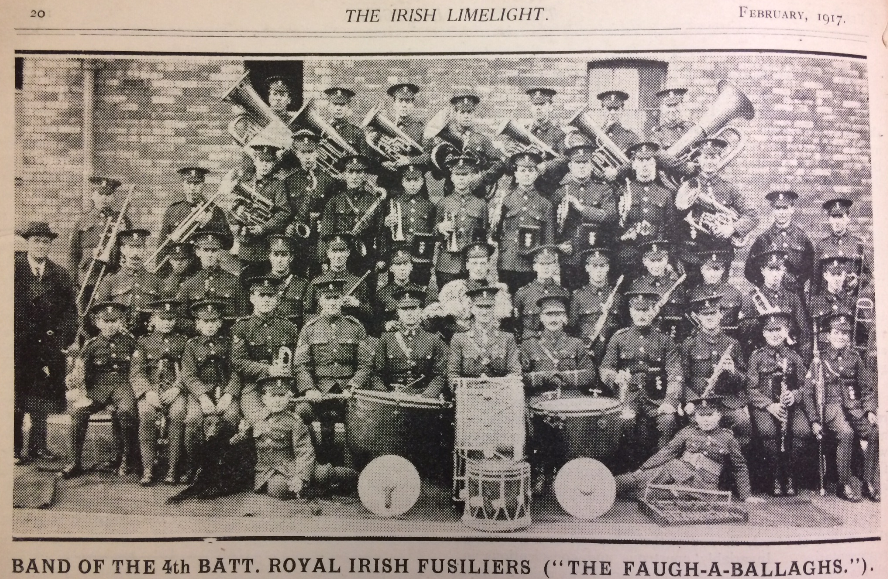
Indeed, the Royal starting advertising the film as early as 10 February, when a short item warned patrons to book the film to avoid disappointment: “Your remember the trouble you had getting a seat at the ‘Battle of the Somme’ films, but you say to yourself that there will be no difficulty with ‘The Tank’ films, and you delay booking only to find yourself in the same position as before” (“‘The Tanks’ Film at the Theatre Royal”). The added attraction of The Tanks was that it included footage of Irish soldiers: “There were no Irish regiments shown in the Somme film, but Lieut. Malins, who took the pictures, succeeded in getting some splendid films of our gallant Irish Brigade.” Despite such extensive publicity of the film, the Royal only showed it at matinees (beginning at 2.30pm), except on Wednesday, when the film replaced the Royal’s two evening variety shows (beginning at 6.45pm and 9pm). Nevertheless, the film was presented at the Royal with “special music and effects that […] should help one to realise ‘what it is like.’ The band of the famous Faugh-a-Ballaghs will play at every performance” (“‘The Tanks’ at ‘The Royal’”). Unfortunately no review of the Royal shows appears to exist that specifies what effects – presumably sound effects imitating exploding shells – were used during the shows and how the audiences responded.

tanks-grafton-dem-21-feb-1917

Dublin Evening Mail 19 Feb. 1917: 2.

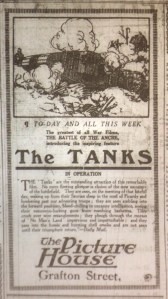
The Royal was far from the only Dublin venue showing the film that week. Another large theatre, the Empire, showed the film all week alongside a somewhat reduced variety programme. Several of the most prestigious picture houses also screened it, with the Bohemian, Carlton, Masterpiece and Town Hall, Rathmines showing it for the first three days of the week, and the Grafton retaining it into the second half of the week. The Bohemian managed to show the film four times daily at 3, 5, 7 and 9, but this was eclipsed by the six shows that the Grafton managed to squeeze in at 1.45, 3.15, 4.45, 6.15, 7.45 and 9.15, “so that business men and others can all have an opportunity of making acquaintance with these new machines of war, of which Sir Douglas Haig says he cannot speak too highly” (“Grafton Picture House”).

While Dublin’s newspapers reviewed the film positively – even the Herald‘s Man About Town, despite his disappointment about the little screen time devoted to the tanks themselves – the Irish Times printed the longest review, and it was most forthright in clarifying the film’s ideological intent. Its “exhibition creates many thrills, and gives a very vivid conception of the war in all its phases,” the writer argued. S/he admitted that this had been done before, most notably by the very popular Battle of the Somme (Britain: British Topical Committee for War Films, 1916), but it had been criticized for showing British soldiers being killed. “[I]n the Tank films one is spared the somewhat gruesome side of the fighting. The tanks are awesome but not gruesome” (“‘Tanks in Action’”). In the face of so much evidence to the contrary, the film therefore helped recruiting by propagating a myth of British military invulnerability. “Should they stimulate our young men to help those Irishmen whom they see manning the trenches,” the Times writer concluded a lengthy review, “‘The Tanks in Action’ will be doing good work in Dublin.”

ultus-sydney-master-dem-24-feb-1917p2

Dublin Evening Mail 24 Feb. 1917: 2.

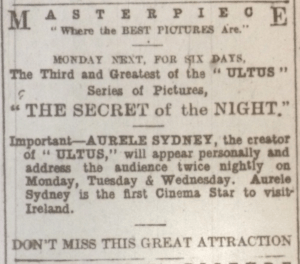
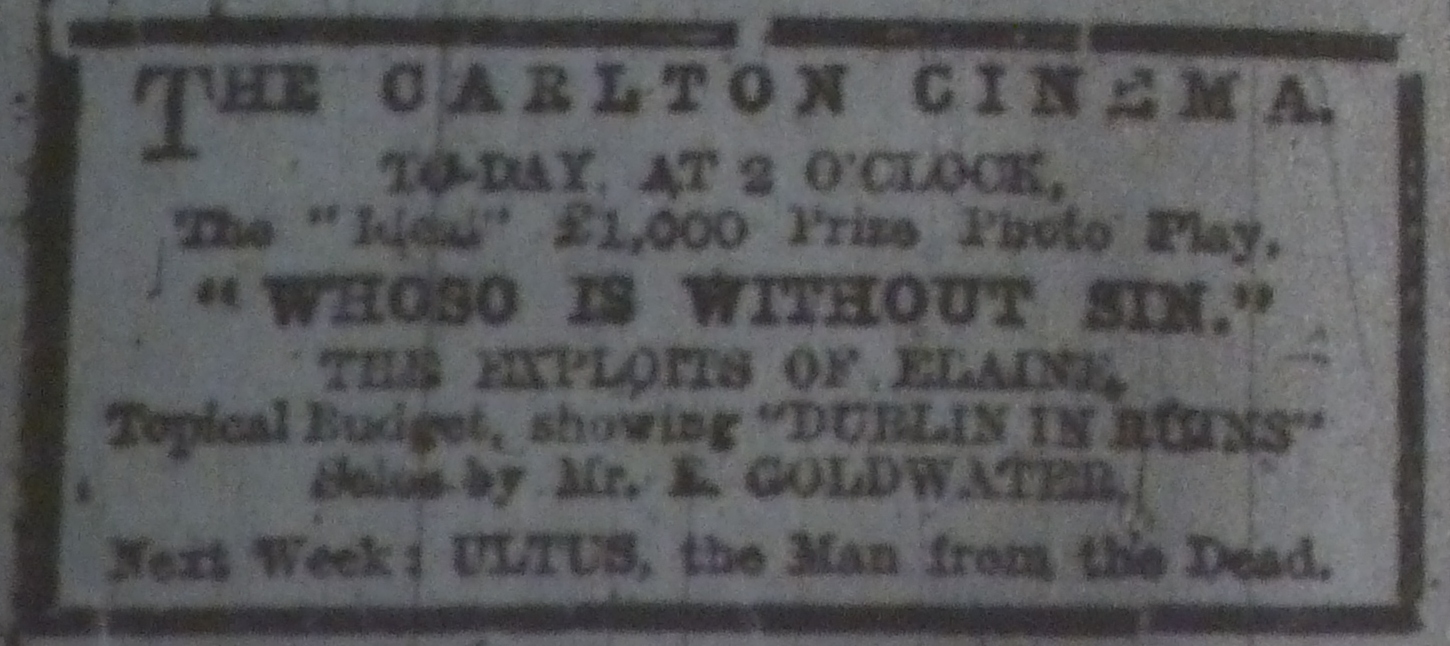
The Times did not usually offer extensive reviews of films, but other newspapers were taking cinema increasingly seriously. On 19 February, the Evening Telegraph – the evening edition of the Freeman’s Journal – resumed publication after a hiatus caused by the destruction of its premises during the Easter Rising. Among its innovations was a Saturday column entitled “Kinematograph Notes and News.” The first series of notes on 24 February included both international items and some of particular Irish relevance. The latter included a notice that Aurele Sydney, star of Ultus series, would attend the Masterpiece Cinema during the following week’s screenings of Ultus and the Secret of the Night (Britain: Gaumont, 1917). Another note concerned the views of John Bunny, a film star who had visited Ireland five years previously and discussed the possibilities for film production in the country. Given that it made no mention of the Film Company of Ireland’s recent filmmaking efforts, the reason for the inclusion of the note on Bunny is unclear, unless it was to quietly contradict the claim made in the Masterpiece’s ad that Sydney was the first cinema star to visit Ireland.

This column was praised by a writer in the Irish Limelight, the cinema magazine that had begun publication in January 1917. “Readers of the Saturday Evening Telegraph got an agreeable surprise recently when they found that cinema notes were introduced,” “Movie Musings” columnist Senix observed. The surprise that the staff at the Limelight got on seeing the column may not have been all that agreeable, given that a weekly newspaper column might steal much of the thunder of the monthly journal. Nevertheless, Senix took it to be a positive development, commenting that “[t]his recognition of the people’s amusement proves pleasant reading after the many bitter attacks which have been made in the local Press. And the fact that it comes so soon after the appearance of the Irish Limelight sets us thinking.”

Dublin Evening Mail 17 Feb. 1917: 2

Dublin Evening Mail 17 Feb. 1917: 2

Despite Senix’s optimistic reading of the appearance of the Telegraph‘s column, bitter attacks on cinema were still very much evident in February 1917, both in the press and in the auditorium. When the “Gossip of the Day” columnist had attempted to define “cinema fan” for his/her readers, s/he speculated that “‘fan’ must be American for ‘fanatic,’ as it is used to designate people who are peculiarly addicted to any pastime.” However, there may be reasons for distinguishing between cinema fans and cinema fanatics. Certainly serial protestor William Larkin was a fanatic often to be encountered in cinemas but not a cinema fan. Since 1914, Larkin had mounted periodic protests in Dublin’s picture houses against films that he and the Catholic Irish Vigilance Association (IVA) considered to be morally dubious. These protests occurred in the auditorium during the screening of the films and involved Larkin shouting about the need for a Catholic-influenced Irish censorship and/or throwing ink at the screen. Larkin sought arrest to magnify the reach of the protest through the newspaper reports of the disturbance and subsequent trial. He had usually found that the magistrates treated him leniently – even indulgently – but in December 1915, he had been jailed when he refused to pay a fine imposed for a cinema protest.

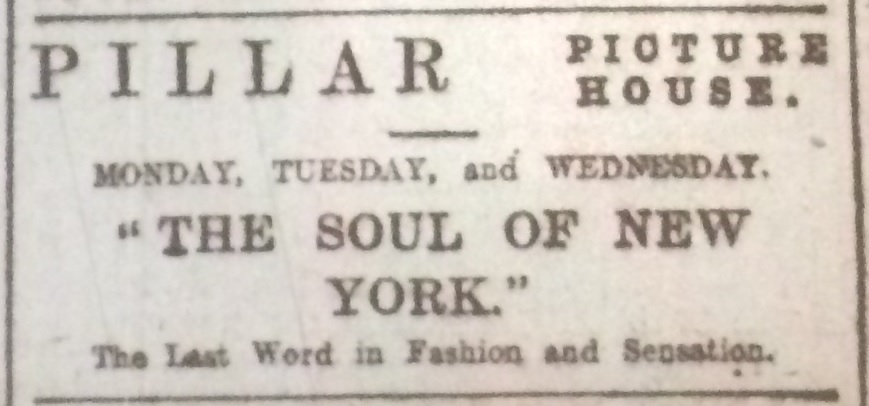
After a period of apparent inactivity during 1916, Larkin’s latest – and last for some years – cinema protest took place on 21 February 1917 during a screening of The Soul of New York (US: Fox, 1915; released in the US as The Soul of Broadway) at the Pillar Picture House in Dublin city centre (“City Cinema”). It followed a well-established pattern. At about 10.25pm, the picture-house porter heard a commotion in the auditorium, found that Larkin had thrown “a blue liquid” at the screen and went to get manager J. D. Hozier. Larkin made no attempt to escape and admitted to having thrown the liquid, which not only caused damage estimated at £30 to the screen but also “bespattered” the instruments and clothes of musicians Herbert O’Brien, Joseph Schofield and Samuel Golding in the orchestra (“City Cinema Scenes”). After several court appearances, the case seems to have been struck out at the end of March.

Evening Telegraph 22 Feb. 1917: 1.

Evening Telegraph 22 Feb. 1917: 1.

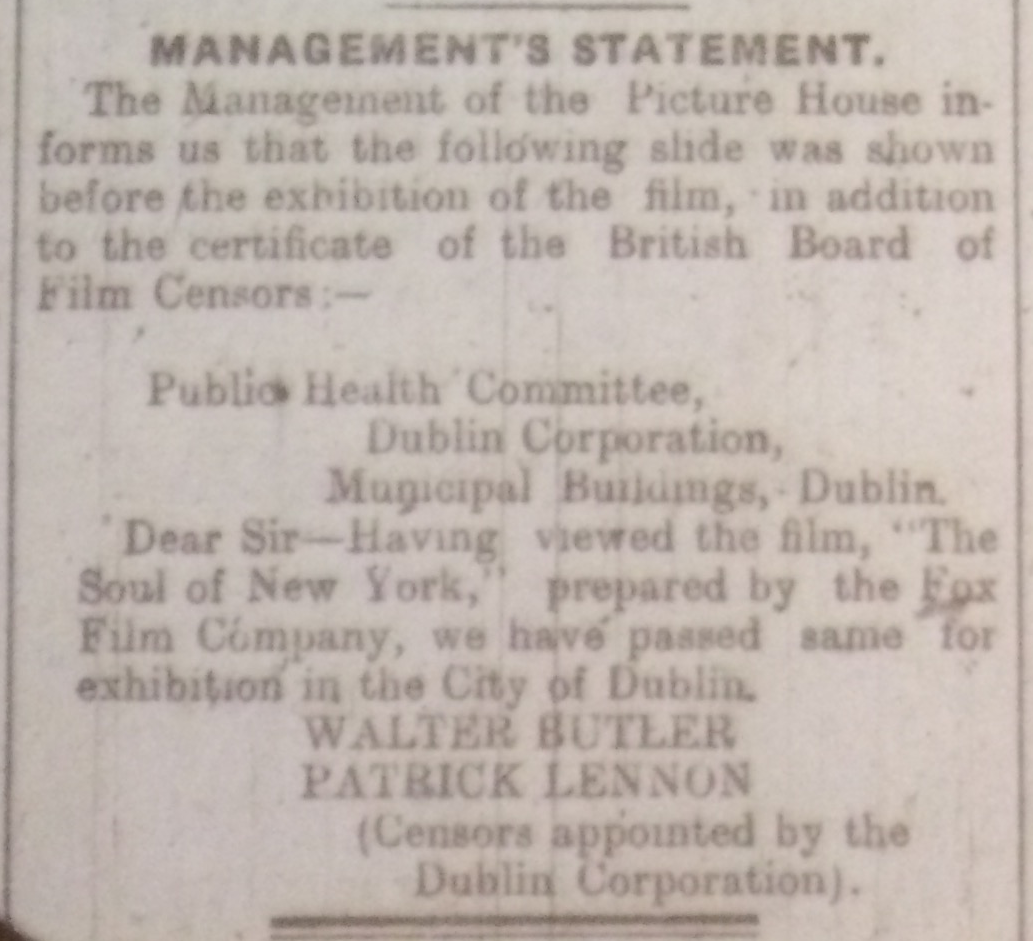
Although this “exciting episode” certainly garnered press coverage, how Larkin’s direct-action methods complemented the Irish Vigilance Association’s ongoing campaign for cinema censorship is not clear. Indeed, despite his previous affiliation with the IVA, Larkin may have been acting on his own in this instance. The IVA’s well organized political lobbying for the introduction and effective exercising of film censorship was well advanced by February 1917. In June 1916, Dublin Corporation had appointed Walter Butler and Patrick Lennon as film censors, and in January 1917, it had engaged two women as “lady inspectors” of picture houses (“Amusement Inspectors,” “Dublin Lady Censors”). The IVA found a ready welcome at Dublin Corporation. On the last day of February, its Public Health Committee (PHC) invited a seven-member IVA deputation to address them on Sunday opening (“Cinema on Sundays”). Answering the deputation’s complaint that many cinemas opened at 8 o’clock on Sunday evenings, thereby intruding on hours set aside for Catholic devotions, PHC chairman and former mayor Lorcan Sherlock assured the deputation that the Corporation would enforce a 8.30pm Sunday opening.

Therefore, Irish cinema was engaging both fans and fanatics in February 1917.

References

“About Those Tanks! Extraordinary Interest of the Latest ‘Big Push’ Films.” Bioscope 12 Oct. 1916: 121.

“Amusement Inspectors: Reports to Be Made on Dublin Performances.” Evening Herald 10 Jan. 1917: 3.

“Cinemas on Sundays: Vigilance Association and the Hours of Opening.” Evening Telegraph 1 Mar. 1917: 2.

City Cinema: Exciting Episode: Blue Liquid Thrown.” Evening Telegraph 22 Feb. 1917: 1.

“City Picture-House Scene.” Dublin Evening Mail 28 Feb. 1917: 2.

“Dublin Lady Censors: Names Submitted.” Freeman’s Journal 15 Jan. 1917: 4.
“Gossip of the Day: Comments on Current Events.” Evening Telegraph 21 Feb. 1917: 2

“Grafton Picture House.” Dublin Evening Mail 17 Feb. 1917: 5.

“Kinematograph Notes and News.” Evening Telegraph 24 Feb. 1917: 5.

The Man About Town. “Thing Seen and Heard.” Evening Herald 19 Feb. 1917: 2.

Senix. “Movie Musings.” Irish Limelight 1:3 (Mar. 1917): 3.

“‘The Tanks’ at ‘The Royal.’” Dublin Evening Mail 17 Feb. 1917: 4.
“‘The Tanks’ Film at the Theatre Royal.” Dublin Evening Mail 10 Feb. 1917: 5.

“‘Tanks in Action’: Cinema Pictures in Dublin.” Irish Times 20 Feb. 1917: 3.

Irish Audiences Watch “O’Neil of the Glen,” August 1916

If cinema in Ireland in July 1916 prompts reflection on film as a weapon of war, developments the following month show significant developments in the emergence of film as an expression of national culture. On 7 August 1916, audiences at Dublin’s Bohemian Picture Theatre were the first to see O’Neil of the Glen (often spelled O’Neill of the Glen), the first Film Company of Ireland (FCOI) production to be publicly released. Formed in March 1916 by James Mark Sullivan and Henry Fitzgibbon, the FCOI would become the most important indigenous fiction film producer of the 1910s. Ò’Neil of the Glen itself, however, is believed to be a lost film, like all FCOI’s other production except Knocknagow (1918), Willy Reilly and His Colleen Bawn (1920) and one reel of the two-reel comedy Paying the Rent (1920). Nevertheless, its success with audiences was vital to securing FCOI’s future.

O'Neil Boh 7 Aug 1916

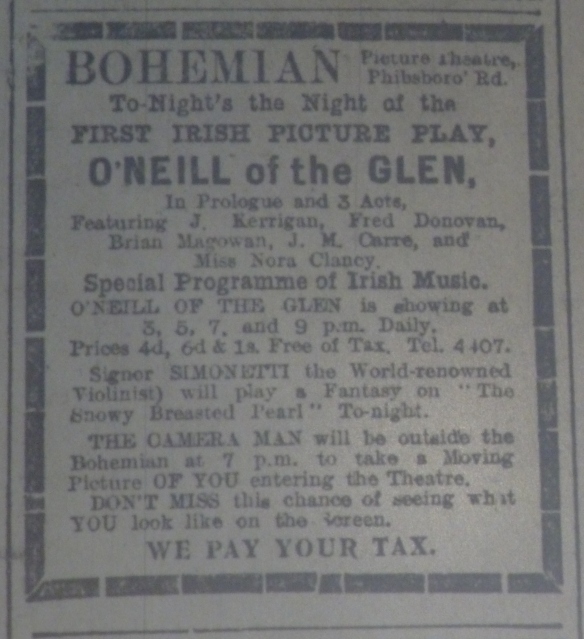
Ad for the first public exhibition of O’Neil of the Glen, at Dublin’s Bohemian, Dublin Evening Mail 7 Aug. 1916: 2.

That success was won in part by the careful management of publicity, a fact that means that the surviving ads, articles and reviews in the press must be treated with caution. It may be a forgivable exaggeration for the papers to have hailed the premiere of O’Neil of the Glen as the start of a new Irish industry, but it was not true that this was “the first picture-play ever produced in Ireland by an Irish company of Irish players,” a claim repeated almost verbatim in several paper, indicating that the journalists were working from the same FCOI publicity materials (“New Irish Industry,”  “O’Neill of the Glen,” “Irish Film Triumph”). Most recently, Charles McEvoy of Dublin’s Masterpiece Cinema had funded Fun at Finglas Fair – even if it had allegedly been destroyed during the Easter Rising before being publicly shown – and in 1912-13, cinema-owner and mayor John J. Farrell had made a number of films with his company Irish Film Productions (Rockett 95, Condon 237).

IRISHLIMEGHT1_MAY_P6 001

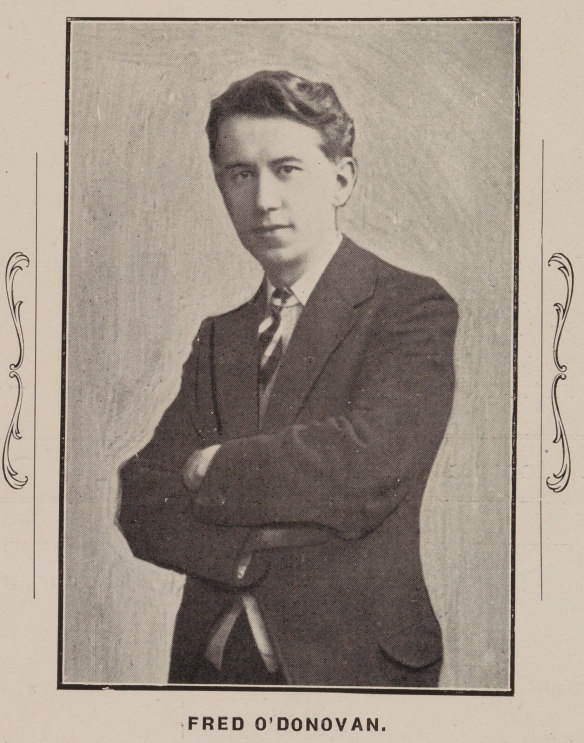
Abbey Theatre and Film Company of Ireland actor – and later director – Fred O’Donovan; Irish Limelight 1:5 (May 1917): 6.

Nevertheless, although O’Neil of the Glen was not the first indigenous Irish fiction film, it was a very significant one by the country’s most important film production company of the 1910s. On 29 June, FCOI announced a “trial exhibition,” or what would now be called a test screening, of their first completed production, O’Neil of the Glen, at Dublin’s Carlton. By this time, and in the context of management difficulties at the Abbey Theatre, FCOI had been able to contract J. M. Kerrigan and Fred O’Donovan, two of the Abbey’s biggest stars, albeit that they were permitted to appear in certain plays (“Abbey Theatre,” “Platform and Stage”). Kerrigan, indeed, directed and played a part in O’Neil of the Glen, a three-reel feature based on a script adapted by W. J. Lysaght from M[argaret] T. Pender’s story of the same title that had been serialized in the Shamrock in 1891. The film told how Don O’Neil (Brian Magowan), the son of a landowner who had been defrauded by the solicitor Tremaine (J. M. Carre), saves the life of Tremaine’s daughter, Nola (Nora Clancy), whose love he wrests from Graves (O’Donovan), a blackmailing suitor (“Bohemian,” Evening Mail).

“The film is of a quality which leads one to anticipate success for the venture,” wrote an Irish Times correspondent at the trial exhibition, noting that it was part of a process of perfecting the film: “the promoters are engaged in a ruthless revision of the film to bring it up to the highest possible standard” (“Irish Film Production”). The Bioscope’s Irish correspondent Paddy’ was less complimentary about this early cut of the film, pointing out that although “[g]reat care was taken with the production and camera work,” it possessed “many of the weak points common to first productions” (“Paddy,” 13 Jul.). Addressing a lunch for the press at the Gresham Hotel after the screening, Fitzgibbon claimed that FCOI “had started an industry which would eventually be a source of great revenue in Ireland.” For his part, Sullivan argued that the film showed that Irish productions – taking advantage of Irish “imagination, ideals, and artistic temperament and beautiful scenery” – could competing with those anywhere (“Irish Film Production”).

Paddy began to revise his lukewarm opinion of O’Neil of the Glen in light of the news that Frederick A. Sparling had booked the film for its first run at his Bohemian for the week of 7-13 August. The Bohemian was one of Dublin’s biggest and most luxurious cinemas, and Sparling’s commitment to a run that was twice the usual three days “speaks well for the film and the undoubted drawing powers such a production will have for Irish audiences” (Paddy, 27 Jul.). In the event, Sparling also included an unplanned Sunday show to take advantage of the phenomenal level of interest.

Although FCOI appears to have taken the bookings itself, prominent local distributor Ben Cowan of Express Film Agency handled this and other FCOI films from 1916 by running trade shows and placing advertisements in the daily and trade press. It was likely one of Cowan’s “novel ideas in the advertising line” for FCOI cameraman John A. Bennett – a former projectionist at Dublin’s Rotunda – to film the audience on the first night and for this local film to be shown subsequently with the feature (Paddy, 27 Jul.; 17 Aug.). “Don’t miss this chance of seeing what you look like on the Screen,” ads warned the opening-night audience. The musical attractions included a special programme of Irish melodies and the cinema’s “world-renowned violinist” Signor Simonetti playing a fantasy on the “Snowy Breasted Pearl” at the evening shows. “It is confidently hoped that large audiences will visit the Bohemian during the coming week,” revealed a preview in the Evening Mail, “and thus mark in a tangible manner their appreciation of what may justly be described as a really first-class picture-play, and one that is sure to bring the work and the players of the Film Company of Ireland right into the forefront of popularity with audiences and trade alike” (“Bohemian”).

The surprising extent of the success of O’Neil of the Glen must be measured in the first instance as a marketing victory rather than an artistic one, by FCOI. The degree to which these early films challenged existing ways of representing the Irish is questionable, but many contemporary commentators seem initially to have been content that films with wholly Irish creative input were finally being made. Nevertheless, the way in which the company were able to capitalize on the interest and goodwill attending the exhibition of this first indigenous Irish fiction film and, crucially, to publicize the large attendances not only in Ireland, where interest was likely to be strong in any case, but also in Britain, appears to have secured a British distribution deal and thereby to have ensured the company survival in this initial period. This success was built on what appears to have been a genuinely surprising level of interest in the picture. “The film, which was expected to prove a good draw, actually surpassed all anticipations,” observed Paddy, warming further to the film, “a record being established for the week, and queues being the rule every evening” (17 Aug.). The Irish Times commented that enthusiastic audiences in a crowded cinema “proves that the Dublin public is always ready to support and encourage Irish enterprise” (“Film Company of Ireland,” 9 Aug.). “That the genuine enthusiasm displayed last night at the conclusion of the film will be the means of bringing before the public a second production by the Irish Film Company in the near future,” observed the Freeman’s Journal, “is a universal wish” (“Bohemian”).

O'Neil Victoria 9 Sep 1916p4

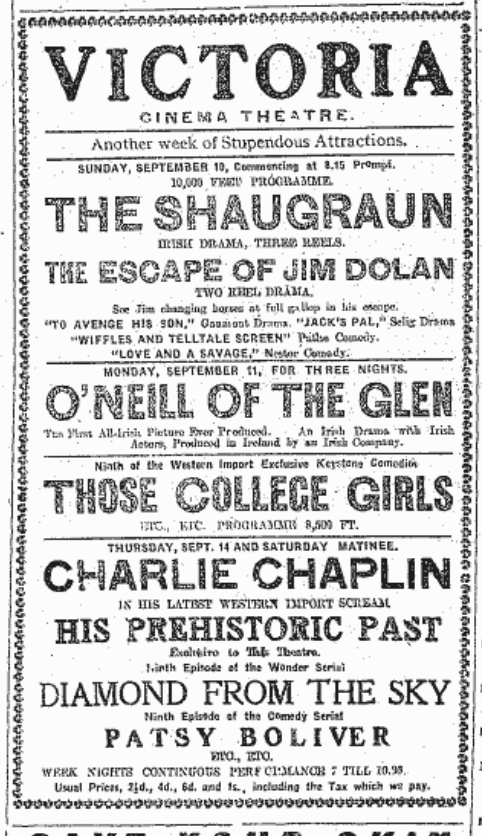
Ad for Galway’s Victoria Cinema Theatre for the week in which O’Neil of the Glen featured. Connacht Tribune 9 Sep 1916: 4.
This wish would be soon fulfilled, and O’Neil of the Glen was exhibited around the country in the following weeks and months. When following substantial runs in Dublin and Belfast it was announced for a three-day run at Galway’s Victoria Cinema Theatre on 11-13 September, a Connacht Tribune reporter distinguished its attractions from that of American films, which were unrivalled “in the matter of cinematographic thoroughness and all-round fullness and finish of technique, but one can get too much of a good thing.” The FCOI’s “national or […] patriotic enterprise” offered something that monotonously perfect and ubiquitous American films could not: “The production is Irish, the subject is Irish, the mise-en-scene is Irish, and the actors and actresses are Irish” (“‘O’Neill of the Glen’”). A writer in the Cork Examiner during the film’s run at Cork’s Coliseum Theatre (14-16 September) concurred, arguing that

[t]hrere certainly should be an opening for cinema representation of Irish drama as played by native Irish actors, whose one object is to show Irish life in its true perspective, without grotesque exaggeration, or what is just as bad, giving an unreal picture of it, even when the intention is friendly to the country and the people. (“Coliseum Theatre.”)

A journalist at the Derry People was particularly interested in the local connections of a film “in which well-known Irish artistes will be screened, and details dealing with Tyrone and neighbouring localities introduced in splendid style” (“Hall”). The film’s second Dublin run was at the Dame Street Picture House (21-3 September) – the cinema closest to FCOI’s offices and where some of their subsequent 1916 films would premiere – before it had first and second runs in Belfast, at the Duncairn (28-30 September) and the Clonard (2-4 October). Subsequent screenings included Mullingar’s National (14-15 October), Kilkenny’s Cinema (18-19 October) and Dublin’s Fr Mathew Hall (2 December).

FCOI IT 14 Aug 1916p4

Irish Times 14 Aug. 1916: 4.

While O’Neil of the Glen toured the country, the company quickly followed up this successful debut with the announcements of their next films in the dailies and trades. On the Monday after the last show of O’Neil of the Glen at the Bohemian, the Dublin papers carried an advertisement headed “Films that Draw Crowded Houses Every Night!” that recommended FCOI’s new films on the basis of the audience-drawing power of that first film. Four two-reel comedies were scheduled for release in September – The Miser’s Gift, Woman’s Wit, Food of Love and An Unfair Love Affair – and nine other forthcoming productions were named, only one of which, “Willie Reilly,” is recognizable as a subsequent FCOI release. An Evening Mail reporter who attended The Miser’s Gift trade show at the Dame Street PH later that week commented that “[i]t is not only characteristically Irish, it is characteristically good. The Irish Picture-House manager who does not support an Irish company which can produce work of the class of ‘The Miser’s Gift’ is missing an opportunity of giving his shows a touch of distinction” (“‘Miser’s Gift’”).

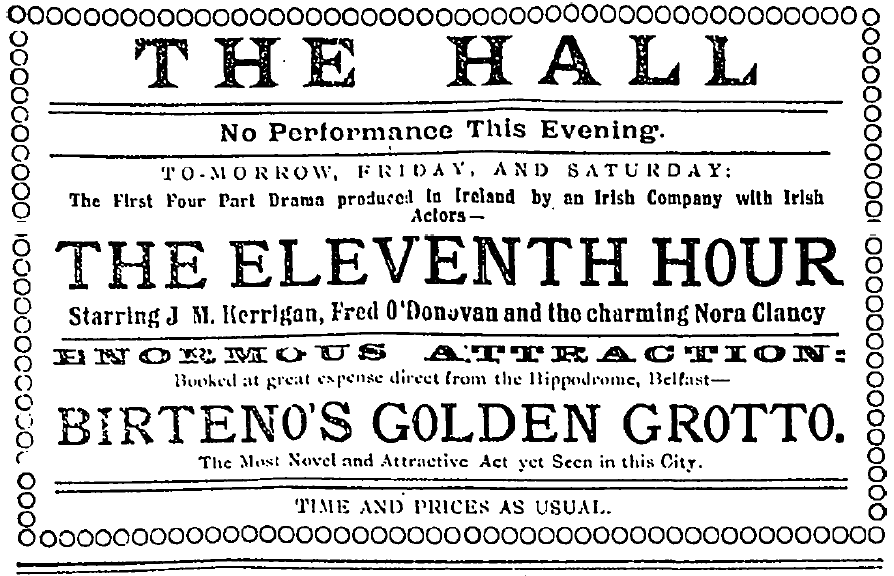
The Miser’s Gift is also lost, but its narrative appears to involve a scheme of Eileen Dolan (Nora Clancy) and her lover, Ned McGrath (Fred O’Donovan), to get her miserly father (J. M. Kerrigan) drunk and dream of leprechaun gold so that he will look favourably on their relationship. “It is agreeable to have pictures such as this,’ commented the Irish Times, “preserving a genuinely Irish atmosphere and that inherent charm which is to be found in Irish life. The sight, for instance, of lepracauns and other little people who live in legend disporting themselves in a fairy fort is a feature which surely is pleasing to Irish eyes” (“Film Company of Ireland,” 18 Aug.). The Irish public got its first chance to delight in authentic Irish leprechauns disporting themselves on the cinema screen in October and November 1916: at Arklow’s Gaiety Picture House (9-11 October), Cork’s Coliseum (12-15 October), Tralee’s Picturedrome (19-21 October), Dublin’s Dame Street PH (26–8 October), Derry’s Hall (2-4 November), Sligo’s Picture Theatre (13-15 November), Kilkenny’s Cinema (15-16 November) and Athlone’s Fr Mathew Hall (22-25 Nov).

Ch5One

Bioscope 24 Aug. 1916: 754.
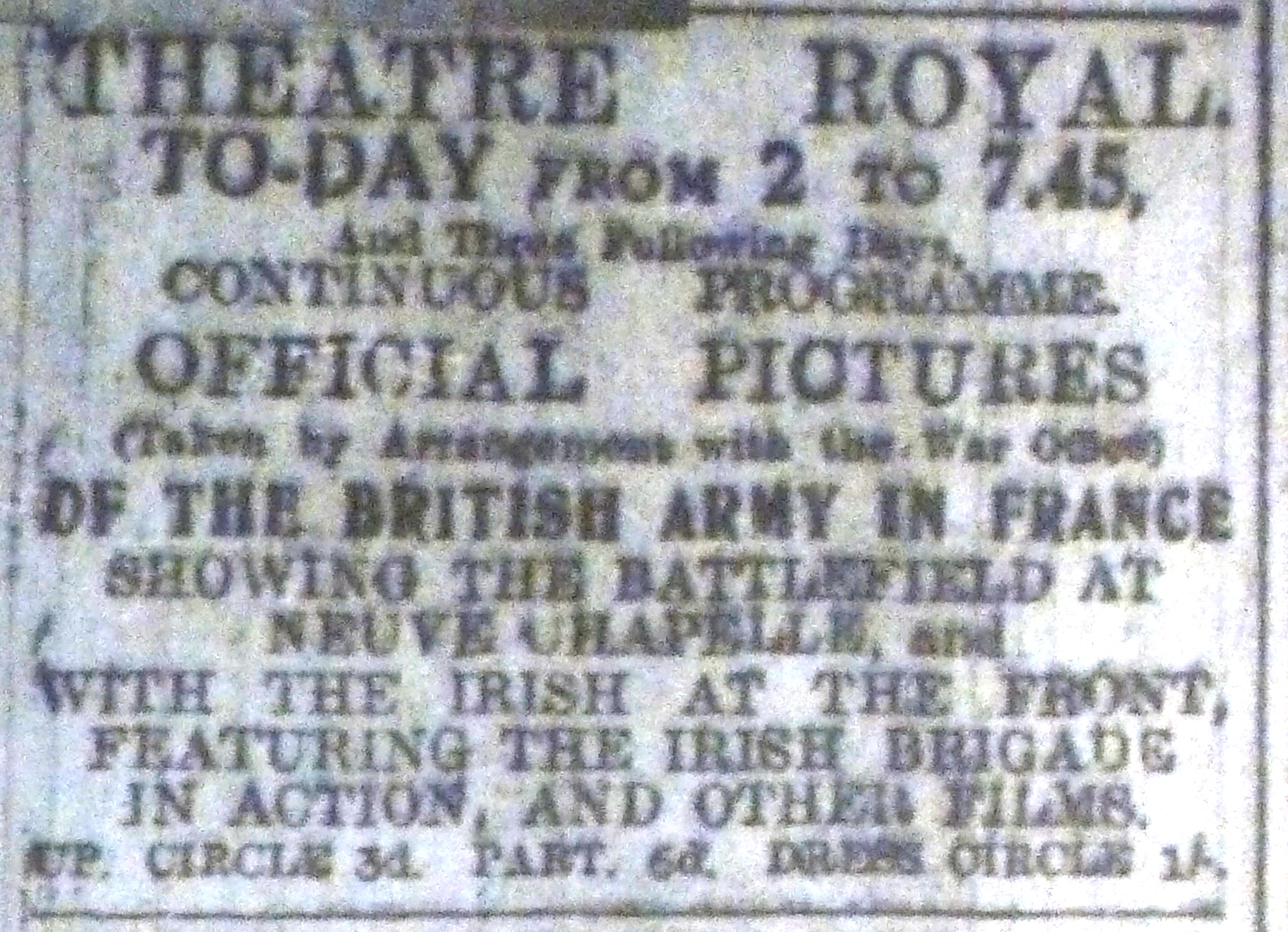
As these arrangements were being made for Ireland, FCOI also entered the British film market on the foundation of O’Neil of the Glen’s Irish success. The Bohemian debut was the subject of an article on the company in the Bioscope of 24 August, which also carried a full-page advertisement listing the actual and intended films mentioned in the Irish papers (“First Irish Film”). Both the article and the advertisement included quotes from Sparling on the huge business the film generated, “the absolutely whole-hearted appreciation of every person who has seen it,” and the fact that “the ‘music’ at the pay-box has kept time with the orchestra throughout.” In contrast to Paddy’s original critical assessment of the film, this article described the audiences’ appreciation of “the exceptional excellence of the first film produced in Ireland by an Irish company and by Irish players.” A month later, although mentioning the film’s success everywhere it had been exhibited, Paddy contended that FCOI’s “second picture, ‘The Miser’s Gift,’ is greatly in advance of the first as regards the quality, and if this company stick to their guns they should still be well in the front rank of British producers” (28 Sep.). Despite Paddy’s reservations, the message prevailed that O’Neil of the Glen packed cinemas in Dublin and Belfast and that Irish exhibitors were eager for more, a message that helped FCOI to acquire a British distributor (Paddy, 14 Sep.). The company did this at the end of October, when Davidson’s Film Sales Agency bought the rights for FCOI’s 1916 films (Paddy, 2 Nov.).
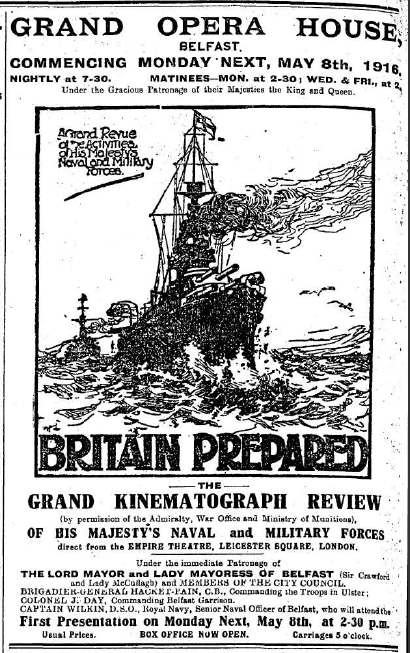
Indigenous Irish film production may not have started with O’Neil of the Glen, but it did enter a new phase.

References

“Abbey Theatre.” Irish Times 7 Aug. 1916: 3.

“The Bohemian.” Dublin Evening Mail 5 Aug. 1916: 5.

“The Bohemian.” Freeman’s Journal 8 Aug. 1916: 6.

“Coliseum Theatre: ‘O’Neill of the Glen.’” Cork Examiner 15 Sep. 1916: 2.

Condon, Denis. Early Irish Cinema, 1895-1921. Dublin: Irish Academic, 2008.

“The Film Company of Ireland.” Irish Times 9 Aug. 1916: 6; 18 Aug. 1916: 2.

“First Irish Film: Success of ‘O’Neil of the Glen.’” Bioscope 24 Aug. 1916: 689.

“The Hall.” Derry People 16 Sep. 1916: 5.

“Irish Film Production.” Irish Times 30 Jun. 1916: 7.

“Irish Film Triumph: Several New Plays.” Cork Examiner 16 Aug. 1916: 6.

“‘The Miser’s Gift’: New Irish Comedy.” Dublin Evening Mail 17 Aug. 1916: 2.

“New Irish Films: Four Coming Comedies.” Freeman’s Journal 15 Aug. 1916: 4.

“New Irish Industry: Film Company of Ireland.” Connaught Telegraph 5 Aug. 1916: 8.

“New Irish Industry: The Film Co. of Ireland: A Promising Enterprise.” Freeman’s Journal 30 Jun. 1916: 6.

“‘The O’Neill of the Glen.’” Derry People 12 Aug. 1916: 5.

Paddy. “Ireland: With the Renters and Exhibitors.” Bioscope 13 Jul. 1916: 173; 27 Jul. 1916: 359; 17 Aug. 1916: 655; 14 Sep. 1916: 1060; 28 Sep. 1916: 1285; 2 Nov. 1916: 518.

“Platform and Stage.” Irish Times 7 Oct. 1916: 9.

Rockett, Kevin. The Irish Filmography. Dublin: Red Mountain, 1996.

“Topics of the Week.” Bioscope 10 Aug. 1916: 466.

Dublin Wreckage Films, Martial Law and Daylight Saving Time in May 1916

Dublin's smoking ruins. Image from Come Here to Me.

Dublin’s smoking ruins in May 1916. Image from the blog Come Here to Me.

Smoke still rose from the ruins in Dublin city centre at the start of May 1916, including from those of the Grand Cinema, but the weather was about to quench the remaining embers. “The remark of the elderly Dublin citizen who, gazing out of the window on Saturday morning, exclaimed: ‘There has been insurrection, famine, and fire; now we’re going to have a flood,’ were more or less justified by the state of the weather,” observed the Ulster Herald of the period of 6-8 May. “From the early hours of Friday morning until Sunday, Dublin has been under a never-ceasing deluge of rain, and even the most curiosity stricken of those who are themselves within its borders are deterred from wandering forth on visits of inspection amongst the ruins” (“Rising in Dublin”).

A photograph of the Picture House, Sackville/O’Connell Street taken during the week of 8-13 May. Image from RTÉ Archives on Twitter bit.ly/1bFWG0U

A photograph of the Picture House, Sackville/O’Connell Street taken during the week of 8-13 May. Image from RTÉ Archives on Twitter.

Despite the fact that the city seemed to be under attack from the four horsemen of the apocalypse, some normality was returning by Monday, 8 May. “Two cinema houses have re-opened in O’Connell street up to 6.30 each evening,” the same source reported, “and one of them displays a large poster announcing ‘All Easter Week: ‘The Christian.’”One of the earliest surviving photographs of a Dublin picture house shows that this was the Picture House at 51 Lower Sackville/O’Connell Street, which was remarkably unscathed given that it faced the totally destroyed Grand. Most of the people in the photograph are not interested in The Christian, however, but are – in the Ulster Herald’s terms – stricken by curiosity to see the ruins.

A photograph of Sackville/O’Connell Street in flames. Image from Letters of 1916.

A photograph of Sackville/O’Connell Street in flames. Image from Letters of 1916.

The Rising itself struck some observers as inherently cinematic. “For spectacular purposes nothing I have seen compares with the bombardment late yesterday afternoon of the Irish Republican flag on the cupola of the building nearly a mile from the hotel,” a Lloyd’s News Service journalist reported from his/her hotel room. “Fully fifty shells burst around the cupola before the flag fluttered to the ground. A cinema picture of this side-show would have been worth thousands” (“Dublin Rebellion”).

No cinematographer seems to have captured scenes of the Rising itself that might have satisfied the curiosity of those who could not get to Dublin’s city centre. This is disappointing but hardly surprising given the dangers from fire, bombardment and snipers. Nevertheless, several newsreel films were made of the aftermath of the Rising showing the city in ruins by Pathé News, Gaumont Graphic and Topical Budget. The Irish Independent’s London correspondent noted that “Dublin wreckage films” were being shown in London theatres and picture houses offering a “picture of gaping ruins far more appalling than the London public has been prepared for” and a heartbreaking sight for Dubliners in exile (“Our London Letter”).

The programme at Dublin's Carlton for the week of the 8-13 May included Topical Budget's Dublin in Ruins. Dublin Evening Mail 9 May 1916: 2.

The programme at Dublin’s Carlton for the week of the 8-13 May included Topical Budget’s Dublin in Ruins. Dublin Evening Mail 9 May 1916: 2.

These films were also shown in Dublin itself once the picture houses reopened, which happened mostly in the week of 8-13 May. At this point, martial law restrictions allowed them to open only to 8pm. “The fabric of that historic building, the Rotunda, has happily escaped almost unscathed from the recent ordeal of fire,” the reviewer in the Irish Times noted on 9 May, “and an excellent programme of living pictures was yesterday presented to a succession of large audiences” (“Rotunda Pictures”).  Further down Sackville/O’Connell Street and closer to the centre of the fighting during the Rising, the Carlton also opened on 8 May with “a superb programme, the Topical Budget included ‘Dublin Ruins,’ depicting the desolation of the Irish metropolis consequent upon the insurrection” (“Carlton Cinema”). “Though the Pillar Picture House was well within the fire zone during the recent disturbances,” the Irish Times also noted, “the building has escaped with very minor injuries, and, despite the difficulties of transport, the management were able to re-open yesterday at noon with a very attractive programme” (“Pillar Picture House”). Although business at the Mary Street Picture House was “somewhat hampered by the dislocation of cross-Channel communication,” it offered a programme that included Chaplin’s A Film Johnnie (US: Keystone, 1914) and the Gaumont Graphic with all the latest topical features, and recent events in Dublin” (“Mary Street”).

Boh Dublin Rising DEM 12 May 1916

The Bohemian advertised The Dublin Rising and Ruins of the City with musical accompaniment by Clyde Twelvetrees. Dublin Evening Mail 12 May 1916: 2.

In the second half of that week (11-13 May), the Bohemian exhibited what appears to have been a longer film of the city’s ruins, Dublin Rising and Ruins of the City. Its prominence in advertising suggests that this was not just another newsreel item but something more substantial. The only surviving newsreel film of more than a few minutes is the Imperial War Museum’s (IWM’s) 14-minute Easter Rising, Dublin 1916. The IWM has little information on the origins of the film, and its intertitles are missing.

Ad for the exhibition at Belfast’s Panopticon of Dublin Revolt, a long film of the aftermath of the Rising; the similarly titled film at the Imperial is actually the Topical Budget. Belfast News-Letter 8 May 1916: 4.

Ad for the exhibition at Belfast’s Panopticon of Dublin Revolt, a long film of the aftermath of the Rising; the similarly titled film at the Imperial is actually the Topical Budget. Belfast News-Letter 8 May 1916: 4.

However, under the title Dublin Revolt, the IWM film was shown at Belfast’s Panopticon for the week of 8-13 May, and in other Belfast cinemas for the latter half of that week. The film had intertitles, including “[‘T]he Sinn Feiners marching into Dublin,’ ‘The Parade of the National Volunteers and Sinn Feiners,’ ‘Liberty Hall,’ ‘British Picket at the Custom House,’ ‘Wounded Sinn Feiners in Hospital,’ ‘British Armoured Car’” (“Panopticon,” 9 May).  The Panopticon’s ad in the Belfast News-Letter claimed that the film was “Taken by Our Own Operator,” but it may have been shot by Norman Whitten of General Film Supply, Ireland’s most prominent maker of film topicals. Paddy, Irish correspondent of the trade journal Bioscope, reported that Whitten “was out very early with his camera, and secured practically 2,000 feet of exceptionally interesting views.” Given the chaos of the picture-house business in Dublin after the Rising and the international interest in events, he sold these to “Messrs. Jury’s Imperial Pictures, Limited, and Mr. Whitten crossed over to England with the negatives so as to make sure that they reached their destination” (Paddy, 18 May). The Bohemian may have secured a 1,000-foot cut of the GFS film (Condon).

Framegrab from Easter Rising, Dublin 1916 (IWM 194) showing newsboys selling the Irish Times of 3 May 1916 against the ruins of Eden Quay.

Framegrab from Easter Rising, Dublin 1916 (IWM 194) showing newsboys selling the Irish Times of 3 May 1916 against the backdrop of the ruins on Eden Quay.

In Dublin, these films appear to have been designed to attract into the picture houses the people who were wandering the destroyed city centre fascinated by the ruins. Paddy reported that “people are not too keen on pictures just at the moment,” but were instead watching as “[o]dd walls of ruined buildings are being pulled down in Sackville Street […T]he streets are packed with people in dense masses, quite oblivious to the fact that some portion of the bricks and mortar may fall on them” (Paddy, 18 May).

Dublin Evening Mail 10 May 1916: 2.

Dublin Evening Mail 10 May 1916: 2.

Films in other venues were fulfilling different purposes. For four days beginning on 10 May, Dublin’s Theatre Royal – a legitimate theatre that only occasionally showed films – chose films that emphasized the loyalty of Dublin citizens. The Royal showed the War Office films, The Battlefield of Neuve Chapelle, which had previously been exhibited in the city, and the new With the Irish at the Front. “The pictures will be of special interest to all citizens,” observed the Irish Times, “but particularly to those whose relatives figure in the scenes from which the photographs have been taken” (“Theatre Royal”). This demonstration of loyalty appears to have been successful because the “pictures were warmly applauded by the audience, among which were many soldiers.”

Belfast News-Letter 6 May 1916: 8.

Belfast News-Letter 6 May 1916: 8.

The disruption to communications and transport caused by the Rising had effects on cinema around the country. “Splendid programmes have been submitted at the ‘National’” in Mullingar

where, despite the dislocation of all business resulting from the troubles in Dublin at Easter, the management were enabled to keep up a capital supply of films. In the case of the ‘Exploits of Elaine,’ however, the films could not be procured by any cinema, during the period of traffic dislocation, and it was only this week that the welcome announcement could be made that the great serial would be resumed. (“National Picture Palace.”)

Although the second week in May brought Dublin Revolt to Belfast’s Panopticon, the lack of a train service between Dublin and Belfast until 3 May meant that manager-proprietor Fred Stewart could not show the films he had advertised for the first week (“Panopticon,” 2 May). As well as this, the cancellation of the planned visit by the D’Oly Carte Opera Company during the week of 15-20 May caused Belfast’s Opera House to retain the film Britain Prepared for a second week (“Grand Opera House”).

Given the disruption and excitement generated by the Rising, other developments seem to have been taken in stride. These included the introduction of the Entertainment Tax and of Daylight Saving Time, and a government focus on cinema as the cause of juvenile crime. Irish newspapers widely reported Home Secretary Herbert Samuel’s statement in Westminster that one of the causes of the considerable rise in juvenile crime in provincial towns was “the character of some of the films shown at cinematograph theatres” (“Crime and the Cinema”). The Leitrim Observer took up the issue in its editorial at the end of May. “There can be no doubt that the cinema has abundantly established its claim as a cheap, popular, and harmless form of amusement and recreation, so far as the adults are concerned,” it argued. “Whether the ordinary cinematograph entertainment is good for young children is another matter” (“Children and Cinemas”). Although acknowledging that parents without childcare had to bring their children to the picture houses with them, the writer thought this a poor excuse if harm was actually being done to the young people.

Article explaining rates of Entertainment Tax; Evening Telegraph 15 May 1916: 1.

Article explaining rates of Entertainment Tax; Evening Telegraph 15 May 1916: 1.

The much heralded Entertainment Tax came into force on 15 May 1916. A reporter for the Cork Examiner gave the matter considerable attention, interviewing theatre managers and analyzing who was paying most. The writer found picture-house managers relatively untroubled by the measure, arguing that if there was any effect at all, it would likely only be for the first week or so.  The writer also pointed out that if there were any decreased attendance, it might in any case be attributed to good summer weather.

Dublin's Bohemian advertises new tax; Evening Telegraph 15 May 1916: 2.

Dublin’s Bohemian advertises new tax; Evening Telegraph 15 May 1916: 2.

However, s/he also noted that the percentage increase “reverses the rule of imposing the highest percentage of tax on the well to do” (“Entertainment Tax,” 16 May). The tax increased the price of the cheapest penny tickets by a ½p  or 50% while those paying for expensive seats between 2s 6d and 5s paid only 3d or between 10% and 5%. “As the actual increases in prices are comparatively small,” s/he nevertheless concluded, “the public will in all probability adapt themselves to the new conditions without any serious demur.” The writer of the Southern Star’s “Bandon Notes” column took a similar view. “The young lads of the town who constantly patronise the pictures in large numbers will be, one would be inclined to think, seriously hit by the tax,” s/he initially contended. “However, where a young lad would be able to make out 3d for the pictures, he would also be able to find 4d. Therefore, from their point of view, we think things will go on as usual.”

Examining the amount raised during the tax’s first week, the Belfast News-Letter found that the bulk of the receipts came from picture houses rather than theatres. Using figures from Liverpool, it estimated that £900 of the £1,600 tax collected in the city came from cinemas (“Entertainment Tax,” 24 May).

The introduction of Daylight Saving Time on 21 May proved even less controversial in the Irish cinema trade. Among the Dublin theatre and picture house managers/proprietors interviewed by an Irish Independent reporter, manager Richard Bell of the Sackville Picture House and John J. Farrell, who owned several Dublin picture houses, expressed the view that the measure would not affect them in any way and that they saw no reason to change their hours of opening. Only Barney Armstrong of the Empire Theatre thought the regulation “would likely have the effect of slightly reducing the attendances during the summer months, especially at the first ‘house’” (“Daylight Saving Act”). For picture houses that opened from the early afternoon, this was less of an issue.

By the end of May, life in the Dublin appeared to be returning to normal, albeit among the ruins of the city centre. Paddy noted that “[m]arital law in Dublin has been considerably modified, people now being allowed out until 12 o’clock. This means that one can visit a theatre or music hall in comfort and still be able to catch the last tram home.” Even if many picture houses were slower in settling down after the Rising, this was due to good weather, which “proved equally as strong an attraction as the spectacle of falling buildings” (Paddy, 25 May).

References

“Bandon Notes.” Southern Star 20 May 1916: 5.

“The Carlton Cinema.” Irish Times 9 May 1916: 3.

“Children and Cinemas.” Leitrim Observer 27 May 1916: 3.

Condon, Denis. “‘Pictures in Abeyance’: Irish Cinema and the Aftermath of the 1916 Easter Rising.” Moving Worlds April 2016.

“Crime and the Cinema.” Leitrim Observer 20 May 1916: 7.

“Daylight Saving Act: Favourable Irish Recption.” Irish Independent 19 May 1916: 4.

“The Dublin Rebellion.” Southern Star 6 May 1916: 2.

“Entertainment Tax Comes into Operation.” Cork Examiner 16 May 1916: 6.

“The Entertainment Tax: £1,600 the First Week’s Yield in Liverpool.” Belfast News-Letter 24 May 1916: 4.

“Grand Opera House: ‘Britain Prepared.’” Belfast News-Letter 16 May 1916: 2.

“Mary Street Picture House.” Irish Times 9 May 1916: 3.

“National Picture Palace.” Westmeath Examiner 20 May 1916: 4.

“Our London Letter: Dublin Wreckage Films.” Irish Independent 15 May 1916: 2.

Paddy. “Pictures in Ireland.” Bioscope  18 May 1916: 845; 25 May 1916: 911.

“The Panopticon.” Belfast News-Letter 2 May 1916: 2; 9 May 1916: 2.

“The Pillar Picture House.” Irish Times 9 May 1916: 3.

“The Rising in Dublin: Scenes in the Ruins.” Ulster Herald 13 May 1916: 3.

“Rotunda Pictures.” Irish Times 9 May 1916: 3.

“Theatre Royal.” Irish Times 9 May 1916, p. 3.


Irish Cinema and the Desire for Change in April 1916

Among the Situations Wanted ads, the Waterville projectionist seeks new prospects; Irish Independent 1 Apr. 1916: 6.

Among the Situations Wanted ads, a Waterville projectionist seeks new prospects; Irish Independent 1 Apr. 1916: 6.

Desiring a change of job, Edward McCabe, the operator (projectionist) at the cinema in Waterville, Co. Kerry, put a small ad in the Irish Independent outlining his five years of experience and seeking “good offers only.” McCabe was expectant – or at least hopeful – of an improved situation, and given cinema’s continuing growth despite the war, his prospects seemed good. Change was certainly coming to Ireland in April 1916, if not of the kind for which McCabe expressed a desire. Planned and executed by a small group of insurgent nationalists, socialists and women’s rights campaigners against British rule, the Easter Rising that month would be the catalyst for profound social and political change, but the cinema had few direct links with it. Although the Rising took place largely in Dublin between 24 and 29 April, the failure of the rebels to land arms in north Kerry – far from Waterville in the south – and the arrest of Rising leader Roger Casement as he was set ashore from a German U-Boat on 21 April influenced events in Dublin and elsewhere. When the Kerry events caused the planned Easter Sunday Rising to be initially cancelled and then rescheduled to Easter Monday, Frank Hardiman and his comrades in the Irish Volunteers and the secret Irish Republican Brotherhood in Galway were thrown into confusion. Manager of the Galway’s Town Hall Picture Palace for James T. Jameson’s Irish Animated Picture Company, Hardiman was arrested on Tuesday, 25 April, paraded with other rebels through the streets and imprisoned on a ship in Galway Bay (“Statement of Frank Hardiman”).

Beside the iconic ruins of the Dublin Bread Company on Dublin's Lower Sackville/O'Connell Street in late May/early April 1916 were the ruins of the smaller Grand Cinema, its projection box visible.

To the left of the iconic ruins of the DBC (Dublin Bread Company) on Dublin’s Lower Sackville/O’Connell Street in late April/early May 1916 were the ruins of the smaller Grand Cinema, its projection box visible on the first floor. Source: Irish Times.

The Rising was even more of a surprise than this for most people working in Irish cinema, and the few who became directly involved did so because they got caught up in events. Despite apparently having no direct role in the Rising, Irish-American diplomat James M. Sullivan, who had recently founded the Film Company of Ireland (FCOI), was arrested outside his home in Dublin on 28 April and imprisoned in Kilmainham Gaol until 6 May (“Irish-American Minister”). The FCOI’s offices at 16 Henry Street would be completely destroyed during the fighting of Easter Week, but the disruption and destruction that were the Rising’s most immediate effects on cinema in Dublin can be seem most clearly in the many photographs of the ruined Grand Cinema – the mangled remains of its projectors clearly visible – beside the iconic hulk of the Dublin Bread Company on Lower Sackville/O’Connell Street. The World’s Fair Waxworks at 30 Henry Street, one of the first and cheapest picture houses in the city, was also completely ruined. Other picture houses were also damaged, if not to this extent, and the military authorities who administered the city after the surrender of the rebels prohibited all entertainments for a time.

Cinema was prohibited as part of a general curfew rather than for any direct role in the Rising, but it did constitute revolutionary change of a kind in Ireland, bringing an explosion of imagery to people and places that could not have experienced anything like it before. This is perhaps epitomized by the Waterville Cinema that Edward McCabe desired to leave on the eve of the Rising. It opened in late December or early January 1916, when a rare notice appeared in the Kerryman commenting on the success of its opening (“New Cinema, Waterville”). It changed the films it showed four times a week, on Sunday, Monday, Wednesday and Friday, including such bill toppers as Chaplin’s The Property Man (US: Mutual, 1914), appropriate for a village that now hosts a Chaplin festival. That Waterville had a picture house at all is remarkable, given that the 1911 Census put its population at just 300 inhabitants and that the village itself was located on the extreme western periphery of Europe. It must have been a precarious enterprise, and it is extraordinary that it lasted even until McCabe sought to leave. The frequent changes suggest that the proprietor attempted to attract patrons several times a week in a region where many inhabitants were subsistence farmers or fisherfolk. Indeed, Ireland’s west coast held a special place in the nationalist consciousness because its remoteness made it a bastion of a tradition Irish culture that was often presented as an ascetic pastoralism conducted in the Irish language. If cinema could be in such a small, remote and traditional place, it seems it could be anywhere. However, Waterville and its environs had something that other poorer parts of the west did not. The peripherality of this part of Kerry had actually made it a hub of modernity, the site in the 1860s for the landing of the first transatlantic telegraphic cable and building of a telegraph station, located on nearby Valencia Island. News from America came first to this remote spot in south Kerry, and Waterville’s population included many who worked as relatively highly paid telegraphists. The patronage of these cable workers and their families who settled in the areas appears to have kept the cinema going at least until McCabe departed.

Skibbereen Coliseum SS 22 Apr 1916

Announcement of the reopening of Skibbereen’s Kinemac as the Coliseum; Sikbbereen Eagle 22 Apr. 1916: 8.

Despite its unusual demographics, Waterville was by no means alone among remote locations in south Kerry and west Cork experiencing the new media of the 1910s, albeit that these changes were occurring in towns with much larger populations. Founded by vibrator entrepreneur Gerald Macaura in 1914, the troubled Kinemac in Skibbereen (pop. 3,021) reopened on 25 April 1916 under a new name, the Coliseum, managed by Andy Wright’s Southern Coliseums. Clonakilty, Co. Cork (pop. 2,961) also saw developments in its cinema enterprises, some of which were not entirely legal. On 23 March, 19-year-old Michael “Murt” O’Donovan was charged at a special court in the town with defrauding Alexander Bonthorne of Faulkland, Scotland and Malachy Brady of Tudor House, Roscommon by failing to supply home cinema equipment for which they had paid him (“Special Court”). O’Donovan had no link to Clonakilty’s picture house, which drew audiences from its hinterland. “‘Where are the boys of the village tonight?’” asked the columnist of the Southern Star’s “Shannonvale Notes.” “They are at the ‘Movies’ escorting certain young ladies and their lady friend who lives up [the] street. Since the Cinematograph started in Clon, it has been well patronised by the boys of our village.” Accompanying young ladies to the cinema was not looked on favourably by young men everywhere. When some of Clones, Co. Monaghan’s unmarried men founded a bachelors’ club to resist a mooted Bachelor Tax, they expressed their opposition to the practice of bringing local ladies “to picture houses, on excursions, picnics, motor drives, or cycle runs” (“Clones Bachelors”).

Even in such towns as Naas, Co. Kildare (pop. 3,842), which had only occasional picture shows, cinema could be encountered on a stroll. “I confess I knew very little of Charlie Chaplin until the other day,” the Kildare Observer’s “Items and Ideas” columnist revealed. “Several times have I heard references to him in a ditty chanted in chorus by small boys from the lanes of Naas as they paraded the suburban thoroughfares.” The columnist included the words, sung to the tune of the 1907 song “Red Wing”:

The moon shines bright on Charlie Chaplin,

His boots is crackin’, for want of blackin’,

And his khaki trousers need a mendin’

Before we send him

To the Dardanelles.

By April 1916, many involved in Irish cinema were resisting or embracing changes sought by the British government, which was increasingly finding cinema useful in various ways. Despite the industry’s strenuous lobbying against it, the government was undeterred in its determination to divert some of the money spent on entertainments into its much depleted war reserves; it set 15 May as the day on which the new Amusement Tax would be imposed on picture houses and theatres. There seemed little firm opposition to it outside the industry in Ireland, the Evening Herald arguing that no valid argument can be advanced against it” (“Where Ireland Goes Out”).  Film’s increasingly direct role in recruiting in Ireland was highlighted when H. Higginson announced that he – like Edward McCabe – desired a change and was resigning the managership of the newly reopened Clontarf Cinema in Dublin to lead a cinema recruiting campaign. He proposed to give two shows in each place the campaign reached, the first exhibiting army and navy films, and the second offering a regular drama and comedy programme whose proceeds would go to various war funds. He also intended “to arrange so that the first man who is actually accepted and passed by the doctor for service with the colours will be presented free with a high-class solid silver luminous wristlet watch, the usual shop price of which is 43s” (“Cinema Recruiting Campaign”). No such recruiting event appears to have been reported later in April, but James J. Stafford’s lent his cinema for a “war meeting” in Longford on 14 April at which films showed “what the war means, in many phases, and the large gathering that thronged the Theatre were treated to a series of recruiting speeches which were generally acknowledged to be the strongest delivered since the start of the military canvass of the country” (“War Meeting in Longford”).

The long-running campaign for educational uses of film gained a new public advocate in mid-April 1916 when David Gilmore from Belfast’s Ormeau Road wrote a letter to the Belfast Newsletter outlining how the dangers of carelessly discarded fruit peel might be ameliorated cinematically. He suggested that “if each cinema show displayed a short film at each exhibition depicting the evil of throwing slippery things on the sidewalk, and a reading caution not to do so, thousands of children would take thought and not throw peel, &c., where people would slip on it.” His enthusiasm for this early public service film extended to an imagined scenario: “The little silent drama could show a child throwing peel down, a person slipping thereon, lying in a hospital, and then creeping about on crutches. Or the drama could end by a funeral, as slipping on orange peel has caused in more than one case” (“Throwing Orange Peel”). He may have been joking, but if not, he displayed a surprising unawareness that films already dealt extensively with casually or maliciously tossed peel, film comedians having done, if anything, too much to exploit the banana skin’s comic potential.

Cellists Clyde Twelvetrees and Joseph Schofield Source: Royal Irish Academy of Music blog.

The changes that picture houses had brought to Dublin’s entertainment world meant that they competed for audiences with popular theatres. By no means for the first or last time, this was explicit again in the week beginning 17 April 1916, when the Empire Theatre’s programme consisted not of its usual variety acts but of the film The Rosary (US: Selig, 1915), starring Kathlyn Williams. The film has been shown first in the city at the Theatre Royal over the 1916 New Year week and had had subsequent runs at the Princess Cinema in Rathmines (14-16 Feb.), the Phoenix Picture Palace on Ellis Quay (6-9 Apr.) and the Dame Street Picture House (13-15 Apr.). Despite the recent showings at the Phoenix and Dame, Empire manager Barney Armstrong must have considered this religious-themed film a good prospect in the run-up to Easter weekend because he offered additional musical attractions that would see the film accompanied “with organ and full orchestra effects” (“Empire Theatre”). When shown at the picture houses, the film had received little attention from newspaper critics, but when it appeared at the Empire, the main daily newspapers gave it as much critical attention as they gave to any other show. However, they gave it a mixed reception. Although the Evening Telegraph reviewer called The Rosary a “splendid” film – perhaps referring to its seven-reel length – s/he complained that it showed “a woeful ignorance of Irish Catholic sentiment, and the impersonations [offer] very little suggestion of an Irish atmosphere” (ibid).

The Bohemian advertises its engagement of Twelvetrees prominent in its Easter programme, beside the Carlton’s ad for its attractions, including Erwin Goldwater’s solo playing; Dublin Evening Mail 22 Apr 1916: 2.

The Bohemian advertised its engagement of Twelvetrees prominently in its Easter programme, beside the Carlton’s ad for its attractions, including Erwin Goldwater’s solo playing; Dublin Evening Mail 22 Apr 1916: 2.

The disparities in the press attention that the Rosary received at the picture houses and at the Empire were an indication that theatre remained the dominant entertainment medium, but there were also indications that this situation was changing. In attracting patrons to The Rosary, the Empire advertised the superiority of the musical attractions it could offer. However, several of the city’s picture houses were enhancing their musical offerings to compete against each other and the theatres. On St Patrick’s Day, 17 March 1916, concert violinist Erwin Goldwater had become resident soloist at the recently opened Carlton Cinema. This somewhat undermined the Bohemian Picture Theatre long advertised claim that it possessed the largest and best orchestra of any of the city’s picture houses. In response, the Bohemian engaged Clyde Twelvetrees – concert cellist and professor of the Royal Irish Academy of Music – to play as part of its daily programme. “Up to the present,” the Irish Independent commented, “if one wanted to hear a few famed soloists one had to attend the big concerts; but now one can hear the very best at convenience (“Dublin and District”). And these musical opportunities were set to increase, as Dublin’s Pillar Picture House engaged another renowned cellist, Joseph Schofield.

Schofield’s debut at the Pillar did not, however, take place as scheduled, at 4pm on Easter Monday, 24 April 1916. By that time, members of the Irish Volunteers and Irish Citizen Army under Patrick Pearse and James Connolly had taken possession of the nearby GPO, and the Rising was underway. Dublin’s cinema screens would remain dark for two weeks as more urgent changes took the stage.

References

“A Cinema Recruiting Campaign.” Dublin Evening Mail 6 Apr. 1916: 4.

“Clones Bachelors Establish a Washing, Cooking and Household Managing Club.” Anglo-Celt 1 Apr. 1916: 11.

“Clontarf Cinema Theatre to be Opened on Sundays.”  Evening Telegraph 31 Mar. 1916: 3.

“Dublin and District.” Irish Independent 22 Apr. 1916: 4.

“The Empire Theatre.” Evening Telegraph 18 Apr. 1918: 6.

“Irish-American Minister: Unpleasant Experiences in Dublin.” Evening Herald 9 May 1916: 1.

“Items and Ideas.” Kildare Observer 1 Apr. 1916: 5.

“New Cinema, Waterville.” Kerryman 8 Jan. 1916: 8.

“Shannonvale Notes.” Southern Star 15 Apr. 1916: 1.

“Special Court in Clonakilty.” Skibbereen Eagle 1 Apr. 1916: 3.

“Statement of Frank Hardiman.” Bureau of Military History, Witness Statement 406, p. 2-3 <http://bureauofmilitaryhistory.ie/reels/bmh/BMH.WS0406.pdf#page=1&gt;

“Throwing Orange Peel, &c., on Sidewalks.” Belfast Newsletter 12 Apr. 1916: 6.

“War Meeting in Longford.” Longford Leader 22 Apr. 1916: 1.

“War Pictures.” Longford Leader 15 Apr. 1916: 1.

“Where Ireland Goes Out.” Evening Herald 13 Apr. 1916: 2.

The Constant Watchfulness of Irish Cinema in March 1916

Irish-American James Mark Sullivan, who co-founded the Film Company of Ireland in March 1916. https://www.loc.gov/item/2002706157/

Irish-American James Mark Sullivan, who co-founded the Film Company of Ireland in March 1916. Image from the Library of Congress.

Although Ireland is celebrating the centenary of the 1916 Rising in March 2016, Easter was celebrated in 1916 in late April. Nevertheless, March 1916 saw such momentous cinematic events as the founding of the first major indigenous film production company. And even if Easter itself was still some way off, Irish cinema hit the beginning of the Easter season. In what was clearly a coordinated move by the Irish Catholic hierarchy, several bishops mentioned cinema in their Lenten pastorals, the letters from them read out on 5 March 1916 in churches in their dioceses to mark the start of the 40-day fasting period leading up to Easter. “Immodest representations in Theatres should be reprobated by every good man, and every effort should be made to discountenance them,” ordered the Bishop of Cork, but he had a particular warning about cinema:

We desire to direct your attention particularly to cinematograph and picture shows. The films come from outside, and from places where what concerns Christian modesty is made little of, and there is always a danger that what is unfit to be seen may be exhibited unless constant watchfulness is exercised to exclude what is objectionable and offensive in a Catholic country.(“Lenten Pastorals.”)

This call for “constant watchfulness” was an intensification of the hierarchy’s involvement in the church’s efforts to control cinema. If the church could not prevent people going to picture houses altogether, it was determined that it would shape what, where and when people would watch. The initially mainly lay Vigilance Committees had in late 1915 been put under centralized clerical control as the Irish Vigilance Association, which held a mass meeting at Dublin’s Mansion House that sent a renewed demand for the introduction of a specifically Irish film censorship (“Mansion House Meeting”). The many local campaigns against the opening of picture houses on Sunday were also led from the altar. “At different Masses on Sunday last in the four parish churches, as well as in the Black Abbey and Capuchin Friary,” reported the Kilkenny People, “a strong appeal was made to the people to abstain from attending the local Picture House on Sundays, particularly during Lent” (“Sunday Cinemas in Kilkenny”).

Ad for Stafford's Longford Cinema in St Patrick's week included an episode of The Exploits of Elaine (US: Wharton, 1914), the serial that featured the master criminal the Clutching Hand. Longford Leader 11 Mar. 1916: 3.

Ad for Stafford’s Longford Cinema in St Patrick’s week included an episode of The Exploits of Elaine (US: Wharton, 1914), the serial that featured the master criminal the Clutching Hand. Longford Leader 11 Mar. 1916: 3.

In making their calls for vigilance, the bishops could indicate the harmfulness of cinema by citing the ongoing trial of a gang of boys in Mullingar who had committed robberies inspired by onscreen criminals. The papers reported many similar cases including the prosecution of 20-year-old ex-sailor James J. Sloan who told the Belfast Assizes that his house-breaking equipment was “the materials Charlie Chaplin works with” (“Items of Interest”). The prominence of such stories led James Stafford of the Longford Cinema to refute publicly the claim made by a boy charged with larceny at the local petty session that he had committed the robbery to get money to go to the pictures. “I have made it a point not to admit to the Longford Cinema Theatre boys of this class,” Stafford contended, “and this boy in particular is one of several of his class whom I frequently refused admission” (“Unfounded Allegation”). As the Mullingar case suggests, the class he referred to was the poorest of the working-class.

The cinema industry long feared the imposition of crippling taxes, going so far in this cartoon as to identify the British government with the zeppelin raids then terrorizing southeast England. Bioscope 7 Oct. 1915: 16c.

The cinema industry long feared the imposition of crippling taxes, going so far in this cartoon as to identify the British government with the zeppelin raids then terrorizing southeast England. Bioscope 7 Oct. 1915: 16c.

The British government also had a vigilant eye on the cinema industry in Britain and Ireland as a way of raising needed war funds. Months before the imposition of an amusement tax in the May 1916 budget, there was much discussion of its likely effects on the industry and how it was to be collected. “The view which at present commends itself to the authorities,” reported the Irish Independent, “is that the Government should print the tickets for the cinema shows, and these should be purchased from the Government by the trade at a price which would cover the tax” (“Proposed Cinema Tax”). As well as further binding the cinema industry to the British war effort, the tax would alter the working-class nature of cinema. “Upon the injustices of a penny per seat tax there can be not two opinions,” argued Frank W. Ogden Smith in the trade journal Bioscope,

and if such a tax be allowed to pass unchallenged this point must be borne in mind – when we revert to peace times it will mean the cinema as a poor man’s amusement and recreation will have ceased to exist, for the Government having tasted the fruit and found it refreshing in actuality not theory, will not be likely to relinquish the tax. (“Passing of the Penny Cinema.”)

Longford and Mullingar were just two of the Irish places where this process could be most clearly seen in March 1916.

Metro ad featuring Ruffells’ parrot, Dublin Evening Mail 6 Mar. 1916: 2.

Metro ad featuring Ruffells’ parrot, Dublin Evening Mail 6 Mar. 1916: 2.

The industry as a whole – including the Bioscope – had long courted an audience far beyond the penny cinemagoer, and it did so in a climate in which many doubted that cinema represented a quality contribution to culture. At a meeting of the Cork County Council, the chairman complained that the large amount of money spent on technical education was wasted because “the people for whom it was intended showed no disposition to profit by it.” Instead, the popularity of Charlie Chaplin and picture houses were proof, he believed, of the failure of the art classes provided to raise the public taste (“Cork County Council”). Publicity strategies to counter such views and promote films and picture houses as quality entertainment were important, and one ad campaign stood out in Ireland in March 1916. Metro’s British agent Ruffells’ Exclusives was pioneering in marketing film brands to the Irish public. Ads for Metro had been appearing in newspapers for some time when the Bioscope reported that Ruffells in Dublin abandoned their trademark parrot for another animal in order to stage a spectacular publicity stunt: “This consisted of six donkey carts, all passing the leading station and advertising on large boards the display of Metro pictures. The houses showing the films were the Bohemian, the Carlton, the Grafton Street and Grand” (“Trade Topics”).

Evening Telegraph 16 Mar. 1916: 4.

Dublin’s Carlton showing Metro drama Cora. Evening Telegraph 16 Mar. 1916: 1.

These named picture houses were among Dublin’s most prominent cinemas, and each watched what the others were doing. What they were doing to ensure success was to provide lavishly comfortable buildings, feature such highly publicized films as Metro’s and offer novel musical accompaniment. Located in Phibsboro outside the city centre, the Bohemian had attracted patrons since its opening in 1914 by advertising the best musical attractions in the city. The Bohemian’s orchestra consisted of 16 musicians under musical director Percy Carver. With the increasing competition for cinema patrons in the city centre, the Carlton as the latest-opened picture house sought to secure its audience by adding to its musical attractions. Beginning on Patrick’s Day, 17 March, the Carlton challenged the Bohemian’s musical pre-eminence by engaging the concert violinist Erwin Goldwater. The Irish Times called this “[a] new departure in connection with cinema entertainments [that] takes the form of a violin recital by Mr. E. Goldwater, a pupil of Sevcik, and formerly first violin at the Royal Opera, Covent Garden. Mr. Goldwater will conduct the orchestra at the Carlton” (“Platform and Stage”).

Clontarf reopens 17 Mar 1916 ET

Ad for reopening of the Clontarf Cinema; Evening Telegraph 17 Mar. 1916: 1.

Goldwater’s engagement was not the only significant event that picture-house proprietors planned for the holiday of the Irish patron saint. A company led by I. I. Bradlaw, David Frame and Henry Grandy reopened the Clontarf Cinema in the former Clontarf Town Hall. “It has been re-decorated and reconstructed throughout in the most luxurious manner,” the Evening Telegraph announced, “and will be found to be equal in every respect to the very best picture houses in the city” (“The Cinema, Clontarf”). Several picture houses offered special programmes of Irish films and/or music. Perhaps the most surprising of these was at Belfast’s CPA (Central Presbyterian Association) Assembly Hall. “Five reels of well-selected cinema were screened, and the premier place amongst these was taken by “Brennan of the Moor,” a three-part filmisation of the Irish story,” revealed the Northern Whig. “Mr. F. J. Moffett presided at the organ, and also acted as accompanist. Mr. W. R. Gordon sang several Irish folk-songs in a most pleasing manner” (“C.P.A. Entertainments”).

“Mr. Erwin Goldwater.” Irish Limelight May 1917: 17.

Although Brennan of the Moor (US: Solax, 1913) was revived on occasion, the most popular films to constitute an Irish programme were still those made by Sidney Olcott and Gene Gauntier for Kalem and other companies in Ireland between 1910 and 1914. Nenagh’s Ormond Kinema Company provided films – including an unnamed Chaplin and The Colleen Bawn (US: Kalem, 1911) – free of charge to the Toomevara and Nenagh Hurling Club after their fund-raising concert in Nenagh’s Town Hall on 17 March (“St. Patrick’s Night’s Concert”). “Some unique films of the famous Tubberadora, Toomevara, and Thurles Teams” were also shown (“The Coming St Patrick’s Night Concert”). The Colleen Bawn was the most popular of Dublin-born Dion Boucicault’s stage melodramas, but productions of his more political Arrah-na-Pogue and The Shaughraun were particularly evident in March 1916. In early March 1916, The Shaughraun (US: Kalem, 1912) – which featured an escaped Fenian – was revived at both Dublin’s Rotunda and Bohemian; during the same period, a stage version was produced at Dublin’s Father Mathew Hall by the Barry Sullivan Society, while at the Hibernian Hall, Parnell Square, the Hibernian Players staged Arrah-na-Pogue. The Olcott and Gauntier’s Arrah-na-Pogue (US: Kalem, 1911) was shown at the newly refurbished Omagh Picture House on St Patrick’s night (“Omagh Picture House”). The Rotunda’s programme for St Patrick’s day and the two days following included two other of Kalem’s Irish-shot films: the 1798 drama Rory O’More (US: Kalem, 1911) and The Fishermaid of Ballydavid (US: Kalem, 1911).

Small ad from the Film Company of Ireland seeking Irish scenarios; Freeman's Jorunal 9 Mar. 1916: 2.

Small ad from the Film Company of Ireland seeking Irish scenarios; Freeman’s Jorunal 9 Mar. 1916: 2.

The Kalem films were so regularly revived in part because no fiction films had been shot in Ireland since Olcott had stopped coming to Ireland following the outbreak of the war. In March 1916, this situation was about to change with the founding of the most important indigenous Irish film production company of the silent period. On 2 March, Irish American lawyer and diplomat James Mark Sullivan and Henry Fitzgibbon registered the Film Company of Ireland (FCOI) at Dublin’s Companies Registration Office. The FCOI had little early press coverage. “The objects are to establish, organise and work in Ireland the manufacture and construction of cinema films of every description,” reported the Freeman’s Journal, seemingly reproducing the information on the company registration form,

and to engage in the making of scenic and dramatic moving pictures, and in the sale and exchange of cinema pictures, and to engage in the employment of skilled and unskilled labour, and of all such artistes, authors, and performers as the development of the business may require. (“An Irish Film Company.”)

Ads that appeared in the papers on 9 March specifically sought authors of “photo play scenarios, preferably with Irish atmosphere and background.” These ads gave the address of the FCOI’s offices as 16 Henry Street, uncomfortably close to the GPO, soon to be the major site of the Easter Rising.

J. M. Kerrigan with Sara Allgood in a 1911 Abbey touring production of The Playboy of the Western World. Image from Wikipedia.

J. M. Kerrigan with Sara Allgood in a 1911 Abbey touring production of The Playboy of the Western World. Image from Wikipedia.

The FCOI also sought actors, and here Joseph Holloway’s diary offers an intriguing early insight. When actor Felix Hughes answered an FCOI ad for actors, he “was astonished on entering the manager’s room to see Joe Kerrigan quite at home there with his back to the fire – the manager was seated at a table & spoke with the twang of a Yankee.” Kerrigan was one of the Abbey Theatre’s leading actors, and Hughes was surprised to encounter him seemingly embedded with Sullivan in the FCOI. However,

Kerrigan spoke up for him & said to the manager, “he’s the very one we want,” (evidently K is to be the star actor in new Co. & has some monetary interest in it as well.) “He has played at the Abbey & travelled with Co to London.” So the manager said, “We must have Felix,” & entered his name & address & said, “he would hear from him in the course of four or five weeks time when all arrangements were fixed up to begin operations. (Holloway, 21 Mar. 1916).

As its operations began, the FCOI gave the hope that cinema would not just be something that the authorities constantly surveilled but would produce challenging films for burgeoning Irish audiences at a historical moment.

References

“The Cinema, Clontarf.” Evening Telegraph 16 Mar. 1916: 2.

“The Coming St Patrick’s Night Concert.” Nenagh News 11 Mar. 1916: 4.

“Cork County Council: Annual Estimate.” Cork Examiner 1 Mar. 1916: 3.

“C.P.A. Entertainments.” Northern Whig 20 Mar. 1916: 7.

Holloway, Joseph. Holloway Diaries. National Library of Ireland.

“Items of Interest: A Youthful Burglar” Irish Independent 17 Mar. 1916: 4.

“An Irish Film Company.” Freeman’s Journal 4 Mar 1916: 2.

“Lenten Pastorals: Diocese of Cork.” Cork Examiner 6 Mar. 1916: 7.

“Mansion House Meeting: Message from the Pope.” Freeman’s Journal 14 March 1916: 3.

Ogden Smith, Frank W. “The Passing of the Penny Cinema.” Bioscope 9 Mar. 1916: 1008.

“Omagh Picture House: Extensive Alterations.” Ulster Herald 18 March 1916: 5.

“Platform and Stage.” Irish Times 18 Mar. 1916: 7.

“Proposed Cinema Tax.” Irish Independent 23 Mar. 1916: 4.

“St. Patrick’s Night’s Concert.” Nenagh News 18 Mar. 1916: 3.

“Sunday Cinemas in Kilkenny.” Kilkenny People 18 Mar. 1916: 5.

“Trade Topics.” Bioscope 30 Mar. 1916: 1377.

“An Unfounded Allegation Contradicted.” Longford Leader 25 Mar. 1916: 2.

Irish Cinema Catches the Public Eye in February 1916

Audience P&Pg 19 Feb 1916p475

Voices filling the dark; Pictures and the Picturegoer 19 Feb. 1916: 475.

At the end of January 1916, cinema-trade-journal Bioscope’s Irish correspondent Paddy congratulated George Hay, manager of Waterford’s Broad Street Cinema, on his catchy new programmes. “‘The Picture and Picturegoer’ is on sale in the theatre,” he observed, “and Mr. Hay has had his entire programme printed on the front page. This catches the public eye, and moreover, when the paper is left lying about at home it catches the eye of other members of the family.” Getting and remaining in the public eye was important to the cinema business, but much of the publicity it garnered in Ireland in February 1916 was negative.

Elaine Hand Sep 2 1915 Bio

Eye-catching ad for The Exploits of Elaine incorporating the clutchching hand motif; Bioscope 9 Sep. 1915: 1127.

Cinema’s “Clutching Hand” certainly caught the public’s eye in February 1916. The Exploits of Elaine (US: Wharton, 1914) serial had been showing in many Irish picture houses, including Dublin’s Rotunda, which had shown the first episode, “The Clutching Hand,” on 18 October 1915. The plucky Elaine’s (Pearl White’s) repeated imperilling by master criminal the Clutching Hand (Sheldon Lewis) and rescuing by scientific detective Craig Kennedy (Arnold Daly) proved a lucrative formula. Showing one episode a week, the Rotunda reached the 14th and final episode, “The Reckoning,” on 20 January 1916. “Those who have followed the various episodes in this serial picture must not omit to visit the Rotunda,” a newspaper article warned, “and witness the first dénouement of the Clutching Hand, in which the culprit is revealed through his inadvertence in referring to the hidden treasure” (“The ‘Clutching Hand’ Revealed”). “Thus far,” the Irish Independent observed, “‘Exploits’ may claim to have established a record in general interest, and increased attendances are like to be experienced as the story reaches its climax” (“Dublin and District”).

Exploits_of_Elaine_-_The_Devil_Worshippers_(1914)

Poster for the episode of The Exploits of Elaine in which the Clutching Hand’s identity is revealed. Source: Wikipedia.

Other picture houses were not far behind the Rotunda. On 10-12 February, Cork’s Coliseum showed the 13th episode, “The Devil Worshippers,” in which the identity of the master criminal the Clutching Hand is revealed. Smaller towns started the serial later, with the first episode being offered to audiences in Ballina in June 1916 and in Longford town in July 1916. Seeing its success, producers Wharton Studios had quickly followed it with The New Exploits of Elaine (US: Wharton, 1915), and the Rotunda and others would begin showing this as soon as the original concluded. As a result, the phrase “Clutching Hand” was in circulation in Ireland as a synonym for criminality throughout 1916. Calling for an enquiry into the military killing of civilians during the Easter Rising, for example, Dublin alderman Laurence O’Neill described himself as having “the clutching hand of the military authority upon him” (“Action of Corporation”).

Pictures and the Picturegoer 26 Feb. 1916.

Pictures and the Picturegoer 26 Feb. 1916.

We have seen here that White’s Elaine offered young women an adventurous role model, but court cases reveal that the Clutching Hand proved equally inspirational for the criminal careers of Irish child gangs. A writer in the Southern Star noted that “the Exploits of Elaine, or the Clutching Hand, is drawing crowded houses at the local Kinema” in Kinsale, Co. Cork. As a result, “[a]ll our youth are now budding Sherlock Holmes.” But the influence of the serial was not so clear cut:

This habit of observation properly cultivated is a very useful thing and fits the youngster for life’s battle, but, judging by the cases before the local court on Saturday last the Clutching Hand is also in evidence. A month was the reward in this case. (“Kinsale Notes and Notions.”)

Cinema could be educational by providing “useful lessons by ocular demonstration” but the “Clutching Hand remains.”

The Southern Star writer did not provide details of the case in Kinsale, but more evidence exists for those the Clutching Hand inspired in Newry and Mullingar. On 9 February 1916, seven boys and one girl were each sentenced to five years in various reformatories and industrial schools for stealing from shops in Newry. As each child was sentenced and put in a room beside the court, they sang the popular World War I song “Are We Downhearted? No!” – a song that begins by mentioning Pat Malone of the Irish Fusiliers – and cheered.“[A]s each fresh defendant came from the magistrates’ hands he was received with the sign of the ‘Clutching Hand,’ and solemnly responded” (“Boys and the ‘Clutching Hand’”). Sentenced to five years at Philipstown Reformatory for stealing 16s 7d and some handkerchiefs on 14 January, Bernard Hughes described how

they planned the robberies, and with the proceeds went to a picture palace, in the café of which they had tea, bread and butter, lemonade, chocolate, wine, and cigarettes. After sleeping in “Duck” Marron’s common lodginghouse all night at 4d. each, they visited Warrenpoint next day, where they were arrested.

The rich food and lodgings they experienced on their spree contrasted markedly to the conditions in which at least some of them lived. Head Constable Mara gave evidence of having been invited by accused James O’Hare’s father, a sailor home on leave, to see how his children were living:

They were covered with vermin, and their mother was drunk. The house was filthy, and nothing in it but a dirty sack for five children to sleep on. [Another accused John] Hanratty, it was stated, lived in the worst house in Newry, with his mother and his sister.

Such testimony does not appear to have influenced the magistrates towards any more leniency than extended incarceration. Nevertheless, the solidarity between the children in court seems remarkable. By mentioned just these signs of defiance in court without the details of their desperate living conditions, most papers presented the case as a commentary on the antisocial nature of cinema.

The Exploits of Elaine showing in Mullingar. Westmeath Examiner 26 Feb. 1916: 8.

The Exploits of Elaine showing in Mullingar. Westmeath Examiner 26 Feb. 1916: 8.

Reports of the Newry case, or similar cases elsewhere, may have inspired the behaviour of the 12-year-old John Connor, Thomas Keena and Michael Creevy who on 26 February 1916 were arrested for stealing in Mullingar. Sergeant Campbell informed the petty sessions that having been told by J. F. Gallagher that £1 10s had been robbed from his shop, he went to Healy’s Picture House and found the boys in possession of the remainder of the money. Although the chairman of the petty sessions seemed inclined to grant Creevy’s mother’s request for bail for her son, the boy himself asked not to be sent home but to go to a detention home with the other boys. While in the cells at the police barracks, the boys reportedly sang “It’s a Long Way to Tipperary” and shouted “Hurrah for the Clutching Hand” (“Robbery in Patrick Street”). The magistrates hearing the boys’ case sent a resolution to the Mullingar Town Commissioners urging them not to renew picture house licences until the proprietors undertook not to show any film that depicted burglary to children under 16 (“Youths Charged with Robbery”). The Commissioners simplified this by barring boys under 16 from evening performances (“Mullingar Town Commissioners”).

These cases lent fuel to the campaigns to regulate – or eliminate – cinema. “What is really a little alarming,” argued a writer in the Irish Times citing the Newry case,

is the prospect of a gradual Americanisation – and a very cheap sort of Americanisation at that – of all our English and Irish ideals and of the whole British outlook on things in general. To-day the picture-house does little or nothing for patriotism; it is not helping us to victory in the field. (“American Films.”)

This writer supported H. G. Richards’ suggestion in the London Times that the importation of all foreign – mainly American – films be banned, including raw film stock. Richards argued this move would save £2 million, free up space on cargo ships, encourage the British film industry to expand, and make films more educational. Considering some of the economic and moral arguments for and against a ban, the Sunday Independent seemed to come down against it. “Naturally for the defence,” an editorial item observed, “we have the sound standing arguments of the public need of diversion in war as well as peace-time, and the benefit to temperance of the competition of the Cinema theatres with the publichouses.” The writer seemed to consider something of a clincher the fact “that on each of the British battle cruisers which await the appearance of the German fleet is installed a picture show for the amusement of the fighting men” (“The Passing Show”).

Few in the industry shared Richards’ views. Fan magazine Pictures and the Picturegoer pointed out that while British audiences were staunch supporters of British films, domestic companies could not supply the market. “[U]nfortunately, the [British] films that are worth much would not go far to feed the four thousand odd theatres,” s/he observed. “Indeed, if all the British film companies suddenly decided to work day and night in order to turn out films with the rapidity of a munitions factory, the output would provide but a mere drop in the ocean” (“Don’t Close Our Picture Theatres”). As the article pointed out, the dearth of people and materials in wartime made it unlikely that the British industry could expand to any great degree.

While these kind of arguments were unlikely to convince those intent on reshaping a mainly entertainment medium into a mainly educational one, other government priorities militated against a film-import ban. The Irish papers prepared their readers for the imposition of an amusement tax in the upcoming budget as a much-needed revenue-raising measure. Cinemagoers would feel the clutching hand of the war economy in May.

References

“Action of Corporation: Petition to House of Commons.” Freeman’s Journal 3 Aug. 1916: 7.

“American Films.” Irish Times 14 Feb. 1916: 4.

“Boys and the ‘Clutching Hand’: Remarkable Case at Newry.’” Irish Times 10 Feb. 1916: 6.

“The ‘Clutching Hand’ Revealed.” Irish Times 20 Jan. 1916: 9.

“Don’t Close Our Picture Theatres: ‘Movies’ the War-Time Medicine of the Masses.” Pictures and the Picturegoer 26 Feb. 1916: 494.

“Dublin and District: Rotunda Pictures.” Irish Independent 20 Jan. 1916: 5.

“Kinsale Notes and Notions.” Southern Star 5 Feb. 1916: 7.

“Mullingar Town Commissioners: Cinemas and the Youth.” Westmeath Examiner 18 Mar. 1916: 6.

Paddy. “Pictures in Ireland.” Bioscope 27 Jan. 1916: 344.

“The Passing Show.” Sunday Independent 13 Feb. 1916: 4.

“Robbery in Patrick Street: Extraordinary Performance of Boys.” Westmeath Examiner 4 Mar. 1916: 8.

“Youths Charged with Robbery: Cheering for the ‘Clutching Hand.’” Westmeath Examiner 18 Mar. 1916: 6.

“The Nation’s Historian” or a “Violent Stimulant to the Eyes”?: Irish Cinema at the Beginning of 1916

Balfour Bio 6 Jan 1916

Arthur Balfour, “Cabinet Minister as Cinema-Lecturer,” touts the importance of war films; Bioscope 6 Jan. 1916: 16.

On 29 December 1915, Arthur Balfour, Britain’s First Lord of the Admiralty, attended a screening of the war film Britain Prepared (Britain: Urban, 1915) at London’s Empire Theatre, Leister Square. “[T]these pictures constitute something more than an afternoon’s amusement,” he asserted. “They contain a lesson of the deepest import to us and the world” (“Britain’s Might Revealed”). The trade journal Bioscope was delighted with Balfour’s comments before the screening, drawing attention to them in a prominent article in its first 1916 issue. “This is, we believe, the first time in the history of the cinematograph that a Cabinet Minister has made a formal speech of introduction at an exhibition of moving pictures,” it claimed, “and as such it is an event of no small significance.” The Bioscope of 20 January clarified the magnitude of its significance, when it declared that cinema was now – finally – “The Nation’s Historian”:

The Trade has just cause for pride and gratification in the complete unanimity with which Press and public, Cabinet Minister and man-in-the-street alike, have welcomed the official cinematograph pictures of the war and the life and training of our soldiers and sailors. It has, we admit, taken a very long time to convince the Government and the Fourth Estate of the value of the cinematograph as the national historian, but now that their approval is forthcoming and the work pronounced to be good, we can well afford to regard the time as well spent. (“Nation’s Historian.”).

Doubtless Balfour’s endorsement of Britain Prepared was a valuable governmental recognition of the British film industry, and as such it is an important historical document. It is more doubtful that a film clearly conceived as propaganda – showing how Britain had prepared and was prepared to fight its enemies – can be considered a work of history. Nor was the Bioscope really interested in making a case for the film as history; it was enough of an achievement that Balfour’s presence and words showed how useful cinema had become to the war effort.

Metro ad DEM 3 Jan 1916

David Lloyd George and H H Asquith feature in this ad for Metro Pictures; Dublin Evening Mail 3 Jan. 1916: 5.

While Balfour argued that Britain Prepared was not mere entertainment but a film that British politicians should take seriously, one distribution company suggested that two other Cabinet ministers were watching its films for relaxation. In January 1916, the Dublin Evening Mail carried a series of ads placed by Ruffell’s, British agents for US production and distribution company Metro Pictures. The ads featured the Ruffell’s mascot, a parrot in a top hat, and in the first of these ads – which is in comic-strip form – the parrot convinces Minister for Munitions David Lloyd George and Prime Minister Herbert Henry Asquith to watch a Metro film as a needed break from their war duties. The incongruity of the images of these senior politicians visiting a cinema with the behatted and cigar-chewing parrot might distract from the no-less significant if admittedly less spectacular incongruity of this and other ads appearing in an Irish daily newspaper. Distribution was a wholesaling business; it acted as the intermediary between the manufacturers – film production companies such as Metro – and the retailers – the cinema-owners who actually showed the films. In the ordinary course of business, a distribution company such as Ruffell’s would advertise in such cinema trade journals as the Bioscope but not in the dailies. Ruffell’s did advertise in the trade press, but this series of ads sought to create recognition among cinema-goers of the relatively new Metro brand name and of the Ruffell’s parrot.

British Army DEM 20 Jan 1916

Official war film British Army in France at the Provincial Cinematograph Company’s Dublin picture houses. In the fist half of this week, the Grafton had shown With the Indian Troops in France. Dublin Evening Mail, 20 Jan. 1916: 5.

And the parrot was right: cinema was more likely the nation’s – or the world’s – entertainer than its historian. Amusement was the primary reason that Irish patrons visited a picture house, even if they did also come for other reasons, including to see how the war that they mostly read about in newspapers actually looked, and to cheer or to boo at a film that sought to use such images to engender patriotic feelings towards a nation that was invariably Britain. Nonetheless, the notion of the cinema as national historian had particular resonances for Ireland in 1916, as it has in 2016 as the country commemorates 1916. The experience of the more than 200,000 thousand Irishmen in the British armed forces were, of course, represented to some extent by Britain Prepared and other propaganda films that were appearing in increasing numbers. The Picture Houses in Grafton Street and in Sackville/O’Connell Street, which were owned by the British chain Provincial Cinematograph Theatres, made a particular feature of these films, promoting them with prominent illustrated ads, such as the one for British Army in France on 20 January. The Bioscope quoted Balfour as regretting that Britain did not “have a permanent record of the grand deeds of our armies in France and Flanders” (“Britain’s Might Revealed”). A number of such films did exist, but filmmakers would answer this call for a permanent record most spectacularly later in the year in the form of the film The Battle of the Somme (Britain: British Topical Committee for War Films, 1916).

As one of the main purposes of such films was to show the unity of the kingdom, they could not represent the motives of Irish nationalists, who had to look elsewhere for elements of an Irish historical experience on film. This was clearly so in the case of the separatist nationalists who sought Irish independence from Britain and opposed recruitment, but it also included the many more moderate Irish nationalists, even soldiers who had joined the war in answer to John Redmond’s call to fight for Home Rule. Nationalist MPs at Westminster ensured Ireland was treated as a special case even in relation to military recruitment, a fact emphasized in January 1916 when the Military Service Act excluded the country from the compulsory conscription. Given the paucity of film production in Ireland, there was little prospect of cinema providing a detailed film record of the struggle for Irish national self-determination. The nearest thing to such a film was Ireland a Nation (US: Macnamara, 1914), shot in Ireland in 1914 but not shown in the country until 1917. Newsreel films of armed National and Irish Volunteers parading do exist, albeit that the Ulster Volunteers were better at media management, including arranging for cinematograph operators to record significant demonstrations. Fiction films representing Ireland’s rebellions in 1798 and 1803 had been made by US companies such as Domino and Kalem, Sidney Olcott shooting many Irish-shot films for the latter. The special Sunday shows at Dublin’s Phibsboro Picture House on 23 January featured For the Wearing of the Green (US: Domino, 1914), in which “Paddy Dwyer, the Irish blacksmith, and his helper, Dennis Grady, who is also his daughter Norah’s sweetheart, are the prime leaders in the conspiracy against the Crown” (“Domino”). The Hibernian Electric Theatre’s Sunday feature a week later was Olcott’s The Mayor from Ireland (US: Kalem, 1911), in which two Irish immigrants follow each other in the office of New York mayor. Neither of these films was a new release, but their revival suggests their importance for Irish audiences in offering fictional self-representations that included revolutionary romances.

Hibernian ad ET 29 Jan 1916p1

Ad for Hibernian, Evening Telegraph 29 Jan. 1916: 1.

Indeed, the Hibernian Electric Theatre may provide one of the most direct links between Irish cinema and the revolution that was being planned for 1916. This picture house at 113 Capel Street, Dublin, had previously been called the Irish Cinema and had been owned and run by Richard Graham. Financial difficulties including rent default forced Graham to sell in late 1915 (“Capel Street Picture House”). No account of the reopening as the Hibernian appears to exist, but it was advertising in the Evening Telegraph by the start of January. The ads and short notices that month give an indication of some of the people involved, including manger Thomas Fullam and musical director Miss M. Grundy (“Hibernian Electric Theatre”). It is possible that it was owned or part owned by Michael Mallin, as later recalled by his son (Hughes 76-78.). Dublin silk weaver, British Army bugler, union organizer and leader of the Irish Citizen Army, Mallin would be executed in May 1916 for his role in the Easter Rising. How his picture-house experience may have had a bearing on his revolutionary activity or vice versa is difficult to say. Nevertheless, the Hibernian was located beside the Trades Hall – a fact noted in ads – and it is likely that its programming aimed to attract union members, as well as the many working class people who lived in the slum districts that would have been the catchment area for the cinema’s audience. In 1913 and 1914, the Irish Cinema had been the only picture house and one of the few entertainments of any kind that advertised in the radical labour journal The Irish Worker. However, apart from The Mayor from Ireland, its offerings seem little different from those of other Dublin picture houses.

Larkin Prison II 4 Jan 1916p4

Irish Independent 4 Jan. 1916: 4.

If Irish picture-house owners – even radical ones – had only moulded cinema in limited ways to produce a national moving image, religious groups were working more deliberately to ensure that cinema reflected the churches’ worldview. This was particularly the case with Catholic groups, such as the Dublin Vigilance Committee, which in December 1915 had coalesced with other vigilance groups around the country to become the Irish Vigilance Association (IVA). Following his arrest on 31 December 1915, serial cinema protester and militant IVA member William Larkin was released from Dublin’s Mountjoy Jail on 4 January 1916. He had been imprisoned for non-payment of the fine imposed on him in October and November for his protest at the Bohemian Picture Theatre in September (“Picture Theatre Protest”). The IVA arranged a parade of welcome from Larkin’s house in Sherrard Avenue in the north city to Foster Place, a favoured place to hold speeches beside the city-centre building that had until 1800 had been the Irish parliament. Larkin’s short prison term had done nothing to lessen his activism on the introduction of film censorship; indeed, it allowed him to claim a certain martyrdom. “I was treated as a low criminal in Mountjoy Jail for protesting against a film,” he claimed in an exchange of correspondence published by the Evening Telegraph. “I had to don a convict’s garb, eat skilly, lie on a board, and refuse hard bread. I had to parade with degenerates in a prison yard; and all, that our youth might be spared gazing on suggestion” (“Proposed Cinema Censorship”).

This concern with young people also prompted calls for censorship from reformers seemingly unaligned with the IVA. In a letter to the Telegraph, E. Gordon urged regulation of picture houses to prevent children from attending late evening shows. “I have seen toddlers and youngsters, aye, and smoking cigarettes (another Dublin byelaw more honoured in the breach than the observance) in picture houses at 10.30 p.m,” he observed:

Where did they get the money, and where were their homes? Where were their parents? Why are those children allowed to spend their lives thus? Perhaps the housing question would account for a lot of it. Now, those youngsters go in to a picture house (“It’s only tuppence, Billy”). They do not go in to look at a moral lesson faithfully learned, or for education – only for a laugh, and “it’s comfey.” (“Children at the Cinema.”)

Gordon wished for an educational cinema, recognizing it as “a great, wonderful and fascinating optical achievement (if directed in the proper channel) that was never dreamt of twenty years ago.” As such, it was an “accomplishment which makes old lanternists blush, and yet their blush can be condoned, for the old scientific lantern will still hold its own, at least in the class-room and lecture hall.”

In the Dublin township of Rathmines, the ongoing controversy on the opening of picture houses on Sunday continued into early 1916. At a meeting on 5 January, the council eventually split 8-8, and the chairman cast the deciding vote in favour of closing cinemas on Sundays; they had had limited opening hours before this. Councillor Thomas Kennedy spoke in favour of keeping them open, reading a supporting letter from the Ratepayers’ Protection Association that argued that soldiers’ relatives particularly liked seeing war reports and that closing cinemas on the only day when many people could visit them would drive these people to the pubs for recreation. Rejecting such arguments, Chairman Sibthorpe explained that he had cast his vote in favour of Sunday closing because oculists had “stated that their work had been more than doubled since these cinemas had been applying a violent stimulant to the eyes of the young people, and they were absolutely ruining the sight of the rising generation” (“Cinema Shows”).

Young people who got into trouble with the law – and their legal representatives – were well aware of these discourses on cinema’s pernicious effects on the young and of how to use them to their advantage. When “two young fellows” named Richard Barnes and Thomas Farrell appeared before Mr. Swifte at Dublin’s Southern Police Court on 27 January 1916, their solicitor argued that they had entered a banana store illegally because of watching burglaries at the picture houses and playing slot machines (“Cinema and Slot Machines”). These new forms of popular culture “were the means of leading many a young fellow astray,” he argued.

Charlie at the Bank

Chaplin foils a robbery in Charlie at the Bank (US: Essanay, 1915).

The person responsible for a good amount of this violent visual stimulation in Ireland in 1916 was Charlie Chaplin, but in January 1916, he was foiling robberies rather than committing them. The writer of the Evening Telegraph’s “Gleaned from All Sources” column, however, had picked up the news that Chaplin’s career was on the wane, “which is the obvious and inevitable result of overdoing the Chaplin ‘boom.’ When it came to imitations in music-hall revues and Charlie Chaplin calendars and pin-cushions,” s/he observed, “a reaction was inevitable.” Despite merchandizing and overexposure, that reaction was not apparent in Dublin picture houses, according to the review writer in the same issue of the Telegraph. Charlie at the Bank had recently been released, and the reviewer was assessing the show at the Pillar Picture House. “There is more riotous fun packed into this two-reel comedy than any other photo-play of a like length. The world’s great comedian, Charlie Chaplin, has outdone himself in this new production. While all his other comedies are funny, this one is a scream. It abounds in real humour and comic situations, with Chaplin at his best in his inimitable antics” (“Pillar Picture House,” 18 Jan.). Charlie at the Bank was shown at more picture houses than any other film that month, suggesting that cinema-owners did not believe that Chaplin’s career was experiencing a dip. Audiences seemed to agree: on account of the “hundreds who could not gain admission” during the three day run, the film was held over for a further three days (“Pillar Picture House,” 20 Jan.).

As 1916 began, Irish audiences enjoyed a thriving cinema culture that more often offered them a violent stimulant of the Chaplin kind than national history.

References

“Britain’s Might Revealed by Film: A Cabinet Minister as Cinema-Lecturer.” Bioscope 6 Jan. 1916: 16A.

“Children at the Cinema.” Evening Telegraph 8 Jan. 1916.

“Cinema and Slot Machines.” Dublin Evening Mail 27 Jan. 1916: 5.

“Cinema Shows: Sunday Performances in Rathmines: Action of Urban Council.” Evening Telegraph 5 Jan. 1916: 5.

“Domino: The Wearing of the Green.” Moving Picture World 3 Mar. 1914: 1302.

“Dublin and District: Picture Theatre Protest.” Irish Independent 1 Jan. 1916: 6.

“Gleaned from All Sources: The Late Charlie Chaplin.” Evening Telegraph 18 Jan. 1916: 1.

“Hibernian Electric Theatre.” Evening Telegraph 29 Jan. 1916: .

Hughes, Brian. Micheal Mallin. Dublin: O’Brien Press, 2012.

“The Nation’s Historian: Triumphant Vindication of the Cinematograph.” Bioscope 20 Jan. 1916: 229.

“Pillar Picture House.” Evening Telegraph 18 Jan 1916: 5; 20 Jan 1916: 5.

“Proposed Cinema Censorship.” Evening Telegraph 11 Jan. 1916: 3.