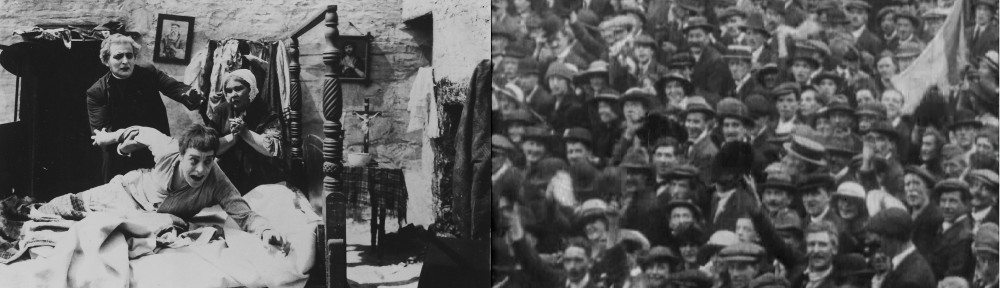
Succeeding Like Success: Irish Cinema at Christmas 1915

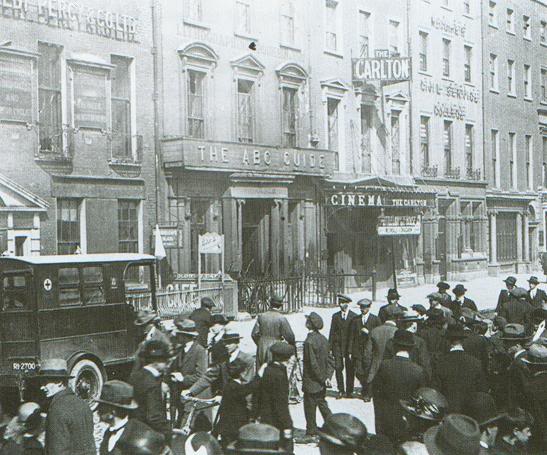
Carlton Cinema, c. 1920. Source: Art Deco in Dublin.

Carlton Cinema, c. 1920. Source: Art Deco in Dublin.

Christmas 1915 was worth celebrating for those involved in the cinema in Ireland. Despite the war and attempts by religious groups to limit its expansion, cinema had continued to grow in 1915, and several new picture houses opened in time for end-of-year holiday season. In many ways, then, a short item in the trade journal Bioscope in December 1915 on the recent opening of an Irish cinema well characterizes the state of the industry as a whole at the end of 1915. “They say,” it began, “nothing succeeds like success” (“Trade Topics”).

However, the success of cinema in 1915 needs to be qualified as well as acknowledged. For a start the short Bioscope item appears to be a promotional piece with little substance. It continues: “but what Mr. Andy Wright said a few nights ago when, in opening the doors for the first time of his new theatre at Waterford, he was knocked down in the rush of an eager populace anxious to secure their seats, is not recorded.” Not recorder either – by this item or other contemporary sources – is what the name of this new theatre was. Not that Wright was unused to the openings of Irish picture houses. Best known as the managing director of the Liverpool-based distribution company Films, Limited and of Wright’s Enterprises, he was also heavily involved in a number of exhibition companies in Ireland. He was a director of Irish Empire Palaces, of the company that built and ran Dublin’s Phoenix Picture Palace, and of Southern Coliseums (“World of Finance”; Paddy, 7 Nov.). Following successes in Wexford and Kinsale during summer 1915, he had opened the Cinema in Carlow in September (Paddy, 9 Sep.). However, this item – if it has any basis in reality – must refer to the opening two months earlier of Waterford’s Coliseum, following its conversion from the Waterford Rink (Paddy, 28 Oct.).
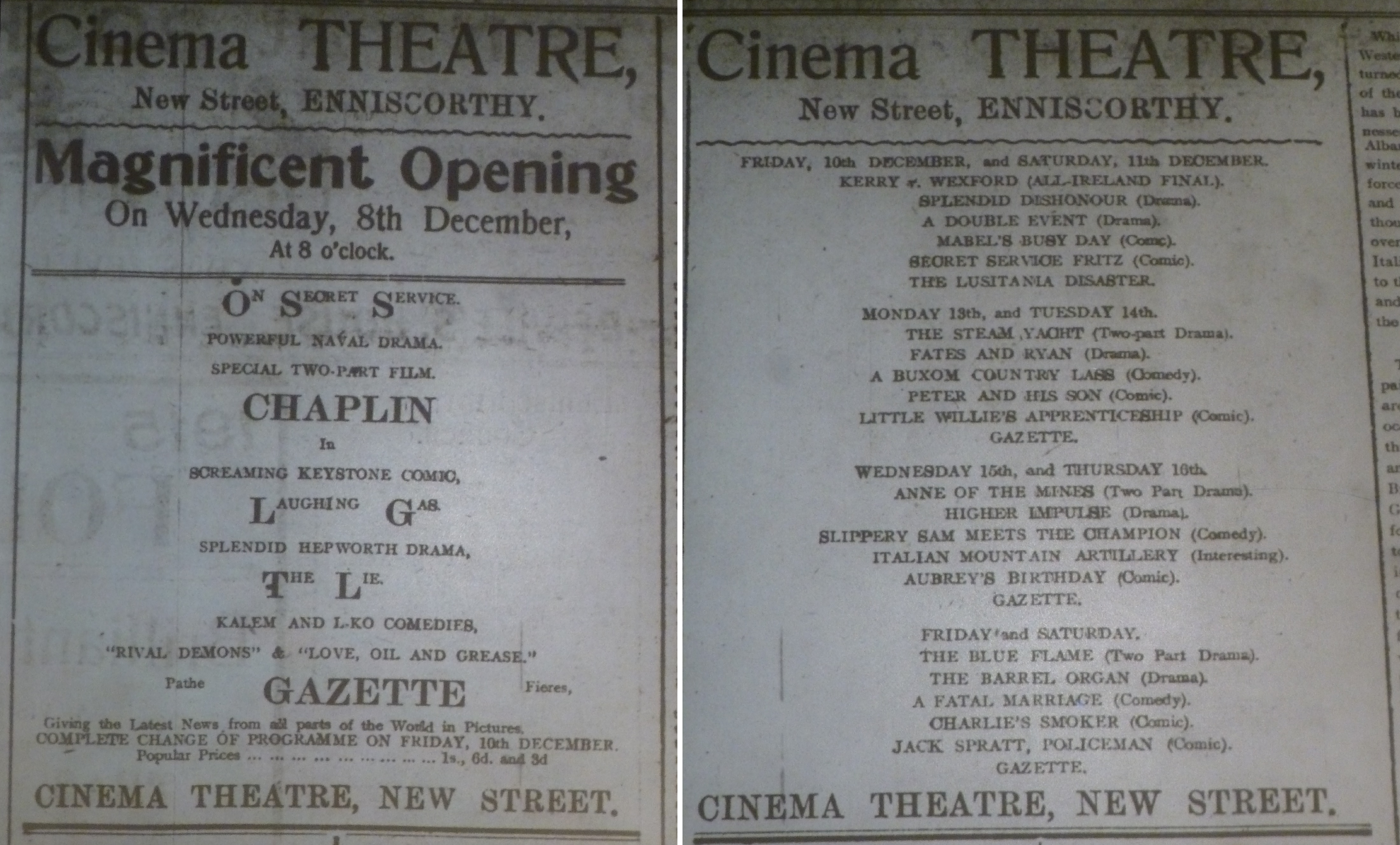
Opening of Enniscorthy's Cinema Theatre, Echo Enniscorthy 4 Dec. 1915: 6, and 11 Dec. 1915: 6.

Ads for the opening weeks of Enniscorthy’s Cinema Theatre, Echo Enniscorthy 4 Dec. 1915: 6, and 11 Dec. 1915: 6.

Among the actual openings for the 1915 Christmas season were picture houses in Enniscorthy, Belfast and Dublin. Enniscorthy’s new Cinema Theatre opened on Wednesday, 8 December, at the Ancient Order of Hibernian’s hall on New Street, which on the occasion, “was crowded, and many people were turned away. The hall was cosily fitted up. The screen proved to be large and the pictures to be clear and bright” (“New Cinema”). All the machinery, fittings and films for the new Cinema Theatre had been provided by Norman Whitten’s General Film Supply, which was also fitting out the picture house in Waterville, Co. Kerry, (Paddy, 9 Dec.). With a population of just 5,500, Enniscorthy could sustain this new picture house alongside the existing Abbey Picture House. Nevertheless, the Abbey put on a rival programme of comedies for 8 December designed to maximize its own audience. Competing with the Cinema Theatre’s naval drama On Secret Service (US: American, 1915) and Chaplin two-reel comedy Laughing Gas (US: Keystone, 1914), the Abbey topped its bill with the Chaplin six-reel feature comedy Tillie’s Punctured Romance (US: Keystone, 1914).

Dublin picture houses advertising the first showings of Chaplin's latest film Charlie at Work. Evening Telegraph 4 Dec. 1915: 1.

Dublin picture houses advertising the first showings of Chaplin’s latest film Charlie at Work. Evening Telegraph 4 Dec. 1915: 1.

Enniscorthy did not have a monopoly on Chaplin. He was still everywhere, with the films he made with Keystone in 1914 still in circulation while his newer Essanay films received special advertising. When Dublin’s Pillar Picture House, Mary Street Picture House and Electric Theatre, Talbot Street premiered the new Charlie at Work on 6 December, Getting Acquainted (US: Keystone, 1914) maintained the audience of the Picture House, Sackville/O’Connell Street “in continuous roars of laughter,” while at the Masterpiece Theatre, one of the Keystones in which Chaplin played alongside Ford Sterling “kept the house in an uproarious mood” (“Picture House,” “Masterpiece”). Of the many other stars, perhaps Mary Pickford was the only one to approach Chaplin. On 2 December, Cork’s Coliseum showed Mistress Nell, which featured Pickford, “who has become such a prime favourite in many Irish picture theatres” (Paddy, 2 Dec.).
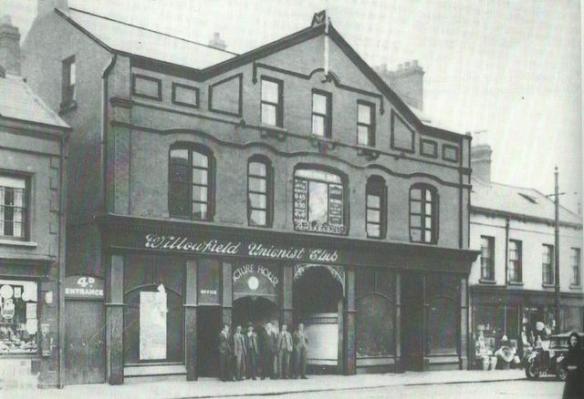
Willowfield PH Belfast

Willowfield Picture House and Unionist Club. Cinema Treasures.

Neither Chaplin nor Pickford topped the bill when Belfast’s newest cinema the Willowfield Picture House opened on 20 December. There was nothing at all unusual about the military mien of the featured drama The Commanding Officer (US: Famous Players, 1915), even when it was complemented by a local topical film of The Inspection of the Ulster Division (1915). The latter film was, however, unusually appropriate for a venue that was also the social club for the Ulster Unionist Party.
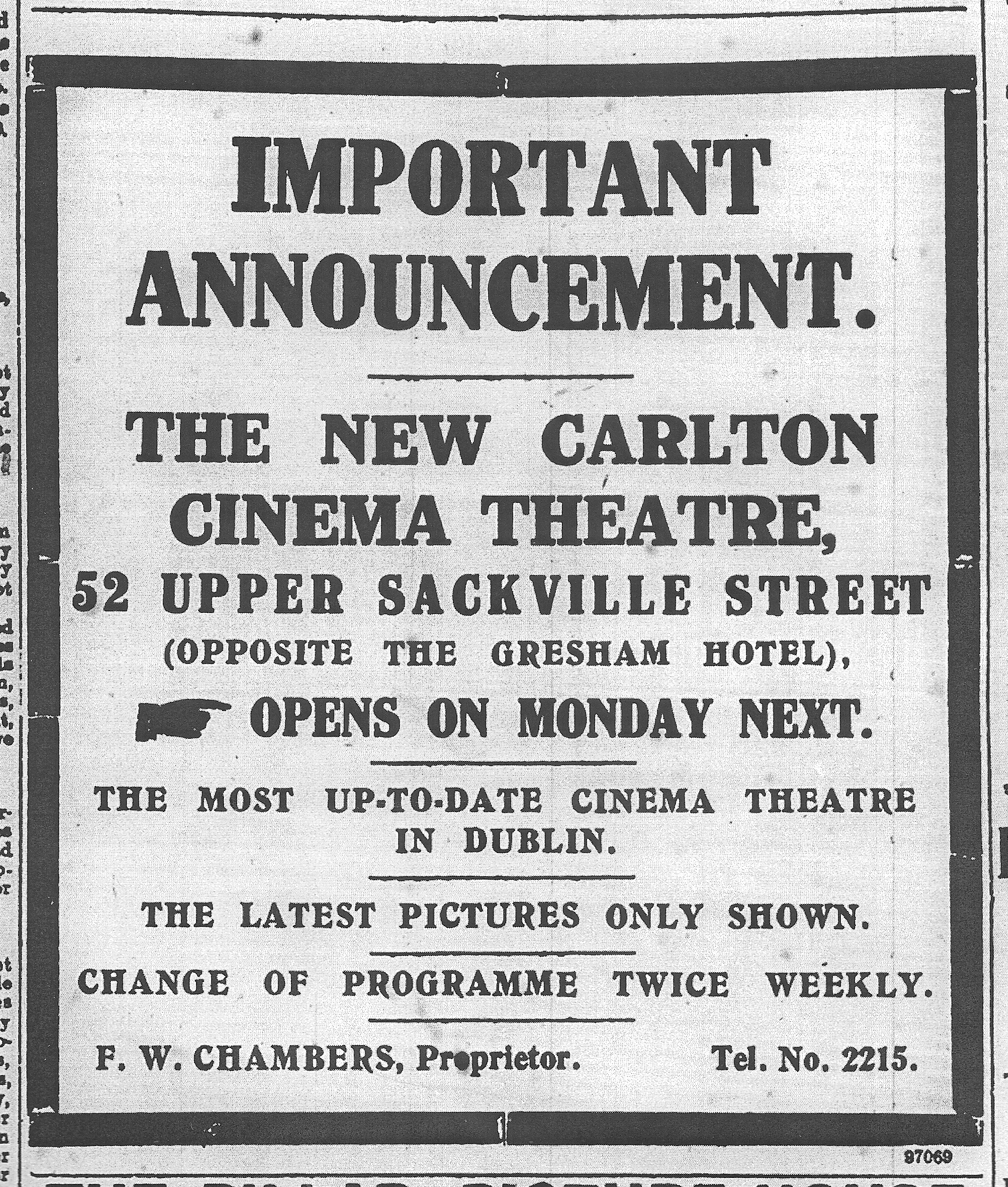
Evening Telegraph, 24-25 Dec. 1915: 4.

Evening Telegraph, 24-25 Dec. 1915: 4.

Dublin’s newest cinema was less out of the ordinary. When the Carlton Cinema Theatre opened its doors on 27 December, it was the last new Irish picture house of 1915. Located at 52 Upper Sackville/O’Connell Street, it had been designed by architect Thomas F. McNamara for Frank W. Chambers, who also ran a tobacconist and billiard hall on the same street. “There is a magnificent entrance and lounge – the latter also being a tea room,” the Bioscope’s Paddy noted, “which lend an imposing appearance to the whole theatre” (6 Jan.). Inside, “[t]he hall is very spacious and well proportioned; the slope in the floor is a distinct improvement, whilst the scheme of decoration and lighting is very effective (“New Carlton Cinema Theatre”). The main opening film was His Wife’s Story (US: Biograph, 1915), which was accompanied, Paddy revealed, by an “orchestra, which consisted of two violins, a piano and a ‘cello.” He predicted that “with the improvement which is bound to come in the course of time, [it] should prove one of the best orchestras in Dublin.” All reviewers commented on the lack of expense spared by Chambers in fitting out the cinema, including in the generator and projectors chosen. “There is, indeed,” the Irish Times declared confidently, “little likelihood of spectators having to suffer the delay of a breakdown, in the Carlton” (“New Picture House”).This was just tempting fate because the same paper reported on 20 January 1916, that a breakdown in the generator had been repaired and that “the light on the picture screen is now perfect” – suggesting previous imperfections – for upcoming screenings of the adaptation of Arthur Conan Doyle’s A Study in Scarlet (“Carlton Picture Theatre”).

Despite such initial technical difficulties, the Carlton would become one of the city’s most popular cinemas. Partly this was because of its favourable location opposite the Gresham Hotel, but it was also because of the musical attractions it would soon offer. In doing so, it would have to compete with two well-established rivals, the nearby Rotunda and the suburban Bohemian. At the Rotunda, “[t]he music, which is now an important feature of a Picture Entertainment, is supplied by the first-class Orchestra, under the baton of Miss Murphy, R.I.A.M.” (“Rotunda Pictures”). However, the state of the art in film accompaniment in Dublin was to be heard at the Bohemian, and in December 1915, it was about to popularize the cinema solo. “The success attendant on the violin solos given by Miss M. Burke, a member of the Bohemian orchestra, during the performances of last week,” an Evening Telegraph reviewer revealed, “doubtless influenced the management to engage for the present week the services of Mr. Patrick Delaney, the celebrated violinist, who rendered at the 7 and 9 performances some delightful selections, which were warmly applauded by large audiences” (“Bohemian”). Although the Bohemian management decided to engage a male soloist, this development was started by one of the city’s skilled women musicians. This Miss M. Burke is likely Mary Burke, who in the 1911 Census is listed as a Galway-born music teacher living in the nearby suburb of Drumcondra.
Victoria Boh Orch 25 Dec 1915p4

Dublin’s Bohemian Orchestra helped reopen Galway’s Victoria Cinema. Connacht Tribune 25 Dec. 1915: 4.

The Bohemian and Galway would have other connections at Christmas 1915. Galway saw the reopening of two of its picture houses – the Cinema Theatre and the Victoria Cinema – on St. Stephen’s Day, 26 December. The main Christmas pictures at the other cinemas – the Court Theatre and the Town Hall Pictures – were serials, the firth episode of The Black Box (US: Universal, 1915) in the case of the Court and the eighth episode The Exploits of Elaine The Exploits of Elaine (US: Wharton, 1914) at the Town Hall. This sense of business as usual was not adopted by the reopening venues, which offered special musical features. The Cinema Theatre under new manager George Gutherie, engaged two singers, “Australian Prima Donna” Marie Elster, who sang “Ave Maria,” and juvenile Irish vocalist Ruth Conway. Among its main alterations, the Victoria Cinema had erected a veranda to protect queuing patrons from the rain, replaced its screen and installed a new projector “to prevent delays between the parts of one picture.” These infrastructural enhancements were launched by a three-day visit from Percy Carver’s Bohemian Orchestra, “acknowledged by press and public as the finest in Ireland” (“Notes & News”). Whether or not Mary Burke was among the visiting musicians is not recorded.

Christmas was celebrated in picture houses around the country with such traditional fare as pantomime films but also with more recent innovations. The Cork Examiner’s review of Robinson Crusoe at Cork’s Coliseum asserted the superiority of the cinema version over the theatrical. “There must be more than ‘Crusoe’s’ own adventures in the modern [theatrical] pantomime. Topical songs are introduced, and this distracts the attention from the mariner’s adventures. It is here the cinema producer scores, for he can keep the main story before the mind all the time” (“Coliseum”). Christmas provided the opportunity for showmen and -women to mount extra film entertainments and for travelling picture shows to visit smaller towns that did not have a regular cinema. James Barrett was granted a licence for a film show in Castlebar’s Town Hall (“Castlebar Urban Council”). With a population of just over 1,500, Granard, Co. Longford, hosted a “highly attractive cinema and gramophone entertainment” at the Town Hall on 29-30 December, “organised for the comforts’ fund of the various battalions of the Leinster Regiments” (“Granard Notes”).

Cinema’s role not only as entertainment but also as a recruiting tool was an important way in which its social usefulness was measured in Christmas 1915. Those men who had not yet enlisted were encouraged to do so by recruitment meetings that included films in Macroom, Charleville and other Co. Cork towns (“Macroom Notes,” “Recruiting Rally”). By contrast, the Freeman’s Journal indicated that some popular films and plays were attempting to prevent recruiting. Praising recruiting efforts around the country, an editorial item observed that the “Irish capital has certainly done magnificently, and perhaps the greatest incentive to recruiting in our midst has been the idiotic pin pricks of the pro-German humbugs, passing as melodramatic Emmets and cinematograph Wolfe Tones” ([Editorial item]). Although it is unlikely that the writer had yet seen it, Sidney Olcott’s Irish-shot Bold Emmett, Ireland’s Martyr (US: Sid Olcott Feature Players, 1915) – steeped in the Irish melodramas of Dion Boucicault – could have been so described.

Dec 4 1915 Nationality PHs ad

Picture house advertising helped fund some of the radical nationalist press; Nationality, 4 Dec. 1915: 3. Available online from the National Archives of Ireland.

Cinema was not expanding everywhere, in part due to the war but also because it had opponents, some of whom were even more active and influential than the Freeman’s editorial writer. Kells Picture House closed for one of its regular hiatuses when its tenancy terminated on 7 December, but it would reopen again in January ([Small ad]). The Ormonde Cinema Company informed Nenagh Town that

[i]n reference to the opinions of well-known advocates of economy during the continuance of the war, and to encourage their propaganda so far as amusements are concerned, [we] have decided to hold exhibitions of pictures only twice weekly in future, viz., on Sunday and Wednesday nights instead of four nights, as was their practice hitherto. (“Nenagh Town Council.”)

Other kinds of cultural nationalist propaganda also rejected cinema. Minnie McAllister of Magherafelt, Co. Derry, the recipient of the third prize in the Columban League of Irish Youth essay competition, included going to the pictures among the foreign manners and customs that Irish boys and girls should avoid. “There is nothing in these performances that appeals to the real Irish imagination,” she wrote, “and frequently enough they are of a description that should not be tolerated in any self respecting country” (“Columban League of Irish Youth”).

Edward O’Dwyer, bishop of Limerick, was of a similar opinion. Just in time for the New Year, he wrote a letter on the exhibition of an immoral film in Limerick city to Fr J. A. O’Connor, administrator of St Michael’s parish that was published nationally in the Cork Examiner and Freeman’s Journal (“Indecent Picture Exhibitions,” “Immoral Pictures”). “On last Wednesday,” he revealed, “a picture was shown in one of these houses, and from the descriptions which has been give to me of it, I feel bound to take the strongest steps within my power as a Catholic Bishop, to prevent the continuance of such an agency of corruption” (ibid.). The description of which film so incensed the bishop is not clear, but he seemed disinclined to confirm its offensiveness by actually viewing the film before urging that swift steps be taken against the picture house in question. On the last day of the year, Limerick’s Vigilance Committee informed the Borough Council through the pages of the Limerick Leader that it could within days expect the Committee’s draft restrictions to be included in subsequent cinematograph licences (“Limerick Vigilance Association”). At a meeting earlier in the month in which the Dublin Vigilance Committee revealed that it had been granted representation at the Recorder annual hearings to grant – or deny – music licences to picture houses, the Committee had acknowledged the increasing national reach of the vigilance movement by changing its name to the Irish Vigilance Association (Dublin Committee) (“Dublin Vigilance Committee”).

As 1915 ended, cinema was certainly a more important cultural force in Ireland than it had ever been, seen as variously profitable, pleasurable and useful. However, it had formidable local opponents ranged against it that were more organized and determined to curb its influence or to destroy it.

References

“The Bohemian.” Evening Telegraph 7 Dec. 1915: 2.

“The Carlton Picture Theatre.” Irish Times 20 Jan. 1916: 8.

“Castlebar Urban Council.” Western People 18 Dec. 1915: 2.

“Coliseum: ‘Robinson Crusoe.’” Cork Examiner 28 Dec. 1915: 6.

“Columban League of Irish Youth: Occasional Chats with the Members.” Donegal News 18 Dec. 1915, p. 7; Ulster Herald 18 Dec. 1915: p. 3.

“Dublin Vigilance Committee.” Evening Telegraph 4 Dec. 1915: 3.

[Editorial Item.] Freeman’s Journal 18 Dec. 1915: 6.

“Granard Notes.” Longford Leader 25 Dec. 1915: 1.

“Immoral Pictures: Letter from Most Rev. Dr. O’Dwyer.” Freeman’s Journal 30 Dec. 1915: 6.

“Indecent Picture Exhibitions: Letter from Most Rev. Dr. O’Dwyer.” Cork Examiner 30 Dec. 1915: 4.

“Limerick Vigilance Association: And Local Picture Houses: Important Restrictions Proposed.” Limerick Leader 31 Dec. 1915, p. 10.

“Macroom Notes.” Southern Star 18 Dec. 1915: 5.

“The Masterpiece.” Evening Telegraph 7 Dec. 1915: 2.

“Nenagh Town Council and Retrenchment.” Nenagh News 25 Dec 1915: 2.

“The New Cinema.” Echo Enniscorthy 11 Dec. 1915: 7.

“A New Picture House.” Irish Times 30 Dec. 1915: 3.

“Notes & News.” Connacht Tribune 25 Dec. 1915: 4.

Paddy. “Pictures in Ireland.” Bioscope 7 Nov. 1912: 417; 9 Sep. 1915: 1176; 28 Oct. 1915: 468; 9 Dec. 1915: 1109; 30 Dec. 1915: 1472; 6 Jan. 1916: 53.

“The Picture House, O’Connell St.” Evening Telegraph 7 Dec. 1915: 2.

“Recruiting Rally in North Cork.” Cork Examiner 29 Dec. 1915: 8.

“Rotunda Pictures.” Evening Telegraph 24 Dec. 1915: 6.

[Small ad.] Meath Chronicle 4 Dec. 1915: 5.

“Trade Topics.” Bioscope 23 Dec. 1915: 1307.

“World of Finance.” Bioscope 7 Mar. 1912: 689; 13 Jun. 1912: 807.
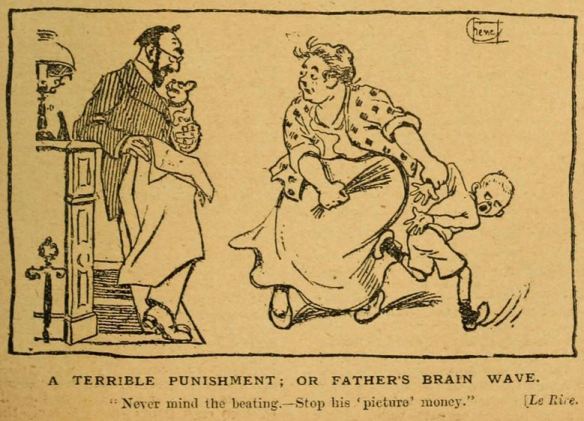
Irish Cinema’s Alluring Enticement to Evil in November 1915

Punishment cartoon 6 Nov 1915p154

This cartoon from the fan magazine Pictures and the Picturegoer (6 Nov. 1915: 154) suggests that children were particularly interested in cinema. Although published in London, the magazine received frequent letters and competition entries from Irish readers, including to its “Young Picturegoer” column. Source: Media History Digital Library.

“Though in our towns we have no theatres or music halls,” noted Cardinal Logue, head of the Irish Catholic church, in a letter published in the Freeman’s Journal on 1 November 1915, “we have the pictures everywhere, and these require close watching” (“Clean Amusements”). November 1915 saw the culmination of some strands of the struggle to regulate Irish cinema, which occurred first between Dublin’s picture-house owners, church groups and city councillors. In a way, of course, this showed that cinema was now too ubiquitous a part of Irish culture to be ignored, as it largely had been by the Catholic church until 1915. The purpose of Logue’s letter was to praise the changed focus of the Dublin Vigilance Committee’s (DVC’s) campaign from “combating unclean and demoralising literature” to “purify[ing] the theatres, music halls and picture houses” (ibid.). Such efforts were especially needed in the case of picture houses because a “great body of those attending them are mere youths and children, and it is to be feared that suggestive and exciting scenes are often presented to them which have a most injurious effect on character and morals” (ibid.).

The timing of the publication of Logue’s letter was no accident but part of a strategy to build a consensus that a distinct layer of Irish film censorship was required. On 2 November, a DVC deputation was permitted to address Dublin Corporation’s Public Health Committee (PHC), the body that issued picture-house licences under the Cinematograph Act (1909) (“Cinematograph Licences in Dublin”). The delegation noted that they had “exercised supervision over the cinema theatres for some time past, and they had to say, with the exception of one particular house, they had no serious complaint to make” (ibid). They discussed their suggested amendments in relation to music, Sunday opening, auditorium lighting, closing on important religious festivals and censorship. PHC chairman James J. Kelly assured them that “he, and the Committee, were in entire sympathy with the views of the Vigilance Committee” and that the PHC “would as far as they could legally go, assist the Vigilance Committee in attaining the objects they had in view” (ibid). The first substantial steps towards a church-sanctioned film censorship had been taken.

Dublin’s Protestant churches were also determined to assert their authority over cinema. A deputation protesting against Sunday opening appeared before the urban council of the Dublin township of Rathmines on 3 November. Although it also included the Catholic parish priest Archdeacon Fricker, it was mainly constituted of Church of Ireland clerics – Ernest H. Lewis Crosby, James Sandys Bird and James Hawthonthwaite – as well as the Methodist minister William B. Lumley (“Rathmines Urban Council”). Three cinemas fell within Rathmines Courcil’s remit: the Princess Cinema and the Town Hall in Rathmines and the Sandford Cinema in Ranelagh. The Rathmines councillors were just as deferential to this deputation as Dublin Corporation had been to the DVC. Chairman John Russell expressed the council’s “very sympathetic feeling with the deputation in the matter” and promised that “[w]hen the time came for the renewal of those licences the Council would try to merit by their action the approval of the deputation” (Paddy, 11 Nov.).

The churches attention extended even to the ways the cinema industry communicated with its audience through advertising. In October, Dublin’s Catholic archbishop, William Walsh had written to the Freeman’s Journal complaining that the advertising hoardings around the city remained “widely open for the display of alluring enticement to evil” (“Objectionable Performances in Dublin Theatres”). “There is surely very little to be gained by the efforts of parents who conscientiously seek to guard their children from the evil influences of lascivious displays in the theatre,” he reasoned, “if some of the most seductive of the sights to be witnessed there are openly displayed along the highways, and even the by ways, of our city” (ibid.). The newspapers – who derived a substantial part of their income from advertising entertainments – had been quick in following up this story about a rival. On the day following the Archbishop’s letter, the Freeman’s Journal had “made inquiries regarding the powers of the Corporation and the police, and the attitude of the principal firm of billposters in the metropolis, in connection with the display of indecent or suggestive pictorial publications” (“Picture Posters”). It found that a poster censorship committee already existed – or had quickly been formed in answer to the controversy – consisting of theatre and picture-house proprietors and the main billposting company, David Allen and Son. If this suggests a close collaboration between these parties, other developments suggest that complete harmony did not exist. On 8 November 1915, the Irish Court of Appeal affirmed a judgement that William King of Madras Place, Phibsboro, Dublin, was in breach of contract with the firm of David Allen and Son Bill Posting, Ltd. King was ordered to pay £80 to Messrs Allen because they had not been able to put an advertising hoarding on the side wall of the Phibsboro Picture House as agreed (“Phibsborough Picture House”).

However, the churches did not have it all their own way. On 19 November, the Recorder of Dublin – the city’s chief magistrate – struck down an appeal by William Larkin of the DVC against his conviction and fining in October on a charge of offensive and riotous behaviour. This was something of a personal victory for Frederick Sparling, proprietor of the Bohemian Picture in Phibsboro. When Larkin had been arrested on 14 September for his protest at the Bohemian against A Modern Magdalen (US: Life Photo Film, 1915), the case had been summarily dismissed by the magistrate as Larkin had publicly predicted it would be. Having been the victim of Larkin’s protests on previous occasions, however, Sparling was determined to teach him a lesson, so he prosecuted him again. This second prosecution was unprecedented and gave rise to some consequences Larkin had not foreseen. At this second trial, Larkin argued that his protest against A Modern Magdalen was legitimate because in the film’s so-called mad-cap scene, protagonist Katinka danced topless, a detail the prosecution and most of the witnesses disputed. The case was adjourned for a week while the magistrate viewed the film, and he concluded that it was not indecent or objectionable, imposing a fine and costs on Larkin. The Recorder confirmed this judgement.

More interestingly, in order to prove the charge that Larkin had caused a panic, Sparling called cinema staff and audience members to testify, and Larkin’s lawyers called the DVC members who had been present as defence witnesses. As a result, this is one of the few instances in which the views – or even the names – of ordinary members of an Irish audience were recorded. The court provided a forum for these ordinary audience members to confront the coercive behaviour of the DVC.

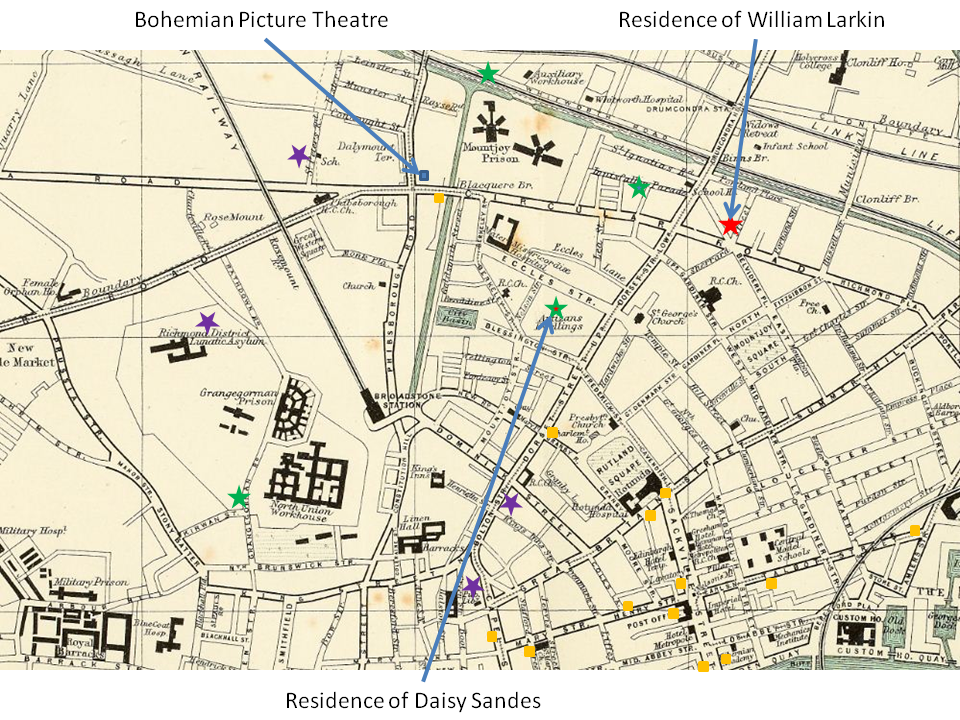
Map showing from where members of the audiences travelled from to get to the Bohemian Picture Theatre on 14 Sep. 1915. Purple stars represent people who supported William Larkin’s account of his protest; green stars represent people who challenged Larkin’s account. Yellow squares represent picture houses in north Dublin.

Map showing from where members of the Dublin audience travelled from to get to the Bohemian Picture Theatre in Phibsboro on 14 Sep. 1915. Purple stars represent people who supported William Larkin’s account of his protest; green stars represent people who challenged Larkin’s account. Yellow squares represent picture houses in north Dublin.

Like Larkin himself, however, these people have left very few archival traces beyond their names, addresses and professions. In all, fifteen people testified in court, including Larkin, Sparling and Mathewson. The DVC members, for the defence, were Richard Jones, chairman of the Richmond Asylum; Mrs. A Murphy of Capel Street; P.J. Walsh, a Phibsboro accountant; Philip Lavery, a justice of the peace from Armagh; and Peter Tierney, a china and glass merchant of Bolton Street. The cinema staff who testified were the operators William Jones and Scallan; advertising agent Robert Moss; and cashier Rachel Smith. Three “unaffiliated” witnesses also spoke for the prosecution: Mrs. Evans of Grangegorman, civil servant Charles Millen and Daisy Sandes. They said similar things, perhaps best put by the youngest of them, Daisy Sandes, who worked at a retouching studio in Henry Street and lived with her working-class family in an artisan dwelling about ten minutes walk from the Bohemian. “I was amazed,” she commented, when asked about Larkin’s behaviour. “I did not see why anyone should object” (“Scene in Dublin Picture Theatre”). Sandes’ utter rejection of Larkin’s arguments refuted the DVC’s claim to speak for ordinary people too timid and accepting to speak for themselves. It seems also to mark a point at which she and other young working-class men and women were increasingly going to the cinema for their entertainment.

Although Sparling seems to have had little support from other exhibitors, other individual picture-house proprietors and the industry as a whole also responded to these attacks by presenting cinema as a public good. The directors of the Grand Cinema in Blackrock, Co. Dublin, gave their premises on Saturday, 30 October to a local committee who had organized a matinee entertainment that raised over £10 for the Red Cross and St. John’s Ambulance (Paddy, 4 Nov.). Such charitable gestures had long been an important way in which picture-house proprietors had asserted the direct utility of their business to local communities. By November 1915, bringing someone to the cinema was considered socially acceptable not only for children or dating couples. As part of her efforts to support recruiting, Florence Blacker-Douglass invited 90 wives of soldiers in the Irish Guards to meet her for a film shows at Dublin’s Sackville Picture House followed by tea at the nearby D.B.C. restaurant (“Entertainment to Wives of Soldiers”).

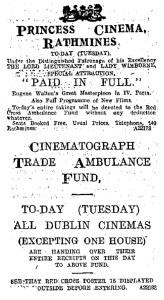
Princess Ambulance Fund FJ 23 Nov 1915p4

Ad for a command performance at the Princess Cinema, Rathmines to mark Cinematograph Trade Ambulance Day, for which patrons were encouraged to attend their favourite cinema. Freeman’s Journal 23 Nov. 1915: 4.

A much more ambitious cooperation of the industry as a whole also occurred in November. Following a very successful event in England on 9 November, Irish representatives of the Cinema Exhibitors’ Association set 23 November as Ireland’s Cinematograph Trade Ambulance Day. On that day, participating picture-house owners agreed to donate a portion – in most cases, all – of their takings to fund ambulances for the war effort. Addressing a meeting of exhibitors from southern counties at Cork’s Metropole Hotel on 19 November, exhibitor David Frame argued that “the trade should associate itself with a scheme ambitious in scope, useful in purpose, and which will be more closely identified with the kinematograph industry, as an industry, rather than with its individual members” (“Kinematograph Trade and the War”) The generous press coverage suggests that Cinema Ambulance Day was a successful public relations event for the industry as a whole. “The public-spirited action of the Cinema proprietors is deserving of the most cordial support,” observed the Irish Times, “and there is no doubt that they will get it in the fullest measure” (Cinema Ambulance Day”). The cinema industry as a whole had aimed “to provide the sum of £30,000 to equip and present a fleet of fifty motor ambulances for Red Cross work at the front, so that every picture-goer should make a special effort to attend his or her favourite picture house to-day” (“Cinema Ambulance Day in Dublin”).

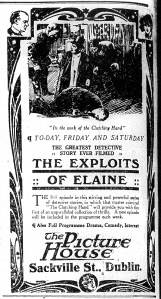
Elaine Sackville 28 Oct 1915

Illustrated ad for The Exploits of Elaine at the Sackville; Evening Telegraph 28 Oct. 1915: 4.

Although such good causes drew crowds on 23 November, the acknowledged ubiquity of cinema in 1915 was based largely on the attractiveness of the films provided. On 18 October, the first episode of The Exploits of Elaine (US: Wharton, 1914)), one of the most popular serials of the period, was released. The trade press had long heralded it arrival with a wide variety of advertisements from distributors Pathé. An article in the Bioscope noted that the

stories of the film will be published in the News of the World each Sunday, commencing October 17th, and in conjunction with this paper, Messrs. Pathé have arranged to give away to each of the first thousand applicants an “Elaine” hat, which is an exact facsimile of that worn by Miss Pearl White. (“Publicity for ‘The Exploits of Elaine.’”)

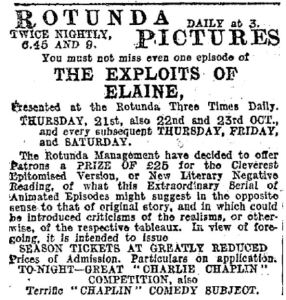
Elaine Rotunda II 18 Oct 1915p4

Ad for the opening episode of The Exploits of Elaine at Dublin’s Rotunda; Irish Independent 18 Oct. 1915: 4.

This was just the beginning of the publicity stunts arrange for the launch of the serial in Britain. The opening in Dublin was less spectacular. James T. Jameson of the Rotunda had secured first run, and he set his patrons a literary competition, offering in the newspaper ads “£25 for the cleverest epitomised version, or the new literary negative reading of what this extraordinary serial of animated episodes might suggest in the opposite sense of that of original story, and in which could be introduced criticisms of the realisms, or otherwise, of the respective tableaux.”

Paddy, the Irish correspondent at the trade journal Bioscope, had little to say about the Irish launch of The Exploits of Elaine, saving his praise for The Million Dollar Mystery (US: Thanhouser, 1914), another serial that opened at the Rotunda on 22 November. “I had the pleasure of seeing this last Monday, and it held me more enthralled than the first part of any serial ever has,” he revealed. Offering the public two mysteries, it was “the right kind of serial that forces you to come again. It was loudly applauded as only the patrons of the Rotunda know how to applaud” (Paddy, 25 Nov.).

It was such compelling films that helped to make cinema ubiquitous by 1915.

References

“Cinema Ambulance Day.” Irish Times 20 Nov. 1915: 9.

“Cinema Ambulance Day in Dublin.” Irish Times 23 Nov. 1915: 3.

“Cinematograph Licences in Dublin.” Irish Times 4 Nov. 1915: 9.

“Clean Amusements: Letter from Cardinal Logue.” Freeman’s Journal 1 Nov. 1915: 6.

“Entertainment to Wives of Soldiers.” Irish Times 6 Nov. 1915: 8.

“Kinematograph Trade and the War: Ambulance Day in Cork.” Cork Examiner 23 Nov. 1915: 6.

“Objectionable Performances in Dublin Theatres: Letter from Archbishop.” Freeman’s Journal 11 Oct. 1915: 4.

Paddy. “Pictures in Ireland.” Bioscope 4 Nov. 1915: 596; 11 Nov. 1915: 667; 25 Nov. 1915: 960.

“Phibsborough Picture House: Bill Posting Litigation.” Irish Times 9 Nov. 1915: 3.

“Picture Posters for City Theatres and Picture Houses: The Archbishop’s Letter.” Freeman’s Journal 12 Oct. 1915: 8.

“Publicity for ‘The Exploits of Elaine.’” Bioscope 26 Aug. 1915: 969.

“Rathmines Urban Council.” Irish Times 4 Nov. 1915: 2.

“Scene in Dublin Picture Theatre: Question as to the Morality of the Film.” Evening Herald 11 Oct. 1915: 5.


Kinemac, Pulsocon, Skibbereen: A New Lexicon for Irish Cinematic Sensation

“Some people when they want to be amused go to a theatre, a circus, or the Kinemac,” explained a writer in the Southern Star in October 1915. This newspaper primarily addressed a readership in the environs of Skibbereen, Co. Cork, for whom the Kinemac, the local entertainment hall, was the place where “[a]s a rule they get the full value of their money in laughter, hearty or otherwise” (“Skibbereen and Carbery Notes”). Indeed, in Skibbereen, the Kinemac appeared for a time to be synonymous with popular entertainment and particularly moving pictures. For instance, when in March 1915, Jeremiah McCarthy – leading stoker of HMS Devonshire – related his war experiences in the battles of Heligoland Bight and Dogger Bank, the seriousness of these contrasted with his demeanour while in Skibbereen, where he was described as being “as cheery and light-hearted as a small boy going for the first time to the Kinemac” (“Skibbereen Man in North Sea Battles”). Similarly, when The O’Donovan – chief of an Irish sept and colonel in the Munster Fusiliers – addressed a recruiting meeting in the west Cork town of Ballydehob in May 1915, he told his hearers that it was necessary to give a graphic account of German brutality in Belgium, which he said had been particularly expressed in the rape of Belgian women:

The man who lives out in the country, though he may see the films occasionally at the Kinemac, does not realise these things, nor appreciate the horrors that would happen his own country, his wife and daughters, and his sisters if the Germans ever invade Ireland, as they may, if not driven back in Flanders and France. (“Ballydehob Meeting.”)

So, although the word “Kinemac” does not echo down cinema history, these references give an indication of the degree to which this picture house had become embedded in the entertainment culture of west Cork in 1915. That might seem of limited local interest, but the story of the Kinemac has national and international aspects unique in early Irish cinema. It was built by a local man with money he had made selling his mechanical vibrators to the world; it was founded in order to provide funding for the paramilitary Irish Volunteers; and it was a financial failure.

Financial failure was some way off when on 14 December 1914, the Kinemac was opened with much ceremony by Henry O’Shea, mayor of Cork city, for the proprietor, Gerald J. Macaura (“The ‘Kinemac’”). O’Shea’s attendance was an acknowledgement of Macaura’s support for the Skibbereen Volunteers and the Irish Parliamentary Party. When the Skibbereen Volunteers were founded earlier in 1914, Macaura had donated £50 in cash, and he had – seemingly on an impulse of his own– bought a set of silver-plated instruments for the establishment of a Volunteer band in the town. He built the Kinemac in order to provide a continuing source of funds for the training of local boys by J. G. Chipchase, a bandmaster he had brought from England. Even before the Kinemac opening, Macaura’s munificence had been rewarded with the title of honorary colonel of the Volunteers.

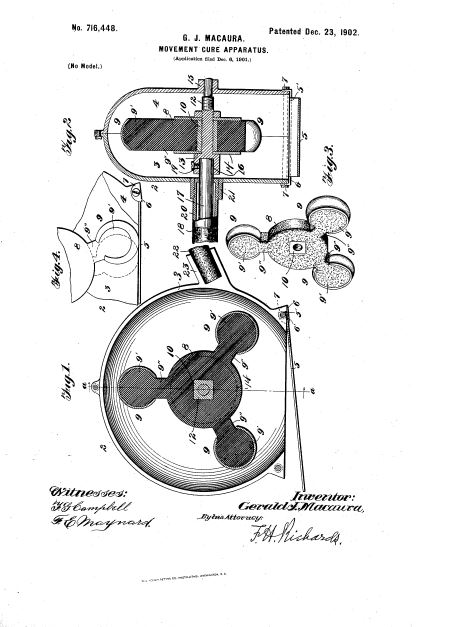
Part of the patent document for Macaura's

Part of the patent document for Macaura’s “movement cure apparatus,” dated 23 Dec. 1902.

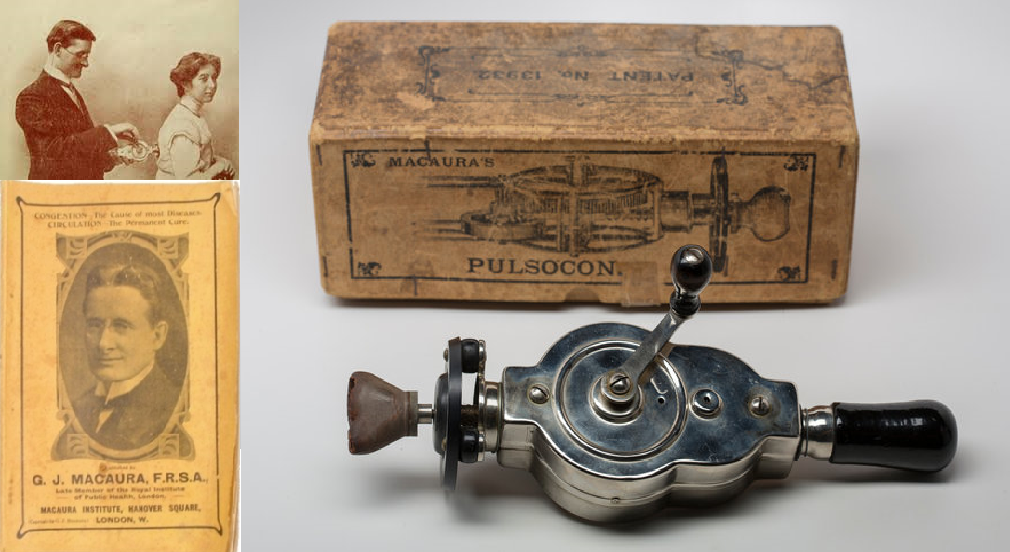
Such munificence was possible because “Colonel” Macaura was more internationally famous – and eventually notorious – as “Dr” Macaura. Dr Macaura was the inventor and popularizer of the Pulsocon, a handheld vibrator. Born Gerald McCarthy in Skibbereen, the son of a master cooper and Fenian activist, Macaura emigrated to the United States where he had relatives in construction (“Death of Dr. Gerald J. Macaura”). His obituary repeated the claim that he had worked with Edison, but this seems to be as spurious as his medical education. Both a professional connection with the most prominent inventor of the age and the letters “Dr” or “Prof” before one’s name were part of a formula for a lucrative career in quackery. In 1898, “Professor” Macaura demonstrated to the people of Skibbereen and of Cork city that he also possessed the indispensable quality of showmanship, when he treated them to a demonstration of his prowess in hypnosis (“Hypnotic Seance”). Returning again in 1901, having “pursued his course of studies in the Sheerin Psychological College, Columbia, Ohio, [and having had] conferred on him the degree of Doctor,” he held a fundraising entertainment with Edison’s latest phonograph in aid of the Skibbereen Temperance Hall (“Entertainment in Skibbereen”). And in December 1902, Macaura patented a device in the United States that would provide the basis of his fortune. Beginning life as the somewhat prosaically titled “movement cure apparatus,” this would later become popular as the more colourful “Oscilectron,” “Pulsocaura,” and – most famously – “Pulsocon.”

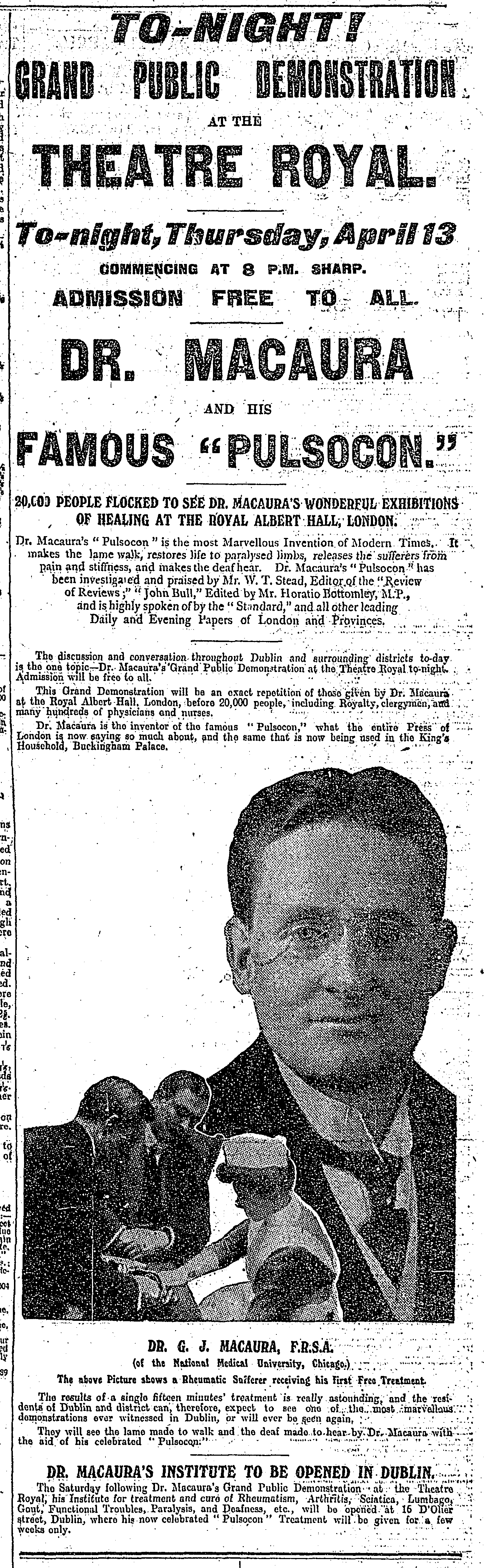
Ad for Macaura's demonstration of the Pulsocon in Dublin, 13 April 1911.

Ad for Macaura’s demonstration of the Pulsocon in Dublin, 13 April 1911.

Macaura’s career with the Pulsocon was an international one, but aspects of it can be seen in the way he operated in Ireland. In 1911, he held lavishly advertised demonstrations of the device in Dublin and Cork presenting himself as “Dr. G. J. Macaura, F.R.S.A., of the National Medical University, Chicago.” The Dublin demonstration was held at the Theatre Royal, the city’s largest theatre, on 13 April, an event whose lack of an entry fee ensured a very full house. Following this public launch, he offered to consult with sufferers from ailments ranging from rheumatism to deafness at his Institute at 16 D’Olier Street in the city centre. The Institute remained in operation with frequently ads until 17 June, when Macaura moved his show to Cork, where he used the same publicity techniques and public meeting – in this case, at the Assembly Rooms on 15 August – before establishing an Institute there until 20 September. The Pulsocon show did not come to so small a town as Skibbereen, but the money Macaura earned from these lucrative shows funded his exploits there.

Interest in the Pulsocon continues; these images are from here, here and here.

Interest in the Pulsocon continues, particularly as part of a hidden sexual history of the early 20th century; these images are from here, here and here.

When he hit on the idea of the Kinemac in late 1914, therefore, Macaura was a self-made man, used to success and overcoming such occupational hazards as his prosecution for fraud and the illegal practice of medicine in France between 1912 and 1914 (“Dr Macaura Arrested,” “American ‘Medicine Man’”). As a mark of that success, the returned cooper’s son bought Lough Ine House near Skibbereen and began disbursing funds as an entry into Irish nationalist politics. As Macaura’s largess grew, the local papers were careful to assert his lack of political ambition. “Although not a politician,” the Cork County Eagle observed when the Kinemac was first announced in October 1914,

Dr. Macaura is very keen on the Volunteer movement. He speaks highly of Mr. John Redmond’s services to Ireland, and it is under his leadership that Dr. Macaura has bestowed these gifts on the movement. When the Hall, which will be a costly structure, is completed. Dr. Macaura’s contributions to the local Volunteer fund will amount to close on £1,000.” (“Skibbereen National Volunteers.”)

Nevertheless, despite the fact that his business was based in London, Macaura returned to Skibbereen at strategic intervals.

He was not, however, intending to manage the Kinemac himself and seems to have expected that his Skibbereen ventures would become self-running and self-funding. The Kinemac was to be operated by a committee associated with the Volunteers, and Macaura expected it to provide a profit that would cover the band’s expenses. As somebody involved in a branch of show business in the United States and Europe, Macaura had undoubtedly seen the money that could be made from picture houses. But he does not seem to have considered whether or not a town with as small a population as Skibbereen could sustain a full-time picture house. Something has already been said here about a population in the region of 5,000 being needed to make a picture house financially viable in the mid-1910s. Skibbereen’s  population of just 3,021 in the 1911 census made it likely that a full-time picture house would struggle to earn a profit. And it did.

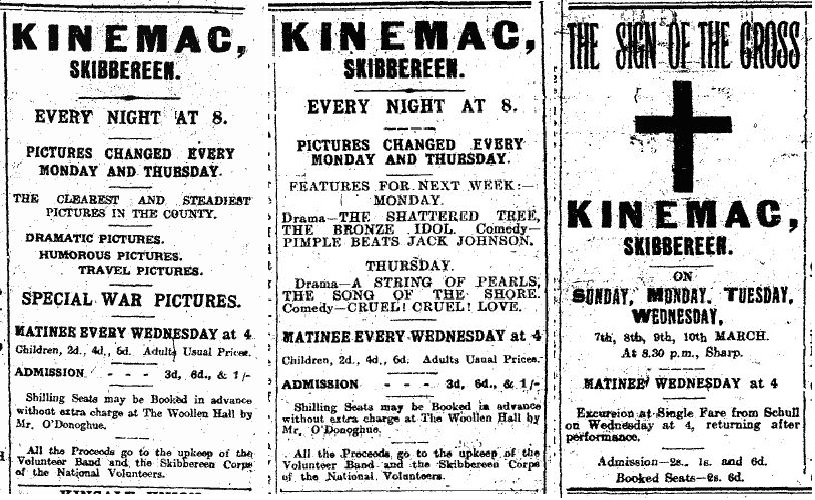
Ads for the Kinemac, 2 Jan., 30 Jan. and 6 Mar. 1915.

Ads for the Kinemac, 2 Jan., 30 Jan. and 6 Mar. 1915.

Initially, the Kinemac resembled many picture houses across Ireland. It offered a nightly show beginning at 8pm, changed the programme on Mondays and Thursdays and charged 3d., 6d. and 1s. admission. It could accommodate 209 patrons on 119 tip-up seats in brown leather cloth, 68 tip-ups in green plush, and 22 leather-covered seats (“Kinemac, Skibbereen”). It offered a programme of dramatic, humorous and travel pictures, including special war films, with such attractions as The Sign of the Cross (US: Famous Players, 1914) receiving special publicity in early March 1915.

Despite such spectacles, the Kinemac was already failing to meet its running costs six months after it opened when it ran into political controversy because of its links to the Volunteers and their band. Following the recruiting drive by The O’Donovan and others, 22 Skibbereen men left the town to join the 9th Battalion of the Munster Fusiliers on 10 June 1915 “amidst a scene of great enthusiasm” (“Volunteers’ Departure”). However, the recruits were played onto the train not by Macaura’s Volunteer Silver Band but by the band of the Baltimore Fishery School because the Volunteer Band committee, led by Councillor Timothy Sheehy, refused permission for them to play. The reasons for this are not clear, but it could be that Sheehy and other members of the committee had not agreed with John Redmond’s policy on the National Volunteers entering the British Army. This is suggested by a mock-heroic ballad in the Cork County Eagle commemorating these events, which observed of Sheehy that “There never was a public thing / That he had not on hand, sir, / Except recruiting against the Huns, / For which he refused the Band, sir” (Simple).

At the end of June 1915, Macaura returned to Skibbereen and had a handbill distributed calling the townspeople to a meeting in the square so that he could explain his disagreement with this decision on the use of the band and the financial difficulties faced by the Kinemac (“Clearing the Air,” “Skibbereen Band Crux”). This was an extraordinary move to undermine his local opponents, and the public meeting was a forum in which he excelled. As the ballad said of Macaura’s actions,

He built this Hall for Picture Shows,

And called it the ‘Kinemac,’ sir,

Gave its control to a Committee,

To which now he has give the sack, sir;

That Kinemac has changed its name

And is known as the ‘Picturedrome,’ sir;

And Michael John is Agent now,

And Manager – one Macowan, sir.” (Simple.)

Suggesting that the committee was biased against the town’s Protestants, who had in turn boycotted the Kinemac, Macaura removed the committee and replaced them with his agent Michael J. Hayes. He closed the Kinemac for the summer months and arranged that it would be run in the autumn by Alex McEwan, the well-known proprietor of Cork city’s Assembly Rooms Picturedrome. And on 10 July, the Macaura Silver Band gave a send-off to five Skibbereen recruits (“Send-Off to Skibbereen Recruits”).

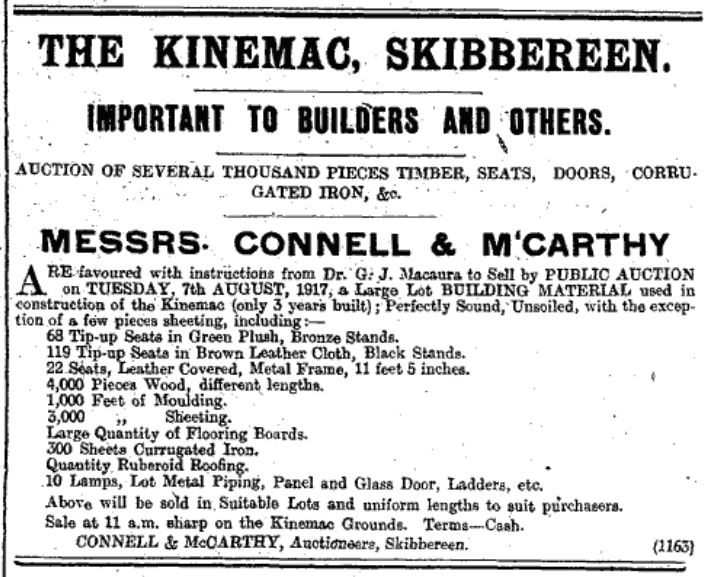
Ad for an auction of the Kinemac's furnishings and building materials. Cork County Eagle 4 Aug. 1917: 4.

Ad for the auction of the Kinemac’s furnishings and building materials. Cork County Eagle 4 Aug. 1917: 4.

However, the Kinemac did not prosper, even under a professional picture-house manager. In part, this may be attributed to a lasting and perhaps not unearned ill will towards Macaura. When he attempted to get his cinematograph licence changed into McEwan’s name by Skibbereen Urban Council, Sheehy complained that Macaura had taken back a gift he had given to the Volunteers in the presence of the Lord Mayor of Cork. McEwan did, nevertheless, run the Kinemac in late 1915, but did not return for a second season. In his stead, Southern Coliseums – which ran the Coliseum and Tivoli in Cork city and which among its other venues, opened a Coliseum in Waterford in October 1915 – reopened the Kinemac as the Coliseum, Skibbereen, on 25 April 1916, the day after the Easter Rising had begun in Dublin. Again, the picture house failed to attract enough patronage, with a local columnist commenting in September 1916 that “it is a pity that the Coliseum was not patronised better since its re-opening [following a summer hiatus] a fortnight ago, but the meagerness of the attendance each night may be attributed to the exceptionally fine weather” (“Local and Other Newsy Items”). Whatever the reasons for poor attendance, Macaura eventually cut his losses on the Kinemac and sold it all – from furnishings to structural timbers – for scrap in August 1917.
The story of the Kinemac is more than just a curious case of a failed picture house at a time when cinema was on the ascendant. It throws unusual light on the motivations of those who built these venues. While this is probably the only case in which a vibrator salesman built a picture house to fund a nationalist band, it exposes the importance of considering a broad constellation local circumstances when assessing the reasons why a picture house succeeded or failed.
References

“American ‘Medicine Man’ Sentenced as Swindler.” Freeman’s Journal 15 May 1914: 9.

“Ballydehob Meeting.” Skibbereen Eagle 29 May 1915: 10.

“Clearing the Air: Colonel Macaura Puts a Plain Issue Before Skibbereen People.” Cork County Eagle 26 Jun. 1915: 11.

“Death of Dr. Gerald J. Macaura: Skibbereen Loses Distinguished Son: Worked with Edison.” Southern Star 10 May 1941: 3.

“Dr Macaura Arrested.” Freeman’s Journal 25 May 1912: 4.

“Entertainment in Skibbereen by Professor Gerald J. Macaura.” Southern Star 5 Oct. 1901: 5.

“A Hypnotic Seance.” Cork Examiner 27 and 29 Aug. 1898: 1; Southern Star 30 Jul. 1898: 1.

“The ‘Kinemac’: Opening Ceremony at Skibbereen.” Southern Star19 Dec. 1914; 1.

“The Kinemac, Skibbbereen: Important to Builders and Others.” Ad. Cork County Eagle 4 Aug. 1917: 4.

“Local and Other Newsy Items.” Cork County Eagle 23 Sep. 1916: 7.

“Macaura Volunteer Silver Band: Concert at the Kinemac.” Cork County Eagle 20 Mar. 1915: 9.

“Send-Off to Skibbereen Recruits.” Cork County Eagle 10 Jul. 1915: 12.

Simple, William. “Skibbereen.” Cork County Eagle 14 Aug. 1915: 9.

“Skibbereen and Carbery Notes.” Southern Star 9 Oct. 1915: 9.

“Skibbereen Band Crux: Dr. Macaura Comes from London.” Southern Star 26 Jun. 1915: 5.

“A Skibbereen Man in North Sea Battles.” Cork County Eagle 6 Mar. 1915: 9.

“Skibbereen National Volunteers: Dr. Macaura’s Munificence.” Cork County Eagle 3 Oct. 1914: 4.

“Volunteers’ Departure.” Southern Star 12 Jun. 1915: 5.

Monopolizing the Limelight: Irish Cinema and Politics in Autumn 1915

“Valentine Grant in All for Old Ireland, the first of a series of Lubin comedy dramas made in Irelnad.” Pictures and the Picturegoer 11 Sep. 1915: 461. Courtesy of the Media History Digital Library.

In late August 1915, a Dublin Evening Mail columnist urged readers to pay more attention to such politicians as Winston Churchill than to celebrities. “It would undoubtedly be very bad for the nation,” s/he argued,

if its greatest heroes were, say, Mr. Harry Lauder […] or Charlie Chaplin, who is said to be making a colossal fortune by comic performances for the cinematograph films. These people deserve our respect, no doubt; they scarcely ever fail to get our applause; but we must not give them the monopoly of the limelight. (“Town Topics.”)

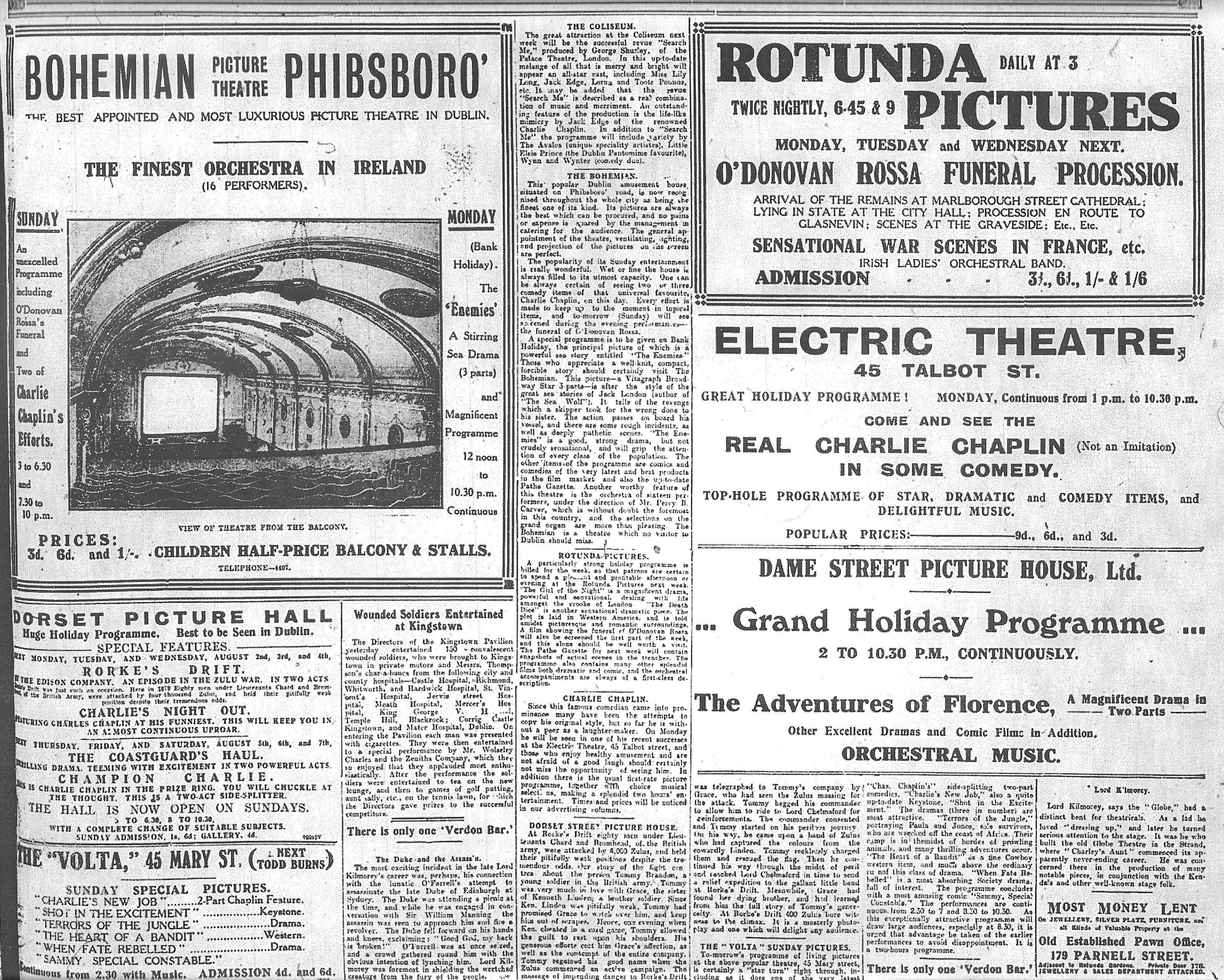
Given that limelight was the late 19th century’s favoured theatrical lighting, this was precisely what one should expect such star performers as Harry Lauder and Charlie Chaplin to be monopolizing, had not “limelight” already become synonymous by 1915 with public attention. Churchill, Chaplin and limelight: even as the Mail reporter denies it, the juxtaposition is suggestive of an early celebrity culture that made little distinction between a personality’s reasons for occupying the public’s gaze, be his or her forte politics or pratfalls. In Irish picture houses in mid-autumn 1915, politics – if not Churchill – were important, but Chaplin was everywhere.

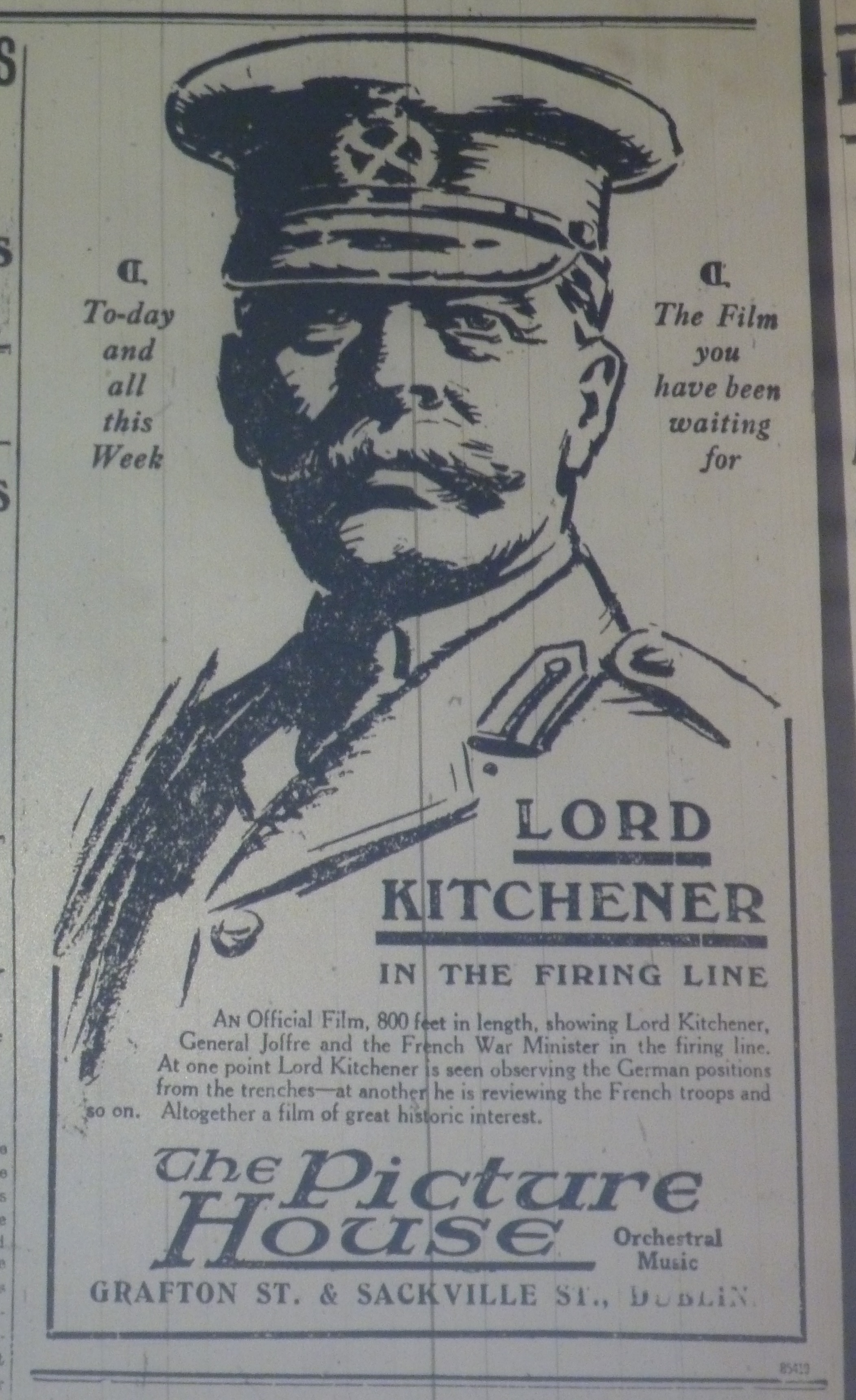
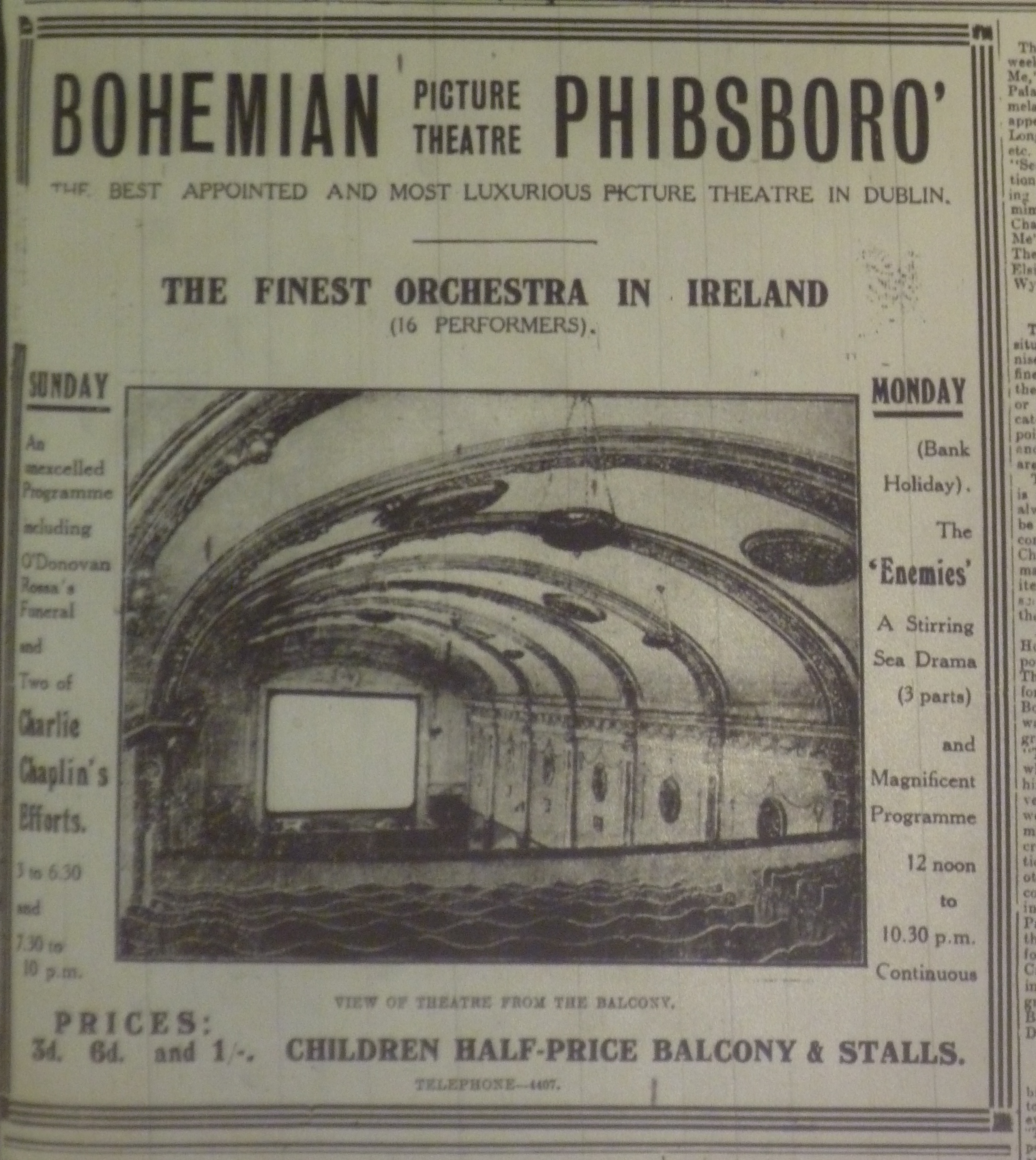
Evening Telegraph 13 Sep. 1915: 2.

Lord Kitchener, all but pointing his finger at us in this illustrated ad from the Evening Telegraph 13 Sep. 1915: 2.

Churchill did not appear on Irish cinema screens at this time – or at least, he was not noted to have done – but politics both international and national was visible in films and in the picture-house auditorium. Irish-born Horatio Herbert Kitchener, British Secretary of State for War, was a more visible and commanding presence in pictures houses than Churchill in September 1915. His image appeared on illustrated ads for the film Lord Kitchener in the Firing Line (Britain: Gaumont, 1915). “At one point Lord Kitchener is seen observing the German positions,” noted the Freeman’s Journal, “at another he is reviewing the French troops. Taken altogether, the film is of great historic interest” (“Grafton Picture House”). Film’s usefulness as a recruiting tool was also being recognized in Ireland, where the Dublin Recruiting Committee awarded Norman Whitten’s General Film Supply a contract to produce an Irish recruiting film (Paddy, 9 Sep.).

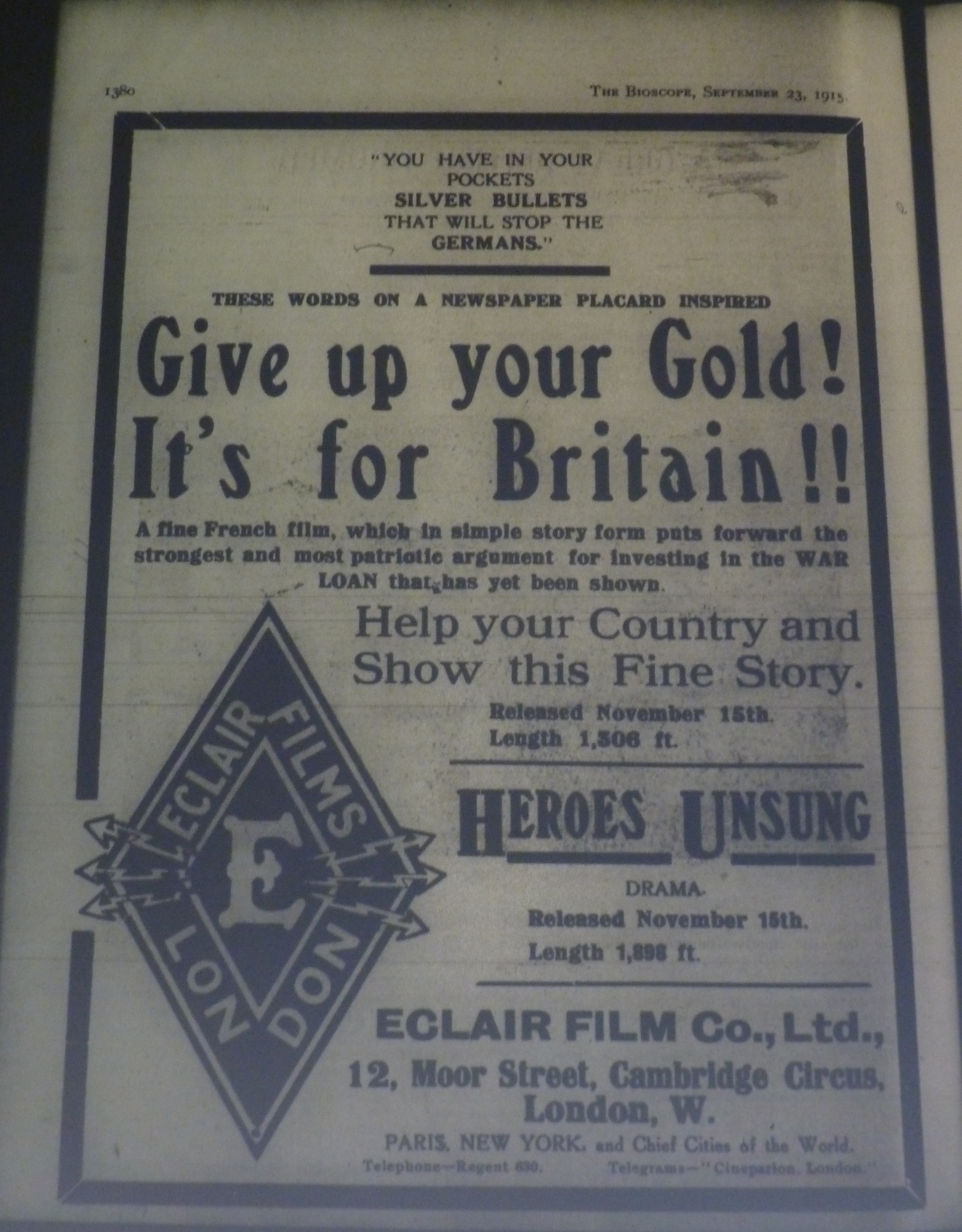
Bioscope 23 Sep. 1915: 1380.

Full-page from the Bioscope 23 Sep. 1915: 1380.

It was not only in such newsreel specials that the war was represented but also in fictional propaganda films (see more here, here and here). In late September, Eclair publicized “Give Up your Gold, It’s for Britain!!” (France, 1915), which aimed to increase public subscription to war funds. Although the War Office had begun to make and commission films itself, this film was produced by a commercial company that expected the film to be popular by catching widespread support for the war. “Although we have had many ‘war films,’” the Bioscope observed, “[i]n too few cases has the wonderful power of the cinema drama in propaganda work been realised and made use of” (“Give Up Your Gold”). As was the Bioscope’s practice, such significant if modest progress in British – or in this case, Franco-British – propaganda was said to be more than matched by developments in Germany. The paper reprinted a report from the Daily Chronicle outlining the expansion and increased coordination of the film department of the “‘Central For Foreign Service,’ whose mission is the circulation of ‘true information’ about Germany in neutral countries” (“German Film Campaign”). The article emphasized that this was a well-connected and competent committee that included “Baron von Mumm, late German Ambassador at Peking, and the notorious Herr Dernburg,” a film producer. The worrying damage its films could do in neutral European countries might be bad enough, but “an American has had duplicates of all the new films supplied to him and […] he is pledged to exhibit them in the United States” (ibid.).

Irish loyalty and commitment to the war effort was by no means unanimous, but it was widespread given the number of Irishmen serving in the British armed forces. In the initial months of the war, the Bioscope had kept a tally of cinema personnel, including those from Ireland, who had volunteered, but as the war wore on, the journal had discontinued the practice. However, in August 1915, Paddy – the Irish correspondent – had reported on a ceremony at the Princess Cinema in Rathmines, Dublin, honouring James Ball, Thomas Butler and James Burke, members of staff who had recently joined the Royal Irish Fusiliers. “Each of the boys was presented with a suitable gift” from managing director Izidore Bradlaw, Paddy observed, “and they were informed that their places would remain open for them on their return” (Paddy, 12 Aug.).

Catherine Countiss and Lionel Barrymore in A Modern Magdalen. Moving Picture World 13 Mar. 1915: 1614

Catherine Countiss and Lionel Barrymore in A Modern Magdalen. Moving Picture World 13 Mar. 1915: 1614. Courtesy of Media History Digital Library.

Such events suggest that a consensus existed in picture houses, but descriptions of certain happenings in the auditorium make one wonder how anything on the screen could have monopolized picture-goers’ attention. The Catholic Dublin Vigilance Committees’ campaign to ensure that cinema would be suitable for their vision of Irish society had gained momentum in 1915, thanks particularly to William and Francis Larkin’s series of protests in picture houses (see here, here, here and here). William Larkin was busy again on the evening of 14 September, when during a screening of A Modern Magdalen (US: Life Photo Film, 1915) at the Bohemian in Phibsboro, Dublin, he shouted that Ireland needed film censorship. His shouting caused people to leave in a hurry, and on the steps outside the building, he continued to harangue the departing patrons. By now familiar with Larkin’s antics, proprietor Frederick Sparling had him arrested on a charge of offensive and riotous behaviour. This was, of course, exactly what Larkin wanted: the guaranteed extra publicity that would come with a court appearance (“A Scene in Picture Theatre”). And as in previous cases, the judge demonstrated at least tacit approval for Larkin’s actions by dismissing the case on the basis that it was not possible to behave offensively and riotously – as least not as the law defined it – in a theatre or picture house (“Scene in a City Cinema”). This was the end of the matter for a while, but Sparling would pursue it further later in the year (Condon).

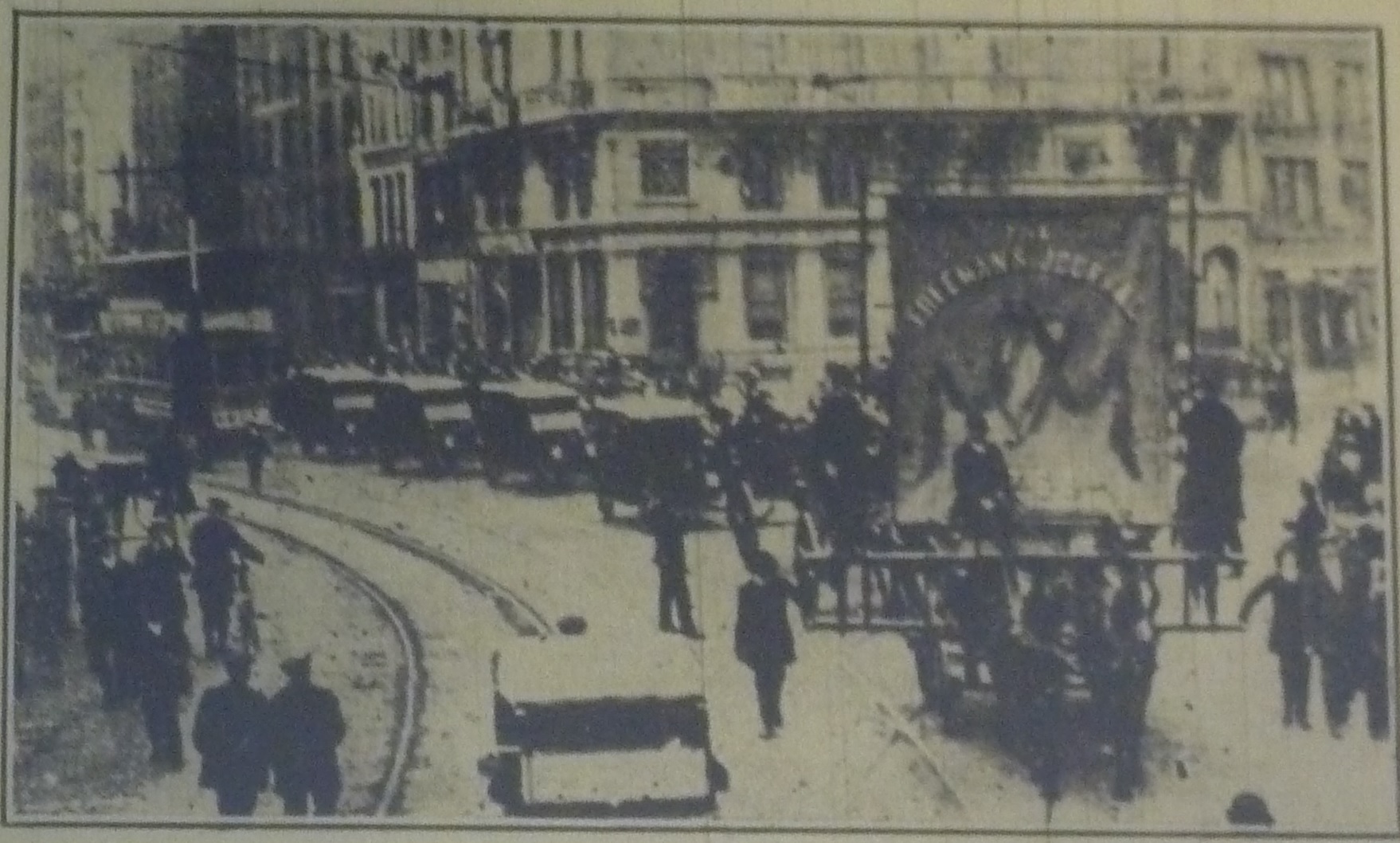
The Catholic nationalist press supported the Vigilance movement. This photo was captioned “The Freeman’s Journal and ‘Evening Telegraph’ Section of the Procession, including motor vans.” Evening Telegraph 6 Sep. 1915: 6.

The Catholic nationalist press supported the Vigilance movement. This photo of the Vigilance demonstration in Dublin on 5 September was captioned: “The Freeman’s Journal and ‘Evening Telegraph’ Section of the Procession, including motor vans.” Evening Telegraph 6 Sep. 1915: 6.

Larkin was not acting alone in his policing of the morals of popular entertainment but was part of a mass movement. On 5 September, he had addressed an overflow meeting of people who congregated outside Dublin’s Mansion House for the now-annual demonstration of Ireland’s Vigilance Committees. Larkin had not been invited to speak at the main meeting in the Mansion House, but his audience numbered about 20,000, who heard him relate his experiences of protesting with impunity in Dublin’s theatres and picture houses (“Fighting a Plague”). Perhaps inspired by Larkin’s words, two days later, on 7 September, a group of men associated with the Catholic Arch-Confraternity of the Holy Family chased the artistes performing the variety revue Everything in the Gardens from the stage of Limerick’s Rink Palace (“Limerick to the Rescue”). The Rink Palace was part of the circuit operated by Ireland’s best known film exhibitor, James T. Jameson, who ran occasional weeks of pure variety revue but mostly offered programmes of pictures accompanied by one variety act. With over ten-years’ experience of Irish show business, Jameson should have known his audience well enough to avoid such a confrontation, but it appears that he fell afoul of a vigilance revival (“Vigilance Revived”).

“Limerick to the Rescue.” Leader 25 Sep. 1915: 153. The verse below the image explains that it “[r]epresents the raided revue with the performer flying, the audience clearing out, and the rotten Press man tearing up his puff. Wee Lorcan [Sherlock, theatre owner and Dublin’s former mayor] is seen gazing in consternation form a box.”

The pro-vigilance press was delighted with this action, perhaps none more so than D.P. Moran’s Leader. In July, Moran had published a Tom Lalor cartoon with accompanying verse by A.M.W. (John Swift) that characterized the Dublin popular audience as degenerate. Now just over two months later, the Leader published the reverse angle of this image, portraying and praising not a typical degenerate audience but the actual members of the audience of Limerick’s Rink Palace, who vowed – among other things – that “No Cockney dirt shall e’er disgrace / The fame of this historic place” (“Limerick to the Rescue”). While these popular actions continued, some of the members of the Vigilance Committees who had been inside the Mansion House were meeting with members of Dublin Corporation (“The Corporation”). Newspaper reports put particular emphasis on the discussion of objectionable film posters and of suggestive music-hall revues. Alderman J.J. Farrell, who as proprietor of the Phibsboro Picture House had experienced protests by Larkin, was adamant that none of the picture houses he controlled showed objectionable material and challenged the delegation to name the offending premises. However, Lord Mayor James Gallagher assured the delegation that “any machinery in the hands of the Corporation would be set in motion at once” (ibid. and Rockett 44-51).

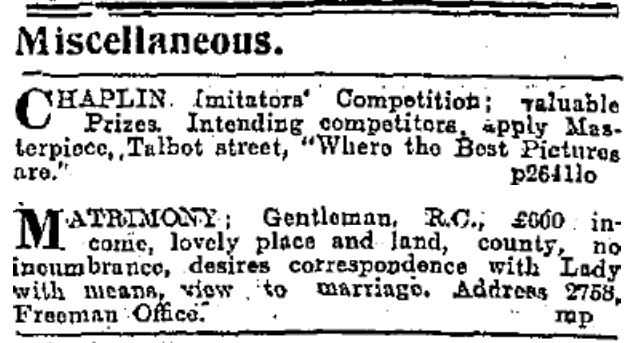
Freeman's Journal 16 Sep. 1915: 8.

Classified ad for Chaplin imitators, Freeman’s Journal 16 Sep. 1915: 8.

That the Vigilance Committees did not fully understand cinema is seen in their lack of attention to Charlie Chaplin. The pattern of Larkin’s protests, the Leader’s articles and the terms on which they approached the Corporation indicate that they saw cinema as a kind of theatre. For them, it was a recorded version of the scandalous plays that Larkin also disrupted or the suggestive revues that the Arch-Confraternity men scattered. Although cinema certainly included these kinds of entertainments, Chaplin worked the other way around. His tramp character had been created on film and was assumed into a diverse range of cultural contexts. All picture houses showed his films as soon as they got them, but some created special Chaplin-themed events. The Electric Theatre in Dublin’s Talbot Street did not often advertise, but it did so during the period of 27 September-2 October, which it dubbed Chaplin Week. The management was confident that this would repay the cost of publicity because they had run a very successful Chaplin Week at the end of August. During the same week, ads for Dublin’s Coliseum Theatre promoted the live revue Charlie Chaplin Mad, featuring “A Stage Full of Charlie Chaplins” and “The Only Charlie Chaplin Girl Extant.” The last claims seems unlikely if a Bioscope item on a women’s fashion trend was to be taken seriously. “Mr. Charles Chaplin, whose ears at present must be in a chronic state of tingling,” the item began, “[h]as further added to his unique reputation by inspiring a well-known firm of ladies’ costumiers to the designing of a Charlie Chaplin costume” (“Trade Topics”).

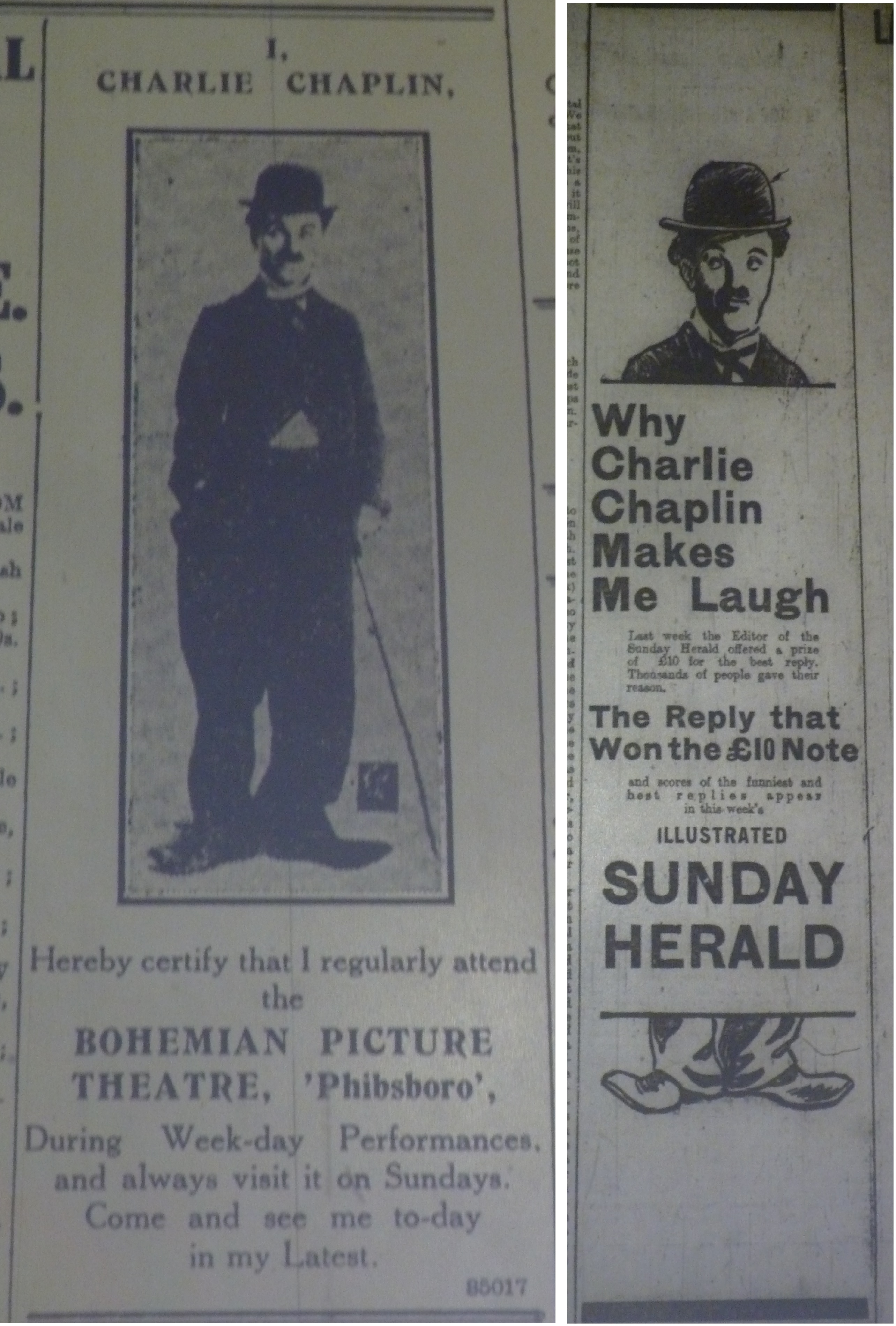
Ads featurng Chaplin, autumn 1915. Left, Evening Telegraph 12 Aug. 1915: 2; right, Dublin Evening Mail 11 Sep. 1915: 5.

Ads featuring Chaplin, autumn 1915. Left, Evening Telegraph 12 Aug. 1915: 2; right, Dublin Evening Mail 11 Sep. 1915: 5.

Chaplin attracted an audience but also inspired an expressive fandom. The editor of the Sunday Herald claimed to have received thousands of replies when s/he offered readers £10 for the funniest story in response to the title “Why Charlie Chaplin makes me laugh.” The Masterpiece Theatre, also in Dublin’s Talbot Street, held what it called a Chaplin Revue in the week of 13-18 September, but this was a “real Chaplin week” – a jibe at the Electric for the relatively few Chaplin films they had shown in August – offering six Chaplin films for the first three days of the week and seven for the second three days (“Chaplin Revue”). During the week, the management encouraged audience interaction when it invited local Chaplin imitators to compete against one another by being filmed and having the public judge the best impersonation. “A very large entry has been secured,” the Evening Telegraph reported, “and the pick of these when filmed should make a picture of more than ordinary interest” (“Masterpiece”).

In this context at least, Chaplin certainly was monopolizing the limelight.

References

“Chaplin Revue at the Masterpiece.” Evening Telegraph 13 Sep. 1915: 6.

Condon, Denis. “‘Offensive and Riotous Behaviour’? Performing the Role of an Audience in Irish Cinema of the mid-1910s.” Performing New Media, 1890-1915. Eds. Kaveh Askari et al. New Barnet, Herts: John Libbey, 2014. 193-202.

“Fighting a Plague: Vigilance Committee’s Crusade: Annual Procession and Meeting.” Irish Catholic 11 Sep. 1915: 2.

“German Film Campaign: Herr Dernburg – Film Producer.” Bioscope 23 Sep 1915: 1360.

“‘Give Up Your Gold, It’s for Britain!!”” Bioscope 30 Sep. 1915: 1473.

“The Grafton Picture House.” Freeman’s Journal 14 Sep. 1915: 7.

“Limerick to the Rescue.” Leader 25 Sep. 1915: 153.

“The Masterpiece.” Evening Telegraph 21 Sep. 1915: 2.

Paddy. “Pictures in Ireland.” Bioscope 12 Aug. 1915: 679; 9 Sep. 1915: 1176.

Rockett, Kevin. Irish Film Censorship: A Cultural Journey from Silent Cinema to Internet Pornography. Dublin: Four Courts, 2004.

“A Scene in Picture Theatre in Dublin: Young Man Charged with Causing Disturbance: ‘Modern Magdalen’: Production of a Film and the Sequel.” Evening Herald 15 Sep. 1915: 5.

“Scene in a City Cinema: ‘Irish Censor Board Wanted’: Charge of Creating a Disturbance: The Case Dismissed.” Dublin Evening Mail 22 Sep. 1915: 5.

“Town Topics.” Dublin Evening Mail 23 Aug. 1915: 2.

“Trade Topics.” Bioscope 23 Sep. 1915: 1319.

“Vigilance Revived: Rink Palace Stormed.” Limerick Leader 8 September 1915: 3.

“Experiments Against the Public Taste” in Irish Picture Houses, August 1915

Evening Telegraph, 23 Aug. 1915: 1.

Evening Telegraph, 23 Aug. 1915: 1.

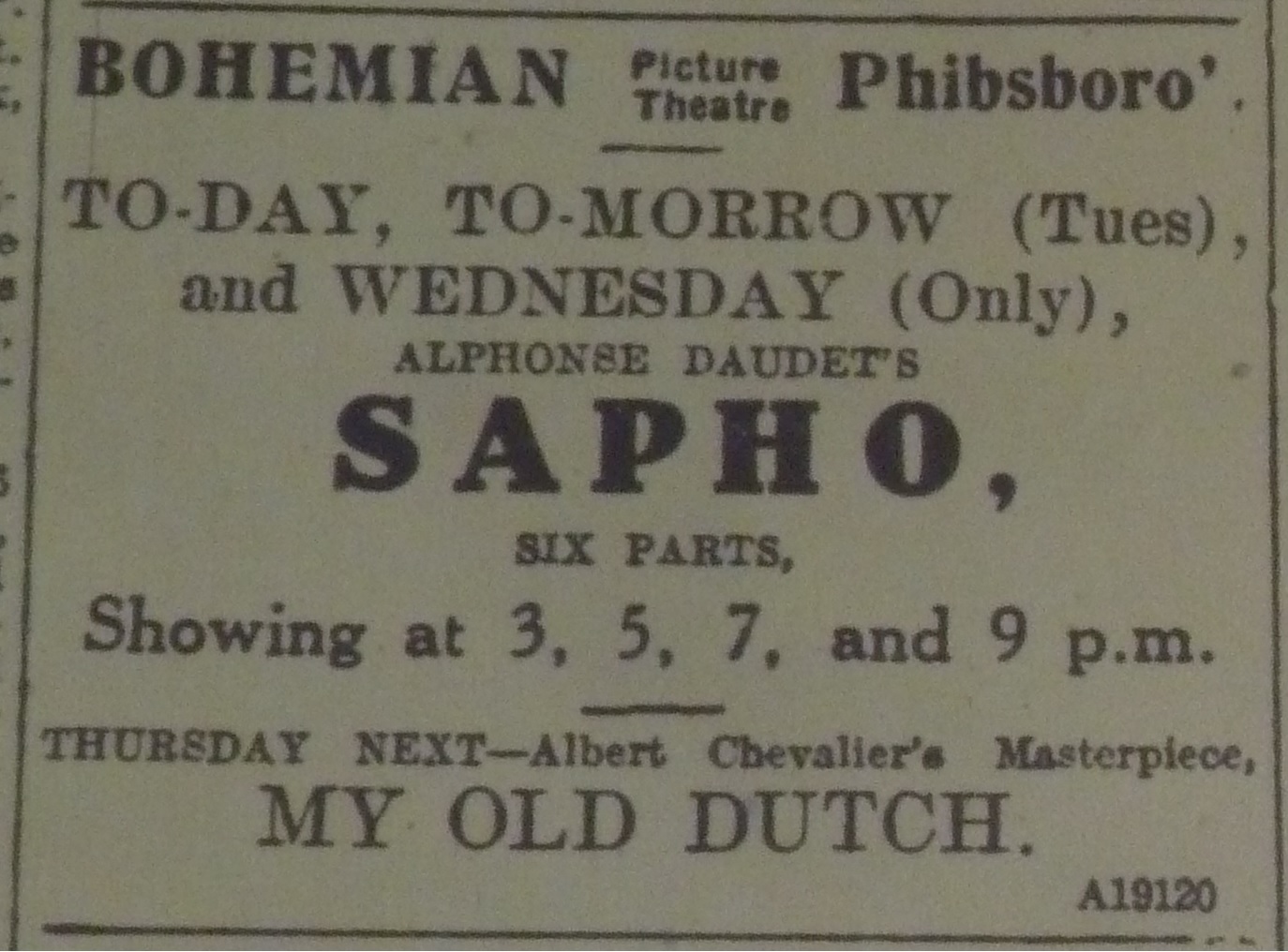
In its reviews of entertainments on Tuesday, 24 August 1915, Dublin’s Freeman’s Journal departed from the usual blandly favourable tone of newspaper notices to criticize the choice of film at the Bohemian Picture Theatre. Although the reviewer praised the “discrimination exercised by the management in the selection of films” since the picture house had opened the previous year, s/he regretted that the “inclusion of ‘Sapho’ this week introduces an unedifying subject” (“Bohemian”). Although the reviewer conceded that the film actually contained “very little to which exception might be taken,” s/he argued that “these experiments against the public taste are very dangerous, as might have been gathered from the attitude of the audience” (ibid).

The reviewer neglected to say, however, what had been the audience actual reaction to Sapho. Others were a little more forthcoming. Attending the Bohemian’s 7pm show on Monday evening, Joseph Holloway thought that the “unpleasant love story of Jean & Sapho was well enacted – a crowded audience witnessed it & many were waiting outside to see the 9 o’clock show as I came out” (Holloway, 23 Aug. 1915). Holloway did not mention any manifestations of dangerous attitudes among this apparently enthusiastic audience, but a report in the trade journal Bioscope some weeks later perhaps accounts for the Freeman’s hints about agitation among the audience. “During the screening of ‘Sapho,’ at the Bohemian Theatre,” Paddy, the Bioscope’s Irish correspondent, claimed that “the Vigilance Committee – or what purported to be the same – held a massed meeting at the corner of the street, and also secured a brass band which did a few triumphal processions past the theatre” (Paddy).

The Bohemian had been and would continue to be a target of Dublin Vigilance Committee (DVC) activity, but the use of a brass band was not repeated there. This may be because this tactic failed to attract the same level of publicity as the disturbance in the auditorium, arrest and court appearance favoured by such DVC activists as William and Francis Larkin.

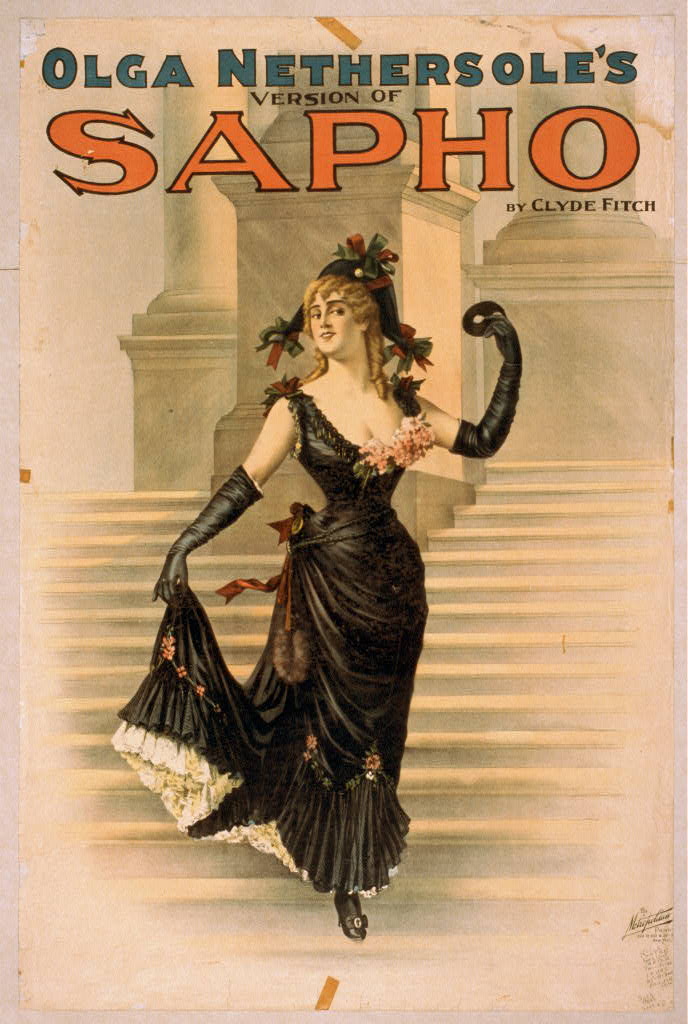
A poster for Olga Nethersole’s theatrical version of Sapho, written by Clyde Fitch. Courtesy of the Library of Congress.

In any case, few audience members – and certainly not the journalists, Holloway or members of the Vigilance Committee – can have been unaware that Sapho was about a woman’s extramarital affairs. Alphonse Daudet had adapted his own popular 1884 novel for the stage, and it had been lent further notoriety when in 1900, Olga Nethersole produced and starred in a US stage version written by Clyde Fitch that told the story from Sapho’s point of view. Both the French and US versions had played in Dublin in the 1900s. So well known was the novel and play that when Nethersole returned to the Gaiety in 1906, the Irish Times commented that it

is unnecessary at this period of time to discuss the morals of the play, or argue the question whether its enactment is calculated to promote a wholesome spirit or not. The subject is one on which people have made up their minds one way or another, and judging by the constitution of last night’s audience the vast bulk, if not the entire of those present, understood perfectly the class of production which they had gone to witness.” (“Gaiety Theatre.”)

Any experiments against the public taste had long yielded their results, it seems, at least as far as the audience at the Gaiety was concerned. However, cinema had altered Ireland’s mediascape by bringing entertainment out of the city centres to the suburbs, small towns and rural areas, and because it was cheaper than theatre, it was more accessible to the working class. With these shifts in entertainment, the definition of “public taste” and “audience” was up for grabs.

In any case, not all journalists were as accepting of the taste experiments represented by plays such as Sapho as the jaded Irish Times reporter appears to have been. In July 1915, D.P. Moran, editor of the Leader, reminded readers of his 15-year-long “campaign against music hall and theatrical filth” (“‘Dirty Dublin’ Again”). He claimed this campaign was necessary because of the complicity of the newspapers with theatre owners:

The names of such plays as “Zaza” “Sapho,” and “Kitty Grey” will recall that campaign to the recollection of our older readers. But the daily Press was then as it is now rotten. We took a big start out of the dailies of that time, and they were cautious of their puffs of imported dirt, but they stuck like wax to the advertisements of the entertainments and plays however dirty. (Ibid.)

Sapho had been one of the key works in Moran’s long-running crusade against the laxity of the mainstream press. And he was right to indicate that theatre and picture-house owners paid to advertise and expected that reviews would at least pay sympathetic attention to their entertainments, if not outright reproduce promotional materials masquerading as criticism. This also makes reviews of limited use for historical purposes. In contrast to this commercial motivation, Moran was – as a self-styled Irish-Irelander interested in Gaelic culture rather than Nationalist politics – hostile to popular entertainments for their Anglicizing influence, which included promoting forms of sexual expression at odds with Irish Catholicism.

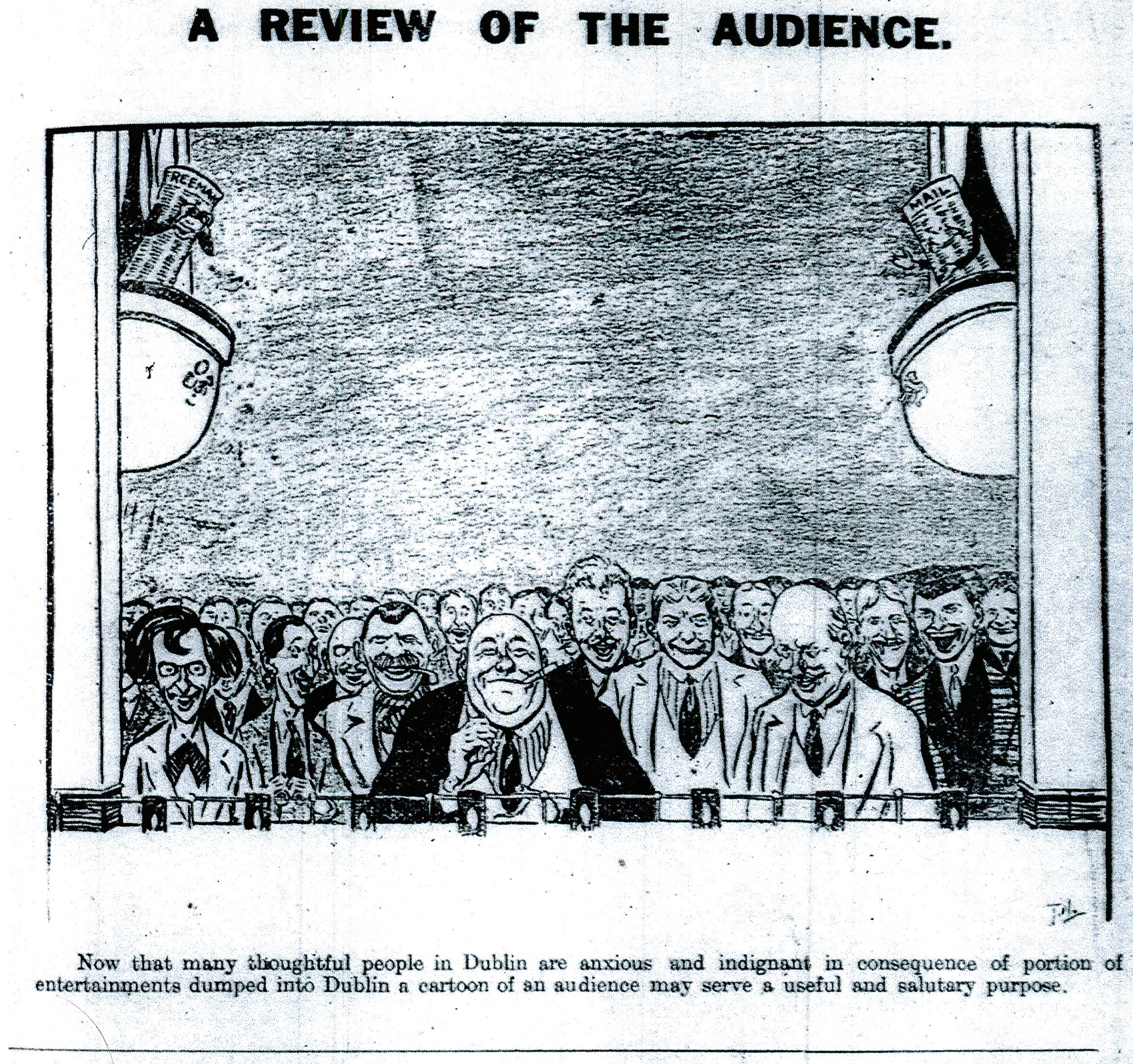
“A Review of the Audience.” Leader 17 Jul. 1915: 541.

Moran’s campaign was not limited to the content of theatrical shows or press complicity but also aimed to refashion the Irish audience. This aspect of his crusade took visual form in July 1915, when he published Tom Lalor’s cartoon entitled “A Review of the Audience.” The accompanying verses by A.M.W. (John Swift) directed readers to contemplate the “dirty degenerates ever so keen / To welcome the smut of a music hall scene.” Among these were the “Johnnie, or nut,” “the College effeminate brat, / Ne’er keen on a lesson that’s wholesome or nice, / But apt in the study of music hall vice,” as well as “the old reprobate well to the fore / In years far advanced but in vices much more.” The press was also excoriated:“Our Press lends its aid to the stuff it should drown, / The ‘Freeman’ and ‘Mail’ that should give it hard knocks / Encourage the same from a seat in a box.”

Although the picture houses were not yet on Moran’s agenda in July 1915, they soon would be when he supported the DVC coming campaign for film censorship, and the appearance of a well-publicized film adaptation of Sapho would no doubt have put him on the alert. The version of the film shown at the Bohemian in August 1915 was one of two film versions released into the British film market in 1913. When the French company Éclair released its version, starring Nethersole, in Britain in March 1913, it became a cause celebre within the industry. The film was banned in Leeds and other places, and when an exhibitor was prosecuted for showing it in Darlington, the Cinema Exhibitors’ Association took up his defence (“The ‘Sapho’Case”).

But it was the US version, released in Britain in November 1913, that would eventually make its way to Ireland. It was made by the Majestic Motion Picture Company and starred Florence Roberts. Whatever its other faults, the adaption to the screen met with approval: “Daudet’s work loses nothing in its production on the cinema, and the large audiences followed the picture through its six parts with interest” (“The Bohemian Picture House”). However, if Irish exhibitors hoped to avoid controversy by waiting nearly two years before booking the film, they miscalculated not so much the public taste as the growing power of the Catholic guardians of morality.

References

“The Bohemian.” Freeman’s Journal 24 Aug. 1915: 2.

“The Bohemian Picture House.” Dublin Evening Mail 24 Aug. 1915: 6.

“‘Dirty Dublin’ Again.” Leader 10 July 1915: 519-20.

“Gaiety Theatre.” Irish Times 20 Sep. 1906: 6.

Holloway, Joseph. Holloway Diaries. National Library of Ireland.

Paddy. “Pictures in Ireland.” Bioscope 9 Sep. 1915: 1176.

“The ‘Sapho’Case.” Bioscope 31 Jul. 1913: 349.

Processions, Protest and the Perfect Woman in Irish Picture Houses, Late Summer 1915

Summer was usually a bad time for indoor entertainments such as cinema. But the Irish weather during July 1915 – like that of July 2015 – did not favour outdoor activities. “It has been a sad time for July holiday-makers,” observed the Irish Times in early August, “and as yet there is no hint of a better hope for August, except that which may be taken from the thought that what has persisted so long must soon change” (“Wet Weather”). While some temporary picture houses opened at seaside resorts, some established venues followed the practice of the theatres and closed for several weeks in July and/or August. Although Dublin’s Rotunda usually stayed open throughout the summer, it took advantage of this practice in 1915 by closing on 7 June for extensive renovations and reopening on 26 July.

Swimmer Annette Kellerman was considered the “|Perfect Woman” because here measurements corresponded to the classical dimension of the Venus de Milo. Australian poster from the collections of the National Library of Australia, available here.

Australian swimmer Annette Kellerman’s bodily measurements promoted on a poster for the film Neptune’s Daughter. Collection of the National Library of Australia, available here.

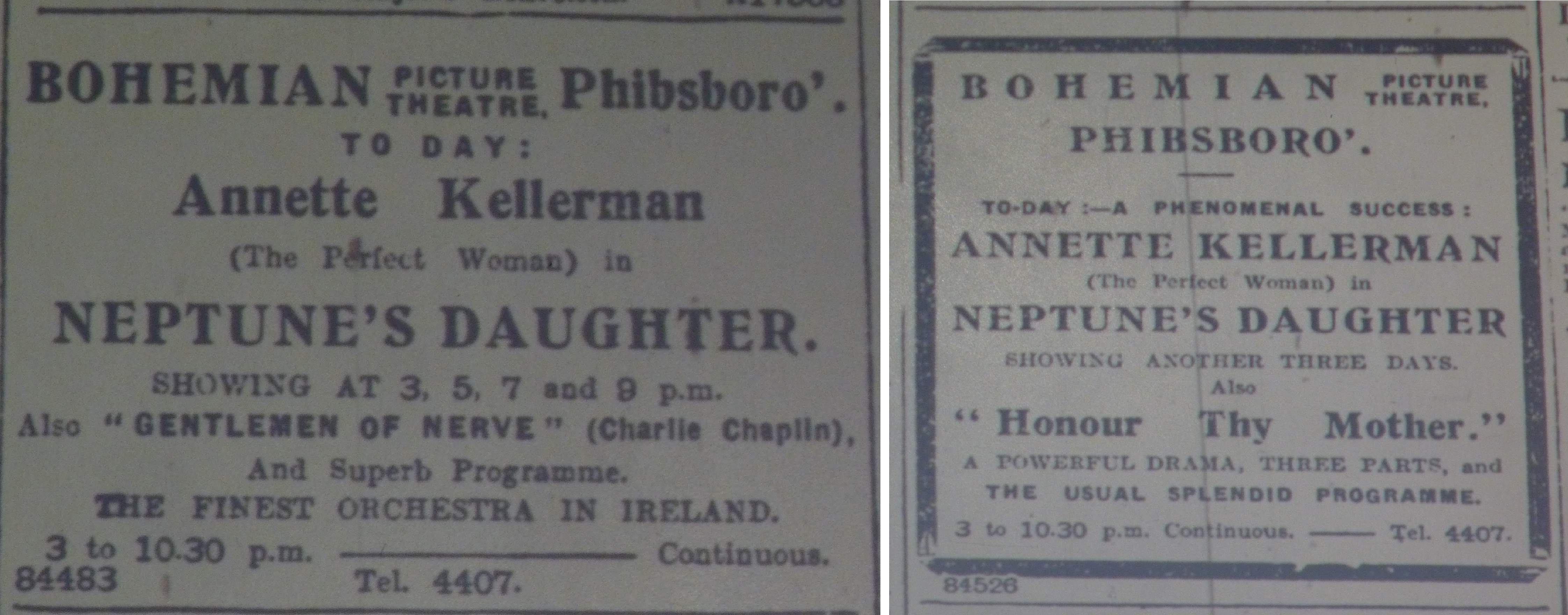
The weather didn’t stop Dublin architect Joseph Holloway from travelling across town on the evening of Friday, 9 July, from his home in Northumberland Road south of the city to the Bohemian Picture Theatre in the northern suburb of Phibsborough. He was clearly quite taken with the “great film drama of a legendary story in five parts, called Neptune’s Daughter featuring Annette Kellerman (the Perfect Woman)” because he described it in more detail than any other film he had seen that year (Holloway, 9 Jul. 1915). The film was one of the several mermaid fantasies the Australian swimmer made during her film career in the 1910s and early 1920s. Dublin audiences had seen Kellerman three years previously in a similar live stage show, when she had appeared at the Theatre Royal with a company of 40 artistes in Undine, a 14th-century set “idyll of forest and stream” (“Theatre Royal”). Although a skilled athlete, Kellerman’s celebrity was partly based on her controversial promotion of a form-fitting one-piece swimsuit for women. This attire allowed women swimmers the ease of movement needed for athletic achievement, which was not permitted by form-hiding two-piece Victorian bathing costumes. Her championing of women’s athletics fitted well with such contemporary campaigns for women’s equality as the suffrage movement, and at a special matinee during her week in Dublin in 1912, Kellerman gave a lecture on women’s physical culture. At the same time, the publicity for her theatrical appearances fully exploited the spectacle of her body, which was declared perfect because it corresponded so exactly to the measurements of the Venus de Milo.

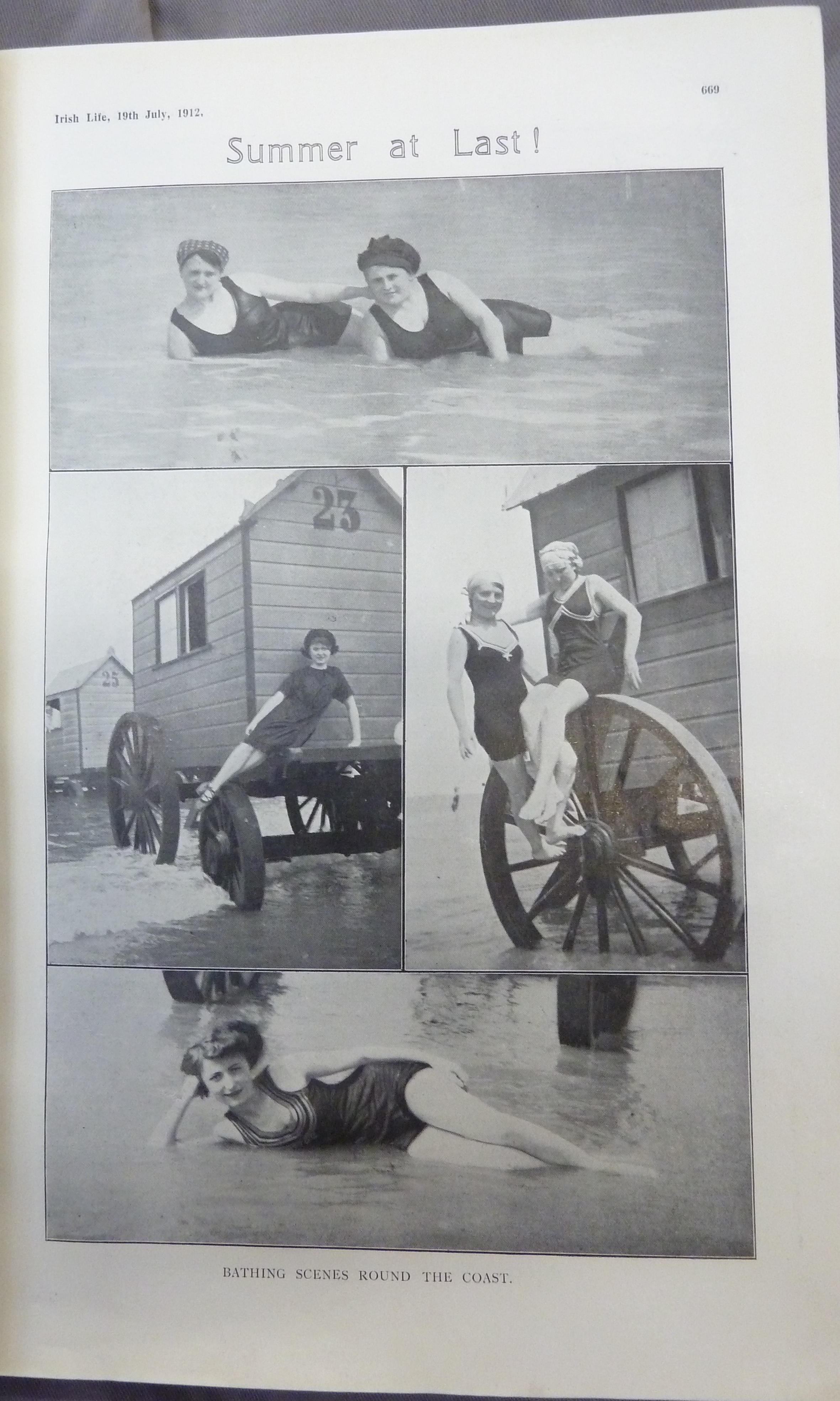
“Summer at Last!” Irish LIfe 19 Jul. 1912: 669.

“Summer at Last!” Irish LIfe 19 Jul. 1912: 669. Courtesy of National Library of Ireland.

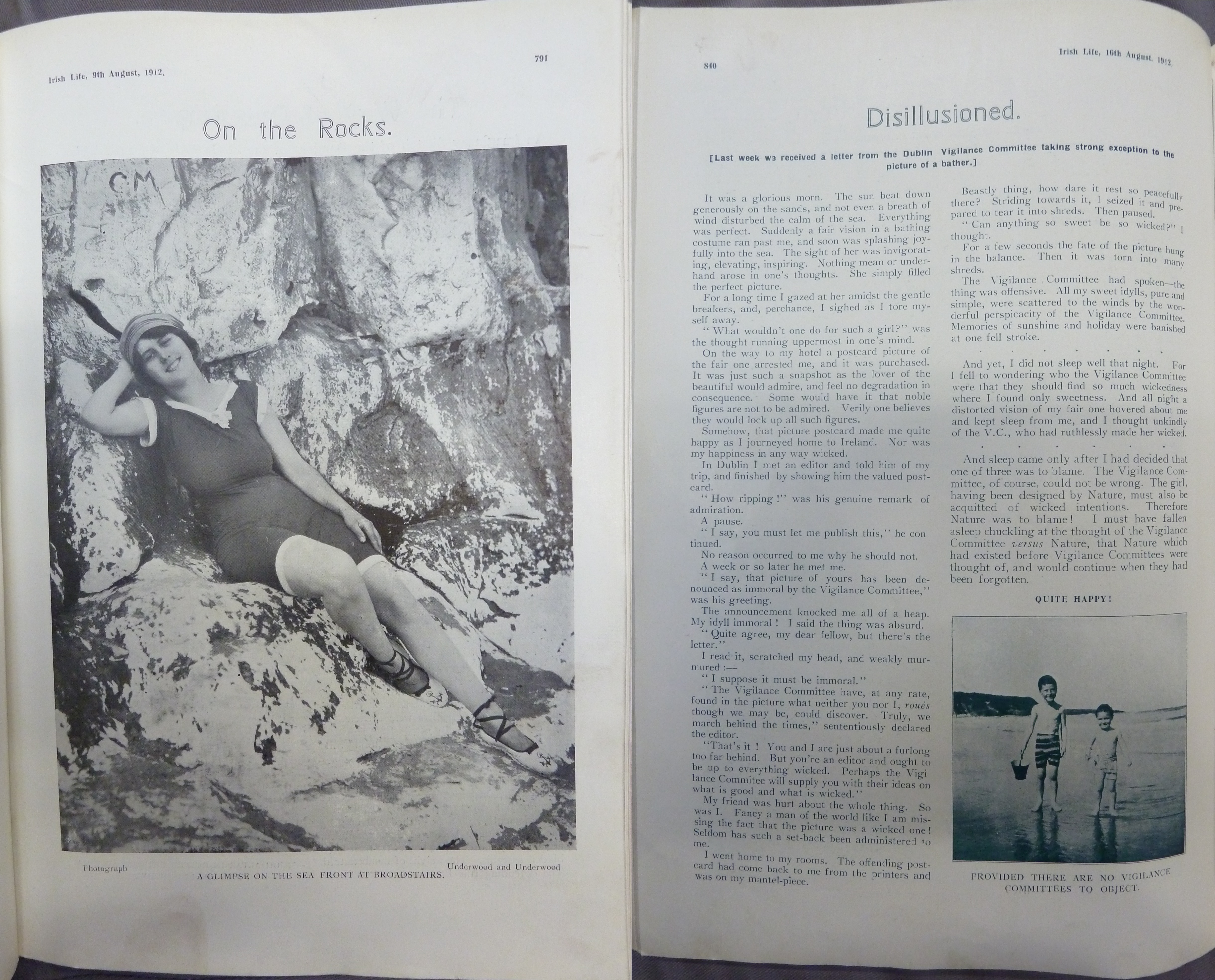
Photographs published by the glossy illustrated weekly Irish Life in July and August 1912 – just after Kellerman’s visit – throw some light on the degree of controversy her appearance is likely to have caused in the early 1910s. Irish Life published many photographs of Ireland’s leisure class at golf, tennis, horse riding, motoring and other activities. Under the title “Summer at Last!” the issue of 19 July 1912 published photos of six women bathers, and the one-piece swimsuit is much in evidence: only one of the women has a swimsuit that covers her upper legs, arms and shoulders. Although four of the women are on or beside bathing machines that suggest the persistence of Victorian seaside practices, they appear unconcerned by the gaze of the camera or are even welcoming of it. The photo story suggests a fairly permissive view of the display of the female body in such public spaces as beaches and of the reproduction of such photographs in a widely circulating magazine of the “respectable” classes.

“On the Rocks” and “Disillusioned,” Irish Life 9 Aug. 1912: 791 and 16 Aug. 1912: 840.

“On the Rocks” and “Disillusioned,” Irish Life 9 Aug. 1912: 791 and 16 Aug. 1912: 840. Courtesy of National Library of Ireland.

However, this sense of the freedom of bodily display is somewhat challenged by the letter of complaint that the editor received the following month in response to Irish Life’s publication on 9 August 1912 of a postcard with a bather – in this case, probably a model – no more undressed or welcoming of the camera’s gaze than the previous women. The complaint was not a trivial one: it came from the Catholic Church based Dublin Vigilance Committee (DVC). Founded in early November 1911, the DVC had grown rapidly and held the first of what was to become an annual show of strength in the form of a procession through the streets of Dublin and a mass meeting at the Mansion House in July 1912. This was an astonishingly successful event, drawing letters of support not only from the Irish Catholic hierarchy but also the pope. The fact that it took place at the Mansion House meant that the movement already had the imprimatur of Dublin’s Lord Mayor, who attended, but the meeting was also addressed by Ireland’s highest government official, the Lord Lieutenant, Lord Aberdeen, who had also been the president of the National Vigilance Association of England for the previous 15 years. This was a movement with serious political clout. Nevertheless, when Irish Life responded to the complaint on 16 August, it was with an article that was more resentful than contrite and that was illustrated by children playing on a beach who were “Quite Happy! / Provided There Are no Vigilance Committees to Object.”

Three years later, at the Bohemian on the evening of 9 July 1915, Holloway was also quite happy with Neptune’s Daughter (US: Universal, 1914). However, the filmmakers – including Dublin-born director Herbert Brenon – pushed the degree of bodily display in Kellerman’s performance to full nudity, causing Holloway some qualms. “The story was splendidly enacted,” he thought, “but Annette Kellerman’s lack of costume was very daring at times.” Nevertheless, Holloway

thought it a very beautiful film, with nothing suggestive in it, – perhaps the incident of the diving from the rocks, again and again, clad only in nature, might have been omitted, with no hurt to the story, but, then Annette Kellerman wanted to show what an expert diver she is, & gave the display.

For a full week in early July 1915, Dublin’ s Bohemian Picture Theatre showed Neptune’s Daughter with Australian swimming star Annette Kellerman; Evening Telegraph 5 Jul. 1915: 1 and 8 Jul. 1915: 1.

Dublin’ s Bohemian Picture Theatre retained Neptune’s Daughter for a full week in early July 1915; Evening Telegraph 5 Jul. 1915: 1 and 8 Jul. 1915: 1.

Holloway’s defensiveness here is understandable because the DVC had not gone away in the interim and was in 1915 shifting its focus from what it termed “evil literature” to “the filthy picture screen” (“Fighting a Plague”). Neptune’s Daughter had been due to finish its three-day run at the Bohemian on Wednesday, 7 July – two nights before Holloway saw it – but because of its popularity, Bohemian manager Frederick Sparling extended its run into the second half of the week. On the Thursday night, the packed Bohemian was visited by William and Francis Larkin, the members of the DVC most likely to make a protest. The newspapers reported that at 9 o’clock, the Larkins “began to hiss, and they persisted in this form of protest for forty minutes, to the end of the film” (“‘Neptune’s Daughter’”). “It was evident that the audience found nothing of a suggestive or offensive nature in the production,” opined the Freeman’s Journal, “and they showed their approval by applauding warmly (“Annette Kellerman at the Bohemian”). The Larkins and the DVC had by no means finished with cinema, and Neptune’s Daughter encountered some further difficulties. The film was condemned from the altar by a local priest when it opened on 22 July for a three-day run at Sparling’s other picture house, the Sandford in the south-city suburb of Ranelagh. “I have reason to believe,” the Bioscope’s Paddy contended, “that the Reverend Father in question had not seen the film but was going on the strength of the publicity matter – which, it will be admitted is rather striking” (Paddy).

Evening Telegraph 31 Jul. 1915: 3.

Evening Telegraph 31 Jul. 1915: 3.

Part of the reason the Bohemian was the site of these events was that it had become one of the most popular picture houses in Dublin. It was a venue that could induce Holloway and presumably others to travel across the city, albeit that Holloway travelled to see Annette Kellerman in Neptune’s Daughter. Regular newspaper ads helped to build and maintain this popularity. At the end of July on a page headed “City Theatres and Picture Palaces to Visit During the Holidays,” the Bohemian published an unusually large ad with a photograph illustrating its claim to be “the best appointed and most luxurious picture theatre in Dublin.” If this ad was addressing potential audience members with reasons to choose the Bohemian from among the other picture houses, those reasons had to do with the luxury experience to be had there. Taken from the back of the balcony, the photo emphasized the decorative plasterwork, light fittings, comfortable seating and large screen. The ad’s largest text apart from the Bohemian’s name referred not to the film offerings but to the “Finest Orchestra in Ireland,” made up of 16 performers. You went to the Bohemian for its beautiful physical and aural environment.

August bank holiday offerings by Dublin's picture houses; Evening Telegraph 31 Jul. 1915: 3.

August bank holiday offerings by Dublin’s picture houses; Evening Telegraph 31 Jul. 1915: 3.

Whereas the Bohemian’s ad pushed film titles to a peripheral position, the ads for the Bohemian’s five rival Dublin picture houses prominently displayed film titles they had chosen for the August holiday weekend. Charlie Chaplin featured in four of the six picture house ads, with the Electric Theatre in Talbot Street emphasizing that it had the “Real Charlie Chaplin in Some Comedy (Not an Imitation).” This may have been a general reference to Chaplin’s multitude of screen and stage imitators or a more specific one to the music hall comedian Jack Edge, who was shown in the Coliseum Theatre’s advertisement on the same page dressed as Chaplin.

The most prominent title advertised by the newly renovated Rotunda was a film of the funeral of the Fenian Jeremiah O’Donovan Rossa, an outdoor activity largely undisrupted by the weather. Organized by the Fenians’ revolutionary successors, the Irish Republican Brotherhood (IRB), the funeral was a massive demonstration of the ability of the IRB to mobilize the more militant factions of Irish nationalism. The IRB arranged for O’Donovan Rossa’s body to be repatriated from New York to Dublin, where it lay in state for three days at City Hall and was subsequently accompanied on Sunday, 1 August, by a procession of about 5,000 mourners – watched by at least ten times that number – to Glasnevin Cemetery, where Patrick Pearse delivered his renowned graveside oration. Pearse was not audible in the film by Whitten’s GFS, which recorded highlights of this three-day commemoration, but the volley of shots over the grave by armed Volunteers and the extent of public support were no doubt eloquent enough for the many people who watched the film in picture houses around the country in the coming days and months. Those eager to see the film first did not have to wait for the screenings at the Rotunda, which did not have a licence to open on Sundays, but could attend the Bohemian, where it was on view a few hours after the end of the funeral and at a picture house on the route of the funeral procession. There they could shelter from the vagaries of the Irish summer in some comfort.

References

“Annette Kellerman at the Bohemian.” Freeman’s Journal 10 Jul. 1915: 7.

“Fighting a Plague: Vigilance Committee’s Crusade.” Irish Catholic 11 Sep. 1915: 1

Holloway, Joseph. Holloway Diaries. National Library of Ireland.

“‘Neptune’s Daughter’: Protest in Dublin Picture House.” Irish Times 9 Jul. 1915: 6.

“Theatre Royal.” Sunday Independent 30 Jun. 1912: 6.

“Wet Weather.” Irish Times 4 Aug. 1915: 4.

Urchins, Ragamuffins and Film Communism in Irish Cinemas, Summer 1915

Poster for Gaby Deslys in Her Triumph (US: Famous Players, 1915)

Poster for Gaby Deslys in Her Triumph (US: Famous Players, 1915). Source: http://allstarpics.famousfix.com/0595982/013521322/gaby-deslys-pic.html

In June 1915, the trade journal Bioscope celebrated the levelling that the cinema had performed on the geography of culture. “There is no provincialism about the picture theatre entertainment,” it asserted, claiming that films had removed the benefits formerly experienced by inhabitants of the metropolitan centres of culture.

The inhabitants of any townlet, however small, provided it possesses a cinema, may follow the latest developments of the new drama with every bit as much intelligence and intimacy as the metropolitan picture-lover. Thanks to the cinematograph, the American stage, with all its fine originality and vitality, is as accessible to the Londoner, as is the London stage to the American. (“The Communism of the Film.”)

Although the writer returns after just a brief sojourn in the de-provincialized townlets to London and the cities of America, it is undoubtedly true that local picture houses could offer the inhabitants of small towns and even villages unprecedented access to globalized popular culture. S/he concludes that cinema “has internationalised art and has completed the wonderful work of intellectual communism which was commenced by the printing press” (ibid.).

A century on, the word “communism” looks odd in this context. The nearest Irish cinema came to communism in the early to mid-1910s was during the Dublin Lockout of 1913-14, discussed here and here. Clearly “intellectual” significantly qualified the expected socio-economic meaning of communism, and the comment is really only made in passing, the writer being interested in communism merely to the degree that it allowed the wide availability of the performance of the scandalous French dancer and international celebrity Gaby Deslys in her film debut Her Triumph (US: Famous Players, 1915).

The Bioscope was not, of course, suggesting that the workers of the film trade would or should seize control of the means of cinematic production. But the idea that the cinema did democratize access to culture was current in Ireland and is worth exploring. Timothy Cronin, a young Tralee, Co. Kerry, publican and nationalist politician had strongly supported the coming of the cinema – “[f]rom the purely educational standpoint, it is possibly the most remarkable invention since Caxton brought the printing press into being” – to his home town in 1913 (“The Pictures”). “We sorely need nourishment for the intellect in our remote country town,” he had argued, and although it was on the Great Southern & Western rail line, Tralee was almost as geographically remote as it was possible to be in Ireland from Dublin and Belfast, or the greater metropolis of London. “In the pictures at the Theatre Royal, inspired as they are by the soft strains of Miss Queenie D’Arcy’s Orchestra, we have a present such nourishment. And more of it will do us no harm” (“The Animated Pictures”).

The revival by Dublin's Masterpiece of Quo Vadis? in June 1915 shows the film's continuing importance. Evening Telegraph 19 Jun. 1915: 1.

The revival by Dublin’s Masterpiece of Quo Vadis? in June 1915 shows the film’s continuing importance. Evening Telegraph 19 Jun. 1915: 1.

And although Cronin also wrote that “[i]t would be invidious to make a comparison between one or other of the films shown,” he later marvelled at the effect of the Quo Vadis? (Italy: Cines, 1912), on whose opening night he “witnessed the remarkable spectacle of a vast audience, representative of every section of the people, keenly appreciating what one might well have thought not one but the most highly cultured would be able to appreciate” (“The Pictures”). “After the performance,” he reveals, “I heard what I never expected to hear in my native town – groups of urchins excitedly discussing a classic drama! In my opinion, the Pictures are directly responsible for this remarkable raising of the popular standard” (ibid.).

Cinema nourished the intellect, but the orientation towards classical Western culture – albeit that Quo Vadis? was based on an 1895 novel by Polish author Henryk Sienkiewicz – and the celebrity culture of the 1910s does not seem especially revolutionary. The real source of cinema’s emancipatory potential may have come from its creation of new social spaces in which different social classes could mix in ways different from other entertainment venues. But the stratification of picture houses – depending on one’s ability to buy a ticket, the cost of one’s ticket and the location of the building – was well advanced in June 1915, when the Bioscope’s Irish correspondent Paddy was quite dismissive of a cheap working-class picture house. Located in Newry, Cos. Down and Armagh, and run by Mrs. M. Green, this cinema was a “‘picture palace’ – with an emphasis on the ‘palace’ – in a slum. Admission could be had by presenting an empty bottle or some rags. To see the show patrons also gave jampots” (Paddy, 24 Jun.).

Ad for the Frontier Palace, Newry; Frontier Sentinel 19 Jun. 1915: 4.

Ad for the Frontier Palace, Newry; Frontier Sentinel 19 Jun. 1915: 4.

Showing little comradely feeling for Newry’s slum dwellers, Paddy found this to be “a rather amusing case,” finishing his item with the local Sergeant Little’s evidence of how he had once found the premises “full of ragamuffins” (ibid.). Paddy and the Bioscope had never mentioned this picture house in their previous reports on Newry, where they had focused on the Picture Palace, the Frontier, the Imperial and the occasion screenings at the Orange Hall. Mrs Green’s picture palace did not meet the image of a respectable and well-regulated business that a trade journal such as the Bioscope sought to present. It may, indeed, be wrong to read too much in to such an item, whose source is unclear; it does not seem to have been appeared in the local or national press. It may also be a mistake to place too much importance on such a venue, in which a form of barter may have been a way of extracting the little value slum children could afford by a local property owner. The 1911 Census lists two likely Mrs M. Greens in Newry: 70-year-old Mary Ann Green, who lists her occupation as “House Property,” and her 32-year-old daughter Margaret Green, a nurse.

Few of the surviving historical sources allow us to linger long on the audiences of a century ago. Nevertheless, it is tempting to speculate on the educative value the urchins of Tralee or the ragamuffins of Newry would have derived not from literary adaptations but from the anarchic antics of Chaplin’s tramp in his little triumphs over bosses, property owners and police sergeants.

The vulnerability of the cinema trade as a whole to stories like this was revealed at the end of June 1915 when an appellant at the Dublin City Sessions claimed that the opening of a picture house nearby was grounds for a lower valuation on his/her premises (“Recorder of Dublin and Picture Houses”). Well known for his opposition to Sunday shows at certain Dublin picture houses, the Recorder (chief magistrate) expressed his displeasure at the unconditional granting of additional cinema licences by the Corporation in the city and the council in the adjacent township of Rathmines. It was, he said, “a most discreditable state of affairs” (ibid.). At the same time, in an indicative incidence of targeted selling an anonymous vendor was offering cinema companies the opportunity to acquire at a moderate price on a long lease with low rent a building in an unnamed southern town said to be suitable for use as a picture house (“To Picture Palace Companies”).

Handbill for Dorset Picture Hall, 4-19 Jun. 1915. Courtesy of National Library of Ireland.

This surviving handbill for the Dorset Picture Hall, 21-26 Jun. 1915 offers a wealth of information on how this cinema operated that is not available elsewhere, such as in the corresponding ad that appeared in the Evening Telegraph 21 Jun. 1915: 4. Courtesy of the National Library of Ireland.

Dorset 22 Jun 1915

Discussion of the Irish churches and cinema often revolved – and continues to revolve – around such issues as restrictive Sunday opening or the censorship of certain kinds of films. However, in mid-June 1915, Paddy reported on the Presbyterian General Assembly’s quite different views in their debate in Belfast on “The Utilisation of the Cinema in Church Missions” (Paddy, 17 Jun.). The Presbyterian churches’ screenings of films alongside preaching has already been noted here, but among the interesting extra details that emerged from this debate was the reported attendance of 60,000 people at the previous season’s Saturday night screenings at the Shankill Road Mission, with 6,000 attending every week during the winter months.

Despite film’s apparently successful missionary role, not all of the Assembly’s participants were in favour of picture shows. Although he assured the meeting that he never attended himself, Reverend S. Sims objected to the queues of boys and girls he observed waiting to get in on Saturday nights because they “paid 1d. or 2d. for admission that ought to be spent on clothing or food” (ibid.). Sims’s views were not endorsed by the meeting, which seems to have been more in accord with Dr Montgomery, who contended that it “was absurd for anybody to appear before that house and argue that a meeting opening with hymn and prayer, in which there was a gospel address, must be wrong because a cinematograph exhibition was given” (ibid.).

The approximately £750 a year that Sims alleged came from the pennies of Belfast’s poor young people suggests that even for religious uses of film, capitalism may have been the more applicable economic model than communism.

References

“The Communism of the Film: Gaby Deslys as a Picture Actress.” Bioscope 10 Jun. 1915: 1096.

Cronin, Timothy B. “The Pictures.” Killarney Echo 10 Jan. 1914: 8.

—. “The Animated Pictures.” Kerry Evening Star 13 Mar. 1913: 3.

Paddy. “Pictures in Ireland.” Bioscope 17 Jun. 1915: 1165; 24 Jun. 1915: 1326.

“Recorder of Dublin and Picture Houses.” Irish Times 1 Jul. 1915: 3.

The Lure of the Picture House: Disaster and Comedy in Irish Cinemas, May 1915

By May 1915, cinema had become so compulsive for some Irish people that it landed them in trouble with the law. Dublin newspapers reported on “the lure of the picture house” that had led two children, Annie Hughes and Rose Kavanagh, from Newtown Park Avenue in Stillorgan, to beg door-to-door to get money to go to the cinema (“Lure of the Picture House”). At the Police Court in Kingstown (now Dún Laoghaire), Kavanagh’s father said that his daughter acted without his knowledge and that “it was the attractions of the picture houses that cause them to beg” (ibid.). Hearing from the police that the girls were constantly begging, Justice Michael Macinerney put them on probation for 12 months.

Illustrated ad for Rupert of Henzau (Britain: London, 1915) at Dublin's Picture House, Grafton Street; Evening Telegraph 31 May 1915: 2.

Illustrated ad for Rupert of Henzau (Britain: London, 1915) at Dublin’s Picture House, Grafton Street; Evening Telegraph 31 May 1915: 2.

Whatever about its compulsion to drive people to illegal activity – a point made both by some reform groups and by some wrongdoers seeking to lay the blame for their actions with the new medium – other commentators were making the point that cinema had become a habit for many people. Writing in Irish Life, playwright and novelist Edward McNulty assessed the progress of the cinematograph against the many claims made for it:

[A]ll the things predicted of the cinematograph are undoubtedly realisable, but, unfortunately, most of the brightest anticipations have not been achieved. The cinema was, above all, to be educational. All the drudgery of teaching was to vanish. Schools and colleges were to be transformed into theatres of instruction; the daily paper was to be supplanted by the Cinema News Bureau, and the French irregular verbs were to be assimilated in the guise of light comedy. (Paddy, 20 May).

Nevertheless, “ in spite of its defects and disappointments, we must gladly acknowledge that the marvel of cinema is the vehicle of diurnal delight all over the civilised globe” (ibid).

Although Irish cinema of the period was certainly a vehicle for diurnal delight, May 1915 was striking for the motivations other than delight that lured patrons to the picture houses. If diurnal delight was epitomized by Charlie Chaplin’s comedies, their power of attraction was at least matched by war films. The Cinema News Bureau had not – and would never – replace the newspaper, but the sinking of the RMS Lusitania showed how the media worked together to serve wider ideological war needs. The Cunard Line’s transatlantic steamer was torpedoed by a German submarine off Kinsale, Co. Cork, at about 2pm on 7 May, and initial reports appeared in the evening newspapers (“Lusitania”), with fuller accounts dominating the news on 8 May. The story had several aspects of interest to Irish papers, some of which had particularly local resonance and other of which linked to war-related issues. Rescue efforts were coordinated from the Cork port of Queenstown (now Cobh), where survivors and victims were initially brought and the inquest held. The large loss of civilian lives – almost 1,200 of the nearly 2,000 people on board died – world have made this a particularly important story in any case, and one that justified propagandistic condemnation of German disregard for civilian life and the rules of war. As well as this, the fact that more than 100 Americans were among the victims provided an impetus for discussion of the hoped-for US entry into the war on the British side.

Newspaper reports were joined on Monday, 10 May by the first newsreel images. The big newsreel companies Gaumont and Pathé sent film units to Queenstown. “Immediately the news was received,” revealed the trade journal Biosocpe,

Gaumont’s dispatched four photographers to the south of Ireland – one from London, Liverpool, Dublin and Belfast – and their joint film contributions were promptly sent to London, where they were supplemented by a few views of the arrival at Euston of survivors. The subject is introduced by a general view of the Lusitania, Messrs. Pathé Frères had men at Queenstown, and a staff of three photographers at Lime Street Station, Liverpool, to meet the train conveying survivors. (Filming ‘Lusitania’ Incident.”)

On Monday, Gaumont released a 350-foot “special topical,” while Pathé initially included just a 50-foot (approx. 1 minute) item in their regular Pathé Gazette, with the intention of supplementing this with a further 150-foot item for the weekend. “The enterprise of these two firms is only surpassed by their restraint,” commented the Bioscope, “when it is remembered that about ten cameras were employed, and the output of film ran into four figures” (ibid.).

Entertainment ads showing impact of Lusitania sinking; Evening Telegraph 10 May 1915: 1.

Entertainment ads showing impact of Lusitania sinking; Evening Telegraph 10 May 1915: 1.

Irish audiences also had the opportunity to see these films. Patrons of Dublin’s Rotunda were offered “a series of pictures depicting incidents connected with the arrival of the Lusitania victims and survivors at Queenstown” (“Rotunda Pictures,” 11 May). The depth of emotion expressed by the journalist who visited the Picture House in Sackville/O’Connell Street suggests that s/he saw the longer Gaumont film. “A picture showing scenes and incidents after the sinking of the Lusitania was shown at this House yesterday;” s/he reported.

[I]t was both interesting and pathetic, and one left with feelings of deepest emotion at the havoc and misery caused to countless human beings by the unmediated act of murder on the part of the German submarine, which, with a total disregard for the lives of women and children sent the mighty ship to the bottom. (“O’Connell Street Picture House.”)

The clear anti-German feeling here was congruent with the reporting on the sinking in general and particularly with the verdict of the inquest, which was given in an editorial item on the same page as the review of the Sackville/O’Connell. “This appalling crime was contrary to international law and the convention of all civilized nations,” it began, “and we, therefore, charge the owners of the submarine, the German Emperor, and the Government of Germany, under whose orders they acted, with the crime of wilful and wholesale murder” (“The Kinsale Verdict.”)

What seems incongruous – but may only seem so – is that the writer so affected by the Lusitania film should find immediate relief in the comedies that accompanied it on the same programme. “After viewing those harrowing incidents,” s/he observed, “the excellent comedies came as a most welcome change; they included ‘Love and Dough,’ featuring the well-known screen comedian Ford Sterling” (“O’Connell Street Picture House”). Images of war and physical comedy complemented each other on the picture-house screen, and as will be seen below, Chaplin had become the comedian in highest demand. Although for audiences in the early 21st century such changes of tone may seem strange or even inappropriate, for audiences in the 1910s, used to entertainments that included variety and contrast, this appears to have been perfectly acceptable.

In any case, films of various kinds provided the imaginative means for coming to terms with the tragedy of war, as well as the spectacle of such new technologies as the zeppelin, the torpedo and the submarine. Bearing echoes of the Lusitania sinking, for example, Dublin’s Masterpiece placed a special ad in the Evening Telegraph at the end of May advising the public that it would give its final exhibition of The Italian Navy “in which is shown a torpedo at its deadly work of sinking a passing vessel” (“The Masterpiece,” 29 May). The Lusitania sinking also had consequences for Irish cinema that only became clear much later. Although Walter Macnamara had shot the Irish historical drama Ireland a Nation for his New York-based production company partly in Ireland in 1914, a copy of the film did not reach the country until 1917 because “the first copy dispatched by them was lost with the ill-fated Lusitania; a duplicate copy was substituted, but […] this also failed to successfully run the submarine ‘blockade’” (“Between the Spools”).

The Lusitania films were joined by other propagandistic war films in mid-May. On 13-15 May, a “very important” War Office film of Lord Kitchener’s visit to British army headquarters in France was shown at Dublin’s Picture Houses in Grafton and Sackville/O’Connell Streets (‘“Lord Kitchener in France”’). Over the same period, the Grafton was also showing a film of the Battle of Neuve Chapelle,

“illustrated by Kineto War Map No. 5. By means of this exceedingly clever animated map the Battle of Neuve Chapelle is shown in a manner most thrilling to watch. The representation of the whole battle is wonderful, and everyone who sees it will be more than interested, as it forcibly portrays the difficult struggle of the British to hold this position against the heavy fire of the enemy’s’ batteries. (Ibid.)

Ad for Dublin’s Masterpiece showing The Secret of Adrianople (1913); Evening Telegraph 15 May 1915: 1.

Ad for Dublin’s Masterpiece showing The Secret of Adrianople (Denmark: Kinografen, 1913) and Bohemian ad drawing attention to the big Whit Monday attraction, Tillie’s Punctured Romance (US: Keystone, 1914); Evening Telegraph 15 May 1915: 1.

For the week of 16-22 May, the Masterpiece advertised The Secret of Adrianpole. The preview in the Evening Telegraph described it as “a magnificent four-part war drama, the scene of which is laid in the now famous Dardanelles, and shows the defences of the much-talked-of Turkish forts” (“The Masterpiece,” 11 May). However, the film was not set during World War I, having been released under the title Adrianopels hemmelighed by the Danish company Kinographen in 1913. Interest in the Dardanelles raised by the Gallipoli land campaign that began on 25 April 1915 lent it renewed topicality:

Now, when all eyes are focused on the Dardanelles, and every scrap of information about the present bombardment eagerly devoured, this great picture comes most opportunely, reproducing in interesting fashion the places daily mentioned in the Press, and showing particularly the actual defences of Fort No. 13, one of the fortifications of so much interest at the moment. (Ibid.)

Although these war films clearly attracted audiences, by early summer 1915 Charlie Chaplin was Irish cinema’s most consistent draw. As already mentioned, the Rotunda showed the Lusitania newsreel beginning on Monday, 10 May; however, the “principal attraction for the great majority of the audience who will frequent the Rotunda this week will, undoubtedly, be the Keystone comedy film entitled ‘The Knockout’” (“Rotunda Pictures,” 11 May). The Knockout (US: Keystone, 1914) actually starred Roscoe “Fatty” Arbuckle and Minta Durfee, with Chaplin in a minor role, but the review of the Rotunda shows mentioned only that it featured “the well-known comedian, Charles Chaplin, as referee in a boxing match of a decidedly novel description” (ibid.). This favouring of Chaplin was consistent with a recent comment that no cinema “programme now is complete without the well-known comedian, Charles Chaplin” (“Rotunda Pictures,” 8 May).

Charlie Chaplin, caught between Mabel Normand and Marie Dressler in Tillie's Punctured Romance (US: Keystone, 1914)

Charlie Chaplin, caught between Mabel Normand and Marie Dressler in Tillie’s Punctured Romance (US: Keystone, 1914).

For the week beginning with the Whit Monday holiday, 24 May 1915, the Rotunda again featured a Chaplin film, Charlie’s New Job (US: Keystone, 1914), but the Bohemian upstaged them by securing exclusive rights to Tillie’s Punctured Romance (US: Keystone, 1914). The first feature-length comedy, the six-reel Tillie’s Punctured Romance starred Chaplin alongside stage actress Marie Dressler and Keystone favourite Mabel Normand. Reporting on a press showing of the film on 9 May, a writer in the Evening Telegraph observed that the “farcical element throughout the whole performance has full sway, and the spirit of fun dominates the various scenes. […] The film has been secured by the ‘Bohemian’ at the cost of £100, and the enterprise of the management should meet with a huge measure of public appreciation” (“Bohemian Picture House”). Their enterprise apparently was rewarded because the reviewer of the Whit Monday show commented that “Chaplin is certainly at his best in this production, and all those desirous of seeing him should go early, as the demand for seats last evening was very great” (“The Bohemian”).

Such diurnal delights would continue to lure audiences for many years to come.

References

“Between the Spools.” Irish Limelight 1:2 (Feb. 1917): 19.

The Bohemian.” Evening Telegraph 25 May 1915: 2.

“Bohemian Picture House.” Evening Telegraph 10 May 1915: 2.

“The Kinsale Verdict.” Evening Telegraph 11 May 1915: 2.

“Filming ‘Lusitania’ Incident.” Bioscope 13 May 1915: 623.

‘“Lord Kitchener in France.”’ Evening Telegraph 12 May 1915: 4.

“The Lure of the Picture House.” Evening Telegraph 3 May 1915: 6.

“Lusitania: Sinking Off Cork Coast: Help from Queenstown: 1,400 Passengers on Board.” Evening Telegraph 7 May 1915: 3.

“The Masterpiece.” Evening Telegraph 15 May 1915: 8; 29 May 1915: 8.

The O’Connell Street Picture House.” Evening Telegraph 11 May 1915: 2.

Paddy. “Picture in Ireland.” Bioscope 20 May 1915: 773.

“Rotunda Pictures.” Evening Telegraph 8 May 1915: 8; 11 May 1915: 2.

From the Stomach to the Front: Projecting the World on Irish Screens in April 1915

The growth of picture houses in the 1910s provided Irish people with unprecedented visual access to the world. The increasing number of cinemagoers could view otherwise difficult or impossible to see geographical spaces, the geopolitical spaces of Europe’s battlefields and even the intimate spaces within the human body.

Stomach film DEM 24 Mar 1915

Dublin Evening Mail 24 March 1915: 5.

“You can take a series of X-Ray pictures at intervals of a few minutes each, while the stomach is busy digesting food,” observed an article in the Dublin Evening Mail in late March 1915.

[P]ut these pictures together on a film, thrown them on a screen, and –

You virtually have a MOVING PICTURE of the stomach in action while digesting your food. (“Moving Pictures of the Stomach.”)

Designed to look like a news item, this article was actually an advertisement for Bisturated Magnesia, a treatment for excess stomach acid. It used the term “moving pictures” – capitalized like no other word in the body of the article – to attract the roving eye of newspaper readers (and film historians), dyspeptic or not. Some advertisers clearly saw moving pictures as a desirable technology with which to associate their product in this way, as the promoters of White’s Fruit Jelly Crystals had done in the same newspaper in August 1913 (“Really Moving Picture”).

In their use of stomach X-rays, the advertisers of Bisturated Magnesia were, however, undoubtedly making a specific reference to Dr John MacIntyre’s experiments in what is now called medical imaging and specifically to Dr John MacIntyre’s X-Ray Film (1896, 1909), which includes early cineradiography of the stomach. Despite being a medical doctor and pioneer of radiography, MacIntyre could also see that X-rays were a spectacular visual technology, of interest far beyond the medical community (Cartwright 22). As such, he had something in common with the showmen who in the late 1890s exploited the entertainment possibilities of X-rays in theatres and fairgrounds, including in Ireland (Condon). This occurred at precisely the same time as the first projected moving pictures were being exhibited. Unlike moving pictures, however, the entertainment career of X-rays was short. For a start, the danger of radiation burns from prolonged exposure to the rays soon became obvious. As well as this, once audiences had seen the bones of their hands or the contents of a locked wooden box, the novelty value of X-rays was exhausted, but they retained a strong imaginative fascination. By contrast, moving pictures were inexhaustible in the potential subjects they could show, from X-ray images of such interior spaces to the exterior spaces of the historical world and the imagined spaces of fiction.

Moving pictures has also prompted the creation of the new social spaces of the picture houses, which were becoming increasingly ubiquitous on the Irish streetscape in April 1915. Although the Grand in Lurgan, Co. Armagh, had opened in autumn 1914, it garnered attention beyond local audiences when it was reviewed in glowing terms by the Bioscope’s “Jottings from Ulster” columnist on 1 April 1915. “Situate on the main street and approached through a spacious and ornate foyer,” the Grand held about 1,000 patrons who were stratified by their ability to pay 3d., 6d. or 1s. This was not, then, a utopian space of horizontal social relations. Although a stepped floor ensured that all patrons had a good view of the screen, “the patrons of the highest priced seats are comfortably and exclusively catered for in a handsome balcony abreast of the operating chamber, nest-o’spring seats and deep framed backs being provided in this section” (“Jottings,” 1 Apr.). Jottings favoured a programme that combined films with live acts, expressing strong approval of the fact that H. G. Austin, who managed the Grand for proprietor Sam Hewitt, had introduced varieties acts into the programme. As a result of this combination of entertainments, Jottings concluded: “I would not be surprised to find the magnificent tapestry with which the walls are decorated, being removed to make room for the appreciative crowds.” However, like other Irish towns with a similar population (12,553), Lurgan had more than one picture house. At the longer-established Picture House in Carnegie Street, manager Clarke embodied Jotting’s favoured combination of variety and cinema, having been part of the variety duo Clarke and Clare (“Jotings,” 22 Apr.).

Evening Telegraph 3 Apr. 1915: 1.

Evening Telegraph 3 Apr. 1915: 1.

If the Lurgan Grand was in many ways typical of the picture houses opening in mid-sized Irish towns at this time, Dublin’s Coliseum Theatre, which opened on Easter Monday, 5 April 1915, was exceptional. With a seating capacity of 3,000, it was Ireland biggest entertainment venue, and its stage was “one of the largest in the kingdom, being not less than 80 ft. wide and 40 ft. deep, capable of staging the largest spectacular scenes” ([Editorial Item]). In its initial stage of development, the Coliseum had been planned as a large picture house called the Premier Picture Palace, but its promoters had decided that another Dublin variety theatre would be more lucrative than a cinema. Nevertheless, given that film projection had become a stable part of variety programmes, a projection booth had been incorporated into the plans for the building and not as an unsightly supplementary structure within the auditorium, as was the case in older theatres. Praising the features of the Coliseum in advance of its opening, the Evening Herald noted that the “biograph chamber is so designed that it will beautify not mar the general scheme” (“Dublin’s New Theatre”).

Despite a general acknowledgment of the quality of the construction and the beauty of the finished theatre, controversy dogged both the building and the opening of the Coliseum. As noted in an earlier post, although other Dublin theatre owners had objected at an August 1914 hearing to the granting of a patent to this new venue, architect, diarist and theatregoer Joseph Holloway had spoken in favour of the new theatre because it offered the prospect of more drama in the city. The most immediate drama came offstage, from such craftspeople as local fibrous-plaster companies and furniture makers who were denied contracts for work in favour of cheaper British firms. In Dublin, the support of local industries was not only a way of creating good will among potential theatregoers but also of mollifying nationalist Anglophobia. With an ill-tempered public correspondence between the theatre and contractors conducted through the newspapers, the negative publicity for the theatre continued over months, causing Holloway to change his mind about its promise and “wish the new theatre a speedy failure under the circumstances. There is no hope ahead for us poor playgoers in Dublin!” (Holloway, 17 Mar. 1915).

Holloway attended the Coliseum’s opening night, and unlike the newspapers’ positive reviews, his diary entries suggest that the management misjudged the Dublin audience. This is noteworthy given that Lorcan Sherlock, the city’s former Lord Mayor, was one of the theatre’s directors. The theatre’s opening bill was headed by the singer Zona Vevey accompanied on organ by Max Erand. Although their act had been going very well and they had been called back for several encores,

the turn that was doing so well was completely spoiled by her singing of a recruiting Jingo song, “Your Country Wants You.” “It does, and we intend to stop it” said a man behind me as she sang. “Give us something Irish” shouted another, and then I knew trouble was brewing for her, and sure enough when she had finished, a stream of hissing and booing broke out and the two artists, retired amid a tornado of ugly sounds. (Holloway, 5 Apr. 1915.)

http://comeheretome.com/2014/05/09/is-it-over-yet-hiding-out-in-the-coliseum-theatre-1916/

Opened in Easter 1915, the Coliseum was destroyed in the fighting of Easter 1916. “The possibility of fire is put almost outside the pale of consideration” (“Dublin’s New Theatre”). Source: http://comeheretome.com/2014/05/09/is-it-over-yet-hiding-out-in-the-coliseum-theatre-1916/

The bioscope pictures – “introducing the Topical Budget of up-to-date current events” – with which the programme concluded appears to have been entirely unremarkable because they received no coverage, but Holloway claims that the opening night ended ignominiously:

A bar of England’s anthem brought the first show to an inglorious end, amid hissing, which cut short the music, as the imported conductor dropped his baton when he saw the way the land lay. This anthem has always been translated, when played in Ireland, into ‘To Hell With The Catholics’, and will always, I fear until we are allowed to govern ourselves. Therefore, it is better omitted from programmes of a general nature. (Ibid.)

Despite Holloway’s misgivings, the Coliseum’s opening was widely reported a success, and its advent tipped the balance of entertainment seats in Dublin city centre firmly back from picture house to theatre. The Evening Herald’s Man About Town was disappointed by the hackneyed nature of some of the opening acts, but he also saw a packed house that included “a few eminent K.C.’s, a land commissioner, several leading medicos, an Abbey Theatre author of distinction, and a trustee of the same concern.” For the Evening Telegraph, among the reasons that the Coliseum “opened its career auspiciously” was that it enjoyed an “advantageously central position […] adjoining the General Post Office and at the tram terminus for all parts of the city and suburbs” (“Coliseum Theatre”).

Those same trams might bring pleasure seekers away from the city centre and to the increasing number of picture houses in the suburbs. The arrival of the picture house had reconfigured entertainment space in the city. Some of the suburban picture houses courted more middle-class patrons in search of higher standard of entertainment in the guise of exclusive films, comfortable surroundings and musical offerings. The Bohemian Picture Theatre in Phibsboro – an area on the northern edge of the city well served by two tramlines – was building its reputation as a venue that provided enhanced musical accompaniment. The Bioscope’s Paddy observed that “one of the finest orchestras to be found in any picture outside London – or in London for the matter of that – is that now installed in the Bohemian.” The Bohemian had twelve musicians “and every instrument seems to have been pressed into use, thus affording a musical feast absolutely unapproached by any other house in Ireland” (Paddy, 25 Mar.).

Cinemas also competed for audience by offering more luxurious furnishings. Dublin’s Pillar Picture House had “an immense mirror […] beautifully set in a gilded frame[…] Thick luxurious carpets are on the stairs leading to the balcony, and the general appearance of the entrance leads one to imagine that a fairy palace of some sort was about to be entered” (Paddy, 4 Mar.). Some picture houses offered early evening patrons free tea. “A big feature is now being made of glow-lamp teas at Kinema House, Belfast,” noted Jottings. “Dainty tables with shaded lights are arranged in full view of the screen, and considerable advantage is being taken of the innovation by those who sacrifice their siestas to the pictures in the afternoons” (Jottings, 1 Apr.). This kind of offering seemed to have been designed to appeal largely to middle-class women who had the leisure to visit the picture houses while shopping in cities and towns in the afternoons.

Some religious groups and magistrates saw cinemagoing as an activity to be restricted rather than encouraged among the middle class. One of the main ways in which they sought to do this was through restrictions or a ban on Sunday opening. The ongoing controversy on Sunday opening came to something of a head at the end of March, when the Recorder of Dublin heard applications for music-and-dancing licences for picture houses. The Recorder reiterated his view that Sunday opening should be restricted to working-class areas of the city, where people had little opportunity to attend entertainments during the week. He therefore granted just a six-day music licence to Jacob Elliman’s Blackrock Picture House because it was located in “a residential place, with a very small number of working people” (“Picture Theatres”). And he again refused a Sunday licence to the Dame Street Picture House, which, he argued, was not frequented by working-class people because it was located on a city-centre shopping street similar to Grafton Street and Sackville/O’Connell Street.

Some religious groups and magistrates saw cinemagoing as an activity to be restricted rather than encouraged among the middle class. One of the main ways in which they sought to do this was through restrictions or a ban on Sunday opening. The ongoing controversy on Sunday opening came to something of a head at the end of March, when the Recorder of Dublin heard applications for music-and-dancing licences for picture houses. The Recorder reiterated his view that Sunday opening should be restricted to working-class areas of the city, where people had little opportunity to attend entertainments during the week. He therefore granted just a six-day music licence to Jacob Elliman’s Blackrock Picture House because it was located in “a residential place, with a very small number of working people” (“Picture Theatres”). And he again refused a Sunday licence to the Dame Street Picture House, which, he argued, was not frequented by working-class people because it was located on a city-centre shopping street similar to Grafton Street and Sackville/O’Connell Street.

These cases reveal a curious class, sectarian and even acoustic geography of the city that emerged in relation to its picture houses.

References

Cartwright, Lisa. Screening the Body: Tracing Medicine’s Visual Culture. Minneapolis: U Minnesota P, 1995.

“Coliseum Theatre: The Opening on Monday.” Evening Telegraph 3 Apr. 1915: 4.

Condon, Denis. “‘Spleen of a Cabinet Minister at Work’: Exhibiting X-Rays and the Cinematograph in Ireland, 1896.” Film History and National Cinema: Studies in Irish Film 2. Ed. John Hill and Kevin Rockett. Four Courts Press: Dublin, 2005.

“Dublin’s New Theatre: The Opening of the Coliseum on Monday.” Evening Herald 2 Apr. 1915: 5.

“Jottings from Ulster.” Bioscope 1 Apr. 1915: 33; 15 Apr. 1915: 260.

The Man About Town. “Things Seen and Heard.” Evening Herald 6 Apr. 1915: 4.

“Moving Pictures of the Stomach During Digestion.” Dublin Evening Mail 24 Mar. 1915: 5.

Paddy. “Pictures in Ireland.” Bioscope 4 Mar. 1915: 824; 18 Mar. 1915: 1051; 25 Mar. 1915: 1111.

“Picture Theatres: Recorder and Sunday Opening: Many Applications.” Evening Herald 29 Mar. 1915: 5.

“A Really Moving Picture.” Dublin Evening Mail 12 Jul. 1913: 3.

“Sunday Opening in Dublin: Important Cases.” Bioscope 8 Apr. 1915: 155.

In the Grip of Spies: Irish Cinemas and War Propaganda, March 1915

On the eve of St. Patrick’s Day 1915, several Dublin newspapers reported on an exciting chase of a suspected spy through the city. “For the past couple of day,” the Evening Telegraph revealed,

the military authorities have regarded with suspicion the movements of an individual in the city. To-day the man was seen in the vicinity of O’Connell Bridge, where he again attracted the attention of the military, and when they proceeded to approach him the man immediately made off. (“City Sensation.”)

The pursuing soldiers commandeered a car when they were unable to catch the man on foot, but he was eventually caught by a passing cyclist who responded to the soldiers’ calls to stop the spy. However, although the man was arrested, he was released without charge when he turned out to be a respected Kildare cattle dealer named Murphy. It is unclear why Murphy expected that expressing his view to British soldiers “that the Kaiser might smash the British army and dominate the world in the end” would be uncontroversial, even though such views were common among militant nationalists and radical labour activists (“‘Stop Spy’ in Dublin Streets”).

Evening Telegraph 15 Mar. 1915: 2.

Evening Telegraph 15 Mar. 1915: 2.

What is interesting, though, is that the expression by an Irishman of such anti-British sentiments led him to be labelled a spy. Indeed, this story fitted into a discourse on spies and spying spread by newspapers and other popular media including the cinema that dovetailed with the British government’s war policies (see also, for example, in same issue of Evening Telegraph “Imaginary Spy” and “Danger of Spies”). For three days in mid-March, Dublin’s Dorset Picture Hall showed In the Grip of Spies (Britain: Big Ben, 1914), and this title offers an apt description of the state of fear of “the enemy among us” that this discourse aimed to spread. “From end to end of the British Isles they are talking of the German Spy menace,” a press ad claimed. “This Film deals with the theft of a naval Code Book, which is equivalent to saying that it is of absorbing interest at the present time” (ibid). But spying was also a suitable subject for comedy, with patrons at the Picture House, Sackville/O’Connell Street enjoying Wiffles Catches a Spy (France: Pathé, 1915).

In general, however, the discourse on spies and the cinema was not comic. Spies brought the war even closer to Ireland and Britain than the German naval blockade blockade to which this ad linked it. Suspicion could be cast on anyone who used a film camera, which purposely or inadvertently could provide intelligence for German attacks. Echoing an incident in Dublin in September 1914 when Norman Whitten was threatened with being shot for filming troops embarking at Dublin port, an article in the Evening Telegraph in early March 1915 reported from the Gateshead Police Court on the arrests, fining and confiscation of the footage of Stanley Dorman and Edwin Joseph Jennings who had filmed a Tyneside naval installation without permission (“Film of a Warship”).

We Serve Neither King nor Kaiser banner and its removal from Liberty Hall in Evening Herald 21 Dec. 1914: 1.

We Serve Neither King nor Kaiser banner and its removal from Liberty Hall in Evening Herald 21 Dec. 1914: 1.

More importantly, the discourse on spies served the useful ideological purpose of suggesting that the divisions of prewar society had been overcome in the face of a common enemy and that any organization or individual not engaged in the war effort was – wittingly or unwittingly – an agent of the Kaiser. Draconian legislation was put in place to deal with such individuals and organizations. Passed just after the outbreak of the war, the Defence of the Realm Act (DORA) introduced strict censorship and gave the police and military widespread powers of arrest. In Ireland, unionists and the mainstream nationalist who followed John Redmond supported the war, but militant nationalists and radical trade unionists condemned it, and some openly supported a German invasion. “When it is said that we ought to unite to protect our shores against the ‘foreign enemy,’” wrote labour leader James Connolly,

I confess to be unable to follow that line of reasoning, as I know of no foreign enemy of this country except the British Government, and know that it is not the British Government that is meant. […] Should a German army land in Ireland to-morrow we should be perfectly justified in joining it if by so doing we could rid this country once and for all from its connection with the Brigand Empire that drags us unwillingly into this war. (“Our Duty in this Crisis.”)

At the start of the war, a banner proclaiming “We Serve Neither King nor Kaiser, But Ireland” was erected on the facade of Liberty Hall, headquarters of the labour movement, and it was only removed by soldiers and police in December 1914 (“‘Liberty’ Hall”). Earlier that month, such radical papers as the Irish Worker, Sinn Fein, Irish Freedom and Eire/Ireland were suppessed (“Irish Papers,” “Another Dublin Paper”).

By contrast, the British trade press continued to urge the wider use of cinema in support of the war effort. In the face of opposition by reformers unsympathetic to popular culture and by the churches to Sunday opening, the industry aimed to win wider social acceptability by aligning itself with state policy. For the Bioscope, cinema certainly played a crucial role as rational recreation at a time of great collective stress. An editorial in March 1915 rejected the snobbish “reproach on those who seek relaxation in theatres and music halls” and argued that “the cinemas are playing no mean part in providing the great mass of people with innocent and healthful entertainment” (“Amusements in War Time”). However, it could also play a much more active role in shaping public opinion in support of the war, a point that the trade papers had argued from an early point in the war. In September 1914, for example, the Bioscope had praised the views of Liberal politician Sir Henry Norman, who in a letter to the London Times had emphasized the role that battlefield reporting could play in support of recruiting and arousing enthusiasm for the war at home. Norman proposed sending to the front with the correspondents “at least one official cinematographer, whose films of the glories of war – we shall have plenty of other means of learning of its sorrows – should be shown in every town and village in the land” (“The Cinematograph at the Front”).

“Atrocities on the Cinema.” Dublin Evening Mail 27 Mar. 1915: 5.

Dublin Evening Mail 27 Mar. 1915: 5.

With little indication that the British government was exploring the propaganda possibilities of the cinema, the press continued to offer stories showing that Germany was winning the propaganda war among the German population, as well as exploiting such advanced technological application as the use of the cinematograph in reconnaissance. The Dublin Evening Mail, the Dublin evening paper with a distinctly unionist editorial line, was particularly fond of these stories, but it also showed that the cinema had the potential to reveal uncomfortable truths about the war. An article in late March, for example, reported that

a cinema theatre in Trieste has been showing pictures of the campaign in Serbia which are intended to be patriotic, but which unconsciously reveal revolting atrocities committed by Austrian soldiers.

After scenes of an Archduchess visiting the wounded, of camp life and other ordinary incidents of the war, some films were projected showing the martyrdom of a Serbian suspected of espionage, the burning alive of a Serbian family in their home by Imperial troops because they were reported to have fired on soldiers from their house, also Austrian soldiers killing off wounded on the battlefield. (“Atrocities on the Cinema.”)

Once the authorities realized what the films depicted, they destroyed them.

Cartoon showing the shooting and exhibition of a German propaganda film; Dublin Evening Mail, 19 Jan. 1915: 3.

Cartoon showing the shooting and exhibition of a German propaganda film; Dublin Evening Mail, 19 Jan. 1915: 3.

The dominant story that the mainstream and cinema trade press in Ireland and Britain told about enemy propaganda concerned its untruthfulness. This was well illustrated in mid-January 1915 when the Dublin Evening Mail published a cartoon depicting how adept the German film industry was in keeping from the German public the realities of their army’s depredations in Belgium. Its two panels showed how a German filmmaker conspired with the German army to produce a faked film of soldiers helping vulnerable Belgian citizens, and how this film influenced public opinion in support of the war when exhibited in cinemas. The title of the cartoon – “German ‘Kultur’ Illustrated” – seemed to carry a criticism of cinema in general in suggesting that German culture should be associated with such a low form as cinema.

Alleged eyewitness accounts of the efficacy of German film propaganda were a part of this discourse, and in March an Irishwoman offered the Bioscope a particularly lengthy personal account. If she is anything more than an invention of propaganda, Norah Mahone seems to have been a remarkable woman. She was described as

a young Irish lady and a member of the theatrical profession, who, after being held a prisoner for several months, has recently succeeded in escaping from the enemy’s land, where she was staying at the outbreak of war.

A talented woman in more ways than one, Miss Mahone visited Dresden last July with the object of completing some business in connection with certain inventions she had patented, and also, incidentally, to take a “cure” in that city. (“German Allegorical Film Play.”)

Following descriptions of her mistreatment by the German authorities and a deluded public, Mahone offered details of such films as the departure of the Saxon army, “an almost barbaric scene in its uncontrolled emotionalism and riotous display.” Because films were so popular in Germany,

the Government are using the cinematograph shows and cafés for propaganda work. Practically all the films shown deal directly with the war, and nearly all of them are of a most filthy and scurrilous nature calculated to arouse in spectators, the worst emotions and most biased hatred against the Allies, and especially against England. These films are all manufactured, I believe, under the indirect supervision of the Government, many of them being allegorical plays, and the rest more or less faked “topical” pictures. (Ibid.)

The efforts of the industry and its supporters would soon convince the British government about the power of the cinema propaganda. Despite the prominence of such Irish people as Norah Mahone, however, these kind of films would always prove to be controversial in Ireland.

References

“Amusements in War Time.” Bioscope 11 Mar. 1915: 875.

“Another Dublin Paper: Suppressed this Morning.” Evening Telegraph 5 Dec. 1914: 3.

“Atrocities on the Cinema: Austrian Films that Told Too Much: Destroyed by Authorities.” Dublin Evening Mail 27 Mar. 1915: 5.

“The Cinematograph at the Front.” Bioscope 3 Sep. 1914: 859.

“City Sensation: Arrest by Military: Man Pursued: By Motor and Cycle.” Evening Telegraph 16 Mar. 1915: 3.

“Danger of Spies: Stringent Regulation: Of Traffic with Holland.” Evening Telegraph 16 Mar. 1915: 4.

“Film of a Warship: Drastic Action by the Authorities.” Evening Telegraph 4 Mar. 1915: 1.

“A German Allegorical Film Play: An Irish Actress’s Remarkable Experience in Germany.” Bioscope 18 Mar. 1915: 1021, 23.

“Imaginary Spy: Exciting Chase in London: Dublin Fusilier Sent to Jail.” Evening Telegraph 16 Mar. 1915: 3.

“Irish Papers Suppressed by the Government: Defence of Realm Act: Instruction by Military: Copies Seized and Printers Warned.” Evening Telegraph 3 Dec. 1914: 3.

“‘Liberty’ Hall: Troops and Police Remove a Motto.” Evening Herald 21 Dec. 1914: 1.

“Our Duty in this Crisis.” Irish Worker 8 Aug. 1914: 2.

“‘Stop Spy’ in Dublin Streets.” Irish Independent 17 Mar. 1915: 5.