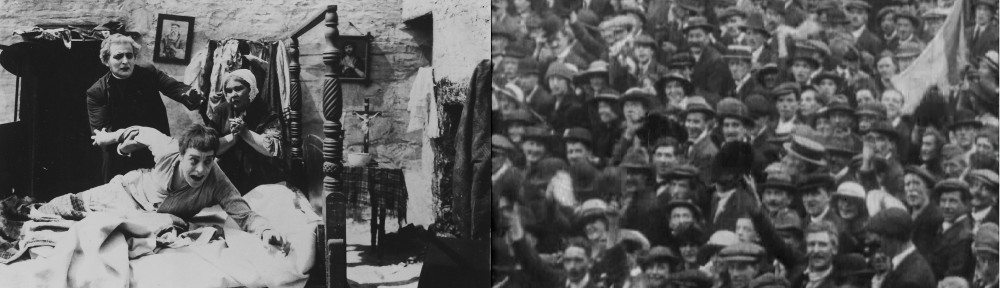
Relieving the Monotony of All Pictures: Variety Acts in Irish Cinemas, February 1915

Unlike the experience in an Irish picture house in 2015, the cinema audience a century ago expected to share the auditorium not only with other spectators but also the musicians and – often – variety artistes who were responsible for producing a considerable part of the entertainment live. On 4 February 1915, the Ulster correspondent of the cinema trade journal Bioscope began his/her regular “Jottings from Ulster” column in fairly typical fashion by praising the attractions available at Provincial Cinematograph Theatres’ Picture House, Royal Avenue, Belfast. The attractions included the pictures Marguerite of Navarre (France: Pathé, 1914), Nick Winter in the Wild West (US: Eclectic, 1914) and The Bond of Love (US: Selig, 1914), which were accompanied by an “orchestra [that] has been considerably augmented.” The music produced by the musicians in the cinema was not the only part of the show produced live because “the monotony of all pictures is delightfully relieved by Mr. Norman Williams, who sings every afternoon and evening.” While the orchestra was expected to accompany the pictures and increase their attractiveness by augmenting them, Williams’ singing was a separate feature of the programme and was used – according to Jottings, at least – to ensure that audiences would not be bored by a programme that just consisted of films.
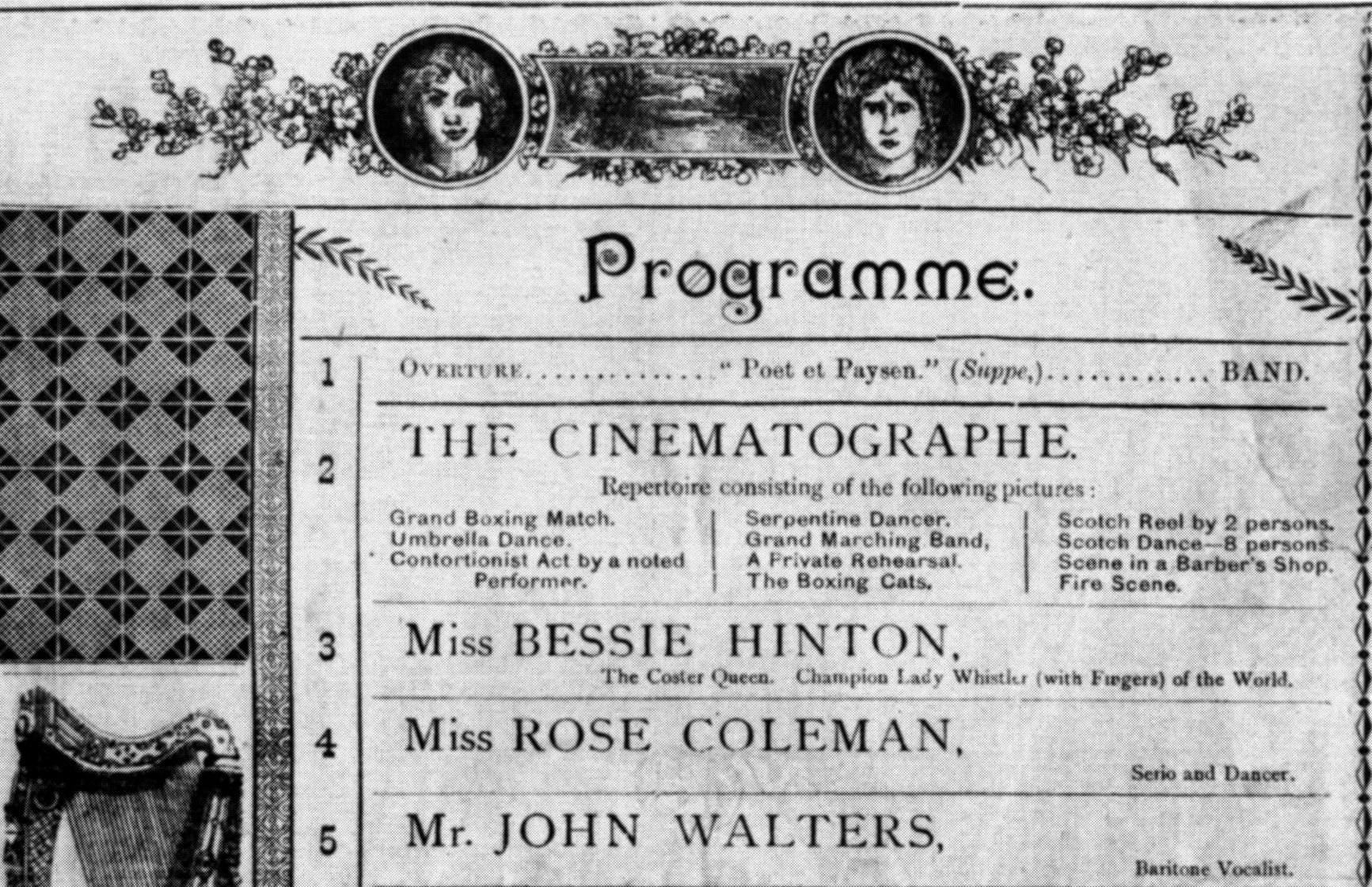
Part of the programme at Dublin's Star Theatre of Varieties at which the first films in Ireland were shown in April 1896.

Part of the programme at Dublin’s Star Theatre of Varieties at which the first films in Ireland were shown in April 1896.

The claim here is worth lingering on because it implies that variety was a necessary part of the programme, and in this case, the necessary variety was based on the differences between live and recorded performance. Variation in the length and genre of films has already been discussed in other posts, but here variety refers to the kinds of live performance – singing, dancing, comedy, juggling, acrobatics and animal acts –with which audiences a century ago would have been intimately familiar from the variety theatre. The variety theatre or music hall had been one of the first places at which moving pictures were exhibited, and the notion that popular entertainment should offer a variety of attractions persisted long after dedicated picture houses first appeared, which in Ireland was the late 1900s. Before this, in the 1890s and 1900s, variety theatre had added film as another of its acts or “turns,” and in the 1910s and for a long time thereafter, some picture houses included not only a variety of film attractions with musical accompaniment but also live variety acts. In fact, given the existence of the mix of film and variety entertainment at such large venues as Dublin’s 4,000-seat Theatre Royal until the 1960s, cine-variety should be considered one of the country’s most persistent forms of entertainment.

In early 1915, in any case, some – but by no means all – Irish picture house owners and commentators recognized the economic and aesthetic benefits of presenting variety alongside film. The cinema trade was not unanimous on whether or not variety turn in cinemas was a good or necessary thing. The Bioscope had long considered the importance of variety in Britain to be confined to the provinces, commenting in an editorial in 1911 that it was particularly associated with “the Midlands and North of England, where at least in a great many halls, the programme is not considered complete unless two or three variety turns are included” (“The All-Picture Programme”). This still seems to have been the case in 1914-15, when the early months of the war saw a decline in music-hall business (“Variety Turns”). Because of falling audiences, music-hall owners faced with closure made a deal called the “Fifty and Fifty” with the Variety Artistes’ Federation in late 1914, agreeing to split box office receipts evenly between artistes and venues (“Variety Artistes”). The picture houses were not favoured with a deal. A meeting of the Variety Artistes’ Federation passed a resolution that “no scheme for the deduction of salaries be granted to picture theatres engaging variety artistes, and that full salaries be demanded” (ibid.).

Nevertheless, Jottings pointed out that “[v]arieties are very steadily creeping into the motion houses throughout Ulster to-day” (“Jottings,” 28 Jan.). At the end of January, Norman Williams at the Picture House, Royal Avenue was joined by “Miss Ruth Vollmer, Scotch comedienne, dancer and clever exponent on the Scotch pipes, [who] was the star attraction at Lisburn Palace” (ibid.). However, once Charles Bronson took over management of the Palace, Omagh, he relied on films alone to draw the audience rather than the variety turns favoured by former manager Alex Cockle (ibid.). At the end of February, Jeanne Bal and Eugenie Van Camp – “two Belgian refugees” – appeared at the Picture House, Regent Street, Newtownards, where the “rendition by Mdlle. Van Camp of ‘Tipperary’ is very pleasing” (“Jottings,” 4 Mar.). The other Newtownards cinema, the Picture Palace, had four variety acts, so that “one would not know whether to refer to it as a cinema with varieties, or as a music-hall with pictures” (ibid.).
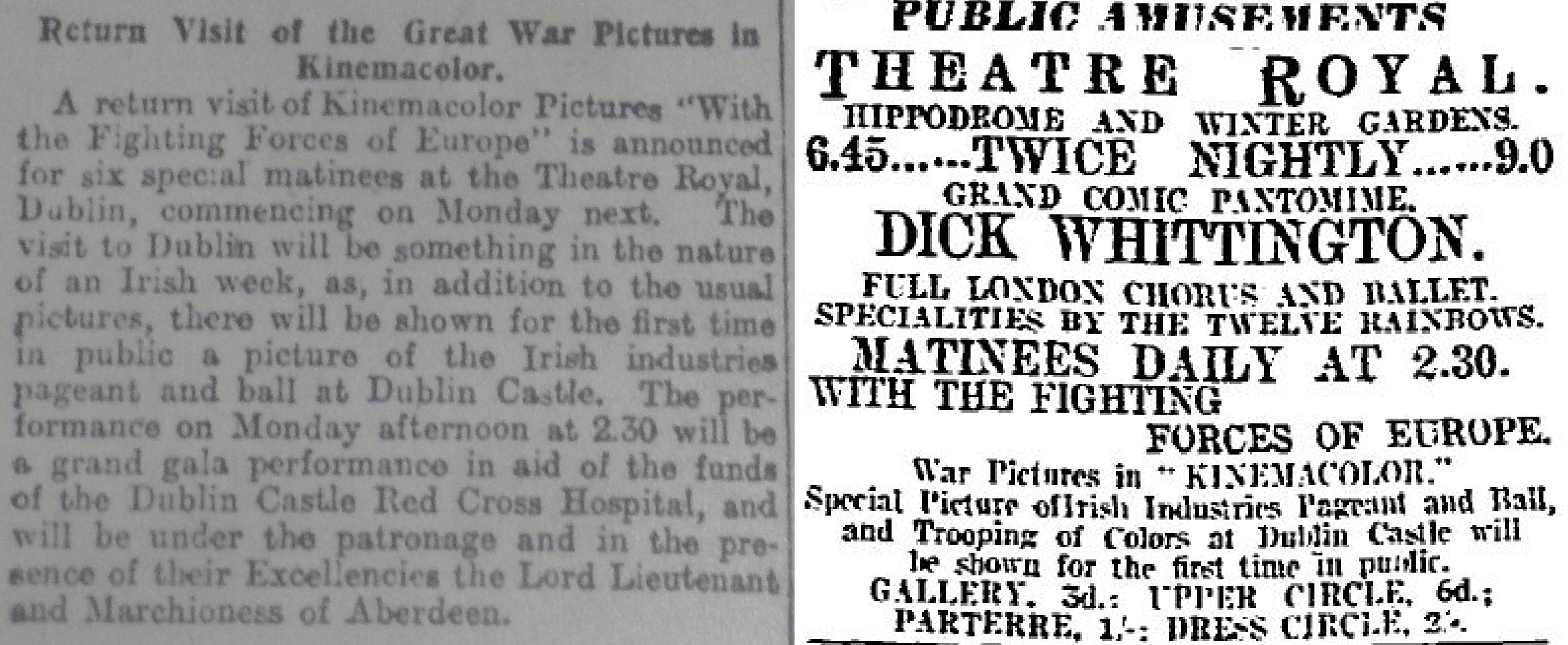
Kinemacolor exhibition at The Theatre RoyalIrish Times 9 Feb. 1915: 4

Kinemacolor exhibition at Dublin’s Theatre Royal; Irish Times 9 Feb. 1915: 4

While the inclusion of variety acts in a picture house programme appeared to put more emphasis on the live aspects of cinema and the associated possibilities for local variation, the appearance in Ireland in early 1915 of technological developments in film sound and colour suggested that a complete cinematic experience could be supplied by the recorded artefact alone. Colour film technology was to be seen from 8-13 February at the matinees of Dublin’s Theatre Royal, which hosted a return of the Kinemacolor war films The Fighting Forces of Europe, which had been first seen in Ireland the previous November. The return visit came with the added publicity of royal command performances in London, and the first show in Dublin was attended by the Lord Lieutenant and Lady Aberdeen. The Aberdeens would themselves leave Ireland in late February, and their departure was filmed by Pathé and by local exhibitor I. I. Bradlaw and local topical specialist Norman Whitten (Paddy, 25 Feb.). In any case, the Kinemacolor war films were one kind of technological development of cinema but they were not self-explanatory and so needed to be “fully described by an interesting lecture given by Mr. John Doran, and a special orchestra under the direction of Mr. Allan Blackwood, the well-known conductor” (“War Pictures”).
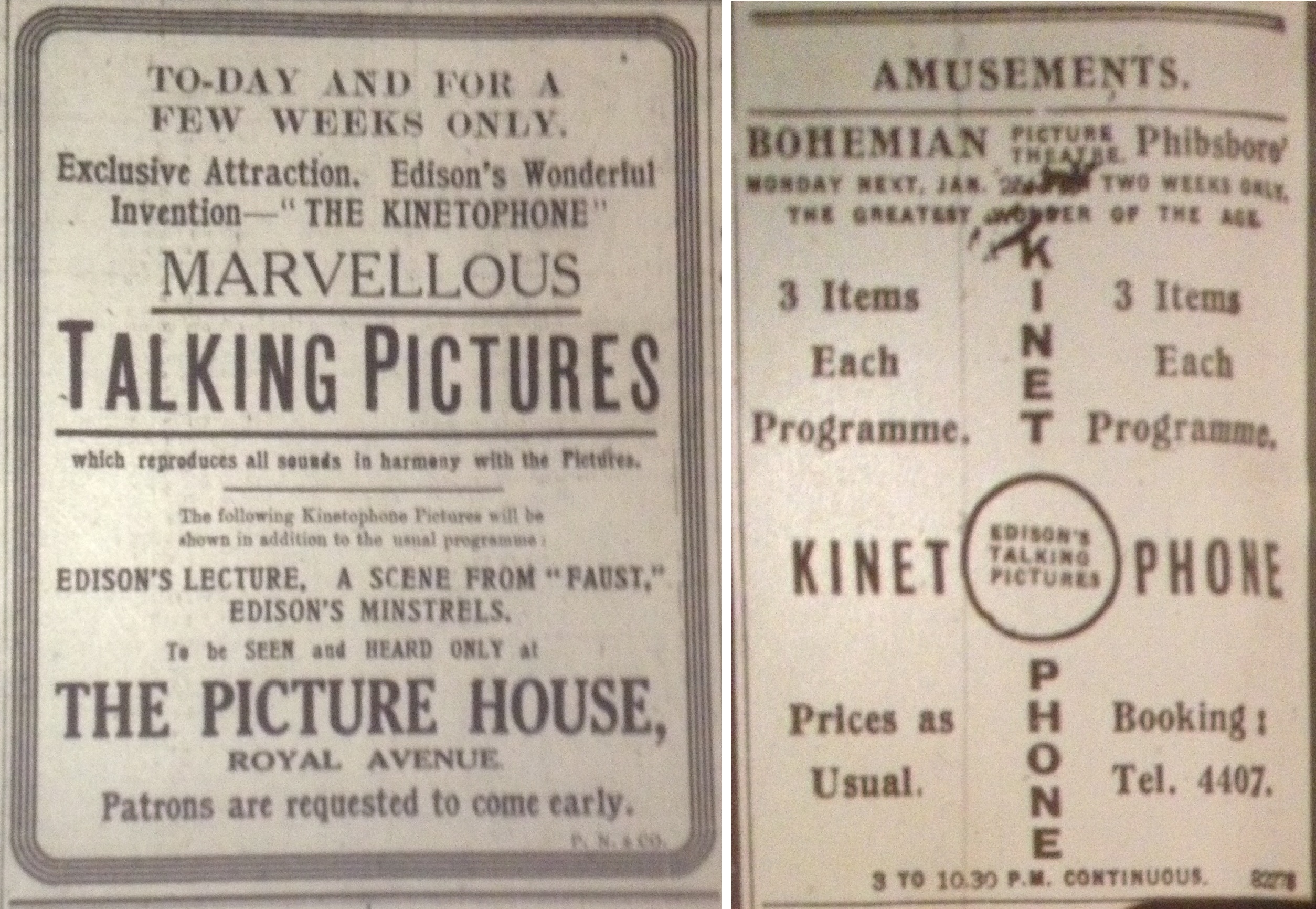
Edison's Kinetophone 1914-15. Irish News 23 Mar. 1914: 8 and Evening Telegraph 25 Jan. 1915: 3.

Edison’s Kinetophone 1914-15. Irish News 23 Mar. 1914: 8 and Evening Telegraph 25 Jan. 1915: 3.

The film sound technologies on exhibition in Ireland in early 1915 offered the possibility that lecturer and orchestra could be dispensed with. In late January, the Edison company’s Kinetophone talking pictures, which had had their first Irish appeared in Belfast the previous March, opened for at two week run at Dublin’s Bohemian Picture Theatre. “The success of this the latest addition to the attractions of the popular Phibsboro’ House,” observed the reviewer in the Evening Telegraph, “was from the start most marked, and the display, which last night included a musical sketch entitled ‘After College Days’ and Edison’s Minstrels, immediately appealed to the hearty enthusiasm of the very large audience” (“The Bohemian”). However, the Kinetophone items did not even nearly fill the programme but had to be supplemented by three reels of The Barefoot Boy (US: Kalem, 1914), the Pathé Gazette newsreel and comedy The Great Toe Mystery (US: Keystone, 1914). A full programme of talking-and-singing pictures was still some way off.
Evening Telegraph 19 Oct. 1914: 4

Evening Telegraph 19 Oct. 1914: 4

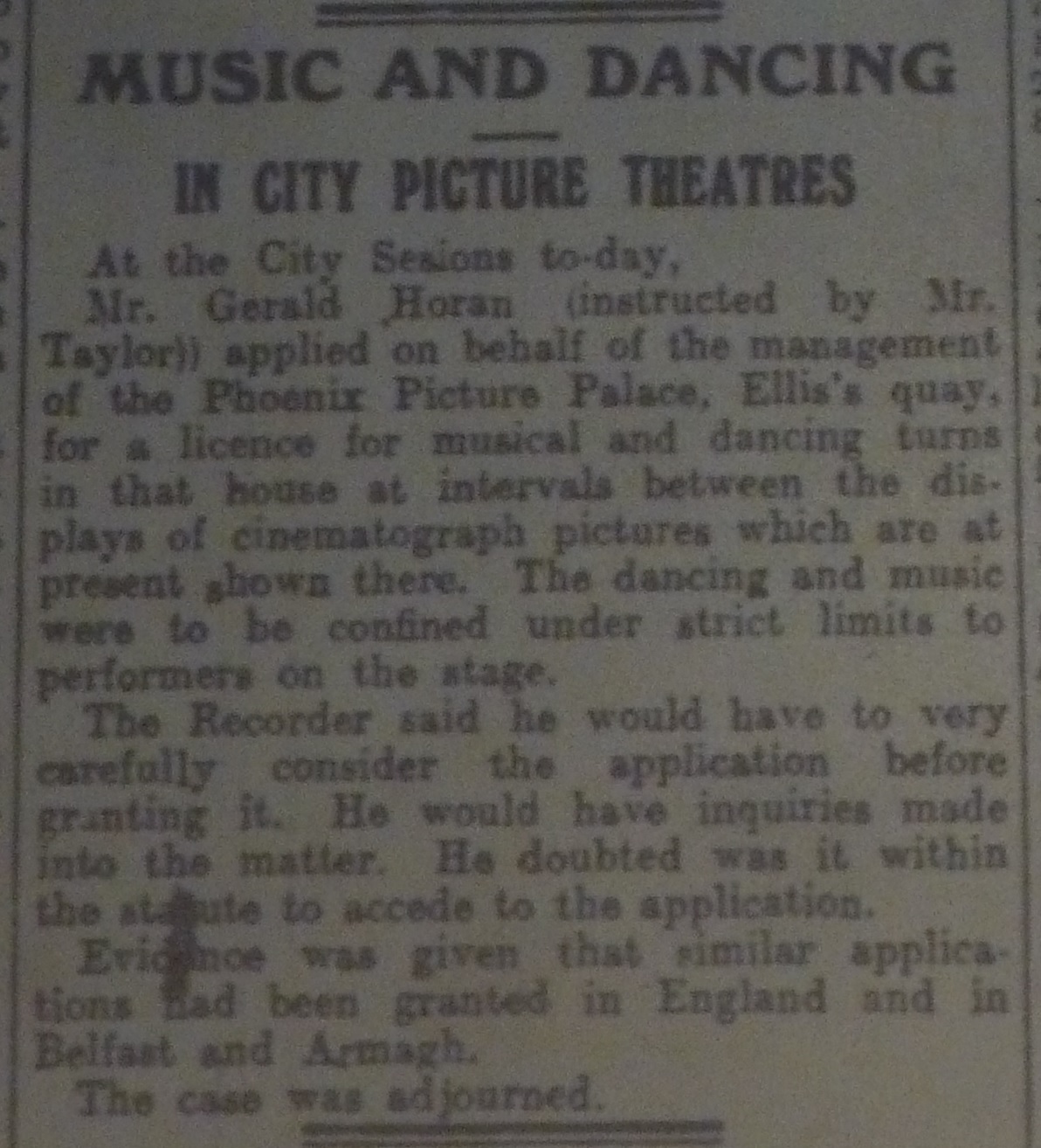
Licensing was one reason that picture house owners might have wished to have fewer live elements to deal with. Live music, and particularly the live singing of a variety artist, required entertainment venues to have a music-and-dancing licence. The reasons for this were made clear in late February 1915, when the latest proceedings were heard against a Dublin picture house, in this case, the Dame Street Picture House, that the city authorities claimed needed not just a cinematograph licence – which was mainly designed to ensure fire safety – but also a music-and-dancing licence. A related case against the Electric Theatre, Talbot Street had concluded in December 1914 with the prosecution of that cinema for not having a music-and-dancing licence (“City Cinemas”). The case against the Electric Theatre was apparently more straightforward because at the Electric’s evening performances, the pictures were accompanied not only by the piano that was used earlier in the day but also by a violin and cello. As a result, Justice Mahony had decided that the Electric’s claim that music was subsidiary to the entertainment was not sustainable. Although the case against the Dame was also due for decision, it had been adjourned because at the Dame only a piano was used to accompany the films.

These cases offer some fascinating details about the nature of live musical accompaniment at these relatively small picture houses at this period. Neither of them employed variety acts, and the musical accompaniment was the main kind of live supplement to the recorded images. While such larger picture houses as the Rotunda and Bohemian made a feature of the live music they offered, naming the musical director in advertising and at least on occasion, mounting special musical entertainments, these smaller venues downplayed the role of music to their entertainment. At least they did so in the context of this court case, which was part of a legal strategy to avoid having to pay for a music licence and/or pay a fine. The Electric’s argument that music was subsidiary was judged unbelievable because the judge concluded that the music was not just used to cover incidental noises in the cinema. Although the newspaper accounts do not state this explicitly, this was clearly true because the Electric augmented the music at the evening entertainment by the inclusion not just of louder music to cover the increased noises of a larger audience but of two instruments that enhanced the musical range of the performance.

By providing consistent piano accompaniment day and evening, the Dame had a stronger case that the music was subsidiary. As a result, when on 27 January 1915, the magistrate also fined them for not having a music licence, they appealed to the King’s Bench, which heard the case on 25 February. “It was proved,” a report in the Dublin Evening Mail revealed, “that at the exhibitions of pictures music in the form of piano playing was performed, which was more or less appropriate to the picture at the time on the screen Such music was performed only while the pictures were on the screen.” As a result, the Dame argued that a

certain amount of noise was occasioned during the exhibition of the pictures by the coming and going of attendants and persons entering and leaving the premises, and by the working of the [projection] apparatus. […M]usic was necessary, and was intended mainly for the purpose of deadening or drowning the noise which was likely to distract attention from the pictures, and that under these circumstances a licence for music was not necessary. (“Music in a Cinema”)

This offers a vivid image of the kind of challenges picture-house musicians faced. It did not, however, convince the justices on the King’s Bench, who voted a 2-1 majority to affirm the magistrate’s decision that the music at the Dame represented a separate attraction that required a licence. Even if part of the function of music in the picture house was to “drown the noise” of early cinema’s supplementary live soundtracks, it also provided an aesthetic experience in itself, if not a layer of acoustic interpretation of the pictures on screen.
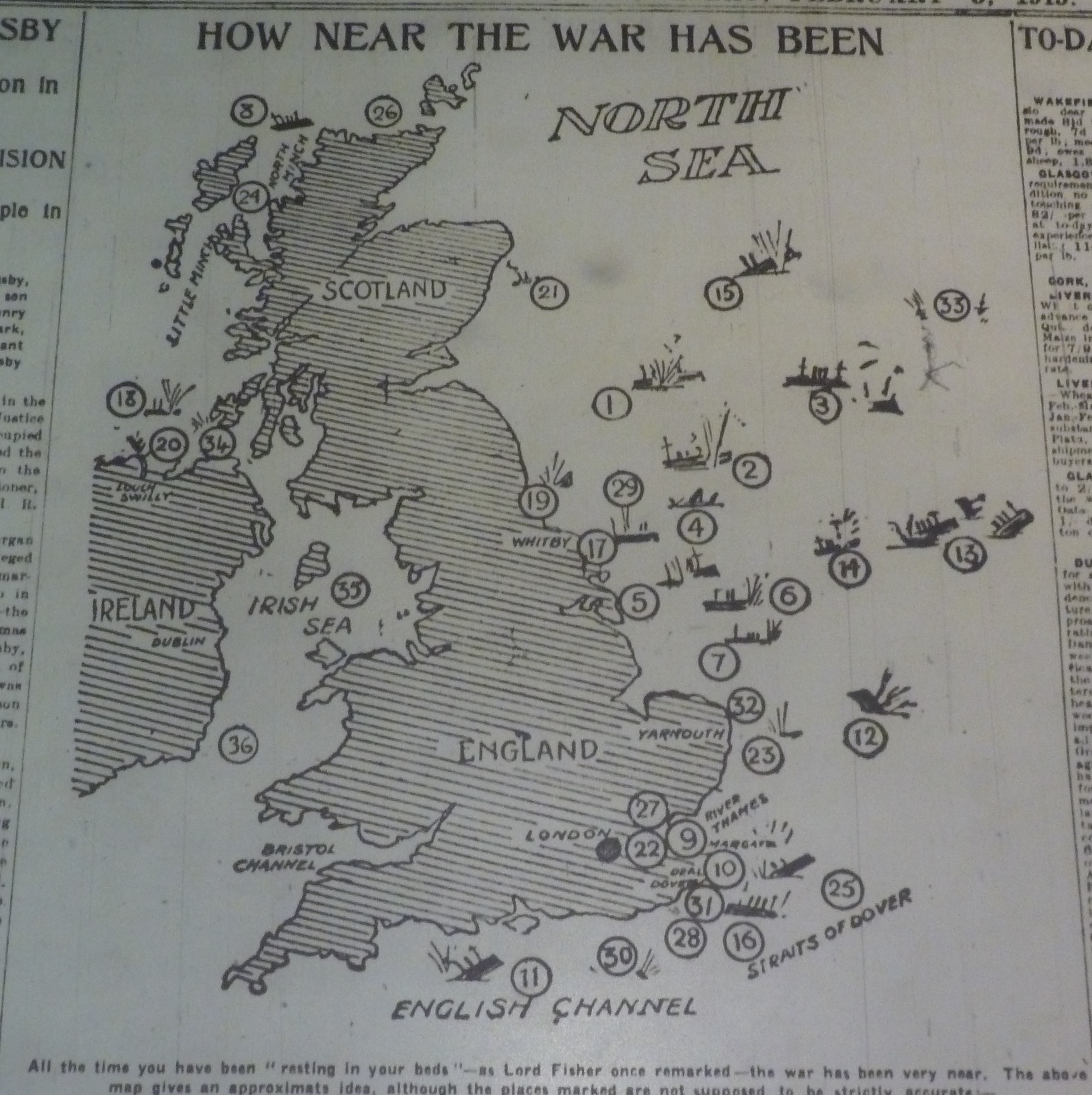
Evening Herald 3 Feb 1915:3.

Evening Herald 3 Feb 1915:3.

War-themed subjects remained among the most popular of the pictures on screen. How films provided an alternative forum in which to think about current events was shown when the Evening Herald printed a map of the war at sea around the coasts of Britain and Ireland, emphasizing the proximity of the war. Although much of this action was located in the North Sea, German submarines attempted to cut the transatlantic supply lines to Britain. The Lusitania – sunk off Cork in May 1915 – was the most famous casualty of the German blockade. With the appearance of The Huns of the North Sea in Ireland at the end of January, Sidney Morgan and John Payne’s P&M’s Films offered Irish audiences a way of imagining the new forms of warfare at sea involving minefields and submarines. The “short two-reeler, dealing with the mine-laying […] should prove exceptionally attractive to halls situated in the North of Ireland, where the mine-field was lately found” (Paddy, 21 Jan.).

Whether through live music or engaging and relevant images, the cinema a century ago continued to draw the attention of the public.

References

“The All-Picture Programme: Where “Variety” Is Not Wanted.” Bioscope 21 Sep. 1911: 591.

“The Bohemian.” Evening Telegraph 26 Jan. 1915: 2.

“City Cinemas: Question of Music Licence: Prosecution: In the Dublin Police Courts; Mr. Mahony’s Decision.” Evening Herald 30 Dec. 1914: 3.

“Dancing and Singing: City Picture House’s Application: Described as ‘Novel.'” Evening Herald 23 Oct. 1914: 4.

“Jottings from Ulster.” Bioscope 28 Jan. 1915: 339; 4 Feb. 1915: 437; 4 Mar. 1915: 837.

“Music in a Cinema: Interesting Dublin Case: ‘To Drown the Noise.’”Dublin Evening Mail 26 Feb. 1915: 5.

Paddy. “Pictures in Ireland.” Bioscope 21 Jan. 1915: 263; 25 Feb. 1915: 741.

“Theatre Royal Hippodrome.” Evening Telegraph 6 Feb. 1915: 6.

“Variety Artistes in Picture Theatres.” Bioscope 19 Nov. 1914: 707.

“Variety Turns in Picture Theatres.” Bioscope 17 Dec. 1914: 1288.

“War Pictures in Kinemacolor.” Dublin Evening Mail 4 Feb. 1915: 6.
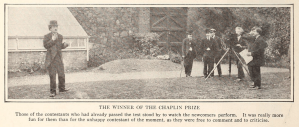
Creating Great Trouble in a Most Laughable Manner: Chaplin in Dublin in 1914

Chaplin Lookalike Winner Film Fun Jan 1916

The winner of a Chaplin lookalike contest run by Dublin’s Masterpiece Theatre; Film Fun Jan 1916: n.p.

By October 1915, a Charlie Chaplin craze was in full swing in Dublin. Paddy, the Irish correspondent of the British cinema trade journal Bioscope, showed this when he reported on several simultaneous tributes to Chaplin less than two years after he made his first film. On 7 October, Paddy revealed that Captain Ahearne of the Dame Street Picture House had shown all-Chaplin programmes the previous week, while a live Chaplin revue at the Coliseum Theatre had distinguished itself from the Chaplin impersonation competition taking place at the Rotunda by featuring what Paddy claimed was “the only Chaplin girl extant” (Paddy, 7 Oct.).

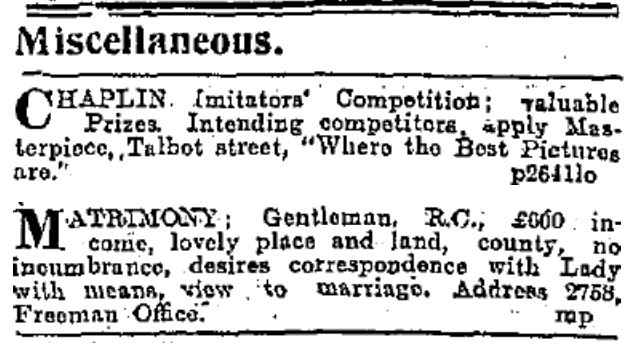
Small ad calling for Chaplin imitators. Freeman's Journal 16 Sep. 1915: 8.

Small ad calling for Chaplin imitators. Freeman’s Journal 16 Sep. 1915: 8.

That such competitions were not wholly new was shown by the fact that Cathal MacGarvey manager of the Masterpiece Theatre, Talbot Street was exhibiting his film of a Chaplin impersonation competition that had taken place at his picture house in September (Paddy, 14 Oct.). Chaplin seemed to be everywhere you looked by the autumn of 1915. But this adulation had taken some time to grow.

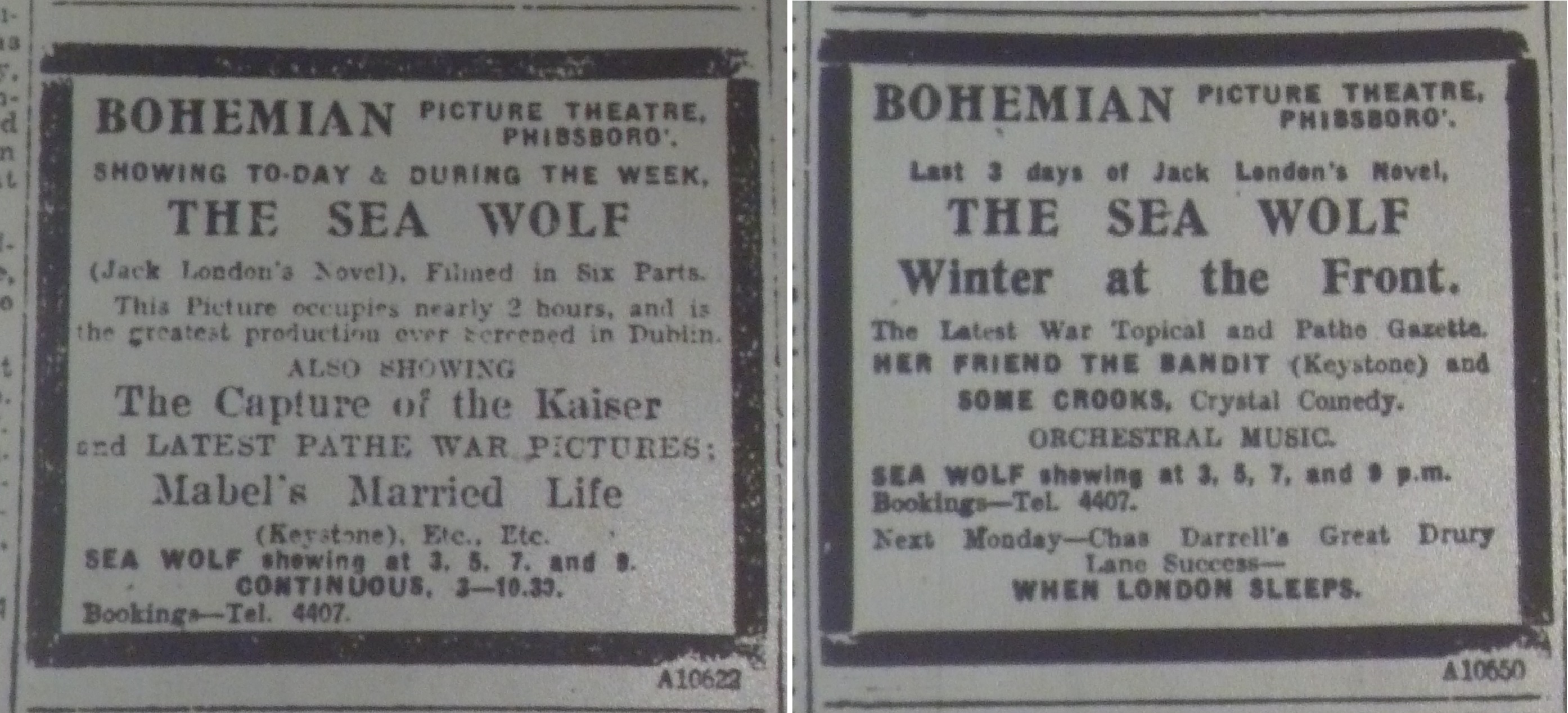
The Bohemian Picture Theatre showed Mabel's Married Life in the first three days of the week beginning 30 Nov. 1914 and Her Friend the Bandit for the last three days of that week. Evening Telegraph 30 Nov. and 3 Dec. 1914.

The Bohemian Picture Theatre showed Mabel’s Married Life in the first three days of the week beginning 30 Nov. 1914 and Her Friend the Bandit for the last three days of that week. Evening Telegraph 30 Nov. and 3 Dec. 1914.

Irish audiences’ decades-long love affair with Charlie Chaplin, the biggest film star of the first half of the 20th century, began modestly a century ago. Cinema audiences in Ireland, like those around the world, knew the slapstick comedies for which Mack Sennett’s Keystone Film Company was already famous when Chaplin joined in December 1913. When he began shooting his first films in January 1914, Chaplin played supporting roles to such better-established comics as Mabel Normand, Roscoe “Fatty” Arbuckle and Ford Sterling. However, he rapidly became the star player in films that he directed himself. Nevertheless, he did not renew his Keystone contract in December 1914, choosing instead to join George K. Spoor and Gilbert M. “Broncho Billy” Anderson’s Essanay Film Manufacturing Company.

As the best remembered of the stars who emerged in the 1910s, Chaplin has already been discussed briefly here and here. Now that the centenaries of his year at Keystone have passed, it may be worth looking in more detail at the Irish reception of this initial stage of his career. Almost all the Keystone films he appeared in have survived, and thanks to the Chaplin Keystone Project, these have been restored to as watchable a condition as possible and are available in the DVD collection Chaplin at Keystone, accompanied by an informative booklet. Despite the films’ flashes of brilliance, however, it is hard not to agree with David Robinson that “[w]e can only look back at the first few Keystone films and see a crude, unfinished form, and the earliest tentative search for a screen character” (130). But as Robinson goes on to argue this is our problem in retrospect: “To the audiences of the time they were new and astonishing. From the very start, Chaplin had created a new relationship with the audience, provoking a response that no one had elicited before in film or in any other medium” (ibid).

Irish audiences’ first sight of Chaplin on screen was not as a tramp but as a “sharper” in Making a Living (US: Keystone, 1914).

Surviving accounts from Irish audience members are rare, but newspapers do offer some clues about how that relationship began in Ireland. These clues have to be sifted out of ads and articles that are largely the product of the marketing needs of film production companies, distributors, picture houses and the newspapers that carried the material. Most of the cinema display ads, preview and reviews in Dublin newsaper were for the few picture houses that paid for advertising. The most regular picture-house advertising was from the Rotunda Pictures in Dublin’s O’Connell/Sackville Street, which had long used extensive advertising to construct its reputation as the city’s premier picture house. In roughly descending order of regularity of advertising, the Rotunda was followed in late 1914 and early 1915 by the Bohemian Picture Theatre in Phibsboro; the Masterpiece Theatre in Talbot Street; the Provincial Cinematograph Theatres pictures houses in Grafton and O’Connell/Sackville Streets; the Phoenix on Ellis Quay; the Dorset Picture Hall; the Volta in Mary Street; the Electric Theatre in Talbot Street; Dame Street Picture House; and the Pillar Picture House in O’Connell/Sackville Street. This represents just two-fifths of Dublin city’s cinemas, and many of those named often did not mention the titles of the short comedies that supported the main dramatic feature. Nevertheless, the display ads, previews notices and reviews of these picture houses allow us to track the release dates and something of the reception of Chaplin during his year at Keystone.

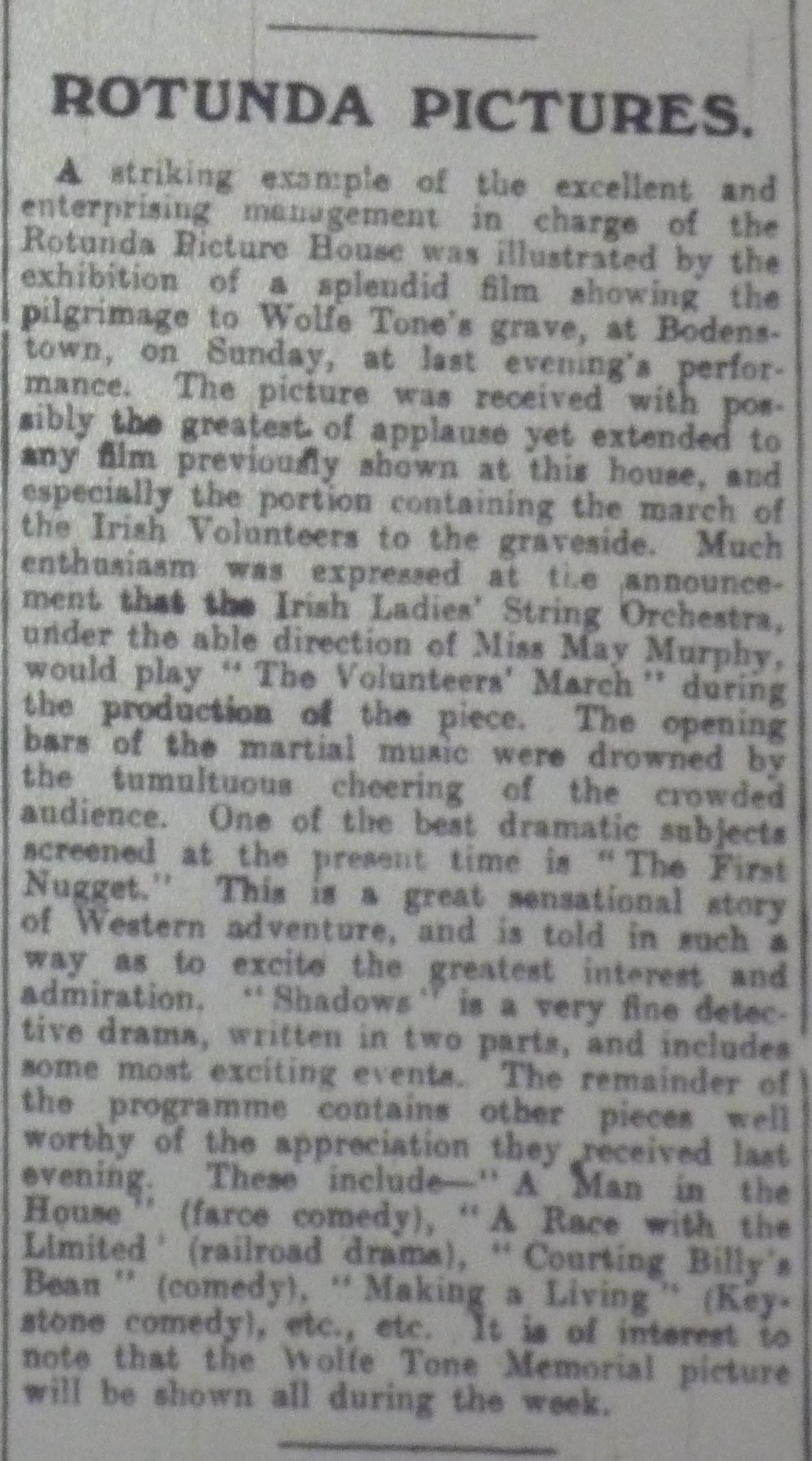
This review of the programme at the Rotunda Pictures gives a good indication of where comedies featured in the priorities of newspaper reviewers. Evening Telegraph 23 Jun. 1914: 2.

This review of the programme at the Rotunda Pictures gives a good indication of where comedies featured in the priorities of newspaper reviewers. Evening Telegraph 23 Jun. 1914: 2.

It was at the Rotunda that Chaplin first appeared on a screen in Dublin in the comedy Making a Living (US: Keystone 1914), which had a three-day run beginning on Monday, 21 June 1914. The Evening Telegraph’s review suggests that contemporary observers did not share the importance we would likely attribute to the beginning of Chaplin’s career. The highlight of the bill on which Making a Living appeared was for at least the nationalist members of the audience – as it was for the reviewer in the nationalist Evening Telegraph – “a splendid film showing the pilgrimage to Wolfe Tone’s grave, at Bodenstown, on Sunday” (“Rotunda Pictures,” 23 Jun.). This local topical (news film) “was received with possibly the greatest of applause yet extended to any film previously shown at this house,” and its exhibition was enhanced by the Irish Ladies’ String Orchestra playing “The Volunteers’ March”: “The opening bars of the martial music were drowned by the tumultuous cheering of the crowded audience” (ibid.). By contrast, Making a Living was merely mentioned in passing along with two other comedies that were also part of the programme.

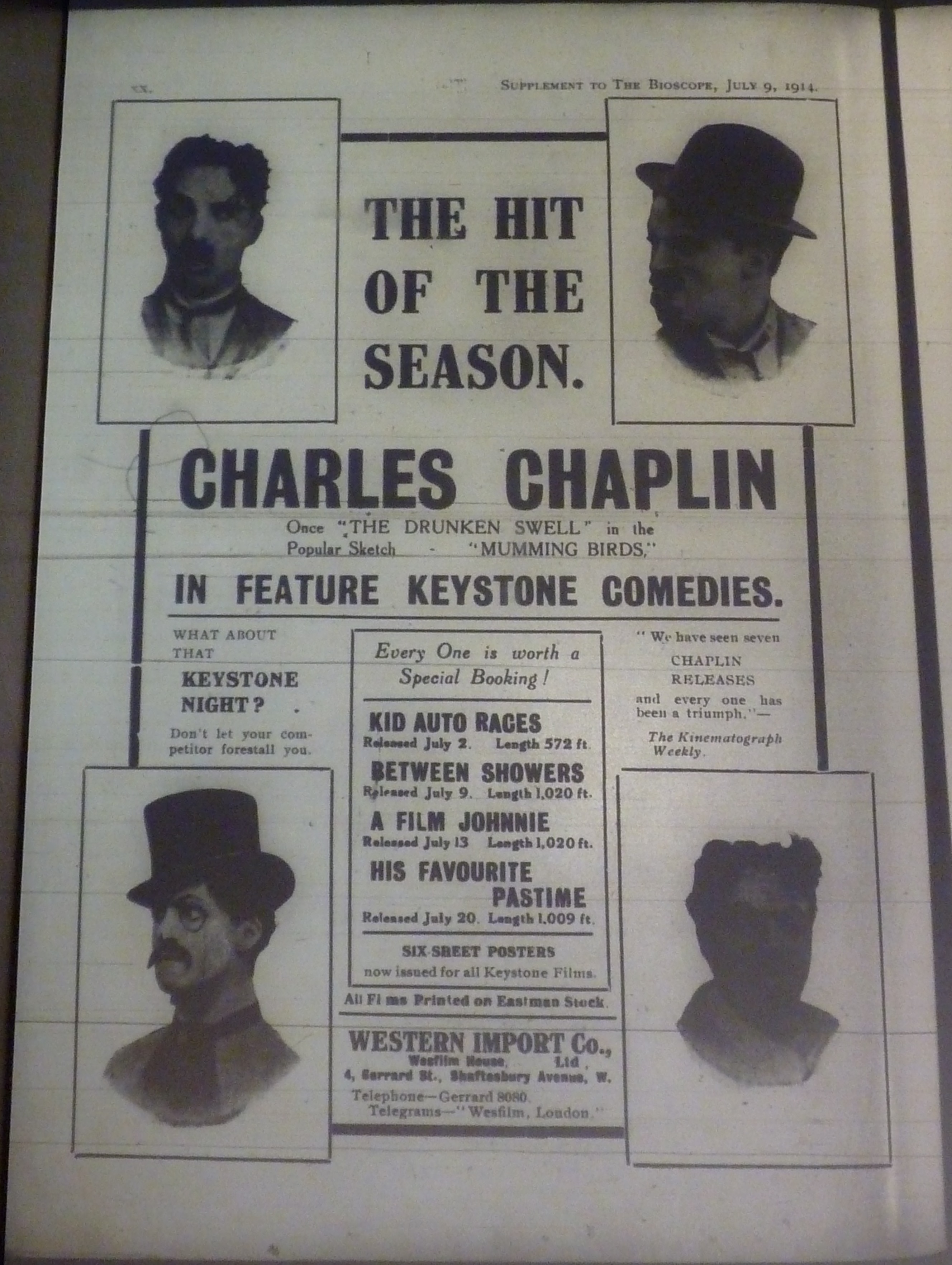
Western Import Co. ad for Chaplin's early Keystone film hails him as the hit of the season and reminds readers of his stage career. Bioscope 9 Jul. 1914: xx.

Western Import Co. ad for Chaplin’s early Keystone films hails him as the hit of the season and reminds readers of his stage career. Bioscope 9 Jul. 1914: xx.

Making a Living was almost five months old by the time it reached Irish screens. It had been shot on 5-9 January 1914 and first released in the United States on 2 February 1914 (Chaplin at Keystone). From 21 June on, however, Chaplin’s films were released in Ireland in quick succession but not always in the same order as they had appeared in the US. This release pattern and much of the publicity material available to picture house managers came from the Western Import Company, the British and Irish distributor of all Keystone films. All the films released by Western Import up to the end of January 1915 were shown in Dublin. Western Import was based in London, and its ads in the trade papers reflected the fact that Chaplin’s films had been a particular hit in the US and were likely to be at least as popular in Britain where he had recently been a music-hall comedian.

In Mabel's Strange Predicament, Dublin audiences saw Chaplin's tramp costume for the first time in a film whose comedy comes largely after Mabel locks herself out of her hotel room in her pajamas.

In Mabel’s Strange Predicament, Dublin audiences saw Chaplin in his tramp costume for the first time, harassing Mabel Normand in her pyjamas.

Despite the information available from the distributor, the names of Mabel Normand or Ford Sterling were more likely to have caught the attention of comedy audiences that week. When Mabel Strange Predicament – the film in which Chaplin first appeared as the tramp – began its three-day run at the Rotunda on 2 July, the Dublin Evening Mail did not mention Chaplin but commented of Normand that “this little lady is now the leading comedienne in filmland” (“Rotunda Pictures,” 27 Jun.). And when Chaplin’s next film, Kid Auto Races at Venice, Cal., was appreciatively reviewed during its Rotunda run (6-8 July), the reviewer misidentified Chaplin as Keystone’s more established Fatty Arbuckle, observing that the “famous ‘Fatty’ of the Keystone company, will be seen in a screamingly funny picture, ‘Kid Auto Races’” (“Rotunda Pictures,” ET 7 Jul.). This pattern was not confined to the first few of Chaplin’s films screened in Dublin but continued up to November, when Mabel’s Busy Day was described as “one of the funniest adventures of Mabel Normand, Keystone Company” (“Rotunda Pictures,” ET 21 Nov.). Although “[a]mongst the humorous contributions” to the bill at the Masterpiece on 22 December “Chaplin, of the Keystone Co., in ‘A Busy Day,’ was very amusing,” this did not distinguish him from Ford Sterling who had left Keystone for a time and was starring “in a highly diverting Sterling Comedy, ‘Three O’clock’” (“Masterpiece”).

As this suggests, Keystone was itself a brand that newspaper advertisers and reviewers expected readers to recognize. This was emphasized on 10 October, when a preview of the Rotunda’s programme recommended When Reuben Fooled the Bandits – featuring the lesser known Keystone player Charles Murray – on the sole basis that it was a Keystone, “which means the last word in comedy” (“Rotunda Pictures,” ET 10 Oct.). The company brand and the star brand were also frequently combined. On 17 October, the preview of the Masterpiece Theatre did not specify the title of the comedy films that would be on show in the following week, but one of them “is a highly diverting Keystone, featuring the inimitable [C]haplin” (“Masterpiece Theatre”).

All the Keystone films featuring Chaplin released onto the British market between late June 1914 and the end of January 1915 were shown in Dublin, and many of them had their first Dublin exhibition on or close to the day Western Import released the film. Some films, however, appear to have been screened weeks or months after the release date, but it is possible that they were screened earlier and in the period before the attractiveness of Chaplin’s name was fully realized, their titles were not mentioned in the press. In any case, Making a Living’s appearance at the Rotunda on 22 June was four days after its London release. Mabel’s Strange Predicament appeared at the Rotunda on 2 July, a week and a half after its 22 June release (“Rotunda Pictures,” DEM 27 Jun.). Kid Auto Races at Venice, Cal. was release on 2 July and shown at the Rotunda on 6 July (“Rotunda Pictures,” ET 7 Jul.). Released on 6 July, A Thief Catcher – staring Ford Sterling but featuring Chaplin – ran at the Picture House, Grafton Street (9-11 July; ad, ET 9 Jul.), before the Rotunda (13-15 July; “Rotund Pictures,” ET 11 Jul., II 13 Jul.), and this seems also to have been the case with Between Showers, which was released on 9 July and exhibited first at the Grafton on 13-15 July (“Grafton Street Pictures”). A Film Johnnie was released on 13 July and shown at the Rotunda beginning on 20 July (“Rotunda Pictures,” ET 21 Jul), and His Favourite Pastime seems to have screen first at the Picture House, O’Connell/Sackville Street a week after its 20 July release (ad, ET 25 Jul.).

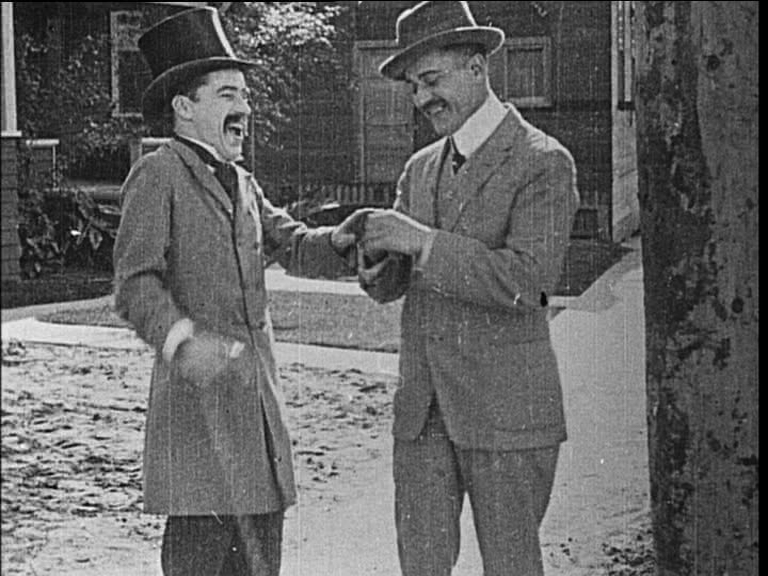
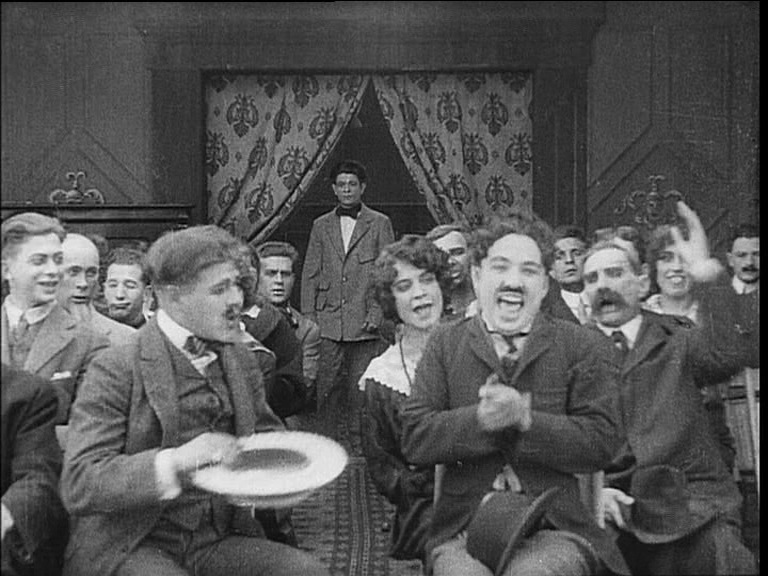
Chaplin's character in A Film Johnnie begins in a picture house and travels to the Keystone studios in pursuit of the Keystone Girl.

Chaplin’s character in A Film Johnnie begins in a picture house and travels to the Keystone studios in pursuit of the Keystone Girl.

No Chaplin film appears to have been released in August 1914, but September was busy. Tango Tangles – featuring Chaplin, Arbuckle and Sterling – was released on 10 September and shown at the Picture House, Sackville/O’Connell Street from 14 September (“O’Connell Street Pictures”). Cruel, Cruel Love’s 17 September release was followed by a 21 September Dublin opening at the Rotunda (“Rotunda Pictures,” ET 19 Sep.). Caught in the Rain was released on 21 September but does not seem to have had a Dublin screening until it was exhibited at the Volta’s well-advertised Sunday shows on 13 December (“Volta,”). Similarly, “Keystone screamer” Twenty Minutes of Love awaited a 17 January 1915 showing at the Volta despite a 28 September 1914 release (“Volta,” 16 Jan.).

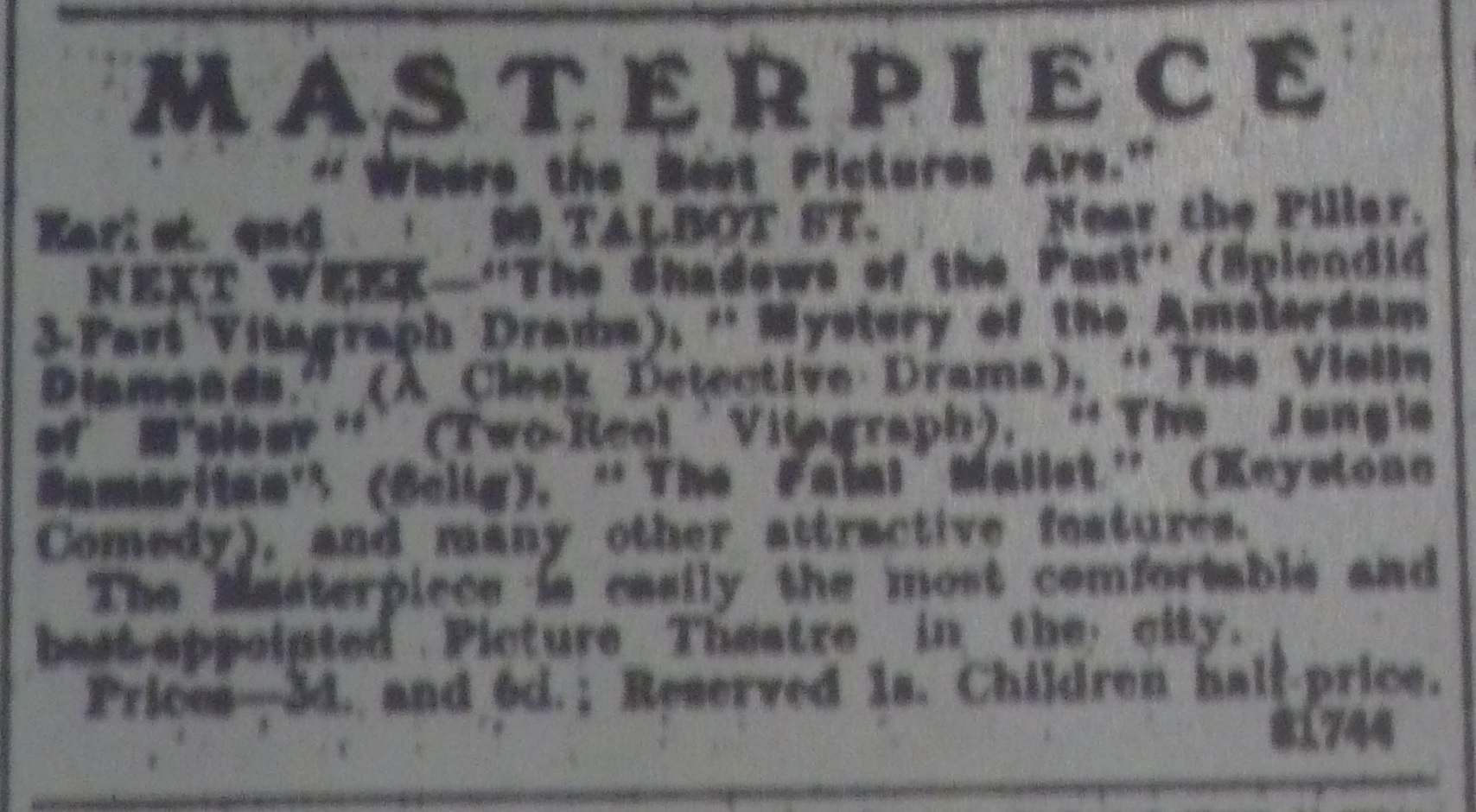
Ad for the Masterpiece programme for the week, including The Fatal Mallet; Evening Telegraph 12 Dec. 1914: 1.

Ad for the Masterpiece programme for the week, including The Fatal Mallet; Evening Telegraph 12 Dec. 1914: 1.

Although October 1914 also saw no Chaplins released, November and December made up for it. The 9 November release of Caught in a Cabaret coincided with the same-day opening at the Rotunda (“Rotunda Pictures,” ET 7 Nov.). A Busy Day waited more than a month after its 12 November release until its Dublin premiere at the Masterpiece on 21 December (“Masterpiece”); the previous week (17-19 Dec.), the Masterpiece had shown The Fatal Mallet, which had been released on 19 November (ad, ET 12 Dec.). Mabel’s Busy Day had a release-day opening at the Rotunda on 23 November (“Rotunda Pictures,” ET 21 Nov.), and Mabel’s Married Life also opened in Dublin the day it was released at both the Rotunda and Bohemian on 30 November (“Rotunda Pictures,” ET 1 Dec.; “Bohemian”). On 3 December, the Bohemian gave Her Friend the Bandit an opening-day release (ad, ET 3 Dec.). And finally, Laughing Gas opened at the Picture House, O’Connell/Sackville Street on 7 January 1915, three days after its 4 January release (ad, ET 7 Jan.).

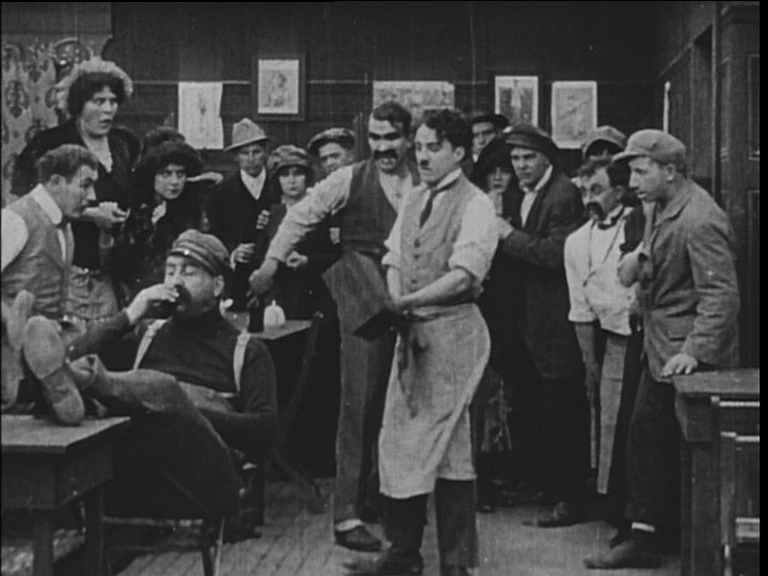
Chaplin prepares to deal with a difficult customer in Caught in a Cabaret.

Chaplin prepares to deal with a difficult customer in Caught in a Cabaret.

Very few of these 18 films were given more than a cursory mention. At the Rotunda in November, Chaplin’s Caught in a Cabaret was given unusual prominence for a comedy by being named as the first “of the principal films of the week” and as “a real live Keystone, one of the funniest yet” (“Rotunda Pictures,” ET 7 Nov.). “‘Caught in a Cabaret’ is the title of one of the best comedy pieces in cinematography yet shown in Dublin, and which is to be seen at the Rotunda Picture House. In all its details it proved a most laughable piece and drew forth loud applause” (“Rotunda Pictures,” ET 11 Nov.). Caught in a Cabaret was also popular at the Kelvin Palace in Bangor at Christmas:

Five performances were held on Christmas Day, and a like number of St Stephen’s [26 Dec.], at each show a complete change of pictures being screened – ten programmes in the two days. To be strictly accurate I should mention tha tone picture was retained in each programme. It was the screamingly-funny two-reel Keystone, “Caught in a Cabaret.” (“Jottings.”)

The most notice any Dublin newspaper reviewer gave to Chaplin in this initial period came at the end of July. “A splendidly long and most amusing comedy is ‘A Film Johnnie,” observed the Evening Telegraph’s columnist, noting the film’s reflexivity. “This picture features Charles Chaplin going to a cinema, where owing to an infatuation for a girl in the screen he creates great trouble in a most laughable manner” (“Rotunda Pictures” ET 21 Jul.). The Irish Times reviewer did not name Chaplin – referring merely to the “young man” in this “real good comedy series” – but commented that the “operations of the fire brigade in regard to that individual are the cause of much laughter” (“Rotunda Pictures,” IT 21 Jul).

Looked at week-to-week, Chaplin’s rise to fame looks more incremental than meteoric, but it would only be a few months before many members of the Dublin audience wanted to be Charlie.

References

“Bohemian Picture Theatre.” Evening Telegraph 1 Dec. 1914: 4.

Chaplin at Keystone. DVD Collection. London: BFI, 2010.

“Grafton Street Pictures.” Evening Telegraph 14 Jul. 1914: 2.

“Jottings from Ulster.” Bioscope 14 Jan. 1915: 146.

“Masterpiece.” Evening Telegraph 22 Dec. 1914: 6.

“Masterpiece Theatre.” Evening Telegraph 17 Oct. 1914: 6.

Paddy. “Pictures in Ireland.” Bioscope 7 Oct. 1915: 57; 14 Oct. 1915: 217.

Robinson, David. Chaplin: His Life and Art. London: Penguin, 2013.

“Rotunda Pictures.” Dublin Evening Mail 27 Jun. 1914: 3.

“Rotunda Pictures.” Evening Telegraph 23 Jun. 1914: 2; 7 Jul. 1914: 2; 14 Jul. 1914: 2; 21 Jul. 1914: 2; 19 Sep. 1914: 6. 7 Nov. 1914: 6; 11 Nov. 1914: 4; 21 Nov. 1914: 5; 1 Dec. 1914: 4.

“Rotunda Pictures.” Irish Independent 13 Jul. 1914: 5.

“Rotunda Pictures,” Irish Times 21 Jul. 1914: 7.

“The ‘Volta’ Sunday Pictures.” Evening Telegraph 13 Dec. 1914: 6; 16 Jan. 1915: 2.