Bioscope 9 Oct. 1913, xb-c.
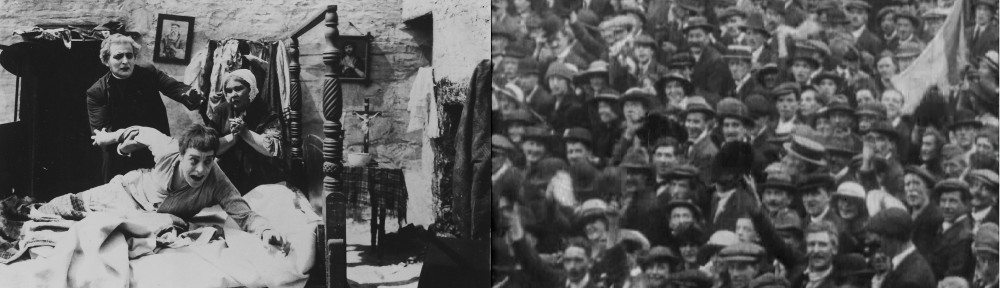
On Friday, 3 October 1913, the Irish Times reported that several Catholic clerics had attended a private viewing at the Rotunda, Dublin, of the film The First Irish National Pilgrimage to Lourdes and that the film would open to the public at the same venue the following Monday (“A Pilgrimage in Picture”). The preparations for and progress of the pilgrimage by over 2,000 Irish Catholics – including the miraculous cures of such pilgrims as Grace Maloney (“Miracle at Lourdes”) – were extensively covered in the press, and newspaper readers may also have been aware that the pilgrimage had been filmed because as many of the pilgrims prepared to depart on 8 September and arrived back on 19 September, some papers had reported that cinematographers were among them (“Lourdes Pilgrims,” “Home Again”).
The film at the Rotunda, therefore, had benefitted from much pre-publicity, and it sought to show cinemagoers the important elements of the pilgrimage in detail. It ran not the 5-10 minutes expected of a newsreel but – according to the Times – for “[n]early an hour,” with the Dublin Evening Mail putting its length in feet – the more popular way of expressing film length at the time – at 2,500 feet (“Rotunda Pictures”), or almost 42 minutes at the most common silent projection speed of 16 frames per second. The film “has many-sided interest for Dublin picture house patrons, most of whom had friends on the pilgrimage” (“Rotunda Living Pictures”), but the Rotunda sought to ensure the attention of its audience by setting them a puzzle: “Unique interest attaches to the film in that it shows an unknown lady, who experienced a cure, looking from a railway carriage window, and the management invite the co-operation of the public in identifying her” (A Pilgrimage in Picture”).
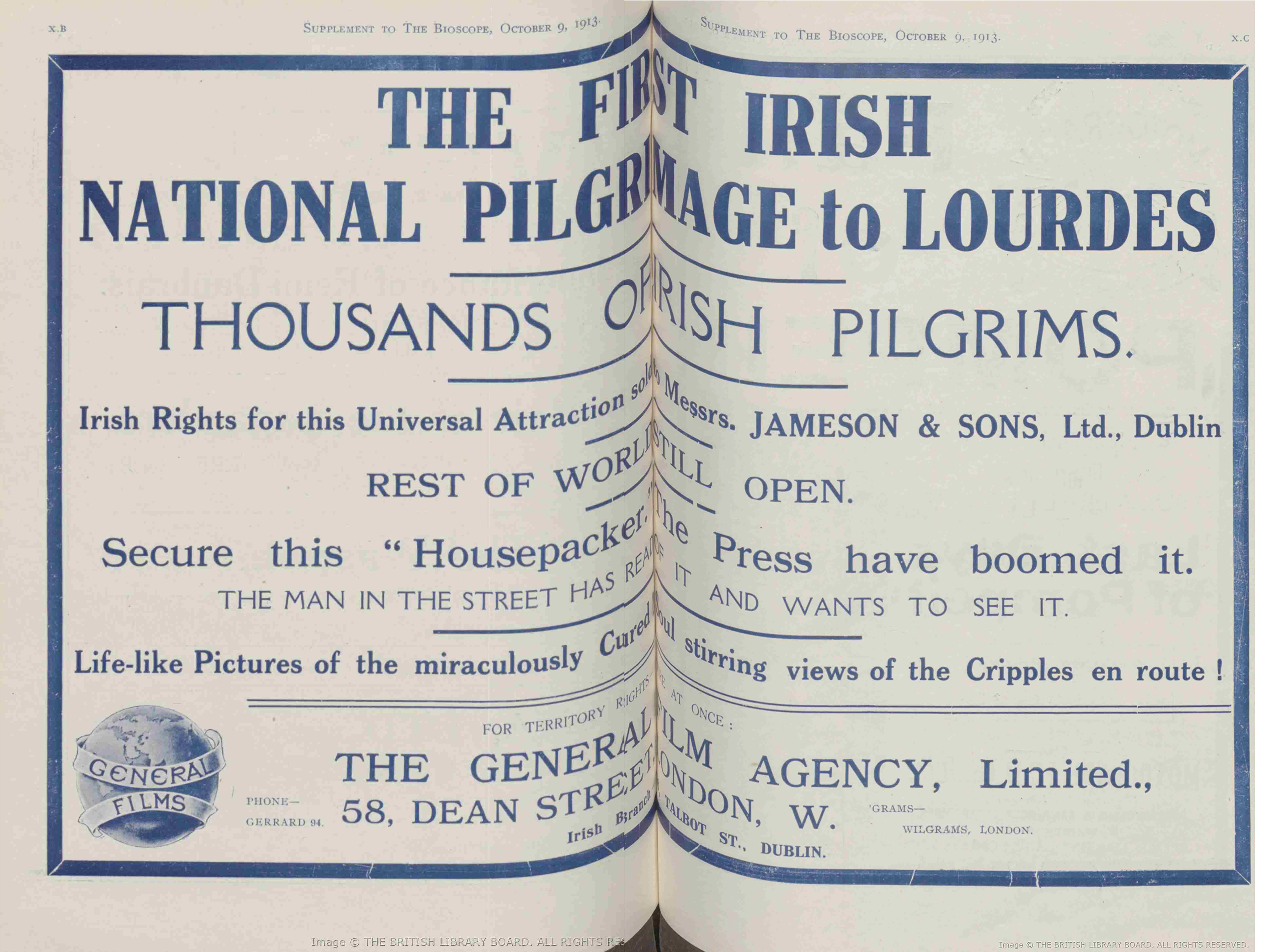
Such strategies to engage the Dublin and Irish audience would not have worked elsewhere, and other techniques would have been needed. Ads in the British trade journal Bioscope using such phrases as “Life-like Pictures of the miraculously Cured” and “Soul stirring views of the Cripples en route” show that the distributors suggested that exhibitors stress the miraculous and make disability into spectacle. Even emphasizing such attractions and given that Jameson had already secured the Irish rights, this film must have been difficult to sell in Britain except in areas with large concentrations of Irish migrants. In Ireland, much of the press coverage of the pilgrimage itself suggests that the spectacle of disability was less of interest than the miraculous cures. The Irish Catholic, for example – which never mentioned the film – devoted its lead stories on 4 and 11 October to medical confirmations of the cures.
Like the vast majority of early films made in Ireland – or anywhere else, for that matter – this film is believed to be lost. Nevertheless, the newspapers provide an account of its contents. A reporter for the Evening Herald, who had been at the press screening on 3 October, offered the most detailed description of the film. The scenes consisted of the following: “Pilgrims breaking journey at London and entering train at Victoria station; going on the special boats and scenes on board from Folkestone to Boulogne; Mass at the Madeline, Paris, outside the Madeline, brake loads of pilgrims; special trains leaving Bordeaux. Nearing Lourdes and panorama as seen from train; arrival at Lourdes and scenes of town and neighbourhood; tram ride up to Basilica; In Lourdes, general group; the first procession; on the way to the Grotto, and scenes at the Grotto and Basilica; portrait of Mdlle. Bernadette, and view of where she lived; the Calvary and monument; procession of the Blessed Sacrament; homeward bound – leaving Lourdes, and scenes at various places on the returning route” (“Lourdes Pictures”). One can only agree with the Herald reporter that the film thoroughly covered the event.
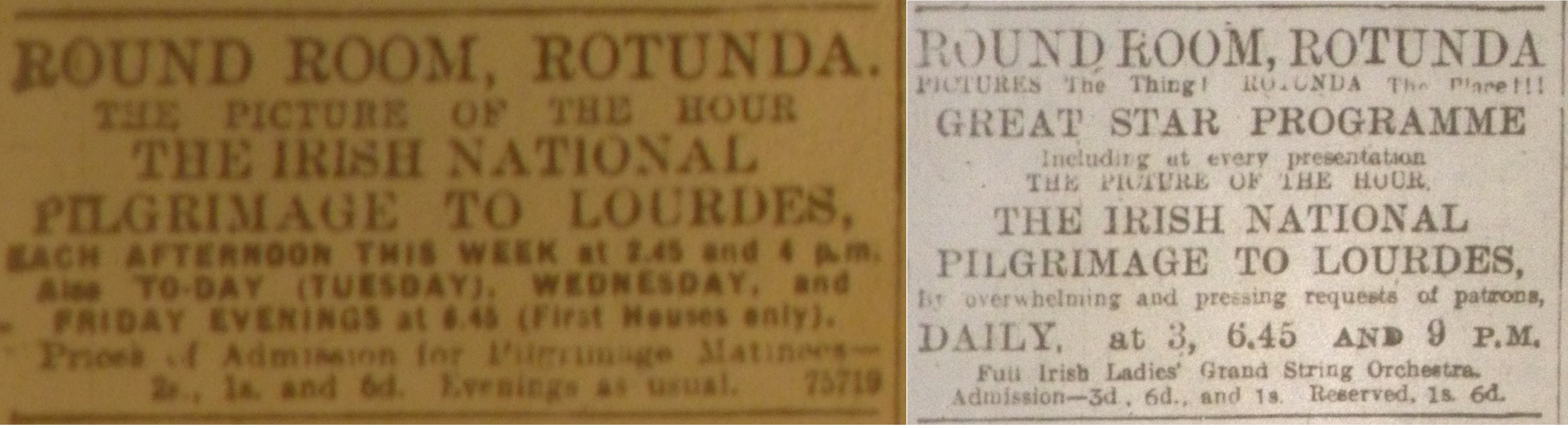
Differences in exhibition strategies at the Rotunda for the Irish National Pilgrimage to Lourdes (left) during its first week and (right) during its second week; Evening Telegraph 7 Oct. 1913: 2, and Dublin Evening Mail 13 Oct. 1913: 4.
Despite its topicality and multiple attractions for an Irish audience, Jameson initially adopted an unusual exhibition strategy. Rather than integrating it into the Rotunda’s normally advertised times of 3pm (matinee), 6:45 and 9pm, he decided to show it apparently alone – or possibly with a reduced supporting programme – at two matinees at 2.45 and 4pm, and with the rest of the advertised programme “at the first evening houses, commencing at 6.45 p.m., on Tuesday, Wednesday, and Friday” (“Pilgrimage in Picture”). The 6:45 show on Monday, Thursday and Saturday and all the lucrative 9pm shows would offer a programme that did not include the pilgrimage film, and this other programme – headed by Mary in Stageland, the third part of the Mary Fuller serial What Happened to Mary – was advertised separately. Whether he had already booked the first programme before he became aware of the availability of the pilgrimage film or whether he believed that the audience for the pilgrimage film would not be interested in the films enjoyed by his regular audience, and vice versa, is not clear.
The film’s popularity appears to have surprised this canny exhibitor, who changed his exhibition strategy in the second week of the film’s run. His decision to run the film for a second week already demonstrated that he identified unusual interest in it, but for the second week, he integrated it into his regular 3pm, 6:45 and 9pm schedule. Predicting that the programme would “undoubtedly prove to be one of the most popular ever set before a Dublin audience,” the Freeman’s Journal reported that the “film has been reproduced at the Rotunda on the overwhelming and pressing requests of patrons, and that the management only justified itself in complying with the enormous demand was thoroughly testified by the approval shown” (“Rotunda Pictures”).
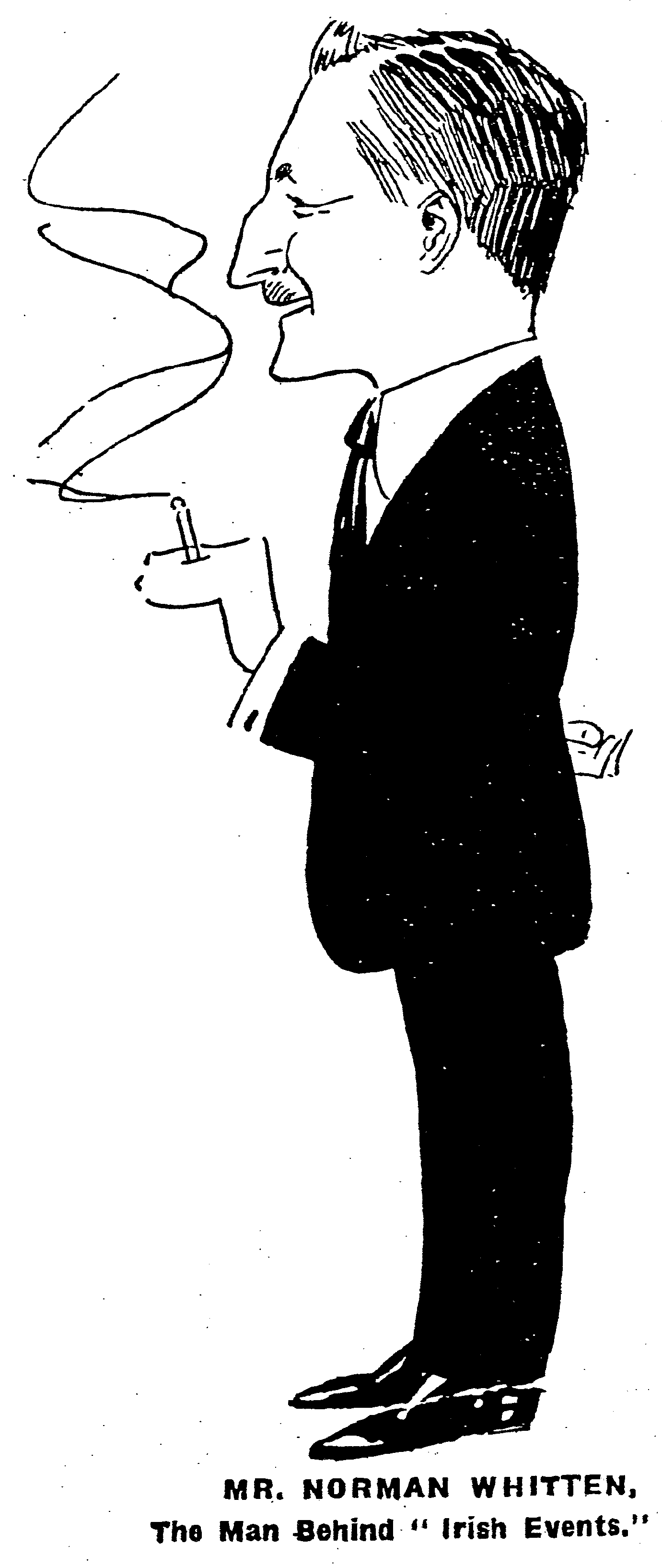
Frank Leah’s caricature of Norman Whitten. Irish Limelight 1:10 (October 1917), p. 1.
The film was produced by the General Film Agency (later, the General Film Supply), a company run by Norman Whitten that seems to have some relationship with a London-based company of the same name. English-born, Whitten had worked with British film pioneer Cecil Hepworth in the early 1900s but moved to Ireland in the early 1910s. In 1917, he would found Irish Events, the first Irish newsreel, before also shooting such fiction films as the bilingual life of St. Patrick Aimsir Padraig/In the Days of St. Patrick (1920). One of Ireland’s most successful film producers of this period, he showed a remarkable ability to understand Irish cinema audiences. In 1913, he began advertising his services as a producer of advertising films and local topicals (films of local events). Whether he was commissioned to make the pilgrimage film or initiated the project himself is not clear, but he certainly had considerable cooperation from the pilgrimage organizers.
The Dublin papers were almost universally positive in their reviews of the film. Although also positive, the Daily Express’ review is notable for the writer’s attempts to draw a distinction between what we would now see as fiction and documentary (at least of a kind):
Pictures recording actual events which are unembarrassed are usually never so effective as those which are produced after continual experiment This however, does not apply to the same extent as regards the present pictures as it might in the case of other pictures. The climatic conditions at Lourdes are pre-eminently suitable for the cinematograph, and without exception the various events, which the pictures pourtray are shown with marked clearness and distinctness (“Lourdes Pictures at the Rotunda”).
The pilgrimage film was not as bad as the writer had experienced other factual film to be, but s/he clearly preferred fictional films, or at least films that allowed rehearsal of some kind. The discussion of climatic conditions was one often aired when anyone tried to explain why so few films were made in Ireland or why those that were made featured relatively poor cinematography.
The one piece of criticism made in relation to the film concerned the choice of musical accompaniment at the Rotunda. The Dublin Evening Mail‘s “Music and Drama” columnist commented at length on film music, arguing that “semi-neutral music is the most effective,” explaining that by this s/he meant “that the selections should be broadly in sympathy with the general character of the film” (“Music and the Drama.”). Exemplary of this was Sackville Picture House musical director Jack Larchet’s recent “dignified” selection of Mendelssohn’s Trio in D Minor and Shubert’s Unfinished Symphony to accompany Hamlet (Hepworth, 1913), featuring theatre star Johnston Forbes-Robertson. By contrast s/he found the accompaniment of the pilgrimage film at the Rotunda by the elsewhere much praised Irish Ladies’ String Orchestra, under the direction of May Murphy, “not only inappropriate but it was badly played. Gounod’s ‘Ave Maria’ was suitable enough if it had been well rehearsed, but Stephen Adam’s ‘Holy City’ and ‘The Star of Bethlehem’ are not sacred songs in the real sense of the word” (ibid). This kind of criticism, however, is indicative that picture houses would increasingly be held to the highest standards of entertainment.
References
“Home Again: Pilgrims Back in Ireland.” Irish Independent 20 Sep. 1913: 5.
“Lourdes Pictures.” Evening Herald 4 Oct. 1913: 6.
“Lourdes Pictures at the Rotunda.” Daily Express 4 Oct. 1913: 10.
“Lourdes Pilgrimage.” Irish Times 8 Oct. 1913: 4.
“Lourdes Pilgrims: 2,300 Irish Folk Will Travel.” Irish Independent 6 Sep. 1913: 6.
“Miracle at Lourdes: Girl from Killaloe Cured.” Evening Herald 13 Sep. 1913: 2.
“Music and the Drama.” Dublin Evening Mail 13 Oct. 1913: 7.
“A Pilgrimage in Picture.” Irish Times 4 Oct. 1913: 5.
“Rotunda Living Pictures.” Irish Times 14 Oct. 1913: 5.
“Rotunda Pictures.” Dublin Evening Mail 11 Oct. 1913: 7.
“Rotunda Pictures.” Freeman’s Journal 14 Oct. 1913: 9.
 Early Irish Cinema