Processions, Protest and the Perfect Woman in Irish Picture Houses, Late Summer 1915

Summer was usually a bad time for indoor entertainments such as cinema. But the Irish weather during July 1915 – like that of July 2015 – did not favour outdoor activities. “It has been a sad time for July holiday-makers,” observed the Irish Times in early August, “and as yet there is no hint of a better hope for August, except that which may be taken from the thought that what has persisted so long must soon change” (“Wet Weather”). While some temporary picture houses opened at seaside resorts, some established venues followed the practice of the theatres and closed for several weeks in July and/or August. Although Dublin’s Rotunda usually stayed open throughout the summer, it took advantage of this practice in 1915 by closing on 7 June for extensive renovations and reopening on 26 July.

Swimmer Annette Kellerman was considered the “|Perfect Woman” because here measurements corresponded to the classical dimension of the Venus de Milo. Australian poster from the collections of the National Library of Australia, available here.

Australian swimmer Annette Kellerman’s bodily measurements promoted on a poster for the film Neptune’s Daughter. Collection of the National Library of Australia, available here.

The weather didn’t stop Dublin architect Joseph Holloway from travelling across town on the evening of Friday, 9 July, from his home in Northumberland Road south of the city to the Bohemian Picture Theatre in the northern suburb of Phibsborough. He was clearly quite taken with the “great film drama of a legendary story in five parts, called Neptune’s Daughter featuring Annette Kellerman (the Perfect Woman)” because he described it in more detail than any other film he had seen that year (Holloway, 9 Jul. 1915). The film was one of the several mermaid fantasies the Australian swimmer made during her film career in the 1910s and early 1920s. Dublin audiences had seen Kellerman three years previously in a similar live stage show, when she had appeared at the Theatre Royal with a company of 40 artistes in Undine, a 14th-century set “idyll of forest and stream” (“Theatre Royal”). Although a skilled athlete, Kellerman’s celebrity was partly based on her controversial promotion of a form-fitting one-piece swimsuit for women. This attire allowed women swimmers the ease of movement needed for athletic achievement, which was not permitted by form-hiding two-piece Victorian bathing costumes. Her championing of women’s athletics fitted well with such contemporary campaigns for women’s equality as the suffrage movement, and at a special matinee during her week in Dublin in 1912, Kellerman gave a lecture on women’s physical culture. At the same time, the publicity for her theatrical appearances fully exploited the spectacle of her body, which was declared perfect because it corresponded so exactly to the measurements of the Venus de Milo.
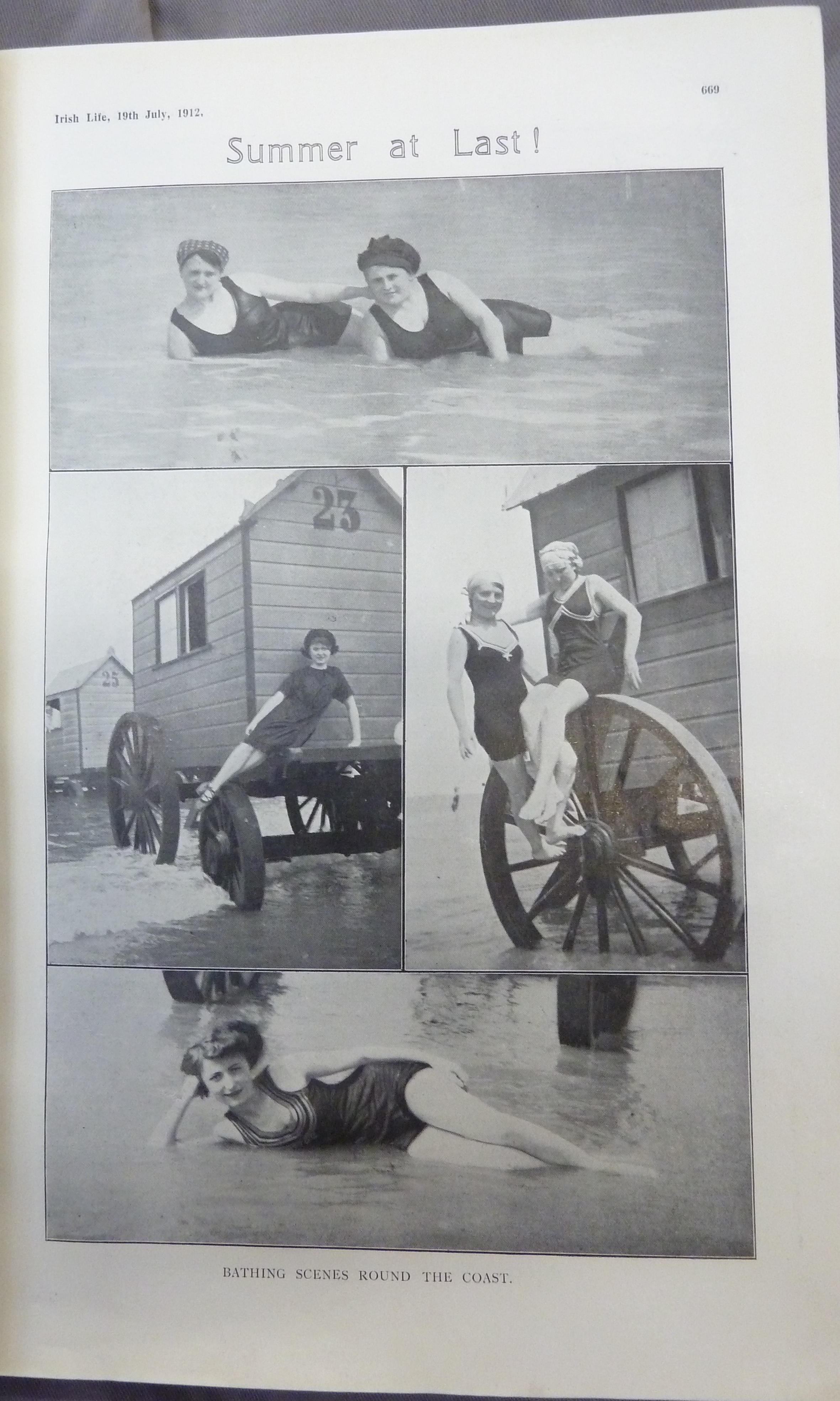
“Summer at Last!” Irish LIfe 19 Jul. 1912: 669.

“Summer at Last!” Irish LIfe 19 Jul. 1912: 669. Courtesy of National Library of Ireland.

Photographs published by the glossy illustrated weekly Irish Life in July and August 1912 – just after Kellerman’s visit – throw some light on the degree of controversy her appearance is likely to have caused in the early 1910s. Irish Life published many photographs of Ireland’s leisure class at golf, tennis, horse riding, motoring and other activities. Under the title “Summer at Last!” the issue of 19 July 1912 published photos of six women bathers, and the one-piece swimsuit is much in evidence: only one of the women has a swimsuit that covers her upper legs, arms and shoulders. Although four of the women are on or beside bathing machines that suggest the persistence of Victorian seaside practices, they appear unconcerned by the gaze of the camera or are even welcoming of it. The photo story suggests a fairly permissive view of the display of the female body in such public spaces as beaches and of the reproduction of such photographs in a widely circulating magazine of the “respectable” classes.
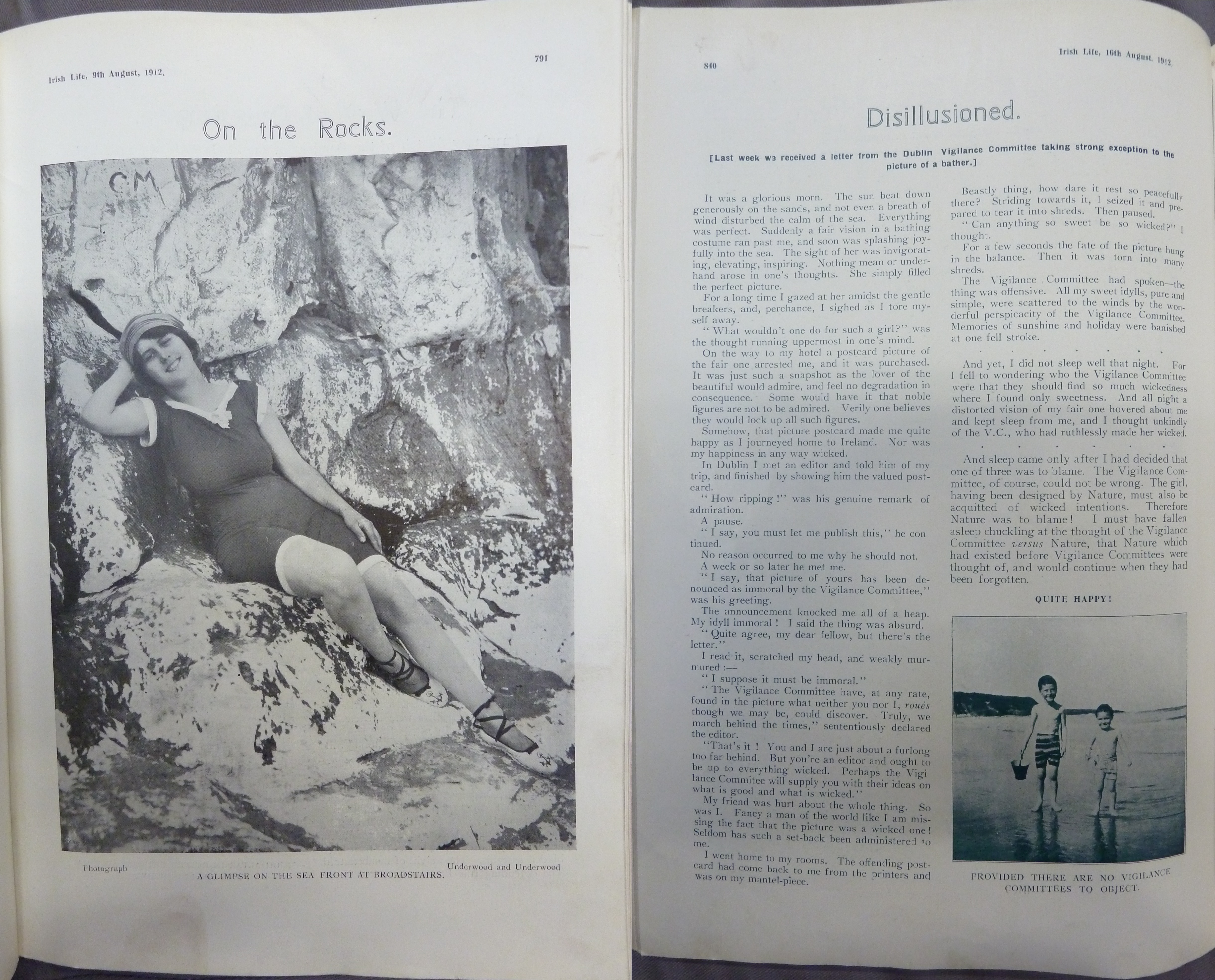
“On the Rocks” and “Disillusioned,” Irish Life 9 Aug. 1912: 791 and 16 Aug. 1912: 840.

“On the Rocks” and “Disillusioned,” Irish Life 9 Aug. 1912: 791 and 16 Aug. 1912: 840. Courtesy of National Library of Ireland.

However, this sense of the freedom of bodily display is somewhat challenged by the letter of complaint that the editor received the following month in response to Irish Life’s publication on 9 August 1912 of a postcard with a bather – in this case, probably a model – no more undressed or welcoming of the camera’s gaze than the previous women. The complaint was not a trivial one: it came from the Catholic Church based Dublin Vigilance Committee (DVC). Founded in early November 1911, the DVC had grown rapidly and held the first of what was to become an annual show of strength in the form of a procession through the streets of Dublin and a mass meeting at the Mansion House in July 1912. This was an astonishingly successful event, drawing letters of support not only from the Irish Catholic hierarchy but also the pope. The fact that it took place at the Mansion House meant that the movement already had the imprimatur of Dublin’s Lord Mayor, who attended, but the meeting was also addressed by Ireland’s highest government official, the Lord Lieutenant, Lord Aberdeen, who had also been the president of the National Vigilance Association of England for the previous 15 years. This was a movement with serious political clout. Nevertheless, when Irish Life responded to the complaint on 16 August, it was with an article that was more resentful than contrite and that was illustrated by children playing on a beach who were “Quite Happy! / Provided There Are no Vigilance Committees to Object.”

Three years later, at the Bohemian on the evening of 9 July 1915, Holloway was also quite happy with Neptune’s Daughter (US: Universal, 1914). However, the filmmakers – including Dublin-born director Herbert Brenon – pushed the degree of bodily display in Kellerman’s performance to full nudity, causing Holloway some qualms. “The story was splendidly enacted,” he thought, “but Annette Kellerman’s lack of costume was very daring at times.” Nevertheless, Holloway

thought it a very beautiful film, with nothing suggestive in it, – perhaps the incident of the diving from the rocks, again and again, clad only in nature, might have been omitted, with no hurt to the story, but, then Annette Kellerman wanted to show what an expert diver she is, & gave the display.
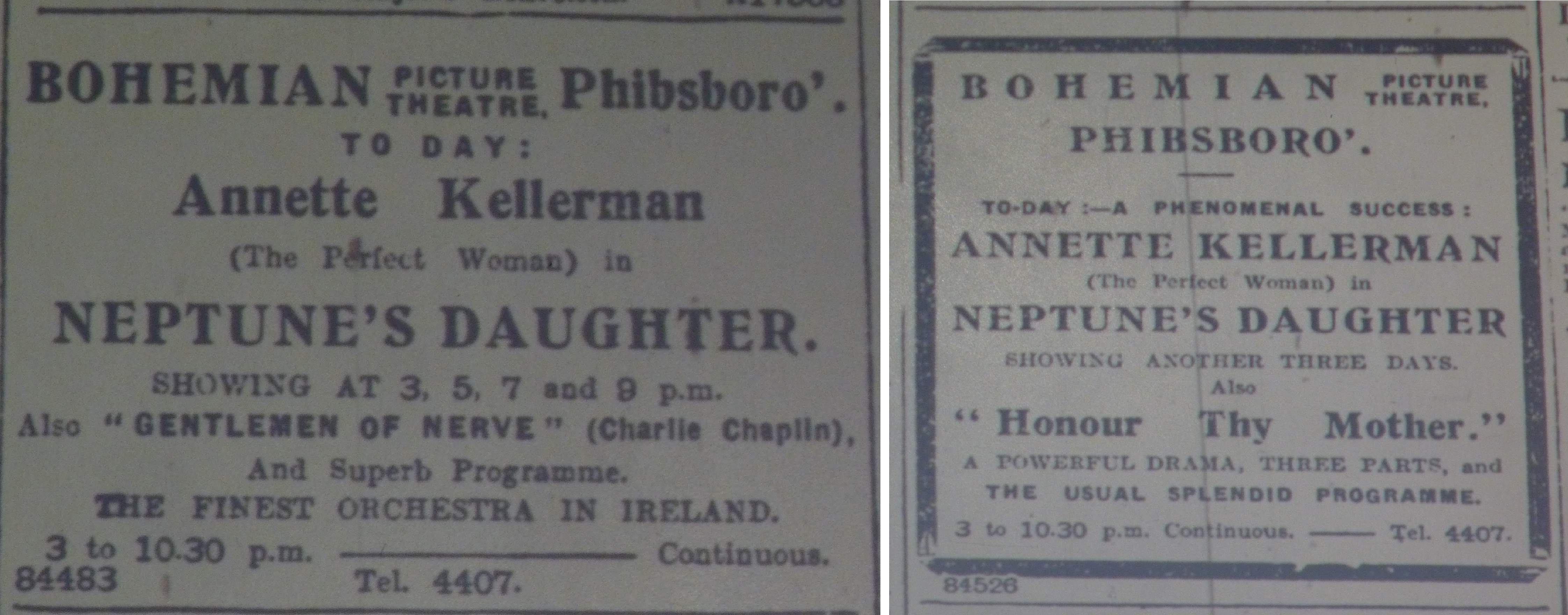
For a full week in early July 1915, Dublin’ s Bohemian Picture Theatre showed Neptune’s Daughter with Australian swimming star Annette Kellerman; Evening Telegraph 5 Jul. 1915: 1 and 8 Jul. 1915: 1.

Dublin’ s Bohemian Picture Theatre retained Neptune’s Daughter for a full week in early July 1915; Evening Telegraph 5 Jul. 1915: 1 and 8 Jul. 1915: 1.

Holloway’s defensiveness here is understandable because the DVC had not gone away in the interim and was in 1915 shifting its focus from what it termed “evil literature” to “the filthy picture screen” (“Fighting a Plague”). Neptune’s Daughter had been due to finish its three-day run at the Bohemian on Wednesday, 7 July – two nights before Holloway saw it – but because of its popularity, Bohemian manager Frederick Sparling extended its run into the second half of the week. On the Thursday night, the packed Bohemian was visited by William and Francis Larkin, the members of the DVC most likely to make a protest. The newspapers reported that at 9 o’clock, the Larkins “began to hiss, and they persisted in this form of protest for forty minutes, to the end of the film” (“‘Neptune’s Daughter’”). “It was evident that the audience found nothing of a suggestive or offensive nature in the production,” opined the Freeman’s Journal, “and they showed their approval by applauding warmly (“Annette Kellerman at the Bohemian”). The Larkins and the DVC had by no means finished with cinema, and Neptune’s Daughter encountered some further difficulties. The film was condemned from the altar by a local priest when it opened on 22 July for a three-day run at Sparling’s other picture house, the Sandford in the south-city suburb of Ranelagh. “I have reason to believe,” the Bioscope’s Paddy contended, “that the Reverend Father in question had not seen the film but was going on the strength of the publicity matter – which, it will be admitted is rather striking” (Paddy).
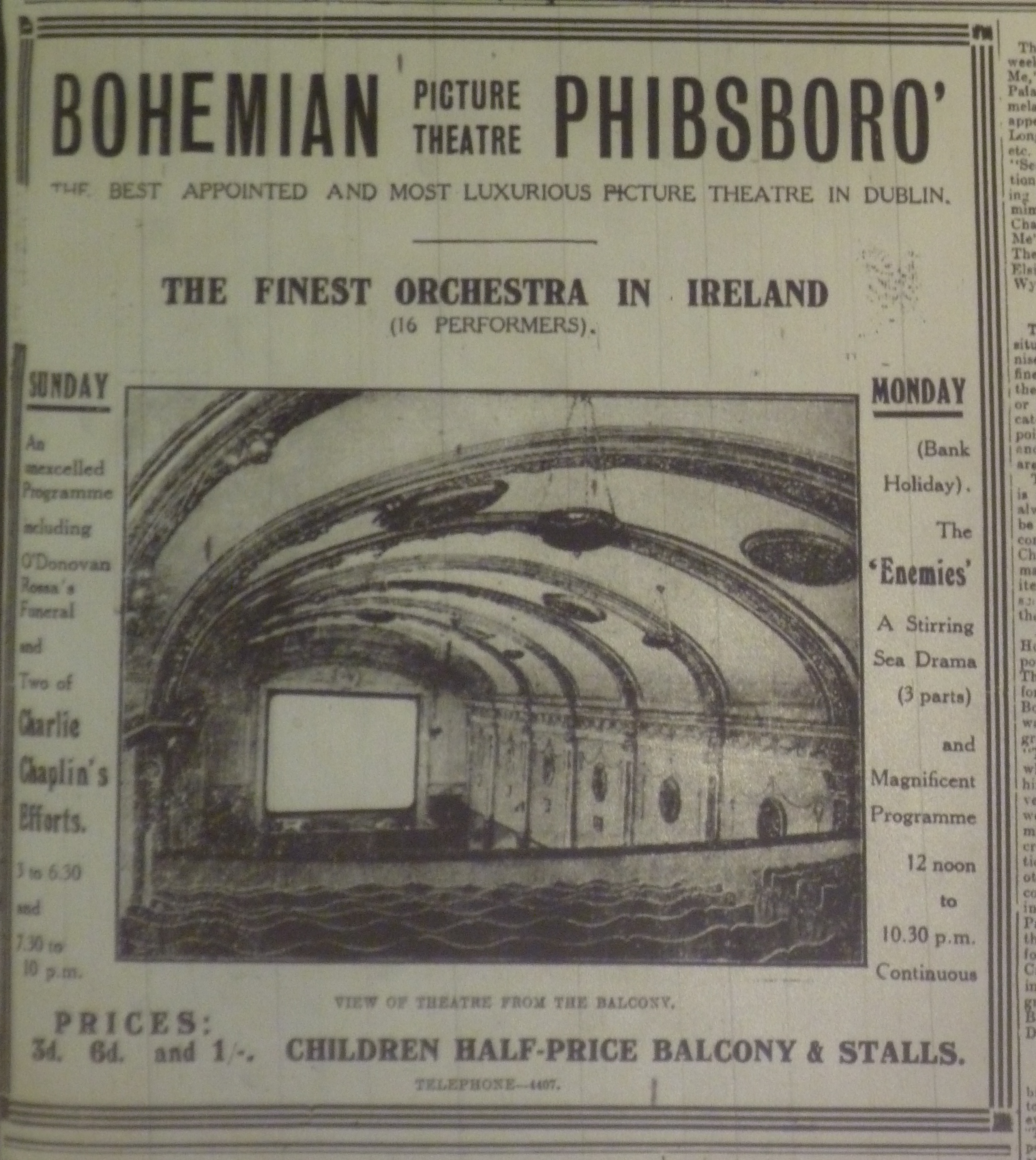
Evening Telegraph 31 Jul. 1915: 3.

Evening Telegraph 31 Jul. 1915: 3.

Part of the reason the Bohemian was the site of these events was that it had become one of the most popular picture houses in Dublin. It was a venue that could induce Holloway and presumably others to travel across the city, albeit that Holloway travelled to see Annette Kellerman in Neptune’s Daughter. Regular newspaper ads helped to build and maintain this popularity. At the end of July on a page headed “City Theatres and Picture Palaces to Visit During the Holidays,” the Bohemian published an unusually large ad with a photograph illustrating its claim to be “the best appointed and most luxurious picture theatre in Dublin.” If this ad was addressing potential audience members with reasons to choose the Bohemian from among the other picture houses, those reasons had to do with the luxury experience to be had there. Taken from the back of the balcony, the photo emphasized the decorative plasterwork, light fittings, comfortable seating and large screen. The ad’s largest text apart from the Bohemian’s name referred not to the film offerings but to the “Finest Orchestra in Ireland,” made up of 16 performers. You went to the Bohemian for its beautiful physical and aural environment.
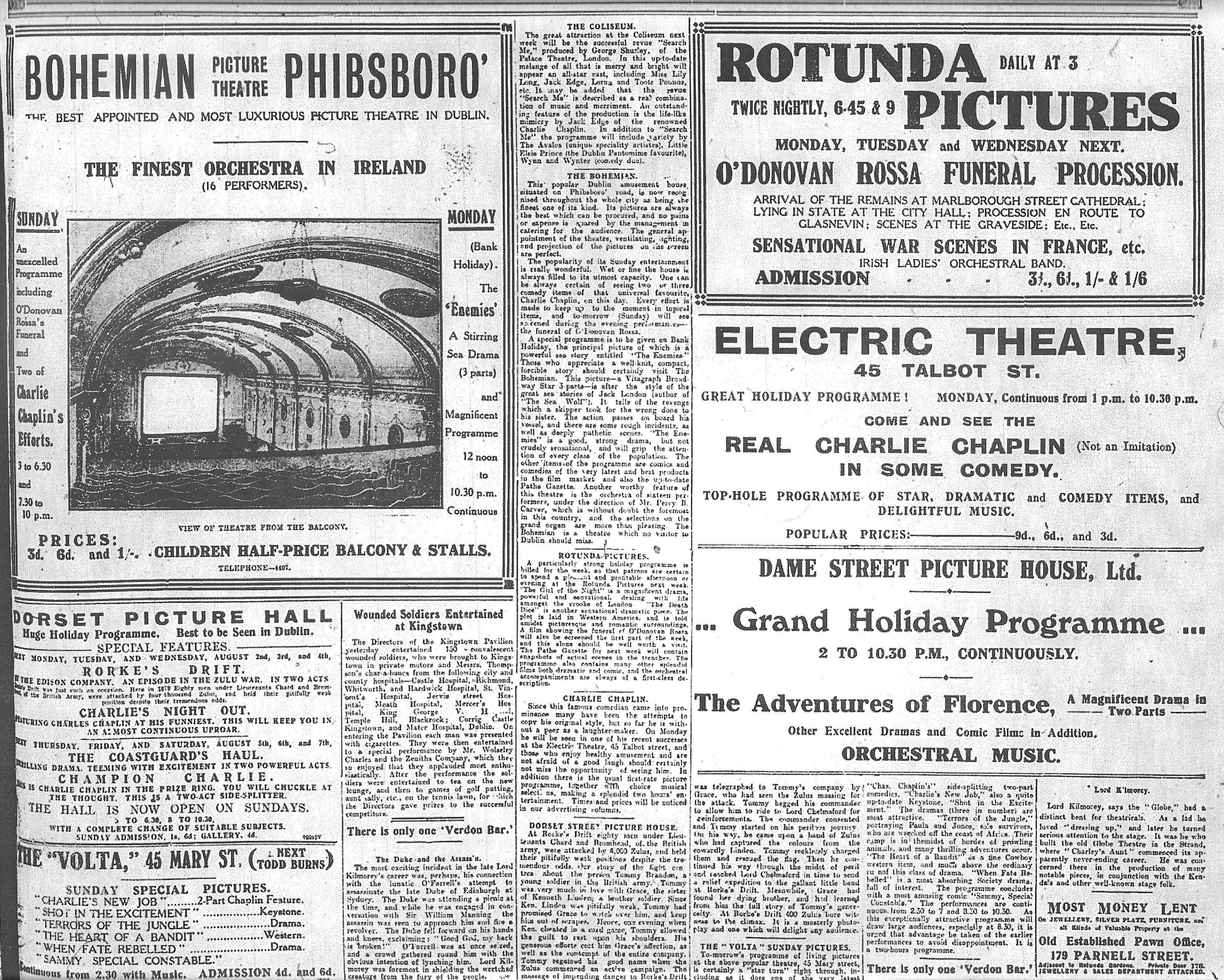
August bank holiday offerings by Dublin's picture houses; Evening Telegraph 31 Jul. 1915: 3.

August bank holiday offerings by Dublin’s picture houses; Evening Telegraph 31 Jul. 1915: 3.

Whereas the Bohemian’s ad pushed film titles to a peripheral position, the ads for the Bohemian’s five rival Dublin picture houses prominently displayed film titles they had chosen for the August holiday weekend. Charlie Chaplin featured in four of the six picture house ads, with the Electric Theatre in Talbot Street emphasizing that it had the “Real Charlie Chaplin in Some Comedy (Not an Imitation).” This may have been a general reference to Chaplin’s multitude of screen and stage imitators or a more specific one to the music hall comedian Jack Edge, who was shown in the Coliseum Theatre’s advertisement on the same page dressed as Chaplin.

The most prominent title advertised by the newly renovated Rotunda was a film of the funeral of the Fenian Jeremiah O’Donovan Rossa, an outdoor activity largely undisrupted by the weather. Organized by the Fenians’ revolutionary successors, the Irish Republican Brotherhood (IRB), the funeral was a massive demonstration of the ability of the IRB to mobilize the more militant factions of Irish nationalism. The IRB arranged for O’Donovan Rossa’s body to be repatriated from New York to Dublin, where it lay in state for three days at City Hall and was subsequently accompanied on Sunday, 1 August, by a procession of about 5,000 mourners – watched by at least ten times that number – to Glasnevin Cemetery, where Patrick Pearse delivered his renowned graveside oration. Pearse was not audible in the film by Whitten’s GFS, which recorded highlights of this three-day commemoration, but the volley of shots over the grave by armed Volunteers and the extent of public support were no doubt eloquent enough for the many people who watched the film in picture houses around the country in the coming days and months. Those eager to see the film first did not have to wait for the screenings at the Rotunda, which did not have a licence to open on Sundays, but could attend the Bohemian, where it was on view a few hours after the end of the funeral and at a picture house on the route of the funeral procession. There they could shelter from the vagaries of the Irish summer in some comfort.

References

“Annette Kellerman at the Bohemian.” Freeman’s Journal 10 Jul. 1915: 7.

“Fighting a Plague: Vigilance Committee’s Crusade.” Irish Catholic 11 Sep. 1915: 1

Holloway, Joseph. Holloway Diaries. National Library of Ireland.

“‘Neptune’s Daughter’: Protest in Dublin Picture House.” Irish Times 9 Jul. 1915: 6.

“Theatre Royal.” Sunday Independent 30 Jun. 1912: 6.

“Wet Weather.” Irish Times 4 Aug. 1915: 4.
Urchins, Ragamuffins and Film Communism in Irish Cinemas, Summer 1915

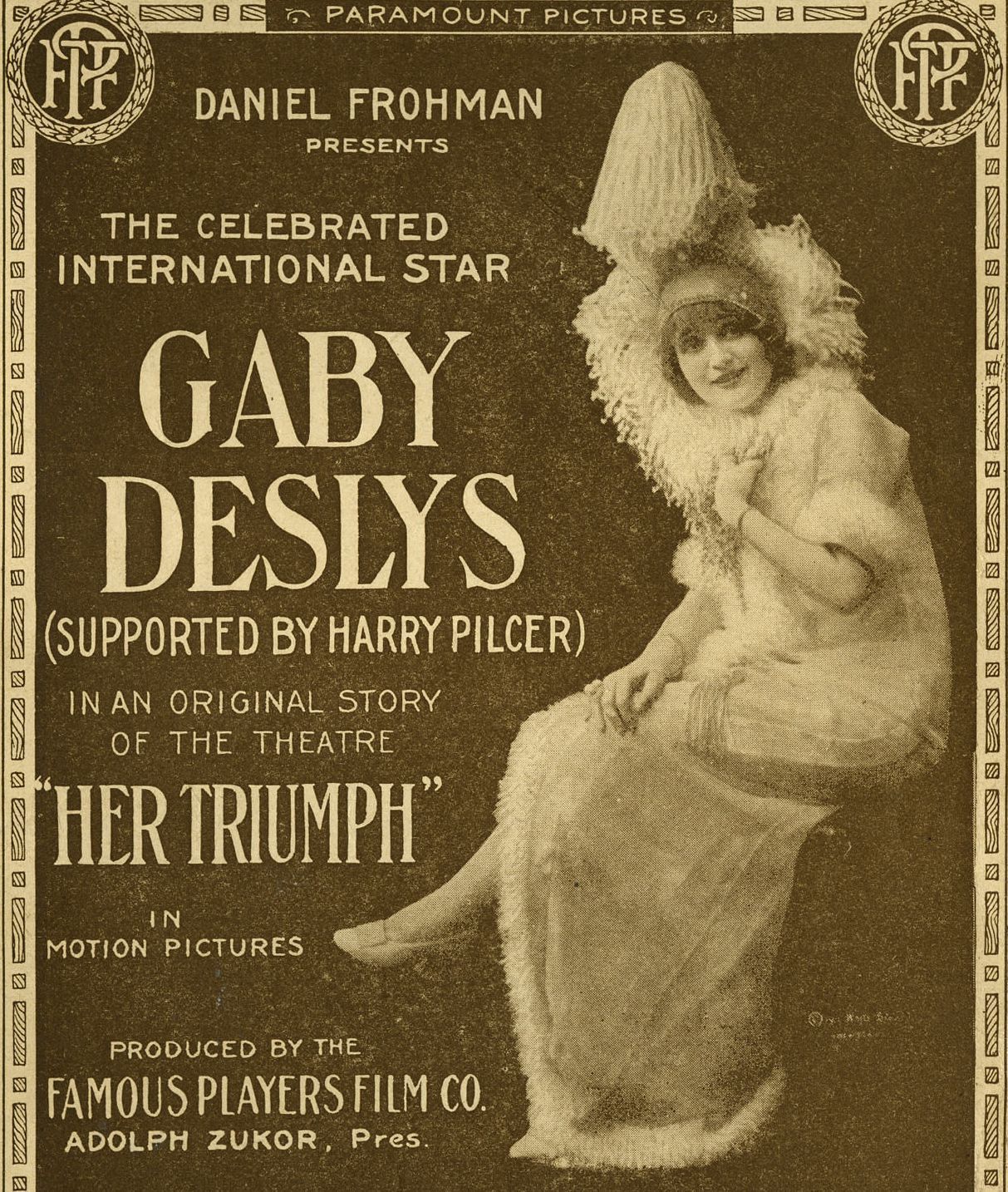
Poster for Gaby Deslys in Her Triumph (US: Famous Players, 1915)

Poster for Gaby Deslys in Her Triumph (US: Famous Players, 1915). Source: http://allstarpics.famousfix.com/0595982/013521322/gaby-deslys-pic.html

In June 1915, the trade journal Bioscope celebrated the levelling that the cinema had performed on the geography of culture. “There is no provincialism about the picture theatre entertainment,” it asserted, claiming that films had removed the benefits formerly experienced by inhabitants of the metropolitan centres of culture.

The inhabitants of any townlet, however small, provided it possesses a cinema, may follow the latest developments of the new drama with every bit as much intelligence and intimacy as the metropolitan picture-lover. Thanks to the cinematograph, the American stage, with all its fine originality and vitality, is as accessible to the Londoner, as is the London stage to the American. (“The Communism of the Film.”)

Although the writer returns after just a brief sojourn in the de-provincialized townlets to London and the cities of America, it is undoubtedly true that local picture houses could offer the inhabitants of small towns and even villages unprecedented access to globalized popular culture. S/he concludes that cinema “has internationalised art and has completed the wonderful work of intellectual communism which was commenced by the printing press” (ibid.).

A century on, the word “communism” looks odd in this context. The nearest Irish cinema came to communism in the early to mid-1910s was during the Dublin Lockout of 1913-14, discussed here and here. Clearly “intellectual” significantly qualified the expected socio-economic meaning of communism, and the comment is really only made in passing, the writer being interested in communism merely to the degree that it allowed the wide availability of the performance of the scandalous French dancer and international celebrity Gaby Deslys in her film debut Her Triumph (US: Famous Players, 1915).

The Bioscope was not, of course, suggesting that the workers of the film trade would or should seize control of the means of cinematic production. But the idea that the cinema did democratize access to culture was current in Ireland and is worth exploring. Timothy Cronin, a young Tralee, Co. Kerry, publican and nationalist politician had strongly supported the coming of the cinema – “[f]rom the purely educational standpoint, it is possibly the most remarkable invention since Caxton brought the printing press into being” – to his home town in 1913 (“The Pictures”). “We sorely need nourishment for the intellect in our remote country town,” he had argued, and although it was on the Great Southern & Western rail line, Tralee was almost as geographically remote as it was possible to be in Ireland from Dublin and Belfast, or the greater metropolis of London. “In the pictures at the Theatre Royal, inspired as they are by the soft strains of Miss Queenie D’Arcy’s Orchestra, we have a present such nourishment. And more of it will do us no harm” (“The Animated Pictures”).

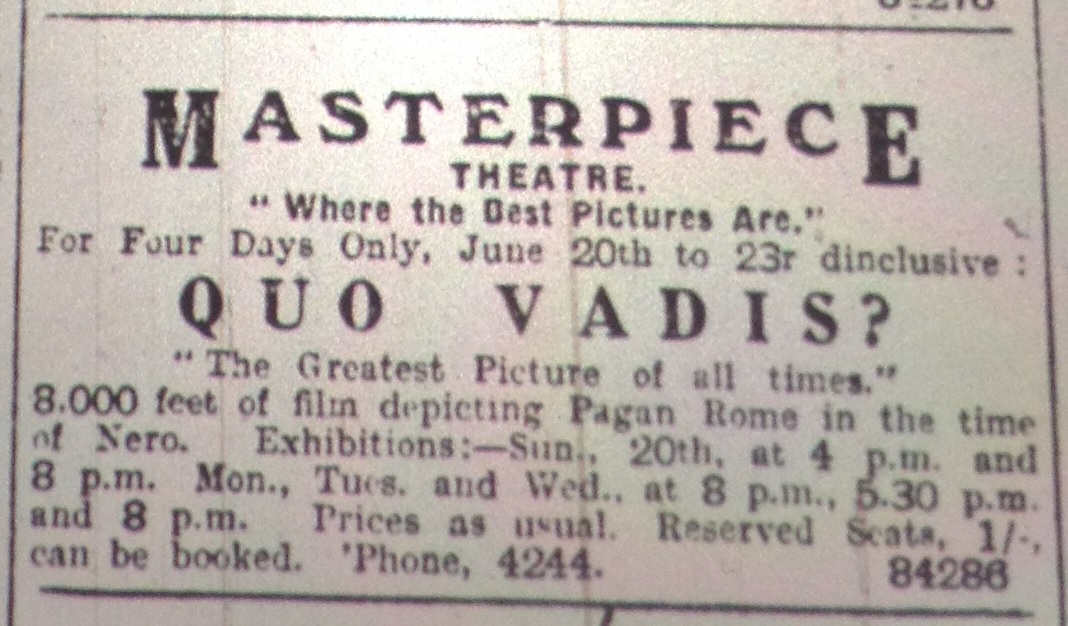
The revival by Dublin's Masterpiece of Quo Vadis? in June 1915 shows the film's continuing importance. Evening Telegraph 19 Jun. 1915: 1.

The revival by Dublin’s Masterpiece of Quo Vadis? in June 1915 shows the film’s continuing importance. Evening Telegraph 19 Jun. 1915: 1.

And although Cronin also wrote that “[i]t would be invidious to make a comparison between one or other of the films shown,” he later marvelled at the effect of the Quo Vadis? (Italy: Cines, 1912), on whose opening night he “witnessed the remarkable spectacle of a vast audience, representative of every section of the people, keenly appreciating what one might well have thought not one but the most highly cultured would be able to appreciate” (“The Pictures”). “After the performance,” he reveals, “I heard what I never expected to hear in my native town – groups of urchins excitedly discussing a classic drama! In my opinion, the Pictures are directly responsible for this remarkable raising of the popular standard” (ibid.).

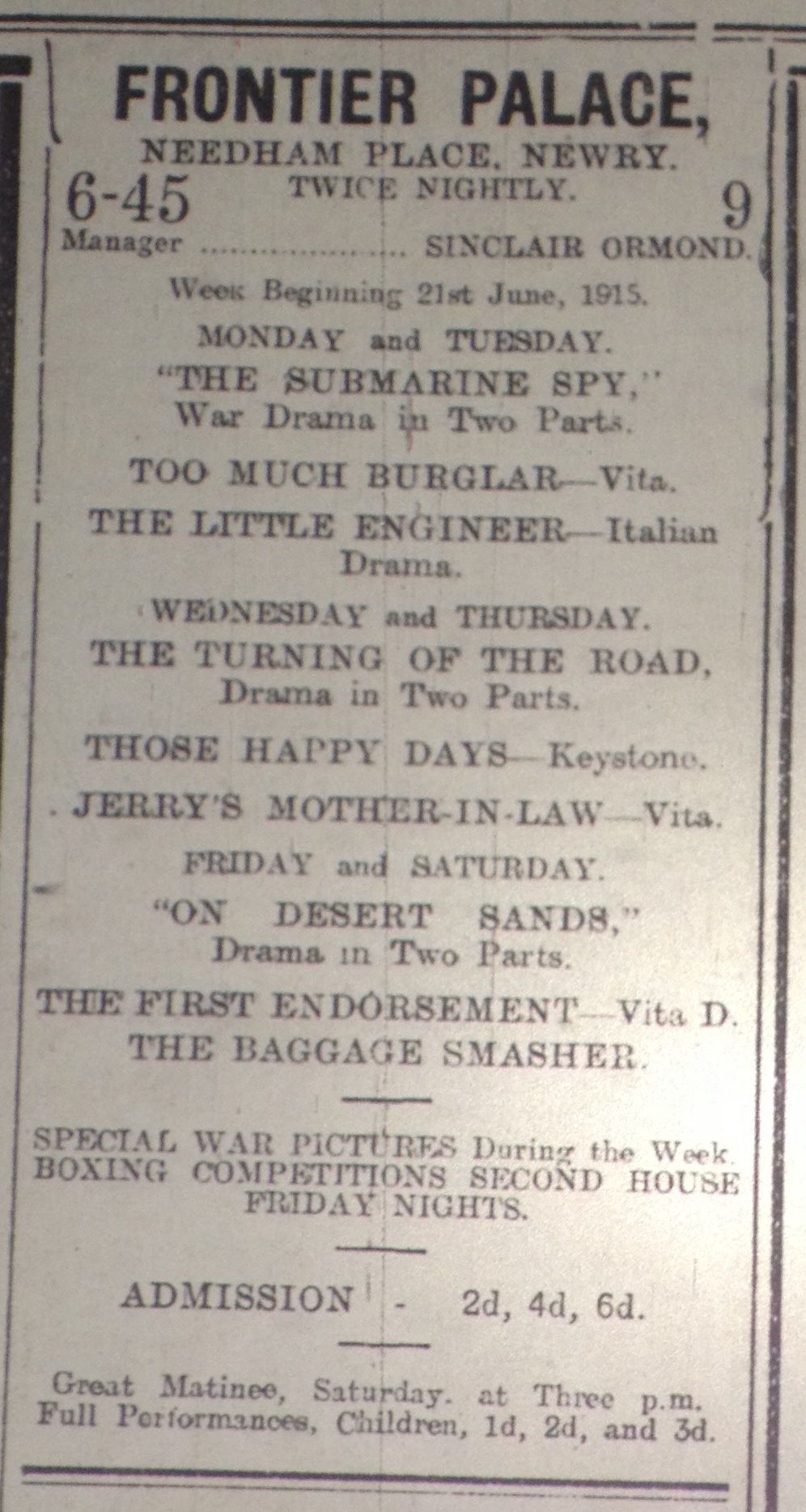
Cinema nourished the intellect, but the orientation towards classical Western culture – albeit that Quo Vadis? was based on an 1895 novel by Polish author Henryk Sienkiewicz – and the celebrity culture of the 1910s does not seem especially revolutionary. The real source of cinema’s emancipatory potential may have come from its creation of new social spaces in which different social classes could mix in ways different from other entertainment venues. But the stratification of picture houses – depending on one’s ability to buy a ticket, the cost of one’s ticket and the location of the building – was well advanced in June 1915, when the Bioscope’s Irish correspondent Paddy was quite dismissive of a cheap working-class picture house. Located in Newry, Cos. Down and Armagh, and run by Mrs. M. Green, this cinema was a “‘picture palace’ – with an emphasis on the ‘palace’ – in a slum. Admission could be had by presenting an empty bottle or some rags. To see the show patrons also gave jampots” (Paddy, 24 Jun.).

Ad for the Frontier Palace, Newry; Frontier Sentinel 19 Jun. 1915: 4.

Ad for the Frontier Palace, Newry; Frontier Sentinel 19 Jun. 1915: 4.
Showing little comradely feeling for Newry’s slum dwellers, Paddy found this to be “a rather amusing case,” finishing his item with the local Sergeant Little’s evidence of how he had once found the premises “full of ragamuffins” (ibid.). Paddy and the Bioscope had never mentioned this picture house in their previous reports on Newry, where they had focused on the Picture Palace, the Frontier, the Imperial and the occasion screenings at the Orange Hall. Mrs Green’s picture palace did not meet the image of a respectable and well-regulated business that a trade journal such as the Bioscope sought to present. It may, indeed, be wrong to read too much in to such an item, whose source is unclear; it does not seem to have been appeared in the local or national press. It may also be a mistake to place too much importance on such a venue, in which a form of barter may have been a way of extracting the little value slum children could afford by a local property owner. The 1911 Census lists two likely Mrs M. Greens in Newry: 70-year-old Mary Ann Green, who lists her occupation as “House Property,” and her 32-year-old daughter Margaret Green, a nurse.

Few of the surviving historical sources allow us to linger long on the audiences of a century ago. Nevertheless, it is tempting to speculate on the educative value the urchins of Tralee or the ragamuffins of Newry would have derived not from literary adaptations but from the anarchic antics of Chaplin’s tramp in his little triumphs over bosses, property owners and police sergeants.

The vulnerability of the cinema trade as a whole to stories like this was revealed at the end of June 1915 when an appellant at the Dublin City Sessions claimed that the opening of a picture house nearby was grounds for a lower valuation on his/her premises (“Recorder of Dublin and Picture Houses”). Well known for his opposition to Sunday shows at certain Dublin picture houses, the Recorder (chief magistrate) expressed his displeasure at the unconditional granting of additional cinema licences by the Corporation in the city and the council in the adjacent township of Rathmines. It was, he said, “a most discreditable state of affairs” (ibid.). At the same time, in an indicative incidence of targeted selling an anonymous vendor was offering cinema companies the opportunity to acquire at a moderate price on a long lease with low rent a building in an unnamed southern town said to be suitable for use as a picture house (“To Picture Palace Companies”).

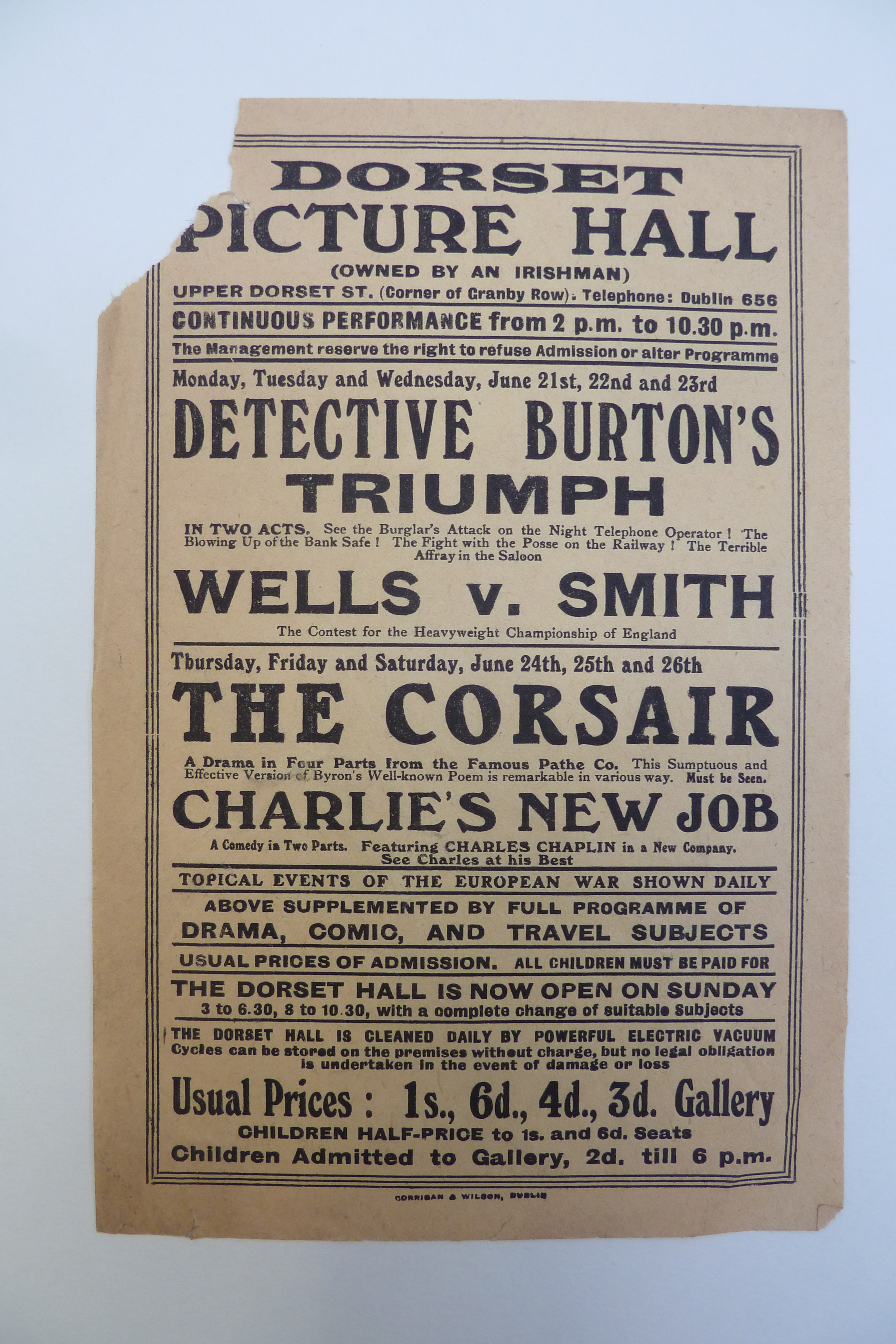
Handbill for Dorset Picture Hall, 4-19 Jun. 1915. Courtesy of National Library of Ireland.

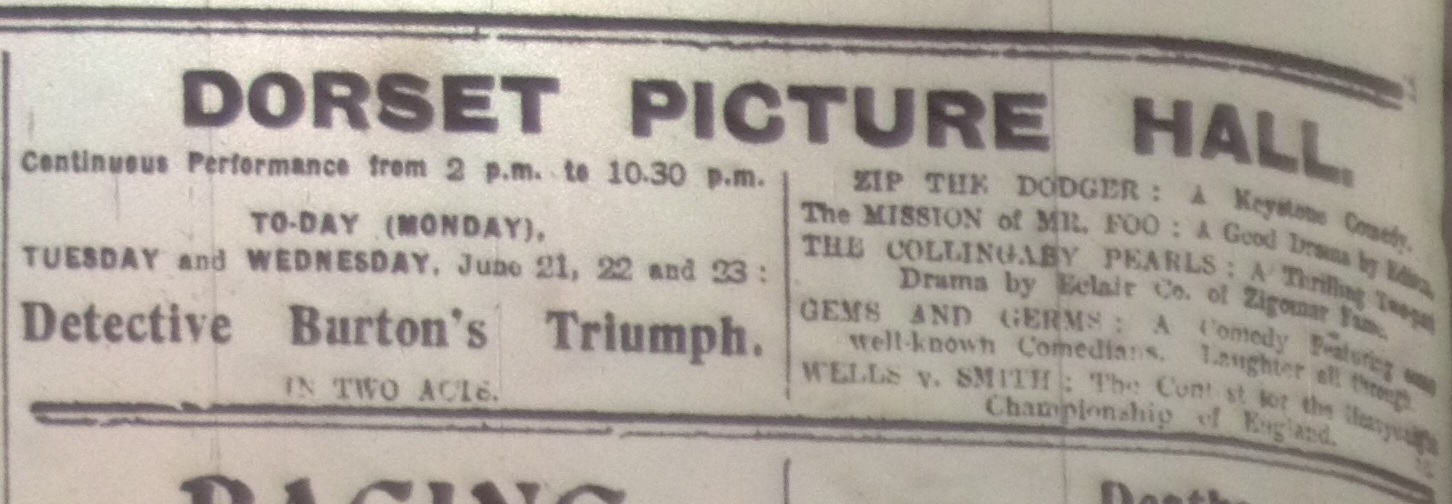
This surviving handbill for the Dorset Picture Hall, 21-26 Jun. 1915 offers a wealth of information on how this cinema operated that is not available elsewhere, such as in the corresponding ad that appeared in the Evening Telegraph 21 Jun. 1915: 4. Courtesy of the National Library of Ireland.
Dorset 22 Jun 1915

Discussion of the Irish churches and cinema often revolved – and continues to revolve – around such issues as restrictive Sunday opening or the censorship of certain kinds of films. However, in mid-June 1915, Paddy reported on the Presbyterian General Assembly’s quite different views in their debate in Belfast on “The Utilisation of the Cinema in Church Missions” (Paddy, 17 Jun.). The Presbyterian churches’ screenings of films alongside preaching has already been noted here, but among the interesting extra details that emerged from this debate was the reported attendance of 60,000 people at the previous season’s Saturday night screenings at the Shankill Road Mission, with 6,000 attending every week during the winter months.

Despite film’s apparently successful missionary role, not all of the Assembly’s participants were in favour of picture shows. Although he assured the meeting that he never attended himself, Reverend S. Sims objected to the queues of boys and girls he observed waiting to get in on Saturday nights because they “paid 1d. or 2d. for admission that ought to be spent on clothing or food” (ibid.). Sims’s views were not endorsed by the meeting, which seems to have been more in accord with Dr Montgomery, who contended that it “was absurd for anybody to appear before that house and argue that a meeting opening with hymn and prayer, in which there was a gospel address, must be wrong because a cinematograph exhibition was given” (ibid.).

The approximately £750 a year that Sims alleged came from the pennies of Belfast’s poor young people suggests that even for religious uses of film, capitalism may have been the more applicable economic model than communism.

References

“The Communism of the Film: Gaby Deslys as a Picture Actress.” Bioscope 10 Jun. 1915: 1096.

Cronin, Timothy B. “The Pictures.” Killarney Echo 10 Jan. 1914: 8.

—. “The Animated Pictures.” Kerry Evening Star 13 Mar. 1913: 3.

Paddy. “Pictures in Ireland.” Bioscope 17 Jun. 1915: 1165; 24 Jun. 1915: 1326.

“Recorder of Dublin and Picture Houses.” Irish Times 1 Jul. 1915: 3.

The Lure of the Picture House: Disaster and Comedy in Irish Cinemas, May 1915

By May 1915, cinema had become so compulsive for some Irish people that it landed them in trouble with the law. Dublin newspapers reported on “the lure of the picture house” that had led two children, Annie Hughes and Rose Kavanagh, from Newtown Park Avenue in Stillorgan, to beg door-to-door to get money to go to the cinema (“Lure of the Picture House”). At the Police Court in Kingstown (now Dún Laoghaire), Kavanagh’s father said that his daughter acted without his knowledge and that “it was the attractions of the picture houses that cause them to beg” (ibid.). Hearing from the police that the girls were constantly begging, Justice Michael Macinerney put them on probation for 12 months.

Illustrated ad for Rupert of Henzau (Britain: London, 1915) at Dublin's Picture House, Grafton Street; Evening Telegraph 31 May 1915: 2.

Illustrated ad for Rupert of Henzau (Britain: London, 1915) at Dublin’s Picture House, Grafton Street; Evening Telegraph 31 May 1915: 2.

Whatever about its compulsion to drive people to illegal activity – a point made both by some reform groups and by some wrongdoers seeking to lay the blame for their actions with the new medium – other commentators were making the point that cinema had become a habit for many people. Writing in Irish Life, playwright and novelist Edward McNulty assessed the progress of the cinematograph against the many claims made for it:

[A]ll the things predicted of the cinematograph are undoubtedly realisable, but, unfortunately, most of the brightest anticipations have not been achieved. The cinema was, above all, to be educational. All the drudgery of teaching was to vanish. Schools and colleges were to be transformed into theatres of instruction; the daily paper was to be supplanted by the Cinema News Bureau, and the French irregular verbs were to be assimilated in the guise of light comedy. (Paddy, 20 May).

Nevertheless, “ in spite of its defects and disappointments, we must gladly acknowledge that the marvel of cinema is the vehicle of diurnal delight all over the civilised globe” (ibid).

Although Irish cinema of the period was certainly a vehicle for diurnal delight, May 1915 was striking for the motivations other than delight that lured patrons to the picture houses. If diurnal delight was epitomized by Charlie Chaplin’s comedies, their power of attraction was at least matched by war films. The Cinema News Bureau had not – and would never – replace the newspaper, but the sinking of the RMS Lusitania showed how the media worked together to serve wider ideological war needs. The Cunard Line’s transatlantic steamer was torpedoed by a German submarine off Kinsale, Co. Cork, at about 2pm on 7 May, and initial reports appeared in the evening newspapers (“Lusitania”), with fuller accounts dominating the news on 8 May. The story had several aspects of interest to Irish papers, some of which had particularly local resonance and other of which linked to war-related issues. Rescue efforts were coordinated from the Cork port of Queenstown (now Cobh), where survivors and victims were initially brought and the inquest held. The large loss of civilian lives – almost 1,200 of the nearly 2,000 people on board died – world have made this a particularly important story in any case, and one that justified propagandistic condemnation of German disregard for civilian life and the rules of war. As well as this, the fact that more than 100 Americans were among the victims provided an impetus for discussion of the hoped-for US entry into the war on the British side.

Newspaper reports were joined on Monday, 10 May by the first newsreel images. The big newsreel companies Gaumont and Pathé sent film units to Queenstown. “Immediately the news was received,” revealed the trade journal Biosocpe,

Gaumont’s dispatched four photographers to the south of Ireland – one from London, Liverpool, Dublin and Belfast – and their joint film contributions were promptly sent to London, where they were supplemented by a few views of the arrival at Euston of survivors. The subject is introduced by a general view of the Lusitania, Messrs. Pathé Frères had men at Queenstown, and a staff of three photographers at Lime Street Station, Liverpool, to meet the train conveying survivors. (Filming ‘Lusitania’ Incident.”)

On Monday, Gaumont released a 350-foot “special topical,” while Pathé initially included just a 50-foot (approx. 1 minute) item in their regular Pathé Gazette, with the intention of supplementing this with a further 150-foot item for the weekend. “The enterprise of these two firms is only surpassed by their restraint,” commented the Bioscope, “when it is remembered that about ten cameras were employed, and the output of film ran into four figures” (ibid.).

Entertainment ads showing impact of Lusitania sinking; Evening Telegraph 10 May 1915: 1.

Entertainment ads showing impact of Lusitania sinking; Evening Telegraph 10 May 1915: 1.

Irish audiences also had the opportunity to see these films. Patrons of Dublin’s Rotunda were offered “a series of pictures depicting incidents connected with the arrival of the Lusitania victims and survivors at Queenstown” (“Rotunda Pictures,” 11 May). The depth of emotion expressed by the journalist who visited the Picture House in Sackville/O’Connell Street suggests that s/he saw the longer Gaumont film. “A picture showing scenes and incidents after the sinking of the Lusitania was shown at this House yesterday;” s/he reported.

[I]t was both interesting and pathetic, and one left with feelings of deepest emotion at the havoc and misery caused to countless human beings by the unmediated act of murder on the part of the German submarine, which, with a total disregard for the lives of women and children sent the mighty ship to the bottom. (“O’Connell Street Picture House.”)

The clear anti-German feeling here was congruent with the reporting on the sinking in general and particularly with the verdict of the inquest, which was given in an editorial item on the same page as the review of the Sackville/O’Connell. “This appalling crime was contrary to international law and the convention of all civilized nations,” it began, “and we, therefore, charge the owners of the submarine, the German Emperor, and the Government of Germany, under whose orders they acted, with the crime of wilful and wholesale murder” (“The Kinsale Verdict.”)

What seems incongruous – but may only seem so – is that the writer so affected by the Lusitania film should find immediate relief in the comedies that accompanied it on the same programme. “After viewing those harrowing incidents,” s/he observed, “the excellent comedies came as a most welcome change; they included ‘Love and Dough,’ featuring the well-known screen comedian Ford Sterling” (“O’Connell Street Picture House”). Images of war and physical comedy complemented each other on the picture-house screen, and as will be seen below, Chaplin had become the comedian in highest demand. Although for audiences in the early 21st century such changes of tone may seem strange or even inappropriate, for audiences in the 1910s, used to entertainments that included variety and contrast, this appears to have been perfectly acceptable.

In any case, films of various kinds provided the imaginative means for coming to terms with the tragedy of war, as well as the spectacle of such new technologies as the zeppelin, the torpedo and the submarine. Bearing echoes of the Lusitania sinking, for example, Dublin’s Masterpiece placed a special ad in the Evening Telegraph at the end of May advising the public that it would give its final exhibition of The Italian Navy “in which is shown a torpedo at its deadly work of sinking a passing vessel” (“The Masterpiece,” 29 May). The Lusitania sinking also had consequences for Irish cinema that only became clear much later. Although Walter Macnamara had shot the Irish historical drama Ireland a Nation for his New York-based production company partly in Ireland in 1914, a copy of the film did not reach the country until 1917 because “the first copy dispatched by them was lost with the ill-fated Lusitania; a duplicate copy was substituted, but […] this also failed to successfully run the submarine ‘blockade’” (“Between the Spools”).

The Lusitania films were joined by other propagandistic war films in mid-May. On 13-15 May, a “very important” War Office film of Lord Kitchener’s visit to British army headquarters in France was shown at Dublin’s Picture Houses in Grafton and Sackville/O’Connell Streets (‘“Lord Kitchener in France”’). Over the same period, the Grafton was also showing a film of the Battle of Neuve Chapelle,

“illustrated by Kineto War Map No. 5. By means of this exceedingly clever animated map the Battle of Neuve Chapelle is shown in a manner most thrilling to watch. The representation of the whole battle is wonderful, and everyone who sees it will be more than interested, as it forcibly portrays the difficult struggle of the British to hold this position against the heavy fire of the enemy’s’ batteries. (Ibid.)

Ad for Dublin’s Masterpiece showing The Secret of Adrianople (1913); Evening Telegraph 15 May 1915: 1.

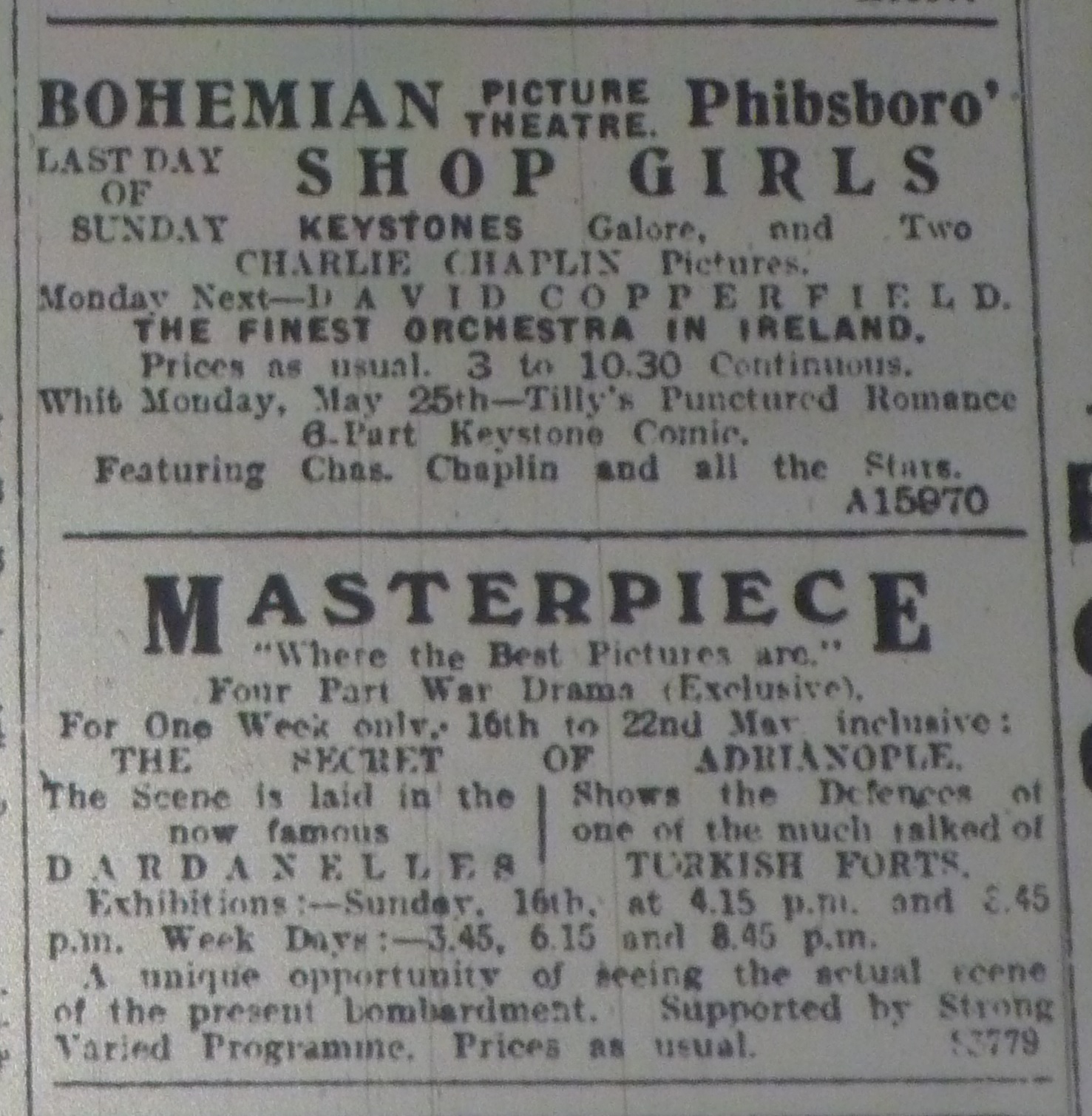
Ad for Dublin’s Masterpiece showing The Secret of Adrianople (Denmark: Kinografen, 1913) and Bohemian ad drawing attention to the big Whit Monday attraction, Tillie’s Punctured Romance (US: Keystone, 1914); Evening Telegraph 15 May 1915: 1.

For the week of 16-22 May, the Masterpiece advertised The Secret of Adrianpole. The preview in the Evening Telegraph described it as “a magnificent four-part war drama, the scene of which is laid in the now famous Dardanelles, and shows the defences of the much-talked-of Turkish forts” (“The Masterpiece,” 11 May). However, the film was not set during World War I, having been released under the title Adrianopels hemmelighed by the Danish company Kinographen in 1913. Interest in the Dardanelles raised by the Gallipoli land campaign that began on 25 April 1915 lent it renewed topicality:

Now, when all eyes are focused on the Dardanelles, and every scrap of information about the present bombardment eagerly devoured, this great picture comes most opportunely, reproducing in interesting fashion the places daily mentioned in the Press, and showing particularly the actual defences of Fort No. 13, one of the fortifications of so much interest at the moment. (Ibid.)

Although these war films clearly attracted audiences, by early summer 1915 Charlie Chaplin was Irish cinema’s most consistent draw. As already mentioned, the Rotunda showed the Lusitania newsreel beginning on Monday, 10 May; however, the “principal attraction for the great majority of the audience who will frequent the Rotunda this week will, undoubtedly, be the Keystone comedy film entitled ‘The Knockout’” (“Rotunda Pictures,” 11 May). The Knockout (US: Keystone, 1914) actually starred Roscoe “Fatty” Arbuckle and Minta Durfee, with Chaplin in a minor role, but the review of the Rotunda shows mentioned only that it featured “the well-known comedian, Charles Chaplin, as referee in a boxing match of a decidedly novel description” (ibid.). This favouring of Chaplin was consistent with a recent comment that no cinema “programme now is complete without the well-known comedian, Charles Chaplin” (“Rotunda Pictures,” 8 May).

Charlie Chaplin, caught between Mabel Normand and Marie Dressler in Tillie's Punctured Romance (US: Keystone, 1914)

Charlie Chaplin, caught between Mabel Normand and Marie Dressler in Tillie’s Punctured Romance (US: Keystone, 1914).

For the week beginning with the Whit Monday holiday, 24 May 1915, the Rotunda again featured a Chaplin film, Charlie’s New Job (US: Keystone, 1914), but the Bohemian upstaged them by securing exclusive rights to Tillie’s Punctured Romance (US: Keystone, 1914). The first feature-length comedy, the six-reel Tillie’s Punctured Romance starred Chaplin alongside stage actress Marie Dressler and Keystone favourite Mabel Normand. Reporting on a press showing of the film on 9 May, a writer in the Evening Telegraph observed that the “farcical element throughout the whole performance has full sway, and the spirit of fun dominates the various scenes. […] The film has been secured by the ‘Bohemian’ at the cost of £100, and the enterprise of the management should meet with a huge measure of public appreciation” (“Bohemian Picture House”). Their enterprise apparently was rewarded because the reviewer of the Whit Monday show commented that “Chaplin is certainly at his best in this production, and all those desirous of seeing him should go early, as the demand for seats last evening was very great” (“The Bohemian”).

Such diurnal delights would continue to lure audiences for many years to come.

References

“Between the Spools.” Irish Limelight 1:2 (Feb. 1917): 19.

The Bohemian.” Evening Telegraph 25 May 1915: 2.

“Bohemian Picture House.” Evening Telegraph 10 May 1915: 2.

“The Kinsale Verdict.” Evening Telegraph 11 May 1915: 2.

“Filming ‘Lusitania’ Incident.” Bioscope 13 May 1915: 623.

‘“Lord Kitchener in France.”’ Evening Telegraph 12 May 1915: 4.

“The Lure of the Picture House.” Evening Telegraph 3 May 1915: 6.

“Lusitania: Sinking Off Cork Coast: Help from Queenstown: 1,400 Passengers on Board.” Evening Telegraph 7 May 1915: 3.

“The Masterpiece.” Evening Telegraph 15 May 1915: 8; 29 May 1915: 8.

The O’Connell Street Picture House.” Evening Telegraph 11 May 1915: 2.

Paddy. “Picture in Ireland.” Bioscope 20 May 1915: 773.

“Rotunda Pictures.” Evening Telegraph 8 May 1915: 8; 11 May 1915: 2.

Creating Great Trouble in a Most Laughable Manner: Chaplin in Dublin in 1914

Chaplin Lookalike Winner Film Fun Jan 1916

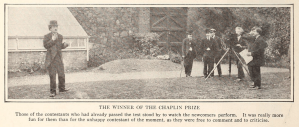
The winner of a Chaplin lookalike contest run by Dublin’s Masterpiece Theatre; Film Fun Jan 1916: n.p.

By October 1915, a Charlie Chaplin craze was in full swing in Dublin. Paddy, the Irish correspondent of the British cinema trade journal Bioscope, showed this when he reported on several simultaneous tributes to Chaplin less than two years after he made his first film. On 7 October, Paddy revealed that Captain Ahearne of the Dame Street Picture House had shown all-Chaplin programmes the previous week, while a live Chaplin revue at the Coliseum Theatre had distinguished itself from the Chaplin impersonation competition taking place at the Rotunda by featuring what Paddy claimed was “the only Chaplin girl extant” (Paddy, 7 Oct.).

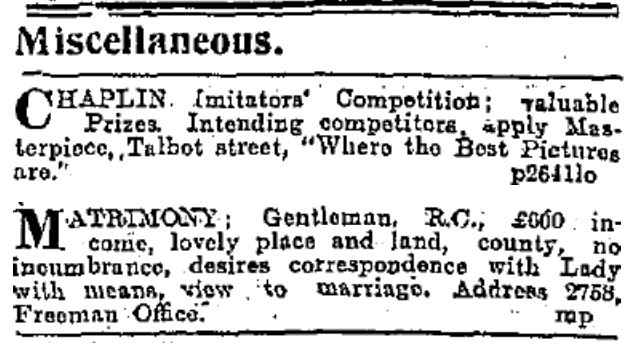
Small ad calling for Chaplin imitators. Freeman's Journal 16 Sep. 1915: 8.

Small ad calling for Chaplin imitators. Freeman’s Journal 16 Sep. 1915: 8.

That such competitions were not wholly new was shown by the fact that Cathal MacGarvey manager of the Masterpiece Theatre, Talbot Street was exhibiting his film of a Chaplin impersonation competition that had taken place at his picture house in September (Paddy, 14 Oct.). Chaplin seemed to be everywhere you looked by the autumn of 1915. But this adulation had taken some time to grow.

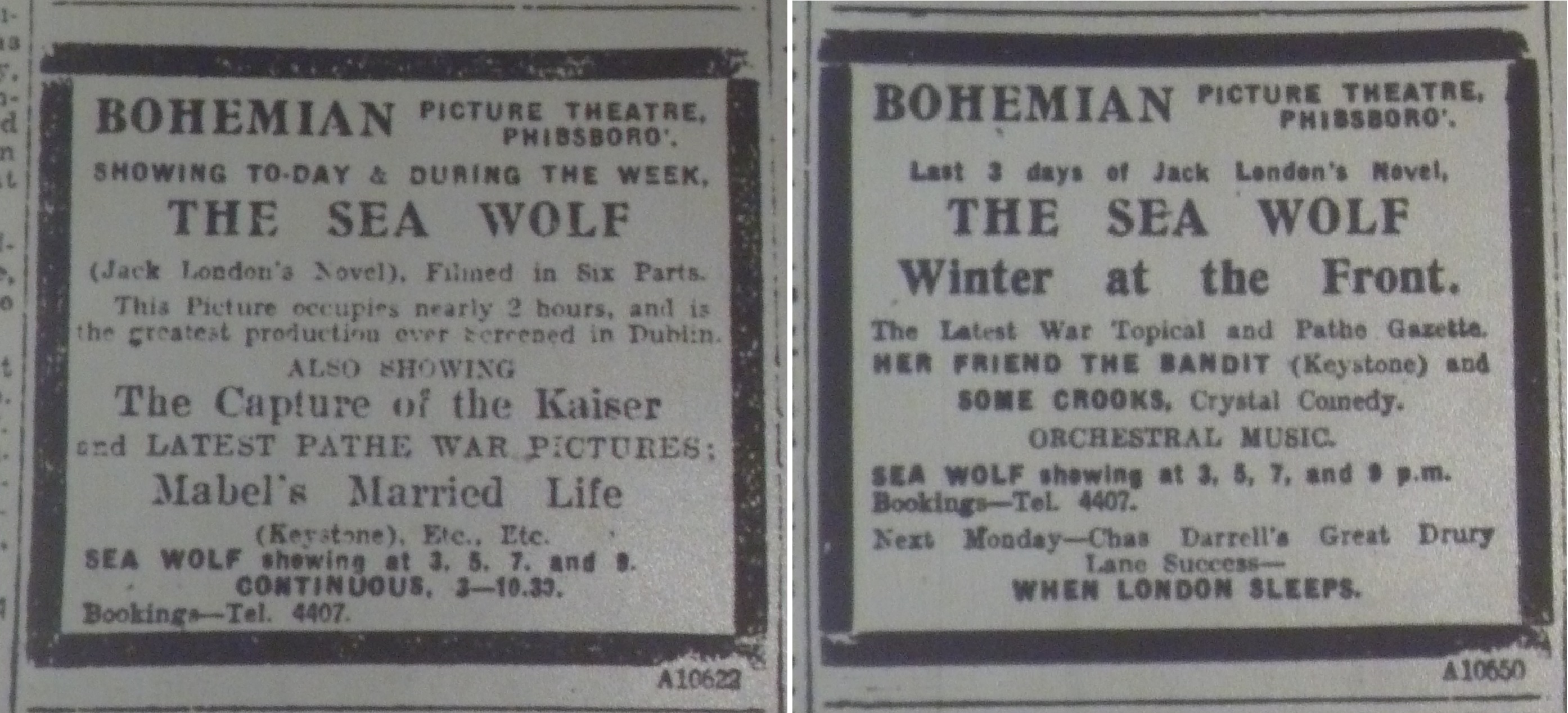
The Bohemian Picture Theatre showed Mabel's Married Life in the first three days of the week beginning 30 Nov. 1914 and Her Friend the Bandit for the last three days of that week. Evening Telegraph 30 Nov. and 3 Dec. 1914.

The Bohemian Picture Theatre showed Mabel’s Married Life in the first three days of the week beginning 30 Nov. 1914 and Her Friend the Bandit for the last three days of that week. Evening Telegraph 30 Nov. and 3 Dec. 1914.

Irish audiences’ decades-long love affair with Charlie Chaplin, the biggest film star of the first half of the 20th century, began modestly a century ago. Cinema audiences in Ireland, like those around the world, knew the slapstick comedies for which Mack Sennett’s Keystone Film Company was already famous when Chaplin joined in December 1913. When he began shooting his first films in January 1914, Chaplin played supporting roles to such better-established comics as Mabel Normand, Roscoe “Fatty” Arbuckle and Ford Sterling. However, he rapidly became the star player in films that he directed himself. Nevertheless, he did not renew his Keystone contract in December 1914, choosing instead to join George K. Spoor and Gilbert M. “Broncho Billy” Anderson’s Essanay Film Manufacturing Company.

As the best remembered of the stars who emerged in the 1910s, Chaplin has already been discussed briefly here and here. Now that the centenaries of his year at Keystone have passed, it may be worth looking in more detail at the Irish reception of this initial stage of his career. Almost all the Keystone films he appeared in have survived, and thanks to the Chaplin Keystone Project, these have been restored to as watchable a condition as possible and are available in the DVD collection Chaplin at Keystone, accompanied by an informative booklet. Despite the films’ flashes of brilliance, however, it is hard not to agree with David Robinson that “[w]e can only look back at the first few Keystone films and see a crude, unfinished form, and the earliest tentative search for a screen character” (130). But as Robinson goes on to argue this is our problem in retrospect: “To the audiences of the time they were new and astonishing. From the very start, Chaplin had created a new relationship with the audience, provoking a response that no one had elicited before in film or in any other medium” (ibid).

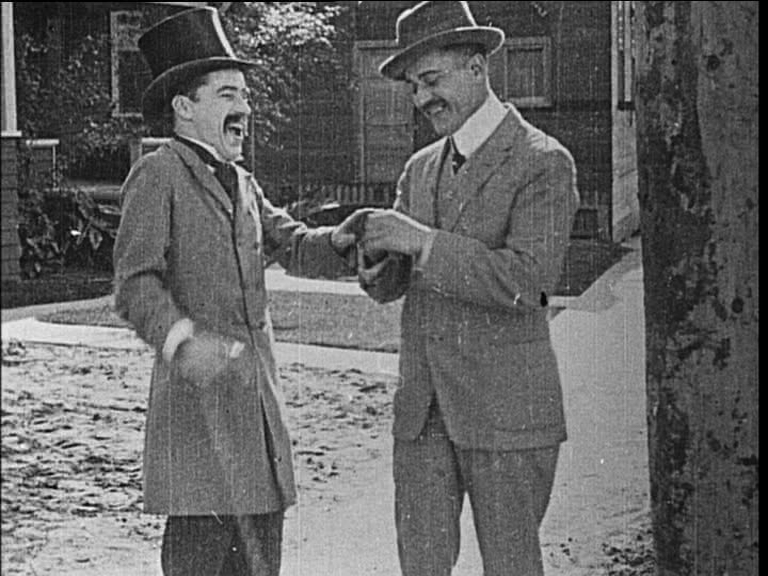
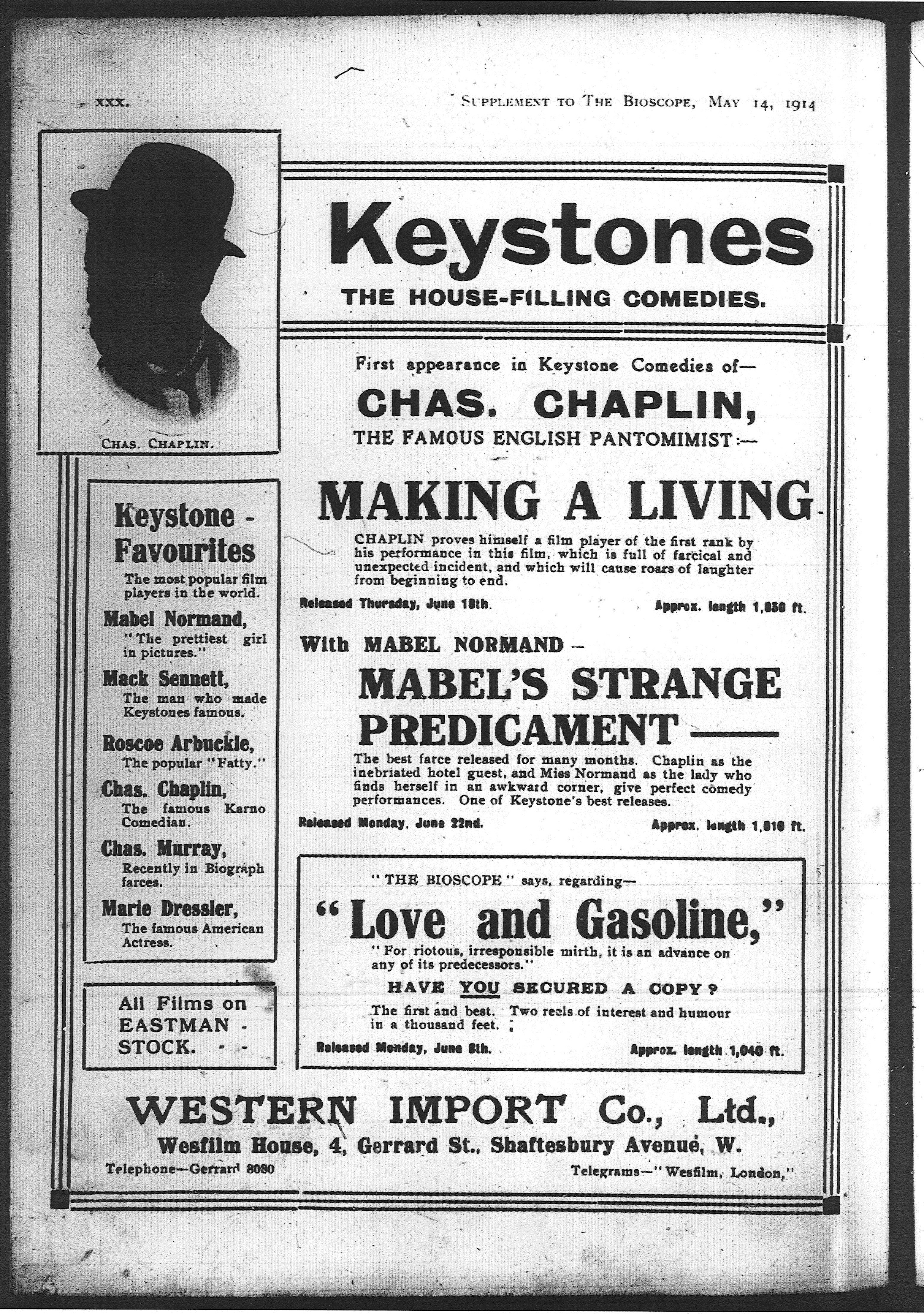
Irish audiences’ first sight of Chaplin on screen was not as a tramp but as a “sharper” in Making a Living (US: Keystone, 1914).

Surviving accounts from Irish audience members are rare, but newspapers do offer some clues about how that relationship began in Ireland. These clues have to be sifted out of ads and articles that are largely the product of the marketing needs of film production companies, distributors, picture houses and the newspapers that carried the material. Most of the cinema display ads, preview and reviews in Dublin newsaper were for the few picture houses that paid for advertising. The most regular picture-house advertising was from the Rotunda Pictures in Dublin’s O’Connell/Sackville Street, which had long used extensive advertising to construct its reputation as the city’s premier picture house. In roughly descending order of regularity of advertising, the Rotunda was followed in late 1914 and early 1915 by the Bohemian Picture Theatre in Phibsboro; the Masterpiece Theatre in Talbot Street; the Provincial Cinematograph Theatres pictures houses in Grafton and O’Connell/Sackville Streets; the Phoenix on Ellis Quay; the Dorset Picture Hall; the Volta in Mary Street; the Electric Theatre in Talbot Street; Dame Street Picture House; and the Pillar Picture House in O’Connell/Sackville Street. This represents just two-fifths of Dublin city’s cinemas, and many of those named often did not mention the titles of the short comedies that supported the main dramatic feature. Nevertheless, the display ads, previews notices and reviews of these picture houses allow us to track the release dates and something of the reception of Chaplin during his year at Keystone.

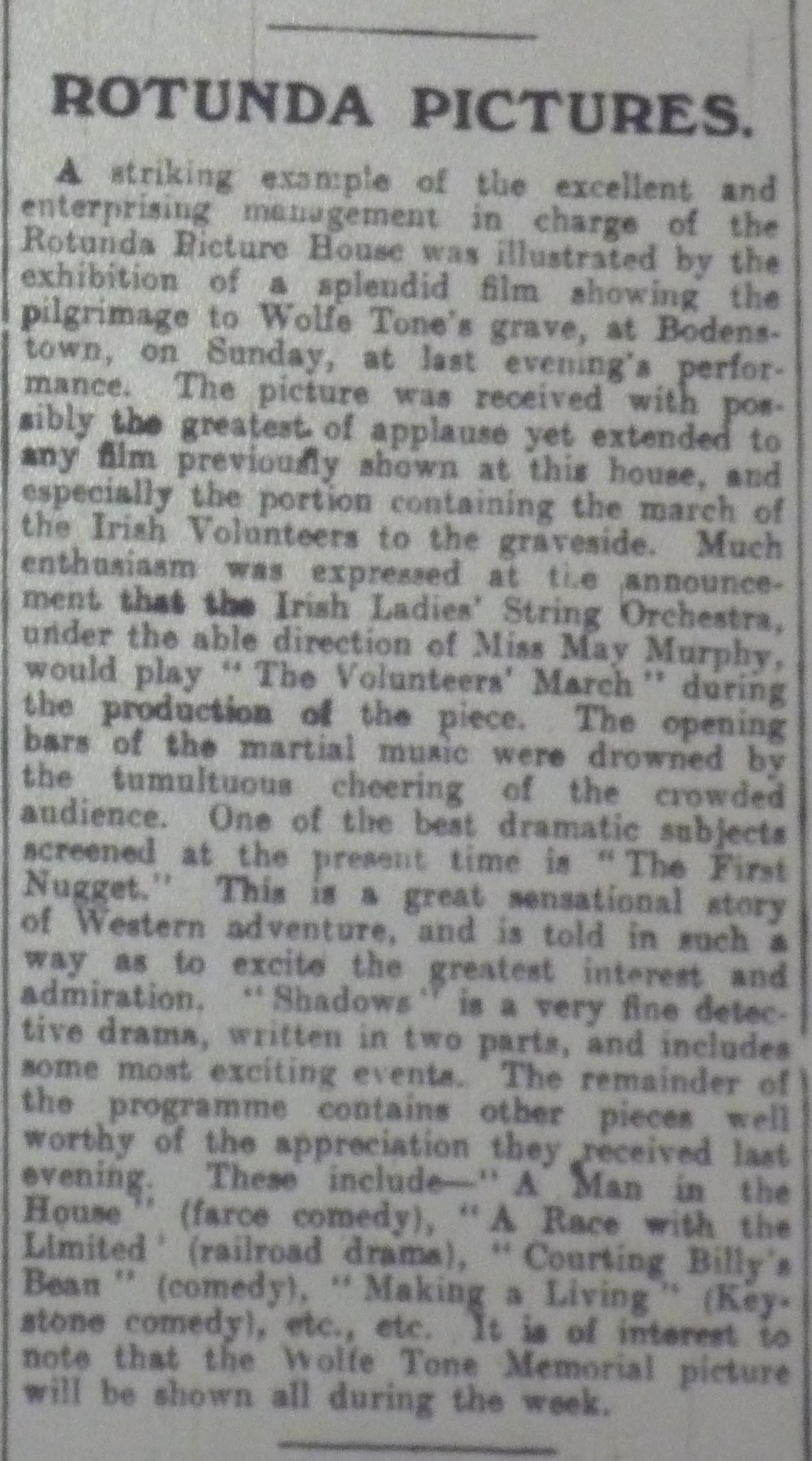
This review of the programme at the Rotunda Pictures gives a good indication of where comedies featured in the priorities of newspaper reviewers. Evening Telegraph 23 Jun. 1914: 2.

This review of the programme at the Rotunda Pictures gives a good indication of where comedies featured in the priorities of newspaper reviewers. Evening Telegraph 23 Jun. 1914: 2.

It was at the Rotunda that Chaplin first appeared on a screen in Dublin in the comedy Making a Living (US: Keystone 1914), which had a three-day run beginning on Monday, 21 June 1914. The Evening Telegraph’s review suggests that contemporary observers did not share the importance we would likely attribute to the beginning of Chaplin’s career. The highlight of the bill on which Making a Living appeared was for at least the nationalist members of the audience – as it was for the reviewer in the nationalist Evening Telegraph – “a splendid film showing the pilgrimage to Wolfe Tone’s grave, at Bodenstown, on Sunday” (“Rotunda Pictures,” 23 Jun.). This local topical (news film) “was received with possibly the greatest of applause yet extended to any film previously shown at this house,” and its exhibition was enhanced by the Irish Ladies’ String Orchestra playing “The Volunteers’ March”: “The opening bars of the martial music were drowned by the tumultuous cheering of the crowded audience” (ibid.). By contrast, Making a Living was merely mentioned in passing along with two other comedies that were also part of the programme.

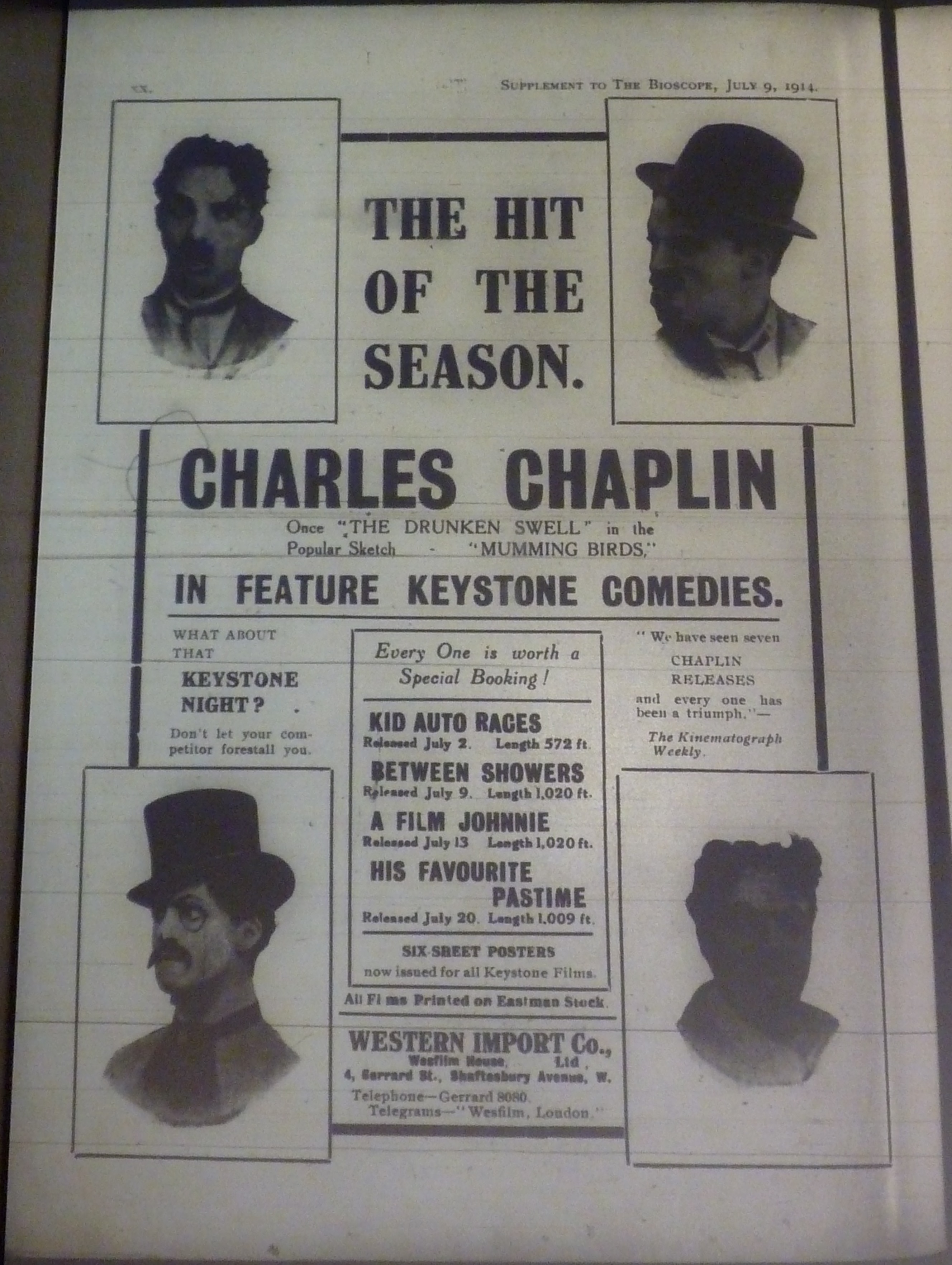
Western Import Co. ad for Chaplin's early Keystone film hails him as the hit of the season and reminds readers of his stage career. Bioscope 9 Jul. 1914: xx.

Western Import Co. ad for Chaplin’s early Keystone films hails him as the hit of the season and reminds readers of his stage career. Bioscope 9 Jul. 1914: xx.

Making a Living was almost five months old by the time it reached Irish screens. It had been shot on 5-9 January 1914 and first released in the United States on 2 February 1914 (Chaplin at Keystone). From 21 June on, however, Chaplin’s films were released in Ireland in quick succession but not always in the same order as they had appeared in the US. This release pattern and much of the publicity material available to picture house managers came from the Western Import Company, the British and Irish distributor of all Keystone films. All the films released by Western Import up to the end of January 1915 were shown in Dublin. Western Import was based in London, and its ads in the trade papers reflected the fact that Chaplin’s films had been a particular hit in the US and were likely to be at least as popular in Britain where he had recently been a music-hall comedian.

In Mabel's Strange Predicament, Dublin audiences saw Chaplin's tramp costume for the first time in a film whose comedy comes largely after Mabel locks herself out of her hotel room in her pajamas.

In Mabel’s Strange Predicament, Dublin audiences saw Chaplin in his tramp costume for the first time, harassing Mabel Normand in her pyjamas.

Despite the information available from the distributor, the names of Mabel Normand or Ford Sterling were more likely to have caught the attention of comedy audiences that week. When Mabel Strange Predicament – the film in which Chaplin first appeared as the tramp – began its three-day run at the Rotunda on 2 July, the Dublin Evening Mail did not mention Chaplin but commented of Normand that “this little lady is now the leading comedienne in filmland” (“Rotunda Pictures,” 27 Jun.). And when Chaplin’s next film, Kid Auto Races at Venice, Cal., was appreciatively reviewed during its Rotunda run (6-8 July), the reviewer misidentified Chaplin as Keystone’s more established Fatty Arbuckle, observing that the “famous ‘Fatty’ of the Keystone company, will be seen in a screamingly funny picture, ‘Kid Auto Races’” (“Rotunda Pictures,” ET 7 Jul.). This pattern was not confined to the first few of Chaplin’s films screened in Dublin but continued up to November, when Mabel’s Busy Day was described as “one of the funniest adventures of Mabel Normand, Keystone Company” (“Rotunda Pictures,” ET 21 Nov.). Although “[a]mongst the humorous contributions” to the bill at the Masterpiece on 22 December “Chaplin, of the Keystone Co., in ‘A Busy Day,’ was very amusing,” this did not distinguish him from Ford Sterling who had left Keystone for a time and was starring “in a highly diverting Sterling Comedy, ‘Three O’clock’” (“Masterpiece”).

As this suggests, Keystone was itself a brand that newspaper advertisers and reviewers expected readers to recognize. This was emphasized on 10 October, when a preview of the Rotunda’s programme recommended When Reuben Fooled the Bandits – featuring the lesser known Keystone player Charles Murray – on the sole basis that it was a Keystone, “which means the last word in comedy” (“Rotunda Pictures,” ET 10 Oct.). The company brand and the star brand were also frequently combined. On 17 October, the preview of the Masterpiece Theatre did not specify the title of the comedy films that would be on show in the following week, but one of them “is a highly diverting Keystone, featuring the inimitable [C]haplin” (“Masterpiece Theatre”).

All the Keystone films featuring Chaplin released onto the British market between late June 1914 and the end of January 1915 were shown in Dublin, and many of them had their first Dublin exhibition on or close to the day Western Import released the film. Some films, however, appear to have been screened weeks or months after the release date, but it is possible that they were screened earlier and in the period before the attractiveness of Chaplin’s name was fully realized, their titles were not mentioned in the press. In any case, Making a Living’s appearance at the Rotunda on 22 June was four days after its London release. Mabel’s Strange Predicament appeared at the Rotunda on 2 July, a week and a half after its 22 June release (“Rotunda Pictures,” DEM 27 Jun.). Kid Auto Races at Venice, Cal. was release on 2 July and shown at the Rotunda on 6 July (“Rotunda Pictures,” ET 7 Jul.). Released on 6 July, A Thief Catcher – staring Ford Sterling but featuring Chaplin – ran at the Picture House, Grafton Street (9-11 July; ad, ET 9 Jul.), before the Rotunda (13-15 July; “Rotund Pictures,” ET 11 Jul., II 13 Jul.), and this seems also to have been the case with Between Showers, which was released on 9 July and exhibited first at the Grafton on 13-15 July (“Grafton Street Pictures”). A Film Johnnie was released on 13 July and shown at the Rotunda beginning on 20 July (“Rotunda Pictures,” ET 21 Jul), and His Favourite Pastime seems to have screen first at the Picture House, O’Connell/Sackville Street a week after its 20 July release (ad, ET 25 Jul.).

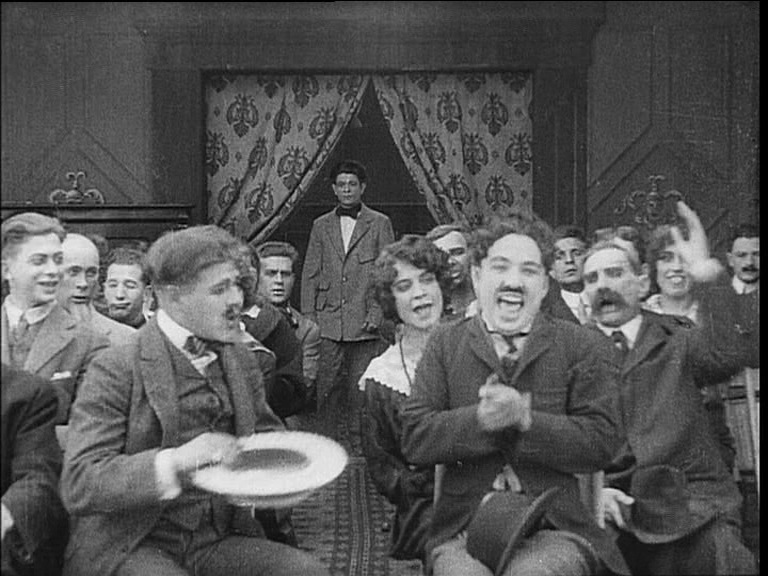
Chaplin's character in A Film Johnnie begins in a picture house and travels to the Keystone studios in pursuit of the Keystone Girl.

Chaplin’s character in A Film Johnnie begins in a picture house and travels to the Keystone studios in pursuit of the Keystone Girl.

No Chaplin film appears to have been released in August 1914, but September was busy. Tango Tangles – featuring Chaplin, Arbuckle and Sterling – was released on 10 September and shown at the Picture House, Sackville/O’Connell Street from 14 September (“O’Connell Street Pictures”). Cruel, Cruel Love’s 17 September release was followed by a 21 September Dublin opening at the Rotunda (“Rotunda Pictures,” ET 19 Sep.). Caught in the Rain was released on 21 September but does not seem to have had a Dublin screening until it was exhibited at the Volta’s well-advertised Sunday shows on 13 December (“Volta,”). Similarly, “Keystone screamer” Twenty Minutes of Love awaited a 17 January 1915 showing at the Volta despite a 28 September 1914 release (“Volta,” 16 Jan.).

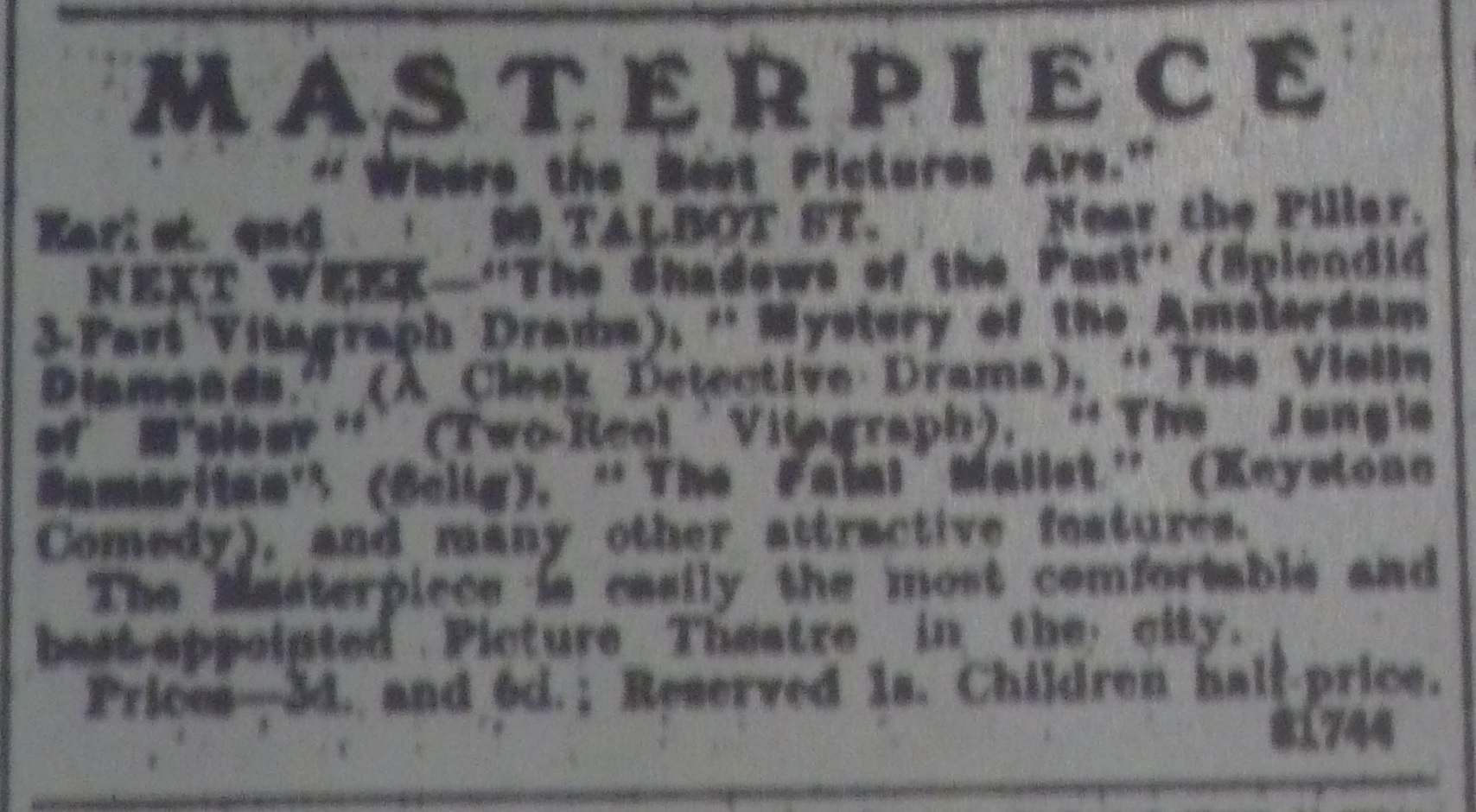
Ad for the Masterpiece programme for the week, including The Fatal Mallet; Evening Telegraph 12 Dec. 1914: 1.

Ad for the Masterpiece programme for the week, including The Fatal Mallet; Evening Telegraph 12 Dec. 1914: 1.

Although October 1914 also saw no Chaplins released, November and December made up for it. The 9 November release of Caught in a Cabaret coincided with the same-day opening at the Rotunda (“Rotunda Pictures,” ET 7 Nov.). A Busy Day waited more than a month after its 12 November release until its Dublin premiere at the Masterpiece on 21 December (“Masterpiece”); the previous week (17-19 Dec.), the Masterpiece had shown The Fatal Mallet, which had been released on 19 November (ad, ET 12 Dec.). Mabel’s Busy Day had a release-day opening at the Rotunda on 23 November (“Rotunda Pictures,” ET 21 Nov.), and Mabel’s Married Life also opened in Dublin the day it was released at both the Rotunda and Bohemian on 30 November (“Rotunda Pictures,” ET 1 Dec.; “Bohemian”). On 3 December, the Bohemian gave Her Friend the Bandit an opening-day release (ad, ET 3 Dec.). And finally, Laughing Gas opened at the Picture House, O’Connell/Sackville Street on 7 January 1915, three days after its 4 January release (ad, ET 7 Jan.).

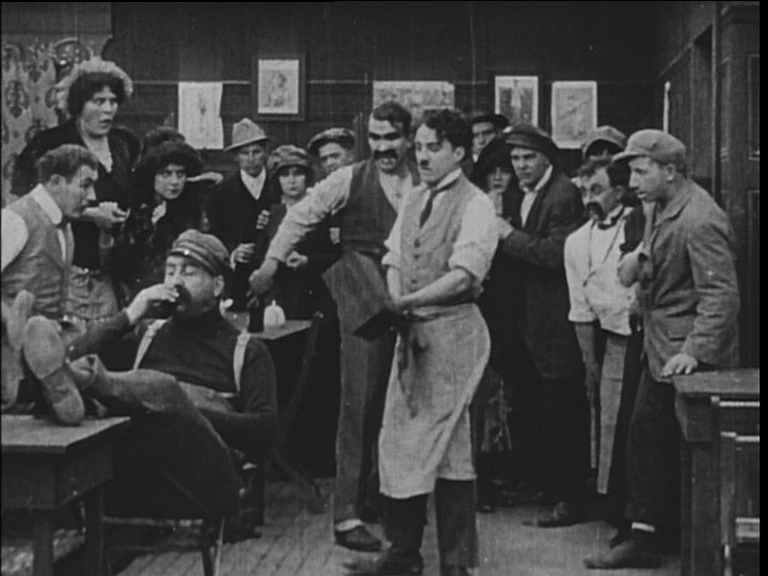
Chaplin prepares to deal with a difficult customer in Caught in a Cabaret.

Chaplin prepares to deal with a difficult customer in Caught in a Cabaret.

Very few of these 18 films were given more than a cursory mention. At the Rotunda in November, Chaplin’s Caught in a Cabaret was given unusual prominence for a comedy by being named as the first “of the principal films of the week” and as “a real live Keystone, one of the funniest yet” (“Rotunda Pictures,” ET 7 Nov.). “‘Caught in a Cabaret’ is the title of one of the best comedy pieces in cinematography yet shown in Dublin, and which is to be seen at the Rotunda Picture House. In all its details it proved a most laughable piece and drew forth loud applause” (“Rotunda Pictures,” ET 11 Nov.). Caught in a Cabaret was also popular at the Kelvin Palace in Bangor at Christmas:

Five performances were held on Christmas Day, and a like number of St Stephen’s [26 Dec.], at each show a complete change of pictures being screened – ten programmes in the two days. To be strictly accurate I should mention tha tone picture was retained in each programme. It was the screamingly-funny two-reel Keystone, “Caught in a Cabaret.” (“Jottings.”)

The most notice any Dublin newspaper reviewer gave to Chaplin in this initial period came at the end of July. “A splendidly long and most amusing comedy is ‘A Film Johnnie,” observed the Evening Telegraph’s columnist, noting the film’s reflexivity. “This picture features Charles Chaplin going to a cinema, where owing to an infatuation for a girl in the screen he creates great trouble in a most laughable manner” (“Rotunda Pictures” ET 21 Jul.). The Irish Times reviewer did not name Chaplin – referring merely to the “young man” in this “real good comedy series” – but commented that the “operations of the fire brigade in regard to that individual are the cause of much laughter” (“Rotunda Pictures,” IT 21 Jul).

Looked at week-to-week, Chaplin’s rise to fame looks more incremental than meteoric, but it would only be a few months before many members of the Dublin audience wanted to be Charlie.

References

“Bohemian Picture Theatre.” Evening Telegraph 1 Dec. 1914: 4.
Chaplin at Keystone. DVD Collection. London: BFI, 2010.

“Grafton Street Pictures.” Evening Telegraph 14 Jul. 1914: 2.

“Jottings from Ulster.” Bioscope 14 Jan. 1915: 146.

“Masterpiece.” Evening Telegraph 22 Dec. 1914: 6.

“Masterpiece Theatre.” Evening Telegraph 17 Oct. 1914: 6.

Paddy. “Pictures in Ireland.” Bioscope 7 Oct. 1915: 57; 14 Oct. 1915: 217.

Robinson, David. Chaplin: His Life and Art. London: Penguin, 2013.

“Rotunda Pictures.” Dublin Evening Mail 27 Jun. 1914: 3.

“Rotunda Pictures.” Evening Telegraph 23 Jun. 1914: 2; 7 Jul. 1914: 2; 14 Jul. 1914: 2; 21 Jul. 1914: 2; 19 Sep. 1914: 6. 7 Nov. 1914: 6; 11 Nov. 1914: 4; 21 Nov. 1914: 5; 1 Dec. 1914: 4.
“Rotunda Pictures.” Irish Independent 13 Jul. 1914: 5.

“Rotunda Pictures,” Irish Times 21 Jul. 1914: 7.

“The ‘Volta’ Sunday Pictures.” Evening Telegraph 13 Dec. 1914: 6; 16 Jan. 1915: 2.

“An Injustice to Good Productions”: Irish Film Distribution, Programme Changes and New Picture Houses in November 1914

The Sign of the Cross.

An exclusive film exhibited in Ireland in November 1914: The Sign of the Cross (US: Famous Players, 1914). Image: The Silent Film Still Archive.

The published information on film distribution in Ireland in the 1910s is useful in general, but it lacks the detail to say something about how Irish cinemas acquired films in, say, November 1914 (Condon, Early Irish Cinema, 215-17; Rockett 38-41). However, the trade press, particularly the London-based Bioscope, and the local papers that month give some more specific details. By this time, exhibitors no longer bought films outright, as the – much smaller number of – exhibitors in the 1900s had. Films were rented from distributors or renters, and the distribution business in Ireland and Britain was based in London. The sea crossing was an issue for distributors into Ireland, particularly as military operations changed the priorities on the transport of goods in 1914. However, such issues were more easily negotiated by the film distributors who had offices in Ireland or worked through Irish agents.
Bioscope 6 Aug. 1914: xix.

Ad for Gaumont’s Chrono projector; Bioscope 6 Aug. 1914: xix. This ad appeared just as war was breaking out; even a few weeks later, it would not have been acceptable in the context of discussions of severing links with enemy companies as part of the war effort.

“I dropped up the other day to see Mr. Young of the Gaumont Company, Lord Edward Street, Dublin,” revealed Irish correspondent Paddy in the Bioscope in early November 1914 (Paddy, 5 Nov.). Since opening early in 1913, the luxuriously appointed Dublin branch office of Gaumont in London sold the company’s popular Chrono projector, held trade viewings in a dedicated screenings room of the films it distributed, and shot many local topical films since its first ones in June 1913, such as The Launch of the Britannic and a film of a hurling match between Kilkenny and Cork (13 Nov.). Paddy noted that “Mr. Young seemed pleased with how matters were progressing, and he expressed the opinion that the falling off on account of the war was practically negligible” (5 Nov.). A year earlier, Paddy had found Young’s predecessor also pleased with business, including the fact that “[a] great many more Irish theatres have thrown in their lot with the Gaumont Film Service” (13 Nov.), including the Grand in Dublin’s O’Connell Street (Paddy, 24 Jul.), Limerick’s Gaiety Bijou (7 Aug.), and Belfast’s Princess Picture Palace (“Jottings,” 12 Nov.).

Gaumont did not have Irish distribution to itself. In November 1914, the Ideal Film Renting Company set up their Dublin office at 40 Dawson Street, Dublin. “There is little doubt that by opening in Dublin,” opined Paddy, “The Ideal Company have stimulated competition and made it possible for exhibitors to make a better selection on the spot” (5 Nov.). Among the exclusive films that Ideal handled were Danish production company Nordisk’s For the Sake of a Man (1913) and Her Hour of Temptation (1914), as well as Joan of Arc (Italy: Savoia, 1913), for which “[s]pecial posters are available” (ibid.).

1The Palace, Frances Street, Newtownards whowing Cecil B. DeMille's The Ten Commandments (1923). http://www.newtownards.info/frances-st.htm

The Palace, Frances Street, Newtownards showing Cecil B. DeMille’s The Ten Commandments (1923). http://www.newtownards.info/frances-st.htm

Other London-based distributors relied on travelling salespeople or on the Irish-based companies that acted as their agents. In the week of 5 November, Paddy also “ran into Mr. Hagan, the Scottish and Irish representative for Messrs. Ruffells’ exclusives,” who “had secured bookings running to over £350” (ibid.). Norman Whitten’s General Film Supply (GFS) appears initially to have been a branch of the London-based General Film Agency, and although Whitten was better known as a maker and distributor of his own local topicals, GFS also distributed the films of other companies. Some larger Irish cinema chains, such as James T. Jameson’s Irish Animated Picture Company, had their own buyers in London (Condon, “Limelight,” 253). An “Item of Interest” in the Bioscope on 19 November informed trade readers that the Palace in Newtownards, Co. Down, had appointed Lillah Dawson as its film reviewer: “Miss Dawson has recommended the features booked at this hall during the past few weeks, and as a result the seating accommodation and the cork lino have come in for some severe wear, strong evidence that this lady weighs up a subject in a capable and experienced manner” (“Film Reviewer Appointed”).

Depending on the nature of the programme at the picture house or houses concerned, a representative such as Dawson might have had a more or less arduous job. Something has already been said here about the content of the film programme, particularly in regards to the number and length of the films and the length of the programme itself. The dominant practice in cities and towns was for picture houses to change their programmes twice a week, on Monday and Thursday, with a third change for those picture houses that held a Sunday licence. As a result, most films had a three-day run, with the possibility of holding over an especially attractive film – most likely, an “exclusive” – for the second half of the week, in which case the other items on the programme were usually changed. A run of longer than six days for any film was really exceptional. Shorter runs were possible. In early November 1914, Dublin’s Rotunda advertised the fact that beginning on 9 November, it would have three changes in the week, which for this venue with no Sunday licence meant two-day programmes, with changes on Monday, Wednesday and Friday. “Large audiences,” a preview in the Evening Telegraph predicted, “are sure to appreciate this move on the part of the management, who certainly spare no expense in catering for the entertainment of their patrons” (“Rotunda Pictures”).

“Programmes Changed Daily: An Injustice to Good Productions.” Bioscope 19 Nov 1914: 789.

An extract from a Bioscope article discussing daily programme changes at the Omagh Picture Palace; 19 Nov 1914: 789.

The generosity – if it can be called that – of the Rotunda management was no match for that of the management at the Picture Palace in Omagh, Co. Tyrone, a town with a population of less than 5,000. Just ten days after the Rotunda had instituted its new programming changes,a Bioscope article drew attention to the fact that the Picture Palace changed its programme every day. As the article’s subtitle – “An Injustice to Good Productions” – suggests, the writer of this article – described as “our Ulster representative,” so presumably it was the writer of the “Jottings from Ulster” column – saw this as an unusual and unwelcome development (“Programmes Changed Daily”). Although conceding that “a manager on the spot knows his own business best,” s/he endorsed the arguments of “a very astute Ulster manager, who favours the bi-weekly change” because of the mutually supporting nature of printed and word-of-mouth publicity:

He argues that on a Monday and Tuesday a hall attracts by its publicity matter only those patrons of the movies who are influenced by good pictorials and by well-written and attractively-set letterpress. On the Tuesday and Wednesday, and again on the Friday and Saturday, the advertising ceased to be of any account. Personal recommendation or condemnation takes its place and either does such good as to comfortably fill the hall, whilst the programme runs, or is so hurtful in its effects as to prove the incompetency of the manager in the selecting of such pictures as please the majority of the people of his district. (Ibid.)

1Ads for Omagh Picture Palace showing variations in programming. Tyrone Constitution 30 Oct. 1914: 4 and 6 Nov. 1914: 4.

Ads for Omagh Picture Palace showing variations in programming. Tyrone Constitution 30 Oct. 1914: 4 and 6 Nov. 1914: 4.

The trade anxieties manifest in this advice about the effective rhythms of advertising had little to do with the Picture Palace’s choice of films but more with the number of films required. Driven from Home (1914), Shadows (US: IMP, 1914) and Lost in Mid-Ocean (US: Vitagraph, 1914) “want a lot of beating as star subjects. Why not, therefore give them an opportunity to prove their value?” (ibid.). Indeed, assuming a complete daily change of programme, the Picture Palace would likely have shown between 25 and 50 films a week, depending on their length. This suggests that the management had a very different view than the Bioscope of the nature of the entertainment it provided. The competing interests of film producers and exhibitors were shown in late November 1914, when the Bioscope cited the call by Carl Laemmle, head of the US production company Universal, to “cheaper American theatres to raise their prices of admission [to cover] the growing cost of film production” (“Trade Topics”). The management of the Omagh Picture Palace appears to have paid little attention to the quality of individual films and focused instead on audience choice and creating a constituency of daily cinemagoers.

First ad for Sandford Cinema; Evening Herald 3 Nov. 1914: 4.

First ad for Dublin’s Sandford Cinema; Evening Herald 3 Nov. 1914: 4.

Omagh’s abundance of films seems to parallel a more general return of optimism to the Irish film trade in late 1914, which saw the opening of some new picture houses. “That little thought is here given to the approach of lean days,” “Jottings” observed, “is evident from the fact that a new hall is now in full swing in Lurgan, under the direction of Mr. Hewitt”, as well as from the enlargement of Lisburn’s Electric Palace, and the equipping of new picture houses in Coleraine and Belfast’s Corn Market (5 Nov.). In Dublin, the Sandford Cinema opened on 2 November with little newspaper publicity. The first notice was a brief review in the Evening Herald the following day, alongside reviews of the Kinemacolor pictures at the Theatre Royal, the Phoenix Picture Palace’s screenings of The Sign of the Cross (US: Famous Players, 1914) – the most heavily publicized film in Ireland in late 1914 – and the Masterpiece Picture House. The review did not give the titles of the films that “were so much admired at the opening show,” focusing instead on the decor of the building that “is sumptuously fitted up interiorally, the costly furniture being supplied by Clery and Co., Ltd.” (“New Picture Theatre in Ranelagh”). Paddy later revealed the opening “star films” to have been England’s Menace (Britain: London, 1914) and The Village of Death (19 Nov.). No other newspaper coverage of the Sandford appeared in the first week of November, but in the following week, several papers carried ads for In the Bishop’s Carriage (US: Famous Players, 1913), with Mary Pickford, for the first three days and The Wheels of Destiny (US: Majestic, 1914) for the last three.

Managed by John and P.W. Whittle, the Sandford was “quite a high-class” picture house, “replete with all modern conveniences,” including Gaumont projectors and the “indirect system of lighting” in the auditorium (Paddy, 19 Nov.). Paddy found the building to be “a beautiful structure, with a fine flight of steps leading up to the pay-box. The entrance doors are finished in stained glass,” and inside, there was a “considerable rake to the floor, thus enabling all patrons to have a full view of the screen” (ibid.). Despite this focus on the experience of all cinemagoers, the audience was to be divided based on ticket price both outside and inside the premises. “The building stands on a corner site, thus enabling the 3d. entrance to be distinct from the 6d. and 1s., [and once inside, the] 1s. seats are distinguished from the 6d. by neat squares of crochet work on the backs” (ibid.). The management did not, however, show the same attention to detail in securing the required official documents, and it was prosecuted on 20 November for operating without a cinematograph licence (“Sandford Cinema Theatre”). Nevertheless, Inspector Gray of the Dublin Metropolitan Police testified that the premises were “extremely comfortable and suitable in every way for a picture theatre. The pictures he had seen were excellent” (ibid.).

Elsewhere – and almost everywhere – war films remained popular. When Dublin’s Daily Express reviewed In the Hands of the Kindly Dutch at the Rotunda in early November, it emphasized the personal response many in the audience might have made to topical films about the war. The film “shows the division of the Naval Brigade who were interned in Holland after the surrender of Antwerp , and was so clear that anyone could recognise a relative or friend” (“The Rotunda Pictures”). In the same week, the Kinemacolor matinees at the Theatre Royal were providing colour films of the front. The fact that these films were shown in such a large theatre rather than in one of the smaller picture houses indicates that the management expected considerable interest in them, and it went out of its way to create further publicity. “On the kind invitation of the management,” the Express reported, “a number of wounded soldiers attended the [Kinemacolor war films] yesterday, and received quite an ovation from the large audience. Others who were unable to attend will be present this afternoon” (“Theatre Royal”).

Evening Telegraph 28 Nov. 1914: 6.

Evening Telegraph 28 Nov. 1914: 6.

Although the Express observed that “[t]he audience yesterday was unreservedly enthusiastic concerning the display” of war pictures at the matinee, certain members of the audience at the Theatre Royal were neither enthusiastic nor reserved about patriotic displays at the theatre’s live evening show (“Picture Matinees”). On 2 November, a group of young men wearing republican badges protested by booing, hissing and groaning when, during one musical number, several Union Jack flags were unfurled and the orchestra played “Rule Britannia.” When 18-year-old Thomas Smart refused to stop, he was arrested and fined 40 shillings in court (“Scene in Theatre Royal”).

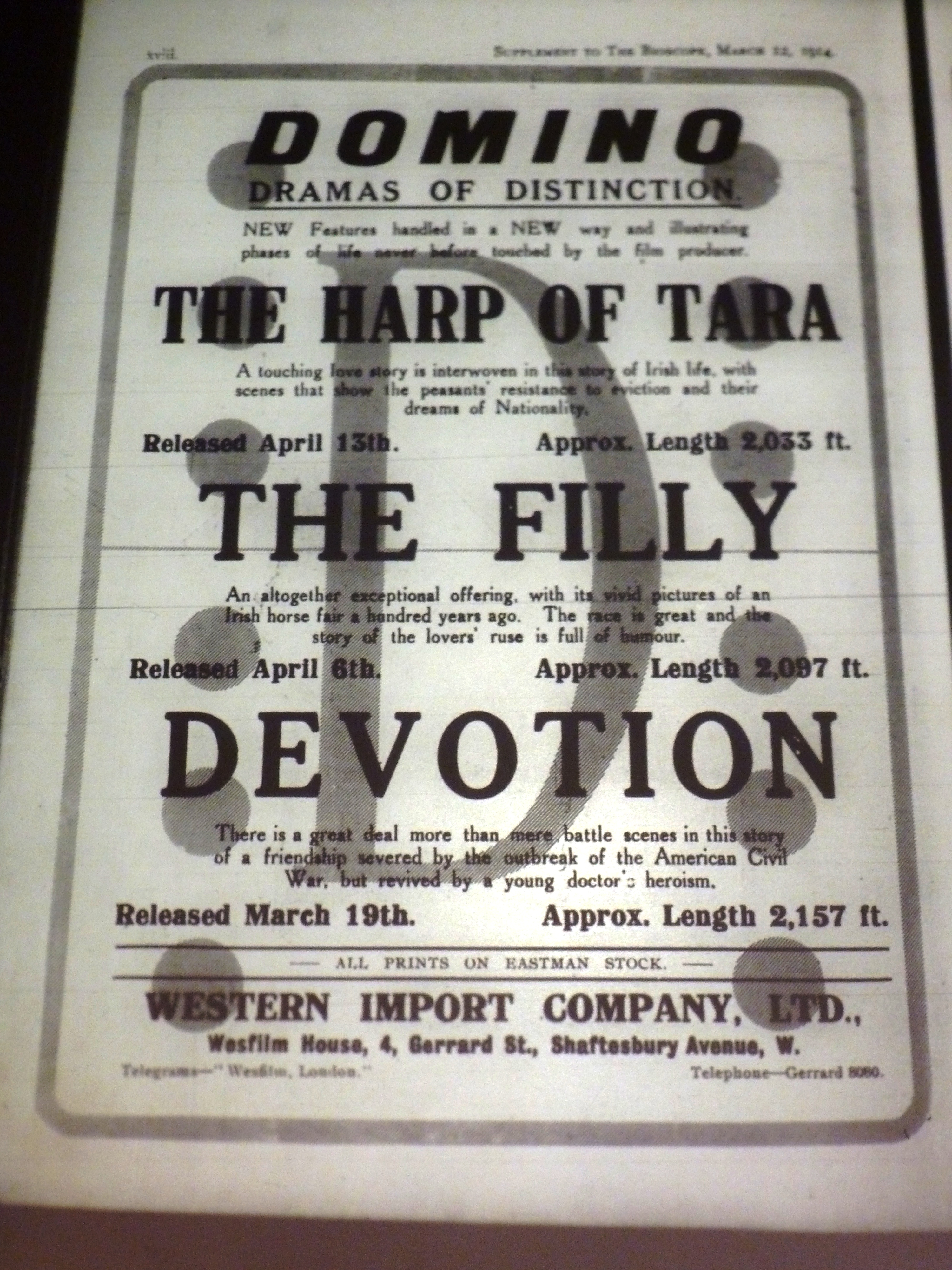
Ad for two Irish-themed films from the US production company Domino; Bioscope 12 Mar. 1914: xviii.

Ad for two Irish-themed films from the US production company Domino; Bioscope 12 Mar. 1914: xviii.

Smart and his fellow protestors might have been more appreciative of the Irish week run by the Masterpiece at the end of November. The main film was True Irish Hearts (US: Domino, 1914), supported by The Filly (US: Domino, 1913), Rory O’More (US: Kalem, 1911), The O’Neill (US: Kalem, 1912), films of Irish scenic landscapes and a topical of the Castlebellingham Feis and Louth Volunteers. During the previous week, manager Cathal McGarvey “had appeared personally at each performance during the week in his original humorous monologues, and these met with a great reception, there being no better humorous reciter in Dublin than Mr. McGarvey” (Paddy, 19 Nov.). For the Masterpiece’s Irish Week, however, McGarvey allowed popular baritone W.A. Sheehan to enhance the live musical accompaniment by singing Irish songs (“An Irish Week”). These kinds of Irish Weeks were not new, but they were facilitated by the fact that such producers as Domino and Kalem were continuing to make Irish subjects. The Domino titles were new ones, available through Western Import since March and April 1914, but the Kalem ones were older titles that required that a distributor – in this case, the Express Film Service – hold on to them for such events.

References

Condon, Denis. Early Irish Cinema, 1895-1921. Dublin: Irish Academic, 2008.

—. “Limelight on the Colleen Bawn: Resisting Autoexoticism in Provincial Irish Picture Houses in the Early 1910s.” Les cinémas périphériques dans la période des premiers temps. Peripheral Early Cinema: Domitor 2008. Perpignan: PU Perpignan, 2010. 245-255.

“Dublin and District: Ranelagh’s New Picture House.” Irish Independent 10 Nov, 1914: 4.

“Film Reviewer Appointed.” Bioscope 19 Nov. 1914: 706.

“An Irish Week at the Masterpiece.” Evening Telegraph 28 Nov. 1914: 6.

“Jottings from Ulster.” Bioscope 13 Nov. 1913: 589; 5 Nov. 1914: 543; 12 Nov. 1914: 647.

“New Picture Theatre in Ranelagh.” Evening Herald 3 Nov. 1914: 4.

Paddy. “Pictures in Ireland.” Bioscope 24 Jul. 1913: 267; 7 Aug. 1913: 413; 13 Nov. 1913: 601; 5 Nov. 1914: 525; 19 Nov. 1914: 736.

“Picture Matinees at the Theatre Royal.” Daily Express 3 Nov. 1914: 8.

“Programmes Changed Daily: An Injustice to Good Productions.” Bioscope 19 Nov 1914: 789.

Rockett, Kevin and Emer. Film Exhibition and Distribution in Ireland, 1909-2010. Dublin Four Courts, 2011.

“The Rotunda Pictures.” Daily Express 3 Nov. 1914, 2.

“Rotunda Pictures.” Evening Telegraph 7 Nov. 1914: 6.

“Scene in Theatre Royal: A Row in the Gallery.” Daily Express 4 Nov. 4 1914: 3.

“Sandford Cinema Theatre.” Evening Telegraph 21 Nov. 1914: 4.

“Trade Topics.” Bioscope 26 Nov. 1914: 821.

“Driven to See Pictures Instead of Plays”: Joseph Holloway Goes Out in 1914 Dublin

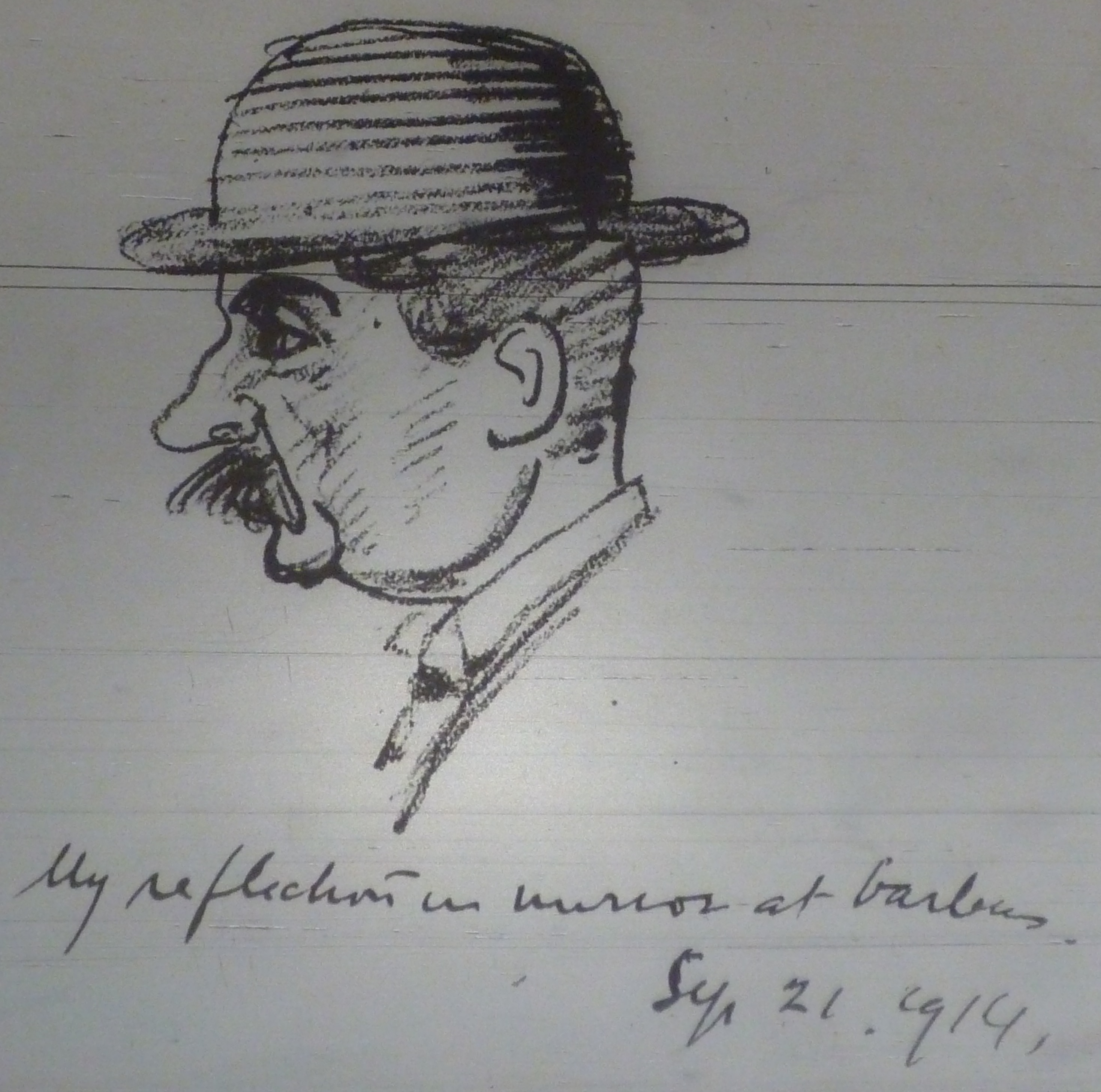
Joseph Holloway's "My Reflection in Mirror at Barbers," 21 Sep. 1914.

Joseph Holloway’s self-portrait “My Reflection in Mirror at Barbers,” 21 Sep. 1914. National Library of Ireland.

On Friday, 31 July 1914, Joseph Holloway – the sometimes architect but more often theatregoer – recorded a moment of cultural angst: “Was at two picture Houses during the day – the Grafton & Rotunda, where a few good films were on view,” he noted in his diary before adding: “It’s terrible to be driven to see pictures instead of plays! I fear the theatres in Dublin are dead for the present.” The death of theatre in Dublin was a cause of serious concern for Holloway, whose diary records the minute attention he paid to shows at Dublin’s “legitimate” theatres – the Theatre Royal and Gaiety – at its melodrama house – the Queen’s Royal Theatre – and at its music halls – the Empire and Tivoli. Despite his unhappiness with theatrical offerings at this time, he nevertheless attended as many plays and shows as he could fit in a life largely filled with the leisure that a small inheritance allowed him. The diary in which he records the details of these shows – as well as his conversations and correspondence with the luminaries and ordinary people of the time – is an incredible work of life writing that has been estimated as running to more than 25 million words (Ferriter). This is not because of the great critical insights he offers; his diary has been described by Irish author Frank O’Connor as “that donkey’s detritus” and by Sean O’Casey as “an impossible pile of rubbish” (ibid). Nevertheless, despite the limited perspective of a middle-class conservative Catholic nationalist, it offers fascinating glimpses into life and leisure as they were experienced in Dublin in the 1910s, including the city’s emerging cinema culture.

Holloway’s viewing of the two film shows in late July 1914 was not unprecedented, nor was it the first time he had expressed his dissatisfaction with picture houses while being a regular cinemagoer. Since the Picture House in Sackville/O’Connell Street had opened in April 1910, Holloway had often visited it and the other picture houses that opened with increasing regularity in its wake. Although he sometimes visited picture houses alone, he also accompanied his mother Anne Holloway and his niece Eileen O’Malley, with whom he lived, demonstrating the popularity of the picture house across three generations (Condon 143). By September 1914, Holloway’s life was changing along with the city’s entertainment offerings, not to mention the political upheavals of the period. The death of his mother in May 1912, and the marriage of Eileen on 16 September 1914 left him living alone and without a cinema-going companion.

As well as this, the breakdown of the longstanding distinctions between Dublin’s legitimate theatre, melodrama house and music hall was particularly visible just as the war began in the autumn of 1914. This was part of an international process by which entertainment companies were buying up and building theatres of all kinds to create chains that sought large popular audiences by providing a modified form of variety entertainment that could accommodate popular music hall artistes and dramatic actors, as well as film. Dublin’s Theatre Royal had long been experimenting with this modified variety, which it called by a name already popular in many British cities: hippodrome. Marvelling at the popularity of the Royal’s hippodrome seasons during the summer period when the theatres usually closed, the theatrical columnist of Irish Life dubbed hippodrome “the Chief Priest and Apostle of the Music Hall in Dublin” (“Between the Acts”). “[I]ts hold over the public is simply amazing. The “two-nightly house” show can apparently thrive under any circumstances. In Dublin it has captured all classes, and has proved itself a most profitable undertaking to those engaged in it” (ibid). Film featured not only as part of the evening programme in the guise of the Royal Bioscope but also at a separate film matinee.

Ad for the Theatre Royal Hippodrome and Winter Gardens, Sep. 1914, featuring film matinees of Nature's Zoo. National Library of Ireland.

Poster for the Theatre Royal Hippodrome and Winter Gardens, Sep. 1914, featuring film matinees of Nature’s Zoo (Britain: Cherry Kearton, 1913), a film that the Royal also exhibited a year earlier. National Library of Ireland.

In early August, Ireland’s Attorney-General and Solicitor-General heard application for patents that would allow legitimate drama from the Star Theatre of Varieties, Ltd., the company that ran the Empire, and from the Premier Picture Palace (Dublin), which proposed to build a large theatre in the city centre on a site off Henry Street and close to the GPO. As the latter’s name suggests, this company had initially planned to open a large picture house but had decided that a variety theatre with the flexibility of mounting plays and showing films would be more profitable. The company would eventually open in April 1915 what was then known as the Coliseum Theatre, a short lived venue that would not be rebuilt following its destruction a year after its opening during the 1916 Rising. The proprietors of the Coliseum included Lord Mayor Lorcan Sherlock, two directors of Dublin’s Tivoli Theatre and theatrical agent Fred Willmott (ibid.). Holloway attended the hearing and spoke as an expert witness – “as an old theatre-goer with 40 years experience” – in support of the Star Theatre of Varieties’ application, arguing that the granting of a dramatic patent would benefit the city by providing the opportunity for more play to be performed (“What Is a Revue?”).

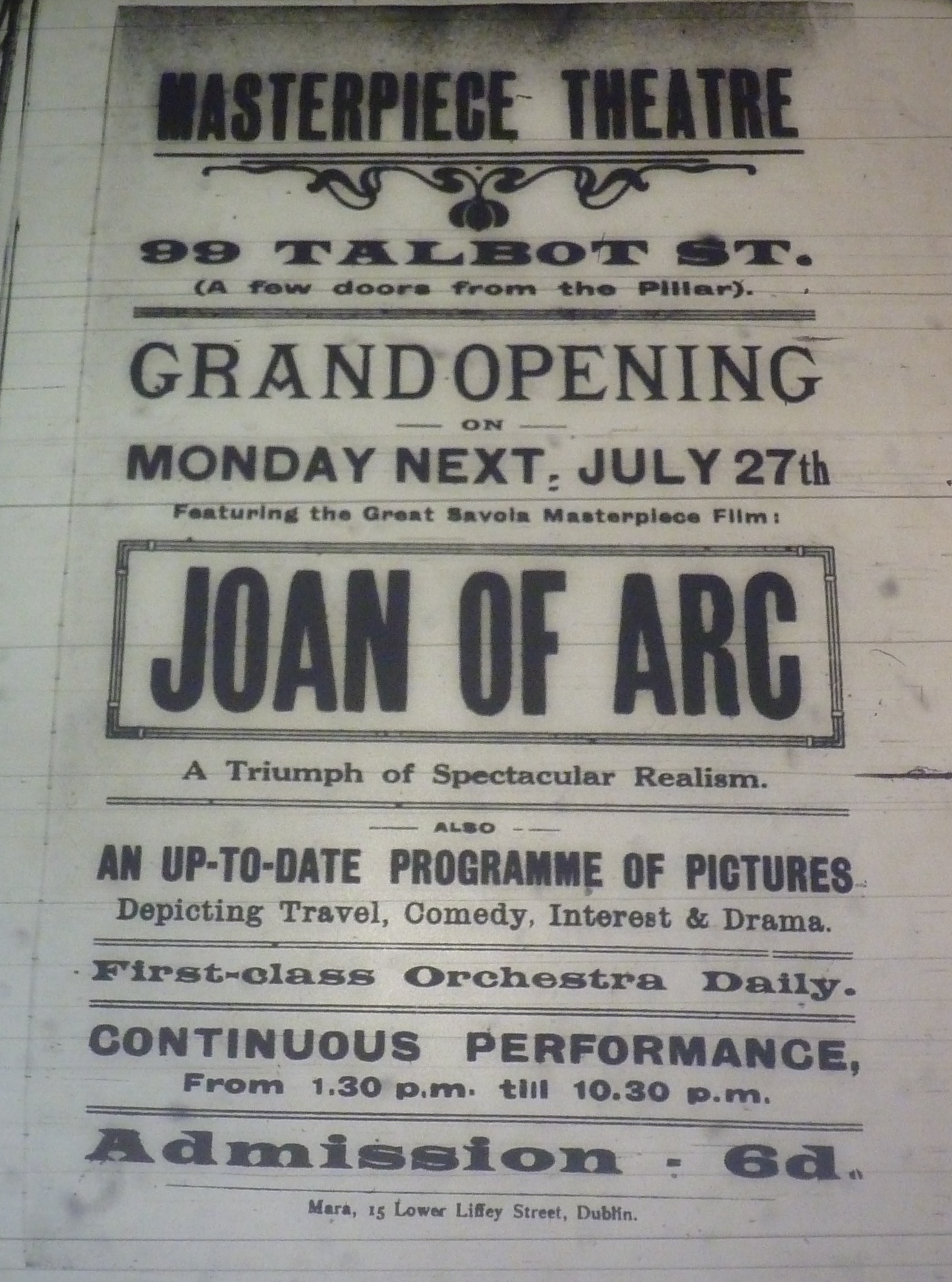
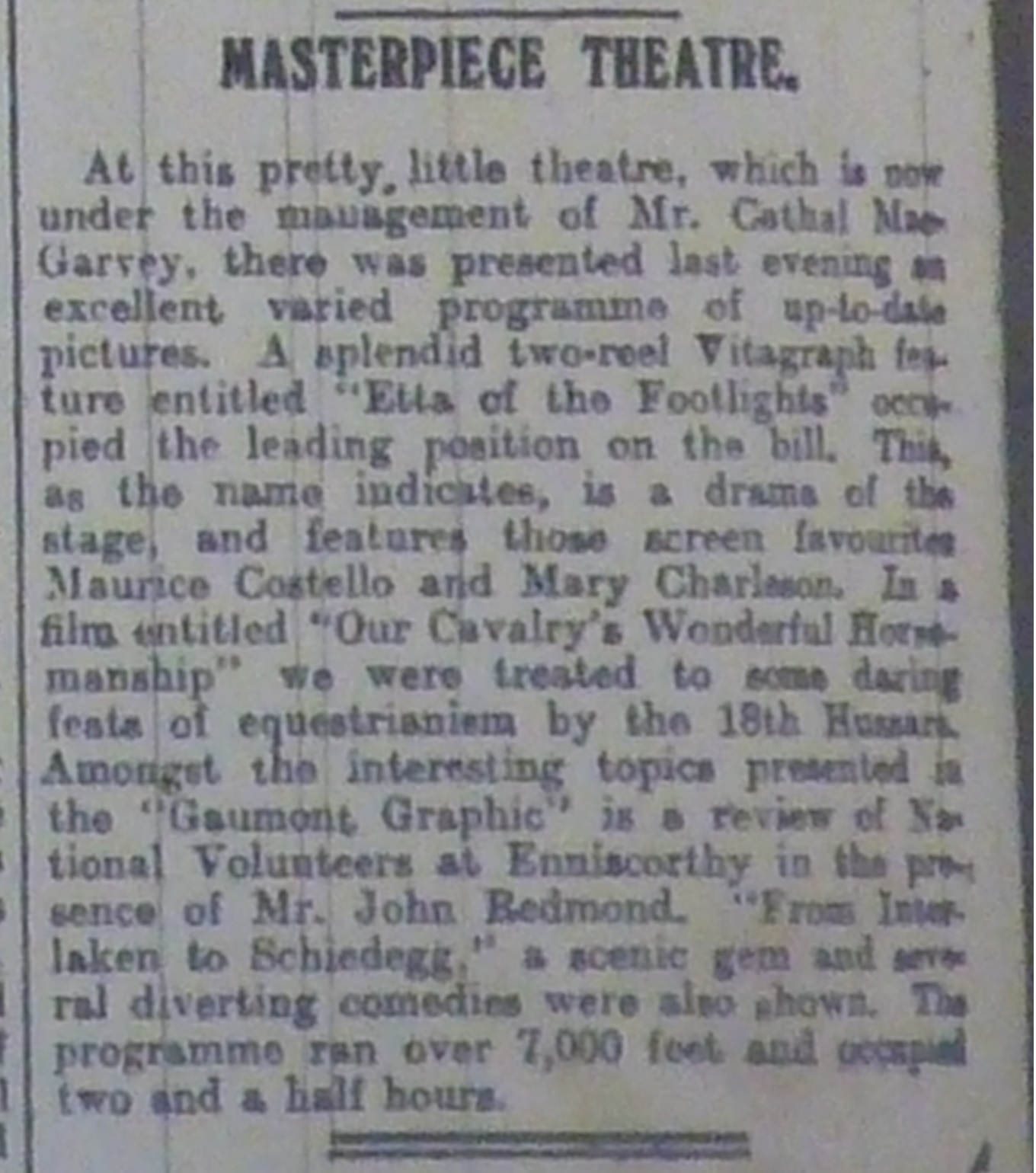
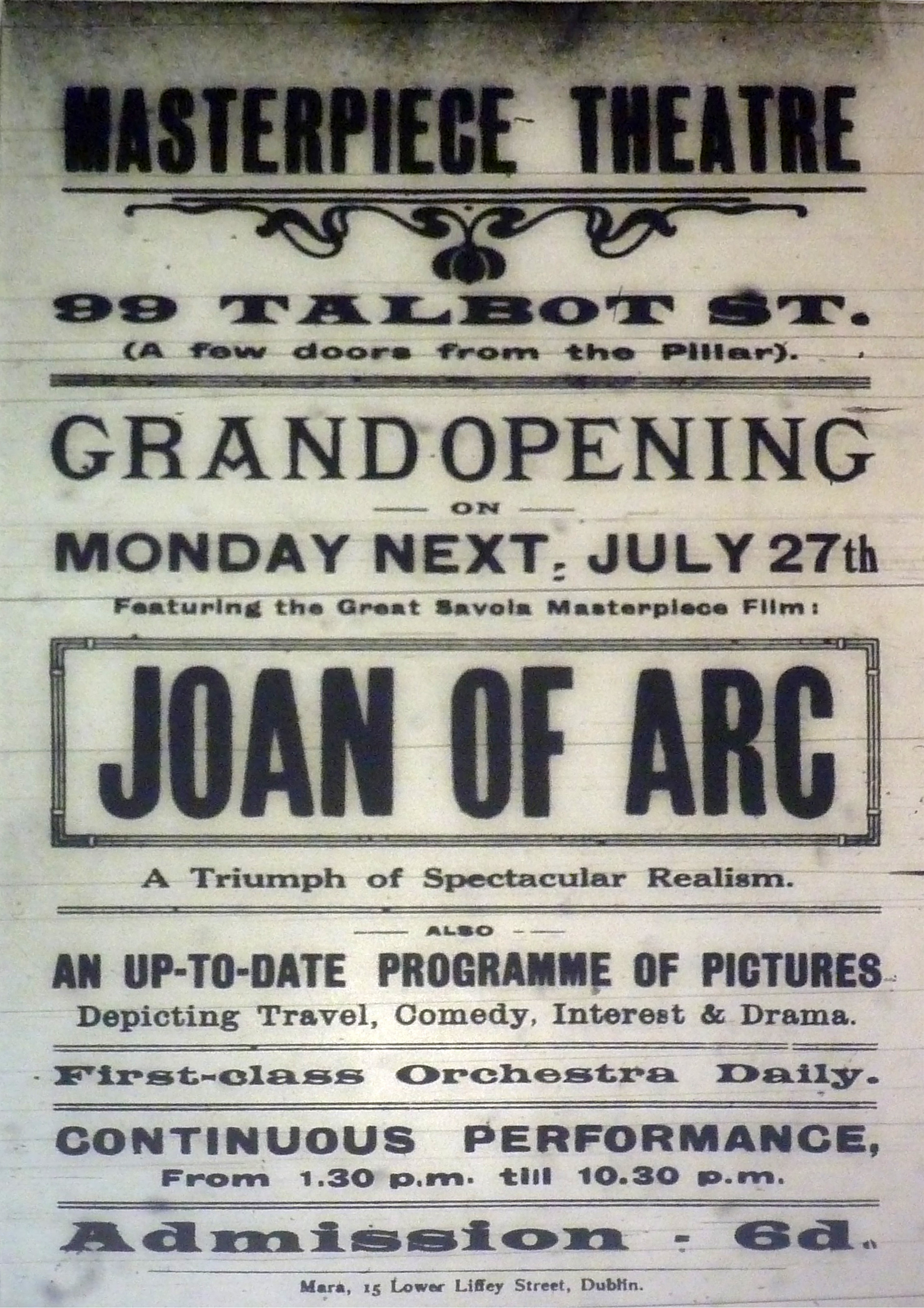
Handbill for opening of the Masterpiece Theatre (Holloway 27 Jul.)

Handbill for opening of the Masterpiece Theatre preserved in Holloway’s diary (Holloway 27 Jul.)

While lobbying in support of more plays and continuing to attend theatrical shows of all kinds, Holloway also visited picture houses regularly. During July and the first half of August 1914, he records twenty visits to Dublin picture houses, fourteen of them alone in July. On the evening of Thursday, 2 July, he went to what he insisted on calling the O’Connell Picture House (but the proprietors persisted in calling the Picture House, Sackville Street) where he saw the “beautiful touching film ‘Child o’ My Heart’” (Britain: London, 1914); on the afternoon of Monday, 6 July, he saw The Afghan Raiders and When Lions Escape (US: Columbus, 1914) at the Rotunda, and “both were full of thrills!”; on the evening of Wednesday, 8 July, he saw the Western Love Triumphant and a newsreel of Joseph Chamberlain’s funeral at the Grafton; on the evening of Friday, 10 July, he saw From the Lion’s Paw and “a thrilling abduction story, both well acted” at the Rotunda; on the evening of Monday, 13 July, he saw The Game of Life (US: Selig, 1914) at the Rotunda, which he found “a particularly exciting one & also an Indian story of the new medical man” [The New Medicine Man (US: Kalem, 1914)]; on the evening of Saturday, 18 July, the films he saw at the Grafton included Lost at Sea (France: Eclair, 1913), Nan Good-for-Nothing (Britain: London, 1914) and a newsreel from Dublin’s Civic Exhibition featuring rival architect George O’Connor, “[a]s large as life & equally as massive!”; on the evening of Monday, 20 July, he admired at the Grafton both The Black Pearls (US: Geroges Méliès, 1914), “a real thriller enacted finely by French players,” and The War Bonnet (US: Kalem, 1914), “an Indian story [that] was fairly interesting chiefly because of its beautiful natural setting; on the afternoon of Tuesday, 21 July, he was amused by The Blood Test (US: IMP, 1914) and an unnamed comedy at the Rotunda; on Thursday, 23 July, he visited the Grafton, where he saw “a few good dramatic pictures & others I didn’t care for,” and later the Rotunda, where The Master Crook Turns Detective (Britain: British and Colonial Kinematograph, 1914) “was the most dramatic & best enacted”; on the evening of Friday, 24 July, His Reformation (Britain: London, 1914) at the O’Connell was the best of “the few more or less interesting pictures” he saw; on Monday, 27 July, he found Joan of Arc (Italy: Savoia, 1914) at the opening of the Masterpiece Theatre “dull and left after ending of part 3,” but enjoyed The Mansion of Sobs (US: Lubin, 1914), “a very good child picture & a funny [John] Bunny picture” later at the Grafton; on Friday, 31 July, he had the two visits to the Grafton and Rotunda that caused him such anxiety about the death of theatre.

Evening Telegraph review of programme at the Masterpiece, 22 Sep. 1914: 2.

Evening Telegraph review of programme at the Masterpiece, 22 Sep. 1914: 2.

The first half of August shows the same rate of picture house attendance, with Holloway visiting a cinema on average almost once every two days. On the evening of Saturday, 1 August, he went to the “exciting film drama” Devil’s Gap at the Dorset Picture House; on the evening of Monday, 3 August, he and Eileen found the programme at the Grafton poor, particularly the vulgar Across the Hall (US: Keystone, 1914), but the evening was somewhat redeemed by Bertie in the Ladies’ College (Britain: Eclair, 1914) and ’Fraid Cat (US: Vitagraph, 1914), “a clever child film”; at the Rotunda on the evening of Thursday, 6 August, he found A Life for a Life “quite pathetic” and was moved – unusually – to write a synopsis of it; Ivy’s Elopement (Britain: Ivy Close Films, 1914) at the O’Connell on 8 August was “set in exquisite surroundings & was really beautiful”; on Wednesday, 12 August, he saw England’s Menace (Britain: London, 1914) with Eileen at the Grafton, “where we saw some fine films, and were entertained by a man with a most aggressive sneeze”; on Friday, 14 August, he attended the 6:30 show at the Rotunda with just a handful of others, attributing the small attendance to “the unruly elements” of thunder showers, roving soldiers “and the unfortunate girls [who] had come out to meet them.”

Over this period, he attended the Rotunda and Grafton almost equally with eight and seven visits respectively. The O’Connell was his next most favoured picture house with three visits; and the Masterpiece and Dorset received one visit each. After the visit to the Masterpiece on 27 July, he appears not to have visited it again until two months later, on Saturday, 26 September, when the well-known comedian Cathal MacGarvey took over its management. Holloway “met Mr M’Garvey at the door – he has only taken up the reins a week ago & scarcely feels his feet yet – he hopes to work it into a big success – The programme was first rate & I told him so as I came out.” Holloway did not mention what was on the programme, but MacGarvey’s appointment drew some welcome publicity to the Masterpiece, and as a result, notices show that Holloway would have seen the drama Etta of the Footlights (US: Vitagraph, 1914) with Maurice Costello and Mary Charleson – which was also showing at the O’Connell – “some daring feats of equestrianism by the 18th Hussars” in Our Cavalry’s Wonderful Horsemanship, the scenic film From Inverlaken to Shiedegg, and a Gaumont Graphic newsreel that included “a review of the National Volunteers at Enniscorthy by Mr. John Redmond and (“Masterpiece Theatre”). It is likely that the location of the last film is mistaken and that this was a film of the infamous speech at Woodenbridge, Co. Wicklow, in which Irish nationalist leader Redmond called on the Volunteers to join the British Army.

Film lover Dr Knott. Holloway Diaries.Aug. 1914

Film lover Dr Knott. Holloway Diaries. National Library of Ireland.

Unlike his often very detailed accounts of theatre shows, Holloway wrote frustratingly little on the films he saw, often not even giving their names. He does, however, sometimes remark on the behaviour – and even mention the names – of members of the audience, some of whom he also occasionally sketched. On the evening of Monday, 1 June 1914, he reveals, the large audience at the Grafton included “AE (George Russell) & Prof. Maginnis.” The aggressively sneezing man at the Grafton on 12 August allowed him some interaction with other members of the audience:

Even the film drama – “England’s Message” – which was loudly applauded – he sneezed often. ”Though its subject wasn’t to be sneezed at!” I said to Eileen, & the man next her, who had been applauding his hands off almost when the foreign fleet in the picture story turned tail & went home, smiled at & approved of my turn of phrase.

However, the behaviour of other audience members could be annoying, as it was on 8 July at the Grafton during the newsreel of Chamberlain’s funeral: “a man behind me kept up a regular tattoo with his fingers on the crown of his straw hat, which was irritating to all save himself. I know he maddened me!” Some people he knew were regular picture house patrons. James Crawford Neil enjoyed natural history pictures (23 Jul. 1914). Dr John Knott, “haunts the picture houses” (16 Sep 1914) and seems to be constantly “seated rather close up to screen” (30 May 1914). Like Knott, Holloway also haunted Dublin’s picture houses, and despite his periodic fears about cinema displacing his beloved theatre, he appears, on balance, to have enjoyed his time in front of the screen.

References

“Between the Acts.” Irish Life 10:2 (24 Jul. 1914), p. 68.

Condon, Denis. “‘Temples to the Art of Cinematography’: Cinema on the Dublin Streetscape, 1895-1929.” Visualizing Dublin: Visual Culture, Modernity and the Representation of Urban Space. Ed. Justin Carville. Bern: Peter Lang, 2013. 132-54.

“Drama in Dublin: Premier Picture Palace Application: Lord Mayor’s Views.” Evening Herald 7 Aug. 1914: 2.

Ferriter, Diarmaid. “Holloway, Joseph.” Dictionary of Irish Biography Online. Cambridge UP and Royal Irish Academy, 2009. Web. 30 Sep. 2014.

Holloway, Joseph. Holloway Diaries. National Library of Ireland.

“Masterpiece Theatre.” Evening Telegraph 22 Sep. 1914: 2.

“O’Connell Street Pictures.” Evening Telegraph 15 Sep. 1914: 2.

“What Is a Revue? Manager Tries to Explain It: Drama in Dublin.” Evening Herald 6 Aug. 1914: 3.

Shadow Soldiers Flickering on a Screen: Irish Cinema and the Beginning of World War I

Provincial War Pics

These ads appeared in the Dublin Evening Mail 7 Aug. 1914: 2; and 18 Aug. 1914: 2.

“It is ever so much more a patriotic thing to go down the quays and give the soldiers a good send-off than it is to sit in a darkened picture house watching, perhaps, ‘shadow soldiers’ flickering on a screen,” reported Paddy, the Ireland correspondent of the British cinema trade journal Bioscope in August 1914 explaining the falloff in attendance at Dublin’s picture houses at the start of the Great War. “[T]he fact that the Lord Mayor of Dublin had to publicly ask the people through the medium of the Press, to refrain from causing a block on the quays and assist in getting the soldiers embarked more expeditiously shows how matters stand” (Paddy, 13 Aug., 673). Mobilization affected the cinema and its relationship with the popular audience in various ways. Those who lined the Dublin quays, Paddy suggested, were particularly the popular audience who would otherwise have occupied the picture houses’ cheapest – usually three-penny or 3d. – seats. Although Frederick Sparling, manager of Phibsboro’s Bohemian Picture Theatre, reported brisk business, “he experienced a great falling off in the attendances at the 3d. seats, and he expected that receipts generally would show a drop for a little time” (ibid).

Paddy claimed that the effect in Ulster was quite different, with the outbreak of the war bringing unionist and nationalist audiences together in the face of a common enemy. “[T]he one-time rivals now fraternise,” he observed, “and quiet, law-abiding and gaiety-loving citizens are now taking their pleasures with less sadness than had been their wont during the two gloomy years from which Ireland has just emerged” (Paddy, 13 Aug., 675). Unfortunately, this somewhat unlikely harmony would be short-lived because the difficulties of procuring enough flax and other raw material for Ulster’s factories would mean that mill workers, “the backbone of the support of the cinema in Ulster as in other manufacturing centres,” would be placed on half-time working at half-pay, leaving “nothing to spend on amusements of any description” (ibid).

Actuality films of the war appeared on the cinema programme alongside such  fiction film as D. W. Griffith's Judith of Bethulia (US: Biograph, 1914).

Actuality films of the war appeared on the cinema programme alongside such fiction film as D. W. Griffith’s Judith of Bethulia (US: Biograph, 1914). Dublin Evening Mail 24 Aug. 1914: 2.

Nevertheless, Irish picture houses attempted from a very early point in the war to provide shadow soldiers on the screen for their audiences, and not only working-class ones. On 7 August 1914, the Dublin Evening Mail carried the first of a series of unusually large ads for the Picture House, Grafton Street and the Picture House, Sackville Street showing films depicting “the latest developments of the War, day by day.” Both of these cinemas were owned by the London-based chain Provincial Cinematograph Theatres, which also ran the less-salubrious Volta in Mary Street and Belfast’s Picture House, Royal Avenue. The company promoted its venues – and particularly the recently renovated and extended Grafton on Dublin’s most prestigious shopping street – as offering luxuries suitable for prosperous city-centre shoppers. Strollers who stopped into the Grafton’s public café might be induced to see the war pictures by a sign that indicated which of the six-to-eight films typically on a cinema programme was currently playing in the auditorium.

Judith (Blanche Sweet) prepares to behead Holofernes in Judith of Bethulia.

Judith (Blanche Sweet) prepares to behead Holofernes in Judith of Bethulia.

Although such passersby or Evening Mail readers arrested by the prominent ads continued to be offered a programme of films after the outbreak of hostilities, they seem to have been presented with an overwhelming number of war-themed films. The Grafton featured England’s Menace (Britain: London, 1914), a “stunning naval drama,” for the week beginning 10 August, the six-day run representing twice the usual period for which a film was shown. For the first three days of the following week, the Grafton exhibited Maurice Elvey’s In the Days of Trafalgar (Britain: British and Colonial, 1914), supported by a programme that included the first part of the British Army Film (Britain: Keith Prowse, 1914), the second part of which ran in the latter half of the week on a bill headed by The Spy, or The Mystery of Capt. Dawson (1914), a detective drama involving the stealing of plans for a new quick-firing gun. The Belgian War Scenes advertised on 24 August were said to have come “from actual photographs [i.e., films] taken in Belgium on Thursday last,” and these played on the programme with D. W. Griffith’s Judith of Bethulia (US: Biograph, 1914), an adaptation of the biblical Book of Judiths story of war and decapitation.

Provincial was not the only cinema proprietor to show actual war footage – Dublin’s Rotunda, Phoenix and Bohemian all advertised their latest war films, as did many others in newspapers or through more ephemeral forms such as posters and handbills that no longer survive. Provincial, however, made a special effort to exhibit the actualities in programmes with other kinds of war-themed films to cater for – or indeed, help to create – a patriotic war fever. Given the recentness of the war, none of the fiction films just mentioned concerned the current conflict with Germany, nor did the British Army Film, a documentary about ordinary life in the army that was made before the war and that had attracted a protest in March. There was nothing new in popular culture assembling and re-presenting pre-existing elements in a new combination that served the prevailing ideology, particularly at a time of crisis. The live music that accompanied silent film in picture houses of the 1910s could add further jingoism. There were precedents for the use of film in war-time patriotic shows as early as the Boer War, but the popular audience in many parts of Ireland had often been vocally resistant to such anti-Boer/pro-British jingoistic shows (Condon).

What had changed between the turn of the century and the 1910s, however, was cinema’s place within the mediascape in Ireland as elsewhere. By 1914, Ireland had a large number of picture houses that provided news alongside dramatic entertainment. Although picture houses could not match the newspapers’ detailed coverage of topical events, newsreels from the front provided by such companies as Pathé and Gaumont offered something the press could not: moving images of battle sites and the people who fought in the war. Because newsreel scenes recorded on film needed to be physically transported from the front, their newsworthiness had dissipated. Some picture theatres, including the Grafton and Sackville, entered into agreements with telegraphic wire services to offer instantaneous messages during shows, a phenomenon that bears resemblance to a Twitter feed. One ad for these picture houses informed the public that “[a]rrangements have been completed with the Central News Agency for a complete service of telegrams from the Front, to be supplied to this Theatre. As the news arrives it will be immediately thrown on to the screen” (“The War”).

As the war began, commentators in the press debated cinema’s place among other media. To some, it was an absurd form. “In a city picture house, a man tells me,” confided Dublin’s Evening Herald columnist The Man About Town in mid-August 1914,

he has just acquired some curious and too little known facts about the Roman Empire. It would appear that the Caesars were in the habit of decorating their apartments with busts of Dante (which certainly showed remarkable foresight on their part), while their consorts sought relaxation by perusing printed volumes, handsomely bound. Verily, to live is to learn, but seeing is not always believing.

Seeing the past – or present – in the form of the “cineanachronisms” provided in the picture houses was not to be believed by this canny man about town. At least not always.

Other commentators took a more considered but not uncritical view of what had become the country’s most ubiquitous theatrical entertainment, reaching parts of small-town, rural and suburban Ireland that had never had regular professional theatrical entertainment before. By the end of 1914, Dublin Corporation approved licences for 25 premises to show films, with two or three others also under consideration. A small group of these were the theatres – the Theatre Royal, Tivoli Theatre, Empire Theatre and Queen’s Theatre – that had been showing films for two decades or more as part of their mainly live theatrical entertainments. The rest were dedicated picture houses in which the main entertainment was the projection of recorded moving pictures onto a screen, with the live elements limited to musical accompaniment, vocalists who sang between films, and in some venues, one or more variety acts. “Personally, I think we are carrying the picture business to excess,” opined the Dublin Evening Mail’s “Music and the Drama” columnist H.R.W. “The opening of theatres [i.e., picture houses] in the suburbs has much to commend it, but the many additions to the already large number of picture houses in the city is rather risky enterprise” (“War and the Drama”). This was not just a problem among competing picture house owners, but also among theatres proprietors because “ [t]he increasing popularity of the Picture Theatre is making the future of the drama and the music hall a serious problem” (“The Invasion of the Film”). H.R.W. felt that Dublin theatre managers had allowed this to happen by offering increasing amounts of music-hall entertainment and neglecting drama:

the vast public which desires something romantic and dramatic has been catered for by the activity of picture theatres, which, with their cheapness, the casual nature of the performances, and the liberty of smoking, has earned for them a considerable degree of popularity. (Ibid.)

By the outbreak of the war, cinema had become a truly mass medium, providing both news images and dramatic entertainment in a very particular setting. Even without overt propaganda films, individual picture houses or cinema chains could in their choice of films, music and other elements of their programmes present the war in ways that influenced the popular audience that governments needed to prosecute the war. If the Irish popular audience was indeed crowding the quays waving off Irish soldiers, it seemed likely that they would return to the picture houses to cheer on the screen’s shadow soldiers.

References

“Belgian War Scenes.” Advertisement. Dublin Evening Mail 24 August 1914: 2.

Condon, Denis. “Receiving News from the Seat of War: Dublin Audiences Respond to Boer War Entertainments.” Early Popular Visual Culture 9:2 (May 2011), pp. 93-106.

H. R. W. “Music and the Drama: War and the Drama.” Dublin Evening Mail 3 Aug. 1914: 2.

—. “Music and the Drama: The Invasion of the Film.” Dublin Evening Mail 27 Jul. 1914: 4.

The Man About Town. “Cineanachronisms.” Evening Herald. 13 Aug. 1914: 2.

Paddy. “Pictures in Ireland.” Bioscope 13 Aug. 1914: 673-5.

“The War: Picture House News Service.” Advertisement. Dublin Evening Mail 12 Aug. 1914: 2.

Irish Cinemagoers Feel the Heat of Summer 1914

July 1914 began with a heat wave in Ireland, and although temperatures fluctuated thereafter, political developments nationally and internationally grew increasingly heated up to the August bank holiday. “Tuesday’s sunshine was the hottest on record this year,” commented Dublin’s Evening Telegraph on Wednesday, 1 July.

From its rising to its setting the sun blazed in a cloudless sky. Ninety-six degrees were registered in the city, and in many parts of the country the thermometer rose to over 100 degrees in the sun. Monday, too, was intensely hot, registering 76 degrees in the shade. Dublin would seem to have been transferred to the tropics. (“The Heat Wave.”)

For such indoor entertainments as cinema, summer weather that allowed outdoor activities was bad news. “To successfully compete with the open-air attractions,” revealed a review of the Phoenix on Dublin’s Ellis Quay, “a big bid is being made by the Phoenix management (“Phoenix Picture Palace,”11 Jul.). As well as the right films, this picture house boasted about its comfortable environment. “The Phoenix is most comfortable this hot weather, for, besides being a big, airy house, it is supplied with electric fans that change the air constantly, and keep it delightfully cool” (“Phoenix Picture Palace,” 30 Jun). This kind of discussion was by no means exclusive to Dublin. The British trade journal Bioscope’s “Jottings from Ulster” columnist observed that “[a]t this time of year especially, temperature should receive as much attention as the programme” (“Jottings,” 9 Jul).

Ad for a fumigator of cinema audiences; Bioscope May 1913.

How the auditorium could be made bearable during even ordinary summer weather was a controversial subject. “The advent of the hot weather is always heralded by the revival of that interminable controversy dealing with ventilation,” noted the Bioscope. “Every cinema boasts of having a more or less “perfect” system of ventilation – a term which is so tentative as to mean almost anything” (“Trade Topics” 9 Jul). Although the Phoenix appears to have invested in a relative sophisticated air-conditioning system, it is not clear how the management of Dublin’s Volta kept it “well ventilated and cool” (“The ‘Volta’ Sunday Pictures”). It’s possible the Volta used the more cost-effective but unpopular strategy of having a cinema attendant spray a scent in the air above audience members – many of whom in 1914 had infrequent access to bathing facilities – as they sat watching the screen in the heat of an otherwise unventilated auditorium.

Handbill for opening of the Masterpiece Theatre, featuring the film Joan of Arc; Joseph Holloway Diaries, National Library of Ireland.

Despite their sometimes inability to deal with climatic conditions, new picture houses continued to open regularly in the immediate pre-war period. Following the openings of the Phibsboro Picture House and Bohemian Picture Theatre in late May and early June, the next picture house to open in Dublin was the Masterpiece Theatre at 99 Talbot Street. Owned by Charles McEvoy – “a gentleman with a good experience of the producing end of the business in Australia” (Paddy, 6 Aug.) – and designed by architect George L. O’Connor, it had “no gallery, so that the flow of air passes through the theatre uninterrupted” (“Masterpiece Picture Theatre”). The 450 patrons who fitted inside approached the picture house through an entrance that was

quite the finest in Dublin. The pay-box is on the right, and having passed through white doors set with stained glass, one traverses a short space of tiled flooring leading up to three steps. The steps surmounted and rich velvet curtains passed, one finds oneself in a form of lounge, beautifully decorated with framed photos of the leading picture play artistes. On either side of the lounge are long forms richly upholstered in Rose Barri tinted velvet. A sweet and cigarette kiosk stands at the left. (Paddy, 6 Aug.)

On either side of the screen were boxes for “the person who explains a particular picture or sings when pictures adapted to this use are thrown on the screen” (“Masterpiece Picture Theatre”) All seats were 6d., and performances were continuous from 1.30 to 10.30. The opening programme was headed by Joan of Arc (Giovanna d’Arco; Italy: Savoia, 1913), supported by “‘Relaying a Railway,’ ‘A Wise Old Dog’ (comic), Topical Topics (cartoons), and ‘Just Kids’ (Comedy)” (ibid).

The opening of the Masterpiece was accompanied by the founding of other new Irish cinema companies. On Dublin’s Sackville/O’Connell Street, J. J. Farrell was building what would be called the Pillar Picture House on part of the site formerly occupied by a pharmacy, while on the other part of this site “a notice has just been put up to the effect that Irish National Picture Palaces, Limited, have secured the site, and will shortly open a theatre capable of holding 1,200” (Paddy, 16 Jul.). Picture houses were also under construction in Dublin’s Manor Street, in Kilkenny, in Coleraine and in Newry. In Belfast and other parts of the north, the increasingly armed resistance of the Ulster Volunteers to Home Rule was no barrier to the local film business. “Despite the trouble now brewing in Ulster,” Jottings observed, “cinematograph theatres are springing up here, there and everywhere. Permanent buildings, too, for the days of the temporary halls are well on the wane in the Northern province of Ireland to-day” (Jottings).

Detail of Dublin Civic Exhibition’s Concert Hall and Cinema, from Evening Telegraph 14 Jul. 1914: 1.

“I really do not know where the building of additional theatres in Dublin is going to stop,” marvelled Paddy, the Bioscope’s Irish correspondent, at the end of July, after a 600-seat temporary concert hall and cinema opened for the Dublin Civic Exhibition, which ran from 15 July to 31 August 1914. “At the Civic Exhibition the cinema theatre is, without the slightest doubt, one of the most popular sideshows” (Paddy, 30 Jul.). Erected on the site of the city’s Linenhall, the Civic Exhibition, aimed

to produce a considered plan, so as to show how Dublin can be made a better commercial and industrial centre, and how, with improved conditions (which will be illustrated by the various section and exhibits) the trade, manufactures, and commerce of the city must increase in a large degree.” (“Dublin Civic Exhibition,” Jul)

As with all such world’s fairs, the latest entertainments were vital not only to amuse audiences but also as a manifestation of the benefits of industrial progress. The appointing of vocalist John C. Browner as manager of the Exhibition’s concert and cinema hall rather than someone with picture-house experience seems to have been a deliberate strategy to promote the educative potential of the medium. In keeping with the theme of the exhibition, the most advertised “cinema” attraction was the Kinemacolor films that were combined with lantern slides of the National Cash Register Company of Dayton, Ohio, in order to illustrate “Industrial Welfare and Commercial Progress,” the free daily lecture about this model factory. The film programme was not always so dull. When Bibian Foran visited the Exhibition from Listowel, Co. Kerry, she noted that thousands of children who were admitted free were rewarded for their patience in having the exhibits explained to them when they were treated to a film show. “[N]ot the least happy memory,” she remarked, “is associated with the delighted ripple of laughter which greeted the humorous pictures given for their entertainment or the ‘Nation Once Again’ sung by hundreds of small voices when leaving the Exhibition two by two and in perfect order” (“Dublin Civic Exhibition,” Sep).

Lord Lieutenant patronizes Princess in Rathmines for film of opening of Dublin Civic Exhibition; Evening Telegraph 18 Jul. 1914: 1. Ad for illustrated lecture in the Exhibition's Cinema Hall; Irish Times16 Jul. 1914: 9.

The Lord Lieutenant patronized the Princess in Rathmines to see the film of the opening of Dublin Civic Exhibition; Evening Telegraph 18 Jul. 1914: 1. Ad for illustrated lecture in the Exhibition’s Cinema Hall; Irish Times16 Jul. 1914: 9.

Although the Civic Exhibition did not reproduce the kind of commercial cinema that was thriving in the city beyond its grounds, it was the subject of a film shown in Dublin’s picture houses. “The Lord Lieutenant was present at the Princess Cinema, Rathmines, on Saturday afternoon,” reported the Irish Times,

when a picture of the opening of the Civic Exhibition was exhibited. By arrangement with the Exhibition Committee, the picture was produced by the management of the Princess Cinema. Eight cinematograph operators, under the direction of Mr. James Worth, were stationed at various points on the route of the procession and at the Linen-hall. The result of their work is highly creditable. (“Dublin Civic Exhibition: Lecture on Dublin Housing.”)

Chaplin causes havoc in a picture house and later in a film studio in A Film Johnnie.

Chaplin’s tramp causes havoc in a picture house and later in a film studio in A Film Johnnie.

Despite the commercial cinema’s exclusion from the exhibition itself, such high-profile screenings demonstrated the mutual benefits to the industry and dominant social class of cinema’s increasing absorption into Ireland’s mainstream media. Among the messages of this film was that despite the recent defeat of workers during the Lockout, the elite were engaged in tackling such problems as the appalling housing condition – and indeed homelessness – of the city’s poor. The Irish Times’s Clubman reported that Harvard professor of social ethics James Ford had told a conference convened as part of the exhibition that a city “in which a large section of the population lived in such a monstrous way as the 51,000 families are housed in Dublin was doomed to decay” (“Dublin Topics”). Although such analysis was important, it was also largely contained by the organization and media framing of the exhibition. Arguably more unsettling in the picture houses was the anarchic humour of Charlie Chaplin’s tramp character in such films as The Film Johnnie (US: Keystone, 1914), which was shown at the Rotunda on 21 July. The tramp provided working-class audiences with ways of seeing “their anger and frustrations recognized, transformed, and liberated” (Musser, 62).

The entertainment ads in the Evening Telegraph on 30 Jul 1914 included a film of the funeral of the Bachelors Walk shootings at the Rotunda.

The cohesive social structure seemingly on show in the Civic Exhibition film was less in evidence after the Howth gunrunning on Sunday, 26 July, and the shooting dead by soldiers later that day of three people on Bachelors Walk. Following the Ulster Volunteer Force’s highly successful gunrunning at Larne in April 1914, the Irish Volunteers finally succeeded in landing and distributing arms at Howth in defiance of the police supported by a military detachment. Soldiers returning to barracks responded with bullets to the taunting of a crowd in the city centre. The Irish Times described the public funeral of those killed as an “impressive spectacle” that had been “made the occasion of a popular demonstration by the various elements of Nationalist forces, and, besides being an indication of sympathy with the relatives of those who were killed, it was chiefly intended as a protest against the action of the military” (“Dublin Shooting Affray”). Among the groups who turned out was a large contingent of the workers’ “Citizen Army, headed by Mr. James Larkin” (ibid). No footage was taken of the landing of the weapons, but the funeral was filmed. Among the film companies that covered the funeral was Norman Whitten’s General Film Supply, which shot part of their Funeral of Victims Shooting Affair Sunday, July 26th from the Bohemian Picture Theatre in Phibsboro (Paddy, Aug. 6).

Although the struggle for and against Home Rule had dominated Irish politics for decades, the outbreak of the Great War would complete change the country and its fledgling ciinema institution. As a harbinger of those changes, the Bioscope’s 6 August issue announced the first of a different kind of local film taken on 2 August that would set the tone for coming events: “The first local picture in connection with the war was taken in Glasgow on Sunday evening, when Messrs. Green’s Film Service secured a fine film of the Naval Reserve entraining en route for Portsmouth” (“Trade Topics,” 6 Aug). Capturing the initial patriotic war euphoria that cinema would help to foster, the article noted that “[t]he picture was shown in many halls in Monday, and was received with great enthusiasm.”

References

“The Champion Fight Pictures.” Evening Telegraph 11 Jul. 1914: 7.

“The Civic Exhibition.” Evening Telegraph  9 Jul. 1914: 7.

“Dublin Civic Exhibition: The Attraction for All Parts of the Country.” Irish Times 4 Jul. 1914: 7.

“Dublin Civic Exhibition: Lecture on Dublin Housing.” Irish Times  20 Jul. 1914: 10.

“Dublin Civic Exhibition: An Active and Leading Participator from North Kerry Interviewed.” Liberator 26 Sep. 1914: 6.

“Dublin Shooting Affray: The Funeral.” Irish Times  30 Jul. 1914: 7.

“Dublin Topics by the Clubman: City Housing.” Weekly Irish Times 1 Aug. 1914: 4.

“The Heat Wave: Yesterday Hottest Day of Year.” Evening Telegraph 1 Jul. 1914: 3.

“Jottings from Ulster.” Bioscope  9 Jul. 1914: 138.

“Masterpiece Picture Theatre.” Irish Times 28 Jul. 1914: 3.

Musser, Charles. “Work, Ideology, and Chaplin’s Tramp.” Resisting Images: Essays on Cinema and History. Eds. Robert Sklar and Charles Musser. Philadelphia: Temple UP, 1990.

Paddy. “Pictures in Ireland.” Bioscope 16 Jul. 1914: 253; 30 Jul. 1914: 494; 6 Aug. 1914: 545.

“Phoenix Picture Palace.” Evening Telegraph 30 Jun. 1914: 3; 11 Jul. 1914: 3; 18 Jul 1914: 2.

“Trade Topics.” Bioscope 9 Jul. 1914: 113; 6 Aug. 1914: 532.

“The ‘Volta’ Sunday Pictures.” Evening Telegraph 11 Jul. 1914: 3.

The Long and Short of the Irish Cinema Programme in Early 1914

The May 2014 announcements by US television networks of the shows that would make up the autumn schedules was just the latest instance of a process that had been going on for a century, albeit in a slightly different form. At the end of May 1914, the British trade journal Bioscope carried an article on “the Selig company’s immense production, ‘The Adventures of Kathlyn,’ which will be released in thirteen parts on alternate Mondays, commencing on Monday, July 27th, the first part being about 2,950 ft. in length, and each subsequent part 2,000 ft” (“The Selig Serial Film”). The article noted that the two-week (rather than one-week) gap between episodes was uncommon, but “it is unlikely that this somewhat unusually prolonged interval will prevent the public from following the story from beginning to end with the most lively and unwavering interest.” This article did not mention that the series had been released in America at Christmas 1913.

Kathlyn II ad Bio

Ad for the second episode of Selig’s The Adventures of Kathlyn appeared in the Bioscope in early June, offering cinema owners the opportunity to plan their autumn schedule. This episode puts Kathlyn among wild animals, but then “[n]o important Selig film would be really complete without it wild animal performers” (“The Selig Serial Film”).

With their feisty heroines, the serial-queen dramas were an extraordinary phenomenon of the 1910s that has already been discussed here. However, what is interesting in the Bioscope article is the degree to which the serial-queen phenomenon was underplayed and instead its similarities to other serials was stressed: “‘The Adventures of Kathlyn’ is to be a connected record of various amazing episodes in the strange career of an adventurous American girl, a feature in which it is identical, curiously enough with most of the other serial pictures already produced” (ibid). Although the gender of the main protagonist is, of course, mentioned, the writer of this article is more interested in reflecting on the way that filmmakers had expanded the dramatic form. “The producer of picture plays has not only created an entirely new form of art,” s/he argued,

he has also invented several original forms in which to present that art to the public First of all he gave us tabloid drama, offering us tragedies and comedies of every character more closely compressed than any we had seen before. This did not exhaust his versatile imagination, however, and, having experimented freely with plays of all shapes and lengths, he ends by giving us serial drama, thus completing his chain of novelties, which includes both the longest and the shortest plays on record. (Ibid.)

Cinema, for this writer, could encompass works of varying lengths. However given that debate in the trade in May 1914 was again cohering around the “long film,” it’s questionable how harmonious the evolution of the film programme had actually been. The debate on the composition of the programme had been going on with some heat since 1911, when films of more than one, 1000-foot reel or 15 minutes began to appear in noticeable numbers. In September 1911, the Bioscope’s editorial writer had pointed out that “[i]t may be that occasionally a lengthy film deserves its number of feet and proves a big attraction, but this very fact serves to emphasise our assertion – that variety is the key-note of the success attained by the cinematograph show” (“The Length of the Film”). At that point, a long film was any film of three reels or more, running over forty minutes. A programme consisted – and continued to consist for some time – of a variety of shorter subjects.

Bioscope ad for Keystone that includes for the first time an image of Chaplin, “the famous English pantomimist”; 14 May 1914: xxx.

Bioscope ad for Keystone that includes for the first time an image (here very indistinct) of Chaplin, “the famous English pantomimist”; 14 May 1914: xxx.

In May 1914, the Bioscope’s editorial writer seemed again to be leaning towards variety and against the long film:

For a considerable time the question of the long film has been a problem responsible for much perturbation amongst the members of the British cinematograph industry. At its first coming we were all – or most of us – enthusiastically in favour of it; now, by the usual swing of the pendulum, a large proportion of us seems to be against it. The truth is that we have scarcely had time to adopt towards it any final and settled attitude at all. (“The Long Film.”)

In fact, by 1914, it was clear that “[t]he long film is good, and, in the end, the public (especially the most intelligent and best paying sections of it) wants what is good” (ibid). It was possible in Dublin in late 1913 and early 1914 for a film to fill the two hours that a picture-house programme was expected to last, as The Messiah (France: Pathé, 1913) had recently done over Easter at Dublin’s Rotunda. It was even possible for an exceptionally long film to rearrange the screening times at a picture house, as The Three Musketeers (Les Trois Mousquetaires; France: Film d’Art, 1912) had done at Dublin’s Phoenix Picture Palace in November 1913, when the over-three-hour film necessitated cutting the usual three shows a day to two. The long film was good, but the short film was still ubiquitous and popular. For the week running from 29 June to 4 July 1914, the Phoenix’s “programme for the first half of the week contains seven films that will take two hours to unspool, the star film being a Lubin two-reel society drama entitled ‘Out of the Depths’” (“Phoenix Picture Palace”). The Rotunda’s programme for the second half of that week consisted of five films: The Flaming Diagram (US: IMP, 1914), A Deal with the Devil (Denmark: Nordisk, 1914), Broncho Billy’s True Love (US: Essanay, 1914), Mabel’s Strange Predicament (US: Keystone, 1914) and the Pathé Gazette (“Rotunda Pictures,” DEM). Although Mabel’s Strange Predicament also featured Charlie Chaplin, for Dublin newspapers Mabel Normand was the biggest star: “this little lady is the leading comedienne of filmland” (ibid).

Valentine Grant and Sidney Olcott posing for a publicity still during the shooting of their 1914 Irish films. http://irishamerica.com/wp-content/uploads/2011/12/19_Grant_Olcott.jpg

Valentine Grant and Sidney Olcott posing for a publicity still during the shooting of their 1914 Irish films. http://irishamerica.com/wp-content/uploads/2011/12/19_Grant_Olcott.jpg

Variety was an issue for Ireland’s few film producers, as well as for exhibitors anxious to underline the local elements of moving-picture entertainments. Long films were being made in Ireland in 1914. Sidney Olcott would visit for the last time that summer for the fifth year in a row and would again base himself near Killarney in Co. Kerry. At the same time, Walter Macnamara, the Waterford-born filmmaker best known as the writer-producer of George Loane Tucker’s white-slave drama Traffic in Souls (US: IMP, 1913), was in Ireland shooting the location scenes of his Irish historical epic Ireland, a Nation (US: Macnamara, 1914).

Using labour leader Jim Larkin's name as an attention grabber, Butler & Sons offered to act as Irish agents for British film companies; Bioscope 28 May 1914: 976.

Using labour leader Jim Larkin’s name as an attention grabber, George Butler & Sons offered to act as Irish agents for British film companies; Bioscope 28 May 1914: 976.

It was in actuality and newsreel subjects that Irish-based filmmakers (as distinct from the US-based Olcott and Macnamara) were active and, it seemed, thriving. Among the most prominent of these was Norman Whitten of the General Film Supply (GFS) who, the Bioscope reported in late May, was forced to move to new and larger premises at 17 Great Brunswick (now Pearse) Street, Dublin, because of increasing business, including in local topicals. The premises “are at present being fitted up, and will include laboratories with the latest machinery for film development, also a very fine showroom” (“Items of Interest”). Earlier in the month, Paddy, the Bioscope’s Ireland correspondent, had praised GFS’s topical of the Curragh races, which was the work of Benny Cann, a cameraman whom Whitten had recently employed. Cann had been through three wars, most recently the Balkans war (Paddy, 7 May). At the start of August, Paddy was reporting that Cann was again leaving Ireland for Serbia (Paddy, 6 Aug.).

Review of the Rotunda programme that mentioned the rapturous reception of the political film The Annual Pilgrimage to Wolfe Tone's Grave; Evening Telegraph 23 Jun. 1914: 2.

Review of the Rotunda programme that mentioned the rapturous reception of the political film The Annual Pilgrimage to Wolfe Tone’s Grave; Evening Telegraph 23 Jun. 1914: 2.

In moving to Great Brunswick Street, Whitten was helping to make that street the centre of the film and theatre businesses in Dublin. Among the other prominent film companies there was Rotunda proprietor James T. Jameson’s Irish Animated Picture Company at #185. Jameson showed GFS topicals, and it is likely that GFS filmed the topical of the demonstration by insurgent nationalists on 21 June at the grave of 1798 Rebellion leader Wolfe Tone. When shown at the Rotunda on a bill that included Chaplin’s Making a Living, The Annual Pilgrimage to Wolfe Tone’s Grave “was received with possibly the greatest of applause yet extended to any film previously shown at this house, and especially the portion containing the march of the Irish Volunteers to the Graveside” (“Rotunda Pictures,” ET). Such topics were not just the preserve of insurgent nationalists, as has already been seen here. On the 28 May, Paddy reported that the Unionist Ulster Volunteers’ “‘Procession at Ardoyne’ was filmed on the 10th inst., and shown at the West Belfast Picture Theatre during the week (Paddy, 28 May).

Not all film businesses were thriving by mid-1914, even in the film-mad city of Belfast. “Jotting from Ulster” on 7 May reported rumours of a new picture house on High Street, Belfast, a few doors from the Panopticon, and like it, a conversion of a furniture warehouse. However, the new cinema was “for the purpose of catering for the large body of patrons who showered their money so extensively upon the now defunct St. George’s Hall” (“Jotting,” 7 May). In losing the St. George’s Hall, Belfast had lost one of its first picture houses. Jottings had reported in November 1913 that the company “Entertainment Halls, Limited, have abandoned the pioneer palace of Belfast – St. George’s – the directorate having been unable to satisfy the requirements of the corporation” (“Jottings,” 13 Nov).

Neverthlesss, as the second half of 1914 began, both Belfast and Dublin were experiencing diversity in their range of picture houses and the nature of the programmes they provided.

References

“‘The Adventures of Kathlyn’: Selig Inaugurates New Series.” Motography vol. X, no. 13 (Christmas 1913): 459-60.

“Items of Interest.” Bioscope 28 May 1914: 900.

“Jottings from Ulster.” Bioscope 13 Nov. 1913: 589; 7 May 1914: 633.

“The Length of the Film: A Question of Policy.” Bioscope 7 Sep. 1911: 471.

“The Long Film.” Bioscope 7 May 1914: 569.

Paddy. “Pictures in Ireland.” Bioscope 7 May 1914: 629; 28 May 1914: 959; 6 Aug. 1914: 543.

“Phoenix Picture Palace.” Dublin Evening Mail 27 Jun. 1914: 3.

“Rotunda Pictures.” Evening Telegraph 23 Jun. 1914: 2.

“Rotunda Pictures.” Dublin Evening Mail 27 Jun. 1914: 3.

“The Selig Serial Film: ‘The Adventures of Kathlyn.’ Part 1.: ‘The Unwelcome Throne.’ Bioscope 21 May 1914: 837.

The Phibsboro Picture House Opens

Announcement of hte opening of the Phibsboro Picture House, Dublin Evening Mail, 23 May 1914.

Announcement of the opening of the Phibsboro Picture House, Dublin Evening Mail, 23 May 1914.

A century ago, on 23 May 1914, Dublin’s newspapers announced the opening of the Picture House in Phibsborough (or Phibsboro), on the northern edge of the city. The papers are a little vague on the exact day of the opening, but as the 23 May was a Saturday, some of the papers cover the opening in their weekly theatrical column. “The grand opening of the new Picture House situated at Blaquiere Bridge, Phibsborough,” declared the Dublin Evening Mail’s The Play’s the Thing column, “took place this week, with signal success” (“New Picture House in Phibsborough”). That morning’s Irish Times had carried the same article, and a shorter notice in the Evening Herald was clearly working from the same publicity material provided to the Mail and Times. “The promoters deserve every congratulation, not only as regards the excellent film presented, but also in as far as design, furnishing, lighting, ventilation, etc., are concerned,” commented the Herald. “The house is most comfortable, and great crowds have been enjoying both the comfort and excellent fare provided. The architect, Mr. Aubrey V. O’Rourke, C.E., was paid a very high compliment by the directors at the opening ceremony” (“New Phibsborough Picture Palace”).

Phibsboro Picture House

The only known photo of the Phibsboro Picture House was taken after it had closed for demolition in 1953 (http://archiseek.com/2012/1914-phibsborough-picture-house-north-circular-rd-dublin#.U38HxCjiiI8).

Certainly, the only still circulating photograph of the original facade – taken almost 40 years later – shows an attractive addition to the streetscape in this part of the city. Construction work had begun in summer 1913, but even after this had started, alterations were made to the design, probably in order to better compete with the Bohemian Picture Theatre, which was also under construction close by on Phibsborough Road. “It is intended to amend the design and planning generally of the new cinematograph theatre now in the course of construction at Madras Place, Phibsboro’,” revealed the Irish Builder.

The front of the building will be carried out in brickwork and terra cotta dressings, and will present a more handsome and bolder appearance than the original design. It is intended to erect a balcony, and to increase the seating capacity considerably. The emergency passage will be covered in, and the gentlemen’s sanitary accommodation approached from this passage. The machine enclosure, rewinding room, and office will be situated at the back of the balcony, and the generating chamber in the basement. The internal decorations, which are to be of a handsome character, are to be carried out in fibrous plaster.” (“Building News”)

The British cinema trade journal Bioscope offered the first indication of the capacity and ownership of the new picture house:

The theatre is specially designed, and will be an up-to-date hall, accommodating 600. Although a separate company from the Irish Kinematograph Company, Limited, the new company will be worked in conjunction with that Company’s Mary Street House. Messrs. Hibberts will have a controlling interest, and Alderman Farrell is to act as managing director. Mr. Bob O’Russ – the popular manager of the Mary Street house – will take over the duties connected with the secretaryship. (“Our View”)

City councillor and former mayor, John J. Farrell already had interests in the Electric Theatre, Talbot Street, the Mary Street Picture House and the soon-to-be announced Pillar Picture House in O’Connell Street. For the Phibsboro venture, however, Farrell registered the Phibsboro Picture House company on 2 September 1914, in partnership with William King, a farmer and horse breeder of Belcamp, Co. Dublin; and British cinema owners Henry Hibbert and T. Wood (“World of Finance”). Construction on the Phibsboro – and all other Dublin buildings – stopped in September 1913 because of the Lockout (Paddy, 30 Oct. and 11 Dec.), but it resumed with the end of the general strike in early 1914.

Advertisement for the newly opened Phibsboro Picture House, Dublin Evening Mail, 23 May 1914.

Advertisement for the newly opened Phibsboro Picture House, Dublin Evening Mail, 23 May 1914.

The first ads for the Phibsboro on 23 May reveal that the performances were continuous from 3 to 10:30 rather than at set times, that the programme changed on Monday and Thursday – initially with no Sunday show, that the pricing was 3d, 6d and 9d, and that there would be an “exclusive” film in every programme. However, they gave little indication of what exactly the first exclusives were. Helpfully, however, the Bioscope’s Paddy reported on 4 June that he

went round the other evening to see the picture theatre in Phibsboro’, and particularly did I admire the “sunrise and sunset” system of lighting, which was concealed round the walls of the building. The building holds, roughly, 600, and the tip-ups are in Rose Barri shade, the carpets being of a darker colour. The harmonizing effect is thus very beautiful. The balcony, to which admission is covered by the nimble shilling, runs in a wide curve, and has a splendid “rake.” (Paddy, 4 Jun.)

The main film Paddy saw that night was Lieutenant Rose and the Sealed Orders (Britain: Clarendon, 1914) “and it was followed with intense interest by a packed house,” as well as the John Bunny comedy Bunny’s Mistake (US: Vitagraph, 1914) and The Vanishing Cracksman (US: Ediston, 1913).

Dublin Evening Mail 30 May 1914: 4.

In the Shadow of the Throne at the Phibsboro; Dublin Evening Mail 30 May 1914: 4.

The first film that the Phibsboro actually advertised was the Danish film I Tronens Skygge, translated as In the Shadow of the Throne (I Tronens Skygge; Denmark: Kinografen, 1914). It was due to run for three days beginning on Monday, 1 June, but its opening had some unintended consequences, many – but not all – unpleasant for the management. The film caused a campaign by members of the Catholic Church’s Vigilance Committee, which had been formed in 1911 to campaign against “evil” literature but which had developed a campaign against theatre shows and films. Part of this campaign involved protests in theatres and cinemas carried out by William Larkin and his twin brother Francis.

The campaign began when P. Donnelly sent a letter to the Freeman’s Journal complaining about the film and asking “How long is Catholic Dublin going to stand this sort of thing?” (“A Cinematograph Show Objected To,” Condon 228). Donnelly objected to the fact that a nun said Mass and that a newly professed nun fell into the arms of a prince. The controversy caused a range of reactions. John J. Farrell responded by retaining the film for the second half of the week, writing a letter to the Freeman contradicting Donnelly’s claims (and perhaps, as alleged in court, threatening legal action if the paper did not print a retraction), and inviting a reporter from the newspaper to give an “objective” assessment of the film. The resulting publicity brought around 600 Dubliners, the seating capacity of the cinema, to subsequent showings of the film. Among these on Friday were William and Francis Larkin, who ended a shouted protest in the auditorium by throwing ink at the screen, splattering the blouse and music of Miss Eager in the orchestra. The Larkins were arrested, found guilty and fined a nominal 5 shillings, a punishment whose leniency suggested – not for the first time – the tacit support of the magistrate for Vigilance Committee activities.

To devote too much attention to the Larkins is to turn away from the story of the cinema, but the newspaper accounts of the case provide details of the working of the Phibsboro that do not survive otherwise. They reveal the name of the attendant Daniel McEvoy, whom William Larkin accused of handling him roughly while removing him, and also two women musicians from the orchestra who would otherwise be anonymous: Miss Eager, the musical director whose blouse was inked, and Miss Duffy, who testified in court. Daniel McEvoy and Miss Eager remain obscure, but Miss Duffy is likely to have been Evelyn Duffy who is listed in the 1911 Census as a 23-year-old professional vocalist living at 106 Phibsboro Road, close to the cinema.

Just three weeks after it opened, the Phibsboro had become a part of the city in several ways. It had become a significant part of the streetscape of north Dublin, a successful business for Farrell and his partners, and a place of employment for McEvoy, Eager and Duffy. Beyond that, it had become central, if only briefly, in one of Ireland’s cultural controversies.

References

“A Cinematograph Show Objected To.” Freeman’s Journal 2 Jun. 1914: 5.

“Building News.” Irish Builder 30 Aug. 1913: 563.

Condon, Denis. Early Irish Cinema, 1895-1921. Dublin: Irish Academic, 2008.

“New Phibsborough Picture Palace.” Evening Herald 23 May 1914: 4.

“New Picture House in Phibsboroough.” Dublin Evening Mail 23 May 1914: 3.

“Opening of the New Picture House in Phibsborough.” Irish Times 23 May1914: 9.

“Our View.” Bioscope 24 Jul.1913: 238.

Paddy. “Pictures in Ireland.” Bioscope 30 Oct. 1913: 395; 11 Dec. 1913: 1077; 4 Jun. 1914: 1069.

“World of Finance.” Bioscope 18 Sep. 1913: 933.