The Lure of the Picture House: Disaster and Comedy in Irish Cinemas, May 1915

By May 1915, cinema had become so compulsive for some Irish people that it landed them in trouble with the law. Dublin newspapers reported on “the lure of the picture house” that had led two children, Annie Hughes and Rose Kavanagh, from Newtown Park Avenue in Stillorgan, to beg door-to-door to get money to go to the cinema (“Lure of the Picture House”). At the Police Court in Kingstown (now Dún Laoghaire), Kavanagh’s father said that his daughter acted without his knowledge and that “it was the attractions of the picture houses that cause them to beg” (ibid.). Hearing from the police that the girls were constantly begging, Justice Michael Macinerney put them on probation for 12 months.

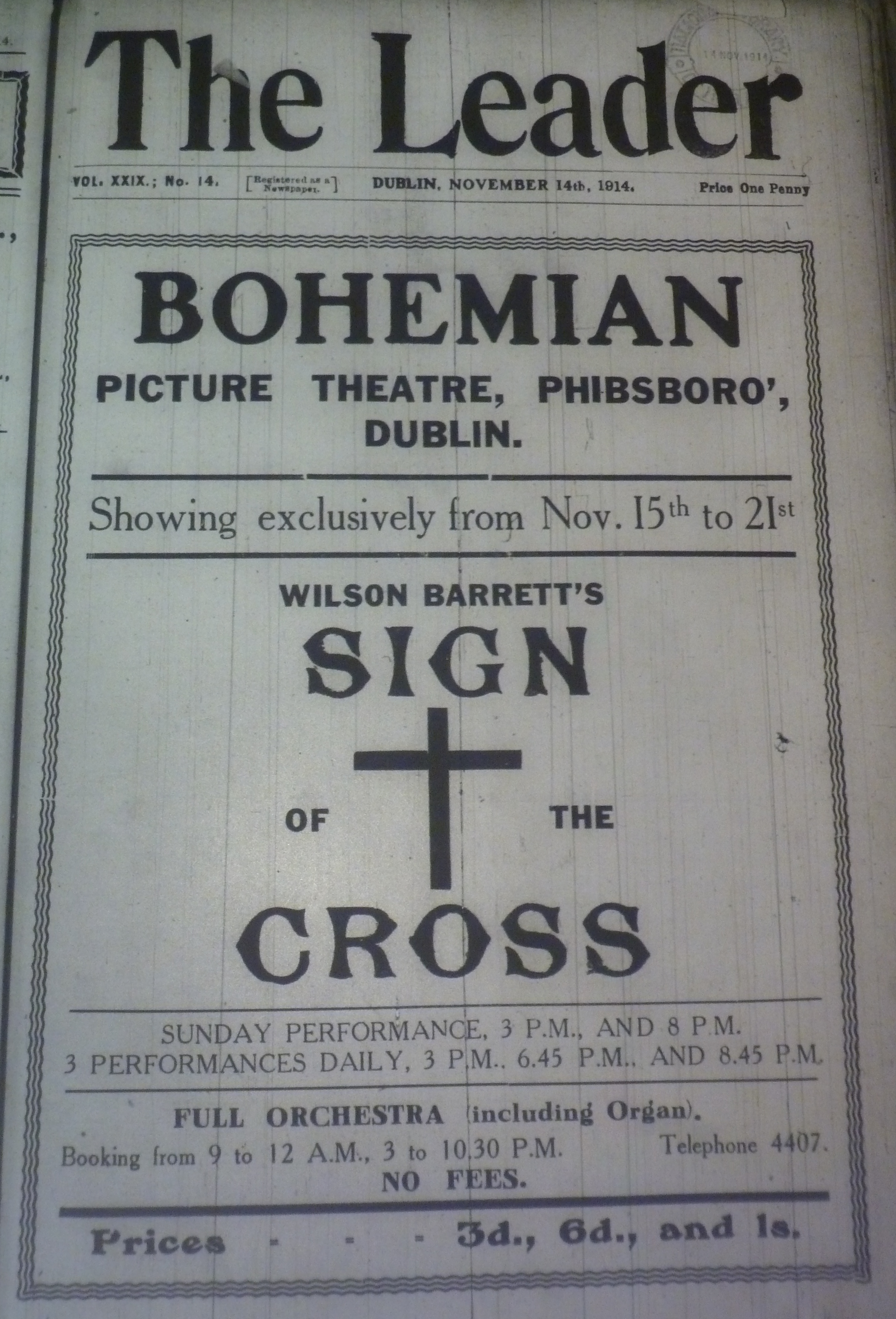
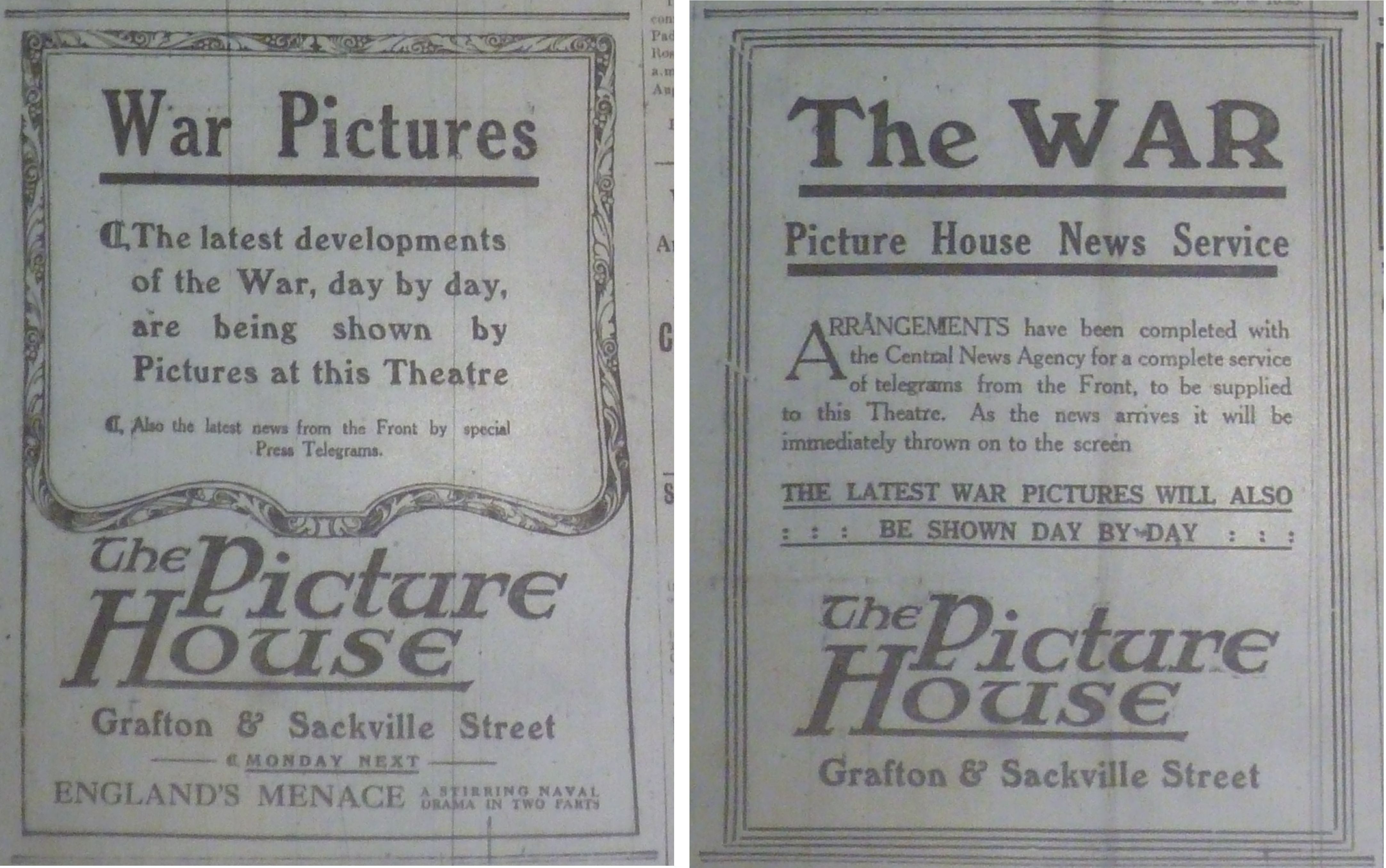
Illustrated ad for Rupert of Henzau (Britain: London, 1915) at Dublin's Picture House, Grafton Street; Evening Telegraph 31 May 1915: 2.

Illustrated ad for Rupert of Henzau (Britain: London, 1915) at Dublin’s Picture House, Grafton Street; Evening Telegraph 31 May 1915: 2.

Whatever about its compulsion to drive people to illegal activity – a point made both by some reform groups and by some wrongdoers seeking to lay the blame for their actions with the new medium – other commentators were making the point that cinema had become a habit for many people. Writing in Irish Life, playwright and novelist Edward McNulty assessed the progress of the cinematograph against the many claims made for it:

[A]ll the things predicted of the cinematograph are undoubtedly realisable, but, unfortunately, most of the brightest anticipations have not been achieved. The cinema was, above all, to be educational. All the drudgery of teaching was to vanish. Schools and colleges were to be transformed into theatres of instruction; the daily paper was to be supplanted by the Cinema News Bureau, and the French irregular verbs were to be assimilated in the guise of light comedy. (Paddy, 20 May).

Nevertheless, “ in spite of its defects and disappointments, we must gladly acknowledge that the marvel of cinema is the vehicle of diurnal delight all over the civilised globe” (ibid).

Although Irish cinema of the period was certainly a vehicle for diurnal delight, May 1915 was striking for the motivations other than delight that lured patrons to the picture houses. If diurnal delight was epitomized by Charlie Chaplin’s comedies, their power of attraction was at least matched by war films. The Cinema News Bureau had not – and would never – replace the newspaper, but the sinking of the RMS Lusitania showed how the media worked together to serve wider ideological war needs. The Cunard Line’s transatlantic steamer was torpedoed by a German submarine off Kinsale, Co. Cork, at about 2pm on 7 May, and initial reports appeared in the evening newspapers (“Lusitania”), with fuller accounts dominating the news on 8 May. The story had several aspects of interest to Irish papers, some of which had particularly local resonance and other of which linked to war-related issues. Rescue efforts were coordinated from the Cork port of Queenstown (now Cobh), where survivors and victims were initially brought and the inquest held. The large loss of civilian lives – almost 1,200 of the nearly 2,000 people on board died – world have made this a particularly important story in any case, and one that justified propagandistic condemnation of German disregard for civilian life and the rules of war. As well as this, the fact that more than 100 Americans were among the victims provided an impetus for discussion of the hoped-for US entry into the war on the British side.

Newspaper reports were joined on Monday, 10 May by the first newsreel images. The big newsreel companies Gaumont and Pathé sent film units to Queenstown. “Immediately the news was received,” revealed the trade journal Biosocpe,

Gaumont’s dispatched four photographers to the south of Ireland – one from London, Liverpool, Dublin and Belfast – and their joint film contributions were promptly sent to London, where they were supplemented by a few views of the arrival at Euston of survivors. The subject is introduced by a general view of the Lusitania, Messrs. Pathé Frères had men at Queenstown, and a staff of three photographers at Lime Street Station, Liverpool, to meet the train conveying survivors. (Filming ‘Lusitania’ Incident.”)

On Monday, Gaumont released a 350-foot “special topical,” while Pathé initially included just a 50-foot (approx. 1 minute) item in their regular Pathé Gazette, with the intention of supplementing this with a further 150-foot item for the weekend. “The enterprise of these two firms is only surpassed by their restraint,” commented the Bioscope, “when it is remembered that about ten cameras were employed, and the output of film ran into four figures” (ibid.).

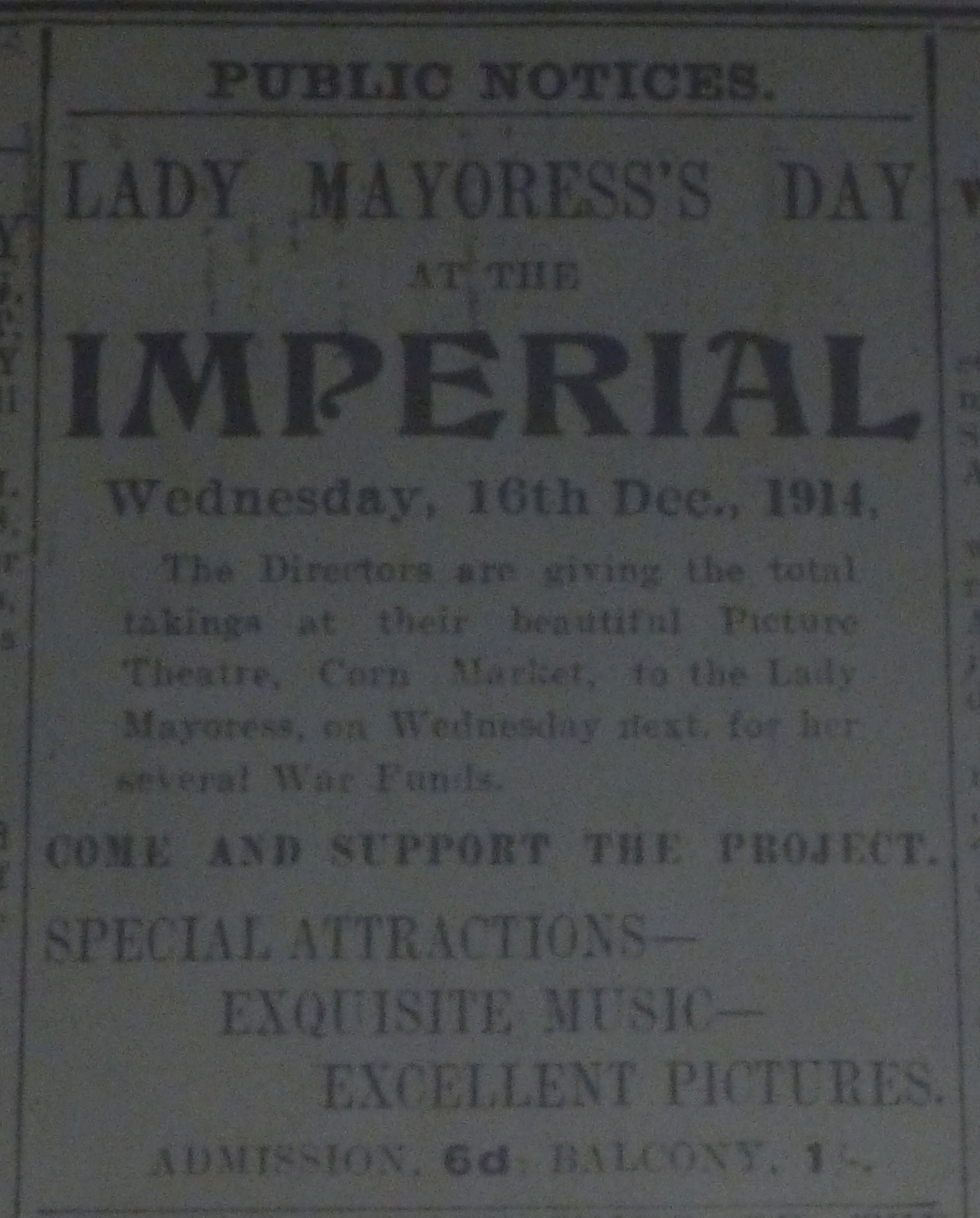
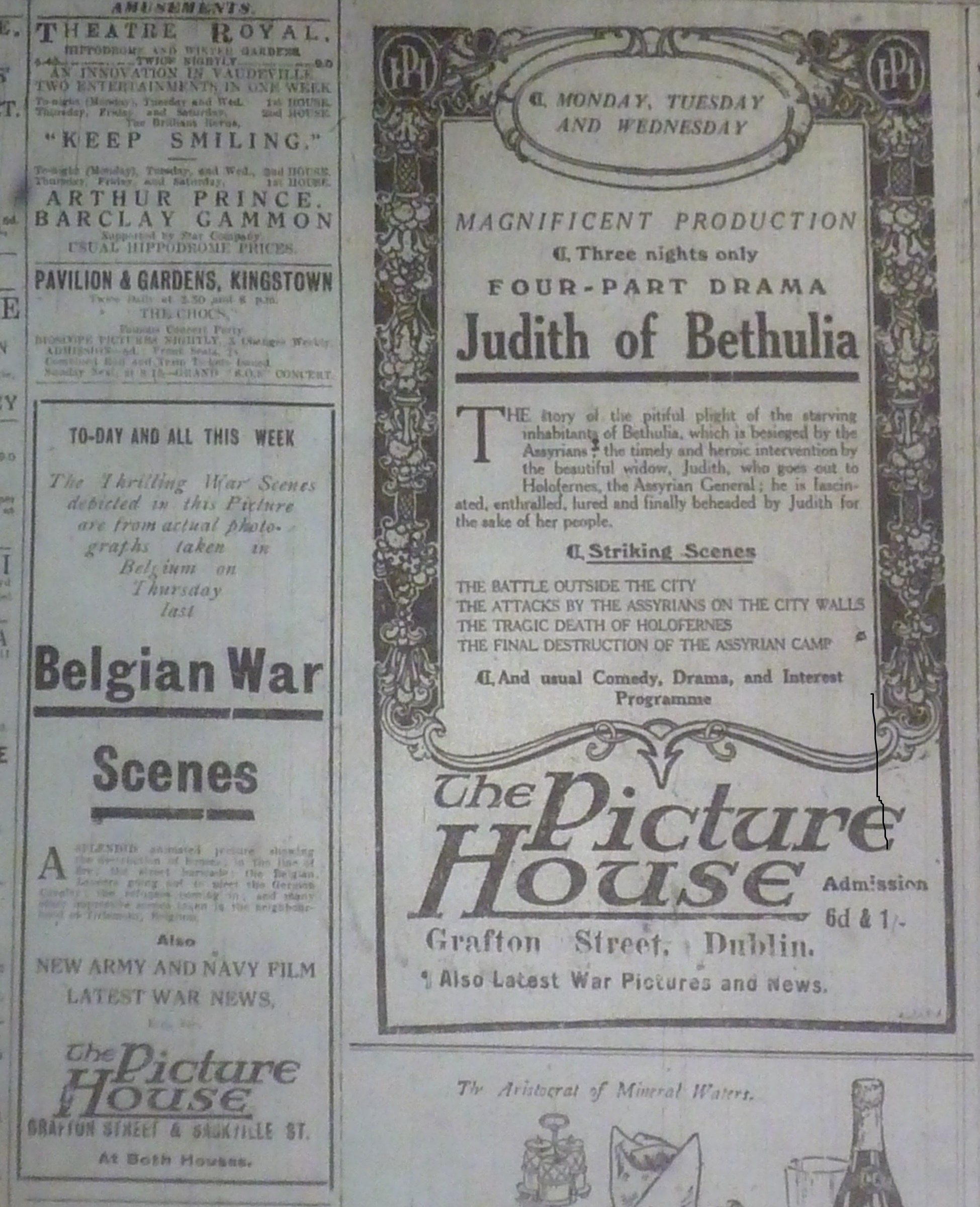
Entertainment ads showing impact of Lusitania sinking; Evening Telegraph 10 May 1915: 1.

Entertainment ads showing impact of Lusitania sinking; Evening Telegraph 10 May 1915: 1.

Irish audiences also had the opportunity to see these films. Patrons of Dublin’s Rotunda were offered “a series of pictures depicting incidents connected with the arrival of the Lusitania victims and survivors at Queenstown” (“Rotunda Pictures,” 11 May). The depth of emotion expressed by the journalist who visited the Picture House in Sackville/O’Connell Street suggests that s/he saw the longer Gaumont film. “A picture showing scenes and incidents after the sinking of the Lusitania was shown at this House yesterday;” s/he reported.

[I]t was both interesting and pathetic, and one left with feelings of deepest emotion at the havoc and misery caused to countless human beings by the unmediated act of murder on the part of the German submarine, which, with a total disregard for the lives of women and children sent the mighty ship to the bottom. (“O’Connell Street Picture House.”)

The clear anti-German feeling here was congruent with the reporting on the sinking in general and particularly with the verdict of the inquest, which was given in an editorial item on the same page as the review of the Sackville/O’Connell. “This appalling crime was contrary to international law and the convention of all civilized nations,” it began, “and we, therefore, charge the owners of the submarine, the German Emperor, and the Government of Germany, under whose orders they acted, with the crime of wilful and wholesale murder” (“The Kinsale Verdict.”)

What seems incongruous – but may only seem so – is that the writer so affected by the Lusitania film should find immediate relief in the comedies that accompanied it on the same programme. “After viewing those harrowing incidents,” s/he observed, “the excellent comedies came as a most welcome change; they included ‘Love and Dough,’ featuring the well-known screen comedian Ford Sterling” (“O’Connell Street Picture House”). Images of war and physical comedy complemented each other on the picture-house screen, and as will be seen below, Chaplin had become the comedian in highest demand. Although for audiences in the early 21st century such changes of tone may seem strange or even inappropriate, for audiences in the 1910s, used to entertainments that included variety and contrast, this appears to have been perfectly acceptable.

In any case, films of various kinds provided the imaginative means for coming to terms with the tragedy of war, as well as the spectacle of such new technologies as the zeppelin, the torpedo and the submarine. Bearing echoes of the Lusitania sinking, for example, Dublin’s Masterpiece placed a special ad in the Evening Telegraph at the end of May advising the public that it would give its final exhibition of The Italian Navy “in which is shown a torpedo at its deadly work of sinking a passing vessel” (“The Masterpiece,” 29 May). The Lusitania sinking also had consequences for Irish cinema that only became clear much later. Although Walter Macnamara had shot the Irish historical drama Ireland a Nation for his New York-based production company partly in Ireland in 1914, a copy of the film did not reach the country until 1917 because “the first copy dispatched by them was lost with the ill-fated Lusitania; a duplicate copy was substituted, but […] this also failed to successfully run the submarine ‘blockade’” (“Between the Spools”).

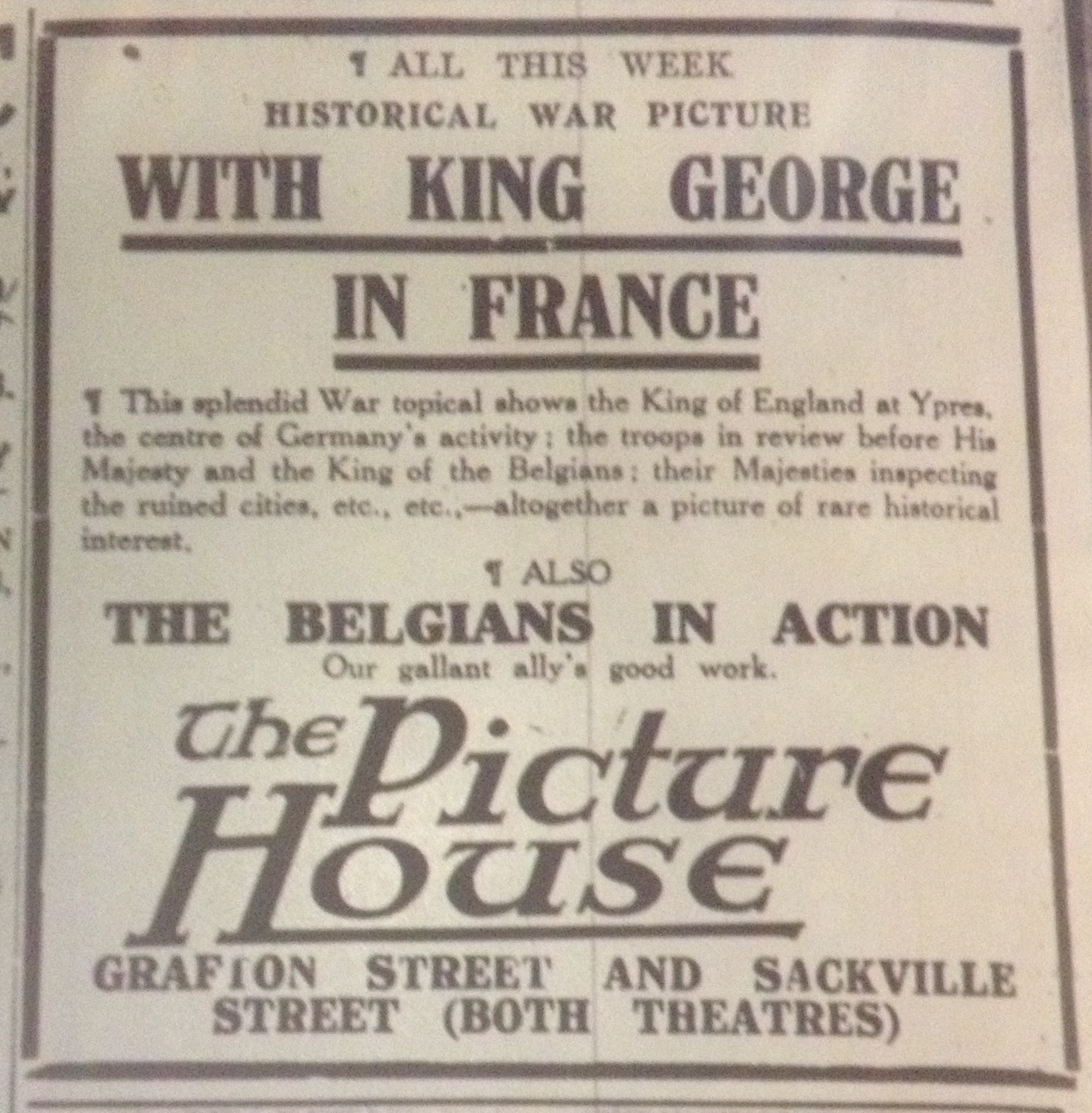
The Lusitania films were joined by other propagandistic war films in mid-May. On 13-15 May, a “very important” War Office film of Lord Kitchener’s visit to British army headquarters in France was shown at Dublin’s Picture Houses in Grafton and Sackville/O’Connell Streets (‘“Lord Kitchener in France”’). Over the same period, the Grafton was also showing a film of the Battle of Neuve Chapelle,

“illustrated by Kineto War Map No. 5. By means of this exceedingly clever animated map the Battle of Neuve Chapelle is shown in a manner most thrilling to watch. The representation of the whole battle is wonderful, and everyone who sees it will be more than interested, as it forcibly portrays the difficult struggle of the British to hold this position against the heavy fire of the enemy’s’ batteries. (Ibid.)
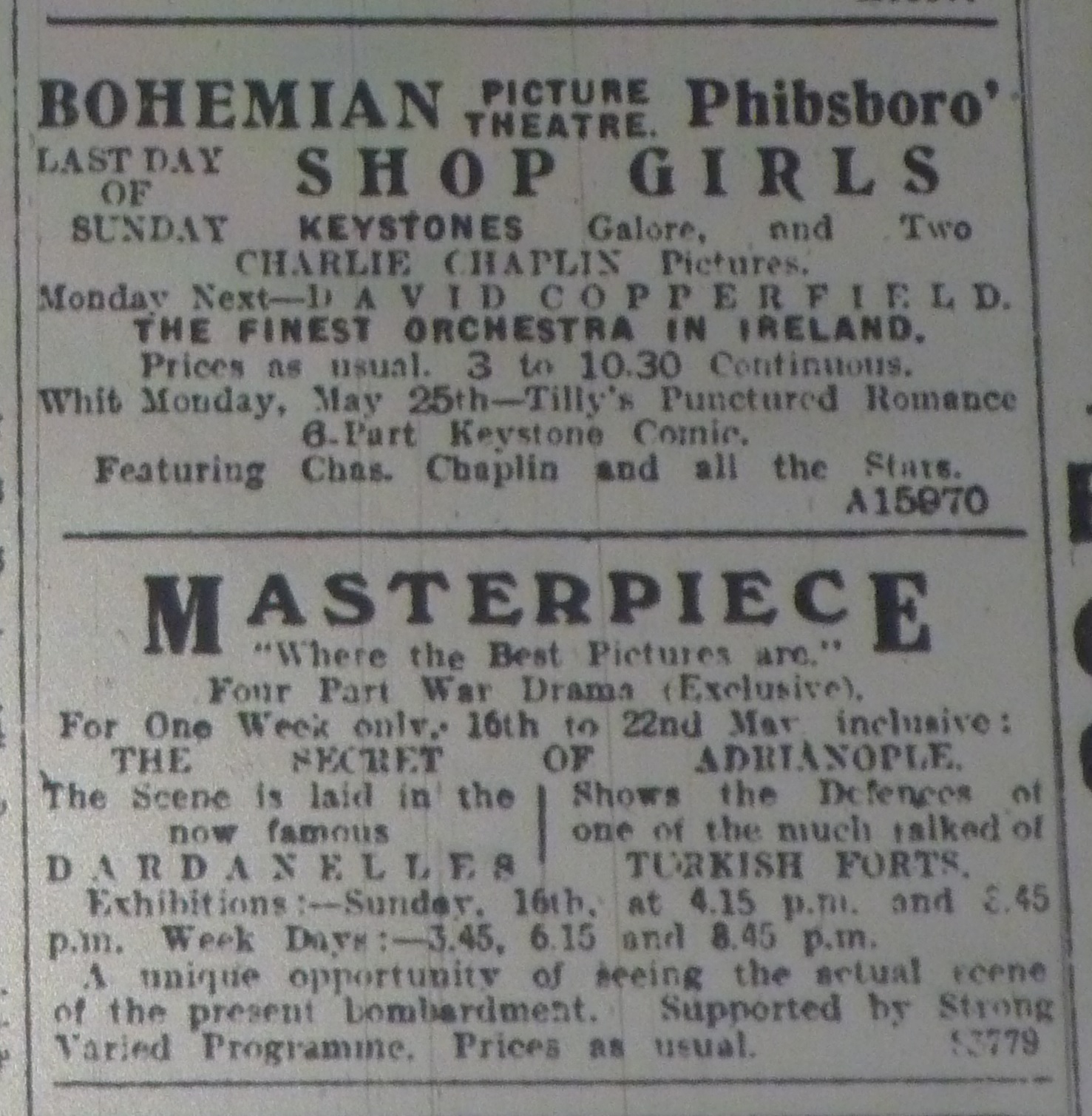
Ad for Dublin’s Masterpiece showing The Secret of Adrianople (1913); Evening Telegraph 15 May 1915: 1.

Ad for Dublin’s Masterpiece showing The Secret of Adrianople (Denmark: Kinografen, 1913) and Bohemian ad drawing attention to the big Whit Monday attraction, Tillie’s Punctured Romance (US: Keystone, 1914); Evening Telegraph 15 May 1915: 1.

For the week of 16-22 May, the Masterpiece advertised The Secret of Adrianpole. The preview in the Evening Telegraph described it as “a magnificent four-part war drama, the scene of which is laid in the now famous Dardanelles, and shows the defences of the much-talked-of Turkish forts” (“The Masterpiece,” 11 May). However, the film was not set during World War I, having been released under the title Adrianopels hemmelighed by the Danish company Kinographen in 1913. Interest in the Dardanelles raised by the Gallipoli land campaign that began on 25 April 1915 lent it renewed topicality:

Now, when all eyes are focused on the Dardanelles, and every scrap of information about the present bombardment eagerly devoured, this great picture comes most opportunely, reproducing in interesting fashion the places daily mentioned in the Press, and showing particularly the actual defences of Fort No. 13, one of the fortifications of so much interest at the moment. (Ibid.)

Although these war films clearly attracted audiences, by early summer 1915 Charlie Chaplin was Irish cinema’s most consistent draw. As already mentioned, the Rotunda showed the Lusitania newsreel beginning on Monday, 10 May; however, the “principal attraction for the great majority of the audience who will frequent the Rotunda this week will, undoubtedly, be the Keystone comedy film entitled ‘The Knockout’” (“Rotunda Pictures,” 11 May). The Knockout (US: Keystone, 1914) actually starred Roscoe “Fatty” Arbuckle and Minta Durfee, with Chaplin in a minor role, but the review of the Rotunda shows mentioned only that it featured “the well-known comedian, Charles Chaplin, as referee in a boxing match of a decidedly novel description” (ibid.). This favouring of Chaplin was consistent with a recent comment that no cinema “programme now is complete without the well-known comedian, Charles Chaplin” (“Rotunda Pictures,” 8 May).

Charlie Chaplin, caught between Mabel Normand and Marie Dressler in Tillie's Punctured Romance (US: Keystone, 1914)

Charlie Chaplin, caught between Mabel Normand and Marie Dressler in Tillie’s Punctured Romance (US: Keystone, 1914).

For the week beginning with the Whit Monday holiday, 24 May 1915, the Rotunda again featured a Chaplin film, Charlie’s New Job (US: Keystone, 1914), but the Bohemian upstaged them by securing exclusive rights to Tillie’s Punctured Romance (US: Keystone, 1914). The first feature-length comedy, the six-reel Tillie’s Punctured Romance starred Chaplin alongside stage actress Marie Dressler and Keystone favourite Mabel Normand. Reporting on a press showing of the film on 9 May, a writer in the Evening Telegraph observed that the “farcical element throughout the whole performance has full sway, and the spirit of fun dominates the various scenes. […] The film has been secured by the ‘Bohemian’ at the cost of £100, and the enterprise of the management should meet with a huge measure of public appreciation” (“Bohemian Picture House”). Their enterprise apparently was rewarded because the reviewer of the Whit Monday show commented that “Chaplin is certainly at his best in this production, and all those desirous of seeing him should go early, as the demand for seats last evening was very great” (“The Bohemian”).

Such diurnal delights would continue to lure audiences for many years to come.

References

“Between the Spools.” Irish Limelight 1:2 (Feb. 1917): 19.

The Bohemian.” Evening Telegraph 25 May 1915: 2.

“Bohemian Picture House.” Evening Telegraph 10 May 1915: 2.

“The Kinsale Verdict.” Evening Telegraph 11 May 1915: 2.

“Filming ‘Lusitania’ Incident.” Bioscope 13 May 1915: 623.

‘“Lord Kitchener in France.”’ Evening Telegraph 12 May 1915: 4.

“The Lure of the Picture House.” Evening Telegraph 3 May 1915: 6.

“Lusitania: Sinking Off Cork Coast: Help from Queenstown: 1,400 Passengers on Board.” Evening Telegraph 7 May 1915: 3.

“The Masterpiece.” Evening Telegraph 15 May 1915: 8; 29 May 1915: 8.

The O’Connell Street Picture House.” Evening Telegraph 11 May 1915: 2.

Paddy. “Picture in Ireland.” Bioscope 20 May 1915: 773.

“Rotunda Pictures.” Evening Telegraph 8 May 1915: 8; 11 May 1915: 2.
From the Stomach to the Front: Projecting the World on Irish Screens in April 1915

The growth of picture houses in the 1910s provided Irish people with unprecedented visual access to the world. The increasing number of cinemagoers could view otherwise difficult or impossible to see geographical spaces, the geopolitical spaces of Europe’s battlefields and even the intimate spaces within the human body.

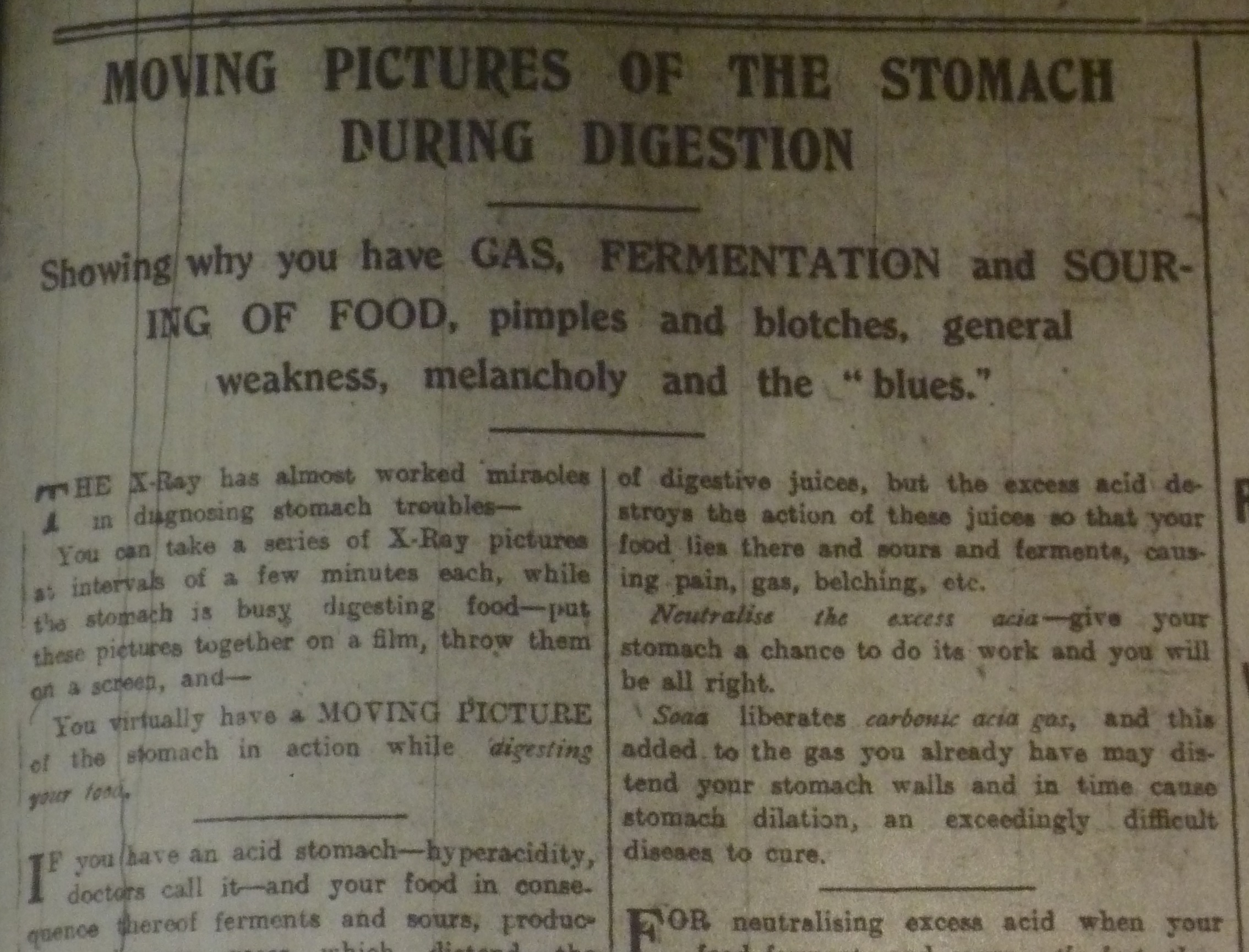
Stomach film DEM 24 Mar 1915

Dublin Evening Mail 24 March 1915: 5.

“You can take a series of X-Ray pictures at intervals of a few minutes each, while the stomach is busy digesting food,” observed an article in the Dublin Evening Mail in late March 1915.

[P]ut these pictures together on a film, thrown them on a screen, and –

You virtually have a MOVING PICTURE of the stomach in action while digesting your food. (“Moving Pictures of the Stomach.”)

Designed to look like a news item, this article was actually an advertisement for Bisturated Magnesia, a treatment for excess stomach acid. It used the term “moving pictures” – capitalized like no other word in the body of the article – to attract the roving eye of newspaper readers (and film historians), dyspeptic or not. Some advertisers clearly saw moving pictures as a desirable technology with which to associate their product in this way, as the promoters of White’s Fruit Jelly Crystals had done in the same newspaper in August 1913 (“Really Moving Picture”).

In their use of stomach X-rays, the advertisers of Bisturated Magnesia were, however, undoubtedly making a specific reference to Dr John MacIntyre’s experiments in what is now called medical imaging and specifically to Dr John MacIntyre’s X-Ray Film (1896, 1909), which includes early cineradiography of the stomach. Despite being a medical doctor and pioneer of radiography, MacIntyre could also see that X-rays were a spectacular visual technology, of interest far beyond the medical community (Cartwright 22). As such, he had something in common with the showmen who in the late 1890s exploited the entertainment possibilities of X-rays in theatres and fairgrounds, including in Ireland (Condon). This occurred at precisely the same time as the first projected moving pictures were being exhibited. Unlike moving pictures, however, the entertainment career of X-rays was short. For a start, the danger of radiation burns from prolonged exposure to the rays soon became obvious. As well as this, once audiences had seen the bones of their hands or the contents of a locked wooden box, the novelty value of X-rays was exhausted, but they retained a strong imaginative fascination. By contrast, moving pictures were inexhaustible in the potential subjects they could show, from X-ray images of such interior spaces to the exterior spaces of the historical world and the imagined spaces of fiction.

Moving pictures has also prompted the creation of the new social spaces of the picture houses, which were becoming increasingly ubiquitous on the Irish streetscape in April 1915. Although the Grand in Lurgan, Co. Armagh, had opened in autumn 1914, it garnered attention beyond local audiences when it was reviewed in glowing terms by the Bioscope’s “Jottings from Ulster” columnist on 1 April 1915. “Situate on the main street and approached through a spacious and ornate foyer,” the Grand held about 1,000 patrons who were stratified by their ability to pay 3d., 6d. or 1s. This was not, then, a utopian space of horizontal social relations. Although a stepped floor ensured that all patrons had a good view of the screen, “the patrons of the highest priced seats are comfortably and exclusively catered for in a handsome balcony abreast of the operating chamber, nest-o’spring seats and deep framed backs being provided in this section” (“Jottings,” 1 Apr.). Jottings favoured a programme that combined films with live acts, expressing strong approval of the fact that H. G. Austin, who managed the Grand for proprietor Sam Hewitt, had introduced varieties acts into the programme. As a result of this combination of entertainments, Jottings concluded: “I would not be surprised to find the magnificent tapestry with which the walls are decorated, being removed to make room for the appreciative crowds.” However, like other Irish towns with a similar population (12,553), Lurgan had more than one picture house. At the longer-established Picture House in Carnegie Street, manager Clarke embodied Jotting’s favoured combination of variety and cinema, having been part of the variety duo Clarke and Clare (“Jotings,” 22 Apr.).

Evening Telegraph 3 Apr. 1915: 1.

Evening Telegraph 3 Apr. 1915: 1.

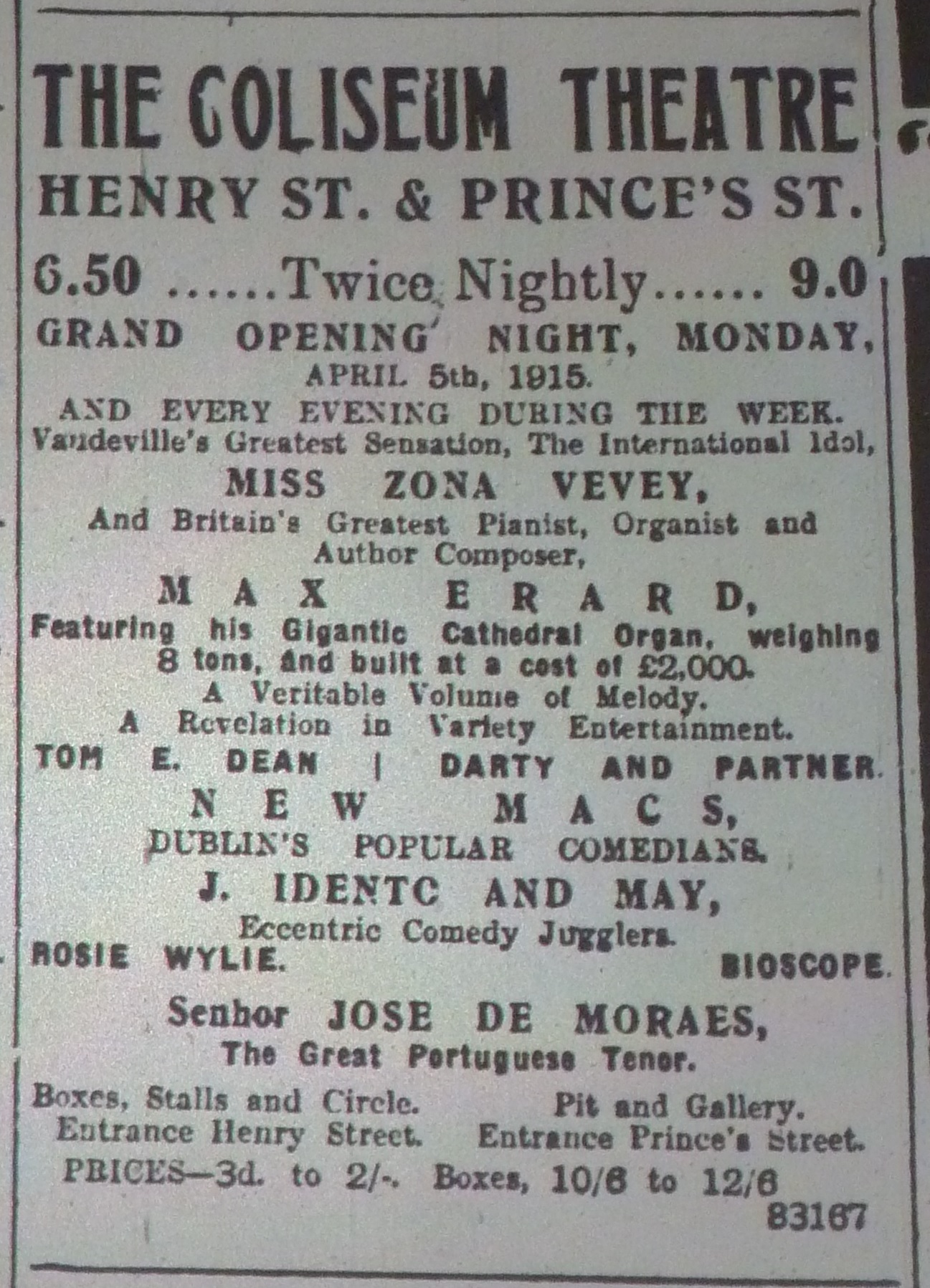
If the Lurgan Grand was in many ways typical of the picture houses opening in mid-sized Irish towns at this time, Dublin’s Coliseum Theatre, which opened on Easter Monday, 5 April 1915, was exceptional. With a seating capacity of 3,000, it was Ireland biggest entertainment venue, and its stage was “one of the largest in the kingdom, being not less than 80 ft. wide and 40 ft. deep, capable of staging the largest spectacular scenes” ([Editorial Item]). In its initial stage of development, the Coliseum had been planned as a large picture house called the Premier Picture Palace, but its promoters had decided that another Dublin variety theatre would be more lucrative than a cinema. Nevertheless, given that film projection had become a stable part of variety programmes, a projection booth had been incorporated into the plans for the building and not as an unsightly supplementary structure within the auditorium, as was the case in older theatres. Praising the features of the Coliseum in advance of its opening, the Evening Herald noted that the “biograph chamber is so designed that it will beautify not mar the general scheme” (“Dublin’s New Theatre”).

Despite a general acknowledgment of the quality of the construction and the beauty of the finished theatre, controversy dogged both the building and the opening of the Coliseum. As noted in an earlier post, although other Dublin theatre owners had objected at an August 1914 hearing to the granting of a patent to this new venue, architect, diarist and theatregoer Joseph Holloway had spoken in favour of the new theatre because it offered the prospect of more drama in the city. The most immediate drama came offstage, from such craftspeople as local fibrous-plaster companies and furniture makers who were denied contracts for work in favour of cheaper British firms. In Dublin, the support of local industries was not only a way of creating good will among potential theatregoers but also of mollifying nationalist Anglophobia. With an ill-tempered public correspondence between the theatre and contractors conducted through the newspapers, the negative publicity for the theatre continued over months, causing Holloway to change his mind about its promise and “wish the new theatre a speedy failure under the circumstances. There is no hope ahead for us poor playgoers in Dublin!” (Holloway, 17 Mar. 1915).

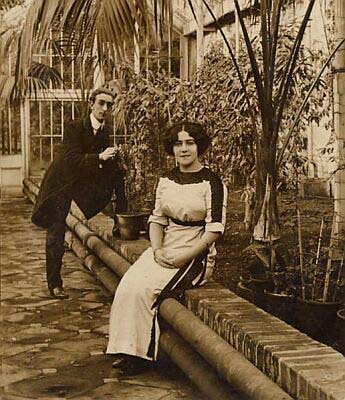
Holloway attended the Coliseum’s opening night, and unlike the newspapers’ positive reviews, his diary entries suggest that the management misjudged the Dublin audience. This is noteworthy given that Lorcan Sherlock, the city’s former Lord Mayor, was one of the theatre’s directors. The theatre’s opening bill was headed by the singer Zona Vevey accompanied on organ by Max Erand. Although their act had been going very well and they had been called back for several encores,

the turn that was doing so well was completely spoiled by her singing of a recruiting Jingo song, “Your Country Wants You.” “It does, and we intend to stop it” said a man behind me as she sang. “Give us something Irish” shouted another, and then I knew trouble was brewing for her, and sure enough when she had finished, a stream of hissing and booing broke out and the two artists, retired amid a tornado of ugly sounds. (Holloway, 5 Apr. 1915.)

http://comeheretome.com/2014/05/09/is-it-over-yet-hiding-out-in-the-coliseum-theatre-1916/

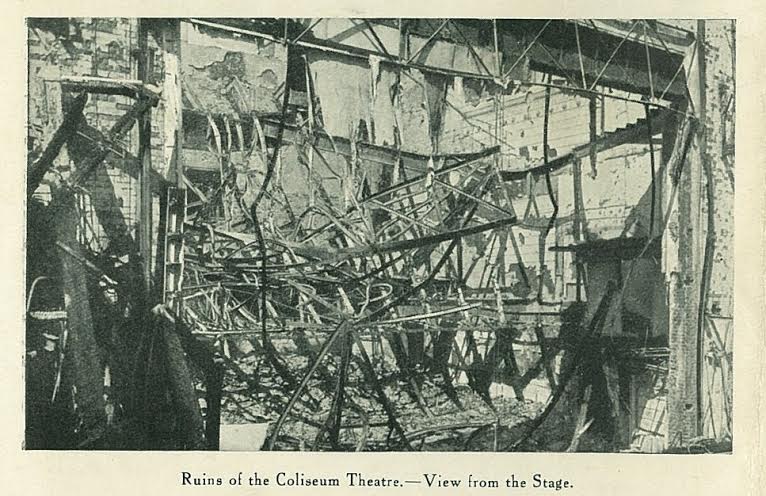
Opened in Easter 1915, the Coliseum was destroyed in the fighting of Easter 1916. “The possibility of fire is put almost outside the pale of consideration” (“Dublin’s New Theatre”). Source: http://comeheretome.com/2014/05/09/is-it-over-yet-hiding-out-in-the-coliseum-theatre-1916/

The bioscope pictures – “introducing the Topical Budget of up-to-date current events” – with which the programme concluded appears to have been entirely unremarkable because they received no coverage, but Holloway claims that the opening night ended ignominiously:

A bar of England’s anthem brought the first show to an inglorious end, amid hissing, which cut short the music, as the imported conductor dropped his baton when he saw the way the land lay. This anthem has always been translated, when played in Ireland, into ‘To Hell With The Catholics’, and will always, I fear until we are allowed to govern ourselves. Therefore, it is better omitted from programmes of a general nature. (Ibid.)

Despite Holloway’s misgivings, the Coliseum’s opening was widely reported a success, and its advent tipped the balance of entertainment seats in Dublin city centre firmly back from picture house to theatre. The Evening Herald’s Man About Town was disappointed by the hackneyed nature of some of the opening acts, but he also saw a packed house that included “a few eminent K.C.’s, a land commissioner, several leading medicos, an Abbey Theatre author of distinction, and a trustee of the same concern.” For the Evening Telegraph, among the reasons that the Coliseum “opened its career auspiciously” was that it enjoyed an “advantageously central position […] adjoining the General Post Office and at the tram terminus for all parts of the city and suburbs” (“Coliseum Theatre”).

Those same trams might bring pleasure seekers away from the city centre and to the increasing number of picture houses in the suburbs. The arrival of the picture house had reconfigured entertainment space in the city. Some of the suburban picture houses courted more middle-class patrons in search of higher standard of entertainment in the guise of exclusive films, comfortable surroundings and musical offerings. The Bohemian Picture Theatre in Phibsboro – an area on the northern edge of the city well served by two tramlines – was building its reputation as a venue that provided enhanced musical accompaniment. The Bioscope’s Paddy observed that “one of the finest orchestras to be found in any picture outside London – or in London for the matter of that – is that now installed in the Bohemian.” The Bohemian had twelve musicians “and every instrument seems to have been pressed into use, thus affording a musical feast absolutely unapproached by any other house in Ireland” (Paddy, 25 Mar.).

Cinemas also competed for audience by offering more luxurious furnishings. Dublin’s Pillar Picture House had “an immense mirror […] beautifully set in a gilded frame[…] Thick luxurious carpets are on the stairs leading to the balcony, and the general appearance of the entrance leads one to imagine that a fairy palace of some sort was about to be entered” (Paddy, 4 Mar.). Some picture houses offered early evening patrons free tea. “A big feature is now being made of glow-lamp teas at Kinema House, Belfast,” noted Jottings. “Dainty tables with shaded lights are arranged in full view of the screen, and considerable advantage is being taken of the innovation by those who sacrifice their siestas to the pictures in the afternoons” (Jottings, 1 Apr.). This kind of offering seemed to have been designed to appeal largely to middle-class women who had the leisure to visit the picture houses while shopping in cities and towns in the afternoons.

Some religious groups and magistrates saw cinemagoing as an activity to be restricted rather than encouraged among the middle class. One of the main ways in which they sought to do this was through restrictions or a ban on Sunday opening. The ongoing controversy on Sunday opening came to something of a head at the end of March, when the Recorder of Dublin heard applications for music-and-dancing licences for picture houses. The Recorder reiterated his view that Sunday opening should be restricted to working-class areas of the city, where people had little opportunity to attend entertainments during the week. He therefore granted just a six-day music licence to Jacob Elliman’s Blackrock Picture House because it was located in “a residential place, with a very small number of working people” (“Picture Theatres”). And he again refused a Sunday licence to the Dame Street Picture House, which, he argued, was not frequented by working-class people because it was located on a city-centre shopping street similar to Grafton Street and Sackville/O’Connell Street.

Some religious groups and magistrates saw cinemagoing as an activity to be restricted rather than encouraged among the middle class. One of the main ways in which they sought to do this was through restrictions or a ban on Sunday opening. The ongoing controversy on Sunday opening came to something of a head at the end of March, when the Recorder of Dublin heard applications for music-and-dancing licences for picture houses. The Recorder reiterated his view that Sunday opening should be restricted to working-class areas of the city, where people had little opportunity to attend entertainments during the week. He therefore granted just a six-day music licence to Jacob Elliman’s Blackrock Picture House because it was located in “a residential place, with a very small number of working people” (“Picture Theatres”). And he again refused a Sunday licence to the Dame Street Picture House, which, he argued, was not frequented by working-class people because it was located on a city-centre shopping street similar to Grafton Street and Sackville/O’Connell Street.

These cases reveal a curious class, sectarian and even acoustic geography of the city that emerged in relation to its picture houses.

References

Cartwright, Lisa. Screening the Body: Tracing Medicine’s Visual Culture. Minneapolis: U Minnesota P, 1995.

“Coliseum Theatre: The Opening on Monday.” Evening Telegraph 3 Apr. 1915: 4.

Condon, Denis. “‘Spleen of a Cabinet Minister at Work’: Exhibiting X-Rays and the Cinematograph in Ireland, 1896.” Film History and National Cinema: Studies in Irish Film 2. Ed. John Hill and Kevin Rockett. Four Courts Press: Dublin, 2005.

“Dublin’s New Theatre: The Opening of the Coliseum on Monday.” Evening Herald 2 Apr. 1915: 5.

“Jottings from Ulster.” Bioscope 1 Apr. 1915: 33; 15 Apr. 1915: 260.

The Man About Town. “Things Seen and Heard.” Evening Herald 6 Apr. 1915: 4.

“Moving Pictures of the Stomach During Digestion.” Dublin Evening Mail 24 Mar. 1915: 5.

Paddy. “Pictures in Ireland.” Bioscope 4 Mar. 1915: 824; 18 Mar. 1915: 1051; 25 Mar. 1915: 1111.

“Picture Theatres: Recorder and Sunday Opening: Many Applications.” Evening Herald 29 Mar. 1915: 5.

“A Really Moving Picture.” Dublin Evening Mail 12 Jul. 1913: 3.

“Sunday Opening in Dublin: Important Cases.” Bioscope 8 Apr. 1915: 155.

In the Grip of Spies: Irish Cinemas and War Propaganda, March 1915

On the eve of St. Patrick’s Day 1915, several Dublin newspapers reported on an exciting chase of a suspected spy through the city. “For the past couple of day,” the Evening Telegraph revealed,

the military authorities have regarded with suspicion the movements of an individual in the city. To-day the man was seen in the vicinity of O’Connell Bridge, where he again attracted the attention of the military, and when they proceeded to approach him the man immediately made off. (“City Sensation.”)

The pursuing soldiers commandeered a car when they were unable to catch the man on foot, but he was eventually caught by a passing cyclist who responded to the soldiers’ calls to stop the spy. However, although the man was arrested, he was released without charge when he turned out to be a respected Kildare cattle dealer named Murphy. It is unclear why Murphy expected that expressing his view to British soldiers “that the Kaiser might smash the British army and dominate the world in the end” would be uncontroversial, even though such views were common among militant nationalists and radical labour activists (“‘Stop Spy’ in Dublin Streets”).

Evening Telegraph 15 Mar. 1915: 2.

Evening Telegraph 15 Mar. 1915: 2.

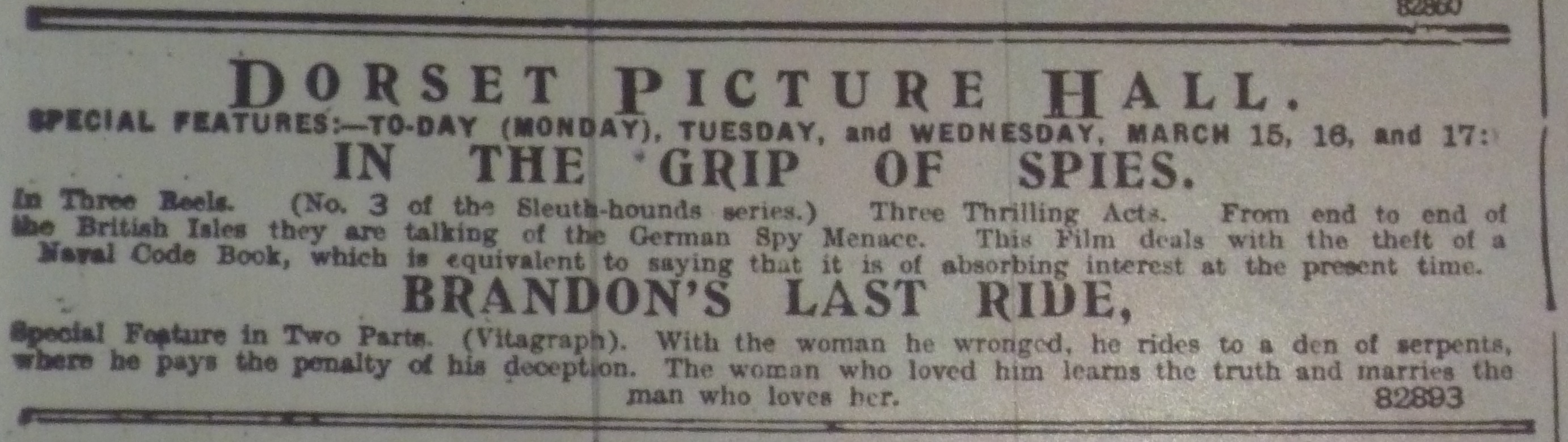
What is interesting, though, is that the expression by an Irishman of such anti-British sentiments led him to be labelled a spy. Indeed, this story fitted into a discourse on spies and spying spread by newspapers and other popular media including the cinema that dovetailed with the British government’s war policies (see also, for example, in same issue of Evening Telegraph “Imaginary Spy” and “Danger of Spies”). For three days in mid-March, Dublin’s Dorset Picture Hall showed In the Grip of Spies (Britain: Big Ben, 1914), and this title offers an apt description of the state of fear of “the enemy among us” that this discourse aimed to spread. “From end to end of the British Isles they are talking of the German Spy menace,” a press ad claimed. “This Film deals with the theft of a naval Code Book, which is equivalent to saying that it is of absorbing interest at the present time” (ibid). But spying was also a suitable subject for comedy, with patrons at the Picture House, Sackville/O’Connell Street enjoying Wiffles Catches a Spy (France: Pathé, 1915).

In general, however, the discourse on spies and the cinema was not comic. Spies brought the war even closer to Ireland and Britain than the German naval blockade blockade to which this ad linked it. Suspicion could be cast on anyone who used a film camera, which purposely or inadvertently could provide intelligence for German attacks. Echoing an incident in Dublin in September 1914 when Norman Whitten was threatened with being shot for filming troops embarking at Dublin port, an article in the Evening Telegraph in early March 1915 reported from the Gateshead Police Court on the arrests, fining and confiscation of the footage of Stanley Dorman and Edwin Joseph Jennings who had filmed a Tyneside naval installation without permission (“Film of a Warship”).

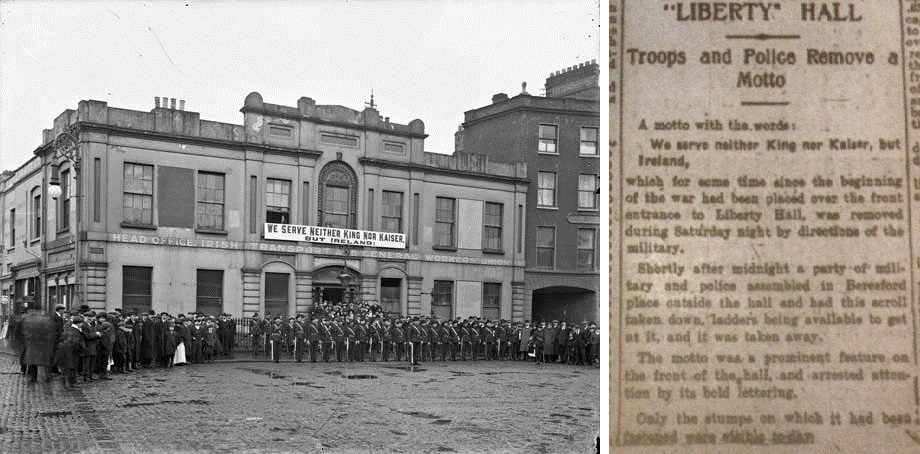
We Serve Neither King nor Kaiser banner and its removal from Liberty Hall in Evening Herald 21 Dec. 1914: 1.

We Serve Neither King nor Kaiser banner and its removal from Liberty Hall in Evening Herald 21 Dec. 1914: 1.

More importantly, the discourse on spies served the useful ideological purpose of suggesting that the divisions of prewar society had been overcome in the face of a common enemy and that any organization or individual not engaged in the war effort was – wittingly or unwittingly – an agent of the Kaiser. Draconian legislation was put in place to deal with such individuals and organizations. Passed just after the outbreak of the war, the Defence of the Realm Act (DORA) introduced strict censorship and gave the police and military widespread powers of arrest. In Ireland, unionists and the mainstream nationalist who followed John Redmond supported the war, but militant nationalists and radical trade unionists condemned it, and some openly supported a German invasion. “When it is said that we ought to unite to protect our shores against the ‘foreign enemy,’” wrote labour leader James Connolly,

I confess to be unable to follow that line of reasoning, as I know of no foreign enemy of this country except the British Government, and know that it is not the British Government that is meant. […] Should a German army land in Ireland to-morrow we should be perfectly justified in joining it if by so doing we could rid this country once and for all from its connection with the Brigand Empire that drags us unwillingly into this war. (“Our Duty in this Crisis.”)

At the start of the war, a banner proclaiming “We Serve Neither King nor Kaiser, But Ireland” was erected on the facade of Liberty Hall, headquarters of the labour movement, and it was only removed by soldiers and police in December 1914 (“‘Liberty’ Hall”). Earlier that month, such radical papers as the Irish Worker, Sinn Fein, Irish Freedom and Eire/Ireland were suppessed (“Irish Papers,” “Another Dublin Paper”).

By contrast, the British trade press continued to urge the wider use of cinema in support of the war effort. In the face of opposition by reformers unsympathetic to popular culture and by the churches to Sunday opening, the industry aimed to win wider social acceptability by aligning itself with state policy. For the Bioscope, cinema certainly played a crucial role as rational recreation at a time of great collective stress. An editorial in March 1915 rejected the snobbish “reproach on those who seek relaxation in theatres and music halls” and argued that “the cinemas are playing no mean part in providing the great mass of people with innocent and healthful entertainment” (“Amusements in War Time”). However, it could also play a much more active role in shaping public opinion in support of the war, a point that the trade papers had argued from an early point in the war. In September 1914, for example, the Bioscope had praised the views of Liberal politician Sir Henry Norman, who in a letter to the London Times had emphasized the role that battlefield reporting could play in support of recruiting and arousing enthusiasm for the war at home. Norman proposed sending to the front with the correspondents “at least one official cinematographer, whose films of the glories of war – we shall have plenty of other means of learning of its sorrows – should be shown in every town and village in the land” (“The Cinematograph at the Front”).

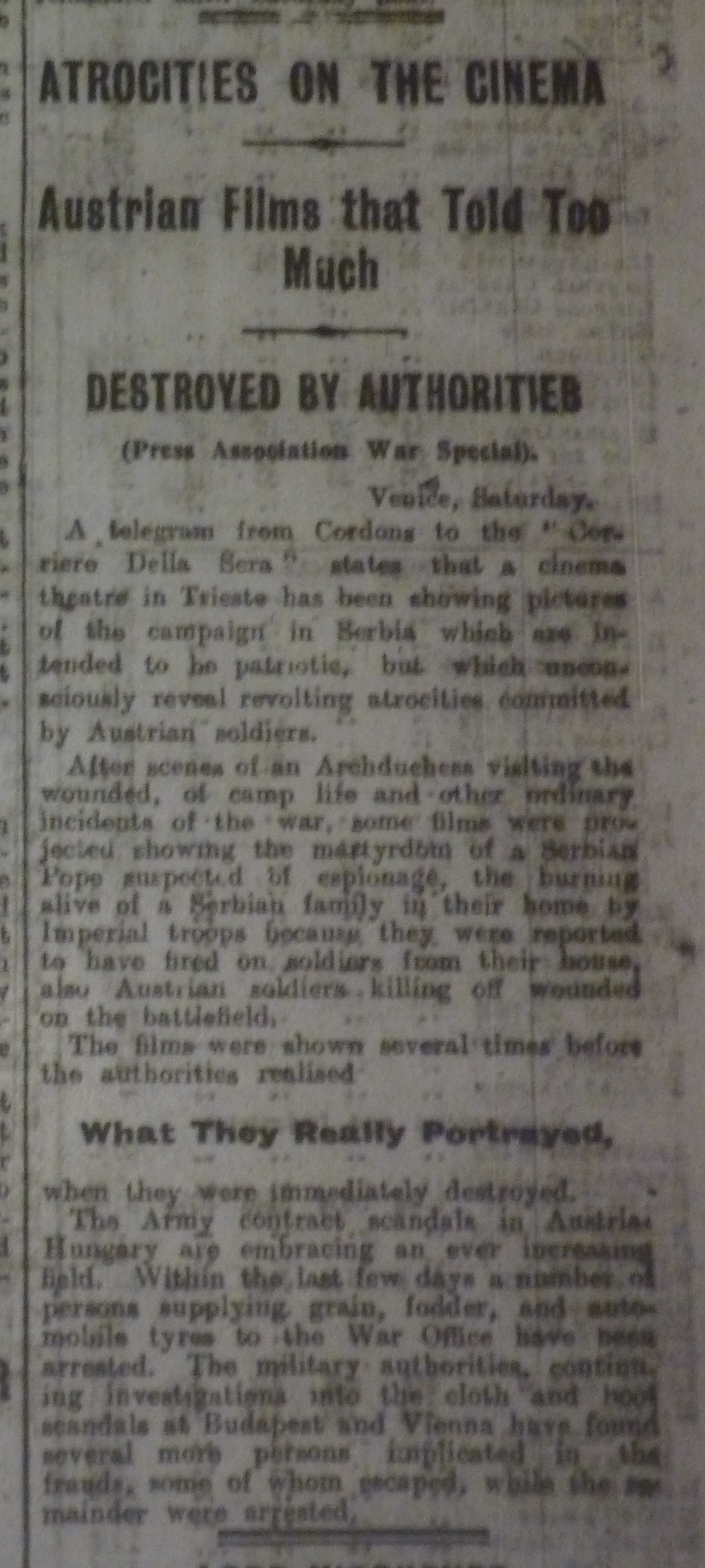
“Atrocities on the Cinema.” Dublin Evening Mail 27 Mar. 1915: 5.

Dublin Evening Mail 27 Mar. 1915: 5.

With little indication that the British government was exploring the propaganda possibilities of the cinema, the press continued to offer stories showing that Germany was winning the propaganda war among the German population, as well as exploiting such advanced technological application as the use of the cinematograph in reconnaissance. The Dublin Evening Mail, the Dublin evening paper with a distinctly unionist editorial line, was particularly fond of these stories, but it also showed that the cinema had the potential to reveal uncomfortable truths about the war. An article in late March, for example, reported that

a cinema theatre in Trieste has been showing pictures of the campaign in Serbia which are intended to be patriotic, but which unconsciously reveal revolting atrocities committed by Austrian soldiers.

After scenes of an Archduchess visiting the wounded, of camp life and other ordinary incidents of the war, some films were projected showing the martyrdom of a Serbian suspected of espionage, the burning alive of a Serbian family in their home by Imperial troops because they were reported to have fired on soldiers from their house, also Austrian soldiers killing off wounded on the battlefield. (“Atrocities on the Cinema.”)

Once the authorities realized what the films depicted, they destroyed them.

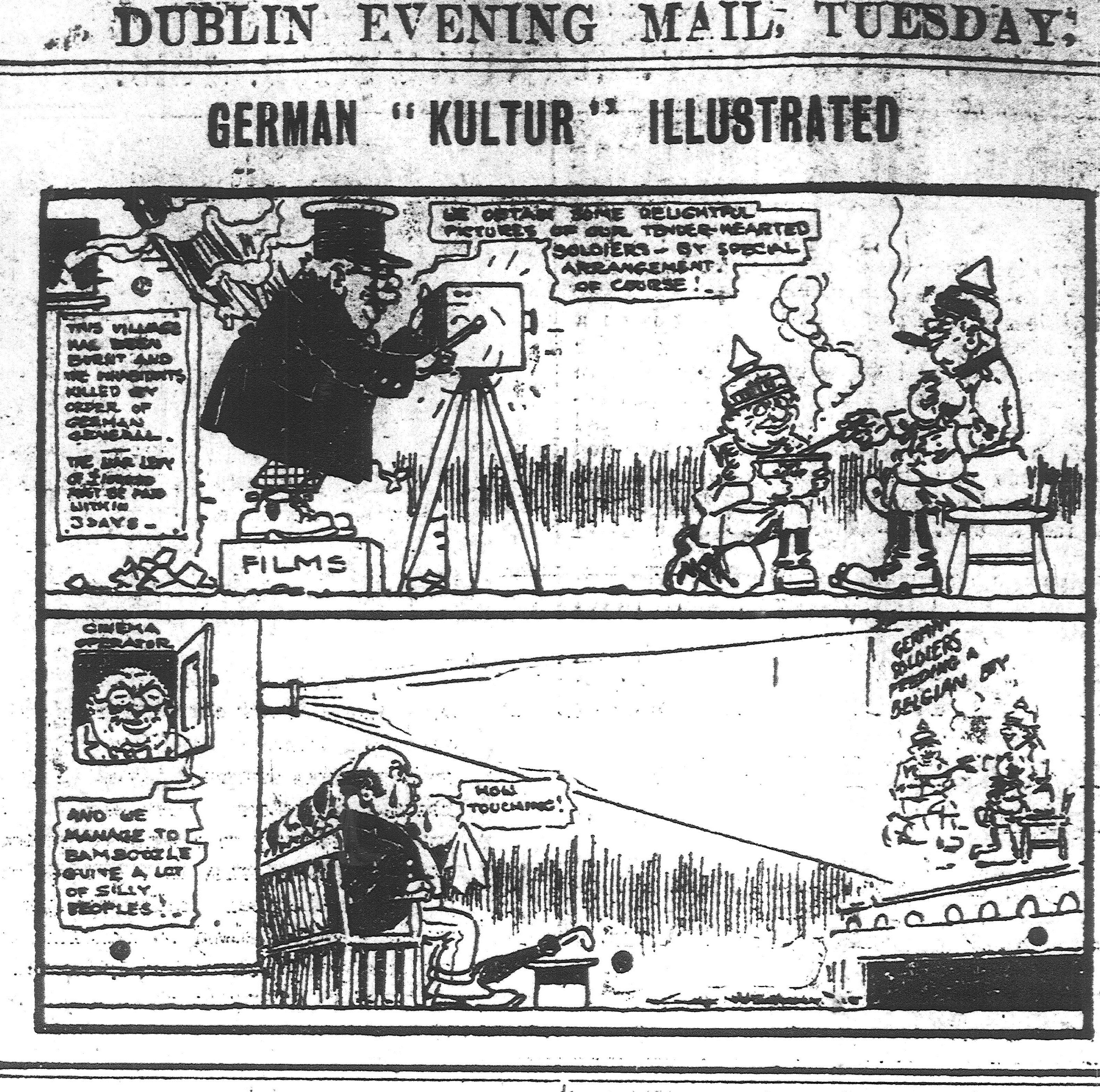
Cartoon showing the shooting and exhibition of a German propaganda film; Dublin Evening Mail, 19 Jan. 1915: 3.

Cartoon showing the shooting and exhibition of a German propaganda film; Dublin Evening Mail, 19 Jan. 1915: 3.

The dominant story that the mainstream and cinema trade press in Ireland and Britain told about enemy propaganda concerned its untruthfulness. This was well illustrated in mid-January 1915 when the Dublin Evening Mail published a cartoon depicting how adept the German film industry was in keeping from the German public the realities of their army’s depredations in Belgium. Its two panels showed how a German filmmaker conspired with the German army to produce a faked film of soldiers helping vulnerable Belgian citizens, and how this film influenced public opinion in support of the war when exhibited in cinemas. The title of the cartoon – “German ‘Kultur’ Illustrated” – seemed to carry a criticism of cinema in general in suggesting that German culture should be associated with such a low form as cinema.

Alleged eyewitness accounts of the efficacy of German film propaganda were a part of this discourse, and in March an Irishwoman offered the Bioscope a particularly lengthy personal account. If she is anything more than an invention of propaganda, Norah Mahone seems to have been a remarkable woman. She was described as

a young Irish lady and a member of the theatrical profession, who, after being held a prisoner for several months, has recently succeeded in escaping from the enemy’s land, where she was staying at the outbreak of war.

A talented woman in more ways than one, Miss Mahone visited Dresden last July with the object of completing some business in connection with certain inventions she had patented, and also, incidentally, to take a “cure” in that city. (“German Allegorical Film Play.”)

Following descriptions of her mistreatment by the German authorities and a deluded public, Mahone offered details of such films as the departure of the Saxon army, “an almost barbaric scene in its uncontrolled emotionalism and riotous display.” Because films were so popular in Germany,

the Government are using the cinematograph shows and cafés for propaganda work. Practically all the films shown deal directly with the war, and nearly all of them are of a most filthy and scurrilous nature calculated to arouse in spectators, the worst emotions and most biased hatred against the Allies, and especially against England. These films are all manufactured, I believe, under the indirect supervision of the Government, many of them being allegorical plays, and the rest more or less faked “topical” pictures. (Ibid.)

The efforts of the industry and its supporters would soon convince the British government about the power of the cinema propaganda. Despite the prominence of such Irish people as Norah Mahone, however, these kind of films would always prove to be controversial in Ireland.

References

“Amusements in War Time.” Bioscope 11 Mar. 1915: 875.

“Another Dublin Paper: Suppressed this Morning.” Evening Telegraph 5 Dec. 1914: 3.

“Atrocities on the Cinema: Austrian Films that Told Too Much: Destroyed by Authorities.” Dublin Evening Mail 27 Mar. 1915: 5.

“The Cinematograph at the Front.” Bioscope 3 Sep. 1914: 859.

“City Sensation: Arrest by Military: Man Pursued: By Motor and Cycle.” Evening Telegraph 16 Mar. 1915: 3.

“Danger of Spies: Stringent Regulation: Of Traffic with Holland.” Evening Telegraph 16 Mar. 1915: 4.

“Film of a Warship: Drastic Action by the Authorities.” Evening Telegraph 4 Mar. 1915: 1.

“A German Allegorical Film Play: An Irish Actress’s Remarkable Experience in Germany.” Bioscope 18 Mar. 1915: 1021, 23.

“Imaginary Spy: Exciting Chase in London: Dublin Fusilier Sent to Jail.” Evening Telegraph 16 Mar. 1915: 3.

“Irish Papers Suppressed by the Government: Defence of Realm Act: Instruction by Military: Copies Seized and Printers Warned.” Evening Telegraph 3 Dec. 1914: 3.

“‘Liberty’ Hall: Troops and Police Remove a Motto.” Evening Herald 21 Dec. 1914: 1.

“Our Duty in this Crisis.” Irish Worker 8 Aug. 1914: 2.

“‘Stop Spy’ in Dublin Streets.” Irish Independent 17 Mar. 1915: 5.

Relieving the Monotony of All Pictures: Variety Acts in Irish Cinemas, February 1915

Unlike the experience in an Irish picture house in 2015, the cinema audience a century ago expected to share the auditorium not only with other spectators but also the musicians and – often – variety artistes who were responsible for producing a considerable part of the entertainment live. On 4 February 1915, the Ulster correspondent of the cinema trade journal Bioscope began his/her regular “Jottings from Ulster” column in fairly typical fashion by praising the attractions available at Provincial Cinematograph Theatres’ Picture House, Royal Avenue, Belfast. The attractions included the pictures Marguerite of Navarre (France: Pathé, 1914), Nick Winter in the Wild West (US: Eclectic, 1914) and The Bond of Love (US: Selig, 1914), which were accompanied by an “orchestra [that] has been considerably augmented.” The music produced by the musicians in the cinema was not the only part of the show produced live because “the monotony of all pictures is delightfully relieved by Mr. Norman Williams, who sings every afternoon and evening.” While the orchestra was expected to accompany the pictures and increase their attractiveness by augmenting them, Williams’ singing was a separate feature of the programme and was used – according to Jottings, at least – to ensure that audiences would not be bored by a programme that just consisted of films.

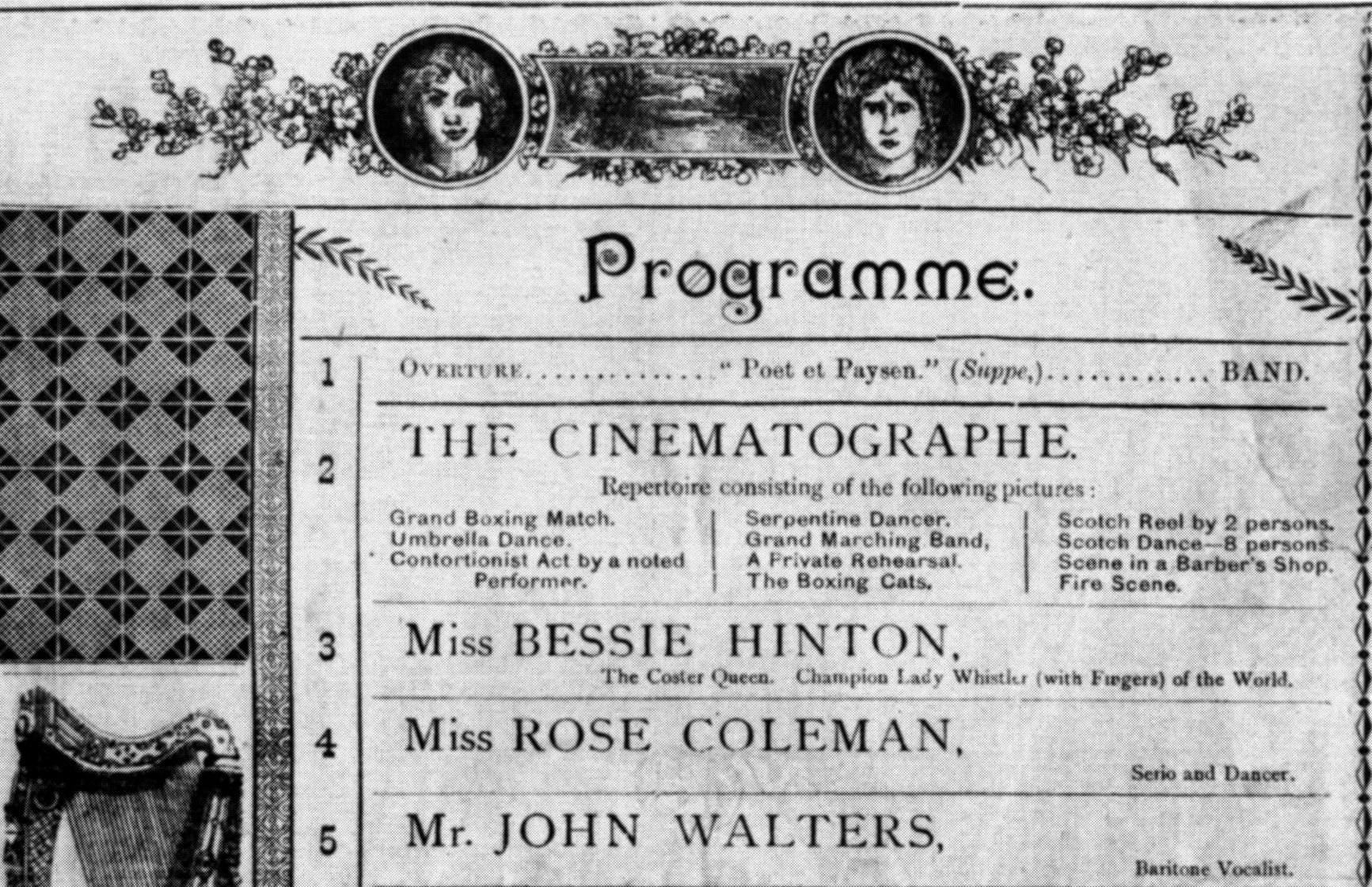
Part of the programme at Dublin's Star Theatre of Varieties at which the first films in Ireland were shown in April 1896.

Part of the programme at Dublin’s Star Theatre of Varieties at which the first films in Ireland were shown in April 1896.

The claim here is worth lingering on because it implies that variety was a necessary part of the programme, and in this case, the necessary variety was based on the differences between live and recorded performance. Variation in the length and genre of films has already been discussed in other posts, but here variety refers to the kinds of live performance – singing, dancing, comedy, juggling, acrobatics and animal acts –with which audiences a century ago would have been intimately familiar from the variety theatre. The variety theatre or music hall had been one of the first places at which moving pictures were exhibited, and the notion that popular entertainment should offer a variety of attractions persisted long after dedicated picture houses first appeared, which in Ireland was the late 1900s. Before this, in the 1890s and 1900s, variety theatre had added film as another of its acts or “turns,” and in the 1910s and for a long time thereafter, some picture houses included not only a variety of film attractions with musical accompaniment but also live variety acts. In fact, given the existence of the mix of film and variety entertainment at such large venues as Dublin’s 4,000-seat Theatre Royal until the 1960s, cine-variety should be considered one of the country’s most persistent forms of entertainment.

In early 1915, in any case, some – but by no means all – Irish picture house owners and commentators recognized the economic and aesthetic benefits of presenting variety alongside film. The cinema trade was not unanimous on whether or not variety turn in cinemas was a good or necessary thing. The Bioscope had long considered the importance of variety in Britain to be confined to the provinces, commenting in an editorial in 1911 that it was particularly associated with “the Midlands and North of England, where at least in a great many halls, the programme is not considered complete unless two or three variety turns are included” (“The All-Picture Programme”). This still seems to have been the case in 1914-15, when the early months of the war saw a decline in music-hall business (“Variety Turns”). Because of falling audiences, music-hall owners faced with closure made a deal called the “Fifty and Fifty” with the Variety Artistes’ Federation in late 1914, agreeing to split box office receipts evenly between artistes and venues (“Variety Artistes”). The picture houses were not favoured with a deal. A meeting of the Variety Artistes’ Federation passed a resolution that “no scheme for the deduction of salaries be granted to picture theatres engaging variety artistes, and that full salaries be demanded” (ibid.).

Nevertheless, Jottings pointed out that “[v]arieties are very steadily creeping into the motion houses throughout Ulster to-day” (“Jottings,” 28 Jan.). At the end of January, Norman Williams at the Picture House, Royal Avenue was joined by “Miss Ruth Vollmer, Scotch comedienne, dancer and clever exponent on the Scotch pipes, [who] was the star attraction at Lisburn Palace” (ibid.). However, once Charles Bronson took over management of the Palace, Omagh, he relied on films alone to draw the audience rather than the variety turns favoured by former manager Alex Cockle (ibid.). At the end of February, Jeanne Bal and Eugenie Van Camp – “two Belgian refugees” – appeared at the Picture House, Regent Street, Newtownards, where the “rendition by Mdlle. Van Camp of ‘Tipperary’ is very pleasing” (“Jottings,” 4 Mar.). The other Newtownards cinema, the Picture Palace, had four variety acts, so that “one would not know whether to refer to it as a cinema with varieties, or as a music-hall with pictures” (ibid.).

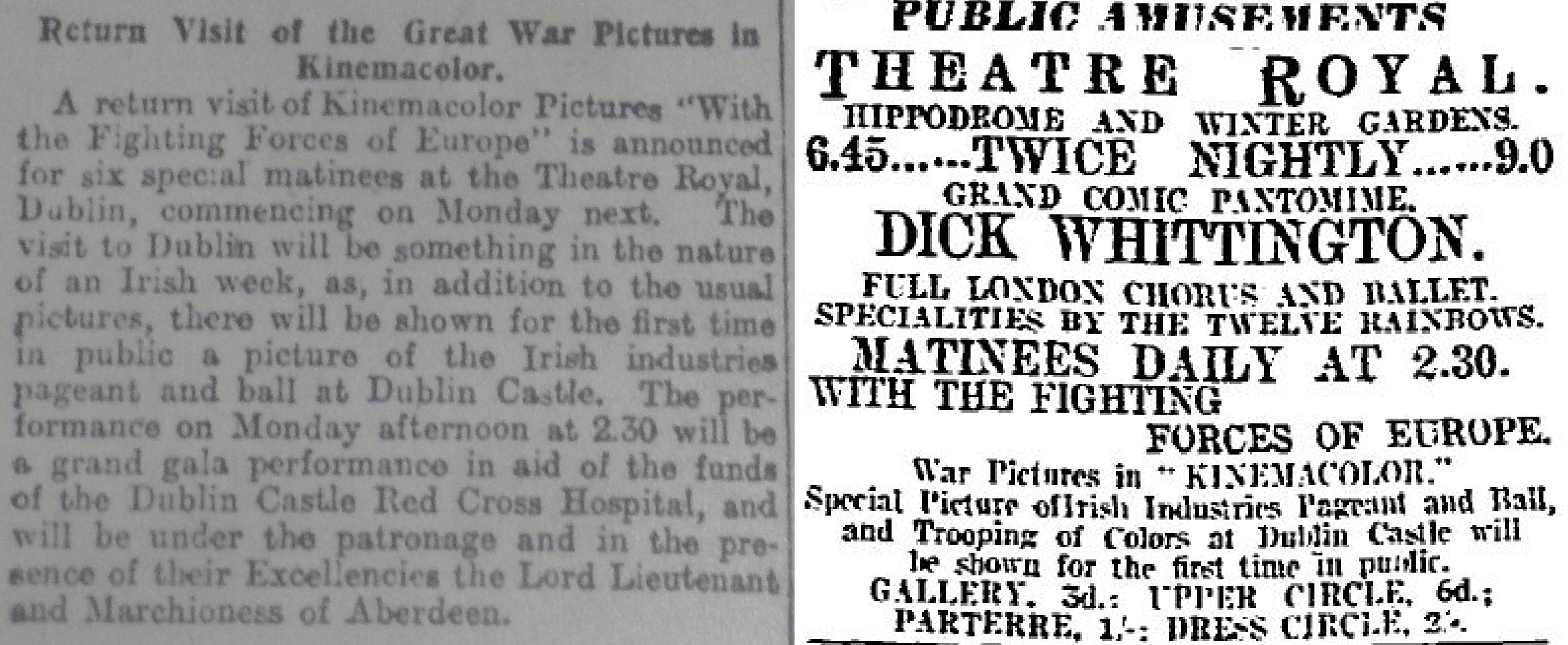
Kinemacolor exhibition at The Theatre RoyalIrish Times 9 Feb. 1915: 4

Kinemacolor exhibition at Dublin’s Theatre Royal; Irish Times 9 Feb. 1915: 4

While the inclusion of variety acts in a picture house programme appeared to put more emphasis on the live aspects of cinema and the associated possibilities for local variation, the appearance in Ireland in early 1915 of technological developments in film sound and colour suggested that a complete cinematic experience could be supplied by the recorded artefact alone. Colour film technology was to be seen from 8-13 February at the matinees of Dublin’s Theatre Royal, which hosted a return of the Kinemacolor war films The Fighting Forces of Europe, which had been first seen in Ireland the previous November. The return visit came with the added publicity of royal command performances in London, and the first show in Dublin was attended by the Lord Lieutenant and Lady Aberdeen. The Aberdeens would themselves leave Ireland in late February, and their departure was filmed by Pathé and by local exhibitor I. I. Bradlaw and local topical specialist Norman Whitten (Paddy, 25 Feb.). In any case, the Kinemacolor war films were one kind of technological development of cinema but they were not self-explanatory and so needed to be “fully described by an interesting lecture given by Mr. John Doran, and a special orchestra under the direction of Mr. Allan Blackwood, the well-known conductor” (“War Pictures”).

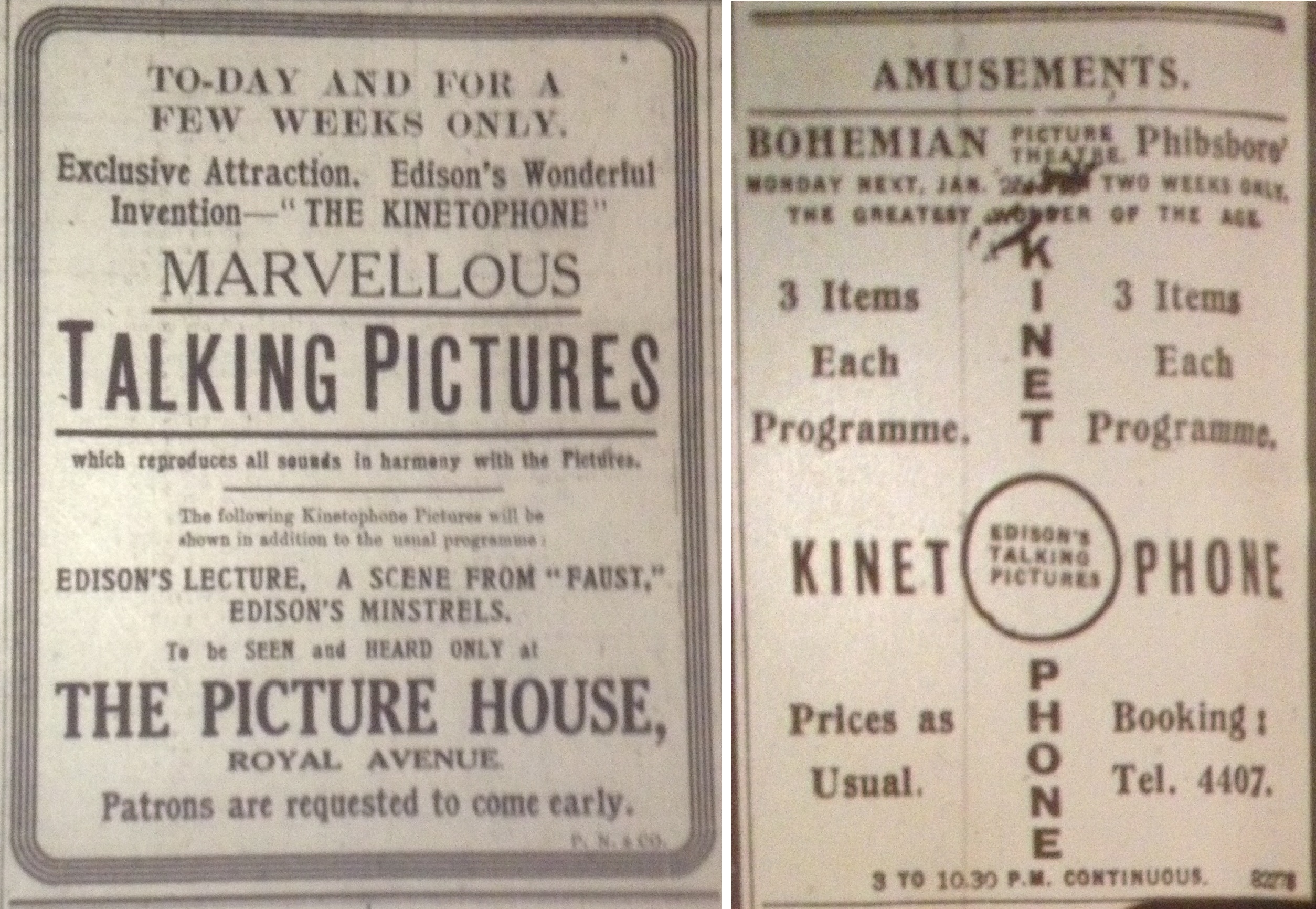
Edison's Kinetophone 1914-15. Irish News 23 Mar. 1914: 8 and Evening Telegraph 25 Jan. 1915: 3.

Edison’s Kinetophone 1914-15. Irish News 23 Mar. 1914: 8 and Evening Telegraph 25 Jan. 1915: 3.

The film sound technologies on exhibition in Ireland in early 1915 offered the possibility that lecturer and orchestra could be dispensed with. In late January, the Edison company’s Kinetophone talking pictures, which had had their first Irish appeared in Belfast the previous March, opened for at two week run at Dublin’s Bohemian Picture Theatre. “The success of this the latest addition to the attractions of the popular Phibsboro’ House,” observed the reviewer in the Evening Telegraph, “was from the start most marked, and the display, which last night included a musical sketch entitled ‘After College Days’ and Edison’s Minstrels, immediately appealed to the hearty enthusiasm of the very large audience” (“The Bohemian”). However, the Kinetophone items did not even nearly fill the programme but had to be supplemented by three reels of The Barefoot Boy (US: Kalem, 1914), the Pathé Gazette newsreel and comedy The Great Toe Mystery (US: Keystone, 1914). A full programme of talking-and-singing pictures was still some way off.

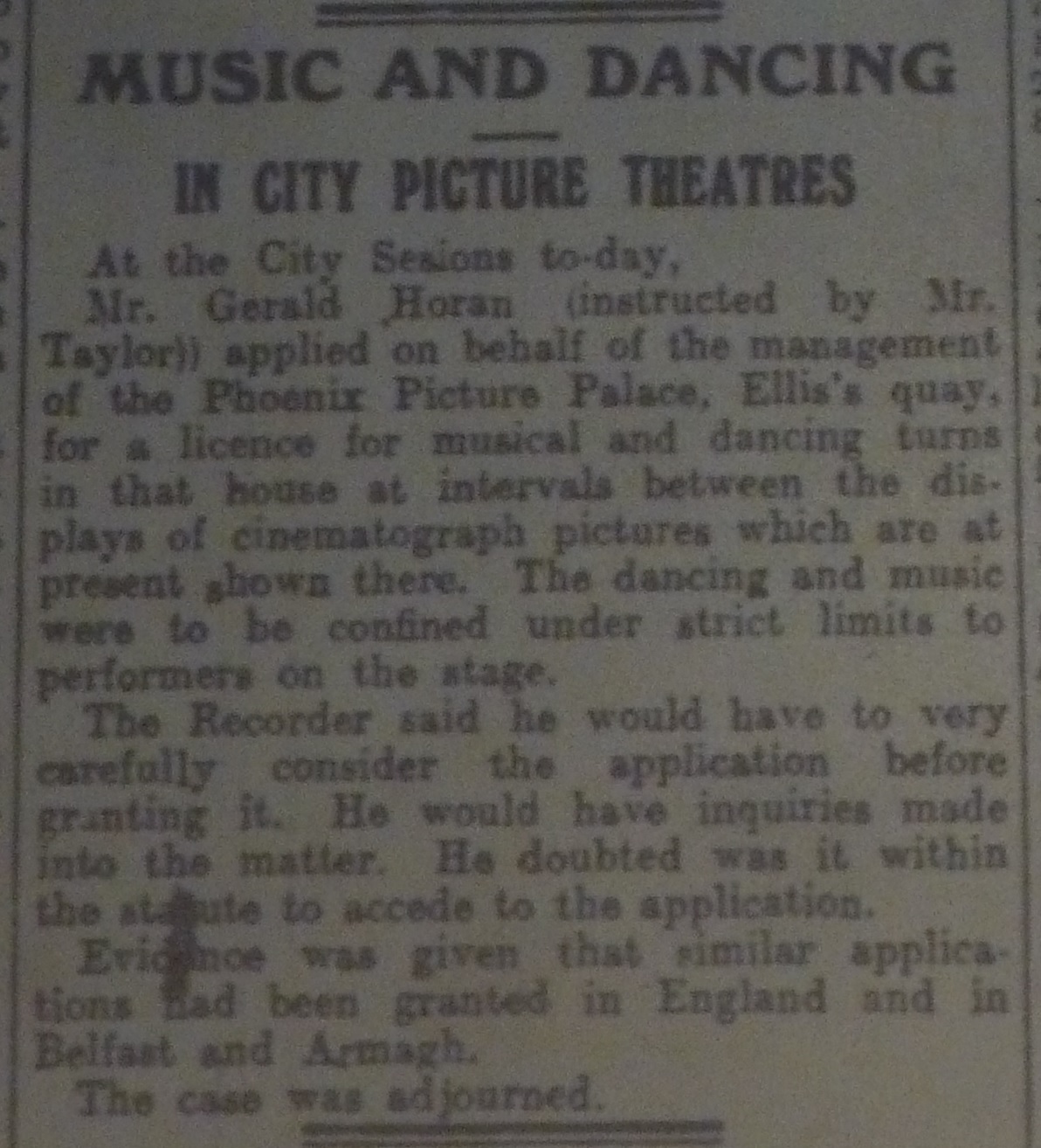
Evening Telegraph 19 Oct. 1914: 4

Evening Telegraph 19 Oct. 1914: 4

Licensing was one reason that picture house owners might have wished to have fewer live elements to deal with. Live music, and particularly the live singing of a variety artist, required entertainment venues to have a music-and-dancing licence. The reasons for this were made clear in late February 1915, when the latest proceedings were heard against a Dublin picture house, in this case, the Dame Street Picture House, that the city authorities claimed needed not just a cinematograph licence – which was mainly designed to ensure fire safety – but also a music-and-dancing licence. A related case against the Electric Theatre, Talbot Street had concluded in December 1914 with the prosecution of that cinema for not having a music-and-dancing licence (“City Cinemas”). The case against the Electric Theatre was apparently more straightforward because at the Electric’s evening performances, the pictures were accompanied not only by the piano that was used earlier in the day but also by a violin and cello. As a result, Justice Mahony had decided that the Electric’s claim that music was subsidiary to the entertainment was not sustainable. Although the case against the Dame was also due for decision, it had been adjourned because at the Dame only a piano was used to accompany the films.

These cases offer some fascinating details about the nature of live musical accompaniment at these relatively small picture houses at this period. Neither of them employed variety acts, and the musical accompaniment was the main kind of live supplement to the recorded images. While such larger picture houses as the Rotunda and Bohemian made a feature of the live music they offered, naming the musical director in advertising and at least on occasion, mounting special musical entertainments, these smaller venues downplayed the role of music to their entertainment. At least they did so in the context of this court case, which was part of a legal strategy to avoid having to pay for a music licence and/or pay a fine. The Electric’s argument that music was subsidiary was judged unbelievable because the judge concluded that the music was not just used to cover incidental noises in the cinema. Although the newspaper accounts do not state this explicitly, this was clearly true because the Electric augmented the music at the evening entertainment by the inclusion not just of louder music to cover the increased noises of a larger audience but of two instruments that enhanced the musical range of the performance.

By providing consistent piano accompaniment day and evening, the Dame had a stronger case that the music was subsidiary. As a result, when on 27 January 1915, the magistrate also fined them for not having a music licence, they appealed to the King’s Bench, which heard the case on 25 February. “It was proved,” a report in the Dublin Evening Mail revealed, “that at the exhibitions of pictures music in the form of piano playing was performed, which was more or less appropriate to the picture at the time on the screen Such music was performed only while the pictures were on the screen.” As a result, the Dame argued that a

certain amount of noise was occasioned during the exhibition of the pictures by the coming and going of attendants and persons entering and leaving the premises, and by the working of the [projection] apparatus. […M]usic was necessary, and was intended mainly for the purpose of deadening or drowning the noise which was likely to distract attention from the pictures, and that under these circumstances a licence for music was not necessary. (“Music in a Cinema”)

This offers a vivid image of the kind of challenges picture-house musicians faced. It did not, however, convince the justices on the King’s Bench, who voted a 2-1 majority to affirm the magistrate’s decision that the music at the Dame represented a separate attraction that required a licence. Even if part of the function of music in the picture house was to “drown the noise” of early cinema’s supplementary live soundtracks, it also provided an aesthetic experience in itself, if not a layer of acoustic interpretation of the pictures on screen.

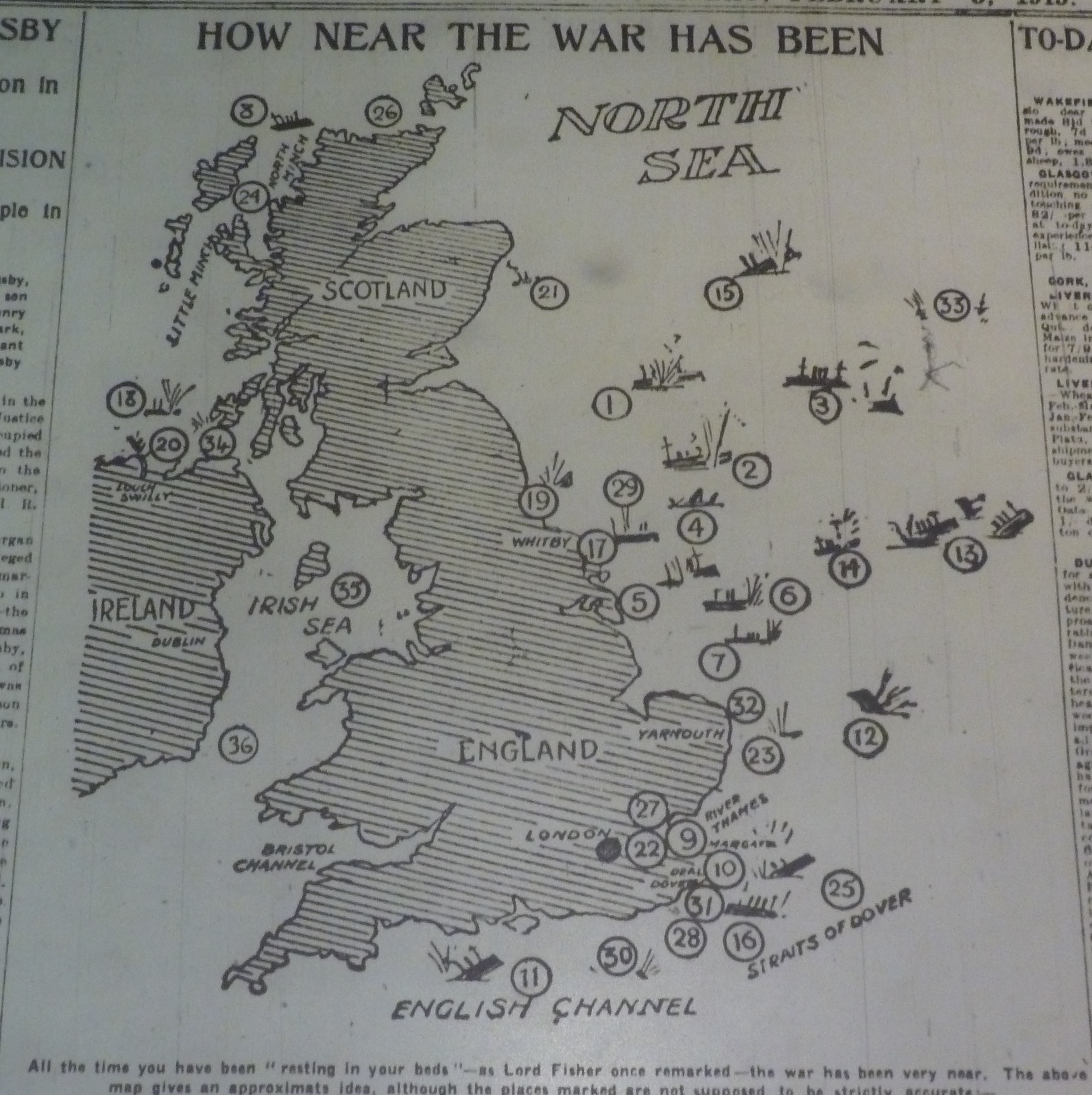
Evening Herald 3 Feb 1915:3.

Evening Herald 3 Feb 1915:3.

War-themed subjects remained among the most popular of the pictures on screen. How films provided an alternative forum in which to think about current events was shown when the Evening Herald printed a map of the war at sea around the coasts of Britain and Ireland, emphasizing the proximity of the war. Although much of this action was located in the North Sea, German submarines attempted to cut the transatlantic supply lines to Britain. The Lusitania – sunk off Cork in May 1915 – was the most famous casualty of the German blockade. With the appearance of The Huns of the North Sea in Ireland at the end of January, Sidney Morgan and John Payne’s P&M’s Films offered Irish audiences a way of imagining the new forms of warfare at sea involving minefields and submarines. The “short two-reeler, dealing with the mine-laying […] should prove exceptionally attractive to halls situated in the North of Ireland, where the mine-field was lately found” (Paddy, 21 Jan.).

Whether through live music or engaging and relevant images, the cinema a century ago continued to draw the attention of the public.

References

“The All-Picture Programme: Where “Variety” Is Not Wanted.” Bioscope 21 Sep. 1911: 591.

“The Bohemian.” Evening Telegraph 26 Jan. 1915: 2.

“City Cinemas: Question of Music Licence: Prosecution: In the Dublin Police Courts; Mr. Mahony’s Decision.” Evening Herald 30 Dec. 1914: 3.

“Dancing and Singing: City Picture House’s Application: Described as ‘Novel.'” Evening Herald 23 Oct. 1914: 4.

“Jottings from Ulster.” Bioscope 28 Jan. 1915: 339; 4 Feb. 1915: 437; 4 Mar. 1915: 837.

“Music in a Cinema: Interesting Dublin Case: ‘To Drown the Noise.’”Dublin Evening Mail 26 Feb. 1915: 5.

Paddy. “Pictures in Ireland.” Bioscope 21 Jan. 1915: 263; 25 Feb. 1915: 741.

“Theatre Royal Hippodrome.” Evening Telegraph 6 Feb. 1915: 6.

“Variety Artistes in Picture Theatres.” Bioscope 19 Nov. 1914: 707.

“Variety Turns in Picture Theatres.” Bioscope 17 Dec. 1914: 1288.

“War Pictures in Kinemacolor.” Dublin Evening Mail 4 Feb. 1915: 6.

Creating Great Trouble in a Most Laughable Manner: Chaplin in Dublin in 1914

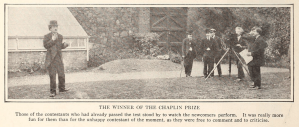
Chaplin Lookalike Winner Film Fun Jan 1916

The winner of a Chaplin lookalike contest run by Dublin’s Masterpiece Theatre; Film Fun Jan 1916: n.p.

By October 1915, a Charlie Chaplin craze was in full swing in Dublin. Paddy, the Irish correspondent of the British cinema trade journal Bioscope, showed this when he reported on several simultaneous tributes to Chaplin less than two years after he made his first film. On 7 October, Paddy revealed that Captain Ahearne of the Dame Street Picture House had shown all-Chaplin programmes the previous week, while a live Chaplin revue at the Coliseum Theatre had distinguished itself from the Chaplin impersonation competition taking place at the Rotunda by featuring what Paddy claimed was “the only Chaplin girl extant” (Paddy, 7 Oct.).

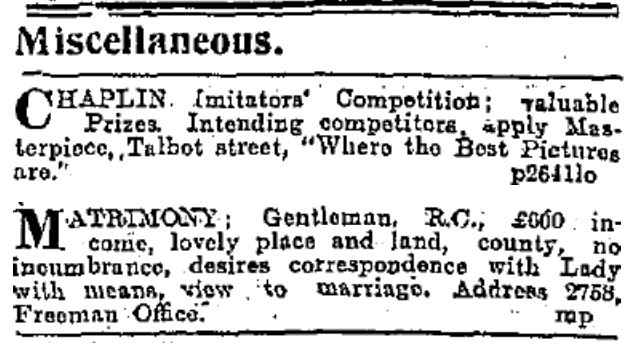
Small ad calling for Chaplin imitators. Freeman's Journal 16 Sep. 1915: 8.

Small ad calling for Chaplin imitators. Freeman’s Journal 16 Sep. 1915: 8.

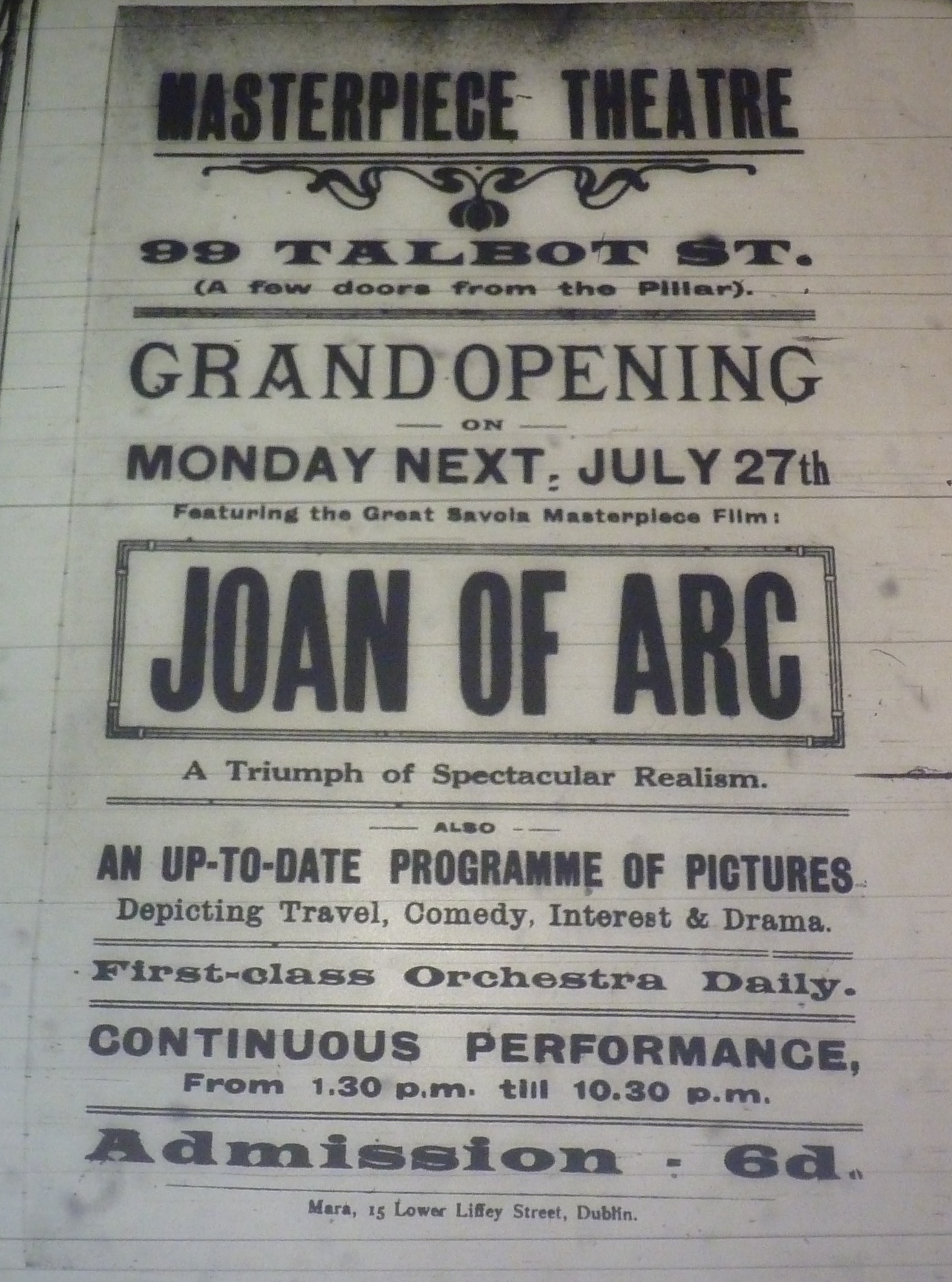
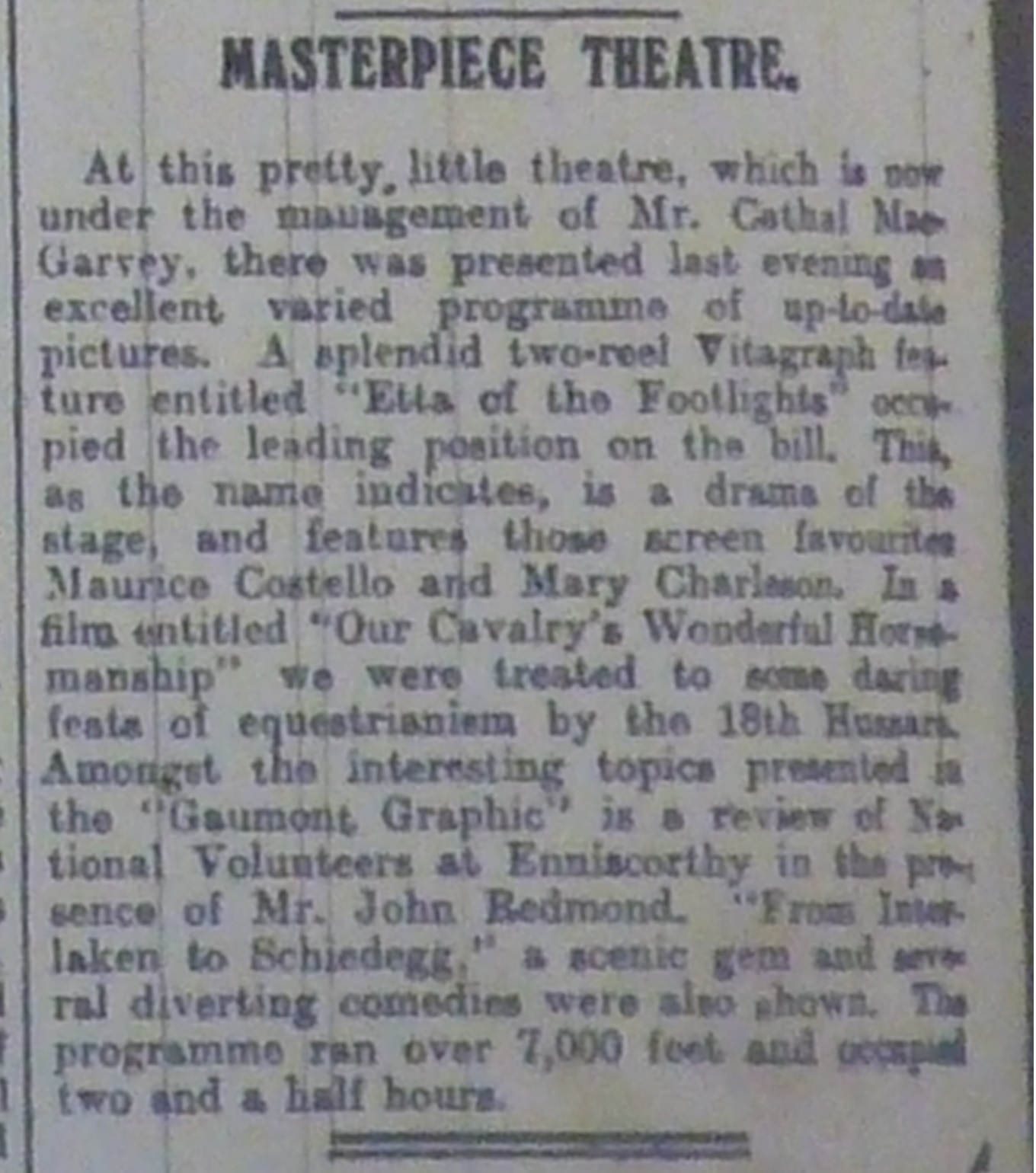
That such competitions were not wholly new was shown by the fact that Cathal MacGarvey manager of the Masterpiece Theatre, Talbot Street was exhibiting his film of a Chaplin impersonation competition that had taken place at his picture house in September (Paddy, 14 Oct.). Chaplin seemed to be everywhere you looked by the autumn of 1915. But this adulation had taken some time to grow.

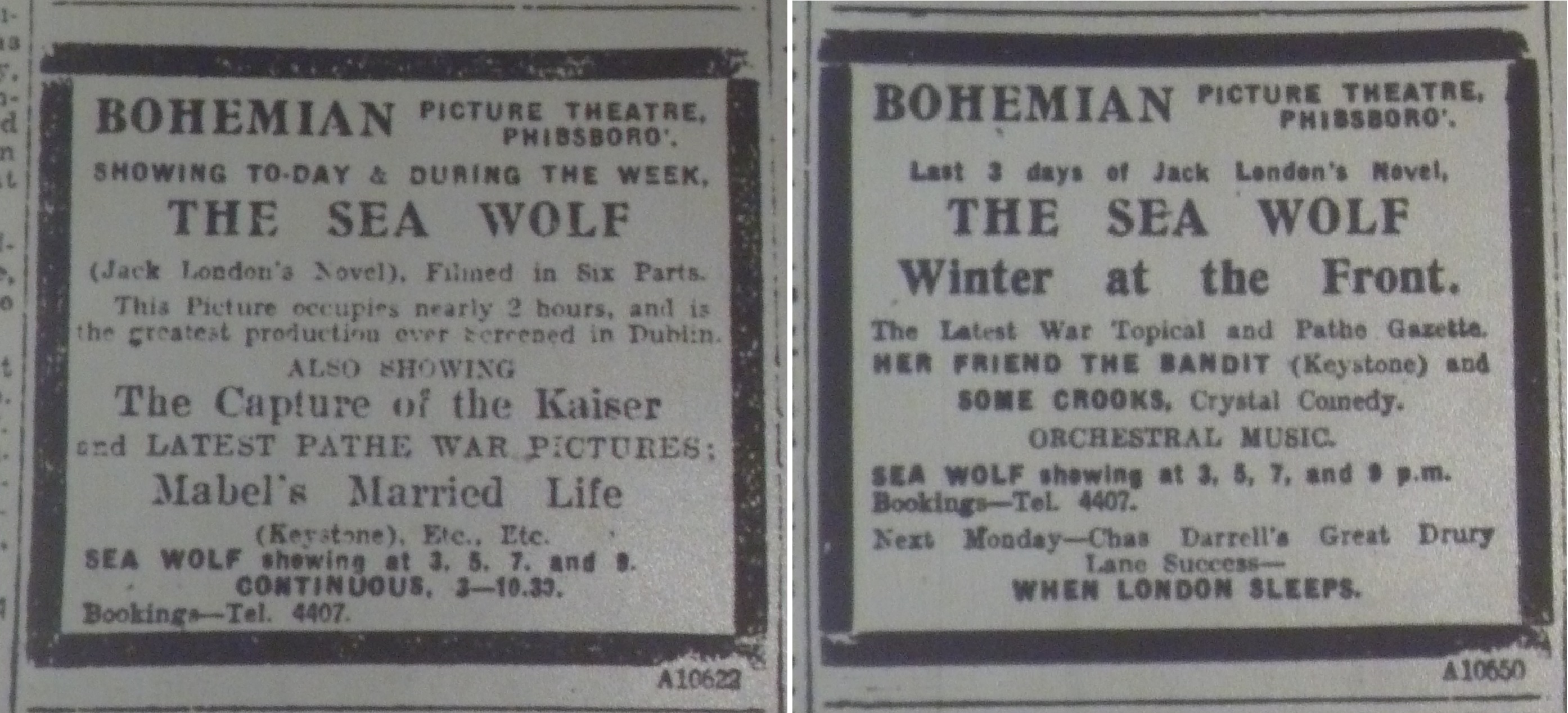
The Bohemian Picture Theatre showed Mabel's Married Life in the first three days of the week beginning 30 Nov. 1914 and Her Friend the Bandit for the last three days of that week. Evening Telegraph 30 Nov. and 3 Dec. 1914.

The Bohemian Picture Theatre showed Mabel’s Married Life in the first three days of the week beginning 30 Nov. 1914 and Her Friend the Bandit for the last three days of that week. Evening Telegraph 30 Nov. and 3 Dec. 1914.

Irish audiences’ decades-long love affair with Charlie Chaplin, the biggest film star of the first half of the 20th century, began modestly a century ago. Cinema audiences in Ireland, like those around the world, knew the slapstick comedies for which Mack Sennett’s Keystone Film Company was already famous when Chaplin joined in December 1913. When he began shooting his first films in January 1914, Chaplin played supporting roles to such better-established comics as Mabel Normand, Roscoe “Fatty” Arbuckle and Ford Sterling. However, he rapidly became the star player in films that he directed himself. Nevertheless, he did not renew his Keystone contract in December 1914, choosing instead to join George K. Spoor and Gilbert M. “Broncho Billy” Anderson’s Essanay Film Manufacturing Company.

As the best remembered of the stars who emerged in the 1910s, Chaplin has already been discussed briefly here and here. Now that the centenaries of his year at Keystone have passed, it may be worth looking in more detail at the Irish reception of this initial stage of his career. Almost all the Keystone films he appeared in have survived, and thanks to the Chaplin Keystone Project, these have been restored to as watchable a condition as possible and are available in the DVD collection Chaplin at Keystone, accompanied by an informative booklet. Despite the films’ flashes of brilliance, however, it is hard not to agree with David Robinson that “[w]e can only look back at the first few Keystone films and see a crude, unfinished form, and the earliest tentative search for a screen character” (130). But as Robinson goes on to argue this is our problem in retrospect: “To the audiences of the time they were new and astonishing. From the very start, Chaplin had created a new relationship with the audience, provoking a response that no one had elicited before in film or in any other medium” (ibid).

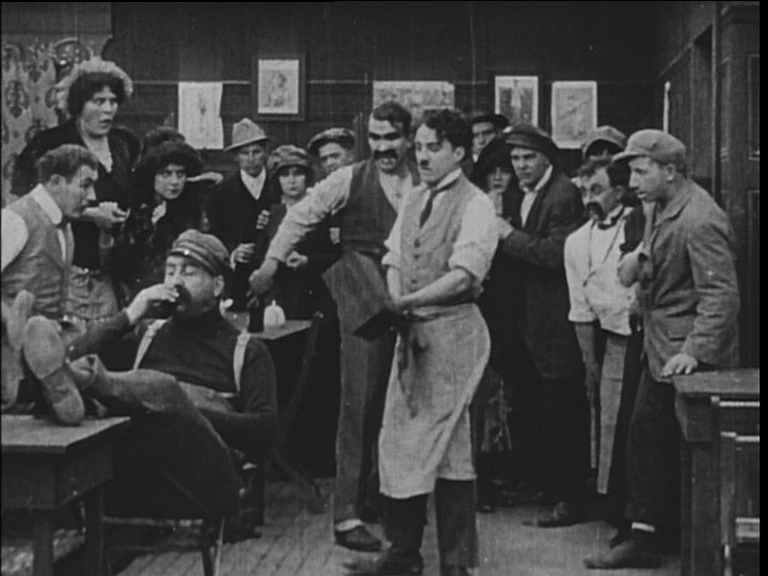
Irish audiences’ first sight of Chaplin on screen was not as a tramp but as a “sharper” in Making a Living (US: Keystone, 1914).

Surviving accounts from Irish audience members are rare, but newspapers do offer some clues about how that relationship began in Ireland. These clues have to be sifted out of ads and articles that are largely the product of the marketing needs of film production companies, distributors, picture houses and the newspapers that carried the material. Most of the cinema display ads, preview and reviews in Dublin newsaper were for the few picture houses that paid for advertising. The most regular picture-house advertising was from the Rotunda Pictures in Dublin’s O’Connell/Sackville Street, which had long used extensive advertising to construct its reputation as the city’s premier picture house. In roughly descending order of regularity of advertising, the Rotunda was followed in late 1914 and early 1915 by the Bohemian Picture Theatre in Phibsboro; the Masterpiece Theatre in Talbot Street; the Provincial Cinematograph Theatres pictures houses in Grafton and O’Connell/Sackville Streets; the Phoenix on Ellis Quay; the Dorset Picture Hall; the Volta in Mary Street; the Electric Theatre in Talbot Street; Dame Street Picture House; and the Pillar Picture House in O’Connell/Sackville Street. This represents just two-fifths of Dublin city’s cinemas, and many of those named often did not mention the titles of the short comedies that supported the main dramatic feature. Nevertheless, the display ads, previews notices and reviews of these picture houses allow us to track the release dates and something of the reception of Chaplin during his year at Keystone.

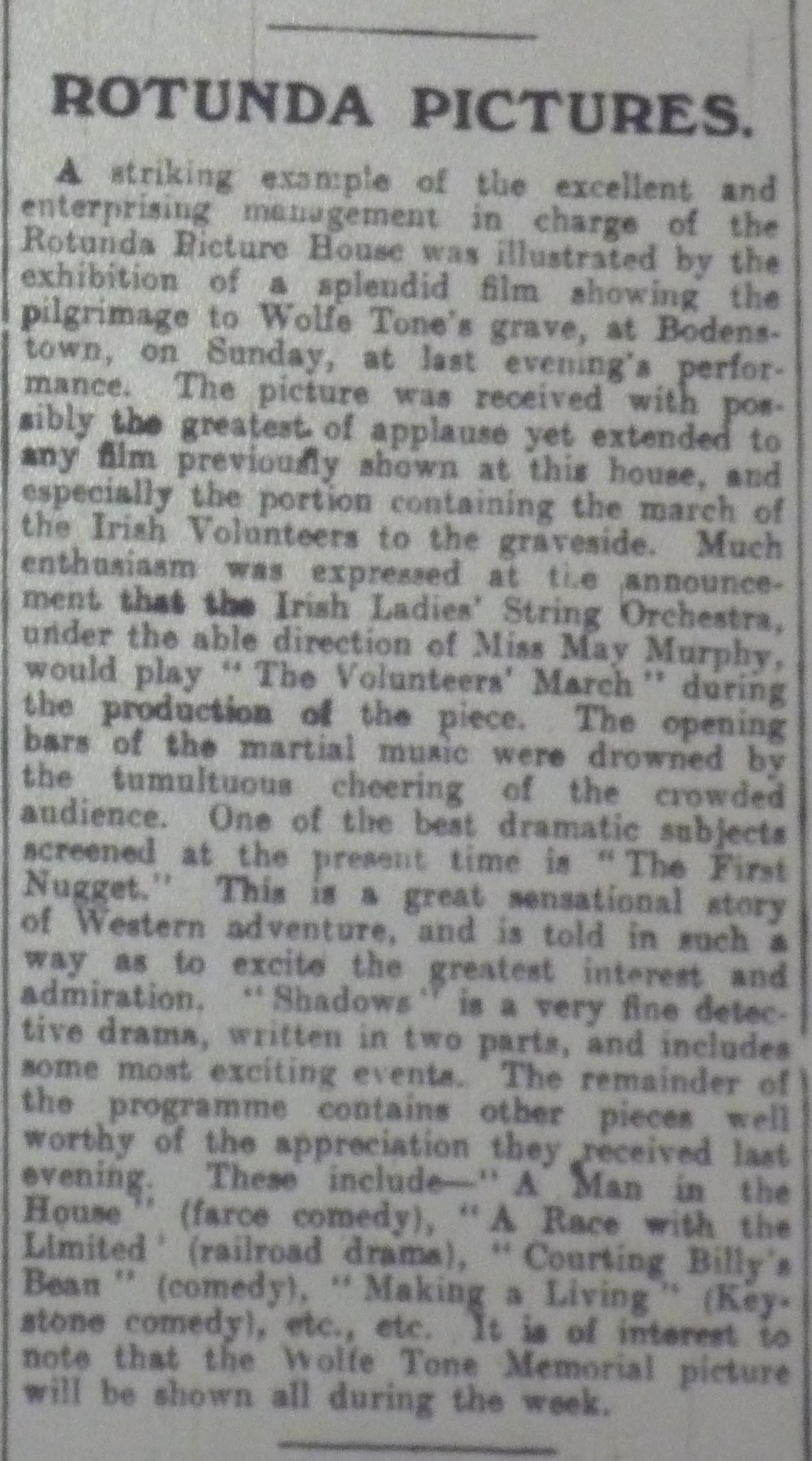
This review of the programme at the Rotunda Pictures gives a good indication of where comedies featured in the priorities of newspaper reviewers. Evening Telegraph 23 Jun. 1914: 2.

This review of the programme at the Rotunda Pictures gives a good indication of where comedies featured in the priorities of newspaper reviewers. Evening Telegraph 23 Jun. 1914: 2.

It was at the Rotunda that Chaplin first appeared on a screen in Dublin in the comedy Making a Living (US: Keystone 1914), which had a three-day run beginning on Monday, 21 June 1914. The Evening Telegraph’s review suggests that contemporary observers did not share the importance we would likely attribute to the beginning of Chaplin’s career. The highlight of the bill on which Making a Living appeared was for at least the nationalist members of the audience – as it was for the reviewer in the nationalist Evening Telegraph – “a splendid film showing the pilgrimage to Wolfe Tone’s grave, at Bodenstown, on Sunday” (“Rotunda Pictures,” 23 Jun.). This local topical (news film) “was received with possibly the greatest of applause yet extended to any film previously shown at this house,” and its exhibition was enhanced by the Irish Ladies’ String Orchestra playing “The Volunteers’ March”: “The opening bars of the martial music were drowned by the tumultuous cheering of the crowded audience” (ibid.). By contrast, Making a Living was merely mentioned in passing along with two other comedies that were also part of the programme.

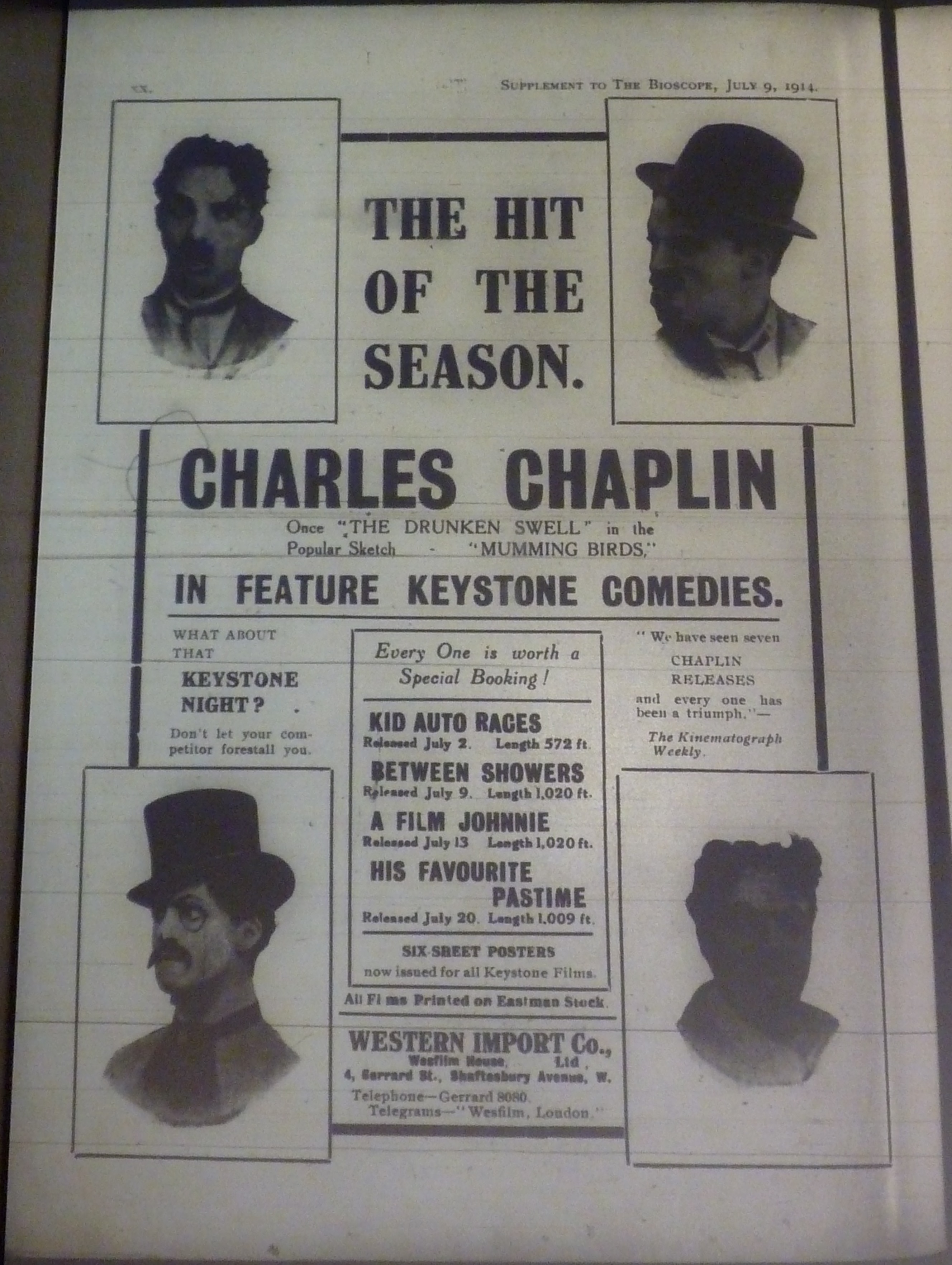
Western Import Co. ad for Chaplin's early Keystone film hails him as the hit of the season and reminds readers of his stage career. Bioscope 9 Jul. 1914: xx.

Western Import Co. ad for Chaplin’s early Keystone films hails him as the hit of the season and reminds readers of his stage career. Bioscope 9 Jul. 1914: xx.

Making a Living was almost five months old by the time it reached Irish screens. It had been shot on 5-9 January 1914 and first released in the United States on 2 February 1914 (Chaplin at Keystone). From 21 June on, however, Chaplin’s films were released in Ireland in quick succession but not always in the same order as they had appeared in the US. This release pattern and much of the publicity material available to picture house managers came from the Western Import Company, the British and Irish distributor of all Keystone films. All the films released by Western Import up to the end of January 1915 were shown in Dublin. Western Import was based in London, and its ads in the trade papers reflected the fact that Chaplin’s films had been a particular hit in the US and were likely to be at least as popular in Britain where he had recently been a music-hall comedian.

In Mabel's Strange Predicament, Dublin audiences saw Chaplin's tramp costume for the first time in a film whose comedy comes largely after Mabel locks herself out of her hotel room in her pajamas.

In Mabel’s Strange Predicament, Dublin audiences saw Chaplin in his tramp costume for the first time, harassing Mabel Normand in her pyjamas.

Despite the information available from the distributor, the names of Mabel Normand or Ford Sterling were more likely to have caught the attention of comedy audiences that week. When Mabel Strange Predicament – the film in which Chaplin first appeared as the tramp – began its three-day run at the Rotunda on 2 July, the Dublin Evening Mail did not mention Chaplin but commented of Normand that “this little lady is now the leading comedienne in filmland” (“Rotunda Pictures,” 27 Jun.). And when Chaplin’s next film, Kid Auto Races at Venice, Cal., was appreciatively reviewed during its Rotunda run (6-8 July), the reviewer misidentified Chaplin as Keystone’s more established Fatty Arbuckle, observing that the “famous ‘Fatty’ of the Keystone company, will be seen in a screamingly funny picture, ‘Kid Auto Races’” (“Rotunda Pictures,” ET 7 Jul.). This pattern was not confined to the first few of Chaplin’s films screened in Dublin but continued up to November, when Mabel’s Busy Day was described as “one of the funniest adventures of Mabel Normand, Keystone Company” (“Rotunda Pictures,” ET 21 Nov.). Although “[a]mongst the humorous contributions” to the bill at the Masterpiece on 22 December “Chaplin, of the Keystone Co., in ‘A Busy Day,’ was very amusing,” this did not distinguish him from Ford Sterling who had left Keystone for a time and was starring “in a highly diverting Sterling Comedy, ‘Three O’clock’” (“Masterpiece”).

As this suggests, Keystone was itself a brand that newspaper advertisers and reviewers expected readers to recognize. This was emphasized on 10 October, when a preview of the Rotunda’s programme recommended When Reuben Fooled the Bandits – featuring the lesser known Keystone player Charles Murray – on the sole basis that it was a Keystone, “which means the last word in comedy” (“Rotunda Pictures,” ET 10 Oct.). The company brand and the star brand were also frequently combined. On 17 October, the preview of the Masterpiece Theatre did not specify the title of the comedy films that would be on show in the following week, but one of them “is a highly diverting Keystone, featuring the inimitable [C]haplin” (“Masterpiece Theatre”).

All the Keystone films featuring Chaplin released onto the British market between late June 1914 and the end of January 1915 were shown in Dublin, and many of them had their first Dublin exhibition on or close to the day Western Import released the film. Some films, however, appear to have been screened weeks or months after the release date, but it is possible that they were screened earlier and in the period before the attractiveness of Chaplin’s name was fully realized, their titles were not mentioned in the press. In any case, Making a Living’s appearance at the Rotunda on 22 June was four days after its London release. Mabel’s Strange Predicament appeared at the Rotunda on 2 July, a week and a half after its 22 June release (“Rotunda Pictures,” DEM 27 Jun.). Kid Auto Races at Venice, Cal. was release on 2 July and shown at the Rotunda on 6 July (“Rotunda Pictures,” ET 7 Jul.). Released on 6 July, A Thief Catcher – staring Ford Sterling but featuring Chaplin – ran at the Picture House, Grafton Street (9-11 July; ad, ET 9 Jul.), before the Rotunda (13-15 July; “Rotund Pictures,” ET 11 Jul., II 13 Jul.), and this seems also to have been the case with Between Showers, which was released on 9 July and exhibited first at the Grafton on 13-15 July (“Grafton Street Pictures”). A Film Johnnie was released on 13 July and shown at the Rotunda beginning on 20 July (“Rotunda Pictures,” ET 21 Jul), and His Favourite Pastime seems to have screen first at the Picture House, O’Connell/Sackville Street a week after its 20 July release (ad, ET 25 Jul.).

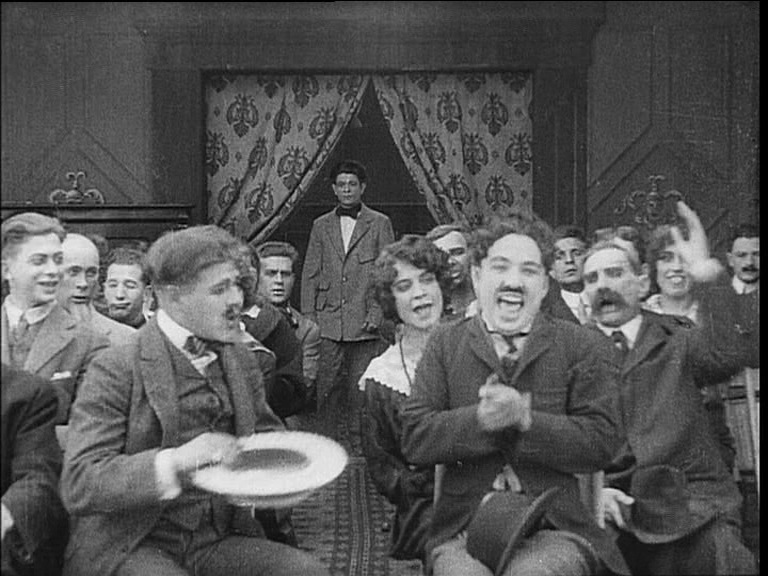
Chaplin's character in A Film Johnnie begins in a picture house and travels to the Keystone studios in pursuit of the Keystone Girl.

Chaplin’s character in A Film Johnnie begins in a picture house and travels to the Keystone studios in pursuit of the Keystone Girl.

No Chaplin film appears to have been released in August 1914, but September was busy. Tango Tangles – featuring Chaplin, Arbuckle and Sterling – was released on 10 September and shown at the Picture House, Sackville/O’Connell Street from 14 September (“O’Connell Street Pictures”). Cruel, Cruel Love’s 17 September release was followed by a 21 September Dublin opening at the Rotunda (“Rotunda Pictures,” ET 19 Sep.). Caught in the Rain was released on 21 September but does not seem to have had a Dublin screening until it was exhibited at the Volta’s well-advertised Sunday shows on 13 December (“Volta,”). Similarly, “Keystone screamer” Twenty Minutes of Love awaited a 17 January 1915 showing at the Volta despite a 28 September 1914 release (“Volta,” 16 Jan.).

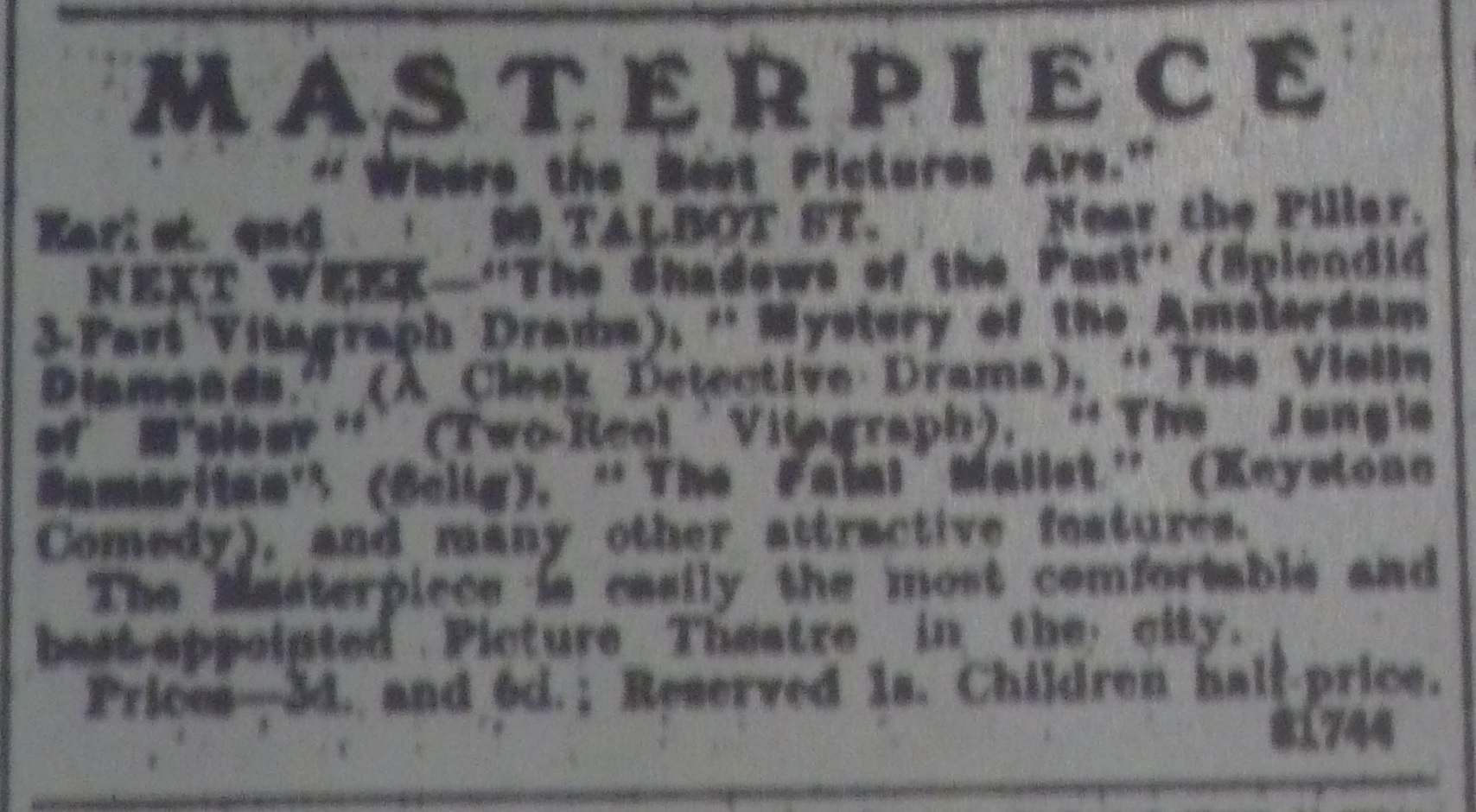
Ad for the Masterpiece programme for the week, including The Fatal Mallet; Evening Telegraph 12 Dec. 1914: 1.

Ad for the Masterpiece programme for the week, including The Fatal Mallet; Evening Telegraph 12 Dec. 1914: 1.

Although October 1914 also saw no Chaplins released, November and December made up for it. The 9 November release of Caught in a Cabaret coincided with the same-day opening at the Rotunda (“Rotunda Pictures,” ET 7 Nov.). A Busy Day waited more than a month after its 12 November release until its Dublin premiere at the Masterpiece on 21 December (“Masterpiece”); the previous week (17-19 Dec.), the Masterpiece had shown The Fatal Mallet, which had been released on 19 November (ad, ET 12 Dec.). Mabel’s Busy Day had a release-day opening at the Rotunda on 23 November (“Rotunda Pictures,” ET 21 Nov.), and Mabel’s Married Life also opened in Dublin the day it was released at both the Rotunda and Bohemian on 30 November (“Rotunda Pictures,” ET 1 Dec.; “Bohemian”). On 3 December, the Bohemian gave Her Friend the Bandit an opening-day release (ad, ET 3 Dec.). And finally, Laughing Gas opened at the Picture House, O’Connell/Sackville Street on 7 January 1915, three days after its 4 January release (ad, ET 7 Jan.).

Chaplin prepares to deal with a difficult customer in Caught in a Cabaret.

Chaplin prepares to deal with a difficult customer in Caught in a Cabaret.

Very few of these 18 films were given more than a cursory mention. At the Rotunda in November, Chaplin’s Caught in a Cabaret was given unusual prominence for a comedy by being named as the first “of the principal films of the week” and as “a real live Keystone, one of the funniest yet” (“Rotunda Pictures,” ET 7 Nov.). “‘Caught in a Cabaret’ is the title of one of the best comedy pieces in cinematography yet shown in Dublin, and which is to be seen at the Rotunda Picture House. In all its details it proved a most laughable piece and drew forth loud applause” (“Rotunda Pictures,” ET 11 Nov.). Caught in a Cabaret was also popular at the Kelvin Palace in Bangor at Christmas:

Five performances were held on Christmas Day, and a like number of St Stephen’s [26 Dec.], at each show a complete change of pictures being screened – ten programmes in the two days. To be strictly accurate I should mention tha tone picture was retained in each programme. It was the screamingly-funny two-reel Keystone, “Caught in a Cabaret.” (“Jottings.”)

The most notice any Dublin newspaper reviewer gave to Chaplin in this initial period came at the end of July. “A splendidly long and most amusing comedy is ‘A Film Johnnie,” observed the Evening Telegraph’s columnist, noting the film’s reflexivity. “This picture features Charles Chaplin going to a cinema, where owing to an infatuation for a girl in the screen he creates great trouble in a most laughable manner” (“Rotunda Pictures” ET 21 Jul.). The Irish Times reviewer did not name Chaplin – referring merely to the “young man” in this “real good comedy series” – but commented that the “operations of the fire brigade in regard to that individual are the cause of much laughter” (“Rotunda Pictures,” IT 21 Jul).

Looked at week-to-week, Chaplin’s rise to fame looks more incremental than meteoric, but it would only be a few months before many members of the Dublin audience wanted to be Charlie.

References

“Bohemian Picture Theatre.” Evening Telegraph 1 Dec. 1914: 4.

Chaplin at Keystone. DVD Collection. London: BFI, 2010.

“Grafton Street Pictures.” Evening Telegraph 14 Jul. 1914: 2.

“Jottings from Ulster.” Bioscope 14 Jan. 1915: 146.

“Masterpiece.” Evening Telegraph 22 Dec. 1914: 6.

“Masterpiece Theatre.” Evening Telegraph 17 Oct. 1914: 6.

Paddy. “Pictures in Ireland.” Bioscope 7 Oct. 1915: 57; 14 Oct. 1915: 217.

Robinson, David. Chaplin: His Life and Art. London: Penguin, 2013.

“Rotunda Pictures.” Dublin Evening Mail 27 Jun. 1914: 3.

“Rotunda Pictures.” Evening Telegraph 23 Jun. 1914: 2; 7 Jul. 1914: 2; 14 Jul. 1914: 2; 21 Jul. 1914: 2; 19 Sep. 1914: 6. 7 Nov. 1914: 6; 11 Nov. 1914: 4; 21 Nov. 1914: 5; 1 Dec. 1914: 4.

“Rotunda Pictures.” Irish Independent 13 Jul. 1914: 5.

“Rotunda Pictures,” Irish Times 21 Jul. 1914: 7.

“The ‘Volta’ Sunday Pictures.” Evening Telegraph 13 Dec. 1914: 6; 16 Jan. 1915: 2.

“War Looks Like ‘Reel’ Business”: Irish Cinema at the End of 1914

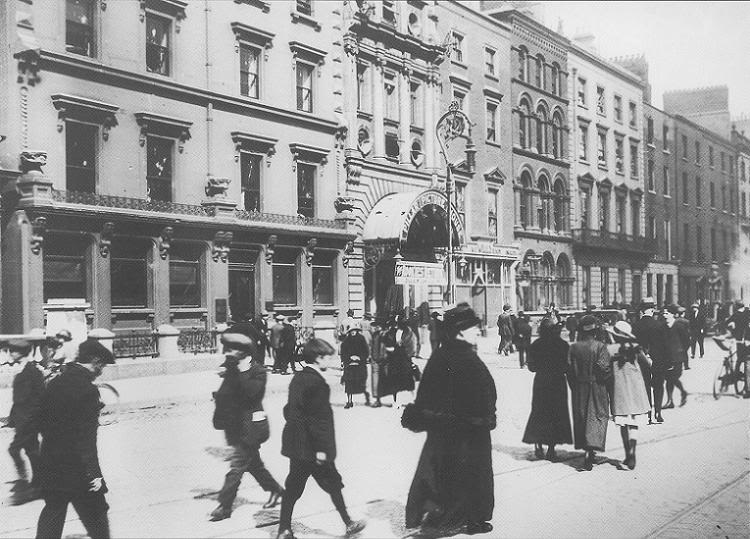
The Pillar Picture House opened on 2 December 1914. This photo shows it in 1921, its distinctive semicircular veranda displaying damage like surrounding building from the fighting of the War of Independence and Civil War. RTE Stills Library; image and discussion here.

Neither weather nor war could seem long to inhibit the progress of Irish cinema in late 1914. “From the cinema man’s point of view this war looks like ‘reel’ business,” announced a one-line item gnomically in Dublin’s Evening Telegraph’s Saturday “Music and the Drama” column, without expanding on any cinematic developments. Nevertheless, this single line seems better to capture developments in popular entertainment in the mid-1910s than the several paragraphs devoted a week later by another columnist in the same newspaper to arguing that “our tastes in amusements and entertainments, indoor and outdoor, run on well-defined lines, and are marked by an extraordinary lack of initiative” (“Notes and Comments”). Drawing on the examples of the ping-pong and roller skating crazes – “the handsome rinks brought very poor prices as scrap” – to show that people prefer “Standard Amusements,” the columnist contended that the “theatre, concert and dance are just the theatres, concerts, and dances of by-gone years with some infinitesimal variations.” “Once or twice in every generation, there are signs of revolt, which are none the less interesting because the innovations have never even a sporting chance of securing a permanent footing” (ibid).

Cinema seems to be left conveniently out of consideration here. Although it had similarities with existing forms of entertainment, it was also significantly different and – as developments in late 1914 showed – was highly successful. Indeed, many of the roller-skating rinks build around the country in the short rinking craze of 1909-11 were not scrapped but had by 1914 become picture houses. Significant capital was also being invested not only in adapting other existing buildings – halls, shops and even churches – but also in constructing new purpose-built picture-houses premises. And building continued five months into the war. As it became part of the Irish streetscape, cinema integrated into the business practices of Irish cities, towns and rural areas; as it became more profitable to be a picture-house proprietor, so it became more socially acceptable to be one. Although doubts about the business stability and the respectability of cinema certainly remained at the end of 1914, it was being reshaped in ways that made it not only acceptable but also ever-more desirable to the dominant business and social class, which was itself changing in the context of the war.

However good its prospects, the cinema business faced challenges. On an elemental level, as a form of entertainment that required people to leave their homes and travel to a picture house, cinema was affected by the weather, particularly extremes of heat or inclement conditions that made travel difficult. Storms of unusual ferocity struck Ireland in the opening week of December 1914. “About midnight last night a violent storm swept over the city,” reported the Evening Telegraph,

bringing about a marked change from the extreme cold that prevailed all yesterday, and that became intensified as the night advanced. A high wind, accompanied by intermittent showers, blew till daylight, when heavy rain fell, and with the gale still fierce, it rained in merciless fashion till after noon, when it developed into a continuous and drenching downpour, which, with violent gusts across the city, made all form of traffic difficult and unpleasant. Dublin has not been visited with such an inclement day for a very considerable time. (“The Weather in Dublin.”)

Hurricane-force winds around the Irish and British coasts severely disrupted shipping, leading to the deaths of 14 men from the steamer Glasgow off the Lizard and 19 of the 250 horses for military use on the Teviot out of Dublin (“Havoc of Hurricane,” “Channel Hurricane,” “Heavy Gale in Dublin”).

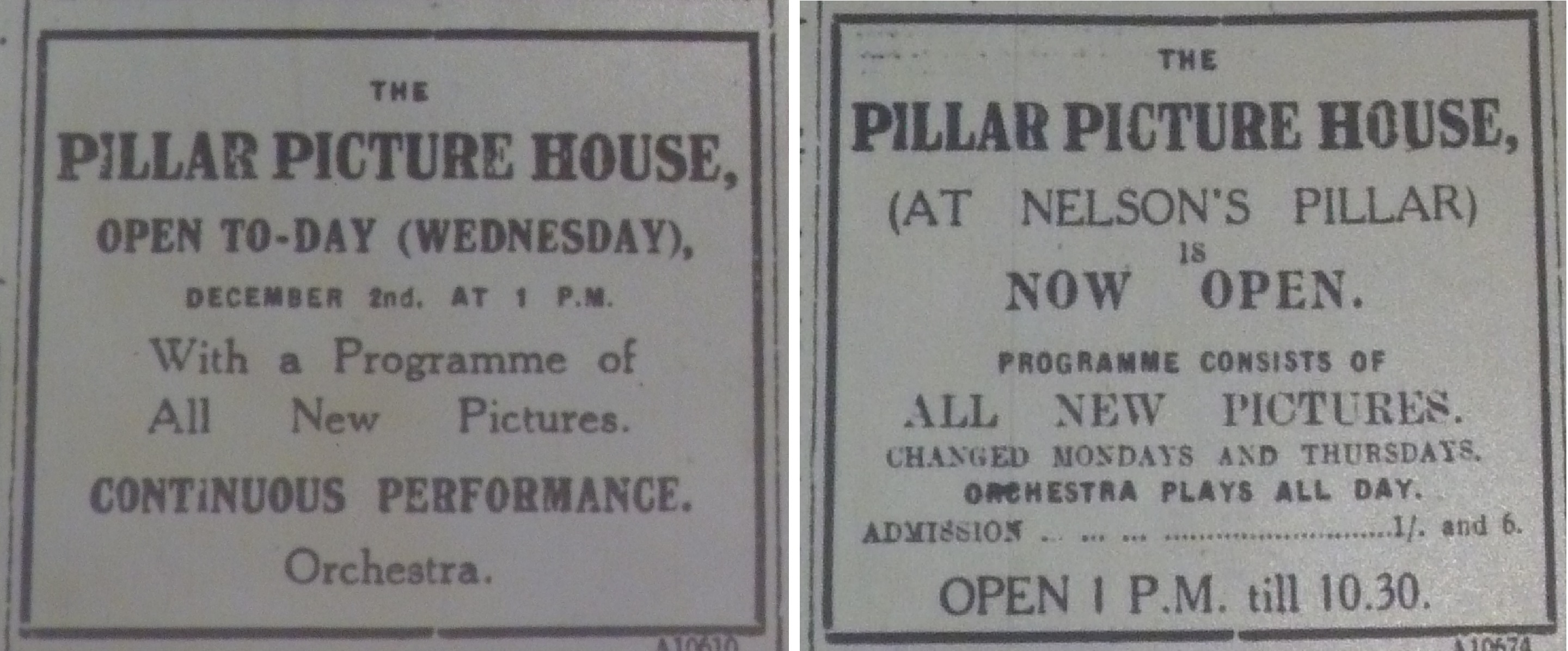
Dublin’s Evening Telegraph 2 and 4 Dec. 1914: 2, providing details on opening hours and admission prices at the new Pillar Picture House.

These raging storms had consequences for at least the first of the two cinemas opened in Dublin and Belfast at the start of December and in time for the Christmas season. Although Dublin’s Pillar Picture House opened its doors on that stormy Wednesday, 2 December, it was only formally declared open two days later (“Pillar Picture House”). It was located in the middle of Sackville/O’Connell Street opposite Dublin’s landmark Nelson’s Pillar. At a time of limited personal transport, “the proprietors are especially fortunate in this, as the position is the terminus of all city and suburban trams” (ibid.). The proprietor was the Pillar Picture House Co., headed by John J. Farrell, a prominent member of Dublin Corporation who also had shares in three other Dublin picture houses. The Pillar was managed by Bob O’Russ, who was also managing Farrell’s picture houses in Phibsboro and Mary Street (Paddy, 24 Dec.), and May O’Russ – one of the city’s women musicians who formerly operated the Mary Street Picture House with her husband – directed the Pillar’s orchestra (Paddy, 17 Dec.).

Like many of the city-centre picture houses of the prewar period, the building was small, with a seating capacity of just 400, but it was architecturally striking both inside and out (“The Pillar Picture House, Dublin”). “The façade of the new premises is handsomely proportioned and cleverly treated in modern classic,” commented the Irish Builder, proceeding to detail its attractive features:

The approach is covered with a semi-circular verandah, which follows the sweep of a broad arch, and the opening under is filled in with Sicilian marble and leaded glass. The vestibule is very effectively treated with walnut and satinwood panelling with a fibrous plaster frieze of figured plaques and swagwork. The ceiling is elaborately ornamented and has a semi-circular dome of leaded glass. The staircase to the balcony is also panelled in walnut, and the enclosing walls artistically decorated in fibrous work. (Ibid.)

The overall impression was of “comfort and art combined in a most successful manner,” and commentators also stressed that the work of Irish manufacturers had been preferred (“Pillar Picture House”). “The general contractor was Councillor John Dillon, and the fibrous plaster contractor was Councillor John Ryan. Councillor M‘Guiness was the consulting electrical engineer, and the architect was Mr. Aubrey V. O’Rourke” (ibid.).

Belfast Evening Telegraph 5 Dec. 1914: 2.

Belfast Evening Telegraph 5 Dec. 1914: 2.

The role of city councillors was even more prominent in the considerable publicity that accompanied the opening of Belfast’s Imperial Picture House on 7 December. Before “an exceptionally large attendance of invited guests, including representatives of the Corporation, public Boards, the Church, the legal profession, and the business community,” the Lord Mayor, Councillor Crawford M‘Cullagh “said he was glad to be privileged in his official capacity to be associated in some degree with the progress and business activity of the city,” in this case embodied by “his colleague, Councillor W G. Turner, and his friend, Mr. James Barron, the directors of the Ulster Cinematograph Theatres, Ltd.” (“Imperial Opened”). The opening was filmed and shown as a special feature of the Imperial programme from 11 December.

The invitation-only opening ceremony was extensively covered in the Belfast’s papers and in the Bioscope, which carried a full page article on the Imperial’s architectural features. Prominently located “in that old-world part of the great industrial centre known as Corn Market,” the Bioscope’s Special Representative reported, the Imperial was “[c]onstruucted on the most improved lines [in such a way that] every possible arrangement has been made for the welfare, comfort, and enjoyment of the patrons of the theatre, or of the clientele which the beautifully appointed tearooms is sure to enjoy” (“Ancient and Modern”). Although the writer provided details of the auditorium – particularly such decorative features as the oil-painted panoramas of Belfast above the proscenium – s/he emphasized the the attractions that were not directly connected to watching a film. “A ladies’ retiring room is provided on the mezzanine floor, writing materials, etc., being supplied free of charge. A telephone and cloakroom are provide in the vestibule for the benefit of patrons, and shoppers may have their parcels addressed in care of the hall if they so desire” (ibid). Like a luxury hotel or department store, the Imperial advertised itself as a place where people, particularly the wealthy, would want to linger.

Ad for special war benefit at the Imperial; Belfast Evening Telegraph 14 Dec. 1914: 4.

Ad for special war benefit at the Imperial; Belfast Evening Telegraph 14 Dec. 1914: 4.

The Imperial maintained a high level of publicity throughout December, publishing more ads than any other form of entertainment. In the Belfast Evening Telegraph, for instance, it published ads not only among the other entertainment ads on page 1 but also on as many of two additional internal pages. As well as this, it advertised and sponsored a benefit on Wednesday, 16 December for the war fund of the lady mayoress, who arranged the participation of local artistes and spent the proceeds on entertaining soldiers who were confined to camp over Christmas (“To Entertain Tommy”).

This kind of publicity strategy was not new but one that the evolving cinema business adapted not only from such longer-established entertainment businesses as theatres but also from business in general, which increased its publicity in the run-up to Christmas, the year’s busiest festival. Despite an expected drop in business during the first Christmas of the war, an extravagance similar to that seen at the Pillar and Imperial seems to have been experienced in the shops. “There are actually areas in the city where more money is being spent than has circulated within living memory,” observed Dublin’s Evening Telegraph. “The crowds are filling the streets. The shopmen are working at high pressure” (“Christmas Eve”)

One of the Irish-Ireland journal The Leader rare picture houses ads was this title page one for The Sign of the Cross at the Bohemian in mid-November 1914.

This title page ad for The Sign of the Cross (US: Famous Players, 1914) at the Bohemian in mid-November 1914 is one of the few picture houses ads that appeared in the Irish-Ireland journal The Leader.

One area of Dublin where more money was being spent on entertainment than ever before was the northern suburb of Phibsboro, where two cinemas had opened in early summer 1914. John J. Farrell’s Phibsboro Picture House had to compete with Frederick Sparling’s Bohemian Picture Theatre. The Bohemian was formidable competition, advertising far more widely than the Phibsboro and introducing such new attractions as the church organ that was installed in November 1914 to accompany the exclusive film The Sign of the Cross (US: Famous Players, 1914). The ability of the Bohemian to secure such desirable exclusive films was, of course, important to maximizing its audience, which for both Phibsboro picture houses meant inducing patrons to travel by tram to this part of the city. The Bohemian also secured the loyalty of its patrons by giving them promotional gifts. While commending Sparling and manager Ernest Matthewson for their choice of Selig’s 9,000-foot adaptation of Rex Beach’s bestselling 1906 novel The Spoilers, Paddy observed that the “Bohemian perfumed calendars and matchbook covers are already well known both to the stern and gentle sex” (Paddy, 24 Dec.).

Evening Telegraph 15 Dec. 1914: 2.
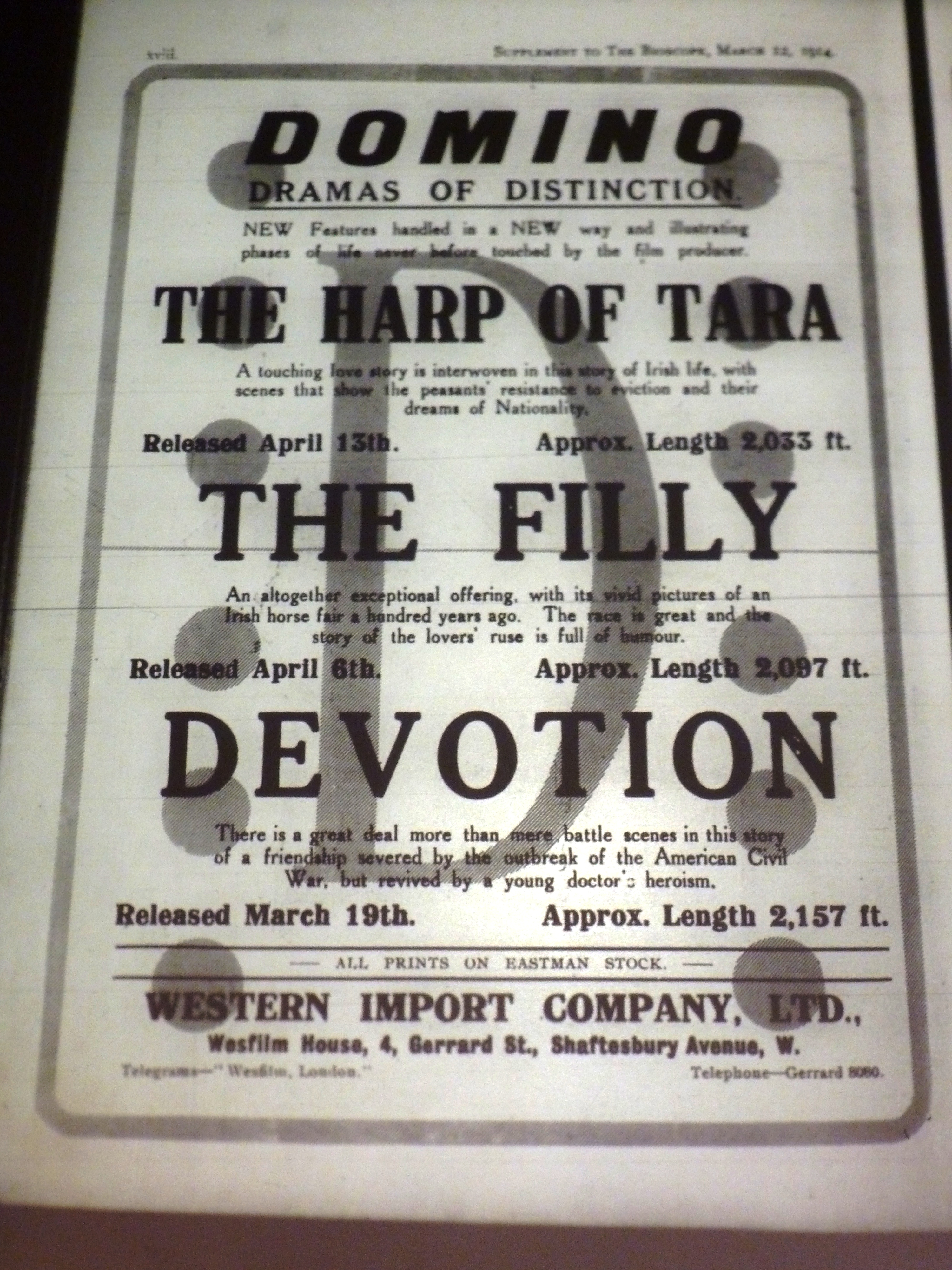
The war was also “reel” business for picture house managements because it provided a topical subject matter with which to attract audiences. There was a popular understanding the films of the war had a persuasive function, particularly when it was used by the enemy. This was highlighted in early December when the Evening Telegraph’s daily column “Sidelights on the War” published an item called “German Victories on the Cinema,” which reported the alleged experiences of “a gentleman who has been to a biograph show in Germany” and who described “[h]ow the news of fictitious victories is circulated.”

A picture of the Kaiser standing with field-glasses in the trenches (delirious enthusiasm). The picture had to be shown over and over again on a screen a hand writes the latest war news: “An English battleship, believed to be the Warrior, was this morning, near Dover, torpedoed by a German submarine and sank.”

[…]

Next picture: The Crown Prince on horseback. A rather subdued applause follows. On the screen the hand thereupon writes: “A German squadron has this morning reached Ireland; mariners have made a landing in the town – name not permitted by censor.” The audience gets up and sings “Deutschland, Deutschland uber alles.” (“Sidelights on the War.”)

Interesting juxtaposition of an ad calling for volunteers to the Royal Engineers and one for the film in which a young man sacrifices himself on a World War I battlefield.

Belfast Evening Telegraph 26 Nov. 1914: 2.

This item clearly implied that the cinema could promote blind devotion to the Kaiser among the German popular audience that generated a war fever that was a danger not only to the sailors of the Warrior but also to Irish citizens facing a German invasion. No similar analysis of Allied war films appeared in mid-December when the Provincial Cinematograph Theatres’ Picture Houses in Dublin’s Grafton Street and Sackville/O’Connell Street and Belfast’s Royal Avenue showed the film With King George in France with The Belgians in Action. Although protests occurred at jingoistic entertainments and criticism appeared in more radical publications, loyalty to King George was accepted by the mainstream Irish press. In late November, the propaganda potential of the war-themed fiction film being produced in increasing numbers by British production companies was highlighted when an ad for one of these films appeared in the Belfast Evening Telegraph below a recruiting ad. While the recruiting ad called for volunteers to the Royal Engineers, the ad for V.C. (Britian: London, 1914), in which a young man dies on a World War I battlefield to vindicate his family’s honour, offered “scenes in the trenches [that] vividly portray modern war conditions.”

The wartime uses of moving pictures were not restricted to their propaganda value in the picture houses. The Bioscope reported comments from the Berlin correspondent of the Spanish El Mundo Cinematografico that “it is evident how much theatrical and cinematographic works can do to lift up and sustain a love of the fatherland in the whole public” (“Cinematography Employed by the Germans”). Citing evidence from the same source on the use of cameras for aerial reconnaissance, the Bioscope argued that “the Germans may claim to be the first nation to put the cinematograph to direct military use in warfare” and urged the War Office and British and French inventors to surpass their enemy (ibid).

By the end of 1914, cinema was showing no signs of going the way of roller skating. It was becoming firmly embedded in the business and entertainment life of Irish cities and towns.

References

“Ancient and Modern: Belfast’s Latest Cinema Described: By Our Special Representative.” Bioscope 10 Dec. 1914: 1143.

“Channel Hurricane: Vessels ‘Sub-Marine’ Passage: Life Boat Lost from ‘Teviot.’” Evening Telegraph 5 Dec. 1914: 4.

“Christmas Eve: Dublin at Its Best: Business Booming.” Evening Telegraph 24 Dec. 1914: 3.

“Cinematography Employed by the German Army: Interesting Details from Berlin of an Alleged New Invention.” Bioscope 10 Dec. 1914: 1076.

“Havoc of Hurricane: Horses Killed on Board Ship: Steamers Forced Back to Dublin: Vessels Blown Down the Liffey: Sailings Postponed and Cancelled.” Evening Telegraph 4 Dec. 1914: 3.

“Heavy Gale in Dublin.” Irish Times 5 Dec. 1914: 5.

“The Imperial Opened: Belfast’s Palatial Picture House: A Civic Ceremony: Home of Pleasure and Comfort.” Belfast Evening Telegraph 9 Dec. 1914: 2.

“Music and the Drama.” Evening Telegraph 5 Dec. 1914: 6.

“Notes and Comments: Standard Amusements.” Evening Telegraph 11 Dec. 1914: 2.

Paddy. “Pictures in Ireland.” Bioscope 17 Dec. 1914: 1217; 24 Dec. 1914: 1347.

“Pillar Picture House.” Evening Telegraph 5 Dec. 1914: 6.

“The Pillar Picture House, Dublin.” Irish Builder 27 Feb. 1915: 98.

“Sidelights on the War: German Victories on the Cinema.” Evening Telegraph 7 Dec. 1914: 2.

“To Entertain Tommy.” Belfast Evening Telegraph 17 Dec. 1914: 5.

“The Weather in Dublin.” Evening Telegraph 2 Dec. 1914: 2.

“An Injustice to Good Productions”: Irish Film Distribution, Programme Changes and New Picture Houses in November 1914

The Sign of the Cross.

An exclusive film exhibited in Ireland in November 1914: The Sign of the Cross (US: Famous Players, 1914). Image: The Silent Film Still Archive.

The published information on film distribution in Ireland in the 1910s is useful in general, but it lacks the detail to say something about how Irish cinemas acquired films in, say, November 1914 (Condon, Early Irish Cinema, 215-17; Rockett 38-41). However, the trade press, particularly the London-based Bioscope, and the local papers that month give some more specific details. By this time, exhibitors no longer bought films outright, as the – much smaller number of – exhibitors in the 1900s had. Films were rented from distributors or renters, and the distribution business in Ireland and Britain was based in London. The sea crossing was an issue for distributors into Ireland, particularly as military operations changed the priorities on the transport of goods in 1914. However, such issues were more easily negotiated by the film distributors who had offices in Ireland or worked through Irish agents.

Bioscope 6 Aug. 1914: xix.

Ad for Gaumont’s Chrono projector; Bioscope 6 Aug. 1914: xix. This ad appeared just as war was breaking out; even a few weeks later, it would not have been acceptable in the context of discussions of severing links with enemy companies as part of the war effort.

“I dropped up the other day to see Mr. Young of the Gaumont Company, Lord Edward Street, Dublin,” revealed Irish correspondent Paddy in the Bioscope in early November 1914 (Paddy, 5 Nov.). Since opening early in 1913, the luxuriously appointed Dublin branch office of Gaumont in London sold the company’s popular Chrono projector, held trade viewings in a dedicated screenings room of the films it distributed, and shot many local topical films since its first ones in June 1913, such as The Launch of the Britannic and a film of a hurling match between Kilkenny and Cork (13 Nov.). Paddy noted that “Mr. Young seemed pleased with how matters were progressing, and he expressed the opinion that the falling off on account of the war was practically negligible” (5 Nov.). A year earlier, Paddy had found Young’s predecessor also pleased with business, including the fact that “[a] great many more Irish theatres have thrown in their lot with the Gaumont Film Service” (13 Nov.), including the Grand in Dublin’s O’Connell Street (Paddy, 24 Jul.), Limerick’s Gaiety Bijou (7 Aug.), and Belfast’s Princess Picture Palace (“Jottings,” 12 Nov.).

Gaumont did not have Irish distribution to itself. In November 1914, the Ideal Film Renting Company set up their Dublin office at 40 Dawson Street, Dublin. “There is little doubt that by opening in Dublin,” opined Paddy, “The Ideal Company have stimulated competition and made it possible for exhibitors to make a better selection on the spot” (5 Nov.). Among the exclusive films that Ideal handled were Danish production company Nordisk’s For the Sake of a Man (1913) and Her Hour of Temptation (1914), as well as Joan of Arc (Italy: Savoia, 1913), for which “[s]pecial posters are available” (ibid.).

1The Palace, Frances Street, Newtownards whowing Cecil B. DeMille's The Ten Commandments (1923). http://www.newtownards.info/frances-st.htm

The Palace, Frances Street, Newtownards showing Cecil B. DeMille’s The Ten Commandments (1923). http://www.newtownards.info/frances-st.htm

Other London-based distributors relied on travelling salespeople or on the Irish-based companies that acted as their agents. In the week of 5 November, Paddy also “ran into Mr. Hagan, the Scottish and Irish representative for Messrs. Ruffells’ exclusives,” who “had secured bookings running to over £350” (ibid.). Norman Whitten’s General Film Supply (GFS) appears initially to have been a branch of the London-based General Film Agency, and although Whitten was better known as a maker and distributor of his own local topicals, GFS also distributed the films of other companies. Some larger Irish cinema chains, such as James T. Jameson’s Irish Animated Picture Company, had their own buyers in London (Condon, “Limelight,” 253). An “Item of Interest” in the Bioscope on 19 November informed trade readers that the Palace in Newtownards, Co. Down, had appointed Lillah Dawson as its film reviewer: “Miss Dawson has recommended the features booked at this hall during the past few weeks, and as a result the seating accommodation and the cork lino have come in for some severe wear, strong evidence that this lady weighs up a subject in a capable and experienced manner” (“Film Reviewer Appointed”).

Depending on the nature of the programme at the picture house or houses concerned, a representative such as Dawson might have had a more or less arduous job. Something has already been said here about the content of the film programme, particularly in regards to the number and length of the films and the length of the programme itself. The dominant practice in cities and towns was for picture houses to change their programmes twice a week, on Monday and Thursday, with a third change for those picture houses that held a Sunday licence. As a result, most films had a three-day run, with the possibility of holding over an especially attractive film – most likely, an “exclusive” – for the second half of the week, in which case the other items on the programme were usually changed. A run of longer than six days for any film was really exceptional. Shorter runs were possible. In early November 1914, Dublin’s Rotunda advertised the fact that beginning on 9 November, it would have three changes in the week, which for this venue with no Sunday licence meant two-day programmes, with changes on Monday, Wednesday and Friday. “Large audiences,” a preview in the Evening Telegraph predicted, “are sure to appreciate this move on the part of the management, who certainly spare no expense in catering for the entertainment of their patrons” (“Rotunda Pictures”).

“Programmes Changed Daily: An Injustice to Good Productions.” Bioscope 19 Nov 1914: 789.

An extract from a Bioscope article discussing daily programme changes at the Omagh Picture Palace; 19 Nov 1914: 789.

The generosity – if it can be called that – of the Rotunda management was no match for that of the management at the Picture Palace in Omagh, Co. Tyrone, a town with a population of less than 5,000. Just ten days after the Rotunda had instituted its new programming changes,a Bioscope article drew attention to the fact that the Picture Palace changed its programme every day. As the article’s subtitle – “An Injustice to Good Productions” – suggests, the writer of this article – described as “our Ulster representative,” so presumably it was the writer of the “Jottings from Ulster” column – saw this as an unusual and unwelcome development (“Programmes Changed Daily”). Although conceding that “a manager on the spot knows his own business best,” s/he endorsed the arguments of “a very astute Ulster manager, who favours the bi-weekly change” because of the mutually supporting nature of printed and word-of-mouth publicity:

He argues that on a Monday and Tuesday a hall attracts by its publicity matter only those patrons of the movies who are influenced by good pictorials and by well-written and attractively-set letterpress. On the Tuesday and Wednesday, and again on the Friday and Saturday, the advertising ceased to be of any account. Personal recommendation or condemnation takes its place and either does such good as to comfortably fill the hall, whilst the programme runs, or is so hurtful in its effects as to prove the incompetency of the manager in the selecting of such pictures as please the majority of the people of his district. (Ibid.)

1Ads for Omagh Picture Palace showing variations in programming. Tyrone Constitution 30 Oct. 1914: 4 and 6 Nov. 1914: 4.

Ads for Omagh Picture Palace showing variations in programming. Tyrone Constitution 30 Oct. 1914: 4 and 6 Nov. 1914: 4.

The trade anxieties manifest in this advice about the effective rhythms of advertising had little to do with the Picture Palace’s choice of films but more with the number of films required. Driven from Home (1914), Shadows (US: IMP, 1914) and Lost in Mid-Ocean (US: Vitagraph, 1914) “want a lot of beating as star subjects. Why not, therefore give them an opportunity to prove their value?” (ibid.). Indeed, assuming a complete daily change of programme, the Picture Palace would likely have shown between 25 and 50 films a week, depending on their length. This suggests that the management had a very different view than the Bioscope of the nature of the entertainment it provided. The competing interests of film producers and exhibitors were shown in late November 1914, when the Bioscope cited the call by Carl Laemmle, head of the US production company Universal, to “cheaper American theatres to raise their prices of admission [to cover] the growing cost of film production” (“Trade Topics”). The management of the Omagh Picture Palace appears to have paid little attention to the quality of individual films and focused instead on audience choice and creating a constituency of daily cinemagoers.

First ad for Sandford Cinema; Evening Herald 3 Nov. 1914: 4.

First ad for Dublin’s Sandford Cinema; Evening Herald 3 Nov. 1914: 4.

Omagh’s abundance of films seems to parallel a more general return of optimism to the Irish film trade in late 1914, which saw the opening of some new picture houses. “That little thought is here given to the approach of lean days,” “Jottings” observed, “is evident from the fact that a new hall is now in full swing in Lurgan, under the direction of Mr. Hewitt”, as well as from the enlargement of Lisburn’s Electric Palace, and the equipping of new picture houses in Coleraine and Belfast’s Corn Market (5 Nov.). In Dublin, the Sandford Cinema opened on 2 November with little newspaper publicity. The first notice was a brief review in the Evening Herald the following day, alongside reviews of the Kinemacolor pictures at the Theatre Royal, the Phoenix Picture Palace’s screenings of The Sign of the Cross (US: Famous Players, 1914) – the most heavily publicized film in Ireland in late 1914 – and the Masterpiece Picture House. The review did not give the titles of the films that “were so much admired at the opening show,” focusing instead on the decor of the building that “is sumptuously fitted up interiorally, the costly furniture being supplied by Clery and Co., Ltd.” (“New Picture Theatre in Ranelagh”). Paddy later revealed the opening “star films” to have been England’s Menace (Britain: London, 1914) and The Village of Death (19 Nov.). No other newspaper coverage of the Sandford appeared in the first week of November, but in the following week, several papers carried ads for In the Bishop’s Carriage (US: Famous Players, 1913), with Mary Pickford, for the first three days and The Wheels of Destiny (US: Majestic, 1914) for the last three.

Managed by John and P.W. Whittle, the Sandford was “quite a high-class” picture house, “replete with all modern conveniences,” including Gaumont projectors and the “indirect system of lighting” in the auditorium (Paddy, 19 Nov.). Paddy found the building to be “a beautiful structure, with a fine flight of steps leading up to the pay-box. The entrance doors are finished in stained glass,” and inside, there was a “considerable rake to the floor, thus enabling all patrons to have a full view of the screen” (ibid.). Despite this focus on the experience of all cinemagoers, the audience was to be divided based on ticket price both outside and inside the premises. “The building stands on a corner site, thus enabling the 3d. entrance to be distinct from the 6d. and 1s., [and once inside, the] 1s. seats are distinguished from the 6d. by neat squares of crochet work on the backs” (ibid.). The management did not, however, show the same attention to detail in securing the required official documents, and it was prosecuted on 20 November for operating without a cinematograph licence (“Sandford Cinema Theatre”). Nevertheless, Inspector Gray of the Dublin Metropolitan Police testified that the premises were “extremely comfortable and suitable in every way for a picture theatre. The pictures he had seen were excellent” (ibid.).

Elsewhere – and almost everywhere – war films remained popular. When Dublin’s Daily Express reviewed In the Hands of the Kindly Dutch at the Rotunda in early November, it emphasized the personal response many in the audience might have made to topical films about the war. The film “shows the division of the Naval Brigade who were interned in Holland after the surrender of Antwerp , and was so clear that anyone could recognise a relative or friend” (“The Rotunda Pictures”). In the same week, the Kinemacolor matinees at the Theatre Royal were providing colour films of the front. The fact that these films were shown in such a large theatre rather than in one of the smaller picture houses indicates that the management expected considerable interest in them, and it went out of its way to create further publicity. “On the kind invitation of the management,” the Express reported, “a number of wounded soldiers attended the [Kinemacolor war films] yesterday, and received quite an ovation from the large audience. Others who were unable to attend will be present this afternoon” (“Theatre Royal”).

Evening Telegraph 28 Nov. 1914: 6.

Evening Telegraph 28 Nov. 1914: 6.

Although the Express observed that “[t]he audience yesterday was unreservedly enthusiastic concerning the display” of war pictures at the matinee, certain members of the audience at the Theatre Royal were neither enthusiastic nor reserved about patriotic displays at the theatre’s live evening show (“Picture Matinees”). On 2 November, a group of young men wearing republican badges protested by booing, hissing and groaning when, during one musical number, several Union Jack flags were unfurled and the orchestra played “Rule Britannia.” When 18-year-old Thomas Smart refused to stop, he was arrested and fined 40 shillings in court (“Scene in Theatre Royal”).

Ad for two Irish-themed films from the US production company Domino; Bioscope 12 Mar. 1914: xviii.

Ad for two Irish-themed films from the US production company Domino; Bioscope 12 Mar. 1914: xviii.

Smart and his fellow protestors might have been more appreciative of the Irish week run by the Masterpiece at the end of November. The main film was True Irish Hearts (US: Domino, 1914), supported by The Filly (US: Domino, 1913), Rory O’More (US: Kalem, 1911), The O’Neill (US: Kalem, 1912), films of Irish scenic landscapes and a topical of the Castlebellingham Feis and Louth Volunteers. During the previous week, manager Cathal McGarvey “had appeared personally at each performance during the week in his original humorous monologues, and these met with a great reception, there being no better humorous reciter in Dublin than Mr. McGarvey” (Paddy, 19 Nov.). For the Masterpiece’s Irish Week, however, McGarvey allowed popular baritone W.A. Sheehan to enhance the live musical accompaniment by singing Irish songs (“An Irish Week”). These kinds of Irish Weeks were not new, but they were facilitated by the fact that such producers as Domino and Kalem were continuing to make Irish subjects. The Domino titles were new ones, available through Western Import since March and April 1914, but the Kalem ones were older titles that required that a distributor – in this case, the Express Film Service – hold on to them for such events.

References

Condon, Denis. Early Irish Cinema, 1895-1921. Dublin: Irish Academic, 2008.

—. “Limelight on the Colleen Bawn: Resisting Autoexoticism in Provincial Irish Picture Houses in the Early 1910s.” Les cinémas périphériques dans la période des premiers temps. Peripheral Early Cinema: Domitor 2008. Perpignan: PU Perpignan, 2010. 245-255.

“Dublin and District: Ranelagh’s New Picture House.” Irish Independent 10 Nov, 1914: 4.

“Film Reviewer Appointed.” Bioscope 19 Nov. 1914: 706.

“An Irish Week at the Masterpiece.” Evening Telegraph 28 Nov. 1914: 6.

“Jottings from Ulster.” Bioscope 13 Nov. 1913: 589; 5 Nov. 1914: 543; 12 Nov. 1914: 647.

“New Picture Theatre in Ranelagh.” Evening Herald 3 Nov. 1914: 4.

Paddy. “Pictures in Ireland.” Bioscope 24 Jul. 1913: 267; 7 Aug. 1913: 413; 13 Nov. 1913: 601; 5 Nov. 1914: 525; 19 Nov. 1914: 736.

“Picture Matinees at the Theatre Royal.” Daily Express 3 Nov. 1914: 8.

“Programmes Changed Daily: An Injustice to Good Productions.” Bioscope 19 Nov 1914: 789.

Rockett, Kevin and Emer. Film Exhibition and Distribution in Ireland, 1909-2010. Dublin Four Courts, 2011.

“The Rotunda Pictures.” Daily Express 3 Nov. 1914, 2.

“Rotunda Pictures.” Evening Telegraph 7 Nov. 1914: 6.

“Scene in Theatre Royal: A Row in the Gallery.” Daily Express 4 Nov. 4 1914: 3.

“Sandford Cinema Theatre.” Evening Telegraph 21 Nov. 1914: 4.

“Trade Topics.” Bioscope 26 Nov. 1914: 821.

Rolls of Honour: Irish Film Businesses and the War, Autumn 1914

“The British Cinematograph Industry has made a magnificent response to the country’s call for men at this terrible crisis,” observed the trade journal Bioscope shortly after Britain’s entry into the First World War. The magazine requested that “managers of the cinematograph business houses or theatres, any of whose workers have temporarily left them for this noble purpose, kindly communicate the fact to us, mentioning the name of the man and the regiment he is joining” (“Trade Topics”). The following issue’s “Roll of Honour” (20 Aug.), a list of members of the trade who had joined the armed forces, did not mention any men from Irish companies, but Irish correspondent Paddy observed that one of the sons of Irish exhibitor James T. Jameson had “been called to the colours” (Paddy, 20 Aug.).

Roll of Honour 1

The Bioscope’s second “Roll of Honour” for men in film businesses who enlisted featured five Irishmen; 27 Aug. 1914: 784.

Beginning on 27 August, the names of employees in Irish or Ireland-based film companies began to appear on the Bioscope’s “Roll of Honour.” The first of those mentioned was William Vass Morris of Cork, described in the census of 1911 as a photographic agent, who was joining the South Irish Horse. Morris was joined on this list by three members of Gaumont’s Dublin office, another Morris, Ganey and Kinnemont, and by Byrne of Dublin’s Grand Cinema. Two members of Provincial Cinematograph’s Belfast staff – Cummings and Lydall – appeared on the first “Roll of Honour” in September. Provincial had already publicized the special contribution of its personnel to the war effort, and the Dublin Evening Mail had duly passed on this information to its readers (“The Picture House Staff”). Those named by the Evening Mail article had prominent positions in the company’s London head office, including chairman of the board Sir William Bass and general manager Aubrey Meares. It also claimed that

[b]etween 60 and 70 attendants at various theatres owned by this company have been called out on reserve, and the company has decided to allow 10s per week to the wife, and 2s 6d for each child during the man’s absence. All employes will be re-instated at the conclusion of the war. (Ibid.)

By early October, Dublin’s Evening Telegraph was putting the number of Provincial staff who had “joined his Majesty’s forces” at 109 (“Picture House Employes”).

Ad for war films at the Grafton; Dublin Evening Mail, 14 Sep. 1914: 2.

Ad for war films at the Grafton; Dublin Evening Mail, 14 Sep. 1914: 2.

Some Irish film production companies expanded their business during the war, taking advantage of new filmmaking opportunities – although these were not without risks – as well as pursuing some innovative work. Norman Whitten of the General Film Supply featured in a short article in the Bioscope in mid-September. It explained that Whitten had mounted a platform in front of a train to take “the beautiful scenery around Galway Bay. In the light of recent stirring events, the ‘topcials’ secured should be of distinct value to exhibitors” (“New Series of Irish Topicals”). As well as this kind of work that he had been doing for some time, Whitten – assisted by a Mr. Ashton who presumably had taken the place of Whitten’s previous cameraman, Benny Cann – made several war-themed films, but not as many as he planned. In early September, Paddy reported that Whitten had been threatened with being shot if he persisted in trying to film soldiers embarking on transport ships at Dublin’s North Wall. The War Office had revoked the permit to film that Whitten had earlier obtained. As Paddy observed, this was disappointing for Whitten, who had been building up his business in local topicals to a point where his film Funeral of Victims Shooting Affair Sunday, July 26th circulated in eight copies, which “constitutes rather a record” (Paddy, 3 Sep.). This film was of continuing relevance because of the campaign of the relatives of victims to get Dublin Corporation to petition the king (“Bachelor’s Walk Outrage”).

Whitten appears to have had eight regular subscribers for his topicals in Dublin, but such a circulation seems small by comparison with the other kinds of war films his company was making at the time. Paddy described Whitten’s Sons of John Bull as both a topical and a “‘cartoon’ film,” but the element of animation is not clear from his description, which makes the film appears to have been a series of filmed portraits and/or still images connected with dissolves and intertitles:

[I]t is a series of photos, hand-coloured, of famous people connected with the war. Each subject dissolves into the next, which rather enhances the beauty of the film. Another portion of the film is entitled “Friends,” and depicts famous men connected with our Allies, including a splendid photo of the king of Belgium. (Paddy, 3 Sep.)

The film ran 100 feet (or about 1 minute 40 seconds), but it is not clear why Paddy considered it “a great advance over the system of still slides,” which it clearly resembled, albeit without the presence of a lantern lecturer to explain the images.

By early October, Paddy was characterizing this film as “a pronounced success in Dublin and elsewhere,” and revealing Whitten’s plans to release a second film of the same kind on 22 October (Paddy, 1 Oct.). Twice the length of Son of John Bull at 200 feet, Britannia’s Message appears to have included newsreel and to have begun with an animated sequence. It

opens with Britannia drawing aside some curtains and revealing a German spy. Interesting scenes include an outside view of hundreds of young fellows besieging a recruiting office, a view of the Rugby Volunteers drilling at Lansdowne Road, Dublin, and a view of troops leaving for camp. (Ibid.)

The latter was presumably shot after Whitten had been given a new permit. The potential public interest beyond Ireland in these pro-war shorts was indicated by the fact that British distributor Cosmopolitan was handling them.

Within Ireland, business at the cinemas was reported to be good. In mid-September, Paddy made a tour of many of Dublin’s cinemas reporting that “in the great majority of cases [I] found business excellent; in fact, in certain houses exceptionally brisk.” His researches made him conclude that there was a difference between working-class and middle-class picture houses. He argued that

it is chiefly the houses which make an appeal to the 2d. and 3d. people that suffer most from the war. The patrons of these houses were largely drawn from reservists of one kind and another and their families. The bread-winner being away on service, the family naturally are thrown back on slenderer resources, and so cannot attend the “movies” as frequently as they might wish. However, as business gradually resumes more normal aspects, it is to be hoped that this state of things will be somewhat alleviated. (Paddy, 24 Sep.)

The Picturedrome is visible on the right of this photograph of Dublin's Harcourt Road. https://www.flickr.com/photos/nlireland/7628356832/

The Picturedrome is visible on the right of this photograph of Dublin’s Harcourt Road in c. 1912. https://www.flickr.com/photos/nlireland/7628356832/

One working-class picture house that he visited was the Picturedrome in Harcourt Road. For Paddy, the Picturedrome was “a theatre which I regret to find I have not mentioned in these notes for some time,” but he was not alone in his lack of coverage because the Picturedrome – catering for a local working-class audience – did not advertise in the Dublin newspapers and so was ignored by reviewers. “Business here was fairly brisk,” Paddy observed, “considering the regular patrons of the hall are drawn from men now with the colours.” Manager Will Sommerson was presenting a bill dominated by three Vitagraph films The Auto Bandits of New York, Old Reliable and Her Mother’s Wedding Gown. “[I]t’s astonishing the popularity of Vitagraph films in Ireland” – although The Auto Bandits seems to have been made by the Ruby Feature Film Company. The only other film he mentioned at the Picturedrome was “an exceptionally interesting scenic, ‘The Volcanoes of Java’” (ibid.).

Tivoli Theatre of Varieties, Burgh Quay, Dublin, May 1915. https://www.flickr.com/photos/nlireland/12082817723/

Tivoli Theatre of Varieties, Burgh Quay, Dublin, May 1915. https://www.flickr.com/photos/nlireland/12082817723/

The most notable thing about the Picturedrome’s programme is that Sommerson appears to have chosen none of the war-themed films that some other exhibitors were making a point of including on their programmes. At the Tivoli Theatre of Varieties, for example, the music-hall bill included the films Cyclists of the Belgian Army and The 23rd French Dragoons, which “had been specially procured by Mr. Charles M. Jones for the benefit of his patrons – a large proportion of soldiers being amongst the audience each night” (ibid.). At the Dorset Hall, manager Frederich Sullivan accompanied the dramas Jim, the Fireman (Britain: Barker, 1914) and In the Wolf’s Fangs (US: Bison, 1914) with “the authentic film of the Germans entering Brussels, and I noted that this film had been passed by the Censor” (ibid.).

The Man About Town's "Things Seen and Heard" column began with items on film on 5 and 10 Oct. 1914: 2.

The Man About Town’s “Things Seen and Heard” column in the Evening Herald began with film items on 5 and 10 Oct. 1914: 2.

Commentators in the Dublin papers were more ambivalent about war films. Also writing on 24 September, the same day as Paddy’s coverage of the Dublin picture houses appeared in the Bioscope, the Evening Herald columnist The Man About Town was pleased to hear from “the proprietor of one of our largest picture houses” that business was quite good, as well as to get a demonstration of the Topical Picture Slide, a new method of displaying topical news. Despite this unnamed proprietor’s focus on matters topical, he told the Man About Town that “[p]eople hear so much about the war that when they go to a cinema they look for something to relieve their minds from the awfulness of it, and I find that with a carefully selected and well-balanced programme business is really good.” A regular cinemagoer, the Man About Town provided an example a week later of a picture house patron who was traumatized by war images on screen. “I was attending a picture theatre the other day with a lady,” he revealed,

and gradually it was borne in upon me that my airy persiflage was falling on deaf or, at least, inattentive ears. The film was telling a thrilling story, and the incidents just being depicted were those of a naval encounter in the course of which the hero – an officer of the Royal Navy – is fatally wounded. My companion seemed a little distraite, and at last observed: “Oh, I wish they wouldn’t show things like this.” Then I remembered that her brother is at present serving in a ship in the North Sea. The cunning of the scene was too much for her. (30 Sep.)

Earlier in the month, he had suggested that certain picture houses were clumsily attempting to elicit patriotic responses from the Dublin audience. “In a picture theatre in — street yesterday a picture of King — was shown,” he observed,

the band played “— Save the King,” the audience uncovered (their heads), and there was some applause. So far so well. Then a raucous voice shouted in an unmistakable brogue, “Hip, hip, hurrah.” Without being able to swear to it, I have no doubt, having regard to the accent, the venue, and the audience, that this enthusiast was a paid rather than a paying spectator. In other words that he was one of the staff. Surely enthusiasm should grow of itself, and not be fomented in this way? As it was the demonstration fell flat. (12 Sep.)

The role of the picture house attendant who cheered was clearly crucial here, but music also played a significant part in this case and generally in shaping the experience of patrons. Paddy commented that the music at the Phibsboro Picture House at the northern edge of the city was “deserving of great praise, and no one takes more interest in her work or gives a more spirited and tasteful exhibition of playing than Miss Eagar”(24 Sep.). The Man About Town included an item entitled “‘Glorious’ War,” in which he demonstrated the way that talented musicians could influence the audience’s reception of war films. “While I was at a picture-house the other night,” he began, “scenes were shown of Belgian wounded being removed in ambulances. The pictures were rather harrowing, and as they were being displayed the band discoursed Elgar’s famous march, ‘Pomp and Circumstance.’ It set one thinking” (14 Sep.).

Therefore, although Irish film businesses generally embraced the pro-war patriotism that dominated the British industry, local exhibitors and audiences were more ambivalent about what they were seeing on the screen.

References

“Bachelor’s Walk Outrage: Relatives of the Victims: Corporation Resolution: To Petition King.” Evening Telegraph 5 Oct. 1914: 4.

The Man About Town. “Things Seen and Heard: ‘Glorious’ War.” Evening Herald 12 Sep. 1914: 2; 14 Sep. 1914: 2; 24 Sep. 1914: 2; 30 Sep. 1914: 2.

“New Series of Irish Topicals.” Bioscope 17 Sep. 1914: 1079.

Paddy. “Pictures in Ireland.” Bioscope 20 Aug. 1914: 752; 3 Sep. 1914: 913; 24 Sep. 1914: 1129; 1 Oct. 1914: 31.

“Picture House Employes.” Evening Telegraph 10 Oct. 1914: 3.

“The Picture House Staff: Many Men Off to the Front.” Dublin Evening Mail 21 Aug. 1914: 4.

“Roll of Honour.” Bioscope 20 Aug. 1914: 784; 27 Aug. 1914: 3 Sep 1914: 869.

“Trade Topics.” Bioscope 13 Aug. 1914: 617.

“Driven to See Pictures Instead of Plays”: Joseph Holloway Goes Out in 1914 Dublin

Joseph Holloway's "My Reflection in Mirror at Barbers," 21 Sep. 1914.

Joseph Holloway’s self-portrait “My Reflection in Mirror at Barbers,” 21 Sep. 1914. National Library of Ireland.

On Friday, 31 July 1914, Joseph Holloway – the sometimes architect but more often theatregoer – recorded a moment of cultural angst: “Was at two picture Houses during the day – the Grafton & Rotunda, where a few good films were on view,” he noted in his diary before adding: “It’s terrible to be driven to see pictures instead of plays! I fear the theatres in Dublin are dead for the present.” The death of theatre in Dublin was a cause of serious concern for Holloway, whose diary records the minute attention he paid to shows at Dublin’s “legitimate” theatres – the Theatre Royal and Gaiety – at its melodrama house – the Queen’s Royal Theatre – and at its music halls – the Empire and Tivoli. Despite his unhappiness with theatrical offerings at this time, he nevertheless attended as many plays and shows as he could fit in a life largely filled with the leisure that a small inheritance allowed him. The diary in which he records the details of these shows – as well as his conversations and correspondence with the luminaries and ordinary people of the time – is an incredible work of life writing that has been estimated as running to more than 25 million words (Ferriter). This is not because of the great critical insights he offers; his diary has been described by Irish author Frank O’Connor as “that donkey’s detritus” and by Sean O’Casey as “an impossible pile of rubbish” (ibid). Nevertheless, despite the limited perspective of a middle-class conservative Catholic nationalist, it offers fascinating glimpses into life and leisure as they were experienced in Dublin in the 1910s, including the city’s emerging cinema culture.

Holloway’s viewing of the two film shows in late July 1914 was not unprecedented, nor was it the first time he had expressed his dissatisfaction with picture houses while being a regular cinemagoer. Since the Picture House in Sackville/O’Connell Street had opened in April 1910, Holloway had often visited it and the other picture houses that opened with increasing regularity in its wake. Although he sometimes visited picture houses alone, he also accompanied his mother Anne Holloway and his niece Eileen O’Malley, with whom he lived, demonstrating the popularity of the picture house across three generations (Condon 143). By September 1914, Holloway’s life was changing along with the city’s entertainment offerings, not to mention the political upheavals of the period. The death of his mother in May 1912, and the marriage of Eileen on 16 September 1914 left him living alone and without a cinema-going companion.

As well as this, the breakdown of the longstanding distinctions between Dublin’s legitimate theatre, melodrama house and music hall was particularly visible just as the war began in the autumn of 1914. This was part of an international process by which entertainment companies were buying up and building theatres of all kinds to create chains that sought large popular audiences by providing a modified form of variety entertainment that could accommodate popular music hall artistes and dramatic actors, as well as film. Dublin’s Theatre Royal had long been experimenting with this modified variety, which it called by a name already popular in many British cities: hippodrome. Marvelling at the popularity of the Royal’s hippodrome seasons during the summer period when the theatres usually closed, the theatrical columnist of Irish Life dubbed hippodrome “the Chief Priest and Apostle of the Music Hall in Dublin” (“Between the Acts”). “[I]ts hold over the public is simply amazing. The “two-nightly house” show can apparently thrive under any circumstances. In Dublin it has captured all classes, and has proved itself a most profitable undertaking to those engaged in it” (ibid). Film featured not only as part of the evening programme in the guise of the Royal Bioscope but also at a separate film matinee.

Ad for the Theatre Royal Hippodrome and Winter Gardens, Sep. 1914, featuring film matinees of Nature's Zoo. National Library of Ireland.

Poster for the Theatre Royal Hippodrome and Winter Gardens, Sep. 1914, featuring film matinees of Nature’s Zoo (Britain: Cherry Kearton, 1913), a film that the Royal also exhibited a year earlier. National Library of Ireland.

In early August, Ireland’s Attorney-General and Solicitor-General heard application for patents that would allow legitimate drama from the Star Theatre of Varieties, Ltd., the company that ran the Empire, and from the Premier Picture Palace (Dublin), which proposed to build a large theatre in the city centre on a site off Henry Street and close to the GPO. As the latter’s name suggests, this company had initially planned to open a large picture house but had decided that a variety theatre with the flexibility of mounting plays and showing films would be more profitable. The company would eventually open in April 1915 what was then known as the Coliseum Theatre, a short lived venue that would not be rebuilt following its destruction a year after its opening during the 1916 Rising. The proprietors of the Coliseum included Lord Mayor Lorcan Sherlock, two directors of Dublin’s Tivoli Theatre and theatrical agent Fred Willmott (ibid.). Holloway attended the hearing and spoke as an expert witness – “as an old theatre-goer with 40 years experience” – in support of the Star Theatre of Varieties’ application, arguing that the granting of a dramatic patent would benefit the city by providing the opportunity for more play to be performed (“What Is a Revue?”).

Handbill for opening of the Masterpiece Theatre (Holloway 27 Jul.)

Handbill for opening of the Masterpiece Theatre preserved in Holloway’s diary (Holloway 27 Jul.)

While lobbying in support of more plays and continuing to attend theatrical shows of all kinds, Holloway also visited picture houses regularly. During July and the first half of August 1914, he records twenty visits to Dublin picture houses, fourteen of them alone in July. On the evening of Thursday, 2 July, he went to what he insisted on calling the O’Connell Picture House (but the proprietors persisted in calling the Picture House, Sackville Street) where he saw the “beautiful touching film ‘Child o’ My Heart’” (Britain: London, 1914); on the afternoon of Monday, 6 July, he saw The Afghan Raiders and When Lions Escape (US: Columbus, 1914) at the Rotunda, and “both were full of thrills!”; on the evening of Wednesday, 8 July, he saw the Western Love Triumphant and a newsreel of Joseph Chamberlain’s funeral at the Grafton; on the evening of Friday, 10 July, he saw From the Lion’s Paw and “a thrilling abduction story, both well acted” at the Rotunda; on the evening of Monday, 13 July, he saw The Game of Life (US: Selig, 1914) at the Rotunda, which he found “a particularly exciting one & also an Indian story of the new medical man” [The New Medicine Man (US: Kalem, 1914)]; on the evening of Saturday, 18 July, the films he saw at the Grafton included Lost at Sea (France: Eclair, 1913), Nan Good-for-Nothing (Britain: London, 1914) and a newsreel from Dublin’s Civic Exhibition featuring rival architect George O’Connor, “[a]s large as life & equally as massive!”; on the evening of Monday, 20 July, he admired at the Grafton both The Black Pearls (US: Geroges Méliès, 1914), “a real thriller enacted finely by French players,” and The War Bonnet (US: Kalem, 1914), “an Indian story [that] was fairly interesting chiefly because of its beautiful natural setting; on the afternoon of Tuesday, 21 July, he was amused by The Blood Test (US: IMP, 1914) and an unnamed comedy at the Rotunda; on Thursday, 23 July, he visited the Grafton, where he saw “a few good dramatic pictures & others I didn’t care for,” and later the Rotunda, where The Master Crook Turns Detective (Britain: British and Colonial Kinematograph, 1914) “was the most dramatic & best enacted”; on the evening of Friday, 24 July, His Reformation (Britain: London, 1914) at the O’Connell was the best of “the few more or less interesting pictures” he saw; on Monday, 27 July, he found Joan of Arc (Italy: Savoia, 1914) at the opening of the Masterpiece Theatre “dull and left after ending of part 3,” but enjoyed The Mansion of Sobs (US: Lubin, 1914), “a very good child picture & a funny [John] Bunny picture” later at the Grafton; on Friday, 31 July, he had the two visits to the Grafton and Rotunda that caused him such anxiety about the death of theatre.

Evening Telegraph review of programme at the Masterpiece, 22 Sep. 1914: 2.

Evening Telegraph review of programme at the Masterpiece, 22 Sep. 1914: 2.

The first half of August shows the same rate of picture house attendance, with Holloway visiting a cinema on average almost once every two days. On the evening of Saturday, 1 August, he went to the “exciting film drama” Devil’s Gap at the Dorset Picture House; on the evening of Monday, 3 August, he and Eileen found the programme at the Grafton poor, particularly the vulgar Across the Hall (US: Keystone, 1914), but the evening was somewhat redeemed by Bertie in the Ladies’ College (Britain: Eclair, 1914) and ’Fraid Cat (US: Vitagraph, 1914), “a clever child film”; at the Rotunda on the evening of Thursday, 6 August, he found A Life for a Life “quite pathetic” and was moved – unusually – to write a synopsis of it; Ivy’s Elopement (Britain: Ivy Close Films, 1914) at the O’Connell on 8 August was “set in exquisite surroundings & was really beautiful”; on Wednesday, 12 August, he saw England’s Menace (Britain: London, 1914) with Eileen at the Grafton, “where we saw some fine films, and were entertained by a man with a most aggressive sneeze”; on Friday, 14 August, he attended the 6:30 show at the Rotunda with just a handful of others, attributing the small attendance to “the unruly elements” of thunder showers, roving soldiers “and the unfortunate girls [who] had come out to meet them.”

Over this period, he attended the Rotunda and Grafton almost equally with eight and seven visits respectively. The O’Connell was his next most favoured picture house with three visits; and the Masterpiece and Dorset received one visit each. After the visit to the Masterpiece on 27 July, he appears not to have visited it again until two months later, on Saturday, 26 September, when the well-known comedian Cathal MacGarvey took over its management. Holloway “met Mr M’Garvey at the door – he has only taken up the reins a week ago & scarcely feels his feet yet – he hopes to work it into a big success – The programme was first rate & I told him so as I came out.” Holloway did not mention what was on the programme, but MacGarvey’s appointment drew some welcome publicity to the Masterpiece, and as a result, notices show that Holloway would have seen the drama Etta of the Footlights (US: Vitagraph, 1914) with Maurice Costello and Mary Charleson – which was also showing at the O’Connell – “some daring feats of equestrianism by the 18th Hussars” in Our Cavalry’s Wonderful Horsemanship, the scenic film From Inverlaken to Shiedegg, and a Gaumont Graphic newsreel that included “a review of the National Volunteers at Enniscorthy by Mr. John Redmond and (“Masterpiece Theatre”). It is likely that the location of the last film is mistaken and that this was a film of the infamous speech at Woodenbridge, Co. Wicklow, in which Irish nationalist leader Redmond called on the Volunteers to join the British Army.

Film lover Dr Knott. Holloway Diaries.Aug. 1914

Film lover Dr Knott. Holloway Diaries. National Library of Ireland.

Unlike his often very detailed accounts of theatre shows, Holloway wrote frustratingly little on the films he saw, often not even giving their names. He does, however, sometimes remark on the behaviour – and even mention the names – of members of the audience, some of whom he also occasionally sketched. On the evening of Monday, 1 June 1914, he reveals, the large audience at the Grafton included “AE (George Russell) & Prof. Maginnis.” The aggressively sneezing man at the Grafton on 12 August allowed him some interaction with other members of the audience:

Even the film drama – “England’s Message” – which was loudly applauded – he sneezed often. ”Though its subject wasn’t to be sneezed at!” I said to Eileen, & the man next her, who had been applauding his hands off almost when the foreign fleet in the picture story turned tail & went home, smiled at & approved of my turn of phrase.

However, the behaviour of other audience members could be annoying, as it was on 8 July at the Grafton during the newsreel of Chamberlain’s funeral: “a man behind me kept up a regular tattoo with his fingers on the crown of his straw hat, which was irritating to all save himself. I know he maddened me!” Some people he knew were regular picture house patrons. James Crawford Neil enjoyed natural history pictures (23 Jul. 1914). Dr John Knott, “haunts the picture houses” (16 Sep 1914) and seems to be constantly “seated rather close up to screen” (30 May 1914). Like Knott, Holloway also haunted Dublin’s picture houses, and despite his periodic fears about cinema displacing his beloved theatre, he appears, on balance, to have enjoyed his time in front of the screen.

References

“Between the Acts.” Irish Life 10:2 (24 Jul. 1914), p. 68.

Condon, Denis. “‘Temples to the Art of Cinematography’: Cinema on the Dublin Streetscape, 1895-1929.” Visualizing Dublin: Visual Culture, Modernity and the Representation of Urban Space. Ed. Justin Carville. Bern: Peter Lang, 2013. 132-54.

“Drama in Dublin: Premier Picture Palace Application: Lord Mayor’s Views.” Evening Herald 7 Aug. 1914: 2.

Ferriter, Diarmaid. “Holloway, Joseph.” Dictionary of Irish Biography Online. Cambridge UP and Royal Irish Academy, 2009. Web. 30 Sep. 2014.

Holloway, Joseph. Holloway Diaries. National Library of Ireland.

“Masterpiece Theatre.” Evening Telegraph 22 Sep. 1914: 2.

“O’Connell Street Pictures.” Evening Telegraph 15 Sep. 1914: 2.

“What Is a Revue? Manager Tries to Explain It: Drama in Dublin.” Evening Herald 6 Aug. 1914: 3.

Shadow Soldiers Flickering on a Screen: Irish Cinema and the Beginning of World War I

Provincial War Pics

These ads appeared in the Dublin Evening Mail 7 Aug. 1914: 2; and 18 Aug. 1914: 2.

“It is ever so much more a patriotic thing to go down the quays and give the soldiers a good send-off than it is to sit in a darkened picture house watching, perhaps, ‘shadow soldiers’ flickering on a screen,” reported Paddy, the Ireland correspondent of the British cinema trade journal Bioscope in August 1914 explaining the falloff in attendance at Dublin’s picture houses at the start of the Great War. “[T]he fact that the Lord Mayor of Dublin had to publicly ask the people through the medium of the Press, to refrain from causing a block on the quays and assist in getting the soldiers embarked more expeditiously shows how matters stand” (Paddy, 13 Aug., 673). Mobilization affected the cinema and its relationship with the popular audience in various ways. Those who lined the Dublin quays, Paddy suggested, were particularly the popular audience who would otherwise have occupied the picture houses’ cheapest – usually three-penny or 3d. – seats. Although Frederick Sparling, manager of Phibsboro’s Bohemian Picture Theatre, reported brisk business, “he experienced a great falling off in the attendances at the 3d. seats, and he expected that receipts generally would show a drop for a little time” (ibid).

Paddy claimed that the effect in Ulster was quite different, with the outbreak of the war bringing unionist and nationalist audiences together in the face of a common enemy. “[T]he one-time rivals now fraternise,” he observed, “and quiet, law-abiding and gaiety-loving citizens are now taking their pleasures with less sadness than had been their wont during the two gloomy years from which Ireland has just emerged” (Paddy, 13 Aug., 675). Unfortunately, this somewhat unlikely harmony would be short-lived because the difficulties of procuring enough flax and other raw material for Ulster’s factories would mean that mill workers, “the backbone of the support of the cinema in Ulster as in other manufacturing centres,” would be placed on half-time working at half-pay, leaving “nothing to spend on amusements of any description” (ibid).

Actuality films of the war appeared on the cinema programme alongside such  fiction film as D. W. Griffith's Judith of Bethulia (US: Biograph, 1914).

Actuality films of the war appeared on the cinema programme alongside such fiction film as D. W. Griffith’s Judith of Bethulia (US: Biograph, 1914). Dublin Evening Mail 24 Aug. 1914: 2.

Nevertheless, Irish picture houses attempted from a very early point in the war to provide shadow soldiers on the screen for their audiences, and not only working-class ones. On 7 August 1914, the Dublin Evening Mail carried the first of a series of unusually large ads for the Picture House, Grafton Street and the Picture House, Sackville Street showing films depicting “the latest developments of the War, day by day.” Both of these cinemas were owned by the London-based chain Provincial Cinematograph Theatres, which also ran the less-salubrious Volta in Mary Street and Belfast’s Picture House, Royal Avenue. The company promoted its venues – and particularly the recently renovated and extended Grafton on Dublin’s most prestigious shopping street – as offering luxuries suitable for prosperous city-centre shoppers. Strollers who stopped into the Grafton’s public café might be induced to see the war pictures by a sign that indicated which of the six-to-eight films typically on a cinema programme was currently playing in the auditorium.

Judith (Blanche Sweet) prepares to behead Holofernes in Judith of Bethulia.

Judith (Blanche Sweet) prepares to behead Holofernes in Judith of Bethulia.

Although such passersby or Evening Mail readers arrested by the prominent ads continued to be offered a programme of films after the outbreak of hostilities, they seem to have been presented with an overwhelming number of war-themed films. The Grafton featured England’s Menace (Britain: London, 1914), a “stunning naval drama,” for the week beginning 10 August, the six-day run representing twice the usual period for which a film was shown. For the first three days of the following week, the Grafton exhibited Maurice Elvey’s In the Days of Trafalgar (Britain: British and Colonial, 1914), supported by a programme that included the first part of the British Army Film (Britain: Keith Prowse, 1914), the second part of which ran in the latter half of the week on a bill headed by The Spy, or The Mystery of Capt. Dawson (1914), a detective drama involving the stealing of plans for a new quick-firing gun. The Belgian War Scenes advertised on 24 August were said to have come “from actual photographs [i.e., films] taken in Belgium on Thursday last,” and these played on the programme with D. W. Griffith’s Judith of Bethulia (US: Biograph, 1914), an adaptation of the biblical Book of Judiths story of war and decapitation.

Provincial was not the only cinema proprietor to show actual war footage – Dublin’s Rotunda, Phoenix and Bohemian all advertised their latest war films, as did many others in newspapers or through more ephemeral forms such as posters and handbills that no longer survive. Provincial, however, made a special effort to exhibit the actualities in programmes with other kinds of war-themed films to cater for – or indeed, help to create – a patriotic war fever. Given the recentness of the war, none of the fiction films just mentioned concerned the current conflict with Germany, nor did the British Army Film, a documentary about ordinary life in the army that was made before the war and that had attracted a protest in March. There was nothing new in popular culture assembling and re-presenting pre-existing elements in a new combination that served the prevailing ideology, particularly at a time of crisis. The live music that accompanied silent film in picture houses of the 1910s could add further jingoism. There were precedents for the use of film in war-time patriotic shows as early as the Boer War, but the popular audience in many parts of Ireland had often been vocally resistant to such anti-Boer/pro-British jingoistic shows (Condon).

What had changed between the turn of the century and the 1910s, however, was cinema’s place within the mediascape in Ireland as elsewhere. By 1914, Ireland had a large number of picture houses that provided news alongside dramatic entertainment. Although picture houses could not match the newspapers’ detailed coverage of topical events, newsreels from the front provided by such companies as Pathé and Gaumont offered something the press could not: moving images of battle sites and the people who fought in the war. Because newsreel scenes recorded on film needed to be physically transported from the front, their newsworthiness had dissipated. Some picture theatres, including the Grafton and Sackville, entered into agreements with telegraphic wire services to offer instantaneous messages during shows, a phenomenon that bears resemblance to a Twitter feed. One ad for these picture houses informed the public that “[a]rrangements have been completed with the Central News Agency for a complete service of telegrams from the Front, to be supplied to this Theatre. As the news arrives it will be immediately thrown on to the screen” (“The War”).

As the war began, commentators in the press debated cinema’s place among other media. To some, it was an absurd form. “In a city picture house, a man tells me,” confided Dublin’s Evening Herald columnist The Man About Town in mid-August 1914,

he has just acquired some curious and too little known facts about the Roman Empire. It would appear that the Caesars were in the habit of decorating their apartments with busts of Dante (which certainly showed remarkable foresight on their part), while their consorts sought relaxation by perusing printed volumes, handsomely bound. Verily, to live is to learn, but seeing is not always believing.

Seeing the past – or present – in the form of the “cineanachronisms” provided in the picture houses was not to be believed by this canny man about town. At least not always.

Other commentators took a more considered but not uncritical view of what had become the country’s most ubiquitous theatrical entertainment, reaching parts of small-town, rural and suburban Ireland that had never had regular professional theatrical entertainment before. By the end of 1914, Dublin Corporation approved licences for 25 premises to show films, with two or three others also under consideration. A small group of these were the theatres – the Theatre Royal, Tivoli Theatre, Empire Theatre and Queen’s Theatre – that had been showing films for two decades or more as part of their mainly live theatrical entertainments. The rest were dedicated picture houses in which the main entertainment was the projection of recorded moving pictures onto a screen, with the live elements limited to musical accompaniment, vocalists who sang between films, and in some venues, one or more variety acts. “Personally, I think we are carrying the picture business to excess,” opined the Dublin Evening Mail’s “Music and the Drama” columnist H.R.W. “The opening of theatres [i.e., picture houses] in the suburbs has much to commend it, but the many additions to the already large number of picture houses in the city is rather risky enterprise” (“War and the Drama”). This was not just a problem among competing picture house owners, but also among theatres proprietors because “ [t]he increasing popularity of the Picture Theatre is making the future of the drama and the music hall a serious problem” (“The Invasion of the Film”). H.R.W. felt that Dublin theatre managers had allowed this to happen by offering increasing amounts of music-hall entertainment and neglecting drama:

the vast public which desires something romantic and dramatic has been catered for by the activity of picture theatres, which, with their cheapness, the casual nature of the performances, and the liberty of smoking, has earned for them a considerable degree of popularity. (Ibid.)

By the outbreak of the war, cinema had become a truly mass medium, providing both news images and dramatic entertainment in a very particular setting. Even without overt propaganda films, individual picture houses or cinema chains could in their choice of films, music and other elements of their programmes present the war in ways that influenced the popular audience that governments needed to prosecute the war. If the Irish popular audience was indeed crowding the quays waving off Irish soldiers, it seemed likely that they would return to the picture houses to cheer on the screen’s shadow soldiers.

References

“Belgian War Scenes.” Advertisement. Dublin Evening Mail 24 August 1914: 2.

Condon, Denis. “Receiving News from the Seat of War: Dublin Audiences Respond to Boer War Entertainments.” Early Popular Visual Culture 9:2 (May 2011), pp. 93-106.

H. R. W. “Music and the Drama: War and the Drama.” Dublin Evening Mail 3 Aug. 1914: 2.

—. “Music and the Drama: The Invasion of the Film.” Dublin Evening Mail 27 Jul. 1914: 4.

The Man About Town. “Cineanachronisms.” Evening Herald. 13 Aug. 1914: 2.

Paddy. “Pictures in Ireland.” Bioscope 13 Aug. 1914: 673-5.

“The War: Picture House News Service.” Advertisement. Dublin Evening Mail 12 Aug. 1914: 2.