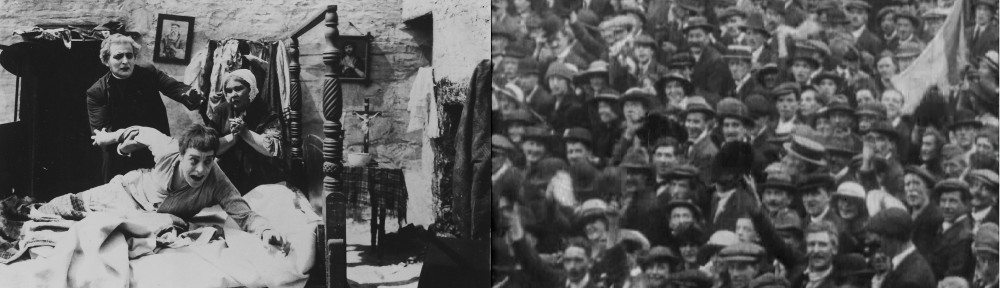
“An Injustice to Good Productions”: Irish Film Distribution, Programme Changes and New Picture Houses in November 1914

The Sign of the Cross.

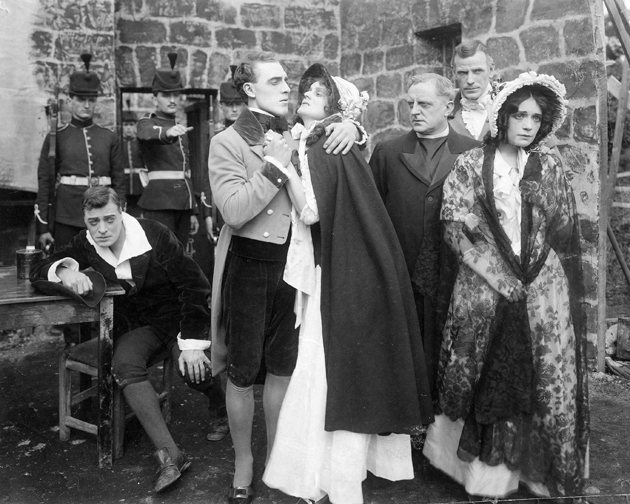
An exclusive film exhibited in Ireland in November 1914: The Sign of the Cross (US: Famous Players, 1914). Image: The Silent Film Still Archive.

The published information on film distribution in Ireland in the 1910s is useful in general, but it lacks the detail to say something about how Irish cinemas acquired films in, say, November 1914 (Condon, Early Irish Cinema, 215-17; Rockett 38-41). However, the trade press, particularly the London-based Bioscope, and the local papers that month give some more specific details. By this time, exhibitors no longer bought films outright, as the – much smaller number of – exhibitors in the 1900s had. Films were rented from distributors or renters, and the distribution business in Ireland and Britain was based in London. The sea crossing was an issue for distributors into Ireland, particularly as military operations changed the priorities on the transport of goods in 1914. However, such issues were more easily negotiated by the film distributors who had offices in Ireland or worked through Irish agents.

Bioscope 6 Aug. 1914: xix.

Ad for Gaumont’s Chrono projector; Bioscope 6 Aug. 1914: xix. This ad appeared just as war was breaking out; even a few weeks later, it would not have been acceptable in the context of discussions of severing links with enemy companies as part of the war effort.

“I dropped up the other day to see Mr. Young of the Gaumont Company, Lord Edward Street, Dublin,” revealed Irish correspondent Paddy in the Bioscope in early November 1914 (Paddy, 5 Nov.). Since opening early in 1913, the luxuriously appointed Dublin branch office of Gaumont in London sold the company’s popular Chrono projector, held trade viewings in a dedicated screenings room of the films it distributed, and shot many local topical films since its first ones in June 1913, such as The Launch of the Britannic and a film of a hurling match between Kilkenny and Cork (13 Nov.). Paddy noted that “Mr. Young seemed pleased with how matters were progressing, and he expressed the opinion that the falling off on account of the war was practically negligible” (5 Nov.). A year earlier, Paddy had found Young’s predecessor also pleased with business, including the fact that “[a] great many more Irish theatres have thrown in their lot with the Gaumont Film Service” (13 Nov.), including the Grand in Dublin’s O’Connell Street (Paddy, 24 Jul.), Limerick’s Gaiety Bijou (7 Aug.), and Belfast’s Princess Picture Palace (“Jottings,” 12 Nov.).

Gaumont did not have Irish distribution to itself. In November 1914, the Ideal Film Renting Company set up their Dublin office at 40 Dawson Street, Dublin. “There is little doubt that by opening in Dublin,” opined Paddy, “The Ideal Company have stimulated competition and made it possible for exhibitors to make a better selection on the spot” (5 Nov.). Among the exclusive films that Ideal handled were Danish production company Nordisk’s For the Sake of a Man (1913) and Her Hour of Temptation (1914), as well as Joan of Arc (Italy: Savoia, 1913), for which “[s]pecial posters are available” (ibid.).

1The Palace, Frances Street, Newtownards whowing Cecil B. DeMille's The Ten Commandments (1923). http://www.newtownards.info/frances-st.htm

The Palace, Frances Street, Newtownards showing Cecil B. DeMille’s The Ten Commandments (1923). http://www.newtownards.info/frances-st.htm

Other London-based distributors relied on travelling salespeople or on the Irish-based companies that acted as their agents. In the week of 5 November, Paddy also “ran into Mr. Hagan, the Scottish and Irish representative for Messrs. Ruffells’ exclusives,” who “had secured bookings running to over £350” (ibid.). Norman Whitten’s General Film Supply (GFS) appears initially to have been a branch of the London-based General Film Agency, and although Whitten was better known as a maker and distributor of his own local topicals, GFS also distributed the films of other companies. Some larger Irish cinema chains, such as James T. Jameson’s Irish Animated Picture Company, had their own buyers in London (Condon, “Limelight,” 253). An “Item of Interest” in the Bioscope on 19 November informed trade readers that the Palace in Newtownards, Co. Down, had appointed Lillah Dawson as its film reviewer: “Miss Dawson has recommended the features booked at this hall during the past few weeks, and as a result the seating accommodation and the cork lino have come in for some severe wear, strong evidence that this lady weighs up a subject in a capable and experienced manner” (“Film Reviewer Appointed”).

Depending on the nature of the programme at the picture house or houses concerned, a representative such as Dawson might have had a more or less arduous job. Something has already been said here about the content of the film programme, particularly in regards to the number and length of the films and the length of the programme itself. The dominant practice in cities and towns was for picture houses to change their programmes twice a week, on Monday and Thursday, with a third change for those picture houses that held a Sunday licence. As a result, most films had a three-day run, with the possibility of holding over an especially attractive film – most likely, an “exclusive” – for the second half of the week, in which case the other items on the programme were usually changed. A run of longer than six days for any film was really exceptional. Shorter runs were possible. In early November 1914, Dublin’s Rotunda advertised the fact that beginning on 9 November, it would have three changes in the week, which for this venue with no Sunday licence meant two-day programmes, with changes on Monday, Wednesday and Friday. “Large audiences,” a preview in the Evening Telegraph predicted, “are sure to appreciate this move on the part of the management, who certainly spare no expense in catering for the entertainment of their patrons” (“Rotunda Pictures”).

“Programmes Changed Daily: An Injustice to Good Productions.” Bioscope 19 Nov 1914: 789.

An extract from a Bioscope article discussing daily programme changes at the Omagh Picture Palace; 19 Nov 1914: 789.

The generosity – if it can be called that – of the Rotunda management was no match for that of the management at the Picture Palace in Omagh, Co. Tyrone, a town with a population of less than 5,000. Just ten days after the Rotunda had instituted its new programming changes,a Bioscope article drew attention to the fact that the Picture Palace changed its programme every day. As the article’s subtitle – “An Injustice to Good Productions” – suggests, the writer of this article – described as “our Ulster representative,” so presumably it was the writer of the “Jottings from Ulster” column – saw this as an unusual and unwelcome development (“Programmes Changed Daily”). Although conceding that “a manager on the spot knows his own business best,” s/he endorsed the arguments of “a very astute Ulster manager, who favours the bi-weekly change” because of the mutually supporting nature of printed and word-of-mouth publicity:

He argues that on a Monday and Tuesday a hall attracts by its publicity matter only those patrons of the movies who are influenced by good pictorials and by well-written and attractively-set letterpress. On the Tuesday and Wednesday, and again on the Friday and Saturday, the advertising ceased to be of any account. Personal recommendation or condemnation takes its place and either does such good as to comfortably fill the hall, whilst the programme runs, or is so hurtful in its effects as to prove the incompetency of the manager in the selecting of such pictures as please the majority of the people of his district. (Ibid.)

1Ads for Omagh Picture Palace showing variations in programming. Tyrone Constitution 30 Oct. 1914: 4 and 6 Nov. 1914: 4.

Ads for Omagh Picture Palace showing variations in programming. Tyrone Constitution 30 Oct. 1914: 4 and 6 Nov. 1914: 4.

The trade anxieties manifest in this advice about the effective rhythms of advertising had little to do with the Picture Palace’s choice of films but more with the number of films required. Driven from Home (1914), Shadows (US: IMP, 1914) and Lost in Mid-Ocean (US: Vitagraph, 1914) “want a lot of beating as star subjects. Why not, therefore give them an opportunity to prove their value?” (ibid.). Indeed, assuming a complete daily change of programme, the Picture Palace would likely have shown between 25 and 50 films a week, depending on their length. This suggests that the management had a very different view than the Bioscope of the nature of the entertainment it provided. The competing interests of film producers and exhibitors were shown in late November 1914, when the Bioscope cited the call by Carl Laemmle, head of the US production company Universal, to “cheaper American theatres to raise their prices of admission [to cover] the growing cost of film production” (“Trade Topics”). The management of the Omagh Picture Palace appears to have paid little attention to the quality of individual films and focused instead on audience choice and creating a constituency of daily cinemagoers.

First ad for Sandford Cinema; Evening Herald 3 Nov. 1914: 4.

First ad for Dublin’s Sandford Cinema; Evening Herald 3 Nov. 1914: 4.

Omagh’s abundance of films seems to parallel a more general return of optimism to the Irish film trade in late 1914, which saw the opening of some new picture houses. “That little thought is here given to the approach of lean days,” “Jottings” observed, “is evident from the fact that a new hall is now in full swing in Lurgan, under the direction of Mr. Hewitt”, as well as from the enlargement of Lisburn’s Electric Palace, and the equipping of new picture houses in Coleraine and Belfast’s Corn Market (5 Nov.). In Dublin, the Sandford Cinema opened on 2 November with little newspaper publicity. The first notice was a brief review in the Evening Herald the following day, alongside reviews of the Kinemacolor pictures at the Theatre Royal, the Phoenix Picture Palace’s screenings of The Sign of the Cross (US: Famous Players, 1914) – the most heavily publicized film in Ireland in late 1914 – and the Masterpiece Picture House. The review did not give the titles of the films that “were so much admired at the opening show,” focusing instead on the decor of the building that “is sumptuously fitted up interiorally, the costly furniture being supplied by Clery and Co., Ltd.” (“New Picture Theatre in Ranelagh”). Paddy later revealed the opening “star films” to have been England’s Menace (Britain: London, 1914) and The Village of Death (19 Nov.). No other newspaper coverage of the Sandford appeared in the first week of November, but in the following week, several papers carried ads for In the Bishop’s Carriage (US: Famous Players, 1913), with Mary Pickford, for the first three days and The Wheels of Destiny (US: Majestic, 1914) for the last three.

Managed by John and P.W. Whittle, the Sandford was “quite a high-class” picture house, “replete with all modern conveniences,” including Gaumont projectors and the “indirect system of lighting” in the auditorium (Paddy, 19 Nov.). Paddy found the building to be “a beautiful structure, with a fine flight of steps leading up to the pay-box. The entrance doors are finished in stained glass,” and inside, there was a “considerable rake to the floor, thus enabling all patrons to have a full view of the screen” (ibid.). Despite this focus on the experience of all cinemagoers, the audience was to be divided based on ticket price both outside and inside the premises. “The building stands on a corner site, thus enabling the 3d. entrance to be distinct from the 6d. and 1s., [and once inside, the] 1s. seats are distinguished from the 6d. by neat squares of crochet work on the backs” (ibid.). The management did not, however, show the same attention to detail in securing the required official documents, and it was prosecuted on 20 November for operating without a cinematograph licence (“Sandford Cinema Theatre”). Nevertheless, Inspector Gray of the Dublin Metropolitan Police testified that the premises were “extremely comfortable and suitable in every way for a picture theatre. The pictures he had seen were excellent” (ibid.).

Elsewhere – and almost everywhere – war films remained popular. When Dublin’s Daily Express reviewed In the Hands of the Kindly Dutch at the Rotunda in early November, it emphasized the personal response many in the audience might have made to topical films about the war. The film “shows the division of the Naval Brigade who were interned in Holland after the surrender of Antwerp , and was so clear that anyone could recognise a relative or friend” (“The Rotunda Pictures”). In the same week, the Kinemacolor matinees at the Theatre Royal were providing colour films of the front. The fact that these films were shown in such a large theatre rather than in one of the smaller picture houses indicates that the management expected considerable interest in them, and it went out of its way to create further publicity. “On the kind invitation of the management,” the Express reported, “a number of wounded soldiers attended the [Kinemacolor war films] yesterday, and received quite an ovation from the large audience. Others who were unable to attend will be present this afternoon” (“Theatre Royal”).

Evening Telegraph 28 Nov. 1914: 6.

Evening Telegraph 28 Nov. 1914: 6.

Although the Express observed that “[t]he audience yesterday was unreservedly enthusiastic concerning the display” of war pictures at the matinee, certain members of the audience at the Theatre Royal were neither enthusiastic nor reserved about patriotic displays at the theatre’s live evening show (“Picture Matinees”). On 2 November, a group of young men wearing republican badges protested by booing, hissing and groaning when, during one musical number, several Union Jack flags were unfurled and the orchestra played “Rule Britannia.” When 18-year-old Thomas Smart refused to stop, he was arrested and fined 40 shillings in court (“Scene in Theatre Royal”).
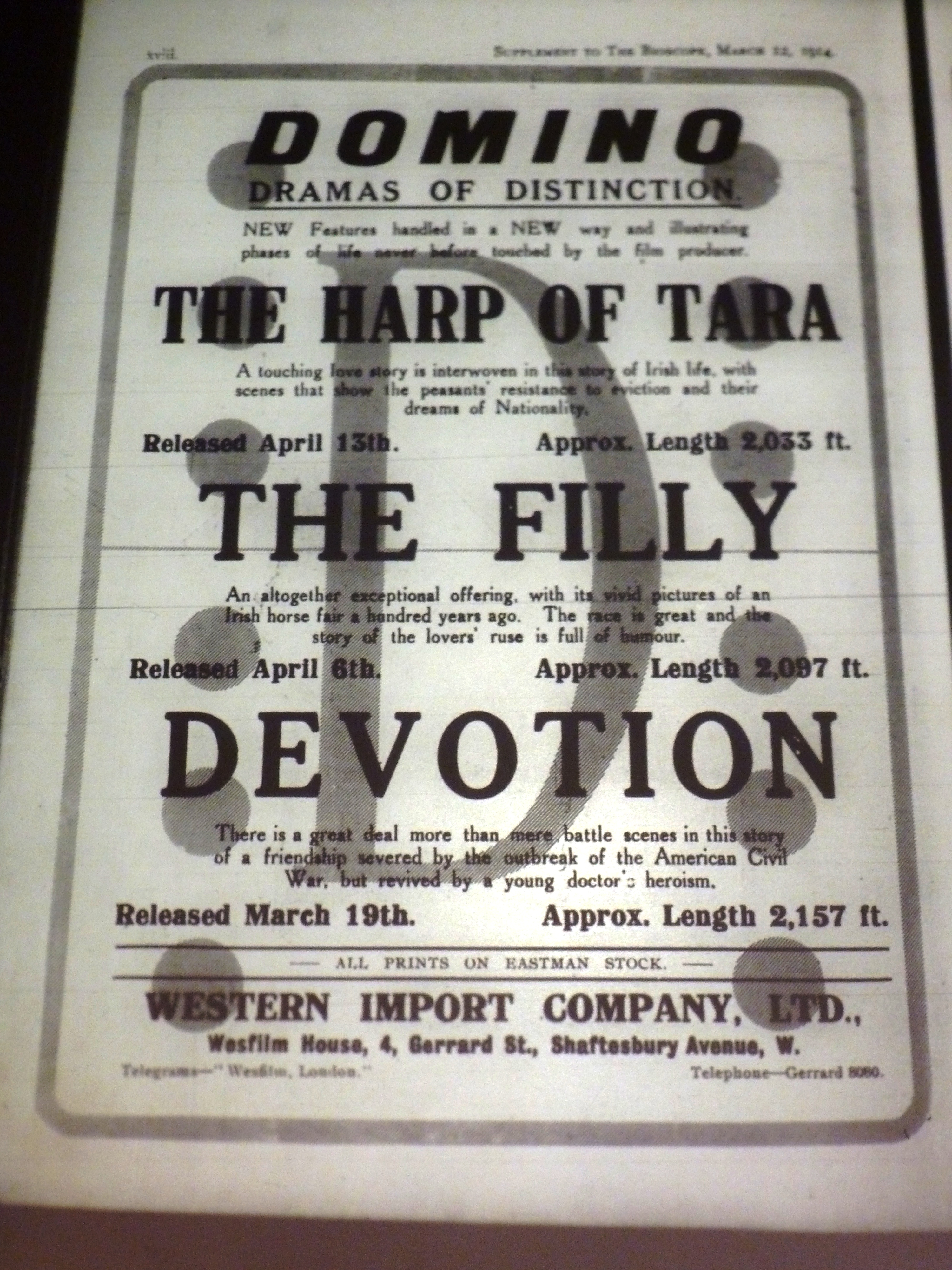
Ad for two Irish-themed films from the US production company Domino; Bioscope 12 Mar. 1914: xviii.

Ad for two Irish-themed films from the US production company Domino; Bioscope 12 Mar. 1914: xviii.

Smart and his fellow protestors might have been more appreciative of the Irish week run by the Masterpiece at the end of November. The main film was True Irish Hearts (US: Domino, 1914), supported by The Filly (US: Domino, 1913), Rory O’More (US: Kalem, 1911), The O’Neill (US: Kalem, 1912), films of Irish scenic landscapes and a topical of the Castlebellingham Feis and Louth Volunteers. During the previous week, manager Cathal McGarvey “had appeared personally at each performance during the week in his original humorous monologues, and these met with a great reception, there being no better humorous reciter in Dublin than Mr. McGarvey” (Paddy, 19 Nov.). For the Masterpiece’s Irish Week, however, McGarvey allowed popular baritone W.A. Sheehan to enhance the live musical accompaniment by singing Irish songs (“An Irish Week”). These kinds of Irish Weeks were not new, but they were facilitated by the fact that such producers as Domino and Kalem were continuing to make Irish subjects. The Domino titles were new ones, available through Western Import since March and April 1914, but the Kalem ones were older titles that required that a distributor – in this case, the Express Film Service – hold on to them for such events.

References

Condon, Denis. Early Irish Cinema, 1895-1921. Dublin: Irish Academic, 2008.

—. “Limelight on the Colleen Bawn: Resisting Autoexoticism in Provincial Irish Picture Houses in the Early 1910s.” Les cinémas périphériques dans la période des premiers temps. Peripheral Early Cinema: Domitor 2008. Perpignan: PU Perpignan, 2010. 245-255.

“Dublin and District: Ranelagh’s New Picture House.” Irish Independent 10 Nov, 1914: 4.

“Film Reviewer Appointed.” Bioscope 19 Nov. 1914: 706.

“An Irish Week at the Masterpiece.” Evening Telegraph 28 Nov. 1914: 6.

“Jottings from Ulster.” Bioscope 13 Nov. 1913: 589; 5 Nov. 1914: 543; 12 Nov. 1914: 647.

“New Picture Theatre in Ranelagh.” Evening Herald 3 Nov. 1914: 4.

Paddy. “Pictures in Ireland.” Bioscope 24 Jul. 1913: 267; 7 Aug. 1913: 413; 13 Nov. 1913: 601; 5 Nov. 1914: 525; 19 Nov. 1914: 736.

“Picture Matinees at the Theatre Royal.” Daily Express 3 Nov. 1914: 8.

“Programmes Changed Daily: An Injustice to Good Productions.” Bioscope 19 Nov 1914: 789.

Rockett, Kevin and Emer. Film Exhibition and Distribution in Ireland, 1909-2010. Dublin Four Courts, 2011.

“The Rotunda Pictures.” Daily Express 3 Nov. 1914, 2.

“Rotunda Pictures.” Evening Telegraph 7 Nov. 1914: 6.

“Scene in Theatre Royal: A Row in the Gallery.” Daily Express 4 Nov. 4 1914: 3.

“Sandford Cinema Theatre.” Evening Telegraph 21 Nov. 1914: 4.

“Trade Topics.” Bioscope 26 Nov. 1914: 821.
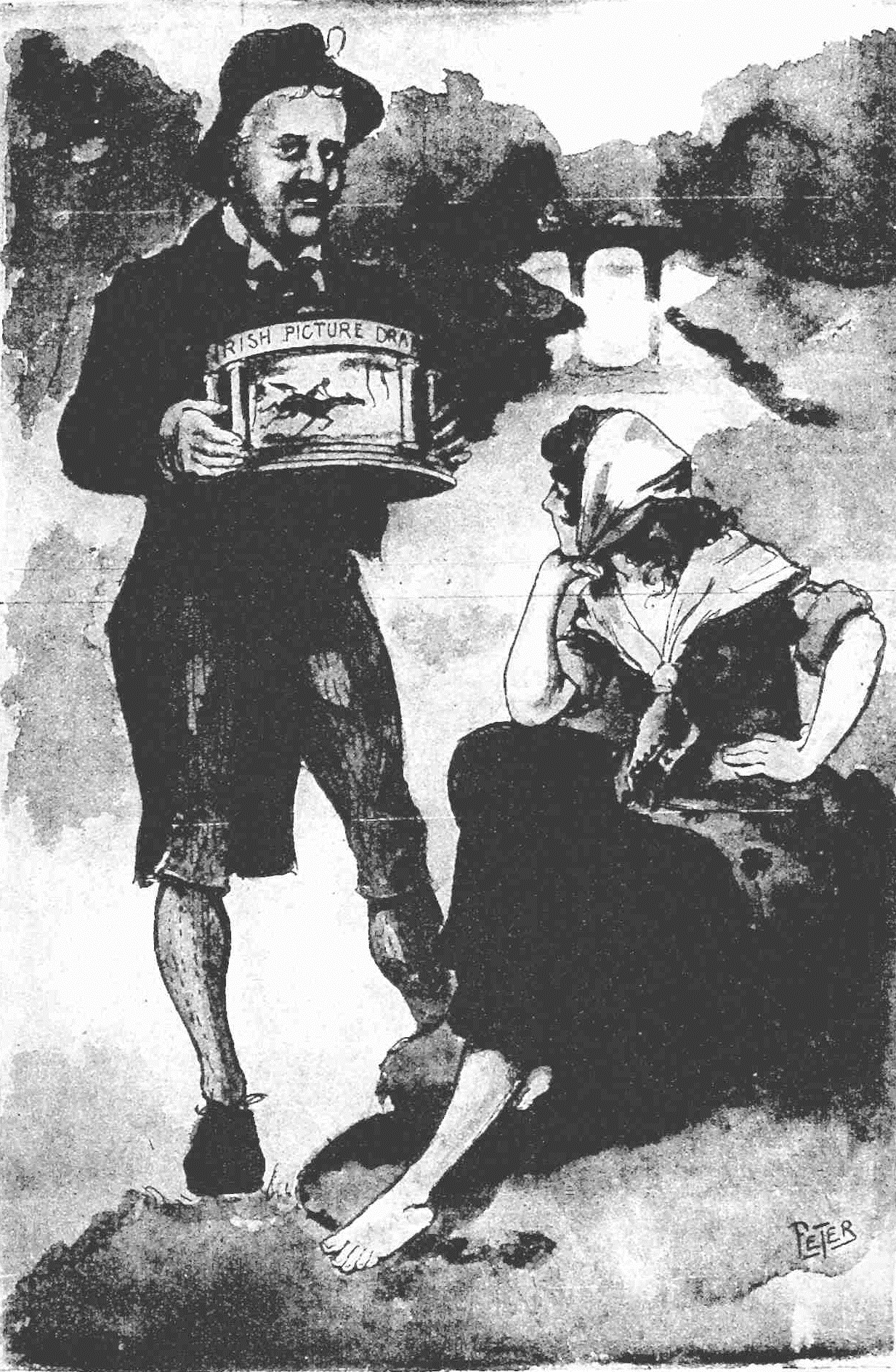
A Happy and Appropriate Synchronism: Passion Films at Easter 1914

The release of Darren Aronofsky’s Noah (US: Paramount/Regency/Protozoa/Disruption, 2014) on cinema screens around the world in the run up to Easter 2014 is a distribution strategy at least a century old. “As a Passion Play,” wrote a reviewer  in Dublin’s Evening Telegraph of the latest release at the Rotunda’s in early April 1914, “‘The Messiah’ holds one with its intense impressiveness and pathos, and its exhibition just at this holy season is a happy and appropriate synchronism” (“‘The Messiah’ at the Round Room Rotunda”). This synchronism – or well-established distribution and exhibition strategy – was familiar to cinemagoers of the 1910s who would have seen the practice of releasing biblically based films for this religious festival as entirely unremarkable. In fact, this practice reproduced in a new medium the centuries-old Christian tradition of performing passion plays at Easter. Filmic passion plays were among the first moving pictures (Cosandey passim), and they were so popular that The Messiah shown in Dublin in April 1914 was the 1913 remake (dir. Maurice-André Maître) by French company Pathé of its La vie et la passion de Notre Seigneur Jésus-Christ, which the company had first produced in 1903 and again in 1907 (Abel 319-20). And this was just the output of one – albeit large – production company.

Jameson

Rotunda manager James T. Jameson as he appeared in a caricature in the Bioscope in November 1911.

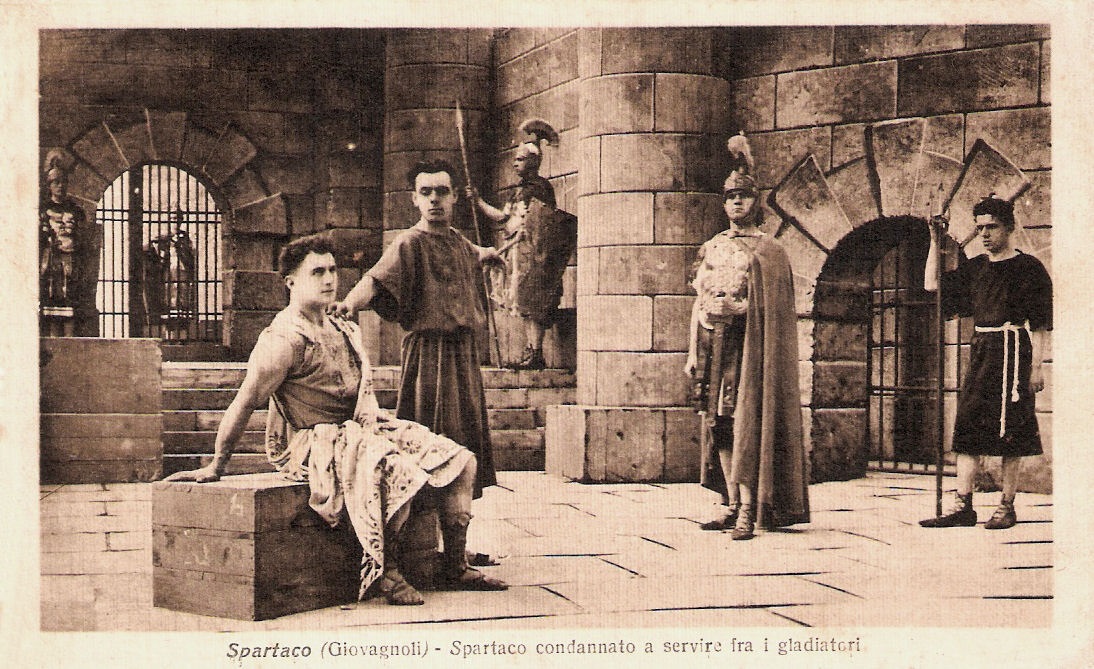
Easter Monday fell on 13 April 1914, but James T. Jameson, director of the Irish Animated Picture Company, and his son, Ernest, who managed the Rotunda, had begun the run up to Easter much earlier. In early March, Jameson senior had secured the Irish rights to two long “exclusives”: The Messiah and Spartacus, or the Revolt of the Gladiators (Italy: Pasquali, 1913) (“Items of Interest”). In its review of Spartacus at the Rotunda in the week beginning 23 March, the Dublin Evening Mail compared it to Quo Vadis? (Italy: Cines, 1912), the Italian epic that had been the biggest hit of 1913 and that had been available to Dublin audiences as lately as 2-7 March at the Camden Picture House (“Rotunda Pictures”). However, The Messiah was a more important film for the Rotunda than Spartacus. For one thing, it was longer; Spartacus shared its bill with the comedies The Awakening at Snakesville (US: Essanay, 1914) and When Cupid Takes in Washing (US: Lubin, 1914), but The Messiah was the only thing on the Rotunda’s programme for the two weeks beginning Monday, 30 March. As well as this, because it depicted the life of Christ, The Messiah had the potential to be as controversial as From the Manger to the Cross (US: Kalem 1913) had been the previous year. The superiority of The Messiah was emphasized by the Evening Telegraph, which urged “any person who witnessed “From Manger to Cross to pay a visit to the Rotunda and see what a drastic and extraordinary difference can be introduced in the treatment of the same subject, and more especially the grandeur of its colouring” (“‘The Messiah’ at the Round Room Rotunda”).

The Messiah was certainly a success at the Rotunda. Quoting figures supplied by the Rotunda management, the Telegraph revealed that by the Saturday of the first week of its run, it had been seen by over 22,000 people, “including a considerable proportion of the clergy of every denomination, and there have been nothing but the highest eulogies expressed by everybody who had the pleasure of seeing this marvellous production” (ibid). Paddy, the Irish correspondent of the British trade paper Bioscope, speculated that the audience for the full two-week run would number 50,000, commenting that the film “easily surpassed anything of the kind ever seen in Dublin, and the special music, so brilliantly rendered by Miss May Murphy’s Irish Ladies’ orchestra, added to the reverent screening of this great film” (Paddy). Although Jameson offered a new bill from Easter Monday featuring Christopher Columbus (US: Selig, 1912) and a film of the Grand National Steeplechase, he brought back – purportedly due to popular demand – The Messiah by the end of that week for selected matinees and early evening shows until Friday, 24 April.

This success of the passion films and such Italian historical epics as Quo Vadis? and Spartacus points to the existence of types of quality filmmaking based on high-cultural criteria. The Rotunda had long pursued a middle-class audience by promoting its film shows as both educative and entertaining, but Jameson had usually favoured programmes of shorter films – and some live variety acts – rather than a single long film. A review of the Rotunda in early March had stressed cinema’s multiple attractions:

The elaborate production of cinematograph films shows how much this form of entertainment has grown in public favour. Unlike skating rinks, living pictures seem to have come to stay. They supply an easy means of transporting oneself for a time from the uneventful round of daily life. Sitting in a comfortable seat, the spectator can in a moment travel from China to Peru, from the waste of the open sea to the sun-bathed mart of some Eastern town; he can witness fire and flood and return safely to a good supper by his civilized fireside (“Irish Animated Picture Company”).

The Rotunda had aimed to provide such a variety of attractions with multiple films in its two-hour shows, but the Italian epics could provide a range of spectacles in one film, as well as a patina of high-cultural value associated with classical education. As adaptations of literary works, Quo Vadis? – from Henryk Sienkiewicz’s novel – and The Last Days of Pompeii (Gli ultimi giorni di Pompeii; Italy: Ambrosio, 1913) – promoted as Lord Lytton’s great work” when it played at the Camden Street Picture House in the week beginning 20 April (“Camden Street Pictures”) – could benefit from recognition by middle-class audiences, as well as bestowing cultural prestige on the film and the picture house at which it was shown. Among other significant literary adaptations on exhibition in Ireland at Easter 1914 was Cines’ Antony and Cleopatra (Italy, 1913), a story that prospective spectators at the Opera House in Derry were informed “has been variously dealt with by many famous writers, including the immortal Shakespeare” (“Easter Amusements”).

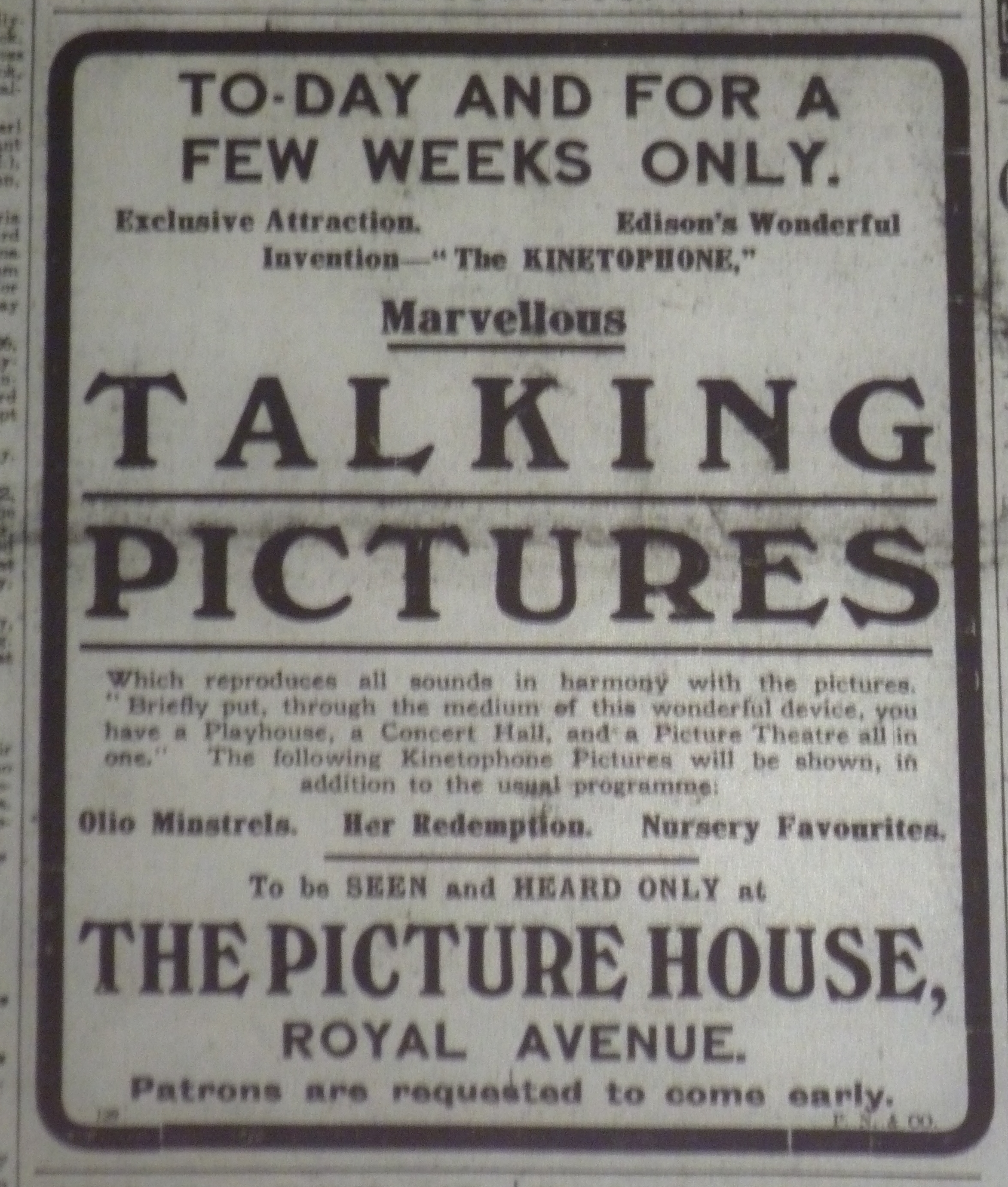
Edison Talking Pictures at the Picture House, Royal Avenue, Belfast. Belfast Newsletter 3 Apr. 1914: 1.

Edison Talking Pictures at the Picture House, Royal Avenue, Belfast. Belfast Newsletter 3 Apr. 1914: 1.

The extent to which a shared or imposed set of cultural values deriving from literary culture, classical education and Christian doctrine was the source of the popularity of The Messiah or the Italian epics is difficult to say definitively without some discussion of how images of these circulated more widely (Uricchio and Pearson). Certainly, the promotion of such films as respectable by the trade press, newspapers and other forms of picture-house promotion did not prevent other cultural forces from continuing to attempt to impose their own control on cinema and its audiences. 

Easter 1914 seemed to be a particularly auspicious time for Irish nationalists. This point was well expressed in the nationalist Evening Telegraph, in which an editorial observed that

this will be the last Easter before Home Rule becomes the law, for the Home Rule Bill will reach the Statute Book in the course, probably, of the next five or six weeks. It is well that Easter should herald the coming of Ireland’s resurrection, for in the Christian sense it symbolises the Resurrection (“Easter”).

Christianity here meant the Catholicism of the Telegraph’s readership and of the majority of Dublin Corporation’s dominant nationalist faction. With Home Rule apparently imminent, more militant forces within the church were determined that cultural policy reflect a Catholic ethos, regardless of how this might affect the business interests of certain Catholic nationalist councillors.

Lord Mayor Lorcan Sherlock came under criticism from Catholic church-based groups in early March when he showed reluctance to introduce local censorship of films – the Corporation “are satisfied, as indeed are so many other civic bodies, with the verdict of the Board of Trade Censor” – or close picture houses on Sundays – “‘They have been,’ he said, ‘patronised to an extraordinary extent on Sunday by the working people of the city’” (“Picture Theatres: Conditions of Licensing”). Responding in a letter to the Telegraph, William Larkin, who had recently been praised rather than fined by a magistrate for protesting loudly during a theatre show, wondered whether or not the general public were “to be left at the mercy of the Corporation in the matter of taste in living pictures” whose “educational value […] in Dublin at present are nil” (“Sunday Pictures: For Working People”). He left no doubt that lay Catholic organizations would not let the matter rest:

Does his lordship know that the United Sodalities of Dublin (male and female) are out for reform of the picture theatres? Does his lordship know that the United Confraternities of the city are out for the same object? And does he also know that the Theatre Reform League of Dublin (which will later embrace all of Ireland) are on the watch against the class of production that has flooded our capital for some time now? (ibid).

Although Larkin and those named lay organizations would lead the campaign, priests and bishops lent the support of the hierarchy. A letter from a Father Gleeson calling for “an Irish National Censor, who understands the hearts and minds of the Irish people” accompanied Larkin’s  (“Letter from Father Gleeson”). In April, the Lord Mayor “stated that Archbishop Walsh was not in favour of closing picture houses on Sunday, but he thought that a limit should be placed in the hours of opening so that there would be no interference with the freedom of persons to attend divine worship.” Under pressure from both inside and outside the Corporation, Sherlock “was writing to Archbishop Walsh asking him whether he would take upon himself the responsibility of suggesting what type of censorship should be put into operation” (“Picture Theatres: The Archbishop’s Views”).

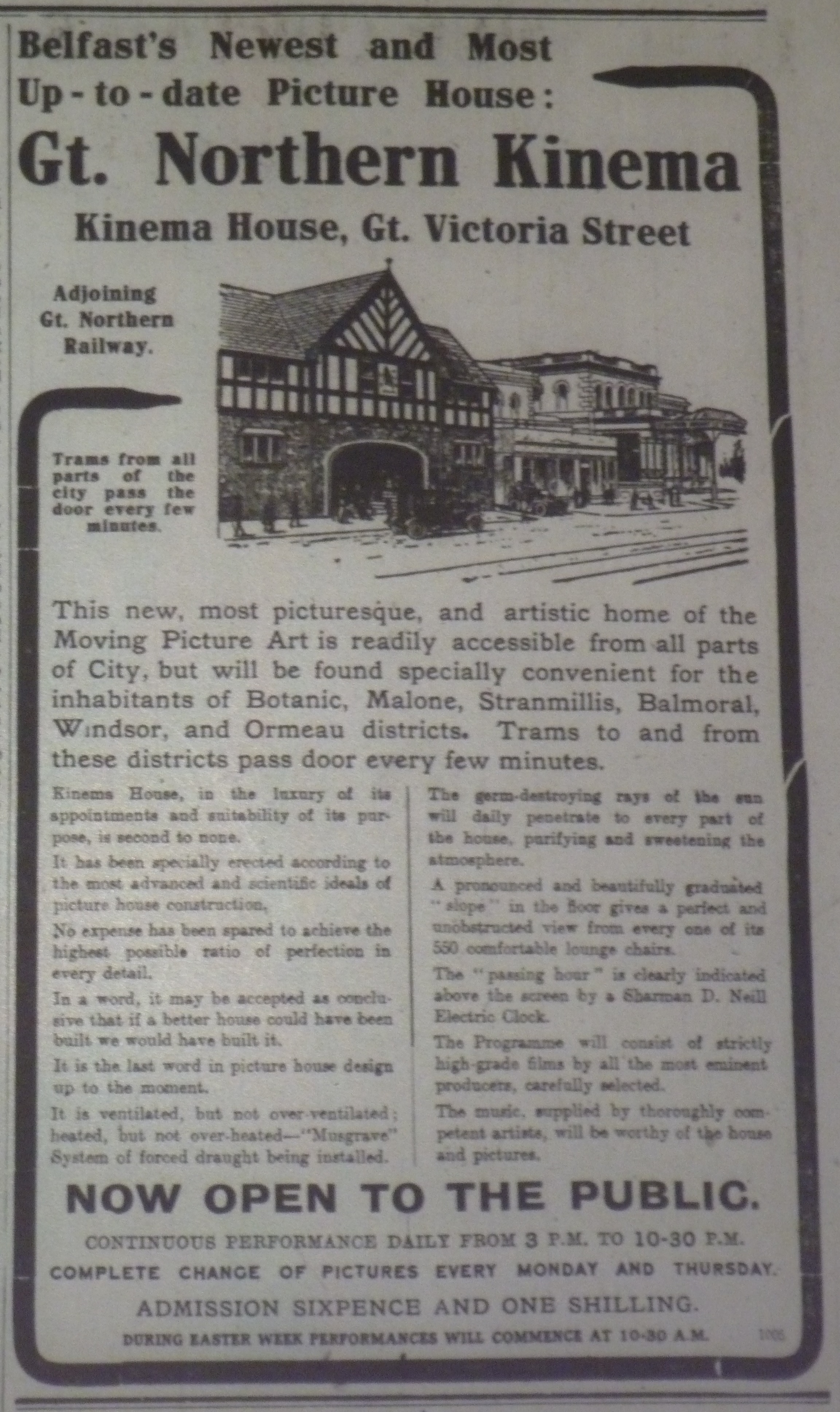
Belfast Newsletter 9 Apr 1914: 9.

Ad for the newly opened Great Northern Kinema in Belfast Newsletter 9 Apr. 1914: 9.

Larkin ended his letter on Dublin picture houses with some architectural criticism by remarking that “the building themselves are not even decent looking” (“Sunday Pictures: For Working People”), but Easter for Belfast’s picture houses was notable for its openings of distinct contributions to the city’s streetscape. The latest addition to Belfast’s substantial tally of picture houses was the Great Northern Kinema in Gt. Victoria Street, which opened in the first week of April, a little over a week after the 23 March opening of the Crumlin Picture House on the Crumlin Road. The Kinema, “[t]his new, most picturesque , and artistic home of the Moving Picture Art,” was located beside the Gt. Northern railway station, as well as on some of the city’s major tram lines (“Belfast’s Newest and Most Up–to-date Picture House”). No single film seemed to dominate the picture house programmes over the holiday period in the same way as The Messiah did in Dublin. At the “luxurious and attractive” Kinema, “[t]he star film during the early part of the current week is a two-reel drama entitled ‘Silent Heroes’” (US: Broncho, 1913) (“Kinema House”). The city’s most highly publicized cinema offerings were Edison’s Talking Pictures at the Picture House, Royal Avenue, where they were joined in the week beginning Easter Monday by a programme that included Selig’s Christopher Columbus. The different relationship between the churches and cinema is suggested by the fact that several of the Protestant halls – the CPA Assembly Hall, the Grosvenor Hall, the City YMCA and the People’s Hall – offered not only their usual Saturday cinematograph shows but also special film shows on Easter Monday and Tuesday.

References 

Abel, Richard. The Ciné Goes to Town: French Cinema, 1896-1914. Berkeley: U of Califronia P, 1994.

“Belfast’s Newest and Most Up–to-date Picture House.” [Ad.] Belfast Newsletter 9 Apr. 1914: 9.

“Camden Street Pictures.” Evening Telegraph 21 Apr. 1914: 6.

Cosandey, Roland, André Gaudreault and Tom Gunning, eds. An Invention of the Devil? Religion and Early Cinema. Sainte-Foy and Lausanne: Éditions Payot/Laval UP, 1992.

“Easter.” Evening Telegraph 11 Apr. 1914: 4.

“Easter Amusements.” Derry Journal 13 Apr. 1914: 8.

“Irish Animated Picture Company.” Irish Times 10 Mar. 1914: 5.

“Items of Interest.” Bioscope 12 Mar. 1914: 1109.

“Kinema House.” Belfast Newsletter 14 Apr. 1914: 9.

“Letter from Father Gleeson.” Evening Telegraph 11 Mar. 1914: 5.

“‘The Messiah’ at the Round Room Rotunda.” Evening Telegraph 4 Apr. 1914; 7.

Paddy. “Pictures in Ireland.” Bioscope16 Apr. 1914: 313.

“Picture Theatres: Conditions of Licensing.” Evening Telegraph 10 Mar. 1914: 3.

“Picture Theatres: The Archbishop’s Views.” Evening Telegraph 20 Apr. 1914: 3.

“Rotunda Pictures.” Dublin Evening Mail 24 Mar. 1914.

“Sunday Pictures: For Working People.” Evening Telegraph 11 Mar. 1914: 5.

Uricchio, William and Roberta E. Pearson. Reframing Culture: The Case of the Vitagraph Quality Films. Princeton: Princeton UP, 1993.

Marching for Saint Patrick and for Carson

At a meeting of the Portadown Technical Committee on Thursday, 12 March 1914, Technical School principal J. G. Edwards reported that certain pupils attributed their poor attendance to “the picture house” and “drilling” (“Technical School Drilling”). Like the nationalist boys who had objected to the British Army Film in Dublin the previous week – although opposed to them politically – the unionist boys of Portadown were culturally and politically active, participating in the Ulster Volunteer Force’s (UVF’s) increasingly visible campaign of opposition to Home Rule. For a significant number of young Irish men of different political convictions in 1914, the cinema and marching formed part of the texture of their lives.

Putlicity still for The Shaughraun from Irish Film Archive (http://irishamerica.com/2011/12/blazing-the-trail-to-ireland/22-the-shaughraun-publicity-still/).

Publicity still for The Shaughraun from the Irish Film Archive (http://irishamerica.com/2011/12/blazing-the-trail-to-ireland/22-the-shaughraun-publicity-still/).

Despite the polarization of Irish politics by the growing Home Rule crisis in March 1914, the celebration of St. Patrick’s Day in the country’s cinemas appears to have been surprisingly uncontroversial. Several cinemas in the largest population centres of Dublin, Belfast and Cork chose Irish-themed films, with Irish-shot films – especially those of the Kalem company – being particularly favoured. Indeed, it would be decades before so many recently produced Irish-shot film would be available to celebrate St. Patrick’s Day. For St. Patrick’s night only, Dublin’s Phoenix Picture Palace showed The Shaughraun (US: Kalem, 1912); the Clonard Picture House in Belfast’s Fall’s Road offered the same film but for the more usual three-day run beginning on 19 March. In Cork, the Coliseum exhibited Kalem’s The Kerry Gow (1912). The Cork Constitution‘s review of the latter appears to come from a non-Irish source as it explained that “The Kerry Gow (a blacksmith) is a splendid Irish production, which was acted in the Green Isle, and features Jack Clarke and Gene Gauntier, with a full company of ‘flicker’ artists of repute” (“The Coliseum”).

Evening Telegraph 16 Mar. 1914: 4.

Evening Telegraph 16 Mar. 1914: 4.

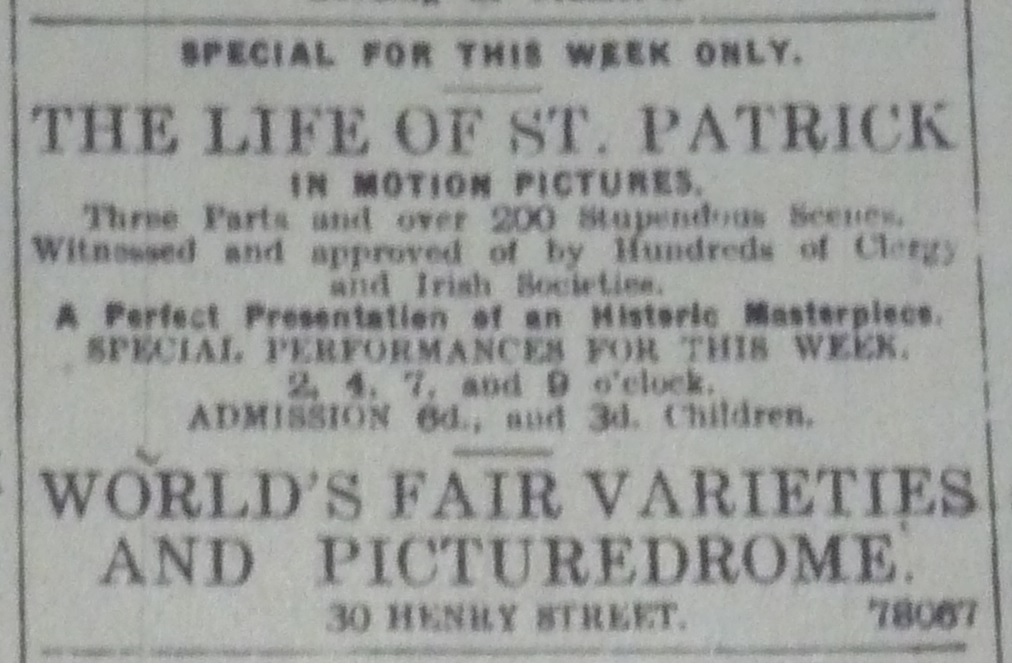
Of even more direct relevance to the feast day of the Irish patron saint was J. Theobald Walsh’s Life of Saint Patrick: from the Cradle to the Grave (US: Photo-Historic, 1912). This film was shown in Patrick’s Week at Dublin’s World’s Fair Varieties in Henry Street. This was not the first time the World’s Fair had shown the film; the venue began 1914 with an extended run of it. It was “over 3,000 feet long [and] was produced by Theobald Walsh, for the Photo-Historic Company, New York, on the actual spots made memorable by Ireland’s Apostle. It is enacted throughout by Irish peasants attired in the correct costumes of that period” (“World’s Fair Varieties”). It was, one reviewer commented, a “splendid picture, and most appropriate for the time of year it is.” Indeed, “it is, undoubtedly, a most masterly film” (“’Life of St. Patrick’”).

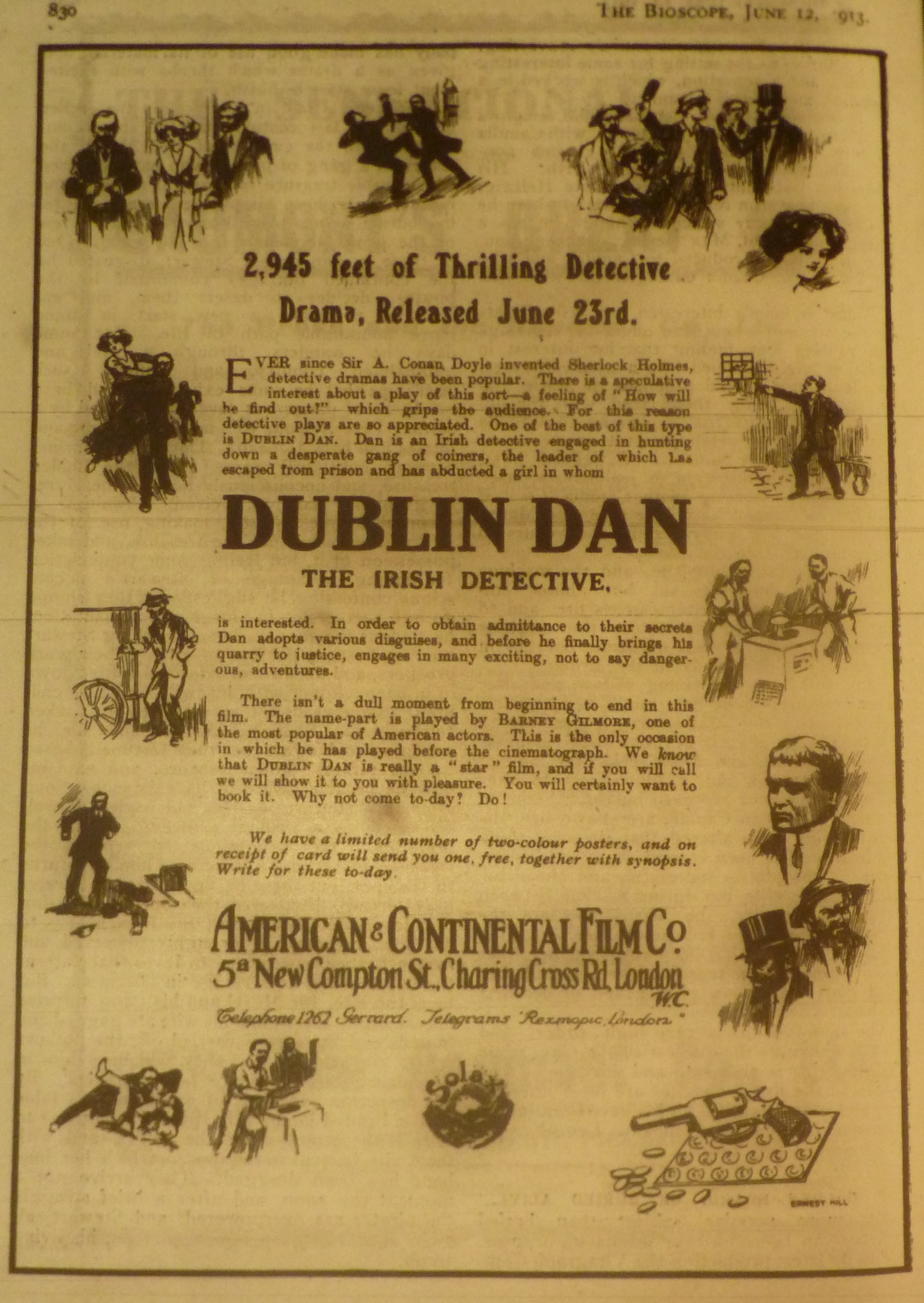
Bioscope ad for Solax's Dublin Dan (12 Jun. 1913: 830).

Bioscope ad for Solax’s Dublin Dan (12 Jun. 1913: 830).

Elsewhere, Irish-set (but not -shot) films or those featuring Irish characters that – like the Kalem films and The Life of Saint Patrick – had been released in the previous year or so were revived for the occasion. For the first part of Patrick’s week, the Clonard showed The Banshee (US: Kay-Bee, 1913), a “splendid two-part drama” to whose representations of the Irish the Ancient Order of Hibernians had objected when it had been shown in Tralee, Co, Kerry, in early February 1914 (Condon). Other titles were more Irish-American than Irish. As part of its special Sunday programme on 15 March, the Phoenix showed Solax’s Dublin Dan: The Irish Detective (1912), which starred popular stage actor Barney Gilmore in his first film. In an ad for the film in a US trade journal, Solax described Gilmore as the “popular American and Irish idol – the matinee girl’s pet – the favorite of millions, an actor known in every state in the Union – a veteran on the stage – although young in years, with a personality that ‘comes across’” (Solax 729). Although The Escape of Jim Dolan (US: Selig Polyscope, 1913) contained a temptingly Irish-named protagonist, this Tom Mix Western at the Picture House in Dublin’s Sackville/O’Connell Street for the three days including St. Patrick’s Day appears to have had no meaningful Irish or Irish-American theme beyond that name.

Image

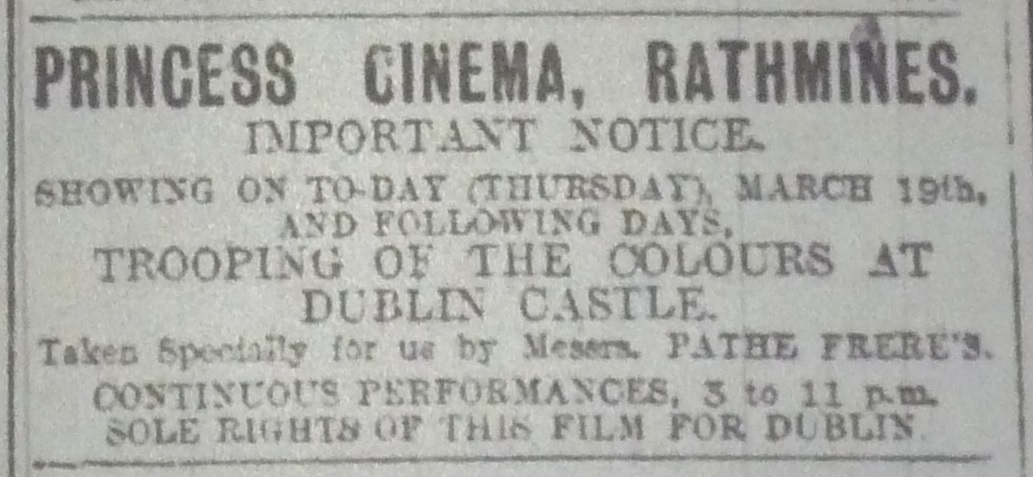
Dublin Evening Mail 18 Mar. 1914: 2.

Two films of actual sporting and political events in Ireland were also popular. On Monday, 16 March, films of two international football matches that took place in Belfast the previous weekend were exhibited at several picture houses, including the West Belfast Picture Theatre on the Falls Road – which showed the soccer match at Windsor Park between Ireland and Scotland – and the Picture House, Sackville/O’Connell Street – which showed the Ireland v. Wales rugby match at the Balmoral show grounds. On 19 March, the Princess Cinema in the Dublin suburb of Rathmines was the first in the city to show the film “Trooping the Colours” that had been shot by Pathé at Dublin Castle on St. Patrick’s Day. A military display overseen by the Lord Lieutenant in the presence of invited dignitaries, this film offered moving-picture evidence of a phenomenon that had long been clear in other media: that St. Patrick’s Day was an established part of the official culture of British-ruled Ireland.

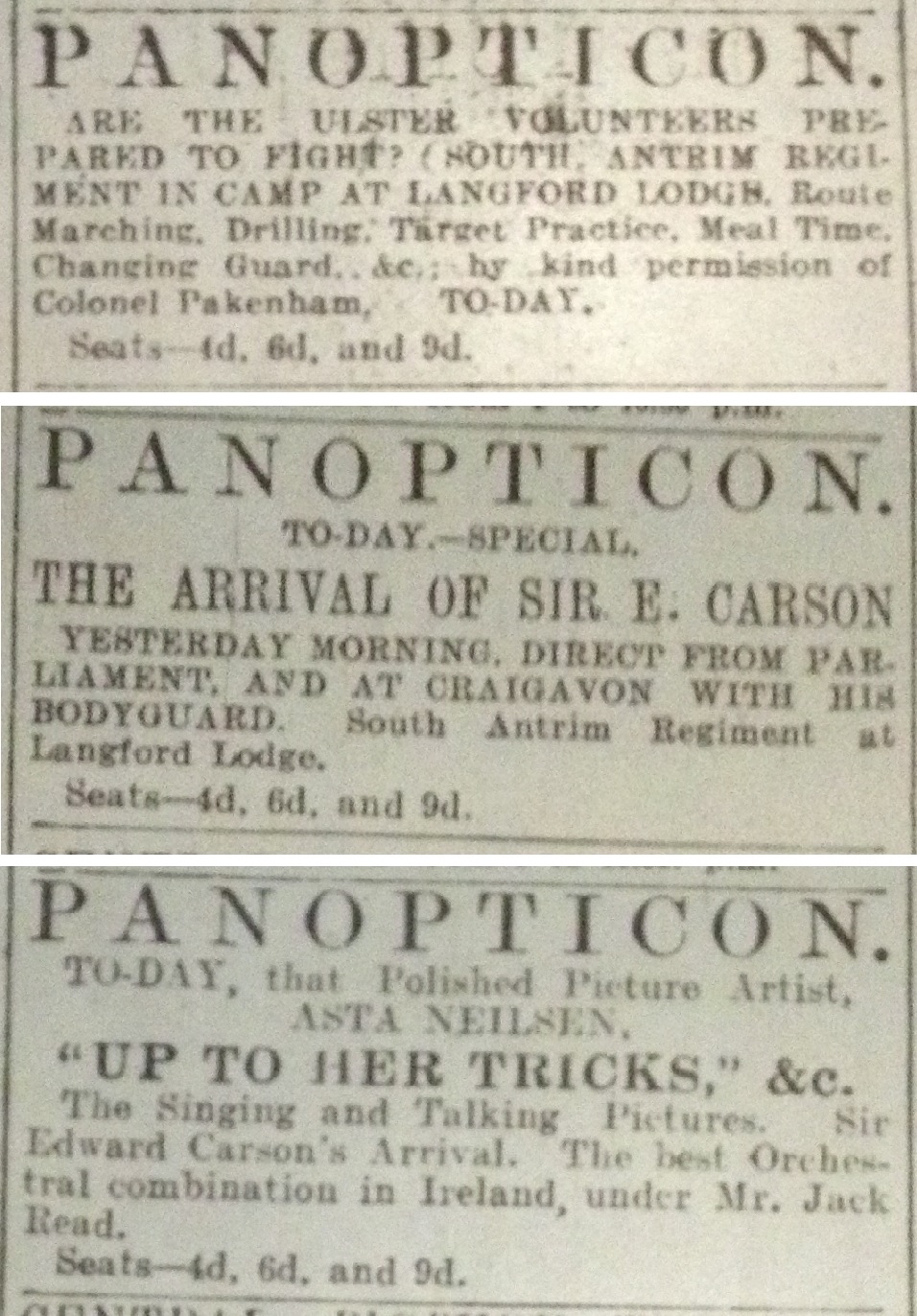
Ads for the Panopticon on 19, 21 and 24 Mar. 1914.

Ads for Belfast’s Panopticon on 19, 21 and 23 Mar. 1914.

Actuality films shown in Belfast presented a very different view of Ireland in 1914. As debates on special terms for the exclusions of parts of Ulster from a home-ruled Ireland continued at Westminster, the Panopticon in High Street topped its bills in the second half of Patrick’s week with films that showed the determination of unionist resistance. An actuality of the South Antrim brigade of the UVF was screened from 19 March in answer to the question posed by newspaper ads for the show: Are the Ulster Volunteers Prepared to Fight? This question had gained increased currency that day, when Edward Carson abruptly left Westminster in the face of insufficient concessions for Ulster, stating his intention of confronting what would come with his people. On Saturday, the South Antrim brigade film was joined on the Panopticon bill by The Arrival of Sir E. Carson, a film that was retained into the following week, although the new programme was headed by Asta Nielsen’s Up to Her Tricks (Engelein; Germany: Projections-AG Union, 1914). By then the political crisis in Ireland had worsened with the beginning of the Curragh Mutiny, the declaration by British Army officers in Ireland that they would not move against the UVF.

Belfast Telegraph 9 Mar. 1914: 5 and 6 Mar. 1914: 2.

The value of crowdsourcing the news: Belfast Evening Telegraph 9 Mar. 1914: 5 and 6 Mar. 1914: 2.

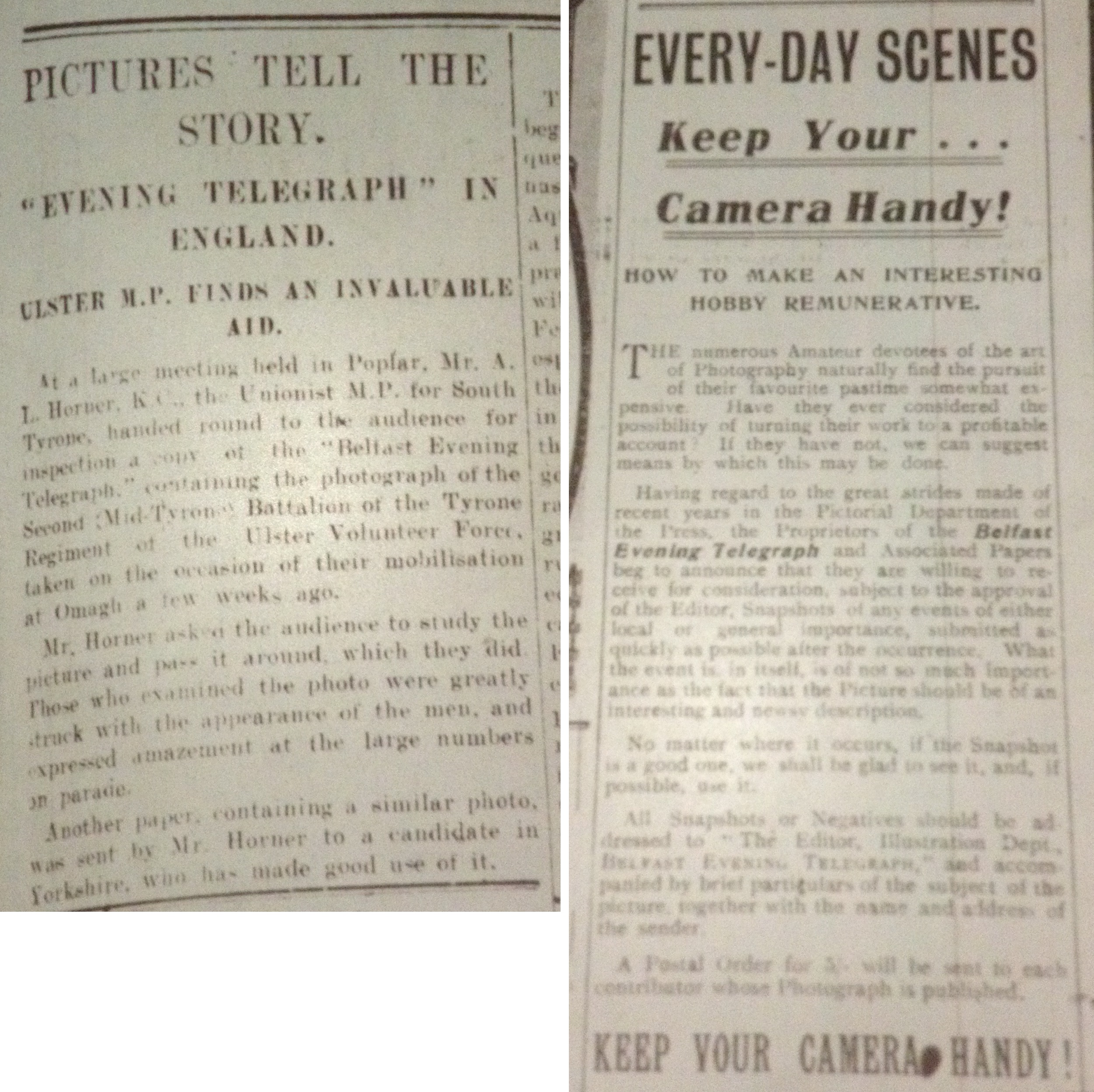
How important the films at the Panopticon were in propagating resistance to Home Rule is difficult to say, but the value of still images to the campaign is clear from the Belfast Evening Telegraph. In early 1914, the Telegraph had been encouraging the amateur photographers among its readers to send in photos of newsworthy events for possible publication. The paper carried a large number of professionally produced photographs, drawings and illustrated ads, and this crowdsourcing of photographs enhanced what was already probably Ireland’s most visually rich newspaper. The usefulness of such images to unionism was made explicit by the 9 March article “Pictures Tell the Story,” which relates how at a meeting in London, Unionist MP Andrew L. Horner distributed a Telegraph photo of a UVF battalion that amazed the audience with the numbers on parade. The method of dissemination here was crude but effective and repeatable: “Mr. Horner asked the audience to study the picture and pass it around, which they did […] Another paper, containing a similar photo, was sent by Mr. Horner to a candidate in Yorkshire, who has made good use of it” (“Pictures Tell the Story”). In this context, the usefulness of moving pictures in showing sympathetic audiences in Britain the extent of unionist opposition to Home Rule seems obvious, but a system of distribution that allowed the correct contextualizing of the films was required.

By June 1914, the full value of moving images of Ulster resistance would be realized when the Union Defence League fitted out four large vans with projectors, screens and films of Carson and the UVF to tour Britain spreading the message of opposition to Home Rule (Paddy, 18 Jun.). Already by March 1914, however, young supporters of the UVF were finding their drilling and cinema-going converging. 

References

“The Coliseum: A Strong Programme.” Cork Constitution 17 Mar. 1914: 6.

Condon, Denis. “Limelight on the Colleen Bawn: Resisting Autoexoticism in Provincial Irish Picture Houses in the Early 1910s.” Les cinémas périphériques dans la période des premiers temps. Peripheral Early Cinema: Domitor 2008. Presses Universitaires de Perpignan, pp. 245-255.

“’Life of St. Patrick.’” Evening Telegraph 17 Mar. 1914: 2

Paddy. “Pictures in Ireland.” Bioscope 18 Jun. 1914: 1261.

“Pictures Tell the Story.” Belfast Evening Telegraph 9 Mar. 1914: 5.

“Princess Cinema, Rathmines.” Dublin Evening Mail 18 Mar. 1914: 2.

Solax. Ad for Dublin Dan. Moving Picture World 10 Aug. 1912: 729.

“Technical Students Drilling.” Weekly Irish Times 14 Mar. 1914: 6.

“World’s Fair Varieties: Life of St. Patrick.” Dublin Evening Mail 16 Mar. 1914: 4.

“The Wonder-Seeking Mind of the Peasant”

By October 1913, picture houses had begun to be a permanent presence not only in such Irish cities as Dublin, Belfast and Cork but also in towns with even as few as 5,000 inhabitants. In such places, the film show would be the first professionally produced mass entertainment available on a long-term basis. However, many towns still relied on travelling companies to bring professional entertainment of any kind, including film shows. Clearly, population was not the only factor, but it was very likely in 1913 that a town with 10,000 people or more would have had at least one permanent picture house, but only some towns of around 5,000 had a dedicated film venue, and most of the latter were likely to be served by travelling picture or picture-and-variety shows. However, market towns of 5,000 might have a dedicated picture house if they also had a good train service and a local person or persons with access to capital who saw the opportunities being exploited successfully elsewhere.

In early October 1913, Paddy, the Irish correspondent for the British trade journal Bioscope reported on a film-and-variety show by Clarence Bailey in Ballina, Co. Mayo:

To County Mayo is rather a far cry. Nevertheless, picture shows go there from time to time, and no touring show is thought so much about as the “livin’ pictur’” one. At Ballina recently, we had Clarence Bailey’s show, a mixture of variety and films. Some of the latter included the “Derby of 1913.” Wild West subjects naturally predominate in travelling shows of this nature, the breathless rush over the dusty plains appealing to the wonder-seeking mind of the peasant (Paddy).

This piece’s use of brogue and mention of “the peasant” was typical of Paddy’s humorous condescension in covering small-town and rural Ireland. Peasants are hicks who live in the far-away west, unsophisticated provincials who lap up Westerns and out-of-date news and in so doing, provide a telling contrast to the readers of Paddy’s column as well as demonstrating the increasing reach of the metropolitan film business. Nevertheless, Paddy also provides some unique details of film exhibition in the west of Ireland a century ago. Travelling shows such as Bailey’s are very difficult to track because they often did not advertise in the local newspapers of the towns they visited, and consequently, the newspapers – the source most likely to provide details of local reception – frequently ignored them unless something else newsworthy occurred. The September-October issues of the Western People and Ballina Herald do not mention, let alone give details of the programme. Clearly, Bailey was not in the first rank of Irish travelling exhibitors, which included the town-hall showman James T. Jameson and the fairground exhibitor John Toft. Bailey’s name is known to film scholars (Barton 14), but Paddy allows us to place him in Ballina showing Westerns and the newsreel of the Epson Derby that retained some interest four months after the race not only because of an abiding interest in horseracing among an audience who had not yet seen these moving pictures but also because this was the race at which suffragette Emily Wilding Davison was killed by King George V’s horse (some fascinating discussion of this case here and here).

Ballina had recently experienced its own suffragette controversy, when Irish Women’s Franchise League members Helen Chevenix and Clara Moser visited the town on 14 August to organize a town-hall meeting for 2 September. When the women held an impromptu meeting in the street, the conservative Protestant Balina Herald claimed that “though on the whole the crowd seemed sympathetic, some unruly parties kept interrupting, and on one occasion an egg or an orange – we don’t quite know which – was flung and narrowly missed one of the ladies” (“Lady Suffragettes in Ballina”). At the September meeting, the Western People explained that the women lost the sympathy of the largely nationalist audience by a “very ill-timed reference to the assistance ladies in the North were giving Sir Edward Carson in his swash buckling campaign against Home Rule [which] made many persons think that the lady who unburdened her mind in this manner came there to preach the cause of Unionism, under the guise of a Suffragette” (“A Suffrage Meeting”). The People strongly denied the “statement that the motor car conveying the Suffragettes and their friends was stoned as it left the hall after the meeting,” all that occurred being “confined to derisive booing and shouting” (ibid.). How these local incidents may have affected reception of the film, or how the film may have cast new light on the local events, or even which film of the Derby was shown is difficult to say, but the picture shows by travelling exhibitors such as Bailey provided the opportunity, at least, to re-examine them.

Toftpwp358

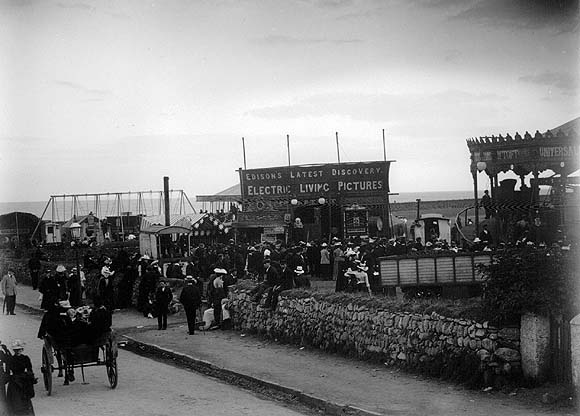
John Toft’s fairground cinematograph show at Tramore, Co Waterford, in 1901. From National Library of Ireland’s catalogue.

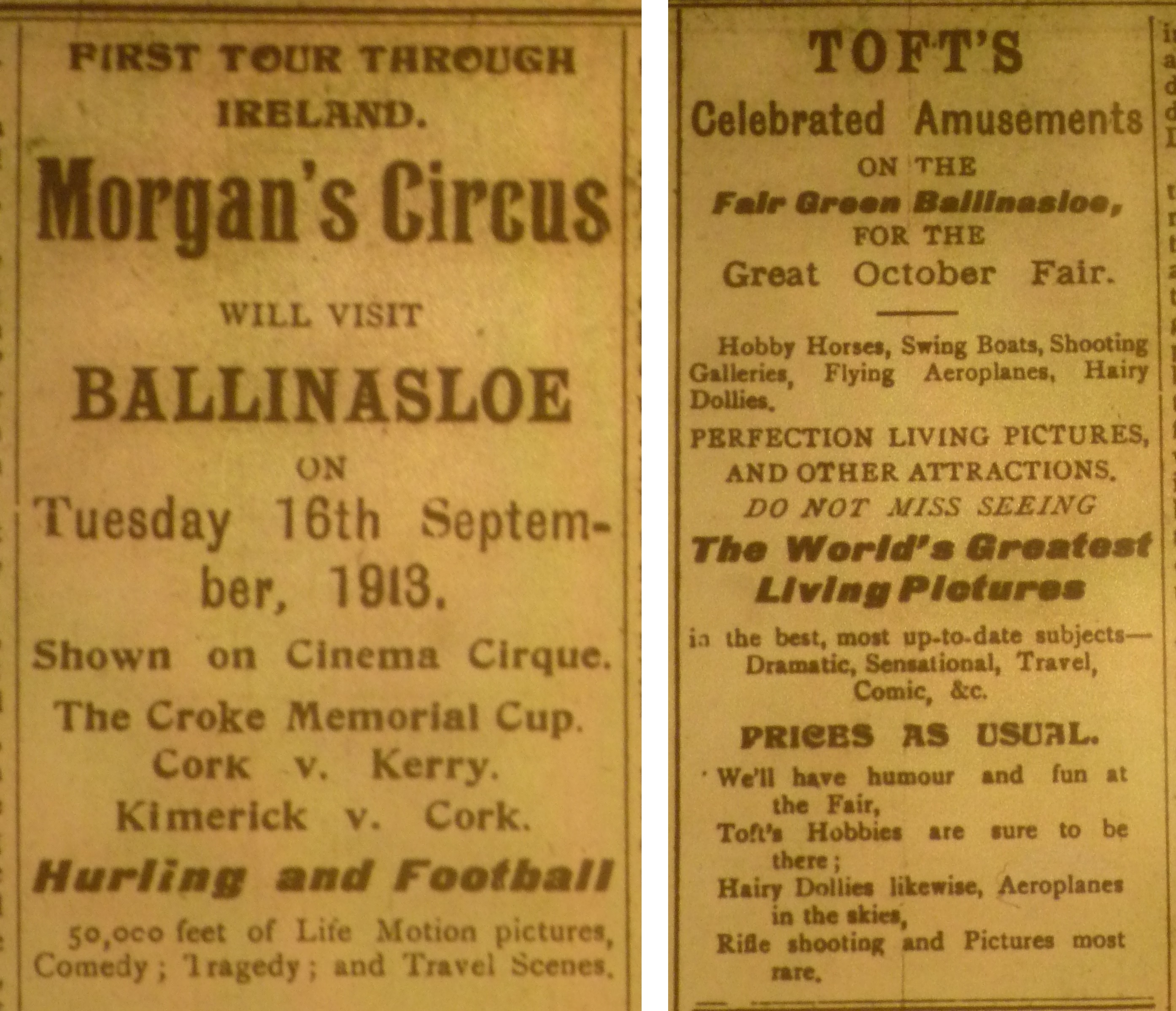
With a population of 4,662, Ballina did not have a dedicated venue at which such opportunities might arise on a regular basis. However, Ballinasloe, a town with the slightly larger population of 5,608 was in October 1913 awaiting the opening of a long-running, if not permanent, film venue. Although in the western county of Galway, Ballinasloe is located along the Galway-Dublin road and rail line, at the terminus of the Grand Canal. It is on the eastern border of that county, which means that it was and is nearer to the middle of the country than the west coast, and as such has long been an important meeting point between east and west, epitomized in its longstanding October fair, one of the oldest in Ireland. The town transport links and the fair’s large crowds drew travelling entertainers, so that in September 1913 alone, two travelling film companies visited before John Toft arrived to take part in the fair.

Cirque and Tofts Ballinasloe 1913

Circus and fairground shows with film: Morgan’s Cinema Cirque and Toft’s Amusements in Ballinasloe, autumn 1913. Ads for the East Galway Democrat 13 Sep. 1913 and 20 Sep. 1913.

Toft displayed a remarkable ability to manage publicity and consequently increase his audience. The East Galway Democrat praised his “readiness to aid every good work” that included his

“Benefit Night” this week in aid of the Temperance Hall, his generous subscriptions to the Nursing Fund, the Fund for the Poor, and the Gaelic League, as well as his kindness in giving the patients and inmates of our public institutions a little enjoyment. […] It is not to be wondered at that Mr Toft’s Amusements are well patronised, and that he makes friends wherever he goes (“Local Topics: Deservedly Popular Show”).

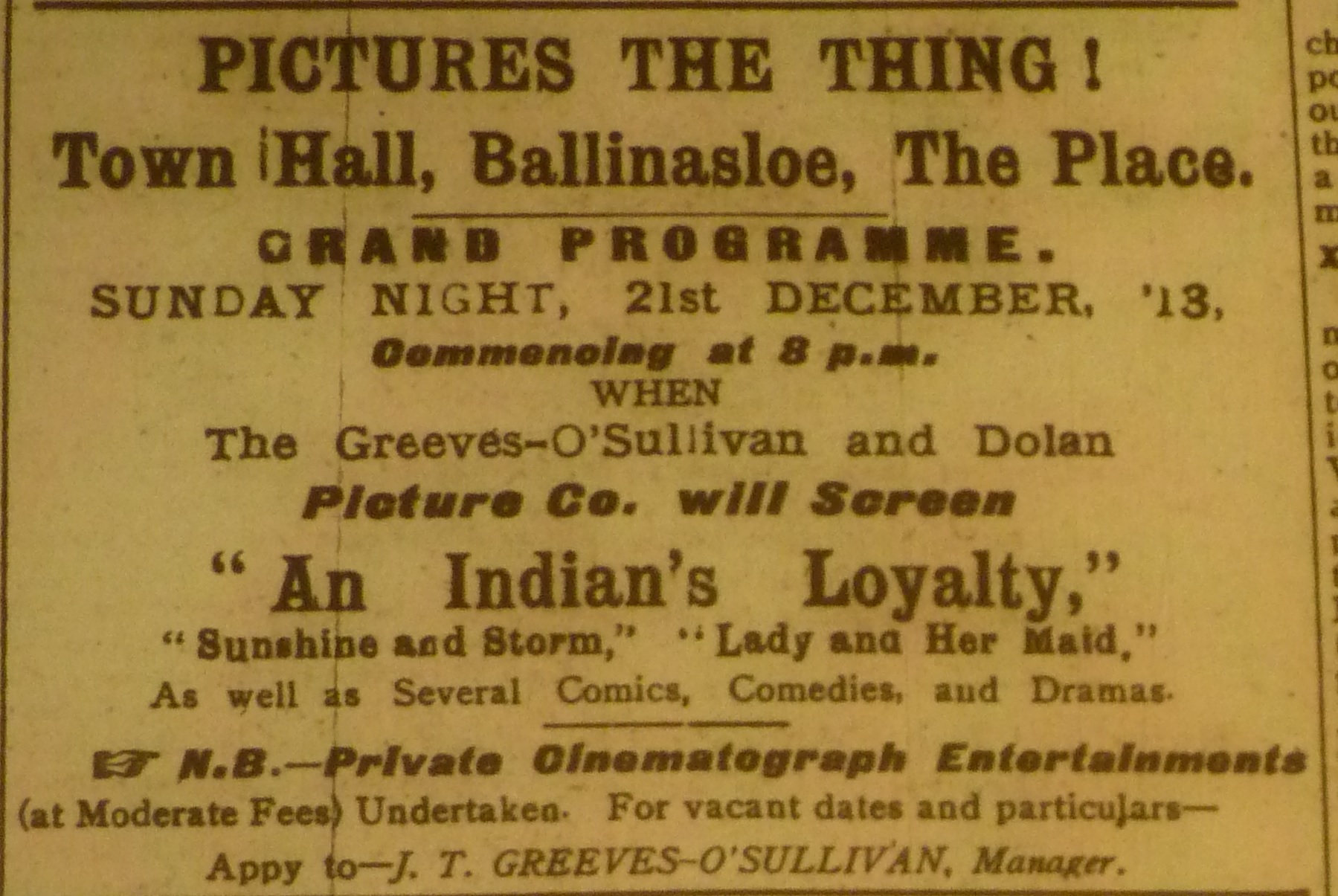
However, when Toft travelled on from Ballinasloe a few day after the end of the fair, local businessmen John Thomas Greeves-O’Sullivan and Timothy J Dolan opened a winter season of their Greeves-O’Sullivan and Dolan Picture and Variety Company, running at the Town Hall from 24 November and over the Christmas period. “No expense has been spared to provide first-class pictures,” the Democrat revealed, “and the machine to be used for the purpose of showing them is one of the latest on the market. An experienced operator has been engaged, and the Ballinasloe Orchestra will discourse selections during the entertainments” (“Local Topics: Picture and Variety Co. for Ballinasloe”).

Dec 20 1913 EastGalway Democrat

East Galway Democrat 20 Dec. 1913: 4.

The company advertised regularly in the press and were acknowledged with notices, including one on 6 December that appears to bear out their claim that they changed films nightly: “to-night (Friday) a grand feature film, ‘Heartt [sic] of the First Empire or The Days of Napoleon,’ a splendid Military Drama; Sunday 7th Dec., ‘The Kerry Gow,’ a three-reel Irish Drama, Monday, 8th Dec., ‘Woman’s Heart,’ and on Friday, 12th Dec., ‘District Attorney’s Conscience,’ a splendid emotional drama” (“Living Pictures”). Despite the use of “variety” in their name, the company appears primarily to have shown pictures and their variety seems to have been limited to selections from the orchestra between films, with the piano selections of Eddie Kelly being particularly singled out in one notice.

The use of such local resources as the orchestra for commercial gain was the main criticism of the company expressed in the press. In an exchange of letters with Greeves-O’Sullivan, the orchestra’s conductor James Roche refused to participate in the venture, explaining that although he had been working with orchestra for a year without remuneration, he was not prepared to continue unpaid “where the band was being used for a private commercial speculation” (“Correspondence”). Greeves-O’Sullivan replaced Roche with local hairdresser Patrick Burke and seems to have gone on using the orchestra, but the exploitation by local businessmen of such community resources as orchestras and town halls for their own profit did cause conflict elsewhere during this period in the development of cinema.

References

Barton, Ruth. Irish National Cinema. London: Routledge, 2004.

“Correspondence.” East Galway Democrat 13 Dec. 1913: 5.

“Lady Suffragettes in Ballina.” Ballina Herald 21 Aug. 1913: 3.

“Living Pictures.” East Galway Democrat 6 Dec. 1913: 5.

“Local Topics: Deservedly Popular Show.” East Galway Democrat 18 Oct. 1913: 4.

“Local Topics: Picture and Variety Co. For Ballinasloe.” East Galway Democrat 15 Nov. 1913: 5.

Paddy. “Pictures in Ireland.” Bioscope 2 Oct. 1913: 31.

Phelan, Martin. “Emigration.” East Galway Democrat 15 Nov. 1913: 7.

“A Suffrage Meeting.” Western People 6 Sep. 1913: 6.

Watching Gaelic Games on Screen in 1913

With a large degree of continuity with a century ago, many more people will watch today’s GAA All-Ireland football final at Croke Park between Dublin and Mayo live on television than will attend the game. Despite the Cork’s Evening Echo’s comment in February 1913 (citing an article in Popular Mechanics Magazine) that a “prediction may safely be made that in the near future provision will be made for moving pictures in the home,” live coverage and a kind of domestic moving pictures that suited the event-based nature of sport would still be some 50 years off (“Films for Families”). Nevertheless, Gaelic games’ fans around the country did watch moving pictures of matches in their local picture house days or weeks after they were played.

Image

A film of the 1912 Munster Hurling Final between Cork and Tipperary, held at Dungarvan on Sunday, 27 October 1912, was shown at the Assembly Rooms Picturedrome the following Wednesday and then moved on to Limerick and Wexford. Evening Echo 28 Oct. 1912: 2.

Unlike today’s game, however, Gaelic games were highly politicized in the 1910s, and the GAA, with branches in every parish in the country was the strongest and most popular nationalist cultural organization. So the gathering of a local audience to watch the film of a game prolonged the demonstration of popular nationalist sentiment that the match itself represented. With such a potential audience, GAA matches drew the attention of several local picture house owners, most prominently James T. Jameson – who ran the Rotunda and a circuit of provincial venues – and Alex McEwan, a Cork-based impresario, who operated from the Assembly Rooms Picturedrome.  When Cork beat Tipperary at the Munster hurling final in July 1912, McEwan arranged to have it filmed, and the Evening Echo recorded the local interest when he exhibited it beginning the following Wednesday: “[v]iews of every passage of the exciting and scientific contest are shown, and the loud and frequent applause which was heard at intervals during Wednesday night’s performance testified to the great enjoyment that was derived by all present” (“Assembly Rooms, Cork ”). It would travel on to McEwan’s picture house in Limerick and other venues.

Cork v Tipp CE 22 Sep 1913

The 1913 film of the Munster hurling final between Cork and Tipperary at the Assembly Rooms Picturedrome had to compete with more moving-picture competition. Cork Examiner 22 Sep. 1913: 4.

This week in 1913 saw not the All-Ireland football final, but the Munster hurling final, which again featured Cork and Tipperary and was played at Dungarvan on Sunday, 21 September. Cork fans would have known from word of mouth and newspaper reports that the Cork team did not repeat its success against Tipperary, but they did not have as long to wait for the film to appear on local screens. Given Cork’s involvement and the success of these films seemingly regardless of result, McEwan had arranged to film the match for his local audience and first exhibited it at the Picturedrome beginning at 3pm on the Monday of the week, the afternoon after the match. He also needed a spectacle to compete against the five picture houses that had opened since last he had shown the Munster final, not least the newly opened Coliseum, which was heavily advertising its first exclusive feature, The Battle of Waterloo.

Gaelic football films in 1913 were a Kerry story, as is so often the case with Gaelic football itself. In early 1913, the GAA held a special tournament, the Croke Memorial, to fund the purchase of the land at Jones’ Road, Dublin, for their headquarters. In a thrilling replay, Kerry beat the All-Ireland champions Louth, and this match was filmed by James T. Jameson. In Tralee, Kerry’s largest town, Jameson exhibited at the Theatre Royal, which he held on a long lease. Although he showed the film in Dublin and Cork first, particular celebration greeted its exhibition in Tralee:

On Wednesday evening the members of the Killarney and East Kerry section of the famous Kerry team motored to Tralee to see the moving pictures of the famous match at the Theatre Royal. The motors were kindly lent by Messrs. Green and Casey, whose cars were always at the disposal of the team.

The leading followers of the team in Tralee took the opportunity of the visit of the Killarney men to give them a hearty reception after their glorious victory. There was a large and representative gathering, and songs, recitations and toasts were given. As the motors passed through the town they received a tremendous ovation (”The Team at Theatre Royal”).

References

“Assembly Rooms, Cork: Munster Hurling Final.” Evening Echo 34 Oct. 1912: 2.

“Films for Families.” Evening Echo 28 Feb. 1913: 2.

“The Team at Theatre Royal, Tralee.” Kerryman 5 July 1913: 1.