Taking a Fearful Joy in Rewitnessing the Civil War on Irish Cinema Screens in July 1922

Dublin War Scenes (Topical Budget, 1922), available on the IFI Archive Player.

“The pictures are luring the Dublin public,” JHC observed in the Irish Independent‘s “To-Day & Yesterday” column on 12 July 1922. “People are taking ‘a fearful joy’ in re-witnessing the ordeal they passed through… The events of the past fortnight fulfil Lessing’s exacting definition of drama – life with the dull parts left out.” The events JHC was referring to are the Battle of Dublin, the engagement that opened the Irish Civil War. That battle began on 28 June, when National Army troops attacked anti-Treaty IRA forces occupying the Four Courts, using artillery loaned by the British government. The bombardment had the desired effect of forcing the occupiers to surrender on 30 June, but not before the destruction of the Public Records Office. Further IRA units located in the O’Connell Street area continued the battle until 5 July, by which time, they too were surrounded and defeated by the National Army’s superior numbers and fire power. At the end of eight days of fighting, the Four Courts and parts of Upper O’Connell Street were in smouldering ruins, and around 80 people had been killed, approximately 35 of whom were non-combatant city residents (Dorney).

National troops holding back locals as artillery shells the Four Courts in The Battle of the Four Courts (Pathé Gazette, 1922). Available on the IFI Archive Player.

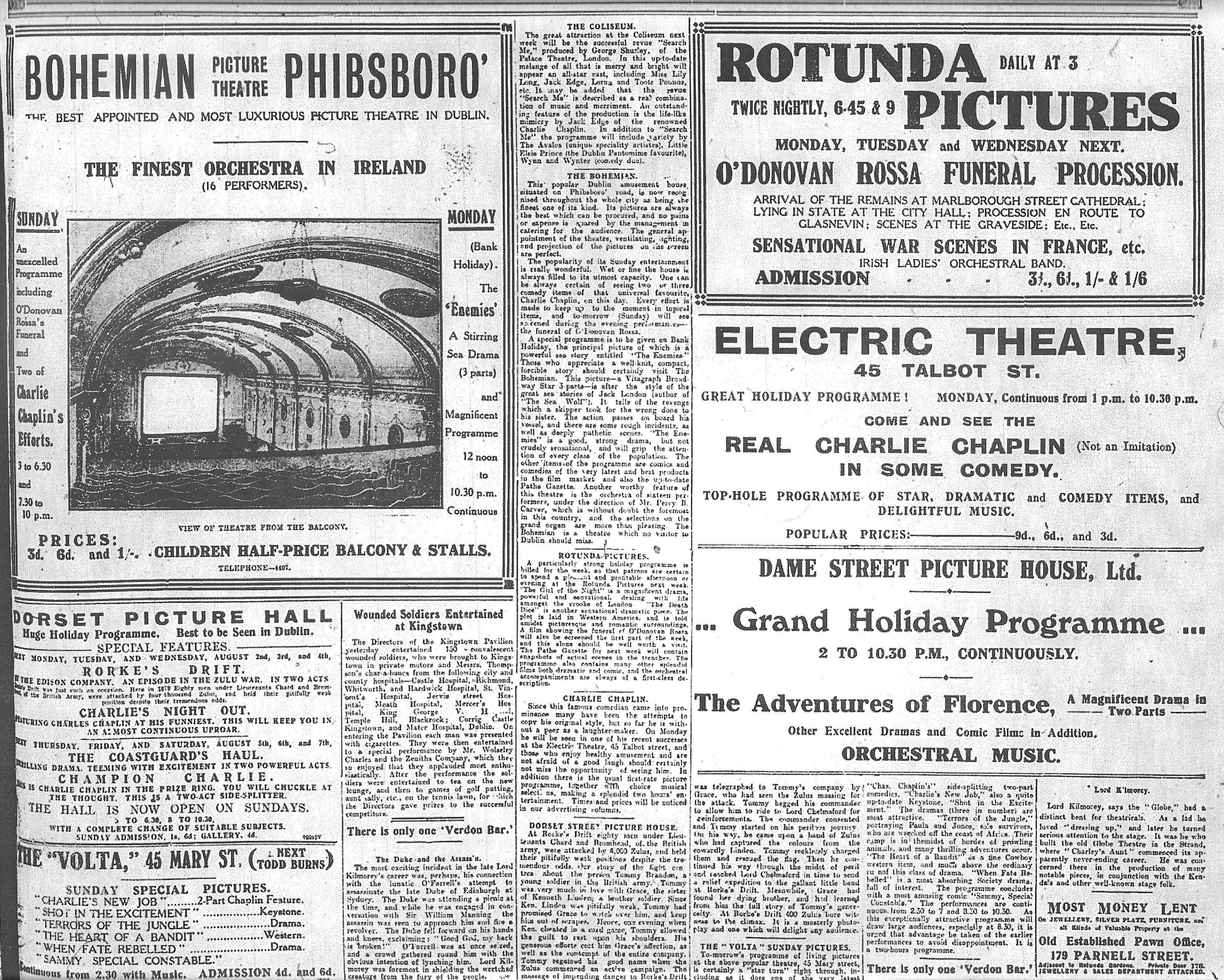
Dubliners had seemed ready to see films of the Civil War by 12 July, but only that week. When the fighting had stopped a week earlier, JHC wasn’t talking about the fearful joy in rewitnessing its events at the cinema. “Times of trial sometimes prompt the craving for amusement,” s/he had argued. “In the beginning of the struggle the picture-houses were well patronised. But yesterday saw them quite forlorn although they offered an up-to-date programme of the ‘battle scenes’ and ‘Four Courts incidents’” (5 Jul.). Which cinemas JHC was referring to is unclear to us now, in part because none of the city-centre cinemas advertised in the early part of that week, and certainly the ones in the O’Connell Street area couldn’t have opened until the shooting stopped and fires were extinguished. Those that had been closed or pressed into other uses were the Sackville at 51 Lower O’Connell Street, the Grand Central at 6-7 Lower O’Connell Street, the Metropole at 35-39 Lower O’Connell Street, La Scala at 4-8 Princes Street, the Pillar at 52 Upper O’Connell Street, the Carlton at 62 Upper O’Connell Street, the Rotunda at 165 Parnell Street and the Corinthian at 4-6 Eden Quay.
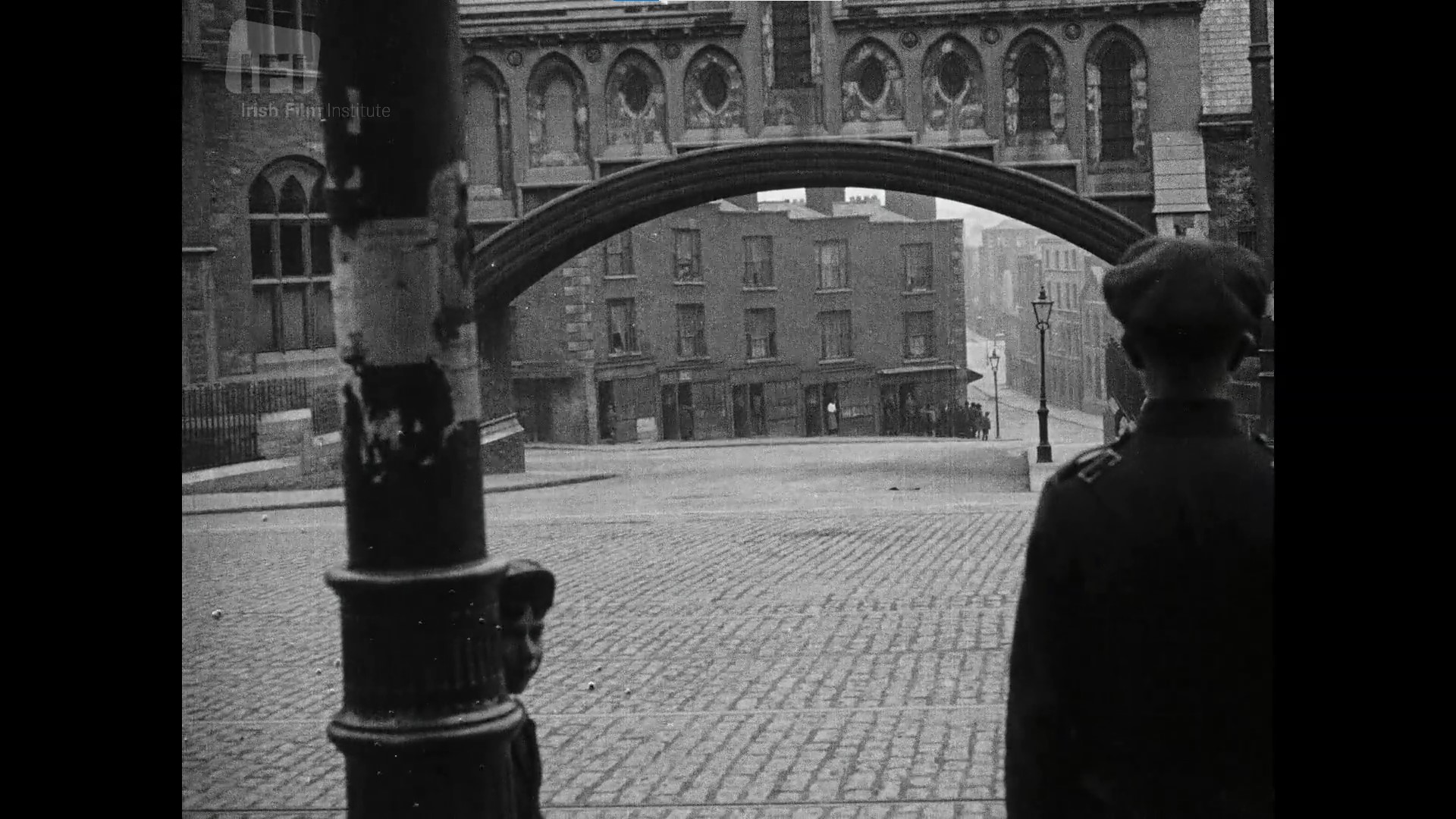
Onlookers face down Winetavern Street but keep a safe distance from sniping from the Four Courts across the river in Civil War in Ireland (Topical Budget, 3 Jul. 1922). Available on the IFI Archive Player.

“The last couple of very stirring weeks were not wanting in their effect on cinema houses,” the Freeman’s Journal’s “Cinema Notes” columnist observed on 10 July. “The Metropole was made a Red Cross centre, and La Scala was a point for bombardment by the National troops of their opponents on the opposite side of O’Connell street.” Mentioning the other cinemas in the area, the writer commented that “the entire marvel of the whole thing, from the picture house point of view, is that we still have these places, none or very little the worse for wear, in which to spend our evenings.” The Irish Time‘s “Cinema Notes” writer echoed these thoughts five days later, adding that

the Sackville and the [Grand] Central Cinemas came through the ordeal almost unscathed. The Corinthian Cinema on Eden quay seemed to have been selected as an Irregular sniping post, and its parapet bears traces of bullet marks.

The other picture theatres in the city had, of course, to close their doors while the battle raged, but they are preparing to reopen. It is to be hoped that business will come back to them in increasing volume, and thus in some measure make amends for the slump which has been felt in Dublin and elsewhere during the past few months.

This suggests that even ten days after the fighting ended, some cinemas were not yet reopened.

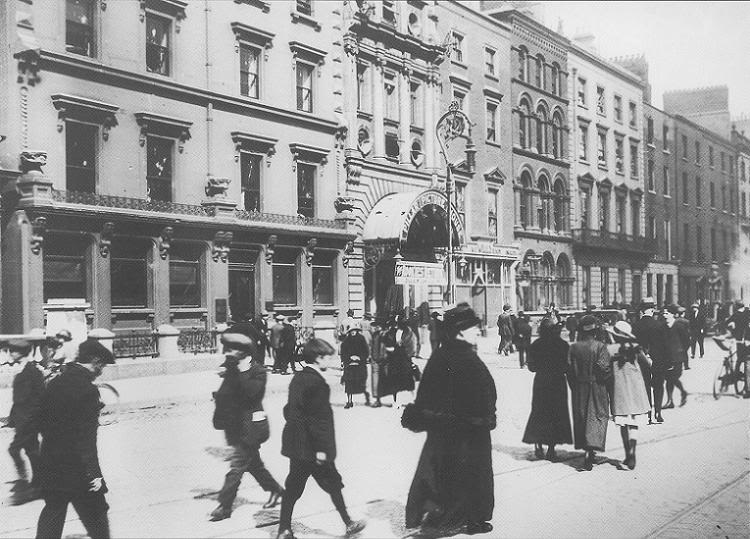
The Pillar in the bullet-damaged streetscape of Upper O’Connell Street just after the fighting had stopped. Image: Cinema Treasures.

The cinemas had certainly been lucky. “Some special god seemed to have been keeping a friendly eye on them,” this writer thought. But even if they didn’t feature on the lists of destroyed buildings, the cinemas weren’t entirely unscathed. The earliest surviving photograph of the Pillar shows it on the busy streetscape of Upper O’Connell Street just after the fighting stopped, with many pedestrians passing its bullet-damaged canopy, even if its façade seems somehow to have fared better than the buildings around it. “Considering its exposed appearance,” an Evening Herald reporter noted, “the Pillar Picture House escaped fairly well. Only a few bullets penetrated the big glass doors, but in the offices overhead a machine-gun had played for some time and did damage to the interior” (“Awe-Stricken Crowd”). It may be for that internal damage that the Pillar applied for compensation to the city for the figure of £750 (“Dublin’s Bill”). 

Freeman’s Journal 7 Jul. 1922: 2.

The Corinthian was the first of the city-centre cinemas to resume advertising – but not necessarily the first exhibiting films – offering on Friday, 7 July, an old favourite, Mary Pickford in Poor Little Rich Girl (US: Artcraft, 1917). Although they didn’t advertise the fact in the newspapers, other cinemas seem also to have opened that day. “Business as usual was the position of Dublin yesterday outside a comparatively few buildings damaged or wrecked in the area of the late fight,” the Irish Independent reported on 8 July. “Most of the city cinema have resumed business, but the theatres are still closed […] due to the absence of the necessary arrangements with artistes” (“Conditions Back to Normal”).
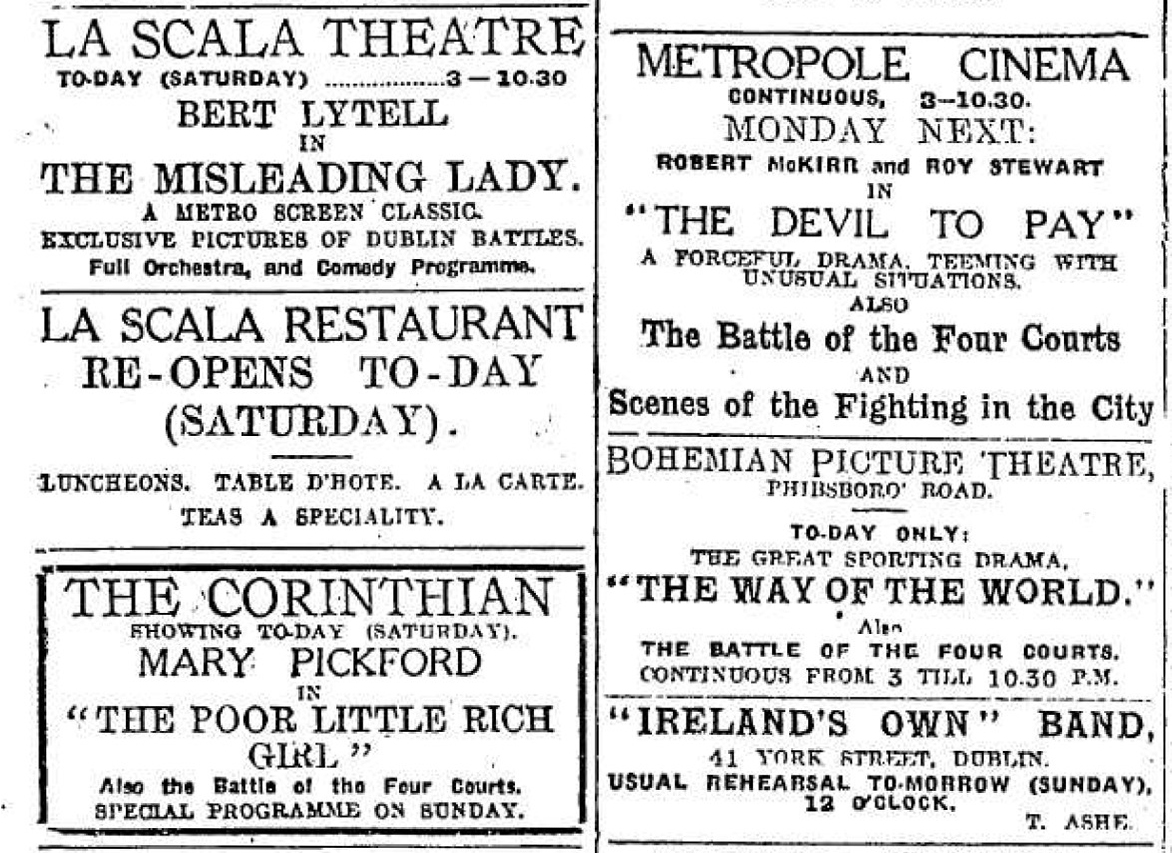
Dublin cinema ads mentioning newsreel of fighting, Evening Herald 8 Jul. 1922: 2.

If the Corinthian’s first ad didn’t mention newsreel, the following day’s entertainment ads indicated that several city cinemas, including the Corinthian, were already showing or intended showing film of the Battle of Dublin. The Evening Herald’s entertainment columns on 8 July had ads for four cinemas – La Scala, the Corinthian, the Metropole and the Bohemian – all of which mentioned footage of the fighting. The Metropole seems not to have been open on that Saturday but advertised its Monday programme as including The Battle of the Four Courts and Scenes of the Fighting in the City, if the latter was an actual film title. The other three cinemas were open, the Corinthian and Bohemian including The Battle of the Four Courts on that day’s bill and La Scala promising “exclusive pictures of Dublin battles.”
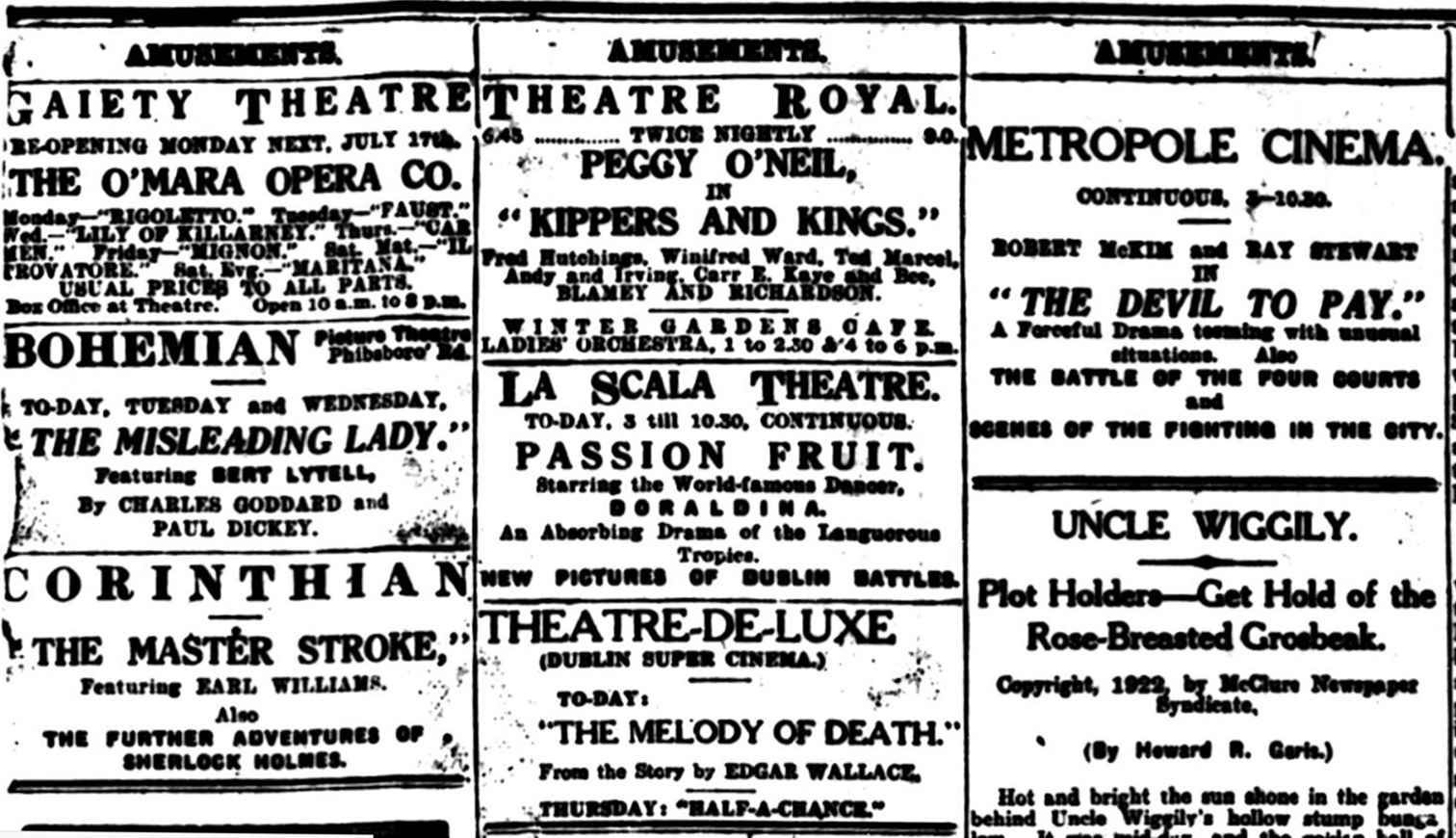
Cinema ads, Evening Telegraph 10 Jul 1922: 2.

What is worth noting here is that the rewitnessing involved a recirculation of newsreels that were a week old. The first newsreels of the conflict had been released the previous Monday, 3 July, when the three major newsreel series – Pathé Gazette, Topical Budget and Gaumont Graphic – all featured items focusing on events at the Four Courts. But as usual, a newsreel issue covered several stories. On 6 July, the Kinematograph Weekly delivered the “Hot News” that

the “Pathé Gazette,” number 890, released on July 3, included realistic pictures of the battle of the Four Courts in Dublin, and some right up to the moment shots of the world’s tennis championships taken from the air, together with pictures of ex-President Taft and the Lord Chancellor receiving honorary degrees at Oxford University.

The Kine Weekly also praised Gaumont’s work, noting that London-based newspapers had used images from the previous week’s newsreel to illustrate stories of fighting in Dublin. “This Monday,” it observed, “the ‘Graphic’ scored again with pictures of the destruction of the Four Courts. The cameraman, J. Silver, actually secured the pictures under fire” (“Gaumont’s Dublin Battle Pictures”).

The usual run of a newsreel issue was three days, so these must have been the ones that JHC had noted on 5 July. On 3 July, the Battle of the Four Courts had itself occurred three to six days previously and the fighting was then on O’Connell Street. On 10 July, therefore this was almost two-week old news. JHC had put a subheading “These Can Wait” in his column dealing with the 3-5 July newsreels. “The public was suffering these attractions first hand,” s/he opined. “Everybody knew that the cinema could hardly improve on the pulsing nowness of the real article. For the moment the Dublin point of view is not, as one might say, bioscopic. Film foot-notes to history will have their vogue – later on.”

Topical Budget’s Civil War in Ireland begins with images of people made homeless by the fighting. Available on the IFI Archive Player.

It took only a week, it seems, for the Dublin point of view to become bioscopic. By the week of 10 July, the city’s cinemagoers had perhaps had enough of the pulsing nowness of the real and were ready for history’s film footnotes. Or that as JHC argued on 12 July, that

thumping realities go best on the screen. The events of the past fortnight fulfil Lessing’s exacting definition of drama – “life with the dull parts left out.”

Of course the moralists are right. It isn’t good for us that our lives should be too picturesque and interesting. Happy the people whose annals are vacant.  

Those who had been on the wrong end of the thumping reality of artillery fire and sniping in the city would no doubt have agreed that it was a good thing that the conflict was now safely contained on the screen, at least for the moment.

The prominence of newsreels in Dublin cinemas in the first half of the week beginning 10 July is largely attributable to J. Gordon Lewis, the  camera operator who became Pathé’s main representative in Ireland after the indigenous newsreel Irish Events wound up at the end of 1920. Despite the skill under fire of operators such as Silver working for other companies and what Ciara Chambers has called Topical Budget’s exceptional “comprehensiveness in its coverage of Irish affairs,” Lewis’s local knowledge  allowed him to successfully time the release of a Pathé compilation newsreel to catch the public mood (Chambers 119). “I have met scarcely one Dublin picture-goer who did not anticipate with interest the cinematographic record of recent events,” the Freeman’s “Cinema Notes” columnist revealed. “And to-day we are getting it in the Pathe Gazette – a big film, made from three series of the Gazette joined into one. It is certainly a marvel of cinema photography; and even more to those who can appreciate the details than to the layman.”

Those in the trade did indeed take notice of Lewis’s work, not least a writer in the Kine Weekly whose account of Lewis’s heroic filming offers details of the film not recorded elsewhere, helping us to reconstruct what he presented on 10-12 July. This writer claims that “last Monday, four numbers of the Pathé Gazette were released in Dublin, giving to the people of the city Mr. Lewis’s record of Dublin’s latest agony.” Although the newspaper ads mention merely battles and fighting, the film also contained other material, beginning with “the last pilgrimage of all the Republican leaders to Wolfe Tone’s grave, with close-ups of each.” This is undoubtedly the film Pilgrims after the Poll, shot on 20 June and prepared for release on 29 June. The writer also mentions material that is more readily identified with the surviving Pathé footage, including close shots of the setting on fire of the Gresham Hotel in O’Connell Street, troops distributing bread to women and children, smoke-filled streets in which an officer is seen firing between two armoured cars and the bombardment of O’Connell Street’s iconic Hammam Hotel.

“Every aspect of Dublin’s battles have been recorded somehow by Gordon Lewis, Pathe’s intrepid photographer of the Irish portion of the Gazette,” the Freeman writer concluded, “little details in the series Dublin is to see to-day prove their absolute under-fire authenticity.” It was Lewis, it seems, who allowed the city’s cinemagoer a fearful joy in rewitnessing the Battle of Dublin.

References

“Awe-Stricken Crowd: The Damage on the West Side of O’Connell Street.” Evening Herald 6 Jul. 1922: 1.

Chambers, Ciara. Ireland in the Newsreels. Dublin: Irish Academic P, 2012.

“Cinema Notes.” Freeman’s Journal 10 Jul. 1922: 3.

“Cinema Notes.” Irish Times 15 Jul. 1922: 7.

“Conditions Back to Normal: Dublin Enjoys Peace.” Irish Independent 8 Jul. 1922: 6.  

Dorney, John. “Today in Irish History, 28 June 1922, the First Day of the Irish Civil War.” 28 June 2017. The Irish Story <https://www.theirishstory.com/2017/06/28/today-in-irish-history-28-june-1922-the-first-day-of-the-irish-civil-war/#.Yt0wSITMJEZ&gt; . Accessed 24 Jul. 2022.

“Dublin’s Bill: Cost of Recent Destruction: £244,000 Claimed.” Irish Independent 12 Jul. 1922: 5.

“Dublin’s Bill Still Growing: The Havoc of War: Total Exceeds £1,854,000.” Irish Independent 18 Jul 1922: 8.

“Gaumont’s Dublin Battle Pictures.” Kinematograph Weekly 6 Jul. 1922: 67.

“Hot News.” Kinematograph Weekly 6 Jul. 1922: 48.

JHC. “To-Day & Yesterday.” Irish Independent 5 Jul. 1922: 2; 12 Jul. 1922: 4.

“Trade Show Under Fire.” Bioscope 13 Jul. 1922: 27.
“A Photo-Play of Unique National Interest”: Seeing Knocknagow in Irish Cinemas, January-April 1918

On 22 April 1918, Knocknagow  (Ireland: FCOI, 1918) opened at Dublin’s Empire Theatre after a tour of many of Ireland’s towns and cities.

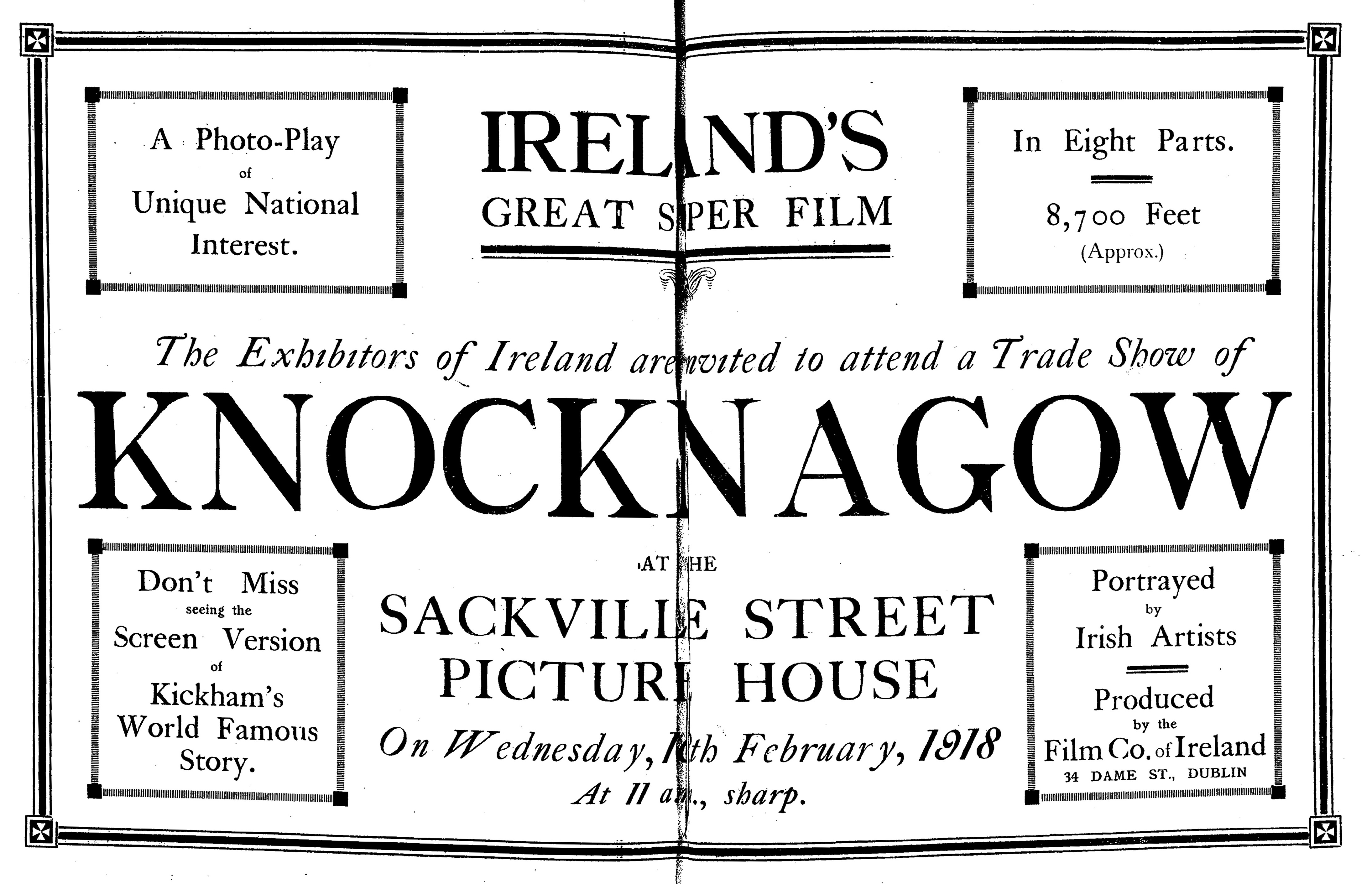
Ad for Knocknagow in the Irish Limelight Feb. 1918: 10-11.

In inviting Irish exhibitors to the trade show of the long-awaited Knocknagow on 6 February 1918 at Dublin’s Sackville Street Picture House, the Film Company of Ireland (FCOI) described the film as “a photo-play of unique national interest.” Knocknagow would become the most significant film made in Ireland during the silent period. Appearing just over two months after the three-reel comedy Rafferty’s Rise, Knocknagow was very different from anything FCOI had yet released. An epic nine-reel (8,700-feet or 2 hours 25 minutes at 16fps) adaptation of the best-selling Irish novel of the late-nineteenth and early-twentieth centuries, Knocknagow was by far the FCOI’s most ambitious work to date. Part of the national interest of the film may have been in making accessible a novel that some critics have argued was very widely bought but very little read (Donovan). Indeed, when in August 1917 the film was announced and a stage adaptation was proving popular, the Evening Herald’s Man About Town wondered “what the opinion of the author of Knocknagow would be if he saw his novel on the cinema screen, or its dramatized version drawing crowded houses in the theatres throughout the country.”

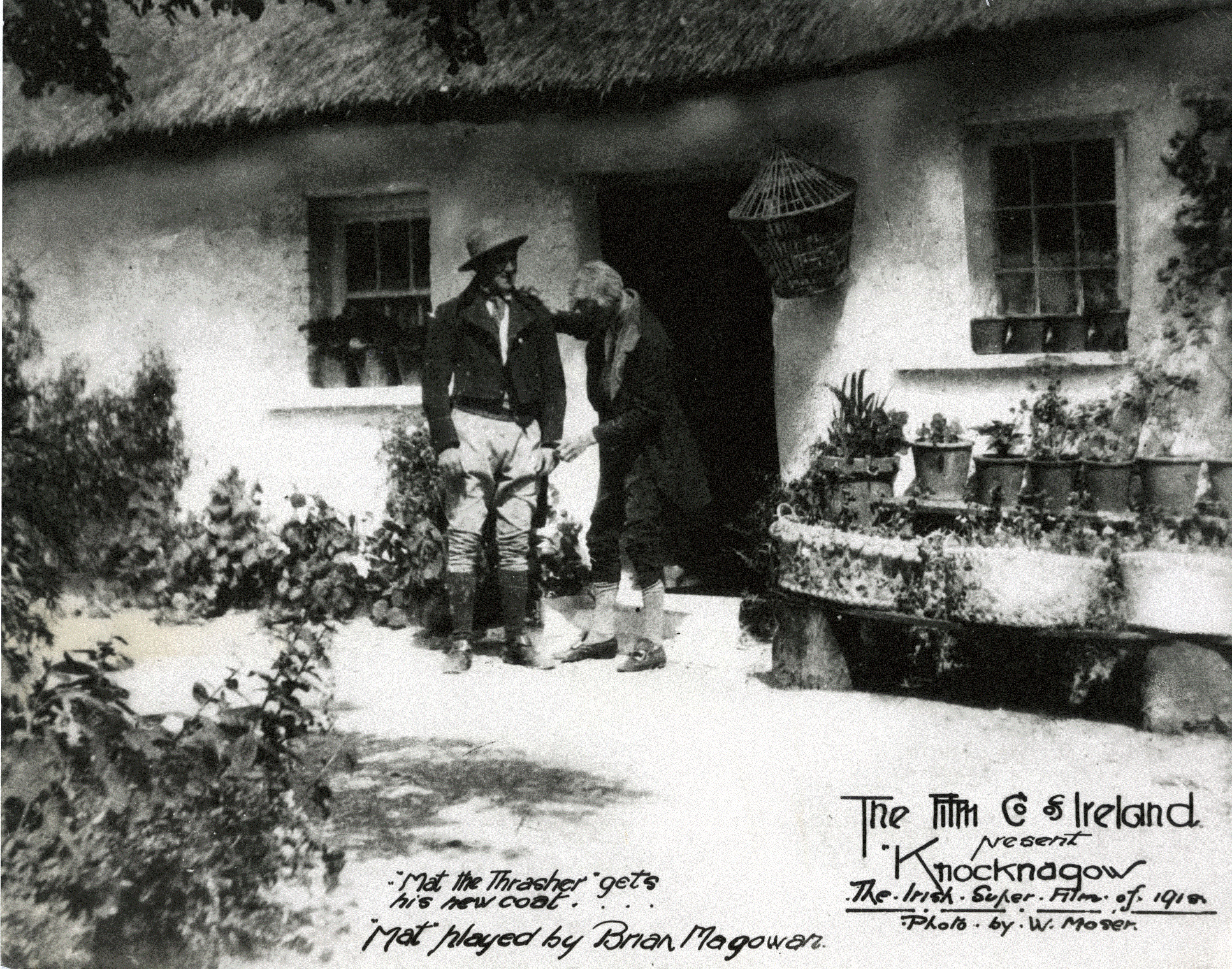
Tailor Phil Lahy (Arthur Shields) fits out Mat the Thrasher (Brian Magowan) for a new coat in Knocknagow. Image and essays on the film available here.

One of the things he would likely have thought is that the film was very selective in what it took from the novel. “The story meanders along through over six hundred pages its placidity disturbed by very little of what the playwright dubs ‘action,’” the Evening Telegraph critic JAP noted of the novel in his review of the trade show.

To extract from the [novel’s] 600 pages enough incidents for a photoplay – which, above all things, must have virile action, – and to contrive that there should be sufficient continuity to sustain interest throughout a half-dozen reels, was a task to daunt the most expert scenario writer. (“Gossip of the Day.”)

Although impressed by the film in other ways, particularly the acting, JAP did not seem to think that the scenario attributed to Mrs. N. T. Patton had been particularly successful in delivering virile action. Indeed, two weeks later, although no longer referring to Knocknagow, he argued that “the best books should not be filmed. To turn a book into a photo-play must be always an unsatisfactory business” (27 Feb.). However, in the trade-show review, he advised that “the action could be brisked up by sub-editing it down from eight reels to six, the sub-titles would be improved by more frequent quotations from the book and better choice of incidents would have helped to get more of the ‘atmosphere.’”

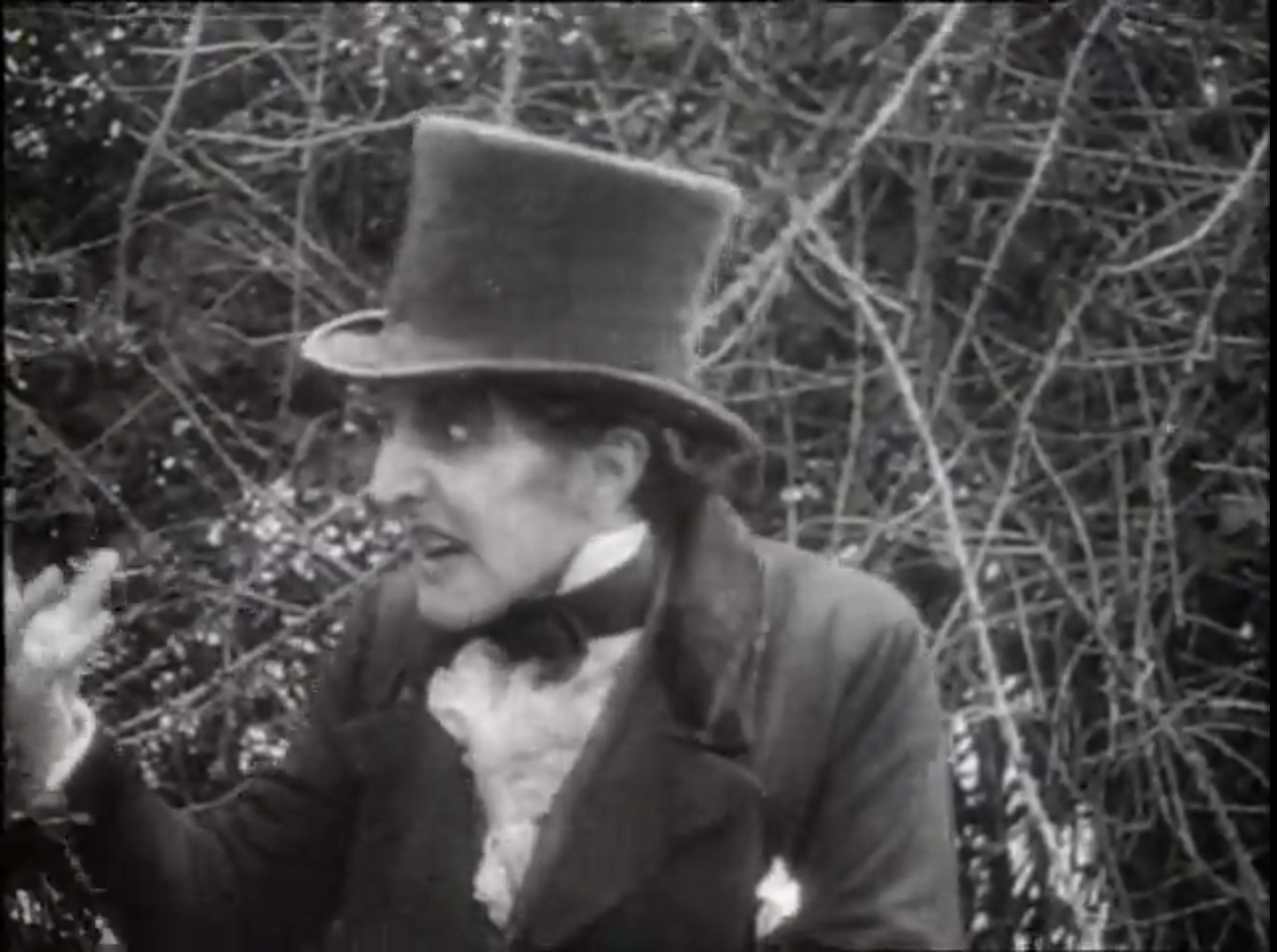
J.M. Carre as the villainous land agent Beresford Pender.

The version of Knocknagow that survives today is about an hour shorter than the original cut. As a result, it is difficult to say exactly what Irish audiences saw in early 1918, but a general description probably captures many of its essential features. Set in 1848, the film concerns the relationships among a large cast of characters who live on or adjacent to the lands of the absentee landlord Sir Garrett Butler, particularly in the village of Kilthubber and the hamlet of Knocknagow. Prominent among these are Mat “the Thrasher” Donovan (Brian Magowan); the tailor Phil Lahy (Arthur Shields), whose sickly daughter Nora (Kathleen Murphy) is betrothed to turfman Billy Heffernan (Breffni O’Rourke); large tenant farmer Maurice Kearney (Dermot O’Dowd) whose daughter Mary Kearney (Nora Clancy) is attracted to theology student Arthur O’Connor (Fred O’Donovan, who also directed); and villainous land agent Beresford Pender (J.M. Carre), who schemes to remove tenants from the land to make way for more lucrative cattle grazing. The film interweaves scenes of rural work and leisure (ploughing, tailoring, Christmas celebrations, a wedding, a hurling match, a fair) with more strongly plotted sequences, such as the developing love stories or Pender’s strategies to evict certain tenants and frame Mat for robbery. “With a true appreciation of the artistic,” the reviewer in Cavan’s Anglo-Celt contended

the various degrees of tone have been lifted from the novel, and placed on the screen just as Kickham would have done it himself. The happy peasantry, the prowess of the youth at the hurling match, the hammer-throwing contest, the unexpected “hunt,” the love scenes and the comedy – the life as it was before the agent of the absentee landlord came like a dark shadow on the scene, and with crowbar and torch, laid sweet Knocknagow in ruins – all were depicted by the very perfect actors who made up the cast. (“‘Knocknagow’ on the Film.”)

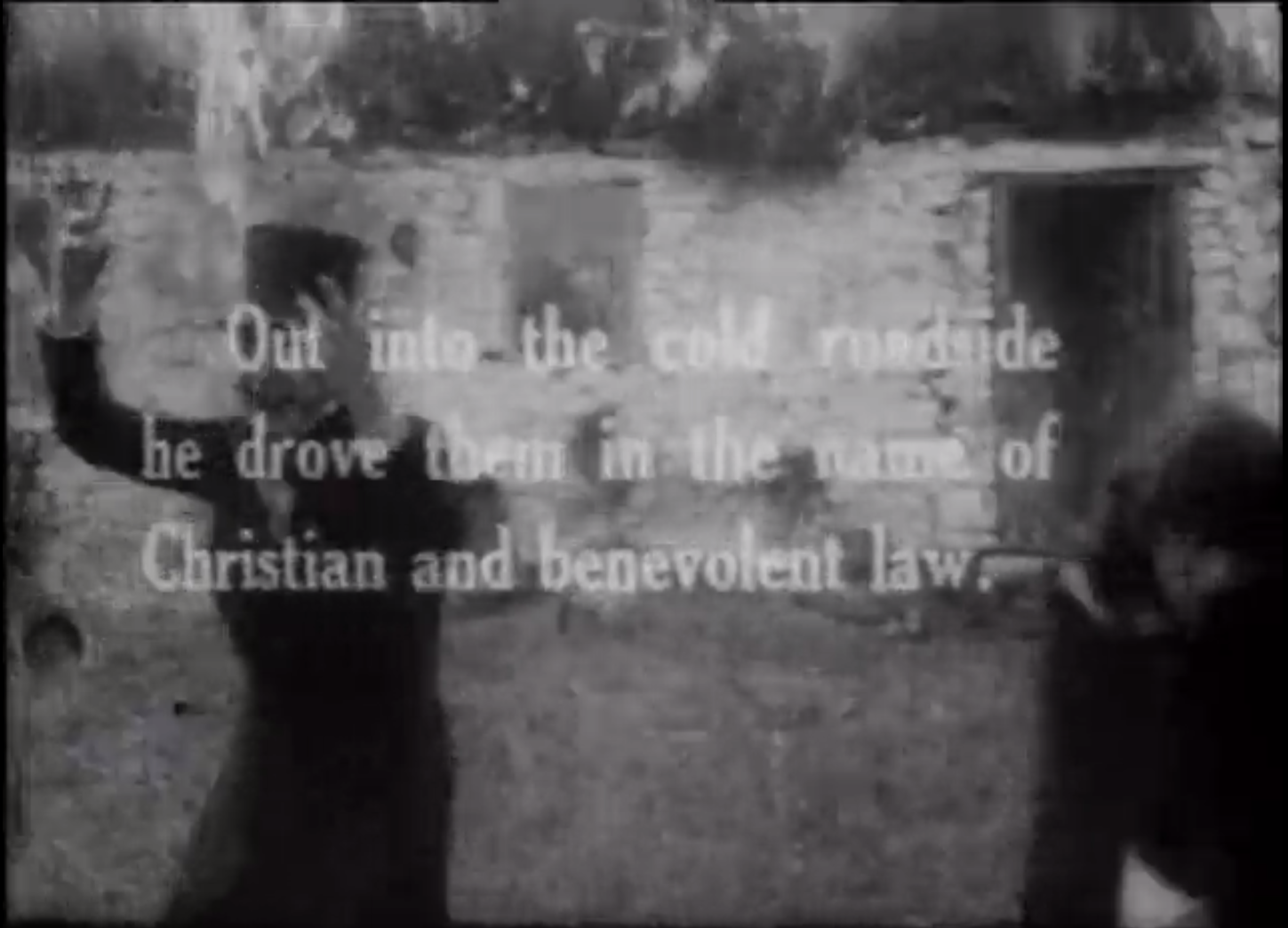
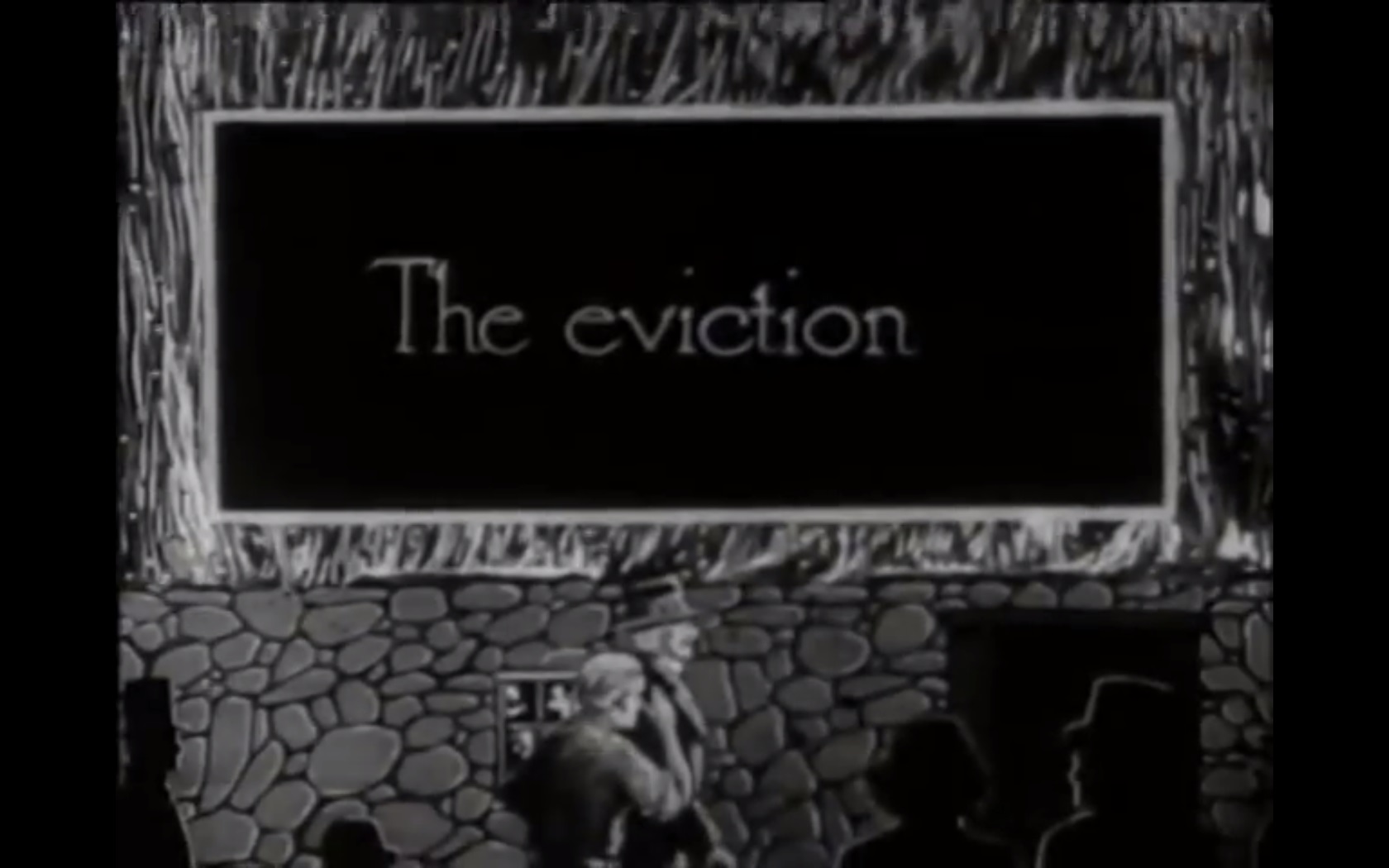
Pender’s eviction of the Brians, a farm labouring family, is depicted in detail, with titles superimposed on the images of the land agent dancing before their burning cottage.

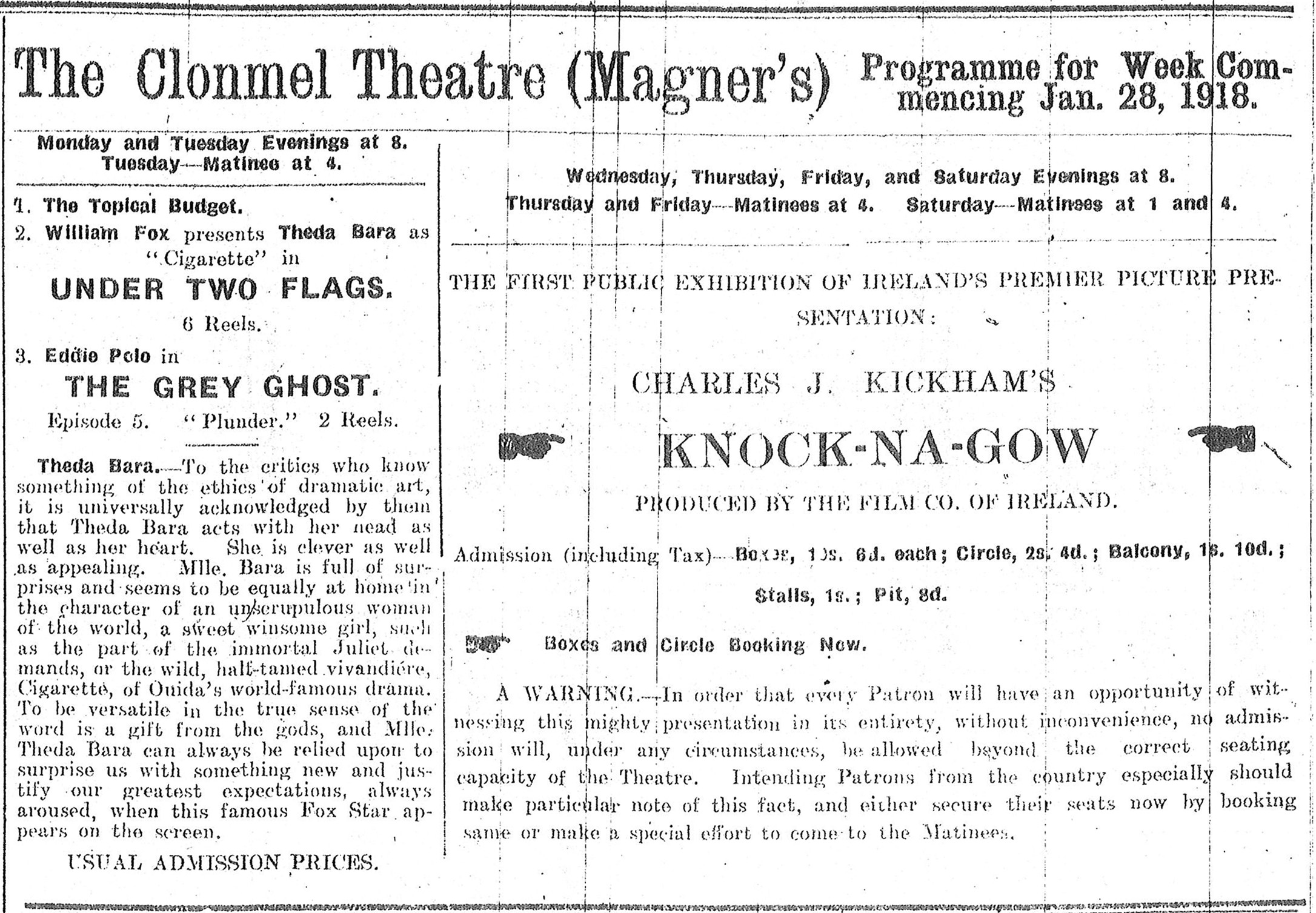
Apart from transposing a bestselling Irish novel into an accessible screen format, two other definitions of “national interest” seem to be particularly relevant to thinking about the release of Knocknagow in early 1918: the commitment to local exhibition and the politics of Irish nationalism. The first of these is illustrated by the fact that the trade show had, unusually, followed rather than preceded a special premiere run in Clonmel from 30 January to 2 February, and the film’s first run after the trade show would not be in the cities of Dublin or Belfast but in Carlow on 18-19 February. The Clonmel opening was designed to acknowledge that the film had been shot almost entirely in the Tipperary locations of Clonmel and Mullinahone associated with Kickham’s source novel. However, the fact that audiences not only in Clonmel and Carlow but also in many other small towns saw the film before it opened to the public in Dublin on 22 April underscores FCOI’s commitment to a definition of national interest that associated it first and foremost with small-town Ireland.

The importance of the Tipperary landscape is emphasized at several points of the film, including a sequence of iris shots in which Mat says farewell to Ireland as he makes ready to emigrate.

Other aspects of the exhibition of Knocknagow deserve discussion, but the 22 April opening date of the film in Dublin also marked a turning point in Irish national politics. That day was flanked by two days of demonstrations against the conscription of Irish men into the British army. Sunday, 21 April represented a particularly Catholic church influenced protest, with mass meeting and fiery speeches in every parish in the country, while Tuesday, 23 April was the day chosen by trade unions for a general strike that meant, among other things, that “there were neither newspapers nor cinema shows” during a “universal cessation of work throughout Nationalist Ireland” (“Labour’s Protest”). The British government’s determination to extend conscription to Ireland would finally succeed in uniting the warring factions of Irish nationalism against it.

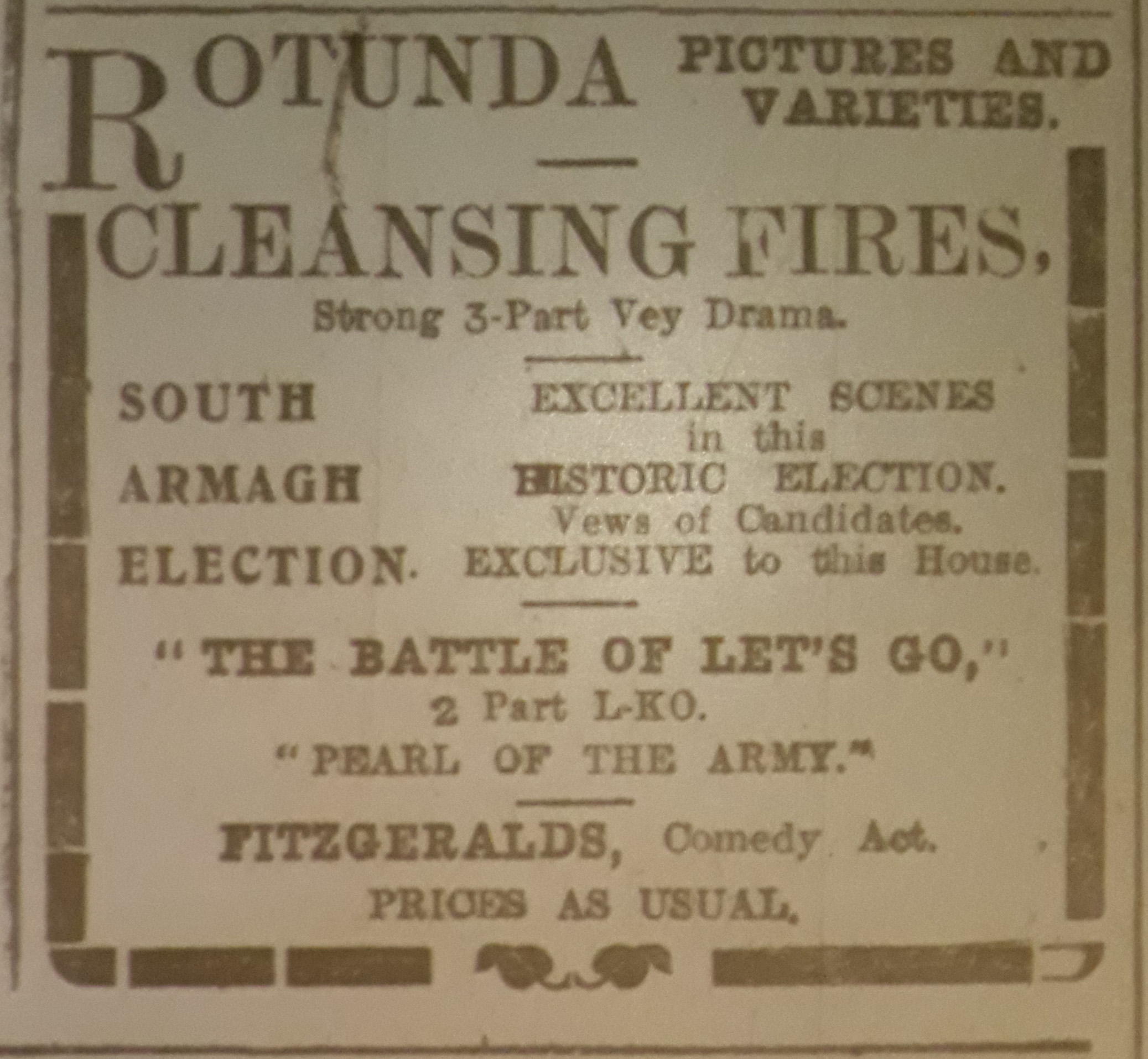
Newsreel special of the by-election in South Armagh, Dublin Evening Mail 4 Feb 1918: 2.

This turning point of the conscription crisis came after the film’s release in much of the country, however, and it was in a political context of the rise of Sinn Féin that the film was produced and initially exhibited. In late 1917 and early 1918, the long stable link between the achievement of nationhood and the Home Rule of the Irish Parliamentary Party (IPP) was severely under threat from the vision of a more radical independence offered in the wake of the 1916 Rising by the new Sinn Féin party. The set pieces of this struggle from the time Knocknagow began shooting in Tipperary in the early summer of 1917 and through the period of its exhibition in late winter and spring 1918 were a series of six by-elections in which Sinn Féin ran candidates in constituencies where the IPP had previously held Westminster seats, winning three of them. After losing four seats in all to Sinn Féin in 1917, the IPP may have seemed to be regaining the momentum by winning the three by-elections in early 1918, but one of these included the Waterford seat left vacant by the death on 6 March of the man most associated with Home Rule, IPP leader John Redmond. Cinema audiences could follow these developments through the newsreel footage of the by-elections and Redmond’s funeral provided by Irish Events and exhibitors such as William Kay of Dublin’s Rotunda who filmed these events.

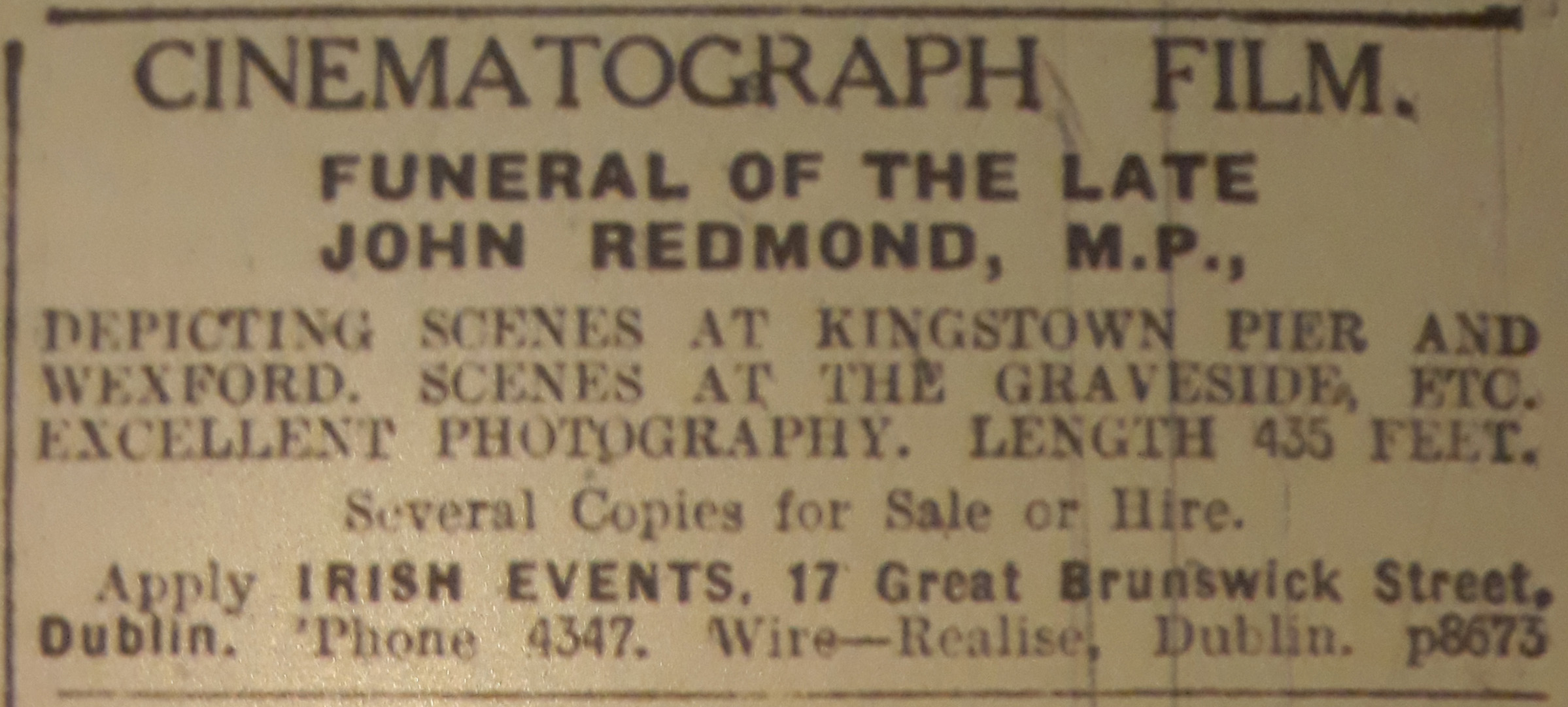
General Film Supply sought sales of its film of the Funeral of the Late John Redmond, M.P. beyond its usual Irish Events network by placing this ad with the entertainment ads in the Evening Telegraph of 11-12 Mar. 1918.

As well as these party-political events, Knocknagow was released in a country that was experiencing increasing incidents of local unrest of many kinds, with a large number of prosecutions for cattle driving and for illegal drilling by Irish Volunteers, as well as a hunger strike by Sinn Féin prisoners in Mountjoy Jail. In early March, County Clare was placed under martial law, and Major-General W. Fry issued a proclamation “prohibiting the holding of any meeting or procession within the Dublin Metropolitan Police Area between March 6 and March 27,” a period that included St. Patrick’s Day (“Proclamation”). In one high-profile case, men arrested for illegal drilling in Dundalk refused to recognize the court and sang “The Soldier’s Song” to disrupt proceedings. This tactic became so common that one defendant (Michael Murray) in a Clare cattle-driving case refused to recognize “this concert” (“Court Scene”). However, when during the Dundalk case, a variety company sang the same “Sinn Féin” songs at one of the local picture house, a section of the audience left in protest (“Round Up”). More seriously, members of an audience at Limerick’s Tivoli Picture House on 4 March became victims of violence when 15 to 18 soldiers who had been involved in running battles with young men in the street burst into the auditorium and attacked the crowded audience at random with sticks and truncheons, injuring many, including the musical director (“Soldiers & People in Conflict”).

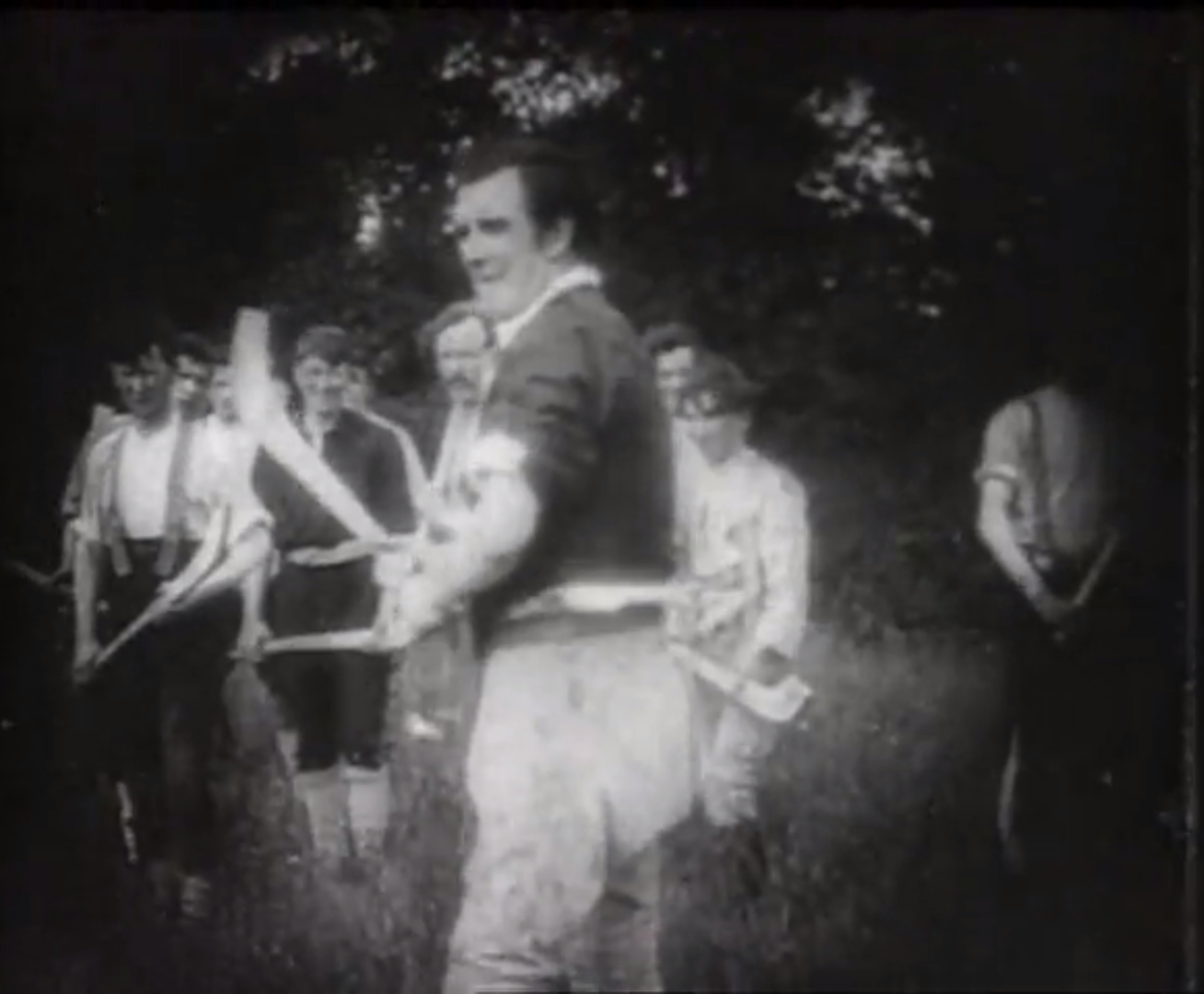
Mat leads the Knocknagow hurling team for a match that the Derry Journal reviewer thought was “a topsy-turvey affair, resembling a rugby scramble more than a game of caman” (“‘Knock-na-Gow’ at the Opera House”). Some more on that aspect of the film here.

In these circumstances in which, it seems, politics could irrupt into the auditorium at any moment, Knocknagow looks like quite an indirect, even tame intervention. The FCOI’s choice of Kickham’s novel as the basis for its first landmark film seems, on the one hand, an overtly nationalist statement: its author was a former president of the Irish Republican Brotherhood and one of the best known Irish revolutionaries of the latter half of the nineteenth century. On the other hand, the nature of the book – rich in detail of Irish country life in the 1840s but also sprawling and sentimental rather than overtly political – was such that it could be adapted without courting political controversy. As such, the film contrasts with the films made in Ireland between 1910 and 1914 by US filmmakers Sidney Olcott and Gene Gauntier for Kalem and subsequently their own production companies, some of which openly feature armed political rebellion against Britain, albeit that these films are also set in the past.

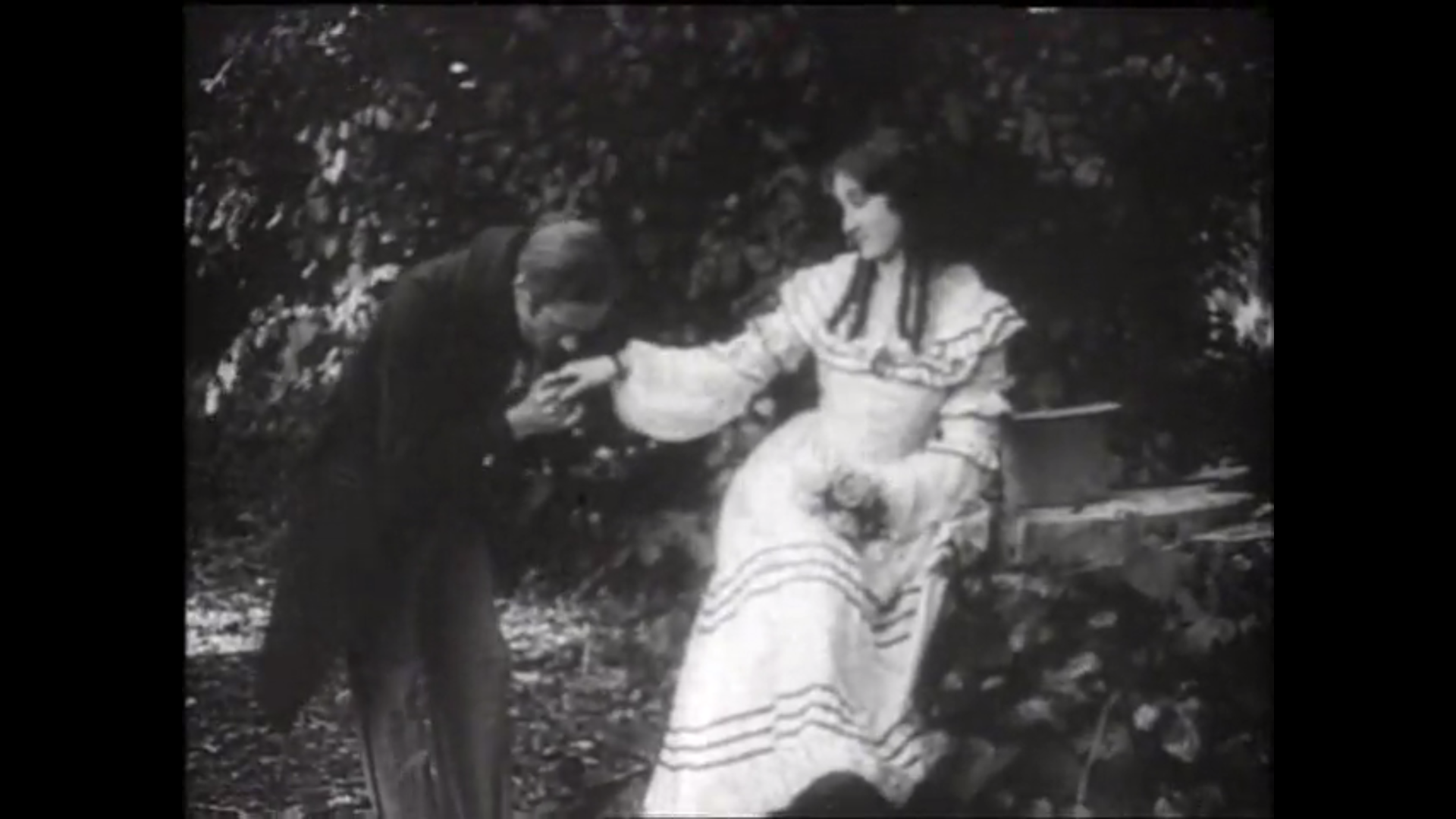
ArthurO’Connor and Mary Kearney pursue their romance.

This is not to argue that FCOI was politically conservative but that the company had to negotiate strict censorship. The attempt to show Ireland a Nation (US: Macnamara, 1914) in Dublin in January 1917 or even the more recent controversy over the potential banning of the Finn Varra Maa pantomime had shown that to have produced a film that the authorities judged to have been overtly nationalistic would undoubtedly have been to see the film immediately banned under the particularly strict wartime censorship provisions of the Defence of the Realm Act. Apart from anything else, the banning of Knocknagow would have been a financial disaster for the already struggling FCOI.

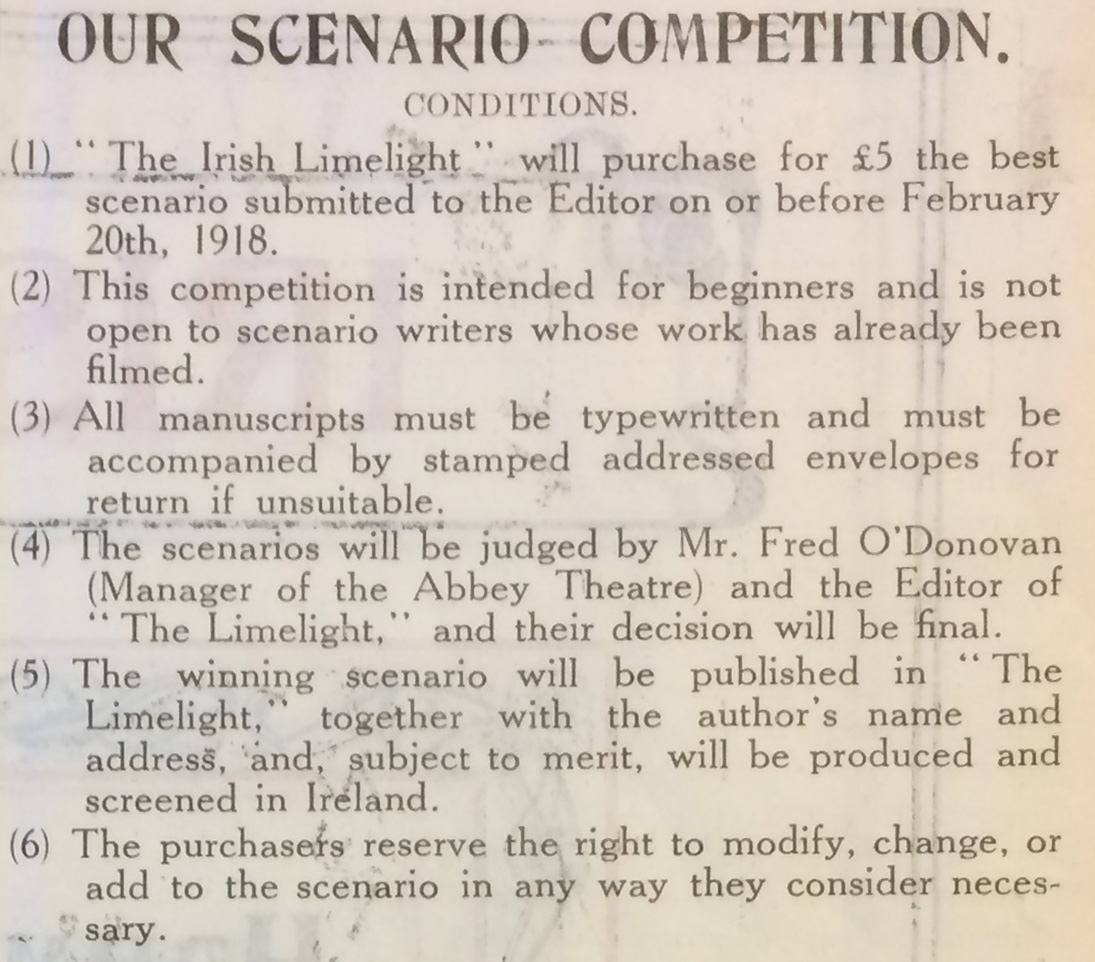
Scenario competition in Irish Limelight Dec 1917: 11.

In this context, Kickham’s work took on a renewed importance in its ability to subtly re-articulate a familiar set of representations in a political way through its association with the author’s republicanism. Despite its setting in the mid-19th century, Knocknagow still resonated with Irish audiences, as the popularity of the stage adaptation shows. And 1918 would be the year of Kickham film adaptations: with a similar setting in time and place, Kickham’s other major novel Sally Cavanagh would be adapted by J. A. McDonald for a scenario competition run by the Irish Limelight in early 1918. Given that Knocknagow’s director Fred O’Donovan joined Limelight editor Jack Warren in judging the competition, it is perhaps not surprising that McDonald’s scenario, Untenanted Graves, won, but its seems never to have been produced (“Untenanted Graves”).

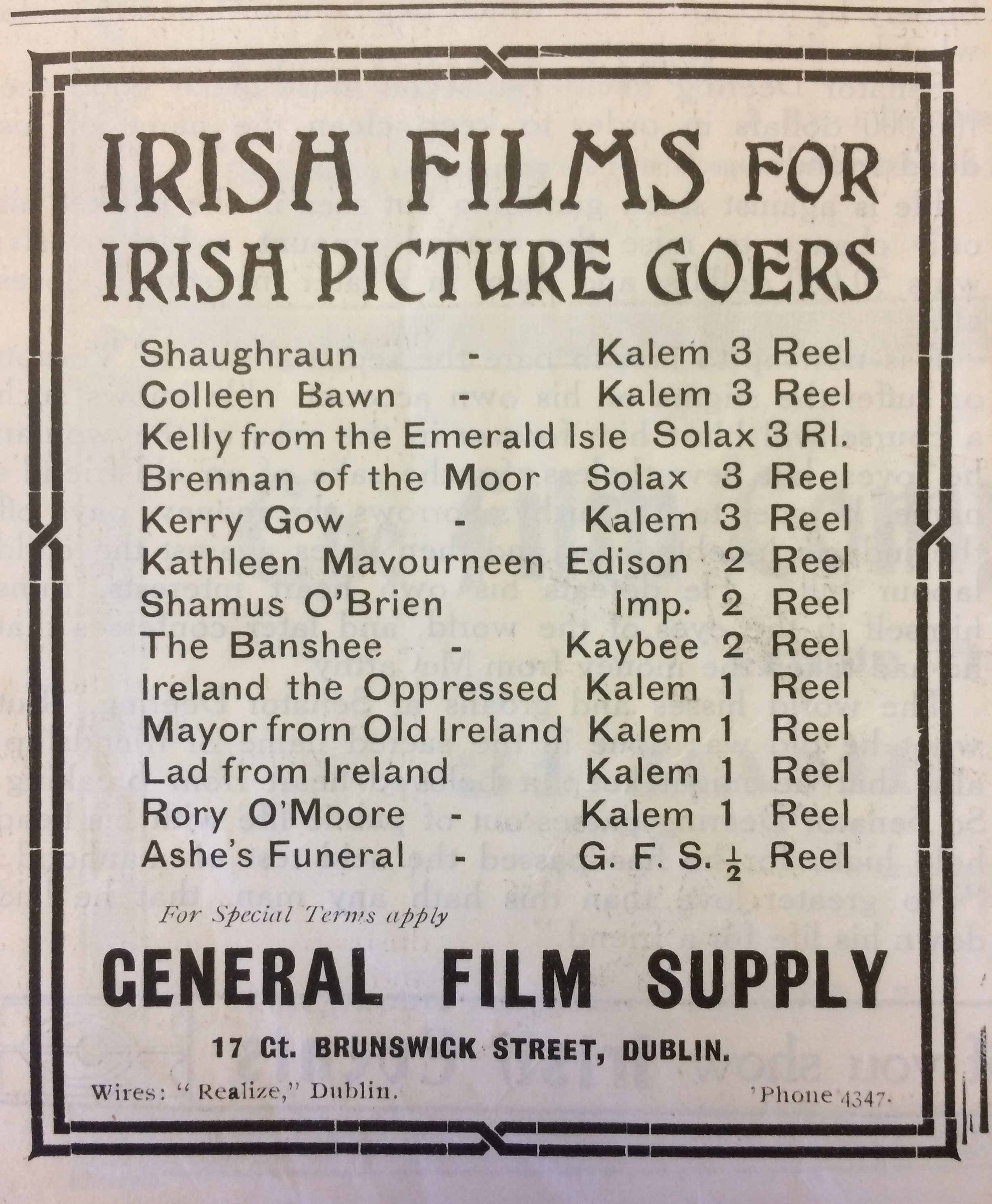
Films made in Ireland by US filmmakers Sidney Olcott and Gene Gauntier for Kalem dominated this list of Irish films available to Irish exhibitors through Dublin-based General Film Supply; Irish Limelight Dec. 1917: 18.

As the Kickham film that was actually made, Knocknagow in itself, and in the company’s rhetoric around it, emphasized its embeddedness in particular Irish locations that were different from the ones popularized by previous, foreign filmmakers in Ireland, especially the Killarney of the enduringly popular Olcott-Gauntier films. Unlike Olcott and Gauntier, the FCOI filmmakers were – predominantly – Irish born, and the company was based in Dublin. In keeping with this rhetoric, local exhibition was of more than usual importance to Knocknagow. FCOI had opened previous films in regional picture houses, despite the claim by the Dame Street Picture Theatre in Dublin that all the company’s productions could be seen there first. But for Knocknagow, regional exhibition was a part of its national significance.

Ad for premiere of Knocknagow at Magner’s Theatre, Clonmel; Nationalist 26 Jan. 1918: 6.

Indeed, successful regional exhibition in Ireland was to be part of the promotion of the film with audiences and exhibitors abroad. On 13 April, while Knocknagow was showing in Derry, Dublin’s Evening Herald published a brief interview by its drama critic Jacques with FCOI producer James Mark Sullivan. Sullivan was on the cusp of bringing the FCOI films to America (on the film in America, see here and here), and Jacques quoted him on the company’s intentions:

“We desire,” he says, “to show Ireland sympathetically; to get away from the clay pipe and the knee breeches; to show Ireland’s rural life, with pride in the same; to show Ireland’s metropolitan life intelligently, depicting the men and women of the 20th century – in short, Ireland at its best in every walk of human endeavour.”

This may have been his desire but if it had any basis in a reality beyond advertising rhetoric, it must have referred to the earlier FCOI films and not Knocknagow. Knocknagow persisted in representing the Irish of the mid-19th century and doing so in familiar ways, including costumed in knee breeches. In addition, Sullivan made specific claims about the way that Knocknagow was being welcomed in Ireland “like no other picture was ever received in Ireland or out of Ireland before. From every place where it has once been shown,” he contended,

we are receiving return bookings—a remarkable thing in the case of a picture, though very ordinary in that of a play or opera. For instance, the city of Limerick gave us four bookings, and I question if any other picture every received over two. The same is true of Waterford, Clonmel, Cork, Carlow, and other towns. This week we are breaking all records in Waterford. I mention these facts to indicate that there is prospect of promise and permanency in our enterprise.

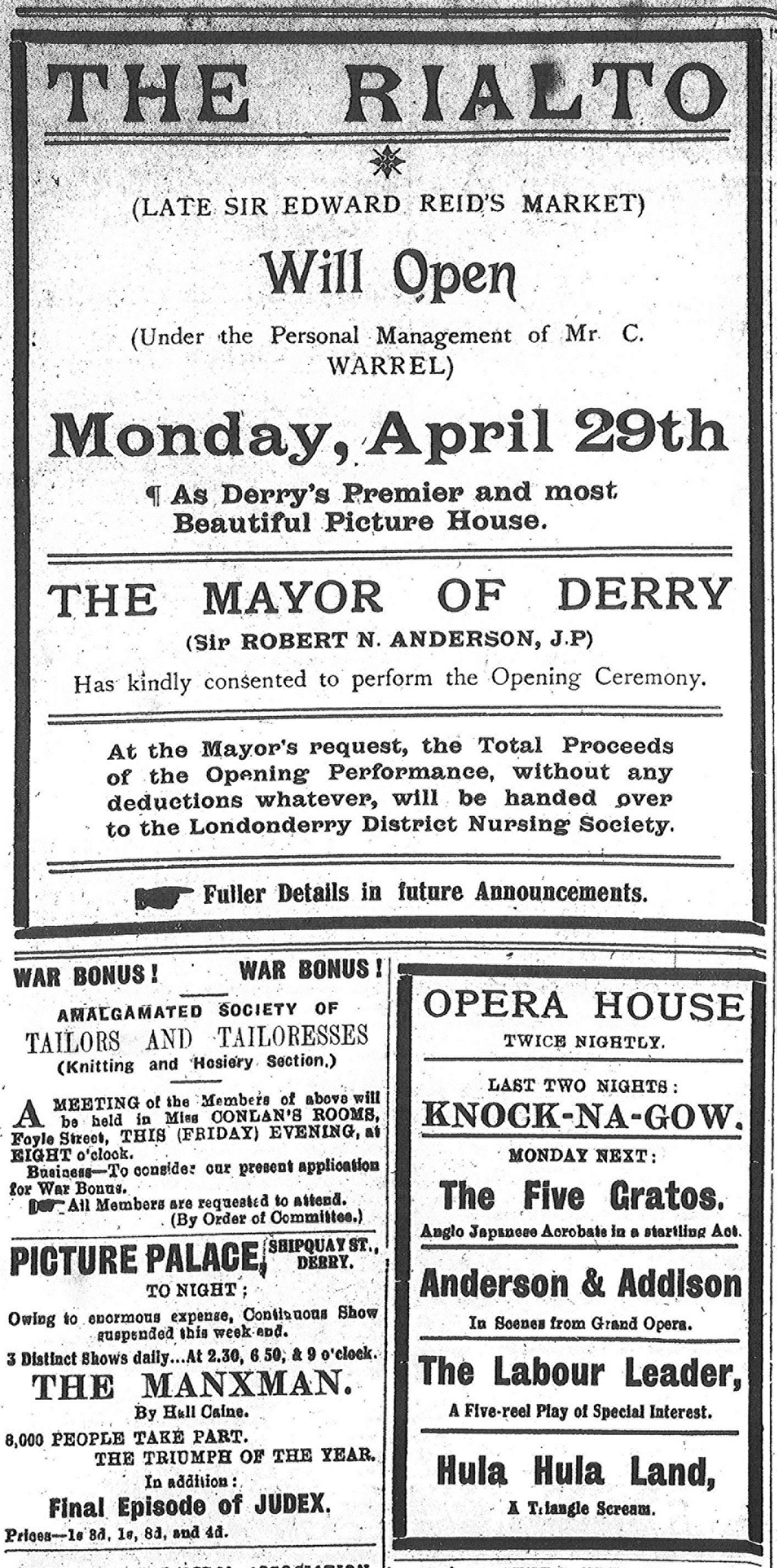
The ad for Knocknagow at Derry’s Opera House was dwarfed by an ad for the opening of the city’s newest picture house, the Rialto, on 29 April. Derry Journal 12 Apr. 1918: 2.

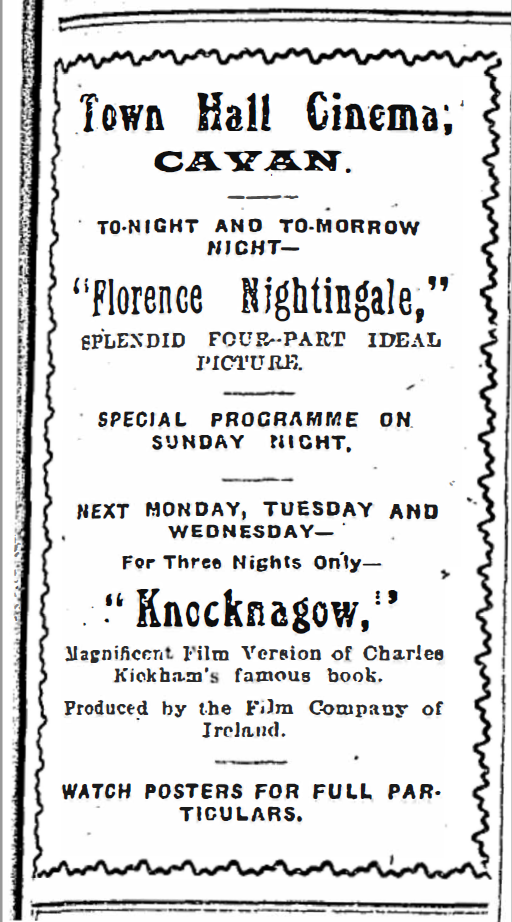
Although the surviving evidence in Ireland’s regional newspapers does not quite support Sullivan’s attempts to boost Knocknagow in advance of its Dublin opening, the film had been shown – or in the case of Limerick, was about to be shown – in the towns he named. To clarify, before its week-long run at the Empire Theatre in Dublin (22-27 Apr.), the film was shown at Magner’s Theatre in Clonmel (30 Jan.-2 Feb.), the Sackville Picture Theatre in Dublin (trade show, 6 Feb.), the Cinema Palace in Carlow (18-19 Feb.), the Town Hall Cinema in Cavan (25-27 Feb.), the Cinema in Kilkenny (6-7 Mar.), the Opera House in Cork (18-23 Mar.), the Coliseum in Waterford (1-6 Apr.), the Opera House in Derry (8-13 Apr.), the Empire Theatre in Belfast (15-20 Apr.), the Shannon Cinema in Limerick (15-17 Apr.) the Picturedrome in Tralee (18-20 Apr.) and the Town Hall in Galway (22-24 Apr.).

Anglo-Celt 23 Feb. 1918: 7.
A survey of the reception of Knocknagow in the run up to the Dublin opening has shown something of the way in which the film resonated with audiences around the country. It makes clear that the film was certainly popular with Irish cinemagoers, with local critics consistently praising its fidelity to Kickham’s novel, the quality of the acting and the beauty of the Tipperary scenery. However, few reviews mentioned the film’s contemporary political relevance. Indeed, some suggested that audiences abroad would be particularly impressed by the film, including the Anglo-Celt‘s reviewer, who subtitled his/her notice “A Picture Play that Will Create a Furore in America” (“‘Knocknagow’ on the Film”).
Despite such potentially politically sensitive scenes as the eviction, this was probably due to the fact that such events were depicted in the past, safely distanced, with Cork Evening Echo emphasizing that the film would attract “all those who take an interest in the economic and social development which has taken place in this country during the past two generations” (“Opera House”). These events had happened “many years ago” even for those such as the Evening Herald’s Jacques, for whom the film vividly recalled personal memories of “the cabin doors broken and the furniture flung out, and the poor half-dressed occupants lying on the roadside amid the wreckage of their home.”

An illustrated intertitle introduces the eviction scene, emphasizing its importance.

It was only really in Galway that a critic saw the film’s immediate political relevance by arguing that it

pointed a topical moral at the present time. We saw the evictions, the crowbar brigades, the burnings, the landlord oppression of 70 years ago, the attempt to wipe out a race. Such memories – only of the other day – as it revived scarcely accommodated the mind of the beholder to the nation of conscription. (“Town Hall.”)

By the time this reviewer was writing on or about 26 April, conscription had become the politically unifying issue for nationalists that it had not been earlier in Knocknagow’s run.

While FCOI could not have foreseen such events, the company enhanced its connection to the local audience in many of the places Knocknagow was shown by having members of the cast sing at screenings. This was a unique feature of the film’s exhibition in Ireland. Film actors had on special occasions attended screenings of their films, but they very rarely contributed to the events’ live music. Brian Magowan, the film’s main star and an actor familiar with musical theatre, appeared most often, regularly accompanied by fellow cast member Breffni O’Rourke. This was not Magowan’s first vocal accompaniment of a FCOI film; he had sung at the premiere of the company’s first film, O’Neill of the Glen. In the case of Knocknagow, however, the FCOI gave this feature special prominence by having Magowan and O’Rourke, dressed in character, sing folk songs connected with the film. Although they did not appear at every venue where the film was shown, and of course, they could not have when the film was showing simultaneously in geographically remote locations, Magowan’s and O’Rourke’s live appearances were regular features of the first run of the film in Ireland.

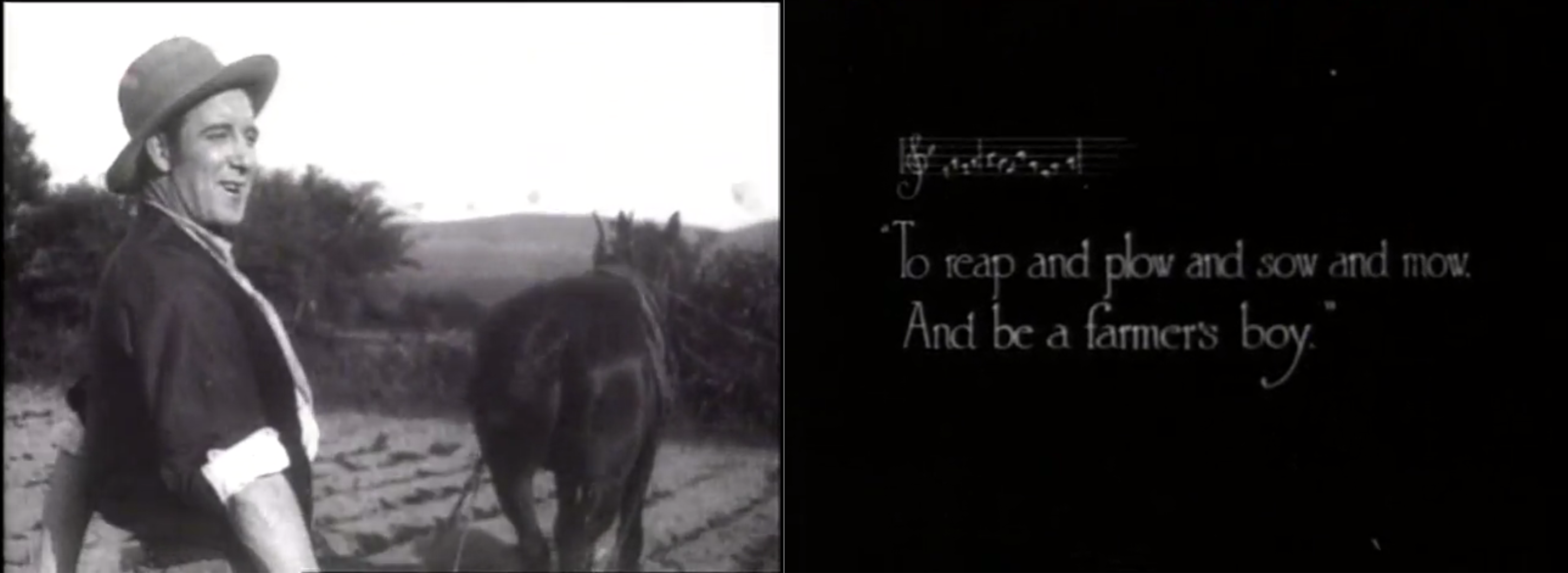
While ploughing a field with a view of Slievenamon (mountain), Mat pauses to sing “The Farmer’s Boy,” with an intertitle helpfully providing musical notation and the song’s refrain.

Their earliest appearance seems to have been in Cavan, where the Anglo-Celt reported that “[a]n interesting feature of the entertainment was that Mr. J. McGowan, who, as ‘Mat the Thrasher’ was the hero on the film, appeared each evening in the flesh and sang some old Irish ballads in very charming voice, while Mr. Breffni O’Rourke (‘Bill Heffenan’ in the play) gave some traditional Irish lays and witty stories” (“‘Knocknagow’ on the Film”). Magowan most important contribution was “Slievenamon,” a song about the Tipperary mountain whose lyrics Kickham had composed. The centrality of this song to the FCOI’s conception of the ideal accompaniment of the film is underlined by the reproduction of Magowan’s arrangement of the song for voice and piano that was included in a programme for a later (probably 1919) run of the film (NLI).

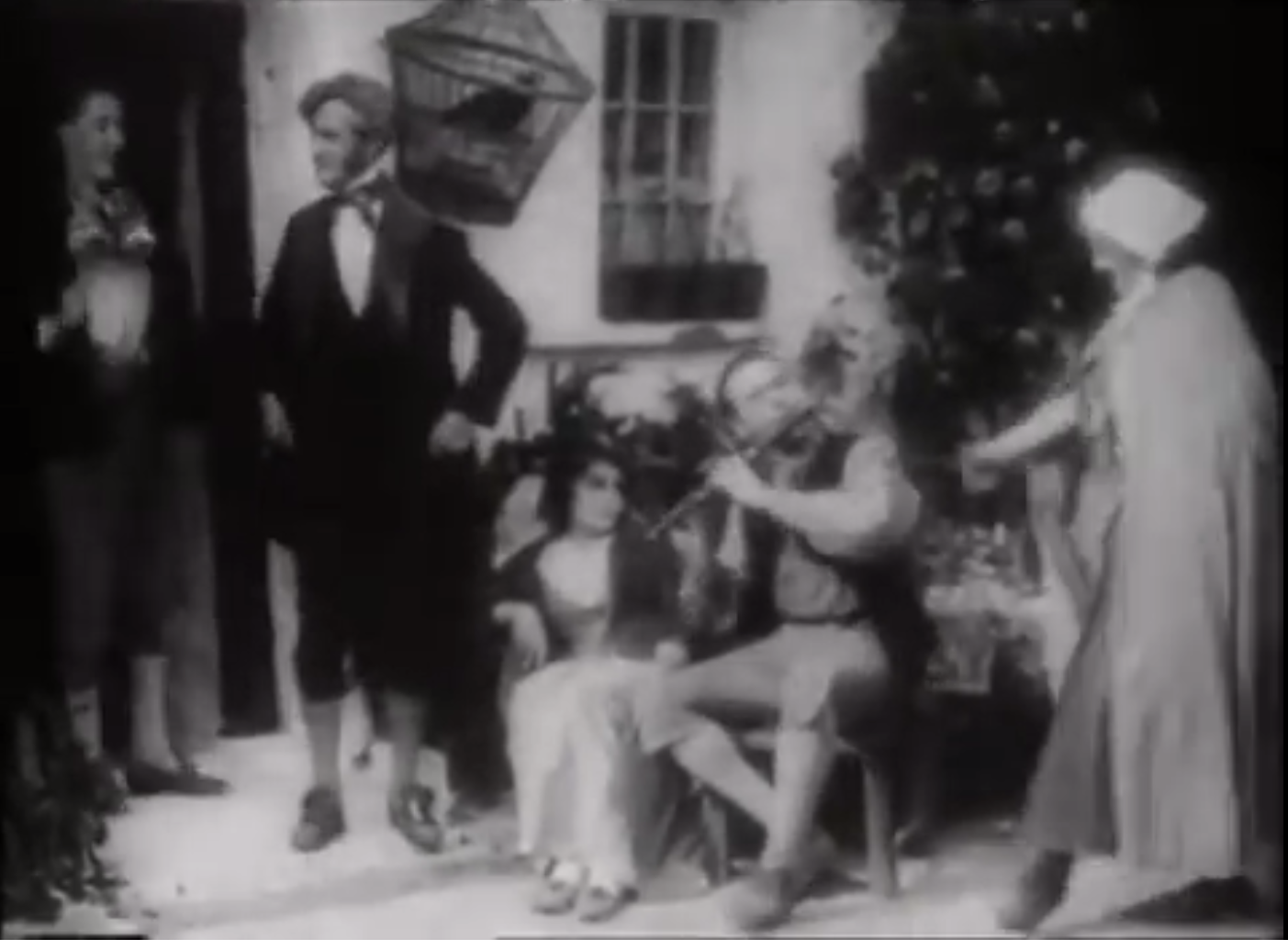
The film has many musical scenes, including this one in which Billy Heffernan plays the flute while the Lahys dance.

The reviews are unclear on whether they sang before, after or during the projection of the film, but the film itself includes moments that motivate vocal accompaniment. In an early scene of the film, Mat is introduced by an intertitle and then shown ploughing a field in long shot. In a mid-shot, he turns around to the camera, and an intertitle appears with a musical stave and the refrain from the folk song “The Farmer’s Boy.” The cut back to Mat shows him singing animatedly before he returns to his ploughing in the shadow of Slievenamon. These on-screen cues might provide the place for Magowan to sing or they might encourage the audience to sing these popular tunes. A similar series of shots occurs later when tailor Phil Lahy sings “The Black Horse,” whose opening lines are printed on an intertitle.

Made and released during a fraught historical moment, Knocknagow sought to engage its audiences with a bestselling literary text and popular songs and involve them in the process of readjusting the representation of the Irish on screen.

References

“Court Scene: Clare Cattle Drivers Refuse to Recognise ‘this Concert.’” Dublin Evening Mail 16 Mar. 1918: 3.

Donovan, Stephen. “Introduction: Ireland’s Own Film.” Screening the Past 33 (2012). Available at <http://www.screeningthepast.com/2012/02/introduction-ireland%E2%80%99s-own-film/&gt;

Jacques. “Knocknagow Filmed: Wonderful Irish Picture of Storied Incident.” Irish Limelight Apr. 1918: 5.

JAP. “Gossip of the Day: Film Version of Kickham’s Most Famous Novel.” Evening Telegraph 7 Feb. 1918: 2.

—. “Gossip of the Day: The Present Fashion in Films.” Evening Telegraph 27 Feb. 1918: 2.

“‘Knock-Na-Gow’ at the Opera House.” Derry Journal 10 Apr. 1918: 4.

“‘Knocknagow’ on the Film: A Picture Play that Will Create a Furore in America.” Anglo-Celt 2 Mar. 1918: 6.

“Labour’s Protest.” Freeman’s Journal 24 Apr. 1918: 2.

The Man About Town. “Thing Seen and Heard.” Evening Herald 22 Aug. 1917: 2; 9 Mar. 1918: 2.

NLI (National Library of Ireland). MS 50,000/272/82, Liam O’Leary Archive. Programme for Knocknagow, n.d.

“Opera House.” Evening Echo 14 Mar. 1918: 2.

“Proclamation: Processions Forbidden for the Next Three Weeks in the Dublin Area.” Dublin Evening Mail 7 Mar. 1918: 3.

“A Round Up: Many Volunteers Arrested.” Evening Telegraph 12 Mar. 1918: 3.

“Soldiers & People in Conflict: Scenes in Limerick.” Irish Independent 6 Mar. 1918: 3.

“Town Hall.” Galway Express 27 Apr. 1918: 4.

“The Untenanted Graves.” Irish Limelight Apr. 1918: 13.

Idealizing Everything Irish: The Film Company of Ireland Releases Rafferty’s Rise in late 1917

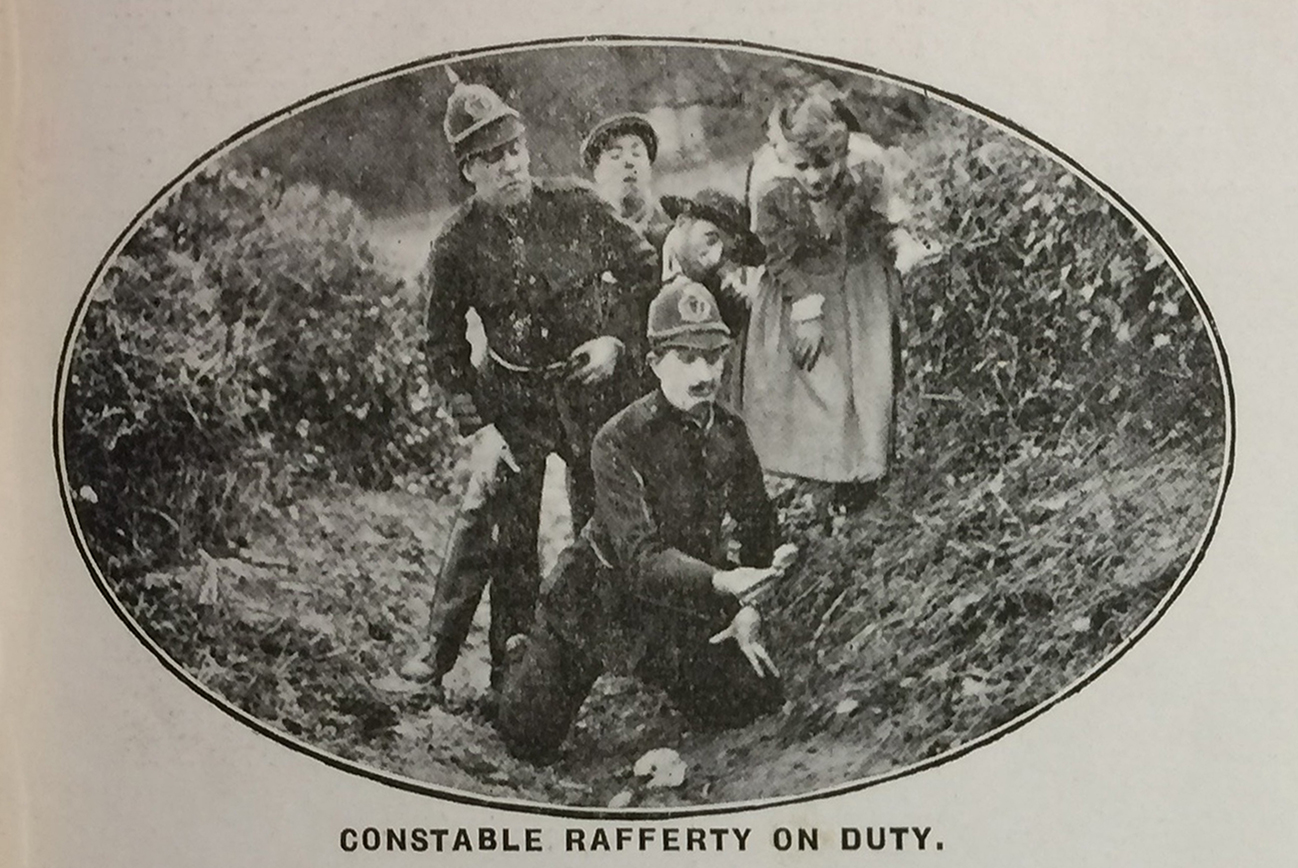
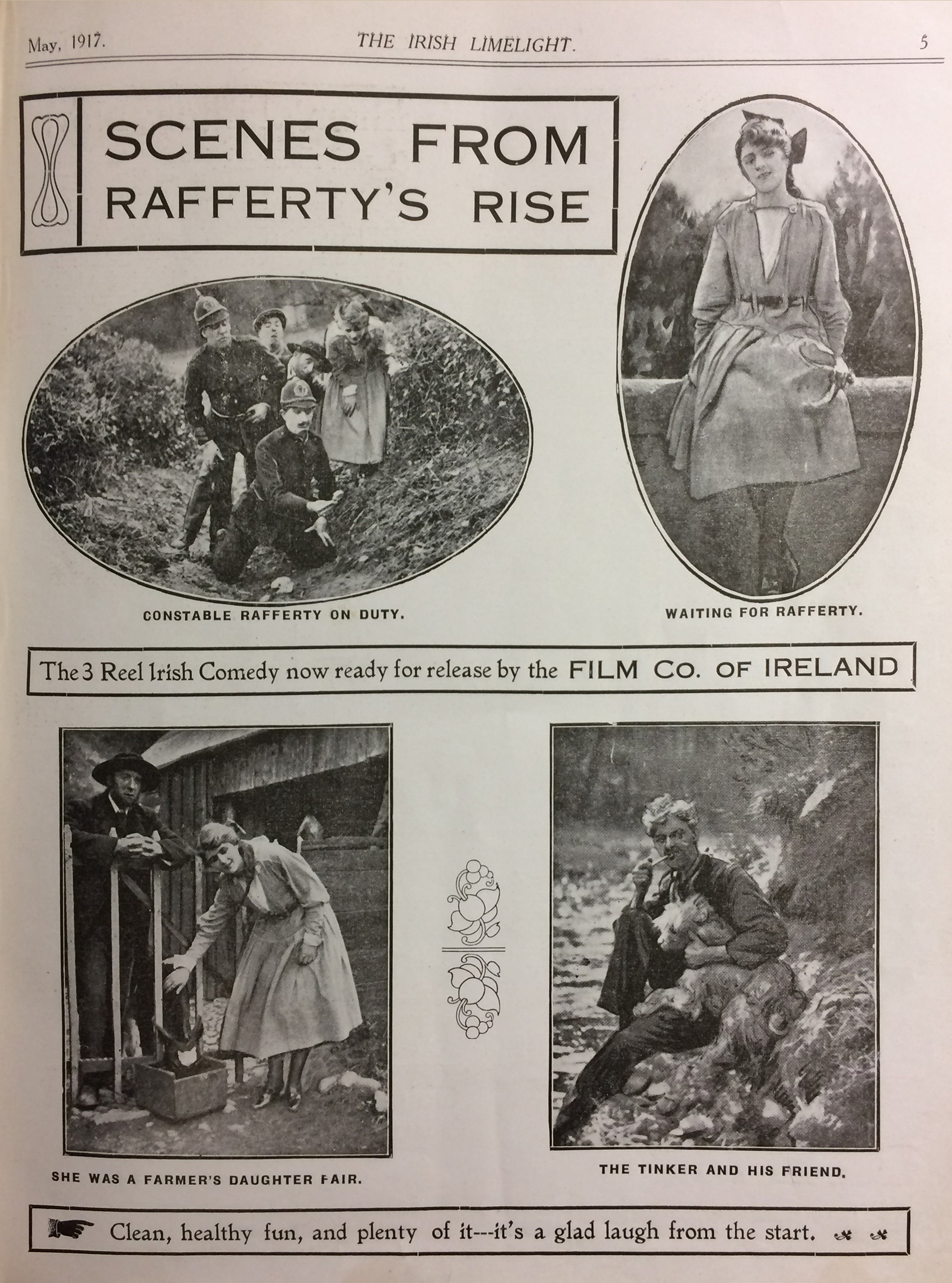
A still from Rafferty’s Rise (Ireland: Film Company of Ireland, 1917)); Irish Limelight May 1917: 5.

On 12 November 1917, the Film Company of Ireland (FCOI) finally premiered Rafferty’s Rise, its first completed production of the year. In many ways this is a minor film. Like all of FCOI’s 1916 productions, this three-reel (approx. 50 minute) comedy is now lost, and it appears to have been little seen in 1917, having had a very limited release. It was overshadowed at the time by the organizational difficulties experienced by FCOI in 1917 and by the fact that the company put its apparently dwindling resources into promoting the much more ambitious Knocknagow. Nevertheless, it is a film by Ireland’s most important fiction-film production company of the silent period and is the first film directed by Abbey Theatre actor-director Fred O’Donovan.


Irish Limelight May 1917: 5.

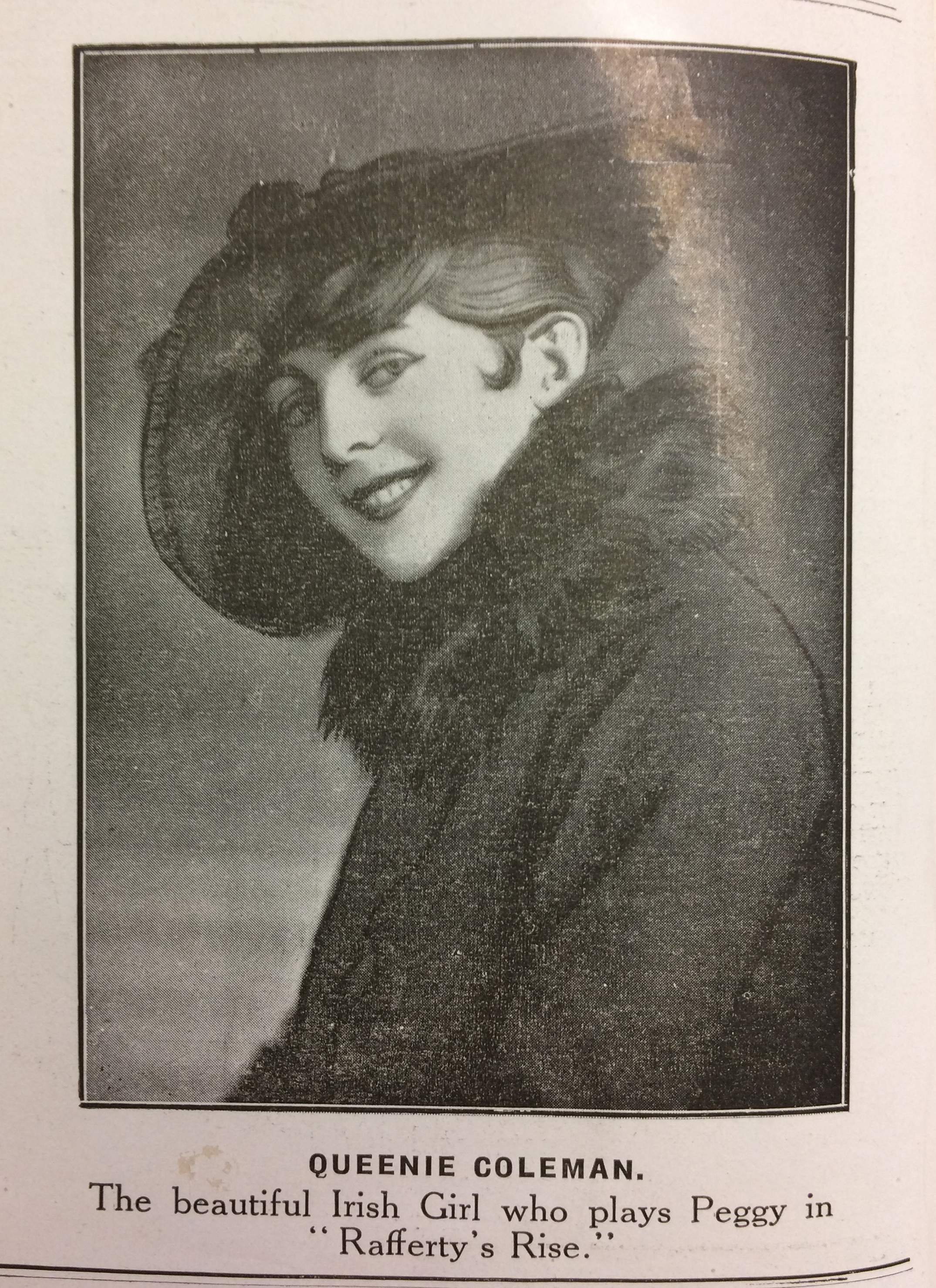
Although Rafferty’s Rise wouldn’t have its premiere until November, it was first mentioned in the Irish Limelight in May 1917. Indeed, it was not just mentioned; it was described in a 200-word article that was accompanied by a photo of Queenie Coleman, “the beautiful Irish Girl who plays Peggy in ‘Rafferty’s Rise,’ and illustrated by an additional full page of stills from the film itself that seem to confirm that it was actually “ready for release” in May, as one of the headings on the stills page asserts. “We extend our hearty congratulations to the Film Co. of Ireland upon their first 1917 release,” the article begins, “a three-reel comedy entitled ‘Rafferty’s Rise.’ The scenario deals with a young and ambitious Irish policeman who endeavours to employ scientific methods in the detection of crime and whose efforts to emulate Sherlock Holmes cause many laughter provoking incidents” (“Rafferty’s Rise” May).

Irish Limelight Jul. 1917: 14.

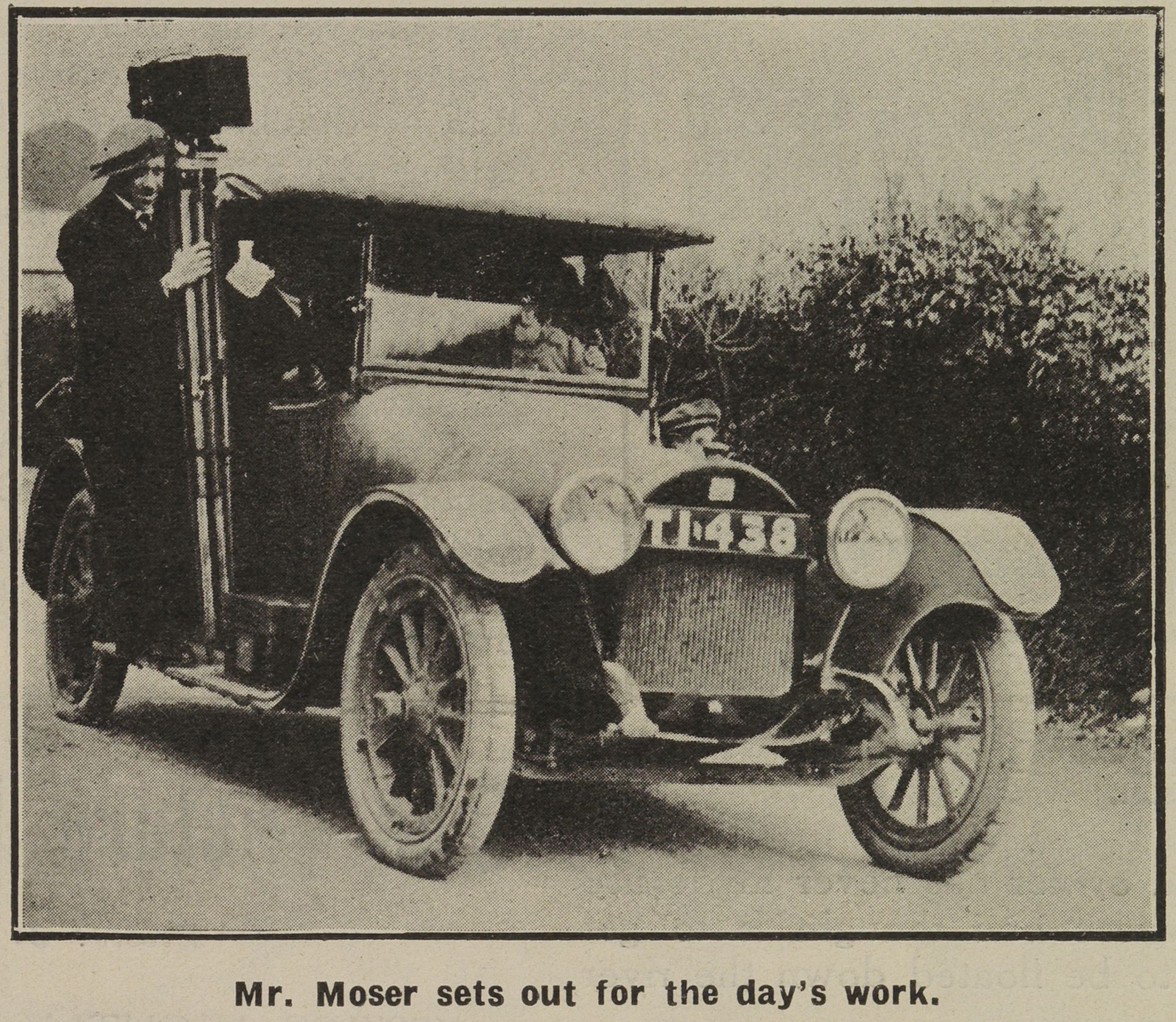
In November, the Freeman’s Journal would identify the scenario writer as Nicholas Hayes, a writer remembered now mostly for the short-story collection In the Doctor’s Den (“Picture House Novelties”). As well as directing, Fred O’Donovan also played the eponymous Rafferty, and was supported along with Queenie Coleman, by Brian Magowan, Kathleen Murphy, Arthur Shields, Valentine Roberts, J. Storey and Brenda Burke (“Rafferty’s Rise” Nov.). The film was shot in the Dublin Mountains by former Pathé cameraman William Moser, in his first on-set job for FCOI (“Camera Expert”). The exact shooting period is not known, but it is likely to have been in April, in time for the publicity materials to appear in the Limelight’s May issue.

An ad offering Rafferty’s Rise to Dublin exhibitors; Evening Herald 30 Oct. 1917: 2.

However, FCOI organizational problems meant that none of the films they had shot in summer 1917 were actually available to exhibitors until the end of October, when an Evening Herald ad announced the appearance of Rafferty’s Rise. A trade show or “private exhibition” referred to in some reviews likely took place at this point, at the end of October or beginning of November. Despite some indications in July that the film had been edited down from three reels to the two reels picturegoers expected of a comedy, the Rafferty’s Rise that went on release in November 1917 was still three-reels long (“Rafferty’s Rise” Jul). “It is a mark of the originality of the Company,” the Mail optimistically asserted, “that it is bold enough to go beyond the stereotyped 2-reels in the production of a humorous story” (“Film Company of Ireland”).

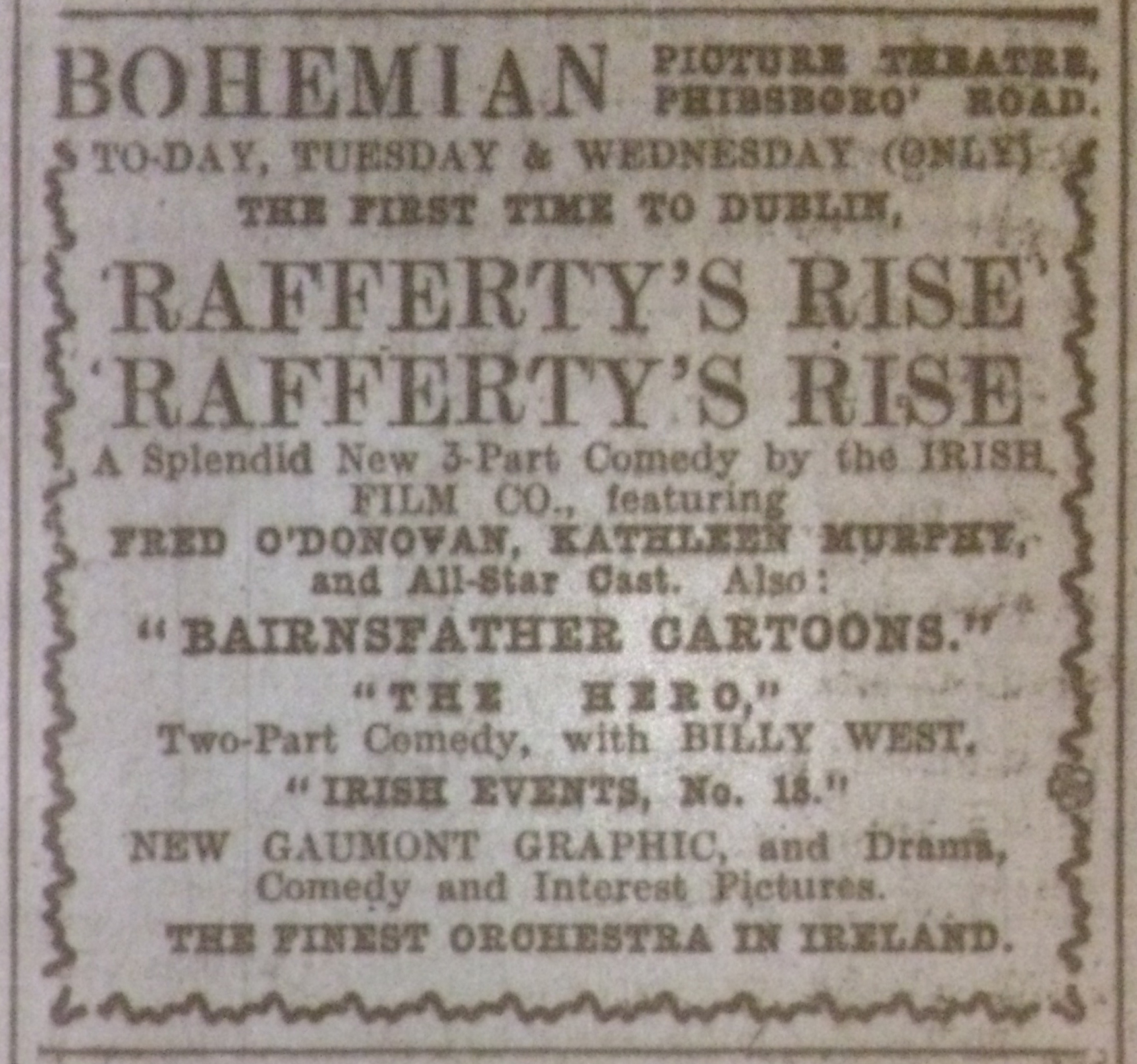
Dublin Evening Mail 12 Nov. 1917: 2.

Both the Dublin Evening Mail and the Evening Telegraph previewed the film in their Saturday entertainment columns prior to its three-day run at the Bohemian beginning Monday, 12 November. “The record of this Film Company in 1916 aroused great interest in their productions,” the Telegraph observed. “Those who have seen the private exhibition of the film speak highly of the progress the company has made in technique over last year’s work” (“Really Irish Films”). The writer in neither paper, however, seems to have attended the private exhibition, and the previews have similarities that suggest that the writers not only hadn’t seen the film but were working from publicity material or other secondary accounts.

Nevertheless, the Telegraph preview is particularly interesting for the way it defines “really Irish films.” “While the company keeps free from propaganda of every kind in its stories so as to be able to appeal to all the Irish people,” it argued,

it nevertheless sticks steadfastly to the idea that its business is to idealise everything Irish that it photographs. In this, the Film Company of Ireland only takes a leaf from the book of the producers of other nations. The Americans always give us in the parts of chivalry and honour – American; the English companies show in the same roles – Englishmen; and the Film Company of Ireland continues, in its attitude and in its interpretations, strictly Irish.

Avoiding overt ideological positions, appealing to all Irish people, idealizing everything Irish and putting Irish people in heroic roles: this usefully provides some kind of framework for thinking about what “really Irish films” might have meant to observers at the time. But to explore the relevance of these characteristics to Rafferty’s Rise, we will need to look at the film’s reception.

Of the newspapers, only the Telegraph reviewed the film, and its review is brief and largely descriptive of what it saw as “an excellent three-reel comedy [that is] packed with clean, healthy fun” (“On the Screen”). The only substantial extant review seems to be in the Limelight, which from its opening issue had associated itself very closely and uncritically with FCOI. “The film is typically Irish,” Limelight reviewer R.A.O’F. commented after attending the private exhibition, “for you will find a Constable Rafferty in every little village in the country – and to anyone who has any experience of the ways and means of a stripe-chaser, it is simply IT.” Specifically, s/he praised the “clean and healthy” humour, the beautiful Dublin Mountains’ scenery and the quality of the photography and acting.

Irish Limelight May 1917: 4.

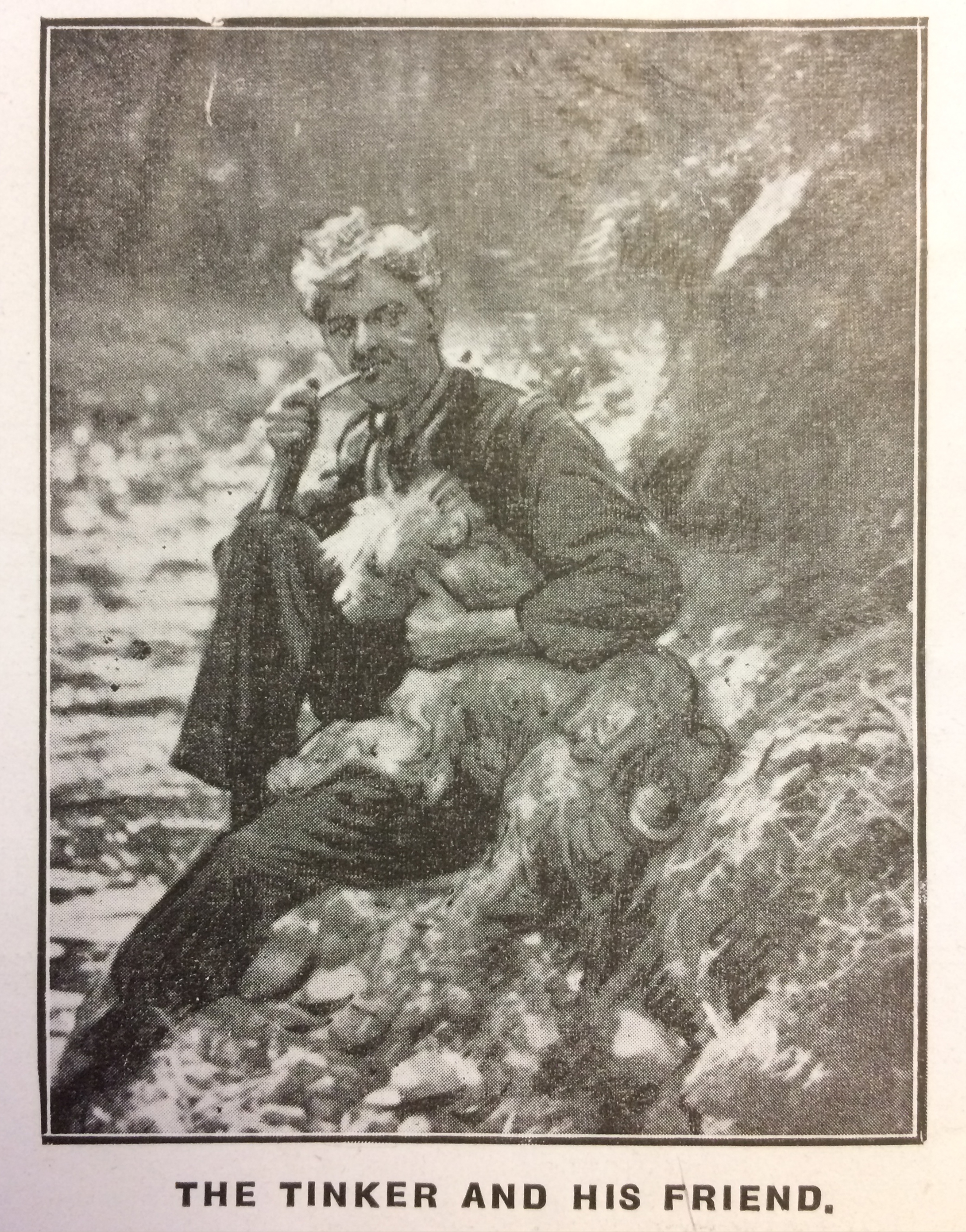
Much of R.A.O’F review is an extended plot summary that represents the most substantial account of the film. More than this, because the film is lost, this account is most of the film. The review is written in a comic style intended, no doubt, to be entertaining but as a result, it is not always clear or wholly accurate. For example, it includes the line: “All the girls loved Rafferty, and he could well afford to ignore the goo-goo eyes and tootsy-wootsy advances of silly Cissie.” The writer overreaches him/herself with the alliteration here because the name of the character who makes eyes at Rafferty is Peggy, played by Queenie Coleman. The following is a paraphrase in the interests of clarity: Rafferty is an officer in the Royal Irish Constabulary (RIC) stationed in a mountain village who wants to get promoted to sergeant by using methods of scientific detection. He is admired by the local girls, including farmer’s daughter Peggy McCauley. When a Traveller (“tinker,” in the original) visits the village, Kitty Hogan, daughter of the local RIC Sergeant, gives him an old pair of her father’s boots. The Traveller steals a dog from Peggy’s father, leaving footprints with the Sergeant’s boots. Rafferty sees the footprints and traces them to the Sergeant’s house, where he is forced to hide to keep his investigations secret, but the Sergeant finds him under Kitty’s bed. Rafferty accuses the Sergeant of stealing the dog, but his mistake is revealed. While Rafferty doesn’t get his promotion, he has some compensation by ending up with Peggy.

Irish Limelight May 1917: 5.

Given that the crime Rafferty investigates is a theft by a Traveller, discussion of ethnic stereotypes seems appropriate, but R.A.O’F language proves opaque here. “An honest tinker in a story would be responsible for the author being stamped as a ‘loony.’ However, the author of this scenario was quite sane, for his tinker was a rogue.” This is clear enough, but ethnic tensions are seemingly dispelled by the following sentence when the Traveller turns out possibly to have been honest after all: “He stole a dog—no he did no, he only exchanged dogs.” The Traveller is merely added as extra local colour in what might be described as a romantic comedy.

The main thing that R.A.O’F seems to want to convey about Rafferty’s Rise is that it was good clean fun and as such, it was typically Irish. This was also how the Mail’s preview  assessed it, as “a good-natured, laughable Irish story without malice and replete with amusing situations” (“Film Company of Ireland”). Good and clean it may have been, but the somewhat more laconic and less positive response of one other contemporary observer suggests that it was not much fun. “I caught tram at Rotunda & went on to the Bohemian Picture House, Phibsboro, to see ‘Rafferty’s Rise,’” Joseph Holloway wrote as part of his diary entry for 12 November 1917, “with O’Donovan as the blustering Constable, seemed the plot was by Nicholas [Hayes], but the humour in the playing was forced & did not make for laughter as intended.” For Holloway, it was not a successful comedy.

Ad for Tralee’s Picturedrome including a synopsis of Rafferty’s Rise; Kerry News 19 Nov. 1917: 4.

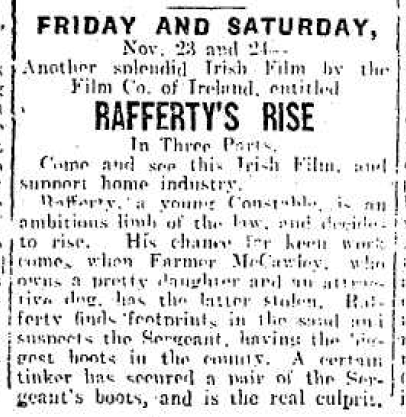
A general acknowledgement that Rafferty’s Rise was not very good may account for why the film received so little attention at the time. FCOI’s loss of such key publicity personnel as Joseph Boland, their travelling salesman whom the Bioscope reported had left the company to represent Geekay in Ireland, can’t have helped (“Irish Notes”). The only other run of the film in 1917 appears to have been on 23-24 November at Tralee’s Picturedrome, where locals were encouraged to “support home industry” by seeing it. Beyond these factors, it might also be worth considering why a romantic comedy about the Royal Irish Constabulary (RIC) recommended itself to FCOI. Granted, Rafferty’s Rise doesn’t seem that different from the company’s 1916 dramas and comedies of Irish rural life, which among other topics had included a comedy about leprechauns. And of course, many film comedies of the period represented the police. But while US comedies tended to see the police either as buffoons or unsympathetic authority figures tasked with keeping (other) elements of the working class in line, Rafferty’s Rise represents the RIC as benign. Although Rafferty is foolish and over-ambitious, these faults are attributable to the follies of youth, and Sergeant Hogan – who “did not want to be a district Tzar” (R.A.O’F.) – is ultimately able to put a stop to them. The RIC is part of the “everything Irish” that should be idealized.

The General Film Supply placed this ad prominently on the cover of the December issue of the Irish Limelight.

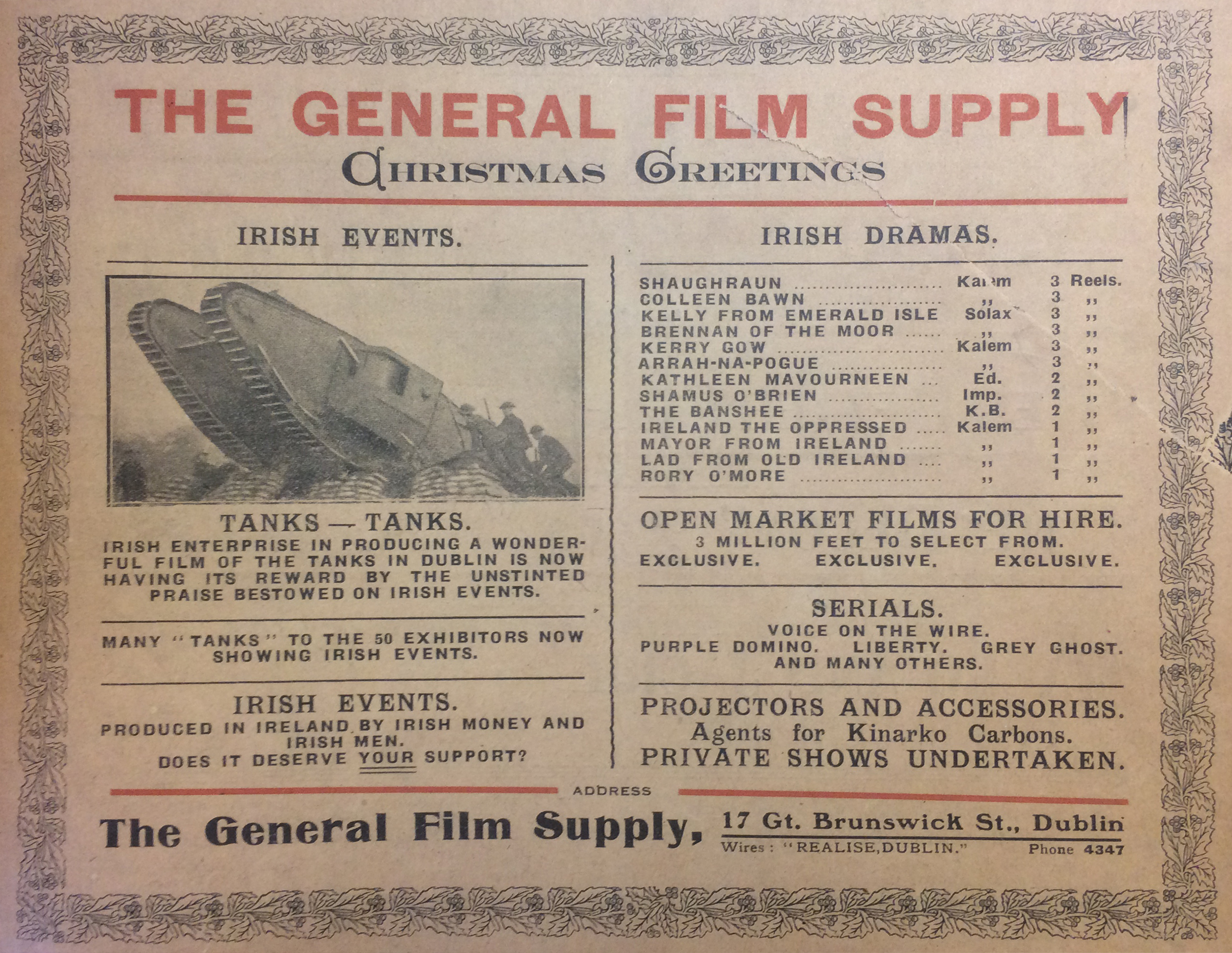
As 1917 drew to a close, the other main Irish film production company of the period, the General Film Supply (GFS), was idealizing the new technologies of war. The GFS took out a large ad on the cover of the Limelight’s December issues, offering Christmas greetings and publicizing the various aspects of its business, particularly its Irish Events newsreel and the Irish-themed fiction films it had for hire. The most striking feature of the ad is a photograph of a tank leading soldiers over an embankment. The text under the photo reads: “Irish enterprise in producing a wonderful film of the tanks in Dublin is now having its reward by the unstinted praise bestowed on Irish Events.” An interview with GFS cameraman J. Gordon Lewis reveals that the company were releasing their film of the tanks that was on manoeuvres near Dublin in instalments over four weeks. “I was agreeably surprised at the wonderful Tanks,” he enthuses:

I took a very nice picture from the inside of one of the Tanks. I sat on the driver’s seat and held the camera on my knees with the lens protruding through the look-out hole and held on to [the] side of the hole like grim death as we crawled along. […] I must say they are fine to ride in, and the heat of the inside will be welcome to many of Tanker Tommy during the winter months that are now among us. (“Filming the Tanks in Dublin.”)

There was as much fascination in Ireland with the spectacular new war technologies as there was anywhere else. In January 1918, the Limelight would reported that Lewis had topped his tank film by filming in a “battle-plane with the result that while 1,500 feet above the earth he secured a picture of another aeroplane in flight that is nothing short of sensational” (“Notes and News”).

With their focus on the police and army, Rafferty’s Rise and the GFS film of tanks in Dublin suggest in their different ways that at the end of 1917, Irish film producers were serving social stability and the war effort.

References

“A Camera Expert: Interview with Mr. William Moser of the Film Company of Ireland.” Irish Limelight Jul. 1917: 14.

“Film Company of Ireland.” Dublin Evening Mail 10 Nov. 1917: 2.

“Filming the Tanks in Dublin.” Irish Limelight Dec. 1917: 18.

Holloway, Joseph. Holloway Diaries. National Library of Ireland.

“On the Screen: Bohemian.” Evening Telegraph 13 Nov. 1917: 4.

Paddy. “Irish Notes.” Bioscope 1 Nov. 1917: 109.

“Picture House Novelties: New Productions of Film Company of Ireland.” Freeman’s Journal 12 Nov. 1917: 4.

“Rafferty’s Rise.” Irish Limelight May 1917: 4.

“‘Rafferty’s Rise.’” Irish Limelight Jul. 1917: 15.

R.A.O’F. “Rafferty’s Rise: Review of an Irish Comedy by Irish Players.” Irish Limelight Nov. 1917: 6.

“Really Irish Films.” Evening Telegraph 10 Nov. 1917: 3.

Screening the Funeral of Thomas Ashe, September-October 1917

Collins Funeral of Thomas Ashe

Michael Collins gives a pointed graveside oration in The Funeral of Thos. Ashe (Ireland: GFS, 1917)

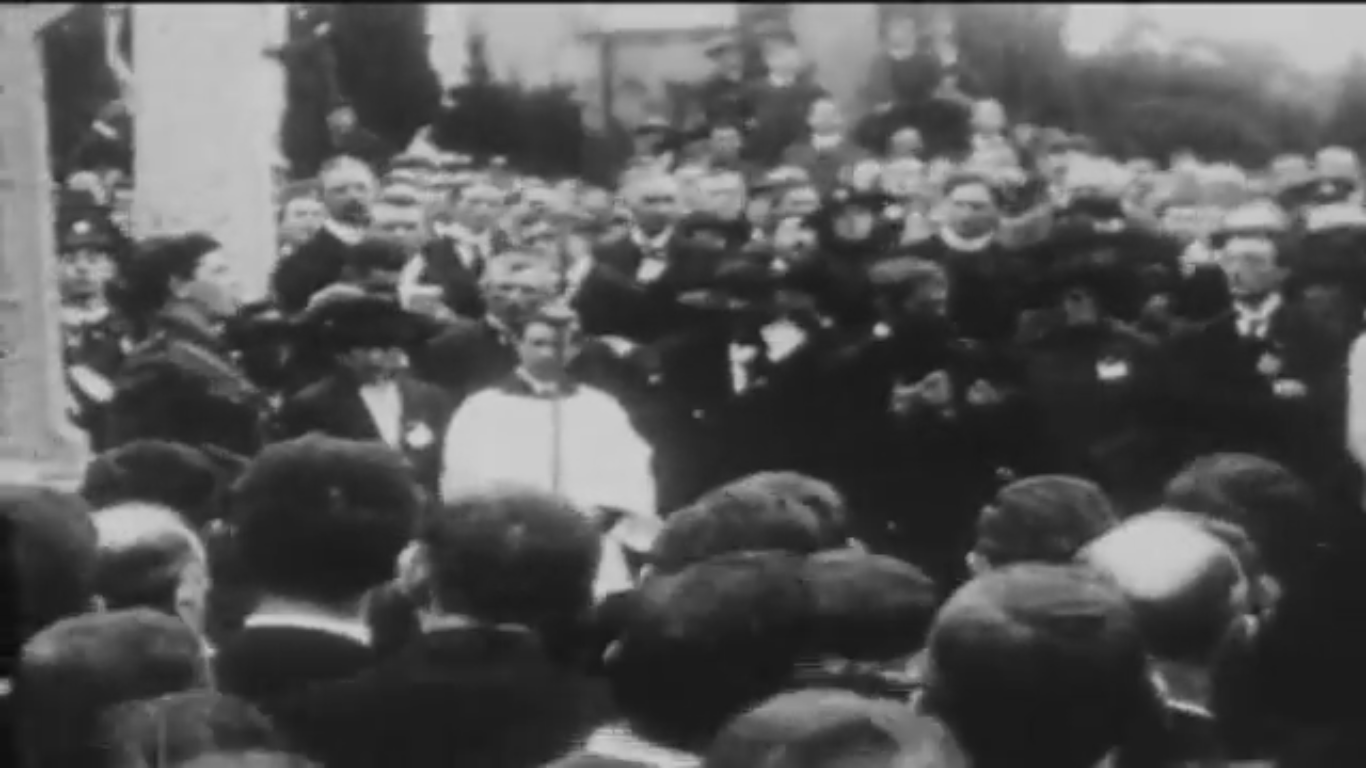
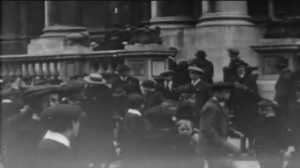
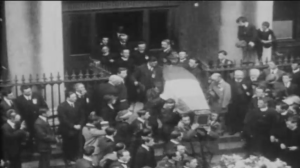
At 10pm on Sunday, 30 September 1917, Dublin’s Bohemian Picture Theatre exhibited a special newsreel film of the funeral of Thomas Ashe that marked the spectacular public culmination of a protest against British government treatment of Sinn Féin prisoners in Mountjoy prison. The occasion of the protest was the death on 25 September of Thomas Ashe, president of the Irish Republican Brotherhood, as a result of force-feeding while on hunger strike. In a series of demonstrations carefully stage-managed by republican leaders, Ashe’s body became the emblem of a new public solidarity between the various insurgent nationalist groups that were moving towards coalition under the name of Sinn Féin. His body lay in state first at the Mater hospital and following a procession through the city, at City Hall. The protest’s highlight was Ashe’s funeral at Glasnevin cemetery on 30 September, the largest public demonstration since the 1916 Rising was suppressed, at which the Irish Volunteers marched openly under arms and fired three volleys of shots over the coffin, “the only speech which it is proper to make above the grave of a dead Fenian,” as Michael Collins put it in his laconic graveside oration (“Funeral of Thomas Ashe”).

Boh Ashe Premiere 29 Sep1917 DEM

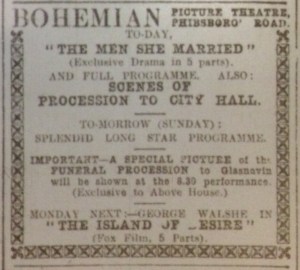
Ad for Bohemian Picture Theatre offering an exclusive screening of the full Funeral of Thos. Ashe film; Dublin Evening Mail 29Sep. 1917: 2.

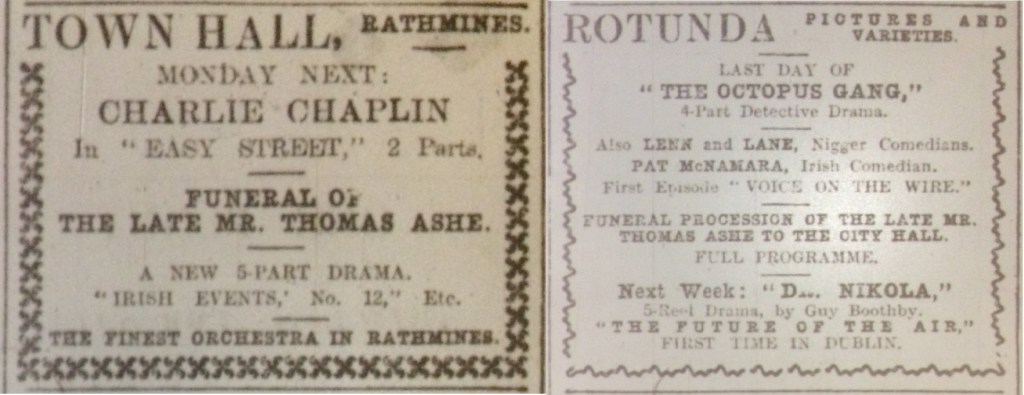
The film of the funeral that the Bohemian showed was the work of Norman Whitten’s General Film Supply (GFS). The Evening Herald commended the exhibition on the evening of Ashe’s funeral “of films showing various ranges of the procession and scenes associated with it. The rifling part at the grave was included” (“30,000 Mourners”). The widespread publicity of organized events after Ashe’s death allowed Whitten and his “able lieutenant” J. Gordon Lewis to plan a newsreel special to supplement their regular Irish Events newsreel (“Films Up-to-Date”). In what might be called a prequel, some of the material relating to Ashe’s lying-in-state at City Hall was shown at such picture houses as the Rotunda and the Town Hall, Rathmines on the Saturday night preceding the funeral, with the complete film, including the procession through the city to the cemetery, due for general release on the following Monday. The final film was first exhibited, however, on the night of the funeral at the Bohemian, a picture house located on the route of the funeral procession out of the city, between Mountjoy prison and Glasnevin cemetery.

Rotunda THR Ashe 29 Sep 1917 DEM

Ads for Town Hall, Rathmines and Rotunda on Saturday 29 September featured newsreel of Ashe’s funeral, including scenes of the body lying in state at City Hall but not of the graveside; Dublin Evening Mail 29 Sep. 1917: 2.

Reporting on the filming of the funeral, the cinema journal Irish Limelight observed that people “took part in the procession, went home to have tea, and an hour later saw themselves on the screen. Some hustle on the part of the camera men!” (“Films Up-To-Date”). Reference has already been made here to the speed with which Whitten could prepare his films for exhibition, and this again distinguished the Thomas Ashe film produced for Irish Events from those of its competitors, in this case, from Charles McEvoy, proprietor of the Masterpiece Theatre, who also filmed the funeral but was unable to show his film until the Monday evening (ibid).

Bohemian Interior

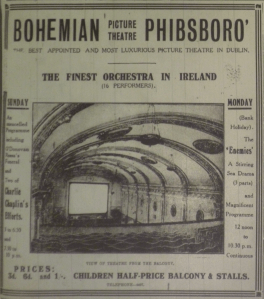
Ad showing interior of the Bohemian Picture Theatre, Evening Telegraph 31 Jul. 1915: 3.

But the really interesting thing here is not just the speed with which the film was ready but also that it was shown at a picture house conveniently located for those who had attended the funeral. The Limelight report suggests that, having taken some refreshment, mourners reassembled at the Bohemian to reconstitute the political demonstration that the funeral represented. Here, they viewed the funeral distilled to its ten-minute highlights – twice the usual length of a newsreel – all taken from advantageous viewpoints. In a sense, the exhibition at the Bohemian represented the culmination of the political protest, of the concentration of the energies and emotions that had been built up over several days. That night the spectators were freed from the limited perspective available to people in a crowd; they saw all the key events from a sometimes privileged vantage point. The audience was now able to see itself, and specifically to see itself involved in a significant political protest. As such, the Bohemian screening of this film was a moment when the cinema assumed a key role in Irish political protest.

Thos Ashe funeral queues at City Hall

People queue to file past Ashe’s body in The Funeral of Thos. Ashe.

Although little information is available on what actually happened in the Bohemian that night, what does survive suggests that the film fostered audience interactivity – a participative kind of spectatorship – among the people who chose to attend its screening. While it is unlikely that many individual mourners could have identified themselves among the throngs depicted in long shot by the funeral film, the camera viewed many of the events from among the spectators and could therefore help re-create for its audience their participation in the funeral as a group by reproducing their optical perspective.

Thos Ashe removal from City Hall

Ashe’s Tricolour-draped coffin is removed from City Hall in The Funeral of Thos. Ashe.

Newspaper reports and photographs demonstrate that even such apparently god-like perspectives as the high-angle shots above the crowd reproduced the points of view of numerous mourners. “Over 200,000 spectators and sympathisers thronged the route,” declared one evening newspaper, “roofs, windows, verandas — even lamp-posts, railings, walls, hoardings, trees, statues, and monuments — every possible point of vantage was utilised by eager sightseers” (“30,000 Mourners”).

Ashe Funeral O'Connell Statue FJ 2 Oct 1917p6

Freeman’s Journal 2 Oct. 1917: 6.

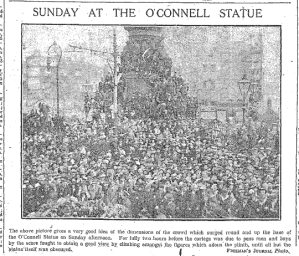
The Freeman’s Journal reported that “residents of many houses were charging for seats at their windows, and that the sites were appreciated by those taking advantage of them was testified by the numbers who witnessed the procession from these points” (“Thomas Ashe”). The caption to a photograph in the Freeman reads:

Sunday at the O’Connell Statue: The above picture gives a very good idea of the dimensions of the crowd which surged round and up the base of the O’Connell Statue on Sunday afternoon. For fully two hours before the cortege was due to pass men and boys by the score fought to obtain a good view by climbing amongst the figures which adorn the plinth, until all but the statue itself was obscured.

Iron Strain Boh 30 Sep 1917

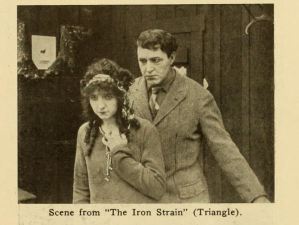
Still of Dustin Farnum and Enid Markey in The Iron Strain (US: Kay-Bee/New York, 1915), known in Ireland and Britain as A Modern Taming of the Shrew. Image from IMDb.

That said, other factors in the first exhibition of The Funeral of Thos. Ashe must have worked to dissipate this participative dynamic or to make it fleeting. Advertisements for the Sunday evening show at the Bohemian, for example, describe it as “a special long and interesting programme,” featuring “a five-part exclusive comedy-drama entitled, ‘A Modern Taming of the Shrew.’” This film – known in America as The Iron Strain – was a Western comedy starring Dustin Farnum and Enid Markey. With the evening performance beginning at 8.30 and the funeral film screening at ten o’clock, the audience would have experienced an hour and a half of A Modern Taming of the Shrew and other films before the funeral film. Nothing about this programming suggests that the audience was being kept in a suitably reverent, nationalistic or rebellious state of mind. There is also no report that the cinema’s well-publicized orchestra played dirges or patriotic tunes during the funeral scenes, although it seems very likely that it did during the screening of the funeral film itself because this was the practice on similar occasions.

As well as this, the Limelight article suggests that it was not primarily the continuation of the demonstration that brought mourners to the Bohemian but the narcissistic pleasure of seeing oneself on screen, of picking oneself out of the crowd. This kind of pleasure was certainly a feature of some of the earliest locally made films, which invited people who believed that they may have been filmed by a visiting cinematographer to “come and see yourself” on screen. And although there was a narcissistic potential here, early films also purposely employed the figuration of the crowd as an instance of identification with oneself not as an individual but as part of a collective.

May 1918 IL Irish Events ad CU

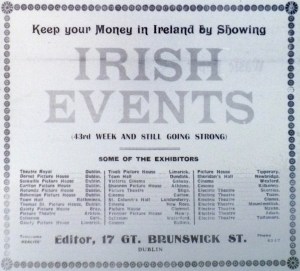
The cover of the May 1918 issue of Irish Events featured an ad listing 35 cinemas around Ireland that subscribed to Irish Events.

As such, this film and others like it address not only those who could claim this very direct form of spectatorial identification with the image that came from attending the event, but also those who would have wished to be there. In the weeks following the funeral, apart from cinema-goers who were indifferent or hostile, it is likely that screenings of the film in Dublin and around Ireland, not least in the 35 cinemas that subscribed to Irish Events, would have brought together spectators who had taken part in the demonstrations as well as those who had wished to but been unable to attend. From this perspective, these films are essentially local newsreels targeted at spectators who could decode them. Therefore, it was not only the actual participants who would be able to place themselves in the crowd, but also those who could fill in this “back-story,” those who would have wanted to be in the crowd and who, as a result, became virtual participants. These films worked on the desire to see oneself as a participant, whether or not one actually had been present at the event, and provided a semi-public context in which to experience this mediated participation.

Ch4Four

Irish Limelight Apr. 1918: 14

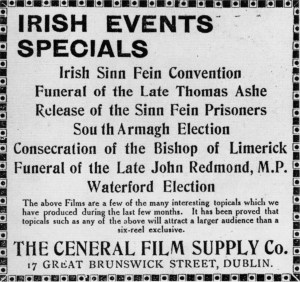
Such Irish Events specials as The Funeral of Thos. Ashe could be used to imply identification between the spectator and popular protest. In the period between the 1916 Rising and the War of Independence, GFS seems to have ensured its audience by being more obviously favourable to the nationalist cause. An ad on the cover of the April 1918 issue of Irish Limelight listed Irish Events specials: Irish Sinn Fein Convention; Funeral of Thos. Ashe; Release of the Sinn Fein Prisoners; South Armagh Election; Consecration of the Bishop of Limerick; Funeral of the Late John Redmond, M.P.; and Waterford Election. “It has been proved,” boasts the ad, “that topicals such as any of the above will attract a larger audience than a six-reel exclusive.” In the context of wider political events and especially when they took the place of the featured attractions at the top of the cinema programme, as The Funeral of Thos. Ashe did at the Bohemian Picture House on 30 September 1917, the political significance of these films becomes more fully visible.

References

“30,000 Mourners: Incidents in Yesterday’s Mighty Funeral.” Evening Herald 1 Oct. 1917: 3.

“Films Up-to-Date.” Irish Limelight Oct. 1917: 8.

“Funeral of Thomas Ashe: Sinn Fein Demonstration in Dublin.” Irish Times 1 Oct. 1917: 6.

“Sunday at the O’Connell Statue.” Freeman’s Journal 2 Oct. 1917: 6.

“Thomas Ashe: Funeral in Dublin Yesterday: Impressive Scenes: Enormous Crowds Throng the Streets.” Freeman’s Journal 1 Oct. 1917: 3.

“Peeps at Parochial Happenings”: Irish Events Newsreel Begins, June-July 1917

Political developments formed the context for the conception and launch of Ireland’s first newsreel, Irish Events, in the month between 18 June and 17 July 1917.

Jun 18 1917 ET Prisoners 2

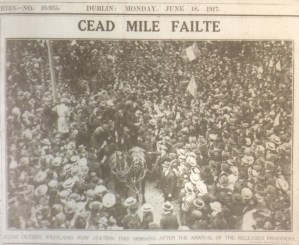
The Evening Telegraph placed a very large photograph of the returned Irish prisoners leaving Westland Row station on its front page on 18 June 1917.

“Somewhere about 9 a.m. a man was about to enter his offices in Great Brunswick Street,” cinema trade journal Irish Limelight reported of the exciting events of 18 June 1917 in Dublin. On 15 June, the British government had announced a general amnesty for the remaining Irish people it had jailed for their roles in the 1916 Rising. Many of these prisoners had experienced jeers as they were marched out of Dublin in early May 1916; their homecoming would be very different, indeed a nationalist celebration. Nevertheless, there was tension in the city in the days leading up to their arrival because it was not clear when or by what route they would come. This was also true of the man leaving his office in Great Brunswick (now Pearse) Street. “It is possible that he was not feeling altogether in harmony with the glorious summer morning,” the Limelight observed.

For two days he had been on the alert, waiting and watching for the homecoming of the released Sinn Fein prisoners. He had no concern with their political views or with the views of the Government that set them at liberty. He was a kinematographer and he was out for business – and it looked as if the business was likely to elude him. (“Sinn Fein Prisoners’ Homecoming.”)

IRISHLIMEGHT1JUL_P17 002

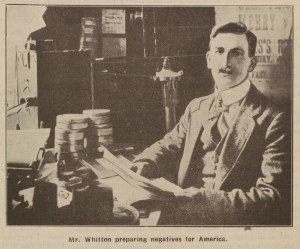
Norman Whitten in his offices at 17 Great Brunswick Street; Irish Limelight 1:7 (Jul. 1917): 17. Courtesy of the National Library of Ireland.

The man was Norman Whitten, managing director of General Film Supply, for whom the prisoners’ homecoming was “as good a ‘topical’ as had happened for a long time.” An English filmmaker who had learned the cinema business from pioneer Cecil Hepworth, Whitten had been working in Ireland since the early 1910s, making topical films of local interest and advertising films. He was also an agent for several British equipment manufacturers as well a distributor of certain films. Two days after the events described by the Limelight, he would be in Dublin’s nisi prius court successfully prosecuting James J. Fisher for outstanding monies related to the exhibition of the film Lost in the Eternal City, for which Whitten held the Irish rights (“Hire of a Film”). Whether Whitten ever received the £70 and costs awarded by the court is not clear because the Limelight pointedly reported on the same page as its account of Whitten’s filmmaking that Fisher, “so well known in Ireland in connection with the official war films, left for Salonika on the 25th June” (“Mr. J. J. Fisher”).

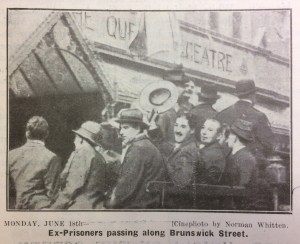
In any case, early on 18 June, Whitten was presented with an opportunity. Westland Row station was about five-minutes walk from his office. “His key was just in the lock when a wave of cheering came down the street from the Westland Row end,” the Limelight report continues:

Looking up he saw the Sinn Fein tricolour waving at the head of a procession just turning into Great Brunswick Street. One glance was enough, and in another he was feverishly active inside in the office. Where was that favourite camera? How many feet of film had he? Where was the other box? And the tripod! (“Sinn Fein Prisoners’ Homecoming.”)

Prisoners photo IL Jul 1917

A framegrab or “cinephoto” from Whitten’s film, showing the former prisoners passing the Queen’s Theatre in Brunswick Street, which was beside Whitten’s office. Irish Limelight 1:7 (Jul. 1917): 16. Courtesy of the National Library of Ireland.

Having assembled his equipment, “he was out again in the street, the tripod was mounted on a chair, the eye of the kinematograph was pointed directly at the oncoming procession and the first film of the ex-prisoners’ homecoming was being taken.” He followed the procession through the streets to Fleming’s Hotel in Gardiner Street, where some of the former prisoners obliged him by waiting in their carriages until he had set up his camera to film them getting down.

To capitalize on this scoop, however, Whitten had to show the “hustle” for which he was renowned by developing, printing and delivering the film to the Dublin’s cinemas interested in it. In doing this, he needed to be faster than the other filmmakers who were also out shooting these events, including Gaumont’s Mr Russell. Among its extensive production and distribution businesses, Gaumont produced its own newsreel, the Gaumont Graphic, and the company had shot their first topical in Ireland in June 1913 (“Irish Topical”). Its well-appointed offices in Dublin’s Lord Edward Street included facilities for developing and printing film, but for some reason – possibly lack of personnel – Russell had to send his film to England to be processed (“Building News”). Whitten, by contrast, processed his own film, and as a result, the excitement of the shooting in the streets was followed by

hours of swift and delicate work in the ruddy gloom of the developing room and in the arid light of the drying room. Three hundred and fifty feet of film had to be fixed on the developing frames and plunged into the tanks for eight minutes, then rinsed and fixed. In the balance of half-an-hour it was washed. Fifteen minutes later the whirling drums had dried it. (“Sinn Fein Prisoners’ Homecoming.”)

At this period, a film of 350 feet would usual run five to six minutes, but this was not the completed film. Whitten edited the raw footage and added end- and intertitles to produce a finished film that likely ran five minutes, the typical length of a newsreel. This was not a typical newsreel film, however, because a newsreel usually consisted of five one-minute items showing a mixture of news and social events. Instead, this was a special topical. “By 3 p.m.,” the Limelight revealed, “three copies had been printed and fully titled with a photograph of McGuinness added at the end and were rushed off in taxis to the picture houses which had been enterprising enough to book this ‘red-hot topical.’” Joseph McGuinness had been a prisoner in Lewes jail when he was elected MP in the May 1917 Longford South by-election, and he had been at Fleming’s Hotel to greet the returned prisoners.

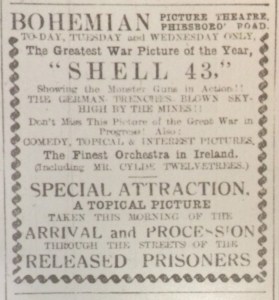
Boh Release Prisoners 13 Jun 18 1917 DEM

Bohemian Picture Theatre with Whitten’s film of the released prisoners; Dublin Evening Mail 18 Jun. 1917: 2.

The film was ready for afternoon showings in Dublin’s picture houses, but its initial run of just three copies meant that it could only play at three venues: the Bohemian Picture Theatre in Phibsboro, the Town Hall, Rathmines (THR) and the city-centre Rotunda. The managers of these picture houses certainly believed that the film would be a draw, and the Bohemian and THR even managed to have it prominently mentioned in their ads in the evening newspapers. Among those who were attracted were some of the prisoners themselves:

Some of the ex-prisoners and their friends could not resist the temptation to see themselves “in the pictures,” and a contingent marched up to the Rotunda early in the afternoon. They cheerfully acceded to the genial manager’s request that they should leave their flags in the porch, and, when inside, gave every indication of enjoying not only “their own film” but the rest of the programme. (“Sinn Fein Prisoners’ Homecoming.”)

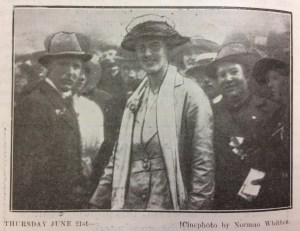
Markievicz IL Jul 1917

Cinephoto from Whitten’s film of the return of Countess Markievicz on 21 June 1917; Irish Limelight Jul. 1917: 16. Courtesy of the National Library of Ireland.

The Limelight’s detailed account of Whitten’s work on this film suggests that he was working alone at this point on shooting, processing and dispatching; it does not mention any employees. Nevertheless, people in the business knew Whitten’s abilities from previous events he had filmed, and on Thursday of that week, he would repeat his achievement when he had a film of the arrival back in Ireland of republican leader Countess Constance Markievicz for showing at 10:30pm, even though she did not reach Westland Row station until 6:45pm. Nevertheless, for the Monday film, he appears to have been overwhelmed by the number of requests for copies and resorted to offering other topicals he had shot of Irish and National Volunteers and the funeral of republican Jeremiah O’Donovan Rossa. When even these supplies were exhausted, desperate exhibitors were prepared to accept even Irish-themed fiction films. “[W]hen everything that could by any stretch of the imagination have been utilised as a ‘topical’ was used up,” the Limelight commented, “they fell back upon ‘The Shaughraun,’ ‘The Colleen Bawn,’ and other film plays of the earlier ‘Irish’ type.”

The phenomenal success of this film and the one of Markievicz later in the week formed the basis for Whitten’s launch of an Irish newsreel service he called Irish Events just a month later. While he must have been considering an Irish newsreel for some time, the decision to launch it in July 1917 appears to have been a sudden one because he did not mention it to the Limelight reporter who so thoroughly covered his work on the film of the released prisoners. But then he was “a hustler from Hustlerville,” as the Limelight called him (“‘Irish Events’”). The Limelight did publish a long article on the launch of Irish Event in its August issue, urging all Irish exhibitors to subscribe to it, but by the start of August, three issues of Irish Events had already been released. “Irish people always will be glad to glimpse really interesting happenings in Great Britain and abroad,” it observed, “but when it comes to peeps at parochial happenings – well, they would certainly prefer to see pictures of sports at, say, Croke Park, instead of pictures of an English sports meeting” (“‘Irish Events’”).

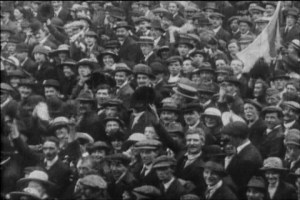
Ch4One

Members of the crowd smile and gesture happily when the newsreel camera is trained on them in Release of the Sinn Fein Prisoners (Ireland: General Film Supply, 1917). Courtesy of the Irish Film Institute.

Although some Irish Events would be released as specials like the film of the returning prisoners, the regular format of Irish Events mirrored that of the other newsreels such as Gaumont Graphic, Pathé News and Topical Budget. That is to say, it included both political and social events. The first few issues included “aquatic and other sports meetings, Phœnix Park demonstrations, the great funeral which the Sinn Feiners gave Mrs. MacDonagh, widow of their executed leader, the Twelfth of July Celebrations in Belfast and a fete in Lord Iveagh’s grounds” (“‘Irish Events’”). It is unlikely that Whitten could have covered all these events alone and run the other aspects of his business. Indeed, when the Limelight highlighted an Irish Events item on the Clontarf Aquatic Festival, it observed that it had been shot by both Whitten and his camera operator J. Gordon Lewis, who would become Whitten’s close collaborator. Over the Irish Events’ years of existence between 1917 and 1921, Whitten and Lewis would shoot such everyday occurrences and present them alongside some of the most momentous political events of Ireland’s history.

References

“Building News.” Irish Builder and Engineer 12 Apr. 1913: 250.

“Hire of a Film: ‘Lost in the Eternal City’: Action for £70.” Dublin Evening Mail 20 Jun. 1917: 4.

“‘Irish Events’: An Enterprise that Merits the Support of Every Exhibitor in this Country: News Films from the Four Provinces.” Irish Limelight 1:8 (Aug. 1917): 18-19.

“Irish Topical.” Bioscope 19 Jun. 1913: 857.

“Mr. J. J. Fisher.” Irish Limelight 1:7 (Jul. 1917): 17.

“Sinn Fein Prisoners’ Homecoming: Story of the Filming of Recent Remarkable Street Scenes in Dublin. Irish Limelight 1:7 (Jul. 1917): 16-17.

“Town Topics: Being a Casual Causerie.” Dublin Evening Mail 7 May 1917: 2.

Shadows of Revolution in Irish Cinemas, March 1917

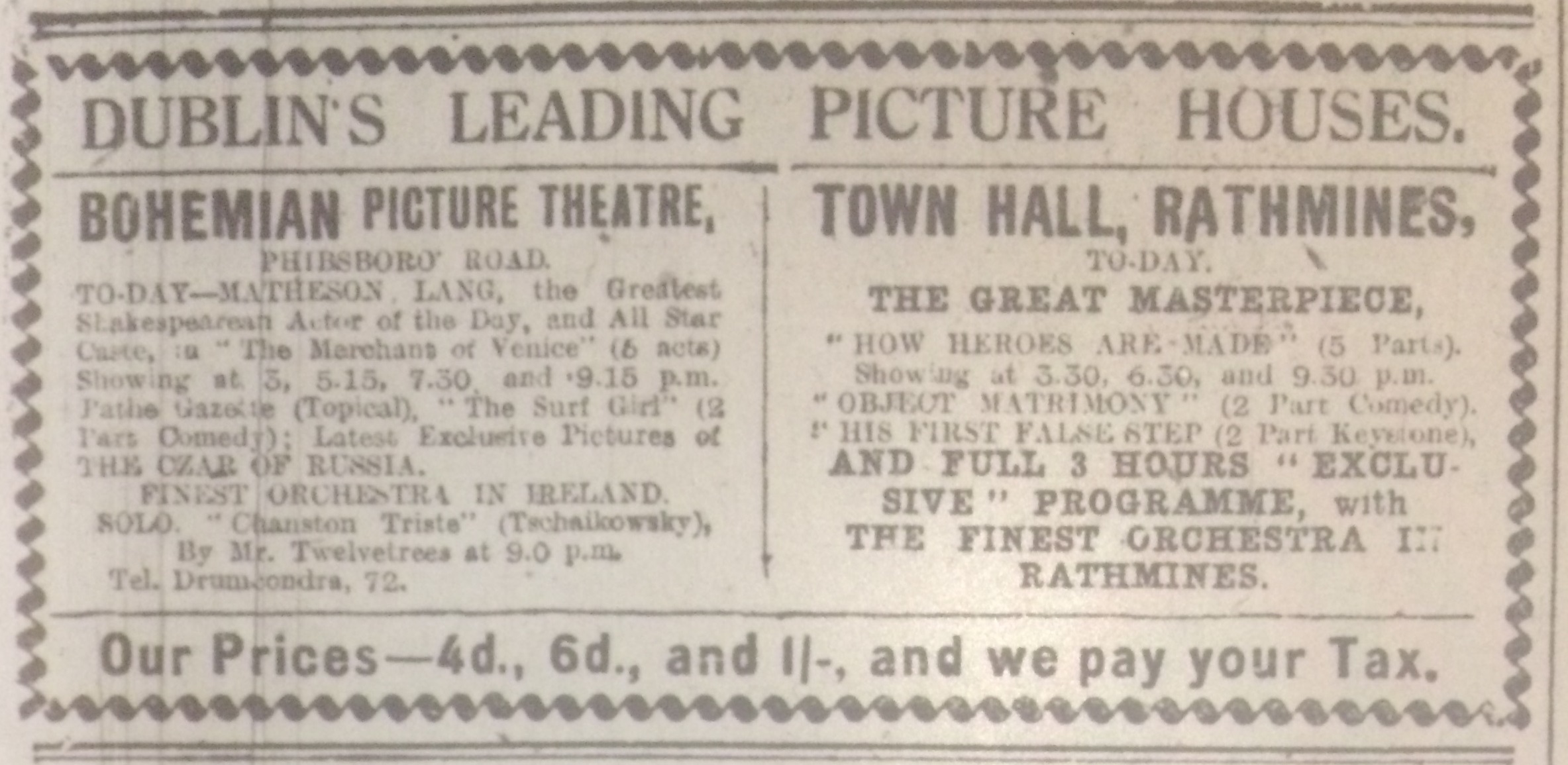
Among the offerings at Dublin’s Bohemian Picture for the first three days of the week beginning 19 March 1917, was footage of the Tsar of Russia; Dublin Evening Mail 19 Mar. 1917: 2.

“Things are very quiet in Dublin film circles just now,” observed the columnist of “Screenings: Kinematograph Notes & News” in Dublin’s Evening Telegraph on St. Patrick’s Day 1917, “but some big things are on the way.” The seeming quite may have been deceptive because big things were already underway in the shape of social upheaval in Russia, which Irish newspapers had first called a revolution the previous day. This was an event that was momentous even in a time of war, and cinema would, at the very least, provide moving images for Irish people to picture these developments. On 19 March, Dublin’s Bohemian Picture Theatre featured the “Latest Exclusive Pictures of The Czar of Russia,” and the Dublin Evening Mail reviewer thought they “should prove a source of great attraction” (“Bohemian Picture Theatre”). Despite this, no reviews of the films appear to exist by which public reaction to them might be judged. In any case, while an undoubtedly old film of the Tsar might pique the curiosity raised by unfolding events, it was unlikely to have satisfied the desire to witness recent developments. But Dublin was not alone in this. “Russian pictures have been going strong in London since the Duma won through to victory,” the “Screenings” writer noted. “And now arrangements have been made to show in the Russian provinces a kinematograph film of the revolution in Petrograd” (“Screenings,” Mar. 24).

The shadow of revolution was also closer to Ireland than this. The Irish administration feared that the first national day after the Easter Rising would occasion some “big things” in the shape of subversive activity and as a result, had put all public buildings in the city under military control for St. Patrick’s Day (“Patrick’s Day”). However, in stark contrast to occurrences in Russia, the main leaders of Ireland’s rebellion had been executed, and many rank-and-file participants remained in prison, a fact raised in speeches at Westminster comparing Ireland and Russia by such Irish MPs as John Dillon and Joseph Devlin (“Broken Pledges”).

Laurence O’Neill (centre with moustache) attending a GAA match at Croke Park, c.1919, in the company of Arthur Griffith, Eamon DeValera and Michael Collins. Wikimedia Commons.

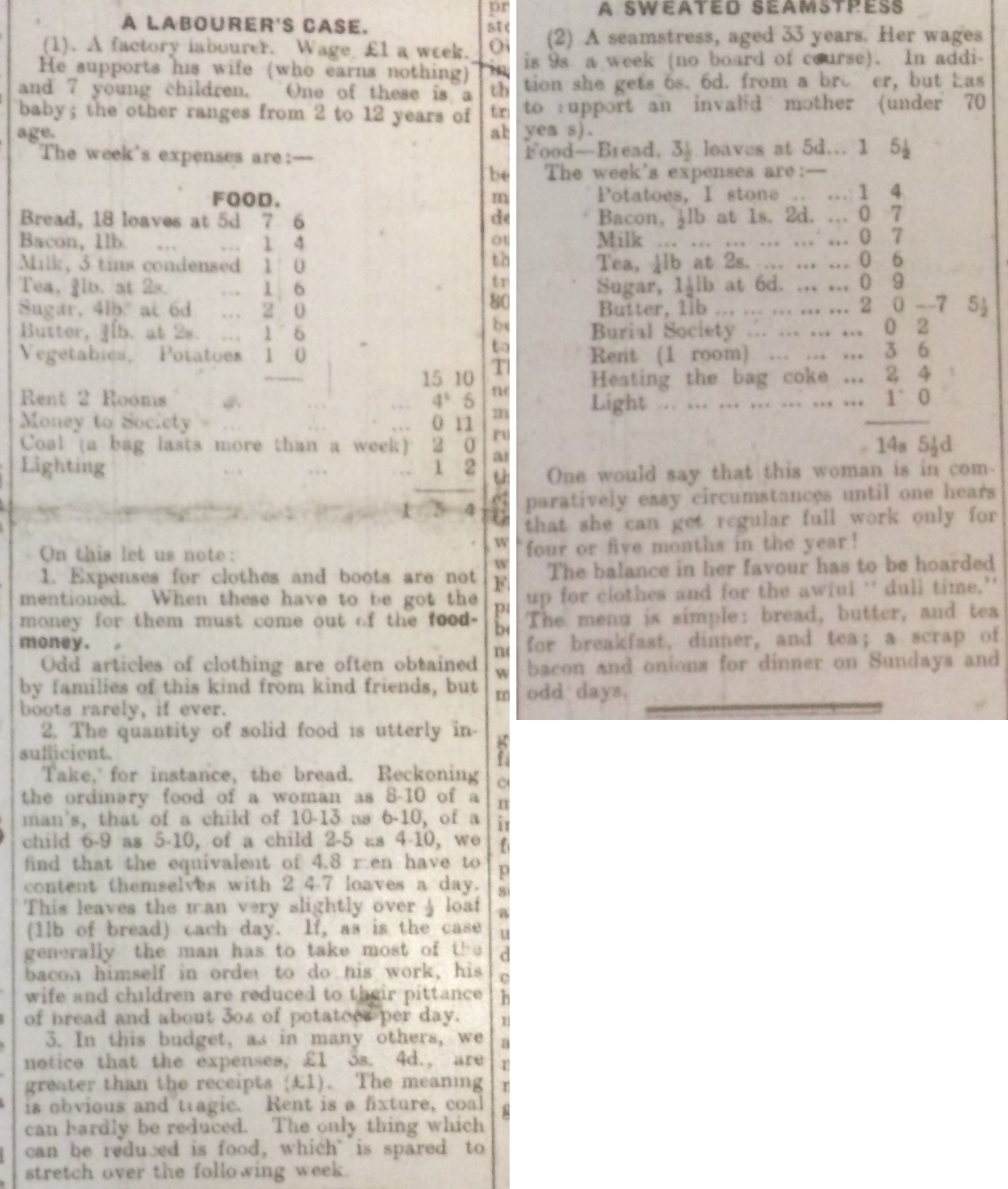
While the question of Irish political prisoners was being discussed, many believed that a scarcity of food was a more immediate potential cause for social unrest. Earlier in March, before the strikes and demonstrations in Russian had become a revolution, Dublin’s lord mayor, Laurence O’Neill, had invoked the French Revolution to warn of the dangers in the city caused by “unemployment and the scarcity and inflated prices of foodstuffs.” “[O]ne of the principal causes of the French Revolution was the luxury of the upper classes and the poverty of the poor,” he observed, “and the lesson of that Revolution was that no matter in which age the authorities or upper classes ignored their duties to the poor, there was bound to be discontent” (“Lord Mayor”).

The first two workers’ budgets from the Leo Guild; Evening Telegraph 24 Feb. 1917: 1.

Contemporary statistics on the living conditions of Dublin’s working poor support O’Neill’s warnings. In a series of newspaper articles between February and April 1917, these statistics were presented in the form of household budgets provided by the Leo Guild, a Catholic organization interested in the welfare of the deserving poor. Named after Pope Leo XIII – the “working-man’s Pope” – the Irish branch had been founded in Dublin in 1912 to counter the increasing influence of socialism and radical labour activism among Irish workers (“Father Mathew Hall”). Members of the Guild conducted research among the poor, and although they published them anonymously, the people featured in the budgets

were not chosen as being exceptional cases of distress, but because after investigation, they were considered to be typical specimens of their class. None of them belong to the class of poor who apply to the union or the charitable institutions. They are all hard working, sober, respectable and self-respecting folk.” (“How the Poor Live.”)

The Guild’s first budgets focused on two households: that of a labourer and that of a sweated seamstress. Neither of these households had discretionary income to spend on the cinema or other entertainments. The commentary on the budgets concluded, for instance, that the labourer – earning £1 a week to support himself, his wife and seven young children – had outgoings of £1 3s 4d: “The meaning is obvious and tragic. Rent is a fixture, coal can hardly be reduced. The only thing which can be reduced is food, which is spared to stretch over the following week.”

The Guild’s statistics were prepared as part of the Catholic Church’s struggle against organized labour, but they offer some insight into who could or who likely could not have attended the cinema in early 1917. Other writers offered different views on whether or not the working poor attended cinema in 1917. In an article in the third (March 1917) issue of the recently launched cinema journal Irish Limelight, Stephanie de Maistre suggested that they could, and indeed did, form a particularly notable part of the cinema audience. Discussing her dissatisfaction with theatre and music hall and preference for cinema, she focused on one particular unnamed picture house that, “whilst always well patronised in the higher priced seats, became a popular haunt for the working man, his sweetheart or his wife and family.” Maistre’s article addresses an audience perceived to be, like herself, middle class, capable of occupying the higher-priced seats and making entertainment choices not available to working people. Her self-consciously literary account constructs cinema as a place where harmony between the classes is achieved by a cross-class interest in the entertainment provided and by an accepted stratification of the audience based on one’s ability to pay for a seat among one’s social peers. But she sees films as particularly beneficial to the working class:

You see people happy, contented: something has come to break the monotony of their lives; to give them a glimpse of the wonders of the world; to bring sentiment and poetry into drab and barren existences, and who shall say what hearts have been touched, appealed to and changed “in the shadows”?

Chaplin Count Framegrab

Eric Campbell, Charlie Chaplin and Edna Purviance in The Count (US: Lone Star, 1916).

Dublin picture-house owners’ choices of films for St Patrick’s Day suggest that they perceived their audiences to be substantially working class and interested in Irish films. Class was central to The Count (US: Lone Star, 1916), Chaplin’s latest Irish release, which ended its first Dublin run at the Pillar Picture House on 17 March. “The management of the Pillar Picture House, O’Connell street, was largely responsible for the introduction of Charlie Chaplin to the Dublin public,” the writer of “Screenings” reported on 10 March, “and they are still first in the field locally with pictures of the little comedian.” In the film, a tailor (Eric Campbell) pretends to be a count to attend a society party but finds that his employee (Chaplin) has beaten him to it and chats up both the cook and the rich hostess (Edna Purviance) until the real count unexpectedly shows up. In the week leading up to and including St Patrick’s Day, several other picture houses showed Chaplin’s The Floorwalker (US: Lone Star, 1916) and The Fireman (US: Lone Star, 1916), including the Rotunda Pictures, where it accompanied popular but sometimes controversial The Rosary (US: Selig Polyscope, 1915), the “Original Irish-American Drama.”

Chaplin was also a favourite among the children of the Irish in Britain. A 12-year-old Irish girl was one of the three London schoolgirls who in mid-March 1917 appeared before the Cinema Commission, a body formed by the National Council of Public Morals that began its inquiry into cinema’s public influence in January 1917 (“Mr. Goodwin’s Striking Figures”). When asked about the kinds of films they liked best, the girls chose Westerns and Chaplin comedies. However, they and their friends were not so enthusiastic about newsreels. “‘Sometimes when they have a Topical Budget,’ confessed one of the girls, ‘the Boys get up and go out’” (“At the Pictures”).

Boh Cleansing Fires ET 15 Mar 1917

In the three-day run up to St Patrick’s Day, the Bohemian showed the newly released Irish film The Eleventh Hour. Evening Telegraph 15 Mar. 1917: 2.

As well as the Irish-American Rosary, picture-house managers also followed the well-established practice of choosing Irish-shot films for St Patrick’s Day. In 1917, some of these were more authentically Irish shot than others. From 15-17 March, the Bohemian showed the already released The Eleventh Hour on a bill topped by Cleansing Fires. Cleansing Fires is sometimes mistaken as one of films made by the Film Company of Ireland (FCOI) in 1916, but FCOI merely controlled the rights of this film.

Film Fun July 1916: np.

Although not quite coinciding with St Patrick’s Day, The Innocent Lie (US: Famous Players, 1916) a “magnificent five-part Irish film,” opened on 26 March 1917 at Dublin’s Town Hall, Rathmines. This was the film’s second run in Dublin; its first had been at the Grafton Picture House in January 1917. Given that it had been directed by Sidney Olcott and starred Valentine Grant and Jack Clark, Irish audiences would not have doubted that it had been, as the Evening Telegraph claimed, “produced amidst beautiful scenery in the South of Ireland” (“Screenings” Mar. 17). Olcott had shot many films for Kalem and other companies in Ireland, and these had long been particularly popular around St Patrick’s Day. In 1915, for example, Dublin’s Masterpiece Cinema had run an Irish Week, at which Olcott’s The Colleen Bawn (US: Kalem, 1911), Ireland the Oppressed (US: Kalem, 1912) and The Mayor from Ireland (US: Kalem, 1912) were shown along with other Irish-shot or Irish-themed films (“Masterpiece Irish Week”). Olcott had made these films in Ireland, but the danger of U-boats on the Atlantic crossing meant that he could not do the same for The Innocent Lie. “The exteriors were photographed in Bermuda,” revealed George Blaisdell in the Moving Picture World before its US release on 8 May 1916, “and they are not only picturesque, but in atmosphere vividly remind of the land and shore of the troubled island they are intended to simulate.”

All in all, it seems things were not as quiet as they may have seemed in Irish cinema in March 1917.

References

“At the Pictures: What School Girls Like.” Evening Telegraph 20 Mar. 1917: 2.

Blaisdell, George. “‘The Innocent Lie’: Valentine Grant Makes Good in Her Debut in Famous Players Five-Part Subject.” Moving Picture World 20 May 1916: 1349.

“Bohemian Picture Theatre.” Dublin Evening Mail 20 Mar. 1917: 5.

“Broken Pledges—Empty Threats: Mr. Dillon’s Indictment of the Government.” Freeman’s Journal 21 Mar. 1917: 5.

“Father Mathew Hall: ‘Are Irish Catholics Good Citizens.’” Freeman’s Journal 18 Sep. 1912: 5.

“How the Poor Live: Typical Budget: A Crying Grievance: Result of Leo Guild Inquiry.” Evening Telegraph 24 Feb. 1917: 1.

“The Life of the Poor: More Leo Guild Budgets: A Pressing Problem.” Evening Telegraph 17 Mar. 1917: 4.

“Lord Mayor and the Distress in the City: Gravity of the Situation Stated in Plain Terms.” Evening Telegraph 12 Mar. 1917: 1.

De Maistre, Stephanie. “In the Shadows.” Irish Limelight 3:1 (Mar. 1917): 4.

“The Masterpiece Irish Week.” Evening Telegraph 16 Mar. 1915: 6.

“Mr. Goodwin’s Striking Figures: Evidence of Film Industry’s Magnitude: First Sitting of Cinema Commission.” Bioscope 11 Jan. 1917: 96.

“Patrick’s Day: Quiet Observance in Dublin.” Evening Telegraph 17 Mar. 1917: 1.

“Screenings: Kinematograph Notes & News.” Evening Telegraph 17 Mar. 1917: 5; 24 Mar. 1917: 5.

Processions, Protest and the Perfect Woman in Irish Picture Houses, Late Summer 1915

Summer was usually a bad time for indoor entertainments such as cinema. But the Irish weather during July 1915 – like that of July 2015 – did not favour outdoor activities. “It has been a sad time for July holiday-makers,” observed the Irish Times in early August, “and as yet there is no hint of a better hope for August, except that which may be taken from the thought that what has persisted so long must soon change” (“Wet Weather”). While some temporary picture houses opened at seaside resorts, some established venues followed the practice of the theatres and closed for several weeks in July and/or August. Although Dublin’s Rotunda usually stayed open throughout the summer, it took advantage of this practice in 1915 by closing on 7 June for extensive renovations and reopening on 26 July.

Swimmer Annette Kellerman was considered the “|Perfect Woman” because here measurements corresponded to the classical dimension of the Venus de Milo. Australian poster from the collections of the National Library of Australia, available here.

Australian swimmer Annette Kellerman’s bodily measurements promoted on a poster for the film Neptune’s Daughter. Collection of the National Library of Australia, available here.

The weather didn’t stop Dublin architect Joseph Holloway from travelling across town on the evening of Friday, 9 July, from his home in Northumberland Road south of the city to the Bohemian Picture Theatre in the northern suburb of Phibsborough. He was clearly quite taken with the “great film drama of a legendary story in five parts, called Neptune’s Daughter featuring Annette Kellerman (the Perfect Woman)” because he described it in more detail than any other film he had seen that year (Holloway, 9 Jul. 1915). The film was one of the several mermaid fantasies the Australian swimmer made during her film career in the 1910s and early 1920s. Dublin audiences had seen Kellerman three years previously in a similar live stage show, when she had appeared at the Theatre Royal with a company of 40 artistes in Undine, a 14th-century set “idyll of forest and stream” (“Theatre Royal”). Although a skilled athlete, Kellerman’s celebrity was partly based on her controversial promotion of a form-fitting one-piece swimsuit for women. This attire allowed women swimmers the ease of movement needed for athletic achievement, which was not permitted by form-hiding two-piece Victorian bathing costumes. Her championing of women’s athletics fitted well with such contemporary campaigns for women’s equality as the suffrage movement, and at a special matinee during her week in Dublin in 1912, Kellerman gave a lecture on women’s physical culture. At the same time, the publicity for her theatrical appearances fully exploited the spectacle of her body, which was declared perfect because it corresponded so exactly to the measurements of the Venus de Milo.

“Summer at Last!” Irish LIfe 19 Jul. 1912: 669.

“Summer at Last!” Irish LIfe 19 Jul. 1912: 669. Courtesy of National Library of Ireland.

Photographs published by the glossy illustrated weekly Irish Life in July and August 1912 – just after Kellerman’s visit – throw some light on the degree of controversy her appearance is likely to have caused in the early 1910s. Irish Life published many photographs of Ireland’s leisure class at golf, tennis, horse riding, motoring and other activities. Under the title “Summer at Last!” the issue of 19 July 1912 published photos of six women bathers, and the one-piece swimsuit is much in evidence: only one of the women has a swimsuit that covers her upper legs, arms and shoulders. Although four of the women are on or beside bathing machines that suggest the persistence of Victorian seaside practices, they appear unconcerned by the gaze of the camera or are even welcoming of it. The photo story suggests a fairly permissive view of the display of the female body in such public spaces as beaches and of the reproduction of such photographs in a widely circulating magazine of the “respectable” classes.

“On the Rocks” and “Disillusioned,” Irish Life 9 Aug. 1912: 791 and 16 Aug. 1912: 840.

“On the Rocks” and “Disillusioned,” Irish Life 9 Aug. 1912: 791 and 16 Aug. 1912: 840. Courtesy of National Library of Ireland.

However, this sense of the freedom of bodily display is somewhat challenged by the letter of complaint that the editor received the following month in response to Irish Life’s publication on 9 August 1912 of a postcard with a bather – in this case, probably a model – no more undressed or welcoming of the camera’s gaze than the previous women. The complaint was not a trivial one: it came from the Catholic Church based Dublin Vigilance Committee (DVC). Founded in early November 1911, the DVC had grown rapidly and held the first of what was to become an annual show of strength in the form of a procession through the streets of Dublin and a mass meeting at the Mansion House in July 1912. This was an astonishingly successful event, drawing letters of support not only from the Irish Catholic hierarchy but also the pope. The fact that it took place at the Mansion House meant that the movement already had the imprimatur of Dublin’s Lord Mayor, who attended, but the meeting was also addressed by Ireland’s highest government official, the Lord Lieutenant, Lord Aberdeen, who had also been the president of the National Vigilance Association of England for the previous 15 years. This was a movement with serious political clout. Nevertheless, when Irish Life responded to the complaint on 16 August, it was with an article that was more resentful than contrite and that was illustrated by children playing on a beach who were “Quite Happy! / Provided There Are no Vigilance Committees to Object.”

Three years later, at the Bohemian on the evening of 9 July 1915, Holloway was also quite happy with Neptune’s Daughter (US: Universal, 1914). However, the filmmakers – including Dublin-born director Herbert Brenon – pushed the degree of bodily display in Kellerman’s performance to full nudity, causing Holloway some qualms. “The story was splendidly enacted,” he thought, “but Annette Kellerman’s lack of costume was very daring at times.” Nevertheless, Holloway

thought it a very beautiful film, with nothing suggestive in it, – perhaps the incident of the diving from the rocks, again and again, clad only in nature, might have been omitted, with no hurt to the story, but, then Annette Kellerman wanted to show what an expert diver she is, & gave the display.

For a full week in early July 1915, Dublin’ s Bohemian Picture Theatre showed Neptune’s Daughter with Australian swimming star Annette Kellerman; Evening Telegraph 5 Jul. 1915: 1 and 8 Jul. 1915: 1.

Dublin’ s Bohemian Picture Theatre retained Neptune’s Daughter for a full week in early July 1915; Evening Telegraph 5 Jul. 1915: 1 and 8 Jul. 1915: 1.

Holloway’s defensiveness here is understandable because the DVC had not gone away in the interim and was in 1915 shifting its focus from what it termed “evil literature” to “the filthy picture screen” (“Fighting a Plague”). Neptune’s Daughter had been due to finish its three-day run at the Bohemian on Wednesday, 7 July – two nights before Holloway saw it – but because of its popularity, Bohemian manager Frederick Sparling extended its run into the second half of the week. On the Thursday night, the packed Bohemian was visited by William and Francis Larkin, the members of the DVC most likely to make a protest. The newspapers reported that at 9 o’clock, the Larkins “began to hiss, and they persisted in this form of protest for forty minutes, to the end of the film” (“‘Neptune’s Daughter’”). “It was evident that the audience found nothing of a suggestive or offensive nature in the production,” opined the Freeman’s Journal, “and they showed their approval by applauding warmly (“Annette Kellerman at the Bohemian”). The Larkins and the DVC had by no means finished with cinema, and Neptune’s Daughter encountered some further difficulties. The film was condemned from the altar by a local priest when it opened on 22 July for a three-day run at Sparling’s other picture house, the Sandford in the south-city suburb of Ranelagh. “I have reason to believe,” the Bioscope’s Paddy contended, “that the Reverend Father in question had not seen the film but was going on the strength of the publicity matter – which, it will be admitted is rather striking” (Paddy).

Evening Telegraph 31 Jul. 1915: 3.

Evening Telegraph 31 Jul. 1915: 3.

Part of the reason the Bohemian was the site of these events was that it had become one of the most popular picture houses in Dublin. It was a venue that could induce Holloway and presumably others to travel across the city, albeit that Holloway travelled to see Annette Kellerman in Neptune’s Daughter. Regular newspaper ads helped to build and maintain this popularity. At the end of July on a page headed “City Theatres and Picture Palaces to Visit During the Holidays,” the Bohemian published an unusually large ad with a photograph illustrating its claim to be “the best appointed and most luxurious picture theatre in Dublin.” If this ad was addressing potential audience members with reasons to choose the Bohemian from among the other picture houses, those reasons had to do with the luxury experience to be had there. Taken from the back of the balcony, the photo emphasized the decorative plasterwork, light fittings, comfortable seating and large screen. The ad’s largest text apart from the Bohemian’s name referred not to the film offerings but to the “Finest Orchestra in Ireland,” made up of 16 performers. You went to the Bohemian for its beautiful physical and aural environment.

August bank holiday offerings by Dublin's picture houses; Evening Telegraph 31 Jul. 1915: 3.

August bank holiday offerings by Dublin’s picture houses; Evening Telegraph 31 Jul. 1915: 3.

Whereas the Bohemian’s ad pushed film titles to a peripheral position, the ads for the Bohemian’s five rival Dublin picture houses prominently displayed film titles they had chosen for the August holiday weekend. Charlie Chaplin featured in four of the six picture house ads, with the Electric Theatre in Talbot Street emphasizing that it had the “Real Charlie Chaplin in Some Comedy (Not an Imitation).” This may have been a general reference to Chaplin’s multitude of screen and stage imitators or a more specific one to the music hall comedian Jack Edge, who was shown in the Coliseum Theatre’s advertisement on the same page dressed as Chaplin.

The most prominent title advertised by the newly renovated Rotunda was a film of the funeral of the Fenian Jeremiah O’Donovan Rossa, an outdoor activity largely undisrupted by the weather. Organized by the Fenians’ revolutionary successors, the Irish Republican Brotherhood (IRB), the funeral was a massive demonstration of the ability of the IRB to mobilize the more militant factions of Irish nationalism. The IRB arranged for O’Donovan Rossa’s body to be repatriated from New York to Dublin, where it lay in state for three days at City Hall and was subsequently accompanied on Sunday, 1 August, by a procession of about 5,000 mourners – watched by at least ten times that number – to Glasnevin Cemetery, where Patrick Pearse delivered his renowned graveside oration. Pearse was not audible in the film by Whitten’s GFS, which recorded highlights of this three-day commemoration, but the volley of shots over the grave by armed Volunteers and the extent of public support were no doubt eloquent enough for the many people who watched the film in picture houses around the country in the coming days and months. Those eager to see the film first did not have to wait for the screenings at the Rotunda, which did not have a licence to open on Sundays, but could attend the Bohemian, where it was on view a few hours after the end of the funeral and at a picture house on the route of the funeral procession. There they could shelter from the vagaries of the Irish summer in some comfort.

References

“Annette Kellerman at the Bohemian.” Freeman’s Journal 10 Jul. 1915: 7.

“Fighting a Plague: Vigilance Committee’s Crusade.” Irish Catholic 11 Sep. 1915: 1

Holloway, Joseph. Holloway Diaries. National Library of Ireland.

“‘Neptune’s Daughter’: Protest in Dublin Picture House.” Irish Times 9 Jul. 1915: 6.

“Theatre Royal.” Sunday Independent 30 Jun. 1912: 6.

“Wet Weather.” Irish Times 4 Aug. 1915: 4.

The Lure of the Picture House: Disaster and Comedy in Irish Cinemas, May 1915

By May 1915, cinema had become so compulsive for some Irish people that it landed them in trouble with the law. Dublin newspapers reported on “the lure of the picture house” that had led two children, Annie Hughes and Rose Kavanagh, from Newtown Park Avenue in Stillorgan, to beg door-to-door to get money to go to the cinema (“Lure of the Picture House”). At the Police Court in Kingstown (now Dún Laoghaire), Kavanagh’s father said that his daughter acted without his knowledge and that “it was the attractions of the picture houses that cause them to beg” (ibid.). Hearing from the police that the girls were constantly begging, Justice Michael Macinerney put them on probation for 12 months.

Illustrated ad for Rupert of Henzau (Britain: London, 1915) at Dublin's Picture House, Grafton Street; Evening Telegraph 31 May 1915: 2.

Illustrated ad for Rupert of Henzau (Britain: London, 1915) at Dublin’s Picture House, Grafton Street; Evening Telegraph 31 May 1915: 2.

Whatever about its compulsion to drive people to illegal activity – a point made both by some reform groups and by some wrongdoers seeking to lay the blame for their actions with the new medium – other commentators were making the point that cinema had become a habit for many people. Writing in Irish Life, playwright and novelist Edward McNulty assessed the progress of the cinematograph against the many claims made for it:

[A]ll the things predicted of the cinematograph are undoubtedly realisable, but, unfortunately, most of the brightest anticipations have not been achieved. The cinema was, above all, to be educational. All the drudgery of teaching was to vanish. Schools and colleges were to be transformed into theatres of instruction; the daily paper was to be supplanted by the Cinema News Bureau, and the French irregular verbs were to be assimilated in the guise of light comedy. (Paddy, 20 May).

Nevertheless, “ in spite of its defects and disappointments, we must gladly acknowledge that the marvel of cinema is the vehicle of diurnal delight all over the civilised globe” (ibid).

Although Irish cinema of the period was certainly a vehicle for diurnal delight, May 1915 was striking for the motivations other than delight that lured patrons to the picture houses. If diurnal delight was epitomized by Charlie Chaplin’s comedies, their power of attraction was at least matched by war films. The Cinema News Bureau had not – and would never – replace the newspaper, but the sinking of the RMS Lusitania showed how the media worked together to serve wider ideological war needs. The Cunard Line’s transatlantic steamer was torpedoed by a German submarine off Kinsale, Co. Cork, at about 2pm on 7 May, and initial reports appeared in the evening newspapers (“Lusitania”), with fuller accounts dominating the news on 8 May. The story had several aspects of interest to Irish papers, some of which had particularly local resonance and other of which linked to war-related issues. Rescue efforts were coordinated from the Cork port of Queenstown (now Cobh), where survivors and victims were initially brought and the inquest held. The large loss of civilian lives – almost 1,200 of the nearly 2,000 people on board died – world have made this a particularly important story in any case, and one that justified propagandistic condemnation of German disregard for civilian life and the rules of war. As well as this, the fact that more than 100 Americans were among the victims provided an impetus for discussion of the hoped-for US entry into the war on the British side.

Newspaper reports were joined on Monday, 10 May by the first newsreel images. The big newsreel companies Gaumont and Pathé sent film units to Queenstown. “Immediately the news was received,” revealed the trade journal Biosocpe,

Gaumont’s dispatched four photographers to the south of Ireland – one from London, Liverpool, Dublin and Belfast – and their joint film contributions were promptly sent to London, where they were supplemented by a few views of the arrival at Euston of survivors. The subject is introduced by a general view of the Lusitania, Messrs. Pathé Frères had men at Queenstown, and a staff of three photographers at Lime Street Station, Liverpool, to meet the train conveying survivors. (Filming ‘Lusitania’ Incident.”)

On Monday, Gaumont released a 350-foot “special topical,” while Pathé initially included just a 50-foot (approx. 1 minute) item in their regular Pathé Gazette, with the intention of supplementing this with a further 150-foot item for the weekend. “The enterprise of these two firms is only surpassed by their restraint,” commented the Bioscope, “when it is remembered that about ten cameras were employed, and the output of film ran into four figures” (ibid.).

Entertainment ads showing impact of Lusitania sinking; Evening Telegraph 10 May 1915: 1.

Entertainment ads showing impact of Lusitania sinking; Evening Telegraph 10 May 1915: 1.

Irish audiences also had the opportunity to see these films. Patrons of Dublin’s Rotunda were offered “a series of pictures depicting incidents connected with the arrival of the Lusitania victims and survivors at Queenstown” (“Rotunda Pictures,” 11 May). The depth of emotion expressed by the journalist who visited the Picture House in Sackville/O’Connell Street suggests that s/he saw the longer Gaumont film. “A picture showing scenes and incidents after the sinking of the Lusitania was shown at this House yesterday;” s/he reported.

[I]t was both interesting and pathetic, and one left with feelings of deepest emotion at the havoc and misery caused to countless human beings by the unmediated act of murder on the part of the German submarine, which, with a total disregard for the lives of women and children sent the mighty ship to the bottom. (“O’Connell Street Picture House.”)

The clear anti-German feeling here was congruent with the reporting on the sinking in general and particularly with the verdict of the inquest, which was given in an editorial item on the same page as the review of the Sackville/O’Connell. “This appalling crime was contrary to international law and the convention of all civilized nations,” it began, “and we, therefore, charge the owners of the submarine, the German Emperor, and the Government of Germany, under whose orders they acted, with the crime of wilful and wholesale murder” (“The Kinsale Verdict.”)

What seems incongruous – but may only seem so – is that the writer so affected by the Lusitania film should find immediate relief in the comedies that accompanied it on the same programme. “After viewing those harrowing incidents,” s/he observed, “the excellent comedies came as a most welcome change; they included ‘Love and Dough,’ featuring the well-known screen comedian Ford Sterling” (“O’Connell Street Picture House”). Images of war and physical comedy complemented each other on the picture-house screen, and as will be seen below, Chaplin had become the comedian in highest demand. Although for audiences in the early 21st century such changes of tone may seem strange or even inappropriate, for audiences in the 1910s, used to entertainments that included variety and contrast, this appears to have been perfectly acceptable.

In any case, films of various kinds provided the imaginative means for coming to terms with the tragedy of war, as well as the spectacle of such new technologies as the zeppelin, the torpedo and the submarine. Bearing echoes of the Lusitania sinking, for example, Dublin’s Masterpiece placed a special ad in the Evening Telegraph at the end of May advising the public that it would give its final exhibition of The Italian Navy “in which is shown a torpedo at its deadly work of sinking a passing vessel” (“The Masterpiece,” 29 May). The Lusitania sinking also had consequences for Irish cinema that only became clear much later. Although Walter Macnamara had shot the Irish historical drama Ireland a Nation for his New York-based production company partly in Ireland in 1914, a copy of the film did not reach the country until 1917 because “the first copy dispatched by them was lost with the ill-fated Lusitania; a duplicate copy was substituted, but […] this also failed to successfully run the submarine ‘blockade’” (“Between the Spools”).

The Lusitania films were joined by other propagandistic war films in mid-May. On 13-15 May, a “very important” War Office film of Lord Kitchener’s visit to British army headquarters in France was shown at Dublin’s Picture Houses in Grafton and Sackville/O’Connell Streets (‘“Lord Kitchener in France”’). Over the same period, the Grafton was also showing a film of the Battle of Neuve Chapelle,

“illustrated by Kineto War Map No. 5. By means of this exceedingly clever animated map the Battle of Neuve Chapelle is shown in a manner most thrilling to watch. The representation of the whole battle is wonderful, and everyone who sees it will be more than interested, as it forcibly portrays the difficult struggle of the British to hold this position against the heavy fire of the enemy’s’ batteries. (Ibid.)

Ad for Dublin’s Masterpiece showing The Secret of Adrianople (1913); Evening Telegraph 15 May 1915: 1.

Ad for Dublin’s Masterpiece showing The Secret of Adrianople (Denmark: Kinografen, 1913) and Bohemian ad drawing attention to the big Whit Monday attraction, Tillie’s Punctured Romance (US: Keystone, 1914); Evening Telegraph 15 May 1915: 1.

For the week of 16-22 May, the Masterpiece advertised The Secret of Adrianpole. The preview in the Evening Telegraph described it as “a magnificent four-part war drama, the scene of which is laid in the now famous Dardanelles, and shows the defences of the much-talked-of Turkish forts” (“The Masterpiece,” 11 May). However, the film was not set during World War I, having been released under the title Adrianopels hemmelighed by the Danish company Kinographen in 1913. Interest in the Dardanelles raised by the Gallipoli land campaign that began on 25 April 1915 lent it renewed topicality:

Now, when all eyes are focused on the Dardanelles, and every scrap of information about the present bombardment eagerly devoured, this great picture comes most opportunely, reproducing in interesting fashion the places daily mentioned in the Press, and showing particularly the actual defences of Fort No. 13, one of the fortifications of so much interest at the moment. (Ibid.)

Although these war films clearly attracted audiences, by early summer 1915 Charlie Chaplin was Irish cinema’s most consistent draw. As already mentioned, the Rotunda showed the Lusitania newsreel beginning on Monday, 10 May; however, the “principal attraction for the great majority of the audience who will frequent the Rotunda this week will, undoubtedly, be the Keystone comedy film entitled ‘The Knockout’” (“Rotunda Pictures,” 11 May). The Knockout (US: Keystone, 1914) actually starred Roscoe “Fatty” Arbuckle and Minta Durfee, with Chaplin in a minor role, but the review of the Rotunda shows mentioned only that it featured “the well-known comedian, Charles Chaplin, as referee in a boxing match of a decidedly novel description” (ibid.). This favouring of Chaplin was consistent with a recent comment that no cinema “programme now is complete without the well-known comedian, Charles Chaplin” (“Rotunda Pictures,” 8 May).

Charlie Chaplin, caught between Mabel Normand and Marie Dressler in Tillie's Punctured Romance (US: Keystone, 1914)

Charlie Chaplin, caught between Mabel Normand and Marie Dressler in Tillie’s Punctured Romance (US: Keystone, 1914).

For the week beginning with the Whit Monday holiday, 24 May 1915, the Rotunda again featured a Chaplin film, Charlie’s New Job (US: Keystone, 1914), but the Bohemian upstaged them by securing exclusive rights to Tillie’s Punctured Romance (US: Keystone, 1914). The first feature-length comedy, the six-reel Tillie’s Punctured Romance starred Chaplin alongside stage actress Marie Dressler and Keystone favourite Mabel Normand. Reporting on a press showing of the film on 9 May, a writer in the Evening Telegraph observed that the “farcical element throughout the whole performance has full sway, and the spirit of fun dominates the various scenes. […] The film has been secured by the ‘Bohemian’ at the cost of £100, and the enterprise of the management should meet with a huge measure of public appreciation” (“Bohemian Picture House”). Their enterprise apparently was rewarded because the reviewer of the Whit Monday show commented that “Chaplin is certainly at his best in this production, and all those desirous of seeing him should go early, as the demand for seats last evening was very great” (“The Bohemian”).

Such diurnal delights would continue to lure audiences for many years to come.

References

“Between the Spools.” Irish Limelight 1:2 (Feb. 1917): 19.

The Bohemian.” Evening Telegraph 25 May 1915: 2.

“Bohemian Picture House.” Evening Telegraph 10 May 1915: 2.

“The Kinsale Verdict.” Evening Telegraph 11 May 1915: 2.

“Filming ‘Lusitania’ Incident.” Bioscope 13 May 1915: 623.

‘“Lord Kitchener in France.”’ Evening Telegraph 12 May 1915: 4.

“The Lure of the Picture House.” Evening Telegraph 3 May 1915: 6.

“Lusitania: Sinking Off Cork Coast: Help from Queenstown: 1,400 Passengers on Board.” Evening Telegraph 7 May 1915: 3.

“The Masterpiece.” Evening Telegraph 15 May 1915: 8; 29 May 1915: 8.

The O’Connell Street Picture House.” Evening Telegraph 11 May 1915: 2.

Paddy. “Picture in Ireland.” Bioscope 20 May 1915: 773.

“Rotunda Pictures.” Evening Telegraph 8 May 1915: 8; 11 May 1915: 2.

Creating Great Trouble in a Most Laughable Manner: Chaplin in Dublin in 1914

Chaplin Lookalike Winner Film Fun Jan 1916

The winner of a Chaplin lookalike contest run by Dublin’s Masterpiece Theatre; Film Fun Jan 1916: n.p.

By October 1915, a Charlie Chaplin craze was in full swing in Dublin. Paddy, the Irish correspondent of the British cinema trade journal Bioscope, showed this when he reported on several simultaneous tributes to Chaplin less than two years after he made his first film. On 7 October, Paddy revealed that Captain Ahearne of the Dame Street Picture House had shown all-Chaplin programmes the previous week, while a live Chaplin revue at the Coliseum Theatre had distinguished itself from the Chaplin impersonation competition taking place at the Rotunda by featuring what Paddy claimed was “the only Chaplin girl extant” (Paddy, 7 Oct.).

Small ad calling for Chaplin imitators. Freeman's Journal 16 Sep. 1915: 8.

Small ad calling for Chaplin imitators. Freeman’s Journal 16 Sep. 1915: 8.

That such competitions were not wholly new was shown by the fact that Cathal MacGarvey manager of the Masterpiece Theatre, Talbot Street was exhibiting his film of a Chaplin impersonation competition that had taken place at his picture house in September (Paddy, 14 Oct.). Chaplin seemed to be everywhere you looked by the autumn of 1915. But this adulation had taken some time to grow.

The Bohemian Picture Theatre showed Mabel's Married Life in the first three days of the week beginning 30 Nov. 1914 and Her Friend the Bandit for the last three days of that week. Evening Telegraph 30 Nov. and 3 Dec. 1914.

The Bohemian Picture Theatre showed Mabel’s Married Life in the first three days of the week beginning 30 Nov. 1914 and Her Friend the Bandit for the last three days of that week. Evening Telegraph 30 Nov. and 3 Dec. 1914.

Irish audiences’ decades-long love affair with Charlie Chaplin, the biggest film star of the first half of the 20th century, began modestly a century ago. Cinema audiences in Ireland, like those around the world, knew the slapstick comedies for which Mack Sennett’s Keystone Film Company was already famous when Chaplin joined in December 1913. When he began shooting his first films in January 1914, Chaplin played supporting roles to such better-established comics as Mabel Normand, Roscoe “Fatty” Arbuckle and Ford Sterling. However, he rapidly became the star player in films that he directed himself. Nevertheless, he did not renew his Keystone contract in December 1914, choosing instead to join George K. Spoor and Gilbert M. “Broncho Billy” Anderson’s Essanay Film Manufacturing Company.

As the best remembered of the stars who emerged in the 1910s, Chaplin has already been discussed briefly here and here. Now that the centenaries of his year at Keystone have passed, it may be worth looking in more detail at the Irish reception of this initial stage of his career. Almost all the Keystone films he appeared in have survived, and thanks to the Chaplin Keystone Project, these have been restored to as watchable a condition as possible and are available in the DVD collection Chaplin at Keystone, accompanied by an informative booklet. Despite the films’ flashes of brilliance, however, it is hard not to agree with David Robinson that “[w]e can only look back at the first few Keystone films and see a crude, unfinished form, and the earliest tentative search for a screen character” (130). But as Robinson goes on to argue this is our problem in retrospect: “To the audiences of the time they were new and astonishing. From the very start, Chaplin had created a new relationship with the audience, provoking a response that no one had elicited before in film or in any other medium” (ibid).

Irish audiences’ first sight of Chaplin on screen was not as a tramp but as a “sharper” in Making a Living (US: Keystone, 1914).

Surviving accounts from Irish audience members are rare, but newspapers do offer some clues about how that relationship began in Ireland. These clues have to be sifted out of ads and articles that are largely the product of the marketing needs of film production companies, distributors, picture houses and the newspapers that carried the material. Most of the cinema display ads, preview and reviews in Dublin newsaper were for the few picture houses that paid for advertising. The most regular picture-house advertising was from the Rotunda Pictures in Dublin’s O’Connell/Sackville Street, which had long used extensive advertising to construct its reputation as the city’s premier picture house. In roughly descending order of regularity of advertising, the Rotunda was followed in late 1914 and early 1915 by the Bohemian Picture Theatre in Phibsboro; the Masterpiece Theatre in Talbot Street; the Provincial Cinematograph Theatres pictures houses in Grafton and O’Connell/Sackville Streets; the Phoenix on Ellis Quay; the Dorset Picture Hall; the Volta in Mary Street; the Electric Theatre in Talbot Street; Dame Street Picture House; and the Pillar Picture House in O’Connell/Sackville Street. This represents just two-fifths of Dublin city’s cinemas, and many of those named often did not mention the titles of the short comedies that supported the main dramatic feature. Nevertheless, the display ads, previews notices and reviews of these picture houses allow us to track the release dates and something of the reception of Chaplin during his year at Keystone.

This review of the programme at the Rotunda Pictures gives a good indication of where comedies featured in the priorities of newspaper reviewers. Evening Telegraph 23 Jun. 1914: 2.

This review of the programme at the Rotunda Pictures gives a good indication of where comedies featured in the priorities of newspaper reviewers. Evening Telegraph 23 Jun. 1914: 2.

It was at the Rotunda that Chaplin first appeared on a screen in Dublin in the comedy Making a Living (US: Keystone 1914), which had a three-day run beginning on Monday, 21 June 1914. The Evening Telegraph’s review suggests that contemporary observers did not share the importance we would likely attribute to the beginning of Chaplin’s career. The highlight of the bill on which Making a Living appeared was for at least the nationalist members of the audience – as it was for the reviewer in the nationalist Evening Telegraph – “a splendid film showing the pilgrimage to Wolfe Tone’s grave, at Bodenstown, on Sunday” (“Rotunda Pictures,” 23 Jun.). This local topical (news film) “was received with possibly the greatest of applause yet extended to any film previously shown at this house,” and its exhibition was enhanced by the Irish Ladies’ String Orchestra playing “The Volunteers’ March”: “The opening bars of the martial music were drowned by the tumultuous cheering of the crowded audience” (ibid.). By contrast, Making a Living was merely mentioned in passing along with two other comedies that were also part of the programme.

Western Import Co. ad for Chaplin's early Keystone film hails him as the hit of the season and reminds readers of his stage career. Bioscope 9 Jul. 1914: xx.

Western Import Co. ad for Chaplin’s early Keystone films hails him as the hit of the season and reminds readers of his stage career. Bioscope 9 Jul. 1914: xx.

Making a Living was almost five months old by the time it reached Irish screens. It had been shot on 5-9 January 1914 and first released in the United States on 2 February 1914 (Chaplin at Keystone). From 21 June on, however, Chaplin’s films were released in Ireland in quick succession but not always in the same order as they had appeared in the US. This release pattern and much of the publicity material available to picture house managers came from the Western Import Company, the British and Irish distributor of all Keystone films. All the films released by Western Import up to the end of January 1915 were shown in Dublin. Western Import was based in London, and its ads in the trade papers reflected the fact that Chaplin’s films had been a particular hit in the US and were likely to be at least as popular in Britain where he had recently been a music-hall comedian.

In Mabel's Strange Predicament, Dublin audiences saw Chaplin's tramp costume for the first time in a film whose comedy comes largely after Mabel locks herself out of her hotel room in her pajamas.

In Mabel’s Strange Predicament, Dublin audiences saw Chaplin in his tramp costume for the first time, harassing Mabel Normand in her pyjamas.

Despite the information available from the distributor, the names of Mabel Normand or Ford Sterling were more likely to have caught the attention of comedy audiences that week. When Mabel Strange Predicament – the film in which Chaplin first appeared as the tramp – began its three-day run at the Rotunda on 2 July, the Dublin Evening Mail did not mention Chaplin but commented of Normand that “this little lady is now the leading comedienne in filmland” (“Rotunda Pictures,” 27 Jun.). And when Chaplin’s next film, Kid Auto Races at Venice, Cal., was appreciatively reviewed during its Rotunda run (6-8 July), the reviewer misidentified Chaplin as Keystone’s more established Fatty Arbuckle, observing that the “famous ‘Fatty’ of the Keystone company, will be seen in a screamingly funny picture, ‘Kid Auto Races’” (“Rotunda Pictures,” ET 7 Jul.). This pattern was not confined to the first few of Chaplin’s films screened in Dublin but continued up to November, when Mabel’s Busy Day was described as “one of the funniest adventures of Mabel Normand, Keystone Company” (“Rotunda Pictures,” ET 21 Nov.). Although “[a]mongst the humorous contributions” to the bill at the Masterpiece on 22 December “Chaplin, of the Keystone Co., in ‘A Busy Day,’ was very amusing,” this did not distinguish him from Ford Sterling who had left Keystone for a time and was starring “in a highly diverting Sterling Comedy, ‘Three O’clock’” (“Masterpiece”).

As this suggests, Keystone was itself a brand that newspaper advertisers and reviewers expected readers to recognize. This was emphasized on 10 October, when a preview of the Rotunda’s programme recommended When Reuben Fooled the Bandits – featuring the lesser known Keystone player Charles Murray – on the sole basis that it was a Keystone, “which means the last word in comedy” (“Rotunda Pictures,” ET 10 Oct.). The company brand and the star brand were also frequently combined. On 17 October, the preview of the Masterpiece Theatre did not specify the title of the comedy films that would be on show in the following week, but one of them “is a highly diverting Keystone, featuring the inimitable [C]haplin” (“Masterpiece Theatre”).

All the Keystone films featuring Chaplin released onto the British market between late June 1914 and the end of January 1915 were shown in Dublin, and many of them had their first Dublin exhibition on or close to the day Western Import released the film. Some films, however, appear to have been screened weeks or months after the release date, but it is possible that they were screened earlier and in the period before the attractiveness of Chaplin’s name was fully realized, their titles were not mentioned in the press. In any case, Making a Living’s appearance at the Rotunda on 22 June was four days after its London release. Mabel’s Strange Predicament appeared at the Rotunda on 2 July, a week and a half after its 22 June release (“Rotunda Pictures,” DEM 27 Jun.). Kid Auto Races at Venice, Cal. was release on 2 July and shown at the Rotunda on 6 July (“Rotunda Pictures,” ET 7 Jul.). Released on 6 July, A Thief Catcher – staring Ford Sterling but featuring Chaplin – ran at the Picture House, Grafton Street (9-11 July; ad, ET 9 Jul.), before the Rotunda (13-15 July; “Rotund Pictures,” ET 11 Jul., II 13 Jul.), and this seems also to have been the case with Between Showers, which was released on 9 July and exhibited first at the Grafton on 13-15 July (“Grafton Street Pictures”). A Film Johnnie was released on 13 July and shown at the Rotunda beginning on 20 July (“Rotunda Pictures,” ET 21 Jul), and His Favourite Pastime seems to have screen first at the Picture House, O’Connell/Sackville Street a week after its 20 July release (ad, ET 25 Jul.).

Chaplin's character in A Film Johnnie begins in a picture house and travels to the Keystone studios in pursuit of the Keystone Girl.

Chaplin’s character in A Film Johnnie begins in a picture house and travels to the Keystone studios in pursuit of the Keystone Girl.

No Chaplin film appears to have been released in August 1914, but September was busy. Tango Tangles – featuring Chaplin, Arbuckle and Sterling – was released on 10 September and shown at the Picture House, Sackville/O’Connell Street from 14 September (“O’Connell Street Pictures”). Cruel, Cruel Love’s 17 September release was followed by a 21 September Dublin opening at the Rotunda (“Rotunda Pictures,” ET 19 Sep.). Caught in the Rain was released on 21 September but does not seem to have had a Dublin screening until it was exhibited at the Volta’s well-advertised Sunday shows on 13 December (“Volta,”). Similarly, “Keystone screamer” Twenty Minutes of Love awaited a 17 January 1915 showing at the Volta despite a 28 September 1914 release (“Volta,” 16 Jan.).

Ad for the Masterpiece programme for the week, including The Fatal Mallet; Evening Telegraph 12 Dec. 1914: 1.

Ad for the Masterpiece programme for the week, including The Fatal Mallet; Evening Telegraph 12 Dec. 1914: 1.

Although October 1914 also saw no Chaplins released, November and December made up for it. The 9 November release of Caught in a Cabaret coincided with the same-day opening at the Rotunda (“Rotunda Pictures,” ET 7 Nov.). A Busy Day waited more than a month after its 12 November release until its Dublin premiere at the Masterpiece on 21 December (“Masterpiece”); the previous week (17-19 Dec.), the Masterpiece had shown The Fatal Mallet, which had been released on 19 November (ad, ET 12 Dec.). Mabel’s Busy Day had a release-day opening at the Rotunda on 23 November (“Rotunda Pictures,” ET 21 Nov.), and Mabel’s Married Life also opened in Dublin the day it was released at both the Rotunda and Bohemian on 30 November (“Rotunda Pictures,” ET 1 Dec.; “Bohemian”). On 3 December, the Bohemian gave Her Friend the Bandit an opening-day release (ad, ET 3 Dec.). And finally, Laughing Gas opened at the Picture House, O’Connell/Sackville Street on 7 January 1915, three days after its 4 January release (ad, ET 7 Jan.).

Chaplin prepares to deal with a difficult customer in Caught in a Cabaret.

Chaplin prepares to deal with a difficult customer in Caught in a Cabaret.

Very few of these 18 films were given more than a cursory mention. At the Rotunda in November, Chaplin’s Caught in a Cabaret was given unusual prominence for a comedy by being named as the first “of the principal films of the week” and as “a real live Keystone, one of the funniest yet” (“Rotunda Pictures,” ET 7 Nov.). “‘Caught in a Cabaret’ is the title of one of the best comedy pieces in cinematography yet shown in Dublin, and which is to be seen at the Rotunda Picture House. In all its details it proved a most laughable piece and drew forth loud applause” (“Rotunda Pictures,” ET 11 Nov.). Caught in a Cabaret was also popular at the Kelvin Palace in Bangor at Christmas:

Five performances were held on Christmas Day, and a like number of St Stephen’s [26 Dec.], at each show a complete change of pictures being screened – ten programmes in the two days. To be strictly accurate I should mention tha tone picture was retained in each programme. It was the screamingly-funny two-reel Keystone, “Caught in a Cabaret.” (“Jottings.”)

The most notice any Dublin newspaper reviewer gave to Chaplin in this initial period came at the end of July. “A splendidly long and most amusing comedy is ‘A Film Johnnie,” observed the Evening Telegraph’s columnist, noting the film’s reflexivity. “This picture features Charles Chaplin going to a cinema, where owing to an infatuation for a girl in the screen he creates great trouble in a most laughable manner” (“Rotunda Pictures” ET 21 Jul.). The Irish Times reviewer did not name Chaplin – referring merely to the “young man” in this “real good comedy series” – but commented that the “operations of the fire brigade in regard to that individual are the cause of much laughter” (“Rotunda Pictures,” IT 21 Jul).

Looked at week-to-week, Chaplin’s rise to fame looks more incremental than meteoric, but it would only be a few months before many members of the Dublin audience wanted to be Charlie.

References

“Bohemian Picture Theatre.” Evening Telegraph 1 Dec. 1914: 4.

Chaplin at Keystone. DVD Collection. London: BFI, 2010.

“Grafton Street Pictures.” Evening Telegraph 14 Jul. 1914: 2.

“Jottings from Ulster.” Bioscope 14 Jan. 1915: 146.

“Masterpiece.” Evening Telegraph 22 Dec. 1914: 6.

“Masterpiece Theatre.” Evening Telegraph 17 Oct. 1914: 6.

Paddy. “Pictures in Ireland.” Bioscope 7 Oct. 1915: 57; 14 Oct. 1915: 217.

Robinson, David. Chaplin: His Life and Art. London: Penguin, 2013.

“Rotunda Pictures.” Dublin Evening Mail 27 Jun. 1914: 3.

“Rotunda Pictures.” Evening Telegraph 23 Jun. 1914: 2; 7 Jul. 1914: 2; 14 Jul. 1914: 2; 21 Jul. 1914: 2; 19 Sep. 1914: 6. 7 Nov. 1914: 6; 11 Nov. 1914: 4; 21 Nov. 1914: 5; 1 Dec. 1914: 4.

“Rotunda Pictures.” Irish Independent 13 Jul. 1914: 5.

“Rotunda Pictures,” Irish Times 21 Jul. 1914: 7.

“The ‘Volta’ Sunday Pictures.” Evening Telegraph 13 Dec. 1914: 6; 16 Jan. 1915: 2.

“War Looks Like ‘Reel’ Business”: Irish Cinema at the End of 1914

The Pillar Picture House opened on 2 December 1914. This photo shows it in 1921, its distinctive semicircular veranda displaying damage like surrounding building from the fighting of the War of Independence and Civil War. RTE Stills Library; image and discussion here.

Neither weather nor war could seem long to inhibit the progress of Irish cinema in late 1914. “From the cinema man’s point of view this war looks like ‘reel’ business,” announced a one-line item gnomically in Dublin’s Evening Telegraph’s Saturday “Music and the Drama” column, without expanding on any cinematic developments. Nevertheless, this single line seems better to capture developments in popular entertainment in the mid-1910s than the several paragraphs devoted a week later by another columnist in the same newspaper to arguing that “our tastes in amusements and entertainments, indoor and outdoor, run on well-defined lines, and are marked by an extraordinary lack of initiative” (“Notes and Comments”). Drawing on the examples of the ping-pong and roller skating crazes – “the handsome rinks brought very poor prices as scrap” – to show that people prefer “Standard Amusements,” the columnist contended that the “theatre, concert and dance are just the theatres, concerts, and dances of by-gone years with some infinitesimal variations.” “Once or twice in every generation, there are signs of revolt, which are none the less interesting because the innovations have never even a sporting chance of securing a permanent footing” (ibid).

Cinema seems to be left conveniently out of consideration here. Although it had similarities with existing forms of entertainment, it was also significantly different and – as developments in late 1914 showed – was highly successful. Indeed, many of the roller-skating rinks build around the country in the short rinking craze of 1909-11 were not scrapped but had by 1914 become picture houses. Significant capital was also being invested not only in adapting other existing buildings – halls, shops and even churches – but also in constructing new purpose-built picture-houses premises. And building continued five months into the war. As it became part of the Irish streetscape, cinema integrated into the business practices of Irish cities, towns and rural areas; as it became more profitable to be a picture-house proprietor, so it became more socially acceptable to be one. Although doubts about the business stability and the respectability of cinema certainly remained at the end of 1914, it was being reshaped in ways that made it not only acceptable but also ever-more desirable to the dominant business and social class, which was itself changing in the context of the war.

However good its prospects, the cinema business faced challenges. On an elemental level, as a form of entertainment that required people to leave their homes and travel to a picture house, cinema was affected by the weather, particularly extremes of heat or inclement conditions that made travel difficult. Storms of unusual ferocity struck Ireland in the opening week of December 1914. “About midnight last night a violent storm swept over the city,” reported the Evening Telegraph,

bringing about a marked change from the extreme cold that prevailed all yesterday, and that became intensified as the night advanced. A high wind, accompanied by intermittent showers, blew till daylight, when heavy rain fell, and with the gale still fierce, it rained in merciless fashion till after noon, when it developed into a continuous and drenching downpour, which, with violent gusts across the city, made all form of traffic difficult and unpleasant. Dublin has not been visited with such an inclement day for a very considerable time. (“The Weather in Dublin.”)

Hurricane-force winds around the Irish and British coasts severely disrupted shipping, leading to the deaths of 14 men from the steamer Glasgow off the Lizard and 19 of the 250 horses for military use on the Teviot out of Dublin (“Havoc of Hurricane,” “Channel Hurricane,” “Heavy Gale in Dublin”).

Dublin’s Evening Telegraph 2 and 4 Dec. 1914: 2, providing details on opening hours and admission prices at the new Pillar Picture House.

These raging storms had consequences for at least the first of the two cinemas opened in Dublin and Belfast at the start of December and in time for the Christmas season. Although Dublin’s Pillar Picture House opened its doors on that stormy Wednesday, 2 December, it was only formally declared open two days later (“Pillar Picture House”). It was located in the middle of Sackville/O’Connell Street opposite Dublin’s landmark Nelson’s Pillar. At a time of limited personal transport, “the proprietors are especially fortunate in this, as the position is the terminus of all city and suburban trams” (ibid.). The proprietor was the Pillar Picture House Co., headed by John J. Farrell, a prominent member of Dublin Corporation who also had shares in three other Dublin picture houses. The Pillar was managed by Bob O’Russ, who was also managing Farrell’s picture houses in Phibsboro and Mary Street (Paddy, 24 Dec.), and May O’Russ – one of the city’s women musicians who formerly operated the Mary Street Picture House with her husband – directed the Pillar’s orchestra (Paddy, 17 Dec.).

Like many of the city-centre picture houses of the prewar period, the building was small, with a seating capacity of just 400, but it was architecturally striking both inside and out (“The Pillar Picture House, Dublin”). “The façade of the new premises is handsomely proportioned and cleverly treated in modern classic,” commented the Irish Builder, proceeding to detail its attractive features:

The approach is covered with a semi-circular verandah, which follows the sweep of a broad arch, and the opening under is filled in with Sicilian marble and leaded glass. The vestibule is very effectively treated with walnut and satinwood panelling with a fibrous plaster frieze of figured plaques and swagwork. The ceiling is elaborately ornamented and has a semi-circular dome of leaded glass. The staircase to the balcony is also panelled in walnut, and the enclosing walls artistically decorated in fibrous work. (Ibid.)

The overall impression was of “comfort and art combined in a most successful manner,” and commentators also stressed that the work of Irish manufacturers had been preferred (“Pillar Picture House”). “The general contractor was Councillor John Dillon, and the fibrous plaster contractor was Councillor John Ryan. Councillor M‘Guiness was the consulting electrical engineer, and the architect was Mr. Aubrey V. O’Rourke” (ibid.).

Belfast Evening Telegraph 5 Dec. 1914: 2.

Belfast Evening Telegraph 5 Dec. 1914: 2.

The role of city councillors was even more prominent in the considerable publicity that accompanied the opening of Belfast’s Imperial Picture House on 7 December. Before “an exceptionally large attendance of invited guests, including representatives of the Corporation, public Boards, the Church, the legal profession, and the business community,” the Lord Mayor, Councillor Crawford M‘Cullagh “said he was glad to be privileged in his official capacity to be associated in some degree with the progress and business activity of the city,” in this case embodied by “his colleague, Councillor W G. Turner, and his friend, Mr. James Barron, the directors of the Ulster Cinematograph Theatres, Ltd.” (“Imperial Opened”). The opening was filmed and shown as a special feature of the Imperial programme from 11 December.

The invitation-only opening ceremony was extensively covered in the Belfast’s papers and in the Bioscope, which carried a full page article on the Imperial’s architectural features. Prominently located “in that old-world part of the great industrial centre known as Corn Market,” the Bioscope’s Special Representative reported, the Imperial was “[c]onstruucted on the most improved lines [in such a way that] every possible arrangement has been made for the welfare, comfort, and enjoyment of the patrons of the theatre, or of the clientele which the beautifully appointed tearooms is sure to enjoy” (“Ancient and Modern”). Although the writer provided details of the auditorium – particularly such decorative features as the oil-painted panoramas of Belfast above the proscenium – s/he emphasized the the attractions that were not directly connected to watching a film. “A ladies’ retiring room is provided on the mezzanine floor, writing materials, etc., being supplied free of charge. A telephone and cloakroom are provide in the vestibule for the benefit of patrons, and shoppers may have their parcels addressed in care of the hall if they so desire” (ibid). Like a luxury hotel or department store, the Imperial advertised itself as a place where people, particularly the wealthy, would want to linger.

Ad for special war benefit at the Imperial; Belfast Evening Telegraph 14 Dec. 1914: 4.

Ad for special war benefit at the Imperial; Belfast Evening Telegraph 14 Dec. 1914: 4.

The Imperial maintained a high level of publicity throughout December, publishing more ads than any other form of entertainment. In the Belfast Evening Telegraph, for instance, it published ads not only among the other entertainment ads on page 1 but also on as many of two additional internal pages. As well as this, it advertised and sponsored a benefit on Wednesday, 16 December for the war fund of the lady mayoress, who arranged the participation of local artistes and spent the proceeds on entertaining soldiers who were confined to camp over Christmas (“To Entertain Tommy”).

This kind of publicity strategy was not new but one that the evolving cinema business adapted not only from such longer-established entertainment businesses as theatres but also from business in general, which increased its publicity in the run-up to Christmas, the year’s busiest festival. Despite an expected drop in business during the first Christmas of the war, an extravagance similar to that seen at the Pillar and Imperial seems to have been experienced in the shops. “There are actually areas in the city where more money is being spent than has circulated within living memory,” observed Dublin’s Evening Telegraph. “The crowds are filling the streets. The shopmen are working at high pressure” (“Christmas Eve”)

One of the Irish-Ireland journal The Leader rare picture houses ads was this title page one for The Sign of the Cross at the Bohemian in mid-November 1914.

This title page ad for The Sign of the Cross (US: Famous Players, 1914) at the Bohemian in mid-November 1914 is one of the few picture houses ads that appeared in the Irish-Ireland journal The Leader.

One area of Dublin where more money was being spent on entertainment than ever before was the northern suburb of Phibsboro, where two cinemas had opened in early summer 1914. John J. Farrell’s Phibsboro Picture House had to compete with Frederick Sparling’s Bohemian Picture Theatre. The Bohemian was formidable competition, advertising far more widely than the Phibsboro and introducing such new attractions as the church organ that was installed in November 1914 to accompany the exclusive film The Sign of the Cross (US: Famous Players, 1914). The ability of the Bohemian to secure such desirable exclusive films was, of course, important to maximizing its audience, which for both Phibsboro picture houses meant inducing patrons to travel by tram to this part of the city. The Bohemian also secured the loyalty of its patrons by giving them promotional gifts. While commending Sparling and manager Ernest Matthewson for their choice of Selig’s 9,000-foot adaptation of Rex Beach’s bestselling 1906 novel The Spoilers, Paddy observed that the “Bohemian perfumed calendars and matchbook covers are already well known both to the stern and gentle sex” (Paddy, 24 Dec.).

Evening Telegraph 15 Dec. 1914: 2.

The war was also “reel” business for picture house managements because it provided a topical subject matter with which to attract audiences. There was a popular understanding the films of the war had a persuasive function, particularly when it was used by the enemy. This was highlighted in early December when the Evening Telegraph’s daily column “Sidelights on the War” published an item called “German Victories on the Cinema,” which reported the alleged experiences of “a gentleman who has been to a biograph show in Germany” and who described “[h]ow the news of fictitious victories is circulated.”

A picture of the Kaiser standing with field-glasses in the trenches (delirious enthusiasm). The picture had to be shown over and over again on a screen a hand writes the latest war news: “An English battleship, believed to be the Warrior, was this morning, near Dover, torpedoed by a German submarine and sank.”

[…]

Next picture: The Crown Prince on horseback. A rather subdued applause follows. On the screen the hand thereupon writes: “A German squadron has this morning reached Ireland; mariners have made a landing in the town – name not permitted by censor.” The audience gets up and sings “Deutschland, Deutschland uber alles.” (“Sidelights on the War.”)

Interesting juxtaposition of an ad calling for volunteers to the Royal Engineers and one for the film in which a young man sacrifices himself on a World War I battlefield.

Belfast Evening Telegraph 26 Nov. 1914: 2.

This item clearly implied that the cinema could promote blind devotion to the Kaiser among the German popular audience that generated a war fever that was a danger not only to the sailors of the Warrior but also to Irish citizens facing a German invasion. No similar analysis of Allied war films appeared in mid-December when the Provincial Cinematograph Theatres’ Picture Houses in Dublin’s Grafton Street and Sackville/O’Connell Street and Belfast’s Royal Avenue showed the film With King George in France with The Belgians in Action. Although protests occurred at jingoistic entertainments and criticism appeared in more radical publications, loyalty to King George was accepted by the mainstream Irish press. In late November, the propaganda potential of the war-themed fiction film being produced in increasing numbers by British production companies was highlighted when an ad for one of these films appeared in the Belfast Evening Telegraph below a recruiting ad. While the recruiting ad called for volunteers to the Royal Engineers, the ad for V.C. (Britian: London, 1914), in which a young man dies on a World War I battlefield to vindicate his family’s honour, offered “scenes in the trenches [that] vividly portray modern war conditions.”

The wartime uses of moving pictures were not restricted to their propaganda value in the picture houses. The Bioscope reported comments from the Berlin correspondent of the Spanish El Mundo Cinematografico that “it is evident how much theatrical and cinematographic works can do to lift up and sustain a love of the fatherland in the whole public” (“Cinematography Employed by the Germans”). Citing evidence from the same source on the use of cameras for aerial reconnaissance, the Bioscope argued that “the Germans may claim to be the first nation to put the cinematograph to direct military use in warfare” and urged the War Office and British and French inventors to surpass their enemy (ibid).

By the end of 1914, cinema was showing no signs of going the way of roller skating. It was becoming firmly embedded in the business and entertainment life of Irish cities and towns.

References

“Ancient and Modern: Belfast’s Latest Cinema Described: By Our Special Representative.” Bioscope 10 Dec. 1914: 1143.

“Channel Hurricane: Vessels ‘Sub-Marine’ Passage: Life Boat Lost from ‘Teviot.’” Evening Telegraph 5 Dec. 1914: 4.

“Christmas Eve: Dublin at Its Best: Business Booming.” Evening Telegraph 24 Dec. 1914: 3.

“Cinematography Employed by the German Army: Interesting Details from Berlin of an Alleged New Invention.” Bioscope 10 Dec. 1914: 1076.

“Havoc of Hurricane: Horses Killed on Board Ship: Steamers Forced Back to Dublin: Vessels Blown Down the Liffey: Sailings Postponed and Cancelled.” Evening Telegraph 4 Dec. 1914: 3.

“Heavy Gale in Dublin.” Irish Times 5 Dec. 1914: 5.

“The Imperial Opened: Belfast’s Palatial Picture House: A Civic Ceremony: Home of Pleasure and Comfort.” Belfast Evening Telegraph 9 Dec. 1914: 2.

“Music and the Drama.” Evening Telegraph 5 Dec. 1914: 6.

“Notes and Comments: Standard Amusements.” Evening Telegraph 11 Dec. 1914: 2.

Paddy. “Pictures in Ireland.” Bioscope 17 Dec. 1914: 1217; 24 Dec. 1914: 1347.

“Pillar Picture House.” Evening Telegraph 5 Dec. 1914: 6.

“The Pillar Picture House, Dublin.” Irish Builder 27 Feb. 1915: 98.

“Sidelights on the War: German Victories on the Cinema.” Evening Telegraph 7 Dec. 1914: 2.

“To Entertain Tommy.” Belfast Evening Telegraph 17 Dec. 1914: 5.

“The Weather in Dublin.” Evening Telegraph 2 Dec. 1914: 2.