“War Looks Like ‘Reel’ Business”: Irish Cinema at the End of 1914

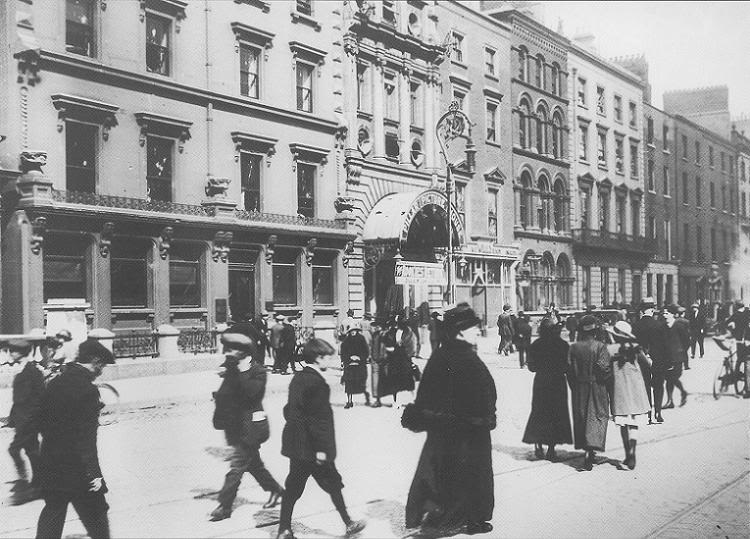
The Pillar Picture House opened on 2 December 1914. This photo shows it in 1921, its distinctive semicircular veranda displaying damage like surrounding building from the fighting of the War of Independence and Civil War. RTE Stills Library; image and discussion here.

Neither weather nor war could seem long to inhibit the progress of Irish cinema in late 1914. “From the cinema man’s point of view this war looks like ‘reel’ business,” announced a one-line item gnomically in Dublin’s Evening Telegraph’s Saturday “Music and the Drama” column, without expanding on any cinematic developments. Nevertheless, this single line seems better to capture developments in popular entertainment in the mid-1910s than the several paragraphs devoted a week later by another columnist in the same newspaper to arguing that “our tastes in amusements and entertainments, indoor and outdoor, run on well-defined lines, and are marked by an extraordinary lack of initiative” (“Notes and Comments”). Drawing on the examples of the ping-pong and roller skating crazes – “the handsome rinks brought very poor prices as scrap” – to show that people prefer “Standard Amusements,” the columnist contended that the “theatre, concert and dance are just the theatres, concerts, and dances of by-gone years with some infinitesimal variations.” “Once or twice in every generation, there are signs of revolt, which are none the less interesting because the innovations have never even a sporting chance of securing a permanent footing” (ibid).

Cinema seems to be left conveniently out of consideration here. Although it had similarities with existing forms of entertainment, it was also significantly different and – as developments in late 1914 showed – was highly successful. Indeed, many of the roller-skating rinks build around the country in the short rinking craze of 1909-11 were not scrapped but had by 1914 become picture houses. Significant capital was also being invested not only in adapting other existing buildings – halls, shops and even churches – but also in constructing new purpose-built picture-houses premises. And building continued five months into the war. As it became part of the Irish streetscape, cinema integrated into the business practices of Irish cities, towns and rural areas; as it became more profitable to be a picture-house proprietor, so it became more socially acceptable to be one. Although doubts about the business stability and the respectability of cinema certainly remained at the end of 1914, it was being reshaped in ways that made it not only acceptable but also ever-more desirable to the dominant business and social class, which was itself changing in the context of the war.

However good its prospects, the cinema business faced challenges. On an elemental level, as a form of entertainment that required people to leave their homes and travel to a picture house, cinema was affected by the weather, particularly extremes of heat or inclement conditions that made travel difficult. Storms of unusual ferocity struck Ireland in the opening week of December 1914. “About midnight last night a violent storm swept over the city,” reported the Evening Telegraph,

bringing about a marked change from the extreme cold that prevailed all yesterday, and that became intensified as the night advanced. A high wind, accompanied by intermittent showers, blew till daylight, when heavy rain fell, and with the gale still fierce, it rained in merciless fashion till after noon, when it developed into a continuous and drenching downpour, which, with violent gusts across the city, made all form of traffic difficult and unpleasant. Dublin has not been visited with such an inclement day for a very considerable time. (“The Weather in Dublin.”)

Hurricane-force winds around the Irish and British coasts severely disrupted shipping, leading to the deaths of 14 men from the steamer Glasgow off the Lizard and 19 of the 250 horses for military use on the Teviot out of Dublin (“Havoc of Hurricane,” “Channel Hurricane,” “Heavy Gale in Dublin”).
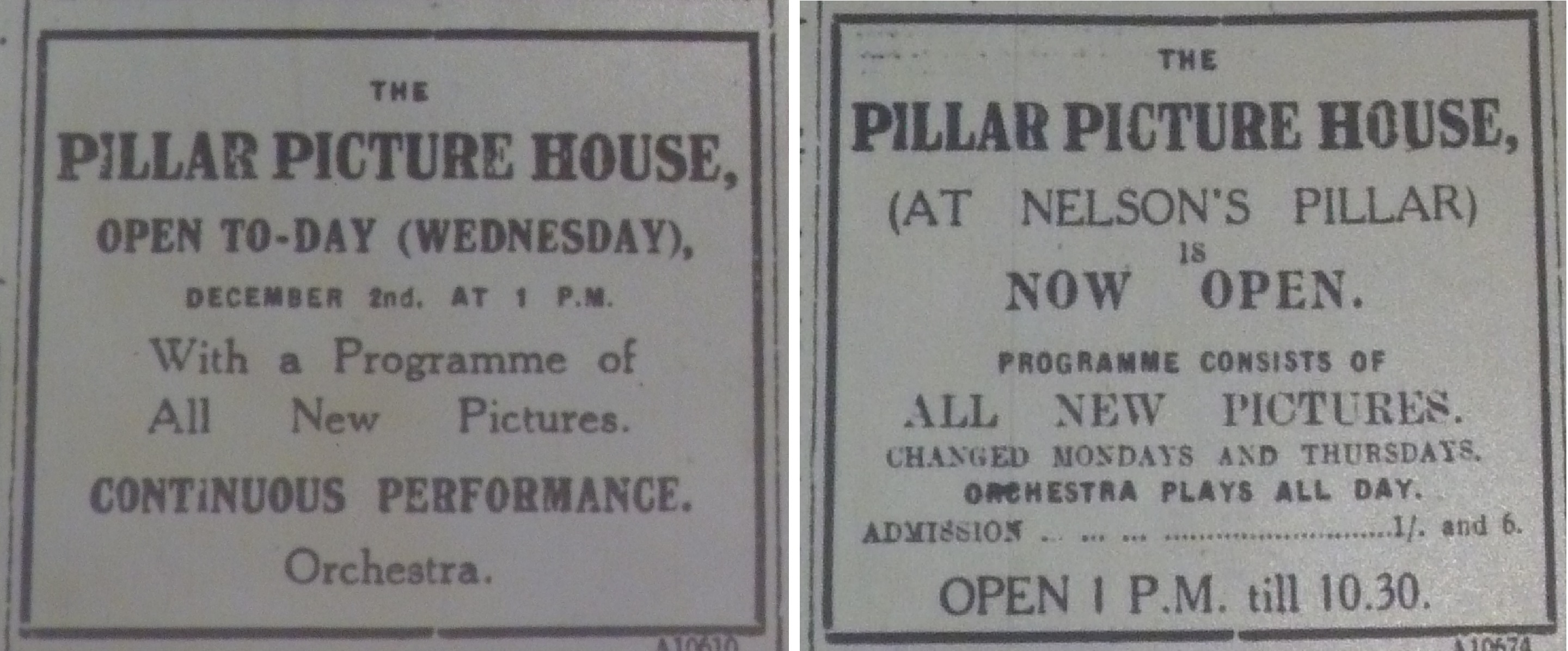
Dublin’s Evening Telegraph 2 and 4 Dec. 1914: 2, providing details on opening hours and admission prices at the new Pillar Picture House.

These raging storms had consequences for at least the first of the two cinemas opened in Dublin and Belfast at the start of December and in time for the Christmas season. Although Dublin’s Pillar Picture House opened its doors on that stormy Wednesday, 2 December, it was only formally declared open two days later (“Pillar Picture House”). It was located in the middle of Sackville/O’Connell Street opposite Dublin’s landmark Nelson’s Pillar. At a time of limited personal transport, “the proprietors are especially fortunate in this, as the position is the terminus of all city and suburban trams” (ibid.). The proprietor was the Pillar Picture House Co., headed by John J. Farrell, a prominent member of Dublin Corporation who also had shares in three other Dublin picture houses. The Pillar was managed by Bob O’Russ, who was also managing Farrell’s picture houses in Phibsboro and Mary Street (Paddy, 24 Dec.), and May O’Russ – one of the city’s women musicians who formerly operated the Mary Street Picture House with her husband – directed the Pillar’s orchestra (Paddy, 17 Dec.).

Like many of the city-centre picture houses of the prewar period, the building was small, with a seating capacity of just 400, but it was architecturally striking both inside and out (“The Pillar Picture House, Dublin”). “The façade of the new premises is handsomely proportioned and cleverly treated in modern classic,” commented the Irish Builder, proceeding to detail its attractive features:

The approach is covered with a semi-circular verandah, which follows the sweep of a broad arch, and the opening under is filled in with Sicilian marble and leaded glass. The vestibule is very effectively treated with walnut and satinwood panelling with a fibrous plaster frieze of figured plaques and swagwork. The ceiling is elaborately ornamented and has a semi-circular dome of leaded glass. The staircase to the balcony is also panelled in walnut, and the enclosing walls artistically decorated in fibrous work. (Ibid.)

The overall impression was of “comfort and art combined in a most successful manner,” and commentators also stressed that the work of Irish manufacturers had been preferred (“Pillar Picture House”). “The general contractor was Councillor John Dillon, and the fibrous plaster contractor was Councillor John Ryan. Councillor M‘Guiness was the consulting electrical engineer, and the architect was Mr. Aubrey V. O’Rourke” (ibid.).
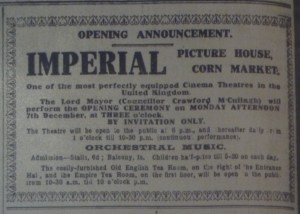
Belfast Evening Telegraph 5 Dec. 1914: 2.

Belfast Evening Telegraph 5 Dec. 1914: 2.

The role of city councillors was even more prominent in the considerable publicity that accompanied the opening of Belfast’s Imperial Picture House on 7 December. Before “an exceptionally large attendance of invited guests, including representatives of the Corporation, public Boards, the Church, the legal profession, and the business community,” the Lord Mayor, Councillor Crawford M‘Cullagh “said he was glad to be privileged in his official capacity to be associated in some degree with the progress and business activity of the city,” in this case embodied by “his colleague, Councillor W G. Turner, and his friend, Mr. James Barron, the directors of the Ulster Cinematograph Theatres, Ltd.” (“Imperial Opened”). The opening was filmed and shown as a special feature of the Imperial programme from 11 December.

The invitation-only opening ceremony was extensively covered in the Belfast’s papers and in the Bioscope, which carried a full page article on the Imperial’s architectural features. Prominently located “in that old-world part of the great industrial centre known as Corn Market,” the Bioscope’s Special Representative reported, the Imperial was “[c]onstruucted on the most improved lines [in such a way that] every possible arrangement has been made for the welfare, comfort, and enjoyment of the patrons of the theatre, or of the clientele which the beautifully appointed tearooms is sure to enjoy” (“Ancient and Modern”). Although the writer provided details of the auditorium – particularly such decorative features as the oil-painted panoramas of Belfast above the proscenium – s/he emphasized the the attractions that were not directly connected to watching a film. “A ladies’ retiring room is provided on the mezzanine floor, writing materials, etc., being supplied free of charge. A telephone and cloakroom are provide in the vestibule for the benefit of patrons, and shoppers may have their parcels addressed in care of the hall if they so desire” (ibid). Like a luxury hotel or department store, the Imperial advertised itself as a place where people, particularly the wealthy, would want to linger.
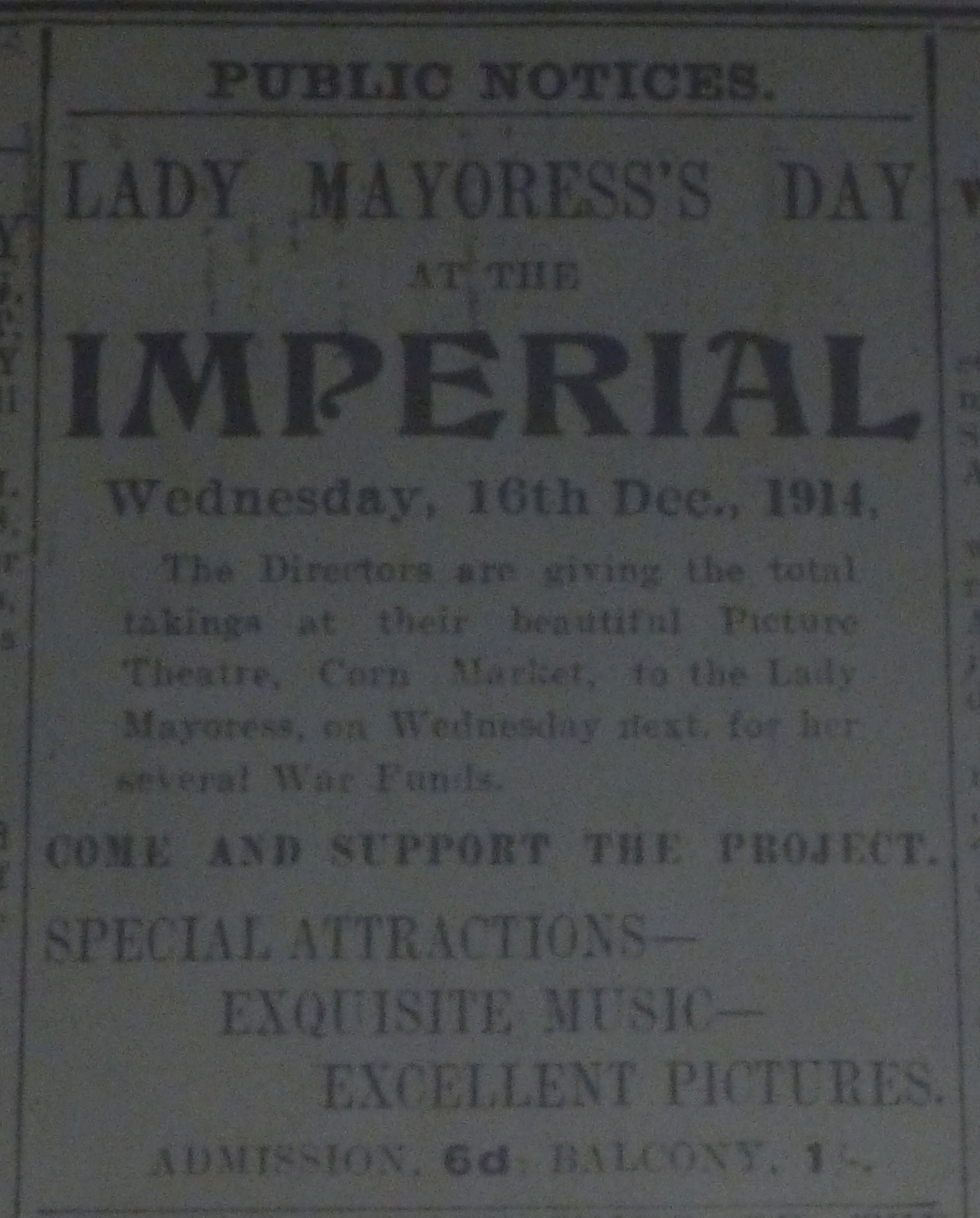
Ad for special war benefit at the Imperial; Belfast Evening Telegraph 14 Dec. 1914: 4.

Ad for special war benefit at the Imperial; Belfast Evening Telegraph 14 Dec. 1914: 4.

The Imperial maintained a high level of publicity throughout December, publishing more ads than any other form of entertainment. In the Belfast Evening Telegraph, for instance, it published ads not only among the other entertainment ads on page 1 but also on as many of two additional internal pages. As well as this, it advertised and sponsored a benefit on Wednesday, 16 December for the war fund of the lady mayoress, who arranged the participation of local artistes and spent the proceeds on entertaining soldiers who were confined to camp over Christmas (“To Entertain Tommy”).

This kind of publicity strategy was not new but one that the evolving cinema business adapted not only from such longer-established entertainment businesses as theatres but also from business in general, which increased its publicity in the run-up to Christmas, the year’s busiest festival. Despite an expected drop in business during the first Christmas of the war, an extravagance similar to that seen at the Pillar and Imperial seems to have been experienced in the shops. “There are actually areas in the city where more money is being spent than has circulated within living memory,” observed Dublin’s Evening Telegraph. “The crowds are filling the streets. The shopmen are working at high pressure” (“Christmas Eve”)
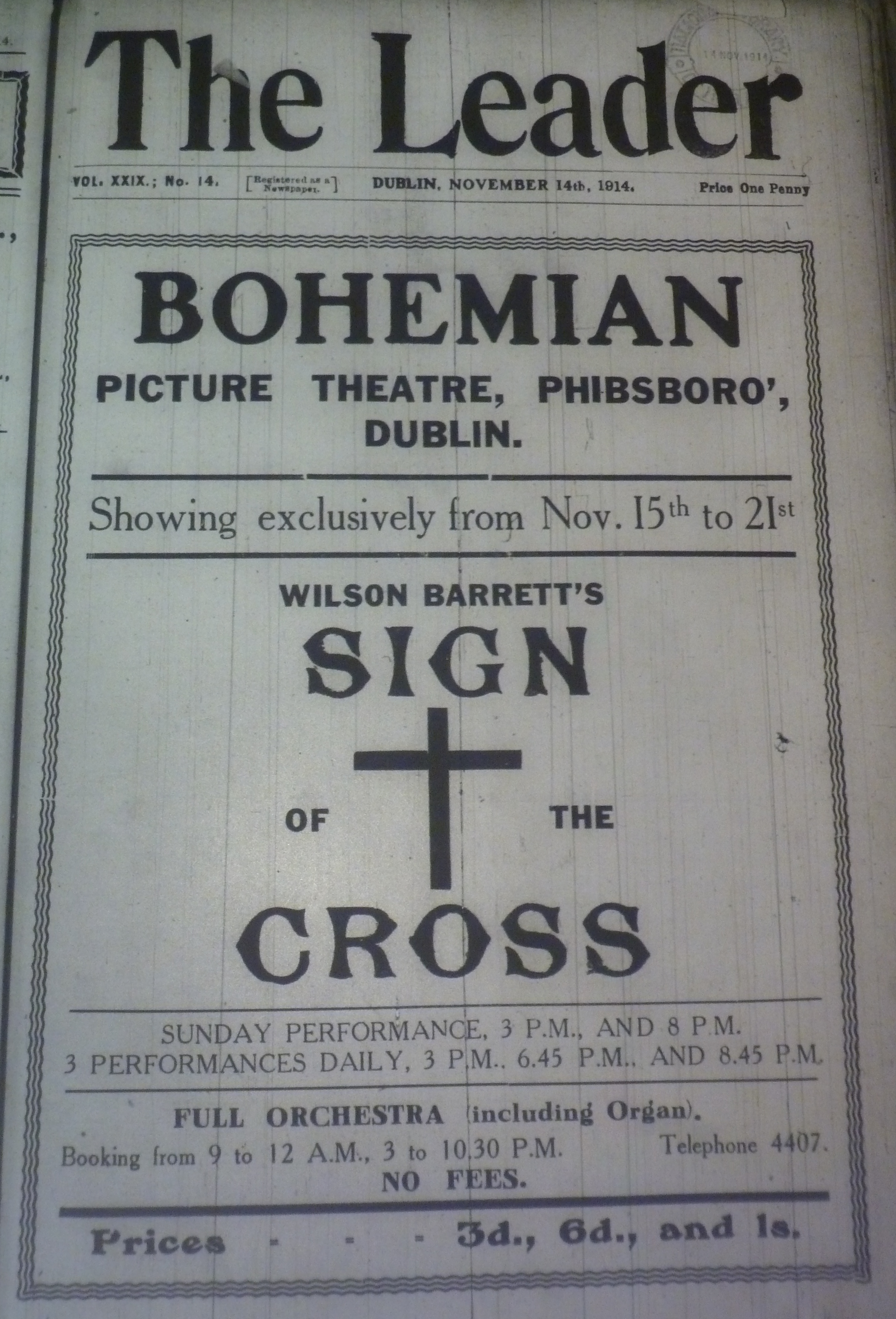
One of the Irish-Ireland journal The Leader rare picture houses ads was this title page one for The Sign of the Cross at the Bohemian in mid-November 1914.

This title page ad for The Sign of the Cross (US: Famous Players, 1914) at the Bohemian in mid-November 1914 is one of the few picture houses ads that appeared in the Irish-Ireland journal The Leader.

One area of Dublin where more money was being spent on entertainment than ever before was the northern suburb of Phibsboro, where two cinemas had opened in early summer 1914. John J. Farrell’s Phibsboro Picture House had to compete with Frederick Sparling’s Bohemian Picture Theatre. The Bohemian was formidable competition, advertising far more widely than the Phibsboro and introducing such new attractions as the church organ that was installed in November 1914 to accompany the exclusive film The Sign of the Cross (US: Famous Players, 1914). The ability of the Bohemian to secure such desirable exclusive films was, of course, important to maximizing its audience, which for both Phibsboro picture houses meant inducing patrons to travel by tram to this part of the city. The Bohemian also secured the loyalty of its patrons by giving them promotional gifts. While commending Sparling and manager Ernest Matthewson for their choice of Selig’s 9,000-foot adaptation of Rex Beach’s bestselling 1906 novel The Spoilers, Paddy observed that the “Bohemian perfumed calendars and matchbook covers are already well known both to the stern and gentle sex” (Paddy, 24 Dec.).
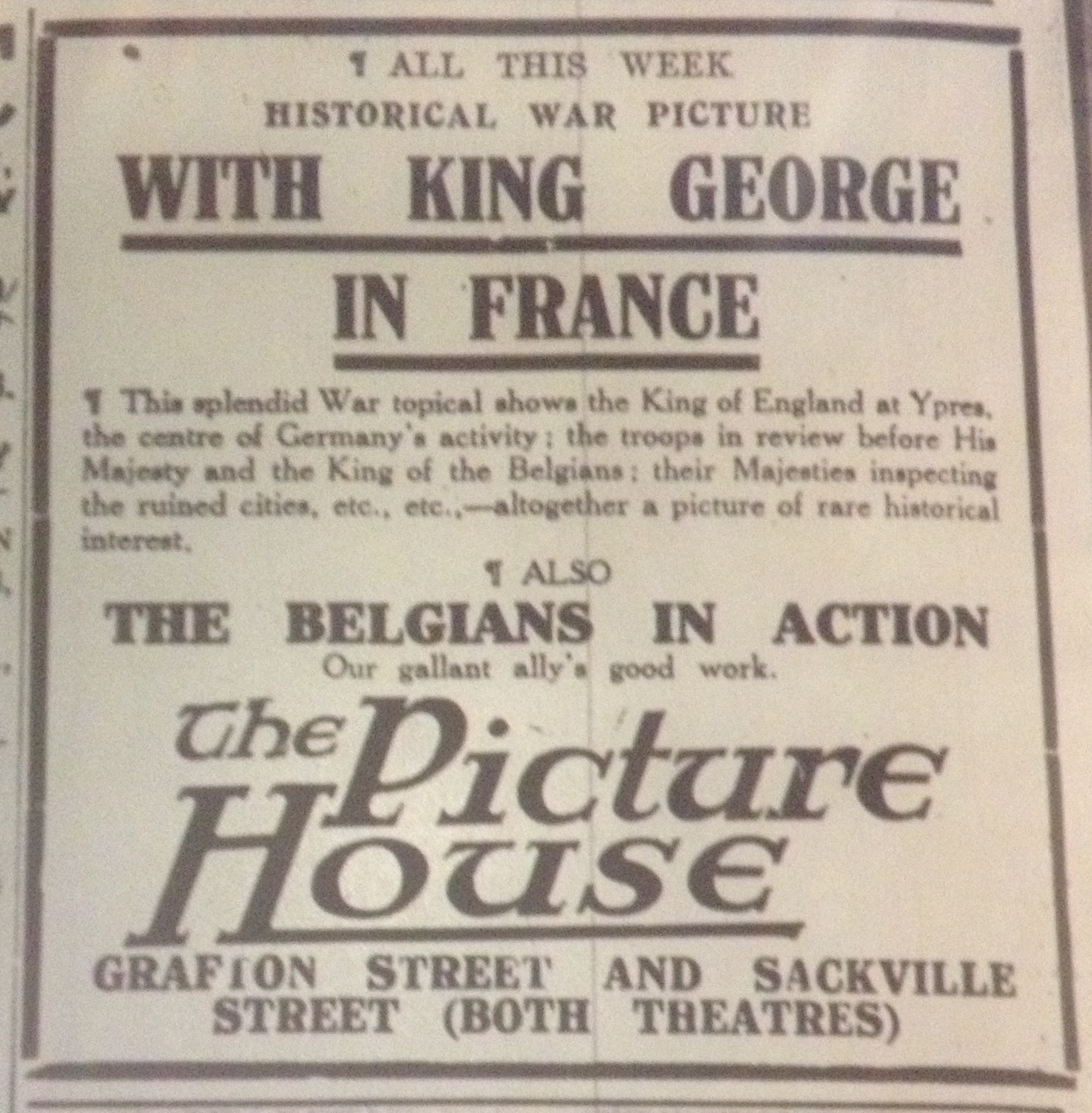
Evening Telegraph 15 Dec. 1914: 2.

The war was also “reel” business for picture house managements because it provided a topical subject matter with which to attract audiences. There was a popular understanding the films of the war had a persuasive function, particularly when it was used by the enemy. This was highlighted in early December when the Evening Telegraph’s daily column “Sidelights on the War” published an item called “German Victories on the Cinema,” which reported the alleged experiences of “a gentleman who has been to a biograph show in Germany” and who described “[h]ow the news of fictitious victories is circulated.”

A picture of the Kaiser standing with field-glasses in the trenches (delirious enthusiasm). The picture had to be shown over and over again on a screen a hand writes the latest war news: “An English battleship, believed to be the Warrior, was this morning, near Dover, torpedoed by a German submarine and sank.”

[…]

Next picture: The Crown Prince on horseback. A rather subdued applause follows. On the screen the hand thereupon writes: “A German squadron has this morning reached Ireland; mariners have made a landing in the town – name not permitted by censor.” The audience gets up and sings “Deutschland, Deutschland uber alles.” (“Sidelights on the War.”)
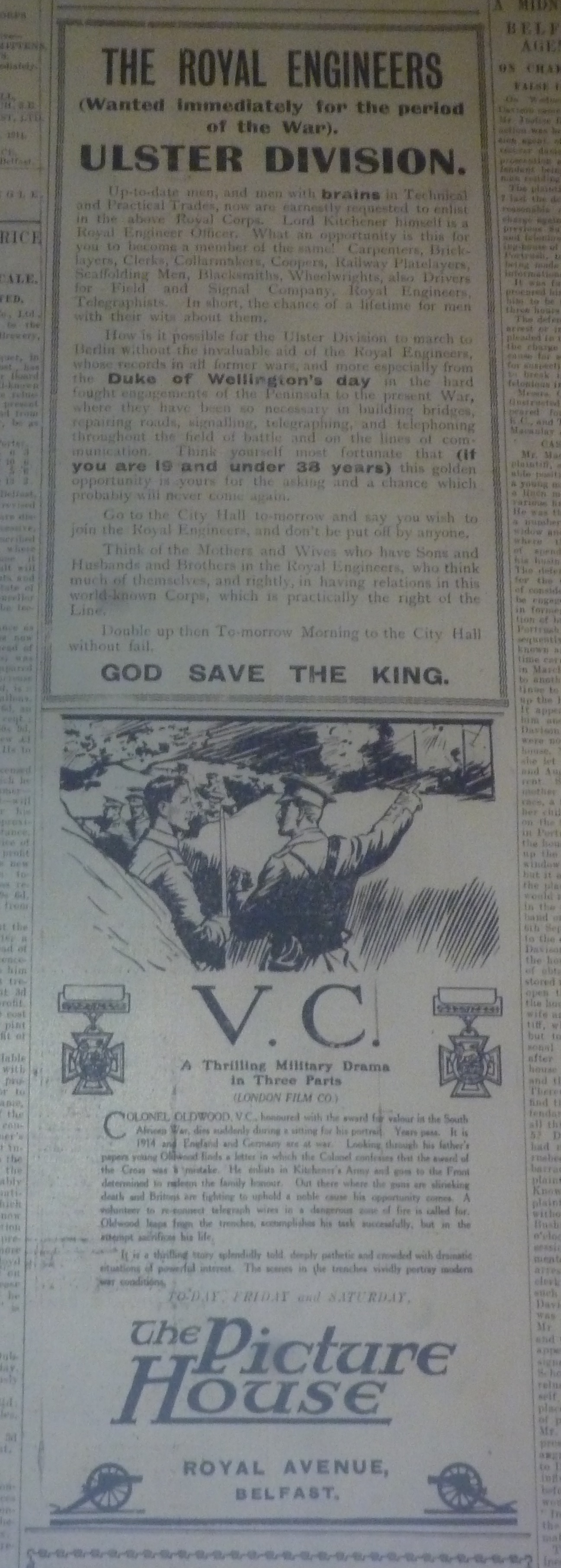
Interesting juxtaposition of an ad calling for volunteers to the Royal Engineers and one for the film in which a young man sacrifices himself on a World War I battlefield.

Belfast Evening Telegraph 26 Nov. 1914: 2.

This item clearly implied that the cinema could promote blind devotion to the Kaiser among the German popular audience that generated a war fever that was a danger not only to the sailors of the Warrior but also to Irish citizens facing a German invasion. No similar analysis of Allied war films appeared in mid-December when the Provincial Cinematograph Theatres’ Picture Houses in Dublin’s Grafton Street and Sackville/O’Connell Street and Belfast’s Royal Avenue showed the film With King George in France with The Belgians in Action. Although protests occurred at jingoistic entertainments and criticism appeared in more radical publications, loyalty to King George was accepted by the mainstream Irish press. In late November, the propaganda potential of the war-themed fiction film being produced in increasing numbers by British production companies was highlighted when an ad for one of these films appeared in the Belfast Evening Telegraph below a recruiting ad. While the recruiting ad called for volunteers to the Royal Engineers, the ad for V.C. (Britian: London, 1914), in which a young man dies on a World War I battlefield to vindicate his family’s honour, offered “scenes in the trenches [that] vividly portray modern war conditions.”

The wartime uses of moving pictures were not restricted to their propaganda value in the picture houses. The Bioscope reported comments from the Berlin correspondent of the Spanish El Mundo Cinematografico that “it is evident how much theatrical and cinematographic works can do to lift up and sustain a love of the fatherland in the whole public” (“Cinematography Employed by the Germans”). Citing evidence from the same source on the use of cameras for aerial reconnaissance, the Bioscope argued that “the Germans may claim to be the first nation to put the cinematograph to direct military use in warfare” and urged the War Office and British and French inventors to surpass their enemy (ibid).

By the end of 1914, cinema was showing no signs of going the way of roller skating. It was becoming firmly embedded in the business and entertainment life of Irish cities and towns.

References

“Ancient and Modern: Belfast’s Latest Cinema Described: By Our Special Representative.” Bioscope 10 Dec. 1914: 1143.

“Channel Hurricane: Vessels ‘Sub-Marine’ Passage: Life Boat Lost from ‘Teviot.’” Evening Telegraph 5 Dec. 1914: 4.

“Christmas Eve: Dublin at Its Best: Business Booming.” Evening Telegraph 24 Dec. 1914: 3.

“Cinematography Employed by the German Army: Interesting Details from Berlin of an Alleged New Invention.” Bioscope 10 Dec. 1914: 1076.

“Havoc of Hurricane: Horses Killed on Board Ship: Steamers Forced Back to Dublin: Vessels Blown Down the Liffey: Sailings Postponed and Cancelled.” Evening Telegraph 4 Dec. 1914: 3.

“Heavy Gale in Dublin.” Irish Times 5 Dec. 1914: 5.

“The Imperial Opened: Belfast’s Palatial Picture House: A Civic Ceremony: Home of Pleasure and Comfort.” Belfast Evening Telegraph 9 Dec. 1914: 2.

“Music and the Drama.” Evening Telegraph 5 Dec. 1914: 6.

“Notes and Comments: Standard Amusements.” Evening Telegraph 11 Dec. 1914: 2.

Paddy. “Pictures in Ireland.” Bioscope 17 Dec. 1914: 1217; 24 Dec. 1914: 1347.

“Pillar Picture House.” Evening Telegraph 5 Dec. 1914: 6.

“The Pillar Picture House, Dublin.” Irish Builder 27 Feb. 1915: 98.

“Sidelights on the War: German Victories on the Cinema.” Evening Telegraph 7 Dec. 1914: 2.

“To Entertain Tommy.” Belfast Evening Telegraph 17 Dec. 1914: 5.

“The Weather in Dublin.” Evening Telegraph 2 Dec. 1914: 2.

Rolls of Honour: Irish Film Businesses and the War, Autumn 1914

“The British Cinematograph Industry has made a magnificent response to the country’s call for men at this terrible crisis,” observed the trade journal Bioscope shortly after Britain’s entry into the First World War. The magazine requested that “managers of the cinematograph business houses or theatres, any of whose workers have temporarily left them for this noble purpose, kindly communicate the fact to us, mentioning the name of the man and the regiment he is joining” (“Trade Topics”). The following issue’s “Roll of Honour” (20 Aug.), a list of members of the trade who had joined the armed forces, did not mention any men from Irish companies, but Irish correspondent Paddy observed that one of the sons of Irish exhibitor James T. Jameson had “been called to the colours” (Paddy, 20 Aug.).

Roll of Honour 1

The Bioscope’s second “Roll of Honour” for men in film businesses who enlisted featured five Irishmen; 27 Aug. 1914: 784.

Beginning on 27 August, the names of employees in Irish or Ireland-based film companies began to appear on the Bioscope’s “Roll of Honour.” The first of those mentioned was William Vass Morris of Cork, described in the census of 1911 as a photographic agent, who was joining the South Irish Horse. Morris was joined on this list by three members of Gaumont’s Dublin office, another Morris, Ganey and Kinnemont, and by Byrne of Dublin’s Grand Cinema. Two members of Provincial Cinematograph’s Belfast staff – Cummings and Lydall – appeared on the first “Roll of Honour” in September. Provincial had already publicized the special contribution of its personnel to the war effort, and the Dublin Evening Mail had duly passed on this information to its readers (“The Picture House Staff”). Those named by the Evening Mail article had prominent positions in the company’s London head office, including chairman of the board Sir William Bass and general manager Aubrey Meares. It also claimed that

[b]etween 60 and 70 attendants at various theatres owned by this company have been called out on reserve, and the company has decided to allow 10s per week to the wife, and 2s 6d for each child during the man’s absence. All employes will be re-instated at the conclusion of the war. (Ibid.)

By early October, Dublin’s Evening Telegraph was putting the number of Provincial staff who had “joined his Majesty’s forces” at 109 (“Picture House Employes”).

Ad for war films at the Grafton; Dublin Evening Mail, 14 Sep. 1914: 2.

Ad for war films at the Grafton; Dublin Evening Mail, 14 Sep. 1914: 2.

Some Irish film production companies expanded their business during the war, taking advantage of new filmmaking opportunities – although these were not without risks – as well as pursuing some innovative work. Norman Whitten of the General Film Supply featured in a short article in the Bioscope in mid-September. It explained that Whitten had mounted a platform in front of a train to take “the beautiful scenery around Galway Bay. In the light of recent stirring events, the ‘topcials’ secured should be of distinct value to exhibitors” (“New Series of Irish Topicals”). As well as this kind of work that he had been doing for some time, Whitten – assisted by a Mr. Ashton who presumably had taken the place of Whitten’s previous cameraman, Benny Cann – made several war-themed films, but not as many as he planned. In early September, Paddy reported that Whitten had been threatened with being shot if he persisted in trying to film soldiers embarking on transport ships at Dublin’s North Wall. The War Office had revoked the permit to film that Whitten had earlier obtained. As Paddy observed, this was disappointing for Whitten, who had been building up his business in local topicals to a point where his film Funeral of Victims Shooting Affair Sunday, July 26th circulated in eight copies, which “constitutes rather a record” (Paddy, 3 Sep.). This film was of continuing relevance because of the campaign of the relatives of victims to get Dublin Corporation to petition the king (“Bachelor’s Walk Outrage”).

Whitten appears to have had eight regular subscribers for his topicals in Dublin, but such a circulation seems small by comparison with the other kinds of war films his company was making at the time. Paddy described Whitten’s Sons of John Bull as both a topical and a “‘cartoon’ film,” but the element of animation is not clear from his description, which makes the film appears to have been a series of filmed portraits and/or still images connected with dissolves and intertitles:

[I]t is a series of photos, hand-coloured, of famous people connected with the war. Each subject dissolves into the next, which rather enhances the beauty of the film. Another portion of the film is entitled “Friends,” and depicts famous men connected with our Allies, including a splendid photo of the king of Belgium. (Paddy, 3 Sep.)

The film ran 100 feet (or about 1 minute 40 seconds), but it is not clear why Paddy considered it “a great advance over the system of still slides,” which it clearly resembled, albeit without the presence of a lantern lecturer to explain the images.

By early October, Paddy was characterizing this film as “a pronounced success in Dublin and elsewhere,” and revealing Whitten’s plans to release a second film of the same kind on 22 October (Paddy, 1 Oct.). Twice the length of Son of John Bull at 200 feet, Britannia’s Message appears to have included newsreel and to have begun with an animated sequence. It

opens with Britannia drawing aside some curtains and revealing a German spy. Interesting scenes include an outside view of hundreds of young fellows besieging a recruiting office, a view of the Rugby Volunteers drilling at Lansdowne Road, Dublin, and a view of troops leaving for camp. (Ibid.)

The latter was presumably shot after Whitten had been given a new permit. The potential public interest beyond Ireland in these pro-war shorts was indicated by the fact that British distributor Cosmopolitan was handling them.

Within Ireland, business at the cinemas was reported to be good. In mid-September, Paddy made a tour of many of Dublin’s cinemas reporting that “in the great majority of cases [I] found business excellent; in fact, in certain houses exceptionally brisk.” His researches made him conclude that there was a difference between working-class and middle-class picture houses. He argued that

it is chiefly the houses which make an appeal to the 2d. and 3d. people that suffer most from the war. The patrons of these houses were largely drawn from reservists of one kind and another and their families. The bread-winner being away on service, the family naturally are thrown back on slenderer resources, and so cannot attend the “movies” as frequently as they might wish. However, as business gradually resumes more normal aspects, it is to be hoped that this state of things will be somewhat alleviated. (Paddy, 24 Sep.)

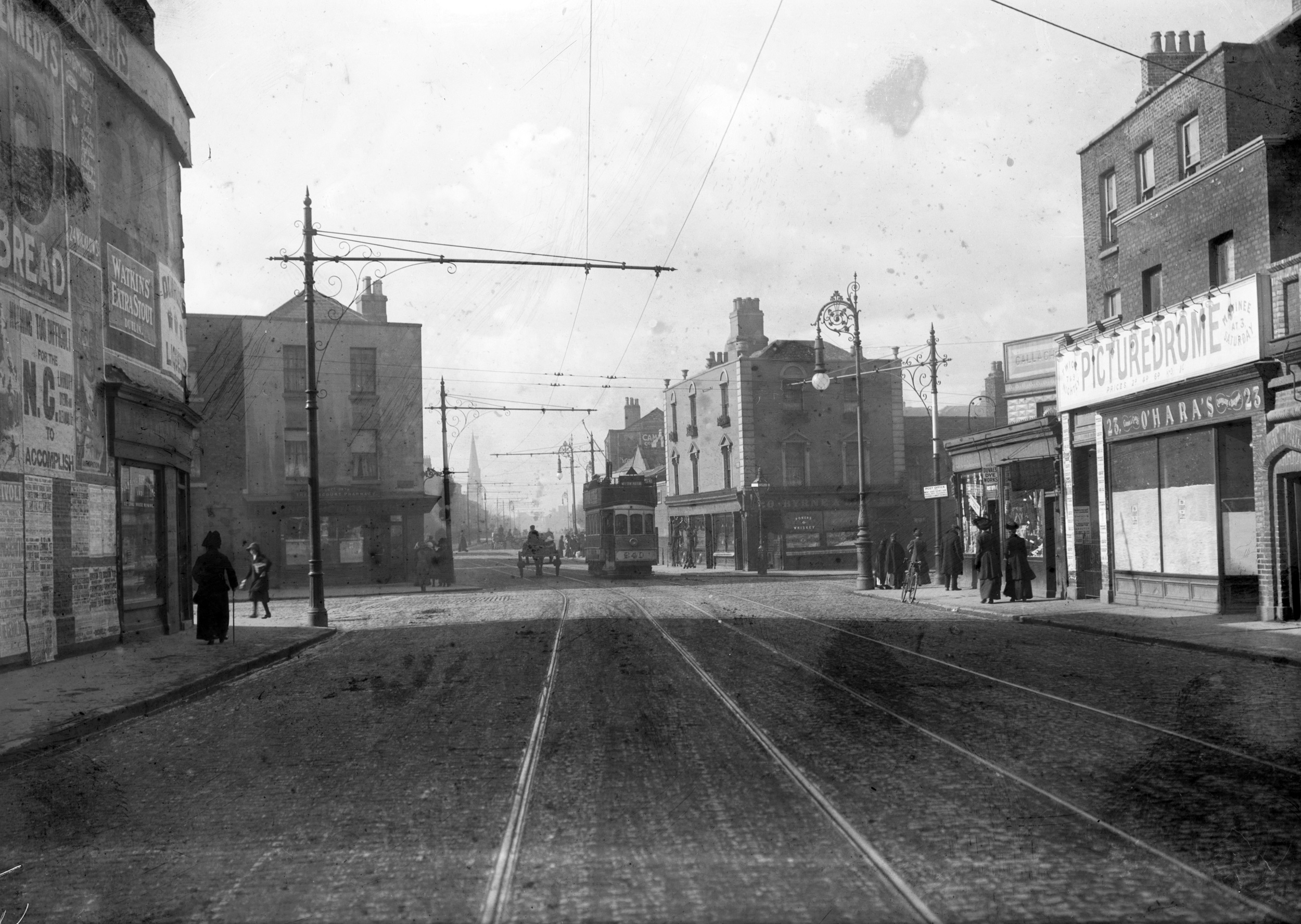
The Picturedrome is visible on the right of this photograph of Dublin's Harcourt Road. https://www.flickr.com/photos/nlireland/7628356832/

The Picturedrome is visible on the right of this photograph of Dublin’s Harcourt Road in c. 1912. https://www.flickr.com/photos/nlireland/7628356832/

One working-class picture house that he visited was the Picturedrome in Harcourt Road. For Paddy, the Picturedrome was “a theatre which I regret to find I have not mentioned in these notes for some time,” but he was not alone in his lack of coverage because the Picturedrome – catering for a local working-class audience – did not advertise in the Dublin newspapers and so was ignored by reviewers. “Business here was fairly brisk,” Paddy observed, “considering the regular patrons of the hall are drawn from men now with the colours.” Manager Will Sommerson was presenting a bill dominated by three Vitagraph films The Auto Bandits of New York, Old Reliable and Her Mother’s Wedding Gown. “[I]t’s astonishing the popularity of Vitagraph films in Ireland” – although The Auto Bandits seems to have been made by the Ruby Feature Film Company. The only other film he mentioned at the Picturedrome was “an exceptionally interesting scenic, ‘The Volcanoes of Java’” (ibid.).

Tivoli Theatre of Varieties, Burgh Quay, Dublin, May 1915. https://www.flickr.com/photos/nlireland/12082817723/

Tivoli Theatre of Varieties, Burgh Quay, Dublin, May 1915. https://www.flickr.com/photos/nlireland/12082817723/

The most notable thing about the Picturedrome’s programme is that Sommerson appears to have chosen none of the war-themed films that some other exhibitors were making a point of including on their programmes. At the Tivoli Theatre of Varieties, for example, the music-hall bill included the films Cyclists of the Belgian Army and The 23rd French Dragoons, which “had been specially procured by Mr. Charles M. Jones for the benefit of his patrons – a large proportion of soldiers being amongst the audience each night” (ibid.). At the Dorset Hall, manager Frederich Sullivan accompanied the dramas Jim, the Fireman (Britain: Barker, 1914) and In the Wolf’s Fangs (US: Bison, 1914) with “the authentic film of the Germans entering Brussels, and I noted that this film had been passed by the Censor” (ibid.).

The Man About Town's "Things Seen and Heard" column began with items on film on 5 and 10 Oct. 1914: 2.

The Man About Town’s “Things Seen and Heard” column in the Evening Herald began with film items on 5 and 10 Oct. 1914: 2.

Commentators in the Dublin papers were more ambivalent about war films. Also writing on 24 September, the same day as Paddy’s coverage of the Dublin picture houses appeared in the Bioscope, the Evening Herald columnist The Man About Town was pleased to hear from “the proprietor of one of our largest picture houses” that business was quite good, as well as to get a demonstration of the Topical Picture Slide, a new method of displaying topical news. Despite this unnamed proprietor’s focus on matters topical, he told the Man About Town that “[p]eople hear so much about the war that when they go to a cinema they look for something to relieve their minds from the awfulness of it, and I find that with a carefully selected and well-balanced programme business is really good.” A regular cinemagoer, the Man About Town provided an example a week later of a picture house patron who was traumatized by war images on screen. “I was attending a picture theatre the other day with a lady,” he revealed,

and gradually it was borne in upon me that my airy persiflage was falling on deaf or, at least, inattentive ears. The film was telling a thrilling story, and the incidents just being depicted were those of a naval encounter in the course of which the hero – an officer of the Royal Navy – is fatally wounded. My companion seemed a little distraite, and at last observed: “Oh, I wish they wouldn’t show things like this.” Then I remembered that her brother is at present serving in a ship in the North Sea. The cunning of the scene was too much for her. (30 Sep.)

Earlier in the month, he had suggested that certain picture houses were clumsily attempting to elicit patriotic responses from the Dublin audience. “In a picture theatre in — street yesterday a picture of King — was shown,” he observed,

the band played “— Save the King,” the audience uncovered (their heads), and there was some applause. So far so well. Then a raucous voice shouted in an unmistakable brogue, “Hip, hip, hurrah.” Without being able to swear to it, I have no doubt, having regard to the accent, the venue, and the audience, that this enthusiast was a paid rather than a paying spectator. In other words that he was one of the staff. Surely enthusiasm should grow of itself, and not be fomented in this way? As it was the demonstration fell flat. (12 Sep.)

The role of the picture house attendant who cheered was clearly crucial here, but music also played a significant part in this case and generally in shaping the experience of patrons. Paddy commented that the music at the Phibsboro Picture House at the northern edge of the city was “deserving of great praise, and no one takes more interest in her work or gives a more spirited and tasteful exhibition of playing than Miss Eagar”(24 Sep.). The Man About Town included an item entitled “‘Glorious’ War,” in which he demonstrated the way that talented musicians could influence the audience’s reception of war films. “While I was at a picture-house the other night,” he began, “scenes were shown of Belgian wounded being removed in ambulances. The pictures were rather harrowing, and as they were being displayed the band discoursed Elgar’s famous march, ‘Pomp and Circumstance.’ It set one thinking” (14 Sep.).

Therefore, although Irish film businesses generally embraced the pro-war patriotism that dominated the British industry, local exhibitors and audiences were more ambivalent about what they were seeing on the screen.

References

“Bachelor’s Walk Outrage: Relatives of the Victims: Corporation Resolution: To Petition King.” Evening Telegraph 5 Oct. 1914: 4.

The Man About Town. “Things Seen and Heard: ‘Glorious’ War.” Evening Herald 12 Sep. 1914: 2; 14 Sep. 1914: 2; 24 Sep. 1914: 2; 30 Sep. 1914: 2.

“New Series of Irish Topicals.” Bioscope 17 Sep. 1914: 1079.

Paddy. “Pictures in Ireland.” Bioscope 20 Aug. 1914: 752; 3 Sep. 1914: 913; 24 Sep. 1914: 1129; 1 Oct. 1914: 31.

“Picture House Employes.” Evening Telegraph 10 Oct. 1914: 3.

“The Picture House Staff: Many Men Off to the Front.” Dublin Evening Mail 21 Aug. 1914: 4.

“Roll of Honour.” Bioscope 20 Aug. 1914: 784; 27 Aug. 1914: 3 Sep 1914: 869.

“Trade Topics.” Bioscope 13 Aug. 1914: 617.

Changing the Entertainment Geography of the City: The Bohemian Picture Theatre Opens

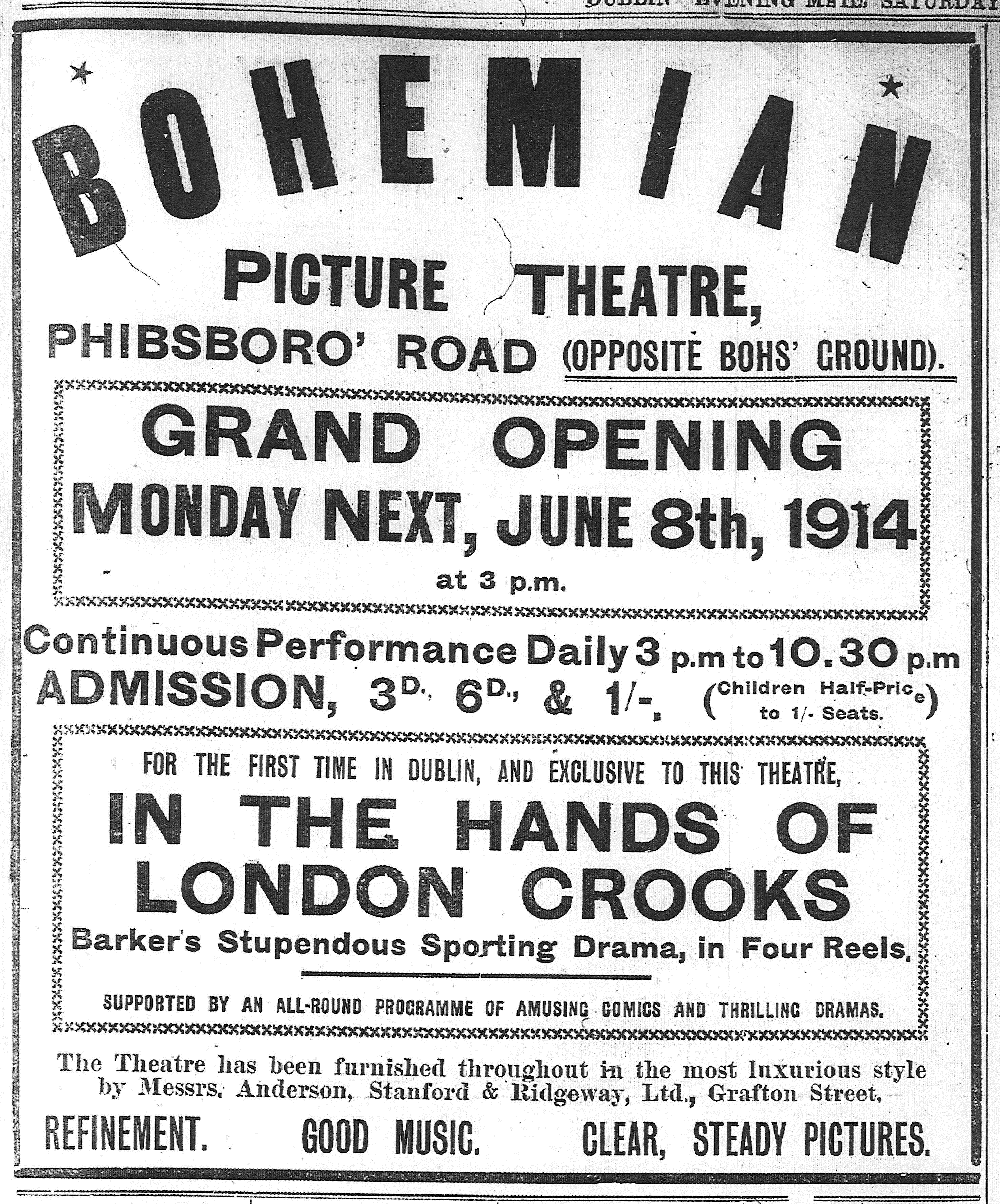
Ad for the opening of the Bohemian Picture Theatrre. Dublin Evening Mail, 6 Jun. 1914: 7.

“Glasnevin has fallen into line – it has not merely one Picture House, but two. Handsome buildings they are, both of them,” observed the Evening Herald’s Man About Town at the end of May 1914. He also noted developments in cinema far from Dublin, in the west coast Aran Islands: “Kilronan, Islands of Arran, too, has ‘joined the movement.’ Kilronan people to the number of 400 turned in on Saturday week last to their Picture Palace, and, as our Arran correspondent adds, ‘thoroughly enjoyed the films shown’” (“Thing Seen and Heard”). However accurate may have been his intriguing information on cinemagoing on islands far from the city that was his beat, he was wrong about the location of the two new Dublin picture houses; they were in the north-city district of Phibsborough, a mile from the more remote village of Glasnevin.

Bohemian

Letterhead from 1916 featuring image of Bohemian Picture Theatre. Courtesy of the National Library of Ireland.

On 9 June 1914, the Irish Times somewhat more accurately reported that the “Bohemian Picture House, in Phibsborough road, was opened yesterday afternoon under conditions which promise well for the future success of the entertainment given there” (“Bohemian Cinema”). The location was right here, as the Bohemian – taking its name from the local soccer club – was built on the site of two demolished houses at 154 and 155 Phibsborough Road. However, as the controversy over the recently opened Phibsboro Picture House’s showing of In the Shadow of the Throne continued into the week beginning 8 June, conditions looked a little less auspicious than the writer would have his/her readers believe. The British trade journal Bioscope’s detailed account of the incident only appeared on 11 June, describing it as “A Catholic Protest” that had been counterproductive because it had “evoked a desire in other people to see [the film] and judge for themselves” (“‘In the Shadow of the Throne’).

Two small shops flanked the entrance to the Bohemian.

Two small shops flanked the entrance to the Bohemian, which was approached by a set of steps.

Nevertheless, both the Times and Herald rightly agreed that the Phibsborough picture houses were handsome, well-equipped buildings. The plans for the Bohemian were drawn up by Dublin’s most prominent cinema architect, George L. O’Connor. Having already prepared the plans for the Mary Street Picture House and the Rathmines Picture Palace (opened in March 1913 and soon afterwards named the Princess), O’Connor was said to be making “a speciality of designing cinema theatres” (“Another New Cinema Theatre for Dublin”). His design for the Bohemian resembled that of the Rathmines Picture Palace in incorporating two shops on either side of the entrance, each only a single storey in order not to block the view of the theatre itself (“More Cinema Theatres for Dublin”). The facade was “finished in red brick and chiselled limestone dressings, gables and finials” (“Building News”). Although set back from the street, the picture house announced itself with a canopy that extended between the shops. Patrons entered the auditorium by climbing a set of steps to the lobby. Inside, a wide stairs led to a spacious gallery, while an auditorium 104 feet by 38 feet was furnished with seats and carpets in shades of blue and topped by an elliptical ceiling finished in decorative fibrous plaster (ibid).

While noting the comfortable furnishings and the lighting and ventilation systems, the Irish Times also took an unusual interest in the details of the cinematic equipment. The projection box held two Ernemann Jubilee projectors, in which

the film is entirely enclosed throughout its length, thus giving complete immunity from fire risks. From lens to screen is a distance of 105 feet, and the screen, 20 feet by 15 feet, is slightly inclined from the vertical in order to give a proper view from every part of the house (“Bohemian Cinema”).

“The Bohemian Boy”: Caricature of Bohemian owner Frederick Sparling. Irish Limelight Aug. 1917: 1.

“The Bohemian Boy”: Caricature of Bohemian owner Frederick Sparling. Irish Limelight Aug. 1917: 1.

The 24-year-old Bohemian owner Frederick Arthur Sparling chose to compete with the more experienced proprietors of the Phibsboro Picture House located just 50 yards away with a very similar entertainment. Both venues offered continuous performances from 3 to 10:30, but the Boh’s prices of 3d, 6d and 1s were slightly higher than the Phibsboro’s 3d, 6d and 9d, and on Sundays, the cost of 3d seats increased to 4d. The ad for the Boh’s opening promised “refinement, good music and clear, steady pictures,” with its programme for the first six days headed by the four-reel British racing drama In the Hands of London Crooks (Barker, 1914). On Sunday 14 June, the main film was the two-reel In the Grip of Circumstance (US: Essanay, 1914), followed on Monday, 15 June, by Lieutenant Daring and the Stolen Invention (Britain: British and Colonial Kinematograph, 1914), and on Thursday, 18 June by The Drudge (US: Vitagraph, 1914). Sparling likely left the choice of “exclusive” films to his manager W. O. Ashton, who had recently been working for the Dublin branch of the distribution company Films, Limited (Paddy,18 Jun.). Musical director Percy Carver supervised the accompaniment, which “plays during the whole of the performance” (“Bohemian Picture Theatre”).

Map showing the main picture houses and theatres showing films in 1914. The slightly anomalous clustering of the Bohemian and Phibsboro.

Map showing the main Dublin picture houses and theatres showing films by 1914, with the location of the Bohemian and Phibsboro indicated.

The Times put the number of seats at 900, while other sources estimated 860 (“More Cinema Theatres for Dublin”), 1,000 (“Building News”) and 1,200 (Paddy, 4 Jun.). Taking even the lowest estimates for the two Phibsborough picture theatres (the Phibsboro with 570 and Bohemian with 860), early June 1914 saw this suburb on the northern edge of the city gain more than 1,400 cinema seats in just over two weeks. To ensure healthy profits, the picture houses would have had to have induced patrons to travel to Phibsborough, perhaps on one of the two tram lines that served the area. This was an extraordinary development because it showed the degree to which cinema had changed the entertainment geography of the city by bringing professionally produced theatrical entertainment into the suburbs.

References

“Another New Cinema Theatre for Dublin.” Irish Builder 31 Jan. 1914: 72.

“Bohemian Cinema.” Irish Times 9 Jun. 1914: 5.

“Bohemian Picture Theatre,” Dublin Evening Mail 13 Jun. 1914: 3.

“Building News.” Irish Builder 19 Dec. 1913: 868.

“‘In the Shadow of the Throne’: A Catholic Protest.” Bioscope 11 Jun. 1914: 1106.

“More Cinema Theatres for Dublin.” Irish Builder 16 Aug. 1913: 536.

Paddy. “Pictures in Ireland.” Bioscope 4 Jun. 1914: 1069; 18 Jun. 1914: 1261.

“Thing Seen and Heard: Glasnevin.” Evening Herald 25 May 1914: 5.

The Phibsboro Picture House Opens

Announcement of hte opening of the Phibsboro Picture House, Dublin Evening Mail, 23 May 1914.

Announcement of the opening of the Phibsboro Picture House, Dublin Evening Mail, 23 May 1914.

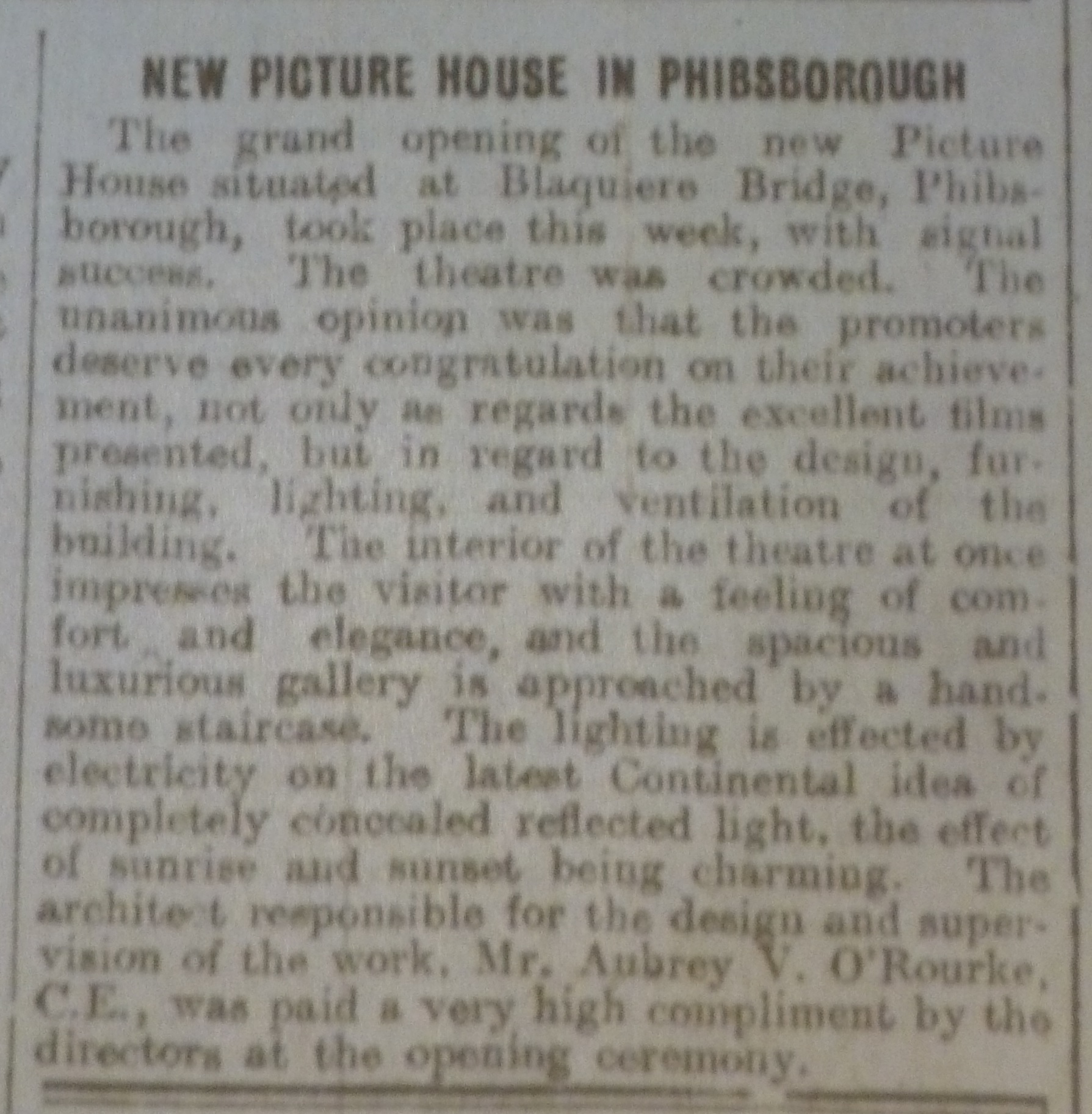
A century ago, on 23 May 1914, Dublin’s newspapers announced the opening of the Picture House in Phibsborough (or Phibsboro), on the northern edge of the city. The papers are a little vague on the exact day of the opening, but as the 23 May was a Saturday, some of the papers cover the opening in their weekly theatrical column. “The grand opening of the new Picture House situated at Blaquiere Bridge, Phibsborough,” declared the Dublin Evening Mail’s The Play’s the Thing column, “took place this week, with signal success” (“New Picture House in Phibsborough”). That morning’s Irish Times had carried the same article, and a shorter notice in the Evening Herald was clearly working from the same publicity material provided to the Mail and Times. “The promoters deserve every congratulation, not only as regards the excellent film presented, but also in as far as design, furnishing, lighting, ventilation, etc., are concerned,” commented the Herald. “The house is most comfortable, and great crowds have been enjoying both the comfort and excellent fare provided. The architect, Mr. Aubrey V. O’Rourke, C.E., was paid a very high compliment by the directors at the opening ceremony” (“New Phibsborough Picture Palace”).

Phibsboro Picture House

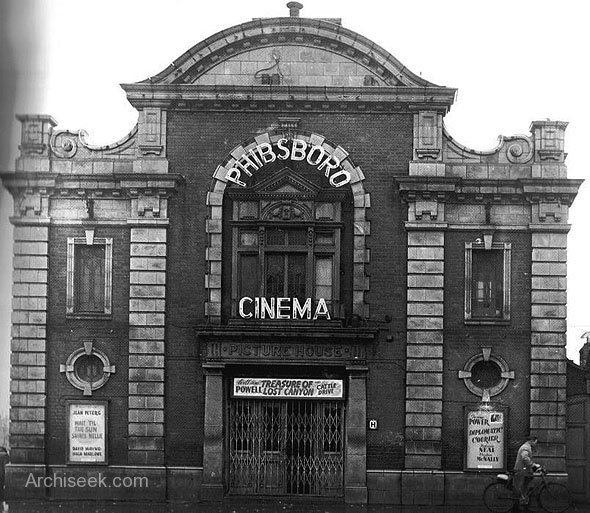
The only known photo of the Phibsboro Picture House was taken after it had closed for demolition in 1953 (http://archiseek.com/2012/1914-phibsborough-picture-house-north-circular-rd-dublin#.U38HxCjiiI8).

Certainly, the only still circulating photograph of the original facade – taken almost 40 years later – shows an attractive addition to the streetscape in this part of the city. Construction work had begun in summer 1913, but even after this had started, alterations were made to the design, probably in order to better compete with the Bohemian Picture Theatre, which was also under construction close by on Phibsborough Road. “It is intended to amend the design and planning generally of the new cinematograph theatre now in the course of construction at Madras Place, Phibsboro’,” revealed the Irish Builder.

The front of the building will be carried out in brickwork and terra cotta dressings, and will present a more handsome and bolder appearance than the original design. It is intended to erect a balcony, and to increase the seating capacity considerably. The emergency passage will be covered in, and the gentlemen’s sanitary accommodation approached from this passage. The machine enclosure, rewinding room, and office will be situated at the back of the balcony, and the generating chamber in the basement. The internal decorations, which are to be of a handsome character, are to be carried out in fibrous plaster.” (“Building News”)

The British cinema trade journal Bioscope offered the first indication of the capacity and ownership of the new picture house:

The theatre is specially designed, and will be an up-to-date hall, accommodating 600. Although a separate company from the Irish Kinematograph Company, Limited, the new company will be worked in conjunction with that Company’s Mary Street House. Messrs. Hibberts will have a controlling interest, and Alderman Farrell is to act as managing director. Mr. Bob O’Russ – the popular manager of the Mary Street house – will take over the duties connected with the secretaryship. (“Our View”)

City councillor and former mayor, John J. Farrell already had interests in the Electric Theatre, Talbot Street, the Mary Street Picture House and the soon-to-be announced Pillar Picture House in O’Connell Street. For the Phibsboro venture, however, Farrell registered the Phibsboro Picture House company on 2 September 1914, in partnership with William King, a farmer and horse breeder of Belcamp, Co. Dublin; and British cinema owners Henry Hibbert and T. Wood (“World of Finance”). Construction on the Phibsboro – and all other Dublin buildings – stopped in September 1913 because of the Lockout (Paddy, 30 Oct. and 11 Dec.), but it resumed with the end of the general strike in early 1914.

Advertisement for the newly opened Phibsboro Picture House, Dublin Evening Mail, 23 May 1914.

Advertisement for the newly opened Phibsboro Picture House, Dublin Evening Mail, 23 May 1914.

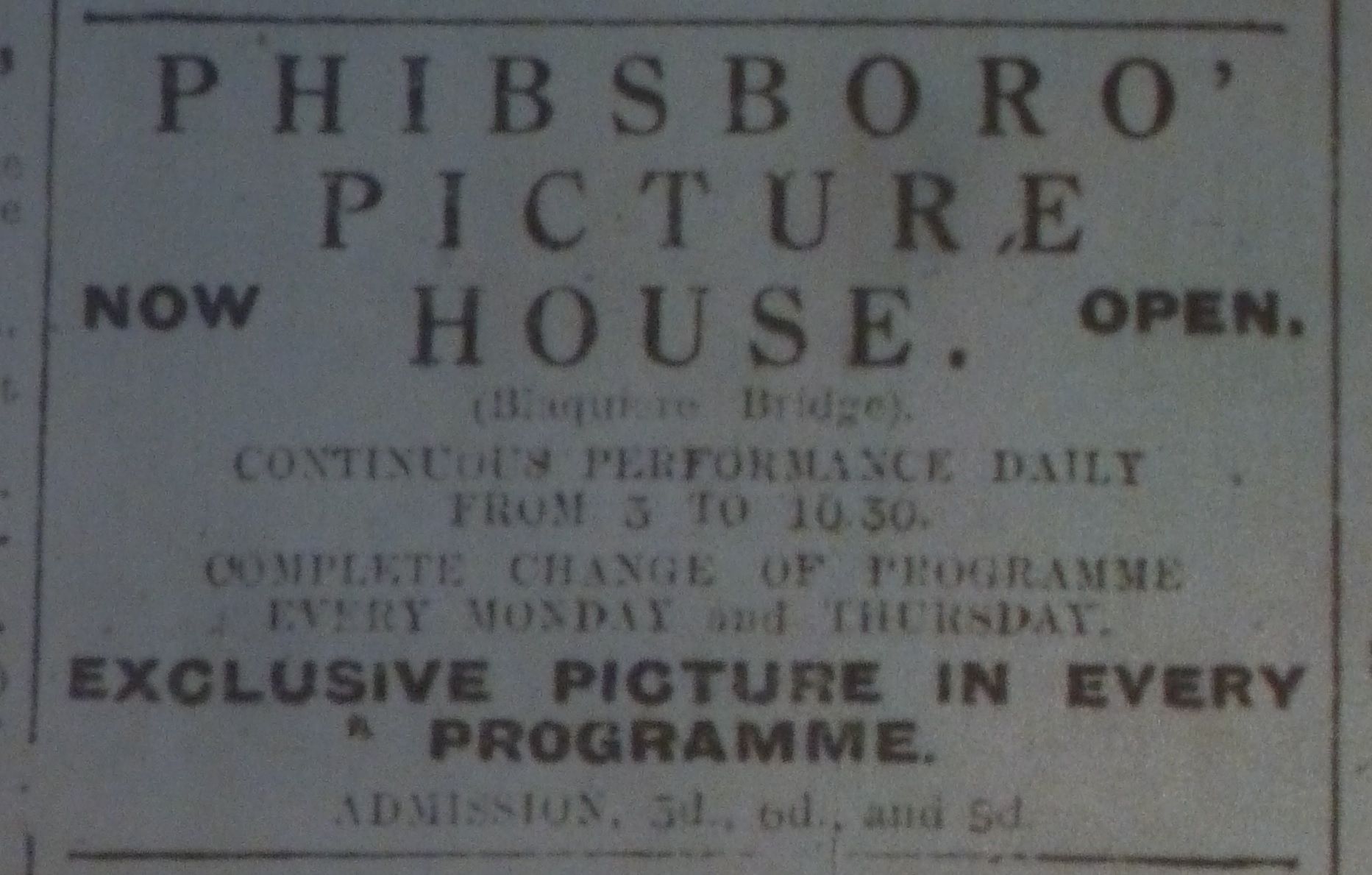
The first ads for the Phibsboro on 23 May reveal that the performances were continuous from 3 to 10:30 rather than at set times, that the programme changed on Monday and Thursday – initially with no Sunday show, that the pricing was 3d, 6d and 9d, and that there would be an “exclusive” film in every programme. However, they gave little indication of what exactly the first exclusives were. Helpfully, however, the Bioscope’s Paddy reported on 4 June that he

went round the other evening to see the picture theatre in Phibsboro’, and particularly did I admire the “sunrise and sunset” system of lighting, which was concealed round the walls of the building. The building holds, roughly, 600, and the tip-ups are in Rose Barri shade, the carpets being of a darker colour. The harmonizing effect is thus very beautiful. The balcony, to which admission is covered by the nimble shilling, runs in a wide curve, and has a splendid “rake.” (Paddy, 4 Jun.)

The main film Paddy saw that night was Lieutenant Rose and the Sealed Orders (Britain: Clarendon, 1914) “and it was followed with intense interest by a packed house,” as well as the John Bunny comedy Bunny’s Mistake (US: Vitagraph, 1914) and The Vanishing Cracksman (US: Ediston, 1913).

Dublin Evening Mail 30 May 1914: 4.

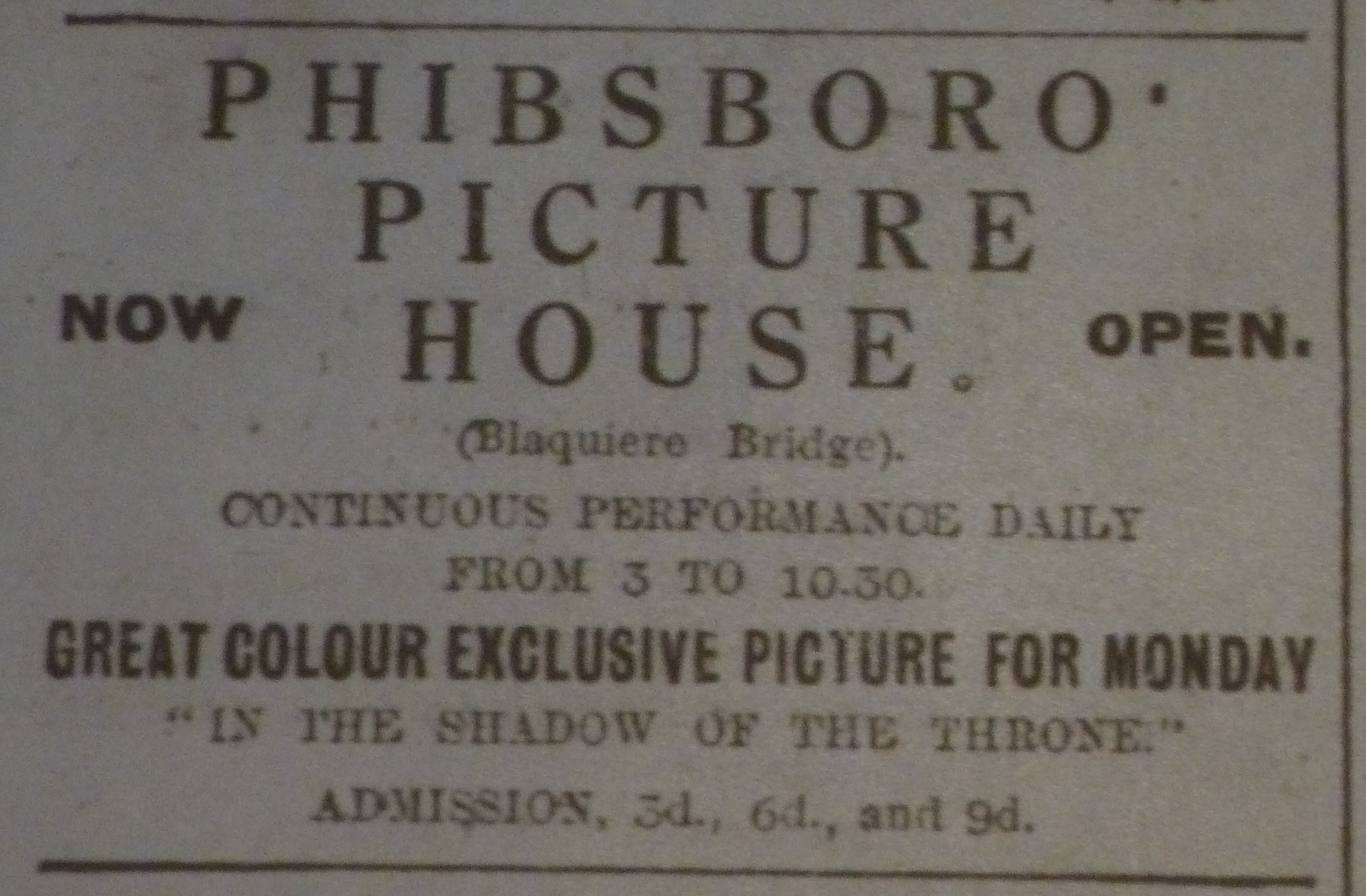
In the Shadow of the Throne at the Phibsboro; Dublin Evening Mail 30 May 1914: 4.

The first film that the Phibsboro actually advertised was the Danish film I Tronens Skygge, translated as In the Shadow of the Throne (I Tronens Skygge; Denmark: Kinografen, 1914). It was due to run for three days beginning on Monday, 1 June, but its opening had some unintended consequences, many – but not all – unpleasant for the management. The film caused a campaign by members of the Catholic Church’s Vigilance Committee, which had been formed in 1911 to campaign against “evil” literature but which had developed a campaign against theatre shows and films. Part of this campaign involved protests in theatres and cinemas carried out by William Larkin and his twin brother Francis.

The campaign began when P. Donnelly sent a letter to the Freeman’s Journal complaining about the film and asking “How long is Catholic Dublin going to stand this sort of thing?” (“A Cinematograph Show Objected To,” Condon 228). Donnelly objected to the fact that a nun said Mass and that a newly professed nun fell into the arms of a prince. The controversy caused a range of reactions. John J. Farrell responded by retaining the film for the second half of the week, writing a letter to the Freeman contradicting Donnelly’s claims (and perhaps, as alleged in court, threatening legal action if the paper did not print a retraction), and inviting a reporter from the newspaper to give an “objective” assessment of the film. The resulting publicity brought around 600 Dubliners, the seating capacity of the cinema, to subsequent showings of the film. Among these on Friday were William and Francis Larkin, who ended a shouted protest in the auditorium by throwing ink at the screen, splattering the blouse and music of Miss Eager in the orchestra. The Larkins were arrested, found guilty and fined a nominal 5 shillings, a punishment whose leniency suggested – not for the first time – the tacit support of the magistrate for Vigilance Committee activities.

To devote too much attention to the Larkins is to turn away from the story of the cinema, but the newspaper accounts of the case provide details of the working of the Phibsboro that do not survive otherwise. They reveal the name of the attendant Daniel McEvoy, whom William Larkin accused of handling him roughly while removing him, and also two women musicians from the orchestra who would otherwise be anonymous: Miss Eager, the musical director whose blouse was inked, and Miss Duffy, who testified in court. Daniel McEvoy and Miss Eager remain obscure, but Miss Duffy is likely to have been Evelyn Duffy who is listed in the 1911 Census as a 23-year-old professional vocalist living at 106 Phibsboro Road, close to the cinema.

Just three weeks after it opened, the Phibsboro had become a part of the city in several ways. It had become a significant part of the streetscape of north Dublin, a successful business for Farrell and his partners, and a place of employment for McEvoy, Eager and Duffy. Beyond that, it had become central, if only briefly, in one of Ireland’s cultural controversies.

References

“A Cinematograph Show Objected To.” Freeman’s Journal 2 Jun. 1914: 5.

“Building News.” Irish Builder 30 Aug. 1913: 563.

Condon, Denis. Early Irish Cinema, 1895-1921. Dublin: Irish Academic, 2008.

“New Phibsborough Picture Palace.” Evening Herald 23 May 1914: 4.

“New Picture House in Phibsboroough.” Dublin Evening Mail 23 May 1914: 3.

“Opening of the New Picture House in Phibsborough.” Irish Times 23 May1914: 9.

“Our View.” Bioscope 24 Jul.1913: 238.

Paddy. “Pictures in Ireland.” Bioscope 30 Oct. 1913: 395; 11 Dec. 1913: 1077; 4 Jun. 1914: 1069.

“World of Finance.” Bioscope 18 Sep. 1913: 933.

“An Immense Power in the Refinement of the World”: Women Musicians in Irish Picture Houses

As the emergence of cinema in the early 1910s changed the nature of Irish popular entertainment, it offered certain women new career opportunities. Although there were some women picture-house managers and jobs in ticket and refreshment sales were generally reserved for women, the largest number of skilled picture-house jobs available to women were as musicians. Every new picture house had at least one musician, and as the 1910s progressed, the prestige of a picture house could be measured by the number of musicians in its orchestra, including known concert musicians whose solos could be advertised as discrete attractions. The boom in picture houses was also a boom in musical employment. For both men and women, these increasingly professionalized jobs required the kind of extended education available only to the middle class. The growing prestige of cinema opened up possibilities for suitably trained women of this class who needed or desired an income but who were restricted from much paid work by barriers to the professions and by such nebulous controls as the discourse on respectability, which, for example, put the menial work undertaken of necessity by many working-class women beyond consideration – or at least, acknowledgement. As such, the increasing number of women cinema musicians is also an index of the increasing acceptability and even respectability of cinema itself, which these women were helping to foster by taking these jobs.

Dorset Picture Hall’s advertisement for staff. Irish Times 20 March 1911: 1.

“Eva Hickie, late pianiste at the Dorset Picture Hall, Dublin, has accepted a similar position at Waterford,” reported Paddy, the Ireland correspondent for the British film trade journal the Bioscope,in mid-April 1914 (Paddy, 16 Apr. 1914). Three years previously, the 1911 Census of Ireland had listed just one Eva Hickie: the 25-year-old head of a household of five siblings and an aged servant, who were living in the north-city suburb of Phibsboro, not far from the Dorset. This Eva Hickie’s occupation is not mentioned, but by Census night, 2 April 1911, she may already have responded to Dorset manager William Shanly’s recent advertisement for “a Lady pianist […] who can play for pictures.” Whether or not she had applied for the job, she was not counted among the 979 Irish women who used the word “music” in the description of their occupation in the Census – the vast majority of them music teachers – and the further 94 who described themselves as musicians.

Despite this lack of self-definition as a musician, Hickie in many ways resembles May Murphy, the most prominent woman musician in Irish cinemas of the early 1910s. The Census puts both women in their mid-twenties and heading households of siblings belonging to the Catholic middle class, for whom music constituted one of the limited choices for respectable employment for women. However, Murphy appears to have been the more socially secure of the two, describing herself in the Census – as did 75 other women – as a professor of music. Although her previous career is obscure, by March 1912 she was leading the Irish Ladies’ Orchestras at James T. Jameson’s most prominent venues: Dublin’s Rotunda and the Pavilion in Kingstown, Co. Dublin:

A potent factor in the success with attends the pictures in the Dublin Rotunda Rooms and the Kingstown Pavilion is the Irish Ladies’ Orchestra, under the direction of Miss Murphy. In the Rotunda there are seven instrumentalists; in Kingstown three. Combined with the crimson and white colour scheme of their dresses, their little Zouave jackets complete a picture of dainty Bohemianism. Mr Jameson is to be congratulated on securing such a permanent attraction. (Paddy, 14 Mar. 1912)

Women’s orchestras were rare but by no means completely novel, and Dublin theatrical audiences might have been familiar with such acts as Les Militaires, a 12-piece women’s orchestra led by Mrs. Hunt and wearing Hussar uniforms and tricorn hats that had visited the city in 1889 (Watters and Murtagh 109-10). Neverthless, the visual spectacle of the Irish Ladies’ Orchestra’s dainty Bohemianism, which would be perfectly understandable in a theatre, seems out of place in a picture house, where the audience should surely be focusing on the screen. However, these musicians were expected to be noticed, a fact that indicates how the live musical portion of the programme was not just invisible accompaniment but was also a visual attraction.

Even as Paddy was asserting the permanence of the attraction, it was changing to offer an opportunity for another woman musician. Just a month after his announcement that Murphy was leading the two orchestras, he revealed that she had found it impossible to manage both the Rotunda and the Pavilion, located in a suburb 12km south of the city. Murphy focused on the Irish Ladies’ Orchestra at the Rotunda, and Jameson – “in no way minded to cut off the musical treat which the people of the Premier Township always expected” – employed a Miss D’Arcy to lead the newly renamed Pavilion Ladies’ Orchestra:

To fill up the place of one who has gone in such a manner that those left behind scarcely feel the vacancy is always a laudable ambition. That Miss D’Arcy has succeeded in maintaining the high state of excellence for which the Pavilion has been famous in the past speaks well for her directorship and ability. (Paddy, 25 Apr. 1912)


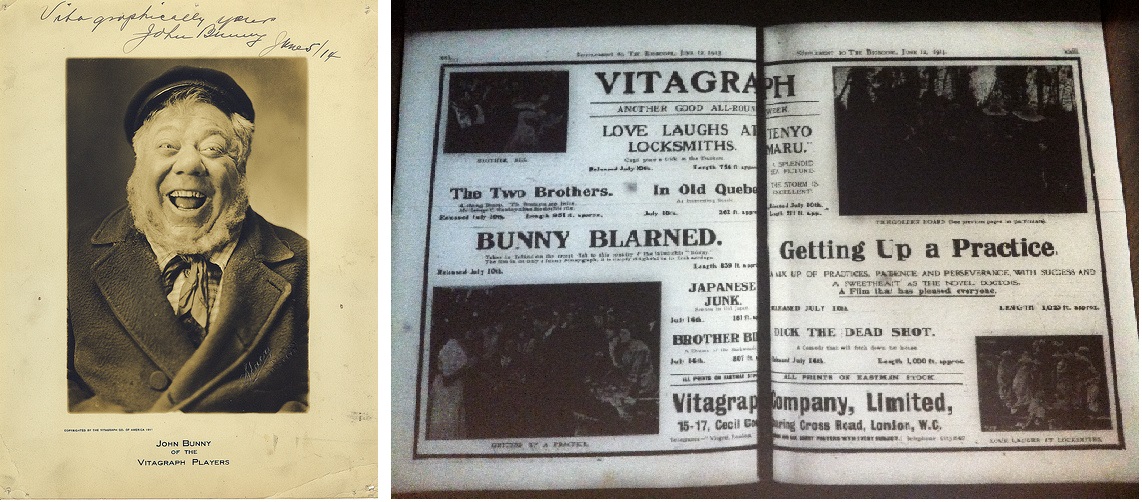
Publicity photograph of John Bunny, signed and dated 5 June 1914 (http://theloudestvoice.tumblr.com/page/328); and Vitagraph ad including Bunny Blarneyed (with title misspelled). Bioscope 12 Jun. 1913.

Vitagraph’s comic star John Bunny praised the Irish Ladies’ Orchestra and outlined the kind of benefits women musicians brought to the cinema. Bunny made his remarks on a working trip to Britain in 1912, during which he visited Ireland to shoot the short comedy Bunny Blarneyed, or The Blarney Stone (US: Vitagraph, 1913) at Cork’s most famous tourist attraction. Taking in a show at the Rotunda, he remarked that

“Women are always an immense power in the refinement of the world. The manager who, seeking to make his show suitable for all – from the little mites up – neglects this truth is only cheating himself of ultimate end. An orchestra composed of women is an undeniable asset to every hall in the world.” (Paddy, 12 Sep. 1912)

For Bunny – and for Paddy who quoted him favourably – such initiatives as the Ladies’ Orchestra put cinema at the forefront of respectable entertainment by putting women at the forefront of the cinema entertainment. There, they were visible signs and guardians of a refined amusement suitable for all the family.

Although Jameson made a particular feature of his Ladies’ Orchestras, other women musicians were also well known to audiences, even when they were less visible during screenings. Miss Frazer, the pianist at the Pavilion’s rival Kingstown Picture House, garnered special praise for her beautiful singing during the run of The Badminton Hunt in January 1913 because “she did not sing from a platform, the film was not stopped at any time. Simply you heard her charming voice coming out of the darkened stillness at the piano” (Paddy, 30 Jan. 1913). Paddy also noted that May Louise O’Russ conducted a very able orchestra at Dublin’s Mary Street Picture House, which was managed by her husband, Bob O’Russ (ibid).

As summer 1914 approached, it appeared that women were taking a more proprietorial role in Irish cinema. On 30 April, the Bioscope published the registration details of the Blackrock Picture Theatre Company, which had been incorporated in Dublin on 20 March. The report listed four women – Mrs. R. Murphy, Mrs. L. Casey, Miss E. Lineham and Miss M. Lineham – among its five directors (“World of Finance”). Little is known of these women, but Lucy Casey was the postmistress and a shopkeeper in the seaside village of Blackrock, Co. Louth, where the company’s new picture house was to be located. Blackrock was south of Dundalk, the largest town in the region, with its population of 13,128 supporting two competing picture houses. Blackrock, by contrast, had a very small resident population of just 418 that was swelled at holiday time by a large influx of tourists. Regardless of the success of their venture, these women joined the few other female picture-house owners and musicians to whom the cinema offered career opportunities.

References

Paddy. “Pictures in Ireland.” Bioscope 14 Mar. 1912: 759; 25 Apr. 1912: 275; 12 Sep. 1912; 797; 30 Jan. 1913: 329; and 16 Apr. 1914: 313.

Watters ,Eugene, and Matthew Murtagh. Infinite Variety: Dan Lowrey’s Music Hall 1879-97. Dublin: Gill and Macmillan, 1975.

“World of Finance: New Companies.” Bioscope 30 Apr. 1914: 411.

A Happy and Appropriate Synchronism: Passion Films at Easter 1914

The release of Darren Aronofsky’s Noah (US: Paramount/Regency/Protozoa/Disruption, 2014) on cinema screens around the world in the run up to Easter 2014 is a distribution strategy at least a century old. “As a Passion Play,” wrote a reviewer  in Dublin’s Evening Telegraph of the latest release at the Rotunda’s in early April 1914, “‘The Messiah’ holds one with its intense impressiveness and pathos, and its exhibition just at this holy season is a happy and appropriate synchronism” (“‘The Messiah’ at the Round Room Rotunda”). This synchronism – or well-established distribution and exhibition strategy – was familiar to cinemagoers of the 1910s who would have seen the practice of releasing biblically based films for this religious festival as entirely unremarkable. In fact, this practice reproduced in a new medium the centuries-old Christian tradition of performing passion plays at Easter. Filmic passion plays were among the first moving pictures (Cosandey passim), and they were so popular that The Messiah shown in Dublin in April 1914 was the 1913 remake (dir. Maurice-André Maître) by French company Pathé of its La vie et la passion de Notre Seigneur Jésus-Christ, which the company had first produced in 1903 and again in 1907 (Abel 319-20). And this was just the output of one – albeit large – production company.

Jameson

Rotunda manager James T. Jameson as he appeared in a caricature in the Bioscope in November 1911.

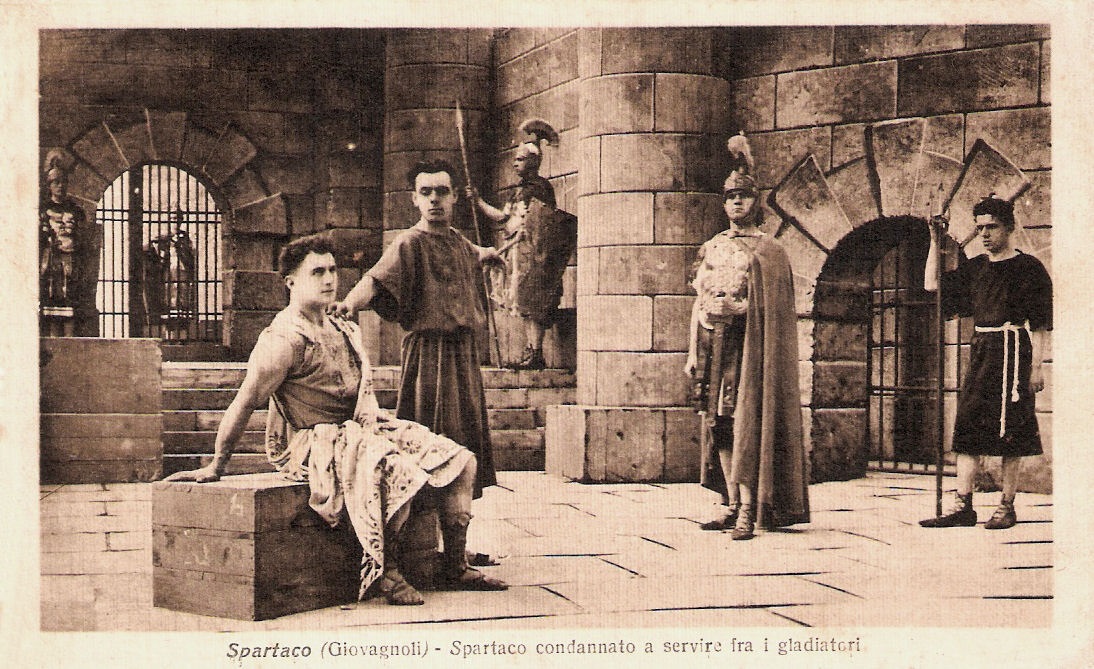
Easter Monday fell on 13 April 1914, but James T. Jameson, director of the Irish Animated Picture Company, and his son, Ernest, who managed the Rotunda, had begun the run up to Easter much earlier. In early March, Jameson senior had secured the Irish rights to two long “exclusives”: The Messiah and Spartacus, or the Revolt of the Gladiators (Italy: Pasquali, 1913) (“Items of Interest”). In its review of Spartacus at the Rotunda in the week beginning 23 March, the Dublin Evening Mail compared it to Quo Vadis? (Italy: Cines, 1912), the Italian epic that had been the biggest hit of 1913 and that had been available to Dublin audiences as lately as 2-7 March at the Camden Picture House (“Rotunda Pictures”). However, The Messiah was a more important film for the Rotunda than Spartacus. For one thing, it was longer; Spartacus shared its bill with the comedies The Awakening at Snakesville (US: Essanay, 1914) and When Cupid Takes in Washing (US: Lubin, 1914), but The Messiah was the only thing on the Rotunda’s programme for the two weeks beginning Monday, 30 March. As well as this, because it depicted the life of Christ, The Messiah had the potential to be as controversial as From the Manger to the Cross (US: Kalem 1913) had been the previous year. The superiority of The Messiah was emphasized by the Evening Telegraph, which urged “any person who witnessed “From Manger to Cross to pay a visit to the Rotunda and see what a drastic and extraordinary difference can be introduced in the treatment of the same subject, and more especially the grandeur of its colouring” (“‘The Messiah’ at the Round Room Rotunda”).

The Messiah was certainly a success at the Rotunda. Quoting figures supplied by the Rotunda management, the Telegraph revealed that by the Saturday of the first week of its run, it had been seen by over 22,000 people, “including a considerable proportion of the clergy of every denomination, and there have been nothing but the highest eulogies expressed by everybody who had the pleasure of seeing this marvellous production” (ibid). Paddy, the Irish correspondent of the British trade paper Bioscope, speculated that the audience for the full two-week run would number 50,000, commenting that the film “easily surpassed anything of the kind ever seen in Dublin, and the special music, so brilliantly rendered by Miss May Murphy’s Irish Ladies’ orchestra, added to the reverent screening of this great film” (Paddy). Although Jameson offered a new bill from Easter Monday featuring Christopher Columbus (US: Selig, 1912) and a film of the Grand National Steeplechase, he brought back – purportedly due to popular demand – The Messiah by the end of that week for selected matinees and early evening shows until Friday, 24 April.

This success of the passion films and such Italian historical epics as Quo Vadis? and Spartacus points to the existence of types of quality filmmaking based on high-cultural criteria. The Rotunda had long pursued a middle-class audience by promoting its film shows as both educative and entertaining, but Jameson had usually favoured programmes of shorter films – and some live variety acts – rather than a single long film. A review of the Rotunda in early March had stressed cinema’s multiple attractions:

The elaborate production of cinematograph films shows how much this form of entertainment has grown in public favour. Unlike skating rinks, living pictures seem to have come to stay. They supply an easy means of transporting oneself for a time from the uneventful round of daily life. Sitting in a comfortable seat, the spectator can in a moment travel from China to Peru, from the waste of the open sea to the sun-bathed mart of some Eastern town; he can witness fire and flood and return safely to a good supper by his civilized fireside (“Irish Animated Picture Company”).

The Rotunda had aimed to provide such a variety of attractions with multiple films in its two-hour shows, but the Italian epics could provide a range of spectacles in one film, as well as a patina of high-cultural value associated with classical education. As adaptations of literary works, Quo Vadis? – from Henryk Sienkiewicz’s novel – and The Last Days of Pompeii (Gli ultimi giorni di Pompeii; Italy: Ambrosio, 1913) – promoted as Lord Lytton’s great work” when it played at the Camden Street Picture House in the week beginning 20 April (“Camden Street Pictures”) – could benefit from recognition by middle-class audiences, as well as bestowing cultural prestige on the film and the picture house at which it was shown. Among other significant literary adaptations on exhibition in Ireland at Easter 1914 was Cines’ Antony and Cleopatra (Italy, 1913), a story that prospective spectators at the Opera House in Derry were informed “has been variously dealt with by many famous writers, including the immortal Shakespeare” (“Easter Amusements”).

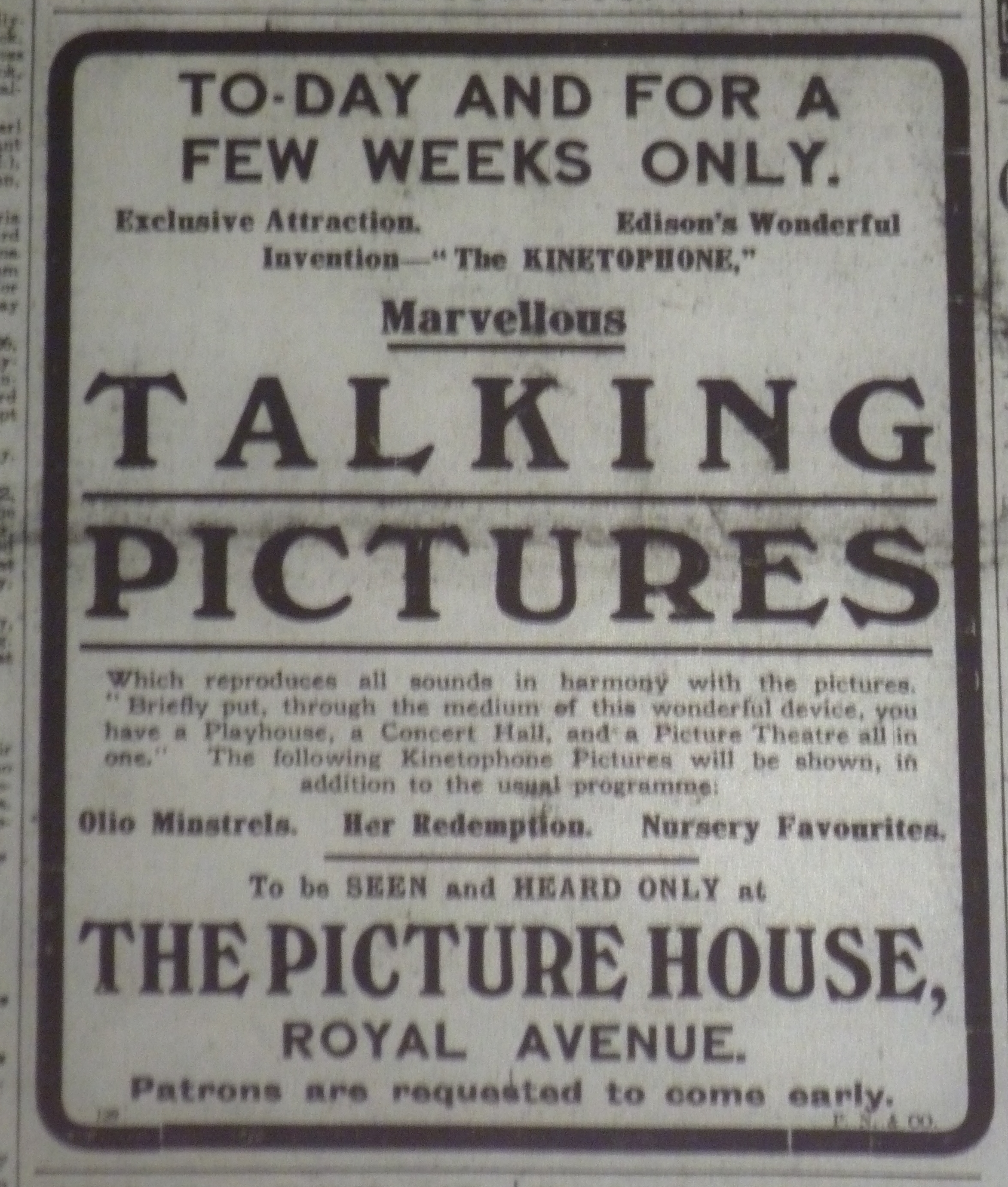
Edison Talking Pictures at the Picture House, Royal Avenue, Belfast. Belfast Newsletter 3 Apr. 1914: 1.

Edison Talking Pictures at the Picture House, Royal Avenue, Belfast. Belfast Newsletter 3 Apr. 1914: 1.

The extent to which a shared or imposed set of cultural values deriving from literary culture, classical education and Christian doctrine was the source of the popularity of The Messiah or the Italian epics is difficult to say definitively without some discussion of how images of these circulated more widely (Uricchio and Pearson). Certainly, the promotion of such films as respectable by the trade press, newspapers and other forms of picture-house promotion did not prevent other cultural forces from continuing to attempt to impose their own control on cinema and its audiences. 

Easter 1914 seemed to be a particularly auspicious time for Irish nationalists. This point was well expressed in the nationalist Evening Telegraph, in which an editorial observed that

this will be the last Easter before Home Rule becomes the law, for the Home Rule Bill will reach the Statute Book in the course, probably, of the next five or six weeks. It is well that Easter should herald the coming of Ireland’s resurrection, for in the Christian sense it symbolises the Resurrection (“Easter”).

Christianity here meant the Catholicism of the Telegraph’s readership and of the majority of Dublin Corporation’s dominant nationalist faction. With Home Rule apparently imminent, more militant forces within the church were determined that cultural policy reflect a Catholic ethos, regardless of how this might affect the business interests of certain Catholic nationalist councillors.

Lord Mayor Lorcan Sherlock came under criticism from Catholic church-based groups in early March when he showed reluctance to introduce local censorship of films – the Corporation “are satisfied, as indeed are so many other civic bodies, with the verdict of the Board of Trade Censor” – or close picture houses on Sundays – “‘They have been,’ he said, ‘patronised to an extraordinary extent on Sunday by the working people of the city’” (“Picture Theatres: Conditions of Licensing”). Responding in a letter to the Telegraph, William Larkin, who had recently been praised rather than fined by a magistrate for protesting loudly during a theatre show, wondered whether or not the general public were “to be left at the mercy of the Corporation in the matter of taste in living pictures” whose “educational value […] in Dublin at present are nil” (“Sunday Pictures: For Working People”). He left no doubt that lay Catholic organizations would not let the matter rest:

Does his lordship know that the United Sodalities of Dublin (male and female) are out for reform of the picture theatres? Does his lordship know that the United Confraternities of the city are out for the same object? And does he also know that the Theatre Reform League of Dublin (which will later embrace all of Ireland) are on the watch against the class of production that has flooded our capital for some time now? (ibid).

Although Larkin and those named lay organizations would lead the campaign, priests and bishops lent the support of the hierarchy. A letter from a Father Gleeson calling for “an Irish National Censor, who understands the hearts and minds of the Irish people” accompanied Larkin’s  (“Letter from Father Gleeson”). In April, the Lord Mayor “stated that Archbishop Walsh was not in favour of closing picture houses on Sunday, but he thought that a limit should be placed in the hours of opening so that there would be no interference with the freedom of persons to attend divine worship.” Under pressure from both inside and outside the Corporation, Sherlock “was writing to Archbishop Walsh asking him whether he would take upon himself the responsibility of suggesting what type of censorship should be put into operation” (“Picture Theatres: The Archbishop’s Views”).

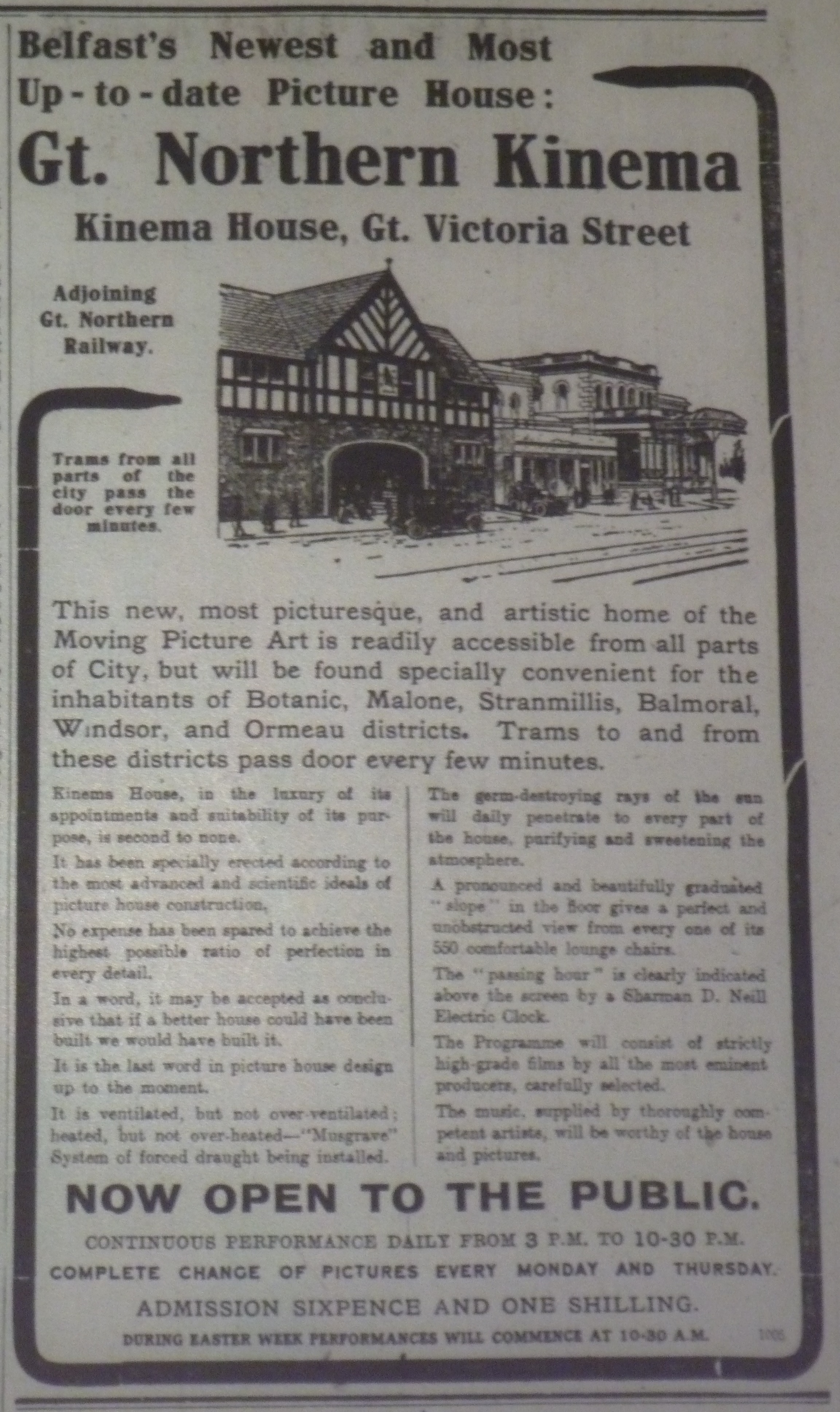
Belfast Newsletter 9 Apr 1914: 9.

Ad for the newly opened Great Northern Kinema in Belfast Newsletter 9 Apr. 1914: 9.

Larkin ended his letter on Dublin picture houses with some architectural criticism by remarking that “the building themselves are not even decent looking” (“Sunday Pictures: For Working People”), but Easter for Belfast’s picture houses was notable for its openings of distinct contributions to the city’s streetscape. The latest addition to Belfast’s substantial tally of picture houses was the Great Northern Kinema in Gt. Victoria Street, which opened in the first week of April, a little over a week after the 23 March opening of the Crumlin Picture House on the Crumlin Road. The Kinema, “[t]his new, most picturesque , and artistic home of the Moving Picture Art,” was located beside the Gt. Northern railway station, as well as on some of the city’s major tram lines (“Belfast’s Newest and Most Up–to-date Picture House”). No single film seemed to dominate the picture house programmes over the holiday period in the same way as The Messiah did in Dublin. At the “luxurious and attractive” Kinema, “[t]he star film during the early part of the current week is a two-reel drama entitled ‘Silent Heroes’” (US: Broncho, 1913) (“Kinema House”). The city’s most highly publicized cinema offerings were Edison’s Talking Pictures at the Picture House, Royal Avenue, where they were joined in the week beginning Easter Monday by a programme that included Selig’s Christopher Columbus. The different relationship between the churches and cinema is suggested by the fact that several of the Protestant halls – the CPA Assembly Hall, the Grosvenor Hall, the City YMCA and the People’s Hall – offered not only their usual Saturday cinematograph shows but also special film shows on Easter Monday and Tuesday.

References 

Abel, Richard. The Ciné Goes to Town: French Cinema, 1896-1914. Berkeley: U of Califronia P, 1994.

“Belfast’s Newest and Most Up–to-date Picture House.” [Ad.] Belfast Newsletter 9 Apr. 1914: 9.

“Camden Street Pictures.” Evening Telegraph 21 Apr. 1914: 6.

Cosandey, Roland, André Gaudreault and Tom Gunning, eds. An Invention of the Devil? Religion and Early Cinema. Sainte-Foy and Lausanne: Éditions Payot/Laval UP, 1992.

“Easter.” Evening Telegraph 11 Apr. 1914: 4.

“Easter Amusements.” Derry Journal 13 Apr. 1914: 8.

“Irish Animated Picture Company.” Irish Times 10 Mar. 1914: 5.

“Items of Interest.” Bioscope 12 Mar. 1914: 1109.

“Kinema House.” Belfast Newsletter 14 Apr. 1914: 9.

“Letter from Father Gleeson.” Evening Telegraph 11 Mar. 1914: 5.

“‘The Messiah’ at the Round Room Rotunda.” Evening Telegraph 4 Apr. 1914; 7.

Paddy. “Pictures in Ireland.” Bioscope16 Apr. 1914: 313.

“Picture Theatres: Conditions of Licensing.” Evening Telegraph 10 Mar. 1914: 3.

“Picture Theatres: The Archbishop’s Views.” Evening Telegraph 20 Apr. 1914: 3.

“Rotunda Pictures.” Dublin Evening Mail 24 Mar. 1914.

“Sunday Pictures: For Working People.” Evening Telegraph 11 Mar. 1914: 5.

Uricchio, William and Roberta E. Pearson. Reframing Culture: The Case of the Vitagraph Quality Films. Princeton: Princeton UP, 1993.

Serial Queens and Super Villains

On 25 November 1913, Dublin’s Evening Herald reported that haulier Sidney Norman of Neath, Wales, had seriously injured himself in the early hours of the previous Saturday when he had jumped ten feet from his bedroom window while dreaming he was escaping from robbers he had seen that evening on a picture theatre screen (“Man’s Leap to Escape Cinema Robbers”). For this ordinary Welshman, the images on the screen had literally become the landscape of his dreams, to his severe bodily cost. The Herald picked this up as a news oddity and published it on its front page, where its readers might wonder at the gullibility of some picture-house patrons or the need to control this new entertainment that was coming to increasingly direct the dreams of its audience.

One of the ways in which it did this was through films of greater length and complexity. The increasing length of films had been a particular issue in the film industry since 1911. “We can remember when a drama of 1,000 ft. was often grumbled at on account of its length,” noted an editorial in the British cinema trade journal Bioscope in September 1911, “but it seems as if that day were past, and the demand for a picture play constituting the usual length of an entire programme has sprung up (“The Length of the Film”). The film of 1,000 feet (about 16 minutes at 16 frames a second) was the standard product of the US distributors, but in Europe, longer films, often with high-cultural prestige such as Italian company Cines’s 1913 Quo Vadis?, captured both the imagination of the public and the film market where they were sold as features or exclusives.

3 Musketeers Phoenix Nov 2013

An unusually large ad for an unusually long film: Evening Herald banner for The Three Musketeers at the Phoenix, 15 Nov. 1913: 4.

In Dublin in November 1913, the Phoenix Picture Palace marketed itself as the picture house that specialized in the long film. “The Phoenix Picture Palace is rapidly becoming famous for the exhibition of big classic film productions,” began a notice in the Herald,

“From Manger to Cross,” “Quo Vadis?” “Monte Cristo,” “The Battle of Waterloo,” etc., have all been shown at the Phoenix within the last few months. Last evening the patrons of this popular house had presented to them the longest film yet shown in this country – the “Film D’Art’s” remarkable production of Dumas’s popular and widely read work, “The Three Musketeers” (“‘The Three Musketeers’”).

This issue of the long film was not resolved in 1911, however, and the Bioscope continued to favour a varied programme of shorter films, arguing in an October 1913 editorial that the long film’s “charm and importance can be better sustained outside the ordinary picture theatres. The popularity of the cinema has been built up on the variety of the entertainment it offers, and a lessening of that variety means a weakening of public interest” (“Exclusives and Other Matters”).

Doubtless, the Bioscope was influenced in its thinking by the nature of variety theatre, cinema’s chief rival in popular entertainment in Britain, Ireland and elsewhere. A solution to providing a lengthy film as part of a variety programme was available in another popular form: the serial. Fictional writing had long been serialized in newspapers and magazines, where it appeared alongside many other kinds of writing in another kind of variety format. In November 1913, the Evening Herald carried an episode of popular novelist Emma M. Mortimer’s Robert Wynstan’s Ward each day, and this was wholly unremarkable.

However, the autumn of 1913 saw a new phenomenon arrive in Ireland: the film serial. When the Rotunda began showing the serial What Happened to Mary in September 1913, the Dublin Evening Mail commented that the Rotunda “management in producing a ‘serial’ film, have broken new ground as far as Dublin picture houses are concerned” (“Rotunda Pictures” 23 Sep.). Unlike the Phoenix, the Rotunda favoured a more varied programme of shorter films, so that when High Tide of Misfortune, the tenth episode of What Happened to Mary, was exhibited there in the week of 24-29 November 1913, it shared the bill with the main film, Broken Threads United; a “very complete picture […] of the procession to Glasnevin on Sunday in connection with the Manchester Martyrs’ commemoration”; the comedies His Lady Doctor, Ghost of the White Lady and Love and Rubbish; and the Pathé Gazette newsreel (“Rotunda Pictures” 25 Nov). The serial was integrated into this variety film programme that was lent some locally produced coherence by being accompanied by the music of the Irish Ladies’ String Orchestra.

What Happened Mary Fuller

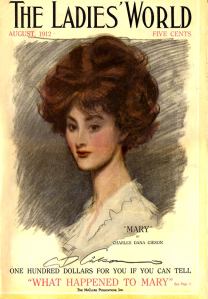
August 1912 cover of US magazine Ladies’ World featuring Mary Fuller and What Happened to Mary. From “The First Movie Serial.”

To what degree the variety format was more successful in attracting a larger and more diverse audience is debatable, but the inclusion of What Happened to Mary seemed a direct appeal to young women. Narrating the adventures of a country girl who comes to the city, What Happened to Mary was produced by Edison in twelve monthly episodes beginning in US picture houses in July 1912 in parallel with the serialized story that appeared in the US mass-circulation women’s magazine Ladies’ World, making its lead actress Mary Fuller into a star (Singer 213). Running from 22 September to 13 December, the first Irish exhibition at Dublin’s Rotunda tied in with its weekly serialization in the British women’s magazine Home Chat (“The Rotunda,” “The Picture Houses”). As such, it was clearly marketed primarily at women. An indication of its local success is the fact that the Rotunda immediately followed it with Who Will Marry Mary?, the Edison sequel, which again featured Mary Fuller.

Although it would take another year for the serial to reach the height of its popularity with such “serial queens” as Helen Holmes the adventurous heroine of The Hazards of Helen and Pearl White in The Perils of Pauline and The Exploits of Elaine, this earlier serial followed some of the patterns of the later ones. Shellley Stamp argues that “for a complete understanding of the template serial heroines offered viewers we must look beyond the screen exploits of Pauline and her compatriots towards the substantial star discourse that circulated around the actresses who played these women on screen” (Stamp 217). Some of the Dublin reviews suggested What Happened to Mary did create the desire in its audiences for more information about Mary Fuller: “‘Alone in New York’ is the second instalment of the ‘What Happened to Mary’ serial; all who have seen the opening scenes of Mary’s adventures will be eager to know more about this fascinating actress” (“Rotunda Pictures” 27 Sep.).

Flapper on Tram IL 24 Oct 1913

An Irish flapper finds space for herself in the public sphere; Irish Life 24 Oct. 1913: 91.

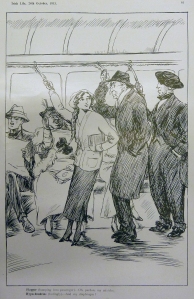
More specific information on the reception of What Happened to Mary among Irish audiences, and particularly Irish women, does not seem to survive. The fact that the exhibition of the film was tied to the publication of a British magazine is indicative of the subsidiary place of Ireland in the publishing and film industries. The Irish women’s magazine Lady of the House, which had very little to say about cinema of the period, made no mention of the serial, but it and other Irish periodicals show how women were represented in popular media. Was the young flapper shown travelling on a tram in a cartoon in the glossy and expensive Irish Life in October 1913 likely to have found Mary’s adventures or Mary Fuller’s star persona enthralling? Perhaps, but it is not clear that the serial form allowed Mary Fuller to capture the imagination of the public to a greater extent than the at-least-sometimes more active heroines of stand-alone films. In the Herald’s notice for the Rotunda on 30 September, the third episode of What Happened to Mary was not mentioned, but the reviewer focused on the heroine of A Wild Ride, set on a South African ostrich farm, in which “a resourceful and up-to-date heroine, in a situation of dire extremity, outwitted cunning and ferocious savages, rode an ostrich across the trackless veldt at high speed, and brought soldiers to the relief of her imprisoned family” (“Rotunda Pictures” 30 Sep.). Such derring-do in the serial would await The Hazards of Helen, which would not hit Dublin screens until 1915.

Other kinds of film serial followed quickly on the heels of What Happened to Mary and offered different forms of fascination – whether that be attraction or repulsion. Sharing the bill at the Rotunda with A Proposal Deferred, the fifth episode of What Happened to Mary in the week beginning 20 October was the second part of Gaumont’s five-part Fantômas (1913), each of which contained three to six episodes. Directed by Louis Feuillade and based on a popular series of 32 French novels by Pierre Souvestre and Marcel Allain that were published in monthly instalments between February 1911 and September 1913, the films followed the early exploits of the eponymous super villain as he terrorizes Paris (Walz and Smith). “Those who go to the Rotunda this week will, at any rate, get plenty of sensation,” observed the Irish Times.

The film, “Fantomas,” is a choice blend of mystery, tangled plot, and blood-curdling enterprise. It is not easy to grasp all the bearings of the incidents or their mutual relationship. The film, however, introduces us to some remarkable phases of Paris life and its institutions. And the glimpses of the city’s streets and parks are always full of interest. It is very admirably acted by all the characters (“Rotunda Living Pictures”).

Unlike What Happened to Mary, Fantômas did not appear on a reliable weekly or even monthly basis that might establish a loyal pattern of attendance. Nevetheless, even if not regular, Fantômas was popular, and the Rotunda continued to premiere the new parts as they were released, showing The Tragedy at the Masked Ball over the Christmas period of 1913 and the fifth part, The False Magistrate, in June 1914.

These serials were not restricted to city audiences but travelled on the important Irish Animated Picture Company exhibition circuit established by James T. Jameson of the Rotunda. In his praise of Jameson in January 1914, the Bioscope’s Irish correspondent Paddy revealed that two of the What Happened to Mary episodes had recently been seen around the country: A Proposal Deferred had been at Tralee, while the twelfth and final episode, Fortune Smiles – receiving “considerable applause” – was on the programme at Galway. The YMCA hall in Queenstown was showing the fourth part of Fantômas, The Tragedy at the Masked Ball (Paddy). As such they came, no doubt to inhabit the dream and nightmare worlds of many Irish people.

References

Birchland, Robert. “What Happened to Mary?” Hollywood Heritage 18: 2 (Fall 1999). Hollywoodheritage.org. http://hollywoodheritage.org/newsarchive/Fall99/Mary.html. 19 Nov. 2013.

“Exclusives and Other Matters.” Bioscope 9 Oct 1913: 87.

“The First Movie Serial.” 100 Years Ago Today. http://100yearsagotoday.wordpress.com/2012/07/26/the-first-movie-serial/. 19 Nov. 2013.

“The Length of the Film: A Question of Policy.” Bioscope 7 Sep. 1911: 471.

“Man’s Leap to Escape Cinema Robbers.” Evening Herald 25 Nov. 1913: 1.

Paddy. “Pictures in Ireland.” Bioscope 22 Jan. 1914: 351.

“The Picture Houses: Rotunda Pictures.” Evening Telegraph 30 Sep. 1913: 2.

“Pictures at the Rotunda.” Freeman’s Journal 21 Oct. 1913: 9.

“The Rotunda.” Irish Times 23 Sep 1913: 5.

“Rotunda Living Pictures.” Irish Times 21 Oct. 1913: 5.

“Rotunda Pictures.” Dublin Evening Mail 23 Sep. 1913: 3.

“Rotunda Pictures.” Evening Herald 27 Sep. 1913: 9.

“Rotunda Pictures.” Evening Herald 30 Sep. 1913: 5.

“Rotunda Pictures.” Dublin Evening Mail  21 Oct. 1913: 2.

“Rotunda Pictures.” Evening Herald 25 Nov. 1913: 5.

Singer, Ben. Melodrama and Modernity: Early Sensational Cinema and Its Contexts. New York: Columbia UP, 2001.

Stamp, Shelley. “An Awful Struggle Between Love and Ambition; Serial Heroines, Serial Stars and Their Female Fans.” The Silent Cinema Reader. Ed. Lee Grieveson and Peter Krämer.London: Routledge, 2004.

“The Three Musketeers’” Evening Herald 18 Nov. 1913: 5.

Walz, Robin, and Elliott Smith. Fantômas. http://www.fantomas-lives.com/fanto6.htm. 28 Nov. 2013.

“Soul Stirring Views of the Cripples”: The (First) Irish National Pilgrimage to Lourdes

Bioscope 9 Oct. 1913, xb-c.

On Friday, 3 October 1913, the Irish Times reported that several Catholic clerics had attended a private viewing at the Rotunda, Dublin, of the film The First Irish National Pilgrimage to Lourdes and that the film would open to the public at the same venue the following Monday (“A Pilgrimage in Picture”). The preparations for and progress of the pilgrimage by over 2,000 Irish Catholics – including the miraculous cures of such pilgrims as Grace Maloney (“Miracle at Lourdes”) – were extensively covered in the press, and newspaper readers may also have been aware that the pilgrimage had been filmed because as many of the pilgrims prepared to depart on 8 September and arrived back on 19 September, some papers had reported that cinematographers were among them (“Lourdes Pilgrims,” “Home Again”).

The film at the Rotunda, therefore, had benefitted from much pre-publicity, and it sought to show cinemagoers the important elements of the pilgrimage in detail. It ran not the 5-10 minutes expected of a newsreel but – according to the Times – for “[n]early an hour,” with the Dublin Evening Mail putting its length in feet – the more popular way of expressing film length at the time – at 2,500 feet (“Rotunda Pictures”), or almost 42 minutes at the most common silent projection speed of 16 frames per second. The film “has many-sided interest for Dublin picture house patrons, most of whom had friends on the pilgrimage” (“Rotunda Living Pictures”), but the Rotunda sought to ensure the attention of its audience by setting them a puzzle: “Unique interest attaches to the film in that it shows an unknown lady, who experienced a cure, looking from a railway carriage window, and the management invite the co-operation of the public in identifying her” (A Pilgrimage in Picture”).

Such strategies to engage the Dublin and Irish audience would not have worked elsewhere, and other techniques would have been needed. Ads in the British trade journal Bioscope using such phrases as “Life-like Pictures of the miraculously Cured” and “Soul stirring views of the Cripples en route” show that the distributors suggested that exhibitors stress the miraculous and make disability into spectacle. Even emphasizing such attractions and given that Jameson had already secured the Irish rights, this film must have been difficult to sell in Britain except in areas with large concentrations of Irish migrants. In Ireland, much of the press coverage of the pilgrimage itself suggests that the spectacle of disability was less of interest than the miraculous cures. The Irish Catholic, for example – which never mentioned the film – devoted its lead stories on 4 and 11 October to medical confirmations of the cures.

Like the vast majority of early films made in Ireland – or anywhere else, for that matter – this film is believed to be lost. Nevertheless, the newspapers provide an account of its contents. A reporter for the Evening Herald, who had been at the press screening on 3 October, offered the most detailed description of the film. The scenes consisted of the following: “Pilgrims breaking journey at London and entering train at Victoria station; going on the special boats and scenes on board from Folkestone to Boulogne; Mass at the Madeline, Paris, outside the Madeline, brake loads of pilgrims; special trains leaving Bordeaux. Nearing Lourdes and panorama as seen from train; arrival at Lourdes and scenes of town and neighbourhood; tram ride up to Basilica; In Lourdes, general group; the first procession; on the way to the Grotto, and scenes at the Grotto and Basilica; portrait of Mdlle. Bernadette, and view of where she lived; the Calvary and monument; procession of the Blessed Sacrament; homeward bound – leaving Lourdes, and scenes at various places on the returning route” (“Lourdes Pictures”). One can only agree with the Herald reporter that the film thoroughly covered the event.

Pilgrimage ads W1 W2

Differences in exhibition strategies at the Rotunda for the Irish National Pilgrimage to Lourdes (left) during its first week and (right) during its second week; Evening Telegraph 7 Oct. 1913: 2, and Dublin Evening Mail 13 Oct. 1913: 4.

Despite its topicality and multiple attractions for an Irish audience, Jameson initially adopted an unusual exhibition strategy. Rather than integrating it into the Rotunda’s normally advertised times of 3pm (matinee), 6:45 and 9pm, he decided to show it apparently alone – or possibly with a reduced supporting programme – at two matinees at 2.45 and 4pm, and with the rest of the advertised programme “at the first evening houses, commencing at 6.45 p.m., on Tuesday, Wednesday, and Friday” (“Pilgrimage in Picture”). The 6:45 show on Monday, Thursday and Saturday and all the lucrative 9pm shows would offer a programme that did not include the pilgrimage film, and this other programme – headed by Mary in Stageland, the third part of the Mary Fuller serial What Happened to Mary – was advertised separately. Whether he had already booked the first programme before he became aware of the availability of the pilgrimage film or whether he believed that the audience for the pilgrimage film would not be interested in the films enjoyed by his regular audience, and vice versa, is not clear.

The film’s popularity appears to have surprised this canny exhibitor, who changed his exhibition strategy in the second week of the film’s run. His decision to run the film for a second week already demonstrated that he identified unusual interest in it, but for the second week, he integrated it into his regular 3pm, 6:45 and 9pm schedule. Predicting that the programme would “undoubtedly prove to be one of the most popular ever set before a Dublin audience,” the Freeman’s Journal reported that the “film has been reproduced at the Rotunda on the overwhelming and pressing requests of patrons, and that the management only justified itself in complying with the enormous demand was thoroughly testified by the approval shown” (“Rotunda Pictures”).

Ch4Two

Frank Leah’s caricature of Norman Whitten. Irish Limelight 1:10 (October 1917), p. 1.

The film was produced by the General Film Agency (later, the General Film Supply), a company run by Norman Whitten that seems to have some relationship with a London-based company of the same name. English-born, Whitten had worked with British film pioneer Cecil Hepworth in the early 1900s but moved to Ireland in the early 1910s. In 1917, he would found Irish Events, the first Irish newsreel, before also shooting such fiction films as the bilingual life of St. Patrick Aimsir Padraig/In the Days of St. Patrick (1920). One of Ireland’s most successful film producers of this period, he showed a remarkable ability to understand Irish cinema audiences. In 1913, he began advertising his services as a producer of advertising films and local topicals (films of local events). Whether he was commissioned to make the pilgrimage film or initiated the project himself is not clear, but he certainly had considerable cooperation from the pilgrimage organizers.

The Dublin papers were almost universally positive in their reviews of the film. Although also positive, the Daily Express’ review is notable for the writer’s attempts to draw a distinction between what we would now see as fiction and documentary (at least of a kind):

Pictures recording actual events which are unembarrassed are usually never so effective as those which are produced after continual experiment This however, does not apply to the same extent as regards the present pictures as it might in the case of other pictures. The climatic conditions at Lourdes are pre-eminently suitable for the cinematograph, and without exception the various events, which the pictures pourtray are shown with marked clearness and distinctness (“Lourdes Pictures at the Rotunda”).

The pilgrimage film was not as bad as the writer had experienced other factual film to be, but s/he clearly preferred fictional films, or at least films that allowed rehearsal of some kind. The discussion of climatic conditions was one often aired when anyone tried to explain why so few films were made in Ireland or why those that were made featured relatively poor cinematography.

The one piece of criticism made in relation to the film concerned the choice of musical accompaniment at the Rotunda. The Dublin Evening Mail‘s “Music and Drama” columnist commented at length on film music, arguing that “semi-neutral music is the most effective,” explaining that by this s/he meant “that the selections should be broadly in sympathy with the general character of the film” (“Music and the Drama.”). Exemplary of this was Sackville Picture House musical director Jack Larchet’s recent “dignified” selection of Mendelssohn’s Trio in D Minor and Shubert’s Unfinished Symphony to accompany Hamlet (Hepworth, 1913), featuring theatre star Johnston Forbes-Robertson. By contrast s/he found the accompaniment of the pilgrimage film at the Rotunda by the elsewhere much praised Irish Ladies’ String Orchestra, under the direction of May Murphy, “not only inappropriate but it was badly played. Gounod’s ‘Ave Maria’ was suitable enough if it had been well rehearsed, but Stephen Adam’s ‘Holy City’ and ‘The Star of Bethlehem’ are not sacred songs in the real sense of the word” (ibid). This kind of criticism, however, is indicative that picture houses would increasingly be held to the highest standards of entertainment.

References

“Home Again: Pilgrims Back in Ireland.” Irish Independent 20 Sep. 1913: 5.

“Lourdes Pictures.” Evening Herald 4 Oct. 1913: 6.

“Lourdes Pictures at the Rotunda.” Daily Express 4 Oct. 1913: 10.

“Lourdes Pilgrimage.” Irish Times 8 Oct. 1913: 4.

“Lourdes Pilgrims: 2,300 Irish Folk Will Travel.” Irish Independent 6 Sep. 1913: 6.

“Miracle at Lourdes: Girl from Killaloe Cured.” Evening Herald 13 Sep. 1913: 2.

“Music and the Drama.” Dublin Evening Mail 13 Oct. 1913: 7.

“A Pilgrimage in Picture.” Irish Times 4 Oct. 1913: 5.

“Rotunda Living Pictures.” Irish Times 14 Oct. 1913: 5.

“Rotunda Pictures.” Dublin Evening Mail 11 Oct. 1913: 7.

“Rotunda Pictures.” Freeman’s Journal 14 Oct. 1913: 9.