Taking a Fearful Joy in Rewitnessing the Civil War on Irish Cinema Screens in July 1922

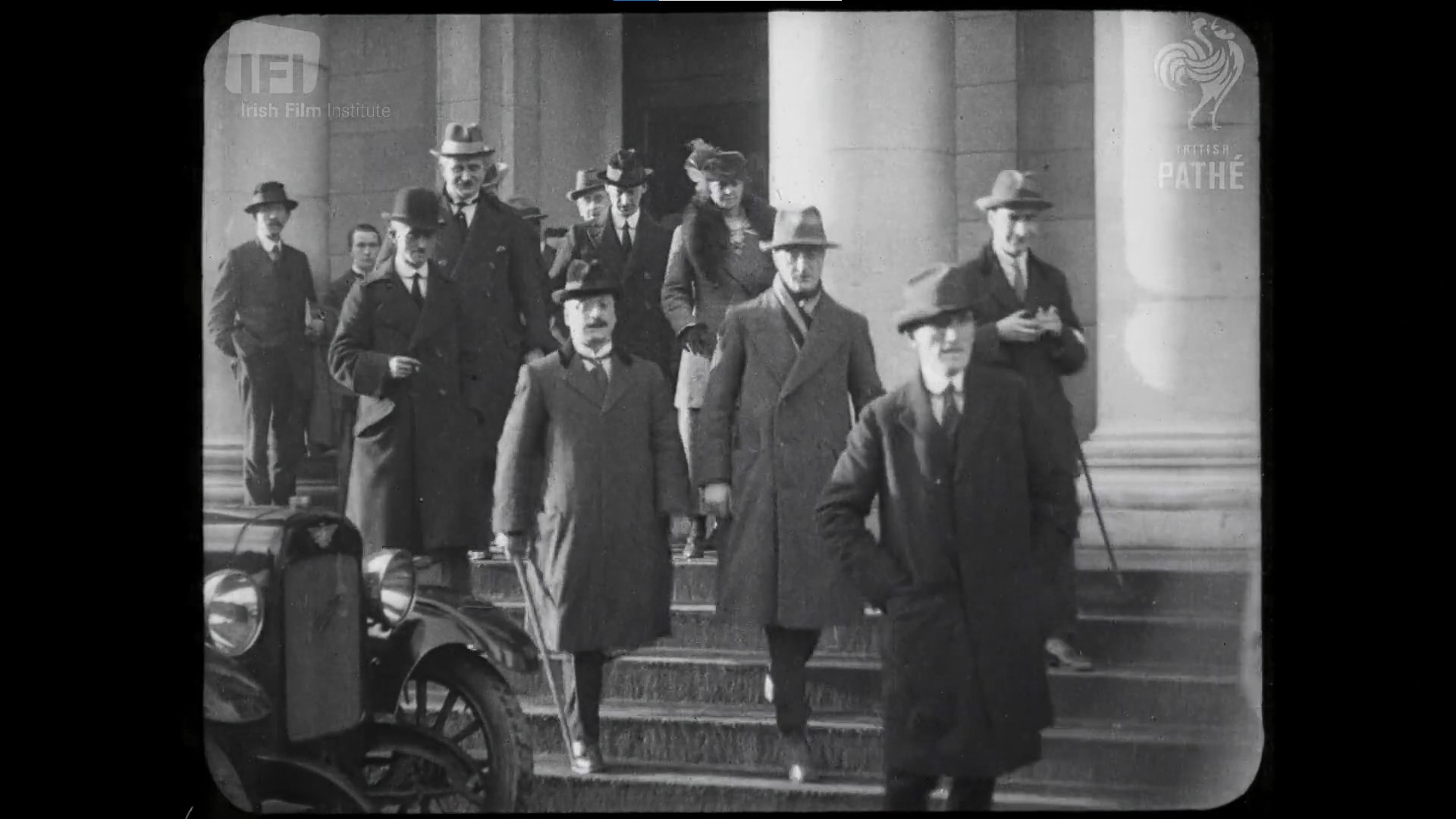
Dublin War Scenes (Topical Budget, 1922), available on the IFI Archive Player.

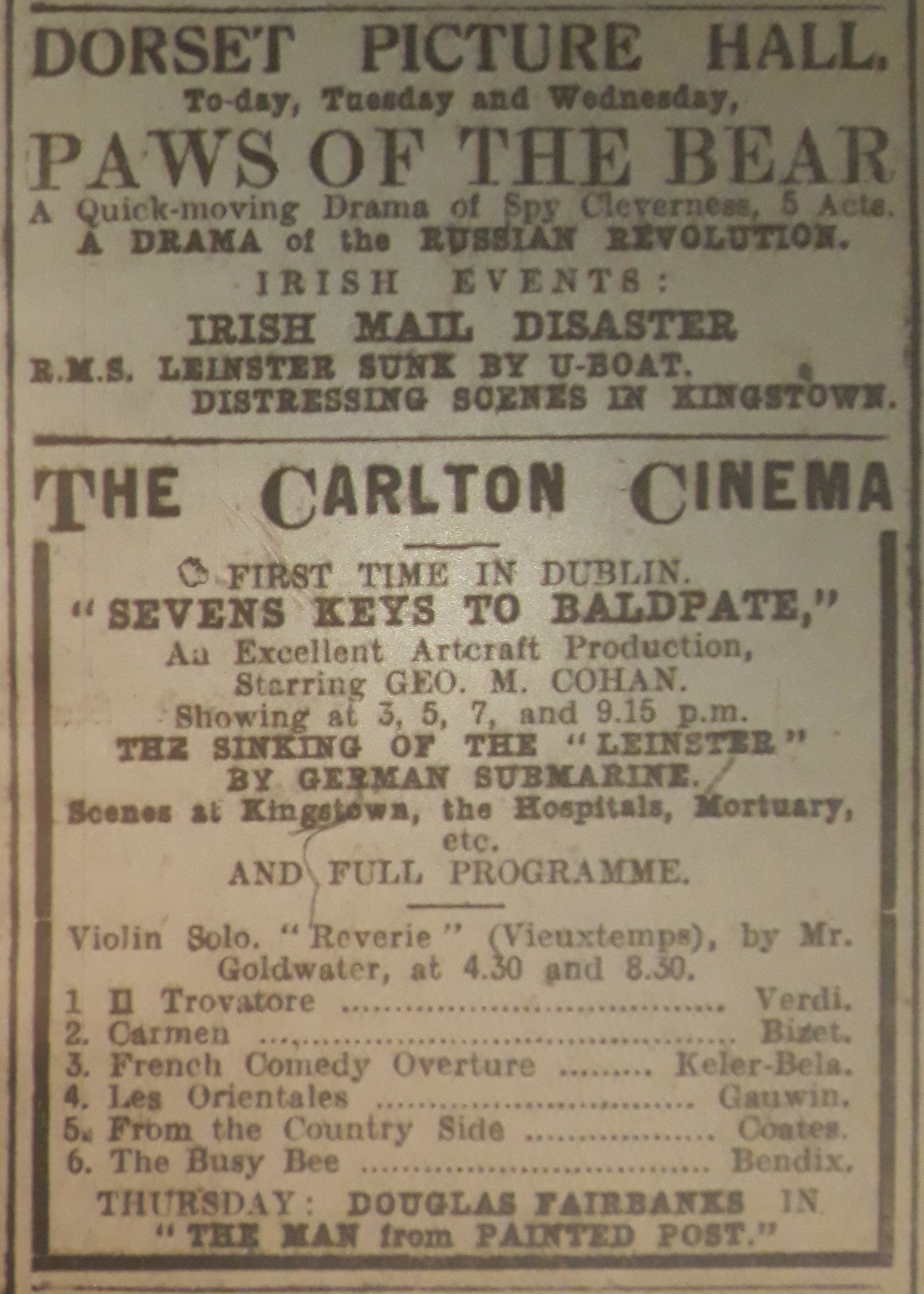
“The pictures are luring the Dublin public,” JHC observed in the Irish Independent‘s “To-Day & Yesterday” column on 12 July 1922. “People are taking ‘a fearful joy’ in re-witnessing the ordeal they passed through… The events of the past fortnight fulfil Lessing’s exacting definition of drama – life with the dull parts left out.” The events JHC was referring to are the Battle of Dublin, the engagement that opened the Irish Civil War. That battle began on 28 June, when National Army troops attacked anti-Treaty IRA forces occupying the Four Courts, using artillery loaned by the British government. The bombardment had the desired effect of forcing the occupiers to surrender on 30 June, but not before the destruction of the Public Records Office. Further IRA units located in the O’Connell Street area continued the battle until 5 July, by which time, they too were surrounded and defeated by the National Army’s superior numbers and fire power. At the end of eight days of fighting, the Four Courts and parts of Upper O’Connell Street were in smouldering ruins, and around 80 people had been killed, approximately 35 of whom were non-combatant city residents (Dorney).

National troops holding back locals as artillery shells the Four Courts in The Battle of the Four Courts (Pathé Gazette, 1922). Available on the IFI Archive Player.

Dubliners had seemed ready to see films of the Civil War by 12 July, but only that week. When the fighting had stopped a week earlier, JHC wasn’t talking about the fearful joy in rewitnessing its events at the cinema. “Times of trial sometimes prompt the craving for amusement,” s/he had argued. “In the beginning of the struggle the picture-houses were well patronised. But yesterday saw them quite forlorn although they offered an up-to-date programme of the ‘battle scenes’ and ‘Four Courts incidents’” (5 Jul.). Which cinemas JHC was referring to is unclear to us now, in part because none of the city-centre cinemas advertised in the early part of that week, and certainly the ones in the O’Connell Street area couldn’t have opened until the shooting stopped and fires were extinguished. Those that had been closed or pressed into other uses were the Sackville at 51 Lower O’Connell Street, the Grand Central at 6-7 Lower O’Connell Street, the Metropole at 35-39 Lower O’Connell Street, La Scala at 4-8 Princes Street, the Pillar at 52 Upper O’Connell Street, the Carlton at 62 Upper O’Connell Street, the Rotunda at 165 Parnell Street and the Corinthian at 4-6 Eden Quay.
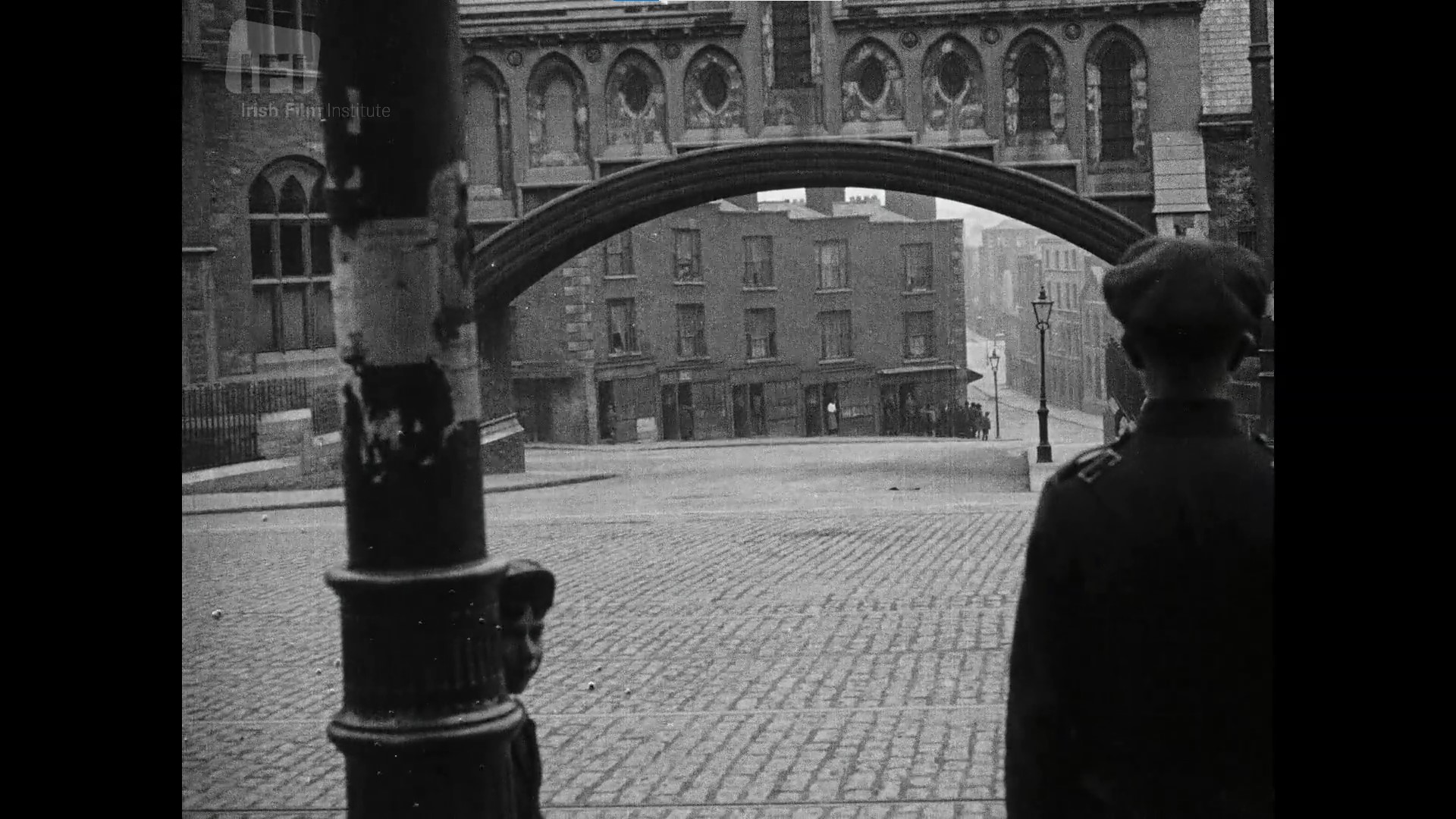
Onlookers face down Winetavern Street but keep a safe distance from sniping from the Four Courts across the river in Civil War in Ireland (Topical Budget, 3 Jul. 1922). Available on the IFI Archive Player.

“The last couple of very stirring weeks were not wanting in their effect on cinema houses,” the Freeman’s Journal’s “Cinema Notes” columnist observed on 10 July. “The Metropole was made a Red Cross centre, and La Scala was a point for bombardment by the National troops of their opponents on the opposite side of O’Connell street.” Mentioning the other cinemas in the area, the writer commented that “the entire marvel of the whole thing, from the picture house point of view, is that we still have these places, none or very little the worse for wear, in which to spend our evenings.” The Irish Time‘s “Cinema Notes” writer echoed these thoughts five days later, adding that

the Sackville and the [Grand] Central Cinemas came through the ordeal almost unscathed. The Corinthian Cinema on Eden quay seemed to have been selected as an Irregular sniping post, and its parapet bears traces of bullet marks.

The other picture theatres in the city had, of course, to close their doors while the battle raged, but they are preparing to reopen. It is to be hoped that business will come back to them in increasing volume, and thus in some measure make amends for the slump which has been felt in Dublin and elsewhere during the past few months.

This suggests that even ten days after the fighting ended, some cinemas were not yet reopened.

The Pillar in the bullet-damaged streetscape of Upper O’Connell Street just after the fighting had stopped. Image: Cinema Treasures.

The cinemas had certainly been lucky. “Some special god seemed to have been keeping a friendly eye on them,” this writer thought. But even if they didn’t feature on the lists of destroyed buildings, the cinemas weren’t entirely unscathed. The earliest surviving photograph of the Pillar shows it on the busy streetscape of Upper O’Connell Street just after the fighting stopped, with many pedestrians passing its bullet-damaged canopy, even if its façade seems somehow to have fared better than the buildings around it. “Considering its exposed appearance,” an Evening Herald reporter noted, “the Pillar Picture House escaped fairly well. Only a few bullets penetrated the big glass doors, but in the offices overhead a machine-gun had played for some time and did damage to the interior” (“Awe-Stricken Crowd”). It may be for that internal damage that the Pillar applied for compensation to the city for the figure of £750 (“Dublin’s Bill”). 

Freeman’s Journal 7 Jul. 1922: 2.

The Corinthian was the first of the city-centre cinemas to resume advertising – but not necessarily the first exhibiting films – offering on Friday, 7 July, an old favourite, Mary Pickford in Poor Little Rich Girl (US: Artcraft, 1917). Although they didn’t advertise the fact in the newspapers, other cinemas seem also to have opened that day. “Business as usual was the position of Dublin yesterday outside a comparatively few buildings damaged or wrecked in the area of the late fight,” the Irish Independent reported on 8 July. “Most of the city cinema have resumed business, but the theatres are still closed […] due to the absence of the necessary arrangements with artistes” (“Conditions Back to Normal”).
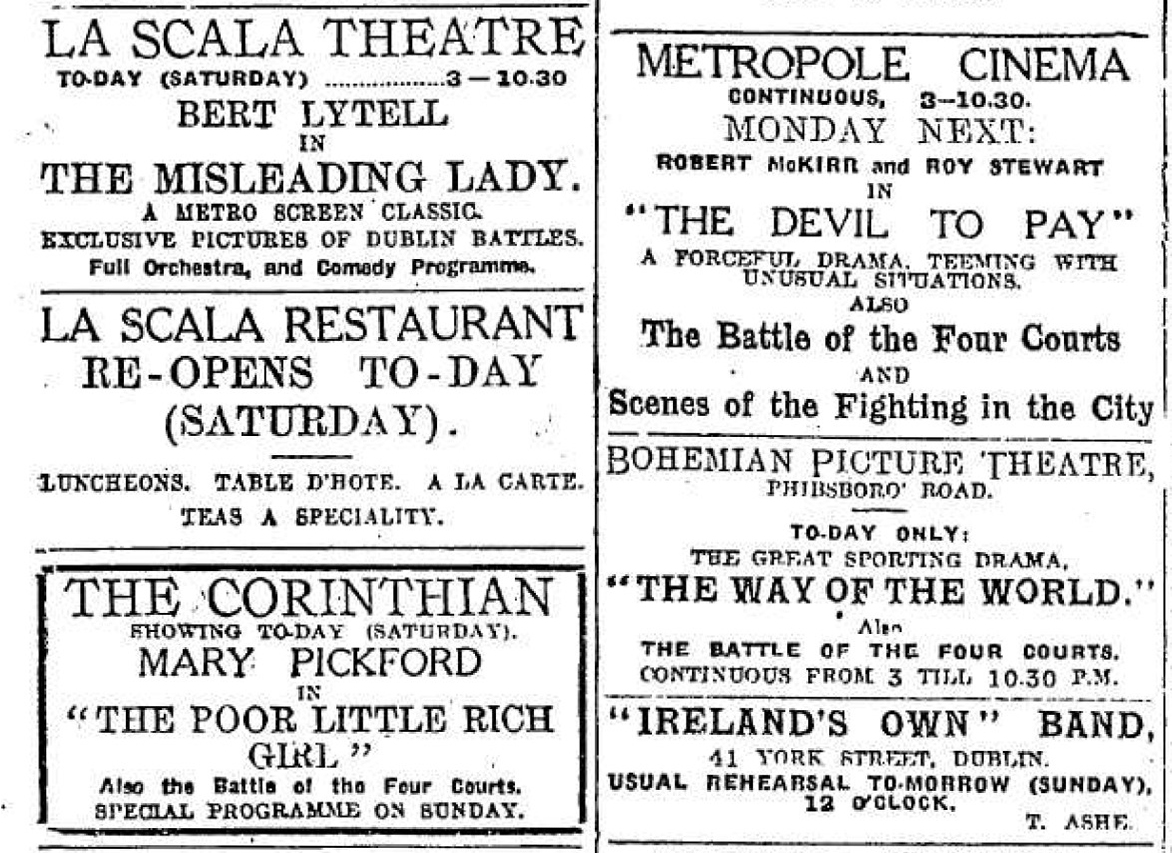
Dublin cinema ads mentioning newsreel of fighting, Evening Herald 8 Jul. 1922: 2.

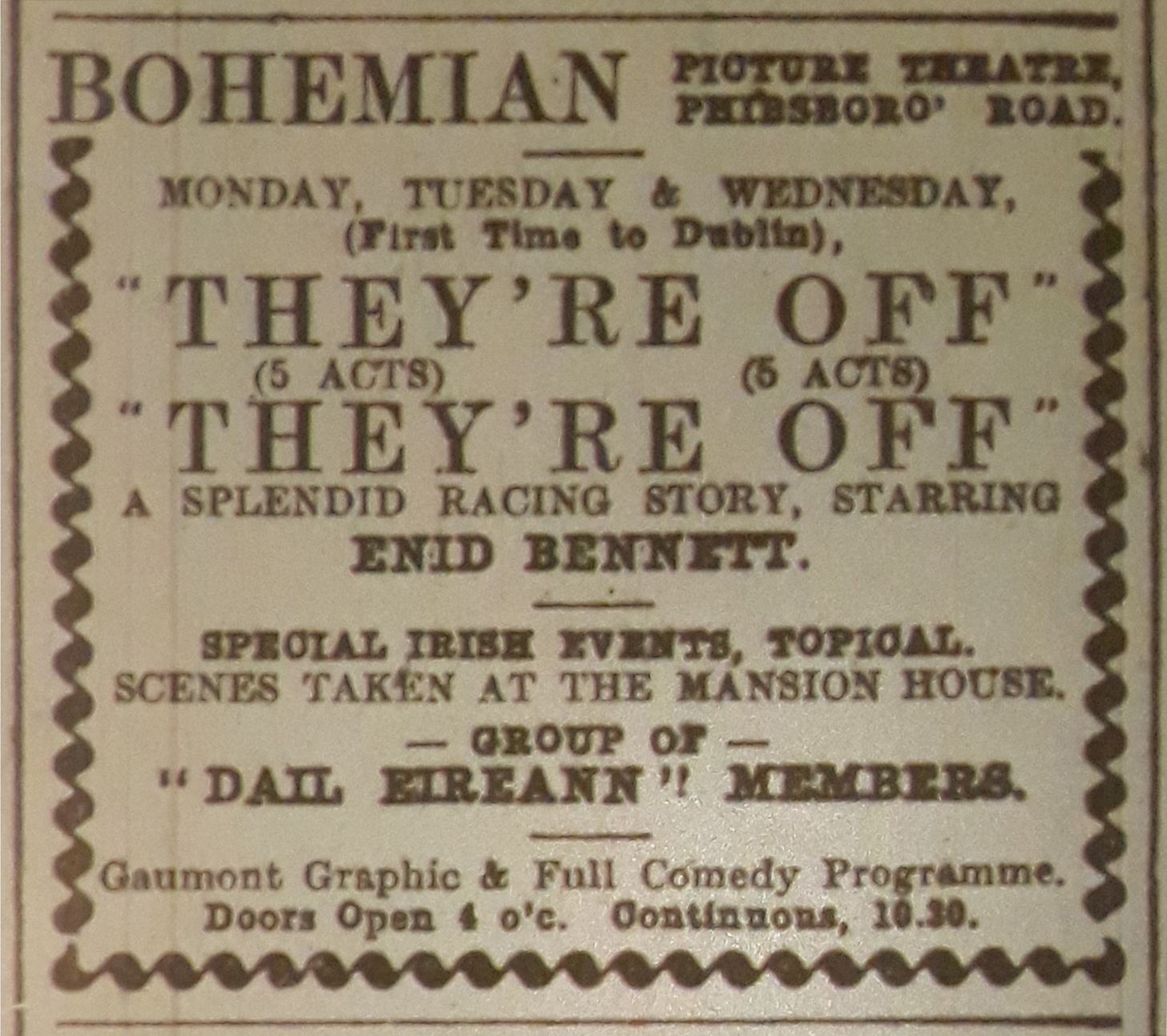
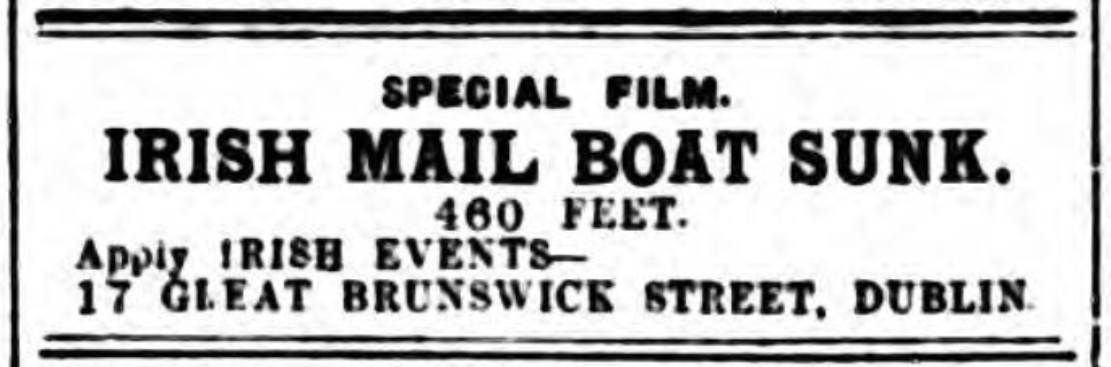
If the Corinthian’s first ad didn’t mention newsreel, the following day’s entertainment ads indicated that several city cinemas, including the Corinthian, were already showing or intended showing film of the Battle of Dublin. The Evening Herald’s entertainment columns on 8 July had ads for four cinemas – La Scala, the Corinthian, the Metropole and the Bohemian – all of which mentioned footage of the fighting. The Metropole seems not to have been open on that Saturday but advertised its Monday programme as including The Battle of the Four Courts and Scenes of the Fighting in the City, if the latter was an actual film title. The other three cinemas were open, the Corinthian and Bohemian including The Battle of the Four Courts on that day’s bill and La Scala promising “exclusive pictures of Dublin battles.”
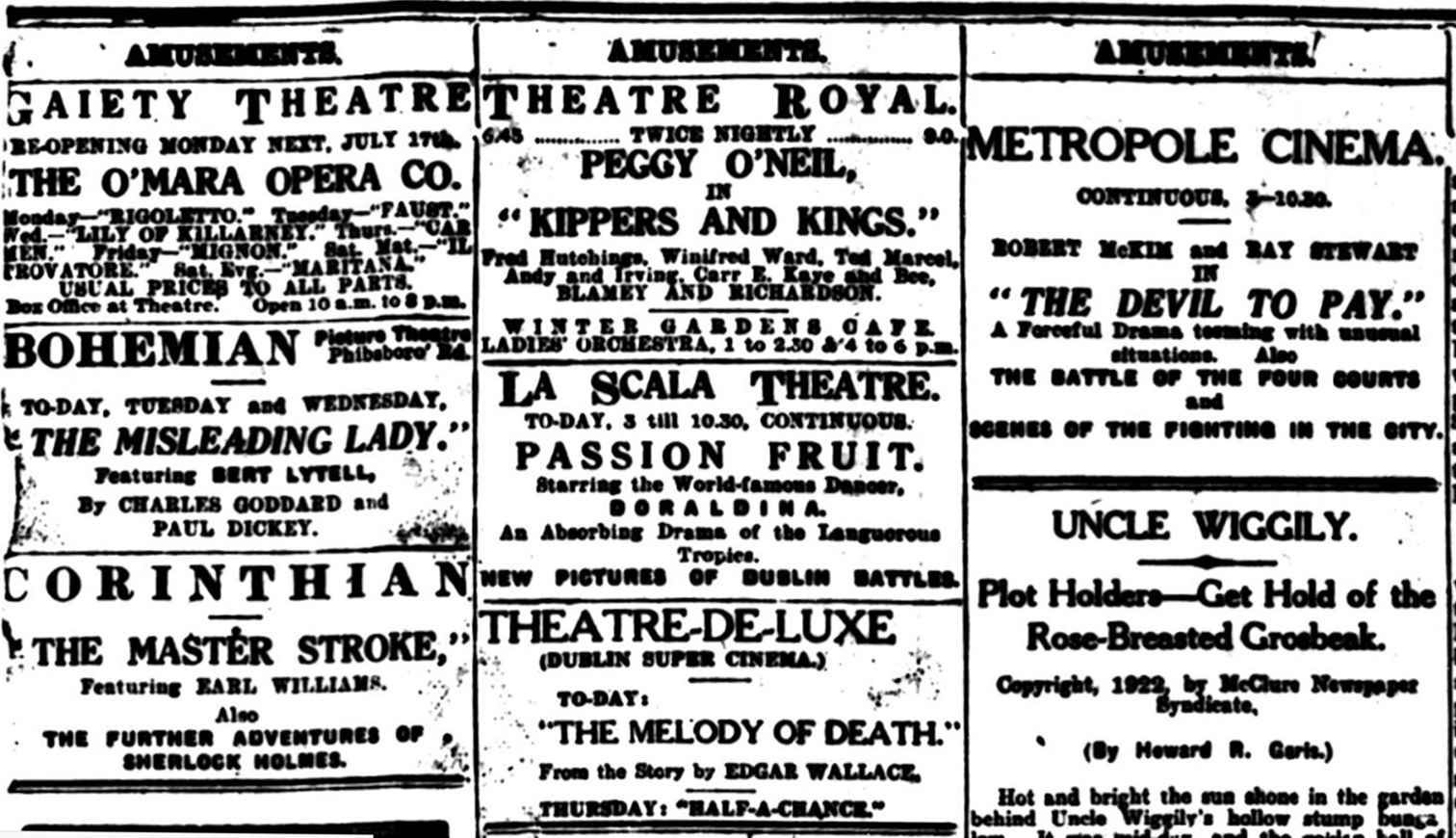
Cinema ads, Evening Telegraph 10 Jul 1922: 2.

What is worth noting here is that the rewitnessing involved a recirculation of newsreels that were a week old. The first newsreels of the conflict had been released the previous Monday, 3 July, when the three major newsreel series – Pathé Gazette, Topical Budget and Gaumont Graphic – all featured items focusing on events at the Four Courts. But as usual, a newsreel issue covered several stories. On 6 July, the Kinematograph Weekly delivered the “Hot News” that

the “Pathé Gazette,” number 890, released on July 3, included realistic pictures of the battle of the Four Courts in Dublin, and some right up to the moment shots of the world’s tennis championships taken from the air, together with pictures of ex-President Taft and the Lord Chancellor receiving honorary degrees at Oxford University.

The Kine Weekly also praised Gaumont’s work, noting that London-based newspapers had used images from the previous week’s newsreel to illustrate stories of fighting in Dublin. “This Monday,” it observed, “the ‘Graphic’ scored again with pictures of the destruction of the Four Courts. The cameraman, J. Silver, actually secured the pictures under fire” (“Gaumont’s Dublin Battle Pictures”).

The usual run of a newsreel issue was three days, so these must have been the ones that JHC had noted on 5 July. On 3 July, the Battle of the Four Courts had itself occurred three to six days previously and the fighting was then on O’Connell Street. On 10 July, therefore this was almost two-week old news. JHC had put a subheading “These Can Wait” in his column dealing with the 3-5 July newsreels. “The public was suffering these attractions first hand,” s/he opined. “Everybody knew that the cinema could hardly improve on the pulsing nowness of the real article. For the moment the Dublin point of view is not, as one might say, bioscopic. Film foot-notes to history will have their vogue – later on.”

Topical Budget’s Civil War in Ireland begins with images of people made homeless by the fighting. Available on the IFI Archive Player.

It took only a week, it seems, for the Dublin point of view to become bioscopic. By the week of 10 July, the city’s cinemagoers had perhaps had enough of the pulsing nowness of the real and were ready for history’s film footnotes. Or that as JHC argued on 12 July, that

thumping realities go best on the screen. The events of the past fortnight fulfil Lessing’s exacting definition of drama – “life with the dull parts left out.”

Of course the moralists are right. It isn’t good for us that our lives should be too picturesque and interesting. Happy the people whose annals are vacant.  

Those who had been on the wrong end of the thumping reality of artillery fire and sniping in the city would no doubt have agreed that it was a good thing that the conflict was now safely contained on the screen, at least for the moment.

The prominence of newsreels in Dublin cinemas in the first half of the week beginning 10 July is largely attributable to J. Gordon Lewis, the  camera operator who became Pathé’s main representative in Ireland after the indigenous newsreel Irish Events wound up at the end of 1920. Despite the skill under fire of operators such as Silver working for other companies and what Ciara Chambers has called Topical Budget’s exceptional “comprehensiveness in its coverage of Irish affairs,” Lewis’s local knowledge  allowed him to successfully time the release of a Pathé compilation newsreel to catch the public mood (Chambers 119). “I have met scarcely one Dublin picture-goer who did not anticipate with interest the cinematographic record of recent events,” the Freeman’s “Cinema Notes” columnist revealed. “And to-day we are getting it in the Pathe Gazette – a big film, made from three series of the Gazette joined into one. It is certainly a marvel of cinema photography; and even more to those who can appreciate the details than to the layman.”

Those in the trade did indeed take notice of Lewis’s work, not least a writer in the Kine Weekly whose account of Lewis’s heroic filming offers details of the film not recorded elsewhere, helping us to reconstruct what he presented on 10-12 July. This writer claims that “last Monday, four numbers of the Pathé Gazette were released in Dublin, giving to the people of the city Mr. Lewis’s record of Dublin’s latest agony.” Although the newspaper ads mention merely battles and fighting, the film also contained other material, beginning with “the last pilgrimage of all the Republican leaders to Wolfe Tone’s grave, with close-ups of each.” This is undoubtedly the film Pilgrims after the Poll, shot on 20 June and prepared for release on 29 June. The writer also mentions material that is more readily identified with the surviving Pathé footage, including close shots of the setting on fire of the Gresham Hotel in O’Connell Street, troops distributing bread to women and children, smoke-filled streets in which an officer is seen firing between two armoured cars and the bombardment of O’Connell Street’s iconic Hammam Hotel.

“Every aspect of Dublin’s battles have been recorded somehow by Gordon Lewis, Pathe’s intrepid photographer of the Irish portion of the Gazette,” the Freeman writer concluded, “little details in the series Dublin is to see to-day prove their absolute under-fire authenticity.” It was Lewis, it seems, who allowed the city’s cinemagoer a fearful joy in rewitnessing the Battle of Dublin.

References

“Awe-Stricken Crowd: The Damage on the West Side of O’Connell Street.” Evening Herald 6 Jul. 1922: 1.

Chambers, Ciara. Ireland in the Newsreels. Dublin: Irish Academic P, 2012.

“Cinema Notes.” Freeman’s Journal 10 Jul. 1922: 3.

“Cinema Notes.” Irish Times 15 Jul. 1922: 7.

“Conditions Back to Normal: Dublin Enjoys Peace.” Irish Independent 8 Jul. 1922: 6.  

Dorney, John. “Today in Irish History, 28 June 1922, the First Day of the Irish Civil War.” 28 June 2017. The Irish Story <https://www.theirishstory.com/2017/06/28/today-in-irish-history-28-june-1922-the-first-day-of-the-irish-civil-war/#.Yt0wSITMJEZ&gt; . Accessed 24 Jul. 2022.

“Dublin’s Bill: Cost of Recent Destruction: £244,000 Claimed.” Irish Independent 12 Jul. 1922: 5.

“Dublin’s Bill Still Growing: The Havoc of War: Total Exceeds £1,854,000.” Irish Independent 18 Jul 1922: 8.

“Gaumont’s Dublin Battle Pictures.” Kinematograph Weekly 6 Jul. 1922: 67.

“Hot News.” Kinematograph Weekly 6 Jul. 1922: 48.

JHC. “To-Day & Yesterday.” Irish Independent 5 Jul. 1922: 2; 12 Jul. 1922: 4.

“Trade Show Under Fire.” Bioscope 13 Jul. 1922: 27.
Shadows on the Screen: The Anglo-Irish Treaty in Irish Cinemas in December 1921

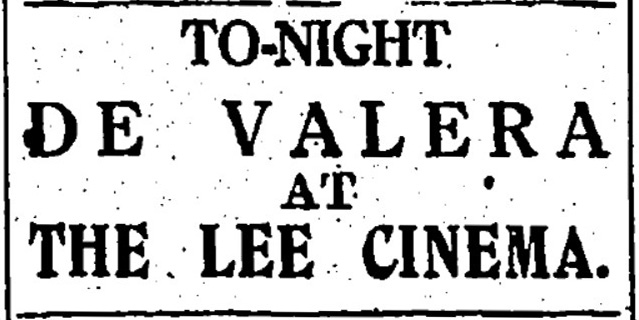
Ad for newsreel of Dáil president Eamon De Valera at Cork’s Lee Cinema, Evening Echo 6 Dec. 1921: 6.

“To facilitate the public who were unable to procure copies [of the Freeman’s Journal],” that newspaper reported on the receipt of news of the Anglo-Irish Treaty on 6 December 1921 in Castlebar, “several traders displayed the FREEMAN’S JOURNAL in the window of their establishments and in addition the management of the Star Cinema threw the substance of the FREEMAN announcement on the screen, acknowledging the source of the information. It was greeted with loud applause” (“Soldier’s Song”). Cinema played a rarely acknowledged role in mediating the Anglo-Irish Treaty, one of the key documents in establishing the constitutional status of Ireland in the aftermath of the War of Independence. While directly projecting text from the newspapers in the way the Freeman described was clearly possible – and we’ll return to that possibility – cinema more often presented the treaty in newsreel images of the negotiations and offered a public space in which people assembled to experience those images together. As the most powerful visual form by which the public saw historic events unfold rather than just reading about them, cinema complemented and to some extent competed with the newspapers, many of whom had over the previous decade or so supplemented its engravings with daily photographs as a way of visually mediating events.

A famous photograph of the Irish plenipotentiaries at their headquarters in Hans Place, London, as it appeared in the Irish Independent, 8 Dec. 1921: 3.

Newspapers were aware of cinema’s increasing presence in the mediascape, and they made the technologically advanced media scrum a newsworthy event in itself, as they did in reports of coverage of the treaty negotiations. “The Irish plenipotentiaries,” the Irish Independent reported on 7 December 1921, “rested most of yesterday in the comparative seclusion of Hans Pl., which was invaded from dawn until nightfall by photographers and cinema operators, endeavouring to snapshot every glimpse of them they could get” (“Arduous Labours”). Indeed, in this case, the Independent mentioned the photographers and newsreel camera operators before the “scores of journalists and special correspondents [who] also besieged the delegates for interviews, but were courteously declined.”

Sinn Féin prisoners released from Kilmainham Gaol, Freeman’s Journal, 9 Dec. 1921:3.

Two other reports in Irish newspapers show that newsreel camera operators were not a rare sight but were seemingly as ubiquitous as other news reporters. As members of Sinn Féin gathered in Dublin on 7 December to begin the debate on the newly signed treaty, the Evening Echo reported that “at 1.50 Mr. De Valera left the Mansion House amid the attention of a number of camera and cinema operators” (“At the Mansion House”). In the immediate aftermath of the treaty negotiations, republican prisoners were released from a number of prison camps and jails, including Dublin’s Kilmainham Gaol, where a “corps of cinema men and press photographers occupied a prominent position outside the building, and interesting pictures of the historic scene were secured” (“At Kilmainham”).

Still from “The Treaty,” one of the items in the Pathé Gazette on 15 Dec. 1921, showing Sinn Féin founder and treaty negotiator Arthur Griffith (nearest the car wheel) leaving the Dáil debate on the treaty at UCD. Available on the IFI Archive Player and at British Pathé.

Much of this footage survives and is even familiar from its reuse in historical documentaries. While that reuse tends to decontextualize the footage, we can recontextualize it to some extent with available resources. Camera operators from British Pathé shot a good proportion of the footage of the London negotiations and the Dáil debates that followed from late December 1921 to the Dáil’s ratification vote on 7 January 1922, and what survives can be viewed freely on the British Pathé website. Parts of this footage have been made available in far higher resolution, and also free, on the Irish Film Institute’s IFI Archive Player. Although footage by other newsreel companies – principally Topical Budget and Gaumont – that operated in Ireland is not as accessible, the British Universities Film & Video Council’s News on Screen website offers information on it that indicates the exact date the films were made available and the other newsreel items with which they were shown. Scholars – most notably Ciara Chambers in her Ireland in the Newsreels – have written about the image of Ireland that emerges from these newsreels and offer ways of thinking about the differences between Pathé’s and Topical Budget’s editorial line on Ireland.

Framegrabs of the signatures at the bottom of the Anglo-Irish Treaty as they are presented in The Wind that Shakes the Barley (2006) and the Pathé Gazette item “Peace Council at the Palace” of 12 December 1921.

As a result, we know quite a lot about newsreels themselves, but we have less information about the cinema context in which people received them. The best-known extant account of an audience watching the footage of the treaty negotiations is fictional. In Ken Loach’s The Wind that Shakes the Barley, the audience in a cinema in rural Cork watches as the terms of the Anglo-Irish Treaty are concisely set out by a newsreel. A pianist accompanies the film, and somebody in the audience reads the text on the intertitles that explain what the main terms of the treaty are. As the concessions made by the Irish side are revealed – “The new state will remain within the British Empire as a dominion.” “Members of the new Parliament will swear an oath of allegiance to the British crown.” “Northern Ireland will remain within the United Kingdom” – the initial celebratory atmosphere changes into one of disbelief and anger. “Is this what we fought for?” Damien O’Donovan, the character played by Cillian Murphy, asks his companions rhetorically.

Three framegrabs from The Wind that Shakes the Barley, showing the accompanist, newsreel of King George V and David Lloyd George smiling, and the audience debating the treaty as presented by the newsreel.

For Loach, film plays a decisive role in mediating the treaty, and he stages this scene powerfully, capturing the essence of the collective nature of cinema in a film that is so interested in collective decision making and action. Narratively, the scene elegantly and economically communicates the disappointment of those who had been involved locally in the War of Independence by struggling for a better, fairer society in the face of a brutally imposed imperialism. For cinema historians, the recreation of the auditorium’s social interactions and live musical accompaniment lend authenticity that is also present in several other ways, including in the newsreel images on the screen. Among those images, we see footage of Michael Collins giving a speech, the signatures on the treaty document itself, Collins laughing and talking with another man, and King George V and Prime Minister Lloyd George smiling at the front of the British delegation.  

Most of this footage derives from “Peace Council at the Palace,” the key newsreel by which people could plausibly have been informed about the treaty. This item was released as part of Topical Budget’s edition of Thursday, 8 December 1921, two days after the treaty was signed. A longer version of “Peace Council at the Palace” also formed part of Pathé Gazette’s edition on the following Monday, 12 December. By that stage, almost a week later, it is unlikely that the film was telling Irish cinemagoers anything they didn’t already know from other sources, and this was the usual situation with newsreel. “Audiences were seldom informed about events via the cinema in the early 1920s,” Chambers observes in a recent article analyzing the use of newsreel in The Wind that Shakes the Barley, “and indeed the newsreels tended to provide moving images depicting events that viewers were already familiar with through newspapers and word of mouth” (“Ethics and the Archive” 140).

Ad for Castlebar’s Star Cinema, Connaught Telegraph 2 Apr. 1921: 3.

Returning to the Freeman’s Journal article with which we started, it is possible that the 8 December release of the Topical Budget was one of those perhaps few occasions that the cinema informed audiences about an event of which they were unaware, but it is unlikely. The article suggests that copies of the Freeman and possibly the other national dailies were in such short supply in Castlebar that the Star Cinema was needed to help fill the informational vacuum. It doesn’t, however, suggest that newsreel images filled that vacuum but that swiftly prepared text from the Freeman, duly acknowledged, most likely written on magic lantern slides, was projected on the Star’s screen. Although this incident was reported on 8 December, it undoubtedly relates to events on 6 December, the day on which the Freeman had first reported the terms of the treaty. In Castlebar, a town whose population the 1911 census put at 3,698, the scarcity of information would quickly be overcome and was highly unlikely to persist until a newsreel issued two days later. Even if it did, neither of the local cinemas – the Star and Ellison’s – seems to have subscribed to Topical Budget; on the few occasions that their ads mentioned newsreel in 1921, it was with the single word “Gazette,” suggesting they both subscribed to Pathé’s newsreel. Finally, the newsreel was a five-minute compendium of one-minute items of both political and social news that appeared as part of a cinema programme that lasted about two hours. Audiences expected to see this part of the bill, but they were likely at the cinema primarily to enjoy the longer dramatic films that it accompanied.

Having said that, even a single newsreel item could be the cause of conflict between members of an audience, albeit that very little reaction to the treaty newsreel items seems to survive. It doesn’t take long after these items appeared, however, to find an example of how divisive these one-minute films could be, and how the cinema context could display wider societal divisions. “A disturbance between military and civilians broke out last night along The Quay in Waterford, ending in a sharp, short bout of fisticuffs,” the Sunday Independent reported in relation to an incident that took place on 23 December at the city’s Coliseum cinema. “At a cinema performance early in the evening, the picture of Mr de Valera was shown, which was loudly cheered by the audience. These were countered by hootings and groanings on the part of several soldiers attending the performance” (“Civilians and Soldiers”). Which precise film of De Valera was screened is not clear because no Coliseum ads from this period seem to be extant. In any case, it seems that the newsworthiness of the images as such – the fact that De Valera was engaged in the Dáil debates on the treaty and was taking an anti-treaty position – wasn’t an issue for the contending members of the audience but merely provided a pretext to express more general pro- and anti-Sinn Féin positions.

As the article indicates, the incident didn’t end with competing cheers, on one side, and hootings and groanings, on the other. During an interval, some of the soldiers left the cinema to get reinforcements.

The reminder of the performance was marked by disorderly conduct and obscene language on the part of a certain section of the soldiers.

This was resented by the male civilians in the theatre, and later, when the show was over, a body of civilians waited for the soldiers, and on The Quay fighting with fists went on for a considerable time, and the pedestrians feared a general outbreak.  (“Civilians and Soldiers.”)

Earlier in the year, a “general outbreak” often meant crown forces going on the rampage, shooting and looting with official sanction for “reprisal.” Here, there seem to be hints of a wider social and political shift in power, with some ominous undertones for things to come. First of all, the article concludes by stating that a full riot, or a breach of the truce that had been in place since July, was avoided when a military patrol arrived to quell the disturbance with fixed bayonets. Up to that point, the article wants to make clear that no firearms were used, but the “body of civilians” who confronted the soldiers on the Quay suggests an intervention by the Volunteers/IRA, an intervention seemingly in the name of a patriarchal respectability given that that it was carried out by “male civilians” who were, the implication presumably is, appalled by the effect on female audience members of the soldiers’ “disorderly conduct and obscene language.”

Cinema was unlikely to have been the place that many Irish people first encountered the details of the treaty. As was usually the case, the daily newspapers scooped the newsreels. However, the cinema provided a communal context in which audiences could respond either to the latest news presented on magic lantern slides or more-or-less delayed newsreel images of the agreement and the people who signed and debated it. That might cause audiences to greet the news with loud applause, hoots of derision or to exchange blows in the street.

References

“Arduous Labours: Irish Delegates’ Work.” Irish Independent 7 Dec. 1921: 6.

“At Kilmainham: Prisoners Stream Out from Early Morning.” Evening Herald 8 Dec 1921: 1.

“At the Mansion House.” Evening Echo 8 Dec. 1921: 4.

Chambers, Ciara. Ireland in the Newsreels. Irish Academic Press, 2012.

—. “Ethics and the Archive: Access Appropriation and Exhibition.” Ethics and Integrity in Visual Research Methods. Edited by Savanah Dodd. Emerald, 2020. 133–151.

“Civilians and Soldiers: Waterford Disturbances Begin in Cinema House.” Sunday Independent 25 Dec. 1921: 1.

“‘The Soldier’s Song’: How the News Was Received in Connacht.” Freeman’s Journal 8 Dec. 1921: 6.

Ominous Flickers and Fade Out for Irish Cinema in 1920

Ad from the Tuam Herald 6 Mar. 1920: 3.

“The past year has scarcely been a bright year in the Irish film world,” the “On the Film” columnist of Dublin’s Evening Telegraph observed at the end of December 1920. “It started hopefully, got out of focus half way through, and towards the end of the picture was a ‘close-up’ in more senses than one” (“On the Film”). Although the filmic metaphor is a little opaque, the writer might have been writing about cinema a century later, albeit that in 2020 cinema went out of focus in March and has been close up in the sense that the pandemic has forced us to have most of what would previously have been cinematic experiences – going out to blockbusters, festivals or other such activities – at home, with very brief windows when the cinemas were open.

The Telegraph’s assessment of 1920 has also been reflected in this blog, which began the year hopeful by contemplating the opening of super cinemas but became less positive almost immediately not because of pandemic – although it did revisit the 1918-19 flu pandemic – but because the violence of the War of Independence was starting to affect such daily activities as cinema. While the blog spent much of the middle of the year discussing such more positive developments as the making of feature films (see here and here) and newsreels, encroaching violence became an increasing feature of the 1920 cinema year and will require more discussion here.

Header on the Kinematograph and Lantern Weekly‘s Ireland column in 1920.

Writing a centenary blog in 2020 presented some challenges, the main one being that the blogs written after February had to rely solely on online research rather than visits to the National Library of Ireland (NLI) and other archives. This has had consequences for the range of sources used, and for the quality of obtainable images. Some freely accessible online sources for Irish cinema history exist, including films from the Irish Film Institute’s IFI player, the 1901 and 1911 Irish censuses, photographs from the NLI and maps from the Ordnance Survey of Ireland. Most other online sources require a subscription, including newspapers and trade journals, which provide the most detailed information. A selection of Irish newspapers has been digitized through two main subscription services: the Irish Newspaper Archive and the British Newspaper Archive (BNA). Both allow access to the Freeman’s Journal’s twice-weekly column “On the Film,” which fills some of the gaps left by the inaccessibility of analogue sources. Late in 2020, the BNA also released its digitization of the Kinematograph and Lantern Weekly, making its information on Irish cinema available alongside other key London-based entertainment trade journals the Bioscope and the Era. Sadly, the issues of The Irish Limelight for 1920 do not survive in digital or analogue form, and when editor Jack Warren handed this first Irish cinema journal over to contributor P.J. Flanagan at the end of 1920, it seems to have ceased publication (“Trade in Ireland”).

“On the Film” column, Evening Telegraph 18 Nov. 1920: 2.

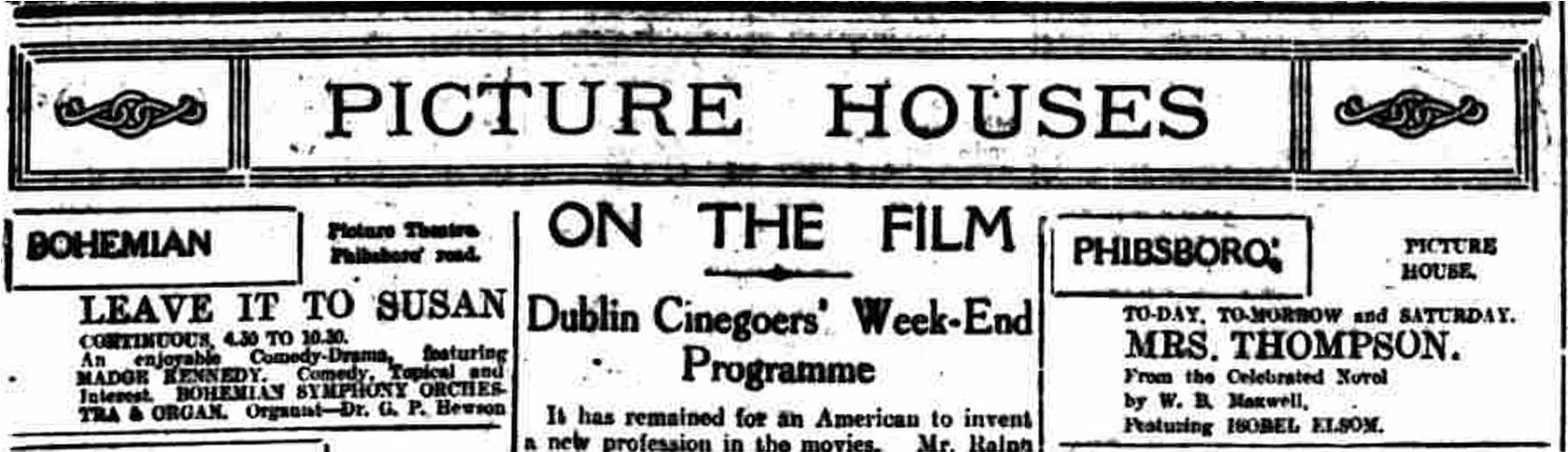
As a result, a combination of Irish newspapers and the trade journals provide the most comprehensive available picture of Irish cinema in late 1920. At the end of November, the “On the Film” columnist provided more apt filmic metaphors for what was happening to the trade at the time. “Last week was a black one for the Dublin picture house,” s/he wrote. “For some time past our political conditions have been throwing ominous flickers across the silver screen. Raids and ‘holds-up’ at all sorts of hours and places were already making cinegoers stick closer to the home fireside; but the new 10 o’clock Curfew is a regular ‘fade out’ for cinema business” (“On the Film,” 29 Nov.). The ominous flickers of political violence conspired with the fade-out of a curfew stricter than the midnight regulations in place since February to make the business of exhibiting films extremely difficult. The new curfew’s requirement to be indoors by 10pm meant that Dublin “cinegoers” could not attend the 9 o’clock show, usually the most lucrative of the day. “In many Cinemas the programme begins at seven, and with the big picture shown twice, the show might be described as ‘twice nightly,’” an unnamed sources at the Bohemian Picture Theatre in Phibsboro revealed, giving details of the patterns of cinemagoing and the economics of exhibition.

The second house, from 9 to 10.30 was usually the crowded one, since very few people either care or are able to go straight from work or after tea to the pictures. With the principal house knocked on the head by the order, the proceeds of the first performance would never be sufficient to make picture pay. (“May Have to Close!”)

In mid-December, the Bioscope’s Ireland correspondent JAP reported on the possibility of preventing the fade out caused by the curfew, observing that “the latest rumour is that there may be a couple of extra hours of freedom for the citizens of Dublin during Christmas week, but it is only a rumour” (“Irish Exhibitors to Carry On”).So it proved. “Picture houses and other places of amusement which look to this week rather than to last week for their best patronage round about the Christmas season,” the Freeman reported on 28 December, “can scarcely  now expect, since the authorities refused to listen to the plea for a Christmas week relaxation to be more fortunate in this respect than the traders” (“Effect of Arson”).

To address their loss of income, cinema proprietors negotiated with their employees when their representative organization the Dublin and South of Ireland Cinematograph Exhibitors Association entered talks with the Musician Union and Irish Transport and General Workers Union (ITGWU). The musicians – “and they include many men of considerable note in their profession” – agreed to a 21-hour week and to give two free matinees a week (“Irish Exhibitors to Carry On”). After the ITGWU negotiation, JAP reported that the other “employees have agreed to accept 15 per cent. less as long as the present Curfew hours obtain in Dublin” (“Trade in Ireland”). “Did anybody say anything about ‘A Merry Christmas?’” JAP asked rhetorically.

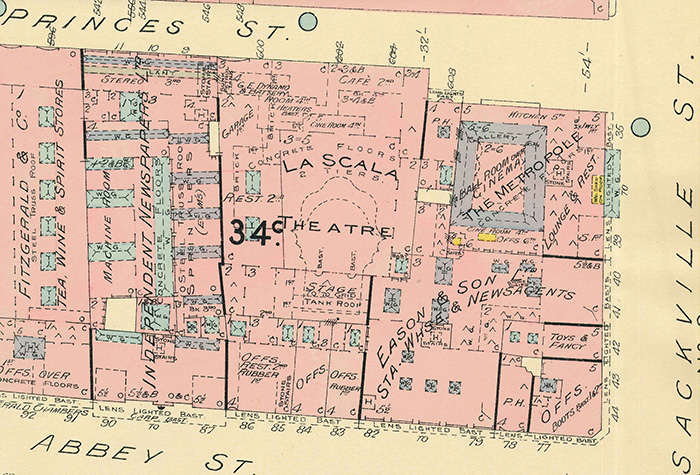
Goad Fire Insurance map of the Dublin block between Princes Street, O’Connell Street and Abbey Street containing La Scala.

La Scala was the one Dublin cinema that JAP reported would continue to pay full wages. We have said something here in January about its size and the fact that it was the first cinema in central Dublin to have inveigled Sunday opening. This favourable position vis-à-vis Dublin’s other cinemas may be part of the reason its management decided to treat its staff differently, but a return to say something about its opening reveals that it may not have been attributable to the management’s generosity. When proprietors Frank Chambers and George Fleming chose the week beginning 9 August 1920 for the opening, few people would have been surprise that they timed it to coincide with Horse Show week, the city’s busiest entertainment week of the year during the Royal Dublin Society’s longstanding horse show at its show grounds in Ballsbridge. But things didn’t go quite to plan as opening day approached. A split in the electricians between those affiliated with the London-based Electrical Workers’ Union and the ITGWU on what union the projectionists should belong to looked like it would leave the cinema unable to open because of a strike. Last minute negotiations meant that while La Scala did open during Horse Show week, it was not on the Monday as planned but on Tuesday, 10 August. In the process, the unions had sent a message to the management about the power of organized labour that seems to have been heeded months later.

Union activity was at the forefront of the War of Independence in ways that would have consequences for cinemas. Members of the rail unions refused to work on trains carrying soldiers, police or their munitions, thereby disrupting military and police deployment. An unintended but inevitable consequence was that all transport was disrupted, including the distribution of films. This dispute would not be resolved until the end of December 1920, and JAP commented on the serious plight for Irish film renters or distribution companies. “The number of towns to which it is possible to send films for screening grows steadily less,” he noted in mid-December. “When one sends out a film to the Irish country districts nowadays it is with a feeling of relief, not altogether unmixed with surprise, that one finds it returned in due course” (“Trade in Ireland”).

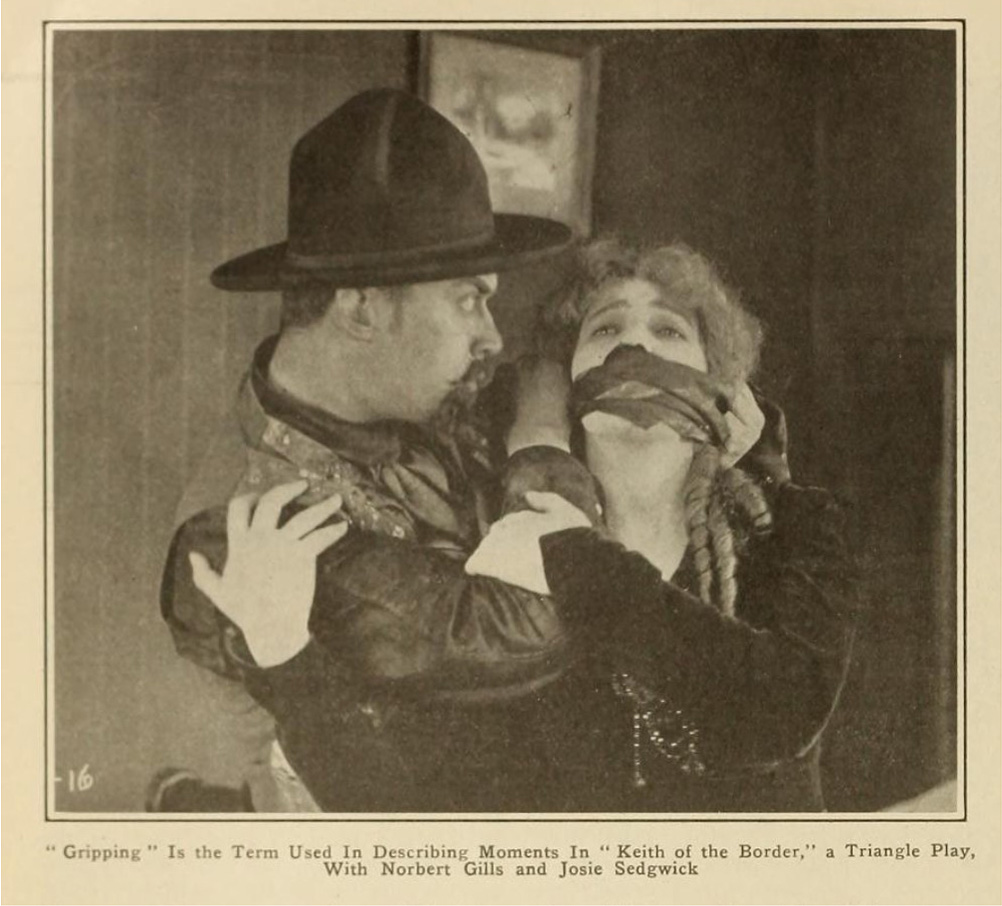
Still from Keith of the Border in Motion Picture News 23 Feb. 1918: 1166.

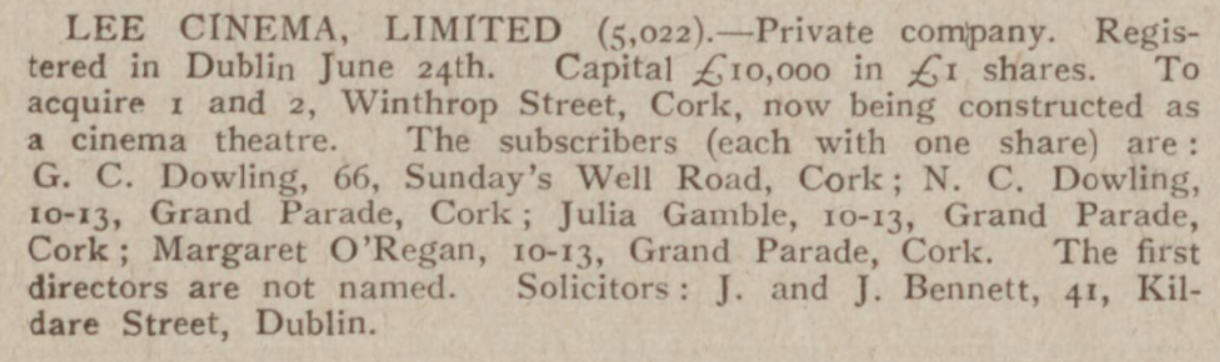
JAP also noted one particularly surprising return. The Dublin office of distributors Western Import had written off the copy of the Western Keith of the Border (US: Triangle, 1918) that was showing at Cork’s Lee Cinema on the night of 11-12 December. That night, British forces burned large part of the centre of Cork, and the Lee Cinema at 1-2 Winthrop Street was one of the premises destroyed. “The carrying case had evidently been through the flames, and the tins inside were rusted from contact with water,” JAP revealed, “but the film itself was undamaged. / Moral:—Exhibitors should see to it that films are packed and returned to their cases each night immediately after having been shown, and thus lessen the chances of damage by fire.”

The record of the Lee Cinema’s company registration in June 1920 is notable for the fact that at least two of the four proprietors were women. Bioscope 8 Jul. 1920: 8.

The destruction of the Lee just weeks after it opened at the start of November might be symbolic of Irish cinema’s fade out in 1920, but many more cinemas opened in 1920 than were closed either in this dramatic fashion or for more mundane commercial reasons. Cork began the year with the opening of Washington Street Cinema on 15 January but was particularly well served with suburban cinema openings in autumn 1920, with both the Blackpool on the Watercourse Road and Bellvue on Military Road opening on the same day, 25 October, a week before the Lee. The lavish Pavilion on Patrick Street was still under construction at the end of the year and would open in March 1921. In Sligo, the Boyne Cinema Company may have claimed the first opening of the year, when it offered film shows in the Assembly Room of the Town Hall. The Kilgannon family, who ran the Sligo Picture Theatre on Thomas Street closed the year by launching the Pavilion just metres away in the same street on Christmas day. Early summer saw several opening in Dublin: 10 May saw the opening of both the Manor Cinema on Manor Street and the Lyceum Picture Theatre at the renovated Volta premises at 45 Mary Street;  on 13 May, the Palace Cinema opened in the remodelled Antient Concert Rooms on Brunswick Street. Autumn in Dublin saw the Theatre de Luxe open on Camden Street on 4 September and the AOH Hall at 31 Parnell Square begin screening on 4 October. Elsewhere, Limerick’s Garryowen opened on 5 March on Broad Street; the Abbeyfeale Cinema opened in mid-May; Wicklow’s Excelsior became that town’s first cinema on 14 December; and ironmonger Michael Connolly opened a cinema at his premises in Ballymahon, Co. Longford over the Christmas season.

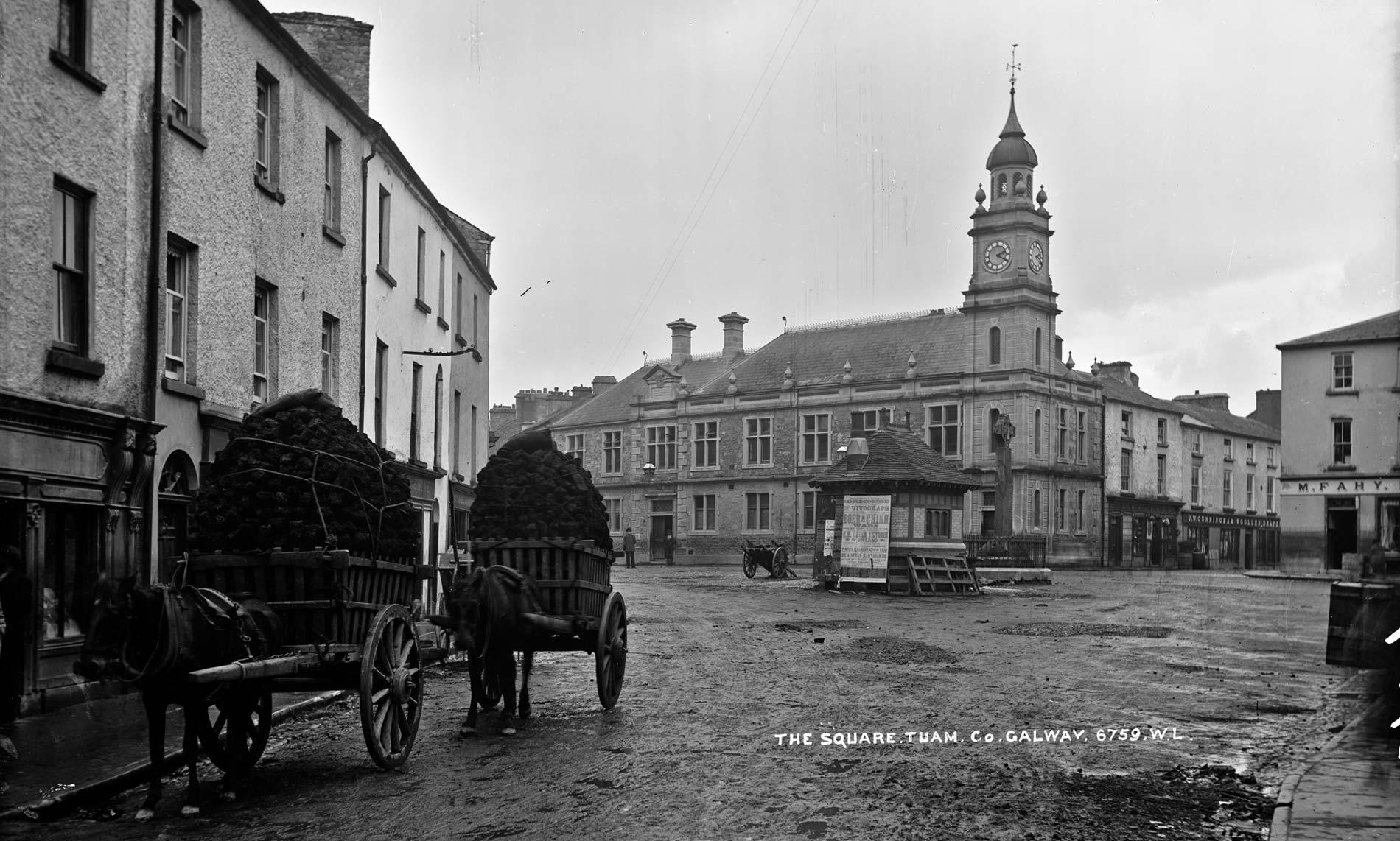
The Square in Tuam, Co. Galway, c.1900,  showing the Town Hall and a kiosk with a poster for Dr Ormonde’s Vivograph film show. Image from the National Library of Ireland on Flickr.

These openings pointed in a much more promising direction than the destruction of the Lee during the burning of Cork, and cinema would not, of course, fade out completely at the end of 1920. However, the marked intensification of the War of Independence in the summer of 1920 did impact it severely. The Restoration of Order in Ireland Act came into force on 9 August, giving the military sweeping new powers of arrest and trial. The Royal Irish Constabulary (RIC), already strengthened by recruits from Britain, many of them unemployed former soldiers dressed in a distinctive black-and-tan uniform, was further bolstered by an Auxiliary Division of former British Army officers. The burning of Cork was a reprisal by the Black and Tans, Auxies and British soldiers after the Auxies had suffered heavy casualties at the hands of the IRA during the Kilmichael ambush on 28 November. Cork was the worst single act of burning buildings as an act of reprisal, but it was a widespread tactic, with cinemas only occasionally being targeted. A cinema in Tullamore was bombed and burned as a reprisal for the killing of RIC sergeant Henry Cronin on 30 October (“Reprisals for Tullamore Murder”). However, the reprisals in Tullamore and many other towns were relatively minor in comparison to Cork and such other extensive incendiary attacks as the sack of Balbriggan on 20 September and the destruction of Tuam on 21 July.

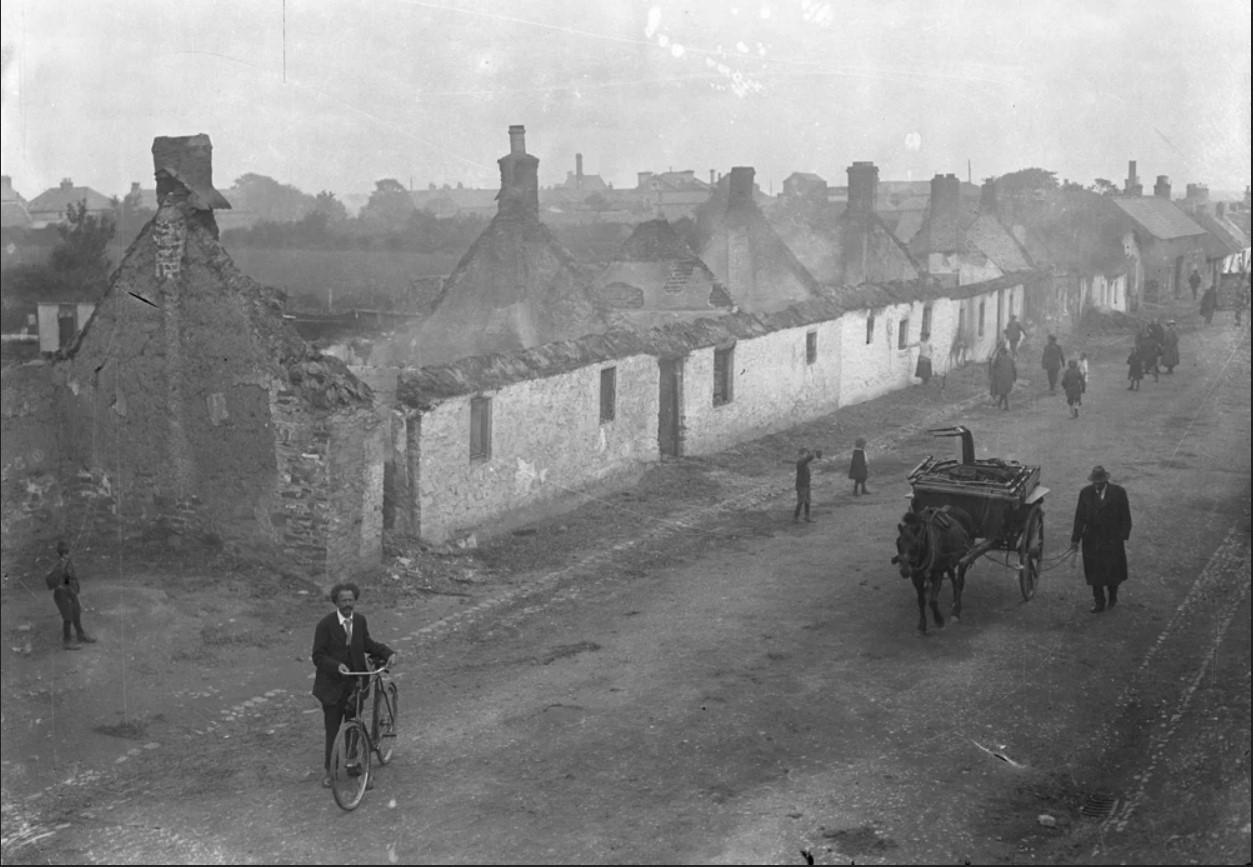
The burned-out remains of houses in Balbriggan, Co. Dublin following the sack of the town by Black and Tans in September 1920. Century Ireland.

Films of the aftermath of the burning of Balbriggan and Tuam provided evidence of the continuing importance of Irish filmmaking in offering a perspective that could challenge British propaganda. An Irish Events newsreel of Tuam was shown in several cinemas on the week of 5 August. “A just conception of the military occupation of Ireland,” the Waterford News and Star remarked, “was afforded last night in the Broad Street Cinema by a series of pictures showing the ruins of Tuam from enemy incendiarism. The fine Town Hall building is a mere skeleton and affords eloquent evidence of British vandalism” (“Burning of Tuam”). The Town Hall had also been the venue for film entertainments over two decades. The Irish Events film of Balbriggan seem to have an even greater impact. It was shown in Irish cinemas in the week of 27 September, a week after the destruction of the town, with several newspaper carrying the comment that “Irish film companies were in a position to show thousands the sack of Balbriggan, and men, women and children running from their burning homes as the peasantry fled from the onrush of the Germans in Belgium and France” (“Seen Through”). It was also shown in America, where, the Freeman’s Journal suggested in November, cinema was contributing to the struggle for Irish independence by exposing US audiences to such Black-and-Tan atrocities as the sacking of Balbriggan “in the cinemas all over the country, the correspondent himself having seen them nearly two thousand miles from the coast” (“Cinemas Tell the Tale”).

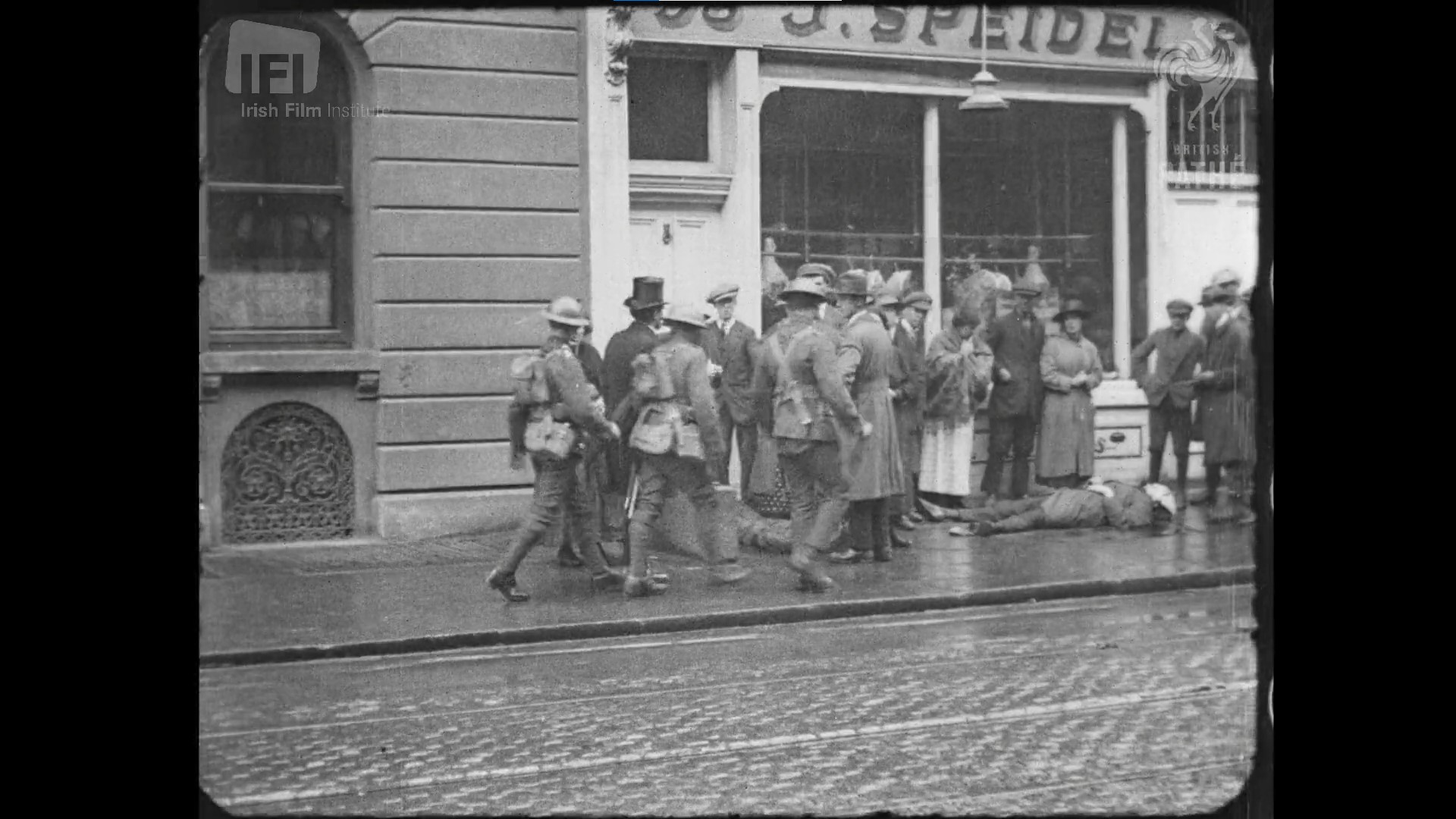
Soldiers approach prone bodies on Talbot Street in newsreel item “Terror in Ireland.”

A cameraman from Irish Events was also quickly on the scene on Dublin’s Talbot Street on 14 October following a shoot-out between of IRA activist Seán Treacy and British soldiers and secret service agents that left Treacy and two of the secret service agents dead. The film survives and can be viewed on the IFI Player, including the scene that Evening Herald “Flickers from Filmland” columnist drew particularly attention to, of “the crowd running from the menace of further shooting, and the still group of victims on the footway, [which] makes a most unusual contribution to film history” (“Flickers from Filmland”).

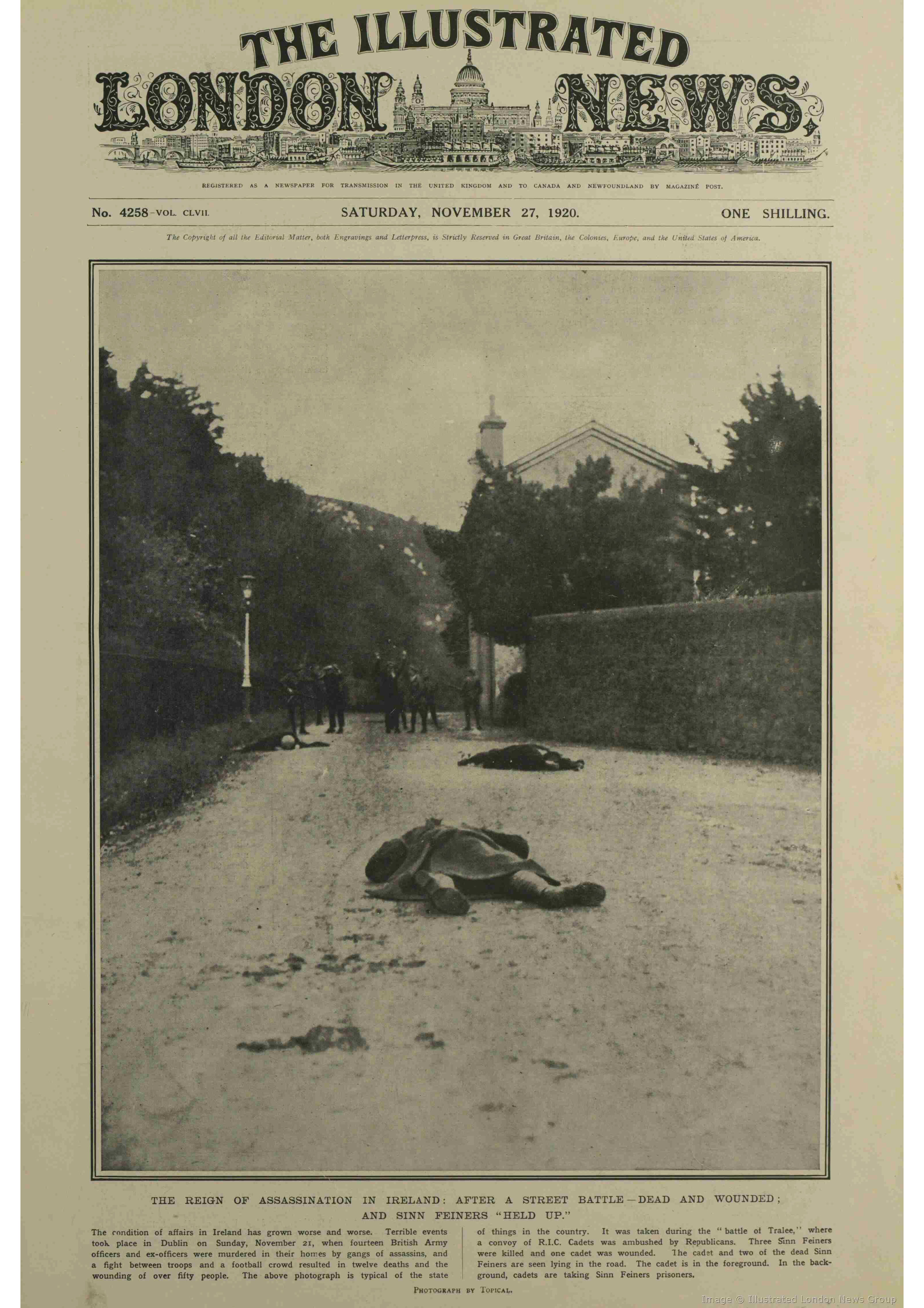
Faked photograph of the Ballymacelligott skirmish on the cover of the Illustrated London News 27 Nov. 1920: 1.

The most notorious 1920 attempt by the British authorities to use the visual media of photography and film to sway British public opinion against the Irish Republican cause came in the guise of the co-called Battle of Tralee (see Barry, Grant). This was actually an IRA-Black-and-Tan skirmish on 12 November at Ballydwyer creamery in Ballymacelligott, on the road between Tralee and Castleisland, that had left two men dead. By chance, Dublin Castle’s police information officer Captain Hugh Pollard was leading a party of foreign correspondents in the area, and they happened across the aftermath of the incident. Among them was journalist Clifford Hutchinson, who reported in the Yorkshire Post on 15 November that “two cinema operators accompanying the party set up their apparatus, and despite the bullets flying around, […] coolly took photography of the fight (“Stern Struggle with Sinn Fein”).

Subsequent events suggest that these cinematographers were working for British Pathé, but Pollard saw an opportunity to create a more politically useful event. Staged photographs of the incident appeared in several British publications, including the Illustrated London News, but were quickly exposed as fakes taken at Vico Road in Killiney, Co Dublin. Film was also supposedly shot at Vico Road and incorporated into a newsreel item released by Pathé on 18 November 1920. “The film, which was taken under fire,” the Daily News reported and the Freeman’s Journal reproduced, “shows wounded Sinn Feiners being led away as prisoners by Auxiliaries of the R.I.C., and struggling vigorously, in spite of their condition. An Irish girl is show pleading with the British troops to allow her brother to go free. In the end he is led away in a lorry” (“A ‘Fight’ Near Tralee”). ”). Although this film seems to have been released, it does not seem to survive in the British Pathé archive, and this may be because it was exposed as a fake. Confronting the British Attorney-General in the House of Commons about the faked photographs in early December, Irish Parliamentary Party MP Jeremiah MacVeagh asked “whether a film was also taken and had to be abandoned because at the ‘private view’ it was found that one of the corpses had moved? (Laughter)” (“Grim Reality”).

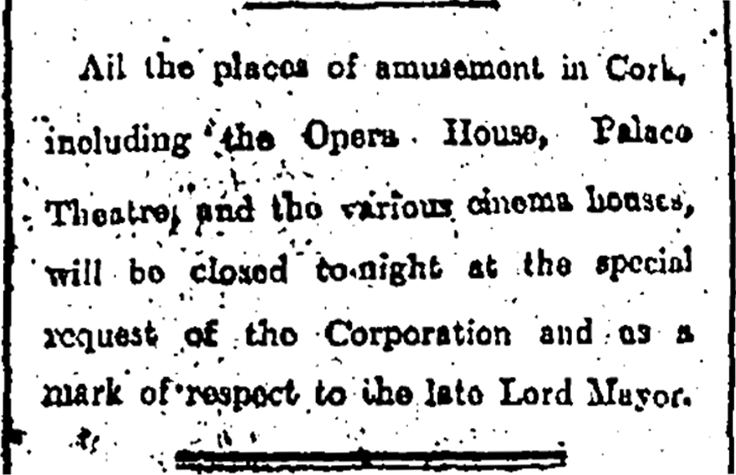
Notice that Cork cinemas had closed as a mark of respect for murdered mayor Tómas Mac Curtain. Evening Echo 20 Mar. 1920: 3.

Violence by crown forces was the most prevalent, destructive and disruptive of cinemagoing, but Republicans also sought to control cinema and even attacked cinemas and cinemagoers. The Irish Independent reported that on 12 June 1920, what it called the “Republican secret service” arrested fifteen boys aged between 14 and 18 for committing robberies in Cork, and the Sinn Fein court’s prosecutor recommended that the Corporation take measures “to prevent children attending pictures, except on specified nights, when pictures tending to educate and to elevate the minds of the boys would be shown” (“Irish Volunteers’ Activity”). On 14 August, Cork papers reported that in the absence of the recently arrested Lord Mayor Terence MacSwiney, the Corporation had passed a resolution calling on the Irish Republican Government to introduce film censorship (“Cork Town Council”). When cinemas closed on 29 October as a mark of respect and protest at MacSwiney death on hunger strike in Brixton Prison, some closures were enforced by the local Voluneers/IRA. The Irish Independent reported that the Dungannon picture house had closed at the request of the Volunteers, who had also stopped several dances (“Dances Stopped”). “A school teacher returning to his home in the village of Crossgar, Downpatrick,” the Irish Times revealed in relation to the same event, “was seized by a number of men who cut off his hair because he attended a performance at the local picture cinema theatre which Sinn Feiners desired to have closed owning to the death of the Lord Mayor of Cork” (“Incidents in the Provinces”). 

Ominous flickers certainly played across Ireland’s silver screens as 1920 faded into 1921.

References
“The Adapting of Programmes to Curfew Times.” Freeman’s Journal 29 Nov. 1920: 8.

Barry, Michael B. “How the British Faked ‘Battles’ During the War of Independence.” Irish Times 20 Jun. 2019. https://www.irishtimes.com/culture/books/how-the-british-faked-battles-during-the-war-of-independence-1.3930891

“The Burning of Tuam: Picture Shown in Waterford.” Waterford News and Star 6 Aug. 1920: 7.
“Cinemas Tell the Tale.” Freeman’s Journal 11 Nov. 1920: 6.
“Cork Town Council.” Evening Echo 14 August 1920: 2.

“Dances Stopped.” Irish Independent 29 Oct 1920: 6.

“Effect of Arson Upon Wholesale Trade.” Freeman’s Journal 28 Dec. 1920: 3.

“Flickers from Filmland.” Evening Herald 23 Oct. 1920: 2.

Grant, David. “The Battle of Trallee Fought at Vico Rd, Dalkey” The Auxiliary Division of the Royal Irish Constabulary. http://theauxiliaries.com/INCIDENTS/vico-road/battle-vico-road.html

“Grim Reality.” Irish Times 3 Dec. 1920: 6.

“Incidents in the Provinces.” Irish Times 3 Nov. 1920: 5.

“Irish Exhibitors to Carry On: Negotiations with Staffs to Cope with Diminished Earnings.” Bioscope 16 Dec. 1920: 5.

“Irish Volunteers’ Activity: Seizures of Still and Poteen.” Irish Independent 12 Jun. 1920: 7.

“May Have to Close! Variety Theatres Hard Hit by Curfew Time: Cinemas Suffer Too.” Freeman’s Journal 29 Nov. 1920: 6.

“Military Activity: Raids and Arrests in Dungarvan.” Waterford News and Star 6 Aug. 1920: 2.

“‘No Control of the Men’: Conduct of Police in Limerick.” Nenagh Guardian 31 Jul. 1920: 4.

“On the Film.” Freeman’s Journal/Evening Telegraph 29 Nov. 1920: 8; 16 Dec. 1920: 6; 30 Dec. 1920: 2.

“Reprisals for Tullamore Murder: Jury Condemns the Crime.” Belfast News-Letter 2 Nov. 1920: 5.

“Seen Through.” Ulster Herald 9 Oct. 1920: 5.

“Stern Struggle with Sinn Fein: The Tralee Ambush.” Yorkshire Post 15 Nov. 1920: 7.

“The Trade in Ireland: Irish Cinema Staffs Accept Reduced Wages for the Duration of the Present Curfew.” Bioscope 30 Dec. 1920: 25.

Irish Events Newsreel Shows an IRA Raid, a Wedding, College Capers and a Religious Procession in June 1920

Evening Herald 8 Jun. 1920: 2.

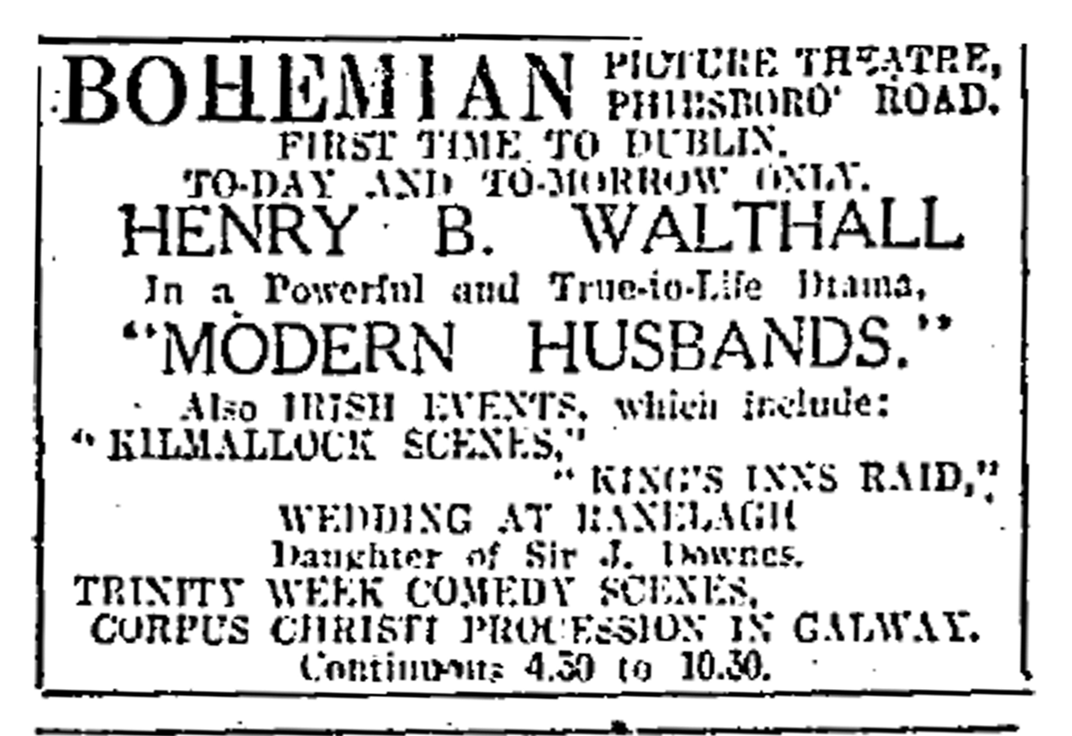
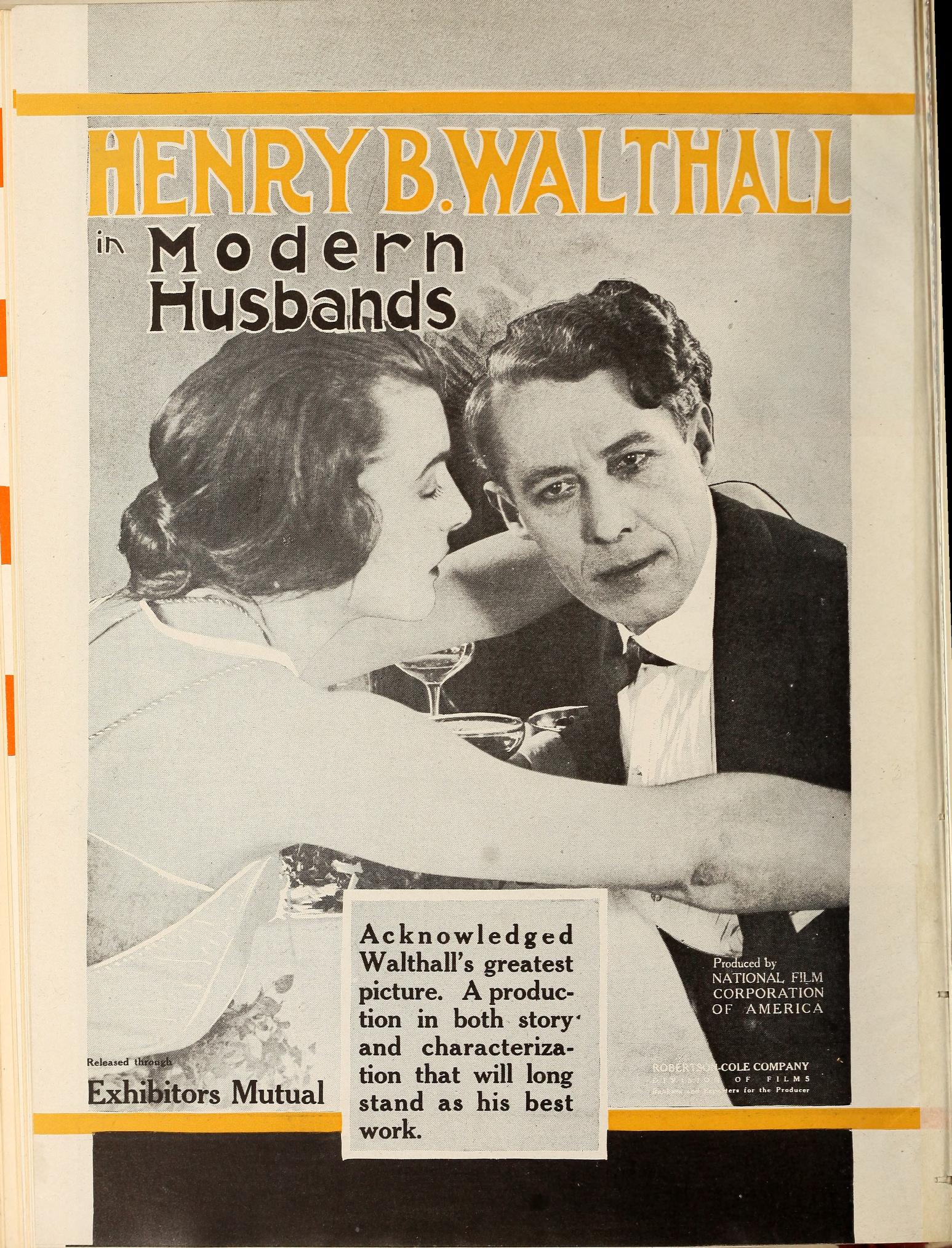
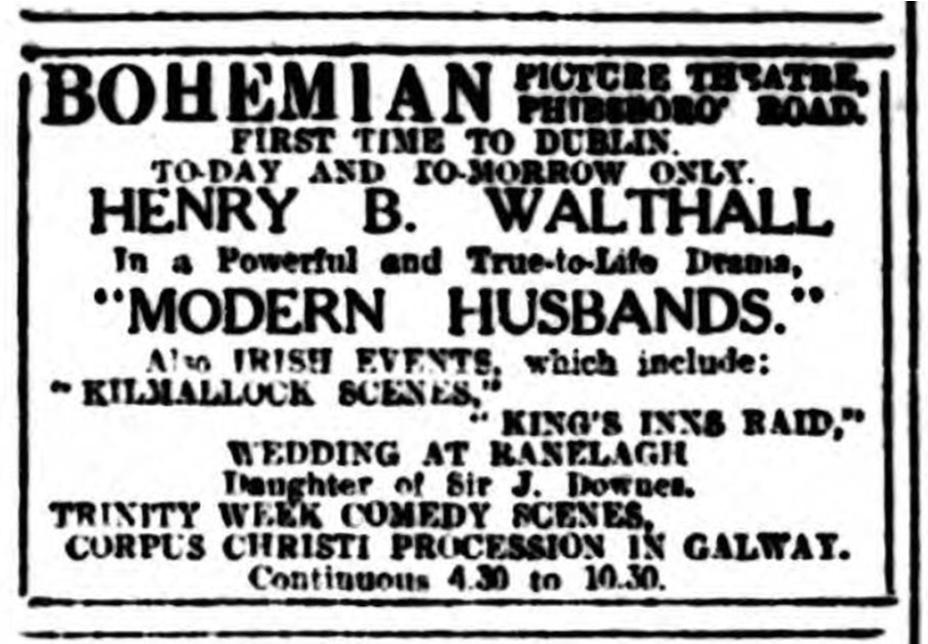
During the week of 7-12 June 1920, ads and brief notices for the Bohemian Picture Theatre in Phibsboro, Dublin offered an unusual amount of detail on the latest issue of the Irish Events newsreel. The newsreel was part of the programme supporting the Bohemian’s main feature, Modern Husbands (US: National, 1919), starring Henry B. Walthall, and Walthall’s name and that of the film dominate the text of the ad, as expected, but the bottom part of the ad is taken up completely with a description of the items making up week’s Irish Events.

Motion Picture News 26 Apr. 1919: 2674.

Irish Events is a popular topic in this blog. Begun by Norman Whitten’s General Film Supply company, Irish Events had been quietly running since July 1917. But apart from the opening month or so, individual items that the newsreel covered were very rarely mentioned, as has already been detailed. Irish Events specials – longer newsreels of typically 10 minutes focused on a particular topic – required extra publicity to encourage local exhibitors to book them and some of that material does survive and has been discussed here. But the normal weekly newsreel that appeared every Monday was generally just mentioned, when it was mentioned at all, as “Irish Events,” with no details of the subjects shown. In some ways, this lack of attention is understandable for a five-minute segment of a two-hour show in which people were most interested in the fiction feature film. Nevertheless, that five minutes of non-fiction film provided glimpses of Irish politics and culture not available anywhere else in the programme. This rare insight into what Irish Event was showing is therefore very welcome.

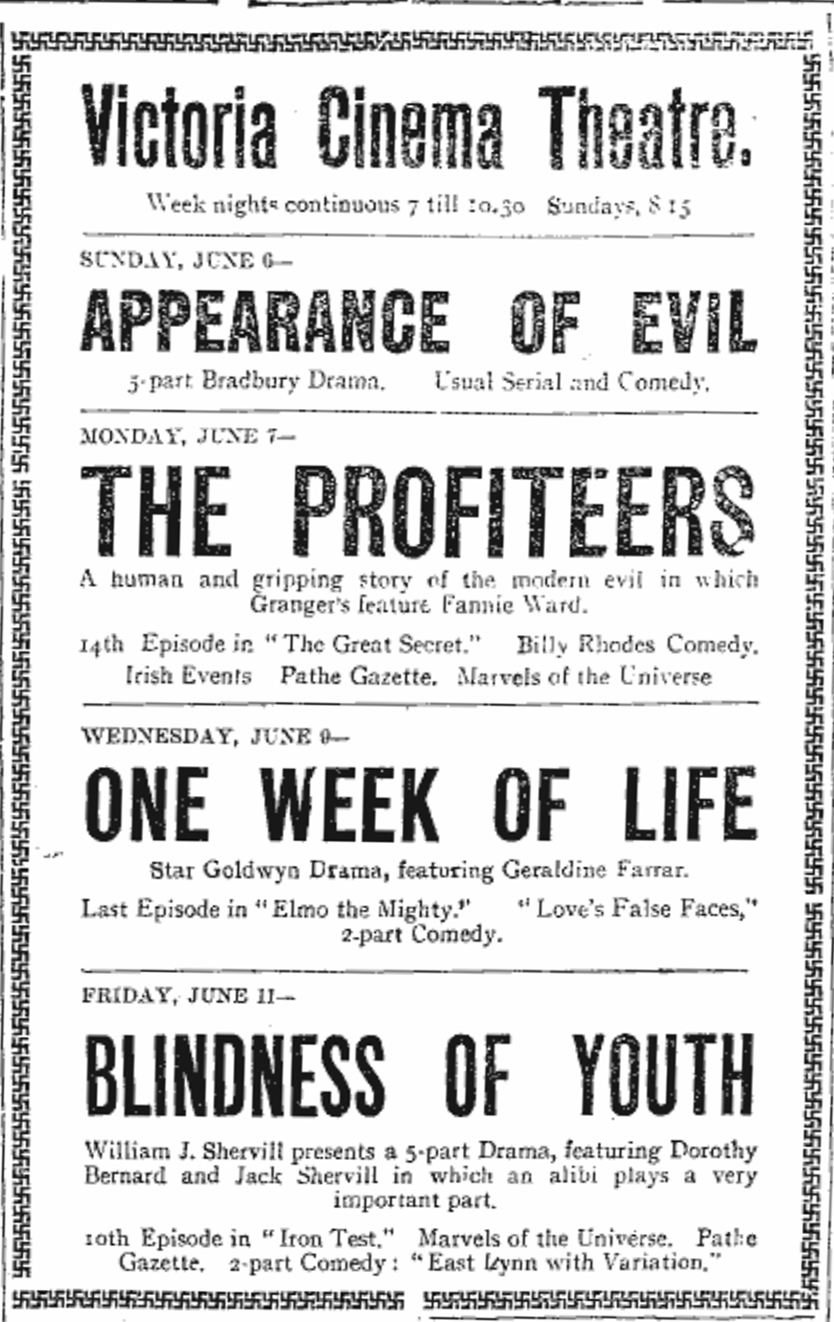
The programme at Galway’s Victoria also included Irish Events supporting the Monday feature The Profiteers (US: Astra, 1919), where it also shared the bill with the 14th episode of The Great Secret (US: Quality, 1917) serial, an unnamed Billie Rhodes comedy, Pathé Gazette and Marvels of the Universe (US: Bray, 1920). Connacht Tribune 5 Jun. 1920: 4.

The events covered in Irish Events that week, which was the 152nd week of the newsreel (IE 152), seem to have been the mixture of politics and social events from the previous week that was the common format not only of Irish Events but also of Pathé Gazette, Gaumont Graphic and Topical Budget, the British newsreels that were also regularly shown in Ireland. All of IE 152’s items had been covered in newspapers, and most had also been illustrated with photographs in those Dublin dailies that regularly included photos, that is, the Irish Independent and Freeman’s Journal. The quality of these photographs is poor on the digitized versions of the newspapers that are accessible at the moment with the archives closed, but they are included below as at least some indication of how these events were visualized in contemporary media.

Evening Telegraph 8 Jun. 1920: 2.

IE 152 included the newsreel standard five items, no doubt running about a minute each. The items were, according to an ad in the Freeman’s Journal and Evening Telegraph:
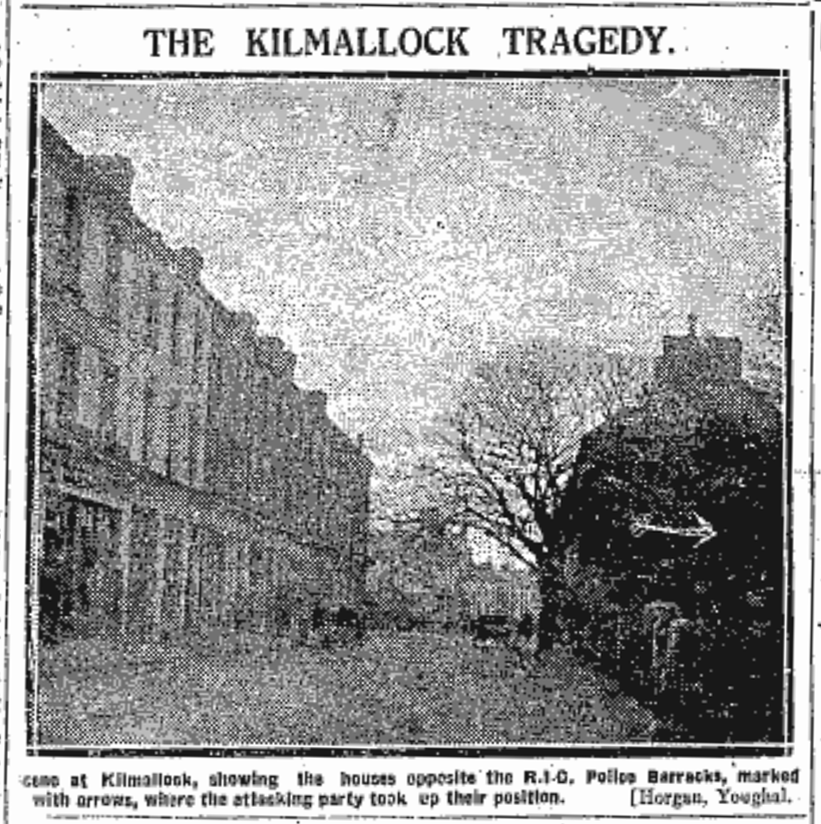
1. Kilmallock Scenes
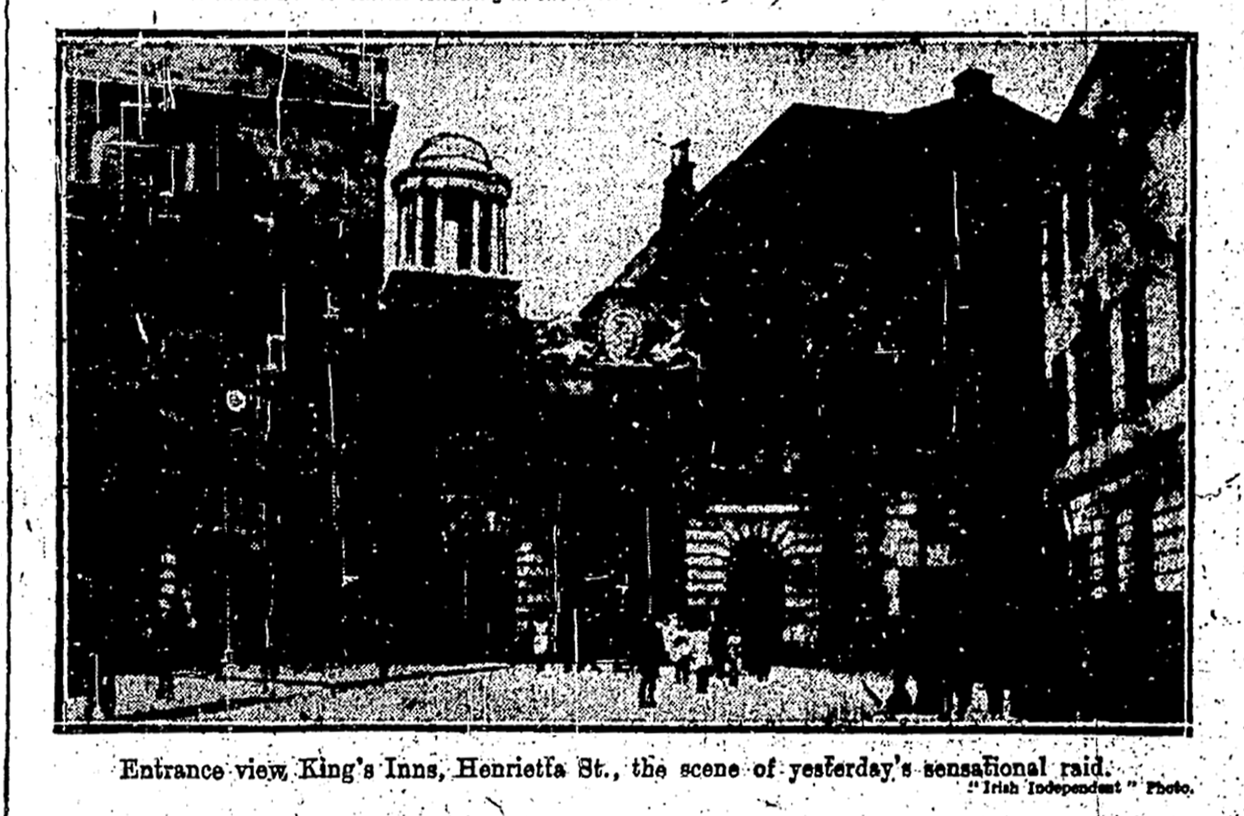
2. “King’s Inns Raid”
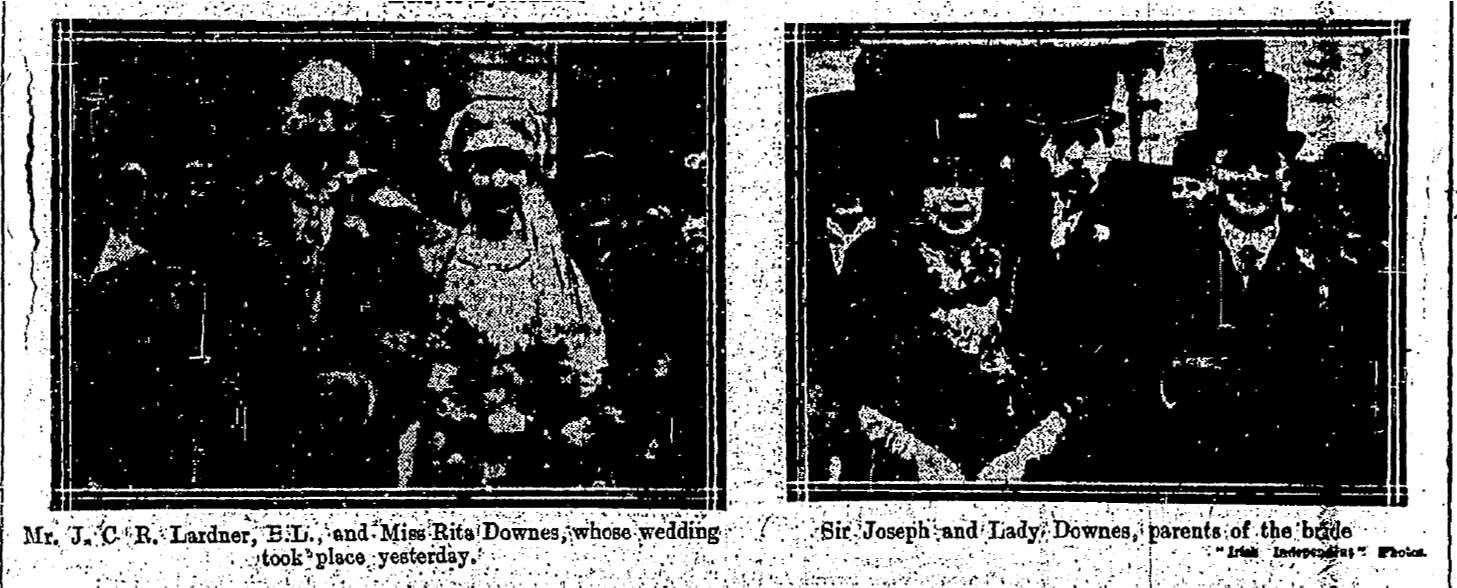
3. Wedding at Ranelagh / Daughter of Sir J. Downes
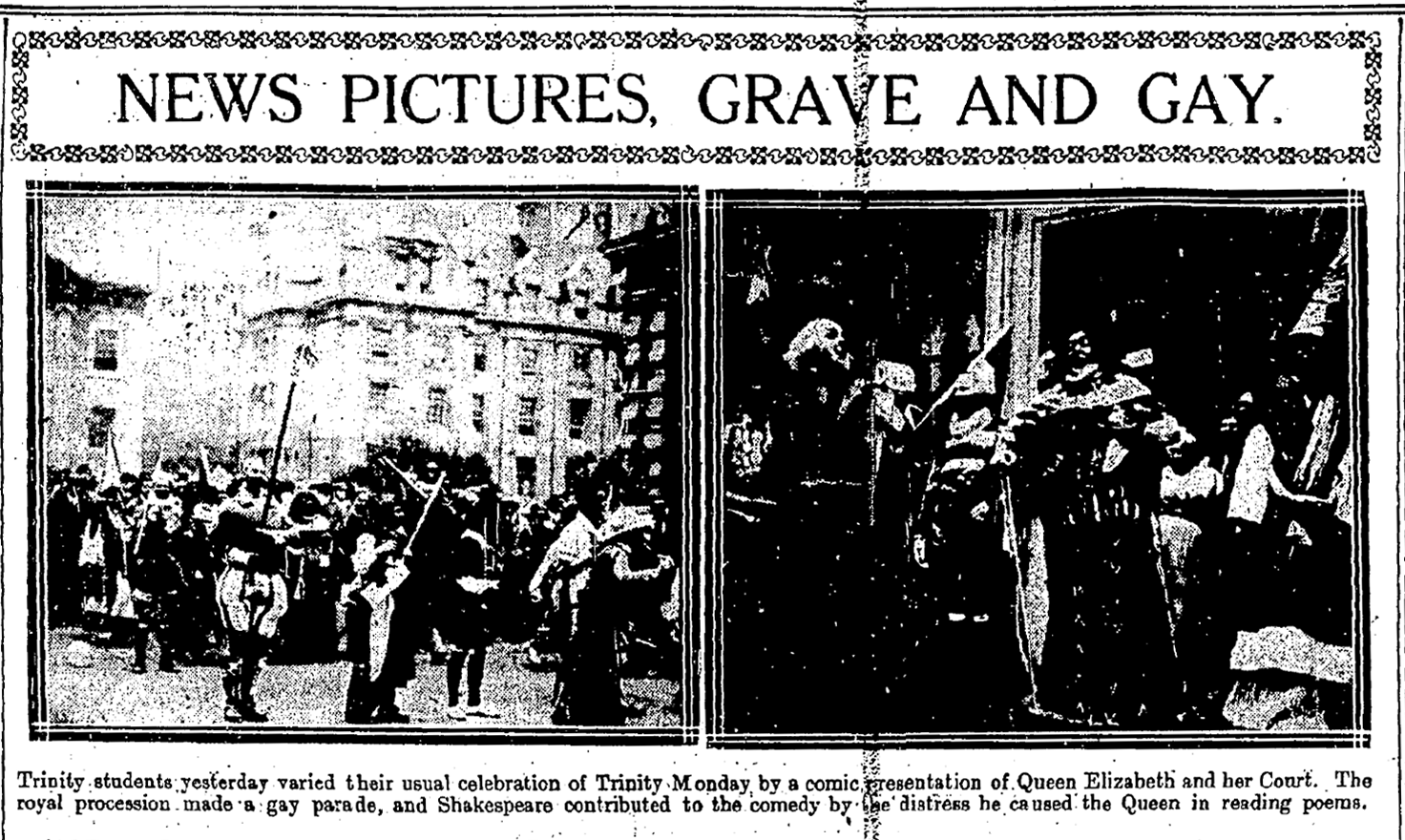
4. Trinity Week Comedy Scenes
5. Corpus Christi Procession in Galway

“Scene at Kilmallock, showing the houses opposite the R.I.C. Police Barracks, marked with arrows, where the attacking party took up their positions.” The photo is attributed to Horgan, the photographers and cinema owners in Youghal, Co. Cork. Freeman’s Journal 31 May 1920: 3.

The first two were certainly related to sensational acts of rebellion that formed part of the War of Independence, albeit that they showed the aftermath of these events. The Kilmallock Scenes followed an IRA raid on the RIC barracks in the Co. Limerick town on 27-28 May 1920. Cutting off communications to the town, a party of between 50 and 100 men laid siege to the barracks for several hours, exchanging gun fire with the occupying policemen. The burned remains of Sergeant Thomas Keane and Constable Joseph Morton were found in the building’s ruins. The newsreel may have shown either the town itself or the funerals of Keane and/or Morton. Photos of both town and funerals appeared in the Independent and the Freeman’s Journal.

“Entrance view King’s Inns, Henrietta St., the scene of yesterday’s sensational raid.” Irish Independent 2 Jun. 1920: 3.

“King’s Inn Raid” was the aftermath of the IRA’s daring daylight raid on the afternoon of 1 June 1920 on the King’s Inns on Dublin’s Henrietta Street, which was being used by the British Army to store arms. The armed raiders drove two cars up to the building, while others in groups of four or five converged on it from all directions and carried out an operation that was described as planned with military precision. No shots were fired, and the raiders made off with machine guns, rifles and a large quantity of ammunition. The Irish Independent quoted an unnamed demobilized officer who witnessed: “‘For coolness, reckless daring, and downright audacity,’ this officer remarked, ‘I have never seen anything to beat it—it was like a cinema scene’” (“Amazing Raid”).

Two images from a society wedding in Dublin; Irish Independent 3 Jun. 1920: 3.

Following these two minutes of revolutionary activity, the other three one-minute items were of less sensational social and cultural events that made it seem that life was carrying pretty much as usual. As part of the essential variety nature of newsreel, they also addressed segments of the audience not interested in politics. The first of these was “Wedding at Ranelagh / Daughter of Sir J. Downes,” in which Rita Downes of the baking empire married barrister JCR Lardner and in the process offered images of the Irish middle class in their finery.

Trinity students yesterday varied their usual celebrations of Trinity Monday by a comic representation of Queen Elizabeth and her Court. The royal procession made a gay parade, and Shakespeare contributed to the comedy by the distress he caused the Queen in reading poems. Irish Independent 1 Jun. 1920: 3.

If such society events were to your taste, you may also have enjoyed “Trinity Week Comedy Scenes.” This item showed scenes from 1920’s Trinity Monday, the day on which the Trinity college’s scholars and fellows are publicly announced from the steps of the Examination Hall. It was also a day that student were known to go on the rampage through the city, but they don’t seem to have done in 1920 or if they did, this was not filmed. “Trinity College students provided a good deal of mirth in the College grounds this afternoon,” the Evening Herald explained, “and if the scenes were more restrained and less boisterous than on former Trinity Mondays, they were none the less entertaining for the large number of spectators” (“Trinity Monday”). The spectators weren’t alone: “Photographers and cinema operators were busy, and had much picturesque material to select from.”

Brief review of the programme at the Bohemian at which IE152 was shown; Irish Times 8 Jun. 1920: 4.

Although it also involved people parading around in their finery, the final IE 152 item, “Corpus Christi Procession in Galway,” likely appealed most strongly to the devout Catholic segment of the audience. The Galway Corpus Christi procession took place on Sunday, 30 May 1920, and was one of the very many such processions that took place around the country that week. No photo seems to survive of the events, but the Connacht Tribune carried a lengthy account of the proceeding (“Galway Procession”).

Brief review of the programme at the Bohemian at which IE152 was shown; Freeman’s Journal 8 Jun. 1920: 6.

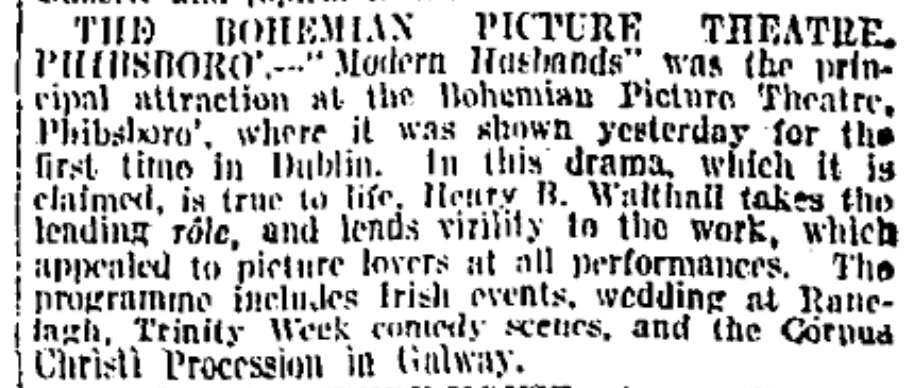
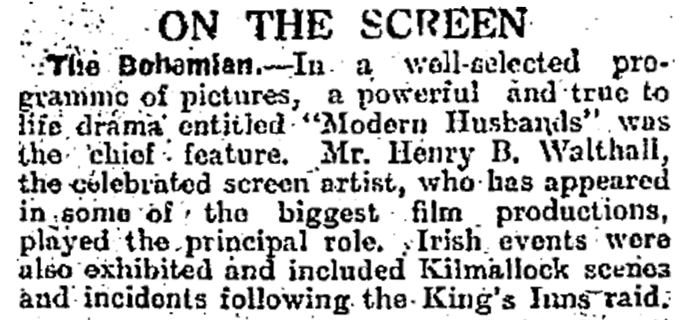
The brief reviews in the Irish Times and the Freeman’s Journal are fascinating for the way in which they answered the question of what events in Ireland over the previous week they thought their readers would be interested in and/or should have their attention directed to. The liberal unionist Irish Times observed that the “programme includes Irish events, wedding at Ranelagh, Trinity Week comedy scenes, and the Corpus Christi Process in Galway.” The nationalist Freeman’s Journal noted that “Irish events were also exhibited and included Kilmallock scenes and incidents following the King’s Inns raid.”While it is a shame that so little of the Irish Events newsreel survives today for us to see how it represented the evolving political and social landscape of the country, we can occasionally get an insight into that process from the traces that they left behind. Doubtless, this IE 152 with its mix of politics and social and religious events is  remarkable only for the publicity that lets us reconstruct it a century later.References

“Amazing Raid for Arms in Dublin: Machine and Lewis Guns Taken.” Irish Independent 2 Jun. 1920: 5.“Galway Procession: Eurcharistic Adoration Draws Large Crowd.” Connacht Tribune 5 Jun. 1920: 5.“Trinity Monday: ‘The B’hoys in Royal Procession’: Comic College Scenes.” Evening Herald 31 May 1920: 1.

“Features Resembling a Sensational Cinema Story”: Political Violence in Irish Cinema in February 1920

Part of the 1911 Census return for Lena (here: Elenia) Johnson and her family. Full record available from the National Archives of Ireland: http://www.census.nationalarchives.ie/reels/nai002751044/.

Political violence associated with the Irish War of Independence impinged on Irish cinema with force in February 1920. It did so in a number of ways, most tragically in the death of cinema attendant Lena Johnson but also in the use of cinema in describing the violence that was occurring on the streets. For newspapers, cinema had become the ready metaphor to describe incidents of heightened excitement or danger, as is evident in the Irish Independent’s description on 26 February of police and military attempts to recapture army deserters as “incidents worthy of a cinema episode” (“Exciting Chase after Deserters”). Why the men deserted is not clear, but the episode had reached the pinnacle of excitement in the newspaper account when the deserters were identified at Dublin’s port, tried to get away across the rail lines, and a group of them “had a miraculous escape from being run over by a passing train.” Chases, hairbreadth escapes and the train as the epitome of human frailty in the face of modern technology had long been the cinema’s stock-in-trade.

Irish Independent 7 Feb. 1920: 4.

What was new now was the metaphor’s application to conflict between the police and British army, on the one hand, and Sinn Féin and the Irish Volunteers, on the other. On 7 February 1920, the Independent reported on an incident in which an armed detective chased a man who pointed a revolver at him in the street into a shop in Dublin’s Coombe and was himself restrained by the shop keeper who said he mistook the detective for an armed robber. The incident “had features resembling a sensational cinema story,” the report surmised (“Sensational City Scene”). If it was a sensational cinema story, that story now concerned the escalating violence of the War of Independence in which armed conflict in the streets of Ireland’s cities, as well as skirmishes in the countryside, were becoming increasingly common. And the story had an openly political character. Whoever the initial man with the revolver had been, shop keeper Patrick Horan, “an ex-soldier wearing the 1915 ribbon,” and his mother Mrs Donnelly, who was serving in the shop, were identified by the detective as Sinn Fein supporters “and they have obstructed me in the discharge of my duty.” Horan’s identification as a decorated soldier and a Sinn Féin supporter suggests some of the complexities of the situation.

Freeman’s Journal 13 Feb. 1920: 3.

Writers in the Independent was not alone in implicating cinema in accounts of political violence. Describing an incident in Dublin in mid-February, the Freeman’s Journal suggested that the cinema had so come to dominate the ways that even experienced journalists saw the world that actual violent confrontations between Irish republican forces and those of the British state was distorted and exaggerated beyond credibility. Seeking to correct Irish and British press reports of a supposed attack by a large number of armed Irish Volunteers on a heavily guarded escort bringing the court-martialled Sinn Féin MP Robert Barton to prison, the reporter observed that accounts of the alleged incident made the “military act like cinema stars” (“North Side Hold-Up”). The incident was “like a cinema scene,” no doubt a sensational one. “Eyewitnesses described the scene,” the writer commented, “which indeed had something in it to stir the imagination of a generation accustomed to the thrilling scenarios of the film-play dramatists.” Nevertheless, s/he claimed that while an attack on a car carrying military personnel did occur, all aspects of the story as reported were exaggerated and were not attributable to major republican groups. “The facts of the affair subdue the high lights, and raise the substantial doubt which, while leaving the authors of the incident in obscurity, utterly demolish the suggestion that Irish Volunteers or any similar organisation was concerned in it. […] There is something wrong with the story.”

Limerick Leader 4 Feb. 1920: 3.

In the case of the shooting of Lena Johnson in Limerick on 2 February, the interaction between cinema and the War of Independence were far from these metaphorical references to stardom and thrilling scenarios. A cinema attendant in her 20s who lived with her family in Thomondgate, Johnson was crossing Sarsfield Bridge on her way home from work at the Coliseum between 10.30 and 11pm when she was hit by a stray bullet fired indiscriminately at a taunting crowd by members of the RIC (Royal Irish Constabulary). Much public sympathy was shown to Johnson and to publican Richard O’Dwyer, the two people fatally shot that night, and who had had no part in any demonstration in the streets. Johnson’s funeral “was one of the most impressive funerals that has taken place in Limerick for a number of years, and all classes joined in paying fitting tribute to a young lady who enjoyed general popularly, and whose death under such peculiarly sad circumstances produced universal grief” (“Limerick Shootings”).

Limerick Echo 17 Feb. 1920: 3.

At the subsequent inquest, the RIC witnesses tried to blame British soldiers stationed in the city for firing on the crowd after an armed man had fired on them first, and much of the coverage of the inquest focused on the contradictions between the evidence of the police and the military. The inquest jury, however, rejected the police’s attempts at exculpation and found “that Helena Johnson met her death by shock, the results of the effect of a bullet wound caused by a rifle bullet fired by police without orders from their superiors, which we strongly condemn, because there was no provocation for what the jury consider murder in the case of Helena Johnson” (“Contradictory”).

Dublin Evening Mail 21 Feb. 1920: 3.

Cinema and those associated with it – including such workers as Lena Johnson, audiences and filmmakers – were only rarely the targets of fighting during the War of Independence. Like the population at large, however, those involved in cinema faced the increasing dangers and restrictions of a society openly in conflict, and these affected how they went about their ordinary activities. One of the new restrictions introduced to Dublin in February 1920 was a curfew between midnight and 5am. Announced by Major-General Gerald Farrell Boyd, the General Officer Commanding the Dublin District, it was made under the Defence of the Realm Act (DORA), many of whose wartime powers remained in use in Ireland. Describing the first night of martial law, the Freeman’s Journal observed that “for some time before the military put in an appearance the streets were practically deserted. Up to 11 o’clock, however, the city might be said to have worn its normal aspect. When the theatres, picture houses and other places of amusement emptied themselves there were the customary scenes of animation” (“Plunged into Complete Darkness”).

Censorship restrictions had long limited what Irish filmmaker could portray. Although indigenous production companies were making films at the time, they were not telling the contemporary sensational stories of life in Ireland, regardless of how much the press touted these stories’ cinematic character. Early 1920 saw the release of two of the major Irish feature films of the silent period: the General Film Supply’s In the Days of St Patrick/Aimsir Padraig and the Film Company of Ireland’s Willy Reilly and His Colleen Bawn, which will shortly receive their due attention here in blogs to mark the centenaries of their releases. It is worth noting, however, that these were historical dramas because when these companies turned to the depiction of the politics of contemporary Ireland, their films were seized by the authorities.

None of these factors were affecting the boom in cinema building in early 1920, but some local councils did see that boom as detrimental to the much-needed construction of housing. At a meeting of Belfast Borough Council on 2 February 1920, Councillor J. Baird sought unsuccessfully to halt “the erection of motor garages, public-houses, picture theatres, factories, extensions of shops and other buildings which could be described as luxuries until the people of the city were supplied with the necessary housing accommodation” (“The Housing Problem”). A meeting of Cork Corporation on 1 March 1920 took a similar view of the cinema-licence application by “three ladies and a gentleman who had made a little capital in Cork, and who wished to invest it in Cork for the benefit of the workingmen of the city” by opening a cinema at 1-2 Winthrop Street (”Cork Corporation”). Lord Mayor Tomás MacCurtain “objected to sanctioning luxury entertainment whilst there were people in the city who hadn’t houses to live in.” Nevertheless, the Corporation’s Law and Finance Committee chaired by MacCurtain subsequently granted a licence not only to those applicants but also to four others for new cinemas at 80-82 Patrick Street, 40-42 Grand Parade, another in Winthrop Street and 26 Cook Street (“Cinema Licences in Cork”).

MacCurtain’s murder by the RIC on 20 March 1920 had nothing to do with these decisions, but it was certainly part of the political violence that also impinged on Irish cinema a century ago.

References

“Cinema Licences in Cork.” Evening Echo 2 Mar. 1920: 3.

“Contradictory: Inquest on Miss Johnson.” Limerick Echo 17 Feb. 1920: 3.

“Cork Corporation.” Cork Examiner 2 Mar. 1920: 7.

“Exciting Chase after Deserters.” Irish Independent 26 Feb. 1920: 6.

“The Housing Problem: Shortage in Belfast.” Belfast News-Letter 3 Feb. 1920: 5.

“Limerick Shootings: Funerals of the Victims.” Limerick Leader 6 Feb. 1920: 3.

“The North Side Hold-Up: Military Act Like Cinema Stars.” Freeman’s Journal 13 Feb. 1920: 3.

“Plunged into Complete Darkness: Military Patrols Move Through Deserted Streets.” Freeman’s Journal 24 Feb. 1920: 3.

“Police Fired without Orders or Provocation.” Freeman’s Journal 14 Feb. 1920: 5.

“Sensational City Scene: Commotion in a Shop.” Irish Independent 7 Feb. 1920: 4.

“Tragic Incidents Further Described.” Cork Examiner 5 Feb. 1920: 5

Rebuilding Dublin as a Cinematic City for the 1920s

JAP’s end of year “Irish Notes,” Bioscope 25 Dec. 1919: 97.

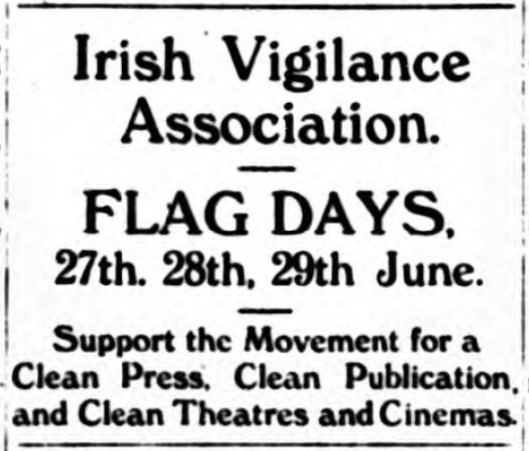
Despite an increasingly unstable political situation as the War of Independence intensified, Irish cinema at the end of the 1910s was in a very healthy state, and cinema in Dublin especially was about to change radically as it underwent a post-World War I, post-1916 Rising building boom. Not that cinema did not face criticism from the Irish Vigilance Association and its press supporters in their ongoing campaign against imported popular culture, which the Evening Herald memorably saw as an “invasion of our theatres by the ever-increasing forces of smut-huns whose poison gas has been as great a danger to public morals as machines of war have been to the physical weal of the people” (“Cleanse the Theatres”).  Notwithstanding such campaigns, the exhibition side of the industry looked particularly strong at the end of 1919, and Irish film production also looked promising. In his last “Irish Notes” of the year in the Bioscope, JAP noted two coming productions. “‘Rosaleen Dhu,’” he reported, “is the title of a four-reel film which has been produced by the Celtic Film Company around Bray, Co. Wicklow” (“Irish Notes,” 25 Dec.). He gave more space to the news that

the Film Company of Ireland recently reconstructed as the Irish Film Company [and] has just completed its only 1919 production, a screen version of a story by the famous Irish novelist of the early nineteenth century, William Carleton. The film, “Willie Reilly and his Colleen Bawn,” was made amidst some of the most picturesque scenery in the vicinity of Dublin, and features Brian MacGowan, who made a big hit as the central figure, “Matt, the Thrasher,” in the company’s super-production, “Knocknagow.” (Ibid.)

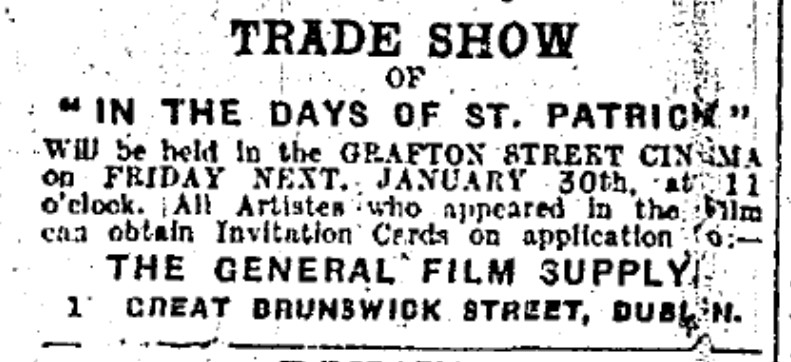
Ad for the trade show of In the Days of St Patrick, Irish Independent 27 Jan. 1920: 4.

Beyond the expectations of this substantial production, JAP observed that both the Film Company and Norman Whitten’s General Film Supply, which was also completing a film about St Patrick, were building film studios in the Dublin suburbs. “There is plenty of room for both companies,” he concluded, “and ‘competition is the life of trade.’”

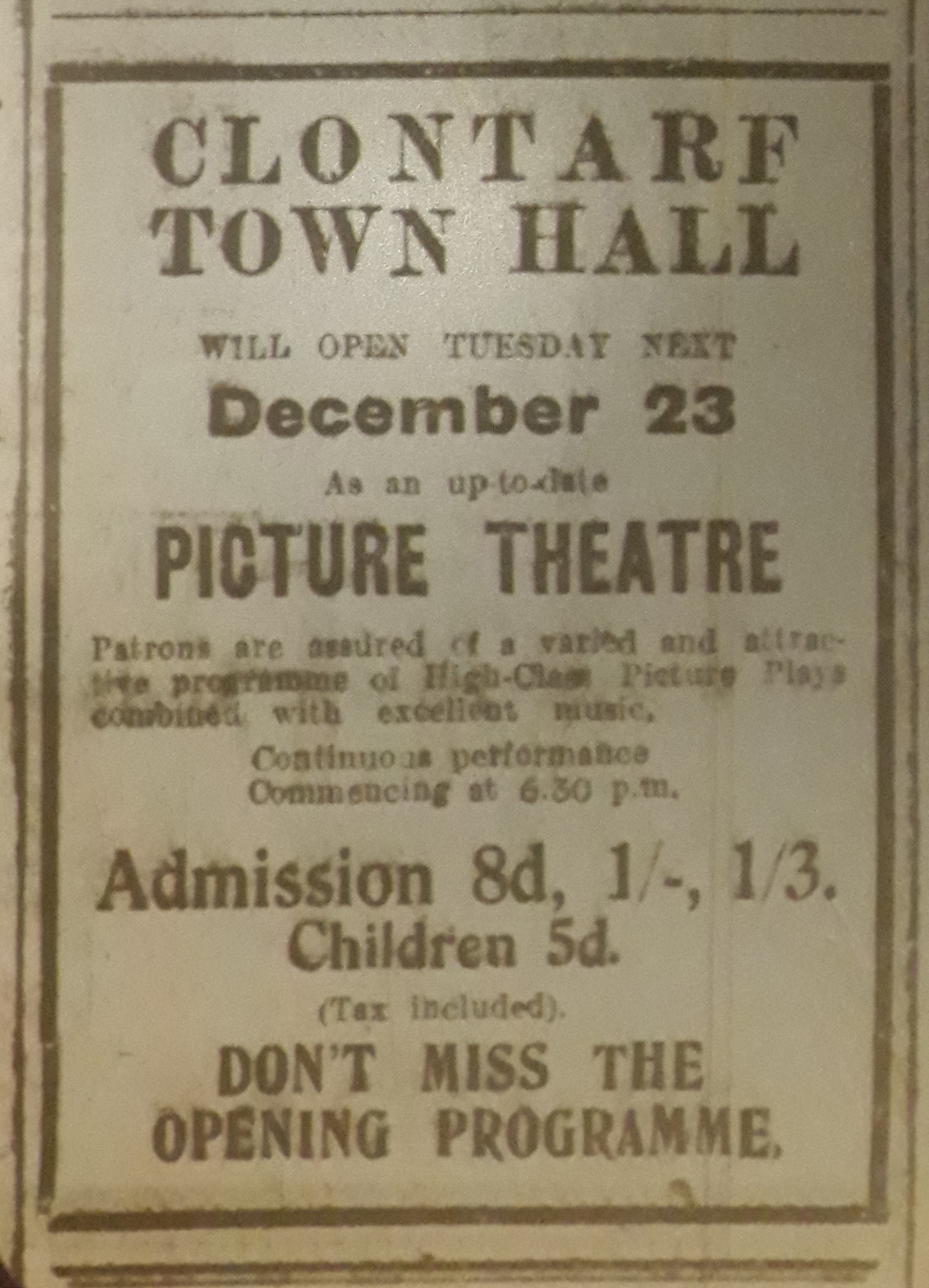
Clontarf Town Hall reopened on 23 December 1919. Dublin Evening Mail 20 Dec. 1919: 2.

To some extent, the reopening on 23 December 1919 of Clontarf Town Hall as a picture theatre epitomizes the development of Dublin film exhibition. The Town Hall had first operated as a cinema in 1913 at the height of the pre-war cinema building boom, and as such, was among the first of the suburban cinemas whose offerings of professionally produced entertainment outside the city made cinema such a phenomenal success in the 1910s. With a substantial resident population and a seaside location that drew people out of the city, the town hall had looked like a good prospect as an entertainment venue throughout the 1910s, but it experienced difficulties that saw it closing and reopening regularly, including in 1916 and 1917. It would change hands again in May 1920, when a Mr O’Connell was named as the proprietor (“Irish Notes,” 13 May). As such, it did not have the stability of the Bohemian Picture Theatre and Phibsboro Picture House in the north-city suburb of Phibsboro and the Princess Cinema and Rathmines Town Hall in the south-city suburb of Rathmines. The Bohemian in particular had overcome the disadvantage of location vis-à-vis city-centre cinemas by attracting patrons to Phibsboro with its musical attractions.

A 1926 Goad Fire Insurance map of the Sackville/O’Connell Street block containing La Scala and the Metropole.

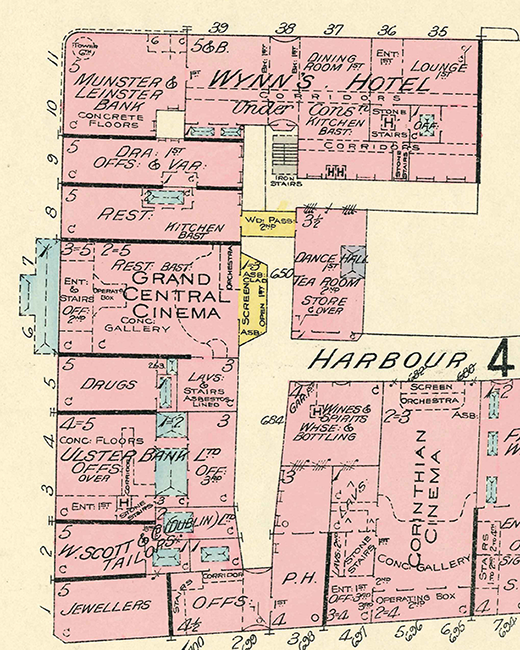
If the 1910s saw the advent and the dominance to a significant degree of the suburban picture house, the turn of the decade to the 1920s would see the city-centre venues spectacularly reassert themselves. Four large cinemas were under construction on key sites in the Sackville/O’Connell Street area that had levelled during the fighting in 1916: La Scala, the Metropole, the Grand Central and the Corinthian. The destroyed block to the south of the GPO, the centre of fighting during the Rising, was about to become the location of two of these cinemas, La Scala and the Metropole. Formerly a hotel at the corner of O’Connell and Princes Streets, the Metropole would become an entertainment venue that included a dance hall, a restaurant and a thousand-seat cinema.

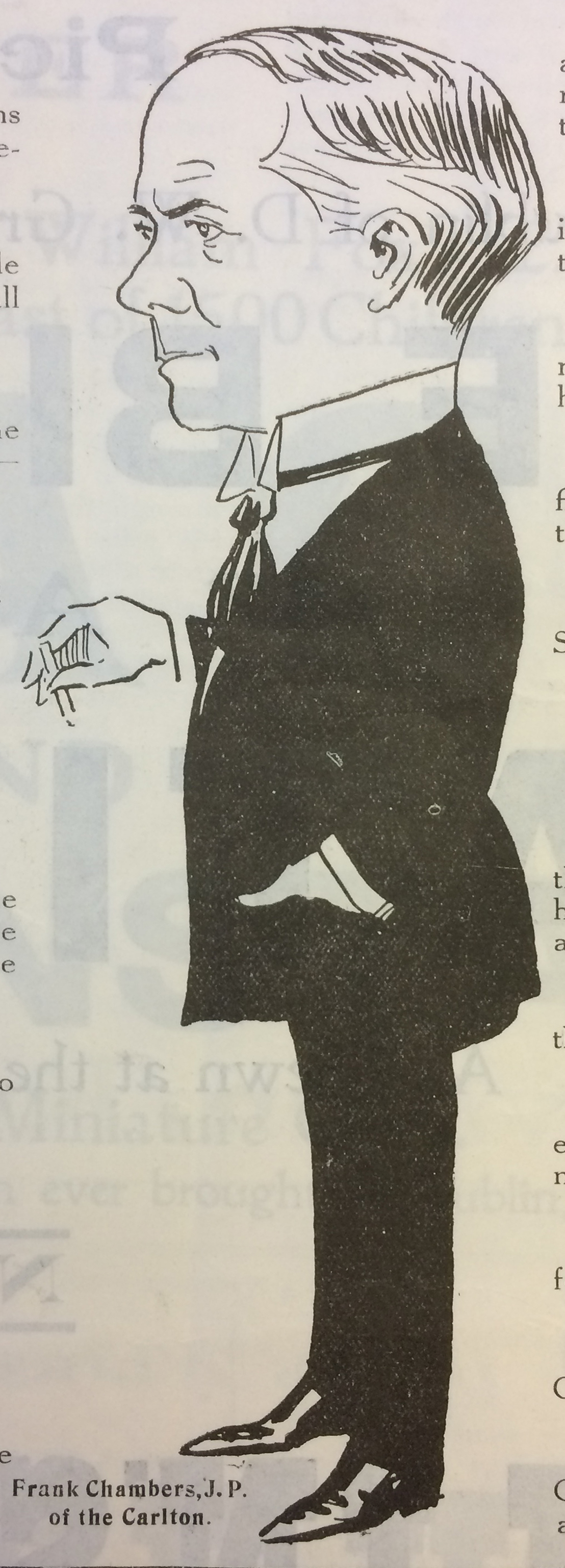
Caricature of Frank Chambers, Irish Limelight Nov.1917: 1.

That seating capacity was dwarfed by La Scala, “Dublin’s new super cinema,” which would occupy a site on Princes Street that had been the premises of the Freeman’s Journal and the print works of the Alex Thom publishing company (“Behind the Screen”). “When completed,” the Irish Limelight observed when the project was first announced in the spring of 1918, “the seating accommodation will exceed that of the Gaiety Theatre, while adjoining the auditorium will be spacious tea and refreshment lounges, modelled on the most up-to-date lines” (ibid.). At this point, the seating accommodation was put at 1,400, but when La Scala opened in August 1920, this figure had more than doubled to 3,200 (“Building News”). La Scala was promoted by a consortium led by Frank Chambers, who had opened the Carlton Cinema in O’Connell Street in December 1915, but who had sold his interest in the Carlton in order to focus on La Scala, with which it would be in competition.

Goad Fire Insurance map of Dublin’s Lower Sackville/O’Connell Street and Eden Quay showing the location and relative sizes of the Grand Central Cinema and the Corinthian Cinema.

But La Scala would have plenty of other competition, both established and new. JAP put it succinctly when reporting on a conversation with another proprietor of a Sackville/O’Connell Street cinema. “Speaking to Alderman Farrell, managing director of the Pillar Picture House, and other Dublin cinemas, the other day,” JAP revealed,

he confirmed the report that he had purchased the site in Sackville Street formerly occupied by the D.B.C. restaurant, which vanished in the flames of the 1916 rebellion. It is a fine site, one of the most central in Dublin. The only trouble is that it is almost directly opposite the two palatial cinemas – the Metropole and the Scala – at present in process of construction, and within a stone’s throw almost of half-a-dozen other houses doing good business. And just round the corner on Eden Quay, the newly-formed Corinthian company are building one of the two picture theatres promised in their prospectuses” (“Irish Notes,” 11 Sep).

Farrell’s new cinema would be called the Grand Central, its name incorporating that of the Grand Cinema, which until its destruction in 1916, had stood next door to the iconic DBC restaurant.

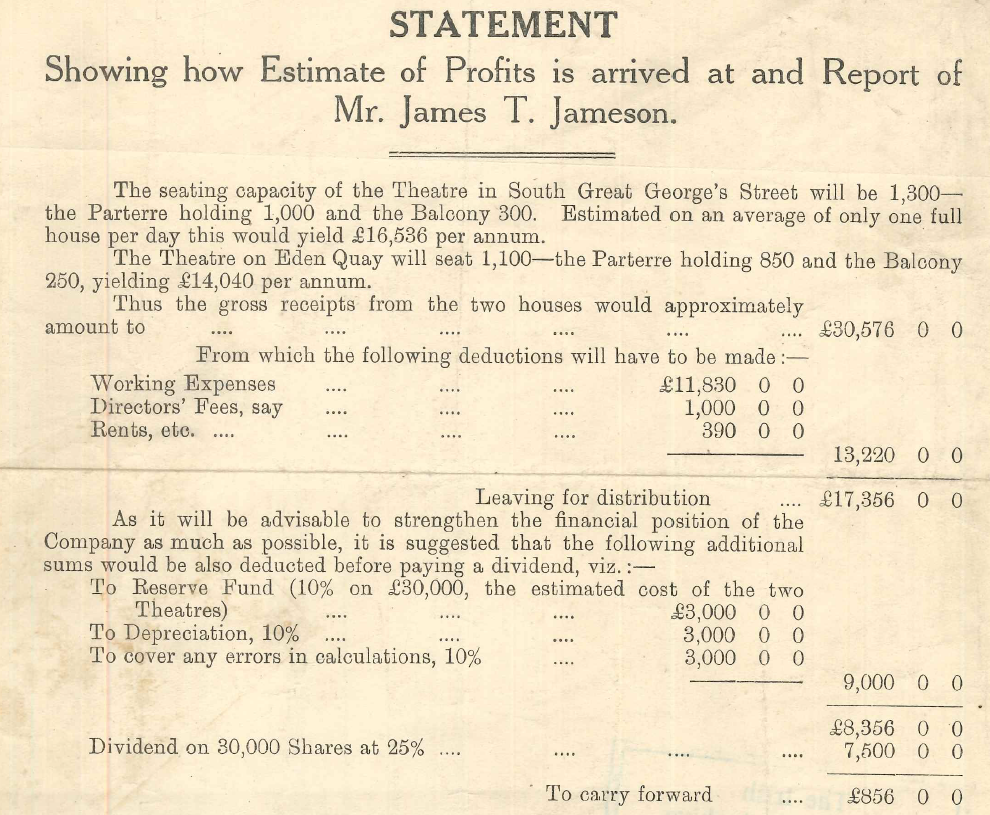
Extract from James T. Jameson’s assessment of the viability of the Corinthian Picture Company. Courtesy of the Architectural Archive of Ireland.

Another key member of the Irish cinema industry was asked to comment on the soundness of the Corinthian Picture Company’s business plan. On 25 August 1919, James T. Jameson wrote a report on the viability of two cinemas that the Corinthian Picture Company intended to build on sites at South Great Georges Street and Eden Quay in central Dublin. As the managing director of the Dublin Kinema Exchange and Mart and Ireland’s most prominent pioneer film exhibitor, Jameson was in a good position to make this assessment. His report was appended to an estimate of the profits of the two cinemas in a document that survives at the Irish Architectural Archive (“Statement”). In it, Jameson approves of the architectural drawing that Thomas McNamara had prepared and of the central locations that the company had secured. With good tram links and plenty of passing trade, the latter would ensure that

there will be no necessity for expensive competitive films, as good ordinary programmes would in my opinion be quite sufficient, neither would there require to be a great deal of advertising, both of which are such a heavy outlay on Picture Houses built in out-of-the-way streets […], and for which big extra attractions and expenses are involved to secure a clientele.

The particular merits of the Eden Quay site were that it “is faced with the inward and outward evening flow of patrons for the Royal Hippodrome and Tivoli Theatres, besides being in the line of persons passing from the North and South sides of the city. The impressive front of this Theatre also cannot be missed and will always be a standing attraction.” Indeed, the company decided to proceed with only this cinema, but it would not open until August 1921, almost exactly two years after Jameson wrote his report.

Although he mentions the possibility of increased revenues if the cinemas could secure Sunday opening, Jameson curiously did not take the growing competition in the Sackville/O’Connell Street area into account. The Recorder had banned Sunday opening for city-centre cinemas except in poor residential areas, and part of the controversy that La Scala would cause related to its attempts to get around this restriction. Suburban cinemas did not have to face the Recorder’s ban, although local clergy enforced Sunday closing in Rathmines. Other objections to the new city-centre cinema boom came from those who feared that cinema was replacing other art forms. “I read your leading article on ‘Music in Dublin,’ in Saturday’s issue, with very great interest,” letter writer “Musicus” commented in the Irish Times at the end of October 1919. “One would have thought that a fine [concert] hall would have been erected in Sackville street, instead of a new picture house, of which we have plenty” (“Music in Dublin”).

JAP was also less impressed than Jameson appeared to be with the re-centralization of cinema. “What puzzles me,” he opined, “is why all the new cinemas are being built in the centre of the city. I know of one or two sites in the outer circle which are simply shrieking to have cinemas built upon them. One district in particular should prove a veritable gold mine for the man who gets there first” (“Irish Notes,” 11 Sep). The unnamed suburb was probably not Clontarf, but it may have been the Liberties, Pembroke or Stoneybatter, where the Manor Street Cinema opened in May 1920.

Areas of Dublin’s suburbs did remain to be exploited by the cinema trade, but what was remarkable as 1919 became 1920 was the way in which parts of the city centre destroyed during the 1916 Rising were not being reconstructed as concert halls, press/publishing facilities or restaurants. They were being rebuilt as part of a cinematic city for the 1920s.

References

“Behind the Screen.” Irish Limelight Apr. 1918: 4.

“Building News.” Irish Builder 14 Aug. 1920: 530.

“Cleanse the Theatres.” Evening Herald 4 Jun. 1919: 2.

“Irish Notes.” Bioscope 11 Sep. 1919: 95; 25 Dec. 1919: 97-98; 13 May 1920: 112.

“Music in Dublin.” Letter. Irish Times 27 Oct. 1919: 6.

“Statement Showing How Estimate of Profits Is Arrived At and Report of Mr. James T. Jameson.” RP.D.147.7, Irish Architectural Archive.

“Leaning towards the Spectacular”: The Suppression of the Sinn Fein Review in April 1919

Drogheda Advertiser 19 Apr. 1919: 3.

On the evening of Wednesday, 16 April 1919, Head Constable John Orr arrived at the Boyne Cinema in Fair Street, Drogheda, accompanied by a squad made up of all the available Royal Irish Constabulary men in the town’s Westgate and South Quay barracks. As Orr recorded in his official report of events, caretaker Thomas Borden told him that manager Joseph Stanley was not present and initially refused to give the policemen the key to the projection box. However, when Orr threatened to break in the door with a heavy hatchet he had instructed be brought from the barracks, Borden relented and opened the door. Seizing two reels of film that made up parts 1 and 2 of the Sinn Fein Review that had been produced and supplied to the cinema by Norman Whitten’s General Film Supply (GFS), Orr brought them back to Westgate barracks to await further instructions (CSORP).

Poster seen on 29 Mar. 1919 by Inspector Herbert of the Dublin Metropolitan in the window of the General Film Supply offices in Dublin. Courtesy of the National Archives of Ireland.

This dramatic raid was the end point of a process that began two-and-a-half weeks earlier, when a poster in the GFS office window at 17 Brunswick had caught the eye of Inspector Herbert of the Dublin Metropolitan Police (DMP) as he had been strolling past between 10 and 11am. Making this his business, Herbert had quizzed an unnamed GFS employee about the poster and had been told that the film showed “a number of incidents in connection with the Rebellion of 1916, its leaders, and the Sinn Fein movement generally which have been shown from time to time have been put into one film in review form” (CSORP).

What happened between these two police actions has been well known in Irish film studies since the late 1980s, thanks to Kevin Rockett’s detailed account in Cinema and Ireland, the first systemic book in the field (Rockett, Gibbons and Hill 34-6). Rockett based his account on a file in the National Archives of Ireland (NAI) that covers the banning of both the Sinn Fein Review in April 1919 and Ireland a Nation in January 1917 (see an account of the latter film here). As such, this file offers the richest detail of any official document of the period on the British authorities’ regulation of Irish cinema in the late 1910s, between the Easter Rising and the War of Independence. Rockett charts how the police and military authorities consulted on what to do, and citing the precedent set by the Ireland a Nation case, the police sent two detectives to view the Sinn Fein Review. Their report led to the conclusion that it should be banned because it was “Sinn Fein propaganda pure and simple.” When the police arrived at the GFS offices to seize the film, they were told that copies had already been despatched to Drogheda, precipitating the raid on the Boyne Cinema.

Ian Macpberson was appointed Chief Secretary of Ireland in January 1919; from Century Ireland.

The details provided by the detectives of Irish Events films and local newspaper accounts of the events in Drogheda deserve more attention than they have had, but it’s worth first saying something about the kind of source this file is. It is part of the Chief Secretary’s Office Registered Papers (CSO/RP), the surviving documents held by NAI that went through the Dublin Castle office of the British cabinet minister with responsibility for the administration of Ireland. In April 1919, the post of chief secretary was held by Ian Macpherson, but as the two-year gap between the Ireland a Nation and Sinn Fein Review cases suggests, cinema-related cases only rarely crossed Macpherson’s desk.

The IVA advertises a 1919 funding drive; Freeman’s Journal 21 Jun. 1919: 4.

The day-to-regulation of cinema was done at a different level of government, by local councils under the powers provided by the 1909 Cinematograph Act. That act originally focused on the very real danger of loss of life from cinema fires caused by the bringing together of highly combustible nitrate film and light sources that produced high heat or even used a naked flame. As a result, regulations initially provided for fire-proof projection booths and auditoria with adequate provision for escape in the event of fire. The employees of the council who were given this responsibility typically belonged to the public health or sanitation department, such as Limerick Corporation’s sub-sanitary officer Solomon Frost, who in February 1919 prosecuted the Athenaeum Hall and Coliseum for overcrowding, or Dublin Corporation theatre inspector Walter Butler who in April 1919, brought similar charges against the Sackville Picture House, Pillar Picture House, Mary Street Picture House and Electric Theatre (“Limerick News,” “City Picture Houses,” “Picture House Crowding”). However, Butler was not just Dublin Corporation’s theatre inspector. His duties increased considerably in June 1916, when in response to the incessant lobbying of by the Catholic-church-based Irish Vigilance Association (IVA), the Corporation appointed him and Councillor Patrick Lennon film censors.

Frank Leah’s caricature of Eugene McGough; Irish Limelight Jun. 1918: 1.

When it became clear that Butler and Lennon could watch only a fraction of the films exhibited in Dublin, the IVA again successfully lobbied the Corporation for the appointment as additional censors of IVA members Eugene McGough and AJ Murray, “two gentlemen of education and standing in the City who are willing to devote their spare time to carry out the work, without fee or reward, solely in the interests of the citizens” (Dublin Corporation). In May 1919, the IVA claimed that McGough and Murray had watched over 700 films in the previous year, spending “2,100 hours of their time viewing these films before they were presented to the public, which meant that they were engaged for seven hours a day cutting out of these films whatever was objectionable” (“Worthy of Support”).

The definition of what was objectionable differed between the IVA-enhanced Corporation censors and the British officials at the CSO. In January 1918, McGough had clarified his and the IVA’s view that “pictures dealing with sexual matters should be prohibited by law and the house showing them should be heavily penalised” (“Our Cinema Censors”). This is shockingly clear; moving pictures should not treat sex or sexuality in any way. Historical or newsreel films such as Ireland a Nation and the Sinn Fein Review were beyond this kind of reproach, but they attracted the attention of the Castle authorities for political content that had the potentiality to cause disaffection among the majority nationalist audience. Nevertheless, politically contentious films that required the involvement of the CSO were rare, in part because the authorities used banning as a way of warning off distributors and exhibitors who may have seen a commercial opportunity in screening politically controversial material in times when Irish audiences appeared to be especially receptive to advanced nationalist, anti-British opinions.

Frank Leah’s caricature of Frederick Sparling, who was best known as the proprietor of the Bohemian Picture Theatre in Phibsboro, Dublin, but who had hired the larger and more centrally located Rotunda to show Ireland a Nation. Irish Limelight Aug. 1917: 1.

In this sense, distributor Frederick Sparling was doing the government’s work for them by keeping the Ireland a Nation case in the public eye. Not that that was his aim: the banning of the film had cost him a considerable sum in securing the distribution rights and in hiring the Rotunda, Dublin’s largest cinema at the time, in which to show it. Understandably, he sought compensation for the banning of a film that the press censor appointed under the Defence of the Realm Act had initially passed for exhibition. But by seeking redress from the War Losses Commission in January 1918 and when this proved unsatisfactory, prompting Irish Parliamentary MP Jeremiah McVeagh to ask a question about it in the House of Commons in February 1919, Ireland a Nation became exemplary of the difficulties over years that distributors could face if they released politically contentious material (“‘Ireland a Nation,’” “Irish Questions”).

Norman Whitten was well aware of these developments, but he had good reason to think that the Sinn Fein Review would not receive such treatment. For a start, the film was a newsreel compilation consisting almost exclusively of short items concerning Sinn Féin that had already been shown as part of Irish Events, and none of these individual items had been banned. The only non-Irish Events items were a couple of films that predated the start of Irish Events in July 1917 and the first film of Sinn Féin president Éamon de Valera since his daring escape from Lincoln Prison on 3 February 1919. Perhaps the de Valera film so prominently featured in advertising was the problem. If the police couldn’t recapture de Valera, they could capture his image. In any case, as the poster spotted by Inspector Herbert indicates, Whitten clearly made no secret that he was compiling the film and intended to offer it for sale. Fingal, the new writer of trade journal Bioscope’s “Irish Notes,” had mentioned it in his/her column of 10 April. “Mr. Whitten’s biggest scoop recently has been the filming of the Sinn Fein ‘President,’ Mr. de Valera, in his hiding place near Dublin after his escape from Lincoln Gaol,” Fingal observed. “This is being included in a film survey of the Sinn Fein movement since the Dublin rebellion in 1916, and is being released under the title ‘Sinn Fein Review’” (“Irish Notes”).

Fingal gave some attention not only to this first Irish newsreel compilation but also to other ambitious film projects that Whitten had in train. These included the feature-length hagiography In the Days of St Patrick, the first scenes of which Fingal had seen and praised as “strikingly picturesque.” But Fingal began the column with the political events that GFS’s Irish Events newsreel covered more generally. “The Irish people have a decided leaning towards the spectacular,” the column began.

Which is a good thing for the makers of topical films.

“Irish Events” is never short of good topical material, and is very popular with audiences in this country. […] At the present moment the most dramatic and picturesque incidents are being provided by the Sinn Feiners.

Fingal probably did not get a chance to see the full Sinn Fein Review, and it does not survive, but Inspectors George Love and Neil McFeely wrote a detailed description of it in their report of a special screening at the GFS offices on the morning of 12 April 1919. “The Film is in two parts and it takes half an hour to show,” they began, before describing the items in each part. Paraphrasing them slightly, these were:

Part I

  1. The annual Republican pilgrimage to Wolfe Tone’s grave at Bodenstown, including a scene at the graveside.
  2. The first Sinn Féin electoral victory in the North Roscommon by-election on 5 February 1917, featuring successful candidate Count George Plunkett.
  3. Scenes at the East Clare by-election after the declaration of the poll on 11 July 1917, showing successful candidate de Valera in uniform alongside Plunkett and Sinn Féin leader Arthur Griffith.
  4. The Sinn Féin Convention at Dublin’s Mansion House on 25 October 1917, showing delegates leaving.
  5. Scenes at the East Cavan by-election of June 1918, showing senior Sinn Féin member Father Michael O’Flanagan and crowds outside the White Horse Hotel.
  6. The funeral procession in Dublin on 17 November 1918 for journalist and author Séumas O’Kelly, who had edited the Sinn Féin newspaper Nationality after Griffith’s arrest
  7. The procession from Dublin’s Westland Row railway station and scenes outside Fleming’s Hotel after the arrival of amnestied Easter Rising prisoners on 18 June 1917, and the reception of Countess Constance Markievicz after her release four days later.

Part II

  1. General election events in Dublin in December 1918, including scenes outside the polling booths, the declaration of the poll at Green Street, and Hanna Sheehy Skeffington congratulating Alderman Thomas Kelly.
  2. The anti-conscription meeting at Ballaghadereen on 5 May 1918, showing Irish Parliamentary Party leader John Dillon and de Valera addressing the audience from the same platform.
  3. Irish Women’s Anti-Conscription Procession in Dublin on 9 June 1918.
  4. Crowds outside the Mansion House on the occasion of the first Meeting of Dáil Eireann on 21 January 1919, with a group portrait of key figures.
  5. First film of de Valera after his escape from Lincoln Prison on 3 February.
  6. Markievicz exhibiting a picture she painted in Holloway Prison, entitled “Easter Week”; also the Countess engaged in gardening and painting a picture.
  7. De Valera’s first appearance in Dublin after his escape, showing his arrival at the Mansion House with Cathal Burgess [Brugha], footage of the Lord Mayor and his two daughters, and de Valera leaving the Mansion House.

Both parts were no doubt close to the standard 1,000-foot reel length, running about 15 minutes. As such, each numbered item ran an average of two minutes, but some were likely the one-minute standard of newsreel items while items taken from newsreel specials were probably over two minutes. Apart from the two final films of de Valera (II 5 and 7) and possible the one of Markievicz (II 6), it is probable that all the other films had been shown previously, as Whitten told the two detectives. Certainly some of them are readily identifiable as films discussed here previously, such as the newsreel special of the first Dáil.

While the structure of the film may seem a bit haphazard, it appears to sacrifice a strict commitment to chronology to a progress towards emotionally charged climaxes. Part I begins with a key annual event in the Republican calendar, the pilgrimage to Wolfe Tone’s grave in June, but the likely film used here was not the oldest Sinn Féin film but probably the film shot on 29 June 1918. Following it, the film proceeds chronologically through items I 2-6 of the by-elections, convention and Séumas O’Kelly’s public funeral. The final item of the triumphant return of the 1916 rebels from prisons in Britain is most clearly out of chronological order but is placed at the end of the reel because this event had such a strong emotional charge and showed the popularity of figures such as Markievicz.

The chronology of part II is not as disturbed, but it begins with the December 1918 general election, at which Sinn Féin had been so successful, before including events earlier in 1918 and finishing with de Valera’s reception at the Mansion House. The fact that Irish Events had two films of de Valera during his period after his escape from prison suggests a close connection between GFS and Sinn Féin, a convergence of the filmmakers’ leaning toward the spectacular and the politicians’ need for publicity. It is also interesting to note the prominence of Markievicz and other women activists again in this half of the film. “The Film as it stands,” Love and McFeely’s report concluded, “is a glorification of Sinn Fein and wherever exhibited would, no doubt, be good Sinn Fein Propaganda, and might in that way be objectionable to members of an audience holding different political views” (CSORP).

Handbill for the exhibition of the Sinn Fein Review at the Boyne Cinema. Courtesy of the National Archives of Ireland.

It was unlikely that many of the members of the Boyne Cinema’s audience held different political views, or at least were not aware in advance of the kind of film that the Sinn Fein Review was. Whether the GFS poster was used in Drogheda is not clear, but the cinema did issue a handbill that survives in the NLI file on the seizure of the film. The handbill also stresses de Valera’s name among all the Sinn Féin leaders who are connected to the movement’s history since 1916. The cinema itself had substantial 1916 connections, having been established by Joseph Stanley, the proprietor of the radical Gaelic Press in Dublin’s Liffey Street and printer of such key 1916 Rising documents as the Proclamation and the Irish War News. Stanley had been among the activists imprisoned in Britain, and Constable Orr in his report on the raid on the Boyne described him as a “Sinn Fein suspect, now living in Drogheda,” a phrase that may explain the heavy-handedness of the seizure.

The Boyne Cinema’s opening programme; Drogheda Independent 25 Jan. 1919: 1.

Although the Boyne seems largely typical of the many small cinemas of the period, Stanley’s radical politics marked it out in certain ways. When it opened on 27 January 1919, the Drogheda Independent reported that it would be run under “Irish-Ireland management” (“New Picture House”). This was immediately evident in the presentation of the opening programme, which was topped by the “Irish-made screamingly funny comedy” Rafferty’s Rise (Ireland: FCOI, 1917) and featured among its supplementary attractions the dancing of gold-medal Irish dancer Greta Daly. As a man under surveillance, Stanley’s choice of a film poking fun at the foibles of a rural constable may not have been wholly accidental. This level of Irish content was not long maintained, however. During the second half of the opening week, the programme was topped by American comedy The Clodhopper (US: Kay Bee/New York, 1917), but perhaps there was more continuity in Charles Ray’s performance of the country bumpkin than initially seems. “People who foolishly imagine that a ‘Clodhopper’ cannot get on in other spheres of life,” the synopsis in the Drogheda papers warned. “should have their minds disabused by a view of th[is] famous comedy film “(“Only a ‘Clodhopper’”).

Drogheda Independent 19 Apr. 1919: 3.

The appearance of the Sinn Fein Review must have been a gift for Stanley, but audience reaction is a little more difficult to judge. Local newspapers carried no ads for the film, but they all reported differently on how waiting patrons reacted to the police raid on the cinema. “At the time of the seizure there was a large crowd outside waiting to gain admission,” the Drogheda Advertiser observed, “but there was little or no display on their part with the exception of cheering” (“Boyne Cinema Raided”). “The seizure was effected quietly, and without any excitement,” the Drogheda Argus reported. “The management, however, carried on to full houses during the evening with other pictures, as if nothing had happened” (“Sinn Fein Review Film Seized”). This impression that the audience was little disturbed by the seizure is contradicted by the Drogheda Independent, which suggested that the audience were hostile to the police actions: “the crowds in waiting accompanied their [the police’s] movements with shouts and jeers, interjecting as well remarks that seemed suited for the occasion” (“Picture Film Seized in Drogheda”). Even if the “excitement called up by the incident was short-lived,” this account suggests that it at least provided an occasion to express disapproval of the police.

While these different accounts would bear some more examination in relation to the editorial persuasion of Drogheda’s newspapers, they show that the Sinn Fein Review had at least brought Irish audiences’ leaning towards the spectacular onto the streets.

References

“Boyne Cinema Raided.” Drogheda Advertiser 19 Apr. 1919: 3.

“City Picture Houses: Alleged Overcrowding.” Dublin Evening Mail 25 Apr. 1919: 3.

CSORP/1919/11025. National Archives of Ireland.

Dublin Corporation, Reports, 1917: 173.

“‘Ireland a Nation’: Why Military Authorities Banned the Film.” Evening Telegraph 29 Jan. 1918: 3.

“Irish Notes.” Bioscope 10 Apr. 1919: 119.

“Irish Questions.” Cork Examiner 28 Feb. 1919: 4.

“Limerick News.” Cork Examiner 1 Feb. 1919: 5.

“New Picture House.” Drogheda Independent 25 Jan. 1919: 2.

“Only a ‘Clodhopper.’” Drogheda Argus 25 Jan. 1919: 1.

“Our Cinema Censors: The Difficulties They Have to Contend With.” Evening Herald 31 Jan. 1918: 2.

“Picture Film Seized in Drogheda.” Drogheda Independent 19 Apr. 1919: 2.

“Picture House Crowding in Dublin.” Dublin Evening Mail

Rockett, Kevin, Luke Gibbons and John Hill. Cinema and Ireland. Routledge, 1988.

“Sinn Fein Review Film Seized.” Drogheda Argus 19 Apr. 1919: 2.

“Worthy of Support: Activities of the Vigilance Association Outlined.” Weekly Freeman’s Journal 3 May 1919: 1.

Searching for “Screen Fein” in January 1919 and January 2019

Reproduced from the British Newspaper Archive.

In late November 1918, the editorial writer of the British trade journal Bioscope made reference to Sinn Féin, Ireland’s radical independence party, while warning cinema proprietors against involvement in the upcoming “khaki” election – so named because mass demobilization of military personnel had only begun and many voters remained in uniform. “Confound Their Politics!” the article’s main title read – meaning the policies of all political parties – while the subtitle suggested that the trade should remain focused on a result favourable to “Screen Fein: For the Cinema Alone.” The article noted the inevitability that “the moving picture, whose power as an agency for propaganda has been amply demonstrated in the war, would quickly be wooed as a new electioneering instrument by the existing party organisations.” But the writer argued that these parties should be treated warily by the trade: cinema should be politically unaligned.

An Illustrated London News photograph of the first meeting of Dáil Éireann; reproduced from Century Ireland.

Nevertheless, the writer chose to make a bilingual punning reference to Sinn Féin, albeit s/he did feel it necessary to remind his/her reader of how to translate it. The writer didn’t mention Irish politics any more explicitly in the course of the article: Irish politics was both familiar enough to serve as the basis of a pun and fraught enough to be beyond further consideration. Nevertheless, Screen Fein is too suggestive a term not to be reappropriated from this context in which it received little attention. Among its many more contemporary resonances is the recent rebranding of the Irish Film Board as Screen Ireland, which in the longstanding naming practice of Irish public institutions are known by the bilingual titles Bord Scannán na hÉireann/Irish Film Board and now Fís Éireann/Screen Ireland. But it might be more appropriate to repurpose Screen Fein for the intensely political Irish context of late 1918 and early 1919 that saw the electoral triumph of Sinn Féin. Did an Irish screen culture exist that responded to or participated in these events? That is, of course, one of the questions that this blog as a whole attempts to address, and it would consequently answer “yes” and add “but it’s complicated.” An illustration of both the yes and some of its complications can be seen if we focus on cinema’s role in one important historical moment that has received considerable attention a century later: the founding in Dublin on 21 January 1919 of Dáil Éireann, the independent parliament of an Irish republic.

President Michael D Higgins arrives at Dublin’s Mansion House to deliver a keynote address to both house of the Oireachtas on the occasion of the centenary of the first Dáil. Image: president.ie.

In a televised event on 21 January 2019, President of Ireland, Michael D. Higgins, led speeches to a joint session of the Oireachtas at Dublin’s Mansion House to mark the centenary of the first sitting of Dáil Éireann. Film cameras had also captured the proceedings at the Mansion House a century earlier, when 27 of the members of the Sinn Féin party who had been elected in the December 1918 general election fulfilled their electoral promise by not going to the British parliament in Westminster and instead constituting the parliament of the Irish Republic that had been declared at Easter 1916.

Screenshot of the British Universities Film and Video Council’s record of Topical Budget’s issue on 27 January 1919, featuring Sinn Fein Parliament as item #3.

One of the five items on Topical Budget’s newsreel released on the Monday following events at the Mansion House was the Sinn Fein Parliament, “the first newsreel to report the establishment of the Dáil” (Chambers 89). Topical Budget may have been the first of the British newsreel companies to show these events, but the Irish Events newsreel appeared on the same day as Topical Budget and gave them far greater prominence. As one film among five, this Topical Budget’s item would have run about a minute in the middle of four other one-minute items. By contrast, for Norman Whitten, proprietor of the Dublin-based General Film Supply company that produced Irish Events, the developments at the Mansion House were not only the most important events of the week but so important that he devoted the full issue of Irish Events to them. Unfortunately, despite its acute historical interest, the film of the first Dáil – in either its Topical Budget or Irish Events form – does not survive to illuminate that historical moment. Nevertheless, in 1919, many people from all over Ireland unable to attend the Mansion House watched the Irish Events version of what had occurred. While they would already have been well informed by the extensive newspaper accounts, in watching the film, they became the kind of mediated eyewitnesses to events that only moving pictures could have facilitated.

The cover of the May 1918 issue of Irish Limelight carried an ad for Irish Events that listed some of its subscribers around the country. Image courtesy of the National Library of Ireland.

The Irish Events newsreel of the first Dáil was shown as the weekly edition of Irish Events beginning on Monday, 27 January. It would have been seen by patrons at the cinemas all over Ireland that subscribed to this newsreel. How many cinemas exactly this was in January 1919 is not clear; an ad in the December 1917 issue of the Irish Limelight had put the number of subscribed exhibitors at 50, and a May 1918 ad in the same publication had named 35 premises in 27 Irish cities and towns that offered it. “I would be almost safe in saying,” the Bioscope’s Irish correspondent Paddy speculated in September 1918, “that there is hardly a theatre left in Ireland which does not show it.” This was an exaggeration, but it is likely true that the number of subscribers had at least remained at a high proportion of Irish cinema from when Paddy had made that remark, in the week that the 60th weekly edition of Irish Events (IE 60) had just been released to the release of the first Dáil film as Irish Events no. 81 (IE 81).

This ad for IE 57 is unusual in the detail it provides about the content of this newsreel focused on one of the country’s biggest horse races, the Galway Plate. Dublin Evening Mail 16 Aug. 1918: 2.

Although Irish Events had become an expected part of many cinema’s offerings, its content was rarely mentioned after its first few weeks of novelty in July-August 1917. This is because like the British newsreels Gaumont Graphic, Topical Budget and Pathé Gazette that were also regularly shown in Irish cinemas, it was a five-minute digest of five one-minute social and political news stories that formed part of a two-hour programme headed by a fiction feature. Nevertheless, Irish Events was distinguished from the British newsreels in that its contents were at least occasionally mentioned in ads and notices. On Saturday, 29 June 1918, for example, Dublin’s evening papers named two of the items that were to appear in the following Monday’s edition of Irish Events (IE 51): the Irish Derby and the annual republican pilgrimage to Wolfe Tone’s grave at Bodenstown. A month and a half later, many newspaper ads revealed that IE 57 consisted of just one item: a film of the Galway Plate horse race. “It clearly depicts the entire race through from start to finish,” an ad for Dublin’s Dorset Picture Hall reported, “including the wonderful escapes from death of the various jockeys whose mounts came to grief.”

Ad for Dublin’s Rotunda with the Irish Events special Sinn Fein Convention; Dublin Evening Mail 26 Oct. 1918: 2.

IE 57 was unusual in focusing on one story, but it appeared as the regular edition of Irish Events that week. Other special films were issued in addition to the numbered weekly edition, and these had to be advertised to alert exhibitors and audiences to their existence. Whitten had a reputation that predated Irish Events for the “hustle” with which he could shoot, process and print a film in time for exhibition just hours after an event had occurred, and he continued this practice after the introduction of Irish Events. “There was a stop-press edition of ‘Irish Events’ issued last Thursday,” the Irish Limelight commented in November 1917. “The Sinn Fein Convention was filmed at 10.30 a.m. on that day, and screened at a Dublin cinema on the same evening. Some hustle!” (“Stop Press”). Instead of holding over the film of the Sinn Féin convention for IE 16, which would be issued on Monday, 29 October 1917, Whitten rushed the film out on the night of 25 October.

Several Dublin cinemas advertised the Irish Events film of the sinking of the Leinster, Dublin Evening Mail 14 Oct. 1918: 2.

It seem anomalous, then, that Whitten had not rushed out the Dáil special on the evening of 21 January 1919 but had instead held it over for almost a  week and issued it as Irish Events’ regular Monday release on 27 January. To a degree this may be explained as an increasing practice of Irish Events over the course of 1918. The Irish Events film of the aftermath of the sinking of the Irish mail boat RMS Leinster appeared as IE 66 on Monday, 14 October 1918, several days after the ship had been torpedoed by a U-boat on 10 October. However, the quite detailed press ads also show that the film remained newsworthy on the Monday of its release because it included footage of the weekend funerals of some of the victims.

Ad for Bohemian Picture Theatre programme featuring the Irish Events newsreel of the first meeting of Dáil Éireann; Dublin Evening Mail 27 Jan. 1919: 2.

This does not seem to have been the case with the film of the Dáil, which looks like it would previously have been seen as a good opportunity for a “stop-press” issue. Much of the information that survives about the film comes from an ad and a brief review of its screenings at the Bohemian Picture Theatre in the Dublin suburb of Phibsboro. The ad reveals that it was indeed an Irish Event special and that it consisted of scenes at the Mansion House, including a group shot of the Sinn Féin members of the Dáil. The review in the Irish Times reported that it was “a special Irish events topical ‘Dail Eireann,’ depicting the principal scenes at the Mansion House on the occasion of the Sinn Fein Assembly” (“Bohemian Picture Theatre”). Little other surviving notice appears to have been taken of the film during the week in which it was on release as IE 81.

Ad offering the film of the sinking of the Leinster to exhibitors who were not Irish Events’ subscribers; Irish Independent 14 October 1918: 2.

Nevertheless, this was unlikely to have been the end of the screening life of this film or of the others Irish Events films mentioned here. As well as releasing his films on the circuit of subscribed cinemas, Whitten also offered then for individual sale, as he did when on 16 October 1918, he placed ads in the Irish Independent for the film of the sinking of the Leinster. Whitten advertised his newsreel specials long after their original newsworthiness had vanished, boasting on one memorable occasion that that his specials “will attract a larger audience than a six-reel exclusive.”

“Behind the Screen” item on “A National Film Library”; Irish Limelight Oct. 1917: 6. Courtesy of the National Library of Ireland.

Beyond these commercial afterlives, the newsreels were seen by some commentators as historically important documents. “The successful launching of the Irish News Film ‘Irish Events,’” observed the Irish Limelight’s “Behind the Screen” columnist in October 1917,

has given a fillip to an interesting suggestion made some time back involving the establishment in this country of a Department of Record whose duty it would be to see that nothing of importance happens in any field without being filmed. (“National Film Library.”)

The writer saw the main advantages of such records in writing and learning history but concluded with the intriguing notion that “the establishment of a department such as suggested would secure for future generations the ability to live, as it were, with those who preceded them.”

“Behind the Scenes” item on first anniversary of Irish Events; Irish Limelight Jul. 1918: 4.

At a more mundane level, the notion of Irish Events as a repository of Ireland’s history persisted and re-emerged on the occasion of the newsreel’s first birthday in July 1918. “Always a lusty infant,” the “Behind the Screen” writer noted, “it has – during its first year of life – succeeded in accumulating a veritable film library of happenings of intense national importance, the preservation of which were alone well worth while” (“Irish Events”). It is certainly true that Irish Events accumulated a vast amount of newsreel footage on Ireland during what is now being commemorated as the Decade of Centenaries.

However, despite the ability of some contemporary observers to see its importance as historical document, no real vision or infrastructure for preservation existed in the 1910s, nor would they co-exist in Ireland until the founding of the Irish Film Archive (IFA) as part of the Irish Film Centre, now Irish Film Institute (IFI), in 1992. As a result, no more than a few fragments of Irish Events still exists, the vast bulk of which is more than likely lost forever. None of the material so far mentioned in this blog survives – or is known to survive – beyond 30 seconds of the Sinn Fein Convention that remains in the IFA’s Sean Lewis Collection. Working from a roughly calculation that each weekly episode of Irish Events lasted 5 minutes, the newsreel had by the time of the appearance of the special on the first Dáil for IE 81 released 6 hours and 45 minutes of edited footage, and this does not count the stop-press issues that appeared in addition to the regular weekly issues or the two further years of material that appeared after IE 81.

Among this lost material is an important document of Irish feminism, which is mentioned in the January issue of the suffragist Irish Citizen. The paper recorded that in the December 1918 election, the first election after women had won the franchise, “veteran Irish suffragist leader” Anna Haslam

recorded her vote in the midst of an admiring feminine throng to cheer her, was presented with a bouquet in suffrage colours for the occasion, and was snapped by an enterprising film company as one of the “Irish Events” of the Election.” (“Activities.”)

Like the Dáil film, this key moment of Irish social and political history captured in moving pictures exists now only in brief written records.

Introductory page to the Irish Independence Film Collection on the IFI Player.

Despite such great losses, it is heartening to be able to finish this blog by acknowledging that all is not lost, and that 2018 saw the arrival of two particularly useful online resources for Irish cinema history: the IFI’s Irish Independence Film Collection (IIFC) and the British Library’s digitization of the Bioscope. One of the 13 collections of Irish films that are available on the online viewing platform and app IFI Player, IIFC provides access to 139 British Pathé and Topical Budget newsreels items on Ireland from the period 1900-30. Access to these films is not geoblocked; they are readily and freely available through the IFI’s website and app.

A comparison of the quality of the available copies of this 1913 British Pathé film of Jim Larkin shows the undoubtedly better quality of the IIFC copy (right) than the version available on Pathé’s YouTube channel (left).

Some of Pathé’s surviving Irish material has been available on the company’s website and YouTube channel, but IIFC is not just a case of the IFI hosting existing material on its player. For a start, the quality of the new IIFC copies is far better than the material previously available, the result of rescanning the film elements to produce high-definition copies. This increased quality has already revealed and will continue to reveal previously indiscernible details. Although taking the Irish material from Pathé’s website decontextualizes it from that production milieu, historians Lar Joyce and Ciara Chambers provide it with an Irish perspective that is quite different from the British one the newsreels themselves espouse. In the process, they frequently correct misidentifications of people, places and incidents, as well as improper cataloguing for these and other reasons. As the scholar who has done most to analyze the surviving British newsreels’ representation of Ireland through her 2012 book Ireland in the Newsreels and the 2017 television series Éire na Nuachtscannán, Chambers offers particularly incisive commentary on how British newsreels presented a view of events in Ireland favourable to the British establishment.

Comparison of images taken from the newly digitized Bioscope and its microfilmed predecessor; 7 Dec. 1916: 1031.

The different kind of coverage provided by Irish Events during much of the Irish revolutionary decade is not mentioned in IIFC, but it can be glimpsed through the pages of such trade journals as the Bioscope. The most important of British trades for the 1910s, the Bioscope offered significant coverage of Ireland, and it has now been digitized. This has implications not only for searching but also for images, which are barely visible on microfilm but are readily useable from the high-quality scans.

While this is a great improvement on the existing situation, it is not of the standard set by the Media History Digital Library (MHDL), Eric Hoyt’s University of Wisconsin project to digitize media trade journals and fan magazines. While MHDL is a free resource, the digitized Bisocope is only available with a subscription to the British Newspaper Archive (BNA), a digitization partnership between the British Library and the genealogy company findmypast. But by paying the subscription, you do not gain access to a better technology. As well as being free, MDHL allows greater interaction – searching, navigating and downloading – with the scanned volumes than does BNA. For those with a BNA subscription, the two projects can be compared directly because MHDL has digitized a few early1930s’ volumes of the Bioscope that are also part of BNA. Nevertheless, Irish subscribers to BNA also have access to many Irish newspapers, both national and local, that have been and continue to be digitized as part of the project.

Despite some reservations, all of these resources are helping to reveal aspects of Screen Fein, Ireland’s own cinema of a century ago.

References

“Bohemian Picture Theatre.” Irish Times 29 Jan. 1919: 2.

British Newspaper Archive. Find My Past/British Library. www.britishnewspaperarchive.co.uk

Chambers, Ciara. Ireland in the Newsreels. Irish Academic Press, 2012.

“Confound Their Politics! The Trade’s Election Prospects: ‘Screen Fein’: For the Cinema Alone.” Bioscope 28 Nov. 1918: 4.

“‘Irish Events.’—Many Happy Returns.” Irish Limelight Jul. 1918: 4.

Irish Independence Film Collection. Irish Film Institute, ifiplayer.ie/independencefilms.

“A National Film Library.” Irish Limelight Oct. 1917: 6.

Paddy. “Irish Notes: The General Opinion.” Bioscope 5 Sep. 1918: 91.

“Stop Press.” Irish Limelight Nov. 1917: 13.

Tracy, Tony. “Goodbye Irish Film Board, Hello Screen Ireland.” RTÉ, 23 Nov. 2018, rte.ie/eile/brainstorm/2018/1122/1012662-goodbye-irish-film-board-hello-screen-ireland.

Cinema on the Brain in August 1918

Mary Street

Mary Street Picture House sometime in the 1950s. Image from Pintrest.

On the 3 August 1918, five boys aged between 11 and 14 were convicted before Dublin’s City Commission court of having stolen a film from the Mary Street Picture House, one of the cinemas owned by Alderman John J. Farrell and managed at the time by William Bowes. Charles and Thomas Boland, Laurence Fitzgerald, James Gaffney and John Dillon (for brevity, the Boland gang) broke into the cinema on 3 July and took the 2,000-foot film to a vacant room in nearby Jervis Street.

Census return Charles and Thomas Boland extract

Extract from the 1911 census return of the family of Charles and Thomas Boland, who were 4 and 6 years old at the time and living with their parents in a tenement room at 23 Greek Street, Dublin.

While their three co-defendants pleaded guilty, the Boland brothers denied the charge, claiming that they had merely found the film in a cellar, and Charles had then brought a portion of it to Bowes, which is how their role in the incident was discovered. However, all the boys were found guilty, with Justice Pim freeing them on the undertaking that their families would ensure their good behaviour for two years (“Dublin Boys Steal a Cinema Film”).

Dublin Evening Mail 3 Aug. 1918: 3.

The incident was a minor one, and only received more than passing mention from the Dublin Evening Mail because of a detail the editor no doubt thought would amuse his/her readers. Offering some insight into the boys’ motives for the theft, arresting officer Constable Holmes claimed to laughter from the court that they had intended to transform their vacant room into a picture house of their own.

John Dillon Green Street Census 1911

Extract from the 1911 census return for the family of John Dillon (4 at this time), the only other one of the convicted boys who can be readily identified in these records. The nine members of his family were living in two tenement rooms at 16 Green Street, across the road from the courthouse in which the boys were tried.

In the context in which picture houses were owned by such prominent businessmen as Farrell, it did seem incongruous that a group of pre-teens from the tenement slums might establish a cinema in an abandoned house. However, inconveniently for such businessmen, the story also suggests that cinema had not yet escaped its public association with criminality, and particularly the criminal behaviour of working-class boys. The most highly publicized case of this in Ireland had been the crime spree by Clutching Hand gangs in 1916.

Irish Limelight Feb. 1917: 9. Courtesy of the National Library of Ireland.

And beyond picture-house proprietors, this continued presentation of cinema as a juvenile-delinquent medium in 1918 would doubtless have caused chagrin to such promoters of the industry as the cinema magazine Irish Limelight. Ridiculing these tropes in an editorial a year-and-a-half previously, it had observed that  “[t]he ‘Saw it on the Pictures’ plea has now lost its force as an argument against the Cinema as a favourite excuse of parents who have neglected to control their erring boys” (“Lesson from History”).

The awful state of housing for Dublin’s working-class families was revealed by a Dublin Corporation report in 1914, which included this image of dilapidated houses in Jervis Street. The report is available here.

It’s not clear if the Limelight commented on this incident because its issues for August and September 1918 are not extant, but it is worth pausing on it to distinguish between the different ways boys may have been said to have erred in their interactions with cinema at this period. The “Saw it on the Pictures” plea was just one of those interactions, but it does seem to be operating in the case of the Clutching Hand gangs, where the screen actions of a master criminal provided an imaginative resource to be emulated. While the Limelight and others were right to point out that blaming the cinema for criminal behaviour had become a cliché, often sensationalized to a moral panic, they were not right to imply that no behaviour treated as criminal was inspired by film viewing Watching films did at least occasionally have a demonstrable effect on audience members.

A 1913 photograph of a tenement room in Dublin’s Francis Street with poor furnishings but some images on the walls; from the Royal Society of Antiquaries in Ireland’s Darkest Dublin (RSAI DD) collection, available here.

In relation to the indictable behaviour of the Boland gang, however, what was on the screen seems less important than the presence of the Mary Street Picture House close to where they lived. The advent of cinema brought picture houses into local communities where venues providing professional entertainment had never existed before and at a relatively low cost. In this regard, the case resembles the conviction of four other Dublin boys for property damage following their night at the Brunswick Street Picture House in October 1916, after which they camped out in an uninhabited and condemned house they were later convicted of damaging.

A single tenement room in the Coombe area of Dublin in 1913; RSAI DD, No. 83.

But the Boland gang differed from these 1916 boys in having committed their crime in the picture house itself. Not that stealing from picture houses was unprecedented. Indeed, Thomas Murphy of 7 Jervis Street had stolen the safe from the Mary Street Picture House in April 1915, a case notable because he was convicted on fingerprint evidence (“City Cinema”). They weren’t even the first Irish boys to steal a film. On 9 October 1917, a boy named David Kennedy of Downing Street, Belfast, was successfully prosecuted in the city’s Custody Court for having stolen a film from the Great Northern Railway Company. The staff at the company’s parcel office had given him the film because they recognized him as having collected films for the Princess Picture Palace in the past. His father told the court that his son had “pictures on the brain” and wanted to go to the pictures all the time. It’s not clear if this compulsion to go to the cinema was the motive for the theft and subsequent sale of the film in Smithfield market for 2s 6d. If it was, Kennedy had undervalued his loot. ”The film was a ‘Chaplin’ one,” the Northern Whig noted, “and worth about £20” (“Belfast Police”).

Nevertheless, regardless of how little of their plan they realized, the Boland gang members contrast with Kennedy in their deeper engagement with cinema. They did not have just pictures on the brain; they had the wider institution of cinema on the brain. They had stolen the film as part of the procurement process that would allow them to set up their own alternative picture house. Given that the Mary Street management valued the film at £90 – an amount, incidentally, at odds with £20 mentioned in the Belfast case – robbery was really their only option to get control of cinema.

Aug 29 1918 DEM Airship

One of a series of ads promoting recruitment to the air force and navy; Dublin Evening Mail 29 Aug. 1918: 4.

As well as these poor boys, promoters of military recruiting in Ireland also had cinema in their sights, if not on the brain, at the end of August 1918. Earlier in the year, the British government’s attempted introduction of conscription of Irishmen into the British army had been defeated, or at least postponed, by the unprecedented alliance of all elements of nationalist Ireland, but this had not stopped regular voluntary recruitment. Appealing to a widespread interest in such new technologies of war as the submarine, the airship and the tank, an extensive summer press and poster campaign attempted to suggest that the air force or navy might be more acceptable alternative forms of military service to the army for Irishmen.

Aug 24 1918 DEM Lynch O'Grady

Ad for the first of the mass recruitment meetings on Dublin streets by Arthur Lynch and James O’Grady; Dublin Evening Mail 24 Aug. 1918: 4.

Two Westminster MPs of Irish descent came to Dublin to make a personal, oratorical appeal to “patriotic young Irishmen” to join up but were forced to use the cinema as an alternative way of reaching their audience. Australian-born Colonel Arthur Lynch, who had led an Irish brigade against the British during the Boer War and was MP for West Clare, and Captain James O’Grady, an English-born Labour MP, first addressed a meeting outside the Recruiting Office headquarters in Kildare Street on 24 August. Following its success, they organized a series of mass recruitment meetings on the city streets: at the Fountain in James Street on 27 August, on Amiens Street on 28 August and at Smithfield on 29 August. Others around the country were to come.

First Irish Conscript PC Whites auctioneers

A cartoon postcard circulating in Dublin in July 1918 expressing the counterproductiveness of forcing conscription on Ireland. Joseph Holloway’s reproduced a copy in his diary on 6 July; this copy is available here.

However, Sinn Féin protestors successfully disrupted the James Street meeting by drowning Lynch out “in a hurricane of groans, shrieks, ‘voices,’ and discordant cat-calls” (“Recruiting Campaign”). Indeed, when Lynch and O’Grady had left the scene, Sinn Féin speakers made speeches from the lorry that had been brought as their platform. “Soon recruiting meetings will be proclaimed,” Joseph Holloway commented wryly in his diary, “as they are providing splendid Sinn Fein demonstrations.” When the Amiens Street meeting delivered a similar occasion, the Smithfield meeting was abandoned, and Lynch complained he had been denied free speech and sought in vain a public debate on recruiting with Sinn Féin representatives.

Lynch Slide DEM 30 Aug 1918

The text Lynch intended to project on Dublin cinema screens to attract recruits to his Irish Brigade; Dublin Evening Mail 30 Aug. 1918: 3.

But he also made plans to use the picture houses, which everybody seemed to agree had a particular attraction for boys and young men. On 30 August, the Dublin Evening Mail included the text of a “message to Young Ireland” to join Lynch’s Irish Brigade that he intended to “be flashed on the screen at cinemas in Dublin and afterwards throughout Ireland” (“Colonel Lynch on the Screen”). But Lynch’s cinematic adventure went beyond a text-based ad. “A film has also been taken of Colonel Lynch and Captain O’Grady,” the Mail report concluded, “and this will also be displayed on the screen in Dublin next week, and afterwards throughout the various picture halls in the country.”

No surviving evidence appears to exist to confirm that the ad and/or the film were shown in Dublin the following week. Although propaganda films were not uncommon, the controversy Lynch and O’Grady caused in the streets might have been enough for nervous cinema managers to keep them off the screen. In any event, the summer of 1918 saw Irish politicians and military recruiters join boys from the tenements in trying to hijack the cinema for their own purposes.

References

“Belfast Police – Yesterday.” Northern Whig 10 Oct. 1917: 3.

“City Cinema Broken into and Robbed: Evidence of Finger Prints.” Evening Telegraph 29 Apr. 1915: 3.

“Colonel Lynch on the Screen: His Message to Young Ireland.” Dublin Evening Mail 30 Aug. 1918: 3.

“Dublin Boys Steal a Cinema Film: To Start Their Own Picture House.” Dublin Evening Mail 3 Aug. 1918: 3.

Holloway, Joseph. Holloway Diaries. National Library of Ireland.

“A Lesson from History.” Editorial. Irish Limelight Feb. 1917: 1.

“Lure of the Films: City Boys Who Wanted a Cinema of Their Own.” Evening Telegraph 3 Aug. 1918: 1.

“Recruiting Campaign: Colonel Lynch Denied a Hearing.” Evening Telegraph 28 Aug. 1918: 3.

When Did Love Come to Gavin Burke? An Irish Film Finds an Audience in Early Summer 1918

Brian Magowan played a prominent role in When Love Came to Gavin Burke; Irish Limelight Dec. 1917: 6. Courtesy of the National Library of Ireland.

On 12 November 1917, the Freeman’s Journal announced that the Film Company of Ireland (FCOI) would “shortly reproduce a strong Irish drama, in six reels, entitled ‘When Love came to Gavin Burke.’” This article was part of the company’s increased publicity as it finally prepared to release the films it had shot that summer. The immediate occasion of the article was the release that day of Rafferty’s Rise, but it also mentioned the imminent appearance of three other FCOI films or film series: Knocknagow, which would open in Clonmel on 31 January 1918, “10,000 feet of Irish Scenery, showing mountain, river and town in all parts of the country,” and When Love Came to Gavin Burke. Probably because Knocknagow was such a priority, When Love Came to Gavin Burke seems to have been relatively neglected by FCOI, and the title does not show up in any newspaper searches for winter 1917.

Galway Express 27 Apr. 1918: 4.

Indeed, there are just a few mentions of Gavan Burke in Irish newspapers in 1918. “The idea of a single picture programme is a good one,” a reviewer in the Galway Express observed at the end of April 1918. “It obtained in the Town Hall with regard to ‘Knocknagow’ […], and ‘When Love Came to Gavin Burke’ is also a seven-part film that takes hours to screen.” Galway’s Town Hall was having a season of the work of FCOI, the epic Knocknagow having screened for the first three days of that week, When Love Came to Gavin Burke for the latter three and Rafferty’s Rise at the weekend. While Knocknagow and Rafferty’s Rise have been treated in some detail here already, When Love Came to Gavin Burke is in some ways a more obscure film, particularly in regards to when it was released and how widely it was shown in Ireland. It is also lost, like all FCOI’s feature films apart from Knocknagow, Willy Reilly and His Colleen Bawn (1920) and one reel of the two-reel comedy Paying the Rent (1920). This post will try to draw together some of the surviving information to try to establish when love actually came to Gavin Burke.

This Irish Limelight article from June 1916 refers to the shooting of When Love Came to Gavin Burke.

Some of these bits of information suggest that When Love Came to Gavin Burke was not so obscure in 1917-18. It was certainly well known to readers of the December 1917 issue of the Irish Limelight who could have read a detailed plot summary of the film. We’ll return to it shortly, but even more intriguingly, the only extant account of FCOI actually shooting a film on location undoubtedly refers to the production of Gavin Burke. This two page article in the June 1917 Limelight offers a unique glimpse of FCOI at work, with text by the Evening Telegraph’s critic JAP and four illustrations: a large photograph and three Frank Leah caricatures.

When Love Came to Gavin Burke was announced on the cover of the June 1917 Irish Limelight.

Beyond these two substantial articles, very few other details of the film’s production and exhibition are extant. Unsurprisingly then, the standard reference work on Irish cinema is a little vague on when exactly Gavin Burke was released. Kevin Rockett’s Irish Filmography and its online version put the film’s Irish premiere at an unspecified date in December 1917. This is plausible: it tallies with the Freeman’s Journal article, which implied that it would have its run before Knocknagow, stating that “[a]s soon as this drama [Gavin Burke] completes its run in Dublin they will be ready with their super-film, ‘Knocknagow’” (“Picture House Novelties”). It also corresponds with the publication of the film’s synopsis in the Limelight’s December 1917 issue.

Ad for what may be the first public screenings of “the most remarkable of all Irish films” at Limerick’s Gaiety, Limerick Chronicle 13 Apr. 1918: 3.

But no evidence appears to exist that it was actually shown in late 1917. Perhaps appropriately for a tale of love postponed, the film appears to have been held over until summer 1918. The first extant newspaper ads or notices related to screenings of the film date between April and December 1918 in Limerick (Gaiety: 18-20 April), Galway (Town Hall: 25-27 April), Dublin (Pillar: 24-26 June; Rotunda: 9-11 September; Sandford: 23-25 September) and Derry (St Columb’s Hall: 19-21 December). On the available evidence, the run at Limerick’s Gaiety was when the public first saw the film. However, the Limerick press paid the film scant attention. Gavin Burke seems to have received little love from Limerick’s popular audience. This was also the case for the other venues; just the already discussed Galway notice provides anything beyond the barest details. Even the film’s length is not consistent between the surviving sources, with an ad on the cover of the June 1917 Limelight putting it at four reels, the Derry Journal mentioning “five acts,” the Freeman’s Journal calculating six reels, and the Galway Express estimating seven reels. That would put the running time of the film at anything between about 67 minutes for four reels and 120 for seven, assuming the unlikely scenario that the film was projected at a consistent or average 16 frames a second.

Extended synopses in Irish Limelight Dec. 1917.

If the synopsis in the Limelight is anything to go by, the narrative included enough twists and turns to fill two hours. As a phenomenon, the extended narrative synopsis was an established genre of film trade journalism, and the Limelight carried a number of them in each issue. For example, the page before the Gavin Burke article carried a synopsis of Rasputin (US: World Brady, 1917) and the page after it offered a synopsis of Treason (US: Universal, 1917). What distinguished these films from Gavin Burke, apart from the fact that they were American productions, is that they had already been booked to play at one of Dublin’s major cinemas, and this was mentioned alongside the synopsis to publicize the upcoming run. FCOI appears to have had no bookings of Gavin Burke to publicize in December 1917.

These actresses played different stages of Grace’s life in When Love Came to Gavin Burke; Irish Limelight Dec. 1917: 7.

Fred O’Donovan directed and starred in Gavin Burke, supported by such familiar members of the FCOI stock company as Brian Magowan, Nora Clancy, Queenie Coleman and Valentine Roberts, as well as the less familiar Stephen Gould and the child actress Oonah Halpin. To synopsize the synopsis, the film is set on the banks of the Liffey in the late 19th century and tells the story of poor farmer Gavin Burke (O’Donovan) who becomes embittered when his sweetheart Kate (Clancy) rejects him for a comfortably off hotel owner (Gould). The hotel owner turns out to be a drunken wastrel who is accidentally killed while bringing their sick daughter Grace (Halpin) to the doctor, and the girl is taken in by Burke, who had parleyed his bitterness into material wealth but is nevertheless charmed by Grace. He makes a deal with Kate that he will raise Grace as his own daughter provided the now impoverished Kate never sees her again. Time passes and a mature Grace (Coleman) faces a similar choice to her mother but unlike Kate, chooses Jack Devine (Magowan), the poor man she loves, rather than Tom Ryan (Roberts), the man who seems to offer material comfort. Burke dispenses words of wisdom when the rivalry leads Ryan to unsuccessfully attempt to kill Devine, gives his wealth to Grace at her wedding, and has his offer of his love accepted by Kate despite the fact that he has voluntarily returned himself to the poverty of his younger days.

Two points seem noteworthy about the way the film negotiates familiar elements of the romance. The first is the way in which women are seemingly offered agency in their ability to make choices in their romantic relationships but that these choices are illusory because the choice of following one’s heart is always right. The second is the way in which the right choice is linked to a rejection of material comfort in favour of the frugal life of the small farmer. Neither of these points makes the film particularly Irish; indeed, Gavin Burke seems to owe as much to Emily Brontë’s Heathcliff as to the peasant plays of Dublin’s Abbey Theatre with which the director and cast were familiar. Again, it is to be expected that a romantic drama would raise issues of gender and class, but the lack of more information on the film’s exhibition hinders a more specific reading of it in relation to struggles over women’s role in Irish society and/or the ideological investment in an ascetic rural life.

Frank Leah’s caricature of Robert Justice operating the camera for Gavin Burke; Limelight Jun 1917: 10-11.

The paucity of exhibition details is disappointing, but JAP’s Limelight article on Gavin Burke does allow us to say something more about FCOI’s filmmaking procedures. It too, however, is written as a humorous account of a day’s motoring excursion with a group of friends rather than a more informative, if less entertaining, documenting of what he saw. Much of the humour is at the expense of the “Artist Person,” presumably Frank Leah, who provided the accompanying caricatures. The only member of the party named is “friend Haigh,” presumably photographer Charlie Haigh, who was the Irish manager for the Triangle Film Company and may have been responsible for the poorly reproduced photograph that accompanied the article. Leah’s caricatures are informative at least in indicating that Robert Justice was the cinematographer; other details of the production team are lacking, especially the identity of the scriptwriter. The actual filming location that JAP’s party drove to is not made clear; he reveals only that their journey ends “fifteen miles from everywhere” at as an old-fashioned house with an ancient summer house.

Leah’s caricature of a love scene between Brian Magowan and Kathleen Murphy; Limelight Jun 1917: 10.

In the summer house, he spies

Miss Kathleen Murphy, dark-haired, tragic-eyed, gazing fondly up into the honest open countenance of Brian Magowan, and […] the gallant youth gazing lovingly down into the star-like orbs of la petite brunette. Even as we interlopers looked upon the scene their faces approached together, their lips—

Apparently I was the only person present possessing the instincts of a gentlemen.

“We are intruding,” said I, “let us retire quickly and quietly before we are observed.”

But the Artist Person, with a coarse laugh, produced a section of millboard and a pencil, and proceeded to rapidly sketch the affecting tableau upon which we had stumbled so suddenly.

Leah’s caricature of Fred O’Donovan directing ; Limelight Jun 1917: 11.

This, of course, turns out to be scene from the film FCOI are shooting, with Fred O’Donovan directing. “‘Place you hand upon her shoulder, Brian. Put your right hand on his shoulder, Miss Murphy. Now kiss – a good long one.’” This scene may not, however, be from Gavin Burke. Kathleen Murphy is not mentioned in the cast listing for the film in the Limelight synopsis, where Magowan’s Jack Devine should be romantically paired with Coleman’s mature Grace. As such, it may be from an unknown subplot of the film or from a different and unfinished film, which would be a shame because “[t]hey had to go through that touching scene three times before Fred O’Donovan was satisfied. I never saw a man with such particular notions about love-making.”

Other scenes he mentions seem to be more clearly from Gavin Burke. A “most realistic and lady-like dispute” between Nora Clancy and Queenie Coleman, does seem to match the casting of the film, where these women played Kate and her grown-up daughter, respectively. And a lengthy anecdote about Magowan and Valentine Grant being swept away by the Liffey as they filmed a fight scene throw light on how Grant’s Tom Ryan attempted to kill Magowan’s Devine. JAP finished on a more serious note, praising the progress FCOI had made in the bare year since the company was founded. “These Irish Players have completely got the hand of the business by now,” he contended. “When you consider that they practically had to teach themselves the business, the progress they have made is really marvellous.”

However, another year on as Gavin Burke was released in the summer of 1918, it was not at all certain as JAP claimed, that FCOI’s films “can compete with the very best films produced in Great Britain.” Even in its home market, Gavin Burke seems to have received very little love.

References

JAP. “With the Film Co. of Ireland:  A Day with the Producers.” Irish Limelight Jun. 1917: 10-11.

“Picture House Novelties: New Productions of Film Company of Ireland.” Freeman’s Journal 12 Nov. 1917: 4.

Rockett, Kevin. The Irish Filmography. Dublin: Red Mountain, 1996.

“When Love Came to Gavin Burke.” Irish Limelight Dec. 1917: 6-7.