“Experiments Against the Public Taste” in Irish Picture Houses, August 1915

Evening Telegraph, 23 Aug. 1915: 1.

Evening Telegraph, 23 Aug. 1915: 1.

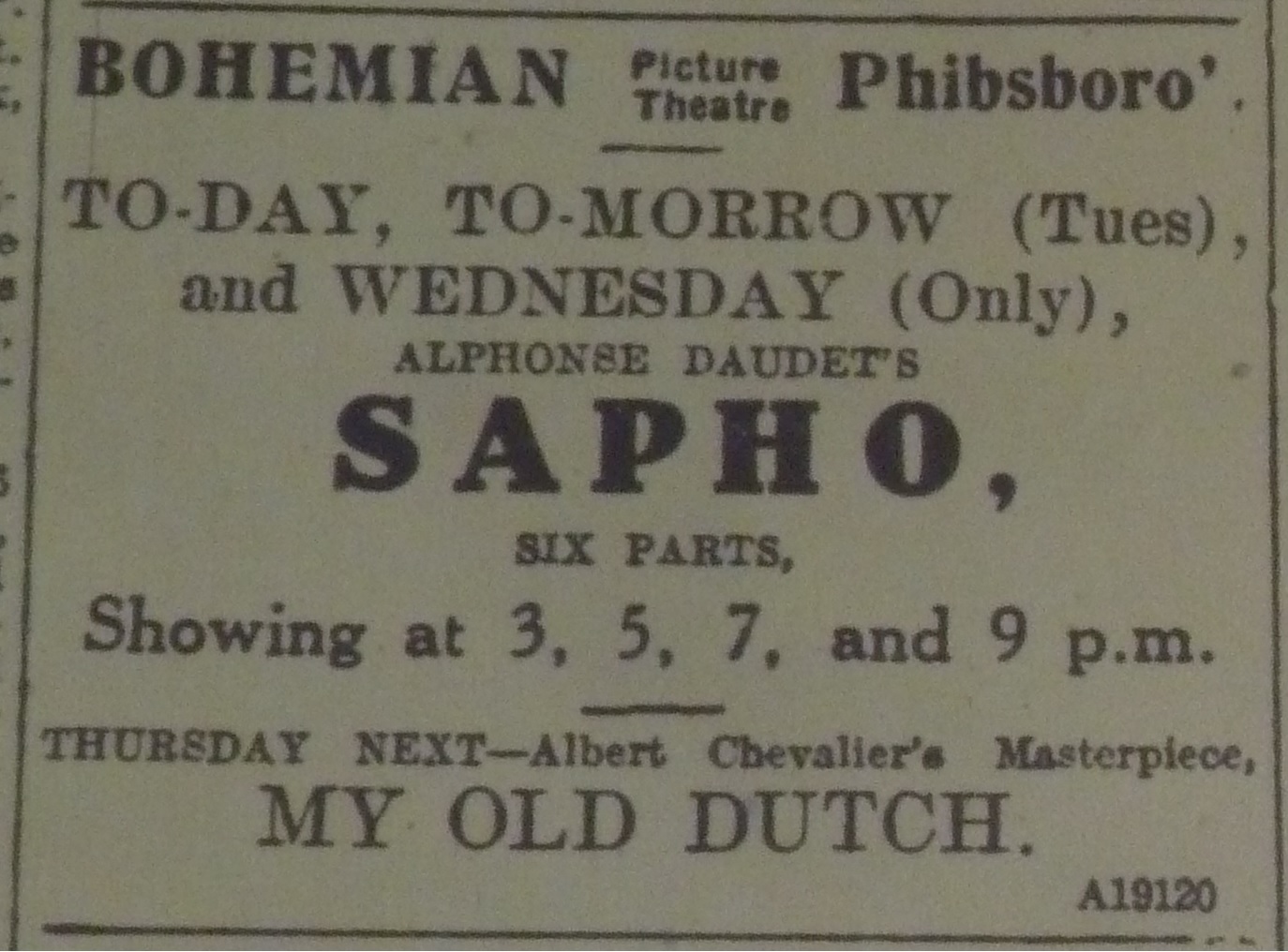
In its reviews of entertainments on Tuesday, 24 August 1915, Dublin’s Freeman’s Journal departed from the usual blandly favourable tone of newspaper notices to criticize the choice of film at the Bohemian Picture Theatre. Although the reviewer praised the “discrimination exercised by the management in the selection of films” since the picture house had opened the previous year, s/he regretted that the “inclusion of ‘Sapho’ this week introduces an unedifying subject” (“Bohemian”). Although the reviewer conceded that the film actually contained “very little to which exception might be taken,” s/he argued that “these experiments against the public taste are very dangerous, as might have been gathered from the attitude of the audience” (ibid).

The reviewer neglected to say, however, what had been the audience actual reaction to Sapho. Others were a little more forthcoming. Attending the Bohemian’s 7pm show on Monday evening, Joseph Holloway thought that the “unpleasant love story of Jean & Sapho was well enacted – a crowded audience witnessed it & many were waiting outside to see the 9 o’clock show as I came out” (Holloway, 23 Aug. 1915). Holloway did not mention any manifestations of dangerous attitudes among this apparently enthusiastic audience, but a report in the trade journal Bioscope some weeks later perhaps accounts for the Freeman’s hints about agitation among the audience. “During the screening of ‘Sapho,’ at the Bohemian Theatre,” Paddy, the Bioscope’s Irish correspondent, claimed that “the Vigilance Committee – or what purported to be the same – held a massed meeting at the corner of the street, and also secured a brass band which did a few triumphal processions past the theatre” (Paddy).

The Bohemian had been and would continue to be a target of Dublin Vigilance Committee (DVC) activity, but the use of a brass band was not repeated there. This may be because this tactic failed to attract the same level of publicity as the disturbance in the auditorium, arrest and court appearance favoured by such DVC activists as William and Francis Larkin.
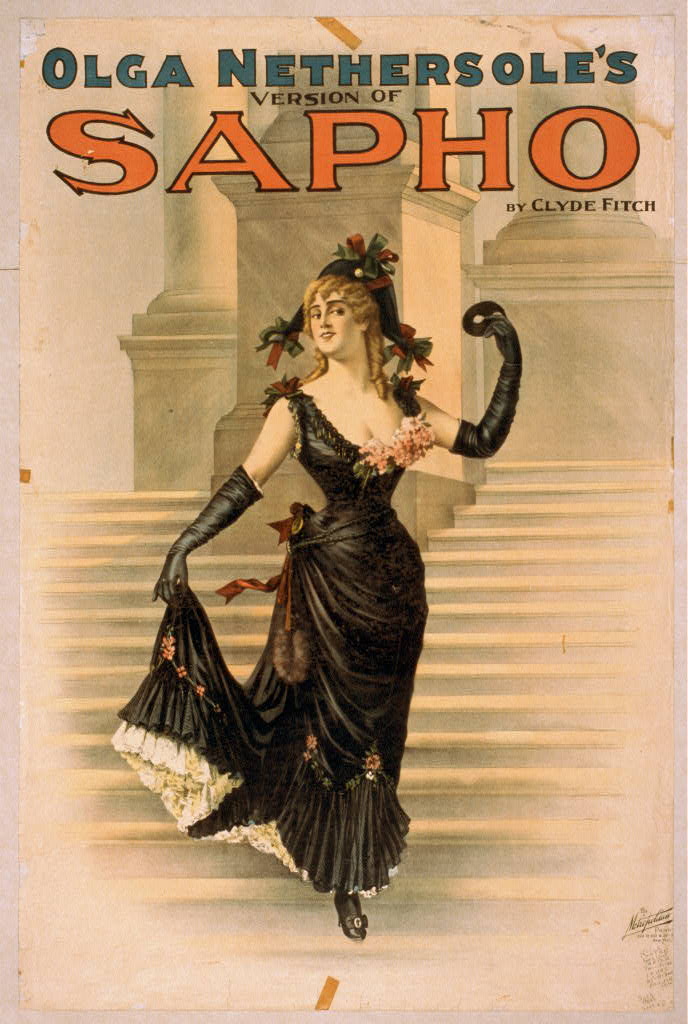
A poster for Olga Nethersole’s theatrical version of Sapho, written by Clyde Fitch. Courtesy of the Library of Congress.

In any case, few audience members – and certainly not the journalists, Holloway or members of the Vigilance Committee – can have been unaware that Sapho was about a woman’s extramarital affairs. Alphonse Daudet had adapted his own popular 1884 novel for the stage, and it had been lent further notoriety when in 1900, Olga Nethersole produced and starred in a US stage version written by Clyde Fitch that told the story from Sapho’s point of view. Both the French and US versions had played in Dublin in the 1900s. So well known was the novel and play that when Nethersole returned to the Gaiety in 1906, the Irish Times commented that it

is unnecessary at this period of time to discuss the morals of the play, or argue the question whether its enactment is calculated to promote a wholesome spirit or not. The subject is one on which people have made up their minds one way or another, and judging by the constitution of last night’s audience the vast bulk, if not the entire of those present, understood perfectly the class of production which they had gone to witness.” (“Gaiety Theatre.”)

Any experiments against the public taste had long yielded their results, it seems, at least as far as the audience at the Gaiety was concerned. However, cinema had altered Ireland’s mediascape by bringing entertainment out of the city centres to the suburbs, small towns and rural areas, and because it was cheaper than theatre, it was more accessible to the working class. With these shifts in entertainment, the definition of “public taste” and “audience” was up for grabs.

In any case, not all journalists were as accepting of the taste experiments represented by plays such as Sapho as the jaded Irish Times reporter appears to have been. In July 1915, D.P. Moran, editor of the Leader, reminded readers of his 15-year-long “campaign against music hall and theatrical filth” (“‘Dirty Dublin’ Again”). He claimed this campaign was necessary because of the complicity of the newspapers with theatre owners:

The names of such plays as “Zaza” “Sapho,” and “Kitty Grey” will recall that campaign to the recollection of our older readers. But the daily Press was then as it is now rotten. We took a big start out of the dailies of that time, and they were cautious of their puffs of imported dirt, but they stuck like wax to the advertisements of the entertainments and plays however dirty. (Ibid.)

Sapho had been one of the key works in Moran’s long-running crusade against the laxity of the mainstream press. And he was right to indicate that theatre and picture-house owners paid to advertise and expected that reviews would at least pay sympathetic attention to their entertainments, if not outright reproduce promotional materials masquerading as criticism. This also makes reviews of limited use for historical purposes. In contrast to this commercial motivation, Moran was – as a self-styled Irish-Irelander interested in Gaelic culture rather than Nationalist politics – hostile to popular entertainments for their Anglicizing influence, which included promoting forms of sexual expression at odds with Irish Catholicism.
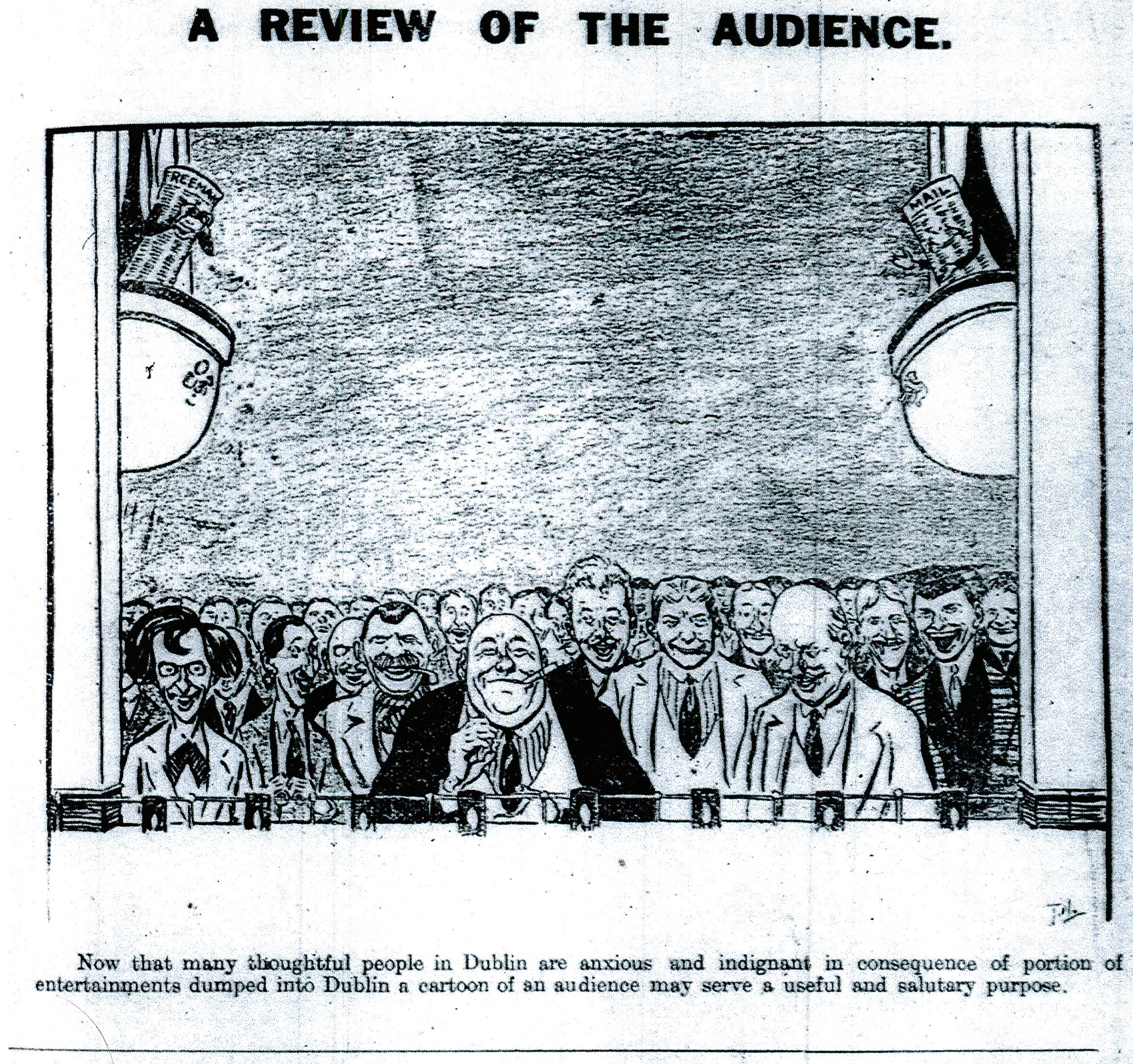
“A Review of the Audience.” Leader 17 Jul. 1915: 541.

Moran’s campaign was not limited to the content of theatrical shows or press complicity but also aimed to refashion the Irish audience. This aspect of his crusade took visual form in July 1915, when he published Tom Lalor’s cartoon entitled “A Review of the Audience.” The accompanying verses by A.M.W. (John Swift) directed readers to contemplate the “dirty degenerates ever so keen / To welcome the smut of a music hall scene.” Among these were the “Johnnie, or nut,” “the College effeminate brat, / Ne’er keen on a lesson that’s wholesome or nice, / But apt in the study of music hall vice,” as well as “the old reprobate well to the fore / In years far advanced but in vices much more.” The press was also excoriated:“Our Press lends its aid to the stuff it should drown, / The ‘Freeman’ and ‘Mail’ that should give it hard knocks / Encourage the same from a seat in a box.”

Although the picture houses were not yet on Moran’s agenda in July 1915, they soon would be when he supported the DVC coming campaign for film censorship, and the appearance of a well-publicized film adaptation of Sapho would no doubt have put him on the alert. The version of the film shown at the Bohemian in August 1915 was one of two film versions released into the British film market in 1913. When the French company Éclair released its version, starring Nethersole, in Britain in March 1913, it became a cause celebre within the industry. The film was banned in Leeds and other places, and when an exhibitor was prosecuted for showing it in Darlington, the Cinema Exhibitors’ Association took up his defence (“The ‘Sapho’Case”).

But it was the US version, released in Britain in November 1913, that would eventually make its way to Ireland. It was made by the Majestic Motion Picture Company and starred Florence Roberts. Whatever its other faults, the adaption to the screen met with approval: “Daudet’s work loses nothing in its production on the cinema, and the large audiences followed the picture through its six parts with interest” (“The Bohemian Picture House”). However, if Irish exhibitors hoped to avoid controversy by waiting nearly two years before booking the film, they miscalculated not so much the public taste as the growing power of the Catholic guardians of morality.

References

“The Bohemian.” Freeman’s Journal 24 Aug. 1915: 2.

“The Bohemian Picture House.” Dublin Evening Mail 24 Aug. 1915: 6.

“‘Dirty Dublin’ Again.” Leader 10 July 1915: 519-20.

“Gaiety Theatre.” Irish Times 20 Sep. 1906: 6.

Holloway, Joseph. Holloway Diaries. National Library of Ireland.

Paddy. “Pictures in Ireland.” Bioscope 9 Sep. 1915: 1176.

“The ‘Sapho’Case.” Bioscope 31 Jul. 1913: 349.
In the Grip of Spies: Irish Cinemas and War Propaganda, March 1915

On the eve of St. Patrick’s Day 1915, several Dublin newspapers reported on an exciting chase of a suspected spy through the city. “For the past couple of day,” the Evening Telegraph revealed,

the military authorities have regarded with suspicion the movements of an individual in the city. To-day the man was seen in the vicinity of O’Connell Bridge, where he again attracted the attention of the military, and when they proceeded to approach him the man immediately made off. (“City Sensation.”)

The pursuing soldiers commandeered a car when they were unable to catch the man on foot, but he was eventually caught by a passing cyclist who responded to the soldiers’ calls to stop the spy. However, although the man was arrested, he was released without charge when he turned out to be a respected Kildare cattle dealer named Murphy. It is unclear why Murphy expected that expressing his view to British soldiers “that the Kaiser might smash the British army and dominate the world in the end” would be uncontroversial, even though such views were common among militant nationalists and radical labour activists (“‘Stop Spy’ in Dublin Streets”).

Evening Telegraph 15 Mar. 1915: 2.

Evening Telegraph 15 Mar. 1915: 2.

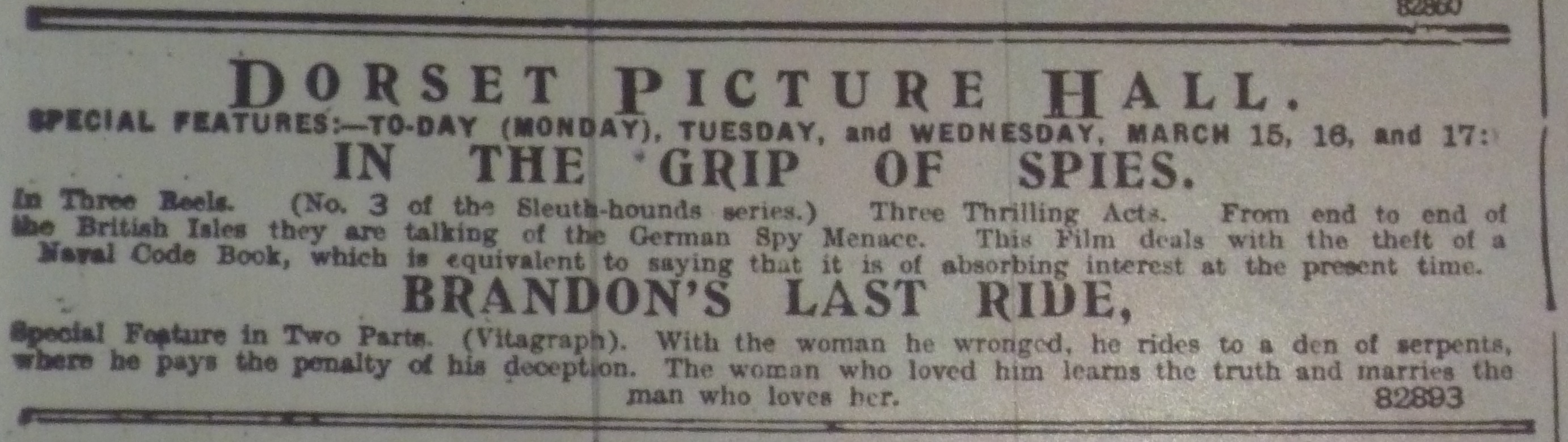
What is interesting, though, is that the expression by an Irishman of such anti-British sentiments led him to be labelled a spy. Indeed, this story fitted into a discourse on spies and spying spread by newspapers and other popular media including the cinema that dovetailed with the British government’s war policies (see also, for example, in same issue of Evening Telegraph “Imaginary Spy” and “Danger of Spies”). For three days in mid-March, Dublin’s Dorset Picture Hall showed In the Grip of Spies (Britain: Big Ben, 1914), and this title offers an apt description of the state of fear of “the enemy among us” that this discourse aimed to spread. “From end to end of the British Isles they are talking of the German Spy menace,” a press ad claimed. “This Film deals with the theft of a naval Code Book, which is equivalent to saying that it is of absorbing interest at the present time” (ibid). But spying was also a suitable subject for comedy, with patrons at the Picture House, Sackville/O’Connell Street enjoying Wiffles Catches a Spy (France: Pathé, 1915).

In general, however, the discourse on spies and the cinema was not comic. Spies brought the war even closer to Ireland and Britain than the German naval blockade blockade to which this ad linked it. Suspicion could be cast on anyone who used a film camera, which purposely or inadvertently could provide intelligence for German attacks. Echoing an incident in Dublin in September 1914 when Norman Whitten was threatened with being shot for filming troops embarking at Dublin port, an article in the Evening Telegraph in early March 1915 reported from the Gateshead Police Court on the arrests, fining and confiscation of the footage of Stanley Dorman and Edwin Joseph Jennings who had filmed a Tyneside naval installation without permission (“Film of a Warship”).

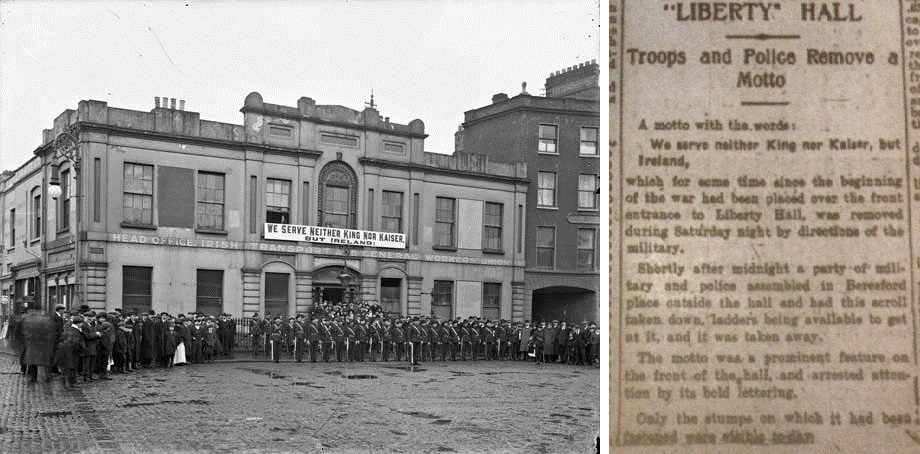
We Serve Neither King nor Kaiser banner and its removal from Liberty Hall in Evening Herald 21 Dec. 1914: 1.

We Serve Neither King nor Kaiser banner and its removal from Liberty Hall in Evening Herald 21 Dec. 1914: 1.

More importantly, the discourse on spies served the useful ideological purpose of suggesting that the divisions of prewar society had been overcome in the face of a common enemy and that any organization or individual not engaged in the war effort was – wittingly or unwittingly – an agent of the Kaiser. Draconian legislation was put in place to deal with such individuals and organizations. Passed just after the outbreak of the war, the Defence of the Realm Act (DORA) introduced strict censorship and gave the police and military widespread powers of arrest. In Ireland, unionists and the mainstream nationalist who followed John Redmond supported the war, but militant nationalists and radical trade unionists condemned it, and some openly supported a German invasion. “When it is said that we ought to unite to protect our shores against the ‘foreign enemy,’” wrote labour leader James Connolly,

I confess to be unable to follow that line of reasoning, as I know of no foreign enemy of this country except the British Government, and know that it is not the British Government that is meant. […] Should a German army land in Ireland to-morrow we should be perfectly justified in joining it if by so doing we could rid this country once and for all from its connection with the Brigand Empire that drags us unwillingly into this war. (“Our Duty in this Crisis.”)

At the start of the war, a banner proclaiming “We Serve Neither King nor Kaiser, But Ireland” was erected on the facade of Liberty Hall, headquarters of the labour movement, and it was only removed by soldiers and police in December 1914 (“‘Liberty’ Hall”). Earlier that month, such radical papers as the Irish Worker, Sinn Fein, Irish Freedom and Eire/Ireland were suppessed (“Irish Papers,” “Another Dublin Paper”).

By contrast, the British trade press continued to urge the wider use of cinema in support of the war effort. In the face of opposition by reformers unsympathetic to popular culture and by the churches to Sunday opening, the industry aimed to win wider social acceptability by aligning itself with state policy. For the Bioscope, cinema certainly played a crucial role as rational recreation at a time of great collective stress. An editorial in March 1915 rejected the snobbish “reproach on those who seek relaxation in theatres and music halls” and argued that “the cinemas are playing no mean part in providing the great mass of people with innocent and healthful entertainment” (“Amusements in War Time”). However, it could also play a much more active role in shaping public opinion in support of the war, a point that the trade papers had argued from an early point in the war. In September 1914, for example, the Bioscope had praised the views of Liberal politician Sir Henry Norman, who in a letter to the London Times had emphasized the role that battlefield reporting could play in support of recruiting and arousing enthusiasm for the war at home. Norman proposed sending to the front with the correspondents “at least one official cinematographer, whose films of the glories of war – we shall have plenty of other means of learning of its sorrows – should be shown in every town and village in the land” (“The Cinematograph at the Front”).

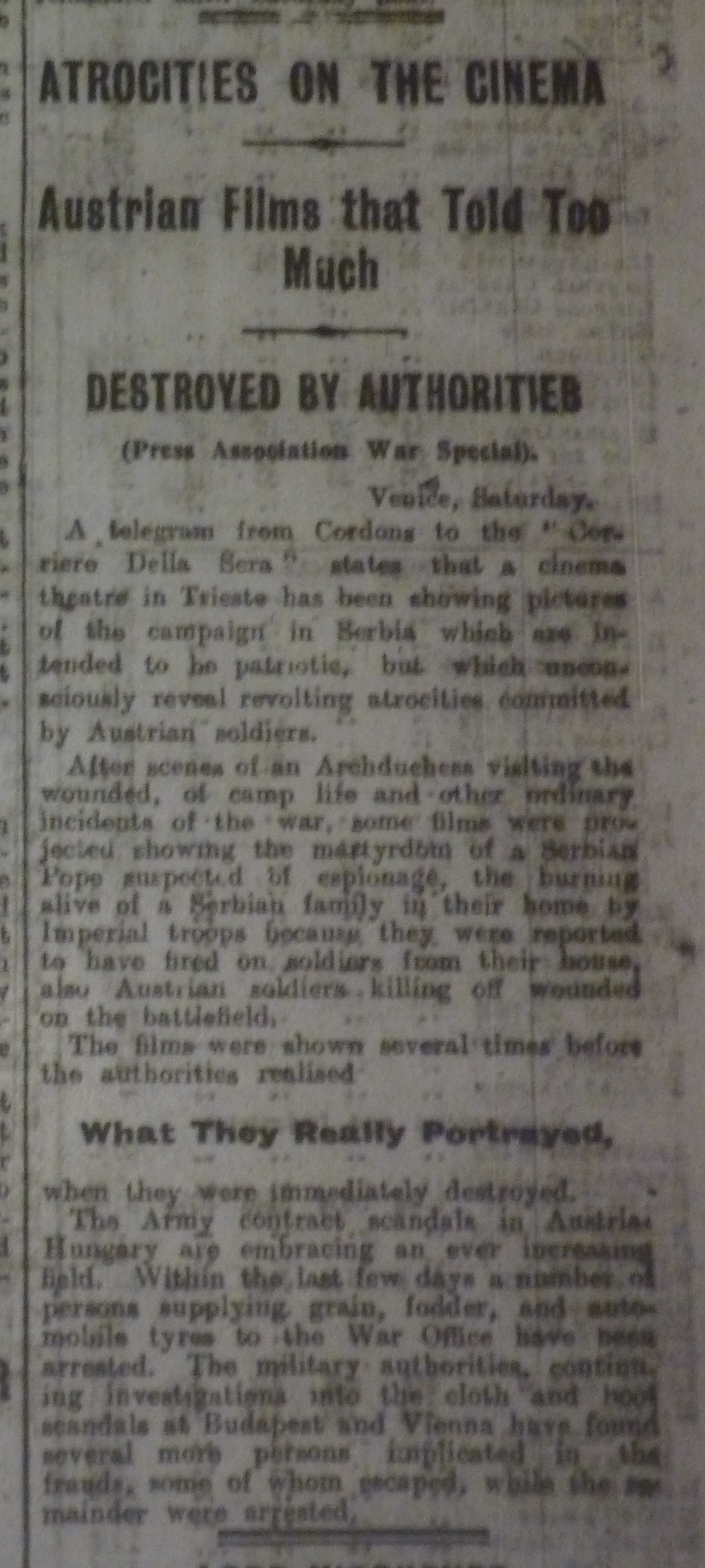
“Atrocities on the Cinema.” Dublin Evening Mail 27 Mar. 1915: 5.

Dublin Evening Mail 27 Mar. 1915: 5.

With little indication that the British government was exploring the propaganda possibilities of the cinema, the press continued to offer stories showing that Germany was winning the propaganda war among the German population, as well as exploiting such advanced technological application as the use of the cinematograph in reconnaissance. The Dublin Evening Mail, the Dublin evening paper with a distinctly unionist editorial line, was particularly fond of these stories, but it also showed that the cinema had the potential to reveal uncomfortable truths about the war. An article in late March, for example, reported that

a cinema theatre in Trieste has been showing pictures of the campaign in Serbia which are intended to be patriotic, but which unconsciously reveal revolting atrocities committed by Austrian soldiers.

After scenes of an Archduchess visiting the wounded, of camp life and other ordinary incidents of the war, some films were projected showing the martyrdom of a Serbian suspected of espionage, the burning alive of a Serbian family in their home by Imperial troops because they were reported to have fired on soldiers from their house, also Austrian soldiers killing off wounded on the battlefield. (“Atrocities on the Cinema.”)

Once the authorities realized what the films depicted, they destroyed them.

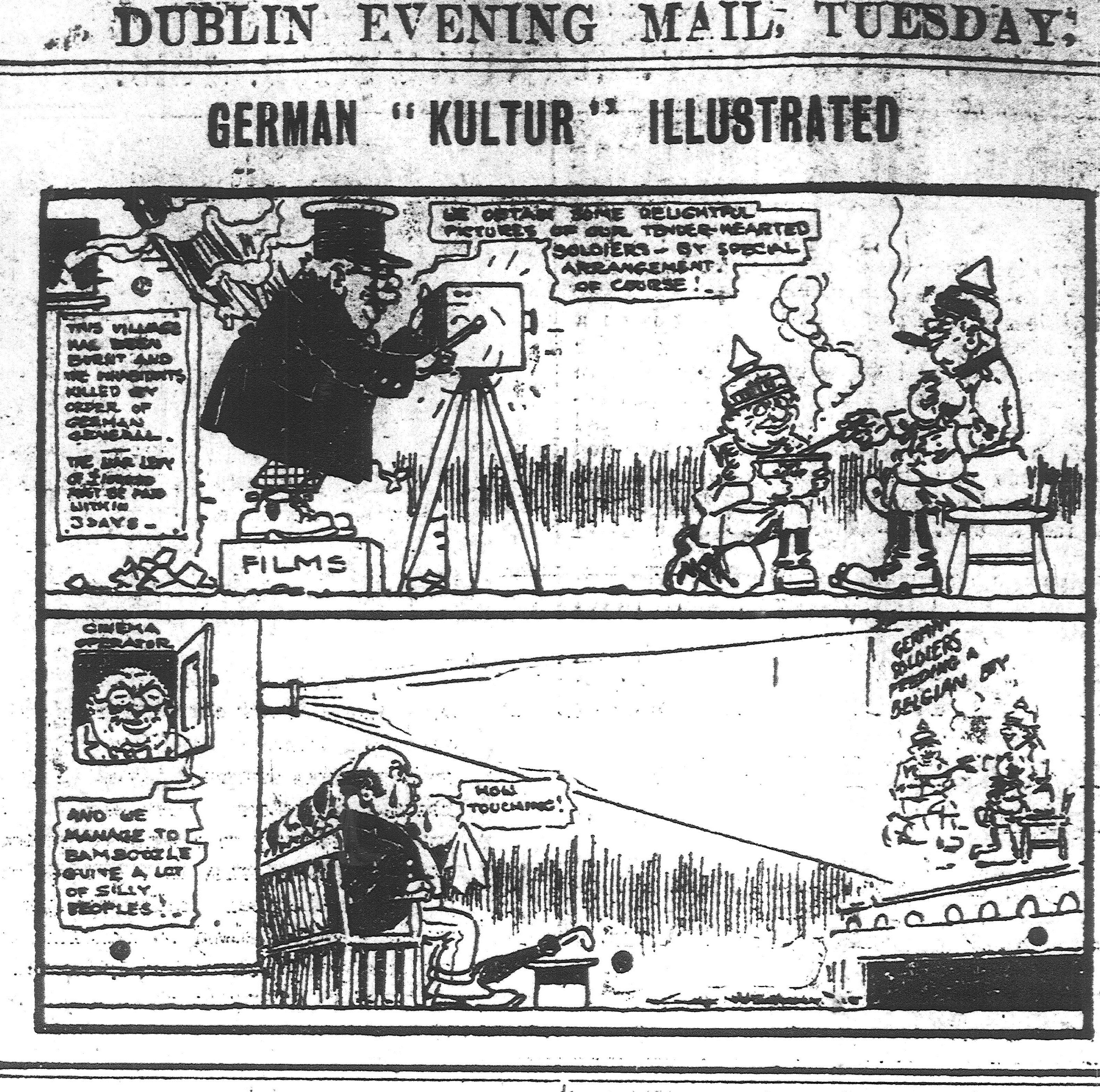
Cartoon showing the shooting and exhibition of a German propaganda film; Dublin Evening Mail, 19 Jan. 1915: 3.

Cartoon showing the shooting and exhibition of a German propaganda film; Dublin Evening Mail, 19 Jan. 1915: 3.

The dominant story that the mainstream and cinema trade press in Ireland and Britain told about enemy propaganda concerned its untruthfulness. This was well illustrated in mid-January 1915 when the Dublin Evening Mail published a cartoon depicting how adept the German film industry was in keeping from the German public the realities of their army’s depredations in Belgium. Its two panels showed how a German filmmaker conspired with the German army to produce a faked film of soldiers helping vulnerable Belgian citizens, and how this film influenced public opinion in support of the war when exhibited in cinemas. The title of the cartoon – “German ‘Kultur’ Illustrated” – seemed to carry a criticism of cinema in general in suggesting that German culture should be associated with such a low form as cinema.

Alleged eyewitness accounts of the efficacy of German film propaganda were a part of this discourse, and in March an Irishwoman offered the Bioscope a particularly lengthy personal account. If she is anything more than an invention of propaganda, Norah Mahone seems to have been a remarkable woman. She was described as

a young Irish lady and a member of the theatrical profession, who, after being held a prisoner for several months, has recently succeeded in escaping from the enemy’s land, where she was staying at the outbreak of war.

A talented woman in more ways than one, Miss Mahone visited Dresden last July with the object of completing some business in connection with certain inventions she had patented, and also, incidentally, to take a “cure” in that city. (“German Allegorical Film Play.”)

Following descriptions of her mistreatment by the German authorities and a deluded public, Mahone offered details of such films as the departure of the Saxon army, “an almost barbaric scene in its uncontrolled emotionalism and riotous display.” Because films were so popular in Germany,

the Government are using the cinematograph shows and cafés for propaganda work. Practically all the films shown deal directly with the war, and nearly all of them are of a most filthy and scurrilous nature calculated to arouse in spectators, the worst emotions and most biased hatred against the Allies, and especially against England. These films are all manufactured, I believe, under the indirect supervision of the Government, many of them being allegorical plays, and the rest more or less faked “topical” pictures. (Ibid.)

The efforts of the industry and its supporters would soon convince the British government about the power of the cinema propaganda. Despite the prominence of such Irish people as Norah Mahone, however, these kind of films would always prove to be controversial in Ireland.

References

“Amusements in War Time.” Bioscope 11 Mar. 1915: 875.

“Another Dublin Paper: Suppressed this Morning.” Evening Telegraph 5 Dec. 1914: 3.

“Atrocities on the Cinema: Austrian Films that Told Too Much: Destroyed by Authorities.” Dublin Evening Mail 27 Mar. 1915: 5.

“The Cinematograph at the Front.” Bioscope 3 Sep. 1914: 859.

“City Sensation: Arrest by Military: Man Pursued: By Motor and Cycle.” Evening Telegraph 16 Mar. 1915: 3.

“Danger of Spies: Stringent Regulation: Of Traffic with Holland.” Evening Telegraph 16 Mar. 1915: 4.

“Film of a Warship: Drastic Action by the Authorities.” Evening Telegraph 4 Mar. 1915: 1.

“A German Allegorical Film Play: An Irish Actress’s Remarkable Experience in Germany.” Bioscope 18 Mar. 1915: 1021, 23.

“Imaginary Spy: Exciting Chase in London: Dublin Fusilier Sent to Jail.” Evening Telegraph 16 Mar. 1915: 3.

“Irish Papers Suppressed by the Government: Defence of Realm Act: Instruction by Military: Copies Seized and Printers Warned.” Evening Telegraph 3 Dec. 1914: 3.

“‘Liberty’ Hall: Troops and Police Remove a Motto.” Evening Herald 21 Dec. 1914: 1.

“Our Duty in this Crisis.” Irish Worker 8 Aug. 1914: 2.

“‘Stop Spy’ in Dublin Streets.” Irish Independent 17 Mar. 1915: 5.

Rolls of Honour: Irish Film Businesses and the War, Autumn 1914

“The British Cinematograph Industry has made a magnificent response to the country’s call for men at this terrible crisis,” observed the trade journal Bioscope shortly after Britain’s entry into the First World War. The magazine requested that “managers of the cinematograph business houses or theatres, any of whose workers have temporarily left them for this noble purpose, kindly communicate the fact to us, mentioning the name of the man and the regiment he is joining” (“Trade Topics”). The following issue’s “Roll of Honour” (20 Aug.), a list of members of the trade who had joined the armed forces, did not mention any men from Irish companies, but Irish correspondent Paddy observed that one of the sons of Irish exhibitor James T. Jameson had “been called to the colours” (Paddy, 20 Aug.).

Roll of Honour 1

The Bioscope’s second “Roll of Honour” for men in film businesses who enlisted featured five Irishmen; 27 Aug. 1914: 784.

Beginning on 27 August, the names of employees in Irish or Ireland-based film companies began to appear on the Bioscope’s “Roll of Honour.” The first of those mentioned was William Vass Morris of Cork, described in the census of 1911 as a photographic agent, who was joining the South Irish Horse. Morris was joined on this list by three members of Gaumont’s Dublin office, another Morris, Ganey and Kinnemont, and by Byrne of Dublin’s Grand Cinema. Two members of Provincial Cinematograph’s Belfast staff – Cummings and Lydall – appeared on the first “Roll of Honour” in September. Provincial had already publicized the special contribution of its personnel to the war effort, and the Dublin Evening Mail had duly passed on this information to its readers (“The Picture House Staff”). Those named by the Evening Mail article had prominent positions in the company’s London head office, including chairman of the board Sir William Bass and general manager Aubrey Meares. It also claimed that

[b]etween 60 and 70 attendants at various theatres owned by this company have been called out on reserve, and the company has decided to allow 10s per week to the wife, and 2s 6d for each child during the man’s absence. All employes will be re-instated at the conclusion of the war. (Ibid.)

By early October, Dublin’s Evening Telegraph was putting the number of Provincial staff who had “joined his Majesty’s forces” at 109 (“Picture House Employes”).

Ad for war films at the Grafton; Dublin Evening Mail, 14 Sep. 1914: 2.

Ad for war films at the Grafton; Dublin Evening Mail, 14 Sep. 1914: 2.

Some Irish film production companies expanded their business during the war, taking advantage of new filmmaking opportunities – although these were not without risks – as well as pursuing some innovative work. Norman Whitten of the General Film Supply featured in a short article in the Bioscope in mid-September. It explained that Whitten had mounted a platform in front of a train to take “the beautiful scenery around Galway Bay. In the light of recent stirring events, the ‘topcials’ secured should be of distinct value to exhibitors” (“New Series of Irish Topicals”). As well as this kind of work that he had been doing for some time, Whitten – assisted by a Mr. Ashton who presumably had taken the place of Whitten’s previous cameraman, Benny Cann – made several war-themed films, but not as many as he planned. In early September, Paddy reported that Whitten had been threatened with being shot if he persisted in trying to film soldiers embarking on transport ships at Dublin’s North Wall. The War Office had revoked the permit to film that Whitten had earlier obtained. As Paddy observed, this was disappointing for Whitten, who had been building up his business in local topicals to a point where his film Funeral of Victims Shooting Affair Sunday, July 26th circulated in eight copies, which “constitutes rather a record” (Paddy, 3 Sep.). This film was of continuing relevance because of the campaign of the relatives of victims to get Dublin Corporation to petition the king (“Bachelor’s Walk Outrage”).

Whitten appears to have had eight regular subscribers for his topicals in Dublin, but such a circulation seems small by comparison with the other kinds of war films his company was making at the time. Paddy described Whitten’s Sons of John Bull as both a topical and a “‘cartoon’ film,” but the element of animation is not clear from his description, which makes the film appears to have been a series of filmed portraits and/or still images connected with dissolves and intertitles:

[I]t is a series of photos, hand-coloured, of famous people connected with the war. Each subject dissolves into the next, which rather enhances the beauty of the film. Another portion of the film is entitled “Friends,” and depicts famous men connected with our Allies, including a splendid photo of the king of Belgium. (Paddy, 3 Sep.)

The film ran 100 feet (or about 1 minute 40 seconds), but it is not clear why Paddy considered it “a great advance over the system of still slides,” which it clearly resembled, albeit without the presence of a lantern lecturer to explain the images.

By early October, Paddy was characterizing this film as “a pronounced success in Dublin and elsewhere,” and revealing Whitten’s plans to release a second film of the same kind on 22 October (Paddy, 1 Oct.). Twice the length of Son of John Bull at 200 feet, Britannia’s Message appears to have included newsreel and to have begun with an animated sequence. It

opens with Britannia drawing aside some curtains and revealing a German spy. Interesting scenes include an outside view of hundreds of young fellows besieging a recruiting office, a view of the Rugby Volunteers drilling at Lansdowne Road, Dublin, and a view of troops leaving for camp. (Ibid.)

The latter was presumably shot after Whitten had been given a new permit. The potential public interest beyond Ireland in these pro-war shorts was indicated by the fact that British distributor Cosmopolitan was handling them.

Within Ireland, business at the cinemas was reported to be good. In mid-September, Paddy made a tour of many of Dublin’s cinemas reporting that “in the great majority of cases [I] found business excellent; in fact, in certain houses exceptionally brisk.” His researches made him conclude that there was a difference between working-class and middle-class picture houses. He argued that

it is chiefly the houses which make an appeal to the 2d. and 3d. people that suffer most from the war. The patrons of these houses were largely drawn from reservists of one kind and another and their families. The bread-winner being away on service, the family naturally are thrown back on slenderer resources, and so cannot attend the “movies” as frequently as they might wish. However, as business gradually resumes more normal aspects, it is to be hoped that this state of things will be somewhat alleviated. (Paddy, 24 Sep.)

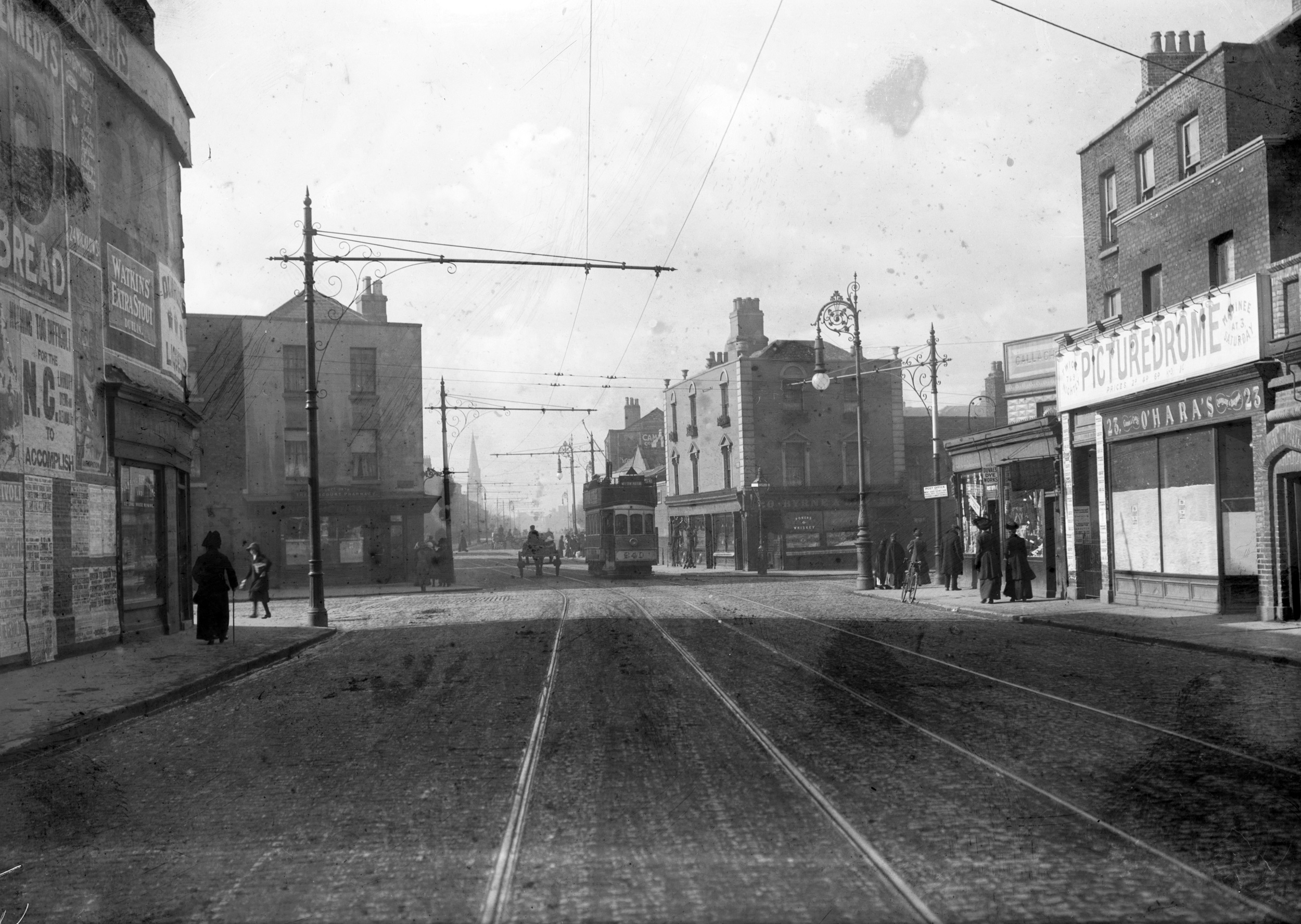
The Picturedrome is visible on the right of this photograph of Dublin's Harcourt Road. https://www.flickr.com/photos/nlireland/7628356832/

The Picturedrome is visible on the right of this photograph of Dublin’s Harcourt Road in c. 1912. https://www.flickr.com/photos/nlireland/7628356832/

One working-class picture house that he visited was the Picturedrome in Harcourt Road. For Paddy, the Picturedrome was “a theatre which I regret to find I have not mentioned in these notes for some time,” but he was not alone in his lack of coverage because the Picturedrome – catering for a local working-class audience – did not advertise in the Dublin newspapers and so was ignored by reviewers. “Business here was fairly brisk,” Paddy observed, “considering the regular patrons of the hall are drawn from men now with the colours.” Manager Will Sommerson was presenting a bill dominated by three Vitagraph films The Auto Bandits of New York, Old Reliable and Her Mother’s Wedding Gown. “[I]t’s astonishing the popularity of Vitagraph films in Ireland” – although The Auto Bandits seems to have been made by the Ruby Feature Film Company. The only other film he mentioned at the Picturedrome was “an exceptionally interesting scenic, ‘The Volcanoes of Java’” (ibid.).

Tivoli Theatre of Varieties, Burgh Quay, Dublin, May 1915. https://www.flickr.com/photos/nlireland/12082817723/

Tivoli Theatre of Varieties, Burgh Quay, Dublin, May 1915. https://www.flickr.com/photos/nlireland/12082817723/

The most notable thing about the Picturedrome’s programme is that Sommerson appears to have chosen none of the war-themed films that some other exhibitors were making a point of including on their programmes. At the Tivoli Theatre of Varieties, for example, the music-hall bill included the films Cyclists of the Belgian Army and The 23rd French Dragoons, which “had been specially procured by Mr. Charles M. Jones for the benefit of his patrons – a large proportion of soldiers being amongst the audience each night” (ibid.). At the Dorset Hall, manager Frederich Sullivan accompanied the dramas Jim, the Fireman (Britain: Barker, 1914) and In the Wolf’s Fangs (US: Bison, 1914) with “the authentic film of the Germans entering Brussels, and I noted that this film had been passed by the Censor” (ibid.).

The Man About Town's "Things Seen and Heard" column began with items on film on 5 and 10 Oct. 1914: 2.

The Man About Town’s “Things Seen and Heard” column in the Evening Herald began with film items on 5 and 10 Oct. 1914: 2.

Commentators in the Dublin papers were more ambivalent about war films. Also writing on 24 September, the same day as Paddy’s coverage of the Dublin picture houses appeared in the Bioscope, the Evening Herald columnist The Man About Town was pleased to hear from “the proprietor of one of our largest picture houses” that business was quite good, as well as to get a demonstration of the Topical Picture Slide, a new method of displaying topical news. Despite this unnamed proprietor’s focus on matters topical, he told the Man About Town that “[p]eople hear so much about the war that when they go to a cinema they look for something to relieve their minds from the awfulness of it, and I find that with a carefully selected and well-balanced programme business is really good.” A regular cinemagoer, the Man About Town provided an example a week later of a picture house patron who was traumatized by war images on screen. “I was attending a picture theatre the other day with a lady,” he revealed,

and gradually it was borne in upon me that my airy persiflage was falling on deaf or, at least, inattentive ears. The film was telling a thrilling story, and the incidents just being depicted were those of a naval encounter in the course of which the hero – an officer of the Royal Navy – is fatally wounded. My companion seemed a little distraite, and at last observed: “Oh, I wish they wouldn’t show things like this.” Then I remembered that her brother is at present serving in a ship in the North Sea. The cunning of the scene was too much for her. (30 Sep.)

Earlier in the month, he had suggested that certain picture houses were clumsily attempting to elicit patriotic responses from the Dublin audience. “In a picture theatre in — street yesterday a picture of King — was shown,” he observed,

the band played “— Save the King,” the audience uncovered (their heads), and there was some applause. So far so well. Then a raucous voice shouted in an unmistakable brogue, “Hip, hip, hurrah.” Without being able to swear to it, I have no doubt, having regard to the accent, the venue, and the audience, that this enthusiast was a paid rather than a paying spectator. In other words that he was one of the staff. Surely enthusiasm should grow of itself, and not be fomented in this way? As it was the demonstration fell flat. (12 Sep.)

The role of the picture house attendant who cheered was clearly crucial here, but music also played a significant part in this case and generally in shaping the experience of patrons. Paddy commented that the music at the Phibsboro Picture House at the northern edge of the city was “deserving of great praise, and no one takes more interest in her work or gives a more spirited and tasteful exhibition of playing than Miss Eagar”(24 Sep.). The Man About Town included an item entitled “‘Glorious’ War,” in which he demonstrated the way that talented musicians could influence the audience’s reception of war films. “While I was at a picture-house the other night,” he began, “scenes were shown of Belgian wounded being removed in ambulances. The pictures were rather harrowing, and as they were being displayed the band discoursed Elgar’s famous march, ‘Pomp and Circumstance.’ It set one thinking” (14 Sep.).

Therefore, although Irish film businesses generally embraced the pro-war patriotism that dominated the British industry, local exhibitors and audiences were more ambivalent about what they were seeing on the screen.

References

“Bachelor’s Walk Outrage: Relatives of the Victims: Corporation Resolution: To Petition King.” Evening Telegraph 5 Oct. 1914: 4.

The Man About Town. “Things Seen and Heard: ‘Glorious’ War.” Evening Herald 12 Sep. 1914: 2; 14 Sep. 1914: 2; 24 Sep. 1914: 2; 30 Sep. 1914: 2.

“New Series of Irish Topicals.” Bioscope 17 Sep. 1914: 1079.

Paddy. “Pictures in Ireland.” Bioscope 20 Aug. 1914: 752; 3 Sep. 1914: 913; 24 Sep. 1914: 1129; 1 Oct. 1914: 31.

“Picture House Employes.” Evening Telegraph 10 Oct. 1914: 3.

“The Picture House Staff: Many Men Off to the Front.” Dublin Evening Mail 21 Aug. 1914: 4.

“Roll of Honour.” Bioscope 20 Aug. 1914: 784; 27 Aug. 1914: 3 Sep 1914: 869.

“Trade Topics.” Bioscope 13 Aug. 1914: 617.

Kinema Kinks and the Respectability Police

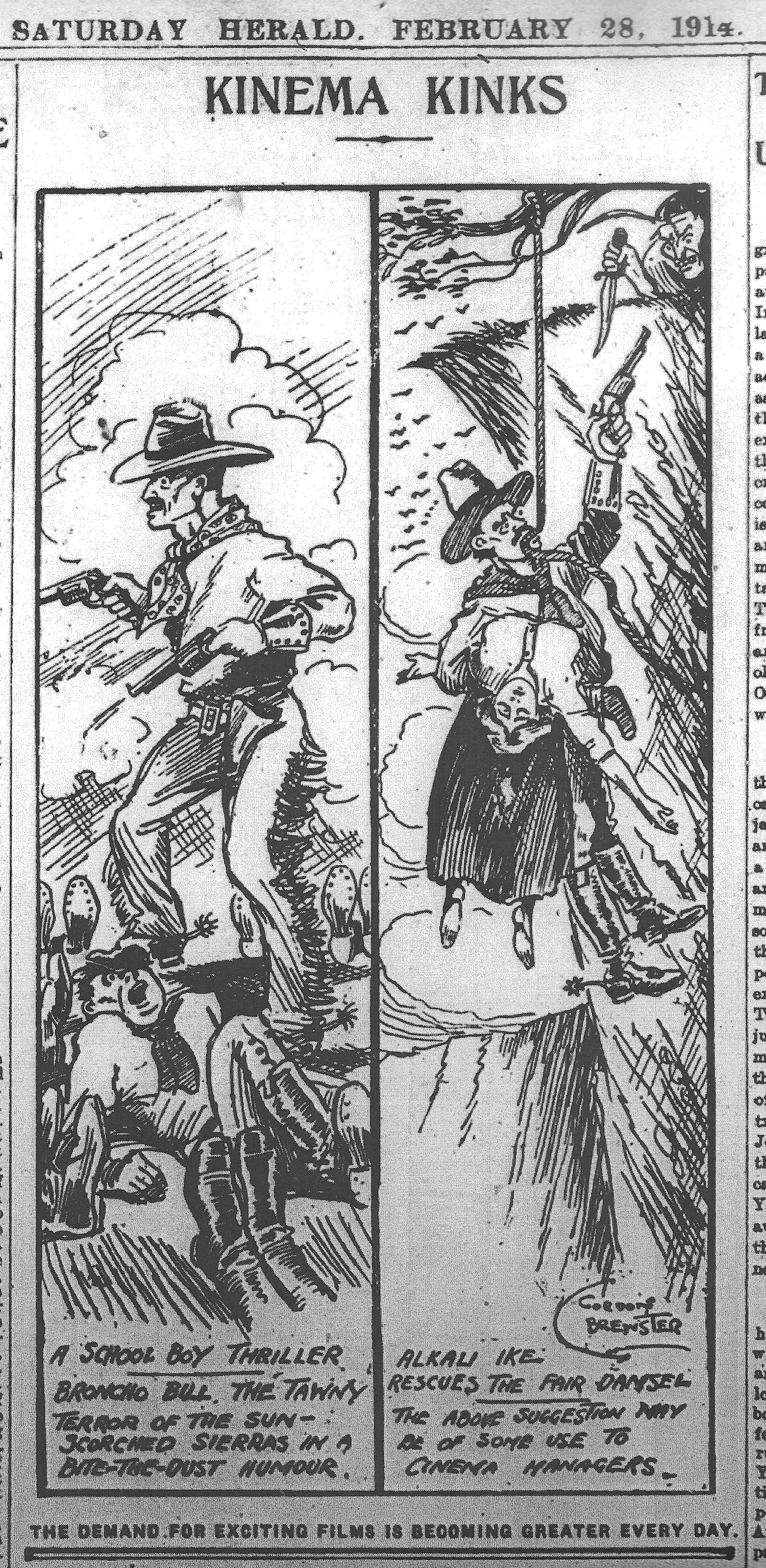
Evening Herald, 28 Feb. 1914: 6.

Evening Herald, 28 Feb. 1914: 6.

On Saturday, 28 February 1914, Dublin’s Evening Herald published a Gordon Brewster cartoon called “Kinema Kinks” and subtitled “The Demand for Exciting Films Is Becoming Greater Every Day.” It seems that the epitome of exciting films as far as Brewster was concerned was the work of the Essanay company’s co-founder (with George K. Spoor, hence the “S and A”), director and actor Gilbert M. Anderson. Anderson was best known for his most popular screen role of Broncho Billy, and the left-hand panel of the cartoon appears to feature him, with its caption: “A School Boy Thriller // Broncho Bill the Tawny Terror of the Sun-Scorched Sierras in Bite-the-Dust Humour.” The image accompanying this text features a cowboy who has clearly come out best in a shootout with six opponents, on the face of one of whom he is standing, while only the boots of the others are visible. Although the triumphant cowboy’s facial features are not like Anderson’s, it is not just the text that suggests that he is Broncho Billy but also the studded wrist cuffs that were often a part of Broncho Billy’s costume.

Poster for Essanay’s The Making of Broncho Billy (1913) and publicity photo for Gilbert M. Anderson, actor, director and co-founder of the Essanay film company (http://silentwesterns.wikia.com/wiki/Broncho_Billy_Anderson?file=Broncho_Billy_Anderson.jpg)

Poster for Essanay’s The Making of Broncho Billy (1913) and publicity photo for Gilbert M. Anderson, actor, director and co-founder of the Essanay film company (http://silentwesterns.wikia.com/wiki/Broncho_Billy_Anderson?file=Broncho_Billy_Anderson.jpg)

That said, the second panel – captioned “Alkali Ike Rescues the Fair Damsel // The Above Suggestion May be of Some Use to Cinema Managers” – also features a cowboy with studded wrist cuffs as he hangs from a rope by his teeth carrying the unconscious damsel and holding off what appears to be a knife-yielding Indian. Alkali Ike was the hero of an Essanay series of comic Westerns produced by Anderson and starring Augustus Carney, who may have been born in Ireland. Of what use to cinema managers the image of Alkali Ike might have been is unclear, but the cartoon attests to the popularity of Westerns – not only those of Broncho Billy and Alkali Ike – in Dublin cinemas. As has already been seen here, commentators noted that “no picture programme nowadays is considered complete if it does not include a cowboy film” (“Rotunda Pictures” 9 Sep. 1913). That was an exaggeration; many film programmes did not include a Western. Nevertheless, it suggests that the cinema audience was entirely familiar with Westerns, and in such a situation, it is not difficult to imagine that there was a demand for cowboy film with increasingly sensational scenes.

Other kinds of excitement were arranged by the audience rather than cinema managers. Protests in the first week of March 1914 in a theatre and a picture house were indicative of the concerted campaigns of protest in cinemas to come. On the evening of 2 March, William Larkin of 27 Sherrard Street shouted from the gallery of the Gaiety Theatre in protest at the immorality of the French farce Who’s the Lady? (“The Scene at the Gaiety”). He created enough of a disturbance that the actors left the stage until Larkin was removed from the theatre and arrested. Larkin appeared in the Southern Police Court the following morning, where the case against him was dismissed by the magistrate, Thomas Drury, who praised Larkin for having “done a public service” (ibid). Emboldened by this support from the judiciary, William Larkin and his twin brother Francis would in the coming months constitute the most publicly visible part of the Catholic Church-based Dublin Vigilance Committee’s campaign for film censorship with a series of protests in cinemas around the city. For this, they could rely on an at-least tacit but often explicit consensus on the regulation of popular theatre and cinema among the Catholic establishment in the city.

The diary of theatregoer Joseph Holloway is revealing on the protests and middle-class Catholics’ attitudes to them. Holloway had not been in the theatre that night, but he followed the controversy in the newspapers. Noting the remarks by the Irish-Ireland journal The Leader that “[a] certain ‘highly respectable’ class of people in Dublin like dirty plays & dirty papers … but in a very literal sense there is a well-dressed ‘Dirty Dublin.,’” Holloway agreed that “[t]his is all very true[;] I have noticed it for years in our theatres that the more questionable the play the better dressed the audience!” (Holloway 504).

Although Larkin’s militant policing of respectability had not quite reached the picture houses in March 1914, other kinds of protest had. Between 8 and 9 o’clock on the evening of Thursday, 5 March, fourteen boys of Na Fianna Éireann – or the National Boy Scouts as most of the newspapers called them – were ejected from the Picture House, Sackville/O’Connell Street for disrupting a screening of the British Army Film (Britain: Keith Prowse, 1914) (“Dublin Picture Palace Scene”). While Larkin was interested in morality, Na Fianna were interested in nationality, expressed as anti-British and pro-Irish: “They took up seats in the front rows, and hissed the scenes that were being shown. The cheered for Germans and Boers, and sang ‘A Nation Once Again’” (ibid). They did not have it all their own way, as other members of the audience cheered the British, and the police and cinema attendants dragged several of them from the auditorium. Nevertheless, as Who’s the Lady? provided the occasion for Larkin’s display of Catholic morality, the British Army Film allowed Na Fianna to project Irish nationalism onto an ostensibly British patriotic text. Joseph Holloway was thus able to point out that the “film also caused a disturbance on last Monday night – The British Army is not to the taste of all people in Dublin” (Holloway 500).

While the DVC and Na Fianna seemed intent on placing strict limits on cinema, “famous Irish painter, author, and visionary poet” A.E. insisted – albeit somewhat reluctantly – on the importance and inevitability of cinema in education (Paddy, 19 Feb.). “[F]or all our qualms, we invite the cinema into education,” the Bioscope’s Irish correspondent Paddy reported him as saying.

Our methods of education in the national schools have not been so superior and thought-quickening that we risk losing much in introducing the living picture, and whether we protested or not the thing is as inevitable as that the aeroplane will carry our children from Ireland to England in another quarter of a century. Ireland, which has been in a backwater, meditating on its wrongs and its past, will have to move in the new ways and adjust itself to the new conditions, to the new forces and the new ideas, and make them operative in its own interests, or else they will operate against its interests.” (ibid)

A.E.’s approach was very different in this regard to Ireland’s most famous visionary poet, W. B. Yeats, who had no time for cinema. By contrast, A.E. was, knowingly or not, contributing to an ongoing debate in the cinema industry worldwide on the new medium’s role not only in entertainment but also in the more sober discourses of education, technology and science. He was not the only or even the best know Irish writer doing this. Comments by George Bernard Shaw would open the Bioscope’s Education Supplement on 18 July 1914.

Ad for the reopening of the Grafton Picture House emphasizes the increased luxury of the premises alongside the latest film offering in the  Sherlock Holmes series. Evening Herrald  26 Feb. 1914: 4.

Ad for the reopening of the Grafton Picture House emphasizes the increased luxury of the premises alongside the latest film offering in the Sherlock Holmes series. Evening Herrald 26 Feb. 1914: 4.

The growing prestige of cinema in Ireland was visible on the Dublin streetscape in the reopening of the Grafton Picture House on 26 February 1914. The Grafton had closed for renovations in June 1913, and its long-delayed reopening marked the first indication that Dublin’s cinema-building boom, which had been halted by the strike and Lockout of the city’s workers, had resumed. Owned by the London-based Provincial Cinematograph Theatres – which was also the proprietor of the Picture House in O’Connell Street, the Volta in Mary Street and Belfast’s Picture House, Royal Avenue – the reopened Grafton emphasized its suitability as a place of entertainment for the city’s wealthiest shoppers. The renovations not only doubled its seating capacity but also added luxurious features and the latest in cinema technology, including walls covered in

rich Old English tapestry representing various scenes. The Eye-Rest system of lighting is employed with considerable effect. On the right of the screen is fixed an electric clock, and on the left a clock showing the number of the orchestra selection. In the three lounge and tea-rooms there is also an indicator telling what picture is being screened. These rooms have been entirely refurnished, and are beautiful n the extreme. (Paddy, 12 Mar.)

Dublin’s middle and elite classes also had increasing opportunities to attend picture houses in the city’s prestigious suburbs, such as the Grand Picture House in Blackrock. It was here that the first screening of the newsreel film The Launch of the Britannic took place at 10.22pm on 26 February 1914.  This screening can be timed exactly because it was covered by journalists from the Dublin newspapers and the Bioscope, whom Gaumont’s Dublin manager H. Bromhead invited to report on the filming of the launch. The Evening Herald‘s reporter travelled with the newsreel team from Dublin to Belfast to Blackrock and back to the Gaumont office, covering it as if it were one of the hairsbreadth escapes of a sensational film:

Ten-fifteen! We drew up at the theatre. People saw us dashing through the entrance. A cry sprang up: “The film; the Britannic has come.”

Ten-twenty-two! The light flickered on the screen. “Launch of the Britannic!” What a cheer rose up, what clapping of excited hands. (“Filming the Britannic”)

It was acceptable in Ireland in 1914 to indulge in an excitement that marvelled at the technologies and skills that allowed a Blackrock audience to witness that evening an event – itself a technological marvel of the age – that had occurred in Belfast just that afternoon. Less acceptable and in need to disciplining to pass the dominant modes of respectability, however, were the kind of excesses of violence and sensation depicted by Brewster’s “Kinema Kinks” cartoon.

References

“Dublin Picture Palace Scene: Fourteen Youths Ejected.” Evening Herald 6 Mar. 1914: 2.

Filming the Britannic: How ‘Topicals’ Are Produced: While Dublin Sleeps.” Evening Herald 27 Feb. 1914: 2.

Holloway, Joseph. Holloway Diaries. National Library of Ireland. 5 Mar. 1914: 500, and 6 Mar 1914: 504.

Paddy. “Pictures in Ireland.” Bioscope 19 Feb. 1914: 783, and 12 Mar. 1914: 1133.

“Rotunda Pictures.” Dublin Evening Mail 9 Sep. 1913: 5.

“The Scene in the Gaiety Last Night: ‘Who’s the Lady?’ Objected to by Young Man: Case Dismissed: Magistrate Says It Was a ‘Public Service.” Evening Herald 3 Mar. 1914: 1.