“Entering More and More into the Everyday Life of the Community”: Irish Cinema at the Beginning of 1914

The record television audiences who watched the opening of the new season of the BBC’s Sherlock on New Year’s Day 2014 were doing what a significant portion of the Irish cinema audience had done a hundred years before (Barraclough). Several Irish picture houses began 1914 by showing Georges Tréville’s 1912 Franco-British production of The Beryl Coronet, the third of his Sherlock Holmes films for Éclair. Like the other film series of 1913, the Holmes series generated substantial publicity based on its relationship to a written text. A notice for the run of the first of the series, The Speckled Band, at Dublin’s Phoenix Picture Palace in November 1913 stressed that the series had “been produced under the personal supervision of Sir A. Conan Doyle” (Phoenix Picture Palace). The attractions for cinema owners and audiences of the adaption of a popular literary source were obvious:

The adventures of Conan Doyle’s great creation, Sherlock Holmes, are always fascinating, and the stories were literally devoured by readers as they issued from the press, and so great was the interest they compelled that they were many times reread. Their appearance now in picture form is certain to prove an immense attraction (ibid).

The New Year’s bills at Provincial Cinematograph Theatres’ Picture House, Sackville/O’Connell Street, Dublin and Picture House, Royal Avenue, Belfast were topped by The Beryl Coronet.

Amusement ads, Belfast Newsletter, 3 Jan. 1914.

Amusement ads, Belfast Newsletter, 3 Jan. 1914.

Although the importance of serials indicates one of the continuities in Irish cinema at the beginning of 1914, changes were also apparent. In his Christmas column, the Irish Independent‘s literary critic Terence O’Hanlon focused on the growing ubiquity of cinema. Surveying developments in the cinema industry around the world, he concluded:

That cinematography is entering more and more into the everyday life of the community is an obvious fact. Already it is playing an important part in commerce and education, in addition to its merits as a public entertainer. […] Each successive year will see further developments in the science, and additions to the long list of uses to which it has already been adapted (O’Hanlon).

Although O’Hanlon stresses commerce, education and science here, the most obvious manifestation of the cinema for ordinary people in Ireland was the increasing appearance of picture house on the streetscape of cities and towns. The Lockout of workers in Dublin had meant that building work on new picture houses – including the extensive renovations to Provincial’s luxurious Picture House, Grafton Street and two new premises in Phibsboro, the Phibsboro Picture House and the Bohemian Picture Theatre –  had halted in that city, but this was not the case in Belfast. In its 1 January issue, the Bioscope heralded the arrival of two new picture houses in Belfast at the turn of the year (“Two New Halls for Belfast”). Both the Clonard Picture House on the Falls Road and the Central Picture Theatre in Smithfield opened on 22 December in time for the increased business at Christmas.

Map of Belfast in 1915 showing Clonard Picture House, Central Picture Theatre and Picture House, Royal Avenue.

Map of Belfast in 1915 showing Clonard Picture House, Central Picture Theatre and Picture House, Royal Avenue.

Managed by W. J. Hogan, the Clonard had a facade executed in the Renaissance style and was praised for its ventilation and use of natural light. Its decorative features included a lobby finished in marble and terrazzo flooring and wood-panelled walls. Once patrons had been enticed inside, they could all enjoy an unobstructed view of the screen and an orchestra that included musician playing “piano, 1st and 2nd violins, bass, clarionet and trombone [who] co-operate in a delightful manner in accompanying the pictures” (ibid).

A less-elaborate conversion of a  former jewellers, the Central ensured that it attracted as much of the attention of passersby as possible with an impressively lit facade:

The front is illuminated by hundreds of tiny coloured lamps and three powerful arcs the latter being hung from specially designed brackets, while on the roof is a large electric sign, with the words, “Picture Theatre” done in gold. The sign is of script pattern, and is so arranged as to be easily visible from the main thoroughfare of the city – Royal Avenue (ibid).

Both picture houses had their own generators, but also used mains electricity. The power at the Central was controlled from the projection box, where “two separate panels have been installed, change-over switches to the city’s supply being mounted in case of breakdown” (ibid). It was not the picture house generators but the mains supply that broke down on the evening of 2 January, when a six-minute blackout occurred while shows were in progress. Neither the Central, Clonard nor Royal Avenue appeared to have been affected,

the interruption being most keenly felt at seven of Belfast’s halls – the Alhambra, Panopticon, Silver, Mountpottinger Picturedrome, Kelvin, the Shaftesbury, and the Shankhill Picturedrome – and but for the timely intervention of the respective managers the alarm occasioned might have developed, in one of two cases, into panic (“Trade Topics”).

This surprising addition to the evening’s entertainment might have devised by one of the villains pursued by Sherlock Holmes.

References

Barraclough, Leo. “‘Sherlock’ Premieres to 9.2 Million Viewers in the U.K.” Variety 2 Jan. 2014. http://variety.com/2014/tv/news/sherlock-nabs-34-audience-share-for-bbc-in-u-k-1201021043/.

O’Hanlon, Terence. “Picture Houses: Big Boom in Bioscopes.” Irish Independent 23 Dec. 1913: 4.

“Phoenix Picture Palace.” Evening Telegraph 1 Nov. 1913: 6.

“Tenders Invited.” Irish Builder 2 Aug. 1913: 502.

“Trade Topics.” Bioscope.8 Jan. 1914: 95.

“Two New Halls for Belfast.” Bioscope 1 Jan. 1914: 31.

Serial Queens and Super Villains

On 25 November 1913, Dublin’s Evening Herald reported that haulier Sidney Norman of Neath, Wales, had seriously injured himself in the early hours of the previous Saturday when he had jumped ten feet from his bedroom window while dreaming he was escaping from robbers he had seen that evening on a picture theatre screen (“Man’s Leap to Escape Cinema Robbers”). For this ordinary Welshman, the images on the screen had literally become the landscape of his dreams, to his severe bodily cost. The Herald picked this up as a news oddity and published it on its front page, where its readers might wonder at the gullibility of some picture-house patrons or the need to control this new entertainment that was coming to increasingly direct the dreams of its audience.

One of the ways in which it did this was through films of greater length and complexity. The increasing length of films had been a particular issue in the film industry since 1911. “We can remember when a drama of 1,000 ft. was often grumbled at on account of its length,” noted an editorial in the British cinema trade journal Bioscope in September 1911, “but it seems as if that day were past, and the demand for a picture play constituting the usual length of an entire programme has sprung up (“The Length of the Film”). The film of 1,000 feet (about 16 minutes at 16 frames a second) was the standard product of the US distributors, but in Europe, longer films, often with high-cultural prestige such as Italian company Cines’s 1913 Quo Vadis?, captured both the imagination of the public and the film market where they were sold as features or exclusives.

3 Musketeers Phoenix Nov 2013

An unusually large ad for an unusually long film: Evening Herald banner for The Three Musketeers at the Phoenix, 15 Nov. 1913: 4.

In Dublin in November 1913, the Phoenix Picture Palace marketed itself as the picture house that specialized in the long film. “The Phoenix Picture Palace is rapidly becoming famous for the exhibition of big classic film productions,” began a notice in the Herald,

“From Manger to Cross,” “Quo Vadis?” “Monte Cristo,” “The Battle of Waterloo,” etc., have all been shown at the Phoenix within the last few months. Last evening the patrons of this popular house had presented to them the longest film yet shown in this country – the “Film D’Art’s” remarkable production of Dumas’s popular and widely read work, “The Three Musketeers” (“‘The Three Musketeers’”).

This issue of the long film was not resolved in 1911, however, and the Bioscope continued to favour a varied programme of shorter films, arguing in an October 1913 editorial that the long film’s “charm and importance can be better sustained outside the ordinary picture theatres. The popularity of the cinema has been built up on the variety of the entertainment it offers, and a lessening of that variety means a weakening of public interest” (“Exclusives and Other Matters”).

Doubtless, the Bioscope was influenced in its thinking by the nature of variety theatre, cinema’s chief rival in popular entertainment in Britain, Ireland and elsewhere. A solution to providing a lengthy film as part of a variety programme was available in another popular form: the serial. Fictional writing had long been serialized in newspapers and magazines, where it appeared alongside many other kinds of writing in another kind of variety format. In November 1913, the Evening Herald carried an episode of popular novelist Emma M. Mortimer’s Robert Wynstan’s Ward each day, and this was wholly unremarkable.

However, the autumn of 1913 saw a new phenomenon arrive in Ireland: the film serial. When the Rotunda began showing the serial What Happened to Mary in September 1913, the Dublin Evening Mail commented that the Rotunda “management in producing a ‘serial’ film, have broken new ground as far as Dublin picture houses are concerned” (“Rotunda Pictures” 23 Sep.). Unlike the Phoenix, the Rotunda favoured a more varied programme of shorter films, so that when High Tide of Misfortune, the tenth episode of What Happened to Mary, was exhibited there in the week of 24-29 November 1913, it shared the bill with the main film, Broken Threads United; a “very complete picture […] of the procession to Glasnevin on Sunday in connection with the Manchester Martyrs’ commemoration”; the comedies His Lady Doctor, Ghost of the White Lady and Love and Rubbish; and the Pathé Gazette newsreel (“Rotunda Pictures” 25 Nov). The serial was integrated into this variety film programme that was lent some locally produced coherence by being accompanied by the music of the Irish Ladies’ String Orchestra.
What Happened Mary Fuller

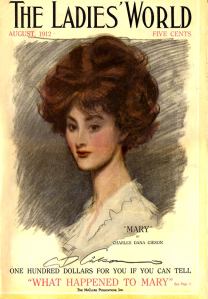
August 1912 cover of US magazine Ladies’ World featuring Mary Fuller and What Happened to Mary. From “The First Movie Serial.”

To what degree the variety format was more successful in attracting a larger and more diverse audience is debatable, but the inclusion of What Happened to Mary seemed a direct appeal to young women. Narrating the adventures of a country girl who comes to the city, What Happened to Mary was produced by Edison in twelve monthly episodes beginning in US picture houses in July 1912 in parallel with the serialized story that appeared in the US mass-circulation women’s magazine Ladies’ World, making its lead actress Mary Fuller into a star (Singer 213). Running from 22 September to 13 December, the first Irish exhibition at Dublin’s Rotunda tied in with its weekly serialization in the British women’s magazine Home Chat (“The Rotunda,” “The Picture Houses”). As such, it was clearly marketed primarily at women. An indication of its local success is the fact that the Rotunda immediately followed it with Who Will Marry Mary?, the Edison sequel, which again featured Mary Fuller.

Although it would take another year for the serial to reach the height of its popularity with such “serial queens” as Helen Holmes the adventurous heroine of The Hazards of Helen and Pearl White in The Perils of Pauline and The Exploits of Elaine, this earlier serial followed some of the patterns of the later ones. Shellley Stamp argues that “for a complete understanding of the template serial heroines offered viewers we must look beyond the screen exploits of Pauline and her compatriots towards the substantial star discourse that circulated around the actresses who played these women on screen” (Stamp 217). Some of the Dublin reviews suggested What Happened to Mary did create the desire in its audiences for more information about Mary Fuller: “‘Alone in New York’ is the second instalment of the ‘What Happened to Mary’ serial; all who have seen the opening scenes of Mary’s adventures will be eager to know more about this fascinating actress” (“Rotunda Pictures” 27 Sep.).
Flapper on Tram IL 24 Oct 1913

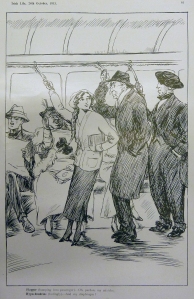
An Irish flapper finds space for herself in the public sphere; Irish Life 24 Oct. 1913: 91.

More specific information on the reception of What Happened to Mary among Irish audiences, and particularly Irish women, does not seem to survive. The fact that the exhibition of the film was tied to the publication of a British magazine is indicative of the subsidiary place of Ireland in the publishing and film industries. The Irish women’s magazine Lady of the House, which had very little to say about cinema of the period, made no mention of the serial, but it and other Irish periodicals show how women were represented in popular media. Was the young flapper shown travelling on a tram in a cartoon in the glossy and expensive Irish Life in October 1913 likely to have found Mary’s adventures or Mary Fuller’s star persona enthralling? Perhaps, but it is not clear that the serial form allowed Mary Fuller to capture the imagination of the public to a greater extent than the at-least-sometimes more active heroines of stand-alone films. In the Herald’s notice for the Rotunda on 30 September, the third episode of What Happened to Mary was not mentioned, but the reviewer focused on the heroine of A Wild Ride, set on a South African ostrich farm, in which “a resourceful and up-to-date heroine, in a situation of dire extremity, outwitted cunning and ferocious savages, rode an ostrich across the trackless veldt at high speed, and brought soldiers to the relief of her imprisoned family” (“Rotunda Pictures” 30 Sep.). Such derring-do in the serial would await The Hazards of Helen, which would not hit Dublin screens until 1915.

Other kinds of film serial followed quickly on the heels of What Happened to Mary and offered different forms of fascination – whether that be attraction or repulsion. Sharing the bill at the Rotunda with A Proposal Deferred, the fifth episode of What Happened to Mary in the week beginning 20 October was the second part of Gaumont’s five-part Fantômas (1913), each of which contained three to six episodes. Directed by Louis Feuillade and based on a popular series of 32 French novels by Pierre Souvestre and Marcel Allain that were published in monthly instalments between February 1911 and September 1913, the films followed the early exploits of the eponymous super villain as he terrorizes Paris (Walz and Smith). “Those who go to the Rotunda this week will, at any rate, get plenty of sensation,” observed the Irish Times.

The film, “Fantomas,” is a choice blend of mystery, tangled plot, and blood-curdling enterprise. It is not easy to grasp all the bearings of the incidents or their mutual relationship. The film, however, introduces us to some remarkable phases of Paris life and its institutions. And the glimpses of the city’s streets and parks are always full of interest. It is very admirably acted by all the characters (“Rotunda Living Pictures”).

Unlike What Happened to Mary, Fantômas did not appear on a reliable weekly or even monthly basis that might establish a loyal pattern of attendance. Nevetheless, even if not regular, Fantômas was popular, and the Rotunda continued to premiere the new parts as they were released, showing The Tragedy at the Masked Ball over the Christmas period of 1913 and the fifth part, The False Magistrate, in June 1914.

These serials were not restricted to city audiences but travelled on the important Irish Animated Picture Company exhibition circuit established by James T. Jameson of the Rotunda. In his praise of Jameson in January 1914, the Bioscope’s Irish correspondent Paddy revealed that two of the What Happened to Mary episodes had recently been seen around the country: A Proposal Deferred had been at Tralee, while the twelfth and final episode, Fortune Smiles – receiving “considerable applause” – was on the programme at Galway. The YMCA hall in Queenstown was showing the fourth part of Fantômas, The Tragedy at the Masked Ball (Paddy). As such they came, no doubt to inhabit the dream and nightmare worlds of many Irish people.

References

Birchland, Robert. “What Happened to Mary?” Hollywood Heritage 18: 2 (Fall 1999). Hollywoodheritage.org. http://hollywoodheritage.org/newsarchive/Fall99/Mary.html. 19 Nov. 2013.

“Exclusives and Other Matters.” Bioscope 9 Oct 1913: 87.

“The First Movie Serial.” 100 Years Ago Today. http://100yearsagotoday.wordpress.com/2012/07/26/the-first-movie-serial/. 19 Nov. 2013.

“The Length of the Film: A Question of Policy.” Bioscope 7 Sep. 1911: 471.

“Man’s Leap to Escape Cinema Robbers.” Evening Herald 25 Nov. 1913: 1.

Paddy. “Pictures in Ireland.” Bioscope 22 Jan. 1914: 351.

“The Picture Houses: Rotunda Pictures.” Evening Telegraph 30 Sep. 1913: 2.

“Pictures at the Rotunda.” Freeman’s Journal 21 Oct. 1913: 9.

“The Rotunda.” Irish Times 23 Sep 1913: 5.

“Rotunda Living Pictures.” Irish Times 21 Oct. 1913: 5.

“Rotunda Pictures.” Dublin Evening Mail 23 Sep. 1913: 3.

“Rotunda Pictures.” Evening Herald 27 Sep. 1913: 9.

“Rotunda Pictures.” Evening Herald 30 Sep. 1913: 5.

“Rotunda Pictures.” Dublin Evening Mail  21 Oct. 1913: 2.

“Rotunda Pictures.” Evening Herald 25 Nov. 1913: 5.

Singer, Ben. Melodrama and Modernity: Early Sensational Cinema and Its Contexts. New York: Columbia UP, 2001.

Stamp, Shelley. “An Awful Struggle Between Love and Ambition; Serial Heroines, Serial Stars and Their Female Fans.” The Silent Cinema Reader. Ed. Lee Grieveson and Peter Krämer.London: Routledge, 2004.

“The Three Musketeers’” Evening Herald 18 Nov. 1913: 5.

Walz, Robin, and Elliott Smith. Fantômas. http://www.fantomas-lives.com/fanto6.htm. 28 Nov. 2013.
“An Objectionable Class from the City”

“One aspect of the strike which has probably not been brought home to the public,” begins a tantalizing article in the Evening Herald on 18 October 1913, “is the effect which it has had upon the amusements of Dublin, such as theatres, music halls, and cinematograph shows” (“Dublin Theatres and the Strike”). Despite offering the views of prominent – albeit unnamed and paraphrased – theatre, music hall and cinema managers, the almost 700-words that follow are, if intriguing, also finally frustratingly unspecific. This is not because as a newspaper owned by employers’ leader William Martin Murphy, the Herald missed few opportunities to point out the folly of Dublin’s striking workers, who had been, it often argued, criminally led astray by union leader Jim Larkin. There are traces of that editorial line here, but the real disappointment is that the writer appears misleadingly to conceive each of these entertainments as being entirely identified with a single class. This, then, looks gratifyingly like a suitable case for analysis and supplement.

The article starts soundly enough by observing that the Lockout affected the city’s entertainments in general in two ways:

firstly, that inasmuch as the earning capacity of some thousands of men has been stopped, therefore their spending capacity has likewise been curtailed.

Secondly, that where the earnings have not been interfered with, among those who are not directly concerned with the strike, yet who live some considerable way from the city, they have been unable to patronise the various entertainments provided for their amusement owing to the difficulties of travel consequent upon the curtailment of the tramway programme (ibid).

A large number of workers with severely reduced income and restrictions on public transport were undoubtedly key factors affecting audience numbers, but the article is less convincing in the argument it makes about the identification of entertainments with particular classes.

It implies that theatre provided entertainment for the social elite, music halls catered for the middle class, and cinema was for the working class. This is done by showing that not all types of entertainment were equally affected by the Lockout. The theatres “have done comparatively well, and the manager of one important theatre stated that had it not been for the strike he would have eclipsed all records” (ibid). Music halls, by contrast,

had suffered considerably, the seats of these houses, whilst altogether more expensive than those of cinematograph shows were cheaper than those of the theatres, so that whereas the man who would pay three or four shillings for a seat at the theatre would and could afford the cost of a conveyance to and from his residence[, t]he man who came from the outlying parts could not, and it is too far to walk a couple of miles each way (ibid).

The difference in ticket prices here seems to create a rigidly stratified system. Stratification based on price, class and type of entertainment certainly existed but not in the way implied here. It is too much of a simplification to state that theatregoers were substantially of a class that could in the absence of trams due to the strike, afford private transport or a cab, while music hall patrons were from a class that lived in the suburbs (to a degree that severely impacted on the business of music halls) but could not afford to pay both for admission and transport home. But the argument become particularly problematic in relation to cinema.

Although the article seems to suggest that the cinematograph shows were competing with music halls for audience, it only discusses picture houses as working-class venues:

In the poorer parts of the city where the cheaper cinematograph shows abound, these have been directly affected by the loss of custom consequent upon those who patronise them being strikers, and therefore, not earning any money. Some of these have suffered severely, and their owners and managers will be very pleased when the strike is settled (ibid).

Certainly the business of picture houses located in working-class areas was affected by the Lockout, but which ones the writer had visited or was thinking of is unclear.

Map Oct 1913

Map of Dublin in 1913 with pins indicating locations of picture houses, music halls and theatres.

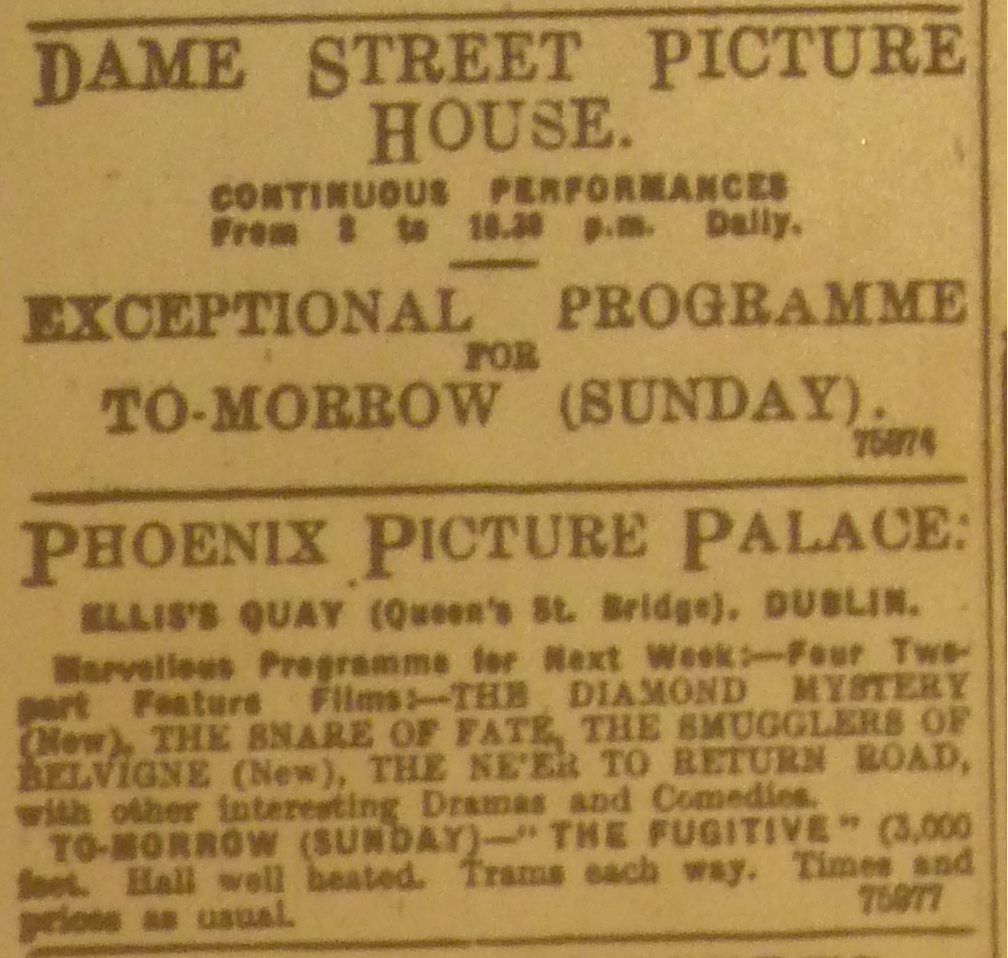
The controversy over the Sunday opening of picture houses suggested that going to the pictures was not just a working class entertainment. On 24 October 1913, the Recorder of Dublin – the city’s chief magistrate – considered an application for a Sunday music licence for the Dame Street Picture House, without which it could not open. From their previous applications in April and July 1913, the proprietors of the Dame Street Picture House knew the authorities’ views that the Grafton and O’Connell Street picture houses “were frequented by persons of the better class, and there was no necessity that they should be opened on Sundays for their benefit” (CSORP/1915/2211). As a result, the proprietors argued that the “people who frequented the Grafton street house were generally people who went shopping. The Dame street house was frequently largely by the working classes, and the object of the application was to give facilities to the working classes to attend performances on Sundays” (ibid). They classed themselves among the picture houses that were allowed to open on Sunday: the Phoenix Picture Palace, the Irish Cinema in Capel Street, the Dorset Picture Hall, the Camden Picture House, the Theatre de Luxe in Camden Street, the Picturedrome in Harcourt Road, the Brunswick Street Cinema, the Princess Cinema in Rathmines, the Mary Street Picture House, the Volta in Mary Street, the World’s Fair Varieties in Henry Street and the Electric Theatre in Talbot Street (ibid).

Dame Phoenix Sunday 1913

Ads for Sunday shows at Phoenix and, despite the Recorder’s ban, the Dame; Evening Telegraph 25 Oct. 1913: 4.

The Recorder did not accept this, contending that Dame Street was one of the city’s principal streets – “near the residence of the King’s representative” in Dublin Castle – and not located in a working-class district (“Picture Houses”). He therefore treated the picture house there as he did the ones in Grafton Street and O’Connell Street by refusing them a Sunday licence. “He would give every facility to Sunday entertainments for the working classes, but he would not, so far as he could prevent it, give up the principal streets to these syndicates on Sundays” (“Sunday Cinemas”).

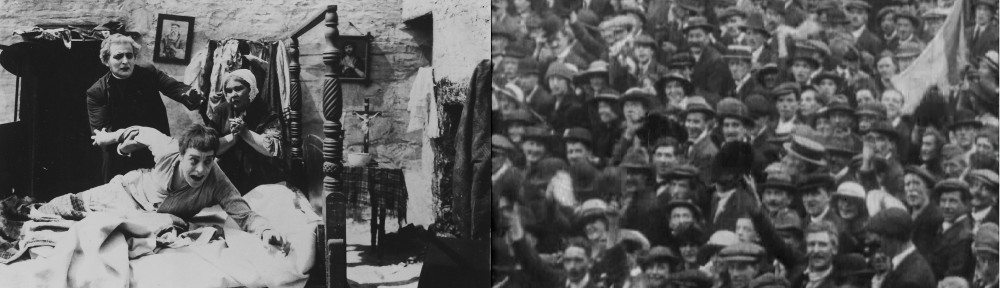
The Recorder’s licensing session also considered local objections to Sunday shows at Clontarf Town Hall, one of the city’s latest picture houses to open – and so not listed above. When Clontarf was incorporated into an expanded Dublin at the turn of the century, the administrative powers of its local council were assumed by Dublin Corporation, and its town hall had no function. Beginning on 18 July 1913, the hall’s leasee George Humphreys ran it as a picture house, with the proviso that he give it up when the Corporation needed it. “Mr. Robertson, (who represented the police) said that he went to the petty Sessions at Clontarf the other day, and they were held in this picture show (laughter)” (“Clontarf Cinema”). Reverend John L. Morrow, chairman of the Clontarf Citizens’ Association objected to the renewal of the picture house’s licence on the basis that local people had not been consulted on its use for this purpose. He complained in particular that its Sunday shows “brought out an objectionable class from the city” (ibid). Humphreys dismissed this claim, observing that “the hall was patronised by people like Ald. Maguire, of Clontarf; Mr. Brady (solicitor), and many other representative and legal gentlemen” (ibid). By 1913, the picture house no longer provided entertainment only for the working class.

References

“Clontarf Cinema: Citizens’ Association: Raise an Objection.” Evening Telegraph 24 Oct. 1913: 3.

CSORP/1915/2211, National Archives of Ireland.

“Dublin Theatres and the Strike.” Evening Herald 18 Oct. 1913: 4.

“Picture Houses: And Licence for Sunday Shows.” Evening Herald 24 Oct. 1913: 2.

“Sunday Cinemas: In Leading Streets.” Evening Telegraph 24 Oct. 1913: 6.