“An Injustice to Good Productions”: Irish Film Distribution, Programme Changes and New Picture Houses in November 1914

The Sign of the Cross.

An exclusive film exhibited in Ireland in November 1914: The Sign of the Cross (US: Famous Players, 1914). Image: The Silent Film Still Archive.

The published information on film distribution in Ireland in the 1910s is useful in general, but it lacks the detail to say something about how Irish cinemas acquired films in, say, November 1914 (Condon, Early Irish Cinema, 215-17; Rockett 38-41). However, the trade press, particularly the London-based Bioscope, and the local papers that month give some more specific details. By this time, exhibitors no longer bought films outright, as the – much smaller number of – exhibitors in the 1900s had. Films were rented from distributors or renters, and the distribution business in Ireland and Britain was based in London. The sea crossing was an issue for distributors into Ireland, particularly as military operations changed the priorities on the transport of goods in 1914. However, such issues were more easily negotiated by the film distributors who had offices in Ireland or worked through Irish agents.

Bioscope 6 Aug. 1914: xix.

Ad for Gaumont’s Chrono projector; Bioscope 6 Aug. 1914: xix. This ad appeared just as war was breaking out; even a few weeks later, it would not have been acceptable in the context of discussions of severing links with enemy companies as part of the war effort.

“I dropped up the other day to see Mr. Young of the Gaumont Company, Lord Edward Street, Dublin,” revealed Irish correspondent Paddy in the Bioscope in early November 1914 (Paddy, 5 Nov.). Since opening early in 1913, the luxuriously appointed Dublin branch office of Gaumont in London sold the company’s popular Chrono projector, held trade viewings in a dedicated screenings room of the films it distributed, and shot many local topical films since its first ones in June 1913, such as The Launch of the Britannic and a film of a hurling match between Kilkenny and Cork (13 Nov.). Paddy noted that “Mr. Young seemed pleased with how matters were progressing, and he expressed the opinion that the falling off on account of the war was practically negligible” (5 Nov.). A year earlier, Paddy had found Young’s predecessor also pleased with business, including the fact that “[a] great many more Irish theatres have thrown in their lot with the Gaumont Film Service” (13 Nov.), including the Grand in Dublin’s O’Connell Street (Paddy, 24 Jul.), Limerick’s Gaiety Bijou (7 Aug.), and Belfast’s Princess Picture Palace (“Jottings,” 12 Nov.).

Gaumont did not have Irish distribution to itself. In November 1914, the Ideal Film Renting Company set up their Dublin office at 40 Dawson Street, Dublin. “There is little doubt that by opening in Dublin,” opined Paddy, “The Ideal Company have stimulated competition and made it possible for exhibitors to make a better selection on the spot” (5 Nov.). Among the exclusive films that Ideal handled were Danish production company Nordisk’s For the Sake of a Man (1913) and Her Hour of Temptation (1914), as well as Joan of Arc (Italy: Savoia, 1913), for which “[s]pecial posters are available” (ibid.).

1The Palace, Frances Street, Newtownards whowing Cecil B. DeMille's The Ten Commandments (1923). http://www.newtownards.info/frances-st.htm

The Palace, Frances Street, Newtownards showing Cecil B. DeMille’s The Ten Commandments (1923). http://www.newtownards.info/frances-st.htm

Other London-based distributors relied on travelling salespeople or on the Irish-based companies that acted as their agents. In the week of 5 November, Paddy also “ran into Mr. Hagan, the Scottish and Irish representative for Messrs. Ruffells’ exclusives,” who “had secured bookings running to over £350” (ibid.). Norman Whitten’s General Film Supply (GFS) appears initially to have been a branch of the London-based General Film Agency, and although Whitten was better known as a maker and distributor of his own local topicals, GFS also distributed the films of other companies. Some larger Irish cinema chains, such as James T. Jameson’s Irish Animated Picture Company, had their own buyers in London (Condon, “Limelight,” 253). An “Item of Interest” in the Bioscope on 19 November informed trade readers that the Palace in Newtownards, Co. Down, had appointed Lillah Dawson as its film reviewer: “Miss Dawson has recommended the features booked at this hall during the past few weeks, and as a result the seating accommodation and the cork lino have come in for some severe wear, strong evidence that this lady weighs up a subject in a capable and experienced manner” (“Film Reviewer Appointed”).

Depending on the nature of the programme at the picture house or houses concerned, a representative such as Dawson might have had a more or less arduous job. Something has already been said here about the content of the film programme, particularly in regards to the number and length of the films and the length of the programme itself. The dominant practice in cities and towns was for picture houses to change their programmes twice a week, on Monday and Thursday, with a third change for those picture houses that held a Sunday licence. As a result, most films had a three-day run, with the possibility of holding over an especially attractive film – most likely, an “exclusive” – for the second half of the week, in which case the other items on the programme were usually changed. A run of longer than six days for any film was really exceptional. Shorter runs were possible. In early November 1914, Dublin’s Rotunda advertised the fact that beginning on 9 November, it would have three changes in the week, which for this venue with no Sunday licence meant two-day programmes, with changes on Monday, Wednesday and Friday. “Large audiences,” a preview in the Evening Telegraph predicted, “are sure to appreciate this move on the part of the management, who certainly spare no expense in catering for the entertainment of their patrons” (“Rotunda Pictures”).

“Programmes Changed Daily: An Injustice to Good Productions.” Bioscope 19 Nov 1914: 789.

An extract from a Bioscope article discussing daily programme changes at the Omagh Picture Palace; 19 Nov 1914: 789.

The generosity – if it can be called that – of the Rotunda management was no match for that of the management at the Picture Palace in Omagh, Co. Tyrone, a town with a population of less than 5,000. Just ten days after the Rotunda had instituted its new programming changes,a Bioscope article drew attention to the fact that the Picture Palace changed its programme every day. As the article’s subtitle – “An Injustice to Good Productions” – suggests, the writer of this article – described as “our Ulster representative,” so presumably it was the writer of the “Jottings from Ulster” column – saw this as an unusual and unwelcome development (“Programmes Changed Daily”). Although conceding that “a manager on the spot knows his own business best,” s/he endorsed the arguments of “a very astute Ulster manager, who favours the bi-weekly change” because of the mutually supporting nature of printed and word-of-mouth publicity:

He argues that on a Monday and Tuesday a hall attracts by its publicity matter only those patrons of the movies who are influenced by good pictorials and by well-written and attractively-set letterpress. On the Tuesday and Wednesday, and again on the Friday and Saturday, the advertising ceased to be of any account. Personal recommendation or condemnation takes its place and either does such good as to comfortably fill the hall, whilst the programme runs, or is so hurtful in its effects as to prove the incompetency of the manager in the selecting of such pictures as please the majority of the people of his district. (Ibid.)

1Ads for Omagh Picture Palace showing variations in programming. Tyrone Constitution 30 Oct. 1914: 4 and 6 Nov. 1914: 4.

Ads for Omagh Picture Palace showing variations in programming. Tyrone Constitution 30 Oct. 1914: 4 and 6 Nov. 1914: 4.

The trade anxieties manifest in this advice about the effective rhythms of advertising had little to do with the Picture Palace’s choice of films but more with the number of films required. Driven from Home (1914), Shadows (US: IMP, 1914) and Lost in Mid-Ocean (US: Vitagraph, 1914) “want a lot of beating as star subjects. Why not, therefore give them an opportunity to prove their value?” (ibid.). Indeed, assuming a complete daily change of programme, the Picture Palace would likely have shown between 25 and 50 films a week, depending on their length. This suggests that the management had a very different view than the Bioscope of the nature of the entertainment it provided. The competing interests of film producers and exhibitors were shown in late November 1914, when the Bioscope cited the call by Carl Laemmle, head of the US production company Universal, to “cheaper American theatres to raise their prices of admission [to cover] the growing cost of film production” (“Trade Topics”). The management of the Omagh Picture Palace appears to have paid little attention to the quality of individual films and focused instead on audience choice and creating a constituency of daily cinemagoers.

First ad for Sandford Cinema; Evening Herald 3 Nov. 1914: 4.

First ad for Dublin’s Sandford Cinema; Evening Herald 3 Nov. 1914: 4.

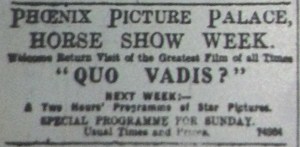
Omagh’s abundance of films seems to parallel a more general return of optimism to the Irish film trade in late 1914, which saw the opening of some new picture houses. “That little thought is here given to the approach of lean days,” “Jottings” observed, “is evident from the fact that a new hall is now in full swing in Lurgan, under the direction of Mr. Hewitt”, as well as from the enlargement of Lisburn’s Electric Palace, and the equipping of new picture houses in Coleraine and Belfast’s Corn Market (5 Nov.). In Dublin, the Sandford Cinema opened on 2 November with little newspaper publicity. The first notice was a brief review in the Evening Herald the following day, alongside reviews of the Kinemacolor pictures at the Theatre Royal, the Phoenix Picture Palace’s screenings of The Sign of the Cross (US: Famous Players, 1914) – the most heavily publicized film in Ireland in late 1914 – and the Masterpiece Picture House. The review did not give the titles of the films that “were so much admired at the opening show,” focusing instead on the decor of the building that “is sumptuously fitted up interiorally, the costly furniture being supplied by Clery and Co., Ltd.” (“New Picture Theatre in Ranelagh”). Paddy later revealed the opening “star films” to have been England’s Menace (Britain: London, 1914) and The Village of Death (19 Nov.). No other newspaper coverage of the Sandford appeared in the first week of November, but in the following week, several papers carried ads for In the Bishop’s Carriage (US: Famous Players, 1913), with Mary Pickford, for the first three days and The Wheels of Destiny (US: Majestic, 1914) for the last three.

Managed by John and P.W. Whittle, the Sandford was “quite a high-class” picture house, “replete with all modern conveniences,” including Gaumont projectors and the “indirect system of lighting” in the auditorium (Paddy, 19 Nov.). Paddy found the building to be “a beautiful structure, with a fine flight of steps leading up to the pay-box. The entrance doors are finished in stained glass,” and inside, there was a “considerable rake to the floor, thus enabling all patrons to have a full view of the screen” (ibid.). Despite this focus on the experience of all cinemagoers, the audience was to be divided based on ticket price both outside and inside the premises. “The building stands on a corner site, thus enabling the 3d. entrance to be distinct from the 6d. and 1s., [and once inside, the] 1s. seats are distinguished from the 6d. by neat squares of crochet work on the backs” (ibid.). The management did not, however, show the same attention to detail in securing the required official documents, and it was prosecuted on 20 November for operating without a cinematograph licence (“Sandford Cinema Theatre”). Nevertheless, Inspector Gray of the Dublin Metropolitan Police testified that the premises were “extremely comfortable and suitable in every way for a picture theatre. The pictures he had seen were excellent” (ibid.).

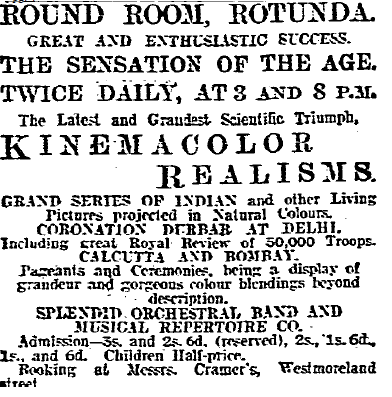
Elsewhere – and almost everywhere – war films remained popular. When Dublin’s Daily Express reviewed In the Hands of the Kindly Dutch at the Rotunda in early November, it emphasized the personal response many in the audience might have made to topical films about the war. The film “shows the division of the Naval Brigade who were interned in Holland after the surrender of Antwerp , and was so clear that anyone could recognise a relative or friend” (“The Rotunda Pictures”). In the same week, the Kinemacolor matinees at the Theatre Royal were providing colour films of the front. The fact that these films were shown in such a large theatre rather than in one of the smaller picture houses indicates that the management expected considerable interest in them, and it went out of its way to create further publicity. “On the kind invitation of the management,” the Express reported, “a number of wounded soldiers attended the [Kinemacolor war films] yesterday, and received quite an ovation from the large audience. Others who were unable to attend will be present this afternoon” (“Theatre Royal”).

Evening Telegraph 28 Nov. 1914: 6.

Evening Telegraph 28 Nov. 1914: 6.

Although the Express observed that “[t]he audience yesterday was unreservedly enthusiastic concerning the display” of war pictures at the matinee, certain members of the audience at the Theatre Royal were neither enthusiastic nor reserved about patriotic displays at the theatre’s live evening show (“Picture Matinees”). On 2 November, a group of young men wearing republican badges protested by booing, hissing and groaning when, during one musical number, several Union Jack flags were unfurled and the orchestra played “Rule Britannia.” When 18-year-old Thomas Smart refused to stop, he was arrested and fined 40 shillings in court (“Scene in Theatre Royal”).
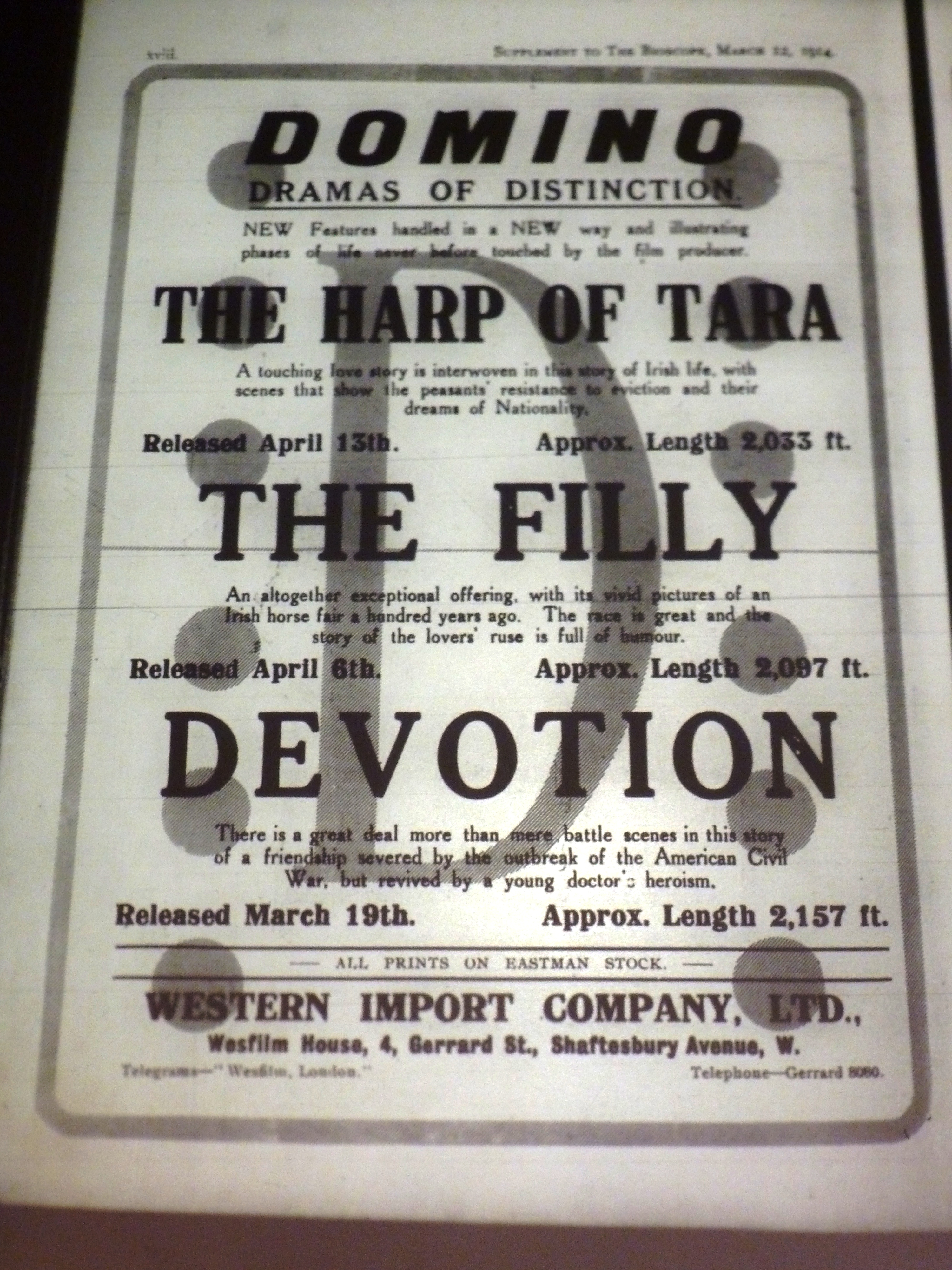
Ad for two Irish-themed films from the US production company Domino; Bioscope 12 Mar. 1914: xviii.

Ad for two Irish-themed films from the US production company Domino; Bioscope 12 Mar. 1914: xviii.

Smart and his fellow protestors might have been more appreciative of the Irish week run by the Masterpiece at the end of November. The main film was True Irish Hearts (US: Domino, 1914), supported by The Filly (US: Domino, 1913), Rory O’More (US: Kalem, 1911), The O’Neill (US: Kalem, 1912), films of Irish scenic landscapes and a topical of the Castlebellingham Feis and Louth Volunteers. During the previous week, manager Cathal McGarvey “had appeared personally at each performance during the week in his original humorous monologues, and these met with a great reception, there being no better humorous reciter in Dublin than Mr. McGarvey” (Paddy, 19 Nov.). For the Masterpiece’s Irish Week, however, McGarvey allowed popular baritone W.A. Sheehan to enhance the live musical accompaniment by singing Irish songs (“An Irish Week”). These kinds of Irish Weeks were not new, but they were facilitated by the fact that such producers as Domino and Kalem were continuing to make Irish subjects. The Domino titles were new ones, available through Western Import since March and April 1914, but the Kalem ones were older titles that required that a distributor – in this case, the Express Film Service – hold on to them for such events.

References

Condon, Denis. Early Irish Cinema, 1895-1921. Dublin: Irish Academic, 2008.

—. “Limelight on the Colleen Bawn: Resisting Autoexoticism in Provincial Irish Picture Houses in the Early 1910s.” Les cinémas périphériques dans la période des premiers temps. Peripheral Early Cinema: Domitor 2008. Perpignan: PU Perpignan, 2010. 245-255.

“Dublin and District: Ranelagh’s New Picture House.” Irish Independent 10 Nov, 1914: 4.

“Film Reviewer Appointed.” Bioscope 19 Nov. 1914: 706.

“An Irish Week at the Masterpiece.” Evening Telegraph 28 Nov. 1914: 6.

“Jottings from Ulster.” Bioscope 13 Nov. 1913: 589; 5 Nov. 1914: 543; 12 Nov. 1914: 647.

“New Picture Theatre in Ranelagh.” Evening Herald 3 Nov. 1914: 4.

Paddy. “Pictures in Ireland.” Bioscope 24 Jul. 1913: 267; 7 Aug. 1913: 413; 13 Nov. 1913: 601; 5 Nov. 1914: 525; 19 Nov. 1914: 736.

“Picture Matinees at the Theatre Royal.” Daily Express 3 Nov. 1914: 8.

“Programmes Changed Daily: An Injustice to Good Productions.” Bioscope 19 Nov 1914: 789.

Rockett, Kevin and Emer. Film Exhibition and Distribution in Ireland, 1909-2010. Dublin Four Courts, 2011.

“The Rotunda Pictures.” Daily Express 3 Nov. 1914, 2.

“Rotunda Pictures.” Evening Telegraph 7 Nov. 1914: 6.

“Scene in Theatre Royal: A Row in the Gallery.” Daily Express 4 Nov. 4 1914: 3.

“Sandford Cinema Theatre.” Evening Telegraph 21 Nov. 1914: 4.

“Trade Topics.” Bioscope 26 Nov. 1914: 821.
“Driven to See Pictures Instead of Plays”: Joseph Holloway Goes Out in 1914 Dublin

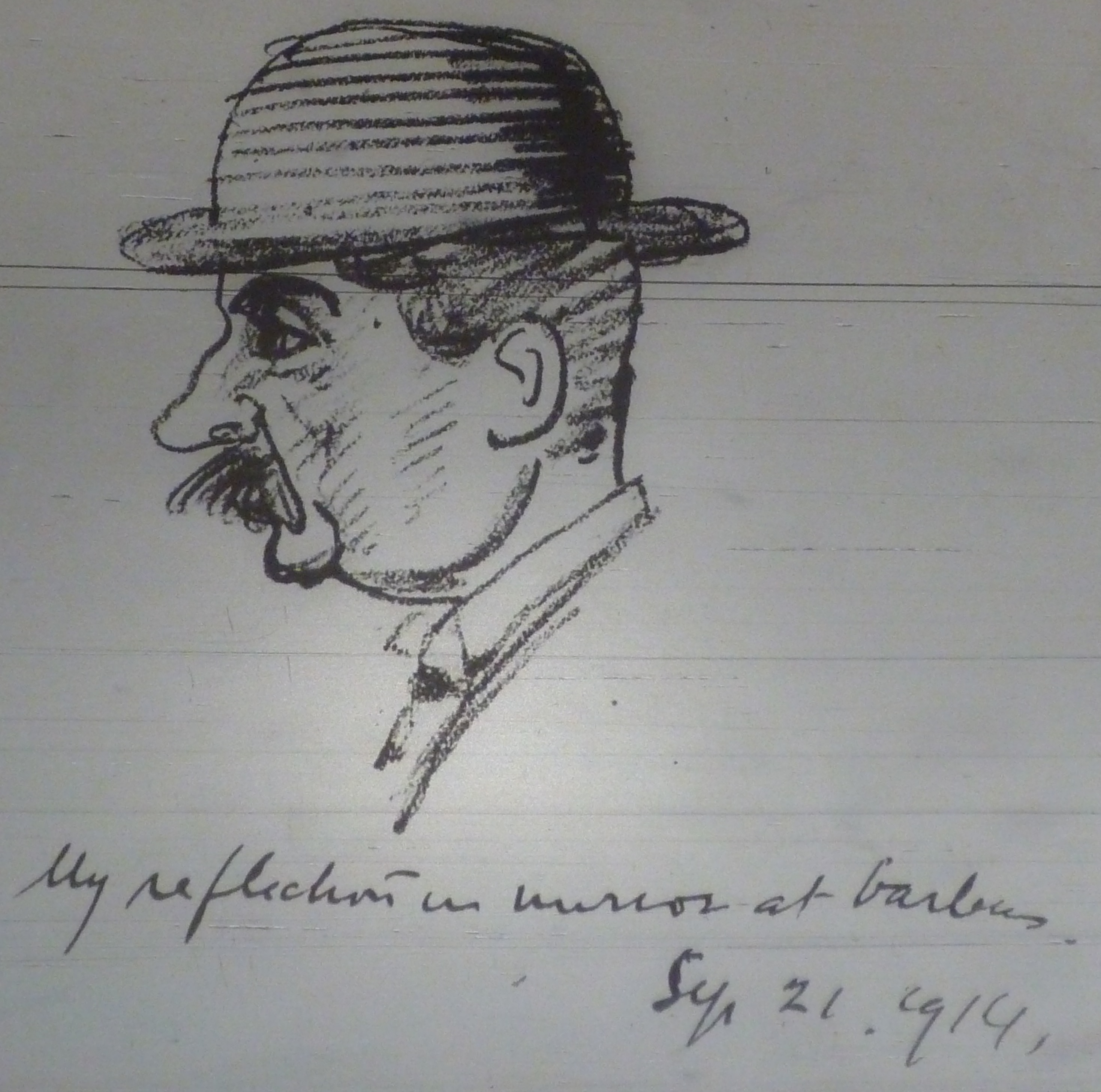
Joseph Holloway's "My Reflection in Mirror at Barbers," 21 Sep. 1914.

Joseph Holloway’s self-portrait “My Reflection in Mirror at Barbers,” 21 Sep. 1914. National Library of Ireland.

On Friday, 31 July 1914, Joseph Holloway – the sometimes architect but more often theatregoer – recorded a moment of cultural angst: “Was at two picture Houses during the day – the Grafton & Rotunda, where a few good films were on view,” he noted in his diary before adding: “It’s terrible to be driven to see pictures instead of plays! I fear the theatres in Dublin are dead for the present.” The death of theatre in Dublin was a cause of serious concern for Holloway, whose diary records the minute attention he paid to shows at Dublin’s “legitimate” theatres – the Theatre Royal and Gaiety – at its melodrama house – the Queen’s Royal Theatre – and at its music halls – the Empire and Tivoli. Despite his unhappiness with theatrical offerings at this time, he nevertheless attended as many plays and shows as he could fit in a life largely filled with the leisure that a small inheritance allowed him. The diary in which he records the details of these shows – as well as his conversations and correspondence with the luminaries and ordinary people of the time – is an incredible work of life writing that has been estimated as running to more than 25 million words (Ferriter). This is not because of the great critical insights he offers; his diary has been described by Irish author Frank O’Connor as “that donkey’s detritus” and by Sean O’Casey as “an impossible pile of rubbish” (ibid). Nevertheless, despite the limited perspective of a middle-class conservative Catholic nationalist, it offers fascinating glimpses into life and leisure as they were experienced in Dublin in the 1910s, including the city’s emerging cinema culture.

Holloway’s viewing of the two film shows in late July 1914 was not unprecedented, nor was it the first time he had expressed his dissatisfaction with picture houses while being a regular cinemagoer. Since the Picture House in Sackville/O’Connell Street had opened in April 1910, Holloway had often visited it and the other picture houses that opened with increasing regularity in its wake. Although he sometimes visited picture houses alone, he also accompanied his mother Anne Holloway and his niece Eileen O’Malley, with whom he lived, demonstrating the popularity of the picture house across three generations (Condon 143). By September 1914, Holloway’s life was changing along with the city’s entertainment offerings, not to mention the political upheavals of the period. The death of his mother in May 1912, and the marriage of Eileen on 16 September 1914 left him living alone and without a cinema-going companion.

As well as this, the breakdown of the longstanding distinctions between Dublin’s legitimate theatre, melodrama house and music hall was particularly visible just as the war began in the autumn of 1914. This was part of an international process by which entertainment companies were buying up and building theatres of all kinds to create chains that sought large popular audiences by providing a modified form of variety entertainment that could accommodate popular music hall artistes and dramatic actors, as well as film. Dublin’s Theatre Royal had long been experimenting with this modified variety, which it called by a name already popular in many British cities: hippodrome. Marvelling at the popularity of the Royal’s hippodrome seasons during the summer period when the theatres usually closed, the theatrical columnist of Irish Life dubbed hippodrome “the Chief Priest and Apostle of the Music Hall in Dublin” (“Between the Acts”). “[I]ts hold over the public is simply amazing. The “two-nightly house” show can apparently thrive under any circumstances. In Dublin it has captured all classes, and has proved itself a most profitable undertaking to those engaged in it” (ibid). Film featured not only as part of the evening programme in the guise of the Royal Bioscope but also at a separate film matinee.

Ad for the Theatre Royal Hippodrome and Winter Gardens, Sep. 1914, featuring film matinees of Nature's Zoo. National Library of Ireland.

Poster for the Theatre Royal Hippodrome and Winter Gardens, Sep. 1914, featuring film matinees of Nature’s Zoo (Britain: Cherry Kearton, 1913), a film that the Royal also exhibited a year earlier. National Library of Ireland.

In early August, Ireland’s Attorney-General and Solicitor-General heard application for patents that would allow legitimate drama from the Star Theatre of Varieties, Ltd., the company that ran the Empire, and from the Premier Picture Palace (Dublin), which proposed to build a large theatre in the city centre on a site off Henry Street and close to the GPO. As the latter’s name suggests, this company had initially planned to open a large picture house but had decided that a variety theatre with the flexibility of mounting plays and showing films would be more profitable. The company would eventually open in April 1915 what was then known as the Coliseum Theatre, a short lived venue that would not be rebuilt following its destruction a year after its opening during the 1916 Rising. The proprietors of the Coliseum included Lord Mayor Lorcan Sherlock, two directors of Dublin’s Tivoli Theatre and theatrical agent Fred Willmott (ibid.). Holloway attended the hearing and spoke as an expert witness – “as an old theatre-goer with 40 years experience” – in support of the Star Theatre of Varieties’ application, arguing that the granting of a dramatic patent would benefit the city by providing the opportunity for more play to be performed (“What Is a Revue?”).

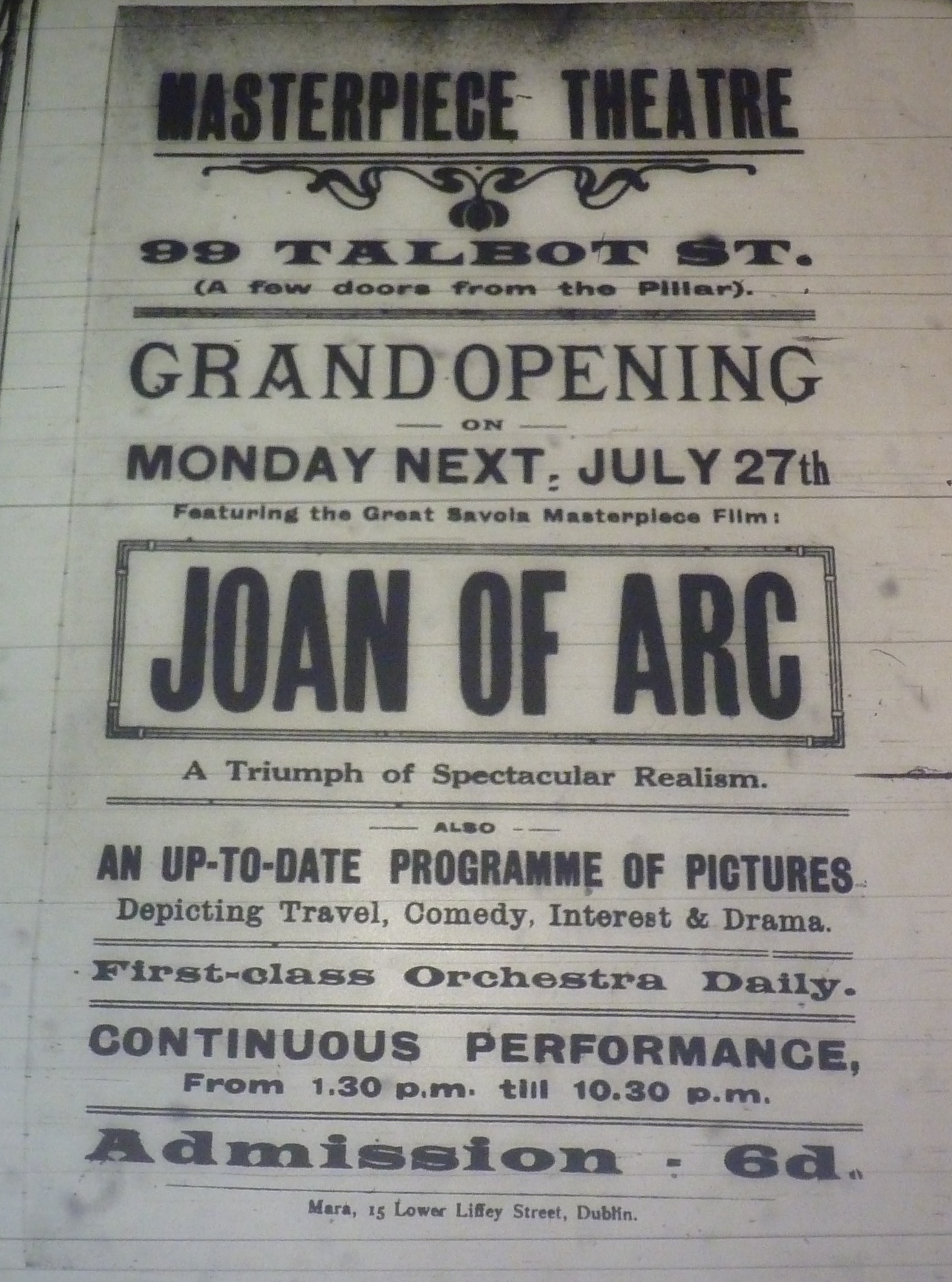
Handbill for opening of the Masterpiece Theatre (Holloway 27 Jul.)

Handbill for opening of the Masterpiece Theatre preserved in Holloway’s diary (Holloway 27 Jul.)

While lobbying in support of more plays and continuing to attend theatrical shows of all kinds, Holloway also visited picture houses regularly. During July and the first half of August 1914, he records twenty visits to Dublin picture houses, fourteen of them alone in July. On the evening of Thursday, 2 July, he went to what he insisted on calling the O’Connell Picture House (but the proprietors persisted in calling the Picture House, Sackville Street) where he saw the “beautiful touching film ‘Child o’ My Heart’” (Britain: London, 1914); on the afternoon of Monday, 6 July, he saw The Afghan Raiders and When Lions Escape (US: Columbus, 1914) at the Rotunda, and “both were full of thrills!”; on the evening of Wednesday, 8 July, he saw the Western Love Triumphant and a newsreel of Joseph Chamberlain’s funeral at the Grafton; on the evening of Friday, 10 July, he saw From the Lion’s Paw and “a thrilling abduction story, both well acted” at the Rotunda; on the evening of Monday, 13 July, he saw The Game of Life (US: Selig, 1914) at the Rotunda, which he found “a particularly exciting one & also an Indian story of the new medical man” [The New Medicine Man (US: Kalem, 1914)]; on the evening of Saturday, 18 July, the films he saw at the Grafton included Lost at Sea (France: Eclair, 1913), Nan Good-for-Nothing (Britain: London, 1914) and a newsreel from Dublin’s Civic Exhibition featuring rival architect George O’Connor, “[a]s large as life & equally as massive!”; on the evening of Monday, 20 July, he admired at the Grafton both The Black Pearls (US: Geroges Méliès, 1914), “a real thriller enacted finely by French players,” and The War Bonnet (US: Kalem, 1914), “an Indian story [that] was fairly interesting chiefly because of its beautiful natural setting; on the afternoon of Tuesday, 21 July, he was amused by The Blood Test (US: IMP, 1914) and an unnamed comedy at the Rotunda; on Thursday, 23 July, he visited the Grafton, where he saw “a few good dramatic pictures & others I didn’t care for,” and later the Rotunda, where The Master Crook Turns Detective (Britain: British and Colonial Kinematograph, 1914) “was the most dramatic & best enacted”; on the evening of Friday, 24 July, His Reformation (Britain: London, 1914) at the O’Connell was the best of “the few more or less interesting pictures” he saw; on Monday, 27 July, he found Joan of Arc (Italy: Savoia, 1914) at the opening of the Masterpiece Theatre “dull and left after ending of part 3,” but enjoyed The Mansion of Sobs (US: Lubin, 1914), “a very good child picture & a funny [John] Bunny picture” later at the Grafton; on Friday, 31 July, he had the two visits to the Grafton and Rotunda that caused him such anxiety about the death of theatre.

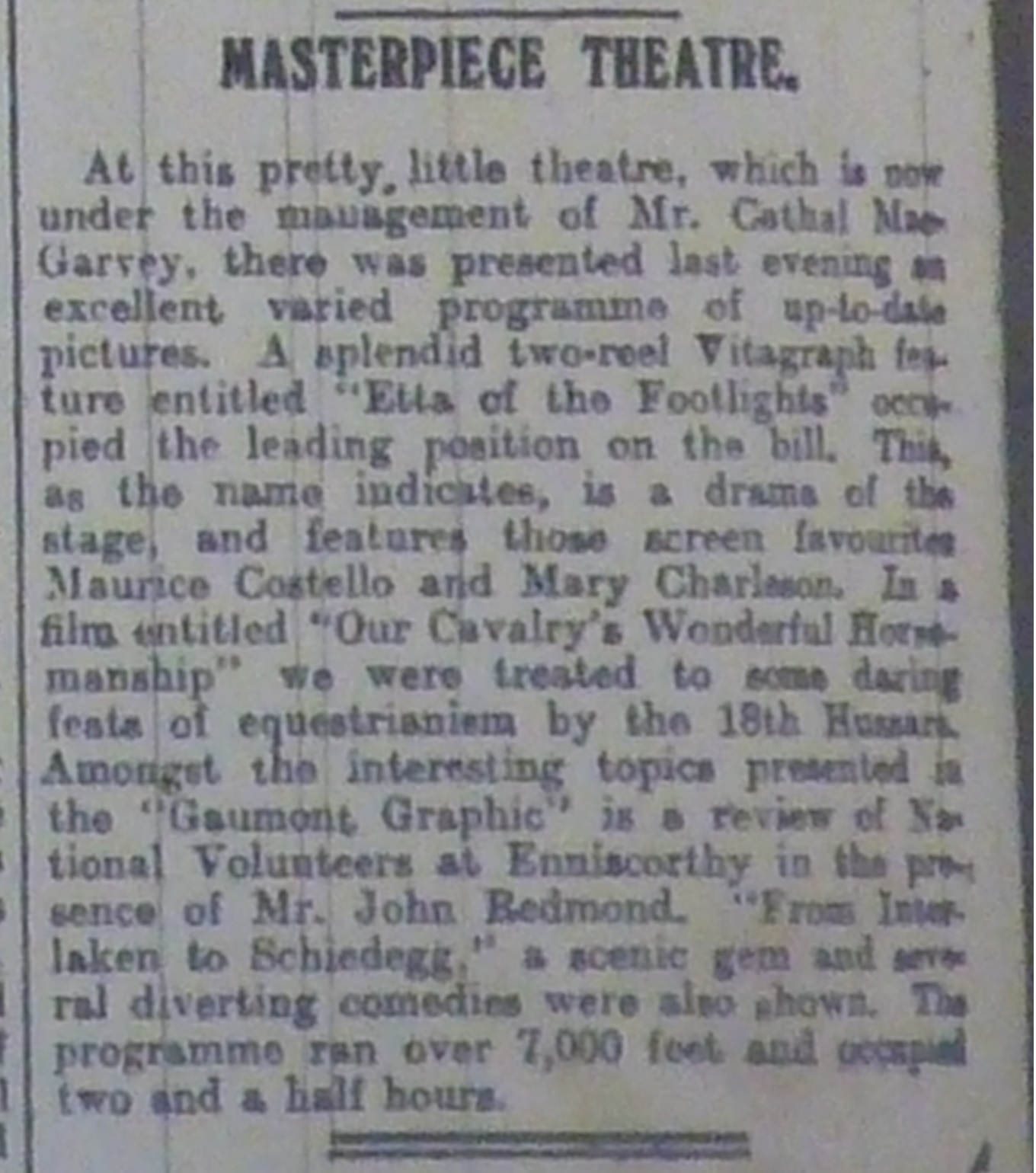
Evening Telegraph review of programme at the Masterpiece, 22 Sep. 1914: 2.

Evening Telegraph review of programme at the Masterpiece, 22 Sep. 1914: 2.

The first half of August shows the same rate of picture house attendance, with Holloway visiting a cinema on average almost once every two days. On the evening of Saturday, 1 August, he went to the “exciting film drama” Devil’s Gap at the Dorset Picture House; on the evening of Monday, 3 August, he and Eileen found the programme at the Grafton poor, particularly the vulgar Across the Hall (US: Keystone, 1914), but the evening was somewhat redeemed by Bertie in the Ladies’ College (Britain: Eclair, 1914) and ’Fraid Cat (US: Vitagraph, 1914), “a clever child film”; at the Rotunda on the evening of Thursday, 6 August, he found A Life for a Life “quite pathetic” and was moved – unusually – to write a synopsis of it; Ivy’s Elopement (Britain: Ivy Close Films, 1914) at the O’Connell on 8 August was “set in exquisite surroundings & was really beautiful”; on Wednesday, 12 August, he saw England’s Menace (Britain: London, 1914) with Eileen at the Grafton, “where we saw some fine films, and were entertained by a man with a most aggressive sneeze”; on Friday, 14 August, he attended the 6:30 show at the Rotunda with just a handful of others, attributing the small attendance to “the unruly elements” of thunder showers, roving soldiers “and the unfortunate girls [who] had come out to meet them.”

Over this period, he attended the Rotunda and Grafton almost equally with eight and seven visits respectively. The O’Connell was his next most favoured picture house with three visits; and the Masterpiece and Dorset received one visit each. After the visit to the Masterpiece on 27 July, he appears not to have visited it again until two months later, on Saturday, 26 September, when the well-known comedian Cathal MacGarvey took over its management. Holloway “met Mr M’Garvey at the door – he has only taken up the reins a week ago & scarcely feels his feet yet – he hopes to work it into a big success – The programme was first rate & I told him so as I came out.” Holloway did not mention what was on the programme, but MacGarvey’s appointment drew some welcome publicity to the Masterpiece, and as a result, notices show that Holloway would have seen the drama Etta of the Footlights (US: Vitagraph, 1914) with Maurice Costello and Mary Charleson – which was also showing at the O’Connell – “some daring feats of equestrianism by the 18th Hussars” in Our Cavalry’s Wonderful Horsemanship, the scenic film From Inverlaken to Shiedegg, and a Gaumont Graphic newsreel that included “a review of the National Volunteers at Enniscorthy by Mr. John Redmond and (“Masterpiece Theatre”). It is likely that the location of the last film is mistaken and that this was a film of the infamous speech at Woodenbridge, Co. Wicklow, in which Irish nationalist leader Redmond called on the Volunteers to join the British Army.

Film lover Dr Knott. Holloway Diaries.Aug. 1914

Film lover Dr Knott. Holloway Diaries. National Library of Ireland.

Unlike his often very detailed accounts of theatre shows, Holloway wrote frustratingly little on the films he saw, often not even giving their names. He does, however, sometimes remark on the behaviour – and even mention the names – of members of the audience, some of whom he also occasionally sketched. On the evening of Monday, 1 June 1914, he reveals, the large audience at the Grafton included “AE (George Russell) & Prof. Maginnis.” The aggressively sneezing man at the Grafton on 12 August allowed him some interaction with other members of the audience:

Even the film drama – “England’s Message” – which was loudly applauded – he sneezed often. ”Though its subject wasn’t to be sneezed at!” I said to Eileen, & the man next her, who had been applauding his hands off almost when the foreign fleet in the picture story turned tail & went home, smiled at & approved of my turn of phrase.

However, the behaviour of other audience members could be annoying, as it was on 8 July at the Grafton during the newsreel of Chamberlain’s funeral: “a man behind me kept up a regular tattoo with his fingers on the crown of his straw hat, which was irritating to all save himself. I know he maddened me!” Some people he knew were regular picture house patrons. James Crawford Neil enjoyed natural history pictures (23 Jul. 1914). Dr John Knott, “haunts the picture houses” (16 Sep 1914) and seems to be constantly “seated rather close up to screen” (30 May 1914). Like Knott, Holloway also haunted Dublin’s picture houses, and despite his periodic fears about cinema displacing his beloved theatre, he appears, on balance, to have enjoyed his time in front of the screen.

References

“Between the Acts.” Irish Life 10:2 (24 Jul. 1914), p. 68.

Condon, Denis. “‘Temples to the Art of Cinematography’: Cinema on the Dublin Streetscape, 1895-1929.” Visualizing Dublin: Visual Culture, Modernity and the Representation of Urban Space. Ed. Justin Carville. Bern: Peter Lang, 2013. 132-54.

“Drama in Dublin: Premier Picture Palace Application: Lord Mayor’s Views.” Evening Herald 7 Aug. 1914: 2.

Ferriter, Diarmaid. “Holloway, Joseph.” Dictionary of Irish Biography Online. Cambridge UP and Royal Irish Academy, 2009. Web. 30 Sep. 2014.

Holloway, Joseph. Holloway Diaries. National Library of Ireland.

“Masterpiece Theatre.” Evening Telegraph 22 Sep. 1914: 2.

“O’Connell Street Pictures.” Evening Telegraph 15 Sep. 1914: 2.

“What Is a Revue? Manager Tries to Explain It: Drama in Dublin.” Evening Herald 6 Aug. 1914: 3.

“An Immense Power in the Refinement of the World”: Women Musicians in Irish Picture Houses

As the emergence of cinema in the early 1910s changed the nature of Irish popular entertainment, it offered certain women new career opportunities. Although there were some women picture-house managers and jobs in ticket and refreshment sales were generally reserved for women, the largest number of skilled picture-house jobs available to women were as musicians. Every new picture house had at least one musician, and as the 1910s progressed, the prestige of a picture house could be measured by the number of musicians in its orchestra, including known concert musicians whose solos could be advertised as discrete attractions. The boom in picture houses was also a boom in musical employment. For both men and women, these increasingly professionalized jobs required the kind of extended education available only to the middle class. The growing prestige of cinema opened up possibilities for suitably trained women of this class who needed or desired an income but who were restricted from much paid work by barriers to the professions and by such nebulous controls as the discourse on respectability, which, for example, put the menial work undertaken of necessity by many working-class women beyond consideration – or at least, acknowledgement. As such, the increasing number of women cinema musicians is also an index of the increasing acceptability and even respectability of cinema itself, which these women were helping to foster by taking these jobs.

Dorset Picture Hall’s advertisement for staff. Irish Times 20 March 1911: 1.

“Eva Hickie, late pianiste at the Dorset Picture Hall, Dublin, has accepted a similar position at Waterford,” reported Paddy, the Ireland correspondent for the British film trade journal the Bioscope,in mid-April 1914 (Paddy, 16 Apr. 1914). Three years previously, the 1911 Census of Ireland had listed just one Eva Hickie: the 25-year-old head of a household of five siblings and an aged servant, who were living in the north-city suburb of Phibsboro, not far from the Dorset. This Eva Hickie’s occupation is not mentioned, but by Census night, 2 April 1911, she may already have responded to Dorset manager William Shanly’s recent advertisement for “a Lady pianist […] who can play for pictures.” Whether or not she had applied for the job, she was not counted among the 979 Irish women who used the word “music” in the description of their occupation in the Census – the vast majority of them music teachers – and the further 94 who described themselves as musicians.

Despite this lack of self-definition as a musician, Hickie in many ways resembles May Murphy, the most prominent woman musician in Irish cinemas of the early 1910s. The Census puts both women in their mid-twenties and heading households of siblings belonging to the Catholic middle class, for whom music constituted one of the limited choices for respectable employment for women. However, Murphy appears to have been the more socially secure of the two, describing herself in the Census – as did 75 other women – as a professor of music. Although her previous career is obscure, by March 1912 she was leading the Irish Ladies’ Orchestras at James T. Jameson’s most prominent venues: Dublin’s Rotunda and the Pavilion in Kingstown, Co. Dublin:

A potent factor in the success with attends the pictures in the Dublin Rotunda Rooms and the Kingstown Pavilion is the Irish Ladies’ Orchestra, under the direction of Miss Murphy. In the Rotunda there are seven instrumentalists; in Kingstown three. Combined with the crimson and white colour scheme of their dresses, their little Zouave jackets complete a picture of dainty Bohemianism. Mr Jameson is to be congratulated on securing such a permanent attraction. (Paddy, 14 Mar. 1912)

Women’s orchestras were rare but by no means completely novel, and Dublin theatrical audiences might have been familiar with such acts as Les Militaires, a 12-piece women’s orchestra led by Mrs. Hunt and wearing Hussar uniforms and tricorn hats that had visited the city in 1889 (Watters and Murtagh 109-10). Neverthless, the visual spectacle of the Irish Ladies’ Orchestra’s dainty Bohemianism, which would be perfectly understandable in a theatre, seems out of place in a picture house, where the audience should surely be focusing on the screen. However, these musicians were expected to be noticed, a fact that indicates how the live musical portion of the programme was not just invisible accompaniment but was also a visual attraction.

Even as Paddy was asserting the permanence of the attraction, it was changing to offer an opportunity for another woman musician. Just a month after his announcement that Murphy was leading the two orchestras, he revealed that she had found it impossible to manage both the Rotunda and the Pavilion, located in a suburb 12km south of the city. Murphy focused on the Irish Ladies’ Orchestra at the Rotunda, and Jameson – “in no way minded to cut off the musical treat which the people of the Premier Township always expected” – employed a Miss D’Arcy to lead the newly renamed Pavilion Ladies’ Orchestra:

To fill up the place of one who has gone in such a manner that those left behind scarcely feel the vacancy is always a laudable ambition. That Miss D’Arcy has succeeded in maintaining the high state of excellence for which the Pavilion has been famous in the past speaks well for her directorship and ability. (Paddy, 25 Apr. 1912)


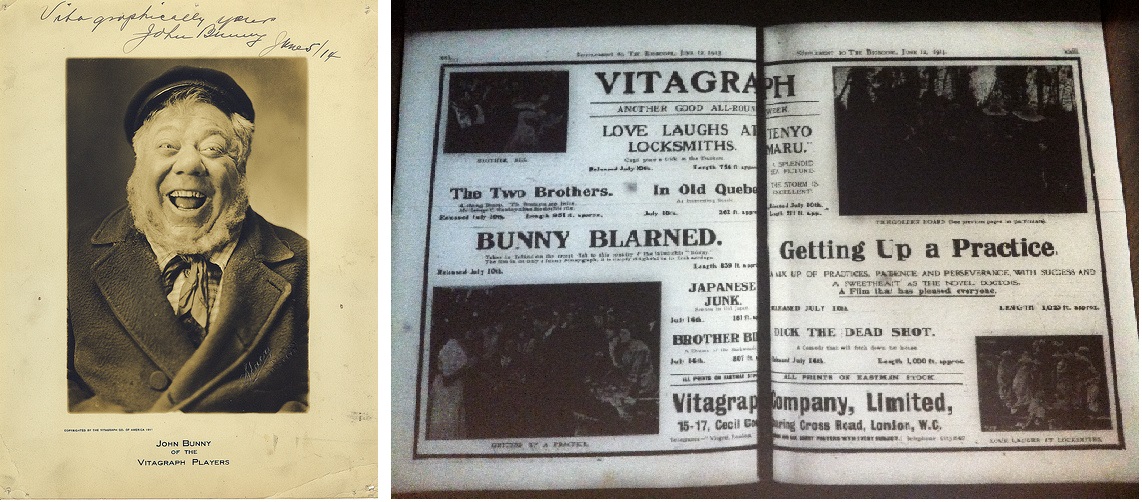
Publicity photograph of John Bunny, signed and dated 5 June 1914 (http://theloudestvoice.tumblr.com/page/328); and Vitagraph ad including Bunny Blarneyed (with title misspelled). Bioscope 12 Jun. 1913.

Vitagraph’s comic star John Bunny praised the Irish Ladies’ Orchestra and outlined the kind of benefits women musicians brought to the cinema. Bunny made his remarks on a working trip to Britain in 1912, during which he visited Ireland to shoot the short comedy Bunny Blarneyed, or The Blarney Stone (US: Vitagraph, 1913) at Cork’s most famous tourist attraction. Taking in a show at the Rotunda, he remarked that

“Women are always an immense power in the refinement of the world. The manager who, seeking to make his show suitable for all – from the little mites up – neglects this truth is only cheating himself of ultimate end. An orchestra composed of women is an undeniable asset to every hall in the world.” (Paddy, 12 Sep. 1912)

For Bunny – and for Paddy who quoted him favourably – such initiatives as the Ladies’ Orchestra put cinema at the forefront of respectable entertainment by putting women at the forefront of the cinema entertainment. There, they were visible signs and guardians of a refined amusement suitable for all the family.

Although Jameson made a particular feature of his Ladies’ Orchestras, other women musicians were also well known to audiences, even when they were less visible during screenings. Miss Frazer, the pianist at the Pavilion’s rival Kingstown Picture House, garnered special praise for her beautiful singing during the run of The Badminton Hunt in January 1913 because “she did not sing from a platform, the film was not stopped at any time. Simply you heard her charming voice coming out of the darkened stillness at the piano” (Paddy, 30 Jan. 1913). Paddy also noted that May Louise O’Russ conducted a very able orchestra at Dublin’s Mary Street Picture House, which was managed by her husband, Bob O’Russ (ibid).

As summer 1914 approached, it appeared that women were taking a more proprietorial role in Irish cinema. On 30 April, the Bioscope published the registration details of the Blackrock Picture Theatre Company, which had been incorporated in Dublin on 20 March. The report listed four women – Mrs. R. Murphy, Mrs. L. Casey, Miss E. Lineham and Miss M. Lineham – among its five directors (“World of Finance”). Little is known of these women, but Lucy Casey was the postmistress and a shopkeeper in the seaside village of Blackrock, Co. Louth, where the company’s new picture house was to be located. Blackrock was south of Dundalk, the largest town in the region, with its population of 13,128 supporting two competing picture houses. Blackrock, by contrast, had a very small resident population of just 418 that was swelled at holiday time by a large influx of tourists. Regardless of the success of their venture, these women joined the few other female picture-house owners and musicians to whom the cinema offered career opportunities.

References

Paddy. “Pictures in Ireland.” Bioscope 14 Mar. 1912: 759; 25 Apr. 1912: 275; 12 Sep. 1912; 797; 30 Jan. 1913: 329; and 16 Apr. 1914: 313.

Watters ,Eugene, and Matthew Murtagh. Infinite Variety: Dan Lowrey’s Music Hall 1879-97. Dublin: Gill and Macmillan, 1975.

“World of Finance: New Companies.” Bioscope 30 Apr. 1914: 411.

A Happy and Appropriate Synchronism: Passion Films at Easter 1914

The release of Darren Aronofsky’s Noah (US: Paramount/Regency/Protozoa/Disruption, 2014) on cinema screens around the world in the run up to Easter 2014 is a distribution strategy at least a century old. “As a Passion Play,” wrote a reviewer  in Dublin’s Evening Telegraph of the latest release at the Rotunda’s in early April 1914, “‘The Messiah’ holds one with its intense impressiveness and pathos, and its exhibition just at this holy season is a happy and appropriate synchronism” (“‘The Messiah’ at the Round Room Rotunda”). This synchronism – or well-established distribution and exhibition strategy – was familiar to cinemagoers of the 1910s who would have seen the practice of releasing biblically based films for this religious festival as entirely unremarkable. In fact, this practice reproduced in a new medium the centuries-old Christian tradition of performing passion plays at Easter. Filmic passion plays were among the first moving pictures (Cosandey passim), and they were so popular that The Messiah shown in Dublin in April 1914 was the 1913 remake (dir. Maurice-André Maître) by French company Pathé of its La vie et la passion de Notre Seigneur Jésus-Christ, which the company had first produced in 1903 and again in 1907 (Abel 319-20). And this was just the output of one – albeit large – production company.

Jameson

Rotunda manager James T. Jameson as he appeared in a caricature in the Bioscope in November 1911.

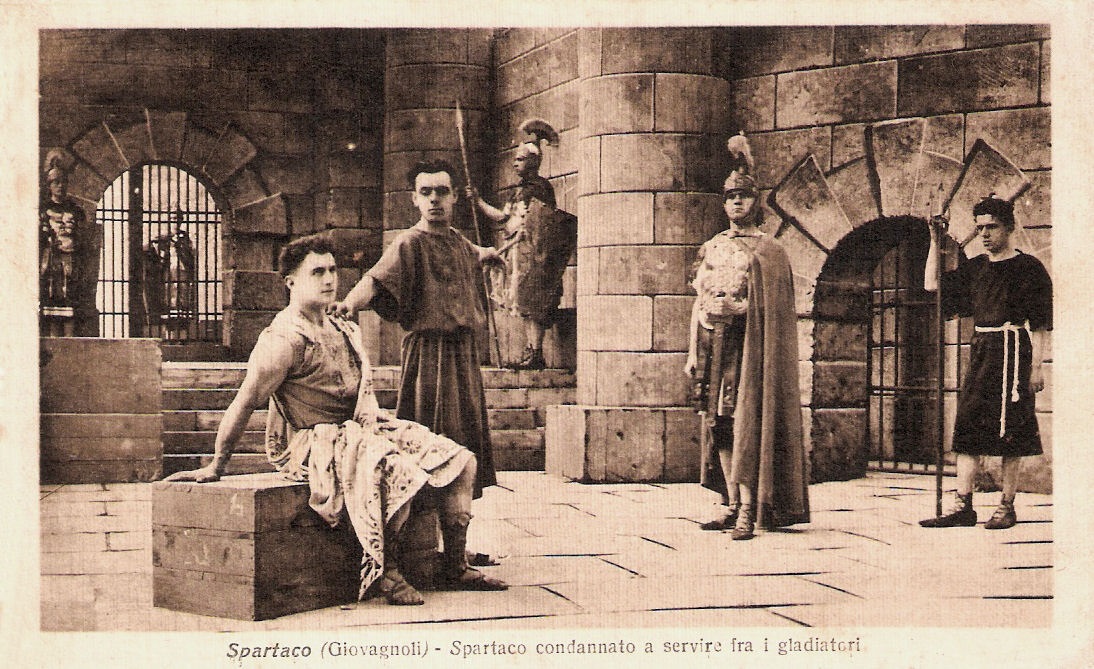
Easter Monday fell on 13 April 1914, but James T. Jameson, director of the Irish Animated Picture Company, and his son, Ernest, who managed the Rotunda, had begun the run up to Easter much earlier. In early March, Jameson senior had secured the Irish rights to two long “exclusives”: The Messiah and Spartacus, or the Revolt of the Gladiators (Italy: Pasquali, 1913) (“Items of Interest”). In its review of Spartacus at the Rotunda in the week beginning 23 March, the Dublin Evening Mail compared it to Quo Vadis? (Italy: Cines, 1912), the Italian epic that had been the biggest hit of 1913 and that had been available to Dublin audiences as lately as 2-7 March at the Camden Picture House (“Rotunda Pictures”). However, The Messiah was a more important film for the Rotunda than Spartacus. For one thing, it was longer; Spartacus shared its bill with the comedies The Awakening at Snakesville (US: Essanay, 1914) and When Cupid Takes in Washing (US: Lubin, 1914), but The Messiah was the only thing on the Rotunda’s programme for the two weeks beginning Monday, 30 March. As well as this, because it depicted the life of Christ, The Messiah had the potential to be as controversial as From the Manger to the Cross (US: Kalem 1913) had been the previous year. The superiority of The Messiah was emphasized by the Evening Telegraph, which urged “any person who witnessed “From Manger to Cross to pay a visit to the Rotunda and see what a drastic and extraordinary difference can be introduced in the treatment of the same subject, and more especially the grandeur of its colouring” (“‘The Messiah’ at the Round Room Rotunda”).

The Messiah was certainly a success at the Rotunda. Quoting figures supplied by the Rotunda management, the Telegraph revealed that by the Saturday of the first week of its run, it had been seen by over 22,000 people, “including a considerable proportion of the clergy of every denomination, and there have been nothing but the highest eulogies expressed by everybody who had the pleasure of seeing this marvellous production” (ibid). Paddy, the Irish correspondent of the British trade paper Bioscope, speculated that the audience for the full two-week run would number 50,000, commenting that the film “easily surpassed anything of the kind ever seen in Dublin, and the special music, so brilliantly rendered by Miss May Murphy’s Irish Ladies’ orchestra, added to the reverent screening of this great film” (Paddy). Although Jameson offered a new bill from Easter Monday featuring Christopher Columbus (US: Selig, 1912) and a film of the Grand National Steeplechase, he brought back – purportedly due to popular demand – The Messiah by the end of that week for selected matinees and early evening shows until Friday, 24 April.

This success of the passion films and such Italian historical epics as Quo Vadis? and Spartacus points to the existence of types of quality filmmaking based on high-cultural criteria. The Rotunda had long pursued a middle-class audience by promoting its film shows as both educative and entertaining, but Jameson had usually favoured programmes of shorter films – and some live variety acts – rather than a single long film. A review of the Rotunda in early March had stressed cinema’s multiple attractions:

The elaborate production of cinematograph films shows how much this form of entertainment has grown in public favour. Unlike skating rinks, living pictures seem to have come to stay. They supply an easy means of transporting oneself for a time from the uneventful round of daily life. Sitting in a comfortable seat, the spectator can in a moment travel from China to Peru, from the waste of the open sea to the sun-bathed mart of some Eastern town; he can witness fire and flood and return safely to a good supper by his civilized fireside (“Irish Animated Picture Company”).

The Rotunda had aimed to provide such a variety of attractions with multiple films in its two-hour shows, but the Italian epics could provide a range of spectacles in one film, as well as a patina of high-cultural value associated with classical education. As adaptations of literary works, Quo Vadis? – from Henryk Sienkiewicz’s novel – and The Last Days of Pompeii (Gli ultimi giorni di Pompeii; Italy: Ambrosio, 1913) – promoted as Lord Lytton’s great work” when it played at the Camden Street Picture House in the week beginning 20 April (“Camden Street Pictures”) – could benefit from recognition by middle-class audiences, as well as bestowing cultural prestige on the film and the picture house at which it was shown. Among other significant literary adaptations on exhibition in Ireland at Easter 1914 was Cines’ Antony and Cleopatra (Italy, 1913), a story that prospective spectators at the Opera House in Derry were informed “has been variously dealt with by many famous writers, including the immortal Shakespeare” (“Easter Amusements”).

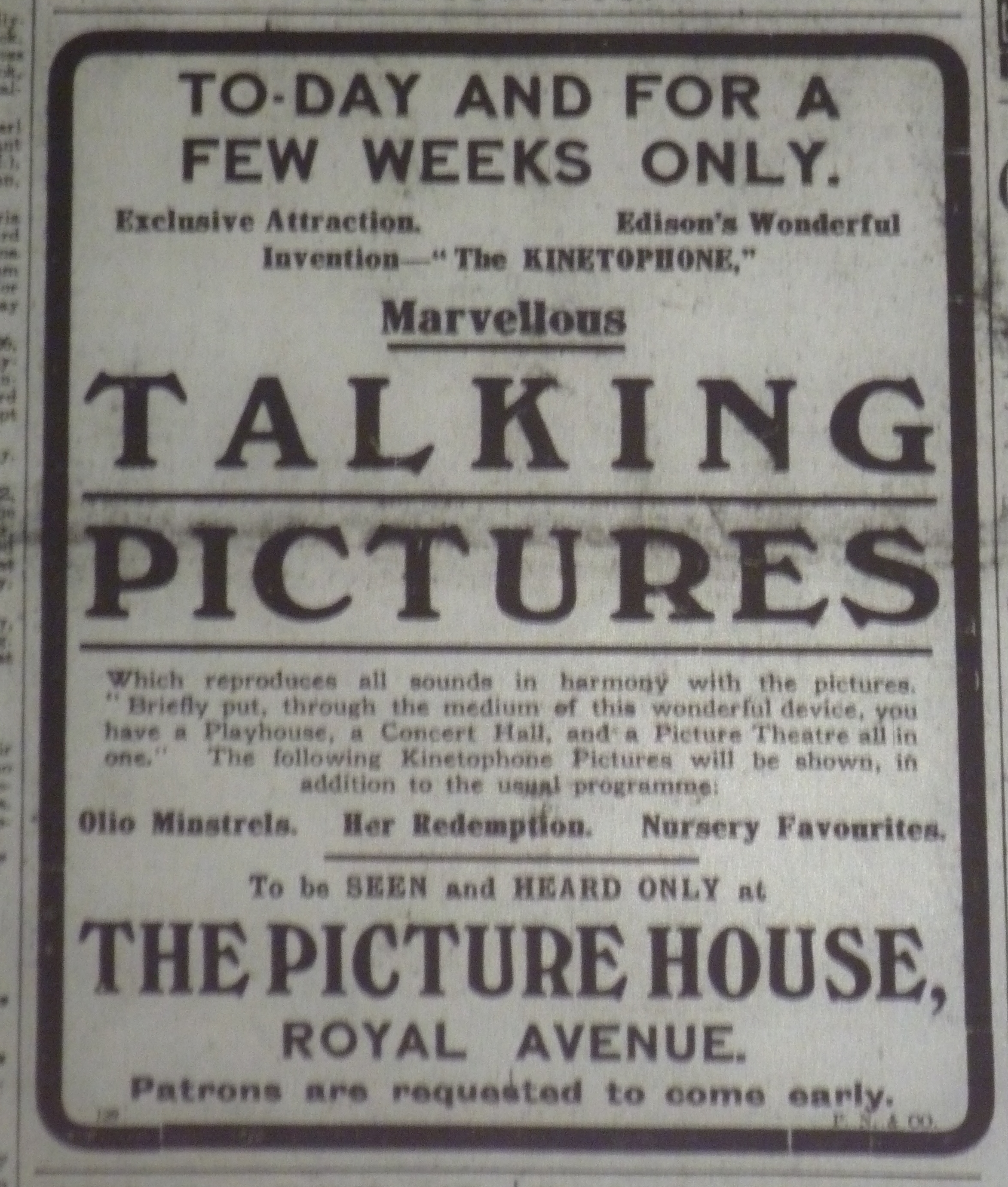
Edison Talking Pictures at the Picture House, Royal Avenue, Belfast. Belfast Newsletter 3 Apr. 1914: 1.

Edison Talking Pictures at the Picture House, Royal Avenue, Belfast. Belfast Newsletter 3 Apr. 1914: 1.

The extent to which a shared or imposed set of cultural values deriving from literary culture, classical education and Christian doctrine was the source of the popularity of The Messiah or the Italian epics is difficult to say definitively without some discussion of how images of these circulated more widely (Uricchio and Pearson). Certainly, the promotion of such films as respectable by the trade press, newspapers and other forms of picture-house promotion did not prevent other cultural forces from continuing to attempt to impose their own control on cinema and its audiences. 

Easter 1914 seemed to be a particularly auspicious time for Irish nationalists. This point was well expressed in the nationalist Evening Telegraph, in which an editorial observed that

this will be the last Easter before Home Rule becomes the law, for the Home Rule Bill will reach the Statute Book in the course, probably, of the next five or six weeks. It is well that Easter should herald the coming of Ireland’s resurrection, for in the Christian sense it symbolises the Resurrection (“Easter”).

Christianity here meant the Catholicism of the Telegraph’s readership and of the majority of Dublin Corporation’s dominant nationalist faction. With Home Rule apparently imminent, more militant forces within the church were determined that cultural policy reflect a Catholic ethos, regardless of how this might affect the business interests of certain Catholic nationalist councillors.

Lord Mayor Lorcan Sherlock came under criticism from Catholic church-based groups in early March when he showed reluctance to introduce local censorship of films – the Corporation “are satisfied, as indeed are so many other civic bodies, with the verdict of the Board of Trade Censor” – or close picture houses on Sundays – “‘They have been,’ he said, ‘patronised to an extraordinary extent on Sunday by the working people of the city’” (“Picture Theatres: Conditions of Licensing”). Responding in a letter to the Telegraph, William Larkin, who had recently been praised rather than fined by a magistrate for protesting loudly during a theatre show, wondered whether or not the general public were “to be left at the mercy of the Corporation in the matter of taste in living pictures” whose “educational value […] in Dublin at present are nil” (“Sunday Pictures: For Working People”). He left no doubt that lay Catholic organizations would not let the matter rest:

Does his lordship know that the United Sodalities of Dublin (male and female) are out for reform of the picture theatres? Does his lordship know that the United Confraternities of the city are out for the same object? And does he also know that the Theatre Reform League of Dublin (which will later embrace all of Ireland) are on the watch against the class of production that has flooded our capital for some time now? (ibid).

Although Larkin and those named lay organizations would lead the campaign, priests and bishops lent the support of the hierarchy. A letter from a Father Gleeson calling for “an Irish National Censor, who understands the hearts and minds of the Irish people” accompanied Larkin’s  (“Letter from Father Gleeson”). In April, the Lord Mayor “stated that Archbishop Walsh was not in favour of closing picture houses on Sunday, but he thought that a limit should be placed in the hours of opening so that there would be no interference with the freedom of persons to attend divine worship.” Under pressure from both inside and outside the Corporation, Sherlock “was writing to Archbishop Walsh asking him whether he would take upon himself the responsibility of suggesting what type of censorship should be put into operation” (“Picture Theatres: The Archbishop’s Views”).

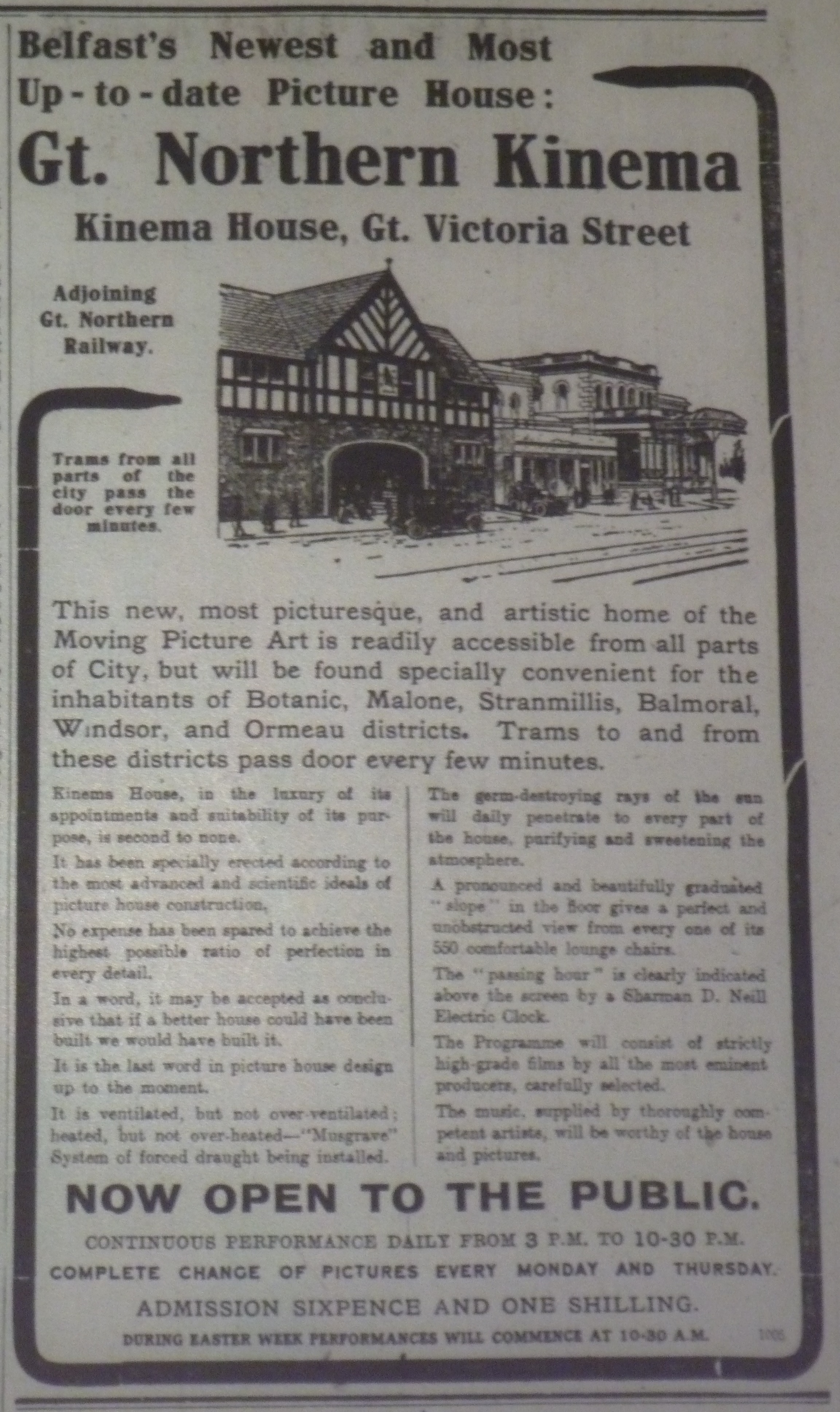
Belfast Newsletter 9 Apr 1914: 9.

Ad for the newly opened Great Northern Kinema in Belfast Newsletter 9 Apr. 1914: 9.

Larkin ended his letter on Dublin picture houses with some architectural criticism by remarking that “the building themselves are not even decent looking” (“Sunday Pictures: For Working People”), but Easter for Belfast’s picture houses was notable for its openings of distinct contributions to the city’s streetscape. The latest addition to Belfast’s substantial tally of picture houses was the Great Northern Kinema in Gt. Victoria Street, which opened in the first week of April, a little over a week after the 23 March opening of the Crumlin Picture House on the Crumlin Road. The Kinema, “[t]his new, most picturesque , and artistic home of the Moving Picture Art,” was located beside the Gt. Northern railway station, as well as on some of the city’s major tram lines (“Belfast’s Newest and Most Up–to-date Picture House”). No single film seemed to dominate the picture house programmes over the holiday period in the same way as The Messiah did in Dublin. At the “luxurious and attractive” Kinema, “[t]he star film during the early part of the current week is a two-reel drama entitled ‘Silent Heroes’” (US: Broncho, 1913) (“Kinema House”). The city’s most highly publicized cinema offerings were Edison’s Talking Pictures at the Picture House, Royal Avenue, where they were joined in the week beginning Easter Monday by a programme that included Selig’s Christopher Columbus. The different relationship between the churches and cinema is suggested by the fact that several of the Protestant halls – the CPA Assembly Hall, the Grosvenor Hall, the City YMCA and the People’s Hall – offered not only their usual Saturday cinematograph shows but also special film shows on Easter Monday and Tuesday.

References 

Abel, Richard. The Ciné Goes to Town: French Cinema, 1896-1914. Berkeley: U of Califronia P, 1994.

“Belfast’s Newest and Most Up–to-date Picture House.” [Ad.] Belfast Newsletter 9 Apr. 1914: 9.

“Camden Street Pictures.” Evening Telegraph 21 Apr. 1914: 6.

Cosandey, Roland, André Gaudreault and Tom Gunning, eds. An Invention of the Devil? Religion and Early Cinema. Sainte-Foy and Lausanne: Éditions Payot/Laval UP, 1992.

“Easter.” Evening Telegraph 11 Apr. 1914: 4.

“Easter Amusements.” Derry Journal 13 Apr. 1914: 8.

“Irish Animated Picture Company.” Irish Times 10 Mar. 1914: 5.

“Items of Interest.” Bioscope 12 Mar. 1914: 1109.

“Kinema House.” Belfast Newsletter 14 Apr. 1914: 9.

“Letter from Father Gleeson.” Evening Telegraph 11 Mar. 1914: 5.

“‘The Messiah’ at the Round Room Rotunda.” Evening Telegraph 4 Apr. 1914; 7.

Paddy. “Pictures in Ireland.” Bioscope16 Apr. 1914: 313.

“Picture Theatres: Conditions of Licensing.” Evening Telegraph 10 Mar. 1914: 3.

“Picture Theatres: The Archbishop’s Views.” Evening Telegraph 20 Apr. 1914: 3.

“Rotunda Pictures.” Dublin Evening Mail 24 Mar. 1914.

“Sunday Pictures: For Working People.” Evening Telegraph 11 Mar. 1914: 5.

Uricchio, William and Roberta E. Pearson. Reframing Culture: The Case of the Vitagraph Quality Films. Princeton: Princeton UP, 1993.

Serial Queens and Super Villains

On 25 November 1913, Dublin’s Evening Herald reported that haulier Sidney Norman of Neath, Wales, had seriously injured himself in the early hours of the previous Saturday when he had jumped ten feet from his bedroom window while dreaming he was escaping from robbers he had seen that evening on a picture theatre screen (“Man’s Leap to Escape Cinema Robbers”). For this ordinary Welshman, the images on the screen had literally become the landscape of his dreams, to his severe bodily cost. The Herald picked this up as a news oddity and published it on its front page, where its readers might wonder at the gullibility of some picture-house patrons or the need to control this new entertainment that was coming to increasingly direct the dreams of its audience.

One of the ways in which it did this was through films of greater length and complexity. The increasing length of films had been a particular issue in the film industry since 1911. “We can remember when a drama of 1,000 ft. was often grumbled at on account of its length,” noted an editorial in the British cinema trade journal Bioscope in September 1911, “but it seems as if that day were past, and the demand for a picture play constituting the usual length of an entire programme has sprung up (“The Length of the Film”). The film of 1,000 feet (about 16 minutes at 16 frames a second) was the standard product of the US distributors, but in Europe, longer films, often with high-cultural prestige such as Italian company Cines’s 1913 Quo Vadis?, captured both the imagination of the public and the film market where they were sold as features or exclusives.

3 Musketeers Phoenix Nov 2013

An unusually large ad for an unusually long film: Evening Herald banner for The Three Musketeers at the Phoenix, 15 Nov. 1913: 4.

In Dublin in November 1913, the Phoenix Picture Palace marketed itself as the picture house that specialized in the long film. “The Phoenix Picture Palace is rapidly becoming famous for the exhibition of big classic film productions,” began a notice in the Herald,

“From Manger to Cross,” “Quo Vadis?” “Monte Cristo,” “The Battle of Waterloo,” etc., have all been shown at the Phoenix within the last few months. Last evening the patrons of this popular house had presented to them the longest film yet shown in this country – the “Film D’Art’s” remarkable production of Dumas’s popular and widely read work, “The Three Musketeers” (“‘The Three Musketeers’”).

This issue of the long film was not resolved in 1911, however, and the Bioscope continued to favour a varied programme of shorter films, arguing in an October 1913 editorial that the long film’s “charm and importance can be better sustained outside the ordinary picture theatres. The popularity of the cinema has been built up on the variety of the entertainment it offers, and a lessening of that variety means a weakening of public interest” (“Exclusives and Other Matters”).

Doubtless, the Bioscope was influenced in its thinking by the nature of variety theatre, cinema’s chief rival in popular entertainment in Britain, Ireland and elsewhere. A solution to providing a lengthy film as part of a variety programme was available in another popular form: the serial. Fictional writing had long been serialized in newspapers and magazines, where it appeared alongside many other kinds of writing in another kind of variety format. In November 1913, the Evening Herald carried an episode of popular novelist Emma M. Mortimer’s Robert Wynstan’s Ward each day, and this was wholly unremarkable.

However, the autumn of 1913 saw a new phenomenon arrive in Ireland: the film serial. When the Rotunda began showing the serial What Happened to Mary in September 1913, the Dublin Evening Mail commented that the Rotunda “management in producing a ‘serial’ film, have broken new ground as far as Dublin picture houses are concerned” (“Rotunda Pictures” 23 Sep.). Unlike the Phoenix, the Rotunda favoured a more varied programme of shorter films, so that when High Tide of Misfortune, the tenth episode of What Happened to Mary, was exhibited there in the week of 24-29 November 1913, it shared the bill with the main film, Broken Threads United; a “very complete picture […] of the procession to Glasnevin on Sunday in connection with the Manchester Martyrs’ commemoration”; the comedies His Lady Doctor, Ghost of the White Lady and Love and Rubbish; and the Pathé Gazette newsreel (“Rotunda Pictures” 25 Nov). The serial was integrated into this variety film programme that was lent some locally produced coherence by being accompanied by the music of the Irish Ladies’ String Orchestra.

What Happened Mary Fuller

August 1912 cover of US magazine Ladies’ World featuring Mary Fuller and What Happened to Mary. From “The First Movie Serial.”

To what degree the variety format was more successful in attracting a larger and more diverse audience is debatable, but the inclusion of What Happened to Mary seemed a direct appeal to young women. Narrating the adventures of a country girl who comes to the city, What Happened to Mary was produced by Edison in twelve monthly episodes beginning in US picture houses in July 1912 in parallel with the serialized story that appeared in the US mass-circulation women’s magazine Ladies’ World, making its lead actress Mary Fuller into a star (Singer 213). Running from 22 September to 13 December, the first Irish exhibition at Dublin’s Rotunda tied in with its weekly serialization in the British women’s magazine Home Chat (“The Rotunda,” “The Picture Houses”). As such, it was clearly marketed primarily at women. An indication of its local success is the fact that the Rotunda immediately followed it with Who Will Marry Mary?, the Edison sequel, which again featured Mary Fuller.

Although it would take another year for the serial to reach the height of its popularity with such “serial queens” as Helen Holmes the adventurous heroine of The Hazards of Helen and Pearl White in The Perils of Pauline and The Exploits of Elaine, this earlier serial followed some of the patterns of the later ones. Shellley Stamp argues that “for a complete understanding of the template serial heroines offered viewers we must look beyond the screen exploits of Pauline and her compatriots towards the substantial star discourse that circulated around the actresses who played these women on screen” (Stamp 217). Some of the Dublin reviews suggested What Happened to Mary did create the desire in its audiences for more information about Mary Fuller: “‘Alone in New York’ is the second instalment of the ‘What Happened to Mary’ serial; all who have seen the opening scenes of Mary’s adventures will be eager to know more about this fascinating actress” (“Rotunda Pictures” 27 Sep.).

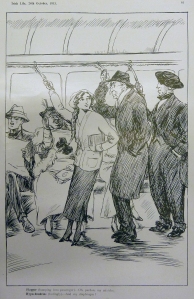
Flapper on Tram IL 24 Oct 1913

An Irish flapper finds space for herself in the public sphere; Irish Life 24 Oct. 1913: 91.

More specific information on the reception of What Happened to Mary among Irish audiences, and particularly Irish women, does not seem to survive. The fact that the exhibition of the film was tied to the publication of a British magazine is indicative of the subsidiary place of Ireland in the publishing and film industries. The Irish women’s magazine Lady of the House, which had very little to say about cinema of the period, made no mention of the serial, but it and other Irish periodicals show how women were represented in popular media. Was the young flapper shown travelling on a tram in a cartoon in the glossy and expensive Irish Life in October 1913 likely to have found Mary’s adventures or Mary Fuller’s star persona enthralling? Perhaps, but it is not clear that the serial form allowed Mary Fuller to capture the imagination of the public to a greater extent than the at-least-sometimes more active heroines of stand-alone films. In the Herald’s notice for the Rotunda on 30 September, the third episode of What Happened to Mary was not mentioned, but the reviewer focused on the heroine of A Wild Ride, set on a South African ostrich farm, in which “a resourceful and up-to-date heroine, in a situation of dire extremity, outwitted cunning and ferocious savages, rode an ostrich across the trackless veldt at high speed, and brought soldiers to the relief of her imprisoned family” (“Rotunda Pictures” 30 Sep.). Such derring-do in the serial would await The Hazards of Helen, which would not hit Dublin screens until 1915.

Other kinds of film serial followed quickly on the heels of What Happened to Mary and offered different forms of fascination – whether that be attraction or repulsion. Sharing the bill at the Rotunda with A Proposal Deferred, the fifth episode of What Happened to Mary in the week beginning 20 October was the second part of Gaumont’s five-part Fantômas (1913), each of which contained three to six episodes. Directed by Louis Feuillade and based on a popular series of 32 French novels by Pierre Souvestre and Marcel Allain that were published in monthly instalments between February 1911 and September 1913, the films followed the early exploits of the eponymous super villain as he terrorizes Paris (Walz and Smith). “Those who go to the Rotunda this week will, at any rate, get plenty of sensation,” observed the Irish Times.

The film, “Fantomas,” is a choice blend of mystery, tangled plot, and blood-curdling enterprise. It is not easy to grasp all the bearings of the incidents or their mutual relationship. The film, however, introduces us to some remarkable phases of Paris life and its institutions. And the glimpses of the city’s streets and parks are always full of interest. It is very admirably acted by all the characters (“Rotunda Living Pictures”).

Unlike What Happened to Mary, Fantômas did not appear on a reliable weekly or even monthly basis that might establish a loyal pattern of attendance. Nevetheless, even if not regular, Fantômas was popular, and the Rotunda continued to premiere the new parts as they were released, showing The Tragedy at the Masked Ball over the Christmas period of 1913 and the fifth part, The False Magistrate, in June 1914.

These serials were not restricted to city audiences but travelled on the important Irish Animated Picture Company exhibition circuit established by James T. Jameson of the Rotunda. In his praise of Jameson in January 1914, the Bioscope’s Irish correspondent Paddy revealed that two of the What Happened to Mary episodes had recently been seen around the country: A Proposal Deferred had been at Tralee, while the twelfth and final episode, Fortune Smiles – receiving “considerable applause” – was on the programme at Galway. The YMCA hall in Queenstown was showing the fourth part of Fantômas, The Tragedy at the Masked Ball (Paddy). As such they came, no doubt to inhabit the dream and nightmare worlds of many Irish people.

References

Birchland, Robert. “What Happened to Mary?” Hollywood Heritage 18: 2 (Fall 1999). Hollywoodheritage.org. http://hollywoodheritage.org/newsarchive/Fall99/Mary.html. 19 Nov. 2013.

“Exclusives and Other Matters.” Bioscope 9 Oct 1913: 87.

“The First Movie Serial.” 100 Years Ago Today. http://100yearsagotoday.wordpress.com/2012/07/26/the-first-movie-serial/. 19 Nov. 2013.

“The Length of the Film: A Question of Policy.” Bioscope 7 Sep. 1911: 471.

“Man’s Leap to Escape Cinema Robbers.” Evening Herald 25 Nov. 1913: 1.

Paddy. “Pictures in Ireland.” Bioscope 22 Jan. 1914: 351.

“The Picture Houses: Rotunda Pictures.” Evening Telegraph 30 Sep. 1913: 2.

“Pictures at the Rotunda.” Freeman’s Journal 21 Oct. 1913: 9.

“The Rotunda.” Irish Times 23 Sep 1913: 5.

“Rotunda Living Pictures.” Irish Times 21 Oct. 1913: 5.

“Rotunda Pictures.” Dublin Evening Mail 23 Sep. 1913: 3.

“Rotunda Pictures.” Evening Herald 27 Sep. 1913: 9.

“Rotunda Pictures.” Evening Herald 30 Sep. 1913: 5.

“Rotunda Pictures.” Dublin Evening Mail  21 Oct. 1913: 2.

“Rotunda Pictures.” Evening Herald 25 Nov. 1913: 5.

Singer, Ben. Melodrama and Modernity: Early Sensational Cinema and Its Contexts. New York: Columbia UP, 2001.

Stamp, Shelley. “An Awful Struggle Between Love and Ambition; Serial Heroines, Serial Stars and Their Female Fans.” The Silent Cinema Reader. Ed. Lee Grieveson and Peter Krämer.London: Routledge, 2004.

“The Three Musketeers’” Evening Herald 18 Nov. 1913: 5.

Walz, Robin, and Elliott Smith. Fantômas. http://www.fantomas-lives.com/fanto6.htm. 28 Nov. 2013.

Duelling Cinematographs: “An Unrehearsed Picture”

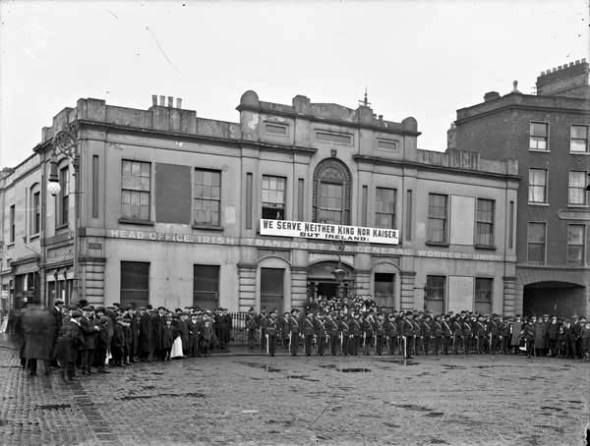
Image

Liberty Hall, Beresford Place, in 1914, with members of the Irish Citizens’ Army, a militia formed to protect workers during the Lockout. From National Library of Ireland on Flickr Commons.

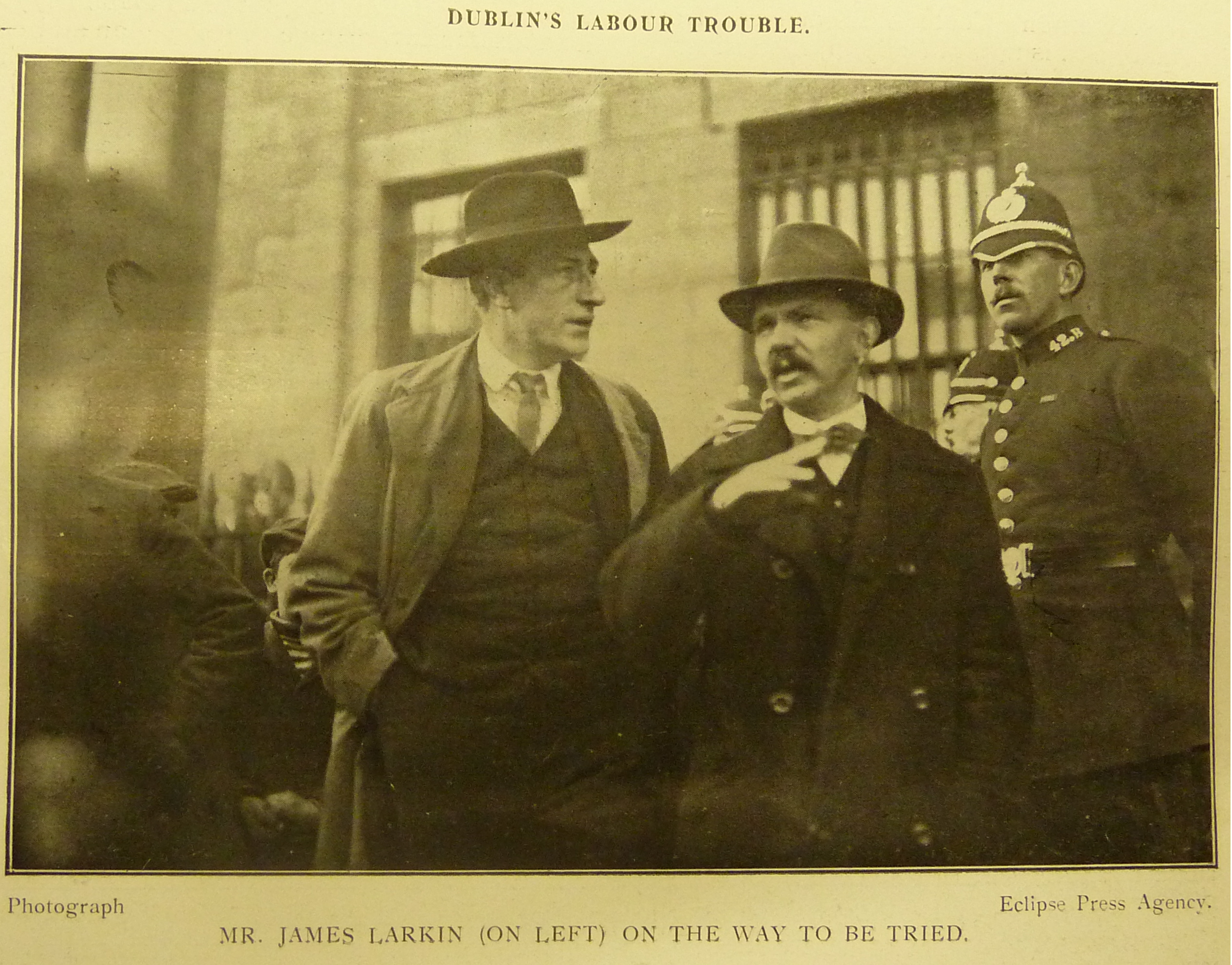
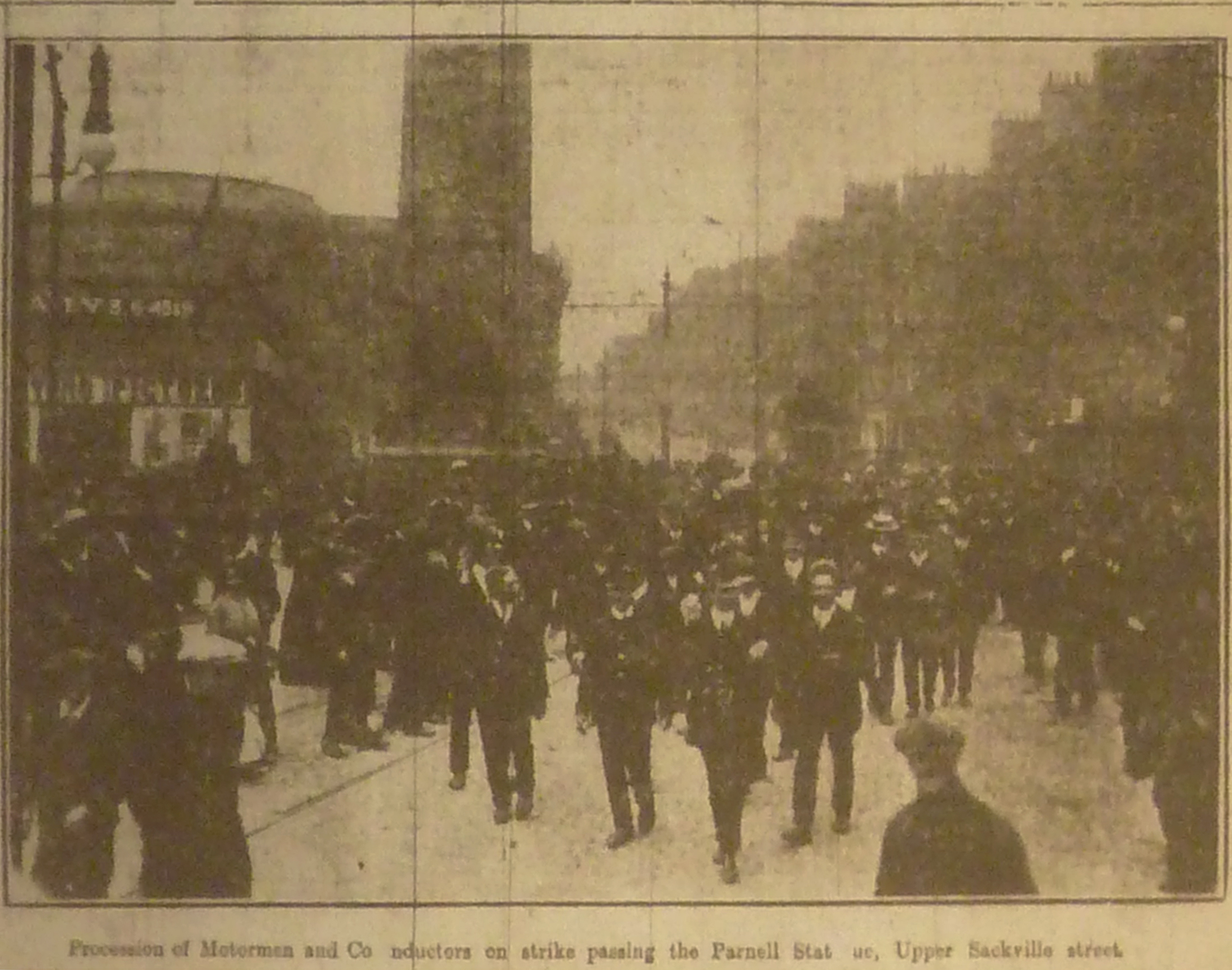
Moving pictures of events of the Dublin Lockout were taken, even if these do not – or are not known to – survive. On 25 October 1913, for instance, the Evening Telegraph reported on an incident of what might be called “duelling cinematographs.” This occurred during the trial on charges of sedition of Irish Transport Workers’ Union leader Jim Larkin and three colleagues as a result of their roles in the city’s strikes. Each morning of the trial, Larkin was accompanied on the walk of a mile from Liberty Hall, in Beresford Place, to the court in Green Street by a crowd of supporters, who waited outside the courthouse and accompanied him back to Liberty Hall, surrounded by police (“Back to Liberty Hall”). “Apparently by arrangement,” begins the Telegraph’s account of what it presents as a publicity event stage-managed for the camera on 25 October,

a cinematograph operator with his machine arrived at Liberty Hall in a taxi-cab about half past one o’clock this afternoon. He entered the building and soon afterwards he took up a position in one of the upper windows. Some 400 or 500 men were loitering about Beresford place, and they pressed forward to watch the operator’s movements, unaware of the fact that they were themselves to be pictured. Mr. James Larkin came to the window and warned them back, so that they would not be within range of the camera, and would also present a more imposing spectacle. There were also instructed to cheer and raise their caps so as to give the necessary life to the picture. All this was well managed, and doubtless the result will impress the patrons of some British or American picture palaces (“Cinema Machines”).

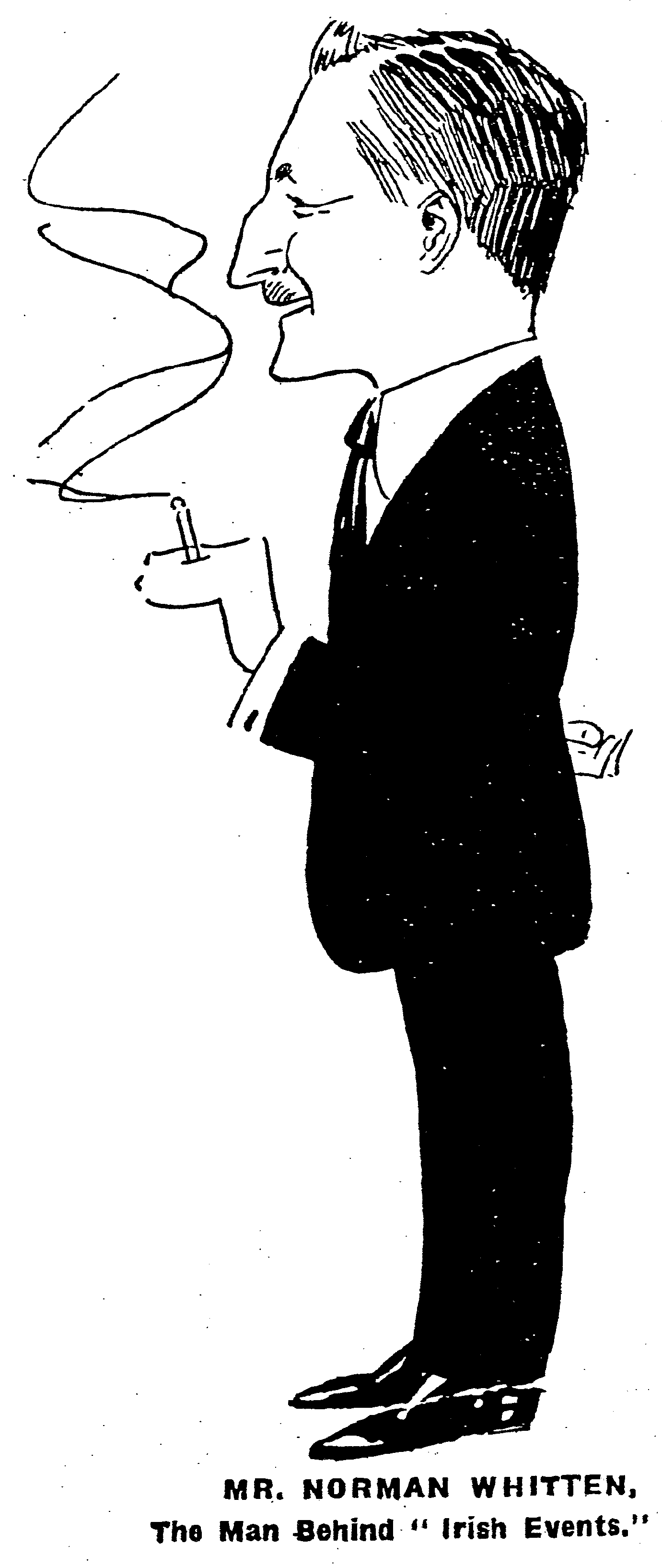
Who this camera operator was is not clear. It was likely to have been one of the several camera operators working in the city, among whom were Norman Whitten, those working for Gaumont and James T. Jameson, and other picture house owners/managers who had cameras and shot local films. Regardless of who shot this film, it shows that the union leadership were – like other political organizations of the time – beginning to think of the cinema as a publicity conduit, alongside the more established methods of pickets, mass meetings, newspapers and other form of print, and theatrical productions. The union was finally attempting to take control of this new means of representation.

In this iconography, Liberty Hall and Beresford Place played an important part as the location in the city where workers could congregate relatively freely and their leaders could address them. A Dublin Evening Mail article on the history of Liberty Hall helpfully sketches its descent from elite residence in the 18th century to hotel in which Dublin’s music hall entertainment originated to a near ruin at the beginning of the 20th century. “In 1908,” it concludes, “the tumble-down premises were taken by that stormy petrel, Jim Larkin, and turned into the headquarters of the Irish Transport Workers’ Union Since that the grimy old windows have looked out upon many a lurid scene” (“Liberty Hall”).

Irish Life 21 Nov. 1913: 247.

Irish Life 21 Nov. 1913: 247.

Larkin and the other union leaders were on trial for their part in inciting riot, particularly on 31 August, when they had been determined to – in the words of W.B. Yeats in “No Second Troy” – “hurl the little streets upon the great.” They had done this by holding a mass meeting on O’Connell/Sackville Street, one of what the Recorder had termed the city’s “principal streets,” whose dual naming encoded the Nationalist/Unionist struggle to gain symbolic control over the capital’s main thoroughfare. The police escort that accompanied Larkin and his supporters from Beresford Place to Green Street – passing Yeats’s Abbey Theatre – made sure that the trade unionists did not impose themselves on the shopper of O’Connell/Sackville Street.

Although union leaders appear to have been slow in using the cinema to promote their cause in the early weeks of the Lockout (a point already made here and here), by late October 1913, Larkin seems to have thought that cinema might provide another way of hurling the little streets unto the great. Although the authorities were intent on preventing trade unionists protesting on the city’s principal streets, a film of union activity might reach the cinemagoers at such prestigious picture houses as the Rotunda, Sackville or Grafton, and so bring Beresford Place to O’Connell/Sackville Street or Grafton Street.

While calling attention to this union film, the Telegraph article presents itself as unmasking Larkin’s manipulation of the truth. Commending Larkin and the camera operator for their direction of events, it acknowledges the film’s likely power to influence US or British audiences. It does not mention its influence over Irish audiences, partly as flattery of its readers’ shrewdness in seeing through the artifice, but also because the article goes beyond revealing Larkin’s deception to describe the Telegraph own counter-filmmaking. “A much more interesting series of pictures,” it reveals

was, however, obtained by our unauthorised cinema operator, who came upon the scene just as his rival had commenced from the window. At once he, too, began to work his machine from the street, obtaining, as he hopes, a more correct view of the crowd, and a complete record of Mr. Larkin’s work as stage manager. The latter series of pictures, if every produced, should add to the gaiety of nations (“Cinema Machines”).

This is an astonishing claim, describing a situation in which two films were shot of Larkin addressing a crowd of workers at Liberty Hall, the second one sponsored by a newspaper anxious to discredit the union leader. This second operator can no more be identified than the first, but it seems extraordinary that the newspaper was able to locate a cinematographer quickly enough to film the proceedings.

The last line of this quote – particularly the phrase “if ever produced” – casts some doubt on the Telegraph’s film ever being seen. This may be because there was some difficulty with the filming or that the cinematographer merely pretended to film. It may also be an acknowledgement that neither of these films would have been guaranteed a screening in Dublin (or abroad; the second film is here envisaged as contributing to “the gaiety of nations” rather than of Dublin or Ireland). Dublin picture houses included such newsreels as the Pathé Gazette or Topical Budget as part of their programmes and occasionally screened films of local political or social events such as the Dublin Horse Show. However, the picture houses seem deliberately to have avoided shooting and/or showing films of this contentious strike. There is no evidence that these films were shown in any Dublin picture house.

References

“Back to Liberty Hall.” Dublin Evening Mail 23 Oct. 1913: .

“Cinema Machines: At Work at Liberty Hall: An Unrehearsed Picture.” Evening Telegraph 25 Oct. 1913: 5.

“Liberty Hall: A Footnote to History: Harmonies and Discords.” Dublin Evening Mail 21 Oct. 1913: 2.

“Soul Stirring Views of the Cripples”: The (First) Irish National Pilgrimage to Lourdes

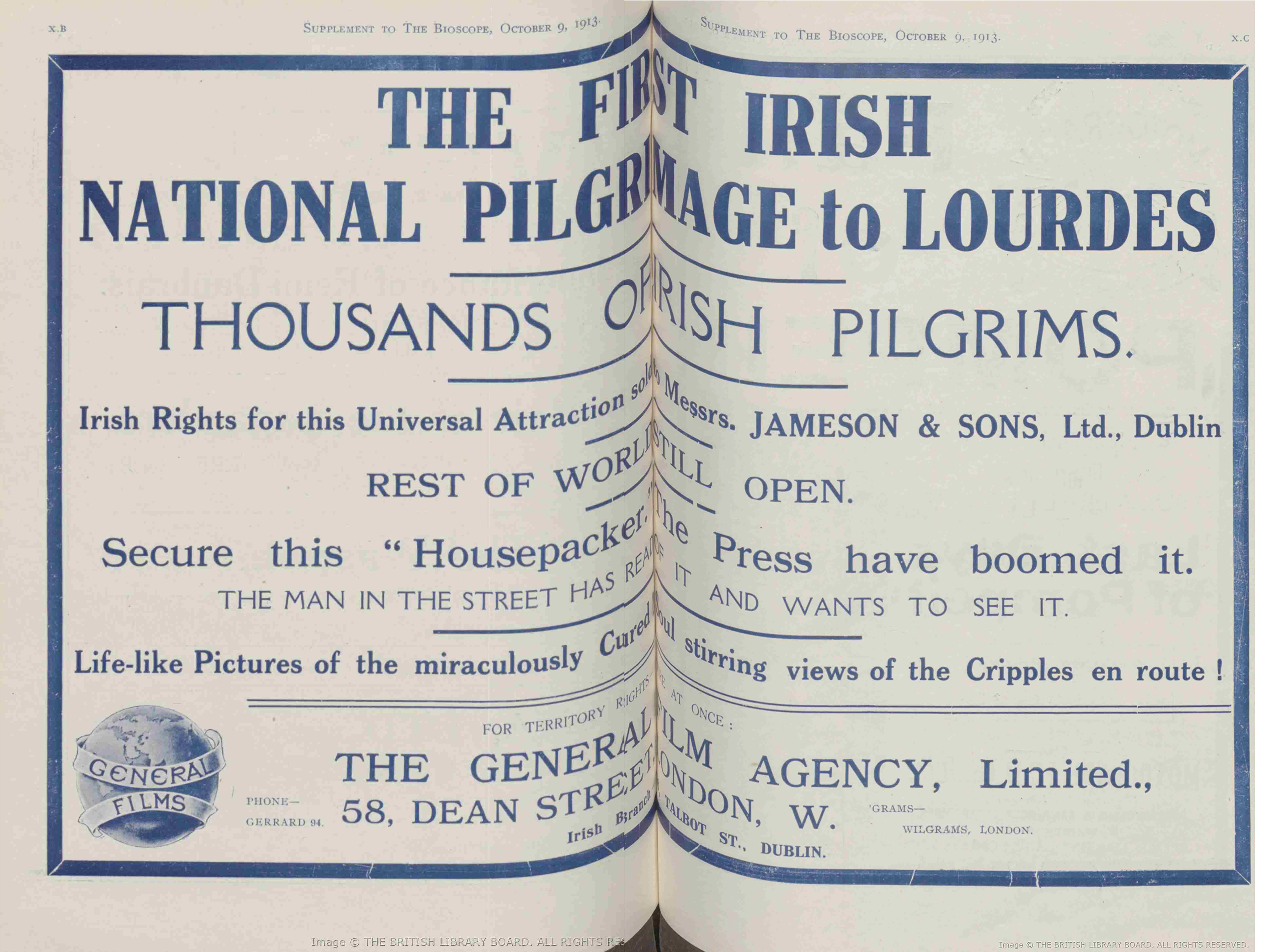
Bioscope 9 Oct. 1913, xb-c.

On Friday, 3 October 1913, the Irish Times reported that several Catholic clerics had attended a private viewing at the Rotunda, Dublin, of the film The First Irish National Pilgrimage to Lourdes and that the film would open to the public at the same venue the following Monday (“A Pilgrimage in Picture”). The preparations for and progress of the pilgrimage by over 2,000 Irish Catholics – including the miraculous cures of such pilgrims as Grace Maloney (“Miracle at Lourdes”) – were extensively covered in the press, and newspaper readers may also have been aware that the pilgrimage had been filmed because as many of the pilgrims prepared to depart on 8 September and arrived back on 19 September, some papers had reported that cinematographers were among them (“Lourdes Pilgrims,” “Home Again”).

The film at the Rotunda, therefore, had benefitted from much pre-publicity, and it sought to show cinemagoers the important elements of the pilgrimage in detail. It ran not the 5-10 minutes expected of a newsreel but – according to the Times – for “[n]early an hour,” with the Dublin Evening Mail putting its length in feet – the more popular way of expressing film length at the time – at 2,500 feet (“Rotunda Pictures”), or almost 42 minutes at the most common silent projection speed of 16 frames per second. The film “has many-sided interest for Dublin picture house patrons, most of whom had friends on the pilgrimage” (“Rotunda Living Pictures”), but the Rotunda sought to ensure the attention of its audience by setting them a puzzle: “Unique interest attaches to the film in that it shows an unknown lady, who experienced a cure, looking from a railway carriage window, and the management invite the co-operation of the public in identifying her” (A Pilgrimage in Picture”).

Such strategies to engage the Dublin and Irish audience would not have worked elsewhere, and other techniques would have been needed. Ads in the British trade journal Bioscope using such phrases as “Life-like Pictures of the miraculously Cured” and “Soul stirring views of the Cripples en route” show that the distributors suggested that exhibitors stress the miraculous and make disability into spectacle. Even emphasizing such attractions and given that Jameson had already secured the Irish rights, this film must have been difficult to sell in Britain except in areas with large concentrations of Irish migrants. In Ireland, much of the press coverage of the pilgrimage itself suggests that the spectacle of disability was less of interest than the miraculous cures. The Irish Catholic, for example – which never mentioned the film – devoted its lead stories on 4 and 11 October to medical confirmations of the cures.

Like the vast majority of early films made in Ireland – or anywhere else, for that matter – this film is believed to be lost. Nevertheless, the newspapers provide an account of its contents. A reporter for the Evening Herald, who had been at the press screening on 3 October, offered the most detailed description of the film. The scenes consisted of the following: “Pilgrims breaking journey at London and entering train at Victoria station; going on the special boats and scenes on board from Folkestone to Boulogne; Mass at the Madeline, Paris, outside the Madeline, brake loads of pilgrims; special trains leaving Bordeaux. Nearing Lourdes and panorama as seen from train; arrival at Lourdes and scenes of town and neighbourhood; tram ride up to Basilica; In Lourdes, general group; the first procession; on the way to the Grotto, and scenes at the Grotto and Basilica; portrait of Mdlle. Bernadette, and view of where she lived; the Calvary and monument; procession of the Blessed Sacrament; homeward bound – leaving Lourdes, and scenes at various places on the returning route” (“Lourdes Pictures”). One can only agree with the Herald reporter that the film thoroughly covered the event.

Pilgrimage ads W1 W2

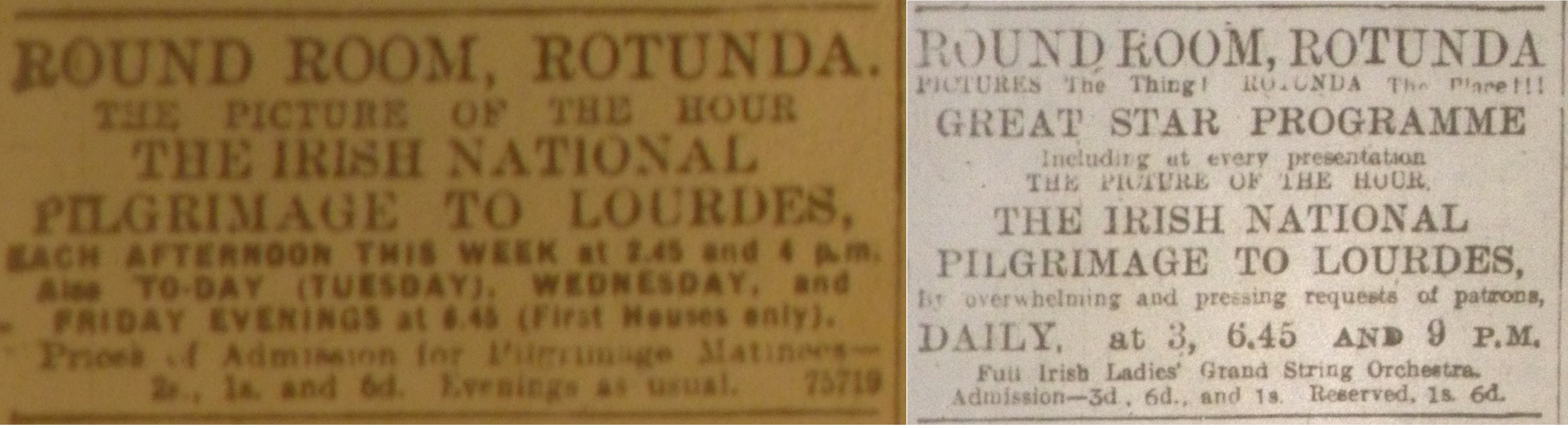
Differences in exhibition strategies at the Rotunda for the Irish National Pilgrimage to Lourdes (left) during its first week and (right) during its second week; Evening Telegraph 7 Oct. 1913: 2, and Dublin Evening Mail 13 Oct. 1913: 4.

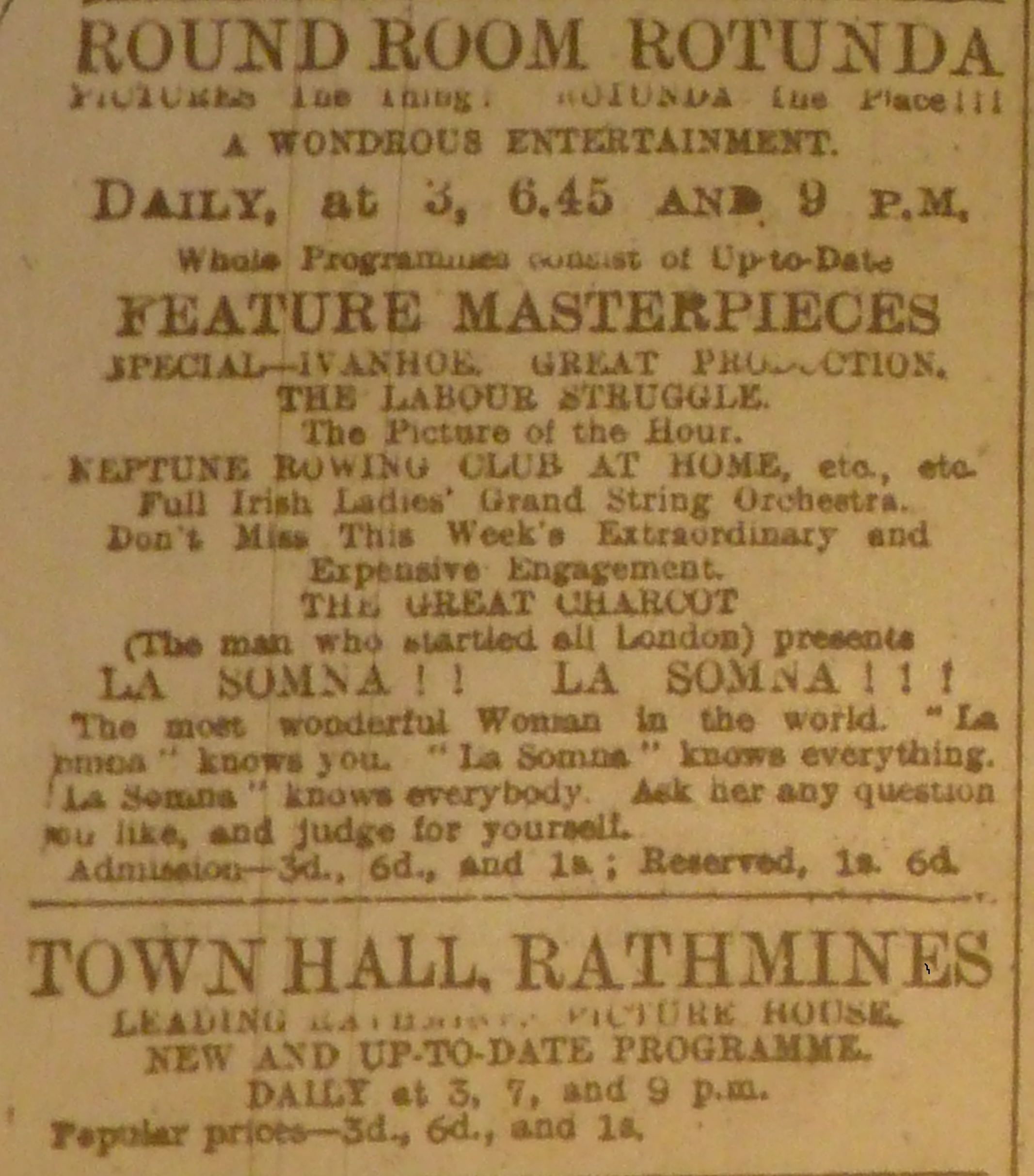
Despite its topicality and multiple attractions for an Irish audience, Jameson initially adopted an unusual exhibition strategy. Rather than integrating it into the Rotunda’s normally advertised times of 3pm (matinee), 6:45 and 9pm, he decided to show it apparently alone – or possibly with a reduced supporting programme – at two matinees at 2.45 and 4pm, and with the rest of the advertised programme “at the first evening houses, commencing at 6.45 p.m., on Tuesday, Wednesday, and Friday” (“Pilgrimage in Picture”). The 6:45 show on Monday, Thursday and Saturday and all the lucrative 9pm shows would offer a programme that did not include the pilgrimage film, and this other programme – headed by Mary in Stageland, the third part of the Mary Fuller serial What Happened to Mary – was advertised separately. Whether he had already booked the first programme before he became aware of the availability of the pilgrimage film or whether he believed that the audience for the pilgrimage film would not be interested in the films enjoyed by his regular audience, and vice versa, is not clear.

The film’s popularity appears to have surprised this canny exhibitor, who changed his exhibition strategy in the second week of the film’s run. His decision to run the film for a second week already demonstrated that he identified unusual interest in it, but for the second week, he integrated it into his regular 3pm, 6:45 and 9pm schedule. Predicting that the programme would “undoubtedly prove to be one of the most popular ever set before a Dublin audience,” the Freeman’s Journal reported that the “film has been reproduced at the Rotunda on the overwhelming and pressing requests of patrons, and that the management only justified itself in complying with the enormous demand was thoroughly testified by the approval shown” (“Rotunda Pictures”).

Ch4Two

Frank Leah’s caricature of Norman Whitten. Irish Limelight 1:10 (October 1917), p. 1.

The film was produced by the General Film Agency (later, the General Film Supply), a company run by Norman Whitten that seems to have some relationship with a London-based company of the same name. English-born, Whitten had worked with British film pioneer Cecil Hepworth in the early 1900s but moved to Ireland in the early 1910s. In 1917, he would found Irish Events, the first Irish newsreel, before also shooting such fiction films as the bilingual life of St. Patrick Aimsir Padraig/In the Days of St. Patrick (1920). One of Ireland’s most successful film producers of this period, he showed a remarkable ability to understand Irish cinema audiences. In 1913, he began advertising his services as a producer of advertising films and local topicals (films of local events). Whether he was commissioned to make the pilgrimage film or initiated the project himself is not clear, but he certainly had considerable cooperation from the pilgrimage organizers.

The Dublin papers were almost universally positive in their reviews of the film. Although also positive, the Daily Express’ review is notable for the writer’s attempts to draw a distinction between what we would now see as fiction and documentary (at least of a kind):

Pictures recording actual events which are unembarrassed are usually never so effective as those which are produced after continual experiment This however, does not apply to the same extent as regards the present pictures as it might in the case of other pictures. The climatic conditions at Lourdes are pre-eminently suitable for the cinematograph, and without exception the various events, which the pictures pourtray are shown with marked clearness and distinctness (“Lourdes Pictures at the Rotunda”).

The pilgrimage film was not as bad as the writer had experienced other factual film to be, but s/he clearly preferred fictional films, or at least films that allowed rehearsal of some kind. The discussion of climatic conditions was one often aired when anyone tried to explain why so few films were made in Ireland or why those that were made featured relatively poor cinematography.

The one piece of criticism made in relation to the film concerned the choice of musical accompaniment at the Rotunda. The Dublin Evening Mail‘s “Music and Drama” columnist commented at length on film music, arguing that “semi-neutral music is the most effective,” explaining that by this s/he meant “that the selections should be broadly in sympathy with the general character of the film” (“Music and the Drama.”). Exemplary of this was Sackville Picture House musical director Jack Larchet’s recent “dignified” selection of Mendelssohn’s Trio in D Minor and Shubert’s Unfinished Symphony to accompany Hamlet (Hepworth, 1913), featuring theatre star Johnston Forbes-Robertson. By contrast s/he found the accompaniment of the pilgrimage film at the Rotunda by the elsewhere much praised Irish Ladies’ String Orchestra, under the direction of May Murphy, “not only inappropriate but it was badly played. Gounod’s ‘Ave Maria’ was suitable enough if it had been well rehearsed, but Stephen Adam’s ‘Holy City’ and ‘The Star of Bethlehem’ are not sacred songs in the real sense of the word” (ibid). This kind of criticism, however, is indicative that picture houses would increasingly be held to the highest standards of entertainment.

References

“Home Again: Pilgrims Back in Ireland.” Irish Independent 20 Sep. 1913: 5.

“Lourdes Pictures.” Evening Herald 4 Oct. 1913: 6.

“Lourdes Pictures at the Rotunda.” Daily Express 4 Oct. 1913: 10.

“Lourdes Pilgrimage.” Irish Times 8 Oct. 1913: 4.

“Lourdes Pilgrims: 2,300 Irish Folk Will Travel.” Irish Independent 6 Sep. 1913: 6.

“Miracle at Lourdes: Girl from Killaloe Cured.” Evening Herald 13 Sep. 1913: 2.

“Music and the Drama.” Dublin Evening Mail 13 Oct. 1913: 7.

“A Pilgrimage in Picture.” Irish Times 4 Oct. 1913: 5.

“Rotunda Living Pictures.” Irish Times 14 Oct. 1913: 5.

“Rotunda Pictures.” Dublin Evening Mail 11 Oct. 1913: 7.

“Rotunda Pictures.” Freeman’s Journal 14 Oct. 1913: 9.

Screening the Lockout (?)

Dublin tramway workers pass the Rotunda, one of the city’s most important picture houses. (“Dublin Tramwaymen’s Strike.” Dublin Evening Mail 27 Aug. 1913: 2.) A different view of this picture house can be found here.

A hundred years ago, on Tuesday, 26 August 1913, the labour dispute known as the Dublin Lockout began when just before 10am, some 200 motormen and conductors of the Dublin United Tramway Company abandoned their trams in the city centre. The tram strike would prompt the Dublin Employers’ Federation – led by the tram company’s chairman and owner of the Irish Independent and Evening Herald newspapers William Martin Murphy – to lock out workers affiliated with Jim Larkin’s Irish Transport and General Workers’ Union. Riots, the arrests of union leaders, demonstrations and vicious police baton charges followed. Newspapers played an important part in this dispute – and in how we remember it a century later; see Century Ireland – but what about cinema?

As early as 1907, cinema was being called the art form of the working class (Patterson), an accessible and relatively cheap form of not just entertainment but also information about the world in moving pictures that did not require a high level of literacy. Although Dublin had just a few film venues before 1910, the new medium of cinema very quickly came to have a significant place in Irish society in the early 1910s. By August 1913, Dublin had three times more picture houses than it did theatres, and half of the theatres also showed fiction films and newsreels on a regular basis as part of their variety programmes. Picture houses were not only located in the city’s business core like the theatres but also in residential areas and in the suburbs and townships adjacent to the city. They often therefore relied to a greater extent than the theatres on the patronage of local audiences. However, these picture houses were also businesses, in which a dichotomy between worker and employer also existed.

As such, activity in Dublin’s picture houses during the last week of August into September 1913 demonstrates something of how the new cultural institution of cinema would mediate the momentous Irish events of the 1910s, and how the institution would be shaped by these events in turn. As regards programming, only the Rotunda in O’Connell/Sackville Street (both names were used at the time, with the preference usually based on whether ones politics were nationalist or unionist) appears to have allowed unfolding events to influence its choice of films. For the three days (the usual length of a cinema programme) from 1-3 September, the Rotunda showed the American film The Labour Struggle (1913), made by Kalem, a film production company particularly well known in Ireland because of the many films they had shot in the country. However, The Labour Struggle had nothing to do with Ireland. Although a reviewer of another timely choice of production that week, the play The Labour Leader at the Queen’s Theatre, commented that “visitors will not see much resemblance between the hero of the play and the local product” (“The Queen’s Theatre”), another writer took allegorical meaning from the conclusion of The Labour Struggle:

If its conclusion were to be interpreted in one sense the raging fire against which by mutual help the employer and employes in the end fought successfully may be taken to picture anarchy. When both sides to the struggle came to recognise the peril which threatened them, they ceased to quarrel, and, turning their strength against the common foe, they subdued it, and then taking a juster measure of one another it looked from the last film as if they were likely “to live happily together ever after” (“The Rotunda”).

How Dublin workers and employers might – Metropolis-like – identify a common foe, the writer does not speculate, and a happy ending to the dispute must have seemed remote to anyone walking the city’s streets. In any case, the film’s engagement with radical labour politics would likely have been diluted not just by its conclusion but also by its appearance on a bill with the live telephatic performer La Somna, a screen adaptation of Ivanhoe (IMP, 1913), and two film comedies featuring Vitagraph star John Bunny.

Sep 1 1913 DEM Rotunda Labour Struggle

Advertisement for the Round Room Rotunda showing Kalem’s The [Great] Labour Struggle and a local film of the Neptune Rowing Club. Dublin Evening Mail 1 Sep. 1913: 4.

Apart from fictional representations produced elsewhere, local film producers could have filmed the demonstration themselves to produce a local news film. Norman Whitten had set up a company in May – with an office at 76 Talbot Street (“Irish Enterprise”) – to take such films. James T. Jameson and his sons, including Ernest who managed the Rotunda – but Ernest had got married on Thursday 28 August, so perhaps he deserves congratulations and the benefit of the doubt – had been shooting such films for a decade. Tellingly perhaps, neither Whitten nor Jameson caught on film Jim Larkin’s famous address to the proclaimed demonstration of workers in O’Connell Street on 31 August or the notorious baton charge that followed it, despite the fact that both had business addresses on or just off that street. The bills at Jameson’s picture houses had long been known for their local films. During the week of 25-30 September, both the Rotunda and the Jameson-run Town Hall Rathmines had shown films of each day of the prestigious Dublin Horse Show. And in lieu of a local strike film, The Labour Struggle was accompanied at the Rotunda by a film of a social event at the Neptune Rowing Club, “a local event of direct personal interest to numbers of the citizens” (“The Rotunda”), but those citizens were likely to have been the middle-class audience Jameson had long courted.

Quo Vadis Phoenix ET 9 Aug 1913

For Horse Show Week 1913, Dublin’s Phoenix Picture Palace revived Quo Vadis? Evening Telegraph 9 Aug. 1913: 2.

Other exhibitors more reliant on a working-class audience do not seem to have modified their bills in response to the strikes even to the extent that Jameson did. The Phoenix Picture Palace on Ellis Quay widely advertised the fact that it was showing Quo Vadis? (Cines, 1912) for the whole of Horse Show Week; in April, the Phoenix had been the first Dublin picture house to show the Italian spectacular. A similar taste for a full week of spectacle to attract well-heeled Horse Show visitors inspired the Dame Street Picture House to book The Life and Works of Richard Wagner (Messter, 1913), which allowed the house orchestra to accompany the silent film with a different Wagner selection at each performance. Other programmes from picture houses that advertised in the newspapers at this time – the Town Hall, Rathmines, the World’s Fair Varieties, the Mary Street Picture House, the Picture House, Sackville Street (called the “O’Connell Picture House” by the nationalist press), the Grand, the Volta, the Theatre de Luxe, the Camden Picture House, the Clontarf Electric Theatre and the Assembly Picture Hall, Serpentine Avenue – show no immediate impact of the Lockout.

Although the picture houses largely failed to represent the early days of the Lockout on screen, the impact of the struggle for workers’ representation that was being fought out in the streets was also felt in the auditorium, projection booth and cash box. Dublin projectionists had organized themselves into the Irish Cinematograph Operators’ Association and initially affiliated themselves with the National Association of Cinematograph Operators (“N.A.C.O. Dublin Branch”). However, in order to represent themselves in solidarity with other picture house workers, the projectionists later affiliated instead with the National Association of Theatrical Employees (NATE). As a result, even the unskilled cinema workers were able to make strong demands for fixed wages to the cinema owners at a special meeting of the Irish Cinematograph Exhibitors’ Association in early September: “In the case of the doormen this should be 26s. for the first doorman, 20s. for the second, and 18s. for the third. It was also proposed to give the inside attendants 12s. per week, the cash-box girl getting 15s” (“Pictures in Ireland”). The cinema owners were not altogether happy with these proposals, and by mid-September, NATE members would be picketing the Theatre de Luxe in Camden Street (Rockett 43). But that is a story for another day.

References

“Irish Enterprise.” Bioscope 12 June 1913: 781.

“N.A.C.O. Dublin Branch.” Bioscope 29 May 1913: 623.

Patterson, Joseph Medill. “The Nickelodeons: The Poor Man’s Elementary Course in the Drama.” Saturday Evening Post 23 November 1907: 10+.

“Pictures in Ireland.” Bioscope 4 September 1913:

“The Queen’s Theatre.” Evening Telegraph 2 Sep. 1913: 2.

Rockett, Kevin and Emer. Film Exhibition and Distribution in Ireland, 1909-2011. Dublin: Four Courts, 2011.

“The Rotunda.” Evening Telegraph 2 Sep. 1913: 2.

Passion on Screen: Easter 1912

Easter was a busy period for Ireland’s entertainment venues, of which cinemas were a growing part by 1912. Appropriately religious-themed films were a popular choice with cinema managers at Christmas and Easter, and a Passion Play film played in several Dublin cinemas and halls in the run-up to Easter. The Rotunda, the base for James T. Jameson’s Irish Animated Picture Company, was exhibiting a different kind of spectacle: the Kinemacolor film of the Delhi Durbar, which celebrated the coronation of King George V and Queen Mary.

When the Galway Cinema Theatre opened its doors in William Street on Easter Monday, 8 April 1912, it was not to present a programme of films but to offer the public a Wild-West play, The Cowboy’s Revenge.