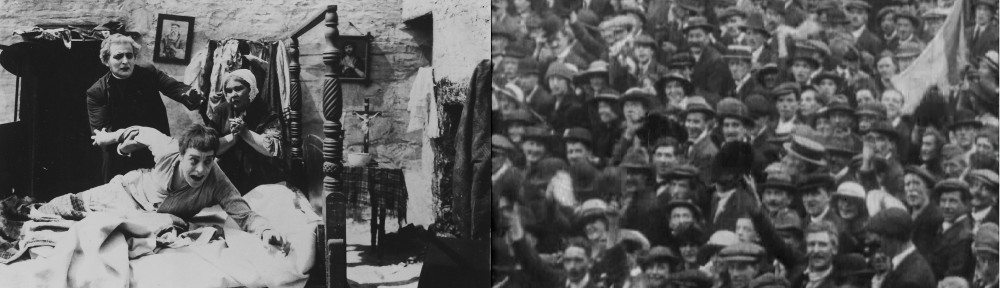
A Happy and Appropriate Synchronism: Passion Films at Easter 1914

The release of Darren Aronofsky’s Noah (US: Paramount/Regency/Protozoa/Disruption, 2014) on cinema screens around the world in the run up to Easter 2014 is a distribution strategy at least a century old. “As a Passion Play,” wrote a reviewer  in Dublin’s Evening Telegraph of the latest release at the Rotunda’s in early April 1914, “‘The Messiah’ holds one with its intense impressiveness and pathos, and its exhibition just at this holy season is a happy and appropriate synchronism” (“‘The Messiah’ at the Round Room Rotunda”). This synchronism – or well-established distribution and exhibition strategy – was familiar to cinemagoers of the 1910s who would have seen the practice of releasing biblically based films for this religious festival as entirely unremarkable. In fact, this practice reproduced in a new medium the centuries-old Christian tradition of performing passion plays at Easter. Filmic passion plays were among the first moving pictures (Cosandey passim), and they were so popular that The Messiah shown in Dublin in April 1914 was the 1913 remake (dir. Maurice-André Maître) by French company Pathé of its La vie et la passion de Notre Seigneur Jésus-Christ, which the company had first produced in 1903 and again in 1907 (Abel 319-20). And this was just the output of one – albeit large – production company.
Jameson

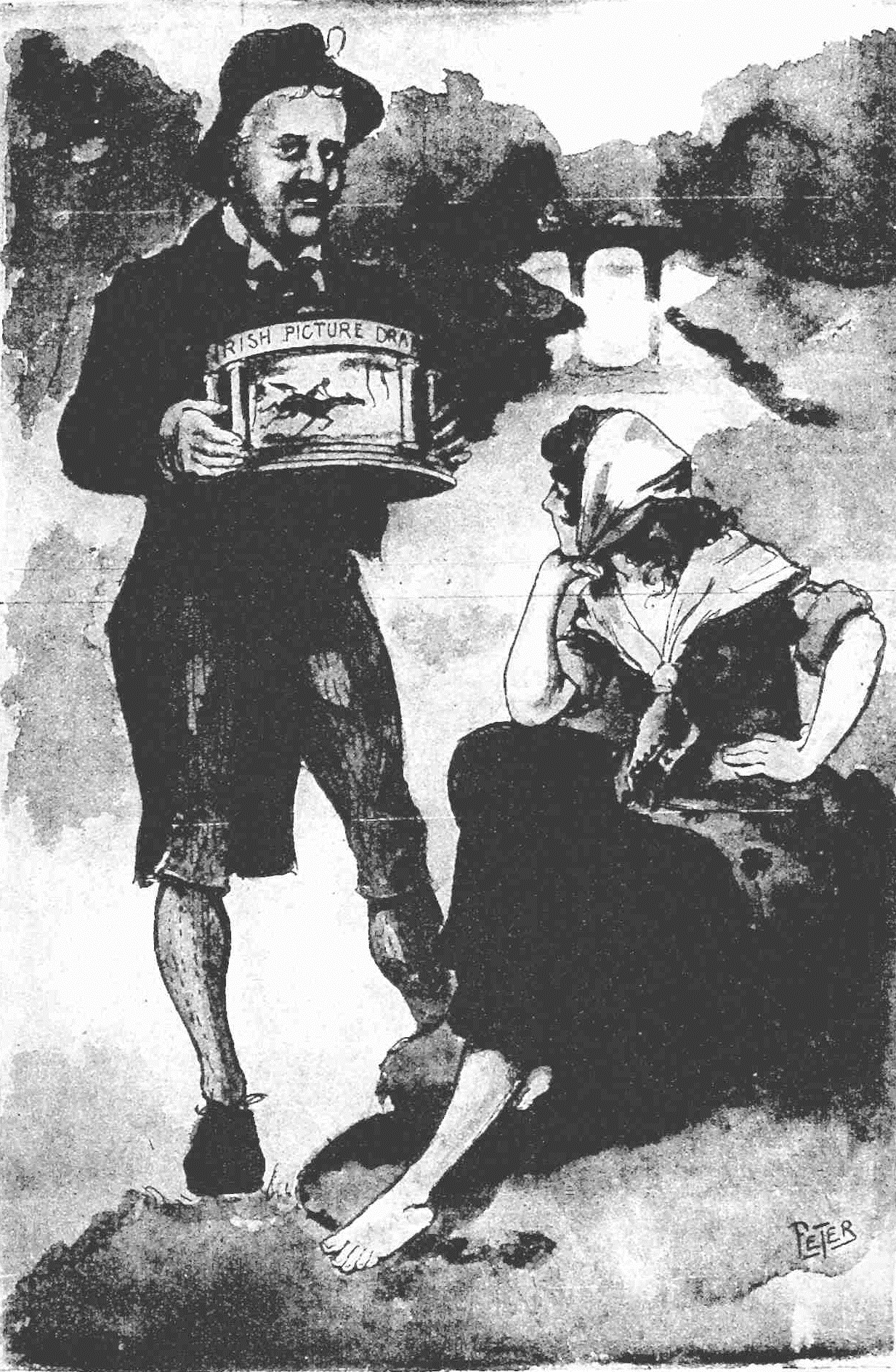
Rotunda manager James T. Jameson as he appeared in a caricature in the Bioscope in November 1911.

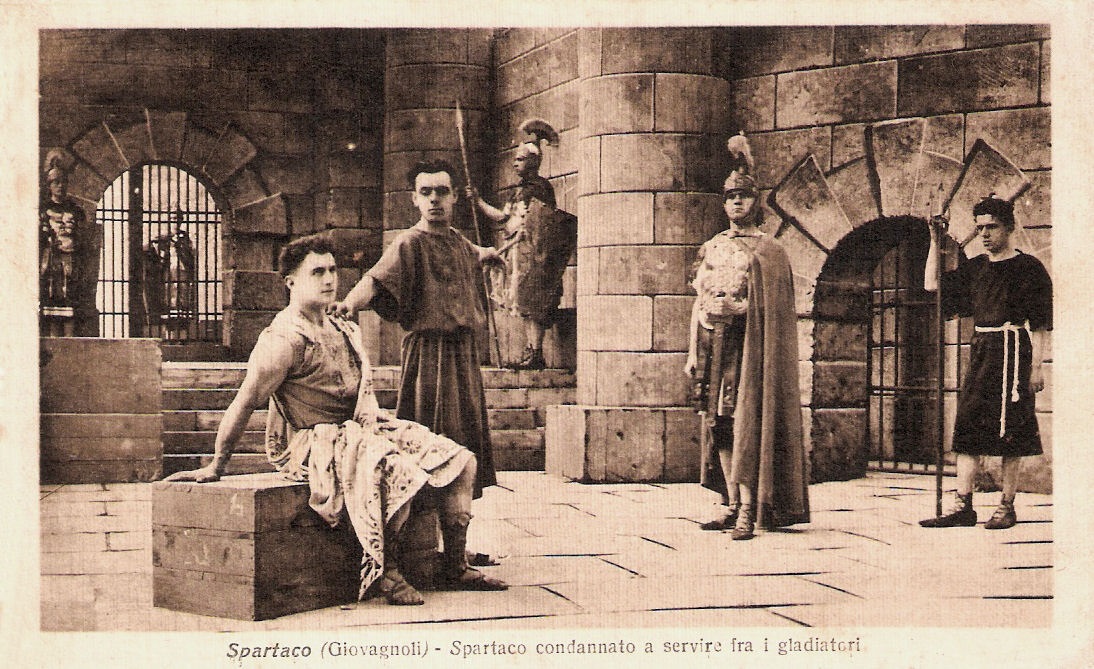
Easter Monday fell on 13 April 1914, but James T. Jameson, director of the Irish Animated Picture Company, and his son, Ernest, who managed the Rotunda, had begun the run up to Easter much earlier. In early March, Jameson senior had secured the Irish rights to two long “exclusives”: The Messiah and Spartacus, or the Revolt of the Gladiators (Italy: Pasquali, 1913) (“Items of Interest”). In its review of Spartacus at the Rotunda in the week beginning 23 March, the Dublin Evening Mail compared it to Quo Vadis? (Italy: Cines, 1912), the Italian epic that had been the biggest hit of 1913 and that had been available to Dublin audiences as lately as 2-7 March at the Camden Picture House (“Rotunda Pictures”). However, The Messiah was a more important film for the Rotunda than Spartacus. For one thing, it was longer; Spartacus shared its bill with the comedies The Awakening at Snakesville (US: Essanay, 1914) and When Cupid Takes in Washing (US: Lubin, 1914), but The Messiah was the only thing on the Rotunda’s programme for the two weeks beginning Monday, 30 March. As well as this, because it depicted the life of Christ, The Messiah had the potential to be as controversial as From the Manger to the Cross (US: Kalem 1913) had been the previous year. The superiority of The Messiah was emphasized by the Evening Telegraph, which urged “any person who witnessed “From Manger to Cross to pay a visit to the Rotunda and see what a drastic and extraordinary difference can be introduced in the treatment of the same subject, and more especially the grandeur of its colouring” (“‘The Messiah’ at the Round Room Rotunda”).
The Messiah was certainly a success at the Rotunda. Quoting figures supplied by the Rotunda management, the Telegraph revealed that by the Saturday of the first week of its run, it had been seen by over 22,000 people, “including a considerable proportion of the clergy of every denomination, and there have been nothing but the highest eulogies expressed by everybody who had the pleasure of seeing this marvellous production” (ibid). Paddy, the Irish correspondent of the British trade paper Bioscope, speculated that the audience for the full two-week run would number 50,000, commenting that the film “easily surpassed anything of the kind ever seen in Dublin, and the special music, so brilliantly rendered by Miss May Murphy’s Irish Ladies’ orchestra, added to the reverent screening of this great film” (Paddy). Although Jameson offered a new bill from Easter Monday featuring Christopher Columbus (US: Selig, 1912) and a film of the Grand National Steeplechase, he brought back – purportedly due to popular demand – The Messiah by the end of that week for selected matinees and early evening shows until Friday, 24 April.

This success of the passion films and such Italian historical epics as Quo Vadis? and Spartacus points to the existence of types of quality filmmaking based on high-cultural criteria. The Rotunda had long pursued a middle-class audience by promoting its film shows as both educative and entertaining, but Jameson had usually favoured programmes of shorter films – and some live variety acts – rather than a single long film. A review of the Rotunda in early March had stressed cinema’s multiple attractions:

The elaborate production of cinematograph films shows how much this form of entertainment has grown in public favour. Unlike skating rinks, living pictures seem to have come to stay. They supply an easy means of transporting oneself for a time from the uneventful round of daily life. Sitting in a comfortable seat, the spectator can in a moment travel from China to Peru, from the waste of the open sea to the sun-bathed mart of some Eastern town; he can witness fire and flood and return safely to a good supper by his civilized fireside (“Irish Animated Picture Company”).

The Rotunda had aimed to provide such a variety of attractions with multiple films in its two-hour shows, but the Italian epics could provide a range of spectacles in one film, as well as a patina of high-cultural value associated with classical education. As adaptations of literary works, Quo Vadis? – from Henryk Sienkiewicz’s novel – and The Last Days of Pompeii (Gli ultimi giorni di Pompeii; Italy: Ambrosio, 1913) – promoted as Lord Lytton’s great work” when it played at the Camden Street Picture House in the week beginning 20 April (“Camden Street Pictures”) – could benefit from recognition by middle-class audiences, as well as bestowing cultural prestige on the film and the picture house at which it was shown. Among other significant literary adaptations on exhibition in Ireland at Easter 1914 was Cines’ Antony and Cleopatra (Italy, 1913), a story that prospective spectators at the Opera House in Derry were informed “has been variously dealt with by many famous writers, including the immortal Shakespeare” (“Easter Amusements”).
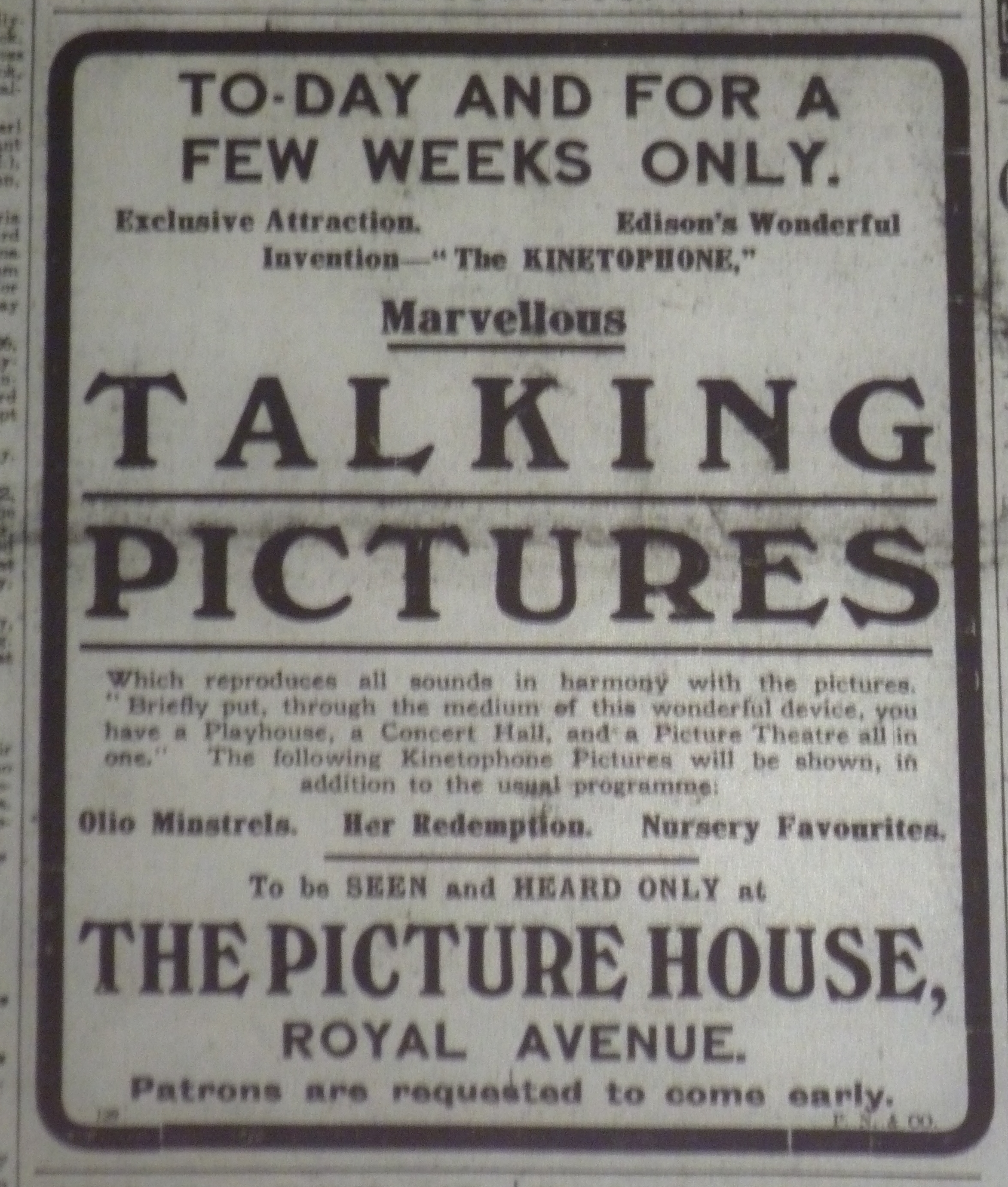
Edison Talking Pictures at the Picture House, Royal Avenue, Belfast. Belfast Newsletter 3 Apr. 1914: 1.

Edison Talking Pictures at the Picture House, Royal Avenue, Belfast. Belfast Newsletter 3 Apr. 1914: 1.

The extent to which a shared or imposed set of cultural values deriving from literary culture, classical education and Christian doctrine was the source of the popularity of The Messiah or the Italian epics is difficult to say definitively without some discussion of how images of these circulated more widely (Uricchio and Pearson). Certainly, the promotion of such films as respectable by the trade press, newspapers and other forms of picture-house promotion did not prevent other cultural forces from continuing to attempt to impose their own control on cinema and its audiences. 

Easter 1914 seemed to be a particularly auspicious time for Irish nationalists. This point was well expressed in the nationalist Evening Telegraph, in which an editorial observed that

this will be the last Easter before Home Rule becomes the law, for the Home Rule Bill will reach the Statute Book in the course, probably, of the next five or six weeks. It is well that Easter should herald the coming of Ireland’s resurrection, for in the Christian sense it symbolises the Resurrection (“Easter”).

Christianity here meant the Catholicism of the Telegraph’s readership and of the majority of Dublin Corporation’s dominant nationalist faction. With Home Rule apparently imminent, more militant forces within the church were determined that cultural policy reflect a Catholic ethos, regardless of how this might affect the business interests of certain Catholic nationalist councillors.

Lord Mayor Lorcan Sherlock came under criticism from Catholic church-based groups in early March when he showed reluctance to introduce local censorship of films – the Corporation “are satisfied, as indeed are so many other civic bodies, with the verdict of the Board of Trade Censor” – or close picture houses on Sundays – “‘They have been,’ he said, ‘patronised to an extraordinary extent on Sunday by the working people of the city’” (“Picture Theatres: Conditions of Licensing”). Responding in a letter to the Telegraph, William Larkin, who had recently been praised rather than fined by a magistrate for protesting loudly during a theatre show, wondered whether or not the general public were “to be left at the mercy of the Corporation in the matter of taste in living pictures” whose “educational value […] in Dublin at present are nil” (“Sunday Pictures: For Working People”). He left no doubt that lay Catholic organizations would not let the matter rest:

Does his lordship know that the United Sodalities of Dublin (male and female) are out for reform of the picture theatres? Does his lordship know that the United Confraternities of the city are out for the same object? And does he also know that the Theatre Reform League of Dublin (which will later embrace all of Ireland) are on the watch against the class of production that has flooded our capital for some time now? (ibid).

Although Larkin and those named lay organizations would lead the campaign, priests and bishops lent the support of the hierarchy. A letter from a Father Gleeson calling for “an Irish National Censor, who understands the hearts and minds of the Irish people” accompanied Larkin’s  (“Letter from Father Gleeson”). In April, the Lord Mayor “stated that Archbishop Walsh was not in favour of closing picture houses on Sunday, but he thought that a limit should be placed in the hours of opening so that there would be no interference with the freedom of persons to attend divine worship.” Under pressure from both inside and outside the Corporation, Sherlock “was writing to Archbishop Walsh asking him whether he would take upon himself the responsibility of suggesting what type of censorship should be put into operation” (“Picture Theatres: The Archbishop’s Views”).
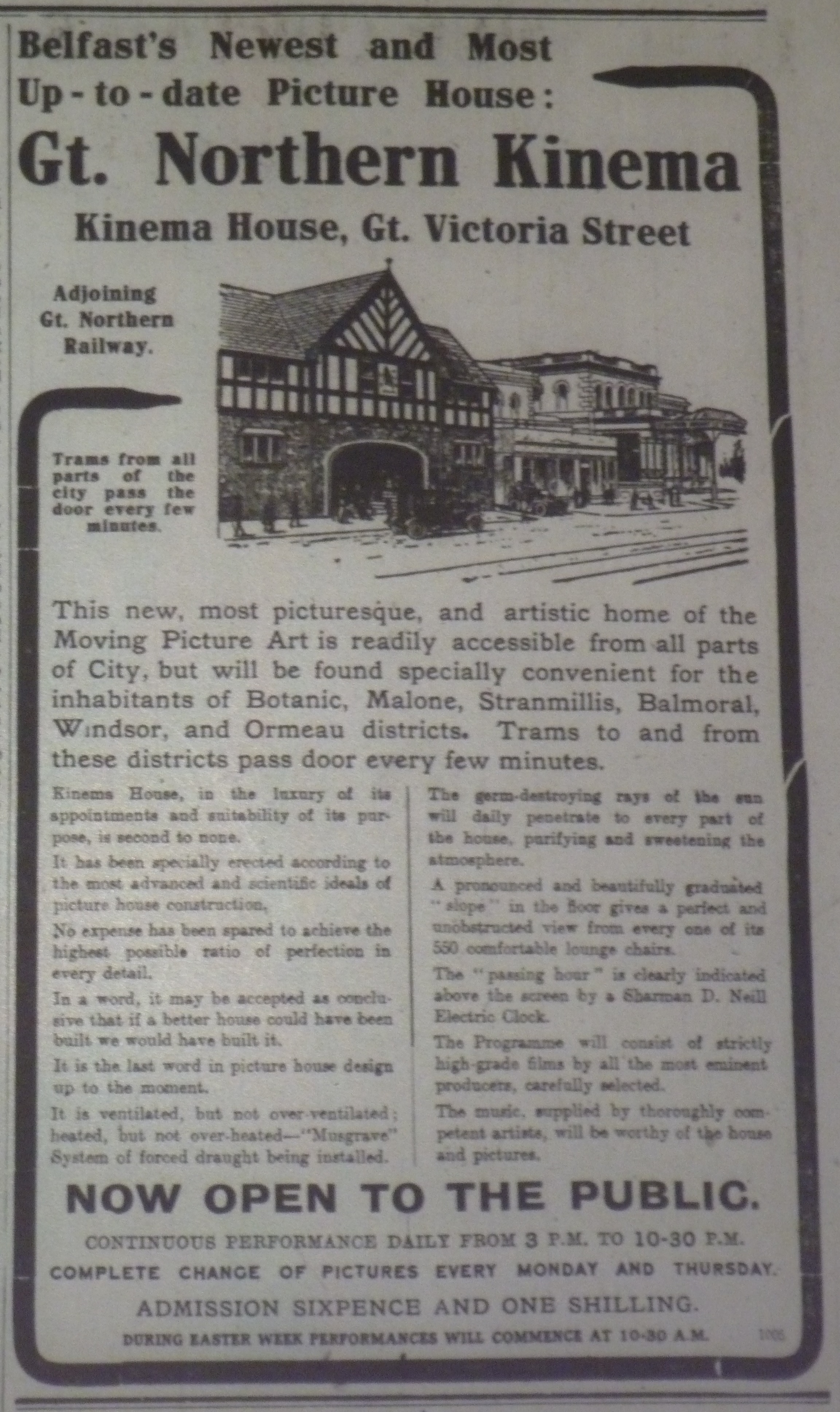
Belfast Newsletter 9 Apr 1914: 9.

Ad for the newly opened Great Northern Kinema in Belfast Newsletter 9 Apr. 1914: 9.

Larkin ended his letter on Dublin picture houses with some architectural criticism by remarking that “the building themselves are not even decent looking” (“Sunday Pictures: For Working People”), but Easter for Belfast’s picture houses was notable for its openings of distinct contributions to the city’s streetscape. The latest addition to Belfast’s substantial tally of picture houses was the Great Northern Kinema in Gt. Victoria Street, which opened in the first week of April, a little over a week after the 23 March opening of the Crumlin Picture House on the Crumlin Road. The Kinema, “[t]his new, most picturesque , and artistic home of the Moving Picture Art,” was located beside the Gt. Northern railway station, as well as on some of the city’s major tram lines (“Belfast’s Newest and Most Up–to-date Picture House”). No single film seemed to dominate the picture house programmes over the holiday period in the same way as The Messiah did in Dublin. At the “luxurious and attractive” Kinema, “[t]he star film during the early part of the current week is a two-reel drama entitled ‘Silent Heroes’” (US: Broncho, 1913) (“Kinema House”). The city’s most highly publicized cinema offerings were Edison’s Talking Pictures at the Picture House, Royal Avenue, where they were joined in the week beginning Easter Monday by a programme that included Selig’s Christopher Columbus. The different relationship between the churches and cinema is suggested by the fact that several of the Protestant halls – the CPA Assembly Hall, the Grosvenor Hall, the City YMCA and the People’s Hall – offered not only their usual Saturday cinematograph shows but also special film shows on Easter Monday and Tuesday.

References 

Abel, Richard. The Ciné Goes to Town: French Cinema, 1896-1914. Berkeley: U of Califronia P, 1994.

“Belfast’s Newest and Most Up–to-date Picture House.” [Ad.] Belfast Newsletter 9 Apr. 1914: 9.

“Camden Street Pictures.” Evening Telegraph 21 Apr. 1914: 6.

Cosandey, Roland, André Gaudreault and Tom Gunning, eds. An Invention of the Devil? Religion and Early Cinema. Sainte-Foy and Lausanne: Éditions Payot/Laval UP, 1992.

“Easter.” Evening Telegraph 11 Apr. 1914: 4.

“Easter Amusements.” Derry Journal 13 Apr. 1914: 8.

“Irish Animated Picture Company.” Irish Times 10 Mar. 1914: 5.

“Items of Interest.” Bioscope 12 Mar. 1914: 1109.

“Kinema House.” Belfast Newsletter 14 Apr. 1914: 9.

“Letter from Father Gleeson.” Evening Telegraph 11 Mar. 1914: 5.

“‘The Messiah’ at the Round Room Rotunda.” Evening Telegraph 4 Apr. 1914; 7.

Paddy. “Pictures in Ireland.” Bioscope16 Apr. 1914: 313.

“Picture Theatres: Conditions of Licensing.” Evening Telegraph 10 Mar. 1914: 3.

“Picture Theatres: The Archbishop’s Views.” Evening Telegraph 20 Apr. 1914: 3.

“Rotunda Pictures.” Dublin Evening Mail 24 Mar. 1914.

“Sunday Pictures: For Working People.” Evening Telegraph 11 Mar. 1914: 5.

Uricchio, William and Roberta E. Pearson. Reframing Culture: The Case of the Vitagraph Quality Films. Princeton: Princeton UP, 1993.
Marching for Saint Patrick and for Carson

At a meeting of the Portadown Technical Committee on Thursday, 12 March 1914, Technical School principal J. G. Edwards reported that certain pupils attributed their poor attendance to “the picture house” and “drilling” (“Technical School Drilling”). Like the nationalist boys who had objected to the British Army Film in Dublin the previous week – although opposed to them politically – the unionist boys of Portadown were culturally and politically active, participating in the Ulster Volunteer Force’s (UVF’s) increasingly visible campaign of opposition to Home Rule. For a significant number of young Irish men of different political convictions in 1914, the cinema and marching formed part of the texture of their lives.

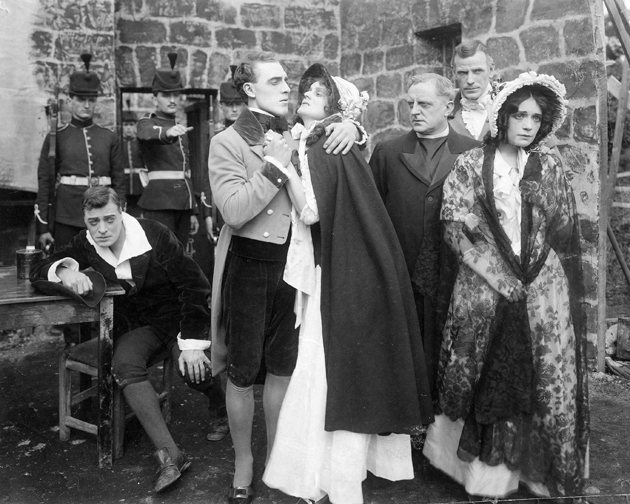
Putlicity still for The Shaughraun from Irish Film Archive (http://irishamerica.com/2011/12/blazing-the-trail-to-ireland/22-the-shaughraun-publicity-still/).

Publicity still for The Shaughraun from the Irish Film Archive (http://irishamerica.com/2011/12/blazing-the-trail-to-ireland/22-the-shaughraun-publicity-still/).

Despite the polarization of Irish politics by the growing Home Rule crisis in March 1914, the celebration of St. Patrick’s Day in the country’s cinemas appears to have been surprisingly uncontroversial. Several cinemas in the largest population centres of Dublin, Belfast and Cork chose Irish-themed films, with Irish-shot films – especially those of the Kalem company – being particularly favoured. Indeed, it would be decades before so many recently produced Irish-shot film would be available to celebrate St. Patrick’s Day. For St. Patrick’s night only, Dublin’s Phoenix Picture Palace showed The Shaughraun (US: Kalem, 1912); the Clonard Picture House in Belfast’s Fall’s Road offered the same film but for the more usual three-day run beginning on 19 March. In Cork, the Coliseum exhibited Kalem’s The Kerry Gow (1912). The Cork Constitution‘s review of the latter appears to come from a non-Irish source as it explained that “The Kerry Gow (a blacksmith) is a splendid Irish production, which was acted in the Green Isle, and features Jack Clarke and Gene Gauntier, with a full company of ‘flicker’ artists of repute” (“The Coliseum”).

Evening Telegraph 16 Mar. 1914: 4.

Evening Telegraph 16 Mar. 1914: 4.

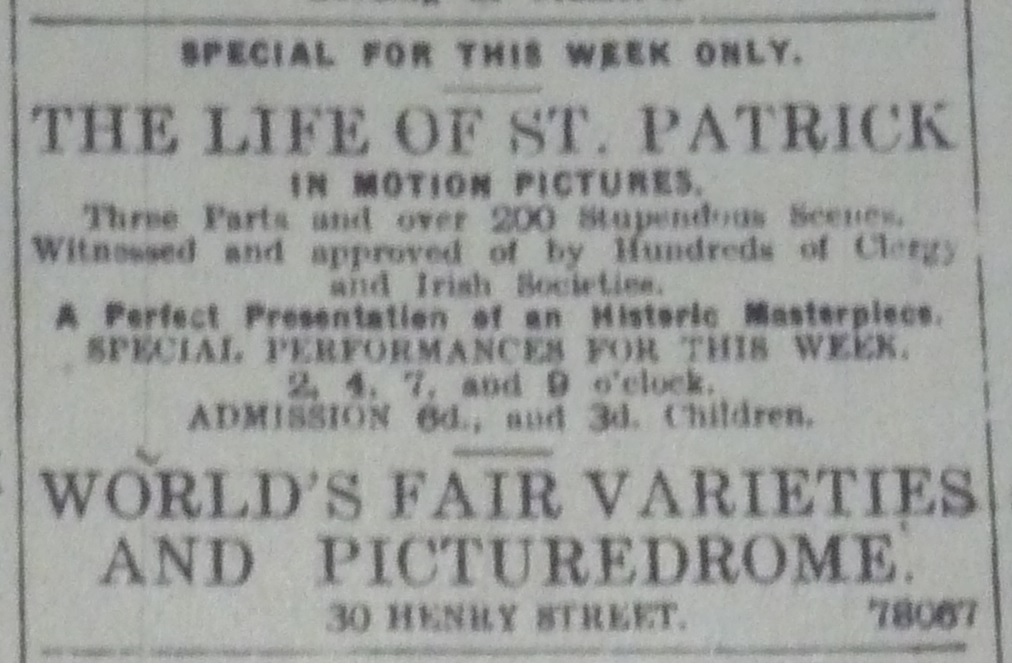
Of even more direct relevance to the feast day of the Irish patron saint was J. Theobald Walsh’s Life of Saint Patrick: from the Cradle to the Grave (US: Photo-Historic, 1912). This film was shown in Patrick’s Week at Dublin’s World’s Fair Varieties in Henry Street. This was not the first time the World’s Fair had shown the film; the venue began 1914 with an extended run of it. It was “over 3,000 feet long [and] was produced by Theobald Walsh, for the Photo-Historic Company, New York, on the actual spots made memorable by Ireland’s Apostle. It is enacted throughout by Irish peasants attired in the correct costumes of that period” (“World’s Fair Varieties”). It was, one reviewer commented, a “splendid picture, and most appropriate for the time of year it is.” Indeed, “it is, undoubtedly, a most masterly film” (“’Life of St. Patrick’”).

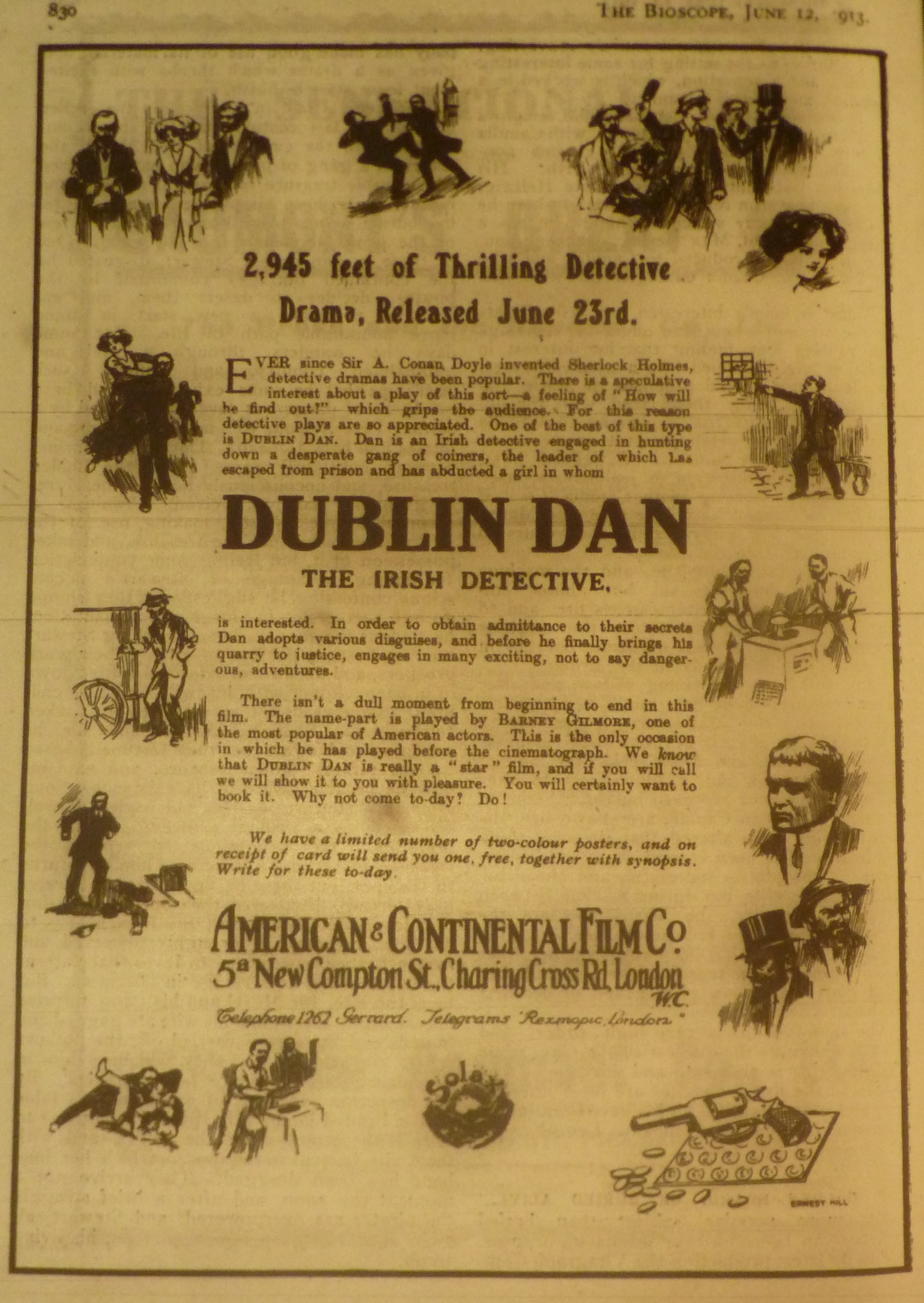
Bioscope ad for Solax's Dublin Dan (12 Jun. 1913: 830).

Bioscope ad for Solax’s Dublin Dan (12 Jun. 1913: 830).

Elsewhere, Irish-set (but not -shot) films or those featuring Irish characters that – like the Kalem films and The Life of Saint Patrick – had been released in the previous year or so were revived for the occasion. For the first part of Patrick’s week, the Clonard showed The Banshee (US: Kay-Bee, 1913), a “splendid two-part drama” to whose representations of the Irish the Ancient Order of Hibernians had objected when it had been shown in Tralee, Co, Kerry, in early February 1914 (Condon). Other titles were more Irish-American than Irish. As part of its special Sunday programme on 15 March, the Phoenix showed Solax’s Dublin Dan: The Irish Detective (1912), which starred popular stage actor Barney Gilmore in his first film. In an ad for the film in a US trade journal, Solax described Gilmore as the “popular American and Irish idol – the matinee girl’s pet – the favorite of millions, an actor known in every state in the Union – a veteran on the stage – although young in years, with a personality that ‘comes across’” (Solax 729). Although The Escape of Jim Dolan (US: Selig Polyscope, 1913) contained a temptingly Irish-named protagonist, this Tom Mix Western at the Picture House in Dublin’s Sackville/O’Connell Street for the three days including St. Patrick’s Day appears to have had no meaningful Irish or Irish-American theme beyond that name.

Image

Dublin Evening Mail 18 Mar. 1914: 2.

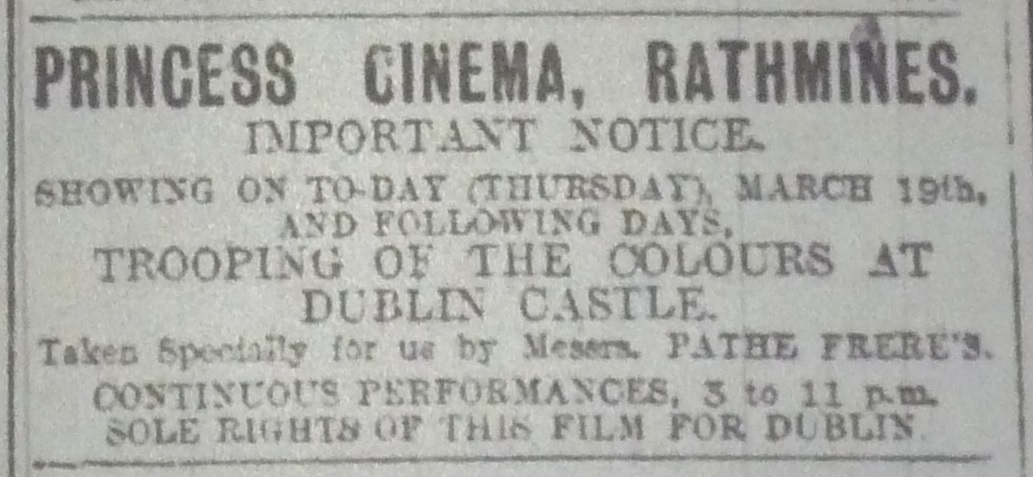
Two films of actual sporting and political events in Ireland were also popular. On Monday, 16 March, films of two international football matches that took place in Belfast the previous weekend were exhibited at several picture houses, including the West Belfast Picture Theatre on the Falls Road – which showed the soccer match at Windsor Park between Ireland and Scotland – and the Picture House, Sackville/O’Connell Street – which showed the Ireland v. Wales rugby match at the Balmoral show grounds. On 19 March, the Princess Cinema in the Dublin suburb of Rathmines was the first in the city to show the film “Trooping the Colours” that had been shot by Pathé at Dublin Castle on St. Patrick’s Day. A military display overseen by the Lord Lieutenant in the presence of invited dignitaries, this film offered moving-picture evidence of a phenomenon that had long been clear in other media: that St. Patrick’s Day was an established part of the official culture of British-ruled Ireland.

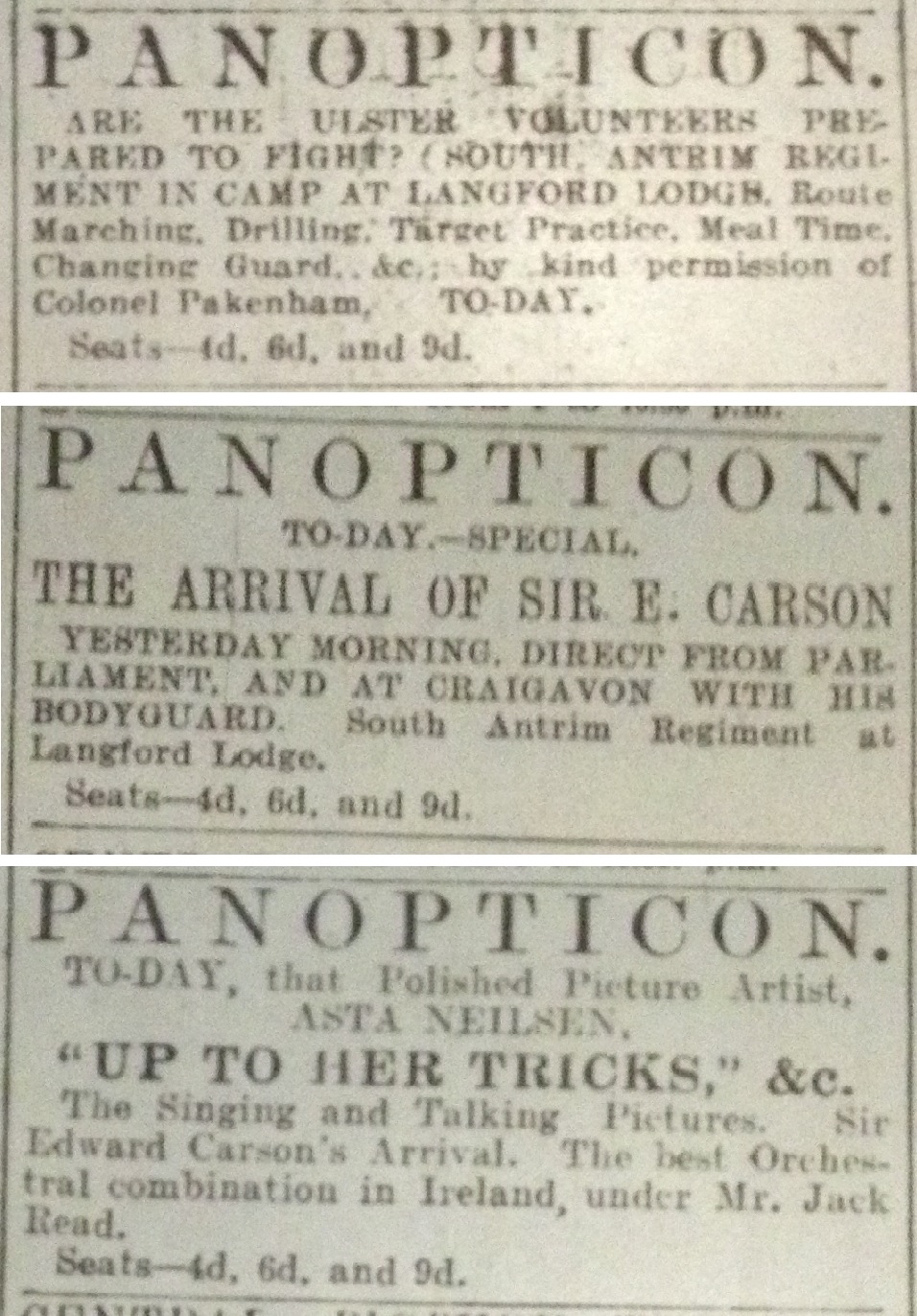
Ads for the Panopticon on 19, 21 and 24 Mar. 1914.

Ads for Belfast’s Panopticon on 19, 21 and 23 Mar. 1914.

Actuality films shown in Belfast presented a very different view of Ireland in 1914. As debates on special terms for the exclusions of parts of Ulster from a home-ruled Ireland continued at Westminster, the Panopticon in High Street topped its bills in the second half of Patrick’s week with films that showed the determination of unionist resistance. An actuality of the South Antrim brigade of the UVF was screened from 19 March in answer to the question posed by newspaper ads for the show: Are the Ulster Volunteers Prepared to Fight? This question had gained increased currency that day, when Edward Carson abruptly left Westminster in the face of insufficient concessions for Ulster, stating his intention of confronting what would come with his people. On Saturday, the South Antrim brigade film was joined on the Panopticon bill by The Arrival of Sir E. Carson, a film that was retained into the following week, although the new programme was headed by Asta Nielsen’s Up to Her Tricks (Engelein; Germany: Projections-AG Union, 1914). By then the political crisis in Ireland had worsened with the beginning of the Curragh Mutiny, the declaration by British Army officers in Ireland that they would not move against the UVF.

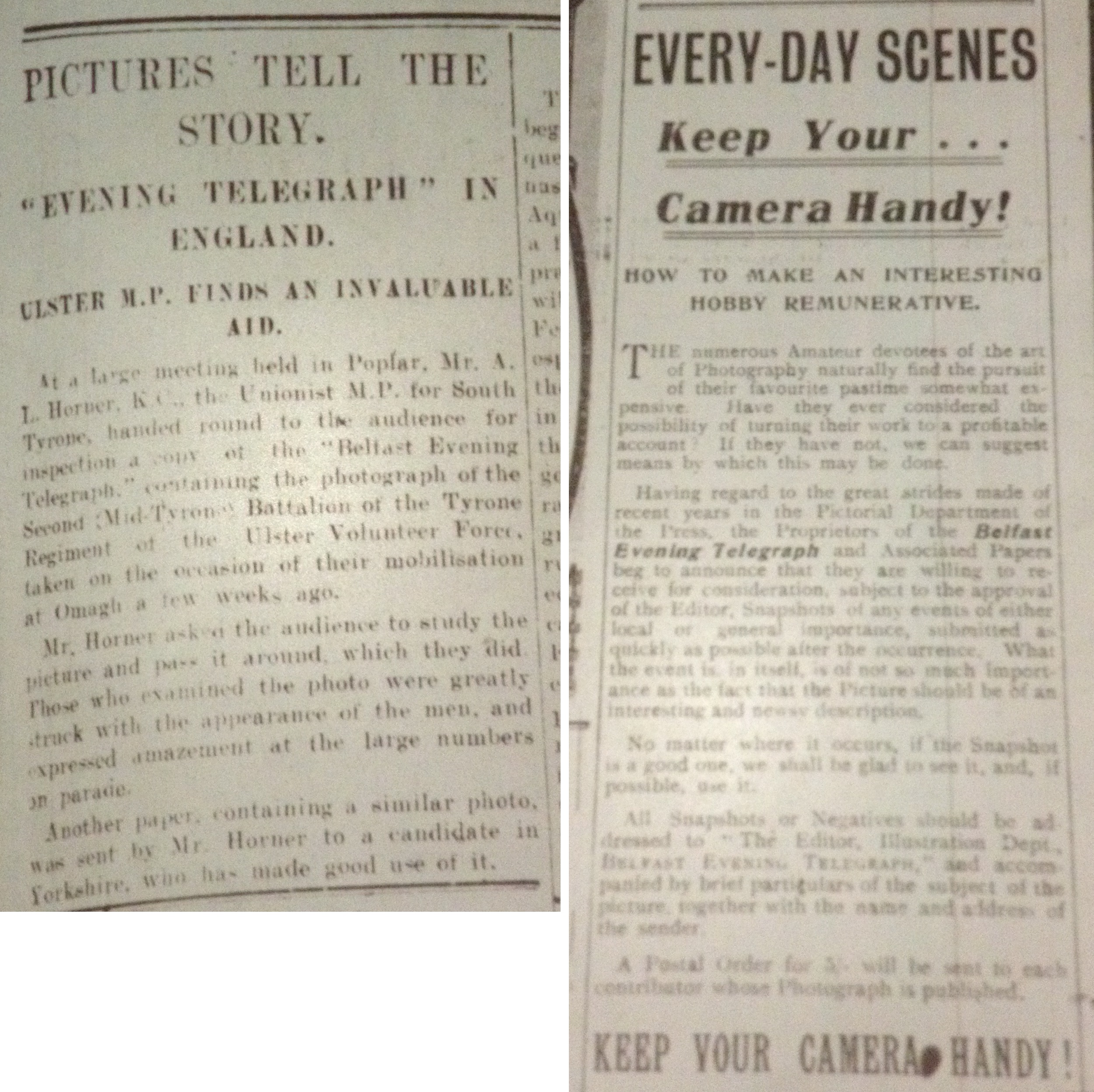
Belfast Telegraph 9 Mar. 1914: 5 and 6 Mar. 1914: 2.

The value of crowdsourcing the news: Belfast Evening Telegraph 9 Mar. 1914: 5 and 6 Mar. 1914: 2.

How important the films at the Panopticon were in propagating resistance to Home Rule is difficult to say, but the value of still images to the campaign is clear from the Belfast Evening Telegraph. In early 1914, the Telegraph had been encouraging the amateur photographers among its readers to send in photos of newsworthy events for possible publication. The paper carried a large number of professionally produced photographs, drawings and illustrated ads, and this crowdsourcing of photographs enhanced what was already probably Ireland’s most visually rich newspaper. The usefulness of such images to unionism was made explicit by the 9 March article “Pictures Tell the Story,” which relates how at a meeting in London, Unionist MP Andrew L. Horner distributed a Telegraph photo of a UVF battalion that amazed the audience with the numbers on parade. The method of dissemination here was crude but effective and repeatable: “Mr. Horner asked the audience to study the picture and pass it around, which they did […] Another paper, containing a similar photo, was sent by Mr. Horner to a candidate in Yorkshire, who has made good use of it” (“Pictures Tell the Story”). In this context, the usefulness of moving pictures in showing sympathetic audiences in Britain the extent of unionist opposition to Home Rule seems obvious, but a system of distribution that allowed the correct contextualizing of the films was required.

By June 1914, the full value of moving images of Ulster resistance would be realized when the Union Defence League fitted out four large vans with projectors, screens and films of Carson and the UVF to tour Britain spreading the message of opposition to Home Rule (Paddy, 18 Jun.). Already by March 1914, however, young supporters of the UVF were finding their drilling and cinema-going converging. 

References

“The Coliseum: A Strong Programme.” Cork Constitution 17 Mar. 1914: 6.

Condon, Denis. “Limelight on the Colleen Bawn: Resisting Autoexoticism in Provincial Irish Picture Houses in the Early 1910s.” Les cinémas périphériques dans la période des premiers temps. Peripheral Early Cinema: Domitor 2008. Presses Universitaires de Perpignan, pp. 245-255.

“’Life of St. Patrick.’” Evening Telegraph 17 Mar. 1914: 2

Paddy. “Pictures in Ireland.” Bioscope 18 Jun. 1914: 1261.

“Pictures Tell the Story.” Belfast Evening Telegraph 9 Mar. 1914: 5.

“Princess Cinema, Rathmines.” Dublin Evening Mail 18 Mar. 1914: 2.

Solax. Ad for Dublin Dan. Moving Picture World 10 Aug. 1912: 729.

“Technical Students Drilling.” Weekly Irish Times 14 Mar. 1914: 6.

“World’s Fair Varieties: Life of St. Patrick.” Dublin Evening Mail 16 Mar. 1914: 4.

Kinema Kinks and the Respectability Police

Evening Herald, 28 Feb. 1914: 6.

Evening Herald, 28 Feb. 1914: 6.

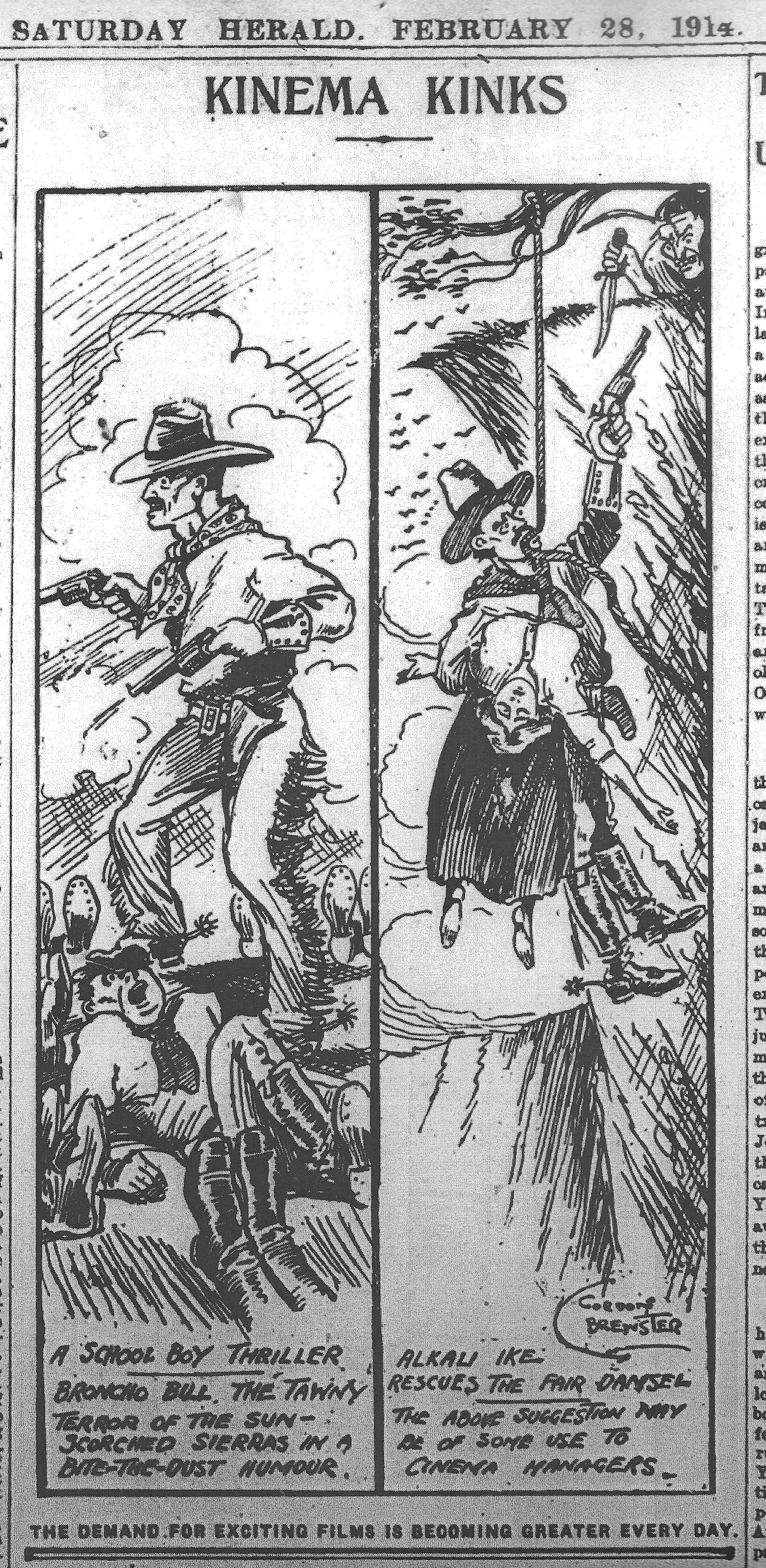
On Saturday, 28 February 1914, Dublin’s Evening Herald published a Gordon Brewster cartoon called “Kinema Kinks” and subtitled “The Demand for Exciting Films Is Becoming Greater Every Day.” It seems that the epitome of exciting films as far as Brewster was concerned was the work of the Essanay company’s co-founder (with George K. Spoor, hence the “S and A”), director and actor Gilbert M. Anderson. Anderson was best known for his most popular screen role of Broncho Billy, and the left-hand panel of the cartoon appears to feature him, with its caption: “A School Boy Thriller // Broncho Bill the Tawny Terror of the Sun-Scorched Sierras in Bite-the-Dust Humour.” The image accompanying this text features a cowboy who has clearly come out best in a shootout with six opponents, on the face of one of whom he is standing, while only the boots of the others are visible. Although the triumphant cowboy’s facial features are not like Anderson’s, it is not just the text that suggests that he is Broncho Billy but also the studded wrist cuffs that were often a part of Broncho Billy’s costume.

Poster for Essanay’s The Making of Broncho Billy (1913) and publicity photo for Gilbert M. Anderson, actor, director and co-founder of the Essanay film company (http://silentwesterns.wikia.com/wiki/Broncho_Billy_Anderson?file=Broncho_Billy_Anderson.jpg)

Poster for Essanay’s The Making of Broncho Billy (1913) and publicity photo for Gilbert M. Anderson, actor, director and co-founder of the Essanay film company (http://silentwesterns.wikia.com/wiki/Broncho_Billy_Anderson?file=Broncho_Billy_Anderson.jpg)

That said, the second panel – captioned “Alkali Ike Rescues the Fair Damsel // The Above Suggestion May be of Some Use to Cinema Managers” – also features a cowboy with studded wrist cuffs as he hangs from a rope by his teeth carrying the unconscious damsel and holding off what appears to be a knife-yielding Indian. Alkali Ike was the hero of an Essanay series of comic Westerns produced by Anderson and starring Augustus Carney, who may have been born in Ireland. Of what use to cinema managers the image of Alkali Ike might have been is unclear, but the cartoon attests to the popularity of Westerns – not only those of Broncho Billy and Alkali Ike – in Dublin cinemas. As has already been seen here, commentators noted that “no picture programme nowadays is considered complete if it does not include a cowboy film” (“Rotunda Pictures” 9 Sep. 1913). That was an exaggeration; many film programmes did not include a Western. Nevertheless, it suggests that the cinema audience was entirely familiar with Westerns, and in such a situation, it is not difficult to imagine that there was a demand for cowboy film with increasingly sensational scenes.

Other kinds of excitement were arranged by the audience rather than cinema managers. Protests in the first week of March 1914 in a theatre and a picture house were indicative of the concerted campaigns of protest in cinemas to come. On the evening of 2 March, William Larkin of 27 Sherrard Street shouted from the gallery of the Gaiety Theatre in protest at the immorality of the French farce Who’s the Lady? (“The Scene at the Gaiety”). He created enough of a disturbance that the actors left the stage until Larkin was removed from the theatre and arrested. Larkin appeared in the Southern Police Court the following morning, where the case against him was dismissed by the magistrate, Thomas Drury, who praised Larkin for having “done a public service” (ibid). Emboldened by this support from the judiciary, William Larkin and his twin brother Francis would in the coming months constitute the most publicly visible part of the Catholic Church-based Dublin Vigilance Committee’s campaign for film censorship with a series of protests in cinemas around the city. For this, they could rely on an at-least tacit but often explicit consensus on the regulation of popular theatre and cinema among the Catholic establishment in the city.

The diary of theatregoer Joseph Holloway is revealing on the protests and middle-class Catholics’ attitudes to them. Holloway had not been in the theatre that night, but he followed the controversy in the newspapers. Noting the remarks by the Irish-Ireland journal The Leader that “[a] certain ‘highly respectable’ class of people in Dublin like dirty plays & dirty papers … but in a very literal sense there is a well-dressed ‘Dirty Dublin.,’” Holloway agreed that “[t]his is all very true[;] I have noticed it for years in our theatres that the more questionable the play the better dressed the audience!” (Holloway 504).

Although Larkin’s militant policing of respectability had not quite reached the picture houses in March 1914, other kinds of protest had. Between 8 and 9 o’clock on the evening of Thursday, 5 March, fourteen boys of Na Fianna Éireann – or the National Boy Scouts as most of the newspapers called them – were ejected from the Picture House, Sackville/O’Connell Street for disrupting a screening of the British Army Film (Britain: Keith Prowse, 1914) (“Dublin Picture Palace Scene”). While Larkin was interested in morality, Na Fianna were interested in nationality, expressed as anti-British and pro-Irish: “They took up seats in the front rows, and hissed the scenes that were being shown. The cheered for Germans and Boers, and sang ‘A Nation Once Again’” (ibid). They did not have it all their own way, as other members of the audience cheered the British, and the police and cinema attendants dragged several of them from the auditorium. Nevertheless, as Who’s the Lady? provided the occasion for Larkin’s display of Catholic morality, the British Army Film allowed Na Fianna to project Irish nationalism onto an ostensibly British patriotic text. Joseph Holloway was thus able to point out that the “film also caused a disturbance on last Monday night – The British Army is not to the taste of all people in Dublin” (Holloway 500).

While the DVC and Na Fianna seemed intent on placing strict limits on cinema, “famous Irish painter, author, and visionary poet” A.E. insisted – albeit somewhat reluctantly – on the importance and inevitability of cinema in education (Paddy, 19 Feb.). “[F]or all our qualms, we invite the cinema into education,” the Bioscope’s Irish correspondent Paddy reported him as saying.

Our methods of education in the national schools have not been so superior and thought-quickening that we risk losing much in introducing the living picture, and whether we protested or not the thing is as inevitable as that the aeroplane will carry our children from Ireland to England in another quarter of a century. Ireland, which has been in a backwater, meditating on its wrongs and its past, will have to move in the new ways and adjust itself to the new conditions, to the new forces and the new ideas, and make them operative in its own interests, or else they will operate against its interests.” (ibid)

A.E.’s approach was very different in this regard to Ireland’s most famous visionary poet, W. B. Yeats, who had no time for cinema. By contrast, A.E. was, knowingly or not, contributing to an ongoing debate in the cinema industry worldwide on the new medium’s role not only in entertainment but also in the more sober discourses of education, technology and science. He was not the only or even the best know Irish writer doing this. Comments by George Bernard Shaw would open the Bioscope’s Education Supplement on 18 July 1914.

Ad for the reopening of the Grafton Picture House emphasizes the increased luxury of the premises alongside the latest film offering in the  Sherlock Holmes series. Evening Herrald  26 Feb. 1914: 4.

Ad for the reopening of the Grafton Picture House emphasizes the increased luxury of the premises alongside the latest film offering in the Sherlock Holmes series. Evening Herrald 26 Feb. 1914: 4.

The growing prestige of cinema in Ireland was visible on the Dublin streetscape in the reopening of the Grafton Picture House on 26 February 1914. The Grafton had closed for renovations in June 1913, and its long-delayed reopening marked the first indication that Dublin’s cinema-building boom, which had been halted by the strike and Lockout of the city’s workers, had resumed. Owned by the London-based Provincial Cinematograph Theatres – which was also the proprietor of the Picture House in O’Connell Street, the Volta in Mary Street and Belfast’s Picture House, Royal Avenue – the reopened Grafton emphasized its suitability as a place of entertainment for the city’s wealthiest shoppers. The renovations not only doubled its seating capacity but also added luxurious features and the latest in cinema technology, including walls covered in

rich Old English tapestry representing various scenes. The Eye-Rest system of lighting is employed with considerable effect. On the right of the screen is fixed an electric clock, and on the left a clock showing the number of the orchestra selection. In the three lounge and tea-rooms there is also an indicator telling what picture is being screened. These rooms have been entirely refurnished, and are beautiful n the extreme. (Paddy, 12 Mar.)

Dublin’s middle and elite classes also had increasing opportunities to attend picture houses in the city’s prestigious suburbs, such as the Grand Picture House in Blackrock. It was here that the first screening of the newsreel film The Launch of the Britannic took place at 10.22pm on 26 February 1914.  This screening can be timed exactly because it was covered by journalists from the Dublin newspapers and the Bioscope, whom Gaumont’s Dublin manager H. Bromhead invited to report on the filming of the launch. The Evening Herald‘s reporter travelled with the newsreel team from Dublin to Belfast to Blackrock and back to the Gaumont office, covering it as if it were one of the hairsbreadth escapes of a sensational film:

Ten-fifteen! We drew up at the theatre. People saw us dashing through the entrance. A cry sprang up: “The film; the Britannic has come.”

Ten-twenty-two! The light flickered on the screen. “Launch of the Britannic!” What a cheer rose up, what clapping of excited hands. (“Filming the Britannic”)

It was acceptable in Ireland in 1914 to indulge in an excitement that marvelled at the technologies and skills that allowed a Blackrock audience to witness that evening an event – itself a technological marvel of the age – that had occurred in Belfast just that afternoon. Less acceptable and in need to disciplining to pass the dominant modes of respectability, however, were the kind of excesses of violence and sensation depicted by Brewster’s “Kinema Kinks” cartoon.

References

“Dublin Picture Palace Scene: Fourteen Youths Ejected.” Evening Herald 6 Mar. 1914: 2.

Filming the Britannic: How ‘Topicals’ Are Produced: While Dublin Sleeps.” Evening Herald 27 Feb. 1914: 2.

Holloway, Joseph. Holloway Diaries. National Library of Ireland. 5 Mar. 1914: 500, and 6 Mar 1914: 504.

Paddy. “Pictures in Ireland.” Bioscope 19 Feb. 1914: 783, and 12 Mar. 1914: 1133.

“Rotunda Pictures.” Dublin Evening Mail 9 Sep. 1913: 5.

“The Scene in the Gaiety Last Night: ‘Who’s the Lady?’ Objected to by Young Man: Case Dismissed: Magistrate Says It Was a ‘Public Service.” Evening Herald 3 Mar. 1914: 1.

“Growing in Favour to an Enormous Extent”: New Media, Ireland 1914

A little after 7pm on Friday, 6 February 1914, architect and inveterate theatregoer Joseph Holloway and his niece Eileen O’Malley arrived at Dublin’s Gaiety Theatre to find that the parterre was already full and there was standing room only in the upper circle. They decided not to stand for that evening’s final performance of the pantomime Jack and the Beanstalk, which was a benefit for comedian Jay Laurier, the actor who played Miffins. Instead they walked to the Nassau Street corner of Grafton Street to take a tram to the Dorset Picture Hall where they spent the evening watching a series of “interesting” but unnamed pictures (Holloway). It’s not clear why they passed the other picture houses along the tram route across the city to favour the Dorset, but Holloway seems to have taken a liking to the Dorset, having seen Kissing Cup (Britain: Hepworth, 1913) there with Eileen on 2 January and The Child from the Sea alone on 28 January. He had also recently seen Germinal (France: Pathé, 1913) at the Princess Cinema in Rathmines and the show of Kinemacolor films at the Queen’s Theatre.

Handbill for films at the Dorset during the week of 15-21 June 1914 with three changes of programme.

Handbill for films at the Dorset during the week of 15-21 June 1914 with three changes of programme. National Library of Ireland.

Holloway’s diary entries on his visits to Dublin’s picture houses are both unique and frustrating, providing the only sustained first-hand account by an Irish cinemagoer of this period but also offering merely tantalizing details of his visits. This contrasts markedly with his often lengthy comments on the city’s theatrical shows, many of which he saw on their opening night. Although he was committed to the theatre, he had also become since 1910 – almost without realizing it himself, it seems – a regular picture-house patron. Although more detail on goings-on in cinemas from an audience member’s point of view would certainly be welcome, the way in which going to the picture house had become such a mundane activity is fascinating. In his diary, Holloway notes significant films alongside theatre shows at the start of a week and often integrates a film show into his schedule, sometimes choosing a film but often choosing to see whatever was on at a favoured picture house.

Holloway and other cinemagoers would have increasing choice as 1914 progressed. “Dublin has not by a long way stopped in its career of opening picture houses,” reveals Paddy in the trade journal Bioscope in early February 1914. He mentions plans to open 18 more cinemas in the city, with plans for eight already approved.

There is no doubt that some of these new fry will pay, because they are to be built in districts badly provided for in the matter of theatres, but when I hear that it is proposed to open three new houses in Grafton Street, and two more in Sackville Street, I wonder what will happen. (Paddy, 5 Feb).

Comments on the growing popularity of Dublin picture houses were not limited to the trade papers. “There can be no gainsaying the popularity of picture theatres in the Irish metropolis,” comments Irish Times columnist the Clubman. “They seem to be always crowded and their proprietors must be making plenty of money out of them. Of course, the ‘man in the street’ will tell you that ‘the pictures’ are only a ‘craze,’ but they are a craze which will, I think, live for some time in Dublin, at any rate (“Dublin Topics”).

It was not just in Dublin, and it would not be a passing craze. In mid-January 1914, the Bioscope’s “Jottings from Ulster” columnist noted that the

Belfast Corporation cinematograph inspector, Mr. Campbell, reported at the last meeting of the Police Committee, that on Christmas Day, Boxing Day, and the 27th ult., 124,087 persons patronised the fourteen picture theatres in the city. These figures show an increase of about 15,000 as compared with Christmas, 1912, It is of considerable interest to note that 124,000 is roughly one-third of the entire population of Belfast; it may, therefore, be taken that the cinema is growing in favour to an enormous extent. (“Jottings,” 15 Jan.)

These are very interesting figures, adding some statistical support to the impression conveyed by Holloway’s diary and newspaper and trade-press articles. It remains more difficult to discern a hundred years later the degree to which individual films that appear to do so actually address such important issues as women’s suffrage, the labour movement and Home Rule. These questions might without too much distortion be phrased in the language of 2014 as concerning the way in which new media engage with questions of the changing nature of work, gender inequality and national sovereignty.

Asta Nielsen as suffrage activist Nelly Panburne being force fed in The Suffragette (1913).

Asta Nielsen as suffrage activist Nelly Panburne being force fed in The Suffragette (1913).

Women’s suffrage was one of the most prominent political questions of the 1910s, kept in the headlines by suffragette activism, including that by the Irish Women’s Franchise League. Suffragettes in Ireland – but not Irish suffragettes – had most directly used the new cinema technologies as a form of protest on the evening of 18 July 1912, when as part of a wider protest, English suffragettes Mary Leigh, Gladys Evans and Lizzie Baker had attempted to set fire to Dublin’s Theatre Royal by igniting the highly combustible nitrate film in the theatre’s cinematograph box between evening shows. “Had the lighted matches come in contact with the films, the substances of which are, of course, highly inflammable, a terrible disaster might have to be chronicled” (“Serious Suffragette Outrage”). For this and for a hatchet attack on British prime minster HH Asquith’s carriage, in which Irish nationalist MP John Redmond was injured, Leigh, Evans and Baker were sentenced to prison terms in Mountjoy Jail, where they joined eight Irish suffragettes and began a hunger strike.

Belfast's Panopticon advertises Asta Nielsen in The Suffragette (1913).

Belfast’s Panopticon advertises Asta Nielsen in The Suffragette (1913); Belfast Newsletter 3 Jan. 1914: 1.

Events such as these were fictionalized in the German film The Suffragette (Projektions AG, 1913), which offered Irish audiences the rare opportunity of seeing suffragettes on screen treated as something other than just comedy. Featuring the Danish star Asta Nielsen as Nelly Panburne – modelled on Christabel Pankhurst – the film shows how Nelly protests by breaking shop windows; is force-fed when she goes on hunger strike in prison; and carries a bomb intended to kill Lord Ascue, a British minister modelled on Asquith opposed to women’s rights. The film attempts to contain its radical energies with a romantic subplot that sees Nelly save Ascue  from the bomb and marry him. Despite the closeness of the film to actual events, the Belfast Newsletter commented that when it was exhibited in January 1914 at the Panopticon Picture Theatre, it “creates great merriment. Asta Neilson, described as the greatest of all picture artists, is seen at her best” (“Panopticon”).

Carson v Redmond
The confrontation between Irish unionists and nationalists had become such a part of popular discourse in Britain in early 1914 that this ad for films that had nothing to do with Ireland could expect to draw attention by using the names of Edward Carson and John Redmond as if they were prize fighters. Bioscope 12 Mar. 1914, p. 1186.

Perhaps the importance of the political events of a different kind in Belfast was among the factors that inclined the Newsletter towards downplaying a fictional representation of the suffrage movement. To keep up pressure on Asquith’s government, Edward Carson again visited Belfast In mid-January 1914 to rally unionist opponents of Irish home rule and review the massed ranks of the Ulster Volunteer Force prepared violently to resist the imposition of home rule. Such nationalist newspapers as Dublin’s Evening Telegraph and Belfast’s Irish News presented unionist demonstrations as a farce and drew attention instead to the counter-demonstration in Belfast led by nationalist MP Joseph Devlin (“Carson Comedy Co.,” “U.V.F. Comedy,” “Mr. Devlin, M.P., in West Belfast”). The unionists, however, again proved themselves more competent with the new cinematic medium. A newsreel camera was again in Belfast to record and relay images not of Devlin but of Carson, and this time, it was operated by Dublin-based Norman Whitten, who filmed the demonstration for Weisker Brothers, a firm to which he had recently affiliated (Paddy, 29 Jan.). Paddy commended Whitten for having the film of Carson ready to screen at Belfast’s Picture House, Royal Avenue on the evening of the rally (ibid).

Of more immediate concern to Dublin’s media from mid-January to early February was the end of the Lockout with the defeat of the striking workers. For the first three days of the week beginning Monday 19 January, the Evening Telegraph’s notice for the Phoenix Picture Palace recommended A Leader of Men, “dealing in a thrilling and sensation manner with an organised strike in a big shipbuilding industry. It is decidedly a picture that will appeal strongly to all at the present time” (“Phoenix Picture Palace”). On the same day, the Telegraph was reporting the “Collapse of Strike: No Food and No Money: Mr. Larkin Advise Men: To Go Back to Work: But to Sign No Agreement” (“Collapse of Strike”). If that drama was too close for comfort to current events, audiences could also enjoy more diverting material on the same bill in the dramas Fortune’s Turn and The Dumb Messenger and the comedies The Honeymooners, When Love Is Young and Cartoons, Mr PiffleAs well as this, to whom and in what way the film would appeal is not clear given that it is unlikely many of the workers impoverished by months of strike could have afforded to attend.

Nevertheless, as cinema continued to develop and picture houses occupied more spaces on the Irish streetscape, films would attract audiences not only by providing escape but also by confronting – both directly and obliquely – important political issues.

References

“Carson Comedy Co.: Performing in Belfast To-Day.” Evening Telegraph 17 Jan. 1914: 6.

“Collapse of Strike.” Evening Telegraph 20 Jan. 1914: 3.

“Dublin Topics by the Clubman.” Irish Times 31 Jan. 1914: 4.

Holloway, Joseph. Holloway Diaries. National Library of Ireland. 6 Feb. 1914: 295.

“Jottings from Ulster.” Bioscope 15 Jan. 1914: 263.

“Mr. Devlin, M.P., in West Belfast: Great Rallies of the Progressive Forces Hear Inspiriting Addresses.” Irish News 19 Jan. 1914: 5-6.

“Phoenix Picture Palace.” Evening Telegraph 20 Jan. 1913: 2.

Paddy. “Pictures in Ireland.” Bioscope 29 Jan. 1914: 454.

Paddy. “Pictures in Ireland.” Bioscope 5 Feb. 1914: 547.

“The Panopticon.” Belfast Telegraph 6 Jan. 1914: 9.

“Serious Suffragette Outrage: Two Attempts to Set Fire: To the Theatre Royal: An Explosive Used: A Panic Avoided.” Freeman’s Journal 19 Jul. 1912: 6.

“U.V.F. Comedy: Parade of the East Belfast Regiment: Inspection by Sir E. Carson.” Irish News 19 Jan. 1914: 7.

“Entering More and More into the Everyday Life of the Community”: Irish Cinema at the Beginning of 1914

The record television audiences who watched the opening of the new season of the BBC’s Sherlock on New Year’s Day 2014 were doing what a significant portion of the Irish cinema audience had done a hundred years before (Barraclough). Several Irish picture houses began 1914 by showing Georges Tréville’s 1912 Franco-British production of The Beryl Coronet, the third of his Sherlock Holmes films for Éclair. Like the other film series of 1913, the Holmes series generated substantial publicity based on its relationship to a written text. A notice for the run of the first of the series, The Speckled Band, at Dublin’s Phoenix Picture Palace in November 1913 stressed that the series had “been produced under the personal supervision of Sir A. Conan Doyle” (Phoenix Picture Palace). The attractions for cinema owners and audiences of the adaption of a popular literary source were obvious:

The adventures of Conan Doyle’s great creation, Sherlock Holmes, are always fascinating, and the stories were literally devoured by readers as they issued from the press, and so great was the interest they compelled that they were many times reread. Their appearance now in picture form is certain to prove an immense attraction (ibid).

The New Year’s bills at Provincial Cinematograph Theatres’ Picture House, Sackville/O’Connell Street, Dublin and Picture House, Royal Avenue, Belfast were topped by The Beryl Coronet.

Amusement ads, Belfast Newsletter, 3 Jan. 1914.

Amusement ads, Belfast Newsletter, 3 Jan. 1914.

Although the importance of serials indicates one of the continuities in Irish cinema at the beginning of 1914, changes were also apparent. In his Christmas column, the Irish Independent‘s literary critic Terence O’Hanlon focused on the growing ubiquity of cinema. Surveying developments in the cinema industry around the world, he concluded:

That cinematography is entering more and more into the everyday life of the community is an obvious fact. Already it is playing an important part in commerce and education, in addition to its merits as a public entertainer. […] Each successive year will see further developments in the science, and additions to the long list of uses to which it has already been adapted (O’Hanlon).

Although O’Hanlon stresses commerce, education and science here, the most obvious manifestation of the cinema for ordinary people in Ireland was the increasing appearance of picture house on the streetscape of cities and towns. The Lockout of workers in Dublin had meant that building work on new picture houses – including the extensive renovations to Provincial’s luxurious Picture House, Grafton Street and two new premises in Phibsboro, the Phibsboro Picture House and the Bohemian Picture Theatre –  had halted in that city, but this was not the case in Belfast. In its 1 January issue, the Bioscope heralded the arrival of two new picture houses in Belfast at the turn of the year (“Two New Halls for Belfast”). Both the Clonard Picture House on the Falls Road and the Central Picture Theatre in Smithfield opened on 22 December in time for the increased business at Christmas.

Map of Belfast in 1915 showing Clonard Picture House, Central Picture Theatre and Picture House, Royal Avenue.

Map of Belfast in 1915 showing Clonard Picture House, Central Picture Theatre and Picture House, Royal Avenue.

Managed by W. J. Hogan, the Clonard had a facade executed in the Renaissance style and was praised for its ventilation and use of natural light. Its decorative features included a lobby finished in marble and terrazzo flooring and wood-panelled walls. Once patrons had been enticed inside, they could all enjoy an unobstructed view of the screen and an orchestra that included musician playing “piano, 1st and 2nd violins, bass, clarionet and trombone [who] co-operate in a delightful manner in accompanying the pictures” (ibid).

A less-elaborate conversion of a  former jewellers, the Central ensured that it attracted as much of the attention of passersby as possible with an impressively lit facade:

The front is illuminated by hundreds of tiny coloured lamps and three powerful arcs the latter being hung from specially designed brackets, while on the roof is a large electric sign, with the words, “Picture Theatre” done in gold. The sign is of script pattern, and is so arranged as to be easily visible from the main thoroughfare of the city – Royal Avenue (ibid).

Both picture houses had their own generators, but also used mains electricity. The power at the Central was controlled from the projection box, where “two separate panels have been installed, change-over switches to the city’s supply being mounted in case of breakdown” (ibid). It was not the picture house generators but the mains supply that broke down on the evening of 2 January, when a six-minute blackout occurred while shows were in progress. Neither the Central, Clonard nor Royal Avenue appeared to have been affected,

the interruption being most keenly felt at seven of Belfast’s halls – the Alhambra, Panopticon, Silver, Mountpottinger Picturedrome, Kelvin, the Shaftesbury, and the Shankhill Picturedrome – and but for the timely intervention of the respective managers the alarm occasioned might have developed, in one of two cases, into panic (“Trade Topics”).

This surprising addition to the evening’s entertainment might have devised by one of the villains pursued by Sherlock Holmes.

References

Barraclough, Leo. “‘Sherlock’ Premieres to 9.2 Million Viewers in the U.K.” Variety 2 Jan. 2014. http://variety.com/2014/tv/news/sherlock-nabs-34-audience-share-for-bbc-in-u-k-1201021043/.

O’Hanlon, Terence. “Picture Houses: Big Boom in Bioscopes.” Irish Independent 23 Dec. 1913: 4.

“Phoenix Picture Palace.” Evening Telegraph 1 Nov. 1913: 6.

“Tenders Invited.” Irish Builder 2 Aug. 1913: 502.

“Trade Topics.” Bioscope.8 Jan. 1914: 95.

“Two New Halls for Belfast.” Bioscope 1 Jan. 1914: 31.