Shadow Soldiers Flickering on a Screen: Irish Cinema and the Beginning of World War I

Provincial War Pics

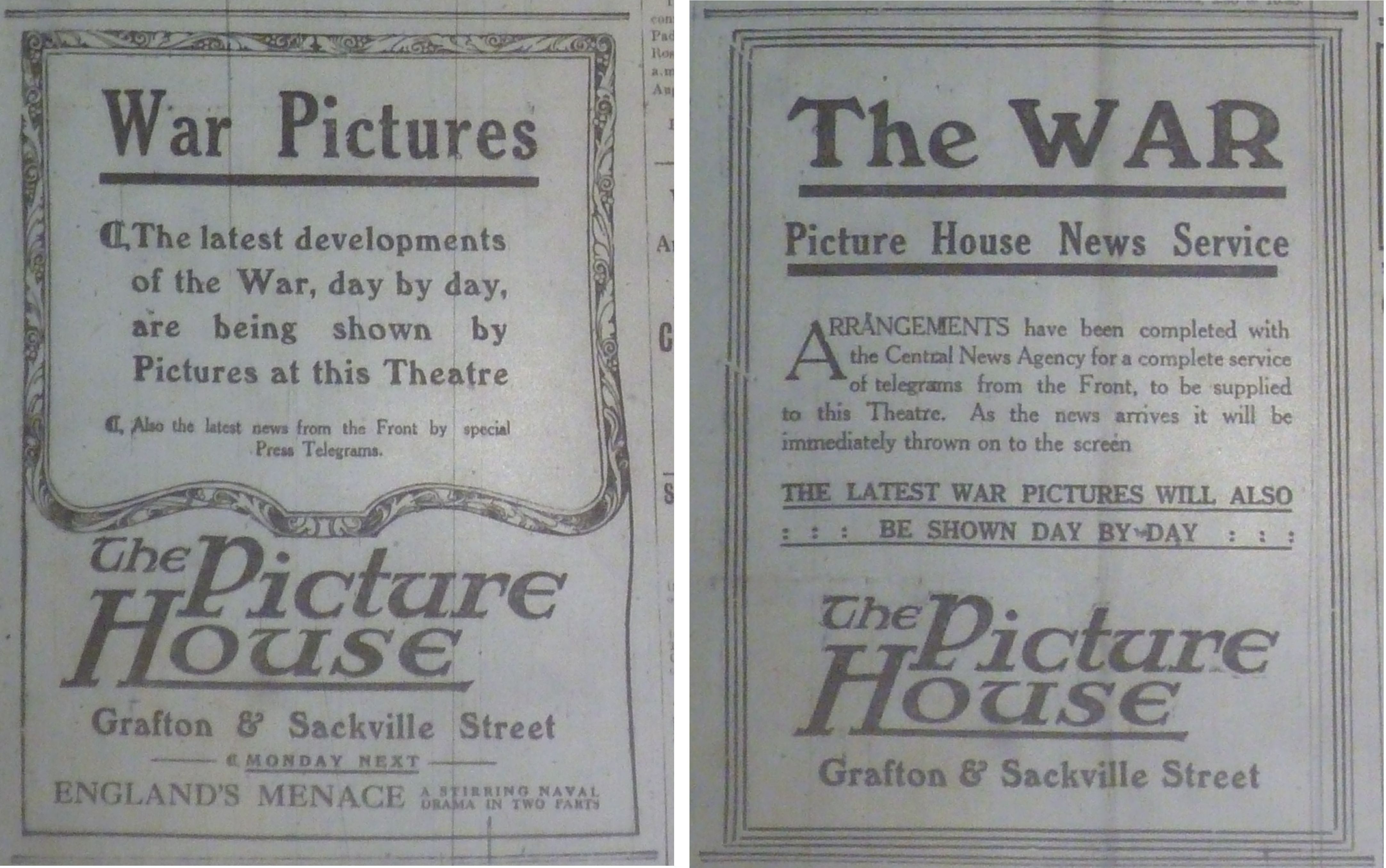
These ads appeared in the Dublin Evening Mail 7 Aug. 1914: 2; and 18 Aug. 1914: 2.

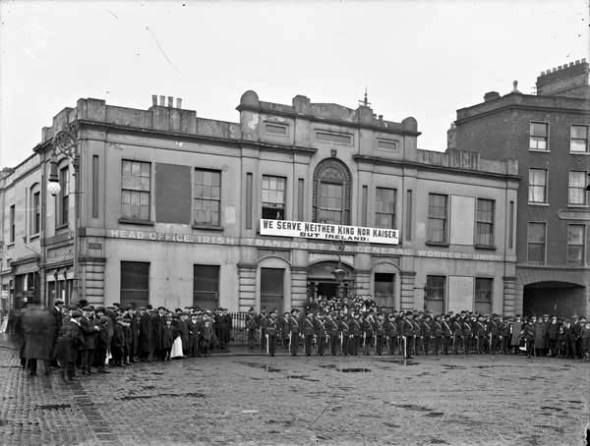
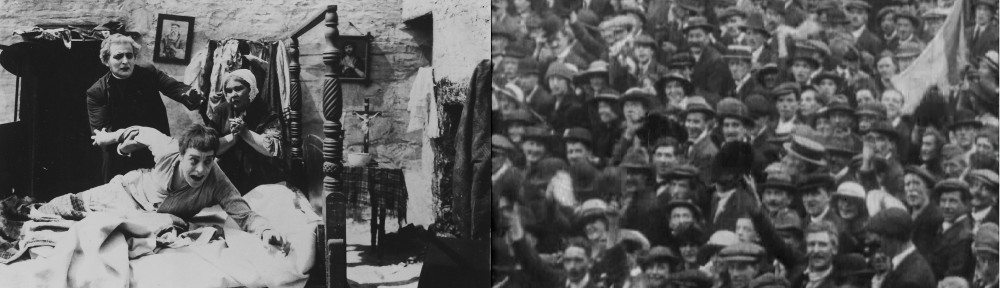
“It is ever so much more a patriotic thing to go down the quays and give the soldiers a good send-off than it is to sit in a darkened picture house watching, perhaps, ‘shadow soldiers’ flickering on a screen,” reported Paddy, the Ireland correspondent of the British cinema trade journal Bioscope in August 1914 explaining the falloff in attendance at Dublin’s picture houses at the start of the Great War. “[T]he fact that the Lord Mayor of Dublin had to publicly ask the people through the medium of the Press, to refrain from causing a block on the quays and assist in getting the soldiers embarked more expeditiously shows how matters stand” (Paddy, 13 Aug., 673). Mobilization affected the cinema and its relationship with the popular audience in various ways. Those who lined the Dublin quays, Paddy suggested, were particularly the popular audience who would otherwise have occupied the picture houses’ cheapest – usually three-penny or 3d. – seats. Although Frederick Sparling, manager of Phibsboro’s Bohemian Picture Theatre, reported brisk business, “he experienced a great falling off in the attendances at the 3d. seats, and he expected that receipts generally would show a drop for a little time” (ibid).

Paddy claimed that the effect in Ulster was quite different, with the outbreak of the war bringing unionist and nationalist audiences together in the face of a common enemy. “[T]he one-time rivals now fraternise,” he observed, “and quiet, law-abiding and gaiety-loving citizens are now taking their pleasures with less sadness than had been their wont during the two gloomy years from which Ireland has just emerged” (Paddy, 13 Aug., 675). Unfortunately, this somewhat unlikely harmony would be short-lived because the difficulties of procuring enough flax and other raw material for Ulster’s factories would mean that mill workers, “the backbone of the support of the cinema in Ulster as in other manufacturing centres,” would be placed on half-time working at half-pay, leaving “nothing to spend on amusements of any description” (ibid).
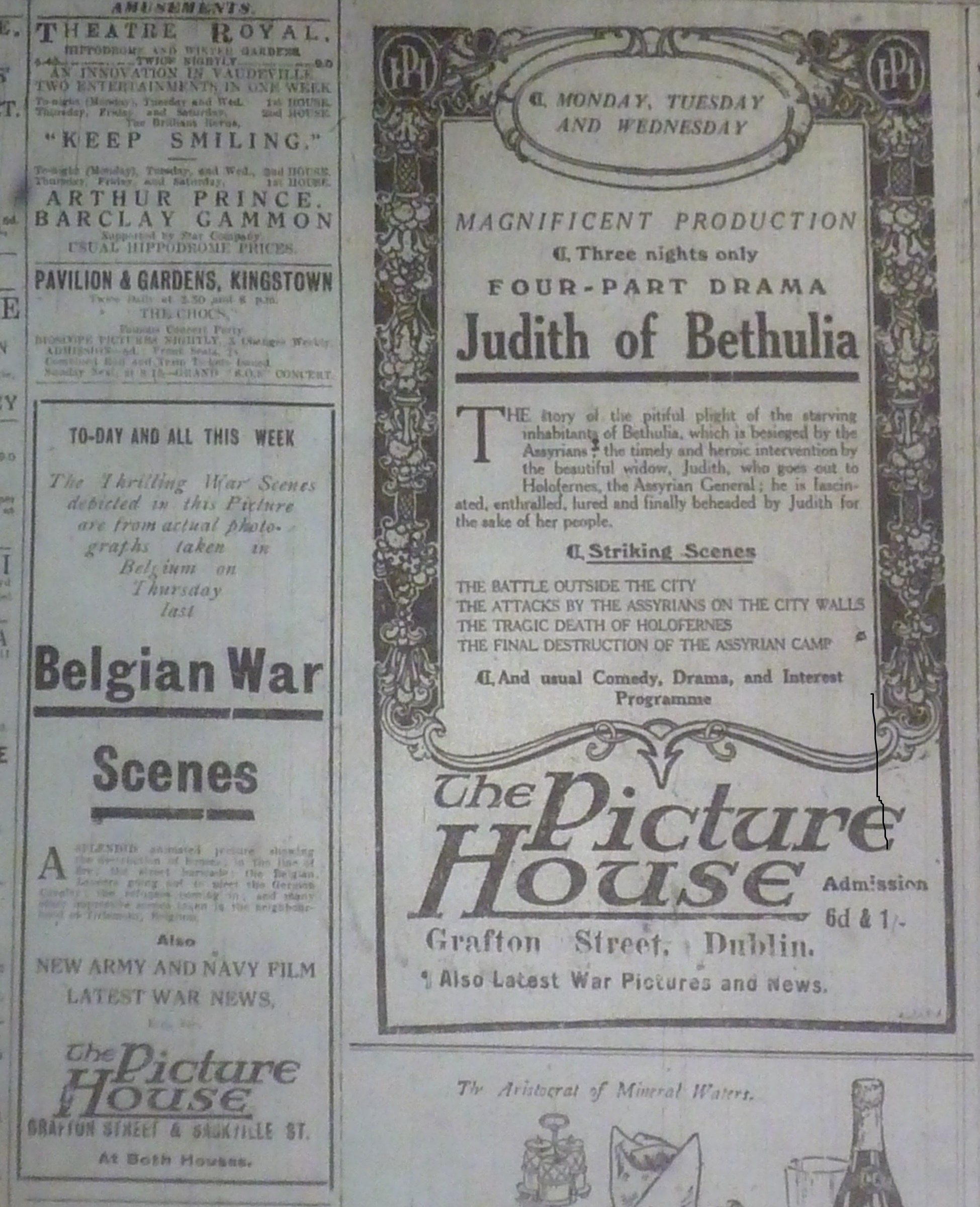
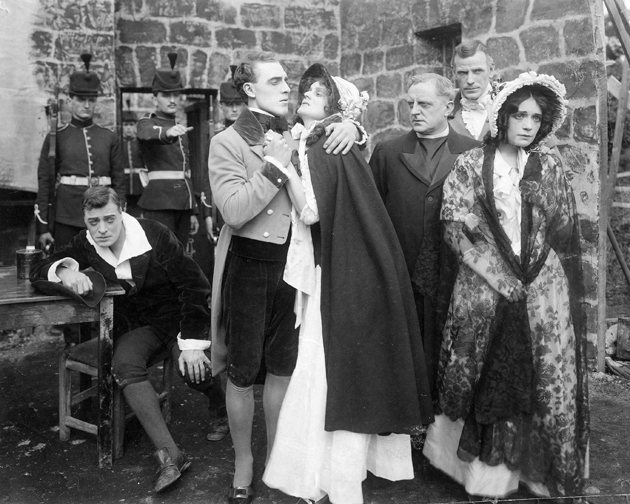
Actuality films of the war appeared on the cinema programme alongside such  fiction film as D. W. Griffith's Judith of Bethulia (US: Biograph, 1914).

Actuality films of the war appeared on the cinema programme alongside such fiction film as D. W. Griffith’s Judith of Bethulia (US: Biograph, 1914). Dublin Evening Mail 24 Aug. 1914: 2.

Nevertheless, Irish picture houses attempted from a very early point in the war to provide shadow soldiers on the screen for their audiences, and not only working-class ones. On 7 August 1914, the Dublin Evening Mail carried the first of a series of unusually large ads for the Picture House, Grafton Street and the Picture House, Sackville Street showing films depicting “the latest developments of the War, day by day.” Both of these cinemas were owned by the London-based chain Provincial Cinematograph Theatres, which also ran the less-salubrious Volta in Mary Street and Belfast’s Picture House, Royal Avenue. The company promoted its venues – and particularly the recently renovated and extended Grafton on Dublin’s most prestigious shopping street – as offering luxuries suitable for prosperous city-centre shoppers. Strollers who stopped into the Grafton’s public café might be induced to see the war pictures by a sign that indicated which of the six-to-eight films typically on a cinema programme was currently playing in the auditorium.
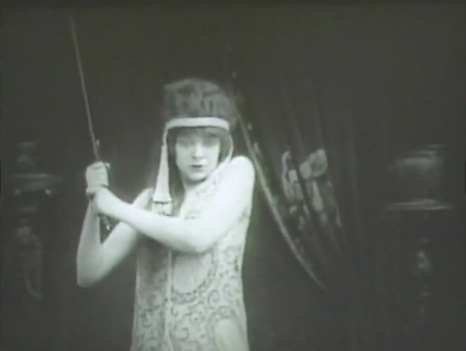
Judith (Blanche Sweet) prepares to behead Holofernes in Judith of Bethulia.

Judith (Blanche Sweet) prepares to behead Holofernes in Judith of Bethulia.

Although such passersby or Evening Mail readers arrested by the prominent ads continued to be offered a programme of films after the outbreak of hostilities, they seem to have been presented with an overwhelming number of war-themed films. The Grafton featured England’s Menace (Britain: London, 1914), a “stunning naval drama,” for the week beginning 10 August, the six-day run representing twice the usual period for which a film was shown. For the first three days of the following week, the Grafton exhibited Maurice Elvey’s In the Days of Trafalgar (Britain: British and Colonial, 1914), supported by a programme that included the first part of the British Army Film (Britain: Keith Prowse, 1914), the second part of which ran in the latter half of the week on a bill headed by The Spy, or The Mystery of Capt. Dawson (1914), a detective drama involving the stealing of plans for a new quick-firing gun. The Belgian War Scenes advertised on 24 August were said to have come “from actual photographs [i.e., films] taken in Belgium on Thursday last,” and these played on the programme with D. W. Griffith’s Judith of Bethulia (US: Biograph, 1914), an adaptation of the biblical Book of Judiths story of war and decapitation.

Provincial was not the only cinema proprietor to show actual war footage – Dublin’s Rotunda, Phoenix and Bohemian all advertised their latest war films, as did many others in newspapers or through more ephemeral forms such as posters and handbills that no longer survive. Provincial, however, made a special effort to exhibit the actualities in programmes with other kinds of war-themed films to cater for – or indeed, help to create – a patriotic war fever. Given the recentness of the war, none of the fiction films just mentioned concerned the current conflict with Germany, nor did the British Army Film, a documentary about ordinary life in the army that was made before the war and that had attracted a protest in March. There was nothing new in popular culture assembling and re-presenting pre-existing elements in a new combination that served the prevailing ideology, particularly at a time of crisis. The live music that accompanied silent film in picture houses of the 1910s could add further jingoism. There were precedents for the use of film in war-time patriotic shows as early as the Boer War, but the popular audience in many parts of Ireland had often been vocally resistant to such anti-Boer/pro-British jingoistic shows (Condon).

What had changed between the turn of the century and the 1910s, however, was cinema’s place within the mediascape in Ireland as elsewhere. By 1914, Ireland had a large number of picture houses that provided news alongside dramatic entertainment. Although picture houses could not match the newspapers’ detailed coverage of topical events, newsreels from the front provided by such companies as Pathé and Gaumont offered something the press could not: moving images of battle sites and the people who fought in the war. Because newsreel scenes recorded on film needed to be physically transported from the front, their newsworthiness had dissipated. Some picture theatres, including the Grafton and Sackville, entered into agreements with telegraphic wire services to offer instantaneous messages during shows, a phenomenon that bears resemblance to a Twitter feed. One ad for these picture houses informed the public that “[a]rrangements have been completed with the Central News Agency for a complete service of telegrams from the Front, to be supplied to this Theatre. As the news arrives it will be immediately thrown on to the screen” (“The War”).

As the war began, commentators in the press debated cinema’s place among other media. To some, it was an absurd form. “In a city picture house, a man tells me,” confided Dublin’s Evening Herald columnist The Man About Town in mid-August 1914,

he has just acquired some curious and too little known facts about the Roman Empire. It would appear that the Caesars were in the habit of decorating their apartments with busts of Dante (which certainly showed remarkable foresight on their part), while their consorts sought relaxation by perusing printed volumes, handsomely bound. Verily, to live is to learn, but seeing is not always believing.

Seeing the past – or present – in the form of the “cineanachronisms” provided in the picture houses was not to be believed by this canny man about town. At least not always.

Other commentators took a more considered but not uncritical view of what had become the country’s most ubiquitous theatrical entertainment, reaching parts of small-town, rural and suburban Ireland that had never had regular professional theatrical entertainment before. By the end of 1914, Dublin Corporation approved licences for 25 premises to show films, with two or three others also under consideration. A small group of these were the theatres – the Theatre Royal, Tivoli Theatre, Empire Theatre and Queen’s Theatre – that had been showing films for two decades or more as part of their mainly live theatrical entertainments. The rest were dedicated picture houses in which the main entertainment was the projection of recorded moving pictures onto a screen, with the live elements limited to musical accompaniment, vocalists who sang between films, and in some venues, one or more variety acts. “Personally, I think we are carrying the picture business to excess,” opined the Dublin Evening Mail’s “Music and the Drama” columnist H.R.W. “The opening of theatres [i.e., picture houses] in the suburbs has much to commend it, but the many additions to the already large number of picture houses in the city is rather risky enterprise” (“War and the Drama”). This was not just a problem among competing picture house owners, but also among theatres proprietors because “ [t]he increasing popularity of the Picture Theatre is making the future of the drama and the music hall a serious problem” (“The Invasion of the Film”). H.R.W. felt that Dublin theatre managers had allowed this to happen by offering increasing amounts of music-hall entertainment and neglecting drama:

the vast public which desires something romantic and dramatic has been catered for by the activity of picture theatres, which, with their cheapness, the casual nature of the performances, and the liberty of smoking, has earned for them a considerable degree of popularity. (Ibid.)

By the outbreak of the war, cinema had become a truly mass medium, providing both news images and dramatic entertainment in a very particular setting. Even without overt propaganda films, individual picture houses or cinema chains could in their choice of films, music and other elements of their programmes present the war in ways that influenced the popular audience that governments needed to prosecute the war. If the Irish popular audience was indeed crowding the quays waving off Irish soldiers, it seemed likely that they would return to the picture houses to cheer on the screen’s shadow soldiers.

References

“Belgian War Scenes.” Advertisement. Dublin Evening Mail 24 August 1914: 2.

Condon, Denis. “Receiving News from the Seat of War: Dublin Audiences Respond to Boer War Entertainments.” Early Popular Visual Culture 9:2 (May 2011), pp. 93-106.

H. R. W. “Music and the Drama: War and the Drama.” Dublin Evening Mail 3 Aug. 1914: 2.

—. “Music and the Drama: The Invasion of the Film.” Dublin Evening Mail 27 Jul. 1914: 4.

The Man About Town. “Cineanachronisms.” Evening Herald. 13 Aug. 1914: 2.

Paddy. “Pictures in Ireland.” Bioscope 13 Aug. 1914: 673-5.

“The War: Picture House News Service.” Advertisement. Dublin Evening Mail 12 Aug. 1914: 2.
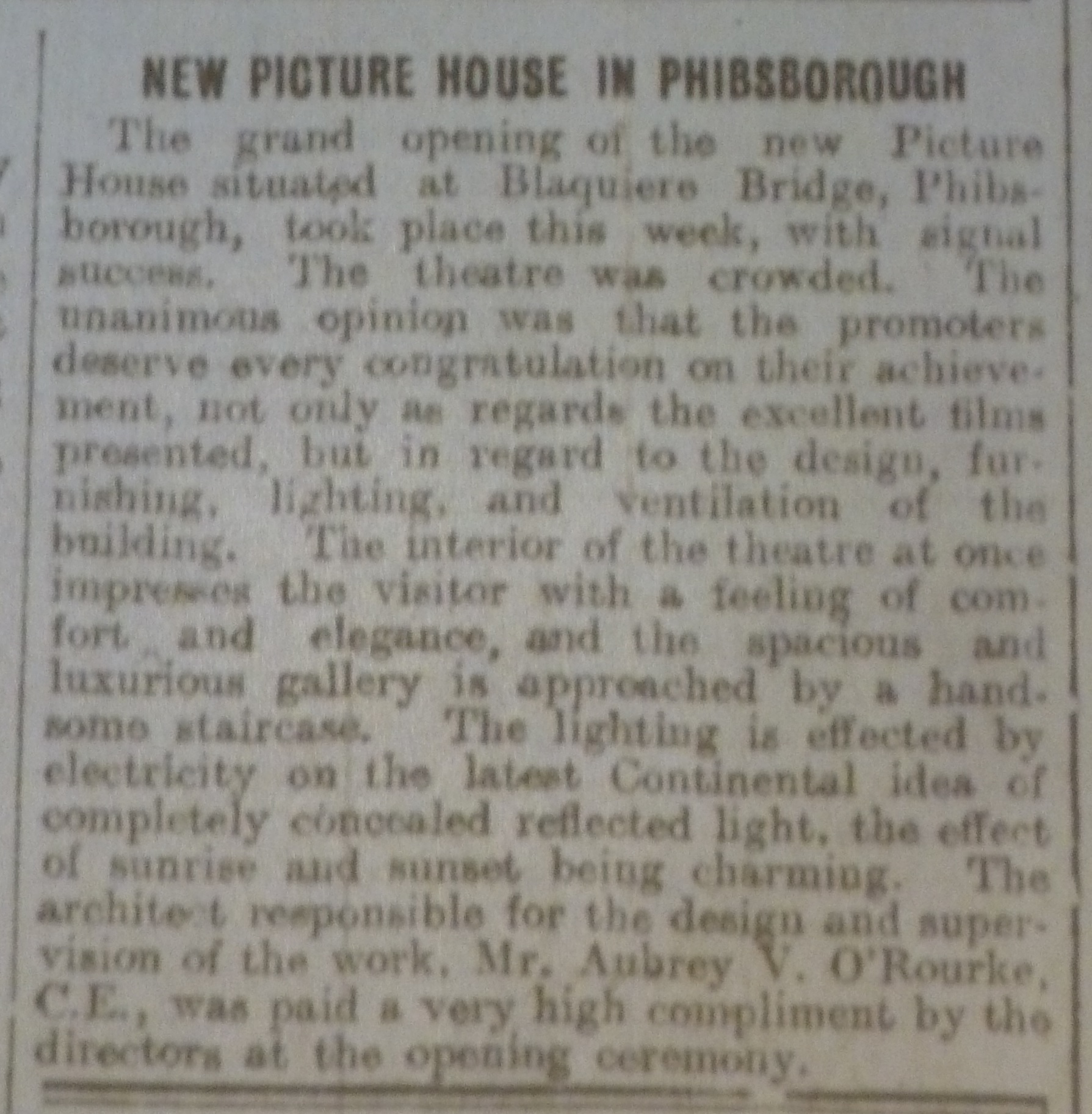
The Phibsboro Picture House Opens

Announcement of hte opening of the Phibsboro Picture House, Dublin Evening Mail, 23 May 1914.

Announcement of the opening of the Phibsboro Picture House, Dublin Evening Mail, 23 May 1914.

A century ago, on 23 May 1914, Dublin’s newspapers announced the opening of the Picture House in Phibsborough (or Phibsboro), on the northern edge of the city. The papers are a little vague on the exact day of the opening, but as the 23 May was a Saturday, some of the papers cover the opening in their weekly theatrical column. “The grand opening of the new Picture House situated at Blaquiere Bridge, Phibsborough,” declared the Dublin Evening Mail’s The Play’s the Thing column, “took place this week, with signal success” (“New Picture House in Phibsborough”). That morning’s Irish Times had carried the same article, and a shorter notice in the Evening Herald was clearly working from the same publicity material provided to the Mail and Times. “The promoters deserve every congratulation, not only as regards the excellent film presented, but also in as far as design, furnishing, lighting, ventilation, etc., are concerned,” commented the Herald. “The house is most comfortable, and great crowds have been enjoying both the comfort and excellent fare provided. The architect, Mr. Aubrey V. O’Rourke, C.E., was paid a very high compliment by the directors at the opening ceremony” (“New Phibsborough Picture Palace”).

Phibsboro Picture House

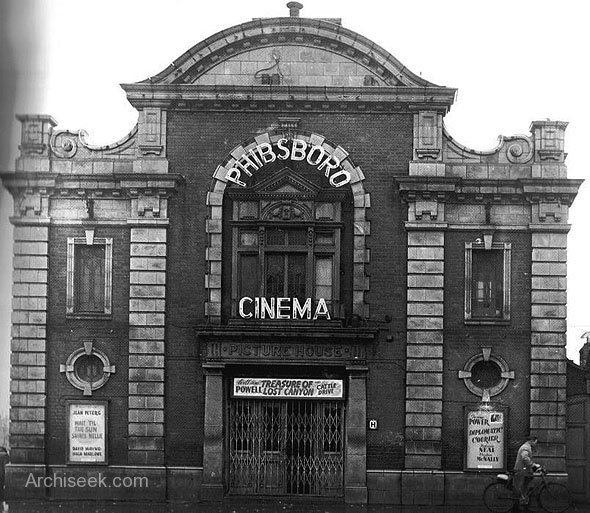
The only known photo of the Phibsboro Picture House was taken after it had closed for demolition in 1953 (http://archiseek.com/2012/1914-phibsborough-picture-house-north-circular-rd-dublin#.U38HxCjiiI8).

Certainly, the only still circulating photograph of the original facade – taken almost 40 years later – shows an attractive addition to the streetscape in this part of the city. Construction work had begun in summer 1913, but even after this had started, alterations were made to the design, probably in order to better compete with the Bohemian Picture Theatre, which was also under construction close by on Phibsborough Road. “It is intended to amend the design and planning generally of the new cinematograph theatre now in the course of construction at Madras Place, Phibsboro’,” revealed the Irish Builder.

The front of the building will be carried out in brickwork and terra cotta dressings, and will present a more handsome and bolder appearance than the original design. It is intended to erect a balcony, and to increase the seating capacity considerably. The emergency passage will be covered in, and the gentlemen’s sanitary accommodation approached from this passage. The machine enclosure, rewinding room, and office will be situated at the back of the balcony, and the generating chamber in the basement. The internal decorations, which are to be of a handsome character, are to be carried out in fibrous plaster.” (“Building News”)

The British cinema trade journal Bioscope offered the first indication of the capacity and ownership of the new picture house:

The theatre is specially designed, and will be an up-to-date hall, accommodating 600. Although a separate company from the Irish Kinematograph Company, Limited, the new company will be worked in conjunction with that Company’s Mary Street House. Messrs. Hibberts will have a controlling interest, and Alderman Farrell is to act as managing director. Mr. Bob O’Russ – the popular manager of the Mary Street house – will take over the duties connected with the secretaryship. (“Our View”)

City councillor and former mayor, John J. Farrell already had interests in the Electric Theatre, Talbot Street, the Mary Street Picture House and the soon-to-be announced Pillar Picture House in O’Connell Street. For the Phibsboro venture, however, Farrell registered the Phibsboro Picture House company on 2 September 1914, in partnership with William King, a farmer and horse breeder of Belcamp, Co. Dublin; and British cinema owners Henry Hibbert and T. Wood (“World of Finance”). Construction on the Phibsboro – and all other Dublin buildings – stopped in September 1913 because of the Lockout (Paddy, 30 Oct. and 11 Dec.), but it resumed with the end of the general strike in early 1914.

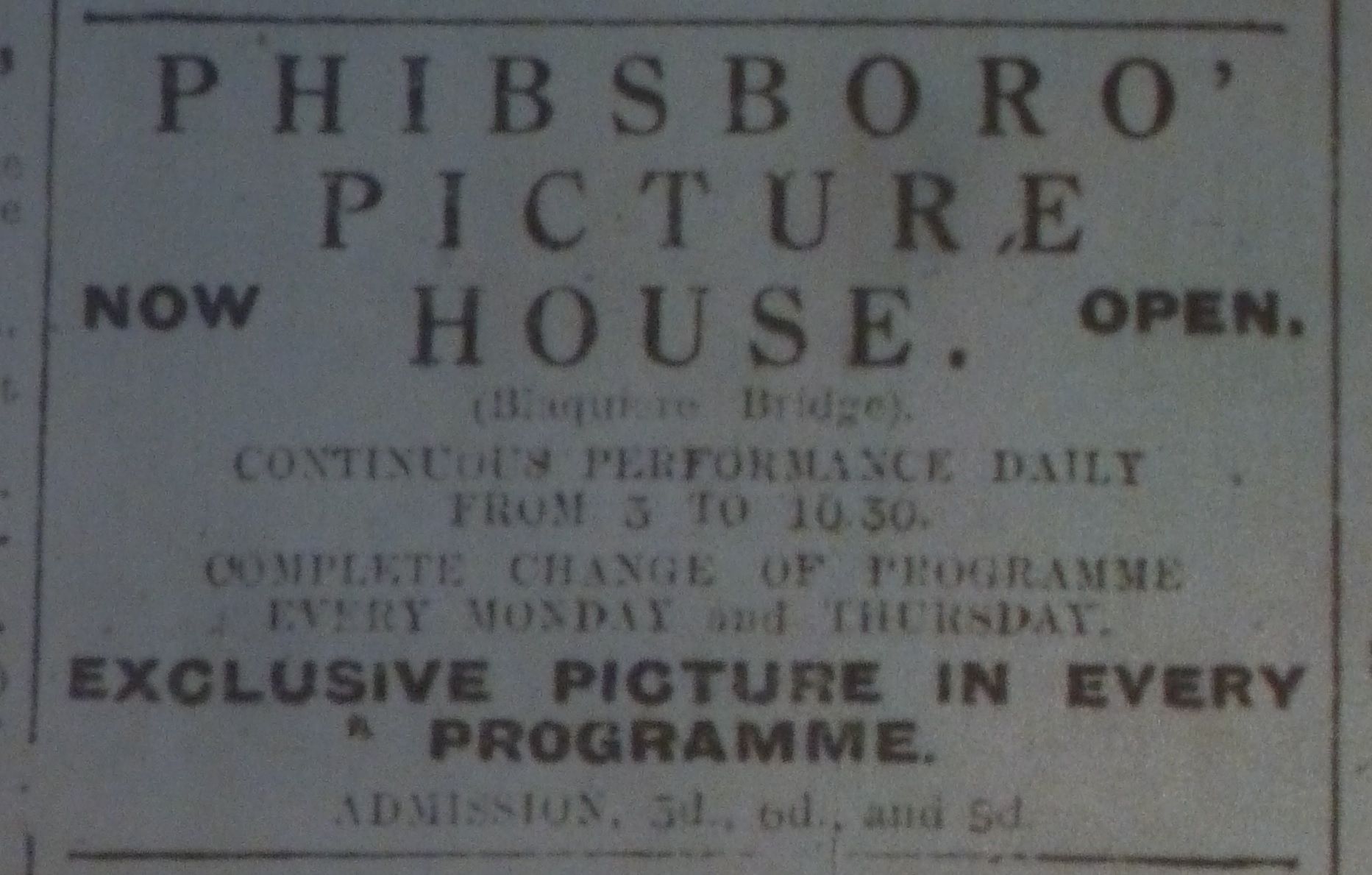
Advertisement for the newly opened Phibsboro Picture House, Dublin Evening Mail, 23 May 1914.

Advertisement for the newly opened Phibsboro Picture House, Dublin Evening Mail, 23 May 1914.

The first ads for the Phibsboro on 23 May reveal that the performances were continuous from 3 to 10:30 rather than at set times, that the programme changed on Monday and Thursday – initially with no Sunday show, that the pricing was 3d, 6d and 9d, and that there would be an “exclusive” film in every programme. However, they gave little indication of what exactly the first exclusives were. Helpfully, however, the Bioscope’s Paddy reported on 4 June that he

went round the other evening to see the picture theatre in Phibsboro’, and particularly did I admire the “sunrise and sunset” system of lighting, which was concealed round the walls of the building. The building holds, roughly, 600, and the tip-ups are in Rose Barri shade, the carpets being of a darker colour. The harmonizing effect is thus very beautiful. The balcony, to which admission is covered by the nimble shilling, runs in a wide curve, and has a splendid “rake.” (Paddy, 4 Jun.)

The main film Paddy saw that night was Lieutenant Rose and the Sealed Orders (Britain: Clarendon, 1914) “and it was followed with intense interest by a packed house,” as well as the John Bunny comedy Bunny’s Mistake (US: Vitagraph, 1914) and The Vanishing Cracksman (US: Ediston, 1913).

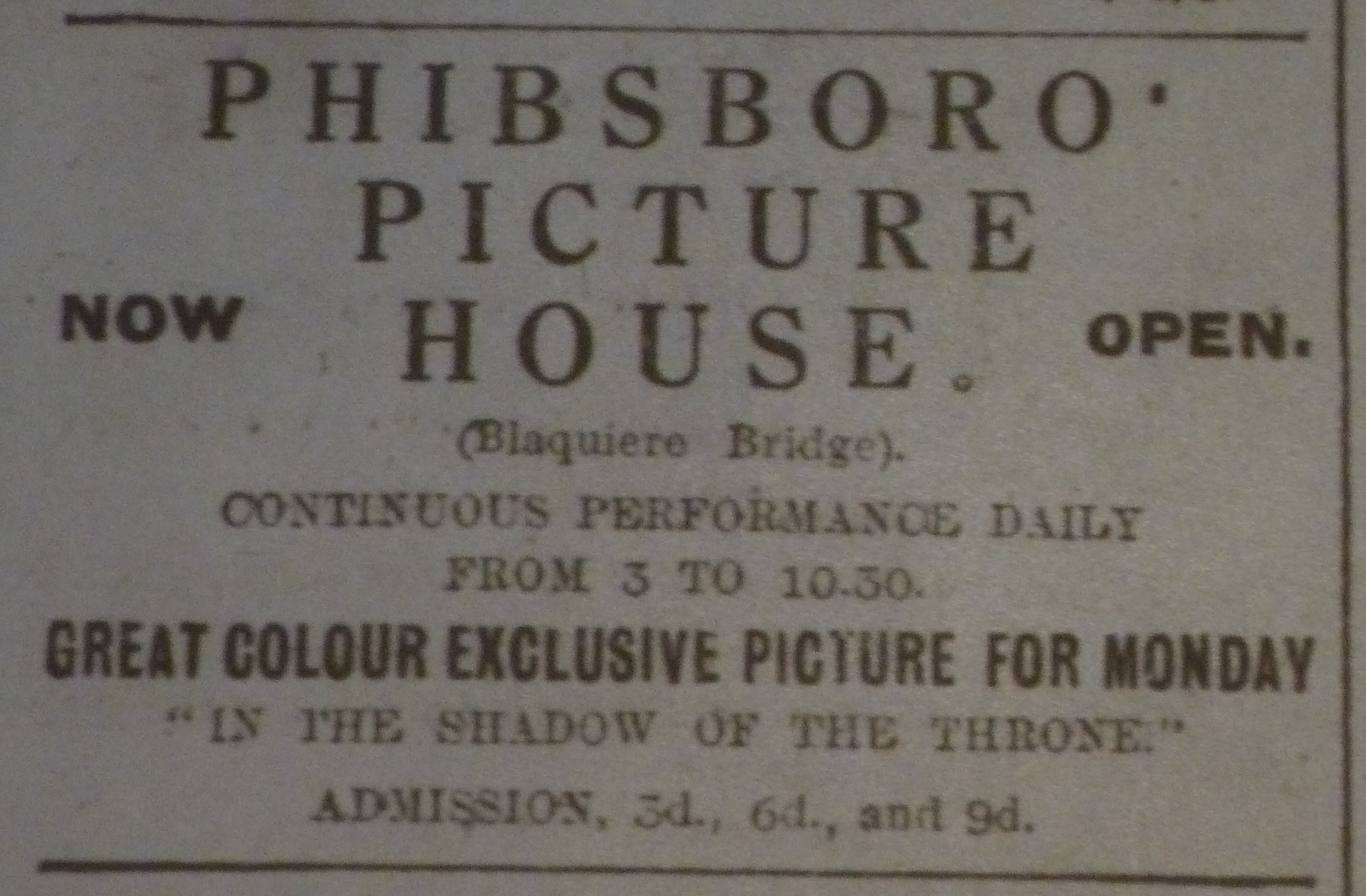
Dublin Evening Mail 30 May 1914: 4.

In the Shadow of the Throne at the Phibsboro; Dublin Evening Mail 30 May 1914: 4.

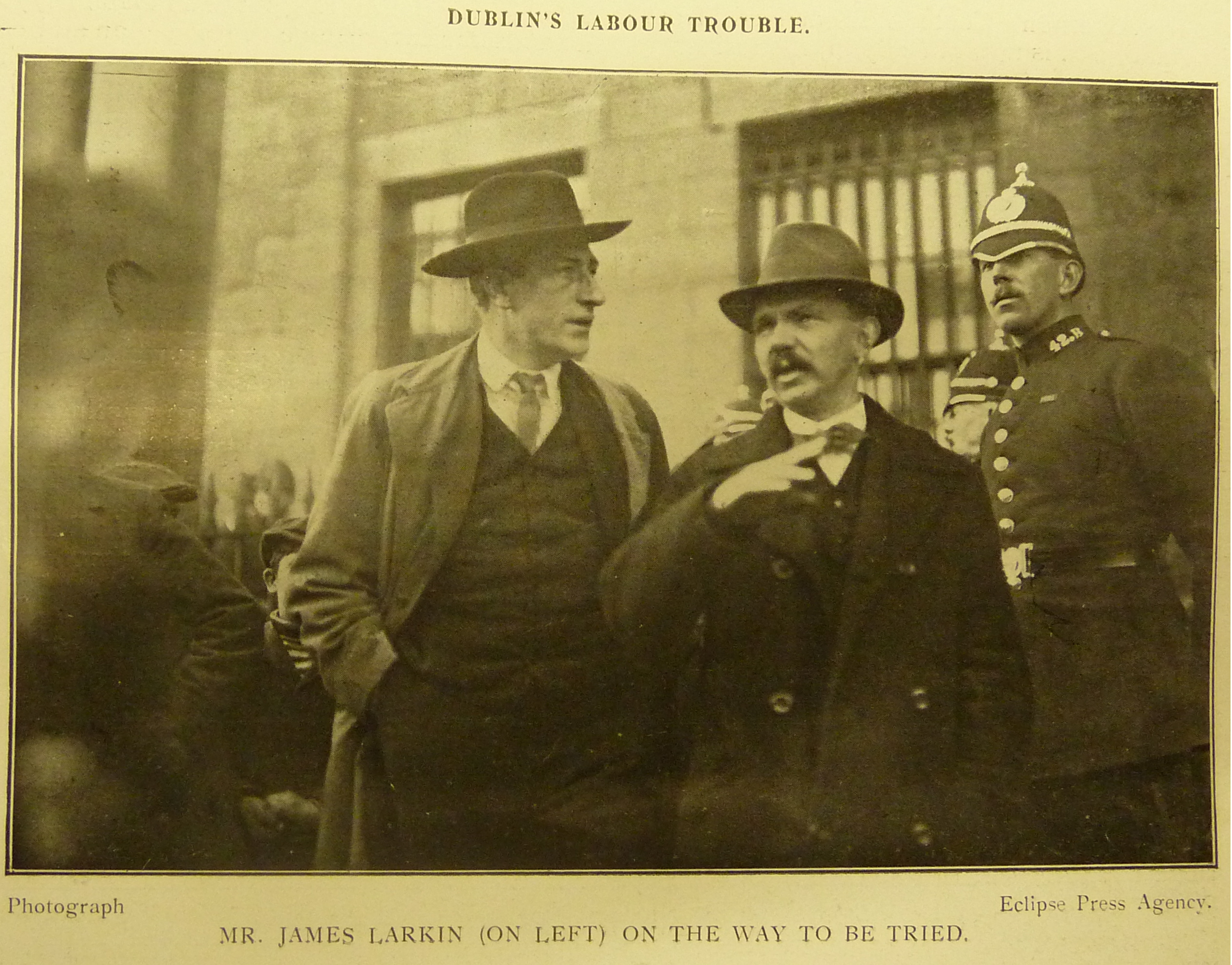
The first film that the Phibsboro actually advertised was the Danish film I Tronens Skygge, translated as In the Shadow of the Throne (I Tronens Skygge; Denmark: Kinografen, 1914). It was due to run for three days beginning on Monday, 1 June, but its opening had some unintended consequences, many – but not all – unpleasant for the management. The film caused a campaign by members of the Catholic Church’s Vigilance Committee, which had been formed in 1911 to campaign against “evil” literature but which had developed a campaign against theatre shows and films. Part of this campaign involved protests in theatres and cinemas carried out by William Larkin and his twin brother Francis.

The campaign began when P. Donnelly sent a letter to the Freeman’s Journal complaining about the film and asking “How long is Catholic Dublin going to stand this sort of thing?” (“A Cinematograph Show Objected To,” Condon 228). Donnelly objected to the fact that a nun said Mass and that a newly professed nun fell into the arms of a prince. The controversy caused a range of reactions. John J. Farrell responded by retaining the film for the second half of the week, writing a letter to the Freeman contradicting Donnelly’s claims (and perhaps, as alleged in court, threatening legal action if the paper did not print a retraction), and inviting a reporter from the newspaper to give an “objective” assessment of the film. The resulting publicity brought around 600 Dubliners, the seating capacity of the cinema, to subsequent showings of the film. Among these on Friday were William and Francis Larkin, who ended a shouted protest in the auditorium by throwing ink at the screen, splattering the blouse and music of Miss Eager in the orchestra. The Larkins were arrested, found guilty and fined a nominal 5 shillings, a punishment whose leniency suggested – not for the first time – the tacit support of the magistrate for Vigilance Committee activities.

To devote too much attention to the Larkins is to turn away from the story of the cinema, but the newspaper accounts of the case provide details of the working of the Phibsboro that do not survive otherwise. They reveal the name of the attendant Daniel McEvoy, whom William Larkin accused of handling him roughly while removing him, and also two women musicians from the orchestra who would otherwise be anonymous: Miss Eager, the musical director whose blouse was inked, and Miss Duffy, who testified in court. Daniel McEvoy and Miss Eager remain obscure, but Miss Duffy is likely to have been Evelyn Duffy who is listed in the 1911 Census as a 23-year-old professional vocalist living at 106 Phibsboro Road, close to the cinema.

Just three weeks after it opened, the Phibsboro had become a part of the city in several ways. It had become a significant part of the streetscape of north Dublin, a successful business for Farrell and his partners, and a place of employment for McEvoy, Eager and Duffy. Beyond that, it had become central, if only briefly, in one of Ireland’s cultural controversies.

References

“A Cinematograph Show Objected To.” Freeman’s Journal 2 Jun. 1914: 5.

“Building News.” Irish Builder 30 Aug. 1913: 563.

Condon, Denis. Early Irish Cinema, 1895-1921. Dublin: Irish Academic, 2008.

“New Phibsborough Picture Palace.” Evening Herald 23 May 1914: 4.

“New Picture House in Phibsboroough.” Dublin Evening Mail 23 May 1914: 3.

“Opening of the New Picture House in Phibsborough.” Irish Times 23 May1914: 9.

“Our View.” Bioscope 24 Jul.1913: 238.

Paddy. “Pictures in Ireland.” Bioscope 30 Oct. 1913: 395; 11 Dec. 1913: 1077; 4 Jun. 1914: 1069.

“World of Finance.” Bioscope 18 Sep. 1913: 933.

A Happy and Appropriate Synchronism: Passion Films at Easter 1914

The release of Darren Aronofsky’s Noah (US: Paramount/Regency/Protozoa/Disruption, 2014) on cinema screens around the world in the run up to Easter 2014 is a distribution strategy at least a century old. “As a Passion Play,” wrote a reviewer  in Dublin’s Evening Telegraph of the latest release at the Rotunda’s in early April 1914, “‘The Messiah’ holds one with its intense impressiveness and pathos, and its exhibition just at this holy season is a happy and appropriate synchronism” (“‘The Messiah’ at the Round Room Rotunda”). This synchronism – or well-established distribution and exhibition strategy – was familiar to cinemagoers of the 1910s who would have seen the practice of releasing biblically based films for this religious festival as entirely unremarkable. In fact, this practice reproduced in a new medium the centuries-old Christian tradition of performing passion plays at Easter. Filmic passion plays were among the first moving pictures (Cosandey passim), and they were so popular that The Messiah shown in Dublin in April 1914 was the 1913 remake (dir. Maurice-André Maître) by French company Pathé of its La vie et la passion de Notre Seigneur Jésus-Christ, which the company had first produced in 1903 and again in 1907 (Abel 319-20). And this was just the output of one – albeit large – production company.

Jameson

Rotunda manager James T. Jameson as he appeared in a caricature in the Bioscope in November 1911.

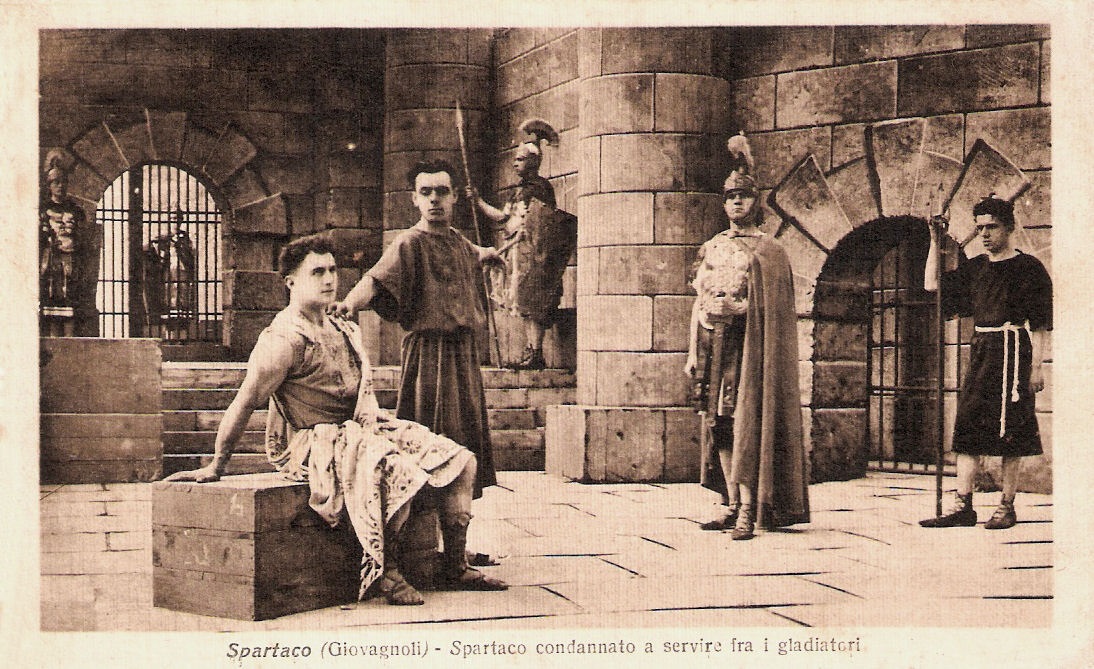
Easter Monday fell on 13 April 1914, but James T. Jameson, director of the Irish Animated Picture Company, and his son, Ernest, who managed the Rotunda, had begun the run up to Easter much earlier. In early March, Jameson senior had secured the Irish rights to two long “exclusives”: The Messiah and Spartacus, or the Revolt of the Gladiators (Italy: Pasquali, 1913) (“Items of Interest”). In its review of Spartacus at the Rotunda in the week beginning 23 March, the Dublin Evening Mail compared it to Quo Vadis? (Italy: Cines, 1912), the Italian epic that had been the biggest hit of 1913 and that had been available to Dublin audiences as lately as 2-7 March at the Camden Picture House (“Rotunda Pictures”). However, The Messiah was a more important film for the Rotunda than Spartacus. For one thing, it was longer; Spartacus shared its bill with the comedies The Awakening at Snakesville (US: Essanay, 1914) and When Cupid Takes in Washing (US: Lubin, 1914), but The Messiah was the only thing on the Rotunda’s programme for the two weeks beginning Monday, 30 March. As well as this, because it depicted the life of Christ, The Messiah had the potential to be as controversial as From the Manger to the Cross (US: Kalem 1913) had been the previous year. The superiority of The Messiah was emphasized by the Evening Telegraph, which urged “any person who witnessed “From Manger to Cross to pay a visit to the Rotunda and see what a drastic and extraordinary difference can be introduced in the treatment of the same subject, and more especially the grandeur of its colouring” (“‘The Messiah’ at the Round Room Rotunda”).

The Messiah was certainly a success at the Rotunda. Quoting figures supplied by the Rotunda management, the Telegraph revealed that by the Saturday of the first week of its run, it had been seen by over 22,000 people, “including a considerable proportion of the clergy of every denomination, and there have been nothing but the highest eulogies expressed by everybody who had the pleasure of seeing this marvellous production” (ibid). Paddy, the Irish correspondent of the British trade paper Bioscope, speculated that the audience for the full two-week run would number 50,000, commenting that the film “easily surpassed anything of the kind ever seen in Dublin, and the special music, so brilliantly rendered by Miss May Murphy’s Irish Ladies’ orchestra, added to the reverent screening of this great film” (Paddy). Although Jameson offered a new bill from Easter Monday featuring Christopher Columbus (US: Selig, 1912) and a film of the Grand National Steeplechase, he brought back – purportedly due to popular demand – The Messiah by the end of that week for selected matinees and early evening shows until Friday, 24 April.

This success of the passion films and such Italian historical epics as Quo Vadis? and Spartacus points to the existence of types of quality filmmaking based on high-cultural criteria. The Rotunda had long pursued a middle-class audience by promoting its film shows as both educative and entertaining, but Jameson had usually favoured programmes of shorter films – and some live variety acts – rather than a single long film. A review of the Rotunda in early March had stressed cinema’s multiple attractions:

The elaborate production of cinematograph films shows how much this form of entertainment has grown in public favour. Unlike skating rinks, living pictures seem to have come to stay. They supply an easy means of transporting oneself for a time from the uneventful round of daily life. Sitting in a comfortable seat, the spectator can in a moment travel from China to Peru, from the waste of the open sea to the sun-bathed mart of some Eastern town; he can witness fire and flood and return safely to a good supper by his civilized fireside (“Irish Animated Picture Company”).

The Rotunda had aimed to provide such a variety of attractions with multiple films in its two-hour shows, but the Italian epics could provide a range of spectacles in one film, as well as a patina of high-cultural value associated with classical education. As adaptations of literary works, Quo Vadis? – from Henryk Sienkiewicz’s novel – and The Last Days of Pompeii (Gli ultimi giorni di Pompeii; Italy: Ambrosio, 1913) – promoted as Lord Lytton’s great work” when it played at the Camden Street Picture House in the week beginning 20 April (“Camden Street Pictures”) – could benefit from recognition by middle-class audiences, as well as bestowing cultural prestige on the film and the picture house at which it was shown. Among other significant literary adaptations on exhibition in Ireland at Easter 1914 was Cines’ Antony and Cleopatra (Italy, 1913), a story that prospective spectators at the Opera House in Derry were informed “has been variously dealt with by many famous writers, including the immortal Shakespeare” (“Easter Amusements”).

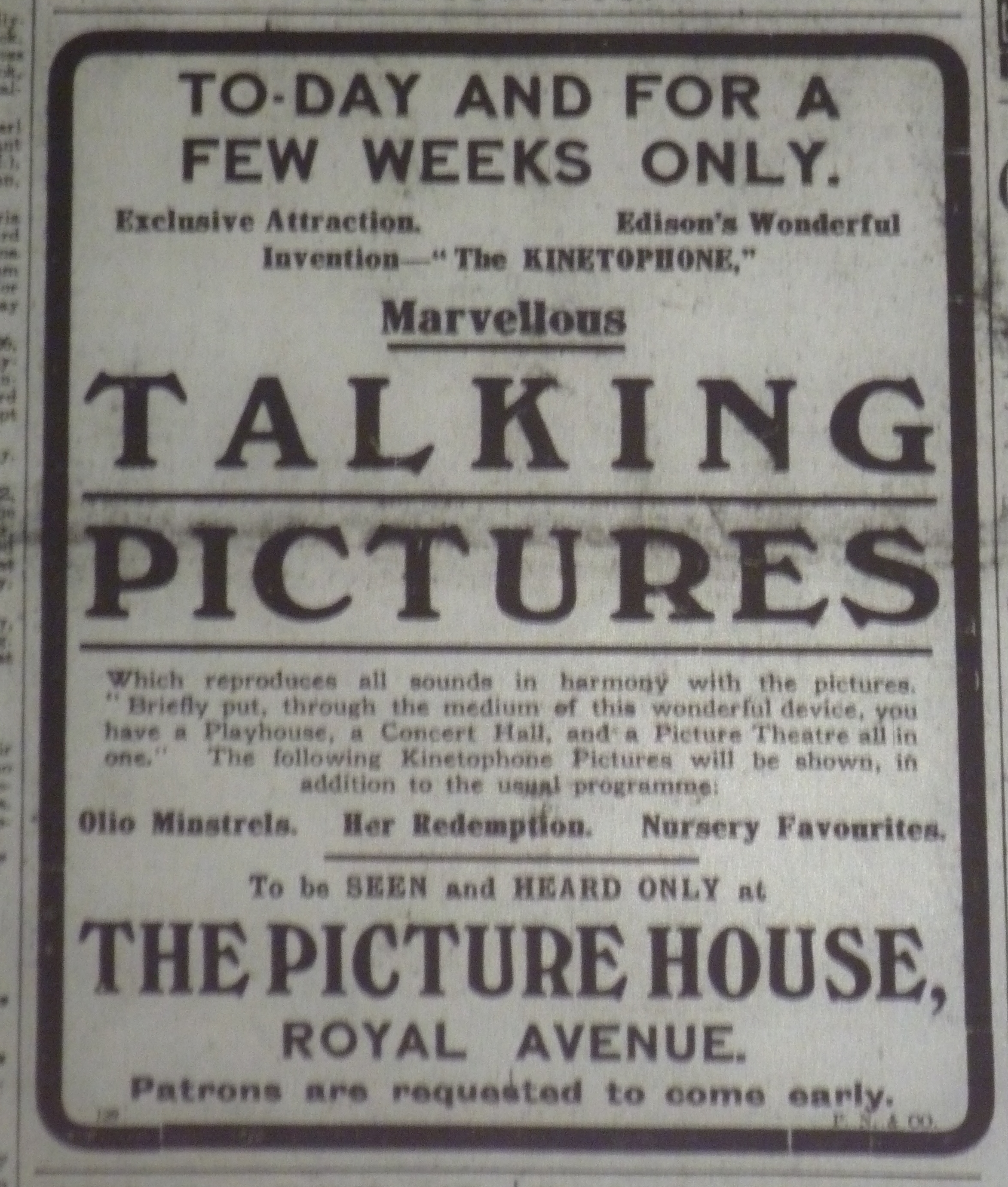
Edison Talking Pictures at the Picture House, Royal Avenue, Belfast. Belfast Newsletter 3 Apr. 1914: 1.

Edison Talking Pictures at the Picture House, Royal Avenue, Belfast. Belfast Newsletter 3 Apr. 1914: 1.

The extent to which a shared or imposed set of cultural values deriving from literary culture, classical education and Christian doctrine was the source of the popularity of The Messiah or the Italian epics is difficult to say definitively without some discussion of how images of these circulated more widely (Uricchio and Pearson). Certainly, the promotion of such films as respectable by the trade press, newspapers and other forms of picture-house promotion did not prevent other cultural forces from continuing to attempt to impose their own control on cinema and its audiences. 

Easter 1914 seemed to be a particularly auspicious time for Irish nationalists. This point was well expressed in the nationalist Evening Telegraph, in which an editorial observed that

this will be the last Easter before Home Rule becomes the law, for the Home Rule Bill will reach the Statute Book in the course, probably, of the next five or six weeks. It is well that Easter should herald the coming of Ireland’s resurrection, for in the Christian sense it symbolises the Resurrection (“Easter”).

Christianity here meant the Catholicism of the Telegraph’s readership and of the majority of Dublin Corporation’s dominant nationalist faction. With Home Rule apparently imminent, more militant forces within the church were determined that cultural policy reflect a Catholic ethos, regardless of how this might affect the business interests of certain Catholic nationalist councillors.

Lord Mayor Lorcan Sherlock came under criticism from Catholic church-based groups in early March when he showed reluctance to introduce local censorship of films – the Corporation “are satisfied, as indeed are so many other civic bodies, with the verdict of the Board of Trade Censor” – or close picture houses on Sundays – “‘They have been,’ he said, ‘patronised to an extraordinary extent on Sunday by the working people of the city’” (“Picture Theatres: Conditions of Licensing”). Responding in a letter to the Telegraph, William Larkin, who had recently been praised rather than fined by a magistrate for protesting loudly during a theatre show, wondered whether or not the general public were “to be left at the mercy of the Corporation in the matter of taste in living pictures” whose “educational value […] in Dublin at present are nil” (“Sunday Pictures: For Working People”). He left no doubt that lay Catholic organizations would not let the matter rest:

Does his lordship know that the United Sodalities of Dublin (male and female) are out for reform of the picture theatres? Does his lordship know that the United Confraternities of the city are out for the same object? And does he also know that the Theatre Reform League of Dublin (which will later embrace all of Ireland) are on the watch against the class of production that has flooded our capital for some time now? (ibid).

Although Larkin and those named lay organizations would lead the campaign, priests and bishops lent the support of the hierarchy. A letter from a Father Gleeson calling for “an Irish National Censor, who understands the hearts and minds of the Irish people” accompanied Larkin’s  (“Letter from Father Gleeson”). In April, the Lord Mayor “stated that Archbishop Walsh was not in favour of closing picture houses on Sunday, but he thought that a limit should be placed in the hours of opening so that there would be no interference with the freedom of persons to attend divine worship.” Under pressure from both inside and outside the Corporation, Sherlock “was writing to Archbishop Walsh asking him whether he would take upon himself the responsibility of suggesting what type of censorship should be put into operation” (“Picture Theatres: The Archbishop’s Views”).

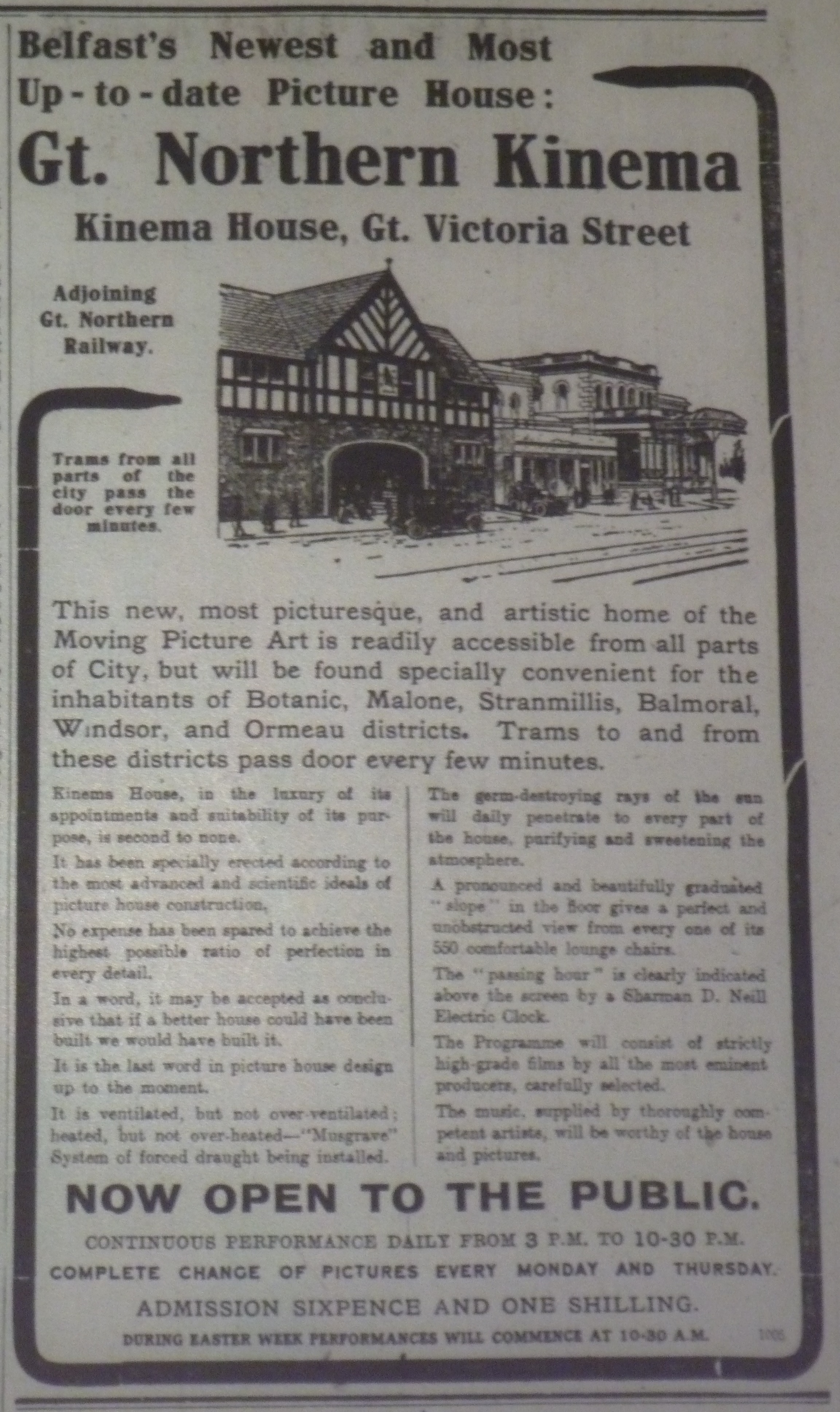
Belfast Newsletter 9 Apr 1914: 9.

Ad for the newly opened Great Northern Kinema in Belfast Newsletter 9 Apr. 1914: 9.

Larkin ended his letter on Dublin picture houses with some architectural criticism by remarking that “the building themselves are not even decent looking” (“Sunday Pictures: For Working People”), but Easter for Belfast’s picture houses was notable for its openings of distinct contributions to the city’s streetscape. The latest addition to Belfast’s substantial tally of picture houses was the Great Northern Kinema in Gt. Victoria Street, which opened in the first week of April, a little over a week after the 23 March opening of the Crumlin Picture House on the Crumlin Road. The Kinema, “[t]his new, most picturesque , and artistic home of the Moving Picture Art,” was located beside the Gt. Northern railway station, as well as on some of the city’s major tram lines (“Belfast’s Newest and Most Up–to-date Picture House”). No single film seemed to dominate the picture house programmes over the holiday period in the same way as The Messiah did in Dublin. At the “luxurious and attractive” Kinema, “[t]he star film during the early part of the current week is a two-reel drama entitled ‘Silent Heroes’” (US: Broncho, 1913) (“Kinema House”). The city’s most highly publicized cinema offerings were Edison’s Talking Pictures at the Picture House, Royal Avenue, where they were joined in the week beginning Easter Monday by a programme that included Selig’s Christopher Columbus. The different relationship between the churches and cinema is suggested by the fact that several of the Protestant halls – the CPA Assembly Hall, the Grosvenor Hall, the City YMCA and the People’s Hall – offered not only their usual Saturday cinematograph shows but also special film shows on Easter Monday and Tuesday.

References 

Abel, Richard. The Ciné Goes to Town: French Cinema, 1896-1914. Berkeley: U of Califronia P, 1994.

“Belfast’s Newest and Most Up–to-date Picture House.” [Ad.] Belfast Newsletter 9 Apr. 1914: 9.

“Camden Street Pictures.” Evening Telegraph 21 Apr. 1914: 6.

Cosandey, Roland, André Gaudreault and Tom Gunning, eds. An Invention of the Devil? Religion and Early Cinema. Sainte-Foy and Lausanne: Éditions Payot/Laval UP, 1992.

“Easter.” Evening Telegraph 11 Apr. 1914: 4.

“Easter Amusements.” Derry Journal 13 Apr. 1914: 8.

“Irish Animated Picture Company.” Irish Times 10 Mar. 1914: 5.

“Items of Interest.” Bioscope 12 Mar. 1914: 1109.

“Kinema House.” Belfast Newsletter 14 Apr. 1914: 9.

“Letter from Father Gleeson.” Evening Telegraph 11 Mar. 1914: 5.

“‘The Messiah’ at the Round Room Rotunda.” Evening Telegraph 4 Apr. 1914; 7.

Paddy. “Pictures in Ireland.” Bioscope16 Apr. 1914: 313.

“Picture Theatres: Conditions of Licensing.” Evening Telegraph 10 Mar. 1914: 3.

“Picture Theatres: The Archbishop’s Views.” Evening Telegraph 20 Apr. 1914: 3.

“Rotunda Pictures.” Dublin Evening Mail 24 Mar. 1914.

“Sunday Pictures: For Working People.” Evening Telegraph 11 Mar. 1914: 5.

Uricchio, William and Roberta E. Pearson. Reframing Culture: The Case of the Vitagraph Quality Films. Princeton: Princeton UP, 1993.

Marching for Saint Patrick and for Carson

At a meeting of the Portadown Technical Committee on Thursday, 12 March 1914, Technical School principal J. G. Edwards reported that certain pupils attributed their poor attendance to “the picture house” and “drilling” (“Technical School Drilling”). Like the nationalist boys who had objected to the British Army Film in Dublin the previous week – although opposed to them politically – the unionist boys of Portadown were culturally and politically active, participating in the Ulster Volunteer Force’s (UVF’s) increasingly visible campaign of opposition to Home Rule. For a significant number of young Irish men of different political convictions in 1914, the cinema and marching formed part of the texture of their lives.

Putlicity still for The Shaughraun from Irish Film Archive (http://irishamerica.com/2011/12/blazing-the-trail-to-ireland/22-the-shaughraun-publicity-still/).

Publicity still for The Shaughraun from the Irish Film Archive (http://irishamerica.com/2011/12/blazing-the-trail-to-ireland/22-the-shaughraun-publicity-still/).

Despite the polarization of Irish politics by the growing Home Rule crisis in March 1914, the celebration of St. Patrick’s Day in the country’s cinemas appears to have been surprisingly uncontroversial. Several cinemas in the largest population centres of Dublin, Belfast and Cork chose Irish-themed films, with Irish-shot films – especially those of the Kalem company – being particularly favoured. Indeed, it would be decades before so many recently produced Irish-shot film would be available to celebrate St. Patrick’s Day. For St. Patrick’s night only, Dublin’s Phoenix Picture Palace showed The Shaughraun (US: Kalem, 1912); the Clonard Picture House in Belfast’s Fall’s Road offered the same film but for the more usual three-day run beginning on 19 March. In Cork, the Coliseum exhibited Kalem’s The Kerry Gow (1912). The Cork Constitution‘s review of the latter appears to come from a non-Irish source as it explained that “The Kerry Gow (a blacksmith) is a splendid Irish production, which was acted in the Green Isle, and features Jack Clarke and Gene Gauntier, with a full company of ‘flicker’ artists of repute” (“The Coliseum”).

Evening Telegraph 16 Mar. 1914: 4.

Evening Telegraph 16 Mar. 1914: 4.

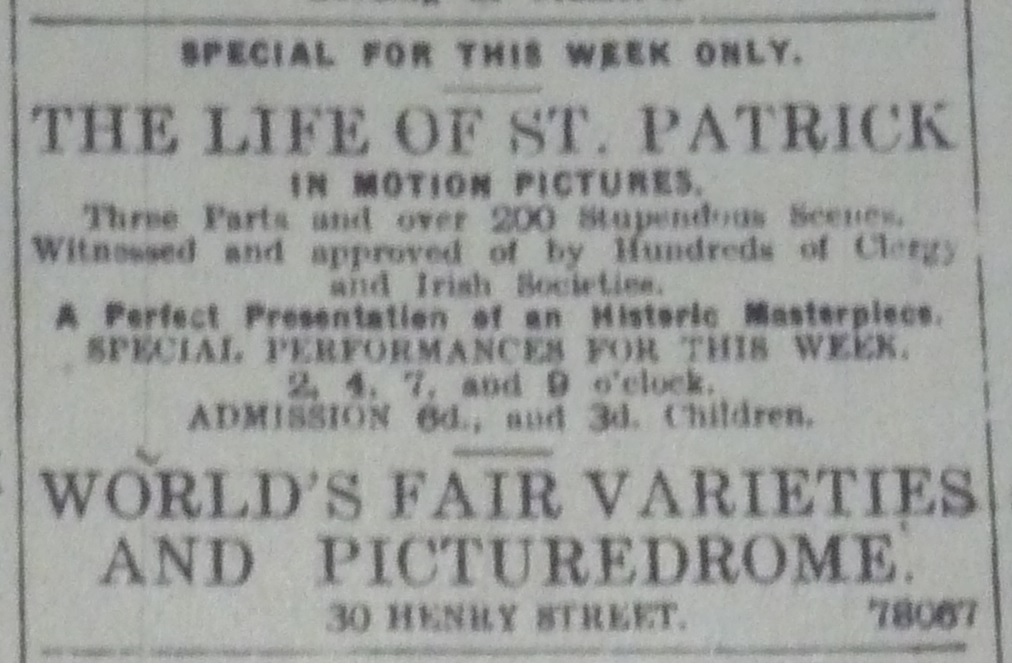
Of even more direct relevance to the feast day of the Irish patron saint was J. Theobald Walsh’s Life of Saint Patrick: from the Cradle to the Grave (US: Photo-Historic, 1912). This film was shown in Patrick’s Week at Dublin’s World’s Fair Varieties in Henry Street. This was not the first time the World’s Fair had shown the film; the venue began 1914 with an extended run of it. It was “over 3,000 feet long [and] was produced by Theobald Walsh, for the Photo-Historic Company, New York, on the actual spots made memorable by Ireland’s Apostle. It is enacted throughout by Irish peasants attired in the correct costumes of that period” (“World’s Fair Varieties”). It was, one reviewer commented, a “splendid picture, and most appropriate for the time of year it is.” Indeed, “it is, undoubtedly, a most masterly film” (“’Life of St. Patrick’”).

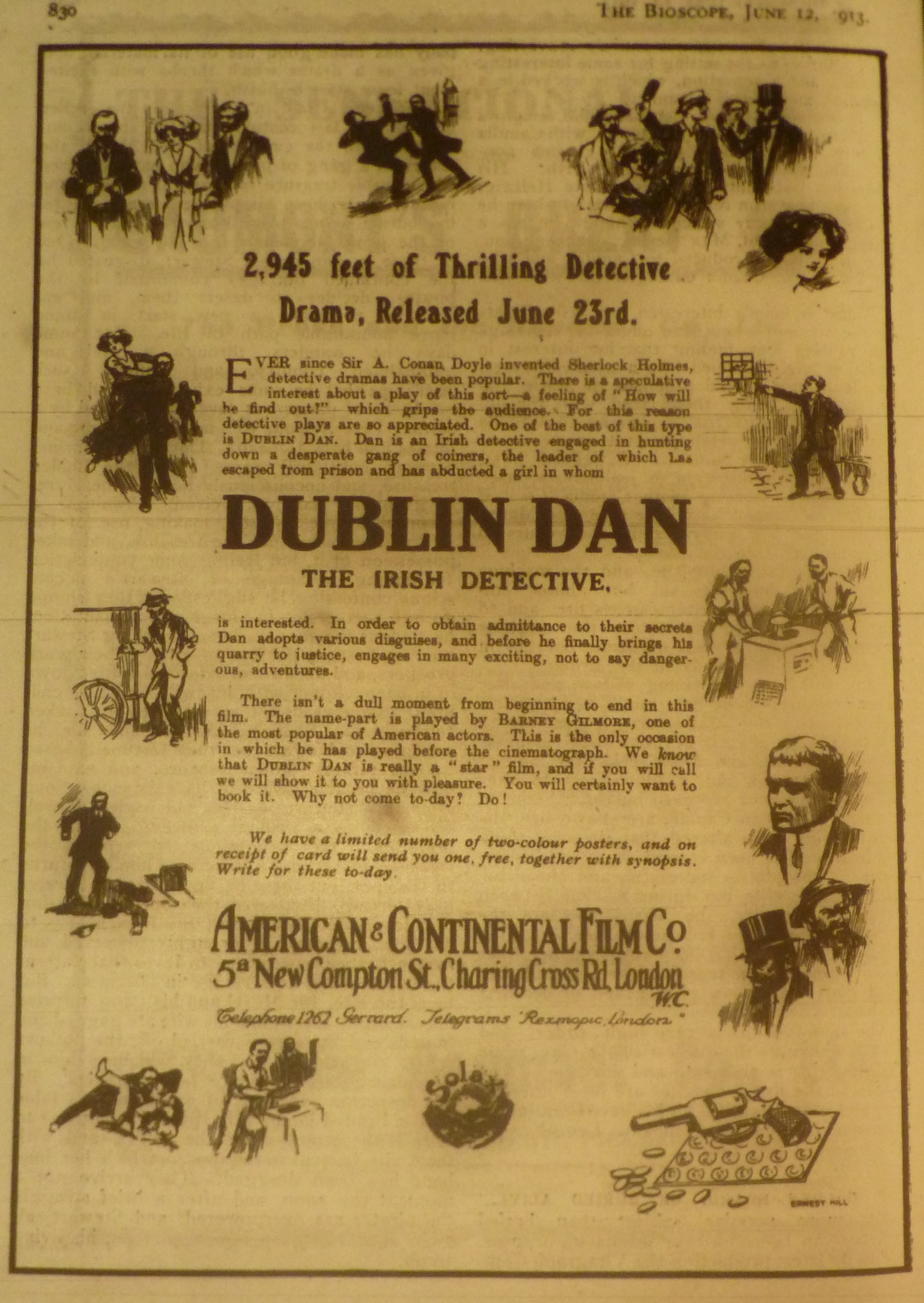
Bioscope ad for Solax's Dublin Dan (12 Jun. 1913: 830).

Bioscope ad for Solax’s Dublin Dan (12 Jun. 1913: 830).

Elsewhere, Irish-set (but not -shot) films or those featuring Irish characters that – like the Kalem films and The Life of Saint Patrick – had been released in the previous year or so were revived for the occasion. For the first part of Patrick’s week, the Clonard showed The Banshee (US: Kay-Bee, 1913), a “splendid two-part drama” to whose representations of the Irish the Ancient Order of Hibernians had objected when it had been shown in Tralee, Co, Kerry, in early February 1914 (Condon). Other titles were more Irish-American than Irish. As part of its special Sunday programme on 15 March, the Phoenix showed Solax’s Dublin Dan: The Irish Detective (1912), which starred popular stage actor Barney Gilmore in his first film. In an ad for the film in a US trade journal, Solax described Gilmore as the “popular American and Irish idol – the matinee girl’s pet – the favorite of millions, an actor known in every state in the Union – a veteran on the stage – although young in years, with a personality that ‘comes across’” (Solax 729). Although The Escape of Jim Dolan (US: Selig Polyscope, 1913) contained a temptingly Irish-named protagonist, this Tom Mix Western at the Picture House in Dublin’s Sackville/O’Connell Street for the three days including St. Patrick’s Day appears to have had no meaningful Irish or Irish-American theme beyond that name.

Image

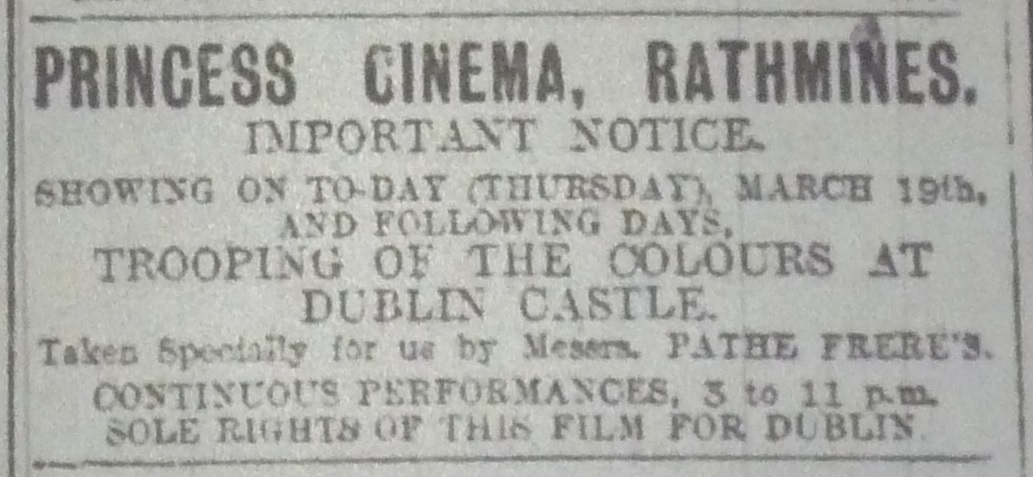
Dublin Evening Mail 18 Mar. 1914: 2.
Two films of actual sporting and political events in Ireland were also popular. On Monday, 16 March, films of two international football matches that took place in Belfast the previous weekend were exhibited at several picture houses, including the West Belfast Picture Theatre on the Falls Road – which showed the soccer match at Windsor Park between Ireland and Scotland – and the Picture House, Sackville/O’Connell Street – which showed the Ireland v. Wales rugby match at the Balmoral show grounds. On 19 March, the Princess Cinema in the Dublin suburb of Rathmines was the first in the city to show the film “Trooping the Colours” that had been shot by Pathé at Dublin Castle on St. Patrick’s Day. A military display overseen by the Lord Lieutenant in the presence of invited dignitaries, this film offered moving-picture evidence of a phenomenon that had long been clear in other media: that St. Patrick’s Day was an established part of the official culture of British-ruled Ireland.

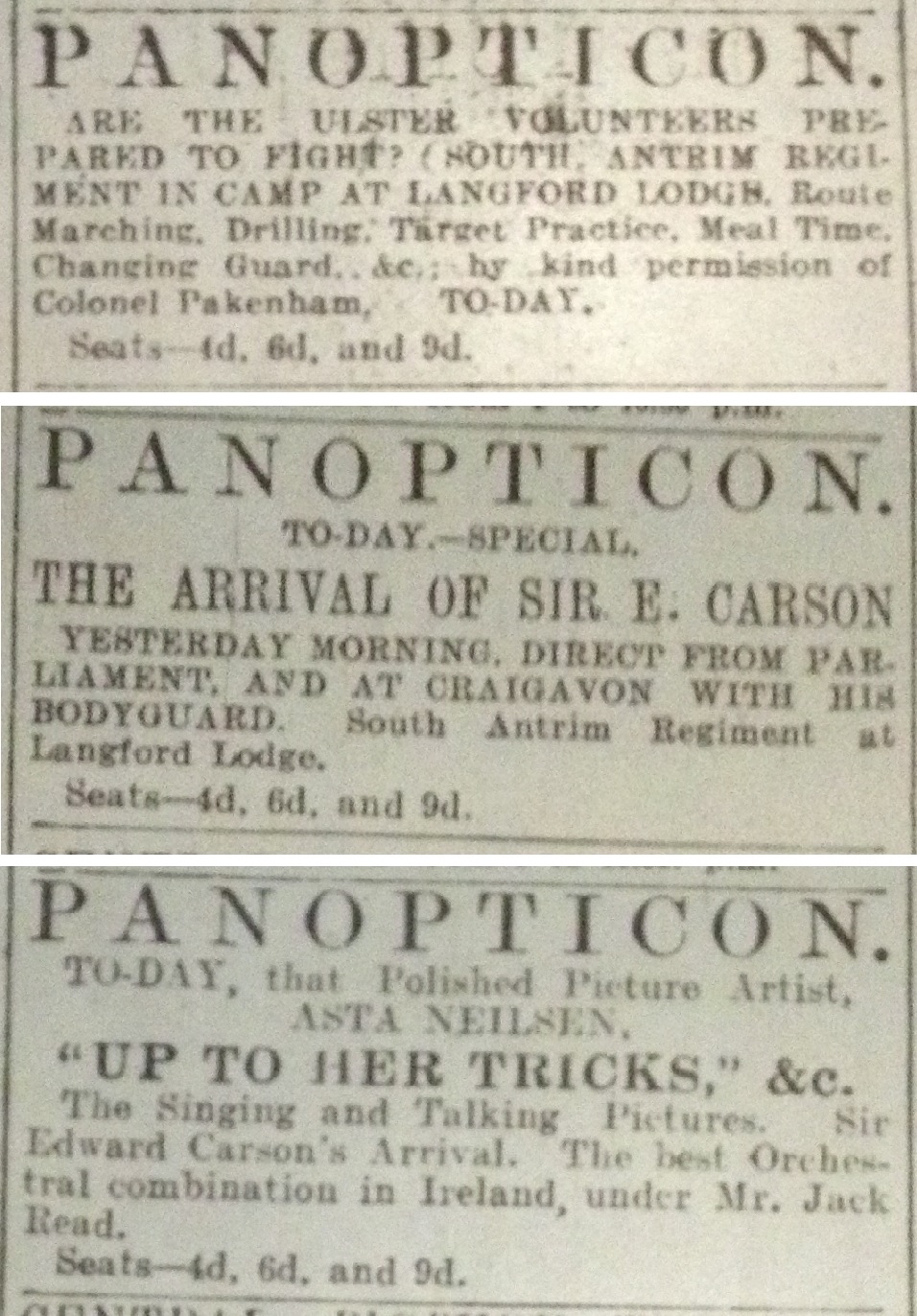
Ads for the Panopticon on 19, 21 and 24 Mar. 1914.

Ads for Belfast’s Panopticon on 19, 21 and 23 Mar. 1914.

Actuality films shown in Belfast presented a very different view of Ireland in 1914. As debates on special terms for the exclusions of parts of Ulster from a home-ruled Ireland continued at Westminster, the Panopticon in High Street topped its bills in the second half of Patrick’s week with films that showed the determination of unionist resistance. An actuality of the South Antrim brigade of the UVF was screened from 19 March in answer to the question posed by newspaper ads for the show: Are the Ulster Volunteers Prepared to Fight? This question had gained increased currency that day, when Edward Carson abruptly left Westminster in the face of insufficient concessions for Ulster, stating his intention of confronting what would come with his people. On Saturday, the South Antrim brigade film was joined on the Panopticon bill by The Arrival of Sir E. Carson, a film that was retained into the following week, although the new programme was headed by Asta Nielsen’s Up to Her Tricks (Engelein; Germany: Projections-AG Union, 1914). By then the political crisis in Ireland had worsened with the beginning of the Curragh Mutiny, the declaration by British Army officers in Ireland that they would not move against the UVF.

Belfast Telegraph 9 Mar. 1914: 5 and 6 Mar. 1914: 2.

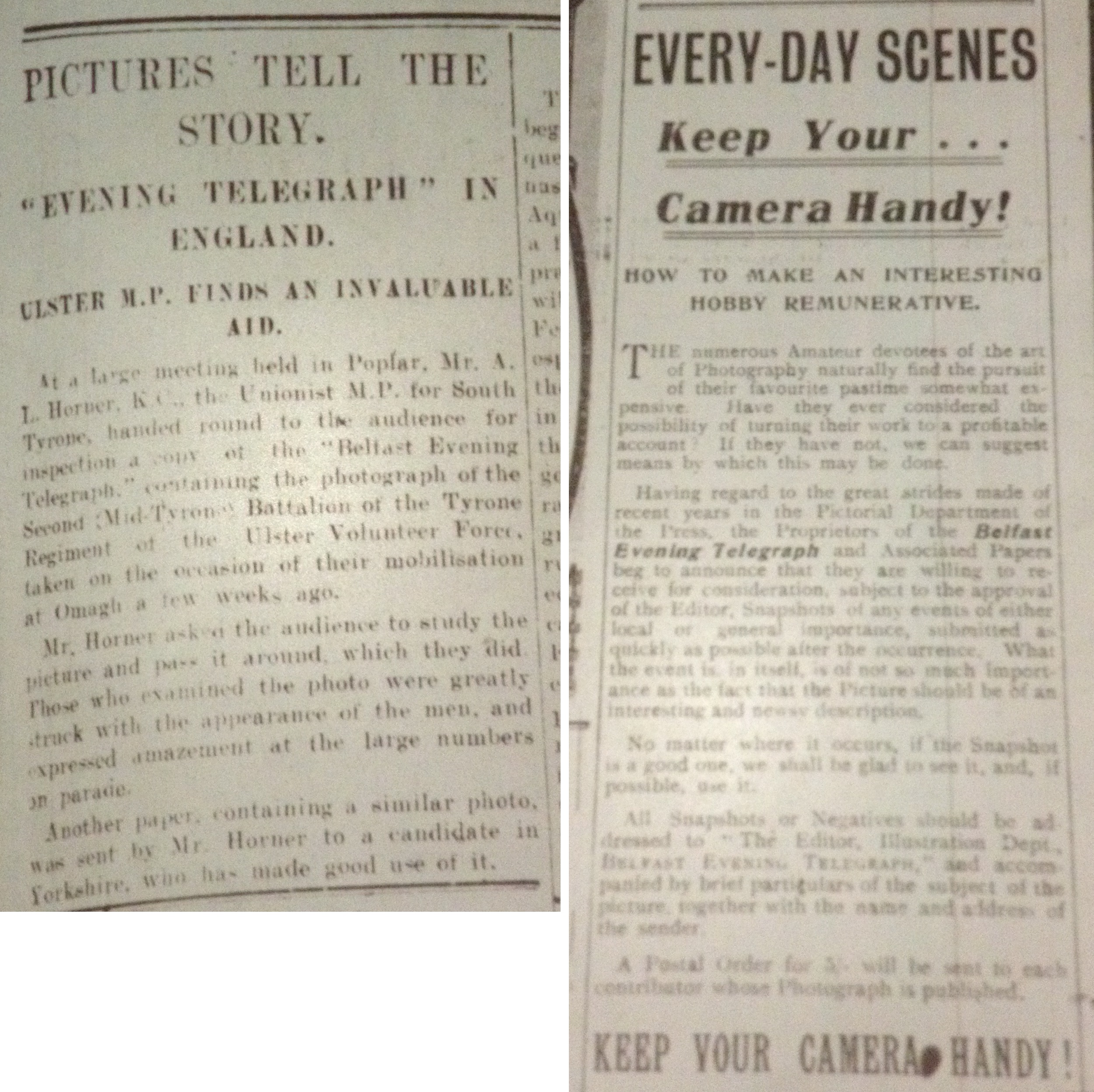
The value of crowdsourcing the news: Belfast Evening Telegraph 9 Mar. 1914: 5 and 6 Mar. 1914: 2.
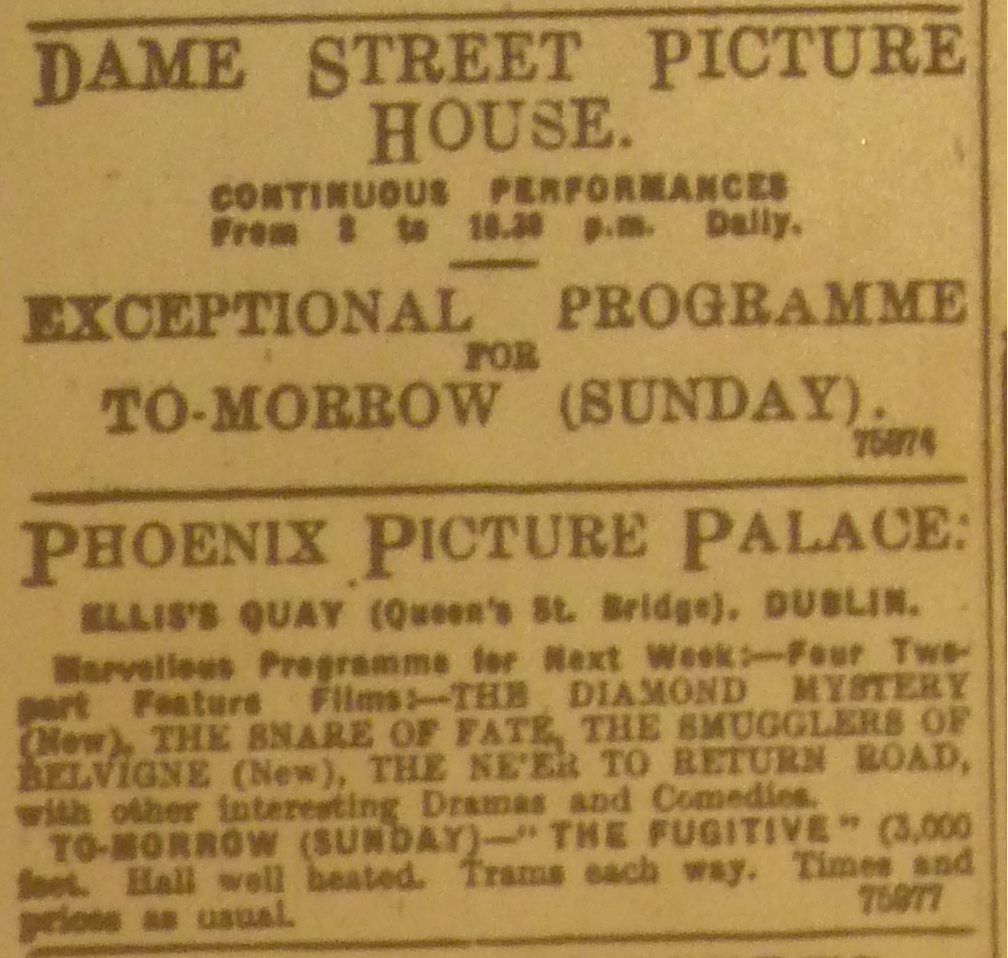
How important the films at the Panopticon were in propagating resistance to Home Rule is difficult to say, but the value of still images to the campaign is clear from the Belfast Evening Telegraph. In early 1914, the Telegraph had been encouraging the amateur photographers among its readers to send in photos of newsworthy events for possible publication. The paper carried a large number of professionally produced photographs, drawings and illustrated ads, and this crowdsourcing of photographs enhanced what was already probably Ireland’s most visually rich newspaper. The usefulness of such images to unionism was made explicit by the 9 March article “Pictures Tell the Story,” which relates how at a meeting in London, Unionist MP Andrew L. Horner distributed a Telegraph photo of a UVF battalion that amazed the audience with the numbers on parade. The method of dissemination here was crude but effective and repeatable: “Mr. Horner asked the audience to study the picture and pass it around, which they did […] Another paper, containing a similar photo, was sent by Mr. Horner to a candidate in Yorkshire, who has made good use of it” (“Pictures Tell the Story”). In this context, the usefulness of moving pictures in showing sympathetic audiences in Britain the extent of unionist opposition to Home Rule seems obvious, but a system of distribution that allowed the correct contextualizing of the films was required.

By June 1914, the full value of moving images of Ulster resistance would be realized when the Union Defence League fitted out four large vans with projectors, screens and films of Carson and the UVF to tour Britain spreading the message of opposition to Home Rule (Paddy, 18 Jun.). Already by March 1914, however, young supporters of the UVF were finding their drilling and cinema-going converging. 

References

“The Coliseum: A Strong Programme.” Cork Constitution 17 Mar. 1914: 6.

Condon, Denis. “Limelight on the Colleen Bawn: Resisting Autoexoticism in Provincial Irish Picture Houses in the Early 1910s.” Les cinémas périphériques dans la période des premiers temps. Peripheral Early Cinema: Domitor 2008. Presses Universitaires de Perpignan, pp. 245-255.

“’Life of St. Patrick.’” Evening Telegraph 17 Mar. 1914: 2

Paddy. “Pictures in Ireland.” Bioscope 18 Jun. 1914: 1261.

“Pictures Tell the Story.” Belfast Evening Telegraph 9 Mar. 1914: 5.

“Princess Cinema, Rathmines.” Dublin Evening Mail 18 Mar. 1914: 2.

Solax. Ad for Dublin Dan. Moving Picture World 10 Aug. 1912: 729.

“Technical Students Drilling.” Weekly Irish Times 14 Mar. 1914: 6.

“World’s Fair Varieties: Life of St. Patrick.” Dublin Evening Mail 16 Mar. 1914: 4.

Kinema Kinks and the Respectability Police

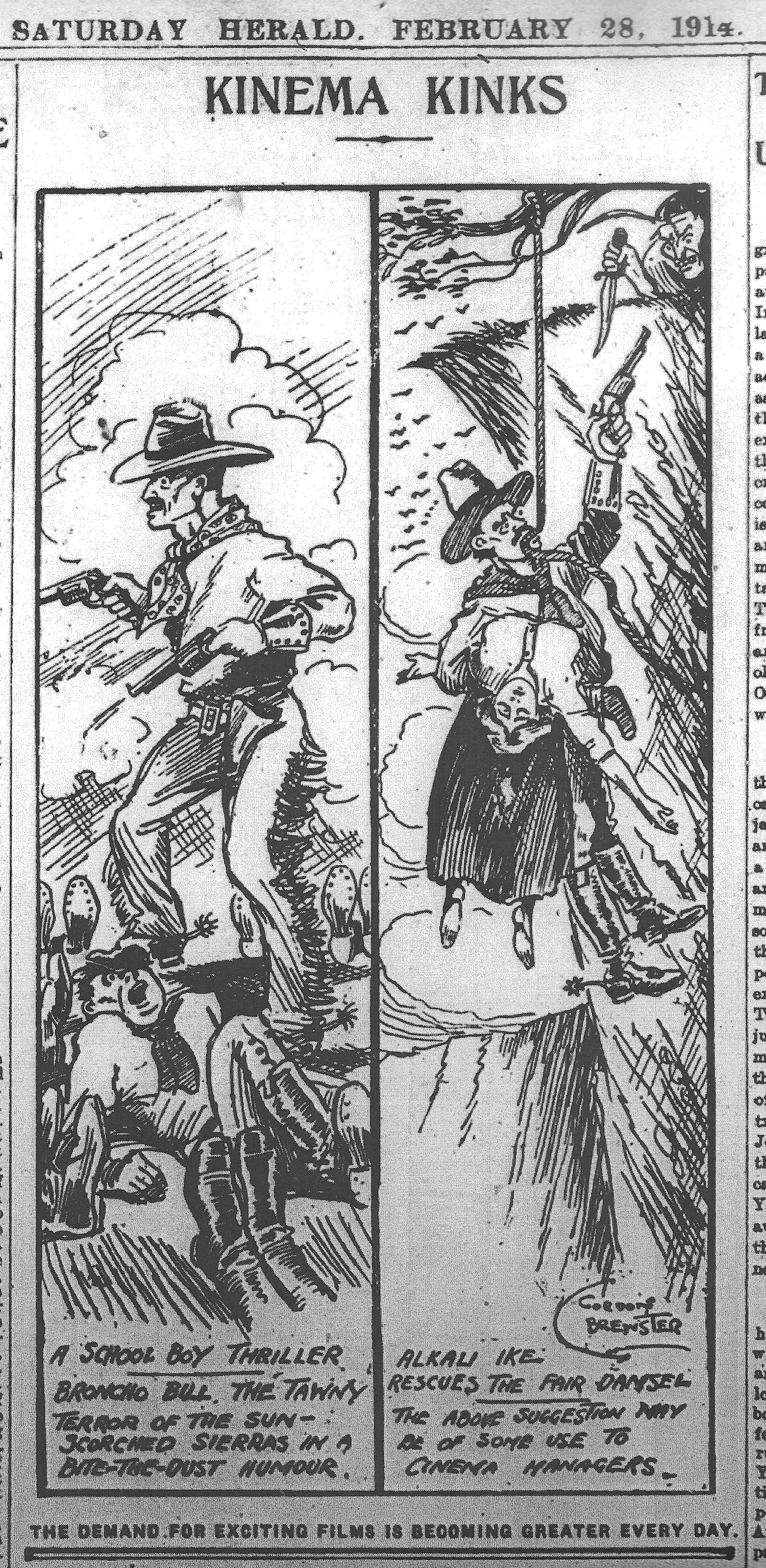
Evening Herald, 28 Feb. 1914: 6.

Evening Herald, 28 Feb. 1914: 6.

On Saturday, 28 February 1914, Dublin’s Evening Herald published a Gordon Brewster cartoon called “Kinema Kinks” and subtitled “The Demand for Exciting Films Is Becoming Greater Every Day.” It seems that the epitome of exciting films as far as Brewster was concerned was the work of the Essanay company’s co-founder (with George K. Spoor, hence the “S and A”), director and actor Gilbert M. Anderson. Anderson was best known for his most popular screen role of Broncho Billy, and the left-hand panel of the cartoon appears to feature him, with its caption: “A School Boy Thriller // Broncho Bill the Tawny Terror of the Sun-Scorched Sierras in Bite-the-Dust Humour.” The image accompanying this text features a cowboy who has clearly come out best in a shootout with six opponents, on the face of one of whom he is standing, while only the boots of the others are visible. Although the triumphant cowboy’s facial features are not like Anderson’s, it is not just the text that suggests that he is Broncho Billy but also the studded wrist cuffs that were often a part of Broncho Billy’s costume.

Poster for Essanay’s The Making of Broncho Billy (1913) and publicity photo for Gilbert M. Anderson, actor, director and co-founder of the Essanay film company (http://silentwesterns.wikia.com/wiki/Broncho_Billy_Anderson?file=Broncho_Billy_Anderson.jpg)

Poster for Essanay’s The Making of Broncho Billy (1913) and publicity photo for Gilbert M. Anderson, actor, director and co-founder of the Essanay film company (http://silentwesterns.wikia.com/wiki/Broncho_Billy_Anderson?file=Broncho_Billy_Anderson.jpg)

That said, the second panel – captioned “Alkali Ike Rescues the Fair Damsel // The Above Suggestion May be of Some Use to Cinema Managers” – also features a cowboy with studded wrist cuffs as he hangs from a rope by his teeth carrying the unconscious damsel and holding off what appears to be a knife-yielding Indian. Alkali Ike was the hero of an Essanay series of comic Westerns produced by Anderson and starring Augustus Carney, who may have been born in Ireland. Of what use to cinema managers the image of Alkali Ike might have been is unclear, but the cartoon attests to the popularity of Westerns – not only those of Broncho Billy and Alkali Ike – in Dublin cinemas. As has already been seen here, commentators noted that “no picture programme nowadays is considered complete if it does not include a cowboy film” (“Rotunda Pictures” 9 Sep. 1913). That was an exaggeration; many film programmes did not include a Western. Nevertheless, it suggests that the cinema audience was entirely familiar with Westerns, and in such a situation, it is not difficult to imagine that there was a demand for cowboy film with increasingly sensational scenes.

Other kinds of excitement were arranged by the audience rather than cinema managers. Protests in the first week of March 1914 in a theatre and a picture house were indicative of the concerted campaigns of protest in cinemas to come. On the evening of 2 March, William Larkin of 27 Sherrard Street shouted from the gallery of the Gaiety Theatre in protest at the immorality of the French farce Who’s the Lady? (“The Scene at the Gaiety”). He created enough of a disturbance that the actors left the stage until Larkin was removed from the theatre and arrested. Larkin appeared in the Southern Police Court the following morning, where the case against him was dismissed by the magistrate, Thomas Drury, who praised Larkin for having “done a public service” (ibid). Emboldened by this support from the judiciary, William Larkin and his twin brother Francis would in the coming months constitute the most publicly visible part of the Catholic Church-based Dublin Vigilance Committee’s campaign for film censorship with a series of protests in cinemas around the city. For this, they could rely on an at-least tacit but often explicit consensus on the regulation of popular theatre and cinema among the Catholic establishment in the city.

The diary of theatregoer Joseph Holloway is revealing on the protests and middle-class Catholics’ attitudes to them. Holloway had not been in the theatre that night, but he followed the controversy in the newspapers. Noting the remarks by the Irish-Ireland journal The Leader that “[a] certain ‘highly respectable’ class of people in Dublin like dirty plays & dirty papers … but in a very literal sense there is a well-dressed ‘Dirty Dublin.,’” Holloway agreed that “[t]his is all very true[;] I have noticed it for years in our theatres that the more questionable the play the better dressed the audience!” (Holloway 504).

Although Larkin’s militant policing of respectability had not quite reached the picture houses in March 1914, other kinds of protest had. Between 8 and 9 o’clock on the evening of Thursday, 5 March, fourteen boys of Na Fianna Éireann – or the National Boy Scouts as most of the newspapers called them – were ejected from the Picture House, Sackville/O’Connell Street for disrupting a screening of the British Army Film (Britain: Keith Prowse, 1914) (“Dublin Picture Palace Scene”). While Larkin was interested in morality, Na Fianna were interested in nationality, expressed as anti-British and pro-Irish: “They took up seats in the front rows, and hissed the scenes that were being shown. The cheered for Germans and Boers, and sang ‘A Nation Once Again’” (ibid). They did not have it all their own way, as other members of the audience cheered the British, and the police and cinema attendants dragged several of them from the auditorium. Nevertheless, as Who’s the Lady? provided the occasion for Larkin’s display of Catholic morality, the British Army Film allowed Na Fianna to project Irish nationalism onto an ostensibly British patriotic text. Joseph Holloway was thus able to point out that the “film also caused a disturbance on last Monday night – The British Army is not to the taste of all people in Dublin” (Holloway 500).

While the DVC and Na Fianna seemed intent on placing strict limits on cinema, “famous Irish painter, author, and visionary poet” A.E. insisted – albeit somewhat reluctantly – on the importance and inevitability of cinema in education (Paddy, 19 Feb.). “[F]or all our qualms, we invite the cinema into education,” the Bioscope’s Irish correspondent Paddy reported him as saying.

Our methods of education in the national schools have not been so superior and thought-quickening that we risk losing much in introducing the living picture, and whether we protested or not the thing is as inevitable as that the aeroplane will carry our children from Ireland to England in another quarter of a century. Ireland, which has been in a backwater, meditating on its wrongs and its past, will have to move in the new ways and adjust itself to the new conditions, to the new forces and the new ideas, and make them operative in its own interests, or else they will operate against its interests.” (ibid)

A.E.’s approach was very different in this regard to Ireland’s most famous visionary poet, W. B. Yeats, who had no time for cinema. By contrast, A.E. was, knowingly or not, contributing to an ongoing debate in the cinema industry worldwide on the new medium’s role not only in entertainment but also in the more sober discourses of education, technology and science. He was not the only or even the best know Irish writer doing this. Comments by George Bernard Shaw would open the Bioscope’s Education Supplement on 18 July 1914.

Ad for the reopening of the Grafton Picture House emphasizes the increased luxury of the premises alongside the latest film offering in the  Sherlock Holmes series. Evening Herrald  26 Feb. 1914: 4.

Ad for the reopening of the Grafton Picture House emphasizes the increased luxury of the premises alongside the latest film offering in the Sherlock Holmes series. Evening Herrald 26 Feb. 1914: 4.

The growing prestige of cinema in Ireland was visible on the Dublin streetscape in the reopening of the Grafton Picture House on 26 February 1914. The Grafton had closed for renovations in June 1913, and its long-delayed reopening marked the first indication that Dublin’s cinema-building boom, which had been halted by the strike and Lockout of the city’s workers, had resumed. Owned by the London-based Provincial Cinematograph Theatres – which was also the proprietor of the Picture House in O’Connell Street, the Volta in Mary Street and Belfast’s Picture House, Royal Avenue – the reopened Grafton emphasized its suitability as a place of entertainment for the city’s wealthiest shoppers. The renovations not only doubled its seating capacity but also added luxurious features and the latest in cinema technology, including walls covered in

rich Old English tapestry representing various scenes. The Eye-Rest system of lighting is employed with considerable effect. On the right of the screen is fixed an electric clock, and on the left a clock showing the number of the orchestra selection. In the three lounge and tea-rooms there is also an indicator telling what picture is being screened. These rooms have been entirely refurnished, and are beautiful n the extreme. (Paddy, 12 Mar.)

Dublin’s middle and elite classes also had increasing opportunities to attend picture houses in the city’s prestigious suburbs, such as the Grand Picture House in Blackrock. It was here that the first screening of the newsreel film The Launch of the Britannic took place at 10.22pm on 26 February 1914.  This screening can be timed exactly because it was covered by journalists from the Dublin newspapers and the Bioscope, whom Gaumont’s Dublin manager H. Bromhead invited to report on the filming of the launch. The Evening Herald‘s reporter travelled with the newsreel team from Dublin to Belfast to Blackrock and back to the Gaumont office, covering it as if it were one of the hairsbreadth escapes of a sensational film:

Ten-fifteen! We drew up at the theatre. People saw us dashing through the entrance. A cry sprang up: “The film; the Britannic has come.”

Ten-twenty-two! The light flickered on the screen. “Launch of the Britannic!” What a cheer rose up, what clapping of excited hands. (“Filming the Britannic”)

It was acceptable in Ireland in 1914 to indulge in an excitement that marvelled at the technologies and skills that allowed a Blackrock audience to witness that evening an event – itself a technological marvel of the age – that had occurred in Belfast just that afternoon. Less acceptable and in need to disciplining to pass the dominant modes of respectability, however, were the kind of excesses of violence and sensation depicted by Brewster’s “Kinema Kinks” cartoon.

References

“Dublin Picture Palace Scene: Fourteen Youths Ejected.” Evening Herald 6 Mar. 1914: 2.

Filming the Britannic: How ‘Topicals’ Are Produced: While Dublin Sleeps.” Evening Herald 27 Feb. 1914: 2.

Holloway, Joseph. Holloway Diaries. National Library of Ireland. 5 Mar. 1914: 500, and 6 Mar 1914: 504.

Paddy. “Pictures in Ireland.” Bioscope 19 Feb. 1914: 783, and 12 Mar. 1914: 1133.

“Rotunda Pictures.” Dublin Evening Mail 9 Sep. 1913: 5.

“The Scene in the Gaiety Last Night: ‘Who’s the Lady?’ Objected to by Young Man: Case Dismissed: Magistrate Says It Was a ‘Public Service.” Evening Herald 3 Mar. 1914: 1.

“Growing in Favour to an Enormous Extent”: New Media, Ireland 1914

A little after 7pm on Friday, 6 February 1914, architect and inveterate theatregoer Joseph Holloway and his niece Eileen O’Malley arrived at Dublin’s Gaiety Theatre to find that the parterre was already full and there was standing room only in the upper circle. They decided not to stand for that evening’s final performance of the pantomime Jack and the Beanstalk, which was a benefit for comedian Jay Laurier, the actor who played Miffins. Instead they walked to the Nassau Street corner of Grafton Street to take a tram to the Dorset Picture Hall where they spent the evening watching a series of “interesting” but unnamed pictures (Holloway). It’s not clear why they passed the other picture houses along the tram route across the city to favour the Dorset, but Holloway seems to have taken a liking to the Dorset, having seen Kissing Cup (Britain: Hepworth, 1913) there with Eileen on 2 January and The Child from the Sea alone on 28 January. He had also recently seen Germinal (France: Pathé, 1913) at the Princess Cinema in Rathmines and the show of Kinemacolor films at the Queen’s Theatre.

Handbill for films at the Dorset during the week of 15-21 June 1914 with three changes of programme.

Handbill for films at the Dorset during the week of 15-21 June 1914 with three changes of programme. National Library of Ireland.

Holloway’s diary entries on his visits to Dublin’s picture houses are both unique and frustrating, providing the only sustained first-hand account by an Irish cinemagoer of this period but also offering merely tantalizing details of his visits. This contrasts markedly with his often lengthy comments on the city’s theatrical shows, many of which he saw on their opening night. Although he was committed to the theatre, he had also become since 1910 – almost without realizing it himself, it seems – a regular picture-house patron. Although more detail on goings-on in cinemas from an audience member’s point of view would certainly be welcome, the way in which going to the picture house had become such a mundane activity is fascinating. In his diary, Holloway notes significant films alongside theatre shows at the start of a week and often integrates a film show into his schedule, sometimes choosing a film but often choosing to see whatever was on at a favoured picture house.

Holloway and other cinemagoers would have increasing choice as 1914 progressed. “Dublin has not by a long way stopped in its career of opening picture houses,” reveals Paddy in the trade journal Bioscope in early February 1914. He mentions plans to open 18 more cinemas in the city, with plans for eight already approved.

There is no doubt that some of these new fry will pay, because they are to be built in districts badly provided for in the matter of theatres, but when I hear that it is proposed to open three new houses in Grafton Street, and two more in Sackville Street, I wonder what will happen. (Paddy, 5 Feb).

Comments on the growing popularity of Dublin picture houses were not limited to the trade papers. “There can be no gainsaying the popularity of picture theatres in the Irish metropolis,” comments Irish Times columnist the Clubman. “They seem to be always crowded and their proprietors must be making plenty of money out of them. Of course, the ‘man in the street’ will tell you that ‘the pictures’ are only a ‘craze,’ but they are a craze which will, I think, live for some time in Dublin, at any rate (“Dublin Topics”).

It was not just in Dublin, and it would not be a passing craze. In mid-January 1914, the Bioscope’s “Jottings from Ulster” columnist noted that the

Belfast Corporation cinematograph inspector, Mr. Campbell, reported at the last meeting of the Police Committee, that on Christmas Day, Boxing Day, and the 27th ult., 124,087 persons patronised the fourteen picture theatres in the city. These figures show an increase of about 15,000 as compared with Christmas, 1912, It is of considerable interest to note that 124,000 is roughly one-third of the entire population of Belfast; it may, therefore, be taken that the cinema is growing in favour to an enormous extent. (“Jottings,” 15 Jan.)

These are very interesting figures, adding some statistical support to the impression conveyed by Holloway’s diary and newspaper and trade-press articles. It remains more difficult to discern a hundred years later the degree to which individual films that appear to do so actually address such important issues as women’s suffrage, the labour movement and Home Rule. These questions might without too much distortion be phrased in the language of 2014 as concerning the way in which new media engage with questions of the changing nature of work, gender inequality and national sovereignty.

Asta Nielsen as suffrage activist Nelly Panburne being force fed in The Suffragette (1913).

Asta Nielsen as suffrage activist Nelly Panburne being force fed in The Suffragette (1913).

Women’s suffrage was one of the most prominent political questions of the 1910s, kept in the headlines by suffragette activism, including that by the Irish Women’s Franchise League. Suffragettes in Ireland – but not Irish suffragettes – had most directly used the new cinema technologies as a form of protest on the evening of 18 July 1912, when as part of a wider protest, English suffragettes Mary Leigh, Gladys Evans and Lizzie Baker had attempted to set fire to Dublin’s Theatre Royal by igniting the highly combustible nitrate film in the theatre’s cinematograph box between evening shows. “Had the lighted matches come in contact with the films, the substances of which are, of course, highly inflammable, a terrible disaster might have to be chronicled” (“Serious Suffragette Outrage”). For this and for a hatchet attack on British prime minster HH Asquith’s carriage, in which Irish nationalist MP John Redmond was injured, Leigh, Evans and Baker were sentenced to prison terms in Mountjoy Jail, where they joined eight Irish suffragettes and began a hunger strike.

Belfast's Panopticon advertises Asta Nielsen in The Suffragette (1913).

Belfast’s Panopticon advertises Asta Nielsen in The Suffragette (1913); Belfast Newsletter 3 Jan. 1914: 1.

Events such as these were fictionalized in the German film The Suffragette (Projektions AG, 1913), which offered Irish audiences the rare opportunity of seeing suffragettes on screen treated as something other than just comedy. Featuring the Danish star Asta Nielsen as Nelly Panburne – modelled on Christabel Pankhurst – the film shows how Nelly protests by breaking shop windows; is force-fed when she goes on hunger strike in prison; and carries a bomb intended to kill Lord Ascue, a British minister modelled on Asquith opposed to women’s rights. The film attempts to contain its radical energies with a romantic subplot that sees Nelly save Ascue  from the bomb and marry him. Despite the closeness of the film to actual events, the Belfast Newsletter commented that when it was exhibited in January 1914 at the Panopticon Picture Theatre, it “creates great merriment. Asta Neilson, described as the greatest of all picture artists, is seen at her best” (“Panopticon”).

Carson v Redmond
The confrontation between Irish unionists and nationalists had become such a part of popular discourse in Britain in early 1914 that this ad for films that had nothing to do with Ireland could expect to draw attention by using the names of Edward Carson and John Redmond as if they were prize fighters. Bioscope 12 Mar. 1914, p. 1186.

Perhaps the importance of the political events of a different kind in Belfast was among the factors that inclined the Newsletter towards downplaying a fictional representation of the suffrage movement. To keep up pressure on Asquith’s government, Edward Carson again visited Belfast In mid-January 1914 to rally unionist opponents of Irish home rule and review the massed ranks of the Ulster Volunteer Force prepared violently to resist the imposition of home rule. Such nationalist newspapers as Dublin’s Evening Telegraph and Belfast’s Irish News presented unionist demonstrations as a farce and drew attention instead to the counter-demonstration in Belfast led by nationalist MP Joseph Devlin (“Carson Comedy Co.,” “U.V.F. Comedy,” “Mr. Devlin, M.P., in West Belfast”). The unionists, however, again proved themselves more competent with the new cinematic medium. A newsreel camera was again in Belfast to record and relay images not of Devlin but of Carson, and this time, it was operated by Dublin-based Norman Whitten, who filmed the demonstration for Weisker Brothers, a firm to which he had recently affiliated (Paddy, 29 Jan.). Paddy commended Whitten for having the film of Carson ready to screen at Belfast’s Picture House, Royal Avenue on the evening of the rally (ibid).

Of more immediate concern to Dublin’s media from mid-January to early February was the end of the Lockout with the defeat of the striking workers. For the first three days of the week beginning Monday 19 January, the Evening Telegraph’s notice for the Phoenix Picture Palace recommended A Leader of Men, “dealing in a thrilling and sensation manner with an organised strike in a big shipbuilding industry. It is decidedly a picture that will appeal strongly to all at the present time” (“Phoenix Picture Palace”). On the same day, the Telegraph was reporting the “Collapse of Strike: No Food and No Money: Mr. Larkin Advise Men: To Go Back to Work: But to Sign No Agreement” (“Collapse of Strike”). If that drama was too close for comfort to current events, audiences could also enjoy more diverting material on the same bill in the dramas Fortune’s Turn and The Dumb Messenger and the comedies The Honeymooners, When Love Is Young and Cartoons, Mr PiffleAs well as this, to whom and in what way the film would appeal is not clear given that it is unlikely many of the workers impoverished by months of strike could have afforded to attend.

Nevertheless, as cinema continued to develop and picture houses occupied more spaces on the Irish streetscape, films would attract audiences not only by providing escape but also by confronting – both directly and obliquely – important political issues.

References

“Carson Comedy Co.: Performing in Belfast To-Day.” Evening Telegraph 17 Jan. 1914: 6.

“Collapse of Strike.” Evening Telegraph 20 Jan. 1914: 3.

“Dublin Topics by the Clubman.” Irish Times 31 Jan. 1914: 4.

Holloway, Joseph. Holloway Diaries. National Library of Ireland. 6 Feb. 1914: 295.

“Jottings from Ulster.” Bioscope 15 Jan. 1914: 263.

“Mr. Devlin, M.P., in West Belfast: Great Rallies of the Progressive Forces Hear Inspiriting Addresses.” Irish News 19 Jan. 1914: 5-6.

“Phoenix Picture Palace.” Evening Telegraph 20 Jan. 1913: 2.

Paddy. “Pictures in Ireland.” Bioscope 29 Jan. 1914: 454.

Paddy. “Pictures in Ireland.” Bioscope 5 Feb. 1914: 547.

“The Panopticon.” Belfast Telegraph 6 Jan. 1914: 9.

“Serious Suffragette Outrage: Two Attempts to Set Fire: To the Theatre Royal: An Explosive Used: A Panic Avoided.” Freeman’s Journal 19 Jul. 1912: 6.

“U.V.F. Comedy: Parade of the East Belfast Regiment: Inspection by Sir E. Carson.” Irish News 19 Jan. 1914: 7.

“A Terrible Lot of Pups in Balbriggan”: Ensuring the Observance of Cinema Regulations

Reporting on their work in the final quarter of 1913, the Dublin Corporation councillors on the Public Health Committee revealed that they had granted an application for a pay increase made by two public servants. Building surveyors J.J. Higginbotham and William Mulhall deserved an extra £15 per annum because

the duties of examining plans of proposed Places of Public Resort, and the inspection and charge of the several Theatres, Cinema Houses, and other Places of Public Resort, had, to a large extent, devolved to them. […] There had been a large increase in the number of places of public amusement within recent years. These were scattered over a large area, and required frequent inspection to ensure the observance of the Regulations” (Dublin Corporation).

In 1910, the Corporation had increased the pay of Walter Butler, inspector of theatres and places of public resort, in acknowledgement that his work had increased with the introduction of the 1909 Cinematograph Act. However, with the growth in the number of picture houses and their wider distribution around the city than any other places of public resort, Butler delegated more of that work to Higginbotham and Mulhall, and they had to be compensated for the extra workload in their turn. Although the most obvious manifestation of the popularity of cinema was the appearance of a new kind of building on the streetscape, among many less apparent but wide-reaching material effects was its contribution to the careers of certain public officials.

Map of Dublin indicating main places of public resort, that is, theatres and cinemas.

Map of Dublin indicating main places of public resort, that is, theatres and cinemas.

Building regulation was one of the ways that cinema became a cultural institution imbedded in the institutional landscape of 1910s Ireland, and it raises questions about who was doing the regulating. This process was driven from inside Dublin Corporation and other local councils by powerful councillors and other senior officials who were sometimes themselves picture house proprietors or shareholders. John J. Farrell – Dublin’s mayor in 1911 and proprietor in 1913 of the Electric Theatre, Talbot Street and Mary Street Picture House – is frequently cited in this regard (Rockett 28-9, 33-4). However, Farrell was by no means alone in his conflict of interest. Dublin’s long-serving chief medical officer Sir Charles Cameron performed the opening ceremonies of several picture houses, including such early ones as the Dublin Cinematograph Theatre – later the Picture House, Lower Sackville/O’Connell Street – in April 1910, and Farrell’s Electric Theatre in May 1911. When he opened the picture house at the Clontarf Town Hall in July 1913 – receiving a gift of a gold-mounted umbrella – he revealed that he was a shareholder in a cinema company “which was paying 20 per cent., and he was only sorry he didn’t sell out all he had and invest the proceeds in a picture house (applause and laughter)” (“Clontarf Electric Theatre”).

Dorset Picture Hall in its later guise of the Plaza. (Irish Architecture Online.)

Dorset Picture Hall, in its later guise of the Plaza, clearly retaining its origins as a Baptist chapel. (Irish Architecture Online.)

Twenty percent was also the handsome return on profit enjoyed by Farrell and the shareholders of the Talbot Street Electric Theatre, but Cameron was not among these shareholders; “he only honoured us by opening it” (“Dublin Electric Theatre”). Nevertheless, Farrell appealed the Electric’s £160 valuation in November 1913, and the Recorder (chief magistrate) reduced it, accepting that the Electric should not have a higher valuation than the Dorset Street Picture House, which Farrell claimed could hold 1,600 people and charged 3d, 6d and 1s when the Electric had to do away with the top rate on its 3d-6d-9d scale. Effectively shifting attention onto the Dorset, whose owner had no known links to the Corporation, Farrell observed that “in Lent, when other places of a like character were nearly empty, the door porter at Dorset street held out his hands and said, ‘Room for no more’ (laughter)” (ibid).

Handbill for M. W. Shanly's Dorset Picture Hall in July 1914, featuring the latest film adaption of T. W. Robertson's play David Garrick.

Handbill for M. W. Shanly’s Dorset Picture Hall in July 1914, featuring the latest film adaption of T. W. Robertson’s play David Garrick. (Courtesy of the National Library of Ireland.)

Indeed, the Dorset was an interesting venue; one of the largest picture houses in Dublin, it had been barely converted from the former Bathesda Chapel by M. William Shanly, who was known primarily for providing chairs at parks in London and Dublin (“Dorset Picture Hall”). Despite having a much larger capacity than the Electric, it resembled Farrell’s picture house in housing a tearooms and being located well off the city centre’s main thoroughfares and close to a large railway station; in the Dorset’s case, this was Broadstone Station. “Travellers can see the pictures, and have their tea, with the assurance that they have not far to go when the time comes to catch their train” (Paddy, 14 Mar. 1912). Already an imposing building, the Dorset was by night “a veritable blaze of light. No less than 300 electric lamps adorn the building, and they have been grouped with care” (Paddy, 5 Dec 1912). Although many patrons smoked, “improved ventilators on the sides and roof of the hall, and on the stage [ensured that] there are scarcely any smoke rays form the operating box to the screen” (ibid).

Dorset small ad for staff. Irish Times 20 March 1911: 1.

Dorset small ad looking for staff. Irish Times 20 March 1911: 1.

With such a large clientele, the Dorset required an extensive staff, and Shanly and his manager Frederick William Sullivan advertised for many of these positions in the Irish Times in March 1911. These included ticket checkers, bill posters, a lady pianist who could play to pictures, two young women to sell tickets and refreshments, an experienced assistant operator to help with the picture house’s five projectors, and boys to sell programmes. The requirements for the door porter mentioned by Farrell were most specific: the two men who were sought must have retired from the police, present a smart appearance, be active and be prepared to wear a uniform. Shanly and Sullivan clearly intended to give the impression that whatever the state of picture houses in other parts of the city, the behaviour on their premises would be well regulated.

Not all Irish picture shows in late 1913 had an imposing attendant or two on the door capable of deterring unruly behaviour. On 22 November, the small County Dublin town of Balbriggan witnessed scenes of uproar, when a group of six local young men rushed the Town Hall to gain free admittance to a picture show (“At the Cinema”). Rather than a burly ex-policeman on the door, a man named McInerney “constituted himself doorman at the outer entrance on the occasion, and was trying to keep order, in the hope that his efforts in that direction might be rewarded by free admission to the pictures” (ibid). McInerney was no match for the six young men, some of whom

went into the passage where tickets for the cinema performances were being issued, and by their frightful language and disorderly and violent conduct caused such a scene of confusion that many intending patrons of the show turned away from the door, while other, who were already inside, came out again through fear and went home (ibid).

At the trial of the young men for riotous and disorderly behaviour, local lamplighter Patrick Darkin “informed the magistrates that there was ‘a terrible lot of pups in Balbriggan,’ and advised their Worships to put a stop to their conduct, which, he said, had resulted in a great deal of damage to the Town Hall” (ibid). Effective regulation of picture houses would be necessary for the cinema to considered respectable entertainment. This would serve the business interests of owners and shareholders, including those working within Dublin Corporation to ensure that their own business interests were legally protected.

References

“At the Cinema: Wild Scenes in Balbriggan.” Evening Telegraph 3 Dec. 1913: 6.

“Clontarf Electric Theatre: New Picture Enterprise.” Freeman’s Journal 19 July 1913: 5.

“Dorset Picture Hall.” Irish Builder 13 May 1911: 317.

Dublin Corporation. Committee Minutes, 1914: 1, pp. 592-3.

“Dublin Electric Theatre: Appeal Against Valuation of Premises.” Dublin Evening Mail 4 Nov. 1913: 3.

Paddy. “Pictures in Ireland.” Bioscope 14 Mar. 1912: 759.

Paddy. “Pictures in Ireland.” Bioscope 5 Dec. 1912: 725.

Rockett, Kevin and Emer. Film Exhibition and Distribution in Ireland, 1909-2010. Dublin: Four Courts, 2011.

Serial Queens and Super Villains

On 25 November 1913, Dublin’s Evening Herald reported that haulier Sidney Norman of Neath, Wales, had seriously injured himself in the early hours of the previous Saturday when he had jumped ten feet from his bedroom window while dreaming he was escaping from robbers he had seen that evening on a picture theatre screen (“Man’s Leap to Escape Cinema Robbers”). For this ordinary Welshman, the images on the screen had literally become the landscape of his dreams, to his severe bodily cost. The Herald picked this up as a news oddity and published it on its front page, where its readers might wonder at the gullibility of some picture-house patrons or the need to control this new entertainment that was coming to increasingly direct the dreams of its audience.

One of the ways in which it did this was through films of greater length and complexity. The increasing length of films had been a particular issue in the film industry since 1911. “We can remember when a drama of 1,000 ft. was often grumbled at on account of its length,” noted an editorial in the British cinema trade journal Bioscope in September 1911, “but it seems as if that day were past, and the demand for a picture play constituting the usual length of an entire programme has sprung up (“The Length of the Film”). The film of 1,000 feet (about 16 minutes at 16 frames a second) was the standard product of the US distributors, but in Europe, longer films, often with high-cultural prestige such as Italian company Cines’s 1913 Quo Vadis?, captured both the imagination of the public and the film market where they were sold as features or exclusives.

3 Musketeers Phoenix Nov 2013

An unusually large ad for an unusually long film: Evening Herald banner for The Three Musketeers at the Phoenix, 15 Nov. 1913: 4.

In Dublin in November 1913, the Phoenix Picture Palace marketed itself as the picture house that specialized in the long film. “The Phoenix Picture Palace is rapidly becoming famous for the exhibition of big classic film productions,” began a notice in the Herald,

“From Manger to Cross,” “Quo Vadis?” “Monte Cristo,” “The Battle of Waterloo,” etc., have all been shown at the Phoenix within the last few months. Last evening the patrons of this popular house had presented to them the longest film yet shown in this country – the “Film D’Art’s” remarkable production of Dumas’s popular and widely read work, “The Three Musketeers” (“‘The Three Musketeers’”).

This issue of the long film was not resolved in 1911, however, and the Bioscope continued to favour a varied programme of shorter films, arguing in an October 1913 editorial that the long film’s “charm and importance can be better sustained outside the ordinary picture theatres. The popularity of the cinema has been built up on the variety of the entertainment it offers, and a lessening of that variety means a weakening of public interest” (“Exclusives and Other Matters”).

Doubtless, the Bioscope was influenced in its thinking by the nature of variety theatre, cinema’s chief rival in popular entertainment in Britain, Ireland and elsewhere. A solution to providing a lengthy film as part of a variety programme was available in another popular form: the serial. Fictional writing had long been serialized in newspapers and magazines, where it appeared alongside many other kinds of writing in another kind of variety format. In November 1913, the Evening Herald carried an episode of popular novelist Emma M. Mortimer’s Robert Wynstan’s Ward each day, and this was wholly unremarkable.

However, the autumn of 1913 saw a new phenomenon arrive in Ireland: the film serial. When the Rotunda began showing the serial What Happened to Mary in September 1913, the Dublin Evening Mail commented that the Rotunda “management in producing a ‘serial’ film, have broken new ground as far as Dublin picture houses are concerned” (“Rotunda Pictures” 23 Sep.). Unlike the Phoenix, the Rotunda favoured a more varied programme of shorter films, so that when High Tide of Misfortune, the tenth episode of What Happened to Mary, was exhibited there in the week of 24-29 November 1913, it shared the bill with the main film, Broken Threads United; a “very complete picture […] of the procession to Glasnevin on Sunday in connection with the Manchester Martyrs’ commemoration”; the comedies His Lady Doctor, Ghost of the White Lady and Love and Rubbish; and the Pathé Gazette newsreel (“Rotunda Pictures” 25 Nov). The serial was integrated into this variety film programme that was lent some locally produced coherence by being accompanied by the music of the Irish Ladies’ String Orchestra.

What Happened Mary Fuller

August 1912 cover of US magazine Ladies’ World featuring Mary Fuller and What Happened to Mary. From “The First Movie Serial.”

To what degree the variety format was more successful in attracting a larger and more diverse audience is debatable, but the inclusion of What Happened to Mary seemed a direct appeal to young women. Narrating the adventures of a country girl who comes to the city, What Happened to Mary was produced by Edison in twelve monthly episodes beginning in US picture houses in July 1912 in parallel with the serialized story that appeared in the US mass-circulation women’s magazine Ladies’ World, making its lead actress Mary Fuller into a star (Singer 213). Running from 22 September to 13 December, the first Irish exhibition at Dublin’s Rotunda tied in with its weekly serialization in the British women’s magazine Home Chat (“The Rotunda,” “The Picture Houses”). As such, it was clearly marketed primarily at women. An indication of its local success is the fact that the Rotunda immediately followed it with Who Will Marry Mary?, the Edison sequel, which again featured Mary Fuller.

Although it would take another year for the serial to reach the height of its popularity with such “serial queens” as Helen Holmes the adventurous heroine of The Hazards of Helen and Pearl White in The Perils of Pauline and The Exploits of Elaine, this earlier serial followed some of the patterns of the later ones. Shellley Stamp argues that “for a complete understanding of the template serial heroines offered viewers we must look beyond the screen exploits of Pauline and her compatriots towards the substantial star discourse that circulated around the actresses who played these women on screen” (Stamp 217). Some of the Dublin reviews suggested What Happened to Mary did create the desire in its audiences for more information about Mary Fuller: “‘Alone in New York’ is the second instalment of the ‘What Happened to Mary’ serial; all who have seen the opening scenes of Mary’s adventures will be eager to know more about this fascinating actress” (“Rotunda Pictures” 27 Sep.).

Flapper on Tram IL 24 Oct 1913

An Irish flapper finds space for herself in the public sphere; Irish Life 24 Oct. 1913: 91.

More specific information on the reception of What Happened to Mary among Irish audiences, and particularly Irish women, does not seem to survive. The fact that the exhibition of the film was tied to the publication of a British magazine is indicative of the subsidiary place of Ireland in the publishing and film industries. The Irish women’s magazine Lady of the House, which had very little to say about cinema of the period, made no mention of the serial, but it and other Irish periodicals show how women were represented in popular media. Was the young flapper shown travelling on a tram in a cartoon in the glossy and expensive Irish Life in October 1913 likely to have found Mary’s adventures or Mary Fuller’s star persona enthralling? Perhaps, but it is not clear that the serial form allowed Mary Fuller to capture the imagination of the public to a greater extent than the at-least-sometimes more active heroines of stand-alone films. In the Herald’s notice for the Rotunda on 30 September, the third episode of What Happened to Mary was not mentioned, but the reviewer focused on the heroine of A Wild Ride, set on a South African ostrich farm, in which “a resourceful and up-to-date heroine, in a situation of dire extremity, outwitted cunning and ferocious savages, rode an ostrich across the trackless veldt at high speed, and brought soldiers to the relief of her imprisoned family” (“Rotunda Pictures” 30 Sep.). Such derring-do in the serial would await The Hazards of Helen, which would not hit Dublin screens until 1915.

Other kinds of film serial followed quickly on the heels of What Happened to Mary and offered different forms of fascination – whether that be attraction or repulsion. Sharing the bill at the Rotunda with A Proposal Deferred, the fifth episode of What Happened to Mary in the week beginning 20 October was the second part of Gaumont’s five-part Fantômas (1913), each of which contained three to six episodes. Directed by Louis Feuillade and based on a popular series of 32 French novels by Pierre Souvestre and Marcel Allain that were published in monthly instalments between February 1911 and September 1913, the films followed the early exploits of the eponymous super villain as he terrorizes Paris (Walz and Smith). “Those who go to the Rotunda this week will, at any rate, get plenty of sensation,” observed the Irish Times.

The film, “Fantomas,” is a choice blend of mystery, tangled plot, and blood-curdling enterprise. It is not easy to grasp all the bearings of the incidents or their mutual relationship. The film, however, introduces us to some remarkable phases of Paris life and its institutions. And the glimpses of the city’s streets and parks are always full of interest. It is very admirably acted by all the characters (“Rotunda Living Pictures”).

Unlike What Happened to Mary, Fantômas did not appear on a reliable weekly or even monthly basis that might establish a loyal pattern of attendance. Nevetheless, even if not regular, Fantômas was popular, and the Rotunda continued to premiere the new parts as they were released, showing The Tragedy at the Masked Ball over the Christmas period of 1913 and the fifth part, The False Magistrate, in June 1914.

These serials were not restricted to city audiences but travelled on the important Irish Animated Picture Company exhibition circuit established by James T. Jameson of the Rotunda. In his praise of Jameson in January 1914, the Bioscope’s Irish correspondent Paddy revealed that two of the What Happened to Mary episodes had recently been seen around the country: A Proposal Deferred had been at Tralee, while the twelfth and final episode, Fortune Smiles – receiving “considerable applause” – was on the programme at Galway. The YMCA hall in Queenstown was showing the fourth part of Fantômas, The Tragedy at the Masked Ball (Paddy). As such they came, no doubt to inhabit the dream and nightmare worlds of many Irish people.

References

Birchland, Robert. “What Happened to Mary?” Hollywood Heritage 18: 2 (Fall 1999). Hollywoodheritage.org. http://hollywoodheritage.org/newsarchive/Fall99/Mary.html. 19 Nov. 2013.

“Exclusives and Other Matters.” Bioscope 9 Oct 1913: 87.

“The First Movie Serial.” 100 Years Ago Today. http://100yearsagotoday.wordpress.com/2012/07/26/the-first-movie-serial/. 19 Nov. 2013.

“The Length of the Film: A Question of Policy.” Bioscope 7 Sep. 1911: 471.

“Man’s Leap to Escape Cinema Robbers.” Evening Herald 25 Nov. 1913: 1.

Paddy. “Pictures in Ireland.” Bioscope 22 Jan. 1914: 351.

“The Picture Houses: Rotunda Pictures.” Evening Telegraph 30 Sep. 1913: 2.

“Pictures at the Rotunda.” Freeman’s Journal 21 Oct. 1913: 9.

“The Rotunda.” Irish Times 23 Sep 1913: 5.

“Rotunda Living Pictures.” Irish Times 21 Oct. 1913: 5.

“Rotunda Pictures.” Dublin Evening Mail 23 Sep. 1913: 3.

“Rotunda Pictures.” Evening Herald 27 Sep. 1913: 9.

“Rotunda Pictures.” Evening Herald 30 Sep. 1913: 5.

“Rotunda Pictures.” Dublin Evening Mail  21 Oct. 1913: 2.

“Rotunda Pictures.” Evening Herald 25 Nov. 1913: 5.

Singer, Ben. Melodrama and Modernity: Early Sensational Cinema and Its Contexts. New York: Columbia UP, 2001.

Stamp, Shelley. “An Awful Struggle Between Love and Ambition; Serial Heroines, Serial Stars and Their Female Fans.” The Silent Cinema Reader. Ed. Lee Grieveson and Peter Krämer.London: Routledge, 2004.

“The Three Musketeers’” Evening Herald 18 Nov. 1913: 5.

Walz, Robin, and Elliott Smith. Fantômas. http://www.fantomas-lives.com/fanto6.htm. 28 Nov. 2013.

Duelling Cinematographs: “An Unrehearsed Picture”

Image

Liberty Hall, Beresford Place, in 1914, with members of the Irish Citizens’ Army, a militia formed to protect workers during the Lockout. From National Library of Ireland on Flickr Commons.

Moving pictures of events of the Dublin Lockout were taken, even if these do not – or are not known to – survive. On 25 October 1913, for instance, the Evening Telegraph reported on an incident of what might be called “duelling cinematographs.” This occurred during the trial on charges of sedition of Irish Transport Workers’ Union leader Jim Larkin and three colleagues as a result of their roles in the city’s strikes. Each morning of the trial, Larkin was accompanied on the walk of a mile from Liberty Hall, in Beresford Place, to the court in Green Street by a crowd of supporters, who waited outside the courthouse and accompanied him back to Liberty Hall, surrounded by police (“Back to Liberty Hall”). “Apparently by arrangement,” begins the Telegraph’s account of what it presents as a publicity event stage-managed for the camera on 25 October,

a cinematograph operator with his machine arrived at Liberty Hall in a taxi-cab about half past one o’clock this afternoon. He entered the building and soon afterwards he took up a position in one of the upper windows. Some 400 or 500 men were loitering about Beresford place, and they pressed forward to watch the operator’s movements, unaware of the fact that they were themselves to be pictured. Mr. James Larkin came to the window and warned them back, so that they would not be within range of the camera, and would also present a more imposing spectacle. There were also instructed to cheer and raise their caps so as to give the necessary life to the picture. All this was well managed, and doubtless the result will impress the patrons of some British or American picture palaces (“Cinema Machines”).

Who this camera operator was is not clear. It was likely to have been one of the several camera operators working in the city, among whom were Norman Whitten, those working for Gaumont and James T. Jameson, and other picture house owners/managers who had cameras and shot local films. Regardless of who shot this film, it shows that the union leadership were – like other political organizations of the time – beginning to think of the cinema as a publicity conduit, alongside the more established methods of pickets, mass meetings, newspapers and other form of print, and theatrical productions. The union was finally attempting to take control of this new means of representation.

In this iconography, Liberty Hall and Beresford Place played an important part as the location in the city where workers could congregate relatively freely and their leaders could address them. A Dublin Evening Mail article on the history of Liberty Hall helpfully sketches its descent from elite residence in the 18th century to hotel in which Dublin’s music hall entertainment originated to a near ruin at the beginning of the 20th century. “In 1908,” it concludes, “the tumble-down premises were taken by that stormy petrel, Jim Larkin, and turned into the headquarters of the Irish Transport Workers’ Union Since that the grimy old windows have looked out upon many a lurid scene” (“Liberty Hall”).

Irish Life 21 Nov. 1913: 247.

Irish Life 21 Nov. 1913: 247.

Larkin and the other union leaders were on trial for their part in inciting riot, particularly on 31 August, when they had been determined to – in the words of W.B. Yeats in “No Second Troy” – “hurl the little streets upon the great.” They had done this by holding a mass meeting on O’Connell/Sackville Street, one of what the Recorder had termed the city’s “principal streets,” whose dual naming encoded the Nationalist/Unionist struggle to gain symbolic control over the capital’s main thoroughfare. The police escort that accompanied Larkin and his supporters from Beresford Place to Green Street – passing Yeats’s Abbey Theatre – made sure that the trade unionists did not impose themselves on the shopper of O’Connell/Sackville Street.

Although union leaders appear to have been slow in using the cinema to promote their cause in the early weeks of the Lockout (a point already made here and here), by late October 1913, Larkin seems to have thought that cinema might provide another way of hurling the little streets unto the great. Although the authorities were intent on preventing trade unionists protesting on the city’s principal streets, a film of union activity might reach the cinemagoers at such prestigious picture houses as the Rotunda, Sackville or Grafton, and so bring Beresford Place to O’Connell/Sackville Street or Grafton Street.

While calling attention to this union film, the Telegraph article presents itself as unmasking Larkin’s manipulation of the truth. Commending Larkin and the camera operator for their direction of events, it acknowledges the film’s likely power to influence US or British audiences. It does not mention its influence over Irish audiences, partly as flattery of its readers’ shrewdness in seeing through the artifice, but also because the article goes beyond revealing Larkin’s deception to describe the Telegraph own counter-filmmaking. “A much more interesting series of pictures,” it reveals

was, however, obtained by our unauthorised cinema operator, who came upon the scene just as his rival had commenced from the window. At once he, too, began to work his machine from the street, obtaining, as he hopes, a more correct view of the crowd, and a complete record of Mr. Larkin’s work as stage manager. The latter series of pictures, if every produced, should add to the gaiety of nations (“Cinema Machines”).

This is an astonishing claim, describing a situation in which two films were shot of Larkin addressing a crowd of workers at Liberty Hall, the second one sponsored by a newspaper anxious to discredit the union leader. This second operator can no more be identified than the first, but it seems extraordinary that the newspaper was able to locate a cinematographer quickly enough to film the proceedings.

The last line of this quote – particularly the phrase “if ever produced” – casts some doubt on the Telegraph’s film ever being seen. This may be because there was some difficulty with the filming or that the cinematographer merely pretended to film. It may also be an acknowledgement that neither of these films would have been guaranteed a screening in Dublin (or abroad; the second film is here envisaged as contributing to “the gaiety of nations” rather than of Dublin or Ireland). Dublin picture houses included such newsreels as the Pathé Gazette or Topical Budget as part of their programmes and occasionally screened films of local political or social events such as the Dublin Horse Show. However, the picture houses seem deliberately to have avoided shooting and/or showing films of this contentious strike. There is no evidence that these films were shown in any Dublin picture house.

References

“Back to Liberty Hall.” Dublin Evening Mail 23 Oct. 1913: .

“Cinema Machines: At Work at Liberty Hall: An Unrehearsed Picture.” Evening Telegraph 25 Oct. 1913: 5.

“Liberty Hall: A Footnote to History: Harmonies and Discords.” Dublin Evening Mail 21 Oct. 1913: 2.

“An Objectionable Class from the City”

“One aspect of the strike which has probably not been brought home to the public,” begins a tantalizing article in the Evening Herald on 18 October 1913, “is the effect which it has had upon the amusements of Dublin, such as theatres, music halls, and cinematograph shows” (“Dublin Theatres and the Strike”). Despite offering the views of prominent – albeit unnamed and paraphrased – theatre, music hall and cinema managers, the almost 700-words that follow are, if intriguing, also finally frustratingly unspecific. This is not because as a newspaper owned by employers’ leader William Martin Murphy, the Herald missed few opportunities to point out the folly of Dublin’s striking workers, who had been, it often argued, criminally led astray by union leader Jim Larkin. There are traces of that editorial line here, but the real disappointment is that the writer appears misleadingly to conceive each of these entertainments as being entirely identified with a single class. This, then, looks gratifyingly like a suitable case for analysis and supplement.

The article starts soundly enough by observing that the Lockout affected the city’s entertainments in general in two ways:

firstly, that inasmuch as the earning capacity of some thousands of men has been stopped, therefore their spending capacity has likewise been curtailed.

Secondly, that where the earnings have not been interfered with, among those who are not directly concerned with the strike, yet who live some considerable way from the city, they have been unable to patronise the various entertainments provided for their amusement owing to the difficulties of travel consequent upon the curtailment of the tramway programme (ibid).

A large number of workers with severely reduced income and restrictions on public transport were undoubtedly key factors affecting audience numbers, but the article is less convincing in the argument it makes about the identification of entertainments with particular classes.

It implies that theatre provided entertainment for the social elite, music halls catered for the middle class, and cinema was for the working class. This is done by showing that not all types of entertainment were equally affected by the Lockout. The theatres “have done comparatively well, and the manager of one important theatre stated that had it not been for the strike he would have eclipsed all records” (ibid). Music halls, by contrast,

had suffered considerably, the seats of these houses, whilst altogether more expensive than those of cinematograph shows were cheaper than those of the theatres, so that whereas the man who would pay three or four shillings for a seat at the theatre would and could afford the cost of a conveyance to and from his residence[, t]he man who came from the outlying parts could not, and it is too far to walk a couple of miles each way (ibid).

The difference in ticket prices here seems to create a rigidly stratified system. Stratification based on price, class and type of entertainment certainly existed but not in the way implied here. It is too much of a simplification to state that theatregoers were substantially of a class that could in the absence of trams due to the strike, afford private transport or a cab, while music hall patrons were from a class that lived in the suburbs (to a degree that severely impacted on the business of music halls) but could not afford to pay both for admission and transport home. But the argument become particularly problematic in relation to cinema.

Although the article seems to suggest that the cinematograph shows were competing with music halls for audience, it only discusses picture houses as working-class venues:

In the poorer parts of the city where the cheaper cinematograph shows abound, these have been directly affected by the loss of custom consequent upon those who patronise them being strikers, and therefore, not earning any money. Some of these have suffered severely, and their owners and managers will be very pleased when the strike is settled (ibid).

Certainly the business of picture houses located in working-class areas was affected by the Lockout, but which ones the writer had visited or was thinking of is unclear.

Map Oct 1913

Map of Dublin in 1913 with pins indicating locations of picture houses, music halls and theatres.

The controversy over the Sunday opening of picture houses suggested that going to the pictures was not just a working class entertainment. On 24 October 1913, the Recorder of Dublin – the city’s chief magistrate – considered an application for a Sunday music licence for the Dame Street Picture House, without which it could not open. From their previous applications in April and July 1913, the proprietors of the Dame Street Picture House knew the authorities’ views that the Grafton and O’Connell Street picture houses “were frequented by persons of the better class, and there was no necessity that they should be opened on Sundays for their benefit” (CSORP/1915/2211). As a result, the proprietors argued that the “people who frequented the Grafton street house were generally people who went shopping. The Dame street house was frequently largely by the working classes, and the object of the application was to give facilities to the working classes to attend performances on Sundays” (ibid). They classed themselves among the picture houses that were allowed to open on Sunday: the Phoenix Picture Palace, the Irish Cinema in Capel Street, the Dorset Picture Hall, the Camden Picture House, the Theatre de Luxe in Camden Street, the Picturedrome in Harcourt Road, the Brunswick Street Cinema, the Princess Cinema in Rathmines, the Mary Street Picture House, the Volta in Mary Street, the World’s Fair Varieties in Henry Street and the Electric Theatre in Talbot Street (ibid).

Dame Phoenix Sunday 1913

Ads for Sunday shows at Phoenix and, despite the Recorder’s ban, the Dame; Evening Telegraph 25 Oct. 1913: 4.

The Recorder did not accept this, contending that Dame Street was one of the city’s principal streets – “near the residence of the King’s representative” in Dublin Castle – and not located in a working-class district (“Picture Houses”). He therefore treated the picture house there as he did the ones in Grafton Street and O’Connell Street by refusing them a Sunday licence. “He would give every facility to Sunday entertainments for the working classes, but he would not, so far as he could prevent it, give up the principal streets to these syndicates on Sundays” (“Sunday Cinemas”).

The Recorder’s licensing session also considered local objections to Sunday shows at Clontarf Town Hall, one of the city’s latest picture houses to open – and so not listed above. When Clontarf was incorporated into an expanded Dublin at the turn of the century, the administrative powers of its local council were assumed by Dublin Corporation, and its town hall had no function. Beginning on 18 July 1913, the hall’s leasee George Humphreys ran it as a picture house, with the proviso that he give it up when the Corporation needed it. “Mr. Robertson, (who represented the police) said that he went to the petty Sessions at Clontarf the other day, and they were held in this picture show (laughter)” (“Clontarf Cinema”). Reverend John L. Morrow, chairman of the Clontarf Citizens’ Association objected to the renewal of the picture house’s licence on the basis that local people had not been consulted on its use for this purpose. He complained in particular that its Sunday shows “brought out an objectionable class from the city” (ibid). Humphreys dismissed this claim, observing that “the hall was patronised by people like Ald. Maguire, of Clontarf; Mr. Brady (solicitor), and many other representative and legal gentlemen” (ibid). By 1913, the picture house no longer provided entertainment only for the working class.

References

“Clontarf Cinema: Citizens’ Association: Raise an Objection.” Evening Telegraph 24 Oct. 1913: 3.

CSORP/1915/2211, National Archives of Ireland.

“Dublin Theatres and the Strike.” Evening Herald 18 Oct. 1913: 4.

“Picture Houses: And Licence for Sunday Shows.” Evening Herald 24 Oct. 1913: 2.

“Sunday Cinemas: In Leading Streets.” Evening Telegraph 24 Oct. 1913: 6.